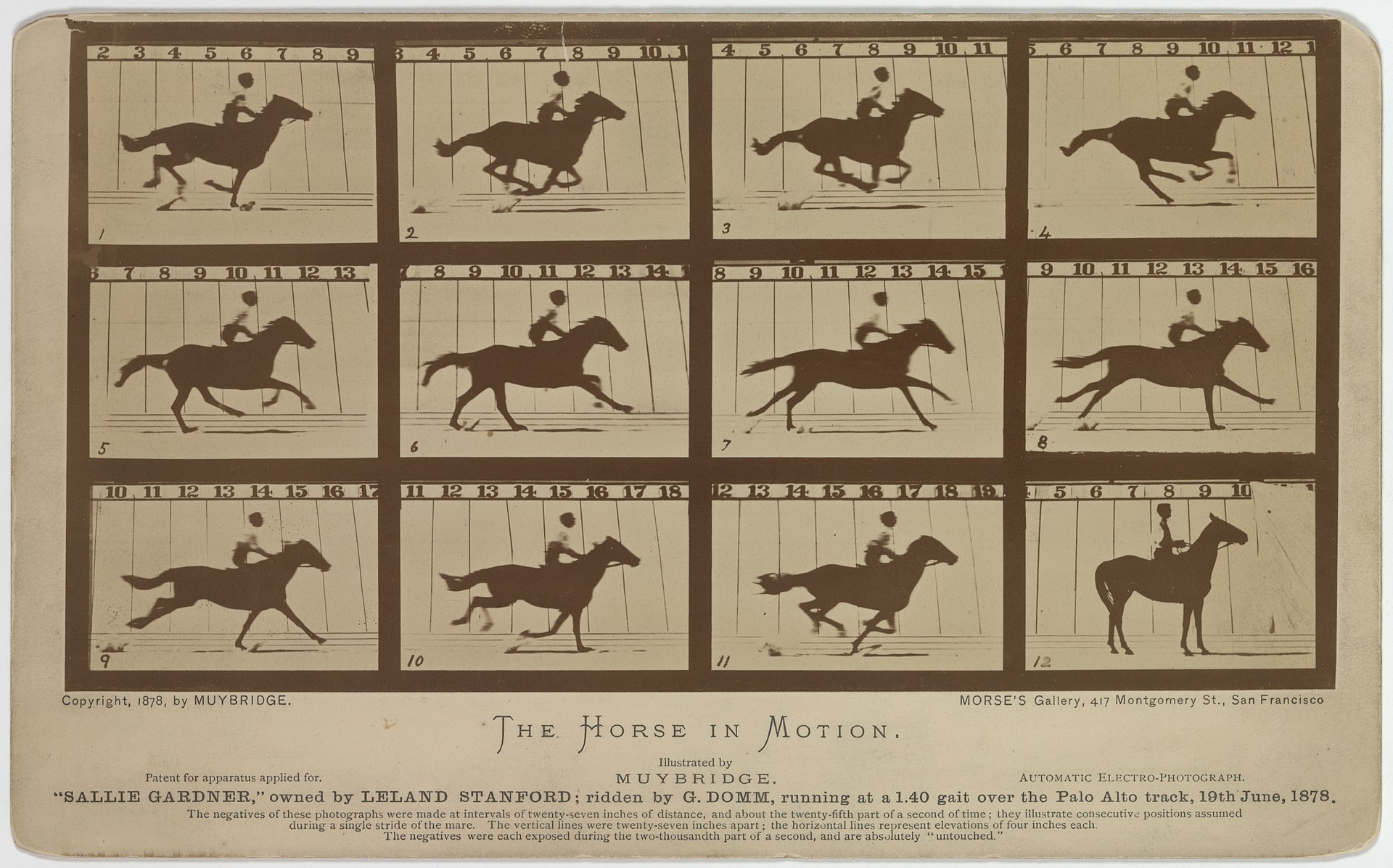
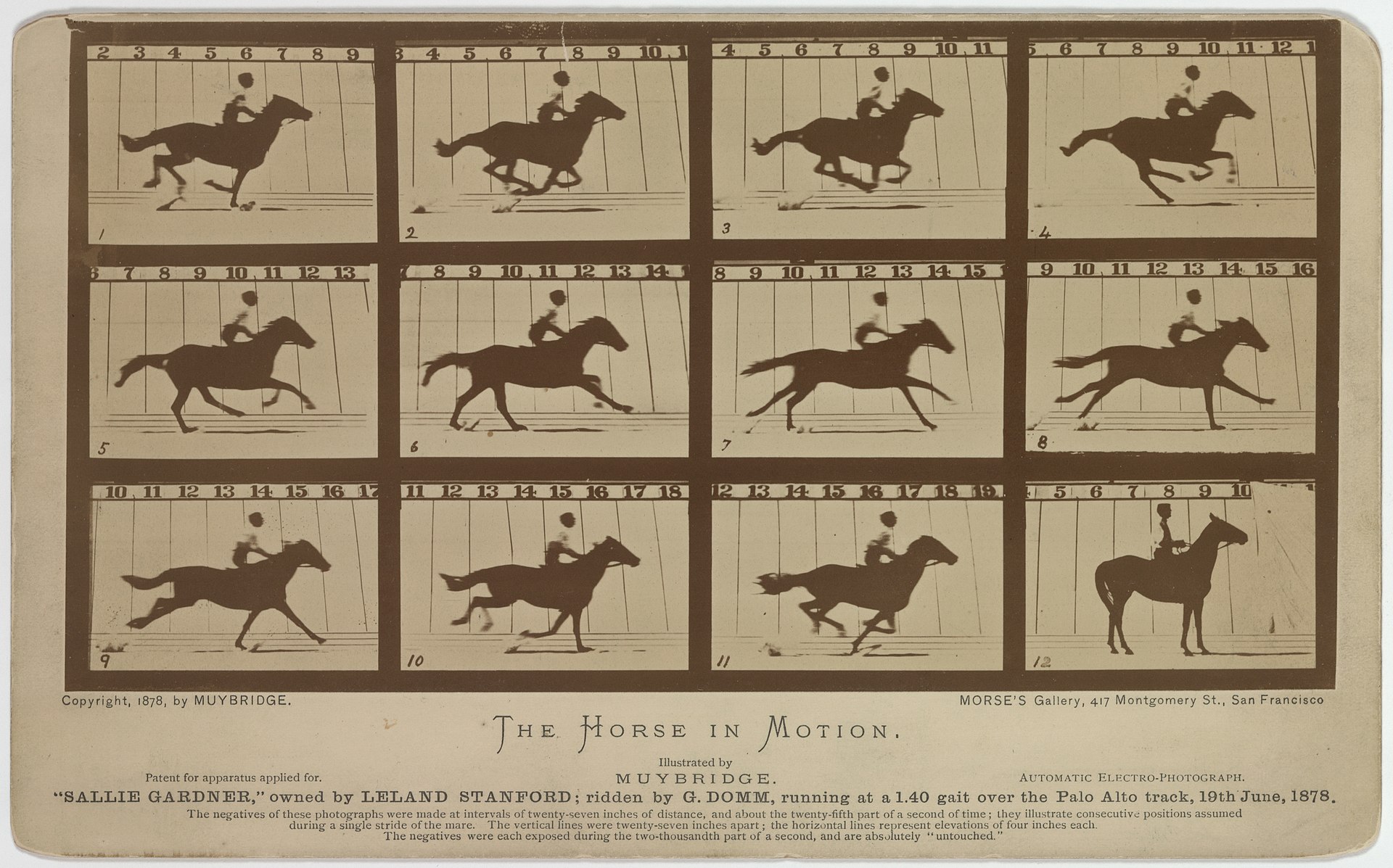
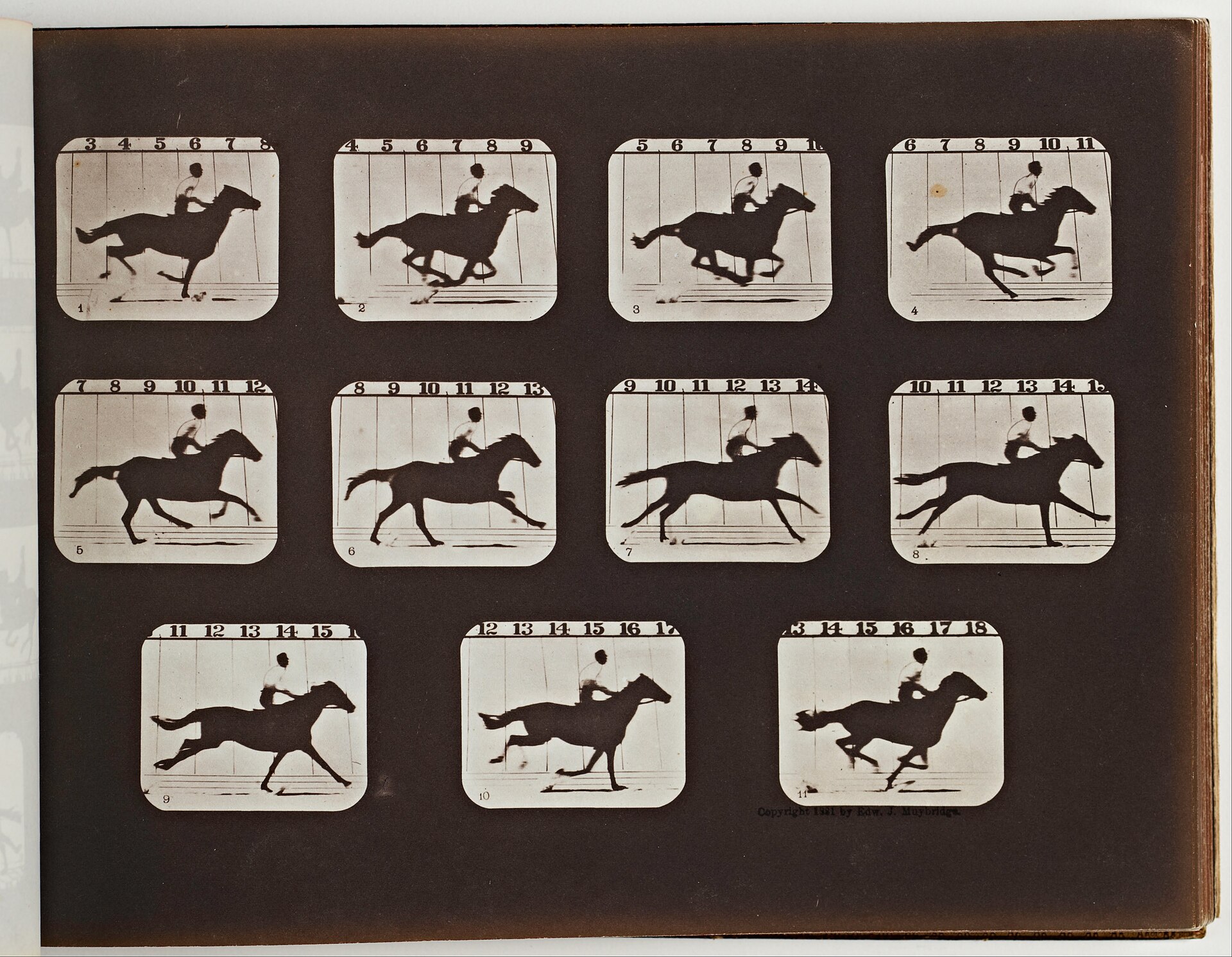
Sallie Gardner at a Gallop
19 June 1878 · Sequence of wet-collodion glass-plate...
Library of Congress
 English, naturalized American · 1830-1904
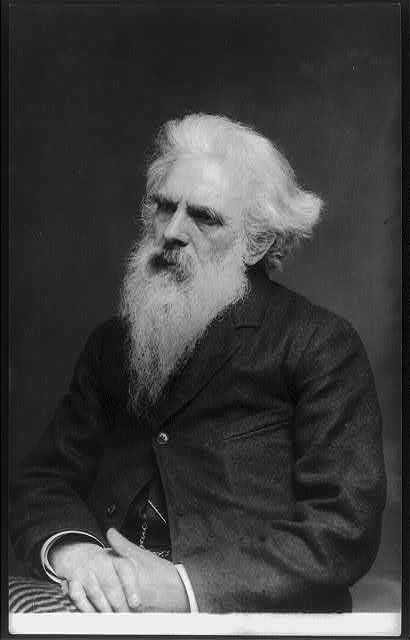
A photographic portrait of Muybridge made around 1890, well after the events described on this page, by the American photographer Frances Benjamin Johnston. Included for identification of the maker; the circumstances of the sitting are not otherwise documented for this record.
Library of Congress, Prints and Photographs Division (photographer Frances Benjamin Johnston)| Full name | Edward James Muggeridge, later Eadweard Muybridge |
|---|---|
| Worked as | Photographer, Inventor |
| Born | 9 April 1830 · Kingston upon Thames, Surrey, England |
| Died | 8 May 1904 · Kingston upon Thames, Surrey, England |
| Nationality | English, naturalized American |
| Movement | None in the conventional art-historical sense. His work founded the technical basis of... |
| In this archive | 1 artwork |
| Sources | 19 cited |
| Last verified |
About this page 1 artwork in the archive · Last verified · 19 sources cited
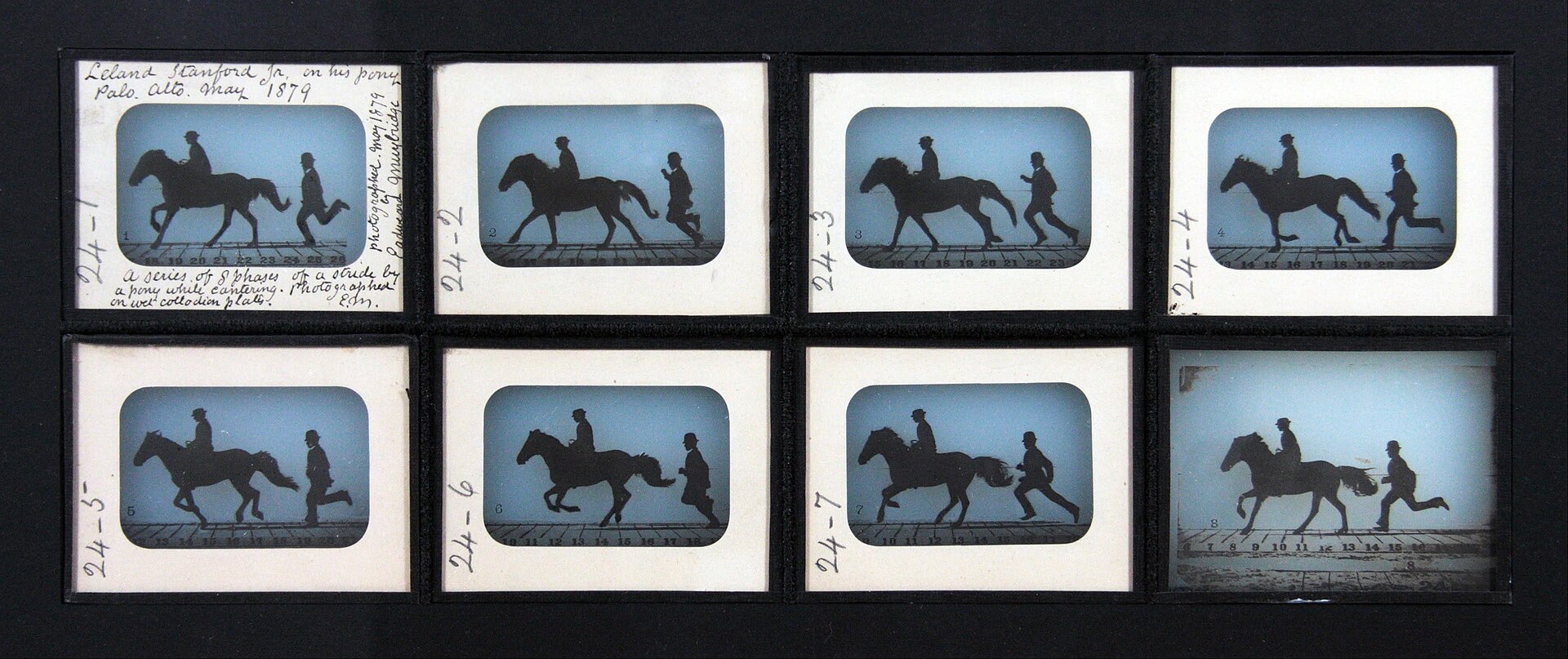
Eadweard Muybridge photographed a horse and ended a century of painting it wrong. On 19 June 1878, at Leland Stanford's Palo Alto track, a battery of trip-wire cameras caught the mare Sallie Gardner with all four hooves off the ground at once, a position no painter had shown and every painter had been showing, in the flying gallop, for generations. That single sequence is the reason his name survives in general use. It is also the smallest part of what he did.
By 1878 he was already one of the most technically ambitious landscape photographers in the American West, and four years earlier he had tracked down his young wife's lover and shot him dead in front of witnesses, then persuaded a Napa County jury to acquit him. After Palo Alto he built a machine, the zoopraxiscope, that projected his still sequences as moving pictures years before anyone used the word cinema, and he spent 1883 to 1887 at the University of Pennsylvania producing more than one hundred thousand photographs of humans and animals in motion, published as 781 plates that remain both a foundational document of the moving image and, in recent scholarship, an uncomfortable record of what a university-sponsored motion study laboratory did with its living models.
The hardest thing to find about Muybridge is not any of the famous facts. It is how much of the standard account does not survive contact with the primary record: historians who have looked hardest at the story now treat the $25,000 wager that supposedly settled the horse question as a myth invented after the fact; a meaningful share of the sequences in his most celebrated book are, on the historian Marta Braun's plate-by-plate analysis, reconstructed, retouched or missing a phase of movement rather than the pure documentary record they are still widely taken to be; and the original glass negatives behind most of that book are, by the Smithsonian's own account, simply gone.

Born Edward James Muggeridge on 9 April in Kingston upon Thames, Surrey, England.14
Emigrates to the United States and works as a bookseller in New York, then San Francisco.4
Trades under the intermediate surname Muygridge during his bookselling years in San Francisco, before settling on Muybridge.1
Badly injured in a stagecoach crash in Texas; unconscious for days, then reports double vision, deafness and loss of taste and smell for months afterward.5
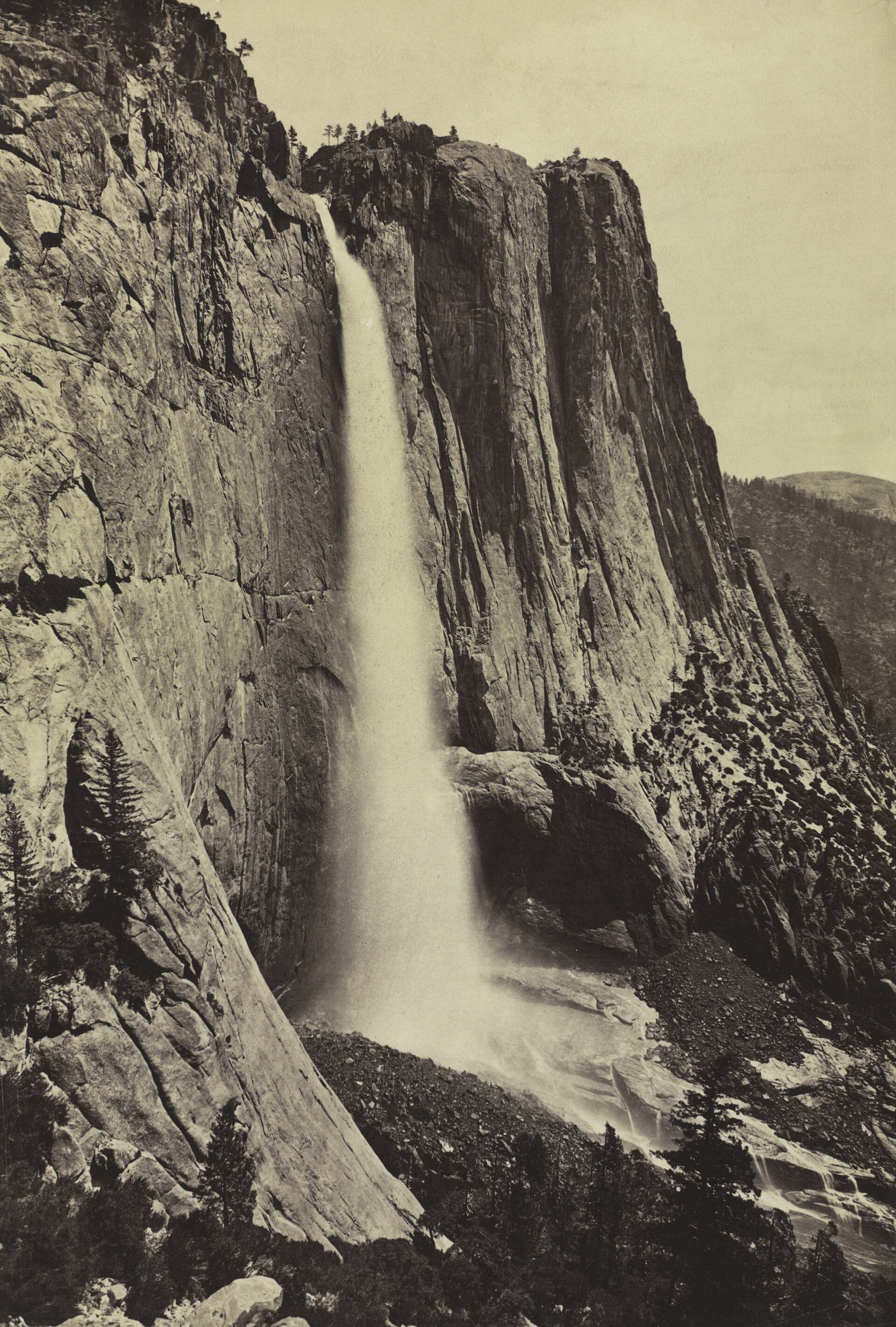
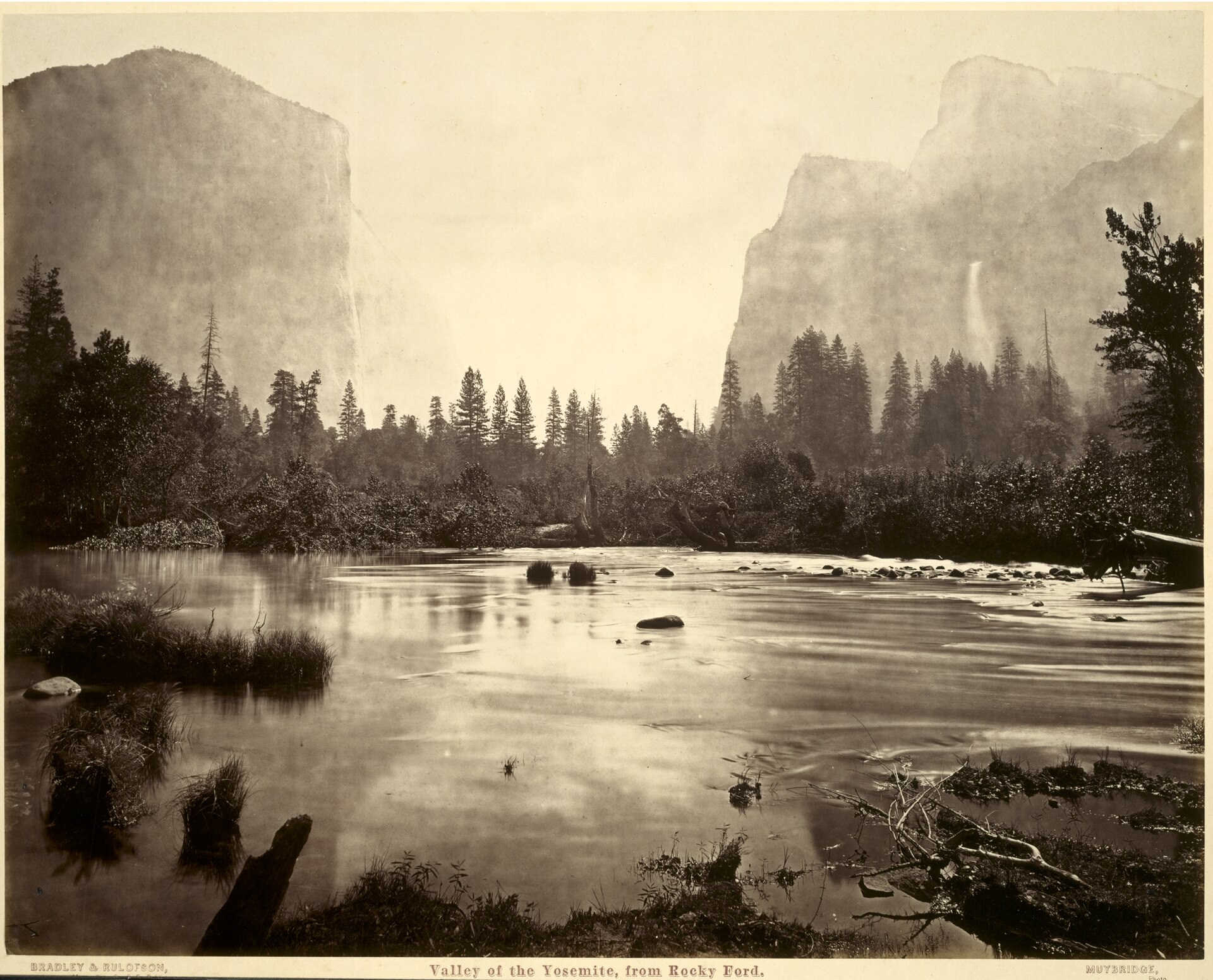
Photographs Yosemite Valley between June and November on a large scale, producing the landscape work that first establishes his reputation as Helios.14
Photographs Tlingit communities and Alaskan landscape on a United States government commission.1
Documents United States Lighthouse Board stations on the West Coast aboard the revenue cutter Shubrick, March to July.1
Photographs the Modoc War in northern California for the US Army; a tertiary account states many of the resulting images were staged and posed.1
Shoots and kills Harry Larkyns near Calistoga on 17 October, after learning of Larkyns's involvement with his wife Flora.12
Acquitted of murder by a Napa County jury on 6 February, on grounds of justifiable homicide, against the judge's own instructions.2
Photographs the mare Sallie Gardner in full gallop at Leland Stanford's Palo Alto track on 19 June, the sequence behind this archive's own record of that photograph.411
Makes a thirteen-panel mammoth-plate panorama of San Francisco from the tower of the Mark Hopkins mansion, printing nine copies that were never advertised.17
Conceives and builds the zoopraxiscope, a projector that spins painted glass discs to show his photographic sequences as continuous motion.3
Copyright-deposits the Palo Alto sequences as The Attitudes of Animals in Motion on 17 May; Stillman's 1882 book on the same material credits Muybridge only as an employee, and his lawsuit to recover authorial credit later fails.4
Undertakes Animal Locomotion at the University of Pennsylvania under a faculty-and-artist oversight commission; produces roughly 20,000 negatives and publishes 781 collotype plates in eleven volumes.6714
Lectures with the zoopraxiscope in a purpose-built Zoopraxographical Hall at the World's Columbian Exposition in Chicago.1
Dies in Kingston upon Thames on 8 May, of prostate cancer; his will leaves the zoopraxiscope and his working negatives and plates to the borough.13
The Kingston Museum's Muybridge bequest collection moves to a dedicated archive at Kingston University's Town House, opened to the public in ticketed sessions that May.10
Muybridge material trades often and mostly modestly, as an edition photographer's work does rather than as a unique object does. Individual plates from Animal Locomotion routinely change hands for low hundreds to low thousands of dollars, and the confirmed result this record could verify sits within that order of magnitude even for a substantial group of plates. Museums deaccession Muybridge holdings as ordinary collections management, not as a sign of trouble, and supply is naturally large because he printed to sell copies from the start.
| Date | Sale | Work | Result | Note |
|---|---|---|---|---|
| 14 February 2017 | Swann Galleries | Fifty collotype plates from Animal Locomotion, 1887 | With premium USD 62,500 (reported total; source does not separate hammer from buyer's premium) USD | Estimate USD 30,000-45,000. Top lot of the sale, sold to a private collector; all five Muybridge lots offered in the sale sold. |
Hammer is the price at which the bidding stopped; with premium adds the fee the house charges the buyer on top. Hammer price and buyer's premium in the glossary.
| Institution | City | Holdings | Note |
|---|---|---|---|
| Kingston Museum bequest collection, held at Kingston University's Town House | Kingston upon Thames, England | The zoopraxiscope and its carrying case of discs, a biunial lantern, two albums of Attitudes of Animals in Motion prints, a complete 13-panel San Francisco panorama, thousands of lantern slides, many Animal Locomotion collotypes, and Muybridge's own scrapbook. | Bequeathed under Muybridge's 1904 will; moved to the university's archive and opened to the public in ticketed sessions in 2023. |
| Library of Congress, Prints and Photographs Division | Washington, D.C. | Copyright-deposit material from The Attitudes of Animals in Motion, 1881, including the Sallie Gardner sequence. | This archive's own separate record for that photograph, muybridge-sallie-gardner-gallop, describes the holding in detail. |
| National Museum of American History, Smithsonian Institution | Washington, D.C. | 871 Animal Locomotion collotype prints, 430 sets of gelatin dry-plate positive transparencies, and roughly 850 sheets of cyanotype contact strips. | The cyanotypes are described by the museum's own conservator as the only surviving record of Muybridge's original glass negatives, whose current location is unknown. |
| University of Pennsylvania Archives | Philadelphia, Pennsylvania | Institutional records of the Animal Locomotion commission, including committee correspondence and remaining equipment. | Some Animal Locomotion equipment was sold by the university after the project ended; other pieces remain in the archive. |
| Cleveland Museum of Art | Cleveland, Ohio | Yosemite landscape photographs, released under CC0. | Two of this page's plates are drawn from this collection. |
He was born Edward James Muggeridge in Kingston upon Thames on 9 April 1830, and by the time he was internationally known he had changed almost every part of that name.
He was born Edward James Muggeridge in Kingston upon Thames on 9 April 1830, and by the time he was internationally known he had changed almost every part of that name. He emigrated to the United States around 1852 and worked first as a bookseller in New York and then in San Francisco, not as a photographer, and it was only after moving into photography that he began signing his work Helios, the Greek name for the sun, trading under the name Helios' Flying Studio. The surname passed through an intermediate form, Muygridge, before settling as Muybridge, and the archaic first-name spelling Eadweard came later still, taken, by his own later account, from an Old English form he associated with the ancient coronation stone that stands in his home town.
A man who rebuilds his own name twice, in a country he was not born in, before he becomes famous for anything, is telling a reader something about how he wanted to be read: not as Muggeridge the immigrant bookseller, but as a self-authored figure closer to the sun-god pseudonym he chose first. The instinct for self-presentation that picked the name is the same instinct that later staged, lit and captioned his photographs.
Before any horse, Muybridge was known for scale.
Before any horse, Muybridge was known for scale. He spent June to November 1867 in Yosemite Valley producing large-format and stereoscopic views that established his reputation, and the following year photographed Tlingit communities and Alaskan landscape on a United States government commission. In the spring of 1871 the US Lighthouse Board hired him to document its West Coast stations aboard the revenue cutter Shubrick, and in 1873 the US Army commissioned him to photograph the Modoc War in northern California, the campaign that ended the Modoc people's armed resistance to forced removal from their homeland onto a reservation shared with the Klamath.
The Modoc War photographs matter to this record for a reason beyond subject matter. The general account of Muybridge's career carried on Wikipedia, a tertiary source flagged here for replacement with a specialist study of his government commissions, states that many of the resulting images were staged and posed rather than documentary in the ordinary sense. This record has not traced that specific claim to a primary military or archival source, and says so rather than repeating it as settled fact; but it is worth stating plainly that the question of whether a Muybridge photograph shows an unstaged instant or a constructed scene is not new to Animal Locomotion. On this account it runs back at least to 1873, five years before the horse.
In July 1860 Muybridge was travelling by stagecoach through Texas when the driver lost control on a mountain descent.
In July 1860 Muybridge was travelling by stagecoach through Texas when the driver lost control on a mountain descent. The crash killed two other passengers and left Muybridge badly injured, unconscious for days, and reporting double vision, deafness, and the loss of taste and smell for months afterward. The accident itself is not in dispute. What is disputed is how much of the rest of his life it explains.
A 2015 review in the peer-reviewed journal Neurosurgical Focus, by the neurosurgeon Sunil Manjila and colleagues, argues that the accident caused an injury to Muybridge's orbitofrontal cortex, draws an explicit comparison with the well-known case of Phineas Gage, and proposes that frontal-lobe damage plausibly explains the erratic, sometimes obsessive behavior that marked his later career, including the killing that follows in this record. It is a considered clinical argument made from more than a century's distance, not a contemporary diagnosis, and the authors themselves frame Muybridge's psychology as something that remains, in their own words, a mystery even for cognitive neurologists. This record treats the retrospective medical case as exactly that: a documented scholarly argument, not an established fact about a brain nobody examined at the time.
Muybridge married Flora Stone in May 1871, when he was 41 and she was 21.
Muybridge married Flora Stone in May 1871, when he was 41 and she was 21. Their son Florado was born in April 1874. On 17 October 1874, roughly six months later, Muybridge learned, through evidence supplied by a maternity nurse who had attended the birth, that Flora had been involved with a drama critic named Harry Larkyns, and that Larkyns was very possibly the boy's father. Muybridge tracked Larkyns to his hotel near Calistoga, in the Napa Valley, calling him to the door before shooting him at close range. He did not deny doing it.
The relevant fact for a record of his photographic career is chronological. The sequence that made Muybridge internationally famous was not made until four years later, in 1878, after his trial and his acquittal. Whatever the killing changed in him, it sits on the far side of the photograph this archive separately records, not on some untroubled prelude before it.
Muybridge went to trial in Napa in February 1875.
Muybridge went to trial in Napa in February 1875. His attorney, W.W. Pendergast, ran an insanity defence built around the 1860 stagecoach accident, putting witnesses on the stand who testified to years of erratic behavior since the crash, while also appealing directly to the jury's sympathy for a husband whose wife had been seduced. On 6 February 1875 the jury returned a verdict of not guilty on the grounds of justifiable homicide, explicitly rejecting the judge's instruction that adultery provided no legal justification for killing.
The case is still cited by legal historians as an early instance of jury nullification: twelve men who evidently did not believe Muybridge was insane acquitted him anyway, on the unwritten conviction, common among all-male juries of the period, that a wronged husband was entitled to kill his wife's lover. This record states that plainly rather than folding it into a vague phrase like a difficult period. Muybridge killed a man, admitted it, and walked out of a courtroom a free man because twelve jurors decided that the law of human nature outranked the law of California.
Leland Stanford, a breeder of trotting and racing horses at his Palo Alto Stock Farm, wanted a genuine question answered: whether a horse's legs, at speed, are ever all simultaneously off the ground...
Leland Stanford, a breeder of trotting and racing horses at his Palo Alto Stock Farm, wanted a genuine question answered: whether a horse's legs, at speed, are ever all simultaneously off the ground, a condition later writers called unsupported transit. Painted convention said no. The animal was shown in a flying gallop, front legs stretched forward and hind legs stretched back, a pose that felt kinetically true to a viewer who had never actually seen a horse move that fast. Stanford's own stated interest, as reported by Stanford Magazine, sat as much in improving his own breeding and training programme as in abstract scientific curiosity, and his doctor had separately recommended outdoor activity for his health.
The far more famous version of this story adds a $25,000 wager settled over dinner with a named opponent. It is a good story and it does not hold up. Stanford Magazine states plainly that virtually every serious historian to look into the claim has concluded there was no bet, and a dedicated 2018 peer-reviewed study by the film historian Allain Daigle, titled precisely to rebut the myth, treats the same tradition as apocryphal; this record could not pass the verification wall in front of the full text of Daigle's article this session, so it cites the study for its existence and title rather than for quoted argument. Stanford's interest in the outcome is documented. A specific bet of a specific size is not, and should stop being repeated as though it were.
Photographing a horse at roughly forty miles an hour with the technology of 1878 required more than one camera and more precision than a hand could supply.
Photographing a horse at roughly forty miles an hour with the technology of 1878 required more than one camera and more precision than a hand could supply. Muybridge's solution was a row of cameras, most accounts of the 19 June 1878 session giving twelve, loaded with wet-collodion glass-plate negatives, each fitted with a fast mechanical shutter released not by hand but by an electromagnetic catch; threads stretched across the track broke in sequence as the horse passed, closing electrical contacts that fired each camera in turn. A retrospective account in IEEE Spectrum credits the resulting exposures at speeds as brief as one one-thousandth of a second, a period claim this record treats as reported rather than independently verified by contemporary instruments.
The electrical triggering system was not Muybridge's alone, and the authorship of that specific piece of engineering is a real, separately documented dispute from the question of who took the photographs. Samuel S. Montague, Stanford's chief engineer on the Central Pacific Railroad, helped Muybridge design the electronic lens shutters, and in 1877 a younger railroad engineer, John D. Isaacs, was brought in to help work out how to operate them; historians of the project treat what followed as a genuine dispute over credit for the Palo Alto apparatus. The dispute became public in 1882, when Stanford's physician J.D.B. Stillman published the analytical text of The Horse in Motion using material from the Palo Alto sessions and named Muybridge only as an employee rather than as an author. Muybridge sued to recover credit and lost, and the Royal Society of Arts in London, which had promised him support, withdrew it once the book appeared without the credit he expected.
Muybridge conceived the zoopraxiscope in 1879 and had it built by January 1880: a projector that spun a glass disc, roughly sixteen inches across, carrying hand-painted silhouettes traced from his...
Muybridge conceived the zoopraxiscope in 1879 and had it built by January 1880: a projector that spun a glass disc, roughly sixteen inches across, carrying hand-painted silhouettes traced from his photographic sequences, viewed through a second, slotted shutter disc that produced the illusion of continuous motion on a screen. He used it in public lectures from 1880 into the mid-1890s to argue, in effect, that his photographs were telling the truth about a movement the naked eye could not see unaided.
Sources genuinely disagree about the date of the very first public showing of a Muybridge motion device, and this record states the disagreement rather than picking a side. One general account of his career gives 8 July 1878, at the San Francisco Art Association, as the date of a magic-lantern showing of the Palo Alto photographs, which cannot have been the zoopraxiscope itself, since that device was not even conceived until the following year; other accounts place the zoopraxiscope's own first demonstrations in 1880. What the 1878 date most likely records is an earlier, simpler lantern-slide presentation of still photographs, projected but not yet animated, a full two years before the machine that later took his name. The discs and the original machine survive: Muybridge's 1904 will left them to Kingston upon Thames, where they remain today, alongside a handful of individual discs now held by the Cinematheque Francaise in Paris and the National Technical Museum in Prague.
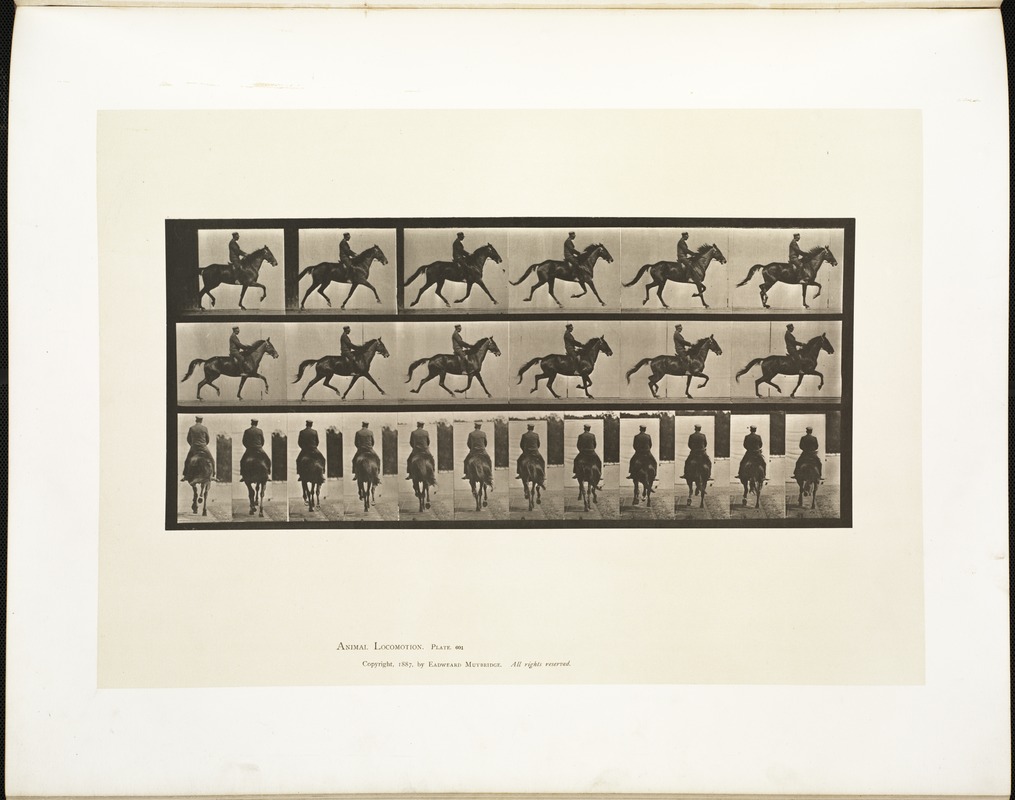
Muybridge's largest project, Animal Locomotion, was made between 1883 and 1887 at the University of Pennsylvania, on an outdoor studio built at 36th and Pine Streets and, for slower or indoor...
Muybridge's largest project, Animal Locomotion, was made between 1883 and 1887 at the University of Pennsylvania, on an outdoor studio built at 36th and Pine Streets and, for slower or indoor subjects, in Biological Hall. The University of Pennsylvania's own archives describe a six-member oversight commission: four Penn faculty, Harrison Allen, George F. Barker, Lewis M. Haupt and William D. Marks, and two representatives of the Pennsylvania Academy of Fine Arts, its chairman Edward A. Coates and the painter Thomas Eakins. A 2024 scholarly study of the project gives a larger roster for the same body, adding Provost William Pepper, the anatomist Joseph Leidy and the veterinary pathologist Rush Shippen Huidekoper, and names Harrison Allen as the commission's secretary rather than an ordinary member. This record states both versions rather than picking one, since the sources consulted do not reconcile them. Funding began with an advance of roughly $5,000 raised among wealthy Philadelphians, including the publisher J.B. Lippincott, before the finished plates were published by the New York Photogravure Company at a total project cost later put near $30,000.
From roughly 20,000 negatives the project published 781 collotype plates in eleven volumes; many hundreds of sequences, in Ellen Handy's review of Sarah Gordon's scholarship for caa.reviews, show nude men, women and children performing everyday and unusual actions before gridded backgrounds. Gordon's scholarship repositions the project away from the image of Muybridge as a solitary auteur and toward a study made through what the review calls intricate networks of collaboration: university administrators who staked institutional prestige on a project that could easily have become a public scandal under the era's active anti-obscenity prosecutions, faculty who supervised it for scientific legitimacy, and models, a number of the women introduced to Muybridge by the artist and teacher J. Liberty Tadd, according to Marta Braun's research as cited in a 2024 study of the project. Muybridge's name is the only one on the title page. The project was not made by Muybridge alone, and its ethics, as much as its authorship, belong to the institution that sponsored it.
Animal Locomotion is still routinely described as a pure documentary record, a camera simply catching what the eye could not see.
Animal Locomotion is still routinely described as a pure documentary record, a camera simply catching what the eye could not see. The scholarship does not support that description without qualification. Muybridge worked, with narrow exceptions, to a system of twelve lateral and twelve foreshortened views per sequence; the historian Marta Braun's plate-by-plate analysis, reported in Michelle Smiley's 2024 study in History of Photography, finds that any published sequence with fewer views than that system requires, outside six identified exceptions, is missing a phase rather than showing a complete cycle of movement. Smiley's own contribution goes further, identifying a category of images she calls inoperative: sequences that mechanical failure, inconsistent time intervals, or the rearrangement of plates left useless for the physiological analysis the project claimed to serve.
The negatives that would let a modern researcher check any individual plate against its source are, for the most part, gone. The conservator Carolyn Long's study of the Muybridge/Animal Locomotion collection at the Smithsonian's National Museum of American History states that a set of roughly 850 cyanotype contact-proof sheets held there constitute the only record of Muybridge's original glass negatives, whose current whereabouts are unknown. Long's own comparison of surviving cyanotype proofs against the published collotypes finds the pose in each matching frame identical, which is evidence of fidelity between the proof and the printed plate; it says nothing about how the pose in the proof itself was assembled, arranged or corrected before it was ever proofed. Braun has read the whole sequence structure of the volumes, from nude male through women, children and disabled subjects to animals, as reproducing a covert social hierarchy in its ordering, and Gordon separately argues that most of the female plates stage conventional Victorian domestic labor rather than survey movement neutrally. Both are named, argued readings, not settled fact, and this record presents them as such.
The French physiologist Etienne-Jules Marey pursued his own chronophotographic research into movement independently of Muybridge, and the two men are still often confused with one another for a...
The French physiologist Etienne-Jules Marey pursued his own chronophotographic research into movement independently of Muybridge, and the two men are still often confused with one another for a reason a historian of Marey's own career states outright: both were born in 1830 and both died in 1904. Muybridge has the earlier claim in one narrow sense, an 1872 photograph of a horse for Stanford predating Marey's work, but Marey, trained as a physiologist rather than arriving from bookselling, is credited by historians of the medium with priority in essentially every other category of the new science, including the study of human movement, and with the more rigorous method: his chronophotographic gun of 1882 recorded a full sequence of movement on a single photographic surface, where Muybridge relied on a row of separate cameras. This record does not resolve, because the sources consulted do not resolve, how much direct contact the two men actually had; it states only what is independently documented about their differing methods and training.
Painters did not agree with each other about what to do with what Muybridge showed them. One account of the picture's early reception records that the French painter Ernest Meissonier allegedly repainted one of his own equine canvases in May 1887 after viewing Muybridge's photographs of a galloping horse, while critics of the period were themselves divided over whether such photographic corrections belonged in painting at all, some arguing that the eye's own synthesis of a moving animal was truer than a frozen mechanical instant. Nearly a century later Francis Bacon used Muybridge's later published selections drawn from the same negatives, principally The Human Figure in Motion of 1901 and its companion Animals in Motion of 1899, as working source material rather than documentary reference: he took Muybridge's images of wrestlers in particular, aware of the ambiguity between the movements of wrestlers and lovers, and reworked them into paintings including Two Figures of 1953 and Paralytic Child Walking on All Fours (from Muybridge) of 1961. Bacon's own explanation for working from photographs rather than a live sitter was characteristically blunt: even with friends willing to pose, he said, he had photographs taken for their portraits because he much preferred working from the photograph than from them.
No single institution holds the Muybridge archive.
No single institution holds the Muybridge archive. Under the terms of his 1904 will, the zoopraxiscope itself and his working negatives and plates passed to the borough of Kingston upon Thames, and that bequest collection moved in 2023 into a dedicated archive at Kingston University's Town House, opened to the public through ticketed viewing sessions that May and the subject of the first international Muybridge conference the same year. The Library of Congress holds copyright-deposit material from The Attitudes of Animals in Motion of 1881, including the Sallie Gardner sequence this archive separately records as its own object. The Smithsonian's National Museum of American History holds the surviving cyanotype contact proofs and composite glass positives from Animal Locomotion, the closest thing that survives to the lost original negatives. Stanford University Libraries and the University of Pennsylvania Archives each hold institutional records from the two commissions that made him famous, and museum print collections, including the Cleveland Museum of Art's CC0-released Yosemite views used on this page, hold individual prints dispersed by sale and gift over more than a century.
The dispersal is a documented fact worth stating rather than assuming away. A reader who wants to see the Muybridge collection cannot go to one address. Kingston has the machine. Washington has the proofs of negatives nobody can find. Philadelphia has the paperwork of the commission that made them. No cataloguing project has yet reunited all of it in one place, digitally or otherwise, and until one does, a claim about the complete surviving Muybridge corpus should be read as a claim about one of these holdings, not all of them together.
Muybridge material trades often and mostly modestly.
Muybridge material trades often and mostly modestly. Price-guide aggregators list several hundred recorded auction results for his work, with single-plate estimates typically running from the low hundreds of dollars into the low thousands; this record treats that range as indicative rather than exact, since it comes from a tertiary aggregator rather than the auction houses' own primary results. One concrete, independently confirmed result: at Swann Galleries in New York on 14 February 2017, a collection of fifty Animal Locomotion collotype plates, estimated at $30,000 to $45,000, sold as the top lot of a photographs sale for $62,500 to a private collector. The trade press reporting that figure does not specify whether it is a hammer price or a price inclusive of buyer's premium, and this record states that ambiguity rather than assigning the number to one or the other.
Institutions sell as well as buy. The Denver Art Museum deaccessioned more than sixty lots of Muybridge photographs through Sotheby's specifically to benefit its own acquisition fund rather than because the material was disputed or damaged, a reminder that a museum deaccession is routine collections management as often as it is scandal. What the market has not produced, so far as the sources consulted for this record show, is a single-object result anywhere near the scale of the highest prices paid for a unique painting. Muybridge's work survives in large, deliberately reproduced editions, printed to be sold from the outset, and an edition, however historically important, prices very differently from a unique object.
Photographer; Inventor. 1830-1904.
Born 9 April 1830, Kingston upon Thames, Surrey, England; died 8 May 1904, Kingston upon Thames, Surrey, England.
Kingston Museum bequest collection, held at Kingston University's Town House (Kingston upon Thames, England); Library of Congress, Prints and Photographs Division (Washington, D.C.); National Museum of American History, Smithsonian Institution (Washington, D.C.); University of Pennsylvania Archives (Philadelphia, Pennsylvania); Cleveland Museum of Art (Cleveland, Ohio).
Muybridge material trades often and mostly modestly, as an edition photographer's work does rather than as a unique object does. Individual plates from Animal Locomotion routinely change hands for low hundreds to low thousands of dollars, and the confirmed result this record could verify sits within that order of magnitude even for a substantial group of plates.
Which date properly marks the first public demonstration of a Muybridge motion device: one account of his career gives 8 July 1878 for a magic-lantern showing at the San Francisco Art Association, which cannot have been the zoopraxiscope itself since that device was not conceived until 1879; other accounts place the zoopraxiscope's own first demonstrations in 1880. The sources consulted for this record do not resolve what exactly was shown in 1878.
Last verified
One artwork and its story every Tuesday, with the picture: who owned it, what it made, and what closes soon in the exhibition calendar. No promotion, and nothing we cannot cite.
We send one email to confirm the address and keep nothing else. Every letter carries a one-click unsubscribe. How we handle your data.