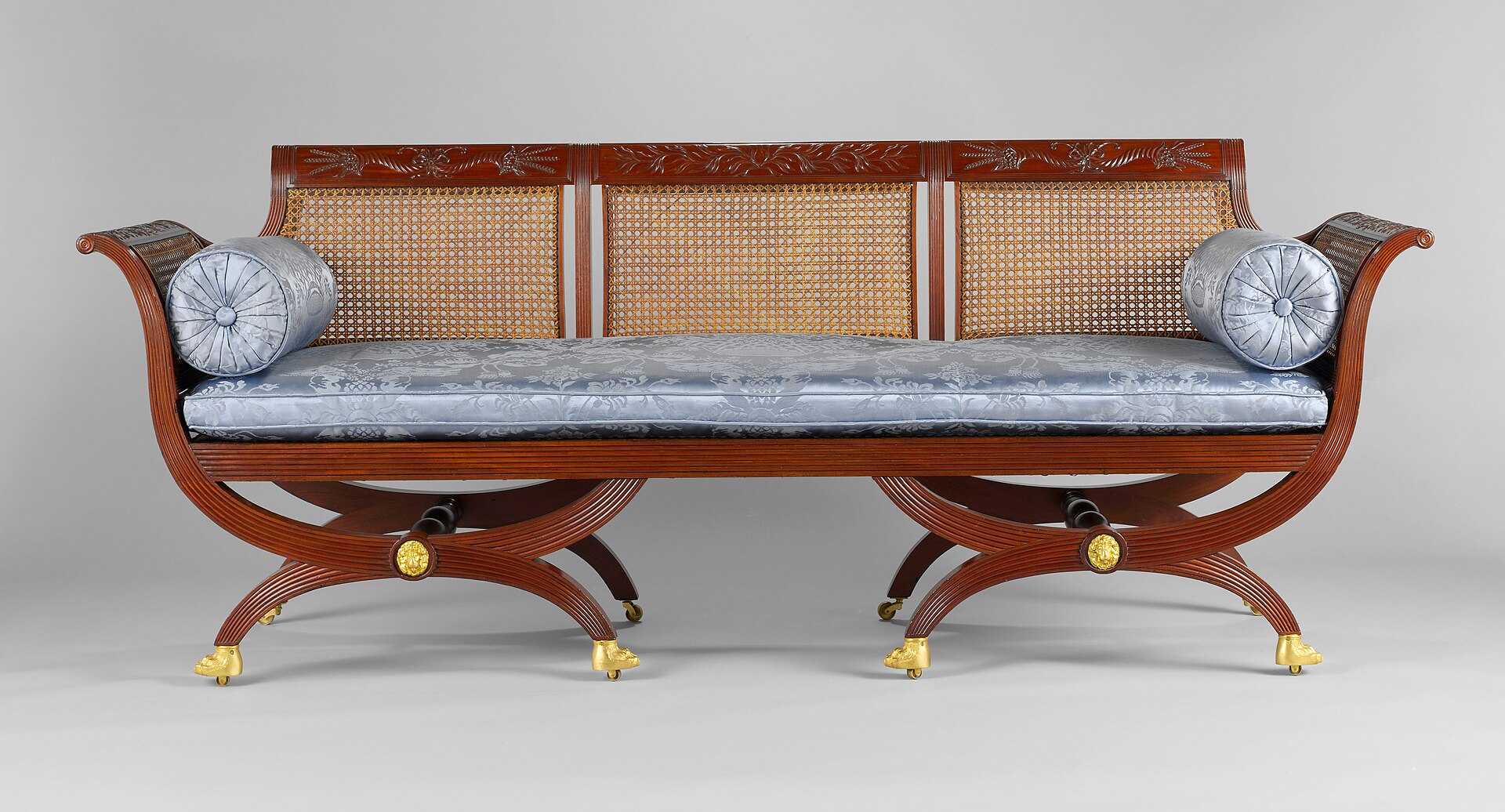
Sofa
circa 1810-1820 · Mahogany
Metropolitan Museum of Art, New York
 American, born Scotland · 1770-1854
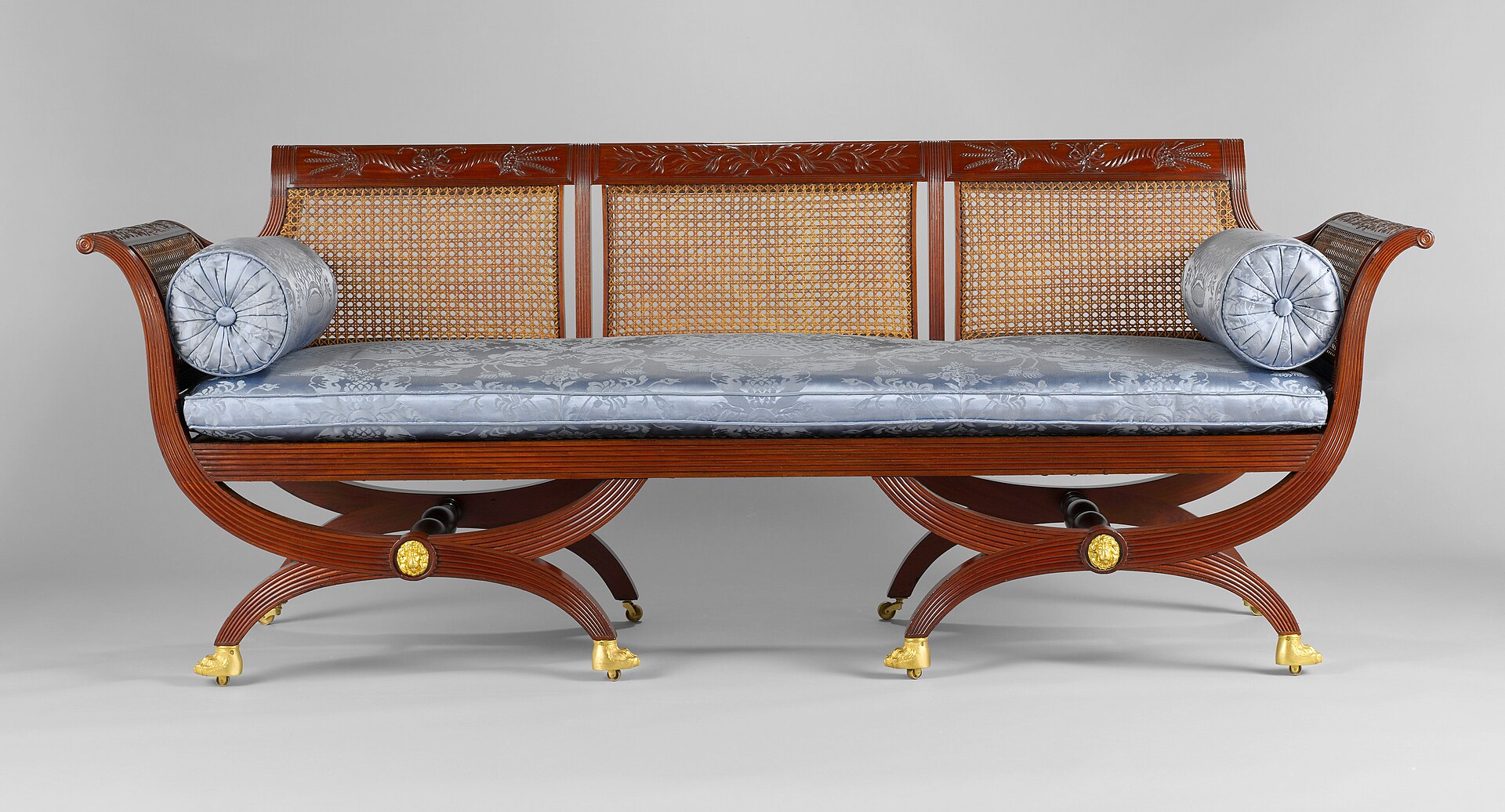
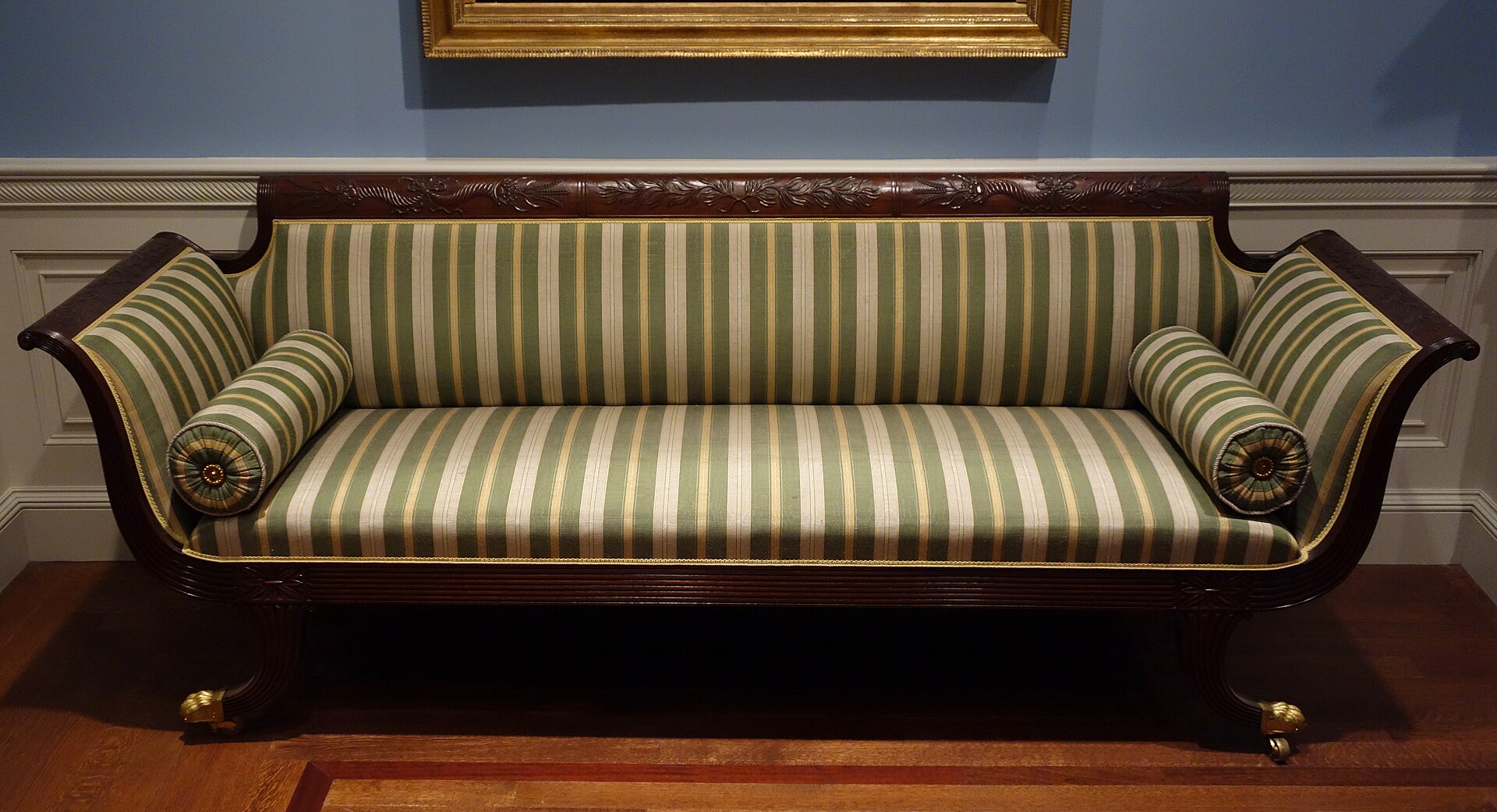
Sofa, Attributed to Duncan Phyfe (Metropolitan Museum, 60.4.1) The Pearsall-suite curule sofa, catalogued by the Metropolitan Museum as Attributed to Duncan Phyfe rather than by him, the graded tier this record's attribution discussion is built around. Mahogany, tulip poplar, cane and gilded brass, circa 1810-1820. No verified portrait. No lifetime portrait or photograph of Duncan Phyfe that is both licence-clean and scholarly-confirmed could be established for this record. Two images circulate online under his name, both checked and both rejected on identification grounds rather than licence grounds. The first, widely reused (including as Wikipedia's own infobox image), is an oil painting inscribed Duncan Phyfe copy by M. Alten, painted around 1920 by the Grand Rapids, Michigan painter Mathias Alten (1871-1938), commissioned by a furniture designer as an explicit copy of, in the Alten catalogue raisonne's own words, a known steel engraving of Phyfe. That places it at two removes from life, twentieth-century paint over an unidentified and undated nineteenth-century print, with no scholarly source consulted for this record (not the Metropolitan, not Winterthur, not the 2011-2012 catalogue) vouching for the original engraving's authenticity or sitter identification. The second file, also on Wikimedia Commons, credits only an unnamed author and a general biography website, with no documentation at all. Both are technically public domain and could be hosted; neither meets this publication's confidence bar for verified_is_this_artist. This record therefore publishes with no portrait, which the site's own house practice treats as a normal and expected outcome for a documented tradesman rather than a public figure who sat for artists in his own name.
Metropolitan Museum of Art, New York| Full name | Duncan Phyfe, born Duncan Fife |
|---|---|
| Worked as | Cabinetmaker, Furniture manufacturer, Workshop proprietor |
| Born | 1768 or 1770 (disputed) · Near Loch Fannich, Ross-shire, Scotland |
| Died | 1854-08-16 · New York City, at his house, 193 Fulton Street |
| Nationality | American, born Scotland |
| Movement | American Federal-era neoclassicism, evolving through Regency and Grecian into American... |
| In this archive | 1 artwork |
| Sources | 14 cited |
| Last verified |
About this page 1 artwork in the archive · Last verified · 14 sources cited
Duncan Phyfe is the best-known name in American furniture and one of the thinnest personally documented. He ran, at his peak, one of the largest cabinetmaking operations in the United States, employing close to a hundred people across a working lifetime of fifty-five years, and he almost never signed or labeled what left his shop. The result, two centuries on, is a name that circulates far in excess of the evidence behind it: as the furniture historian Deborah Dependahl Waters put it in the standard modern study of the problem, through the efforts of generations of dealers, collectors, curators and furniture manufacturers, Phyfe has become a generic term used to identify American-made furniture in the antique or neoclassical style, inspired by the forms and ornament used in classical Greece and Rome.
What survives that can actually be tied to Duncan Phyfe himself is a small, specific, and researchable body of evidence: roughly forty surviving bills and receipts to named clients, no surviving daybook or ledger, a handful of labeled or signed pieces, and a documentary core that the Metropolitan Museum of Art's 2011-2012 retrospective built its checklist outward from. Everything else attributed to him, including a large share of what the American antiques trade has sold as Phyfe since the 1880s, is reasoned by comparison to that small core rather than read directly off the object.
This page treats the name the way the current scholarship insists it be treated: as a career, a workshop and a documented commercial record that are genuinely rich, attached to an individual corpus of objects that mostly is not. It also follows the money in both directions, into the eighteen-teens invoices that priced a lyre banister at seven shillings eight pence, and into the 1930 Sears, Roebuck catalogue that sold a six-dollar-ninety-five-cent chair under his name.
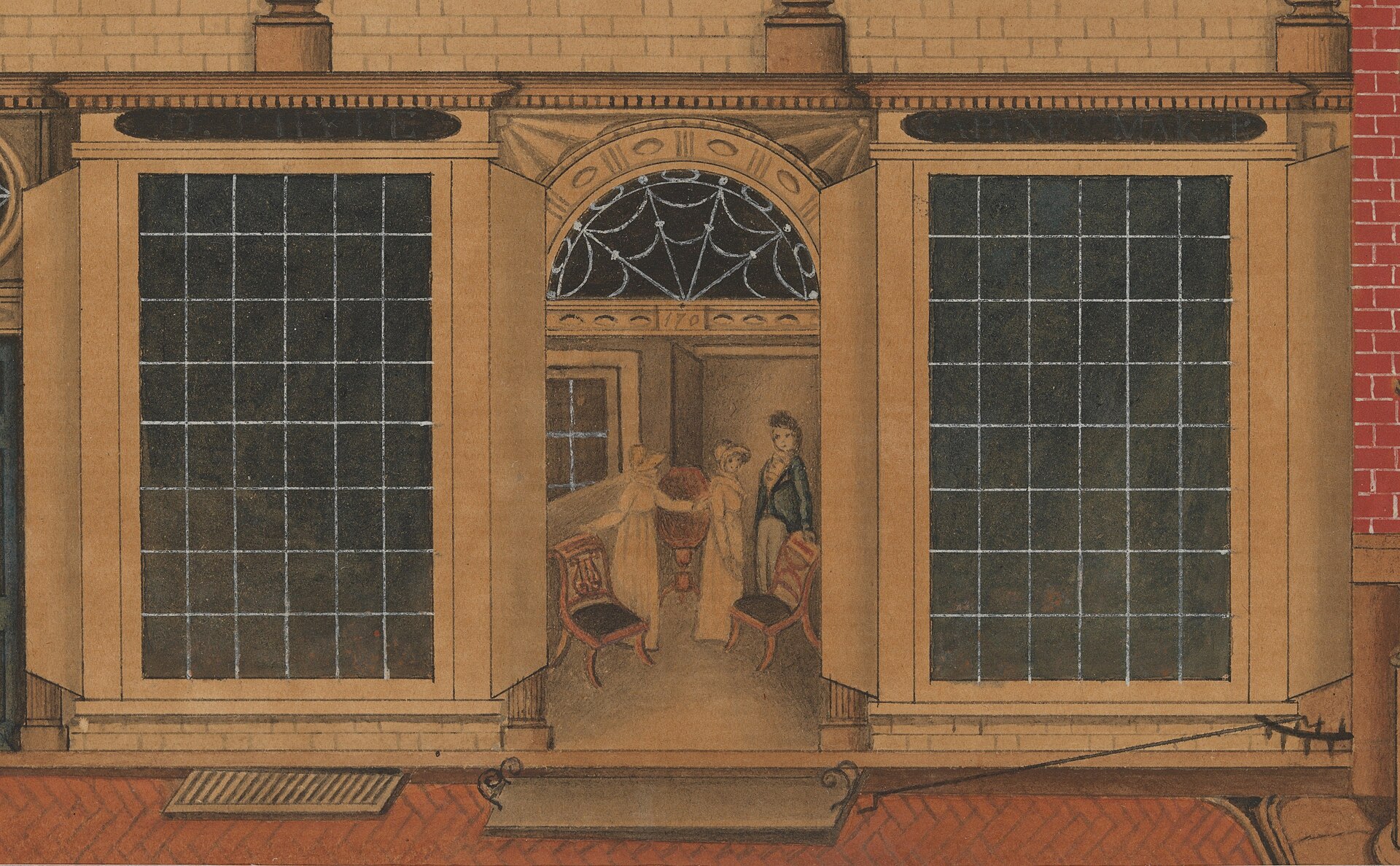
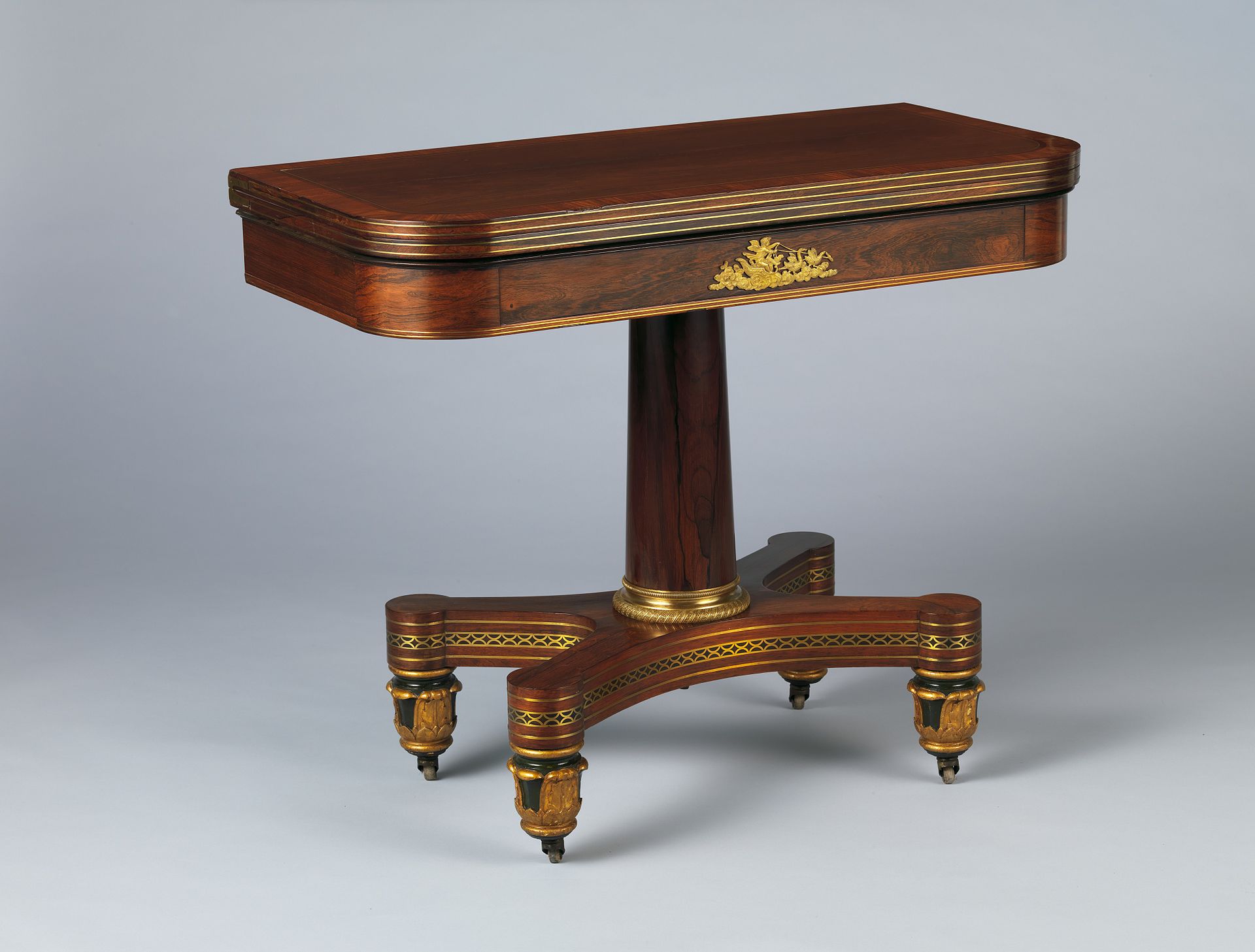
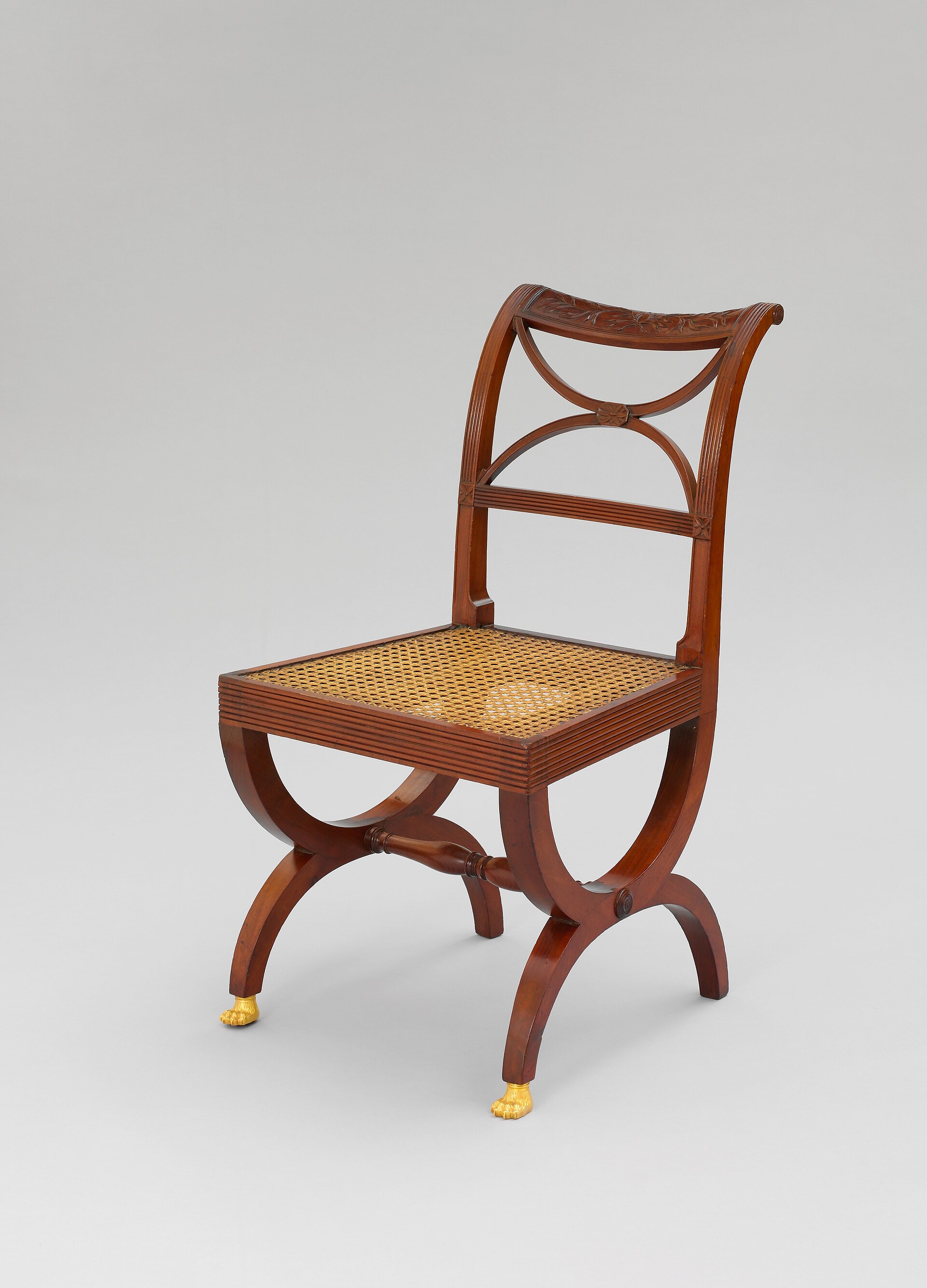
Born Duncan Fife near Loch Fannich, Ross-shire, Scotland; the two years are both used in current scholarship.12
Family emigrates to Albany, New York, where he apprentices as a cabinetmaker.12
Listed in the New York directory as Duncan Fife, joiner, at 2 Broad Street.2
Opens his own shop; changes the spelling of his surname to Phyfe; elected to the General Society of Mechanics and Tradesmen.12
Moves the business to Partition Street (renamed Fulton Street in 1817), where it remains until closure in 1847.12
Earliest surviving bill in the Winterthur collection: a coffin supplied to a Mr. Rutherford.1
William Bayard's November bill documents the earliest known Grecian-style commission from the shop.14
The London Chairmakers' and Carvers' Book of Prices supplement, illustrating two curule stools, reaches New York as the probable design source for curule-form chairs and sofas.2
The shop's so-called best period: delicate Sheraton, Regency and Directoire-influenced work later canonized by the 1922 exhibition.23
Partition Street renamed Fulton Street; The New-York Book of Prices For Manufacturing Cabinet and Chair Work, pricing individual carved elements, is published.12
Robert Donaldson orders furniture from Phyfe; a surviving 1826 window seat is inscribed D. Phyfe under its upholstery, a rare direct signature.3
Invoice to Benjamin Clark of New York documents the shop's earliest known Grecian plain style furniture; nearly half the pieces billed survive.3
Two of Phyfe's sons become partners; the firm is renamed D. Phyfe and Sons. Sources disagree on which two sons.13
Firm renamed D. Phyfe and Son after one partner-son leaves; a Southern client writes that the Phyfes are as much behind the times in style as in price.13
D. Phyfe and Son furnishes Millford Plantation, Sumter County, South Carolina, for John Laurence Manning, documented by a bill of lading.3
Phyfe retires; the shop's stock, over four hundred pieces, is sold at a peremptory auction; the business closes.3
Duncan Phyfe dies at his house, 193 Fulton Street, New York City; an estate inventory is taken a month later.1
The Hudson-Fulton Exhibition at the Metropolitan Museum displays a Phyfe-attributed collection assembled by R. T. Haines Halsey with Ernest F. Hagen's assistance.2
Furniture Masterpieces of Duncan Phyfe opens at the Metropolitan Museum, the first museum exhibition devoted to a single American cabinetmaker.23
Francis P. Garvan acquires Halsey's Phyfe-attributed collection and gives it to Yale University.2
Sears, Roebuck and Co. offers the Monticello, A Duncan Phyfe Adaptation, dining suite in its spring-summer catalogue, chairs at $6.95.2
Nancy V. McClelland publishes Duncan Phyfe and the English Regency, 1795-1830, which becomes the standard reference and reproduces Hagen's 1907 memorandum in full.2
Duncan Phyfe: Master Cabinetmaker in New York, the first full retrospective in ninety years, is held at the Metropolitan Museum and travels to the Museum of Fine Arts, Houston.34
Price tracks attribution tier directly in this market, and the Metropolitan Museum's own decision to catalogue one of two near-identical curule sofas as Attributed to Duncan Phyfe and the other as Attributed to the Workshop of Duncan Phyfe is the clearest illustration available that these are not interchangeable marketing phrases: they are graded claims that also move money. At Sotheby's Important Americana sale of January 25, 2025, two games tables catalogued as attributed to Duncan Phyfe carried presale estimates of $8,000 to $12,000 (circa 1820, carved lyre base) and $12,000 to $18,000 (circa 1825, eagle-carved). Both lots had closed by the time this record was researched; the prices actually realized sit behind Sotheby's own login wall and could not be confirmed without one, a gap this record states rather than estimates. Furniture explicitly sold as an acknowledged later reproduction, such as the Company of Master Craftsmen's 1920s registered reproductions or the Sears Roebuck Monticello line of 1930, occupies a wholly separate, and far lower, market from anything catalogued as by or attributed to Phyfe himself.
| Institution | City | Holdings | Note |
|---|---|---|---|
| Metropolitan Museum of Art | New York | The largest institutional holding of Phyfe and Phyfe-shop furniture, including the Pearsall-suite sofa (60.4.1) and its lower-tier companion (42.16), across the American Wing. | Site of both the 1922 and 2011-2012 retrospectives. |
| Winterthur Museum | Winterthur, Delaware | The Phyfe Room, including chairs believed to be part of the 1807 William Bayard commission, and the Joseph Downs Collection of Phyfe's surviving bills, receipts and estate inventory. | The principal documentary archive for the shop. |
| Yale University Art Gallery | New Haven, Connecticut | The Garvan Collection, built from R. T. Haines Halsey's Phyfe-attributed holdings, given to Yale in 1930. | |
| Museum of the City of New York | New York | Curule side chairs from the Pearsall suite, including the example inscribed Thomas Cornell Pearsall made/for him by Duncan Phyfe. | |
| Brooklyn Museum | New York | Robert Donaldson's 1826 window seats, one signed D. Phyfe under its upholstery, a matching Grecian couch, and a circa 1926 Hagen-shop copy side chair. | |
| Classical American Homes Preservation Trust, Millford Plantation | Sumter County, South Carolina | The double parlor suite and related furnishings documented by the 1841 D. Phyfe and Son bill of lading to John Laurence Manning. | |
| Cincinnati Art Museum | Cincinnati, Ohio | A sofa attributed to the Duncan Phyfe shop, circa 1810-1815, a separate object from the Metropolitan's Pearsall-suite sofa. | |
| Columbia Museum of Art | Columbia, South Carolina | A rosewood sofa from the 1841 Millford Plantation suite. |
Phyfe attached his name to almost nothing he made.
Phyfe attached his name to almost nothing he made. Of the thousands of pieces of American Federal, Regency, Grecian and Empire seating and case furniture that have been called Phyfe in dealer catalogues, museum labels and family tradition since the late nineteenth century, only a small number can be tied to him by a surviving bill, a signature, or a label from his own shop. Deborah Dependahl Waters, writing the standard modern study of the problem for the Chipstone Foundation's American Furniture in 1996, opened with the question dealers and appraisers still field constantly, is it Phyfe?, and answered it by tracing exactly how the name stopped meaning a specific maker and started meaning a style: through the efforts of generations of dealers, collectors, curators and furniture manufacturers, she wrote, Phyfe has become a generic term used to identify American-made furniture in the antique or neoclassical style, inspired by the forms and ornament used in classical Greece and Rome.
The 2011-2012 Metropolitan Museum retrospective, curated by Peter M. Kenny and Michael K. Brown, was explicit that the problem is structural, not sloppy scholarship: because of the size of Phyfe's operation and the number of subcontractors and trained employees who passed through it, specialists writing on the exhibition noted, it is frequently more accurate to describe a piece as being of the school or workshop of Phyfe than to attribute it to him directly. The Museum's own collection makes the point without needing a specialist to state it. Two nearly identical curule-form sofas sit in the American Wing: one, accession 60.4.1, is catalogued Attributed to Duncan Phyfe; the other, accession 42.16, is catalogued Attributed to the Workshop of Duncan Phyfe. The same institution, looking at comparable objects, lands in two different attribution tiers, which is the clearest demonstration available that this is a live, contestable judgment and not a settled identification.
Duncan Phyfe was born Duncan Fife near Loch Fannich in Ross-shire, Scotland.
Duncan Phyfe was born Duncan Fife near Loch Fannich in Ross-shire, Scotland. His birth year is itself disputed in the scholarship: Waters's 1996 study and much of the older literature give 1768, while the Winterthur Library's own finding aid for his papers states that new evidence suggests 1770 is correct, a year the Metropolitan Museum has also used in labeling its 2011-2012 retrospective. This record states both rather than choosing one on its own authority.
His family emigrated to Albany, New York, in the mid-1780s (the Winterthur finding aid gives circa 1783; other accounts give 1784), where he apprenticed as a cabinetmaker. He moved to New York City by 1791 or 1792. The New York directory for 1793 lists him as Duncan Fife, joiner, at 2 Broad Street, sharing quarters with the turner and rush-bottom chairmaker Vincent Tillou. He had changed the spelling of his surname to Phyfe by 1794, the year he opened his own shop, and was elected to the General Society of Mechanics and Tradesmen of the City of New York, a network that supplied him with contacts and customers from the start. By 1795 he had moved his business to Partition Street, renamed Fulton Street in 1817, where he worked until his retirement in 1847 and continued to live until his death in 1854.
Phyfe organized production closer to a factory than a single master's bench, one of the first American furniture makers to do so.
Phyfe organized production closer to a factory than a single master's bench, one of the first American furniture makers to do so. At its height his shop employed close to a hundred people: master cabinetmakers, journeymen, apprentices, carvers, turners and upholsterers, many working under subcontract rather than directly at his own bench. Their names and numbers have mostly escaped the historical record, which is precisely why the school of Phyfe, workshop of Phyfe and by Phyfe distinction carries real weight on any given object: a large, trained operation is capable of turning out work in a recognizably Phyfe idiom that Phyfe's own hand never touched.
The evidence for internal division of labor survives even inside the shop's most securely documented commission. The earliest documented Grecian-style furniture from Phyfe's workshop, made in 1807 for the New York merchant William Bayard, comprised three sets of scroll-back chairs; specialists examining the surviving examples find the crests, carved with clusters of thunderbolts held together by bowknots, were apparently cut by two different carvers working from the same design. Even a bill-documented commission to Phyfe's most securely attested early patron shows more than one hand inside it.
After the shop closed in 1847, the workforce Phyfe had trained dispersed into the wider New York trade, carrying his design vocabulary into shops that had no claim on his name at all, which is a second, less visible source of the same attribution problem: a chair made by a Phyfe-trained journeyman working for someone else can be functionally indistinguishable from one made under Phyfe's own roof.
No daybook or account ledger from Phyfe's business is known to survive.
No daybook or account ledger from Phyfe's business is known to survive. What does survive, held chiefly in the Winterthur Library's Joseph Downs Collection, is a group of roughly forty bills and receipts running from 1801 to the 1830s, naming real clients and, sometimes, the woods and forms supplied: a coffin for a Mr. Rutherford in 1801; a counting-house desk, sideboard and washstand for a Mr. Morewood in 1802; a tea table for John Cruger in 1803; a sideboard and dining furniture for George P. McCulloch in 1806; bedsteads and tables for a Mr. Talbot in 1807 and 1808; a large order of chairs, sofas, a sideboard and dressing and card tables for William Bayard in November 1807; a wardrobe, bureaus and a child's coffin for Thomas Masters in 1810; a dining table for Lady Elizabeth Heyliger of St. Croix in 1811; chairs and tables for Charles N. Bancker of Philadelphia in 1815 and 1816, accompanied by surviving pencil drawings of two chair styles with prices for cane or stuffed seats; furniture and repairs for George Newbold across 1823 to 1826; a coffin for a Mr. Stanford in 1824; a coffin for the estate of Thomas Worthington in 1827; and a $910 bill to the New York merchant and collector Luman Reed in 1833.
Labeled or signed furniture is rarer still. Robert Donaldson of Fayetteville, North Carolina, and later of State Street, New York, ordered furniture from Phyfe in 1822 and again in 1826 for his house on the site of Archibald Gracie's former home; a pair of window seats from the 1826 order, now in the Brooklyn Museum, survive with D. Phyfe inscribed on the underside of the upholstery, and one of the original cushions carries the date July 4, 1826 on its linen undercover. An 1834 invoice to Benjamin Clark of New York documents his earliest known furniture in the Grecian plain style, and nearly half the pieces billed on it survive. An 1841 letter and bill of lading from D. Phyfe and Son document the furnishing of Millford Plantation in Sumter County, South Carolina, for John Laurence Manning, filling every room of the mansion including a double parlor blending Grecian, Gothic and old French forms. It is this small, named, invoiced core, not connoisseurship alone, that the 2011-2012 Metropolitan retrospective used to anchor everything else.
Phyfe's earliest mature work, from around 1800, blended the English Hepplewhite and Sheraton vocabularies with French neoclassical and Directoire forms, and the shop's own copy of the trade's...
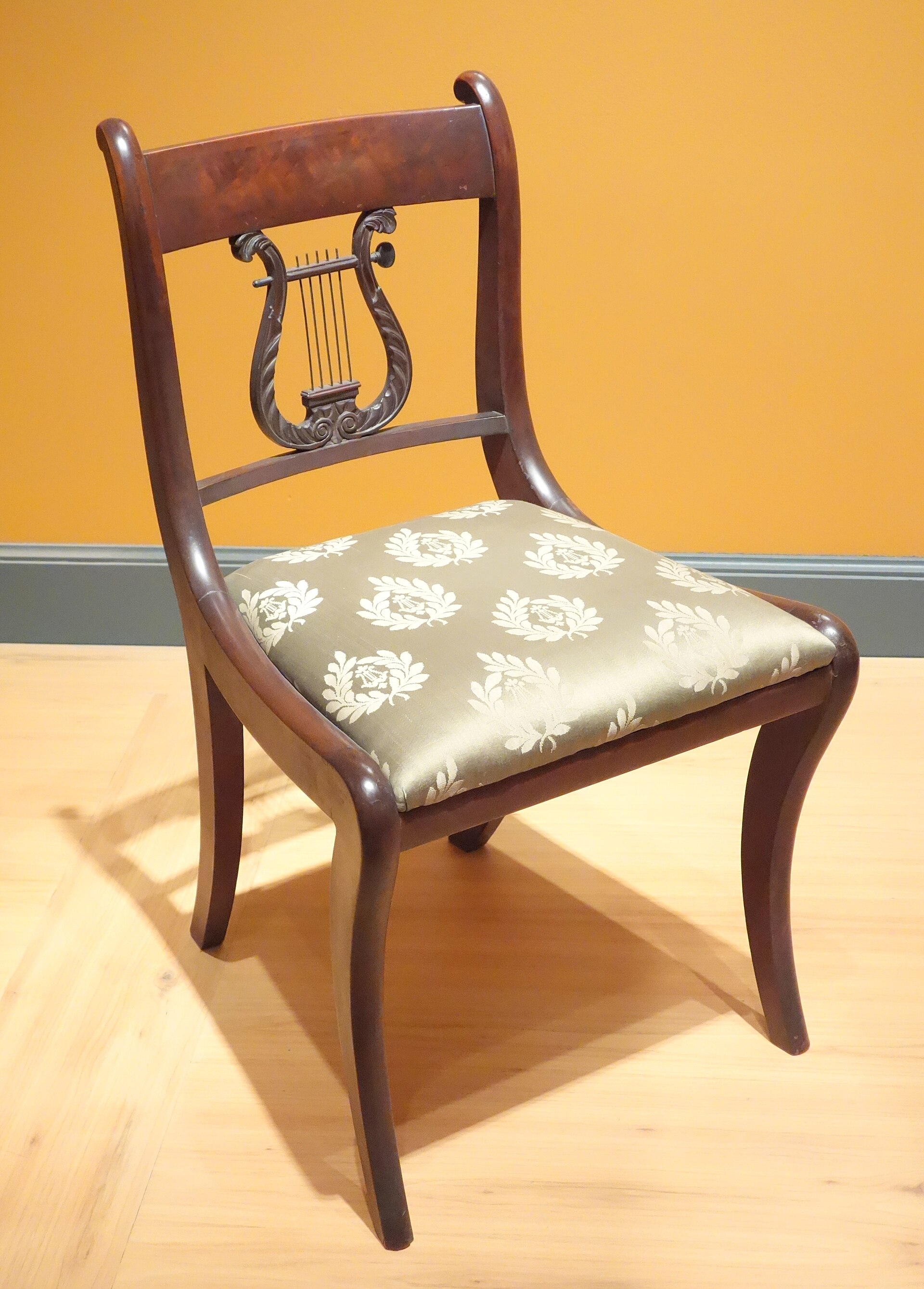
Phyfe's earliest mature work, from around 1800, blended the English Hepplewhite and Sheraton vocabularies with French neoclassical and Directoire forms, and the shop's own copy of the trade's published price book, Revised Prices for Manufacturing Cabinet and Chair Work (New York, 1810), survives at Winterthur. Its best period, roughly 1805 to 1820, is marked by scrolled crest rails on chairs, incurved saber-shaped legs on pillar-and-claw card tables, and carved lyre banisters, priced in the New York cabinetmakers' own 1817 price book at seven shillings eight pence for a basic lyre with an extra three pence per string for brass stringing. Curule, or Grecian cross-frame, seating, of the kind on the Metropolitan's own Pearsall-suite sofa, derives from the Roman sella curulis, the seat of a magistrate holding imperium, and reached New York cabinetmakers through the 1808 supplement to the London Chairmakers' and Carvers' Book of Prices, which illustrates two curule stools; a sketch of a similar chair is thought to have accompanied a letter from Phyfe to Bancker around 1816.
From about 1820 the shop's output grew heavier and more architectural, into what contemporaries called the archaeological antique or Grecian style: deep cavetto cornices, simple square columns, Marlboro feet and console supports the shop itself referred to simply as Grecian scrolls, borrowed directly from French Restauration design. Rosewood veneer increasingly displaced mahogany as the primary show wood in this period, over secondary woods including ash, cherry, tulip poplar and white pine. Surface ornament grew correspondingly richer: gilded brass mounts, gilded gesso, and vert antique paint imitating the patina of ancient bronzes then being excavated in the Mediterranean, a direct material echo of the archaeological revival driving the forms themselves.
The earliest patron securely documented in the modern scholarship on Phyfe's shop is William Bayard, whose 1807 bill is the earliest documented Grecian-style commission.
The earliest patron securely documented in the modern scholarship on Phyfe's shop is William Bayard, whose 1807 bill is the earliest documented Grecian-style commission. Other named, bill-documented clients span the trade and the merchant class of New York and beyond: George P. McCulloch, Thomas Masters, Elizabeth Heyliger of St. Croix, Charles N. Bancker of Philadelphia, George Newbold, and Luman Reed, later a noted collector of American painting in his own right. Robert Donaldson, who inherited a London commission-house fortune and sat for the portraitist Charles R. Leslie while in England in 1820, returned to furnish first a Fayetteville house and then a former Archibald Gracie residence on State Street with Phyfe furniture in the most current Grecian taste; a close compatriot of the landscape architect Andrew Jackson Downing, Donaldson was dedicated Downing's 1842 book Cottage Residences as its arbiter elegantiarum, the ultimate judge of taste, which frames exactly the kind of client Phyfe was building his most ambitious furniture for.
Coffins were a documented, ordinary line of the business alongside parlor furniture: surviving bills record coffins supplied to the Rutherford, Stanford and Worthington families and a child's coffin on the 1810 Masters bill, alongside the household furniture also being ordered. The New York cabinetmakers' own published price books give a period sense of what labor cost inside the shop: scroll sweep elbows at eleven shillings, about a dollar thirty-eight; springing a pair of front legs at six pence; preparing legs for lion's paw feet at one shilling each. By 1845, Moses Yale Beach's Wealth and Biography of the Wealthy Citizens of New York City could describe Phyfe's rise in a single sentence: he commenced in Fulton Street, where he now is, a poor cabinetmaker, and has now the largest and most fashionable establishment in the county.
Phyfe took two of his sons into partnership from 1837, renaming the firm D.
Phyfe took two of his sons into partnership from 1837, renaming the firm D. Phyfe and Sons and then, when one son left in 1840, D. Phyfe and Son. Here the sources on record disagree in a way worth stating plainly rather than smoothing over. Peter M. Kenny's account for the Metropolitan Museum names the two 1837 partners as Michael and James. The Winterthur Library's own finding aid for Phyfe's papers instead names them as William (1803-1875) and James Duncan (1814-1887), and separately documents, in the same finding aid, that a son named Michael Phyfe (1794-1836) died the year before the 1837 partnership began, with his own estate settled that year. The two accounts cannot both be describing the same person under the 1837 partnership; this record states both rather than silently picking one.
In 1840 a Southern client writing from Columbia, South Carolina, judged in a letter to his wife that the Phyfes were by then as much behind the times in style as in price, a contemporary verdict that anticipated the twentieth-century taste, later fixed by the 1922 Metropolitan exhibition, for Phyfe's earlier and lighter work over his late output. The firm closed for good in 1847, when Phyfe retired at about seventy after fifty-five years in business, having accumulated what his contemporaries described as a large fortune. The stock of the warehouse was sold at a peremptory auction: over four hundred pieces of furniture were offered, among which only a handful were described as Gothic and only a single rosewood sofa, in the style of Louis XIV, serpentine front, covered with rich figured crimson plush, and eight matching rosewood chairs appear in the record, suggesting the firm never fully engaged with the historical-revival styles then coming into fashion elsewhere. No price total for the sale has been found in the sources consulted for this record. Phyfe died at his house, 193 Fulton Street, on August 16, 1854; an inventory of the house and shop contents was taken a month later, room by room, listing furniture largely of mahogany and rosewood, some with marble tops, alongside stocks, bonds and cash.
Phyfe's reputation had faded within a generation of his death.
Phyfe's reputation had faded within a generation of his death. Its revival has a documented starting point and a documented engine. The furniture restorer and dealer Ernest F. Hagen, a German immigrant who arrived in New York in 1844 and was too young ever to have worked in Phyfe's own shop, which closed in 1847, spent decades from the 1880s onward collecting Phyfe family testimony, furniture and documents, becoming, in Waters's phrase, the source most twentieth-century knowledge of Phyfe was built on. Hagen assisted the collector R. T. Haines Halsey in assembling a Phyfe-attributed collection for the 1909 Hudson-Fulton Exhibition at the Metropolitan, the first major exhibition to display American decorative arts alongside American painting and sculpture, and Hagen's own biographical notes on Phyfe were used directly in the exhibition's catalogue essay.
On October 15, 1922, the Metropolitan opened Furniture Masterpieces of Duncan Phyfe, curated by Charles Over Cornelius with Halsey as a major lender, drawing over one hundred pieces together as the first museum exhibition ever devoted to a single American cabinetmaker; lenders included the collectors Mrs. Giles Whiting and Mrs. Harry Horton Benkard. The show and its companion catalogue, illustrated with measured drawings by Stanley J. Rowland, fixed a narrow public idea of what a Phyfe looks like, focused almost entirely on the delicate 1805-1820 best period furniture the curators and early collectors preferred, to the near exclusion of Phyfe's later Grecian and Empire output. Halsey's own collection was acquired by Francis P. Garvan in 1929 and given to Yale University the following year. In 1939 Nancy V. McClelland published Duncan Phyfe and the English Regency, 1795-1830, a book that quickly became, in Waters's word, the canon of Phyfe scholarship and attribution for the rest of the twentieth century, reproducing Hagen's own 1907 memorandum on Phyfe in full. The Metropolitan's 2011-2012 retrospective was explicitly framed as the first full reconsideration of Phyfe in ninety years, built in part to correct the distortions the 1922 exhibition and the McClelland canon had set running.
Hagen was not only a source for scholars; his own shop, first as Meier and Hagen and later under his own name, actively supplied the market it was helping to authenticate.
Hagen was not only a source for scholars; his own shop, first as Meier and Hagen and later under his own name, actively supplied the market it was helping to authenticate. The firm's surviving order books describe stock explicitly as Phyfe's Antique alongside frank reproductions sold as in Phyfe's pattern, made from frames bought from a specialist chairmaker, Jacob Dieter, at $9.50 each and finished in-house to sell for about $25. A single bill from June 15, 1886 lists, in the same transaction, one antique Phyfe armchair for $35 beside a small reproduction chair to match for $22. Hagen was candid about the trade: in a 1907 memorandum he wrote that Phyfe's early work, carrying out and improving the Sheraton style, was excellent, but that the shop's later output degenerated first into the questionable American Empire and after 1830 into the abominable heavy nondescript veneered style Phyfe himself, in Hagen's account, called the Butcher furniture. That characterization, reproduced whole in McClelland's 1939 book, shaped curatorial and dealer taste against Phyfe's later work for the rest of the century.
The contamination this trade produced reached the Metropolitan's own landmark 1922 exhibition. One of a pair of New York card tables shown and illustrated in the 1922 catalogue carries a Hagen shop label on the underside of its top, leaving unresolved whether it is a genuine antique Hagen restored or a period reproduction built from old wood in his shop. A sofa in the same exhibition bears an inscription on a rear leg reading HAGEN, OCT. 1922, FEH, for Hagen's son Frederick Ernest Hagen, apparently recording restoration carried out specifically so the piece could be shown as a Phyfe. A documented later case, distinct from any deception, is a side chair made around 1926 by Hagen's sons Henry and Frederick as an openly acknowledged copy of a Phyfe design, now in the Brooklyn Museum: not a forgery, but a specific, dated object showing the same family workshop still supplying the market's appetite for the name two generations after Phyfe's own death.
The 1924 opening of the Metropolitan's American Wing set off a second wave of commercial exploitation, this time openly acknowledged as reproduction rather than passed off as antique.
The 1924 opening of the Metropolitan's American Wing set off a second wave of commercial exploitation, this time openly acknowledged as reproduction rather than passed off as antique. Halsey himself advised The Company of Master Craftsmen, Inc., a Flushing, Queens subsidiary of the department-store furniture house W. and J. Sloane, active from 1925 to 1942, which sold registered reproductions of museum objects to the growing middle-class market; its advertisement for a Phyfe-style sofa in the September 1926 issue of Antiques magazine targeted collectors directly. More modest still was the Monticello, a Duncan Phyfe Adaptation dining suite offered in the 1930 spring-summer Sears, Roebuck and Co. catalogue, with side chairs priced at $6.95; the chair design was reasonably faithful apart from its stretchers, while the accompanying china closet mixed in later Colonial Revival details that had nothing to do with Phyfe's own vocabulary. By this point Phyfe furniture had also become subject matter for the federal Index of American Design, the Depression-era project that paid unemployed artists to render American decorative arts in watercolor for a national archive; several such renderings of Phyfe-attributed chairs, tables and a sofa, made under that program in the mid-to-late 1930s, survive at the National Gallery of Art.
None of this later material is fraudulent on its own terms. The Sloane and Sears lines were sold honestly as reproductions and adaptations, not as antiques, and the Index of American Design watercolors were an openly documentary exercise. What they demonstrate, cumulatively, is the mechanism by which a specific eighteenth- and nineteenth-century tradesman's name detached from his own workshop's output and became, by the middle of the twentieth century, a generic style descriptor stamped on drop-leaf tables and dining suites that Phyfe himself never saw, exactly the process Waters's 1996 study set out to trace and, where possible, to reverse.
Duncan Phyfe: Master Cabinetmaker in New York, curated by Peter M.
Duncan Phyfe: Master Cabinetmaker in New York, curated by Peter M. Kenny and Michael K. Brown with Frances F. Bretter and Matthew A. Thurlow, opened at the Metropolitan Museum on December 20, 2011, and ran through May 6, 2012, traveling afterward to the Museum of Fine Arts, Houston. It was billed as only the second major retrospective ever given to Phyfe, ninety years after the 1922 show, and its stated method was to build the exhibition, phase by phase across Phyfe's whole fifty-five-year career, from documented furniture rather than from the connoisseurship-only attributions that had accumulated since the 1920s. The accompanying catalogue, published by the Museum with Yale University Press, gave equal or greater space to the middle and late Phyfe shop's Grecian, Grecian plain, and even the deliberately unfashionable early-1840s output Hagen had dismissed as Butcher furniture, using the Benjamin Clark and Millford Plantation documentary material as its anchor for that later work specifically.
A review of the catalogue in Chipstone's American Furniture for 2012 credited the authors with assiduously adhering to strict principles of close study of firmly documented examples before making even tentative attributions, deliberately avoiding what the reviewer called the sinkhole of defenseless attributions that had marked earlier decades of Phyfe scholarship. No catalogue raisonne in the traditional sense, an exhaustive numbered inventory of every accepted work, exists for Phyfe and none is claimed by the 2011-2012 project; it is instead the closest thing the field has to an authoritative modern checklist, organized around documented anchor pieces rather than an attempt at total coverage.
Price in the Phyfe market tracks attribution tier directly, and the Metropolitan's own cataloguing of its two near-identical curule sofas, Attributed to Duncan Phyfe against Attributed to the...
Price in the Phyfe market tracks attribution tier directly, and the Metropolitan's own cataloguing of its two near-identical curule sofas, Attributed to Duncan Phyfe against Attributed to the Workshop of Duncan Phyfe for a physically comparable object, is the clearest illustration available of a distinction that also moves money at auction: school of, workshop of, attributed to and by Phyfe are not interchangeable marketing language but graded claims with different evidentiary weight and different value. At Sotheby's Important Americana sale of January 25, 2025, two games tables catalogued as attributed to Duncan Phyfe, circa 1820 and circa 1825 respectively, carried presale estimates of $8,000 to $12,000 and $12,000 to $18,000. Both lots had closed by the time this record was researched; the prices actually realized are held behind Sotheby's own login wall and could not be confirmed from a source accessible without one, a gap this record states rather than estimates.
No aggregate figure for how many pieces are currently accepted as documented, as against the much larger number merely attributed, has been published in any source consulted for this record, and this record does not invent one. What is documented is the shape of the gap: a documented core of roughly forty surviving bills and a handful of labeled or signed objects, set against a market and a museum landscape carrying Phyfe's name on furniture numbering, by any account, in the many hundreds.
There is no authentication board or committee for Duncan Phyfe furniture comparable to the foundation-run bodies that rule on some painters' work, and this record does not invent one to fill the gap.
There is no authentication board or committee for Duncan Phyfe furniture comparable to the foundation-run bodies that rule on some painters' work, and this record does not invent one to fill the gap. In practice, current attribution runs through the Metropolitan Museum's American Wing curatorial staff, the authors of the 2011-2012 catalogue foremost among them, working outward from the documented bill-and-label core described above, and through comparanda held across a small group of institutions: the Metropolitan itself, Yale University Art Gallery's Garvan Collection (built from Halsey's own Phyfe-attributed holdings), the Museum of the City of New York, the Brooklyn Museum, and the Winterthur Museum, whose Decorative Arts Photographic Collection, referred to in the Museum's own finding aid simply as the DAPC, is a documentary photograph archive of Phyfe-associated furniture and bills rather than a deciding authority in its own right. The Joseph Downs Collection at Winterthur, holding the surviving bills themselves, functions as the closest thing to a primary evidentiary record the field has, and it is consulted, not obeyed: a bill establishes that a named client received furniture from Phyfe's shop on a given date, not that any specific surviving chair is the one described on it.
This record does not claim a settled birth year, a settled identity for the two sons who partnered with Phyfe from 1837, a total count of documented versus attributed works, a price for the 1847...
This record does not claim a settled birth year, a settled identity for the two sons who partnered with Phyfe from 1837, a total count of documented versus attributed works, a price for the 1847 closing sale, or a confirmed lifetime portrait, because none of those is established in the sources consulted. It also does not claim that the technical line between workshop of Phyfe and by Phyfe is examinable in every case: the Metropolitan's own curators, choosing to grade two near-identical sofas differently, are demonstrating a judgment call rather than reading a fact off the wood. Where the scholarship itself disagrees, on the sons' names and on Phyfe's birth year, this record states both positions rather than picking one on its own authority.
Cabinetmaker; Furniture manufacturer; Workshop proprietor. 1768 or 1770-1854.
Born 1768 or 1770 (disputed), Near Loch Fannich, Ross-shire, Scotland; died 1854-08-16, New York City, at his house, 193 Fulton Street.
Meier and Hagen's Phyfe's Antique and Phyfe's pattern lines. Ernest F. Hagen's New York restoration shop, active from the 1880s, bought unfinished reproduction chair frames from a specialist chairmaker, Jacob Dieter, at $9.50 each, finished them in-house and sold them for about $25 as furniture in Phyfe's pattern; the same order books describe genuine restored pieces as Phyfe's Antique.
Metropolitan Museum of Art (New York); Winterthur Museum (Winterthur, Delaware); Yale University Art Gallery (New Haven, Connecticut); Museum of the City of New York (New York); Brooklyn Museum (New York); Classical American Homes Preservation Trust, Millford Plantation (Sumter County, South Carolina).
Price tracks attribution tier directly in this market, and the Metropolitan Museum's own decision to catalogue one of two near-identical curule sofas as Attributed to Duncan Phyfe and the other as Attributed to the Workshop of Duncan Phyfe is the clearest illustration available that these are not interchangeable marketing phrases: they are graded claims that also move money. At Sotheby's Important Americana sale of January 25, 2025, two games tables catalogued as attributed to Duncan Phyfe carried presale estimates of $8,000 to $12,000 (circa 1820, carved lyre base) and $12,000 to $18,000 (circa 1825, eagle-carved).
Was Duncan Phyfe born in 1768 or 1770? Current scholarship is split: Waters (1996) and older literature give 1768; the Winterthur Library's finding aid, calling it new evidence, and Metropolitan Museum usage give 1770.
Last verified
One artwork and its story every Tuesday, with the picture: who owned it, what it made, and what closes soon in the exhibition calendar. No promotion, and nothing we cannot cite.
We send one email to confirm the address and keep nothing else. Every letter carries a one-click unsubscribe. How we handle your data.