Sofa
Attributed to Duncan Phyfe · circa 1810-1820
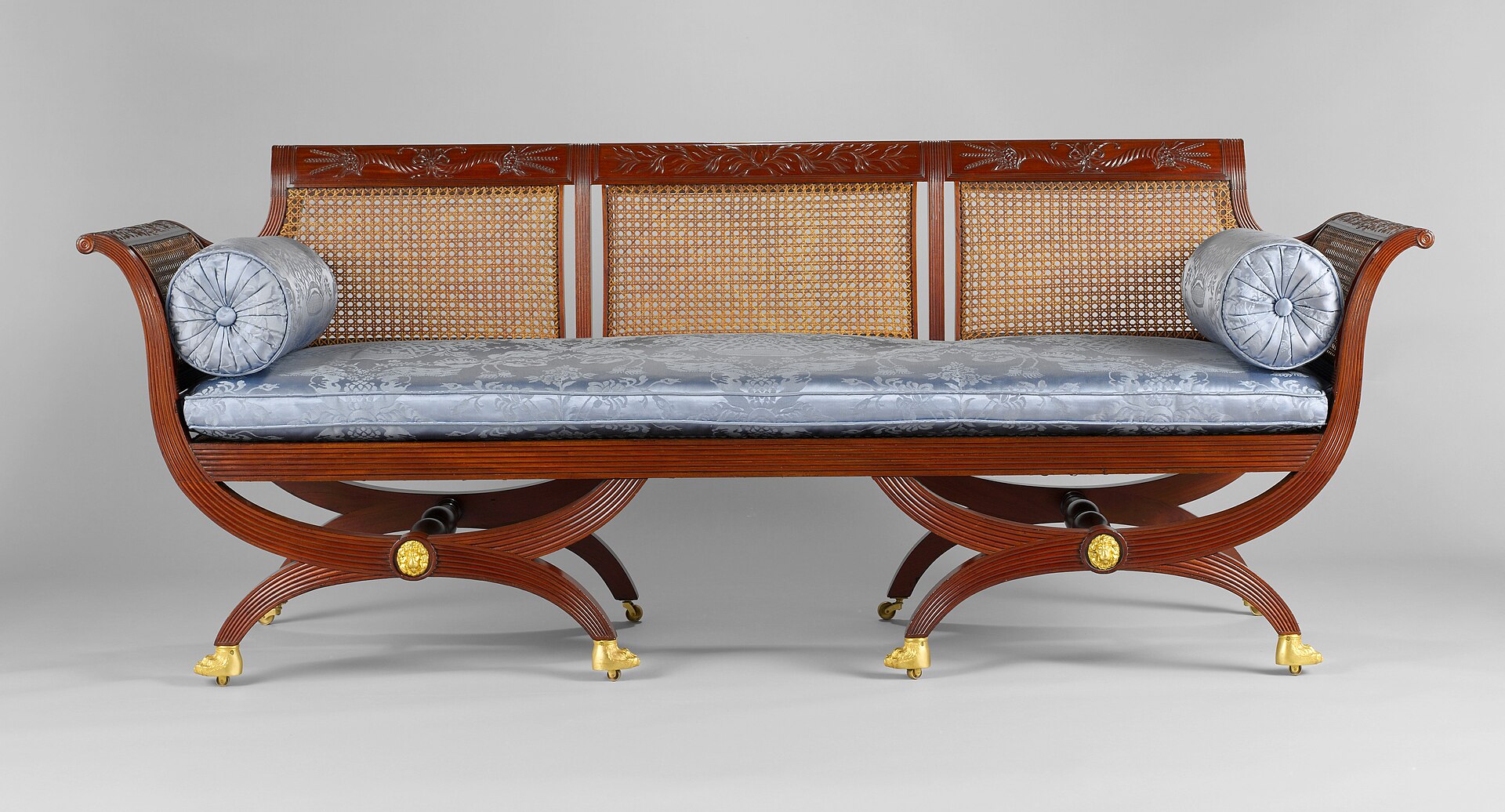
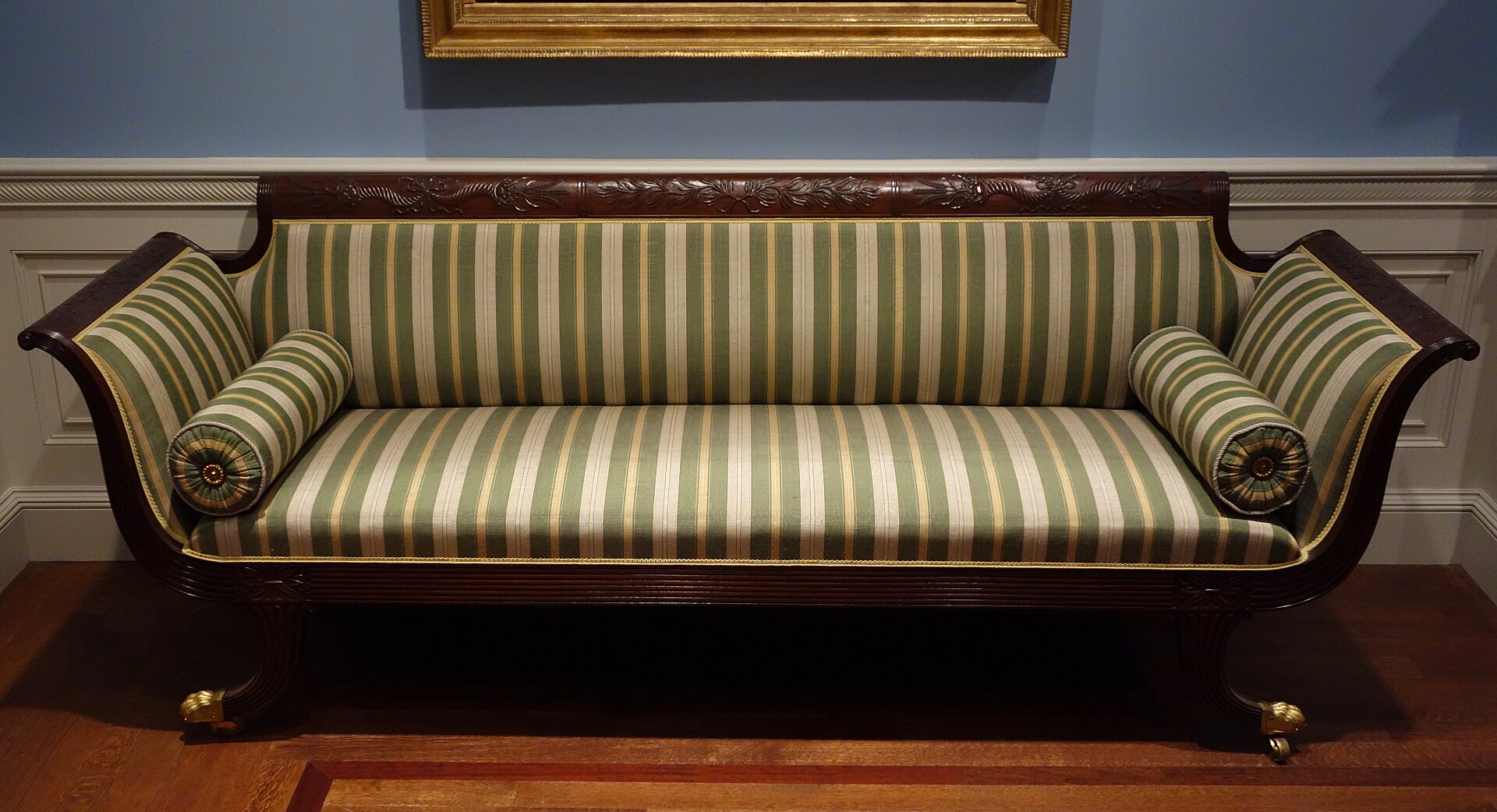
The sofa as catalogued by the Metropolitan Museum, accession 60.4.1. Mahogany, tulip poplar, cane and gilded brass, circa 1810-1820. Confirmed via Wikimedia Commons file metadata as CC0 and tagged to this accession number.
| Artist | Attributed to Duncan Phyfe |
|---|---|
| Date | circa 1810-1820 |
| Medium | Mahogany, tulip poplar, cane, gilded brass |
| Dimensions | 34 x 84 3/4 x 23 3/4 in. (86.4 x 215.3 x 60.3 cm) |
| Where it is now | Metropolitan Museum of Art, New York, on view in the American Wing, Gallery 728last confirmed |
| Inventory number | 60.4.1 |
| Attribution | AcceptedCatalogued by the Metropolitan Museum as Attributed to Duncan Phyfe, not as a documented autograph work. Full note |
| Object type | Furniture |
| Period | American Federal / early Republic, New York, circa 1810-1820 |
| Cases | Has a provenance gap |
| Inscriptions | An inscription is stamped on the inside of the seat rail recording the Pearsall family's ownership of the suite; the Museum treats this, together with family tradition and the quality of the carving, as the basis for attributing the sofa to Phyfe. A related chair from the same suite, now at the Museum of the City of New York, carries a more explicit ink inscription on the inside of its front seat rail reading 'Thomas Cornell Pearsall made/for him by Duncan Phyfe.' Neither inscription is a maker's own signature or label. |
| Owners on record | 6 links4 documented, 2 unknown |
| Sources | 14 cited |
About this record Last verified · 14 sources cited · Change log
On this page 12 sections
ContentsClose
A mahogany sofa on crossed curule legs, made in a New York workshop around 1810 to 1820 and catalogued by the Metropolitan Museum of Art as Attributed to Duncan Phyfe rather than by him. Phyfe almost never labeled or signed his furniture, so nearly everything bearing his name, including this piece, rests on a mixture of family history, inscriptions added by owners rather than the maker, and the trained eye of specialists comparing joinery and carving to the small number of securely documented pieces.
This sofa belonged to a large curule-form suite once owned by Thomas Cornell Pearsall, a New York merchant and shipowner, whose family kept it long enough to be photographed in a descendant's parlor in the early twentieth century before it was sold at Parke-Bernet Galleries in November 1946 and bought by the collector C. Ruxton Love Jr., who split the suite between the Metropolitan Museum and the Museum of the City of New York and gave the Met his portion, including this sofa, in 1960.
The record that follows treats the Phyfe name the way the Museum's own scholarship now insists it be treated: as a graded attribution built from an inscription, a family story, and stylistic judgment, sitting inside a field where furniture has been overattributed to Phyfe for market reasons since at least the 1880s.
Provenance
Each link is graded. Documented: a cited source supports it. Disputed: the identification is argued but not established. Unknown: no owner for that span, and the gap is not smoothed into a narrative. The grades in the glossary.
- circa 1810-1820 - 1820Thomas Cornell Pearsall, New York merchant and shipownerdocumented
Made in a New York workshop attributed to Duncan Phyfe and associated with Pearsall by an inscription stamped on the seat rail and by family tradition. This documents Pearsall's ownership at or near the date of manufacture; it does not document Phyfe's personal hand, which remains an attribution rather than a fact.123
- 1820 - early 20th centuryPearsall family descendants, individuals not named in sources consultedunknown
No specific intervening owner is documented across roughly a century. The only physical evidence that the suite remained in the family is an early twentieth-century photograph of it in the parlor of one of Pearsall's great-granddaughters.4
- early 20th century - 1946Presumed Pearsall descendantsunknown
The consignor of the 1946 Parke-Bernet sale is not named in the sources consulted; it is presumed, but not documented here, to be a Pearsall descendant.12
- 1946-11-09 - 1946-11-09Sold at Parke-Bernet Galleries, New Yorkdocumented
The curule seating suite, including this sofa, was sold at Parke-Bernet Galleries on November 9, 1946, and purchased there by C. Ruxton Love Jr. No lot number or price for this sale was found in the sources consulted.12
- 1946 - 1960C. Ruxton Love Jr., private collectiondocumented
Love bought the suite at the 1946 sale and later divided it between the Metropolitan Museum of Art and the Museum of the City of New York.128
- 1960 - presentMetropolitan Museum of Art, New Yorkdocumented
Given to the Museum by C. Ruxton Love Jr. in 1960, accession 60.4.1, along with at least one matching side chair, accession 60.4.4, from the same suite.12
Prices realised
| Date | Sale | Estimate | Result | Note |
|---|---|---|---|---|
| 9 November 1946 | Parke-Bernet Galleries | Not published in the sources consulted | Hammer Not published in the sources consulted With premium Not published in the sources consulted USD (presumed; not confirmed in sources consulted) | The sale of the Pearsall curule suite, including this sofa, to C. Ruxton Love Jr. on November 9, 1946 is corroborated by multiple secondary sources discussing the Metropolitan Museum's Phyfe holdings, but no lot number, sale title, estimate or price was located. This is recorded as a documented sale event with an undocumented price, rather than as a full auction result. |
Hammer is the price at which the bidding stopped; with premium adds the fee the house charges the buyer on top. Hammer price and buyer's premium in the glossary.
Technical evidence
| Attribution note | Catalogued by the Metropolitan Museum as Attributed to Duncan Phyfe, not as a documented autograph work. No maker's label or signature by Phyfe survives on this sofa. The attribution rests on three things: an inscription stamped on the inside of the seat rail recording the set's ownership by Thomas Cornell Pearsall, a family tradition passed with the furniture that Pearsall's suite was made by Phyfe, and the Museum's own judgment that the quality of carving and joinery is consistent with Phyfe's best-period shop work of about 1810-1820. This is a family-history and connoisseurship attribution, not a signed or billed one. A nearly identical companion sofa in the same collection, accession 42.16, is catalogued one tier lower, as Attributed to the Workshop of Duncan Phyfe rather than to Phyfe himself, which shows that the exact grading of this kind of evidence remains a live curatorial judgment rather than a settled fact. |
|---|---|
| Primary wood | Mahogany, used for the show surfaces of the frame, arms and legs.12 |
| Secondary wood | Tulip poplar, used structurally beneath the mahogany, standard practice in high-style New York cabinet shops of this period, including Phyfe's.12 |
| Seat construction | Caned seat, which would originally have carried a separate, fitted loose cushion, now lost.12 |
| Metalwork | Gilded brass ornament. The Museum's public record does not itemize the exact form or placement of the brass elements, and this record does not speculate about it beyond what is stated in the medium line.12 |
| Leg form | Curule, or Grecian cross-frame, base: crossed S-curved legs derived from the ancient Roman sella curulis, the seat of a magistrate holding imperium, transmitted to New York cabinetmakers via the 1808 supplement to the London Chairmakers' and Carvers' Book of Prices.129 |
| Dimensions | 34 x 84 3/4 x 23 3/4 in. (86.4 x 215.3 x 60.3 cm).12 |
| Inscription | Stamped on the inside of the seat rail, recording Pearsall family ownership; the sole physical basis, together with family tradition and stylistic judgment, for the Phyfe attribution.123 |
| Attribution tier as catalogued | Attributed to Duncan Phyfe (Metropolitan Museum accession 60.4.1), one tier above the Attributed to the Workshop of Duncan Phyfe designation given to the near-identical companion sofa, accession 42.16, in the same collection.1212 |
Images
The record in full
Chapter 1What it is
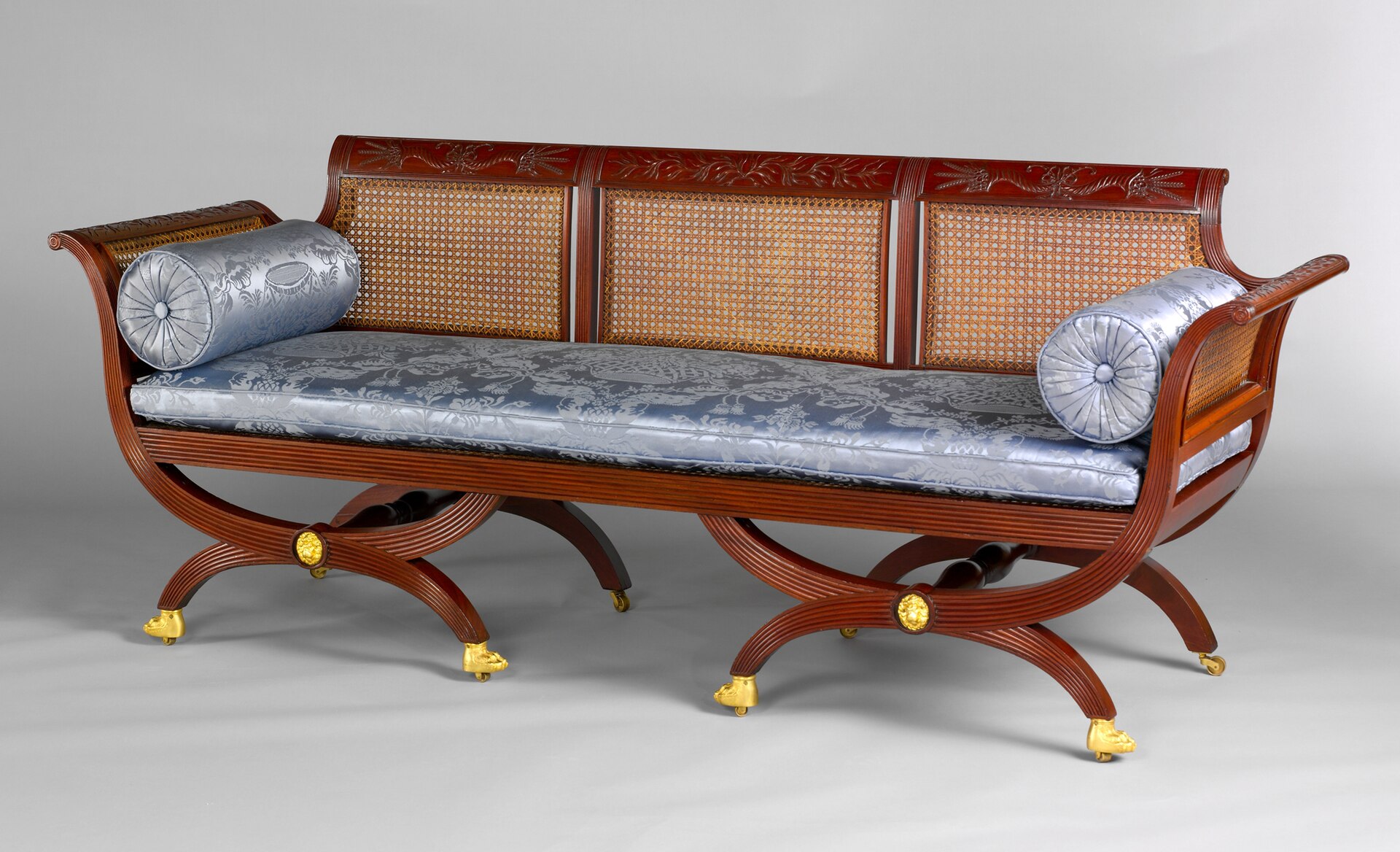
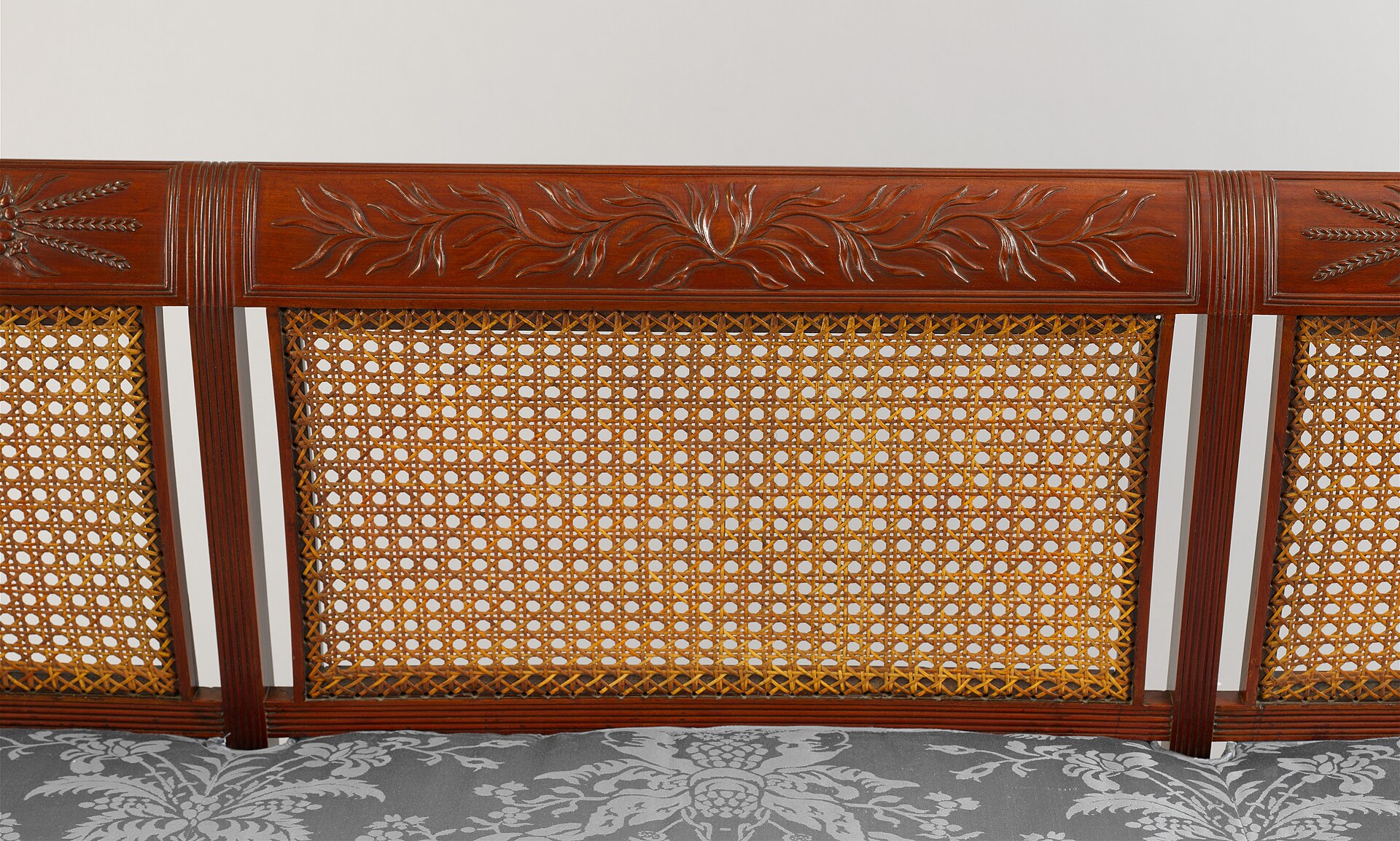
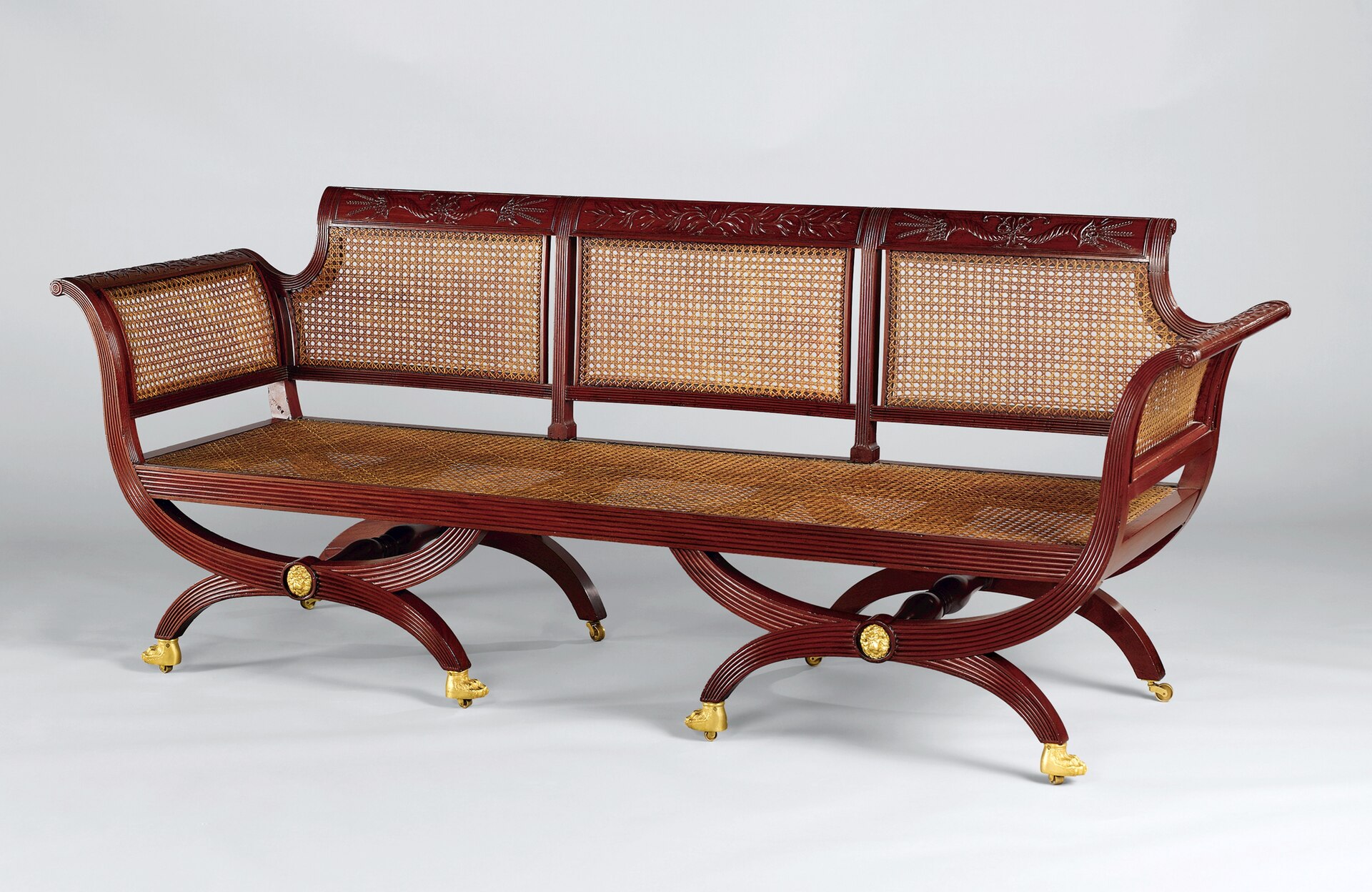
The sofa is 34 inches high, 84 3/4 inches long and 23 3/4 inches deep, built in mahogany over a secondary structure of tulip poplar, with a caned seat and gilded brass ornament.
The sofa is 34 inches high, 84 3/4 inches long and 23 3/4 inches deep, built in mahogany over a secondary structure of tulip poplar, with a caned seat and gilded brass ornament. Its legs are not straight or saber-shaped but crossed in an X, a form known in the furniture trade as curule or as a Grecian cross frame. This is a specific and identifiable design choice, not a generic Federal-period leg: it derives from the ancient Roman sella curulis, the folding stool of magistrates holding imperium, and it reached American cabinetmakers through the 1808 supplement to the London Chairmakers' and Carvers' Book of Prices, a pattern book that circulated the antique Greco-Roman revival forms fashionable in Regency England.
The caned seat is a practical detail worth noting: it would originally have carried a loose, fitted squab cushion, now lost, rather than an upholstered frame, which is typical of the lighter, more overtly antique-inspired seating furniture that came into fashion in New York in the 1810s.
Chapter 2A Roman form for a new republic
The curule chair carried a specific charge in antiquity: it was the seat of Roman magistrates, dictators, consuls, praetors and curule aediles, and its persistence in Roman coinage and imagery marks...
The curule chair carried a specific charge in antiquity: it was the seat of Roman magistrates, dictators, consuls, praetors and curule aediles, and its persistence in Roman coinage and imagery marks it as an emblem of political authority rather than an ordinary domestic form. When the form was revived in late eighteenth-century France and England as part of the broader neoclassical fashion for antiquity, and then carried across the Atlantic in pattern books, American consumers and cabinetmakers adopted it inside a culture that had just built a republic self-consciously modeled on Rome's.
It would be an overreach to claim that Thomas Cornell Pearsall commissioned a curule-based suite as a deliberate statement of republican virtue; no letter, diary or invoice from Pearsall makes that case, and none is cited in the scholarship consulted for this record. What can be said, and is documented in the literature on the form, is that curule seating furniture in Federal America was inseparable from the classical revival's political and intellectual fashion for Greece and Rome, and that owning a suite built on an ancient magistrate's seat was, at minimum, a legible piece of period taste rather than a neutral choice of leg shape.
Chapter 3How this specific sofa is attributed to Phyfe
The Metropolitan Museum's own catalogue entry for this object is explicit about the basis of the attribution, and it is worth quoting closely because it is the single most important fact in this...
The Metropolitan Museum's own catalogue entry for this object is explicit about the basis of the attribution, and it is worth quoting closely because it is the single most important fact in this record. The Museum states that the sofa is part of a large suite of seating furniture, including a pair of armchairs, ten side chairs and two footstools, once owned by Thomas Cornell Pearsall, and that other chairs from the same set are held by the Museum of the City of New York. It then states plainly: the attribution to Phyfe is based on the set's traditional history of ownership, which is recorded in an inscription stamped on the inside of the seat rails on the sofa and several of the chairs, and that the skillful execution of the details also points to Phyfe.
Read carefully, that sentence names two kinds of evidence, and neither is a maker's mark. The first is a family-history inscription: something stamped into the wood recording who owned the piece, not who made it. The second is connoisseurship: a curatorial judgment that the carving and construction are of a quality consistent with Phyfe's best shop work. A closely related side chair from the same suite, now at the Museum of the City of New York, carries a more direct ink inscription on the inside of its front seat rail reading Thomas Cornell Pearsall made/for him by Duncan Phyfe, which is as close as this suite comes to a documentary link to Phyfe by name, and even that is an owner's or a later hand's inscription rather than the cabinetmaker's own label.
The Museum's own comparative practice makes the gap between kinds of evidence visible. A nearly identical sofa in the same collection, accession 42.16, gift of Mrs. Harry Horton Benkard in 1942 and dated slightly earlier, to 1805-1815, is catalogued one tier down, as Attributed to the Workshop of Duncan Phyfe, rather than Attributed to Duncan Phyfe outright. Two similar objects, evaluated by the same institution, land in different attribution tiers, which is the clearest possible demonstration that this is a graded, contestable judgment rather than a settled identification.
Chapter 4The wider problem: a cabinetmaker who almost never signed his work
Duncan Phyfe achieved enormous fame in his own lifetime, known to contemporaries as the United States Rage, yet only a small number of labeled or billed examples of his furniture are known to survive.
Duncan Phyfe achieved enormous fame in his own lifetime, known to contemporaries as the United States Rage, yet only a small number of labeled or billed examples of his furniture are known to survive. Scholars organizing the Metropolitan Museum's 2011-2012 retrospective, Duncan Phyfe: Master Cabinetmaker in New York, by Peter M. Kenny, Michael K. Brown, Frances F. Bretter and Matthew A. Thurlow, built their attributions outward from a small core of firmly documented objects, among them furniture recorded in an 1834 invoice to a client named Benjamin Clark, of which nearly half the pieces billed still survive, and furniture from Millford Plantation in South Carolina tied to an 1841 bill of lading. Everything else, including a large share of what museums and the trade call Phyfe, is reasoned outward from that documented core by comparison of construction, carving and design vocabulary.
The scale of the resulting uncertainty is real. As specialists writing on the 2011-2012 exhibition put it, because of the size of Phyfe's operation and the number of subcontractors and trained employees who passed through it, it is frequently more accurate to describe a piece as being of the school or workshop of Phyfe than to attribute it to him directly, precisely the distinction the Museum draws between this sofa and its companion, accession 42.16. The 2011-2012 catalogue was assembled, in the words of one review, by scholars who assiduously adhered to strict principles of close study of firmly documented examples before making even tentative attributions, deliberately avoiding what the reviewer called the sinkhole of defenseless attributions that had marked earlier decades of Phyfe scholarship.
Chapter 51922: the exhibition that made the name a market
The modern cult of the Phyfe name has a documented starting point.
The modern cult of the Phyfe name has a documented starting point. In 1922 the Metropolitan Museum staged Furniture Masterpieces of Duncan Phyfe, curated by Charles Over Cornelius with the collector and connoisseur Richard Townes Haines Halsey as a major lender and contributor, drawing over one hundred pieces of furniture together as the first solo museum exhibition ever given to an American cabinetmaker. It was accompanied by a catalogue of the same title with measured drawings by Stanley J. Rowland, published by Doubleday, Page and Company for the Museum.
The exhibition's influence outran its evidence. Cornelius and the early collectors who lent to the show were interested specifically in what they judged Phyfe's best period, the delicate Sheraton- and Directoire-influenced work of roughly 1805 to 1820, to the near exclusion of his later, heavier Grecian and Empire-period production. That narrow focus shaped two generations of collecting taste: it fixed a public idea of what a Phyfe looks like, and it created strong commercial pressure to find, and where the evidence was thin, to declare, more furniture that fit the fashionable 1805-1820 profile. The Museum's own 2011-2012 retrospective was explicitly framed as the first full reconsideration of Phyfe in ninety years, in part to correct the distortions the 1922 show had set in motion.
Chapter 6The manufacture of a name: Ernest Hagen's shop
The clearest documented case of the market actively manufacturing Phyfe furniture, rather than merely misjudging genuine pieces, is the New York firm of Meier and Hagen, later run by the cabinetmaker...
The clearest documented case of the market actively manufacturing Phyfe furniture, rather than merely misjudging genuine pieces, is the New York firm of Meier and Hagen, later run by the cabinetmaker and restorer Ernest F. Hagen. Hagen's own order books describe stock explicitly as Phyfe's Antique alongside frank reproductions sold as in Phyfe's pattern; a surviving 1886 bill from the firm lists, in the same transaction, one antique Phyfe armchair for thirty-five dollars beside a small reproduction chair to match for twenty-two. Hagen was not a secretive counterfeiter; in a 1905 newspaper interview he explained candidly that the ruins of irreparably damaged old pieces furnish the modern cabinetmaker with the very best seasoned mahogany, and in 1907 he warned, with apparent honesty about his own trade, that from about 1840 to about 1865 a great deal of furniture was made there which is now sold for antique to such as don't know any better.
The contamination reached the Metropolitan Museum's own 1922 exhibition. One of a pair of New York card tables shown and illustrated as plate 20 in the 1922 catalogue, from the Benkard collection, carries a Hagen shop label on the underside of its top, leaving unresolved whether the table is a genuine antique that Hagen restored or a period reproduction built up from old wood in his shop. A sofa included in the same 1922 exhibition bears an inscription on the inner face of a rear leg reading HAGEN / OCT. 1922 / FEH, for Hagen's son, Frederick Ernest Hagen, apparently recording restoration work carried out specifically so the piece could be shown as a Phyfe. None of this touches the sofa in this record directly, and this record makes no claim that 60.4.1 passed through the Hagen shop; the point of setting it out is that the market and even the Museum's own landmark early exhibition demonstrably absorbed Hagen-shop material as genuine Phyfe furniture, which is the concrete, documented shape of the wider problem this piece's attribution sits inside.
Chapter 7Thomas Cornell Pearsall
Thomas Cornell Pearsall, who died in 1820, was a wealthy New York merchant and shipowner, and the suite this sofa belongs to was made for or otherwise associated with him during his lifetime, on the...
Thomas Cornell Pearsall, who died in 1820, was a wealthy New York merchant and shipowner, and the suite this sofa belongs to was made for or otherwise associated with him during his lifetime, on the evidence of the seat-rail inscription and family tradition. A contemporary source quoted in scholarship on the 2011-2012 Phyfe retrospective is considerably less flattering about the man than about his furniture, recording him as that worthless scamp Tom Pearsall, a phrase whose author and full context are not given in the source consulted for this record, but which is a useful check against reading Pearsall as simply a stock wealthy Federal-era patron.
The physical evidence that the suite stayed in the family is a single early twentieth-century photograph, cited in the same scholarship, showing the curule furniture arranged in the parlor of one of Pearsall's great-granddaughters. That photograph, not any continuous documentary chain of individual owners, is the basis for saying the suite descended through the Pearsall family from 1820 into the twentieth century.
Chapter 8Duncan Phyfe: from Loch Fannich to Fulton Street
Duncan Phyfe was born Duncan Fife, in 1768 or 1770 depending on the source, near Loch Fannich in Ross-shire, Scotland.
Duncan Phyfe was born Duncan Fife, in 1768 or 1770 depending on the source, near Loch Fannich in Ross-shire, Scotland. His family emigrated and settled in Albany, New York, in 1784, where he apprenticed as a cabinetmaker. He moved to New York City around 1791 or 1792 and had changed the spelling of his surname to Phyfe by the mid-1790s, opening his own shop in 1794. He worked initially from an address on Broad Street and later from Partition Street, renamed Fulton Street in 1817, in lower Manhattan.
His rise was fast enough that contemporaries nicknamed him the United States Rage, and demand for his work peaked between about 1805 and 1820, the same window that would later be canonized as his best period by the 1922 exhibition. The earliest patron securely documented in the scholarship on his shop is William Bayard of New York; Thomas Cornell Pearsall's association with the shop, by contrast, rests on the family-tradition inscription discussed above, not on a comparable bill or receipt.
Chapter 9The scale of the workshop
Phyfe was among the first American furniture makers to organize production on something close to a factory model rather than a single master's bench.
Phyfe was among the first American furniture makers to organize production on something close to a factory model rather than a single master's bench. At the height of his business he is reported to have employed more than one hundred people across the trades his shop required: master cabinetmakers, journeymen, apprentices, carvers, turners and upholsterers working under one roof or in closely coordinated satellite shops. That scale is precisely why the school of Phyfe versus workshop of Phyfe versus by Phyfe distinction matters so much to any individual piece's attribution: a large operation staffed by trained subcontractors is capable of producing work in a recognizably Phyfe idiom without Phyfe's own hand ever touching a given chair or sofa, and after his death that same trained workforce dispersed into the wider New York trade, carrying his design vocabulary with them into shops with no claim on his name at all.
Chapter 10From delicate neoclassicism to the archaeological antique, and a fall from fashion
Phyfe's earliest mature work, from around 1800, followed the delicate lines of Sheraton, Regency and French Directoire design.
Phyfe's earliest mature work, from around 1800, followed the delicate lines of Sheraton, Regency and French Directoire design. By the 1820s his shop's output had grown heavier and more architectural, moving into what period and later commentators called the archaeological antique or Grecian style, and by the 1830s and 1840s into full Empire forms with plainer, blockier massing. Contemporary opinion did not treat this evolution as simple progress. A Southern client writing around 1840 remarked that the Phyfes were then as much behind the times in style as in price, a period judgment that anticipated the twentieth-century collecting taste, fixed by the 1922 exhibition, for his earlier and lighter work over his later Empire-period production.
Phyfe took his sons Michael and James into partnership from 1837 to 1847, then retired in 1847 at about seventy-seven years old after fifty-five years in business, and died in New York on August 16, 1854. Within a generation his name had faded from fashionable use, only to be revived, and considerably inflated, by the Museum's own 1922 exhibition seventy years after his death.
Chapter 11From the Pearsall parlor to the auction room
Between Thomas Cornell Pearsall's death in 1820 and the early twentieth-century photograph of the suite in his great-granddaughter's parlor, no individual owner is named in any source consulted for...
Between Thomas Cornell Pearsall's death in 1820 and the early twentieth-century photograph of the suite in his great-granddaughter's parlor, no individual owner is named in any source consulted for this record. The suite is documented only as having stayed within the extended Pearsall family. The circumstances under which it was consigned for sale in the twentieth century, and by which family member, are likewise not given in the sources consulted.
What is documented is the sale itself: the curule seating furniture and footstools were sold at Parke-Bernet Galleries in New York on November 9, 1946, and bought there by the collector C. Ruxton Love Jr. No lot number, hammer price, estimate or sale catalogue title for this specific lot was found in the sources consulted for this record, a gap recorded in the auction entry below rather than filled with an invented figure.
Chapter 12C. Ruxton Love Jr. and the 1960 gift
C. Ruxton Love Jr. divided the Pearsall suite he bought in 1946 between two institutions, giving part of it, including this sofa and at least one matching side chair, accession 60.4.4, to the...
C. Ruxton Love Jr. divided the Pearsall suite he bought in 1946 between two institutions, giving part of it, including this sofa and at least one matching side chair, accession 60.4.4, to the Metropolitan Museum of Art in 1960, and other pieces from the set to the Museum of the City of New York. He had already given the Museum a separate, related Phyfe-attributed sofa, accession 59.197, the year before, in 1959.
Love and his wife, Audrey, were substantial collectors well beyond American Federal furniture. A profile of the couple describes them as voracious and discerning collectors of Italian bronzes, fine Napoleonic-era vermeil and early nineteenth-century silver by Paul Storr, and describes Ruxton Love's particular passion for Napoleonic relics, including a suite of chairs from Malmaison, Napoleon's campaign desk by the goldsmith Odiot, and toilet cases, or necessaires, made for Josephine and her daughter Hortense by Martin-Guillaume Biennais. The same profile credits the couple as early, pioneering collectors of Benin bronzes and Gandharan sculpture, decades before either field became fashionable, and states that many of their finest pieces have since been given to museums in Ruxton Love's memory. No source consulted for this record gives Love's birth or death dates, his profession, or a fuller account of how he came to acquire the Pearsall suite specifically; those gaps are recorded in the open questions below rather than guessed at.
Chapter 13What is unresolved and what is not claimed
This record does not claim that Duncan Phyfe personally built this sofa, and neither does the Metropolitan Museum: the Museum's own cataloguing language is Attributed to Duncan Phyfe, a graded...
This record does not claim that Duncan Phyfe personally built this sofa, and neither does the Metropolitan Museum: the Museum's own cataloguing language is Attributed to Duncan Phyfe, a graded judgment resting on a family-ownership inscription and stylistic assessment, sitting one tier above the Workshop of Duncan Phyfe designation the Museum gives to a nearly identical companion sofa in the same collection. It does not claim a documented chain of ownership between 1820 and 1946; the evidence for that stretch is a single family photograph and nothing more specific. It does not state a price for the 1946 sale that placed the suite with C. Ruxton Love Jr., because none was found. Where the record is silent on a question a reader would expect answered, primarily the century between Pearsall's death and the sale, and the biography of the donor who gave the sofa to the Museum, that silence is itself recorded as an open question rather than smoothed over.
The artist
Duncan Phyfe, born Duncan Fife
Duncan Phyfe is, by reputation, the best-known cabinetmaker in American history, and by documentation one of the thinnest. He almost never labeled or signed his furniture, so the enormous body of work carrying his name today, including this sofa, has been assembled over two centuries by family tradition, connoisseurship and a small core of billed or labeled pieces, not by a corpus of signed work comparable to a painter's oeuvre. Read the facts below as what they are: a career and a workshop that are well documented, attached to individual objects that mostly are not.
Exhibited
- 1922Furniture Masterpieces of Duncan PhyfeMetropolitan Museum of Art, New York (object's inclusion not confirmed; the exhibition drew on the wider Phyfe-attributed corpus including material from the Pearsall suite's period and type)
- 2011-2012Duncan Phyfe: Master Cabinetmaker in New YorkMetropolitan Museum of Art, New York (January 20, 2011 - May 6, 2012), traveled to the Museum of Fine Arts, Houston (June 20 - September 11, 2012); object's specific inclusion in the checklist not confirmed in sources consulted
Literature
- Charles Over Cornelius, Furniture Masterpieces of Duncan Phyfe (New York: Metropolitan Museum of Art / Doubleday, Page and Company, 1922), measured drawings by Stanley J. Rowland.
- Peter M. Kenny, Michael K. Brown, Frances F. Bretter and Matthew A. Thurlow, Duncan Phyfe: Master Cabinetmaker in New York (New York: Metropolitan Museum of Art, distributed by Yale University Press, 2011).
- Deborah Dependahl Waters, 'Is It Phyfe?', American Furniture 1996 (Milwaukee: Chipstone Foundation, 1996).
Related works
| Work | Relation | Where it is |
|---|---|---|
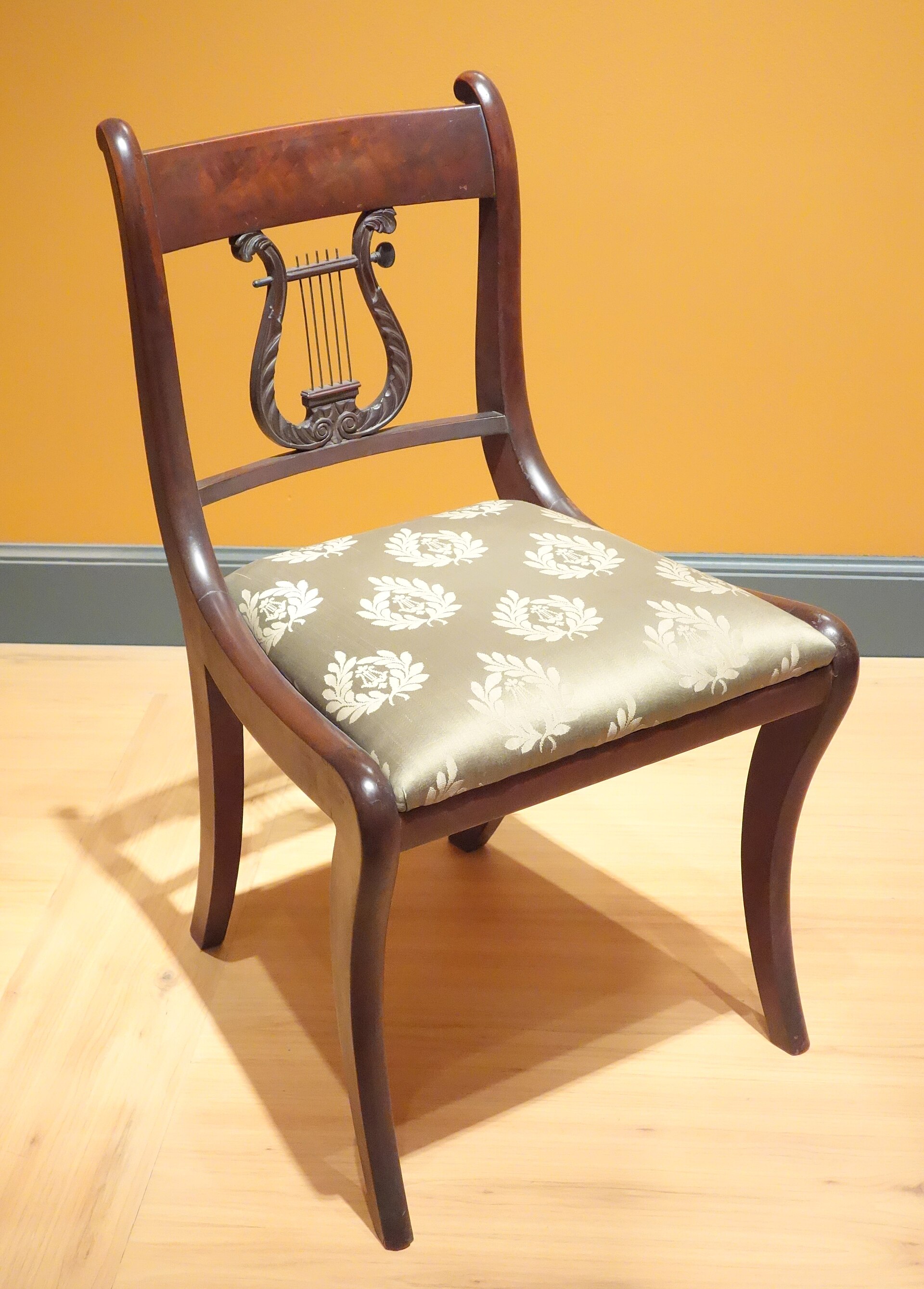
| Side chair, from the same Pearsall suite Attributed to Duncan Phyfe | Same curule suite, same 1960 gift from the same donor One of the ten side chairs from the Pearsall suite, given to the Met by C. Ruxton Love Jr. in the same 1960 gift as this sofa. | Metropolitan Museum of Art, New York (accession 60.4.4) |
| Curule side chair inscribed with the Pearsall/Phyfe attribution Attributed to Duncan Phyfe | Same Pearsall suite, part of C. Ruxton Love's 1946 purchase, given instead to the sister institution Carries the fuller ink inscription on the inside of the front seat rail, Thomas Cornell Pearsall made/for him by Duncan Phyfe, which is the closest documentary link this suite has to Phyfe by name. | Museum of the City of New York |
| Sofa Attributed to the Workshop of Duncan Phyfe | Different suite, different donor, catalogued one attribution tier lower than this sofa despite close similarity Gift of Mrs. Harry Horton Benkard, 1942, dated circa 1805-1815. This is NOT the sofa described in this record. It illustrates how the Museum distinguishes Attributed to Duncan Phyfe from the lower Workshop of Duncan Phyfe tier for physically comparable curule seating. | Metropolitan Museum of Art, New York (accession 42.16) |
| Sofa Duncan Phyfe (attributed) | A separate sofa given to the Met by the same donor, C. Ruxton Love Jr., the year before this gift This is NOT the sofa described in this record and is not part of the Pearsall suite; it is a different object from a different Love gift, dated circa 1810-1820, included here only to prevent confusion between Love's several Phyfe-attributed gifts. | Metropolitan Museum of Art, New York (accession 59.197) |
| Couch Attributed to the Workshop of Duncan Phyfe | Illustrates the heavier Grecian Plain style of Phyfe's later shop output, contrasted with this sofa's earlier curule form Dated to the 1820s-1840s Grecian Plain phase of the workshop, the period of Phyfe's career that the 1922 exhibition and early twentieth-century collectors undervalued relative to the 1805-1820 work this sofa represents. | Metropolitan Museum of Art, New York (accession 66.221.1) |
| Side chair branded h. dorr Henry Dorr (New York chairmaker, active 1842/43-1862/63) | Constructed similarly to chairs in the Metropolitan Museum's Pearsall group, raising the question of whether Dorr extended the original set Slightly different proportions and carving details from the Phyfe-attributed chairs; scholarship treats it as a possible later extension of the Pearsall suite by a different chairmaker rather than part of the original Phyfe-attributed production. | Cited in Waters 1996 as part of the comparative Metropolitan Museum group |
Open questions
- Is the seat-rail inscription that grounds the Phyfe attribution contemporary with the sofa's construction around 1810-1820, or was it added later when the family tradition was formalized? The sources consulted do not date the inscription itself.
- Who owned or kept the suite within the Pearsall family between Thomas Cornell Pearsall's death in 1820 and the early twentieth-century photograph of it in his great-granddaughter's parlor? No individual owner across that span is named in the sources consulted.
- Under what circumstances, and consigned by whom, was the suite sold at Parke-Bernet Galleries on November 9, 1946, and what price did this sofa or the group make? No lot number or price was found.
- What are C. Ruxton Love Jr.'s life dates and profession, and what governed his decision to split the Pearsall suite between the Metropolitan Museum and the Museum of the City of New York rather than keep it together or give it entirely to one institution?
- Given that the Metropolitan Museum catalogues a near-identical companion sofa, accession 42.16, one attribution tier lower, as Workshop of Duncan Phyfe rather than Attributed to Duncan Phyfe, what specific, examinable evidence separates the two tiers, and could future technical examination move this sofa's designation either way?
- Was this sofa's gilded brass ornament original to its construction, or has it been repaired, replaced or added, given the documented pattern of nineteenth- and early twentieth-century restoration shops altering Federal-period seating furniture before it entered museum collections?
Questions about this object
What is Sofa?
Sofa is a furniture, dated circa 1810-1820. Medium: Mahogany, tulip poplar, cane, gilded brass.
Who made Sofa, and is the attribution settled?
The attribution to Attributed to Duncan Phyfe is recorded here as accepted. Catalogued by the Metropolitan Museum as Attributed to Duncan Phyfe, not as a documented autograph work. No maker's label or signature by Phyfe survives on this sofa. The attribution rests on three things: an inscription stamped on the inside of the seat rail recording the set's ownership by Thomas Cornell Pearsall, a family tradition passed with the furniture that Pearsall's suite was made by Phyfe, and the Museum's own judgment that the quality of carving and joinery is consistent with Phyfe's best-period shop work of about 1810-1820. This is a family-history and connoisseurship attribution, not a signed or billed one. A nearly identical companion sofa in the same collection, accession 42.16, is catalogued one tier lower, as Attributed to the Workshop of Duncan Phyfe rather than to Phyfe himself, which shows that the exact grading of this kind of evidence remains a live curatorial judgment rather than a settled fact.
Where is Sofa now?
Metropolitan Museum of Art, New York, on view in the American Wing, Gallery 728. Inventory number 60.4.1. Last confirmed 4 September 2026. Gift of C. Ruxton Love Jr., 1960.
What has Sofa sold for?
Hammer Not published in the sources consulted; with premium, Not published in the sources consulted. Parke-Bernet Galleries, 1946-11-09.
What is still unknown about Sofa?
Is the seat-rail inscription that grounds the Phyfe attribution contemporary with the sofa's construction around 1810-1820, or was it added later when the family tradition was formalized? The sources consulted do not date the inscription itself.
Sources
- 1The Metropolitan Museum of Art, Collection API, object record for accession 60.4.1 (object ID 7595). collectionapi.metmuseum.org/public/...
- 2The Metropolitan Museum of Art, 'Sofa, Attributed to Duncan Phyfe,' object page, accession 60.4.1, including the Overview description of the Pearsall suite and the attribution basis. metmuseum.org/art/...
- 3Deborah Dependahl Waters, 'Is It Phyfe?', American Furniture 1996, Chipstone Foundation. Discusses the Pearsall suite's ink-inscribed chair, the Henry Dorr-branded comparison chair, and the documented case of Meier and Hagen selling reproductions as 'Phyfe's Antique' and 'Phyfe's pattern,' including the Hagen-labeled 1922 exhibition card table and the Hagen-family restoration inscription on a sofa shown in 1922. chipstone.org/article.php/...
- 4Chipstone Foundation, American Furniture 2012, review of Duncan Phyfe: Master Cabinetmaker in New York (Peter M. Kenny, Michael K. Brown, Frances F. Bretter, Matthew A. Thurlow; Metropolitan Museum of Art / Yale University Press, 2011). Source for the William Bayard and Thomas Cornell Pearsall patron references, the 1929 Girl Scouts Loan Exhibition, and the Pearsall family photograph. chipstone.org/article.php/...
- 5Peter M. Kenny, 'Changing Perspectives on an Iconic American Craftsman: Duncan Phyfe at The Metropolitan Museum,' Incollect. Source for the 1834 Benjamin Clark invoice, the 1841 Millford Plantation bill of lading, and the 1922 exhibition's narrow focus on Phyfe's 1805-1820 'best period.' incollect.com/articles/...
- 6Antiques and The Arts Weekly, 'Duncan Phyfe: Master Cabinetmaker In New York At The Metropolitan Museum Of Art.' Source for the exhibition's run through May 6, 2012, the catalogue authorship, and the 'workshop of Phyfe' versus direct attribution distinction. antiquesandthearts.com/duncan-phyfe-master-cabinetmaker-i...
- 7Wikipedia, 'Duncan Phyfe,' consolidating birth, emigration, career and retirement dates. en.wikipedia.org/wiki/...
- 8Departures, 'Love Among the Ruins,' profile of collectors Ruxton and Audrey Love, their Duncan Phyfe furniture, Napoleonic relics, Benin bronzes and Gandharan sculpture. Full article text could not be independently re-fetched at time of writing; content drawn from indexed excerpt. Flagged for a follow-up direct read. departures.com/art-culture/...
- 9Yale University Art Gallery, 'Curule: Ancient Design in American Federal Furniture.' Source for the sella curulis's origin and meaning in Roman antiquity and its revival in American Federal furniture design. artgallery.yale.edu/curule-ancient-design-american-federa...
- 10Wikimedia Commons, file metadata for File:Sofa MET DP171097.jpg, confirming CC0 licensing and Metropolitan Museum accession 60.4.1. commons.wikimedia.org/wiki/...
- 11The Metropolitan Museum of Art, Collection API, object record for accession 59.197 (object ID 7594), a separate sofa also given by C. Ruxton Love Jr., in 1959. collectionapi.metmuseum.org/public/...
- 12The Metropolitan Museum of Art, Collection API and object page, accession 42.16 (object ID 7593), catalogued as Attributed to the Workshop of Duncan Phyfe, gift of Mrs. Harry Horton Benkard, 1942. metmuseum.org/art/...
- 13The Metropolitan Museum of Art object record for accession 60.4.4, a side chair from the same Pearsall suite and the same 1960 gift as this sofa. metmuseum.org/art/...
- 14The Metropolitan Museum of Art object record for accession 66.221.1, a couch attributed to the Workshop of Duncan Phyfe in the later Grecian Plain style. metmuseum.org/art/...

Last verified · Published
Change log
4 September 2026 - Record created at the house standard: researched narrative, technical evidence, maker dossier, graded provenance chain, prices with hammer and premium separated, related works, open questions and sources.