Duccio di Buoninsegna
 Sienese (Italian) · d. 1319
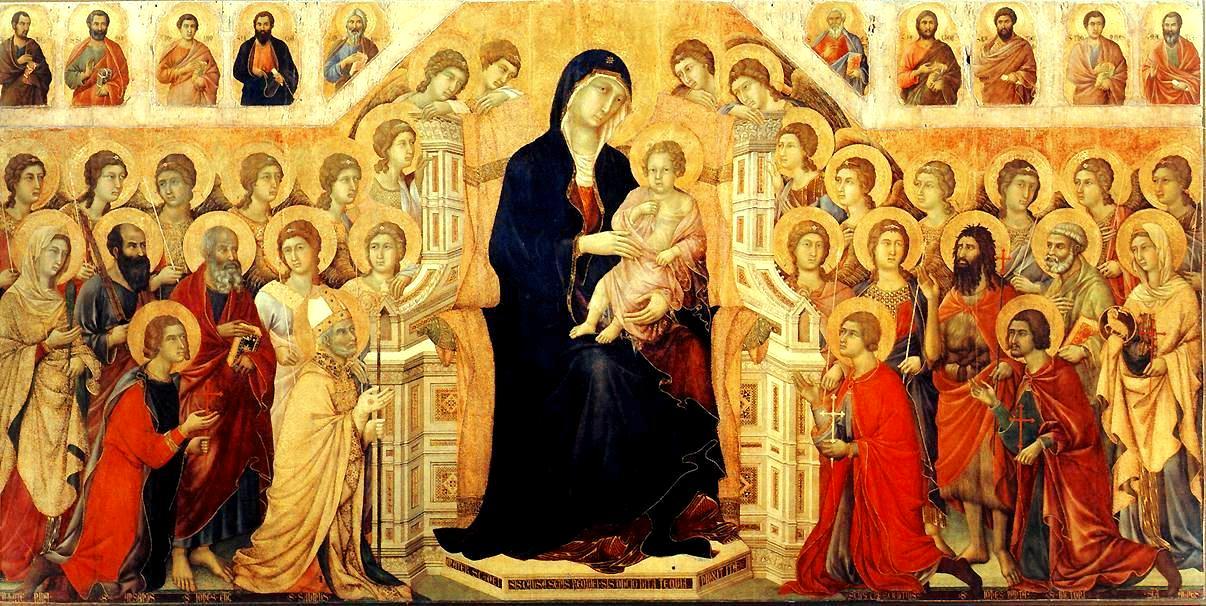
Maesta, front panel The Madonna and Child enthroned among angels, saints and the four patron saints of Siena kneeling at their feet. The front panel of the altarpiece Duccio contracted to paint for Siena Cathedral's high altar in 1308, now in the Museo dell'Opera del Duomo, Siena. No verified portrait. No securely identified likeness of this maker is known under a free licence. We do not publish a face we cannot verify.
Museo dell'Opera del Duomo, Siena| Worked as | Painter |
|---|---|
| Born | c. 1255-1260 (no birth record survives) · presumed Siena |
| Died | late 1318 or 1319 (the last document naming him, October... · Siena |
| Nationality | Sienese (Italian) |
| Movement | Founder of the Sienese school |
| Sources | 19 cited |
| Last verified |
About this page Last verified · 19 sources cited
On this page 12 sections
ContentsClose
Duccio di Buoninsegna is the founder of the Sienese school of painting and, by his own hand, one of the least documented major artists of the Italian Middle Ages. No birth record survives. What survives instead is a paper trail of fines, debts and a will his own children refused, plus a body of paintings that has to be reassembled from wreckage rather than read off a wall. About a dozen to thirteen independent panels are now widely accepted as his, and one of those panels is not really one panel at all: it is the surviving fraction of the Maesta, the altarpiece he contracted to paint for the high altar of Siena Cathedral in 1308, for what was reported at the time to be the largest sum ever paid to a painter.
The single thing most readers do not know is what happened to it afterward. In 1771, workmen sawed the Maesta into pieces so that its front and back could be displayed separately against two different chapel walls. The cut was rough, the frame was destroyed, and the smaller panels began drifting onto the antiques market. Two and a half centuries later, more of Duccio's accepted work hangs in London, New York, Fort Worth and Madrid than remained in Italy after the saw did its work, and several of those panels can be traced through the same string of dealers and collectors as they crossed the Atlantic. That dispersal, not any single masterpiece, is the record this page exists to keep straight.
No portrait of Duccio survives, and none is known ever to have existed. That is the correct, unforced answer for a painter this early and this poorly documented, and it is treated here as a finding rather than a gap to be papered over.
Images
Chronology
- 1278
First documented activity: paid by the commune of Siena to decorate twelve strongboxes for the treasury.1
- 1279
Decorates the cover of a treasury account book; the first of many recorded fines and debts begins.1
- 1280
Fined 100 lire by the commune for a reason not recorded.1
- c. 1283-1284
Paints the Crevole Madonna, accepted by nearly every scholar as an early autograph work.13
- 1285, 15 April
Contracted by the Compagnia dei Laudesi to paint the Rucellai Madonna for Santa Maria Novella, Florence, for 150 lire.5
- 1302
Paid by the Nove, Siena's ruling council, for a Maesta for the chapel of the Palazzo Pubblico; the work is now completely lost.3
- 1304
Buys a vineyard near Siena, evidence of a period of comparative prosperity.3
- 1308, 4-9 October
Contracted by the cathedral operaio Jacopo di Giliberto Mariscotti to paint the Maesta for the high altar of Siena Cathedral.32
- 1311, 9 June
The finished Maesta is carried in civic procession from Duccio's workshop to the cathedral and installed on the high altar.3
- 1313
Recorded once again deep in debt.1
- c. 1312-1315
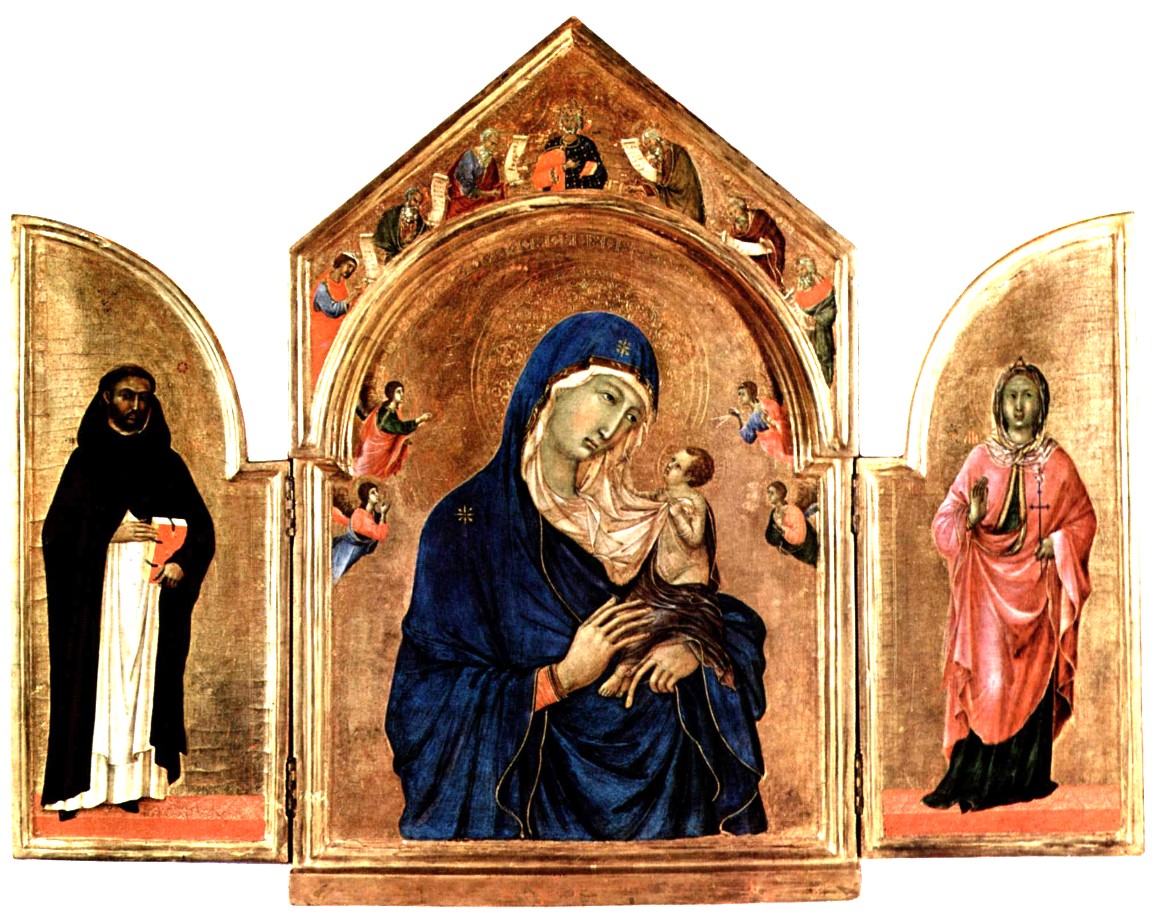
Paints the portable triptych The Virgin and Child with Saints Dominic and Aurea for Cardinal Niccolo degli Albertini da Prato.113
- 1318 or 1319
Dies in Siena; his wife Taviana is recorded as a widow.1
- 1319, October
His seven children formally renounce their claim to his estate, the last document to name him.1
- 1506
The Maesta is removed from the high altar to make way for Vecchietta's new bronze ciborium.4
- 1771, 1 August
The Maesta is sawn apart to separate its painted front from its painted back; the blade cuts through the Virgin's cheek.24
- 1798
A cathedral sacristy inventory records only eight predella scenes and twelve pinnacle panels surviving of the dismembered whole.2
- 1857
The National Gallery, London, buys The Virgin and Child with Saints Dominic and Aurea.11
- 1870
The Museo dell'Opera del Duomo opens in Siena.4
- 1878
The two main Maesta panels, two corner corbels and part of the predella are placed in the Museo dell'Opera del Duomo, eight years after it opened.4
- 1879
Dispersed predella panels, including the future Frick and Kimbell panels, recorded in the hands of Giuseppe and Marziale Dini near Siena.12
- 1883
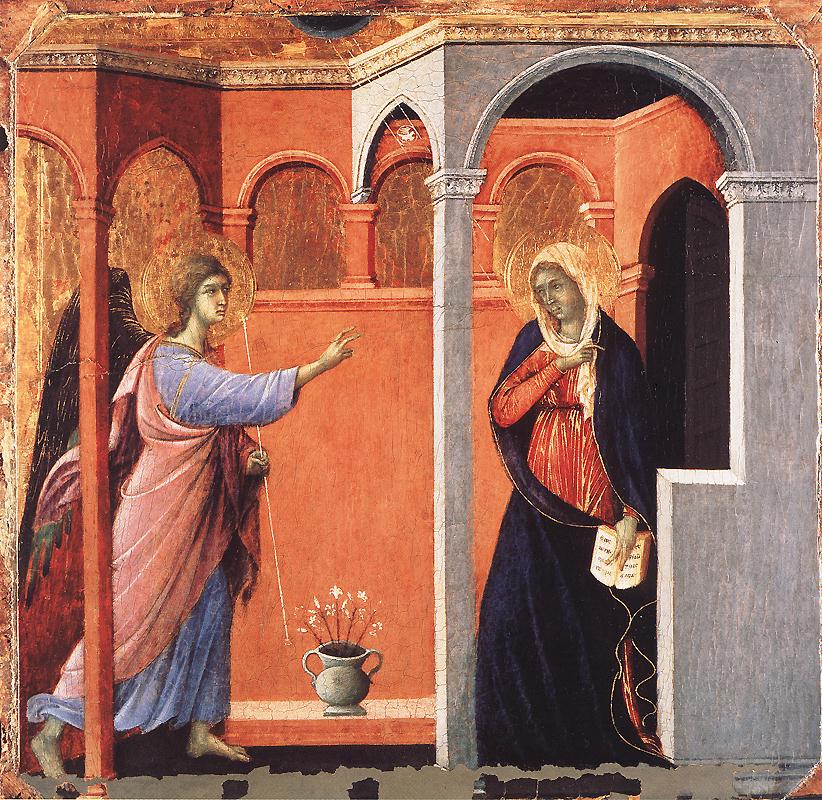
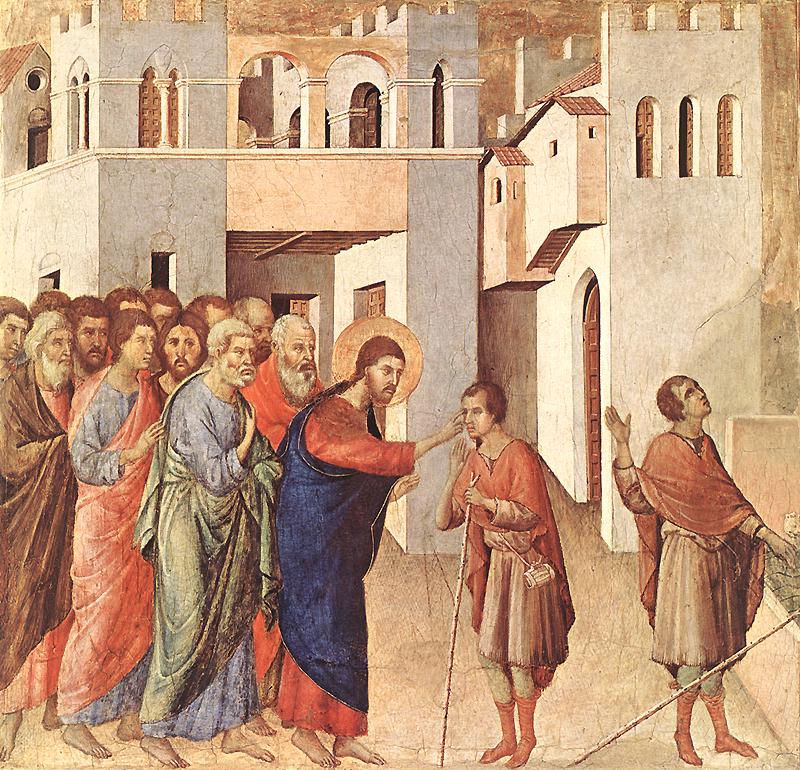
The National Gallery, London, buys The Annunciation and The Healing of the Man born Blind from the dealer Charles Fairfax Murray.89
- 1886
The Dini panels reach the London collectors Robert and Evelyn Benson, purchased through Charles Fairfax Murray.12
- 1889
Franz Wickhoff argues on stylistic grounds that the Rucellai Madonna, long given to Cimabue, must be Duccio's work.5
- 1891
R.H. Wilson gives The Transfiguration to the National Gallery, London.10
- 1927
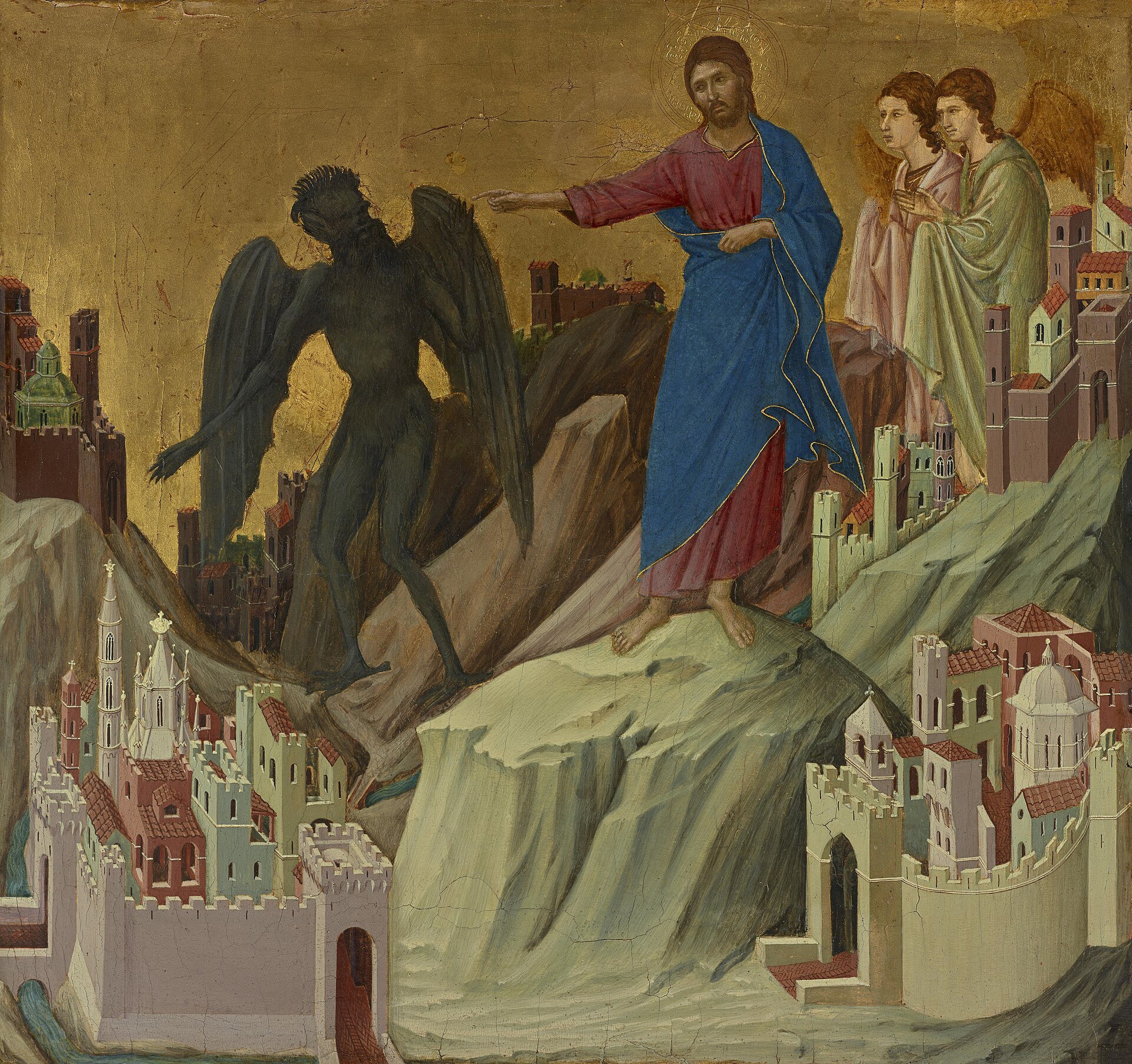
The Benson collection is sold to Duveen Brothers; The Temptation of Christ on the Mountain passes directly to the Frick Collection.12
- c. 1929
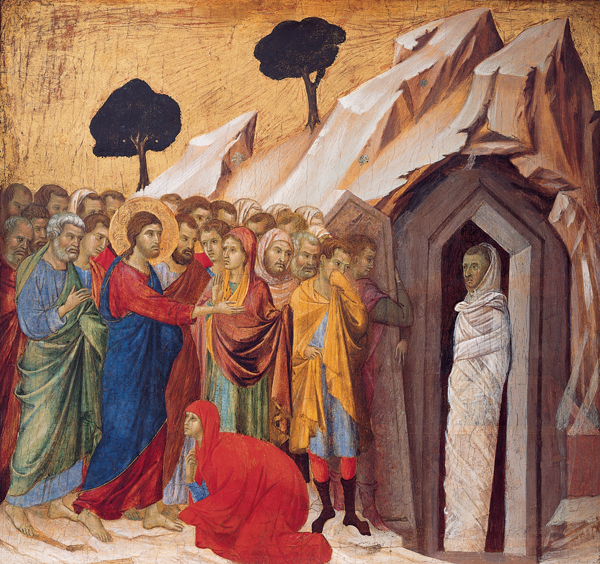
The Raising of Lazarus, from the same Duveen stock, is acquired by John D. Rockefeller Jr.12
- 1939
The Calling of the Apostles Peter and Andrew enters the Samuel H. Kress Collection at the National Gallery of Art, Washington.19
- 1960
The Raising of Lazarus passes by descent to David Rockefeller.12
- 1973
John White publishes his reconstruction of the Maesta's original physical structure.2
- 1975
The Raising of Lazarus is purchased by the Kimbell Art Foundation, Fort Worth.12
- 1979
James Stubblebine and John White publish rival full-length studies of Duccio in the same year, each proposing a different corpus.2
- 2004
The Metropolitan Museum acquires the Madonna and Child from the Stoclet heirs for 45 million dollars.67
- 2006-2007
James Beck disputes the Metropolitan's attribution in print; Keith Christiansen defends it on the basis of the museum's technical examination.6
The market
No autograph panel by Duccio has ever come to public auction in the modern era, because almost the entire accepted corpus is already in institutional hands, either in the Museo dell'Opera del Duomo in Siena or in the national and municipal museums that acquired the Maesta's dispersed fragments a century or more ago. None of those institutions is a plausible seller. When Duccio's name does appear in a sale room, it is exclusively on downgraded attributions, circle of, school of, or after, at small regional or online-only houses, for estimates in the low hundreds or low thousands of euros or dollars, with no verified hammer price meeting this record's sourcing standard. That absence is itself the finding: this is a painter whose name in trade signals a workshop or later copy, not the thing itself.
Where to see the work
| Institution | City | Holdings | Note |
|---|---|---|---|
| Museo dell'Opera del Duomo | Siena | The two main surviving Maesta panels, two corner corbels, part of the predella, and the Crevole Madonna. | The largest single holding of accepted Duccio material, reassembled here in 1878 after the 1771 dismemberment. |
| National Gallery | London | Three Maesta predella panels (The Annunciation, The Healing of the Man born Blind, The Transfiguration) and the portable triptych The Virgin and Child with Saints Dominic and Aurea. | The Transfiguration retains its original 14th-century Sienese frame; its two siblings were rehoused in 20th-century replica frames. |
| The Frick Collection | New York | The Temptation of Christ on the Mountain, from the Maesta's back predella. | Acquired in 1927 from the Duveen Brothers purchase of the Robert Benson collection. |
| Kimbell Art Museum | Fort Worth | The Raising of Lazarus, from the Maesta's back predella. | Traceable through the same Dini-Fairfax Murray-Benson-Duveen chain as the Frick panel before passing through the Rockefeller family to the Kimbell in 1975. |
| Museo Nacional Thyssen-Bornemisza | Madrid | Christ and the Samaritan Woman, from the Maesta's back predella. | |
| Metropolitan Museum of Art | New York | Madonna and Child, c. 1290-1300. | Not from the Maesta; acquired 2004 for 45 million dollars, and the subject of an unresolved attribution dispute. |
| Galleria degli Uffizi | Florence | The Rucellai Madonna, 1285. | Misattributed to Cimabue from the 16th century until 1889. |
| National Gallery of Art | Washington, DC | The Calling of the Apostles Peter and Andrew, from the Maesta's back predella. | Part of the Samuel H. Kress Collection. |
The essay
Chapter 1A name attached to almost no biography
Duccio's documented life is a list of scrapes, not a story.
Duccio's documented life is a list of scrapes, not a story. He first appears in 1278, paid by the commune of Siena to decorate twelve strongboxes for its treasury records; the following year he decorated the cover of an account book for the same office. From 1279 onward the Sienese archives record him repeatedly in debt or fined: a hundred lire in 1280 for an unrecorded offense, and further penalties over the years for breaking the civic curfew, entering private land and causing damage, refusing to swear fealty to the Capitano del Popolo, refusing military service, building over a public road, and, in one entry, an accusation of witchcraft. None of these documents describes a painting. They describe a man who was hard to manage and often broke.
He was not always broke: in 1304, between the two great commissions of his career, he had enough money to buy a vineyard outside Siena. By 1313 he was recorded deep in debt again. When he died, in late 1318 or in 1319 (the record is not precise enough to fix the month), he left a widow, Taviana, and seven children. The very last document naming him, from October 1319, is not a will but its opposite: his seven children formally renounced their claim to his estate, the standard medieval mechanism for refusing an inheritance that came with more debt than asset. Two of those children, Galgano and Giorgio, are recorded as painters in their own right. Nothing by either of them has been identified.
Chapter 2Whose pupil he was is not known
Standard accounts call Duccio a pupil of Cimabue, and it is argued rather than documented.
Standard accounts call Duccio a pupil of Cimabue, and it is argued rather than documented. No contract, no payment record and no contemporary text places the young Duccio in Cimabue's workshop; the claim rests entirely on the visual evidence of Duccio's earliest accepted panels, which speak a dialect of the same Byzantine-derived style Cimabue was working in in Florence. An alternative and equally undocumented proposal has Duccio travelling to Constantinople and learning Byzantine painting at its source rather than through a Florentine intermediary. Neither can be settled from what survives, and this page treats the training question as open rather than resolved in either direction.
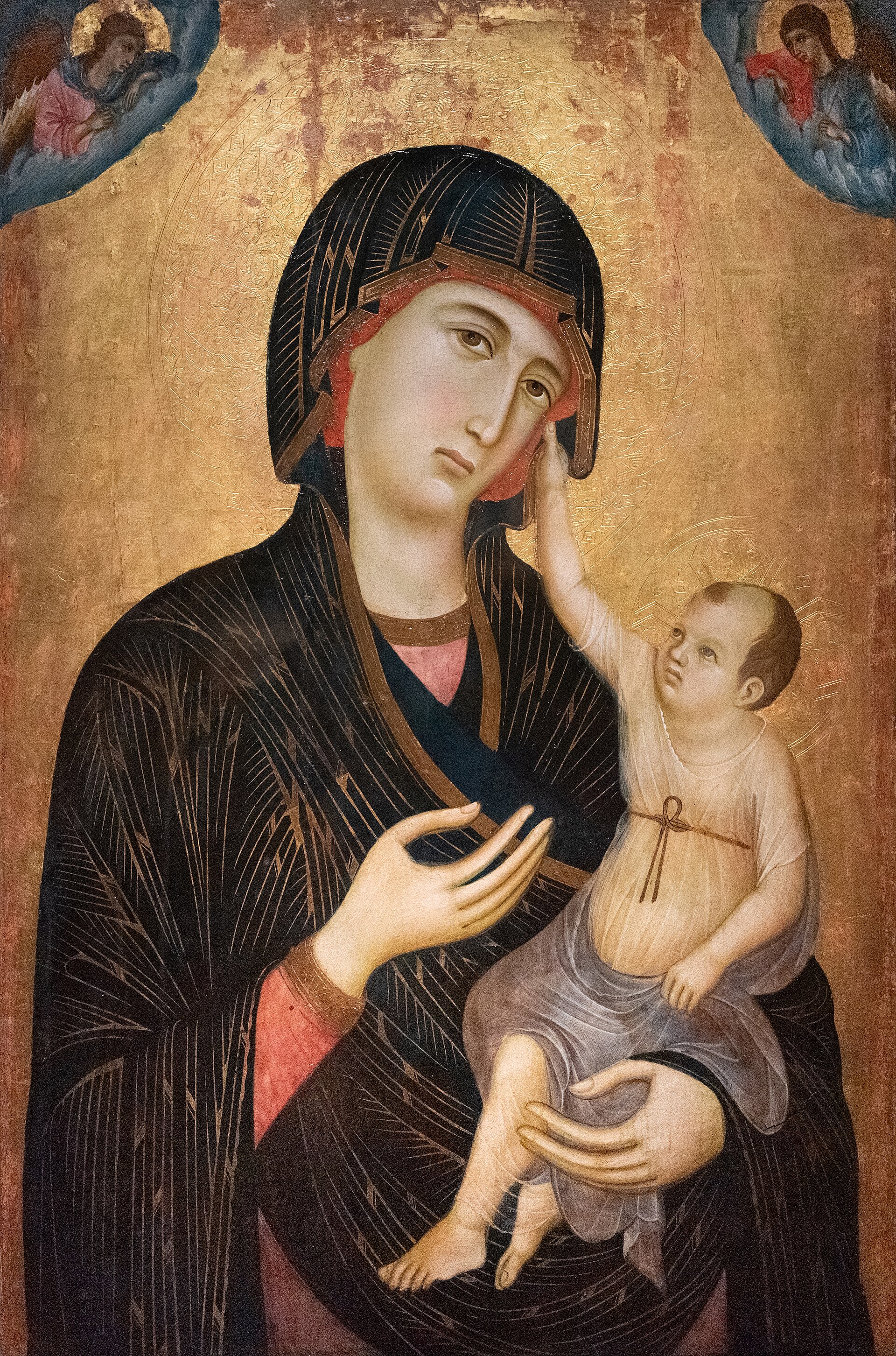
What can be shown, because the objects survive to compare, is the direction Duccio moved away from Cimabue once he was working independently. The Gualino Madonna (Turin, Galleria Sabauda, c. 1280-1283) is traditionally counted as Duccio's earliest accepted panel and is still catalogued that way in general reference works, but recent technical and restoration-based study has argued for reattributing it to Cimabue himself, on the strength of specific tooling methods (granitura) and ornamental punchwork said to be diagnostic of Cimabue's shop rather than Duccio's. The dispute is unresolved. The Crevole Madonna (c. 1283-1284, now Museo dell'Opera del Duomo, Siena), by contrast, is attributed to the young Duccio without conflicting opinions, and it is the panel usually used to demonstrate the break: set beside the closely related Madonna of Castelfiorentino, generally given to Cimabue, the Crevole Christ Child has a softer, less angular face, and the drapery has lost the harder Byzantine schematism. The Rucellai Madonna of 1285 completes the departure by introducing Gothic curves that never appear in Cimabue's own work.
Chapter 3The Rucellai Madonna and six centuries under the wrong name
On 15 April 1285 the Compagnia dei Laudesi, a lay confraternity devoted to singing the Virgin's praises, contracted Duccio to paint a large Madonna for their chapel in the Dominican church of Santa...
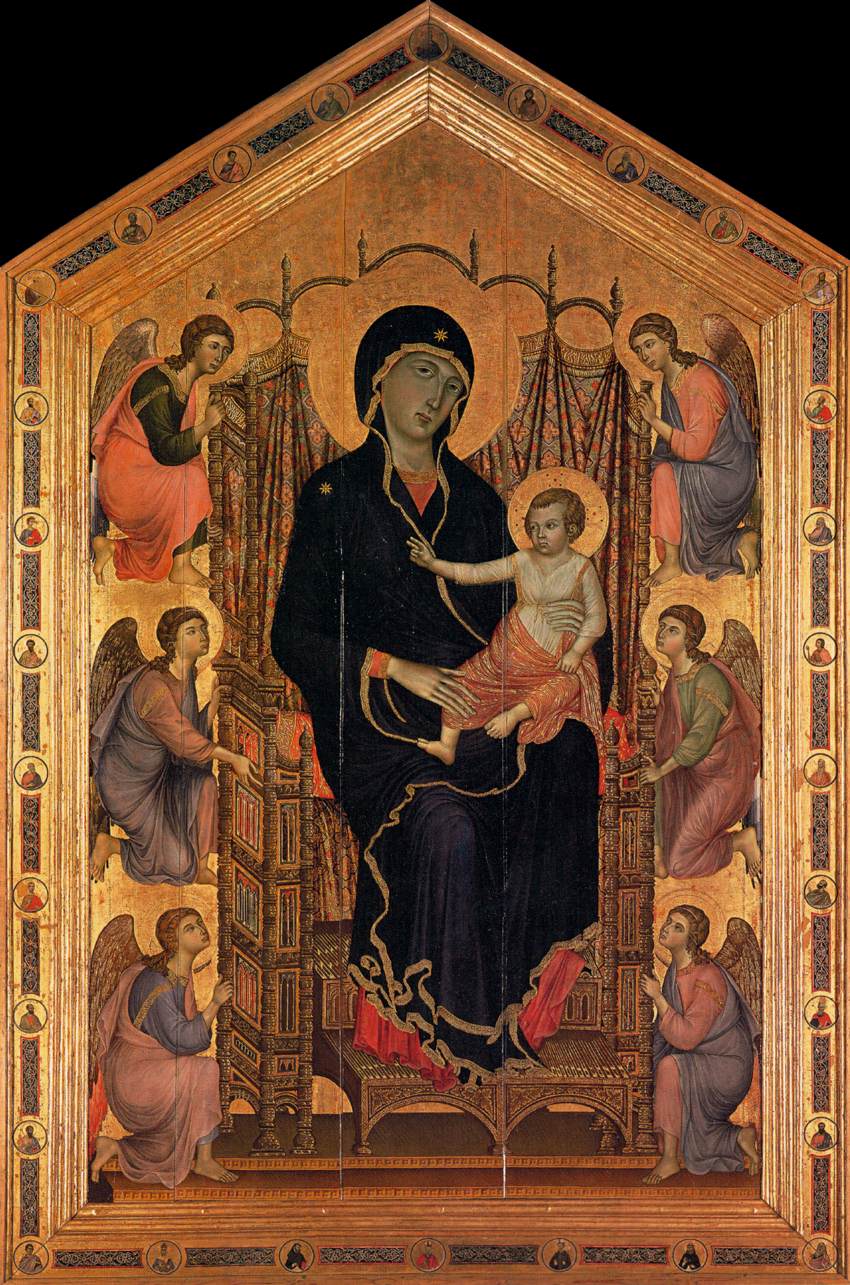
On 15 April 1285 the Compagnia dei Laudesi, a lay confraternity devoted to singing the Virgin's praises, contracted Duccio to paint a large Madonna for their chapel in the Dominican church of Santa Maria Novella in Florence. The contract survives and is unusually specific: Duccio was to work alone, without help from his workshop, was to be paid 150 lire, and was required to use costly ultramarine made from ground lapis lazuli for the Virgin's robe and real gold leaf for the ground. The panel itself, the largest painted in Tuscany in the thirteenth century, was supplied by the confraternity, which also retained the right to refuse the finished work if it was not satisfactory.
None of that protected Duccio's name. Giorgio Vasari, writing in the sixteenth century, attributed the picture to Cimabue, and the misattribution held for roughly three hundred years, reinforced by the two painters' genuinely close early styles. It was not until 1889 that the art historian Franz Wickhoff argued, on stylistic grounds tying the panel to Duccio's documented Maesta, that the Rucellai Madonna had to be Duccio's work, a case that persuaded the field. Even after that, a minority of twentieth-century scholars proposed splitting the difference with a hypothetical intermediate personality, a 'Master of the Rucellai Madonna,' rather than accept the reattribution outright. The panel moved from the Rucellai family chapel, where it had stood since 1591, to the Uffizi in the nineteenth century, and hangs there now, corrected but never quite free of the name it carried for longer than it has carried its own.
Chapter 4A city's vow made into a commission
Before the Battle of Montaperti in September 1260, with a Florentine army approaching, the Sienese swore in front of the cathedral's altar to place the city under the protection of the Virgin Mary if...
Before the Battle of Montaperti in September 1260, with a Florentine army approaching, the Sienese swore in front of the cathedral's altar to place the city under the protection of the Virgin Mary if she granted them victory. Siena won, and the Republic's subsequent self-image as a city belonging to the Virgin is documented policy, not later legend; it is the reason the high altar of Siena Cathedral was the single most important commission the city government could hand out, and the reason it went, in 1302, to Duccio for an altarpiece for the Palazzo Pubblico chapel of the Nove, the ruling council. That 1302 Maesta is completely lost; not a single fragment has been identified with it, and it survives only as a payment record.
The commission that does survive was drawn up on 4 October 1308 between Duccio and Jacopo di Giliberto Mariscotti, the cathedral's operaio, and he was formally set to work on 9 October. Under it Duccio swore on the Gospels to work in good faith and without fraud, to paint the whole work with his own hand and with all the skill God had given him, and to accept no other commission until it was finished. One surviving document from around this time also fixes piece-rates for the altarpiece's narrative scenes specifically: 34 stories on the back, together with the small angels painted above them, were aggregated to 38 units for payment purposes, at two and a half gold florins each, amounting to 95 florins in total, with the cathedral bearing the separate cost of panels, gesso and gold. Later accounts, repeated across general reference works, give an overall figure of 3,000 gold florins for the whole commission, described as the highest sum paid to a painter up to that date. The two figures describe different things, a piece-rate for part of the work and a reported grand total for all of it, and the surviving record does not fully reconcile them; this page states both rather than picking one.
Chapter 5What the altarpiece said, and to whom
The Maesta's programme was not private devotion, it was civic argument made in paint.
The Maesta's programme was not private devotion, it was civic argument made in paint. The vast front panel shows the Virgin enthroned in majesty, attended by a court of angels and saints, with the four patron saints of Siena kneeling at her feet in the position of intercessors specifically for the city. At the base of her throne Duccio painted his one surviving signature, an inscription that is simultaneously a prayer and a personal claim: 'Holy Mother of God, be thou the cause of peace to Siena and life to Duccio because he painted thee thus.' The order and prominence given to the Sienese saints was legible to a contemporary viewer as a picture of the city's own ideal hierarchy, not just a heavenly one.
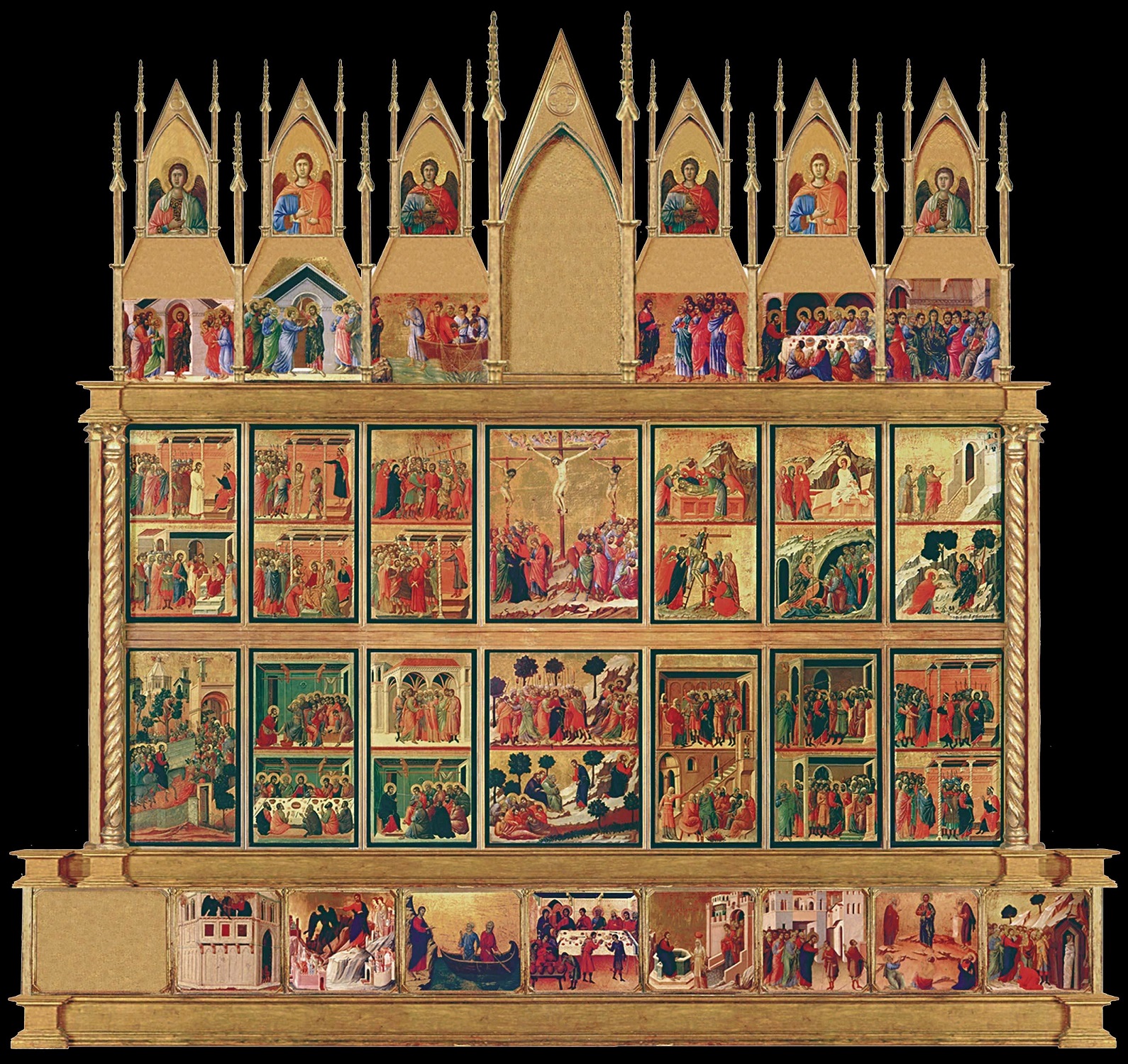
The predella that ran along the base of the front carried scenes from the infancy of Christ; the back of the altarpiece, subdivided into compartments illustrating the Passion, and its own predella of Christ's public ministry, brought the total to 59 narrative scenes across the whole double-sided structure. The materials were not incidental to the meaning. Ultramarine, ground from lapis lazuli quarried at Badakhshan in what is now Afghanistan and shipped to Italy by sea and along the Silk Road, cost more than gold by weight and was reserved, by convention and often by contract, for the robes of Christ and the Virgin alone; Duccio's own Healing of the Man born Blind, from the Maesta's back predella, is a standard example cited for exactly this use. Specifying it, as the 1285 Laudesi contract did explicitly and as the cathedral's own commission implicitly assumed, was a patron paying for holiness to be visibly, verifiably expensive.
Chapter 6Installed to public jubilation
The finished altarpiece was carried from Duccio's workshop to the cathedral on 9 June 1311 in a procession that the whole city turned out for: clergy, civic magistrates and the general populace...
The finished altarpiece was carried from Duccio's workshop to the cathedral on 9 June 1311 in a procession that the whole city turned out for: clergy, civic magistrates and the general populace, moving through the streets to drums and trumpets, with three days of alms distributed to the poor and public feasting to follow. Contemporary chroniclers treated the event as remarkable in itself, not merely as the installation of church furniture, and the episode is usually read as the first clearly documented moment in Italian art history when a city recognized, at the time and not only in retrospect, that a specific work by a specific painter was a masterpiece.
Chapter 7The saw of 1771
By the eighteenth century the Maesta had already been moved once, in 1506, when it was taken down from the high altar to make way for Vecchietta's new bronze ciborium and relocated, eventually...
By the eighteenth century the Maesta had already been moved once, in 1506, when it was taken down from the high altar to make way for Vecchietta's new bronze ciborium and relocated, eventually standing against a chapel wall where only one face could be seen at a time. The solution the cathedral authorities settled on in 1771 was to cut the object in two. On 1 August that year workmen sawed the altarpiece apart to separate its painted front from its painted back, so that both sides, hanging separately, could be seen at once. The poplar boards, glued and nailed together as a single thick support, resisted the saw; the operation was rough enough that the blade struck through the painted surface itself, leaving a scar across the Virgin's right cheek that is still visible today. The predella and the crowning pinnacle panels were not spared either.
The two main sections went to different altars in the cathedral. The smaller component panels, no longer part of a single object, fared worse: some were repaired in the sacristy, but for others this was the point at which dispersal onto the open antiques market began, and at least one predella scene, probably the Baptism of Christ, disappeared entirely and has never been recovered. An 1798 inventory of the sacristy already records only eight predella scenes and twelve pinnacle panels where more had existed. It took until 1878 for the two main panels, two corner corbels and part of the predella to be placed together in the Museo dell'Opera del Duomo, which had opened eight years earlier, in 1870; that remains their location today. Everything else was already gone.
Chapter 8Where the pieces went, and who moved them
Tracing the dispersed panels means tracing a specific art trade, not an abstract diaspora.
Tracing the dispersed panels means tracing a specific art trade, not an abstract diaspora. Several of the smaller pieces passed, by 1879, into the hands of Giuseppe and Marziale Dini of Colle Alto, near Siena, and from there were purchased through the London and Florence dealer Charles Fairfax Murray by the London collectors Robert Henry Benson and Evelyn Holford Benson, who had them by 1886. When the Benson collection was sold in 1927, it went en bloc to Duveen Brothers, the dealership that dominated the transatlantic trade in Italian primitives to American buyers in this period. From that single sale, The Temptation of Christ on the Mountain went directly to the Frick Collection in New York in 1927, where it remains. The Raising of Lazarus took a longer route out of the same Duveen stock: to John D. Rockefeller Jr. around 1929, by descent to his son David Rockefeller in 1960, and finally by purchase to the Kimbell Art Foundation in Fort Worth in 1975. Two panels sawn from the same altarpiece in 1771 passed through the same dealer's hands in the same year and ended up, decades apart, in two different American museums.
The National Gallery in London acquired its Maesta fragments by a different route entirely: the Annunciation and the Healing of the Man born Blind were bought in 1883, again from Charles Fairfax Murray, and the Transfiguration followed as a gift from R.H. Wilson in 1891. A fourth Duccio at the National Gallery, The Virgin and Child with Saints Dominic and Aurea, is not from the Maesta at all; bought in 1857, it is a small portable triptych, its wings folding in to protect the central image, made for private travelling devotion. Its subject is not generic: it was painted for Niccolo degli Albertini da Prato, who became Cardinal Bishop of Ostia in 1303, which is why Saint Aurea, the patron saint of Ostia, and Saint Dominic, whose order the Cardinal belonged to, flank the Virgin. The Museo Nacional Thyssen-Bornemisza in Madrid holds Christ and the Samaritan Woman, another back-predella scene, and the National Gallery of Art in Washington holds The Calling of the Apostles Peter and Andrew, acquired through the Kress Collection. Almost none of this material stayed in Italy by choice; it left because the panels had become detachable commodities the moment the saw finished its work.
Chapter 9A hand that took help, and how you can see it
Duccio ran a workshop and used it, including on signed, cathedral-commissioned work.
Duccio ran a workshop and used it, including on signed, cathedral-commissioned work. On the National Gallery's Healing of the Man born Blind, technical examination shows Duccio drawing the figures and sketching in the architecture himself, then handing the panel to an assistant who finished the architectural background, incising the straight lines with a ruler rather than freehand; the ruled incisions are still visible under close inspection and are physically distinct from Duccio's own freehand underdrawing elsewhere in the same panel. That single detail is as close as the surviving material comes to catching the division of labor inside Duccio's shop in the act.
The broader technical signature is consistent across the accepted panels: egg tempera bound with egg yolk, applied over gesso on poplar panel, with gold grounds built up through water gilding finished with punchwork tooling and, in places, mordant gilding for smaller passages. Incised underdrawing and brush underdrawing both appear, sometimes on the same panel, which is itself a workshop indicator. A recurring condition issue across multiple accepted panels, including the Metropolitan Museum's Madonna and Child and the Kimbell's Raising of Lazarus, is that the flesh tones have thinned with age to reveal the greenish terre verte underpainting beneath, so that faces read as sallow or green today in a way Duccio never intended; this is a conservation fact about survival, not a stylistic choice, and it is worth stating plainly because it affects how every one of these faces now looks to a visitor. Stylistically, what separates a Duccio autograph from Cimabue's work or from a close follower's is the same thing the Crevole Madonna demonstrates against the Castelfiorentino Madonna: softer, less angular modeling of the face, a shift from Byzantine schematism toward an observed tenderness between mother and child, and drapery that moves.
Chapter 10What is Duccio, and what only looks like him
General surveys put the accepted, independent corpus at roughly a dozen to thirteen paintings, a figure that is elastic mainly because it depends on whether the surviving compartments of the...
General surveys put the accepted, independent corpus at roughly a dozen to thirteen paintings, a figure that is elastic mainly because it depends on whether the surviving compartments of the dismembered Maesta are counted as one commission or as dozens of separate objects. Two full-length studies, both published in 1979, remain the working reference points and disagree with each other: James H. Stubblebine's two-volume Duccio di Buoninsegna and His School, and John White's Duccio: Tuscan Art and the Medieval Workshop. White's own 1973 reconstruction of the Maesta's physical, three-dimensional structure, rather than just its painted content, has since been revised by Christa Gardner von Teuffel; the exact original carpentry of the altarpiece is argued, not settled.
The most public recent dispute concerns a work that is not from the Maesta at all. The Metropolitan Museum's small Madonna and Child, known earlier as the Stroganoff Madonna and then the Stoclet Madonna after two of its collectors, was bought by the Met in 2004 for 45 million dollars, funded by pooled gifts from dozens of donors, from the heirs of the Belgian collector Adolphe Stoclet. In 2006 and 2007 the Columbia University art historian James Beck argued in print that the painting could not be Duccio's at all, calling it, in his own words, not even a good forgery, and pointing to the illusionistic parapet in front of the Virgin, a device he argued was not used in painting until roughly a century after Duccio's death. Keith Christiansen, the Met's curator of European paintings, rejected the claim and defended the attribution on the basis of the Museum's own technical examination of the panel's construction, underdrawing and pigments, arguing that the parapet is evidence of Duccio's innovation rather than evidence against him. Neither side has persuaded the other, and the dispute has not been independently settled since.
Chapter 11The nephew, the sons, and the painters who outgrew him
Duccio's only clearly documented direct follower is his nephew, Segna di Bonaventura, who most likely trained in his uncle's workshop and continued producing Duccio-derived Madonnas and altarpieces...
Duccio's only clearly documented direct follower is his nephew, Segna di Bonaventura, who most likely trained in his uncle's workshop and continued producing Duccio-derived Madonnas and altarpieces into the 1330s; four of his own signed works survive. Duccio's own two painter sons, Galgano and Giorgio, are recorded but their work has never been identified, a small, ordinary case of attribution loss inside the family itself. The wider generation that followed, Ugolino di Nerio and the Master of Badia a Isola among the closest imitators, and Simone Martini and the brothers Ambrogio and Pietro Lorenzetti among the artists who are usually described as having trained in or near his orbit, moved decisively beyond him; art history treats Simone Martini and the Lorenzetti as major independent painters in their own right rather than as Duccio followers, precisely because their mature work no longer reads as derivative of his.
Chapter 12A market that essentially does not exist
No autograph panel by Duccio has ever been offered at public auction in the modern era.
No autograph panel by Duccio has ever been offered at public auction in the modern era. This is not an accident of taste; it is a direct consequence of the dispersal history above. Virtually the entire accepted corpus sits in institutional hands, either in the Museo dell'Opera del Duomo in Siena or in the national and municipal museums that bought or received the Maesta fragments a century or more ago, and none of those institutions is a plausible future seller. When the name Duccio does appear at auction, it is exclusively as a downgraded attribution, 'circle of,' 'school of,' or 'after,' at small regional or online-only houses, for low estimates in the hundreds or low thousands of euros or dollars rather than anything approaching the value of an autograph work, and none of these listings has a verified hammer price meeting the sourcing standard of this record. The absence of a real market is itself the finding: Duccio's name in trade almost always signals a workshop or later copy, and a buyer who sees it attached to anything offered for sale should treat that as the starting assumption, not an exception to it.
What is documented
Technique
The surviving work
- What is accepted
- General reference works place the independent, widely accepted corpus at roughly a dozen to thirteen paintings, as of current scholarship. The figure is elastic because it depends on whether the dozens of surviving compartments of the dismembered Maesta are counted as a single commission or as separate items.
- What is contested
- The Gualino Madonna (Turin), traditionally Duccio's earliest accepted panel, has recently been argued on technical grounds to be Cimabue's instead; the dispute is unresolved. The Crevole Madonna is attributed to the young Duccio without conflicting opinions among scholars. The Metropolitan Museum's Madonna and Child, bought in 2004 for 45 million dollars, was publicly challenged as not by Duccio at all by James Beck in 2006-2007; the Met's curatorial department rejects the challenge and neither position has been independently settled since.
- Who rules on attribution
- No authentication board or foundation rules on Duccio attributions. Disputes are argued out between individual scholars and settled, when they are settled at all, by the holding institution's own technical examination, as in the Metropolitan Museum's defense of its Madonna and Child against James Beck's challenge.
Catalogue raisonne
- James H. Stubblebine, Duccio di Buoninsegna and His School, Princeton University Press, 1979 (2 volumes). The fuller catalogue of Duccio and his workshop and followers.2
- John White, Duccio: Tuscan Art and the Medieval Workshop, Thames and Hudson, 1979. Focused on Duccio's own hand and, separately, on reconstructing the Maesta's original physical structure; White's 1973 structural reconstruction was later revised by Christa Gardner von Teuffel.2
Questions about Duccio di Buoninsegna
Who was Duccio di Buoninsegna?
Painter. active c. 1278, died 1318/1319.
When did Duccio di Buoninsegna live?
Born c. 1255-1260 (no birth record survives), presumed Siena; undocumented; died late 1318 or 1319 (the last document naming him, October 1319, records his sons renouncing his estate), Siena.
Where can you see work by Duccio di Buoninsegna?
Museo dell'Opera del Duomo (Siena); National Gallery (London); The Frick Collection (New York); Kimbell Art Museum (Fort Worth); Museo Nacional Thyssen-Bornemisza (Madrid); Metropolitan Museum of Art (New York).
What does the market for Duccio di Buoninsegna look like?
No autograph panel by Duccio has ever come to public auction in the modern era, because almost the entire accepted corpus is already in institutional hands, either in the Museo dell'Opera del Duomo in Siena or in the national and municipal museums that acquired the Maesta's dispersed fragments a century or more ago. None of those institutions is a plausible seller.
What is still unresolved about Duccio di Buoninsegna?
Which predella scene, probably the Baptism of Christ, went missing between the 1771 dismemberment and the 1798 sacristy inventory, and where, if anywhere, it survives.
Open questions
- Which predella scene, probably the Baptism of Christ, went missing between the 1771 dismemberment and the 1798 sacristy inventory, and where, if anywhere, it survives.
- What the Maesta's original three-dimensional carpentry and support structure actually looked like; John White's 1973 reconstruction has been revised by Christa Gardner von Teuffel and the point is still argued rather than settled.
- Whether the Metropolitan Museum's Madonna and Child is genuinely by Duccio; James Beck's 2006-2007 challenge was rejected by the Met's own curators but has never been independently resolved by a third party.
- Whether the Gualino Madonna in Turin is an early autograph Duccio or a work by Cimabue; recent technical and restoration-based scholarship argues for Cimabue against the traditional attribution.
- Whether Duccio trained under Cimabue in Florence or learned Byzantine painting directly, possibly through travel to Constantinople; no surviving document settles the question either way.
- The exact month of Duccio's death; surviving records fix it only to late 1318 or 1319.
- What became of the 1302 Maesta painted for the Palazzo Pubblico chapel of the Nove; it is documented as commissioned and paid for, and no fragment of it has ever been identified.
Sources
- 1Wikipedia, 'Duccio', consolidating the biographical record, documented fines and debts, family and death. en.wikipedia.org/wiki/...
- 2Wikipedia, 'Maesta (Duccio)', for the altarpiece's structure, the 1771 dismemberment, dispersal and the John White/Stubblebine scholarship. en.wikipedia.org/wiki/...
- 3Enzo Carli, 'Duccio: Later commissions', Encyclopaedia Britannica. britannica.com/biography/...
- 4Finestre sull'Arte, 'The Majesty of Duccio di Buoninsegna: a masterpiece of Italian art history', for the physical history of the 1506 move, 1771 dismemberment and 1878 reassembly. finestresullarte.info/en/...
- 5Wikipedia, 'Rucellai Madonna', for the 1285 contract terms and the Cimabue-to-Duccio reattribution history. en.wikipedia.org/wiki/...
- 6Wikipedia, 'Madonna and Child (Duccio, Metropolitan)', for the provenance, 2004 acquisition price, and the Beck-Christiansen attribution dispute. en.wikipedia.org/wiki/...
- 7The Metropolitan Museum of Art, object page for 'Madonna and Child' (2004.442). metmuseum.org/art/...
- 8The National Gallery, London, 'Duccio | The Annunciation | NG1139'. nationalgallery.org.uk/paintings/...
- 9The National Gallery, London, 'Duccio | The Healing of the Man born Blind | NG1140'. nationalgallery.org.uk/paintings/...
- 10The National Gallery, London, 'Duccio | The Transfiguration | NG1330'. nationalgallery.org.uk/paintings/...
- 11The National Gallery, London, 'Duccio | The Virgin and Child with Saints Dominic and Aurea | NG566'. nationalgallery.org.uk/paintings/...
- 12Kimbell Art Museum, object page for 'The Raising of Lazarus', including full provenance from the Dini family through Fairfax Murray, Benson, Duveen Brothers and the Rockefeller family. kimbellart.org/collection/...
- 13Wikipedia, 'Crevole Madonna'. en.wikipedia.org/wiki/...
- 14Wikipedia, 'Gualino Madonna', for the contested Duccio/Cimabue attribution. en.wikipedia.org/wiki/...
- 15Museo Nacional Thyssen-Bornemisza, object page for 'Christ and the Samaritan Woman'. museothyssen.org/en/...
- 16The Eclectic Light Company, 'Blue from over the sea: ultramarine', for the sourcing, cost and reserved use of ultramarine, illustrated with Duccio's Healing of the Man born Blind. eclecticlight.co/2025/...
- 17Dr Richard Stemp, '121 - A golden girl goes missing', for the iconography and cult of Saint Aurea of Ostia as it bears on the National Gallery triptych. drrichardstemp.com/2021/...
- 18The Frick Collection, object page for 'The Temptation of Christ on the Mountain'. Direct access was blocked by the site's bot-detection challenge; content is drawn from search-indexed extracts of the same page and should be re-verified against a direct fetch. collections.frick.org/objects/...
- 19National Gallery of Art, Washington, object page for 'The Calling of the Apostles Peter and Andrew'. Direct access was blocked (403); content is drawn from search-indexed extracts of the same page and the Samuel H. Kress Foundation's own collection page, and should be re-verified against a direct fetch. nga.gov/artworks/...
Last verified