Anna Atkins
 British (English) · 1799-1871
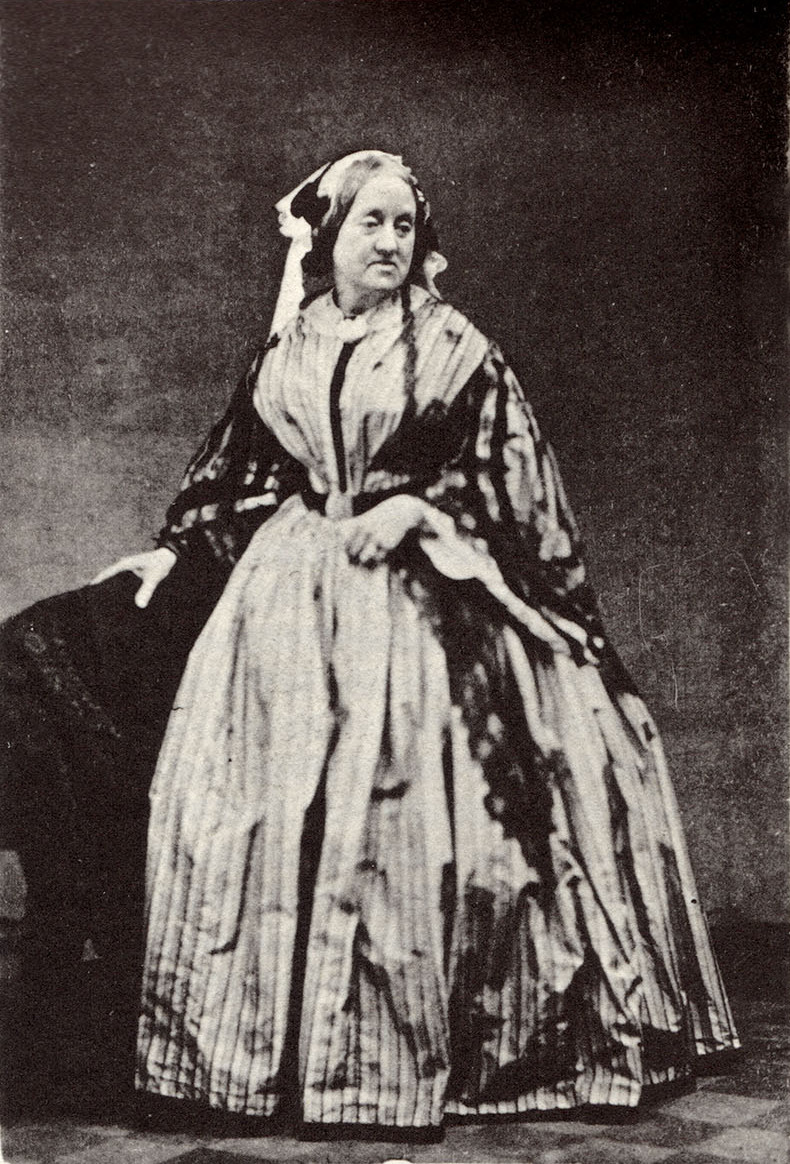
Photograph of Anna Atkins, an albumen print dated 1861 on Commons, source RPS Yorkshire, photographer unknown. The NHM captions the Commons image as her in 1861 and Tonbridge Historical Society says she was photographed at 62. Hyperallergic reproduced an Atkins portrait dated 1862 and credited to the Nurstead Court Archives, and this page could not tell whether it is the same photograph. No source opened disputes the identification, but the original print's whereabouts and exact date are not settled.
Unknown photographer; Commons file (PD-old), source RPS Yorkshire| Full name | Anna Atkins (nee Children) |
|---|---|
| Worked as | Botanist, Photographer, Cyanotype printmaker, Botanical illustrator |
| Born | 16 March 1799 · Tonbridge, Kent |
| Died | 9 June 1871 · Halstead Place, near Sevenoaks, Kent |
| Nationality | British (English) |
| Movement | Early British photography |
| Sources | 34 cited |
| Last verified |
About this page Last verified · 34 sources cited
On this page 13 sections
ContentsClose
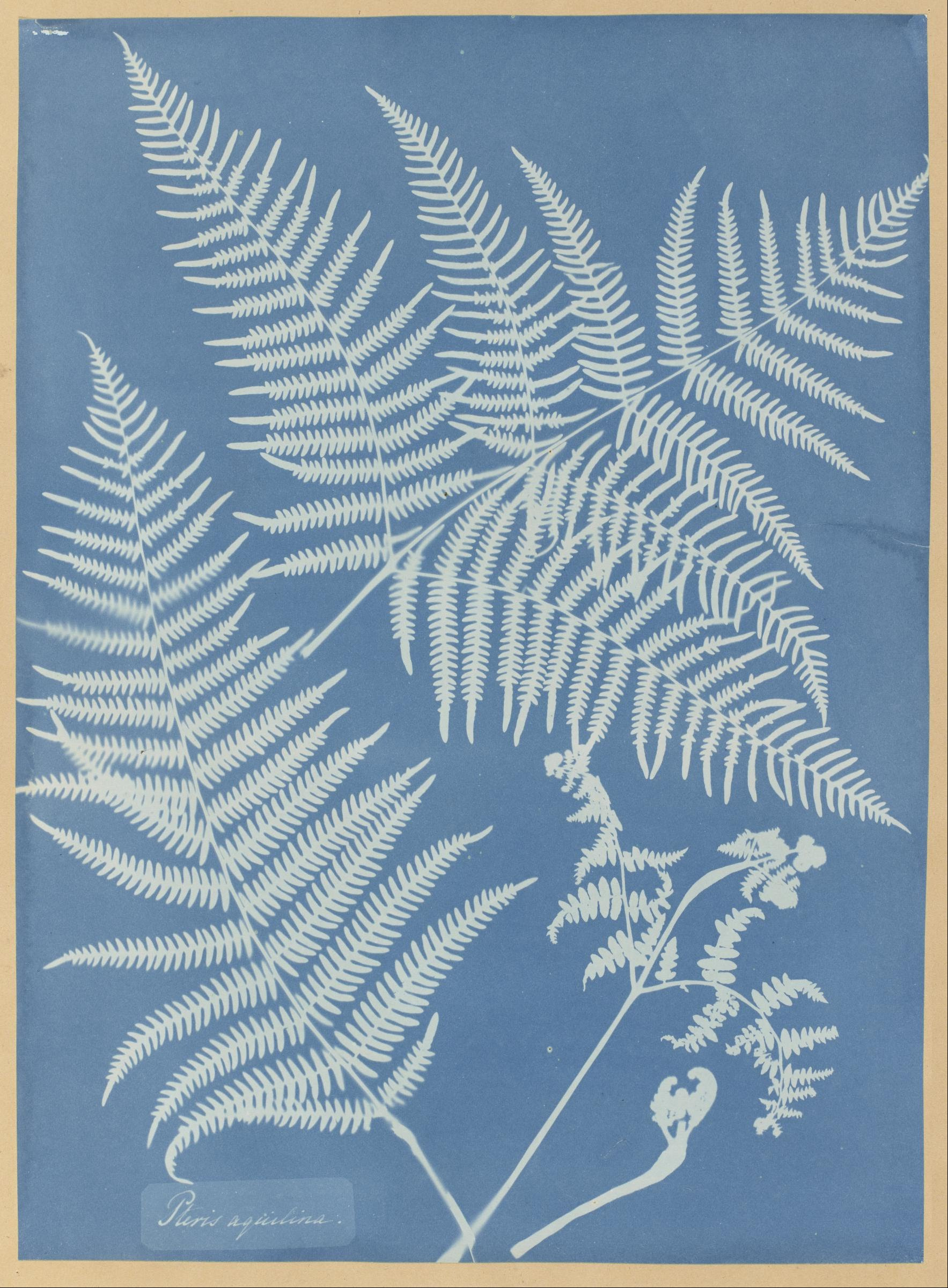
Anna Atkins spent ten years, from 1843, making cyanotype photograms of British seaweed by hand and posting them in unbound parts to her botanical friends, who bound them. The result, Photographs of British Algae: Cyanotype Impressions, is the work most scholars call the first book illustrated with photographs. Because the recipients did the binding and she kept replacing plates, no two copies match.
The number a reader most wants does not exist in any form this page could open. No published census of the copies turned up, and the counts in print run from about a dozen to nearly two dozen. For the plates it is worse: the Royal Society's own catalogue gives its three volumes as 425 plates plus 7 spares, while the figure usually repeated for the book 'as Atkins intended' is 389. The authorship also blurs after 1852, when her friend Anne Dixon began to help, and no source opened here says which leaf of the fern and flowering-plant albums is whose.
She signed the work A. A. Within a generation of her death the initials were being read as 'Anonymous Amateur', and her work reached beyond specialists only in the 1980s, through Larry Schaaf's 1979 article and his 1985 book. The market has followed the rediscovery: one reported sale of a copy in 1996 made GBP 133,500, a 2004 Christie's sale made GBP 229,250 and the Rijksmuseum paid a reported EUR 450,000 in 2017.
Images
Chronology
- 1799
Born 16 March at Tonbridge, Kent, only child of John George Children and Hester Anne Children.124
- 1800
Her mother dies; Anna is raised by her father and grandfather at Ferox Hall, Tonbridge.124
- 1813
The Tonbridge Bank fails; the Children family is ruined, leaves Ferox Hall and John George Children takes a British Museum post.23
- 1822-1824
Her shell drawings are published in her father's English translation of Lamarck's Genera of Shells.924
- 1825
Marries John Pelly Atkins on 30 August at St George, Bloomsbury, and moves to Halstead Place.221
- 1838
John Pelly Atkins inherits Halstead Place and his father's Jamaican and Bermudan estates.22
- 1839
- 1841
Harvey's Manual of British Algae appears, without illustrations; Atkins is known to have had access to a camera.1926
- 1842
Herschel's paper describing the cyanotype is read to the Royal Society on 16 June.20
- October 1843
First part of Photographs of British Algae issued, dedicated to her father, with an introduction signed A. A.132627
- June 1844
First fascicle of Talbot's The Pencil of Nature appears.1
- 1849-1850
Parts of British Algae are by now issued up to at least Part XII; Walther counts ten volumes of twelve prints sent by spring 1849.1113
- January 1852
Her father dies at her home; Anne Dixon stays at Halstead that summer and begins to help with cyanotypes.2323
- 1853
British Algae is declared complete; Atkins publishes the Memoir of her father; the fern album 'A. D. to H. D. 1853' is given to Henry Dixon.2323
- 1854
Atkins gives Anne Dixon an album of flowering plants and ferns; five mounted leaves given the same year surface at Christie's in 2023.419
- 1861
Photographed at about 62; the print is dated 1861 on Commons, and a portrait dated 1862 was shown in the NYPL's 2018 exhibition.1132
- 1864
Talbot refers to the unnamed lady who photographed British seaweeds.1012
- 1865
- 9 June 1871
Dies at Halstead Place aged 72.1
- 29 September 1872
John Pelly Atkins dies; the estate passes to a relative, sources differing on whom.2122
- 1888-1889
Her cyanotypes are exhibited for the first time by Apollo's account and A. A. is read as 'anonymous amateur'; the Rijksmuseum copy carries a label of 1889.125
- 1979
Schaaf publishes 'The First Photographically Printed and Illustrated Book' in the Papers of the Bibliographical Society of America.10
- c. 1981
The 1854 album of flowering plants and ferns is sold at auction and broken up.412
- 1985
Schaaf's Sun Gardens: Victorian Photograms is published by Aperture.11
- 19 May 2004
Robert Hunt's copy of 382 prints realises GBP 229,250 at Christie's London.15
- 11 November 2016
A 102-cyanotype album of British Algae realises EUR 219,000 at Sotheby's Paris.1617
- 2017
The Rijksmuseum buys a 307-plate copy, reported at EUR 450,000, and shows it in New Realities.51811
- 2018
NYPL exhibition Blue Prints and the revised Sun Gardens, by Schaaf and Joshua Chuang.11
- 2023
Taschen publishes a facsimile; Christie's online sells single leaves from the Dixon gift.121319
- November 2026
Steidl announces a facsimile of Herschel's own copy, 13 parts.14
The market
Her market is thin and two-tiered. Copies come up rarely, and the Rijksmuseum's curators said that the 307-plate copy they bought was the first voluminous one on the market since 2004. The prices are in the low to mid six figures: GBP 229,250 in 2004, EUR 219,000 for a 102-leaf album in 2016, and a reported EUR 450,000 in a private sale to the Rijksmuseum in 2017. Single leaves from the Dixon gift sold in an online sale in October 2023 at between USD 6,930 and USD 12,600 each by Art.Salon's list.
No source opened analyses what drives these prices. Hammer and premium are not separated in any source this page could open, so every figure below is a reported total or a price realised, and all are labelled as such. The 1996 sale is known only from Wikipedia's citation of a newspaper.
| Date | Sale | Work | Result | Note |
|---|---|---|---|---|
| 19 May 2004 | Christie's, London, Photographs sale, lot 48 | Robert Hunt's copy, 382 cyanotype prints in two volumes, with a later signed cyanotype reproduction by William Lang Jr. bound into volume I | Hammer Not found With premium GBP 229,250 price realised (estimate GBP 200,000-300,000) GBP | Art.Salon states price realised. Christie's price-realised figures are conventionally premium-inclusive, but this page did not open a Christie's page that says so for this lot, so the hammer is unknown. |
| 11 November 2016 | Sotheby's, Paris, Important European Collection, lot 15 | British Algae Vol. III, album of 102 cyanotypes, modern binding (title page and three text pages in cyanotype) | Hammer Not found With premium EUR 219,000 price realised (estimate EUR 120,000-180,000) EUR | Art.Salon figure; Sotheby's own result page is behind a login. Sotheby's catalogue says provenance Sun Pictures, Hans P. Kraus, New York. |
| Early 2017 | Private sale to the Rijksmuseum (no auction) | Copy of 307 plates, 19th-century binding, RP-F-2016-133 | Hammer Not applicable (private sale) With premium Not applicable; reported price EUR 450,000 EUR | DutchNews price, single outlet. The Rijksmuseum bulletin shows the chain through Weintraub, Oka Doner and the dealers Zucker Art Books and Hans P. Kraus Jr, with BankGiro Lottery and Rijksmuseum fund support. |
| October 2023 | Christie's, London, online sale, Gerald Fineberg Collection | Five 1854 cyanotype leaves given by Atkins to Anne Dixon, mounted (for example Lastoea Cristats, lot 110) | Hammer Not found With premium USD 6,930 to 12,600 per leaf, as listed by Art.Salon USD | Christie's says a buyer's premium is added to the final bid. This page cannot assign a price to each title. |
Hammer is the price at which the bidding stopped; with premium adds the fee the house charges the buyer on top. Hammer price and buyer's premium in the glossary.
Recorded without a public price
- 1996 · Photographs of British Algae, 411 plates in three volumes · Not named in the source; reported by The Guardian, 19 June 1996, per Wikipedia · Not found Reported figure GBP 133,500, split between hammer and premium not published in the source opened. Via Wikipedia only.
Where to see the work
| Institution | City | Holdings | Note |
|---|---|---|---|
| New York Public Library, Spencer Collection | New York | Herschel's own set of 13 parts, which the Herschel family kept as he received it, and digitised scans. | Steidl's facsimile reproduces this copy. |
| Rijksmuseum | Amsterdam | RP-F-2016-133, 307 plates, 19th-century binding, inscribed and labelled 1889. | CC0 images online. |
| The Royal Society | London | Three volumes, 425 plates plus 7 unbound, per its own record. | The copy Wikipedia calls the only one as Atkins intended, a view that its own count does not match. |
| Metropolitan Museum of Art | New York | Gilman Collection copy, accession 2005.100.557, numbered to at least item 154. | CC0 images. |
| J. Paul Getty Museum | Los Angeles | Part VII of British Algae (12 plates, 84.XA.1107); the 100-plate ferns album (84.XO.227); leaves from the 1854 flowering-plants album. | The ferns album was the gift of Anne Dixon to Henry Dixon in 1853. |
| British Library | London | A copy with extra plates, given to the British Museum (Wikipedia says through J. E. Gray), shelfmark C.192.c.1 per the British Library catalogue. | Wikipedia counts 429 scanned pages online. |
| Natural History Museum | London | A copy the museum describes as 411 plates, and the herbarium donated in 1865. | 424 pages digitised by Wikipedia's count. |
| Horniman Museum and Gardens | London | 14 text pages and 443 plates in four books, in the library by 1901. | Duplicates retained. |
| Beinecke Rare Book and Manuscript Library, Yale | New Haven | Album of 74 cyanotypes by Atkins and Anne Dixon, 1845-1861. | Fully digitised, per Wikipedia. |
| National Science and Media Museum (Science Museum Group) | Bradford | The second Atkins and Dixon fern album, per the Getty. | Not opened directly. |
Forgeries and misattributions
- A later cyanotype reproduction bound into an original copy
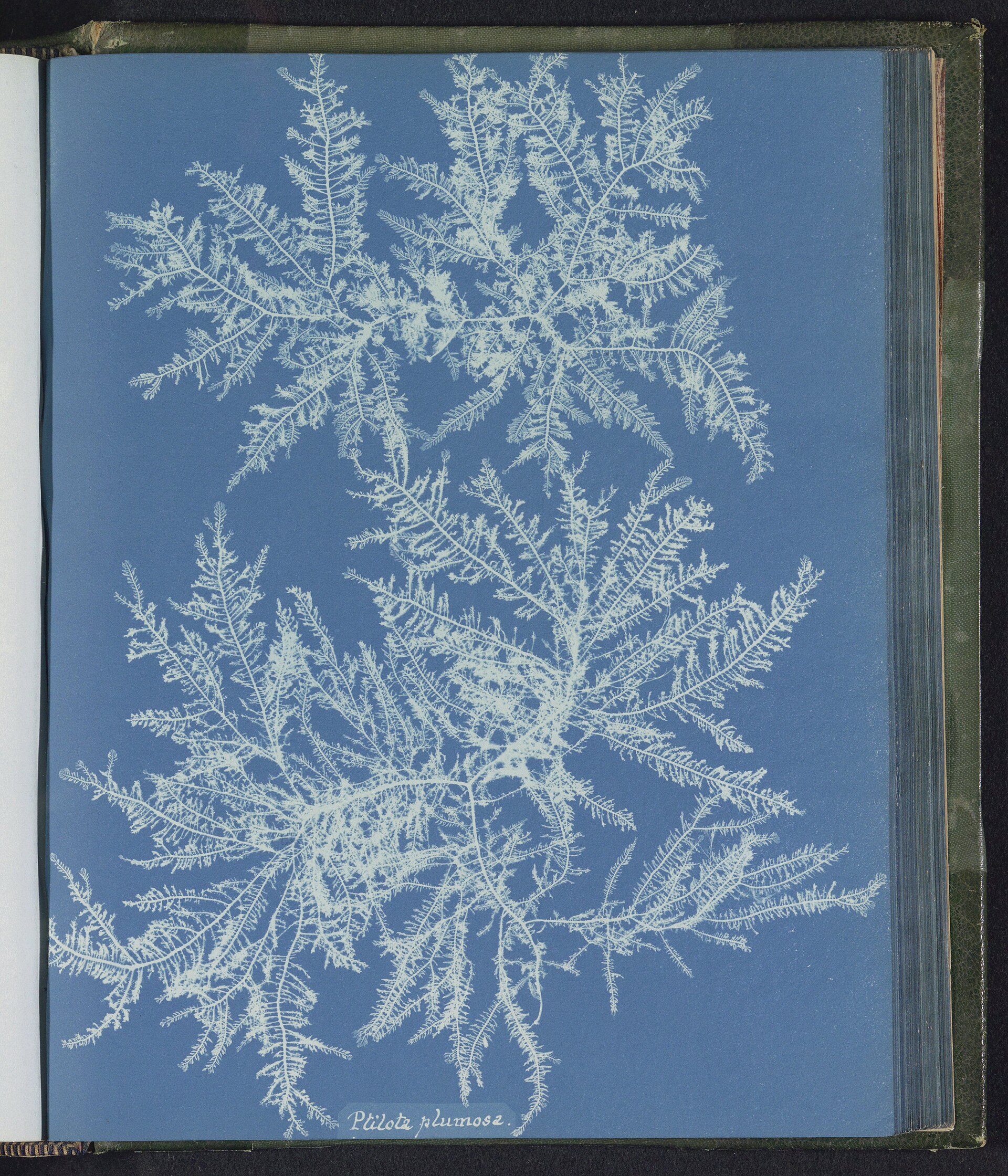
- Christie's 2004 description of Robert Hunt's copy says volume I was bound with one cyanotype print signed by William Lang Jr., with a printed caption 'Cyanotype Reproduction of Seaweed (Philota Plumosa)'. It is a reproduction of an Atkins plate, openly labelled, and it matters when a single leaf is offered without its volume. A printed caption and a signature inside the image, and the lot's own description. Tell: Atkins's captions are her handwriting, reproduced; Lang's is printed.15
- The initials A. A. read as 'Anonymous Amateur'
- Apollo says that when her cyanotypes were first exhibited in 1888 the curator assumed the initials meant anonymous amateur. Hyperallergic says William Lang Jr. proposed the reading and a British Museum curator corrected him. Either way, a nineteenth-century catalogue entry for 'A. A.' may be hers. Corrected by a curator who knew who had given the volumes, per Hyperallergic. This page opened neither original.1112
- Four novels falsely attributed to her
- Boase and Blain credit The Perils of Fashion, The Colonel, Murder Will Out and A Page from the Peerage to Anna Atkins, and the landed-families blog still calls her a published novelist. Routledge's contract ledgers identify the author as Clarinda Atkyns, according to the Victorian fiction database.2922
- Atkins and Dixon leaves
- Leaves credited to both women, from the 1853-54 albums and the Beinecke album, cannot be assigned to one hand. The Getty says it is difficult to know whether surviving works from this time were made by Atkins, Dixon or both. No method yet; Schaaf's 2018 book is the place to check.3425
The essay
Chapter 1No census of the copies exists, and the published counts run from a dozen to nearly two dozen
Scientific American (2021) says only around a dozen copies are known.
Scientific American (2021) says only around a dozen copies are known. Wikipedia and JSTOR Daily say seventeen. The Horniman Museum says seventeen other copies exist besides its own, which makes eighteen. The Natural History Museum says there are thought to be 20 known copies, 15 of them substantially complete. The Rijksmuseum's bulletin says fewer than twenty. Steidl's 2026 facsimile blurb says nearly two dozen substantially complete or partial copies. None of these gives a list a reader could check.
The print run is unknown. The Rijksmuseum's collection record says the number of copies 'will not have exceeded more than 25', and its bulletin says the size of the run is unknown. Peter Walther, writing in 2023, says around 15 copies of the first part went out in October 1843. The Rijksmuseum's own purchase was, in its curators' words, the first voluminous copy to reach the market since 2004.
The inventory the institutions cite is Schaaf's Sun Gardens: Cyanotypes by Anna Atkins (New York Public Library, 2018), the revised form of his 1985 Aperture book. The Getty cites its numbered entries 20 to 23 for individual copies and albums. This page could not open that book, so it states the disagreement and does not settle it.
Chapter 2The same book is 102, 154, 307, 382, 389, 411, 425, 443 or 463 pages, depending on the copy
Counts reported for single copies, each as the holder or seller states it: the Rijksmuseum copy has 307 cyanotype plates plus a title page.
Counts reported for single copies, each as the holder or seller states it: the Rijksmuseum copy has 307 cyanotype plates plus a title page. Robert Hunt's copy, sold at Christie's in 2004, had 382 cyanotype prints in two volumes, with 192 and 187 plates under the volume prefaces. The Horniman copy has 14 text pages and 443 plates, because Atkins sent better examples of some species and the original plates were kept. The Linnean Society's copy is catalogued as three volumes of 162, 152 and 99 plates, which sum to 413 on this page's arithmetic. The Natural History Museum gives 411. The Royal Society gives 425 plates in three volumes plus 7 never incorporated. The Universite de Montreal copy is described as 463 images in one binding, including a binder's note. The Metropolitan Museum's Gilman copy is numbered 2005.100.557, and its numbering runs to at least item 154. A Sotheby's album sold in 2016 had 102 cyanotypes.
Two figures carry the idea of a complete set. The Horniman says Atkins apparently intended 14 text pages and 389 plates, and Hyperallergic's report of the New York Public Library's 2018 exhibition says British Algae reached 389 unique plates by 1853. Wikipedia says the Royal Society's copy, with 403 pages and 389 plates, is thought to be the only existing copy as Atkins intended. The Royal Society's own object record says something else: fifteen part donations from October 1843 to the end of 1853, bound by the Society to Atkins's instructions into three volumes of 425 plates, with a further 7 plates 'believed to have been sent in to the Society as replacements but never incorporated'. These are two incompatible figures held by different sources. This page does not average them and cannot say whether the difference is one of counting or of content.
Replacement is documented in the plates themselves. The NYPL's 2018 show labelled one leaf 'Part IV, version 2 (1846 or later)', and the Horniman and Royal Society copies both carry duplicate or replacement plates. Anyone comparing two copies plate by plate has to expect that an alga appears in more than one state.
Chapter 3The first book of photographs is a claim with a definition attached
Carolyn Peter's 2019 Getty essay says British Algae 'is recognized as the first book of photographs'.
Carolyn Peter's 2019 Getty essay says British Algae 'is recognized as the first book of photographs'. The Natural History Museum calls Atkins the first person to illustrate a book with photographic images. Yale's library says it was the first book illustrated with photographs. Steidl calls it the first book illustrated by photography and the earliest sustained application of photography to science. The Royal Society's record is narrower: the first scientific manual printed using photography in place of conventional illustration. The standard scholarly statement is Schaaf's 1979 article in the Papers of the Bibliographical Society of America, titled 'The First Photographically Printed and Illustrated Book'. The word printed matters: the Getty essay says the whole book was made without a camera, including the title pages, the text pages, the name plates, the wrappers and the plates themselves, with the text contact-printed from Atkins's oiled handwritten pages.
The rival is William Henry Fox Talbot's The Pencil of Nature, whose first fascicle appeared in June 1844, about eight months after Atkins's first part, and which Wikipedia describes as the first commercially published book illustrated with photographs. So the priority holds if a privately issued set of unbound parts, handed out to friends, counts as a book. It fails if the word means a bound, published and sold work. This page found no scholar who names an earlier photographically illustrated book, so the dispute it records is over the definition and not over a rival.
The parts themselves are also less tidy than 'a book of 1843'. Schaaf, as summarised by JSTOR Daily, says the first set held the title page, an introduction in Atkins's handwriting reproduced photographically, and eight prints.
Chapter 4She issued it in parts, and the recipients made the books
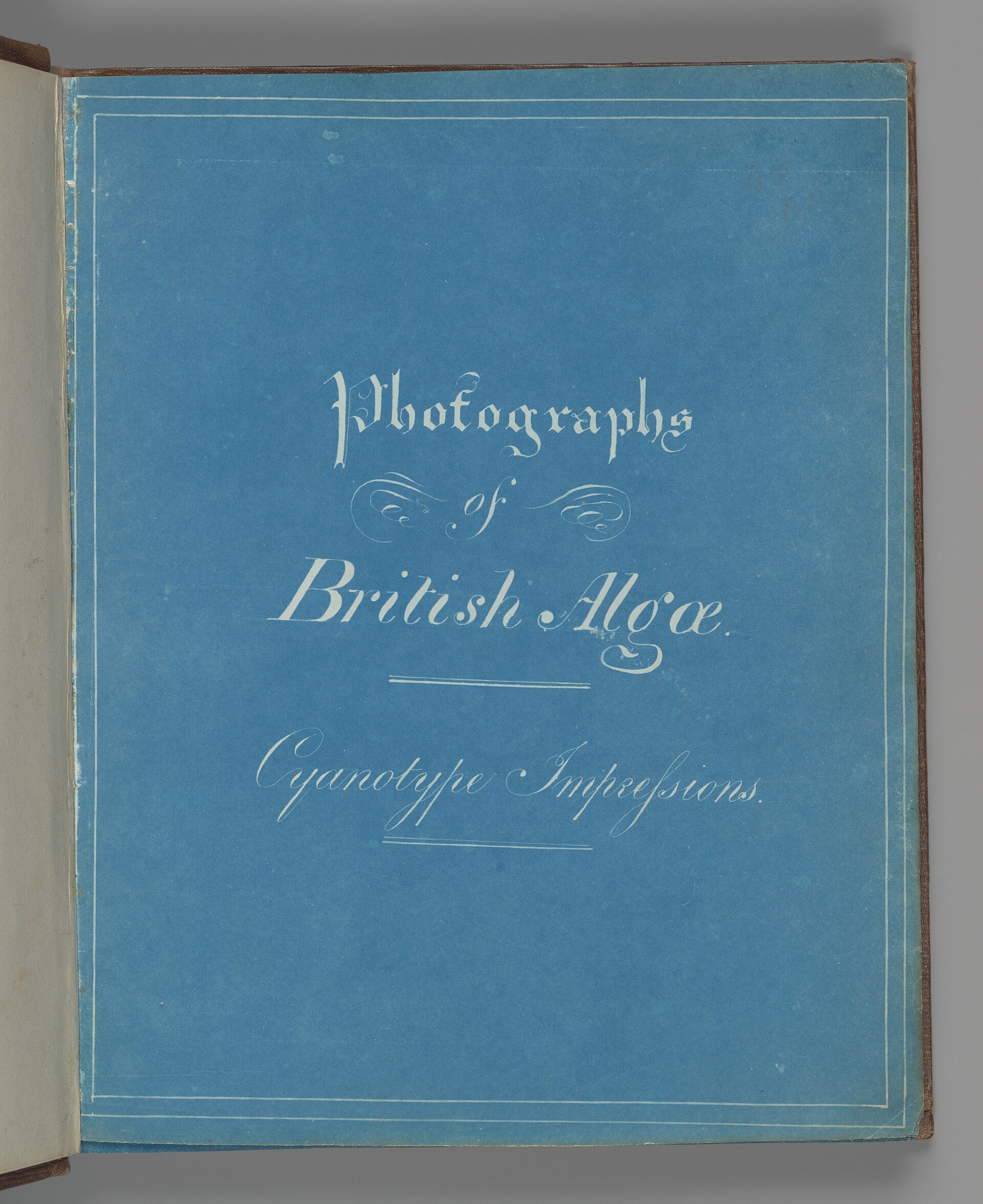
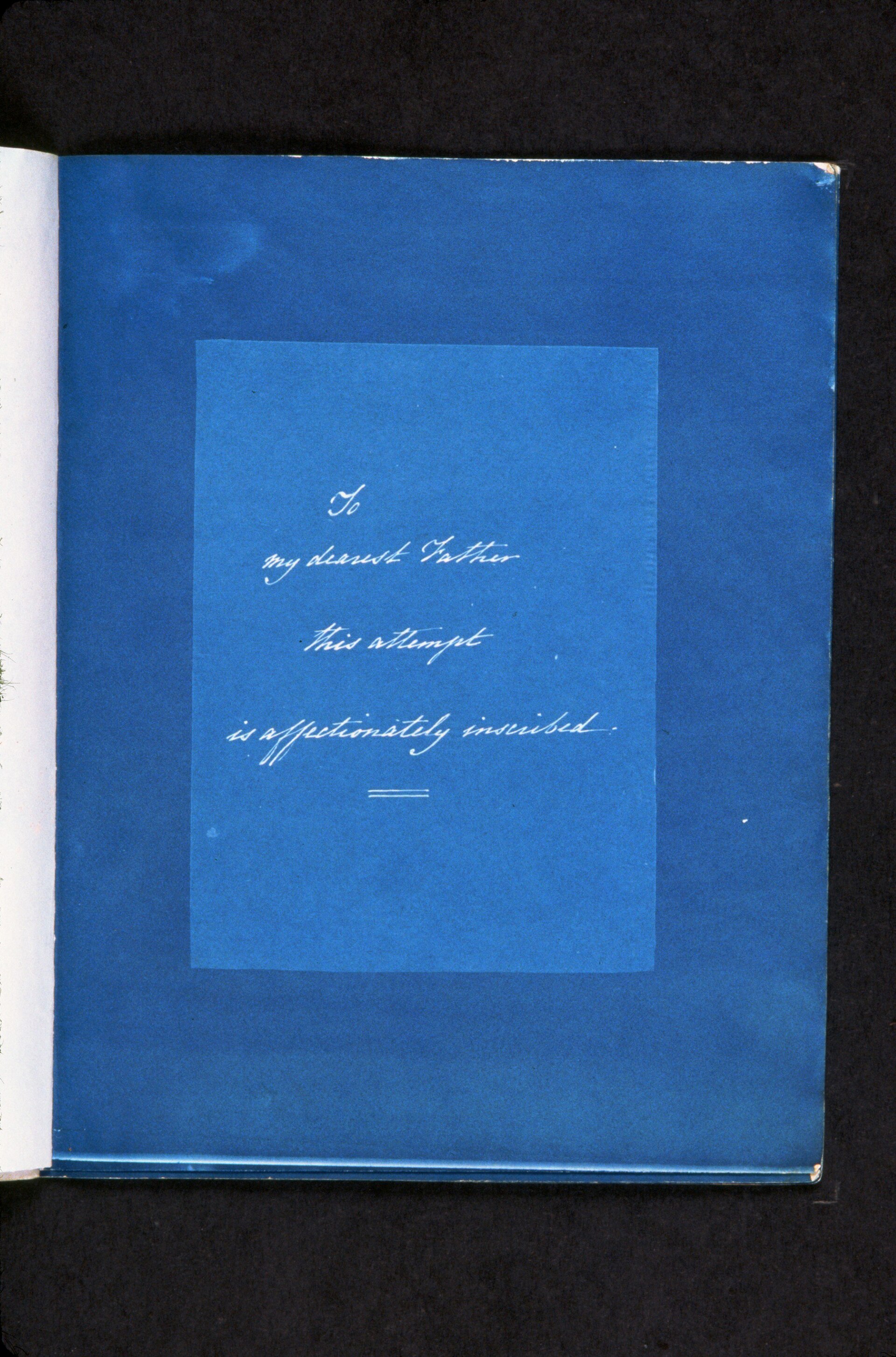
Part I carried a leaf in white script on blue: 'To my dearest Father this attempt is affectionately inscribed.' Her father, John George Children, was then 66.
Part I carried a leaf in white script on blue: 'To my dearest Father this attempt is affectionately inscribed.' Her father, John George Children, was then 66. The introduction on the next leaf, read here from the digitised NYPL plate, ends with the initials A. A. It says she turned to Herschel's process because of the difficulty of making accurate drawings of objects as minute as many of the algae. It also says the names follow Harvey's Manual of British Algae, that she had taken the tribes and species in proper order where she could, and that in the first number she had 'intentionally departed from the systematic arrangement' to give specimens of very various characters as a sample. She thanked the friends who had let her use their collections of algae. That is the documented statement of purpose, in her own hand.
The count of parts depends on who counts. The Getty essay says approximately twelve installments between 1843 and 1853. Walther says ten volumes of twelve prints each were sent out up to spring 1849. Steidl says the set she gave Herschel, now in the NYPL's Spencer Collection, is 13 parts, preserved by the Herschel family exactly as he received it. The Royal Society records fifteen donations to itself, the fifteenth being listed in its presents register as 'Volume III' in 1853. Recipients named by the Getty are Talbot, Herschel, Robert Hunt, the Royal Society, the Linnean Society, the British Museum and Library and the Museum of the History of Science at Oxford. Walther adds the book collector Thomas Phillips and the botanical gardens of London and Edinburgh.
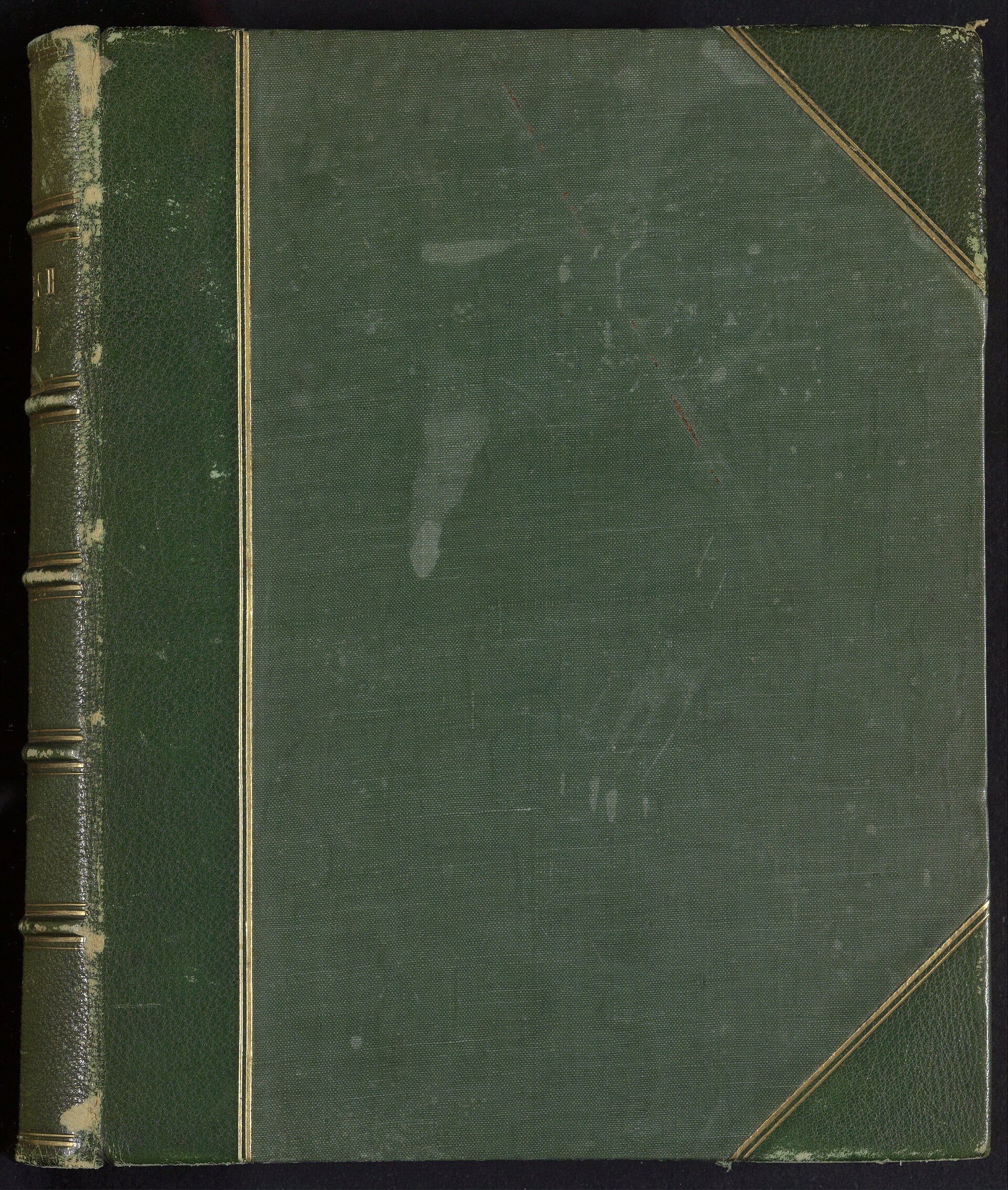
Binding was the recipient's job, to Atkins's written instructions and her contents lists. JSTOR Daily, summarising Schaaf, says the contents shifted as she revised the plan: by late 1850 she had sent a revised list for volume I, and the instructions for volume II followed in late 1851. Volume III was declared done in 1853, though it alluded to material that was never sent. That is why the copies differ in order as well as in size.
Chapter 5How the plates were made, and the tell
The Getty essay gives the chemistry: ordinary writing paper, British Whatman Turkey Mill in Atkins's case, coated with ferric ammonium citrate and potassium ferricyanide.
The Getty essay gives the chemistry: ordinary writing paper, British Whatman Turkey Mill in Atkins's case, coated with ferric ammonium citrate and potassium ferricyanide. The specimen was laid directly on the sheet, most likely under glass in a wooden printing frame, and set in the sun for five to fifteen minutes. The Rijksmuseum bulletin says the same range and adds that she coated each sheet, dried it in the dark, exposed it, developed it in water and dried it again. Plates measure about 250 by 200 mm, and the Rijksmuseum copy carries paper watermarked between 1840 and 1851. Christie's records Whatman Turkey Mill watermarks dated 1843 to 1851 in the Hunt copy. A sheet watermarked after 1853 would need explaining.
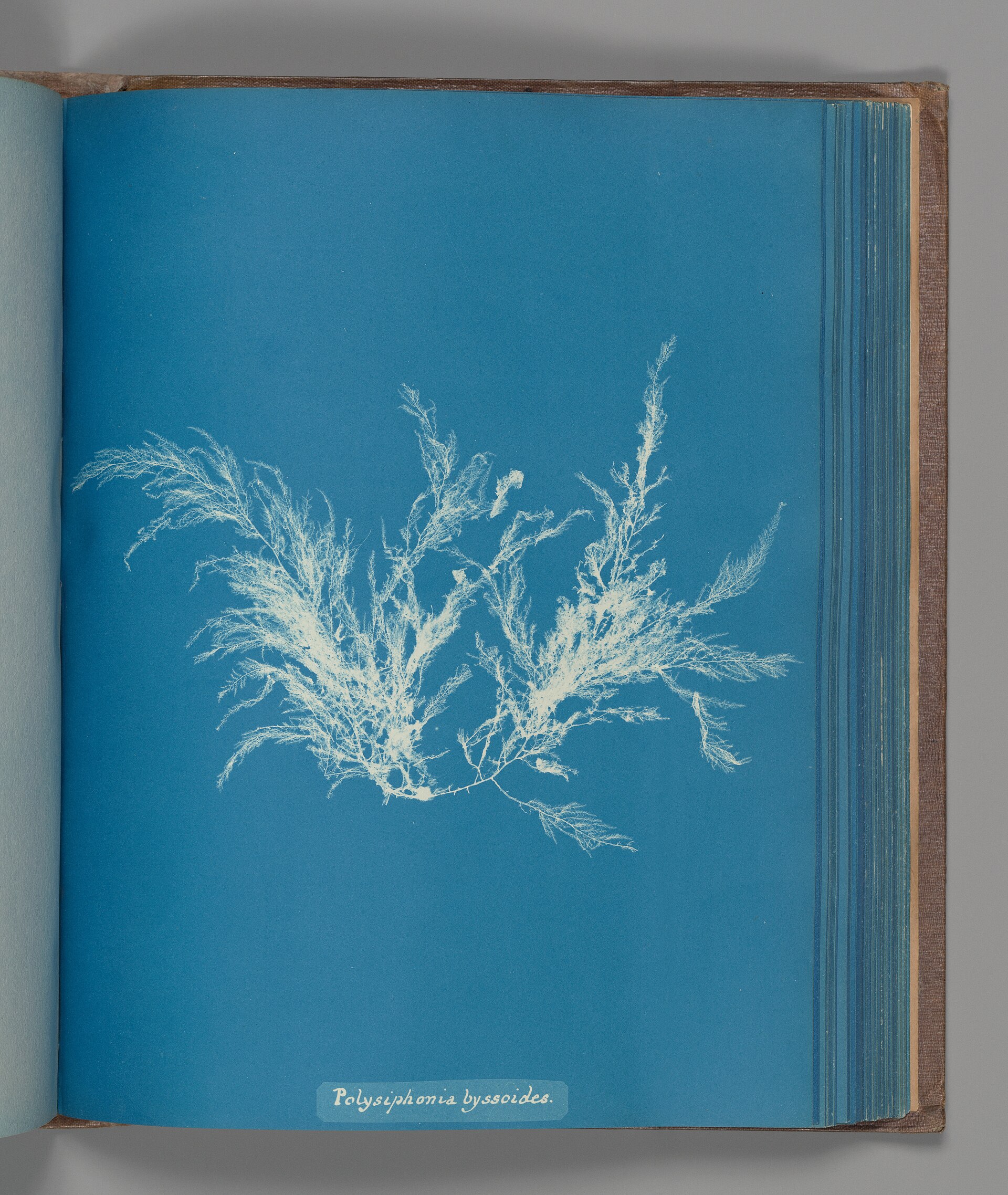
The tell is in the lettering. The Getty essay and Walther agree that each plate's caption is a contact print of Atkins's own handwriting on a label that had been oiled to make it translucent, laid on the sheet beside the specimen, so the name usually reads white on the blue inside the image. The Metropolitan's Polysiphonia plate, viewed for this page, instead shows a pale label with dark lettering, so the rule has variants. Walther adds that the backs of many sheets are pale blue, from which he infers that she often immersed the paper in the solutions and did not brush them on. A caption in ink or in type would not match the method the sources describe. The only printed in-image caption this page found is on William Lang Jr.'s reproduction in the Hunt copy, and that is openly a reproduction.
Her own introduction states the technique's limit. For the thick fuci, she wrote, the specimen's thickness made it impossible to press the glass close enough for a perfect representation of every part, and she preferred giving such impressions as she could obtain to omitting the species. Her own words say the result is imperfect for those plates; they do not say blurred. Walther says the plates carry serial numbers, that she rearranged the algae before each exposure so that two plates of one species differ in layout, and that the depth of blue varies from species to species.
No source opened describes any hand colouring of the plates: the colour is the Prussian blue of the process, and the variation in its depth is the exposure and the species.
Chapter 6Who stood beside her: servants, Anne Dixon and the attribution of the albums
The Getty essay says Atkins was 'most likely assisted by her servants and, in the later years, by her dear friend Anne Dixon' in making thousands of cyanotypes.
The Getty essay says Atkins was 'most likely assisted by her servants and, in the later years, by her dear friend Anne Dixon' in making thousands of cyanotypes. Other sources go the other way. The Natural History Museum says she made every print herself, and the Tonbridge Historical Society says she was personally responsible for the more than 400 plates in each copy. These are different claims about the same labour, and no source opened here records a servant's name.
Dixon's role is better documented but still unmeasured. Dixon came to Halstead Place for an extended stay in the summer of 1852, to comfort Atkins after Children's death that January, and the Getty essay says Schaaf suggests Dixon began assisting and making her own cyanotypes then or the next summer. From that point, in the Getty's words, it is difficult to know whether surviving works were made by Atkins, Dixon or both. Her identity is itself loosely handled. Apollo calls her Anne Dixon, nee Austen, a second cousin of Jane Austen who came to live with the Childrens in 1811. Tonbridge calls her Anne Austen. The Natural History Museum calls her Anna Dixon. The Getty gives her dates as 1799-1877 and Yale and Wikipedia give 1799-1864.
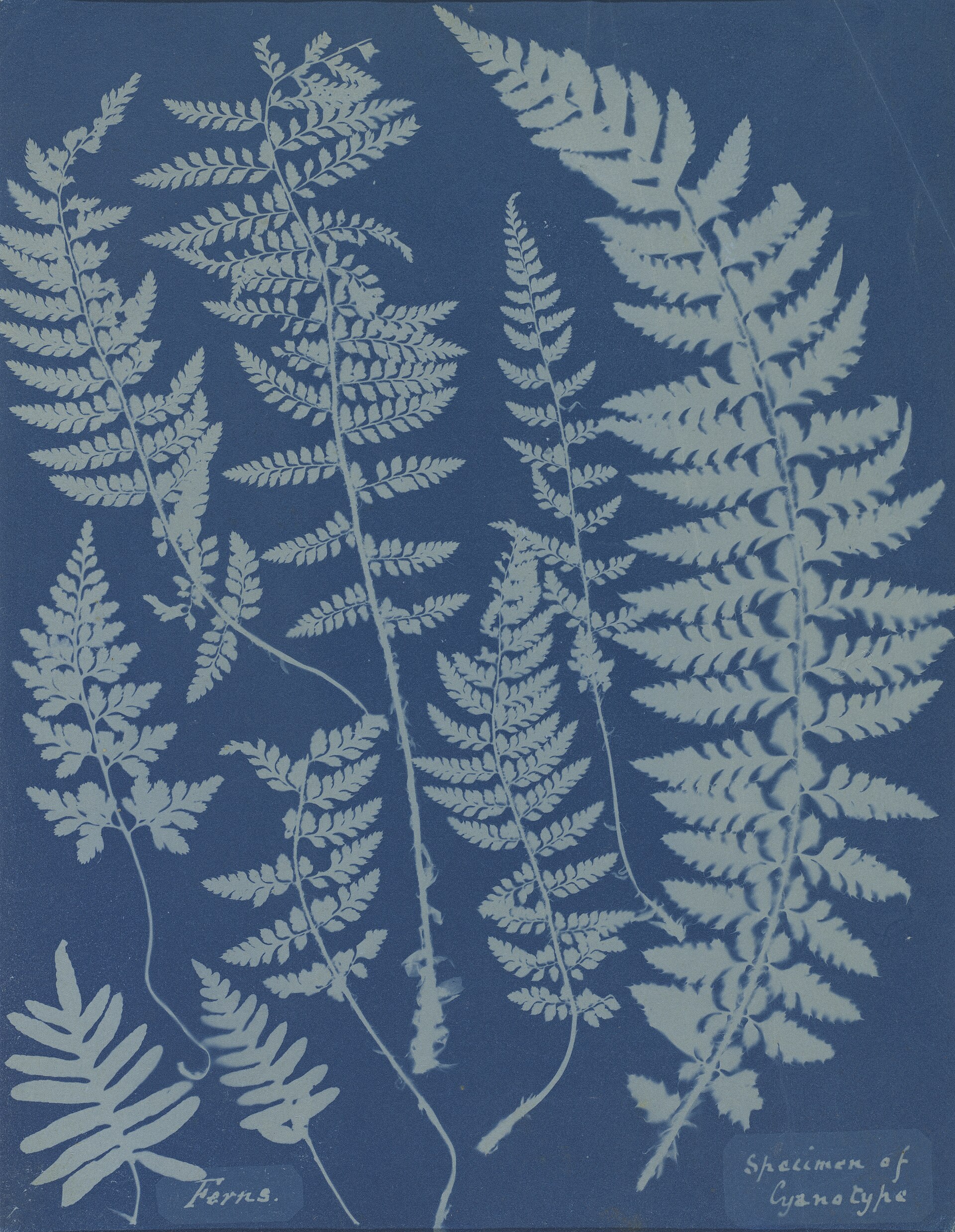
Three presentation albums are documented. The Getty's Cyanotypes of British and Foreign Ferns has 100 plates and was given by Dixon to her nephew Captain Henry Dixon in 1853, as the gilt stamp 'A. D. to H. D. 1853' on its cover shows. The Getty says one other album of the same subject and format is known, now in the Science Museum Group's collection at Bradford. A second album, Cyanotypes of British and Foreign Flowering Plants, was given by Atkins to Dixon in 1854 and stayed intact until around 1981, when it was sold at auction and broken up. Christie's said in 2023 that it sold five unique mounted leaves that Atkins gave to Dixon in 1854. Yale's Beinecke holds an unpublished album of 74 cyanotypes by Atkins and Dixon, dated 1845-1861 by Yale. A leaf credited to both is a leaf nobody can split.
Chapter 7A father at the British Museum, a husband in the West Indies trade, and what she read
Her mother, Hester Anne Children, died in 1800, and Anna was raised by her father and grandfather at Ferox Hall in Tonbridge.
Her mother, Hester Anne Children, died in 1800, and Anna was raised by her father and grandfather at Ferox Hall in Tonbridge. John George Children (1777-1852) was elected a Fellow of the Royal Society at thirty and later became its Secretary. When the Tonbridge Bank failed in 1813 the family was ruined and left Ferox Hall, and a post was found for Children at the British Museum, where he served for over twenty years. He died in January 1852 at his daughter's home. In 1853 she published a 313-page Memoir of him, privately.
Documented as training: the NHM says that in her early twenties she completed 256 drawings of shells for her father's English translation of Lamarck's Genera of Shells (1822-24), and Tonbridge says she contributed more than 200. The Getty essay documents her membership of the Botanical Society of London from 1839, one of the first scientific bodies to admit women, a letter of 1851 from Children to Sir William Hooker about the two women's plant collecting, and a letter she wrote to Hooker in 1864 offering Dixon's samples. The NHM adds that she supplied specimens to botanists at Kew.
Documented as method: she followed William Henry Harvey's Manual of British Algae (1841), which carried no illustrations, and by her own introduction her names refer to it. The Getty essay calls the book an unofficial illustrated companion to Harvey's. That is the whole of the intellectual programme the sources support. No library list, society address or letter was found in which Atkins takes a side on how algae should be classified, on Lamarck's transformism, or on anything beyond Harvey's arrangement and Herschel's chemistry. Her father's translation of Lamarck is a fact about her father's bookshelf and her own drawing hand. Whether it shaped her views is not documented, and this page does not claim it.
Chapter 8The money: a West India fortune, and what the sources do not show
John Pelly Atkins (1790-1872), whom she married on 30 August 1825 at St George, Bloomsbury, was a London West India merchant, partner with his father John Atkins (1760-1838), who was Lord Mayor of...
John Pelly Atkins (1790-1872), whom she married on 30 August 1825 at St George, Bloomsbury, was a London West India merchant, partner with his father John Atkins (1760-1838), who was Lord Mayor of London in 1818-19 and who owned a string of coffee plantations in Jamaica and Bermuda. John Pelly inherited Halstead Place and the Jamaican and Bermudan estates in 1838. They had no children.
The Natural History Museum says that John's wealth, in part derived from compensation paid to enslavers, helped fund Anna's endeavours. The UCL Legacies of British Slavery entry is more specific and cuts the other way for the son: it lists four claims for John Pelly Atkins, none in which he is recorded as an awardee. Two are marked unsuccessful claimant, one unsuccessful claimant (consensual) and judgement creditor, and one as a claimant in List E or Chancery cases and judgement creditor. It also says that his father John Atkins was successful in a number of other claims. The entry gives John Pelly's wealth at death as GBP 160,000, citing William Rubinstein. The landed-families blog gives GBP 160,000 both as what his father was worth at death in 1838 and as the ceiling of John Pelly's own estate in 1872. The same figure for two men is a coincidence or a conflation, and this page could not tell which.
What the records show: compensation claims for Jamaican and Bermudan estates were made by John Pelly Atkins with his father, and his father succeeded in others, and those claims were for enslaved people. Whether any compensation money reached Halstead is not shown in the records opened here. The project was self-funded. Apollo says she self-published at her own expense, in very small editions.
Chapter 9Forgotten within a generation: from Anonymous Amateur to Schaaf
In 1864 Talbot referred to Herschel's cyanotype by describing 'a lady, some years ago' who had photographed the entire series of British seaweeds and distributed the copies to persons interested in...
In 1864 Talbot referred to Herschel's cyanotype by describing 'a lady, some years ago' who had photographed the entire series of British seaweeds and distributed the copies to persons interested in botany and photography, as Schaaf's article is summarised by JSTOR Daily and quoted by Apollo. He did not name her. By Apollo's account her cyanotypes were first exhibited in 1888 and the curator assumed A. A. meant 'anonymous amateur'. Hyperallergic gives another telling: the book collector William Lang Jr. proposed 'Anonymous Amateur' in an article of the late 1800s and was corrected by a British Museum curator. This page found neither primary account. The Rijksmuseum copy carries a label dated 1889 and the inscription 'British Algae represented by the rare Cyanotype process unpublished', which shows how a copy in private hands was labelled around that time.
The NYPL's curator Joshua Chuang says her obscurity was largely because Atkins did not strive for recognition, so clues to her life and project were not preserved or scattered. It was not until the 1980s that her work reached beyond specialists, when Schaaf, researching Herschel, found her and published Sun Gardens: Victorian Photograms by Anna Atkins (Aperture, 1985). The NYPL's 2018 exhibition Blue Prints came with a revised Sun Gardens that Schaaf and Chuang prepared. The Rijksmuseum showed her in New Realities in 2017. Google marked her 216th birthday in 2015. Taschen issued a facsimile in 2023.
One error needs removing from every biography. Boase and Blain attributed four Victorian novels to Anna Atkins, and the landed-families blog still calls her a published novelist. The Victorian fiction database of Troy Bassett identifies the author from Routledge's contract ledgers as Clarinda Atkyns (1797-1865) and says Anna Atkins 'is definitely not their author'. The count of novels varies elsewhere between four and five.
Chapter 10The market: four reported sales of copies since 1996, and single leaves in the thousands
Three copy sales are on record with enough detail to use, plus one private treaty.
Three copy sales are on record with enough detail to use, plus one private treaty. A copy of 411 plates in three volumes is reported at GBP 133,500 in 1996, on Wikipedia's citation of the Guardian, which this page did not open. At Christie's London on 19 May 2004, lot 48, Robert Hunt's copy of 382 prints in two volumes, estimated at GBP 200,000 to 300,000, realised GBP 229,250. At Sotheby's Paris on 11 November 2016, lot 15, a modern-bound album of 102 cyanotypes titled British Algae Vol. III, estimated at EUR 120,000 to 180,000, realised EUR 219,000 per Art.Salon. Sotheby's pre-sale text said only a few copies remained in private hands.
In 2017 the Rijksmuseum bought its 307-plate copy, bound in the nineteenth century. DutchNews reported the price as EUR 450,000, paid to a New York artist, Michele Oka Doner, making it the museum's most expensive photography purchase. The Rijksmuseum's own bulletin gives a longer chain: a Michael Weintraub of New York, then Oka Doner in the 1980s, then Zucker Art Books and Hans P. Kraus Jr of New York, then the museum in 2016, with support from the BankGiro Lottery and two Rijksmuseum funds. The price is from one press outlet and the museum's own pages do not state it. A purchase with lottery and fund support is not an auction price.
Single leaves sit far lower. Art.Salon lists five 1854 leaves from the Dixon gift sold in Christie's online Fineberg sale in October 2023 at between USD 6,930 and USD 12,600 each; the aggregator's layout does not let this page assign a price to a title with confidence. Christie's states that a buyer's premium is added to the final bid, and this page did not find whether Art.Salon's figures include it. Hammer and premium are separated nowhere in these sources, so every figure on this page is a reported total.
Chapter 11What happened to the herbarium, the house and the likeness
In 1865 she gave her collection to the British Museum.
In 1865 she gave her collection to the British Museum. The NHM calls it her herbarium of British plants, assembled from the 1830s, with a sheet shared with her father and Dixon. Wikipedia says algae, ferns and other plants. JSTOR Daily says a 1,500-piece algae collection. The NYPL's 2018 show included pages from her herbarium and letters. This page found no catalogue count of the herbarium and no evidence it has been digitised.
Atkins died on 9 June 1871 at Halstead Place aged 72, of paralysis, rheumatism and exhaustion according to Wikipedia. John Pelly Atkins died on 29 September 1872. The sources do not agree on where Halstead went next. The landed-families blog says his will passed the estate to his sister's nephew by marriage, Thomas Frederick Burnaby, who took the name Atkins by royal licence on 3 January 1873. The UCL entry says his property passed to his wife's family, two of whom were executors. The King's College entry says his wife inherited his estate, which cannot be right because she died first. Halstead Place was let or sold as a school, requisitioned in the Second World War and demolished in 1952.
The likeness used on this page is a photograph taken when she was about sixty-two. Commons carries the photograph used on this page as an albumen print of 1861, unknown photographer, credited to RPS Yorkshire. Hyperallergic reproduced a portrait dated 1862, courtesy Nurstead Court Archives. The landed-families blog records Violet Burnaby-Atkins (1875-1969), an amateur artist of Nurstead Court, among Thomas Frederick's children. That the portrait descends through her is this page's inference only.
Chapter 12Reading it now
The facsimiles are the quickest route to the arrangement.
The facsimiles are the quickest route to the arrangement. Taschen's 2023 edition, 660 pages at GBP 100, reproduces British Algae in full alongside Cyanotypes of British and Foreign Ferns (1853). Steidl's facsimile of Herschel's own set, in 13 softcover parts, 464 pages, in a clamshell box at EUR 175, is announced for November 2026.
Digital copies exist at several holders. Wikipedia counts the British Library scan at 429 pages, the NYPL at 285 pages, the Royal Society at 403 pages with plates only, the Natural History Museum at 424 pages and the Universite de Montreal at 463 images. The Metropolitan Museum, the Rijksmuseum and the NGA release their cyanotypes as CC0. The NYPL's scans are public domain. This page did not verify an IIIF manifest for any Atkins copy and has not tested the counts.
What is documented
Technique
The surviving work
- What is accepted
- No accepted total of her works has been published that this page could open. The intended British Algae is put at 389 plates and 14 text pages by the Horniman and the NYPL's 2018 exhibition, but the Royal Society's own record is 425 plates plus 7 spares for its copy. The albums with Anne Dixon number at least three, and Schaaf's Sun Gardens (2018) is the inventory of copies and albums that the Getty cites by entry number.
- What is contested
- Whether a given leaf of the fern and flowering-plant albums is by Atkins, by Dixon or by both. The Getty says that from the summer of 1852 or 1853 it is difficult to know. Her labour on British Algae is also disputed: the Getty says she was most likely assisted by servants and Dixon, while the NHM and Tonbridge Historical Society say she made the prints herself.
- Who rules on attribution
- No active authority, no authentication board and no complete catalogue of surviving copies. In practice the arbiter is Larry Schaaf, with the New York Public Library's curatorial team around Joshua Chuang, and each holding institution for its own copy.
Catalogue raisonne
- Larry J. Schaaf (text), Joshua Chuang (ed.), Sun Gardens: Cyanotypes by Anna Atkins, New York: New York Public Library, 2018. Revised form of Sun Gardens: Victorian Photograms (Aperture, 1985). The Getty cites its numbered entries, including entries 20 to 23, for copies and albums. Not opened for this page.235
- Larry Schaaf, 'The First Photographically Printed and Illustrated Book', Papers of the Bibliographical Society of America 73:2 (1979), 209-224. The article that set out the priority claim and, by JSTOR Daily's summary, the sequence of parts. Not opened for this page.10
Questions about Anna Atkins
Who was Anna Atkins?
Botanist; Photographer; Cyanotype printmaker; Botanical illustrator. 1799-1871.
When did Anna Atkins live?
Born 16 March 1799, Tonbridge, Kent; died 9 June 1871, Halstead Place, near Sevenoaks, Kent.
How are fakes and misattributions of Anna Atkins detected?
A later cyanotype reproduction bound into an original copy. Christie's 2004 description of Robert Hunt's copy says volume I was bound with one cyanotype print signed by William Lang Jr., with a printed caption 'Cyanotype Reproduction of Seaweed (Philota Plumosa)'. It is a reproduction of an Atkins plate, openly labelled, and it matters when a single leaf is offered without its volume.
Where can you see work by Anna Atkins?
New York Public Library, Spencer Collection (New York); Rijksmuseum (Amsterdam); The Royal Society (London); Metropolitan Museum of Art (New York); J. Paul Getty Museum (Los Angeles); British Library (London).
What does the market for Anna Atkins look like?
Her market is thin and two-tiered. Copies come up rarely, and the Rijksmuseum's curators said that the 307-plate copy they bought was the first voluminous one on the market since 2004.
What is still unresolved about Anna Atkins?
How many copies of British Algae survive, and which are complete? Counts run from about a dozen to nearly two dozen and no census could be opened.
Open questions
- How many copies of British Algae survive, and which are complete? Counts run from about a dozen to nearly two dozen and no census could be opened. Schaaf's 2018 Sun Gardens is the likely inventory.
- What is a complete set? The Horniman and the NYPL's 2018 exhibition use 389 plates, Wikipedia puts the Royal Society's copy at 403 pages and 389 plates, and the Royal Society's own record says 425 plates plus 7 spares.
- Who made which leaf after 1852? Schaaf, cited by the Getty, thinks Dixon began helping that summer or the next, and the credit line on the 1854 leaves is both names. No technical study that separates the two hands was found.
- How much of the labour was Atkins's own? The Getty says servants and Dixon most likely helped, the NHM and Tonbridge say she made every print. No servant is named in any source opened.
- Did slavery compensation fund the project? The NHM says the Atkins wealth was partly derived from it. The UCL database lists four claims for her husband, none recorded as an award to him, and success for his father in others. How the family's money reached her cyanotypes is not documented.
- Who held the Halstead papers and the estate after 1872? The landed-families blog, the UCL entry and the King's College entry disagree, and the Burnaby-Atkins line is the obvious place to look for her letters.
- Is there an open IIIF manifest for any complete copy, and do the digital page counts quoted for the British Library, NYPL, Royal Society and NHM copies still hold? This page verified none of them.
Sources
- 1Used only for dates, the copy list and the sale figures it cites; replace with Larry J. Schaaf, 'Atkins, Anna', Oxford Dictionary of National Biography (2004) and Schaaf, Sun Gardens: Cyanotypes by Anna Atkins (New York Public Library, 2018), neither of which could be opened. en.wikipedia.org/wiki/...
- 2Carolyn Peter, 'Photographs of British Algae. Cyanotype Impressions, Part VII, 1853', Scholarly Essays, J. Paul Getty Museum, 2019 (cites Schaaf, Sun Gardens, 2018, pp. 70-71 and 186). Opened and read in full. museum-essays.getty.edu/photographs/...
- 3Carolyn Peter, 'Cyanotypes of British and Foreign Ferns', Scholarly Essays, J. Paul Getty Museum, 2019 (cites Schaaf, Sun Gardens, 2018, pp. 77, 188-189). Opened and read in full. The essay's first line misprints the title as 'Photographs of Blue Algae'. museum-essays.getty.edu/photographs/...
- 4Carolyn Peter, 'Cyanotypes of British and Foreign Flowering Plants', Scholarly Essays, J. Paul Getty Museum, 2019. Opened and read in full. museum-essays.getty.edu/photographs/...
- 5Mattie Boom and Hans Rooseboom, 'Acquisitions: Photographs - Anna Atkins to Anne Geene', Rijksmuseum Bulletin (2017), entry 1 on Anna Atkins, inv. RP-F-2016-133, with provenance. Downloaded as PDF and read. bulletin.rijksmuseum.nl/article/...
- 6Rijksmuseum, collection record RP-F-2016-133, 'Photographs of British Algae. Cyanotype Impressions' (inscriptions, plate count, print-run statement). Opened and read. rijksmuseum.nl/en/...
- 7Horniman Museum and Gardens, 'Celebrating Women in Science: Anna Atkins' (its copy, 14 text pages and 443 plates, bought as part of Frederick Horniman's bequest, in the library by 1901). Opened and read. horniman.ac.uk/story/...
- 8Royal Society Picture Library, object record for 'Kalymenia dubyi', from Photographs of British Algae, volume III, library reference 9352 (object history of the Royal Society's copy). Opened and read. pictures.royalsociety.org/image-rs-20287
- 9Kerry Lotzof, 'Anna Atkins's cyanotypes: The first book of photographs', Natural History Museum, London (undated web article). Opened and read in full. nhm.ac.uk/discover/...
- 10Allana Mayer, 'The Artful Science of Anna Atkins', JSTOR Daily, 17 July 2017 (updated 2024), summarising Larry Schaaf, 'The First Photographically Printed and Illustrated Book', Papers of the Bibliographical Society of America 73:2 (1979), pp. 209-224. Opened and read. daily.jstor.org/the-artful-science-of-anna-atkins
- 11'A Pioneering Photographer's Legacy in Algae' (review of Blue Prints, New York Public Library, 2018), Hyperallergic, 2018. Opened and read in full. hyperallergic.com/473240/...
- 12Jonathan Griffin, 'Anna Atkins, queen of cyan', Apollo, 15 September 2023 (review of the Taschen edition). Opened and read in full. apollo-magazine.com/anna-atkins-cyanotypes-botany-taschen
- 13Peter Walther, extract from the essay in Anna Atkins: Cyanotypes (Taschen, 2023), printed in The Art Newspaper, 2 May 2023. Opened and read in full. theartnewspaper.com/2023/...
- 14Steidl Verlag, product page for Photographs of British Algae: Cyanotype Impressions (Sir John Herschel's Copy), facsimile, 13 parts, 464 pages, announced for November 2026. Opened and read. steidl.de/Books/...
- 15Art.Salon (aggregator), 'Photographs of British Algae. Cyanotype Impressions., Robert Hunt's copy', Christie's London, Photographs, 19 May 2004, lot 48, reproducing Christie's lot description and giving estimate and price realised, plus the aggregator's list of other Atkins auction results. Opened and read. art.salon/artwork/...
- 16Art.Salon (aggregator), 'British Algae Vol. III', Sotheby's Paris, 'Important European Collection', 11 November 2016, lot 15: estimate, price realised, lot description. Opened and read. art.salon/artwork/...
- 17'The First Photographic Book, British Algae, at Sotheby's Paris', Fine Books & Collections, 27 October 2016 (Sotheby's pre-sale press text: 102 cyanotypes, estimate EUR 120,000-180,000). Opened and read. finebooksmagazine.com/fine-books-news/...
- 18'Rijksmuseum buys copy of world's oldest photo book for EUR 450,000', DutchNews.nl, May 2017. Opened and read. Single press outlet for the price. dutchnews.nl/2017/...
- 19Christie's, online sale 'A Century of Art: Photographs from The Gerald Fineberg Collection', lot 110, Anna Atkins, 'Lastoea Cristats', c. 1850 (provenance and lot essay on the 1854 gift of five leaves to Anne Dixon). Opened and read. onlineonly.christies.com.cn/s/...
- 20Royal Society, Science in the Making, PT/26/11: Herschel's paper 'On the action of the rays of the solar spectrum on vegetable colours', dated 13 June 1842, received 15 June, read 16 June 1842. Opened and read. makingscience.royalsociety.org/items/...
- 21Legacies of British Slavery, UCL, entry for John Pelly Atkins (1790-1872), with four associated claims and a note citing Schaaf's ODNB entry. Opened and read. lbs.ucl.ac.uk/lbs/...
- 22'(233) Burnaby-Atkins of Halstead Place', Landed families of Britain and Ireland (blog). Opened and read. Secondary; its statement that Anna was a published novelist is contradicted by source 29. landedfamilies.blogspot.com/2016/...
- 23'The Children Family', Tonbridge Historical Society (John George Children, the 1813 bank failure, the Memoir of 1853). Opened and read. tonbridgehistory.org.uk/the-childrenfamily
- 24'Anna Children (Anna Atkins)', Tonbridge Historical Society. Opened and read. tonbridgehistory.org.uk/anna-children-anna-atkins
- 25Yale News, 'Otherworldly images produced by an early form of photography', 4 August 2025 (Beinecke album of 74 cyanotypes by Atkins and Anne Dixon, 1845-1861, with Dixon's dates as 1799-1864). Opened and read. The Beinecke catalogue record itself (collections.library.yale.edu/catalog/33340516) returned no content to this page's fetch. news.yale.edu/2025/...
- 26Atkins, introduction to Part I of Photographs of British Algae (October 1843), New York Public Library, Spencer Collection, Digital ID 419691; read by eye from the digitised plate (Commons file page, NYPL scan). Transcription is this page's own. commons.wikimedia.org/wiki/...
- 27Atkins, dedication leaf of Part I, New York Public Library, Spencer Collection (NYPL b11861683-419690), dated 1843-10 by NYPL; read by eye from the digitised plate. commons.wikimedia.org/wiki/...
- 28Metropolitan Museum of Art Open Access API, object 291650 (accession 2005.100.557 (154), Schizonema Grevillii, Gilman Collection, purchased 2005) and object 291498 (2005.100.557 (1)). Queried 16 Nov 2026. collectionapi.metmuseum.org/public/...
- 29Troy J. Bassett, 'Author: Clarinda Atkyns (1797-1865)', At the Circulating Library: A Database of Victorian Fiction, entry dated 10 Nov 2026 (cites Larry Schaaf, PBSA 73, 1979). Opened and read. victorianresearch.org/atcl/...
- 30Leslie Nemo, 'Female Botanist Published the First Ever Photo Book', Scientific American, 29 March 2021. Opened and read. Popular article, used only for its copy count. scientificamerican.com/article/...
- 31King's Past (King's College London), entry for John Pelly Atkins. Opened and read. Contains an error on the heir (see notes_for_editor). kingspast.kcl.ac.uk/database/...
- 32Wikimedia Commons file page, 'File:Anna Atkins 1861.jpg' (wikitext read: albumen print, 1861, source RPS Yorkshire, author unknown, PD-old; licence 'Public domain'). commons.wikimedia.org/wiki/...
- 33Christie's, lot 57, Anna Atkins, 'Mediola Arginica (Bangor, US)', 1852-1854, lot essay stating the leaf comes from the album Cyanotypes of British and Foreign Flowering Plants and Ferns given by Atkins to Anne Dixon. Opened and read. christies.com.cn/lot/...
- 34British Library Archives and Manuscripts Catalogue, shelfmark C.192.c.1, Photographs of British Algae (Atkins), record 032-003237982. Opened; shows the shelfmark only. searcharchives.bl.uk/catalog/...


Last verified