Sevres Porcelain Manufactory (Vincennes, then Sevres)
French · Active 1740-present
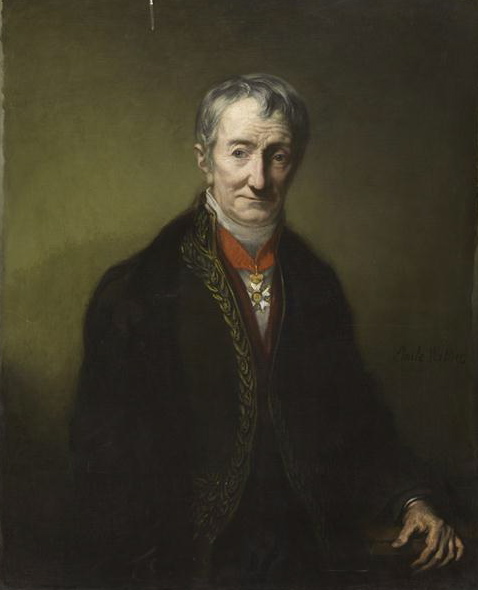
Alexandre Brongniart (1770-1847), director of the manufactory from 1800 until his death, painted by Emile-Charles Wattier in 1847. He ran it as an administrator and scientist; he was not a maker, and the manufactory had no founding portrait. The identification rests on the Commons record, which credits the Cite de la ceramique de Sevres as source and carries the title 'Portrait d'Alexandre Brongniart, directeur de la Manufacture de Sevres'; I haven't seen the museum's own catalogue entry.
Emile-Charles Wattier, 1847; via the Cite de la ceramique de Sevres, Wikimedia Commons (public domain)| Full name | Manufacture royale de porcelaine de France, at Vincennes then Sevres |
|---|---|
| Worked as | Porcelain manufactory, Royal manufactory, Soft-paste and hard-paste porcelain, Biscuit sculpture |
| Born | c. 1740 (the Metropolitan Museum says about 1740, the V&A... · Chateau de Vincennes, east of Paris |
| Died | Not ended: the V&A records that the manufactory still... · Sevres, south-west of Paris (since 1756) |
| Nationality | French |
| Movement | Rococo (Vincennes and early Sevres), Neoclassical (from the 1770s), Empire and later... |
| Sources | 28 cited |
| Last verified |
About this page Last verified · 28 sources cited
On this page 13 sections
ContentsClose
Sevres is a factory, a royal brand and, for collectors, a forged mark. It began as a handful of men experimenting in the old riding school of the Chateau de Vincennes. By 1759 Louis XV was its sole owner, and for the rest of the century it set the standard for European porcelain, a judgement the Metropolitan Museum makes outright. The name on a base, though, proves almost nothing. The interlaced L mark was faked by other factories, most often in the nineteenth century. The factory itself sold off old undecorated stock in 1800, and whether any of it was decorated elsewhere is a question the sources do not answer. The date letter that most guides treat as a lookup table is read one year apart by different authorities.
What the manufactory made is better documented than most workshops of its age, because it kept records and because its workers were allowed to add marks. The Seattle Art Museum libraries note that painters' marks began in 1753 and that most gilders' marks come only in the 1770s. Those marks are management control, not signatures: about 385 painters and gilders worked there in the eighteenth century and only about 195 marks are known, and of roughly 68 women who worked there only six or seven are said to have had one.
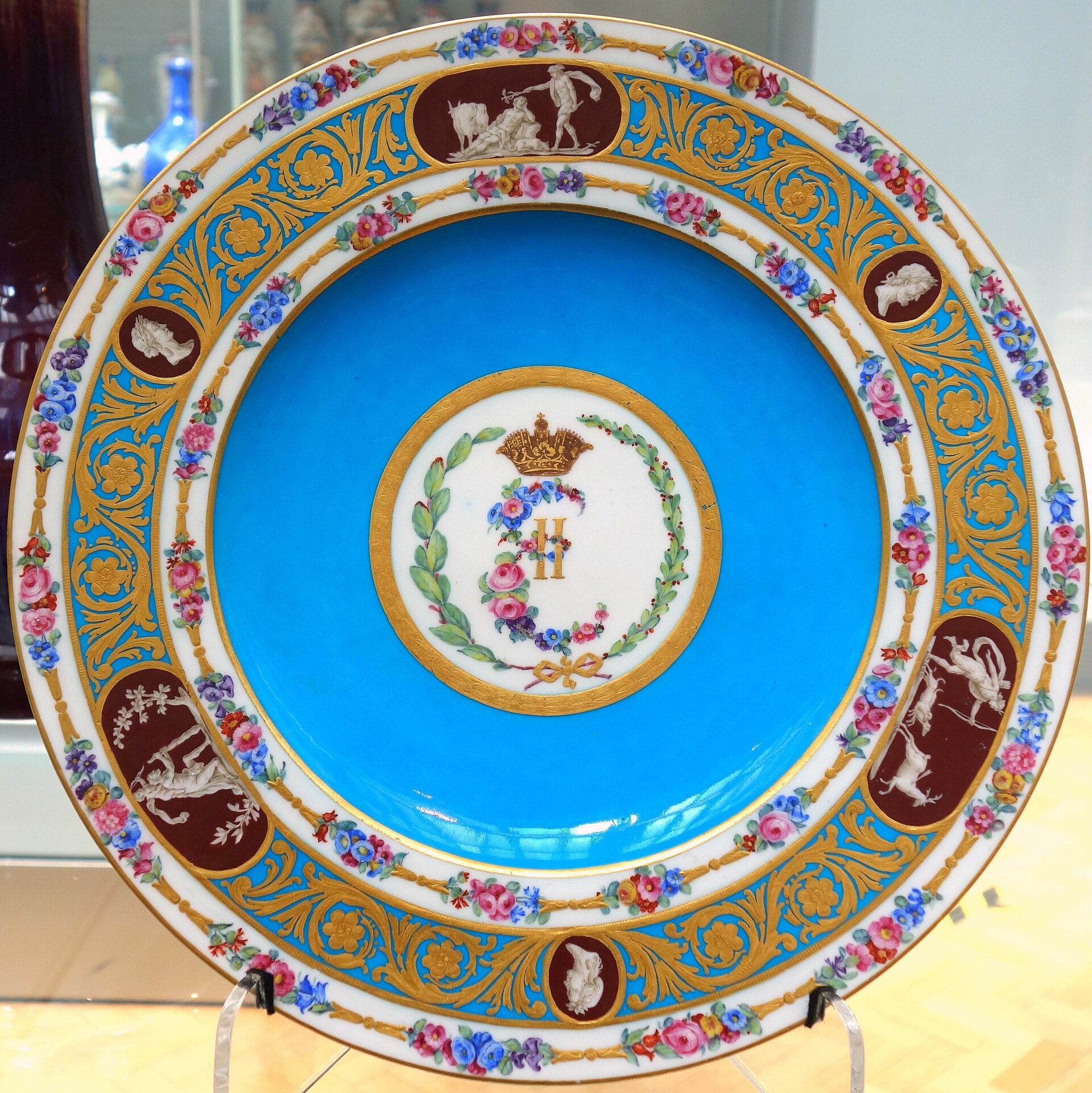
The single fact most readers don't have is how the Catherine II 'Cameo Service' was made. The turquoise ground empress Catherine asked for would not take on the new hard-paste body, so the service was made in a special soft-paste, and the hard-paste cameos that give it its name were cut separately and set into it. The V&A says about 3,000 pieces were made to get about 800 perfect ones (Christie's calls that the factory's own estimate of the soft-paste losses). About 160 pieces of the finished service were later looted from the Winter Palace in a fire in 1837 and reached London dealers.
Images
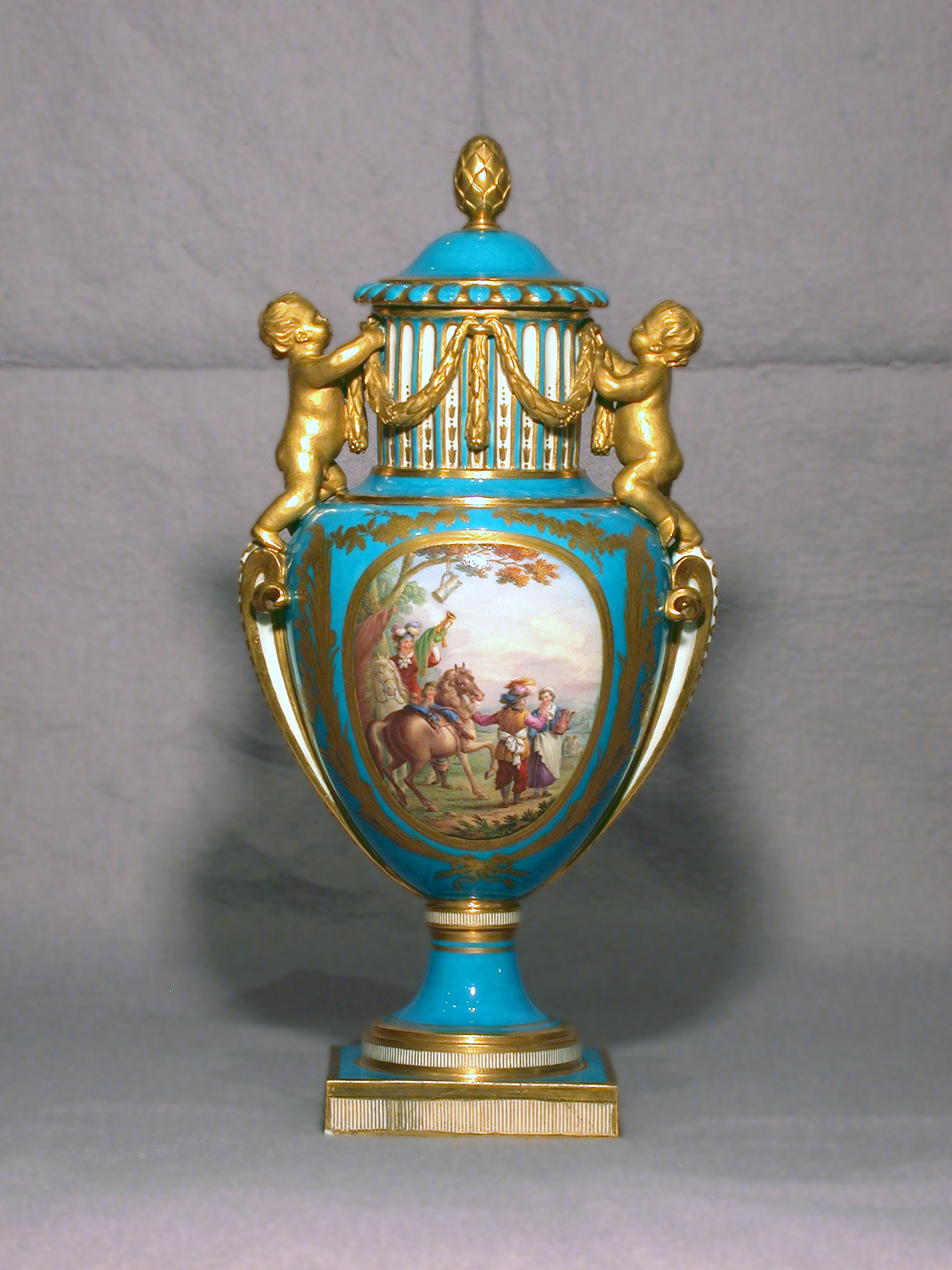
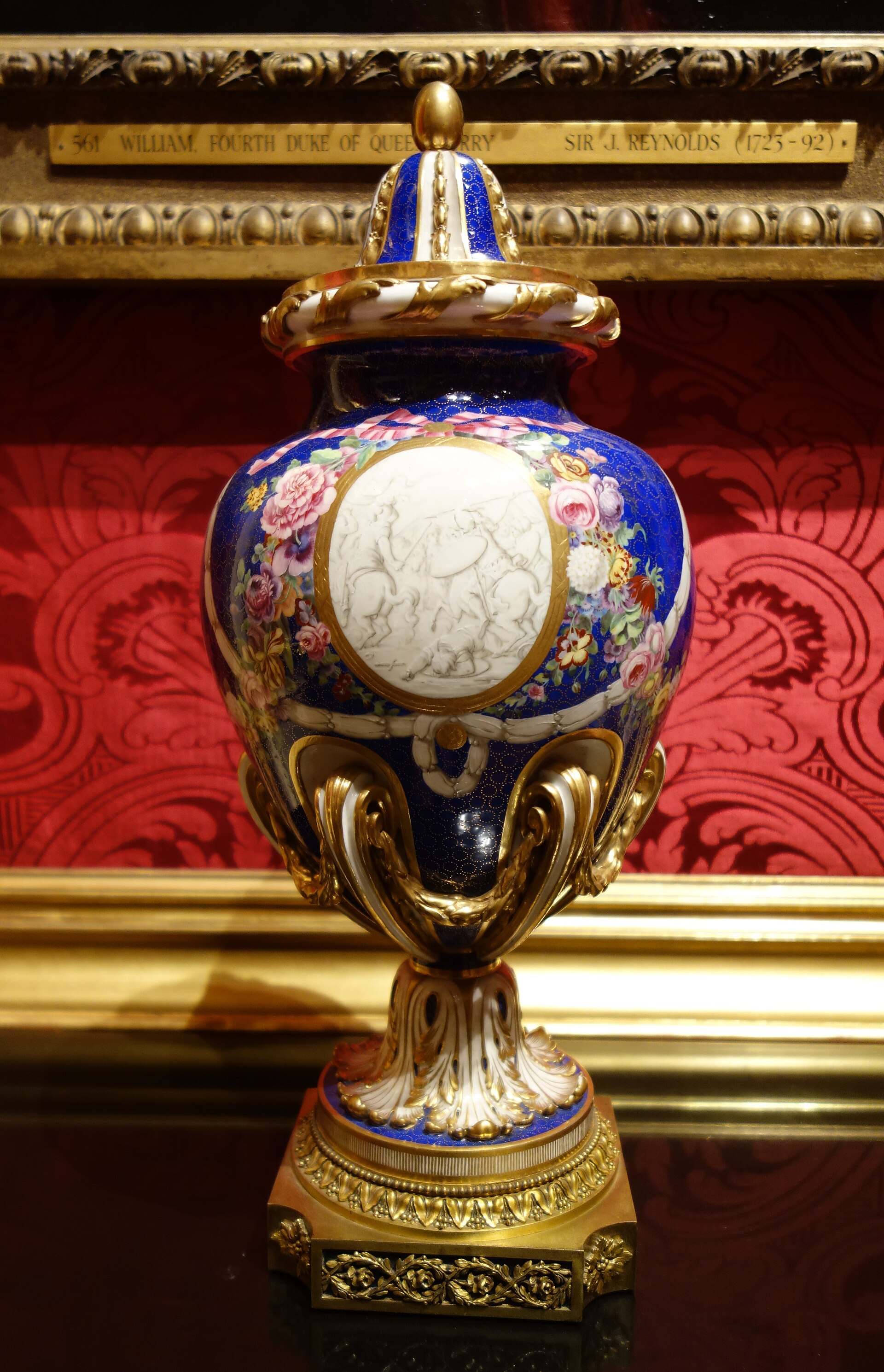
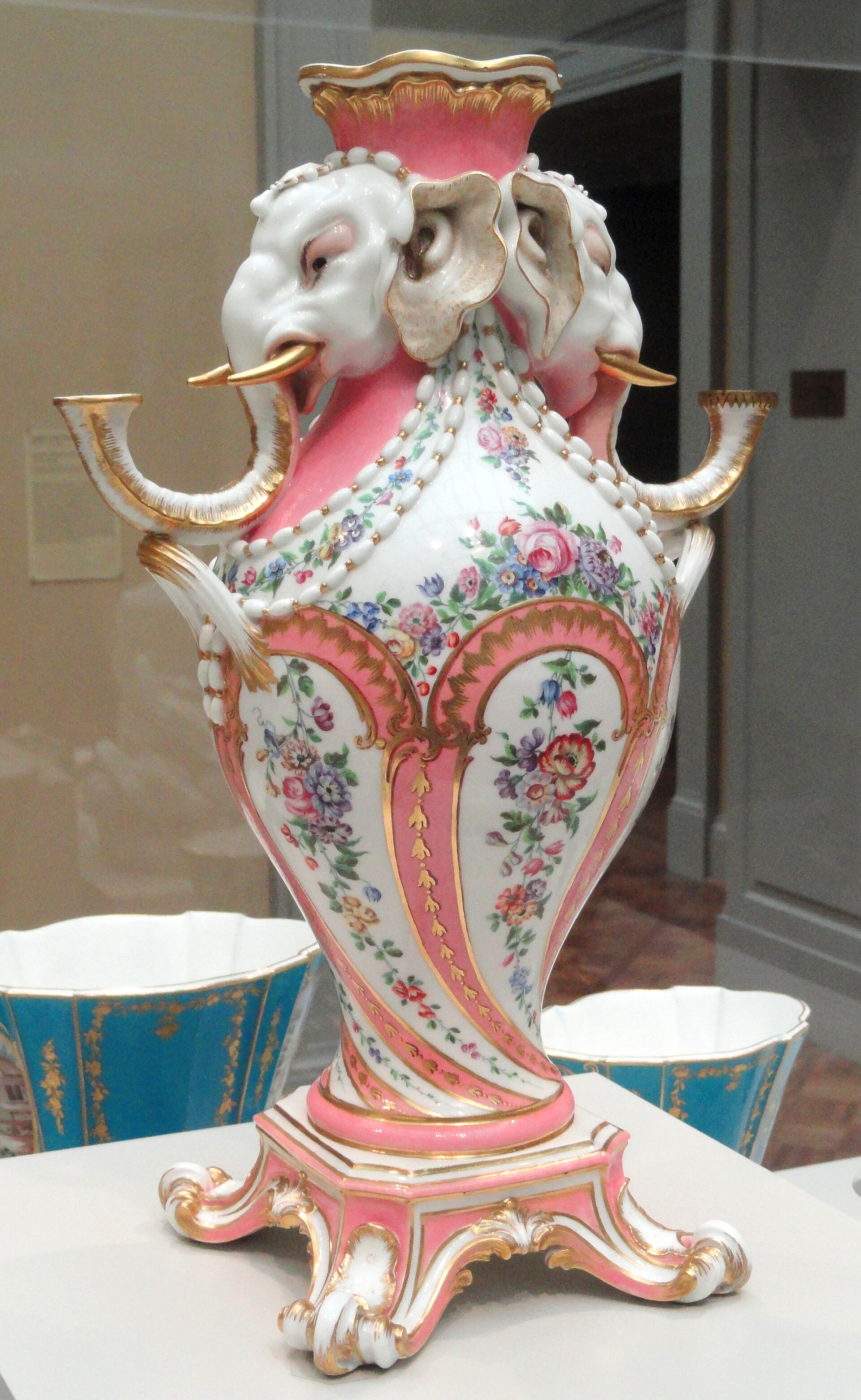
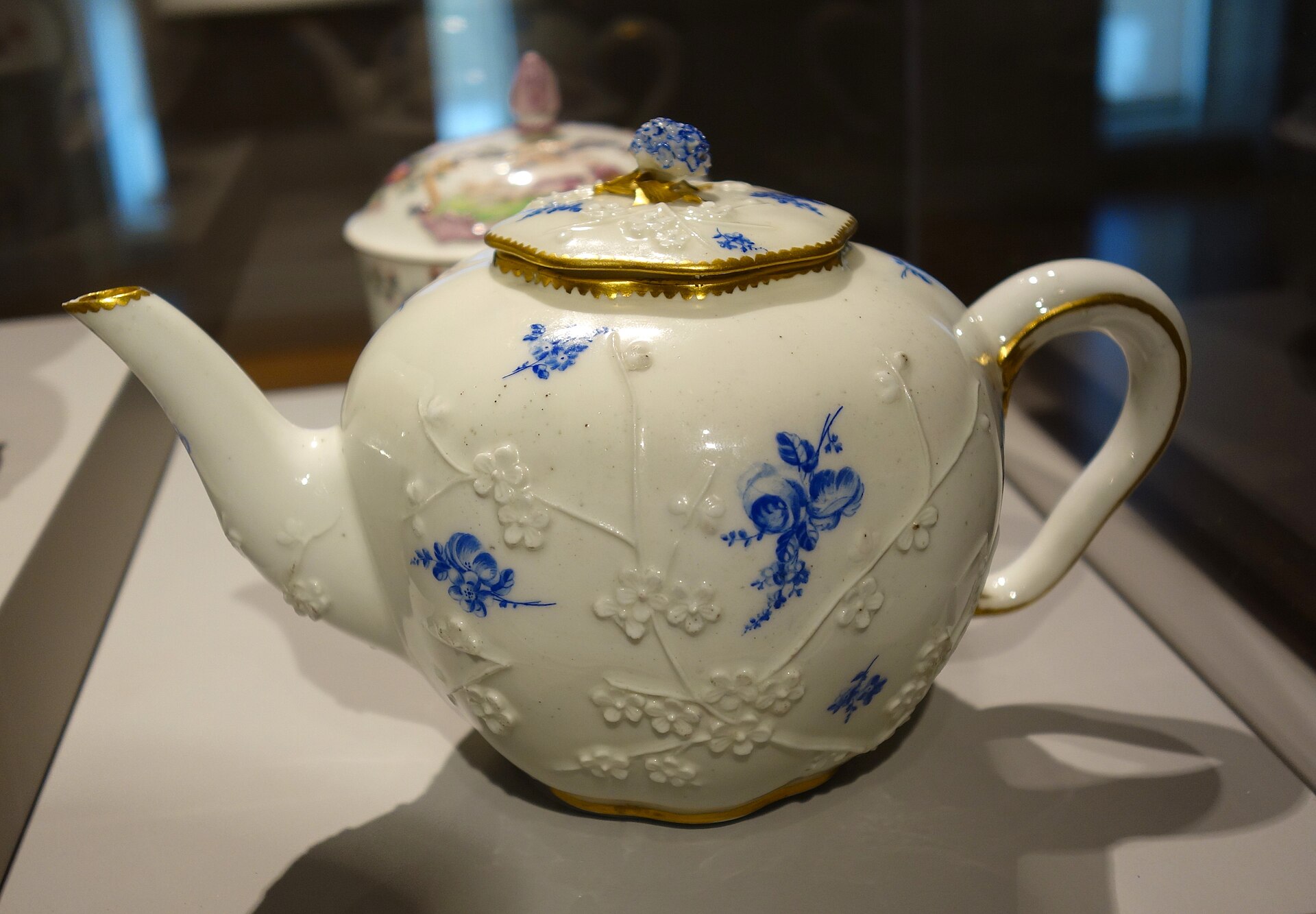
Chronology
- 1738-1740
Vincennes soft-paste production begins: Christie's says soft-paste was produced at Vincennes from 1738; the Metropolitan says about 1740; the V&A says 1740 in the royal chateau; Garnier says towards 1740.2491
- 1745
A royal privilege gives the exclusive right to make porcelain in Meissen style in France (V&A); Garnier dates the recognising decree 24 July 1745 and its 20-year term.111
- 1748
Gilding begins at Vincennes and Jean-Claude Duplessis becomes director of models (V&A); Wikipedia adds a 'floristry' of twenty girls under Madame Gravant.11918
- c. 1750
Bleu lapis ground colour invented; interlaced Ls adopted as factory mark around this time (V&A). Sales in 1750 total 32,696 livres 4 sols (Garnier).111
- 1751
Orry de Fulvy dies and the company is reorganised; Bachelier becomes director of decoration (V&A); the V&A says almost all figures from 1751 were left unglazed as biscuit, while another V&A record says biscuit figures were first produced in 1752.1910
- 1753
Date letter A and painters' marks begin (SAM libraries); Christie's says bleu celeste was introduced; Wikipedia says women were banned from the factory.16418
- 1755-1756
A decree of 19 August 1755 gives the king a third of the shares (Garnier); the factory moves to Sevres in 1756 (Metropolitan, V&A, Garnier).129
- 1757
Falconet becomes director of sculpture; he supplies sixty models by 1766 (V&A).109
- 1758
Ice-pails first appear in the records, in a service Louis XV gave to Empress Maria Theresa (V&A).8
- 1759
Louis XV buys out the other shareholders and becomes sole owner; annual grant of 96,000 livres (Garnier).12
- 1760
Kaolin from Hertre reported to Macquer on 26 April; the resulting body is grey and too coarse (Garnier).1
- 1768
Macquer confirms the kaolin beds at Saint-Yrieix near Limoges (Garnier).1
- c. 1770
A crown above the monogram marks hard-paste (SAM libraries); hard-paste production begins in the 1770s (Christie's).164
- 1773
Boileau dies, leaving 300,000 livres in the treasury and the same in stock (Garnier).1
- 1776-1779
Catherine II commissions the Cameo Service (1776); the factory works on it through 1777-1779; shipped from Rouen in June 1779, arrives in October.54
- 1778
Regnier appointed director on 20 December (Garnier); the AA date letter belongs to this year in modern catalogues (V&A, Christie's).164
- 1789-1791
Montucla writes of ruin in September 1789; Louis XVI retains the manufactory in 1790; a decree of 26 May 1791 leaves it at the king's disposal (Garnier).1
- 1795-1800
A decree of 1 February 1795 creates three directors; Brongniart takes charge on 14 May 1800 (Garnier).1
- 1804
Soft-paste production ends (Metropolitan); the manufactory becomes the property of the Crown under the Empire (Garnier).31
- 17 December 1837
Fire at the Winter Palace; about 160 pieces of the Cameo Service are looted and reach London dealers (Christie's).5
- 1845-1864
Edme Samson founds his Paris firm in 1845 and its copies of Sevres follow; the firm moves to Montreuil in 1864 (V&A, Bearnes Hampton and Littlewood).1517
- 1856-1857
Hertford sells most of his Cameo Service pieces back to Tsar Alexander II; he keeps six, including four ice-pails now in the Wallace Collection (Christie's).5
- 7 July 2016
Pair of Cameo Service ice-pails sold at Christie's London for GBP 842,500.45
- 9 May 2018
Marly Rouge dessert service portion sold at Christie's New York for USD 1,812,500.4
The market
Prices come from Christie's pages and list one 'sold for' figure per lot. Those pages and the guide do not separate hammer from buyer's premium, so none is derived here. No published list of the highest Sevres prices was found. Christie's calls the 2018 Rockefeller Marly Rouge result a world-record price without saying for what category.
The market runs from about GBP 12,000 for a nineteenth-century part dejeuner through about USD 50,000 for early Vincennes tea wares and plates to GBP 842,500 for a pair of Cameo Service ice-pails. The Cameo Service is the cohort to watch: ten ice-pails exist, eight are in museums, and the two then in private hands sold in 2016.
| Date | Sale | Work | Result | Note |
|---|---|---|---|---|
| 10 September 2013 | Christie's London | Sevres reticulated part dejeuner (dejeuner chinois), about 1846-48 | Hammer Not stated in the page read With premium Not separated; the guide says 'sold for GBP 11,875' GBP | Illustrates the Brongniart-era and later market, far below the eighteenth century. |
| 25 November 2014 | Christie's London | Vincennes baluster pot and cover, about 1746-49 (Meissen-inspired harbour scenes) | Hammer Not stated in the page read With premium Not separated; the guide says 'sold for GBP 50,000' GBP | Early Vincennes. |
| 7 July 2016 | Christie's London, lot 330 | Pair of bleu celeste ice-pails, covers and liners from the Catherine II 'Cameo Service', about 1778-79, date letters AA | Hammer Not stated in the page read With premium Not separated; the guide says 'sold for GBP 842,500' GBP | Property of Dimitri Mavrommatis, acquired from Rosenberg and Stiebel in 1993; earlier owners Pannwitz, Coope (Christie's 1910) and Lonsdale; the lot essay says these are the only two of ten in private hands. |
| 4 July 2017 | Christie's London | Bleu celeste soup plate from the Catherine II service, 1778, date letters AA, gilder's mark for Henry-Francois Vincent | Hammer Not stated in the page read With premium Not separated; the guide says 'sold for GBP 137,000' GBP | The V&A's matching plate was 'bought for GBP 15' (accession 3643-1856, so around 1856). |
| 2017 (month not on the page read) | Sotheby's London, 'Two Great Scottish Collections', lot 426 | Sevres green-ground dejeuner, about 1775, painted by Charles-Nicolas Dodin, date letter X, gilder LG | Hammer Result behind a login; estimate GBP 15,000-25,000 With premium Not available GBP | Shown as an estimate only; no price is claimed. |
| 9 May 2018 | Christie's New York, Peggy and David Rockefeller collection | Portion of the 'Marly Rouge' dessert service made for Napoleon I, about 1807-09 | Hammer Not stated in the page read With premium Not separated; the guide says 'sold for USD 1,812,500', 'the world-record price' USD | Delivered to Fontainebleau in October 1809. |
| 19 October 2021 | Christie's Online | Hard-paste ormolu-mounted powdered lavender and gold-ground 'Lagrenee' vase, about 1805-06 | Hammer Not stated in the page read With premium Not separated; the guide says 'sold for USD 150,000' USD | Bought by the marchand-mercier M. Jacques in 1805-06 and sold to the 10th Duke of Hamilton. |
Hammer is the price at which the bidding stopped; with premium adds the fee the house charges the buyer on top. Hammer price and buyer's premium in the glossary.
Recorded without a public price
- 4-5 April 2022 · Rose marbre part dejeuner, about 1762-63 (USD 52,920 on 4 April) and a Vincennes bleu celeste plate from the first service for Louis XV, about 1754 (USD 50,400 on 5 April) · Christie's Online · Not stated in the page read Two sales, one row; both from the guide's captions.
Where to see the work
| Institution | City | Holdings | Note |
|---|---|---|---|
| The Wallace Collection | London | Four of the ten Cameo Service ice-pails and two of the eight wine-bottle coolers; also Sevres vases (a 1769 vase console on Commons). | Via the 4th Marquess of Hertford; Christie's lot essay and a Commons uploader's caption agree on the count of four. |
| The State Hermitage Museum | St Petersburg | The majority of the Catherine II Cameo Service, including four ice-pails. | I did not read the Hermitage's own catalogue; the account is Christie's. |
| Victoria and Albert Museum | London | Catherine service plates (C.449-1921, 3643-1856), a 1778 flower-sprayed ice-pail, liner and cover that is not from the Catherine service (O100500, bequest of Mrs T. R. P. Hole), rose-ground tea services, Falconet biscuits. | Open collections database; marks transcribed. |
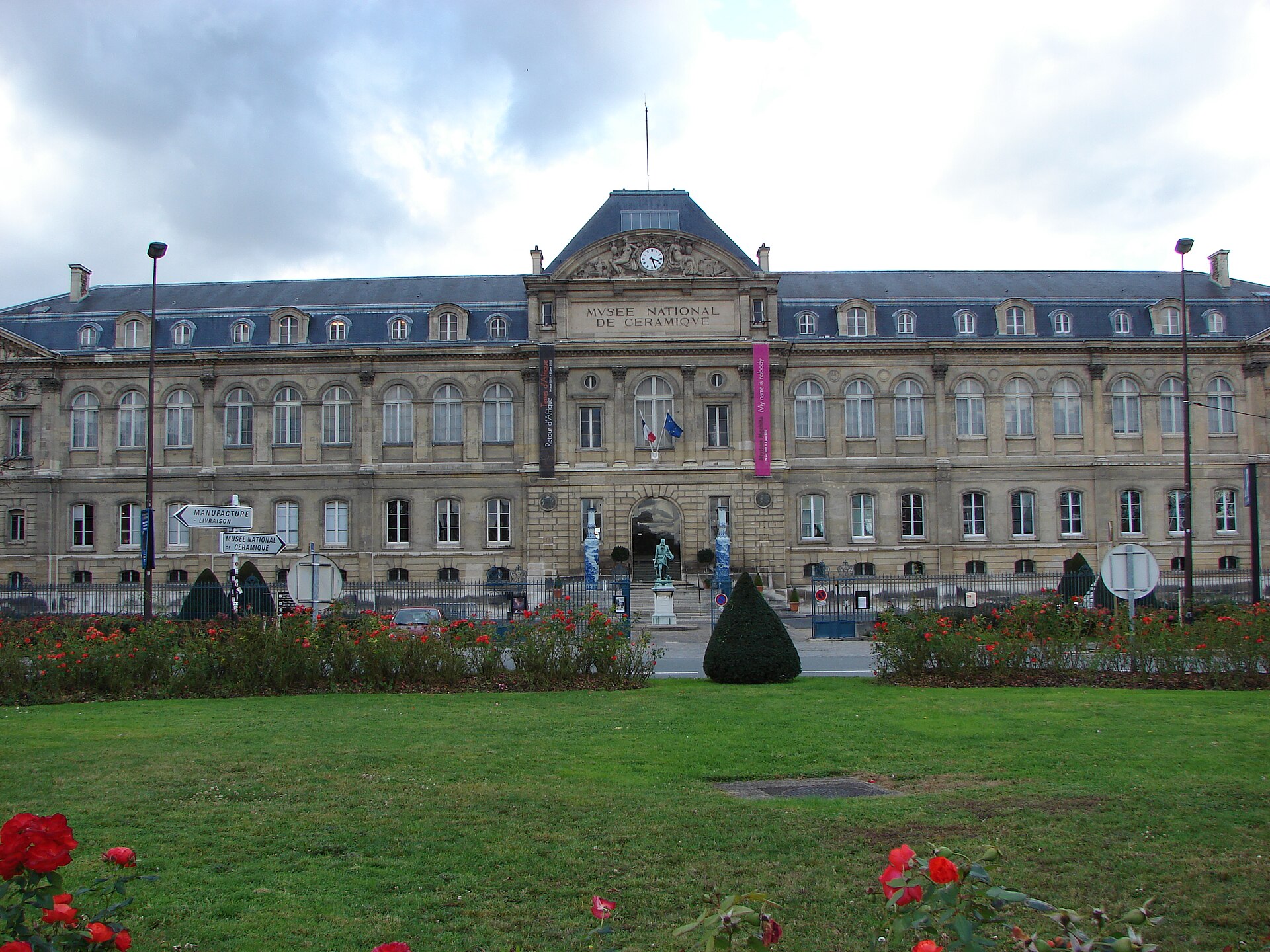
| Cite de la ceramique (Sevres - Manufacture et Musee) | Sevres | The factory museum with production from the eighteenth century to now, and the archives that identify painters and gilders; per Christie's. | The museum page read in November 2026 says it is temporarily closed for renovation; check before travelling. |
| Walters Art Museum | Baltimore | Bleu celeste Vase colonne de Paris, 1779, with provenance from the Earl of Pembroke sale 1851 and Baron Schroder sale 1910. | Open access; marks transcribed. |
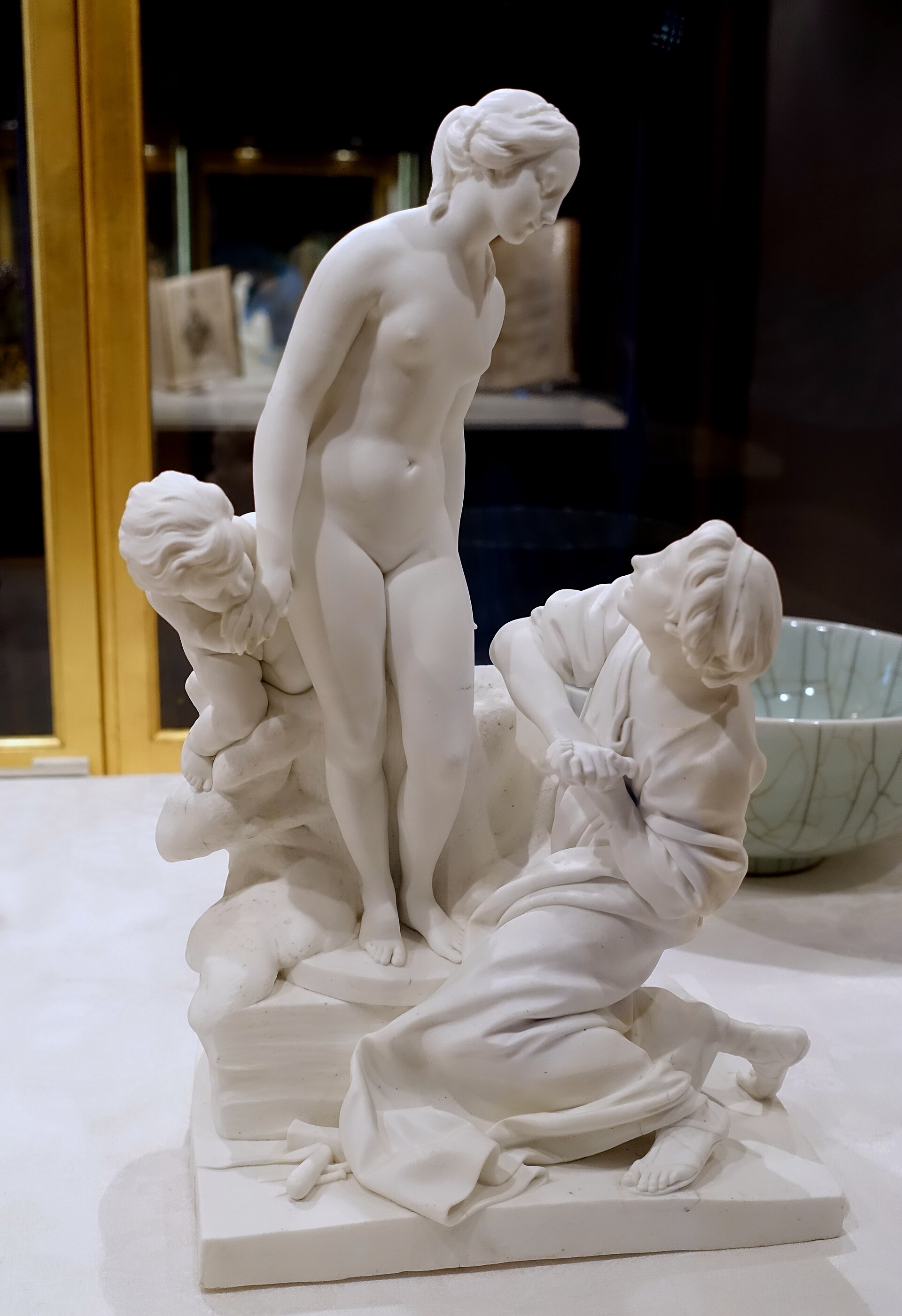
| The Metropolitan Museum of Art; Wadsworth Atheneum; Huntington; Art Institute of Chicago; Waddesdon Manor | New York; Hartford; San Marino; Chicago; Buckinghamshire | Eighteenth-century soft-paste and hard-paste, biscuit figures, the elephant vase (Chicago) and Pygmalion and Galatea after Falconet (Waddesdon). | Plates on this page come from photographs in these collections. |
Forgeries and misattributions
- The faked Sevres mark and the Samson firm (nineteenth century onward)
- Christie's says the Sevres mark was frequently faked by other factories, most often in the nineteenth century. Samson of Paris, founded in 1845 by Edme Samson, made high-quality copies of eighteenth-century Sevres, Chelsea and Worcester; the V&A records that the firm said it would mark its copies distinctly but that its own double S is often missing, and Bearnes Hampton and Littlewood say buyers erased the mark, leaving a patch of ground-out glaze, or replaced it with other marks. Weak, hesitant painting of the mark; ground colour too garish or gilding too thick and bright; a stiff handling of paint; an erased Samson mark leaving a patch of ground glaze; against it the tooled gilding of genuine Sevres. A decorated-later blank can show black specks from re-firing.4141517
- Undecorated stock sold in the 1800s
- The Metropolitan says old undecorated stock was sold off after Brongniart arrived in 1800; Christie's says some pieces were left blank in the eighteenth century and decorated later. The two statements sit side by side and no source I read joins them: a genuine Sevres body with later non-factory decoration is an inference of mine. Black specks from re-firing (Christie's); the painter's and gilder's marks being absent or wrong for the date letter; checking the decoration against the archive records of painters' active years.34
- Misread name: rose Pompadour and rose Du Barry
- Not a forgery but a misattribution by labelling: the V&A says English dealers called the pink ground Rose Dubarry or Rose Pompadour, and Garnier says Du Barry was an infant when most was made. Dates and archive terms, not dealer labels.121
The essay
Chapter 1The date letter is a table, and the tables disagree by a year
Collectors learn that Sevres can be dated from the letter inside the interlaced Ls.
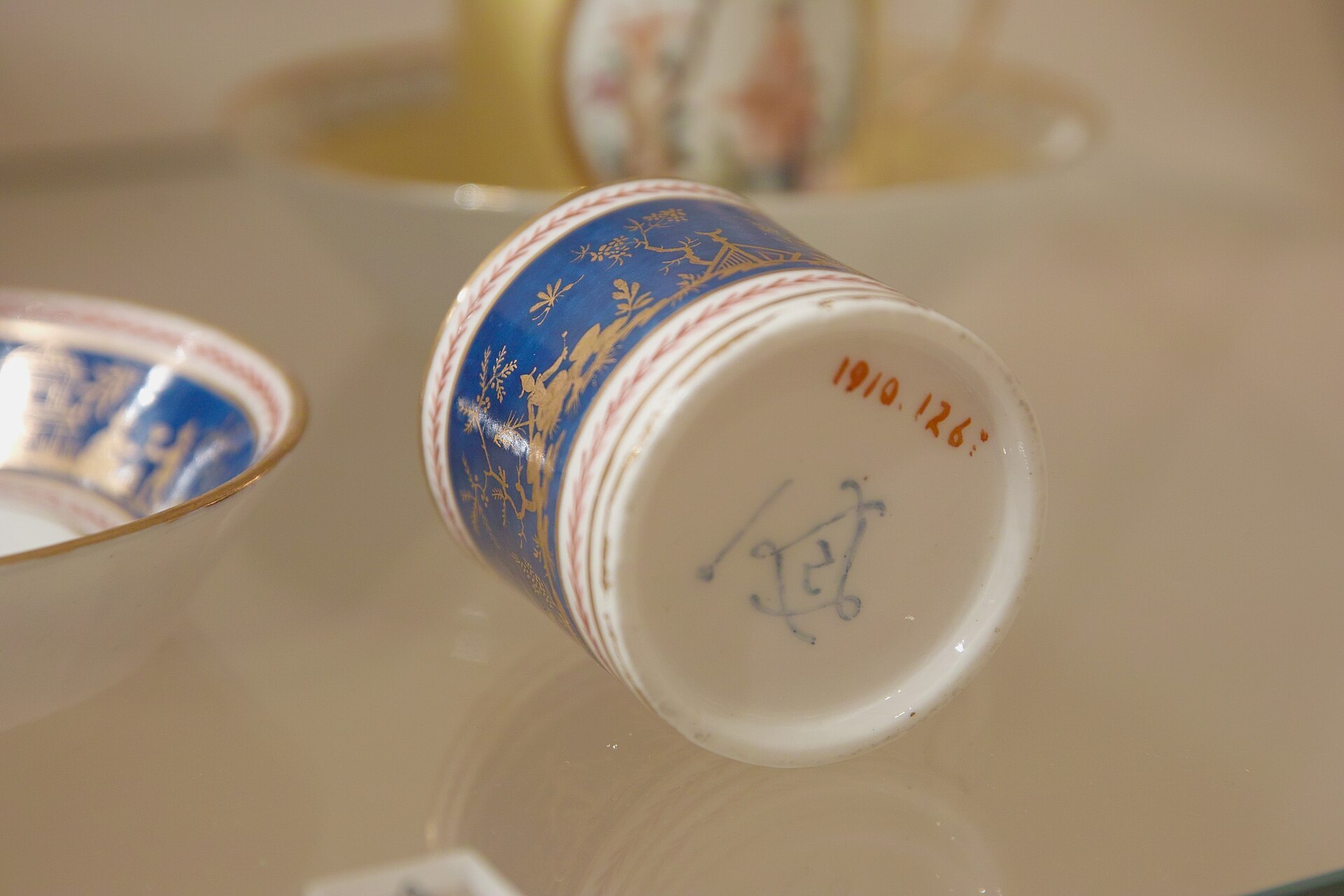
Collectors learn that Sevres can be dated from the letter inside the interlaced Ls. The Seattle Art Museum libraries state the rule plainly: A is 1753, B is 1754, and so on, and the factory began using double letters in 1778. Christie's collecting guide gives the same logic but dates a tea bowl marked A to about 1754. The Victoria and Albert Museum records the Catherine II soup plates as 1778 with the letters AA. The Walters Art Museum dates its bleu celeste vase, marked bb, to 1779. A Sotheby's catalogue of 2017 reads the letter X as 1775.
Edouard Garnier's 1892 study, the earliest full table I could read, prints something different. It runs A (1753) through Z (1776), treats I and J as one letter (1761), and starts the doubled letters with AA in 1777. By that table X is 1774 and bb would be 1778. The Museum fur Kunst und Gewerbe in Hamburg labels a cup with the letter Z as 1777, which agrees with the modern reading and not with Garnier. So the discrepancy is real and it sits in the middle of the alphabet: the early letters agree, the later ones sit one year apart. I did not find a source explaining why. The arithmetic points at I and J: Garnier's table has no W and merges I and J (24 letters, A 1753 to Z 1776), while a table that keeps I and J apart has 25 letters and ends Z in 1777, with AA in 1778 as the V&A and Christie's read it. That is my own sum, not a finding from a source. The V&A shows the same one-year pull inside its own records: it dates a rose-ground tea service marked H to 1761, where the A-is-1753 rule gives 1760. For any lot, check the date letter against a modern catalogue and against the painter's active dates before trusting either table.
The mark itself tells a second story. The V&A, describing a bleu lapis saucer of about 1752 with the blue interlaced Ls, says the bleu lapis dates from about 1750 and that the royal cipher was adopted as the factory mark around then. Garnier says a decree of 19 April 175? (the last digit is unreadable in the scan I read) compelled the factory to mark all its ware with the two Ls and a date letter, with the first letter A for 1753; the same book, in its history chapter, dates the decree that let the factory call itself the Manufacture Royale de la Porcelaine de France, mark all its porcelain with the royal cipher and take the king in for a third of the shares, to 19 August 1755. Both passages credit one decree with the title, so they are probably one decree under two dates (the OCR of the April year may even read 1755), but I could not confirm that, and if the mark was made compulsory in 1755 it does not explain why the date letter A stands for 1753. The Seattle libraries add a diagnostic: on bleu lapis pieces the mark was put on before the glaze, so it often runs at the edges, and from about 1770 a crown above the monogram marks the hard-paste body.
On top of the factory mark sit the hands. The V&A's records for the Catherine plates give, for a soup plate, the interlaced Ls with AA, a painter's mark (a fleur-de-lys for Taillandier), a second painter's mark (B for Boulanger pere) and, on a companion plate, a red gilder's mark (HP for Henri-Martin Prevost). Christie's guide names Louis-Denis Armand l'aine's crescent and says the Sevres archives record who used which mark. The Seattle libraries, citing Eriksen and de Bellaigue, say the marks existed for management control. Multiple workers touched a piece, including the man who laid the ground colour, but a plate rarely carries all their marks.
Chapter 2Two founding dates, a failing company and a king who bought what he already half owned
The Metropolitan Museum says the Vincennes factory was founded in about 1740 and the V&A says 1740 in the royal chateau; Christie's says soft-paste was produced at Vincennes from 1738.
The Metropolitan Museum says the Vincennes factory was founded in about 1740 and the V&A says 1740 in the royal chateau; Christie's says soft-paste was produced at Vincennes from 1738. Garnier's 1892 account, which modern specialists will want to check against Rosalind Savill and the Sevres archives, names the first backers: Orry de Fulvy (brother of the Comptroller General of Finance) and two brothers Dubois from Chantilly, who offered the secret and, in his telling, wasted four years and a royal grant of 10,000 livres. He says a workman called Gravant rescued the work and that by 1745 the paste was good enough to continue. The V&A confirms a royal privilege of 1745 giving the exclusive right to make porcelain 'in Meissen style' in France.
Garnier's numbers are the best I found for the money. A company of 21 shares was set at 90,000 livres and grew to 250,000. Sales in 1750 were 32,696 livres 4 sols, of which 26,323 were floral ornaments; he calls it a financial disaster. The king advanced 40,000, 30,000 and 30,000 livres in 1747, 1748 and 1749. After Orry de Fulvy's death in 1751 the company was recast, and Garnier dates a new capital of 240,000 livres in 80 shares of 3,000, one third held by the king, to a decree of 19 August 1755 granted under the name of Eloy Brichard. Sales in 1756 and 1758 reached 210,000 and 274,000 livres.
The factory moved to Sevres in 1756; the Metropolitan, V&A and Garnier all give 1756. Garnier says the building stood on the site of Lully's little chateau, while Wikipedia says it was built by Laurent Lindet between 1753 and 1756 on the site of a farm called de la Guyarde; I can't reconcile the two. In 1759, after a dispute between the royal commissioner and the shareholders, Louis XV bought out the other shareholders. Garnier says the crown then paid the manufactory an annual grant of 96,000 livres in twelve instalments and Boileau stayed as director. The Metropolitan words it as the king becoming sole owner in 1759, and the V&A adds that the move to Sevres came 'shortly' before the purchase. The Wikipedia article puts Madame de Pompadour as patron from 1751 and says she kept effective control. That last point is tertiary and I could not trace it to a primary source, so treat it as a claim about influence, not about ownership. The V&A and Garnier both credit Pompadour with protection, and Garnier says Louis XV extended his patronage 'by the advice of' Machault and Pompadour.
Chapter 3Who made it: a director of models, a director of decoration and a sculptor on a weekly visit
The V&A names the men who gave Vincennes and Sevres their look: Jean-Claude Duplessis as director of models from 1748 to 1774, Jean-Jacques Bachelier as director of decoration from 1751 to 1793 and...
The V&A names the men who gave Vincennes and Sevres their look: Jean-Claude Duplessis as director of models from 1748 to 1774, Jean-Jacques Bachelier as director of decoration from 1751 to 1793 and Etienne-Maurice Falconet as director of sculpture from 1757 to 1766. The court painter Francois Boucher is described as central to the development of the art. Garnier adds that Boucher and Van Loo furnished sketches of ornament and figures which were modelled by sculptors and executed in biscuit, and that Hellot of the Academy of Sciences oversaw paste, colours and firing.
Falconet's role is the best documented. A V&A record says Boucher may have introduced him to Pompadour, who commissioned a marble of herself as 'Friendship' in 1755; he supplied a model of it for biscuit that year, became director of sculpture in 1757, visited the workshops once a week, kept his Paris practice, produced sixty models by 1766 and left for Catherine II's court in September 1766. The same record says many of his models drew on Boucher. So a Falconet biscuit is a sculptor's model made up by the factory.
Below the directors the decoration was a chain of trades. The Seattle libraries, summarising Savill, say painters came from fan painting, 'cardboard-box' decoration, other porcelain factories and from unrelated trades, and some arrived as apprentices aged nine or ten; the factory gave lodging, health care and often a pension, and workers were bound by secrecy and by rules against illicit decoration at home. Garnier explains why early decoration is easy to read: fan painters used heavy gouache-like effects, enamellers used fine strokes, so the hand shows in early Vincennes. By the time of the Catherine service Christie's lot essay says the factory had 69 painters and 13 gilders, of whom at least 37 painters and 5 gilders worked on that single commission. Christie's guide adds that families passed skills down, so several painters of one name appear across decades.
Chapter 4The women: a banned flower workshop, a home workforce and marks that stop at six or seven
Women appear early in the record of the manufactory and are then hard to find.
Women appear early in the record of the manufactory and are then hard to find. Wikipedia's Sevres article says a 'floristry' of twenty young girls was set up at Vincennes in 1748 under Madame Gravant to make the porcelain flowers, that it ran until 1753 when 'women were banned from the factory', and that the few women who continued afterwards worked from home, collecting wares and returning them daily. It is a tertiary source and the passage is fragmentary; I could not trace it to the underlying scholarship, and it does not fit the other evidence.
That other evidence is the Seattle libraries' summary of Savill and of Eriksen and de Bellaigue. The painters' wives were often employed as flower painters, about 68 women worked at the factory across the eighteenth century and only about six or seven had marks of their own. The same page says about 385 painters and gilders worked there in total while only about 195 marks are known, so the woman without a mark is an extreme case of a general problem, not a special one. Christie's records two named women in a lot note: Genevieve-Louise Bouillat as a flower painter at Sevres from 1776 to 1798, and Marie-Marguerite Gabrielle Le Bel as a painter of flowers and patterns from 1776 to 1790 and again in 1804-05. Those notes do not tell us which Bouillat's mark is on which plate, because the same note records an Edme-Francois Bouillat, whose relation to her it does not state, as a flower painter from 1758 to 1810.
The honest finding is a conflict kept open. One source says women were barred in 1753 and then worked at home; another, on the same factory, says wives and women were employed as flower painters with a handful holding marks, and that painters were forbidden to decorate at home. Both may be true if the ban fell on one workshop and practice changed later, but no source I read says so. It is a live question for anyone attributing a flower-painted plate: the absence of a woman's name on the base is not evidence that no woman painted it.
Chapter 5Blue, rose and the names that came later
The V&A calls bleu lapis the earliest ground colour, invented around 1750, and says ground colours generally begin in 1752; Christie's says the first pieces were small tea and coffee wares with...
The V&A calls bleu lapis the earliest ground colour, invented around 1750, and says ground colours generally begin in 1752; Christie's says the first pieces were small tea and coffee wares with coloured grounds and gilding. The blue was the only ground applied under the glaze, directly onto the dry porous body, which gave a mottled, wash-like effect. The same museum notes, on a pair of plant pots, that the blue 'bled' at the edges of the white reserves, that the factory saw this as a defect and that the gilder tried to hide it with elaborate frames and even masked a firing crack in a rim with gilding. Christie's says the brilliant bleu celeste was introduced in 1753 and was one of the costliest colours to produce; Louis XV is said to have ordered a whole service in it soon after. Garnier credits Hellot with a bleu turquoise.
The pink is the one with the best misnomer. Garnier writes that Hellot discovered the rose colour, that no piece in it bears a date later than 1761 and that it was long called rose Du Barry in England, 'a name probably given' by a fanciful amateur or a dealer. The V&A, on a tea service of 1761, says English dealers described the pink routinely as Rose Dubarry or Rose Pompadour, and that a nineteenth-century buyer may have thought the set had belonged to one of Louis XV's mistresses. So the Pompadour name is a label the V&A attributes to English dealers, with no documented link to her, and Madame du Barry was an infant when most of it was made, as Garnier points out. Garnier's 'nothing after 1761' is also contradicted by a V&A tray with a rose ground, painted by Jean Bouchet and dated 1775, though a later colour may simply have the same name. Treat both as open.
The Catherine service used a third: the V&A's Catherine record says the empress chose the turquoise ground, and Christie's lot essay quotes the order for 'bleu celeste imitant la turquoise' and says it was a copper-based enamel with an acid component that bit into the glaze and needed two or three coats and firings. Whether the colour carried meaning beyond imitating a stone is not stated in the sources, and I found no document that gives one.
Chapter 6Soft paste, hard paste, and why a factory with kaolin kept making the weaker body
Until kaolin turned up in France, Sevres made soft-paste.
Until kaolin turned up in France, Sevres made soft-paste. The Metropolitan Museum says kaolin was not discovered in France until the second half of the eighteenth century and that all French porcelain made before 1770 was soft-paste. Garnier gives the recipe: Fontainebleau sand, nitre, sea salt, Alicante soda, alum and gypsum fused into a frit, crushed and mixed with Argenteuil marl in nine parts frit to three of marl, worked for three weeks and made plastic with soft soap. The glaze used Fontainebleau sand, litharge, soda, flint from Bougival and potash. Christie's lot essay gives the same lead-glass logic with red lead for the Catherine glaze.
The search for French kaolin is documented in Garnier: a doctor of Alencon, Odolant Desnos, wrote to Macquer on 26 April 1760 about clay at Hertre, which made a grey body too coarse; and in 1768 Macquer confirmed the beds at Saint-Yrieix near Limoges, discovered, Garnier says, by the wife of a surgeon called Darnet. Garnier says Regnier, appointed director on 20 December 1778, oversaw the first important hard-paste objects, and that Boileau died in 1773 with 300,000 livres in the treasury and as much in stock, all dissipated in under six years by his successor Parent, who was later prosecuted and imprisoned. Wikipedia places the start of hard-paste after 1770, the V&A says the factory had 'recently begun' a hard-paste body by 1776, and Christie's says the 1770s. I found no source that dates a first hard-paste piece to 1769 and I can't confirm that year; Saint-Yrieix was confirmed in 1768 and production followed within a few years.
The manufactory did not abandon soft-paste at once. The Metropolitan says it ended in 1804, Garnier says it vanished from the day Brongniart took over, and the Seattle libraries note the crown above the monogram that identifies hard-paste after about 1770. The reason is a constraint of the ground colours: only a soft-paste body was suitable for the bleu celeste ground, the lot essay says, while only hard-paste could be cut to look like cameos. That one fact explains why the grandest service of the 1770s is a hybrid.
Chapter 7The Catherine II service: what a bill of about 331,317 livres bought
Christie's lot essay, the fullest account I read, says the empress commissioned the Cameo Service in 1776 through her favourite Potemkin and that a letter of March 1778 to Baron Grimm shows she meant...
Christie's lot essay, the fullest account I read, says the empress commissioned the Cameo Service in 1776 through her favourite Potemkin and that a letter of March 1778 to Baron Grimm shows she meant it as a gift to Potemkin but ordered it 'for me' to make Sevres produce the best. On 16 July (the essay gives no year; the commission is dated 1776) Potemkin instructed the order through the ambassador Bariatinsky and the director of the empress's cabinet: sixty places, 'the best and newest style' with the monogram on every piece, 'without any deviation from antique models, with reproductions of cameos'. The V&A says the empress selected the EII monogram, the cameos and the turquoise ground, and that it was the first Sevres service in the Neoclassical style, with new designs and moulds none of which were reused. The V&A adds that the plates alone were redesigned eight times before the empress was satisfied.
The workshop numbers come from three sources that don't agree. The V&A says 37 painters and five gilders worked on it over three years; the lot essay says at least 37 of 69 painters and five of 13 gilders, and almost four years. The V&A says each plate went through eight firings, with two layers of tooled gold, and that 3,000 pieces were made to get about 800 good ones; the lot essay adds the cost of new mills for the cameo-cutting wheels at 40,000 livres, 96 livres per cut cameo, and 2,058 livres for each ice-pail, ten times the cost of a conventionally shaped ice-pail with best-quality decoration. The total is 'thought' to be 331,317 livres, paid by instalments, with a final 90,000 livres in 1792 clearing the bill. The V&A says the empress initially balked at the price and the last instalment was paid in 1792, in the middle of the Revolution.
Even the piece count is unsettled. One V&A record says 744 pieces for 60 diners; another V&A record says 800; a Commons caption for a Wallace Collection photograph says 797; Christie's says the factory's sales register lists 778 pieces for the service and 77 for the centrepiece, and that this matches neither the French foreign ministry records nor the pieces recorded as received in St Petersburg. Boizot most probably designed the forms, and the gilt scroll friezes were based on the frieze of the Theatre of Marcellus in Rome (the lot essay's argument, citing a Bibliotheque nationale document), so the Neoclassical programme is a documented instruction plus an argued source.
Chapter 9After the service: a fire, a dealer and the Wallace Collection
Christie's lot essay gives the Cameo Service one of the best documented afterlives in French porcelain.
Christie's lot essay gives the Cameo Service one of the best documented afterlives in French porcelain. The service arrived at St Petersburg in October 1779 on a Dutch ship that left Rouen in June, delivered to Potemkin at the Tauride Palace; Potemkin later gave it to the empress, and it reached the Winter Palace on 26 July 1782. After the fire at the Winter Palace on 17 December 1837 about 160 pieces were looted and passed through the dealer Ferdinando Civiliotti to Storr and Mortimer of New Bond Street. Viscount Lowther bought 129 or 130 by July 1840 and 20 more by July 1842; in 1856 he, by then Earl of Lonsdale, sold 156 to the dealer John Webb. Webb sold the best of them to the 4th Marquess of Hertford, who sold most back to Tsar Alexander II in 1856-57 (a payment instruction of 9 February 1857 confirms it) and kept six, including four of the ten ice-pails. Those four are in the Wallace Collection; four are in the Hermitage; the last two were the pair sold at Christie's in 2016.
Seven of the ten ice-pails were among the stolen pieces, the essay says. It also records that Rosalind Savill's 1988 Wallace Collection catalogue wrongly says six are in the Hermitage because it was written before access improved, when the Soviet Union still stood; the essay says there are four. That is a catalogue-history error worth knowing about, because anyone counting survivors from the older catalogue gets the wrong number.
A lesser trace is the V&A's soup plate 3643-1856, which the museum says was 'bought for GBP 15'. The 1856 is the accession year in the V&A record, so it dates the museum's acquisition; the record gives no earlier purchase date, and the 'GBP 15' is the museum's own note; it falls in the same year Lonsdale and Webb were moving the pieces. The Commons title for a Wallace Collection photograph, a vase console of 1769 'bought by Louis XV', is the only source I have for that purchase and I did not confirm it.
Chapter 10Revolution, the lottery and the sale of the white stock
Garnier is the source for the Revolution years, and his translations of the primary letters are what a student should read.
Garnier is the source for the Revolution years, and his translations of the primary letters are what a student should read. In September 1789 Montucla, the head clerk, wrote that production should drop by a third because the wealthy had left, no one was paying and the creditors were pressing. In 1790 the question of selling the manufactory arose; Louis XVI wrote a note, which Garnier prints in English, saying he retained the Sevres manufactory at his own expense with expenditure not to exceed 100,000 ecus and monthly wages not above 12,000 livres. A decree of 26 May 1791 left Sevres and the Gobelins at the king's disposal. Under the Convention the factory could not pay in cash and applied for grain and provisions from the national stores and for leave to dispose of its remaining stock of porcelain in a lottery. A workman called Chanou is said to have usurped management during the worst years, until the decree of 13 Pluviose year III (1 February 1795) created three directors.
Brongniart took charge on 14 May 1800 and proposed cutting his own salary from 6,000 to 3,000 francs. The Metropolitan says his appointment marked a profound shift, that the factory's 'old, undecorated stock was immediately sold off', that new Neoclassical forms replaced old models and that soft-paste was abandoned in 1804. Garnier says the manufactory became the property of the Crown in 1804 and was carried on in the Emperor's name. Christie's adds that a large number of Sevres pieces were bought by marchands-merciers in the early 1800s and resold to wealthy and aristocratic buyers, many of them British, such as the vase purchased by M. Jacques in 1805-06 and sold to the 10th Duke of Hamilton.
These lines matter to authentication because sold white stock is a source of genuine porcelain that was never decorated at the factory. Christie's guide says some Sevres was left blank in the eighteenth century and decorated later, and that re-fired examples often show black specks in the body. The Metropolitan does not connect its sale of white stock to those blanks. The link is my inference and I flag it as such.
Chapter 11Fakes, copies and honest blanks
Christie's guide says the Sevres mark was frequently faked by other factories, most often in the nineteenth century, and gives the usual tells: a mark painted without confidence, a badly painted...
Christie's guide says the Sevres mark was frequently faked by other factories, most often in the nineteenth century, and gives the usual tells: a mark painted without confidence, a badly painted scene, a garish ground colour, gilding too bright and thickly applied, against the finely tooled gilding of Vincennes and Sevres. The most documented firm is Samson of Paris. Bearnes Hampton and Littlewood say Edme Samson started in 1845 a workshop that decorated good reproductions of antique porcelain in museums and private collections, initially on blanks bought from other factories, and that his firm copied Worcester, Chelsea, Sevres and Meissen. His usual mark was a blue S or double S, and the auction house says later buyers erased it, leaving a telling patch of ground-out glaze, or replaced it.
The V&A says the firm was established in 1845, moved to Montreuil in 1864 under his son Emile, and claimed all reproductions would be distinctly marked; a second V&A record says he claimed to mark each piece with his double S as well as the original maker's mark, but in many cases his own mark is missing. Christie's notes the Samson copies' palette is garish and the paint handling stiff. Samson is also a lesson in a family of copies, since the auction article adds that Samson himself is now faked.
A distinct hazard is real Sevres altered later: re-gilding, restoration and added decoration, which Christie's says matter for price. And there is the honest copy in a Sevres style from other factories: Coalport pink-ground plates imitating eighteenth-century Sevres (the V&A records a Coalport plate of 1850 in the Sevres manner) . I could not find any systematic published count of fakes.
Chapter 12What the money says
The market prices in this page are from Christie's, which publishes a single 'sold for' figure; none of the pages I read separates hammer from premium, and I do not derive one.
The market prices in this page are from Christie's, which publishes a single 'sold for' figure; none of the pages I read separates hammer from premium, and I do not derive one. Early tea wares are the entry point: Christie's guide says small eighteenth-century tea wares are a good and relatively inexpensive way to start, and that restored or later-decorated pieces cost less. A part dejeuner of 1846-48 made GBP 11,875 in 2013; a rose marbre part dejeuner of about 1762-63 made USD 52,920 in 2022; a Vincennes bleu celeste plate from the first service for Louis XV (about 1754) made USD 50,400 in 2022 and a Vincennes baluster pot of about 1746-49 made GBP 50,000 in 2014.
The Catherine service is where the top of the market sits, and it is a cohort. A pair of ice-pails made GBP 842,500 in July 2016 and a soup plate dated 1778 made GBP 137,000 in July 2017. Four ice-pails are in the Wallace Collection and four in the Hermitage, so in 2016 those two were the only ones in private hands, per the lot essay. The Marly Rouge portion made for Napoleon, sold from the Peggy and David Rockefeller collection in May 2018, fetched USD 1,812,500, which Christie's calls the world-record price. I could not verify a record list. A Sotheby's 2017 catalogue of a green-ground dejeuner of about 1775 painted by Dodin carried an estimate of GBP 15,000-25,000 and the result was behind a login.
For perspective, a V&A record says the duc de Deux-Ponts bought four dejeuners in June 1775 for 840 livres each, an 'exorbitant' price, and that a gilder wrongly marked his owner monogram PN instead of PZ. A modern reader needs a method for converting livres; none of my sources give one and I haven't invented one. The one comparison the sources support is internal: an ice-pail for the Catherine service cost 2,058 livres, ten times a conventionally shaped one with best-quality decoration.
What is documented
Technique
The surviving work
- What is accepted
- No authority publishes a count of surviving Sevres pieces, and none was found in any source opened for this page. The countable cohorts are small ones: ten ice-pails for the Catherine service (four Wallace Collection, four Hermitage, two sold 2016), 744 or 800 or 797 pieces in that service depending on the source.
- What is contested
- The Cameo Service count (744, 797, 800 or 778 plus 77 on the factory's sales register), the date-letter table (Garnier against modern catalogues), whether women were banned in 1753, and whether Savill's 1988 Wallace catalogue was right about the Hermitage ice-pails (Christie's says it was not).
- Who rules on attribution
- No authentication board exists. The Sevres archives, kept by the Cite de la ceramique, record painters and gilders by mark (Christie's guide), so a mark can be traced to a person and years of activity; the catalogues above are what curators and auction houses cite.
Catalogue raisonne
- Rosalind Savill, The Wallace Collection Catalogue of Sevres Porcelain, 3 vols, London, 1988. Cited by Christie's for the Cameo Service and by the Seattle Art Museum libraries for the painters and gilders; not read directly. Christie's says it wrongly records six ice-pails in the Hermitage.516
- David Peters, Sevres Plates and Services of the 18th Century, Little Berkhamsted, 2005. Christie's recommends it for painters' marks and date codes and cites vol. III pp. 604-606 for the Cameo Service pieces on the market; not read directly.45
- Geoffrey de Bellaigue, French Porcelain in the Collection of Her Majesty the Queen, London, 2009. Cited by Sotheby's as related literature; not read directly. The Royal Collection Trust website blocked every route I tried.19
- Edouard Garnier, The Soft Porcelain of Sevres, London, 1892. Read in full. The earliest history and table of marks; the date letters and some dates differ from modern catalogues.1
Questions about Sevres Porcelain Manufactory (Vincennes, then Sevres)
Who was Sevres Porcelain Manufactory (Vincennes, then Sevres)?
Porcelain manufactory; Royal manufactory; Soft-paste and hard-paste porcelain; Biscuit sculpture; Diplomatic gift maker. Active 1740-present (Vincennes c. 1740; moved to Sevres 1756; sole property of the Crown from 1759).
When did Sevres Porcelain Manufactory (Vincennes, then Sevres) live?
Born c. 1740 (the Metropolitan Museum says about 1740, the V&A says 1740, Christie's says soft-paste was made at Vincennes from 1738), Chateau de Vincennes, east of Paris; died Not ended: the V&A records that the manufactory still produces, Sevres, south-west of Paris (since 1756).
How are fakes and misattributions of Sevres Porcelain Manufactory (Vincennes, then Sevres) detected?
The faked Sevres mark and the Samson firm (nineteenth century onward). Christie's says the Sevres mark was frequently faked by other factories, most often in the nineteenth century. Samson of Paris, founded in 1845 by Edme Samson, made high-quality copies of eighteenth-century Sevres, Chelsea and Worcester; the V&A records that the firm said it would mark its copies distinctly but that its own double S is often missing, and Bearnes Hampton and Littlewood say buyers erased the mark, leaving a patch of ground-out glaze, or replaced it with other marks.
Where can you see work by Sevres Porcelain Manufactory (Vincennes, then Sevres)?
The Wallace Collection (London); The State Hermitage Museum (St Petersburg); Victoria and Albert Museum (London); Cite de la ceramique (Sevres - Manufacture et Musee) (Sevres); Walters Art Museum (Baltimore); The Metropolitan Museum of Art; Wadsworth Atheneum; Huntington; Art Institute of Chicago; Waddesdon Manor (New York; Hartford; San Marino; Chicago; Buckinghamshire).
What does the market for Sevres Porcelain Manufactory (Vincennes, then Sevres) look like?
Prices come from Christie's pages and list one 'sold for' figure per lot. Those pages and the guide do not separate hammer from buyer's premium, so none is derived here.
What is still unresolved about Sevres Porcelain Manufactory (Vincennes, then Sevres)?
Was a first hard-paste Sevres piece made in 1769, as some sources say? The sources opened say Saint-Yrieix was confirmed in 1768 and production followed in the 1770s, and none dates a first piece.
Open questions
- Was a first hard-paste Sevres piece made in 1769, as some sources say? The sources opened say Saint-Yrieix was confirmed in 1768 and production followed in the 1770s, and none dates a first piece.
- Why does Garnier's date-letter table differ from modern catalogues by a year from the middle of the alphabet, and which year should an auction lot be dated by?
- How many pieces were in the Catherine II Cameo Service: 744, 778 plus 77, 797 or 800, and how many reached St Petersburg?
- Was there a ban on women working in the factory in 1753, and how does it fit with the eighteenth-century flower painters named in the records and the painters' wives said to be employed?
- Did the decree Garnier dates 19 April 175? and the one he dates 19 August 1755 mean the same decree, and when exactly did the interlaced Ls become compulsory given that the date letter A is 1753?
- What does the Royal Collection hold, as catalogued by de Bellaigue in 2009? The Royal Collection Trust site blocked every route tried.
- Where did the cobalt and gold used by the factory come from, and at what price? None of the sources opened says.
- What wages and piece rates did painters, gilders and apprentices earn? No wage table was found, so no period comparison is made.
Sources
- 1Edouard Garnier, The Soft Porcelain of Sevres, with an historical introduction, London, 1892. Full text read from the Internet Archive scan (OCR); some digits are garbled. Primary-era but dated; check against modern scholarship. archive.org/details/...
- 2Jeffrey H. Munger, 'French Porcelain in the Eighteenth Century', Heilbrunn Timeline of Art History, Metropolitan Museum of Art, 1 October 2003. Read in full. metmuseum.org/essays/...
- 3Jeffrey H. Munger, 'Sevres Porcelain in the Nineteenth Century', Heilbrunn Timeline of Art History, Metropolitan Museum of Art, 1 October 2004. Read in full. metmuseum.org/essays/...
- 4Matilda Burn, 'Collecting guide: Sevres porcelain', Christie's, 14 June 2023. Read in full from the page text. Auction-house guide, secondary. christies.com/en/...
- 5Christie's, lot 330, 'The Catherine the Great Cameo Service ice-pails', London, 7 July 2016: provenance, lot essay and footnotes. Read in full from the page text. christies.com/en/...
- 6Victoria and Albert Museum, collections record O100044, soup plate C.449-1921, from the Catherine II service, 1778. Read through the V&A API. collections.vam.ac.uk/item/...
- 7Victoria and Albert Museum, collections record O99041, plate 3643-1856, from the Catherine II service, 1778. Read through the V&A API. collections.vam.ac.uk/item/...
- 8Victoria and Albert Museum, collections record O100500, ice-pail, liner and cover, 1778 (bequest of Mrs T. R. P. Hole). Read through the V&A API. collections.vam.ac.uk/item/...
- 9Victoria and Albert Museum, collections record O99375, figure of France as Peace, Vincennes, about 1750-1752 (names the directors of models, decoration and sculpture). Read through the V&A API. collections.vam.ac.uk/item/...
- 10Victoria and Albert Museum, collections record O341836, Baigneuse nouvelle after Falconet (Falconet's role at the factory). Read through the V&A API. collections.vam.ac.uk/item/...
- 11Victoria and Albert Museum, collections record O98961, Vincennes saucer with bleu lapis ground, about 1752. Read through the V&A API. collections.vam.ac.uk/item/...
- 12Victoria and Albert Museum, collections record O99176, tea service cup with rose ground, 1761 (names for the pink ground). Read through the V&A API. collections.vam.ac.uk/item/...
- 13Victoria and Albert Museum, collections record O71045, tray with rose ground painted by Jean Bouchet, 1775, and the duc de Deux-Ponts purchase. Read through the V&A API. collections.vam.ac.uk/item/...
- 14Victoria and Albert Museum, collections record O125384, figurine of Argan, Samson and Company, Paris. Read through the V&A API. collections.vam.ac.uk/item/...
- 15Victoria and Albert Museum, collections record O1318883, inkwell by Samson and Cie., Montreuil (the firm's history). Read through the V&A API. collections.vam.ac.uk/item/...
- 16Seattle Art Museum Libraries, 'The Story of Painters and Gilders and Their Marks', Fritzsche Porcelain Collection digital exhibit (summarising Savill and Eriksen and de Bellaigue). Read in full. Secondary; replace with Savill 1988 and Eriksen and de Bellaigue 1987. samlibraries.omeka.net/exhibits/...
- 17Bearnes Hampton and Littlewood, 'Forging Ahead with Mr Samson', 5 January 2015. Read in full. Auction-house article, secondary. bhandl.co.uk/about/...
- 18Wikipedia, 'Sevres porcelain' (Manufacture nationale de Sevres), section 'Women at the royal manufactory' and chronology. Preaud and Scherf, 2015). en.wikipedia.org/wiki/...
- 19Sotheby's, 'Two Great Scottish Collections', 2017, lot 426, Sevres green-ground dejeuner. Read; the result is behind a login. sothebys.com/en/...
- 20Christie's, lot 498, fourteen Sevres dinner plates (Brody collection), lot note naming flower painters. Read in full. christies.com/en/...
- 21Wikimedia Commons file page and wikitext for 'Sevres Porcelain Manufactory - Vase (Vase colonne de Paris) - Walters 48565.jpg' (Walters Art Museum data: marks, provenance). commons.wikimedia.org/wiki/...
- 22Wikimedia Commons file page and wikitext for 'MKGSevresBechertasse.jpg' (Museum fur Kunst und Gewerbe label quoted). commons.wikimedia.org/wiki/...
- 23Victoria and Albert Museum, collections record O99889, Vincennes coffee cup 1753-1754 (blue ground applied under the glaze). Read through the V&A API. collections.vam.ac.uk/item/...
- 24Victoria and Albert Museum, collections record O72448, Vincennes-Sevres plant pot with bleu lapis ground (the bled-blue defect and masked firing crack). Read through the V&A API. collections.vam.ac.uk/item/...
- 25Sevres - Cite de la ceramique, manufactory page (museum temporarily closed for renovation), read November 2026. sevresciteceramique.fr/en/...
- 27Victoria and Albert Museum, collections record O342266, biscuit figure after Falconet (biscuit as a substitute for sugar sculpture). Read through the V&A API. collections.vam.ac.uk/item/...
- 28Victoria and Albert Museum, collections record O11296, Coalport plate with pink ground in the Sevres manner, 1850. Read through the V&A API. collections.vam.ac.uk/item/...
- 26Wikimedia Commons file page and wikitext for 'AlexBrongniart.jpg' (portrait by Emile-Charles Wattier, 1847, source Cite de la ceramique de Sevres). commons.wikimedia.org/wiki/...


Last verified