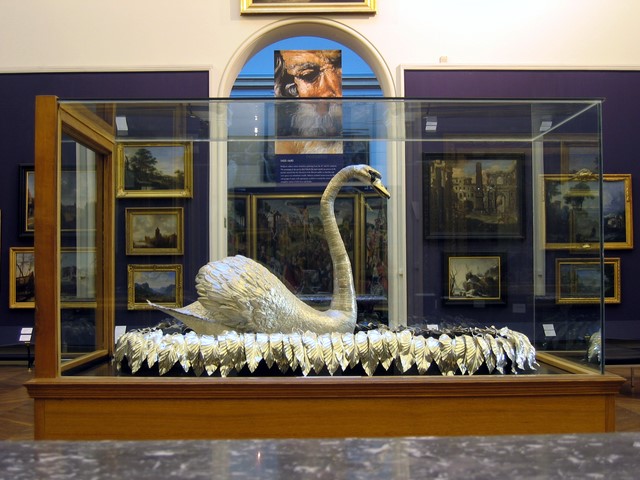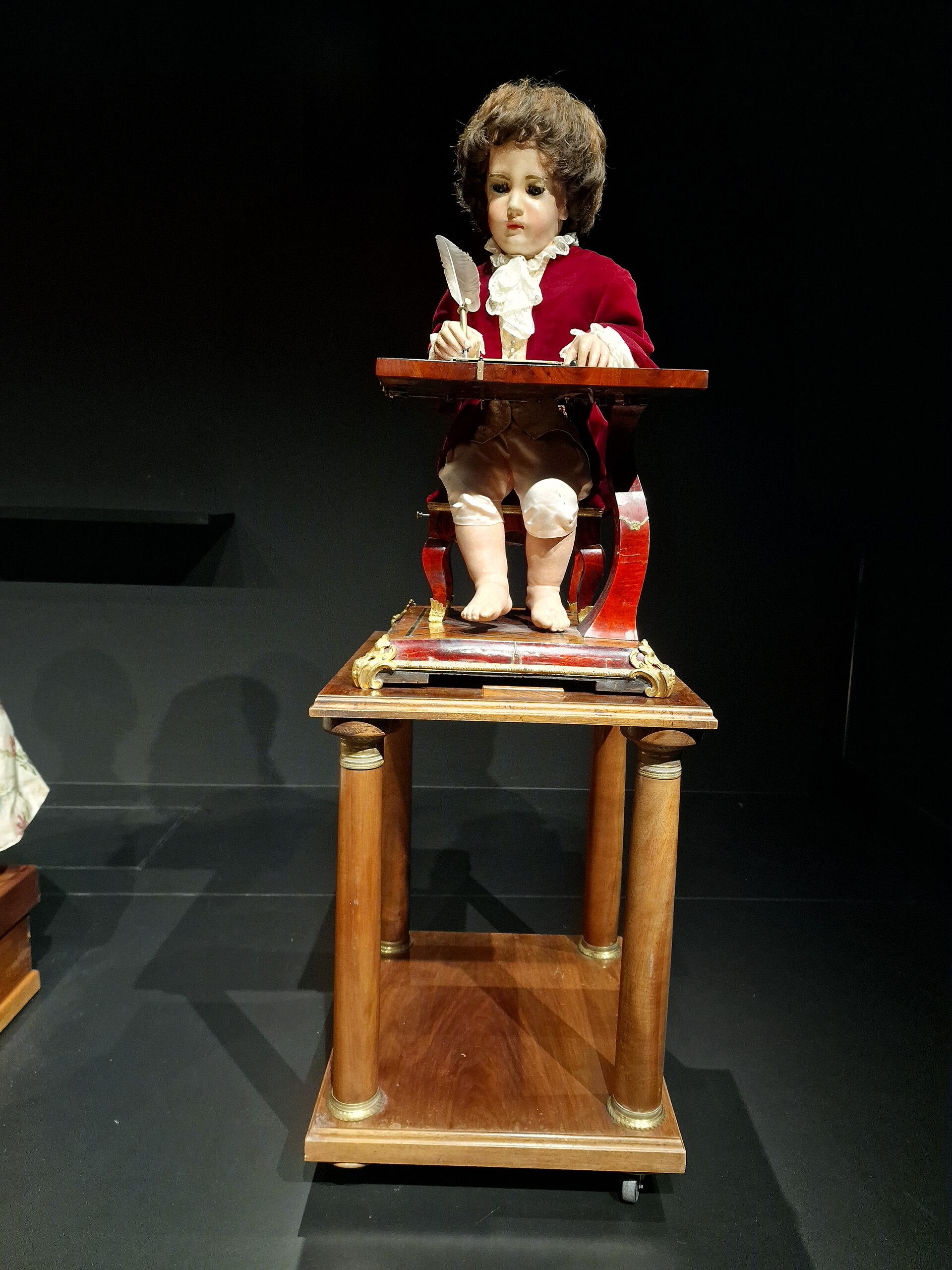
The Jaquet-Droz Automata (The Writer, The Draughtsman, The Musician)
1768-1774 · Brass
Musee d'Art et d'Histoire, Neuchatel
 active 1738-1824
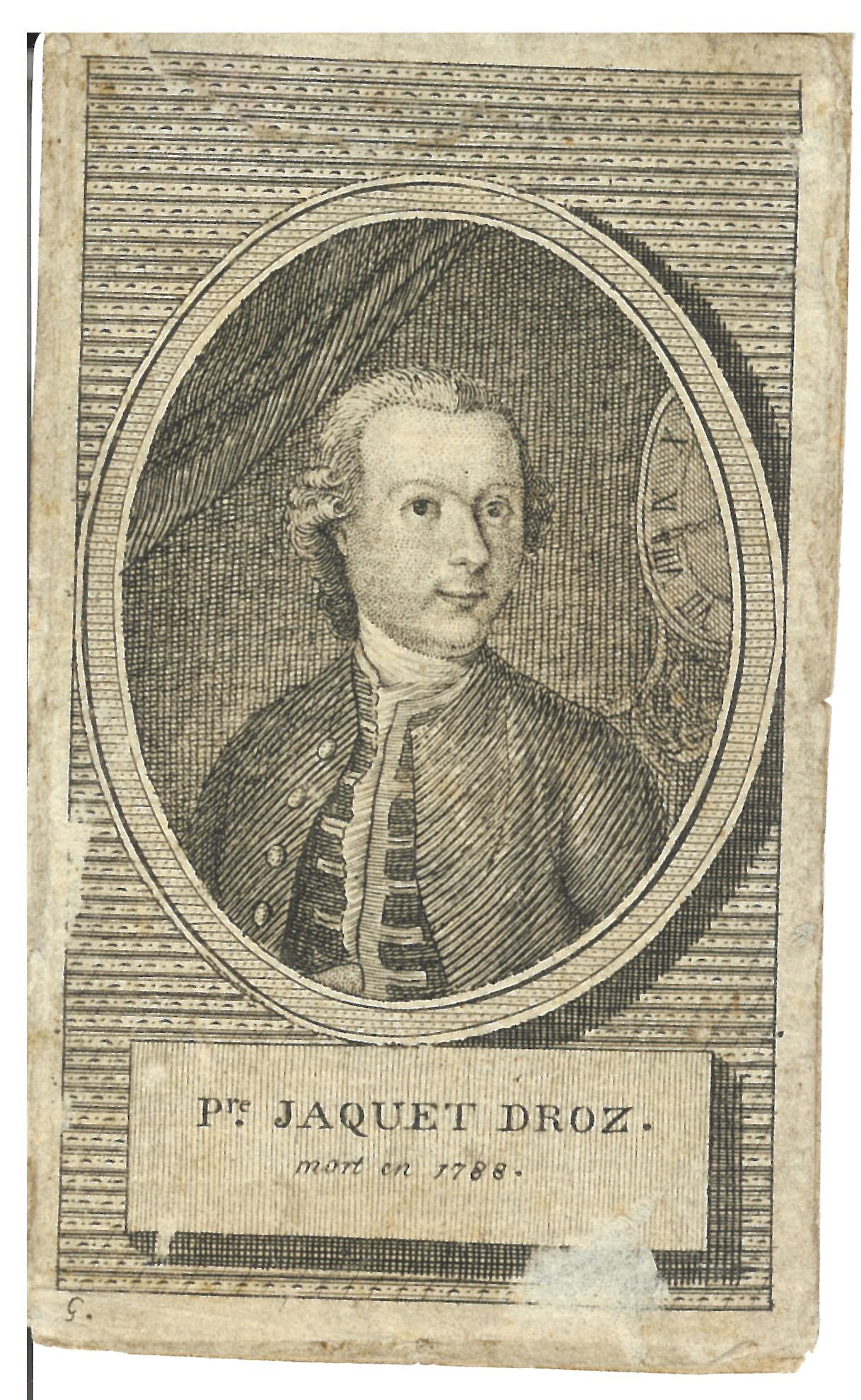
Pierre Jaquet-Droz, an engraved portrait by Abram-Louis Girardet (1772-1821), a Le Locle-born printmaker active from 1789, held by the Collections des Moulins souterrains du Col-des-Roches, Le Locle, and dated on the Commons file to about 1790. The file's own caption gives Jaquet-Droz's death year as 1788, which conflicts with the 28 November 1790 date recorded by the Dictionnaire historique de la Suisse and by most other sources consulted for this record; that date discrepancy is stated here rather than silently corrected. Beyond the museum's own record, no separate scholarly discussion confirming the sitter identification was located, so readers should weigh the identification accordingly.
Collections des Moulins souterrains du Col-des-Roches, Le Locle, via Wikimedia Commons| Full name | Jaquet-Droz and Leschot workshop (Pierre Jaquet-Droz, Henri-Louis Jaquet-Droz and Jean-Frederic Leschot) |
|---|---|
| Worked as | Watchmakers, Automaton makers, Clockmakers |
| Nationality | Swiss (Principality of Neuchatel and Republic of Geneva) |
| Movement | Enlightenment horology and mechanism |
| In this archive | 1 artwork |
| Sources | 31 cited |
| Last verified |
About this page 1 artwork in the archive · Last verified · 31 sources cited
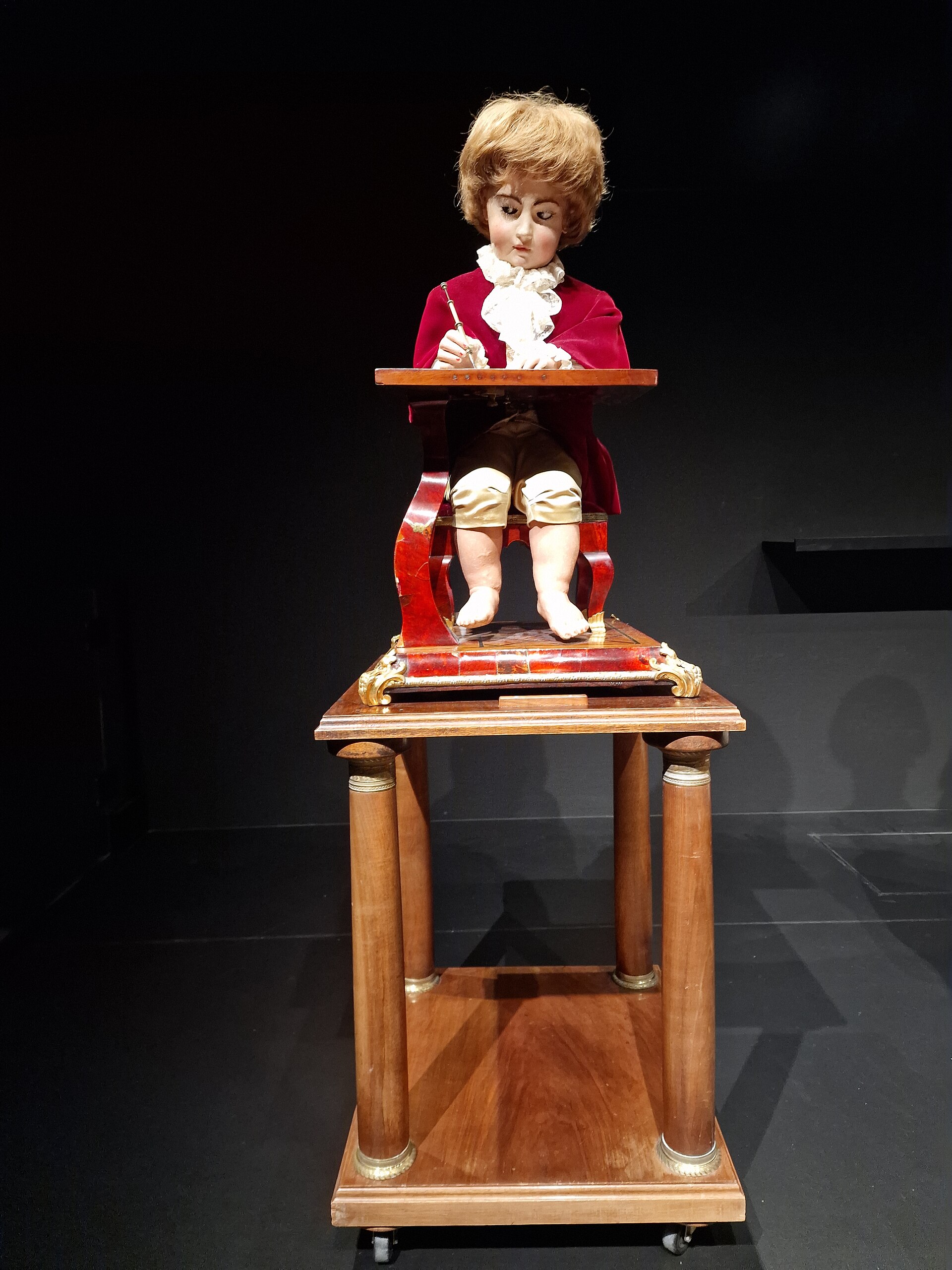
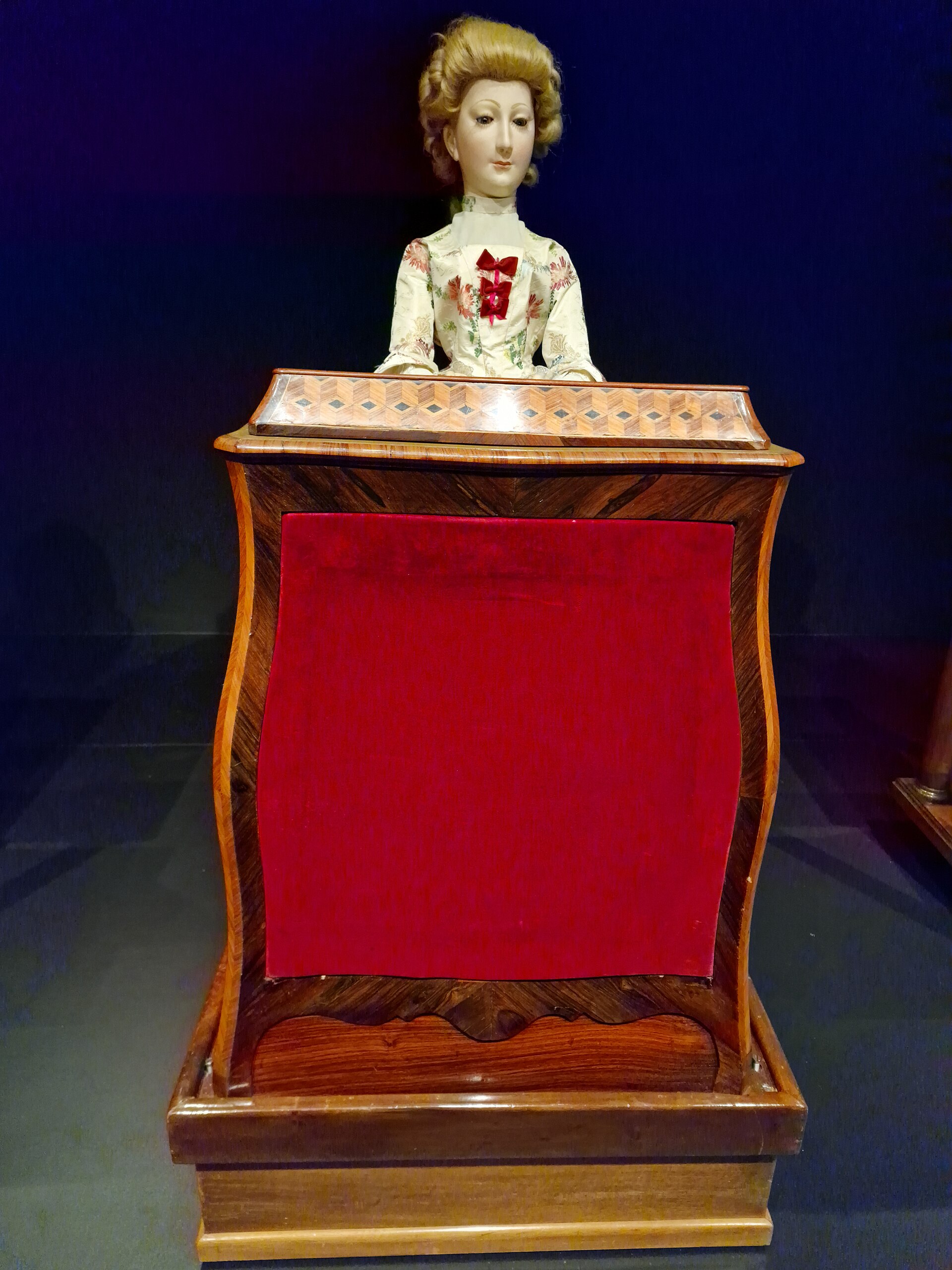
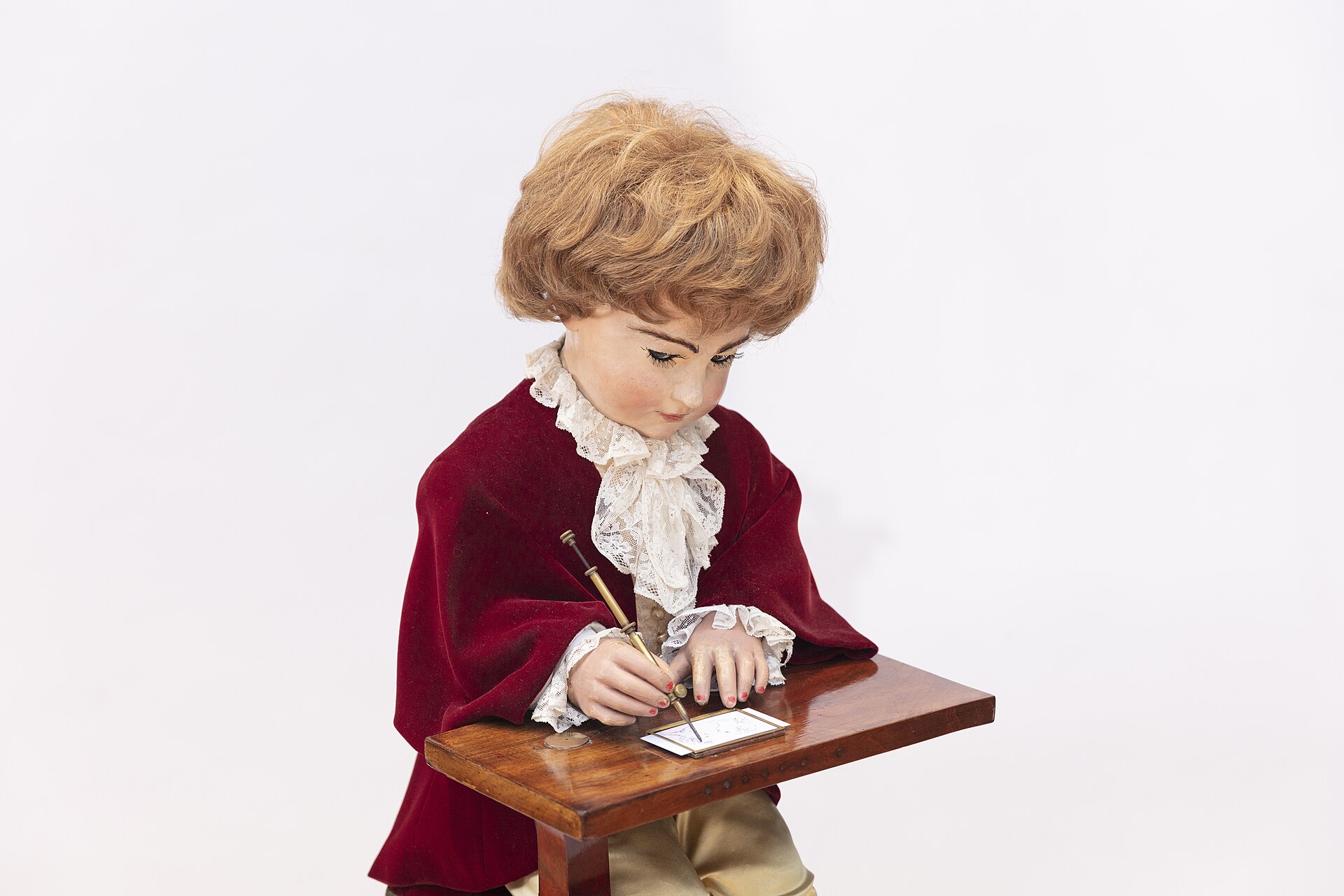
Jaquet-Droz and Leschot is the name given to the household workshop of the watchmaker Pierre Jaquet-Droz, his son Henri-Louis Jaquet-Droz, and Jean-Frederic Leschot, a neighbor's son whom Pierre took in and raised after the boy's mother died. Working together at La Chaux-de-Fonds between 1768 and 1774, the three men built three life-sized mechanical figures, a writer, a draughtsman and a musician, each capable of performing one human skill with no hidden assistance. All three still exist, still work in two of three cases, and still belong to the museum that bought them in 1906. No other eighteenth-century automaton project of comparable ambition survives so completely or so publicly.
What most accounts leave out is that the three androids were built to advertise a business, not to found one. The same workshop's ordinary trade, in singing-bird boxes, musical clocks and automaton watches sold across Europe and, through a London merchant house, into China, is where the firm actually made its money, and it is where most of what survives in private hands and at auction actually comes from. The showpieces are famous; the commercial output is what a collector is far more likely to be offered.
The single hardest thing to pin down about this workshop is also the most honest thing to say about it: which of the three men is responsible for which automaton is not settled. The workshop's own three-name attribution is universal and undisputed. The internal division of labour behind it is not, and this record reports that gap rather than choosing a version to repeat.
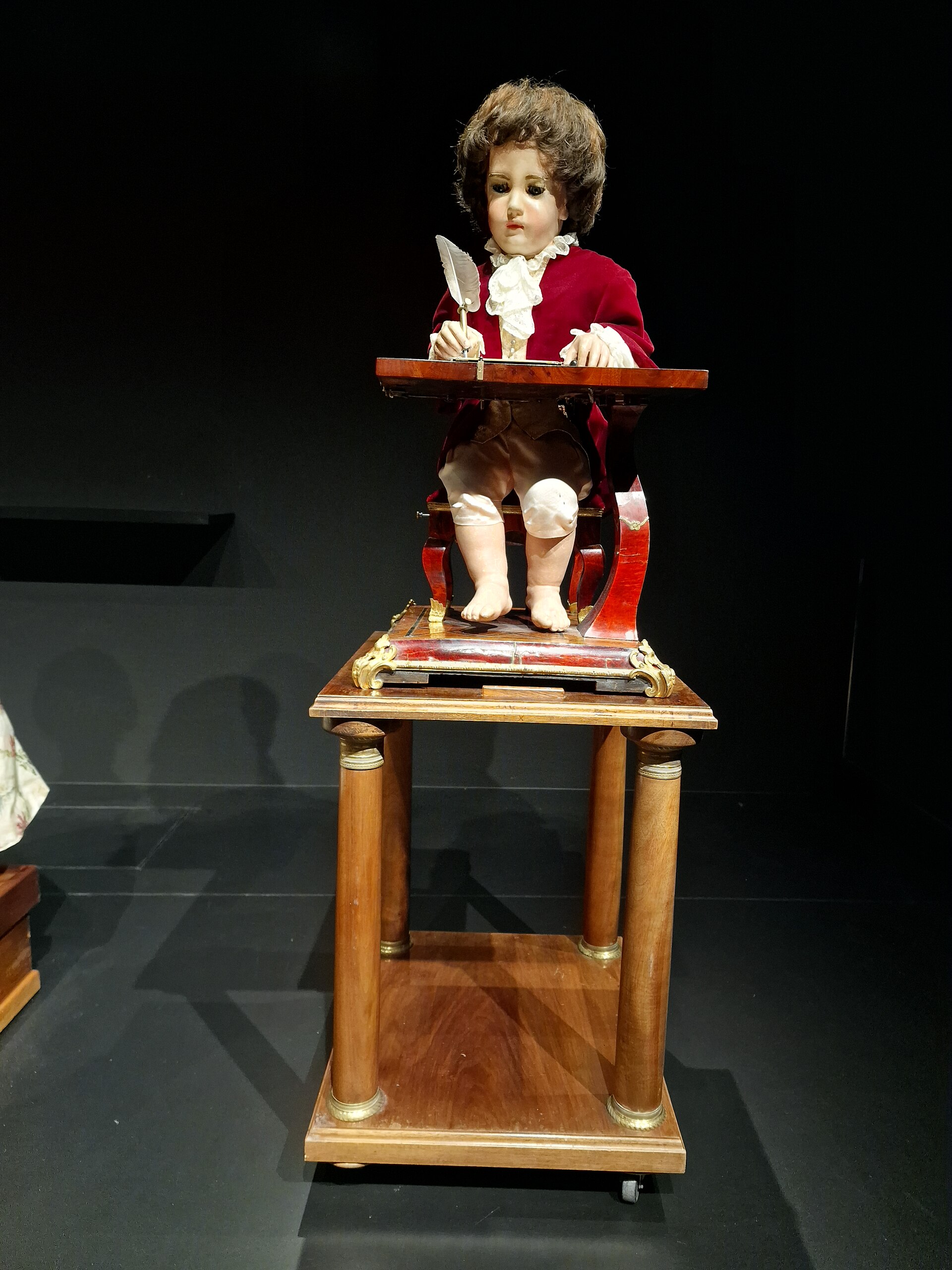
Pierre Jaquet-Droz born 28 July at La Chaux-de-Fonds.2
Pierre Jaquet-Droz turns to precision mechanical watchmaking, per the Dictionnaire historique de la Suisse; the same source records an international clockmaking enterprise by 1759.2
Jean-Frederic Leschot born at La Chaux-de-Fonds.4
Henri-Louis Jaquet-Droz born, son of Pierre.3
Pierre Jaquet-Droz travels alone to the Spanish court and presents clocks with simple automata, including a mechanical dog, to King Ferdinand VI.212
Work begins on the Writer at La Chaux-de-Fonds.5
The Writer, the Draughtsman and the Musician built, along with the fourth, now-lost automaton La Grotte.15
The automata first shown to the public at La Chaux-de-Fonds, then moved to Geneva.1
The automata presented in Paris; Leschot recorded as received at the French court and meeting Marie-Antoinette.4
Henri Maillardet begins a partnership with Henri-Louis Jaquet-Droz in London, a collaboration that ends around 1788 amid Henri-Louis declining health.311
A Mechanical Spectacle organised by Henri-Louis Jaquet-Droz and Leschot runs in Paris and then London.9
Pierre Jaquet-Droz and Jean-Frederic Leschot open Geneva's first clockmaking manufacture. Jacob Frisard settles in Geneva and begins working for the firm as a singing-bird specialist.42829
The three androids and La Grotte sold together to the Gendre brothers of Madrid.10
Pierre Jaquet-Droz dies 28 November at Bienne.2
Henri-Louis Jaquet-Droz dies 15 November at Naples.3
Jean-Frederic Leschot designs artificial limbs, including a prosthetic arm, alongside the firm's clockmaking work.8
Jean-Frederic Leschot founds his own house in Geneva, continuing singing-bird production under the Jaquet-Droz and Leschot name in London.4
Georges-Auguste Leschot, Jean-Frederic's son, born; later a designer of watchmaking machinery for Vacheron and Constantin.4
Jacob Frisard dies on the return journey from a selling trip to Constantinople.2829
Jean-Frederic Leschot dies 12 June at Cologny, near Geneva.4
The Societe d'histoire et d'archeologie du canton de Neuchatel buys the three surviving androids for 75,000 gold francs.111
The Society gives the three androids to the City of Neuchatel, 1 May.1
A cooperative of roughly 150 Swiss watch manufacturers uses Jaquet-Droz as a shared brand name, unrelated to the historical workshop, before the venture fails.24
A separate, Investcorp-backed company begins using the Jaquet-Droz name; Francois Bodet and Yves Scherrer acquire it in 1995 and produce replicas of the historical automata before launching a watch line.24
The Swatch Group acquires the Jaquet Droz brand, 25 April.24
A Jaquet-Droz and Leschot singing-bird scent flask sells for $2,530,000 at Sotheby's New York, a record for an antique piece by the firm.1617
The automaton clock L'Oiseau Prive sells for CHF 1,025,000 at Antiquorum, Geneva.20
The three androids themselves have never been in private hands since 1906 and do not trade; the market that exists is for the firm's smaller commercial output. Exceptional, well-provenanced singing-bird automata reach seven figures: a gold, enamel and gem-set singing-bird scent flask made by the firm around 1785 to 1787 for the Chinese market sold for $2,530,000 at Sotheby's New York in 2015, roughly double its high estimate, and carried a documented ownership chain back through the Geneva-New York dealer A La Vieille Russie and the Swiss collector Maurice Sandoz, who bought it in 1942 for $2,997. Rare automaton clocks reach high six to seven figures, as with the neo-classical clock L'Oiseau Prive, sold for CHF 1,025,000 at Antiquorum in 2019. More modest singing-bird cage clocks, without comparable rarity or provenance, have sold in the low hundreds of thousands. Quill and Pad's own report of the 2015 sale describes it as 'hammering at' USD 2,530,000, treated here as a hammer price; for the other results below the sources consulted report only a single achieved price without separately publishing a hammer figure and a buyer's premium, and this record states that conflation rather than inventing a split.
| Date | Sale | Work | Result | Note |
|---|---|---|---|---|
| 11 June 2015 | Sotheby's, New York | Singing Bird Scent Flask (gold, enamel, pearl and gem-set automaton scent flask with watch and serinette mechanism), Jaquet-Droz, Leschot and Frisard, Geneva, circa 1786-1787, originally made for the Chinese market and later sold to James Cox, London, in 1787 | Hammer 2530000 USD | Quill and Pad's own report of the sale describes the automaton as 'hammering at USD 2,530,000' against an estimate of USD 800,000 to USD 1,200,000, treating the figure as a hammer price; Sotheby's own lot page could not be independently reconfirmed here (login-walled) and no separate buyer's premium figure was found in the sources consulted. Provenance: A La Vieille Russie, New York, until 1942; the Maurice Sandoz collection, 1942 to 1957, acquired for USD 2,997; an American collection, 1958 to 2015. |
| 11 May 2019 | Antiquorum, Geneva | L'Oiseau Prive, a neo-classical automaton clock in the form of a scent bottle, circa 1795 | With premium 1025000 CHF | Reported by the modern Jaquet Droz brand's own press materials as a record price for an authentic antique Jaquet-Droz automaton clock; sources do not separately state a hammer price and a buyer's premium. |
| 2014 | Antiquorum, Geneva | Small Singing Bird Cage Clock with automaton jumping bird and automaton waterfall, attributed to Jaquet-Droz et Leschot, Geneva | With premium 291750 CHF | Reported sold to a Russian collector for CHF 291,750, approximately $305,000 at the time; sources do not separately state a hammer price and a buyer's premium. |
Hammer is the price at which the bidding stopped; with premium adds the fee the house charges the buyer on top. Hammer price and buyer's premium in the glossary.
| Institution | City | Holdings | Note |
|---|---|---|---|
| Musee d'Art et d'Histoire | Neuchatel, Switzerland | The Writer, the Draughtsman and the Musician, the three surviving androids, held since 1909 | The Musician and the Draughtsman are demonstrated for the public on a published schedule. The Writer is currently out of service. |
| Musee international d'horlogerie | La Chaux-de-Fonds, Switzerland | A pocket watch with jumping seconds and a central balance wheel, signed Jaquet-Droz et Leschot, London, late eighteenth century with an early nineteenth-century box (inventory I-2912) | Confirmed directly from the museum's own published watch-collection catalogue entry. |
| The Metropolitan Museum of Art | New York, United States | A gold and enamel boudoir clock by the firm of Jaquet-Droz and Leschot, London and Geneva, circa 1784-1791, gift of Mrs Bernice Chrysler Garbisch, 1952 (accession 52.206.9) | Confirmed directly from the museum's own published collection record. |
Pierre Jaquet-Droz was born on 28 July 1721 at La Chaux-de-Fonds, in the Principality of Neuchatel.
Pierre Jaquet-Droz was born on 28 July 1721 at La Chaux-de-Fonds, in the Principality of Neuchatel. He studied mathematics, physics and theology, reportedly at Basel and Neuchatel, before apprenticing as a watchmaker and opening his first workshop at La Chaux-de-Fonds in 1738. His son Henri-Louis, born in 1752, grew up inside that workshop. Jean-Frederic Leschot, born in 1746 at La Chaux-de-Fonds, was the son of a neighbor; after his mother's death Pierre took him in and raised him as an adoptive son, and he became the firm's most consequential business partner rather than merely an employee.
Reading any one of the three names alone understates how tightly the operation was a family and near-family concern. It is also why the surviving record is often vague about exactly which of the three men is responsible for which part of the work: a household workshop does not necessarily keep the kind of internal attribution records a modern reader would want.
A decade before the three androids existed, Pierre Jaquet-Droz travelled alone to the Spanish court in 1758 and 1759 and presented clocks fitted with simple automata, including a mechanical shepherd...
A decade before the three androids existed, Pierre Jaquet-Droz travelled alone to the Spanish court in 1758 and 1759 and presented clocks fitted with simple automata, including a mechanical shepherd and a dog, to King Ferdinand VI. The dog is reported to have startled the king by appearing to bark and guard a basket of fruit. The proceeds funded the firm's later, far more ambitious project.
This earlier, solo trip is frequently confused in popular writing with the later tour of the three androids themselves. It predates the automata project by roughly a decade and this record treats it as a separate, earlier event.
All three automata are accepted as products of the joint workshop, built at La Chaux-de-Fonds between 1768 and 1774.
All three automata are accepted as products of the joint workshop, built at La Chaux-de-Fonds between 1768 and 1774. No serious source disputes the three-name attribution. Where accounts genuinely diverge is on which of the three automata belongs to which man. A detailed horological history credits the Writer to Pierre Jaquet-Droz, begun in 1768 and already assisted by Leschot, and credits both the Musician and the Draughtsman, built 1772 to 1774, to Henri-Louis Jaquet-Droz assisted again by Leschot. The Neuchatel museum's own published account agrees that the Writer is Pierre's and that the Musician is a joint work of Henri-Louis and Leschot, but is silent on a separate credit for the Draughtsman.
Neither source calls the other wrong; they report the internal division of labour differently, which is itself a fact about how thin the documentary record on this workshop's internal practice is. The Dictionnaire historique de la Suisse adds a distinct data point: it records that Leschot, rather than either Jaquet-Droz, was the family member most often sent abroad to present the finished automata, including at the French court. Construction credit and public-facing credit may therefore belong to different men, and this record does not resolve that gap by picking a version.
The Writer's mechanism is reported at roughly 6,000 individual components, though at least one horological account gives a lower figure nearer 4,000 for the same machine; neither number has been...
The Writer's mechanism is reported at roughly 6,000 individual components, though at least one horological account gives a lower figure nearer 4,000 for the same machine; neither number has been independently verified here. Its core is a set of interchangeable steel cams, one governing each character the boy is capable of forming, arranged so that an operator can select and order up to forty letters across three lines before the automaton runs. The Draughtsman uses a comparable cam system adapted to two dimensions, coding horizontal and vertical pencil movement plus a third cam that lifts the pencil between strokes, and is built around roughly 2,000 components; unlike the Writer, its repertoire of four drawings is fixed rather than programmable. The Musician is built around roughly 2,500 components and a genuine small pipe organ rather than a concealed music box, played by the figure's own fingers, with a chest that rises and falls to simulate breathing.
Because the Writer's character set is swappable rather than fixed, it is regularly cited in histories of computing as an early physical example of programmability: the cams function as a read-only memory that a period owner could reconfigure between performances. In modern times the museum has reprogrammed the Writer's cams to mark specific occasions, including a text produced for a visit by the French president Francois Mitterrand, which is itself evidence that the programming mechanism still functions as designed.
The three androids were not the workshop's only large automaton from this campaign.
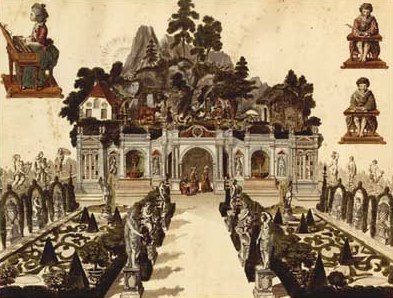
The three androids were not the workshop's only large automaton from this campaign. A fourth piece, La Grotte, was completed at the same time and, according to the early twentieth-century history of the firm by Charles Perregaux and F. Louis Perrot, was expected to have been at least as complicated as the three human figures. It survives today only as a description and a single engraving, drawn in England, engraved by Balthasard Anton Dunker and completed by F. Lardy in 1776. A poster advertising the piece in Lyon in 1784 describes a small architectural base under a metre square overlooking a moving pastoral scene of livestock, a peasant riding to a mill, a flute-playing shepherd, a shepherdess with a guitar, dancers, fountains and an aviary of singing birds.
Perregaux and Perrot's own account of its disappearance is cautious rather than certain: they judge it probable that a mechanism of that complexity, once it broke down, was never repaired and was left to decay. That is a historian's considered inference, not a documented event, and this record treats it as such.
The three androids and La Grotte were first shown to the public at La Chaux-de-Fonds in 1774, then moved to Geneva.
The three androids and La Grotte were first shown to the public at La Chaux-de-Fonds in 1774, then moved to Geneva. By 1775 the automata had reached Paris, where multiple independent accounts place a presentation before the French court; the Dictionnaire historique de la Suisse specifically credits Leschot as the family member received there, recording that he met Marie-Antoinette in this capacity. From Paris the tour continued to London, where a specialised history of European automaton exhibitions records a Mechanical Spectacle organised by Henri-Louis Jaquet-Droz and Leschot running in Paris in 1775 and in London between 1775 and 1777. The workshop opened a London branch the same year and placed Henri Maillardet, then an apprentice, in charge of it.
Popular accounts of the tour also place the automata before the Spanish court and further afield; this record has not been able to verify those specific stops against a source independent of promotional company history, and does not repeat them as established fact. Pierre Jaquet-Droz's own, separately documented, solo journey to Spain in 1758 to 1759, described above, is easy to confuse with a claimed court tour of the three androids themselves, and this record treats the two as distinct.
The three androids were the most spectacular item in a catalogue that otherwise sold expensive practical clocks and watches fitted with singing birds, chimes and automata, and it is this commercial...
The three androids were the most spectacular item in a catalogue that otherwise sold expensive practical clocks and watches fitted with singing birds, chimes and automata, and it is this commercial output, not the androids, that funded the firm's later decades and that a collector is actually likely to encounter. Jean-Frederic Leschot managed the firm's relationship with the London merchant house of James Cox, whose agents in Canton opened the Chinese market to Jaquet-Droz clocks and automata; a company history states that more than 600 pieces were exported to China within a decade through this route, a figure this record has not independently verified beyond that promotional account and flags accordingly.
Jacob Frisard, born at Villeret in 1753, trained in La Chaux-de-Fonds and settled in Geneva around 1784, where he worked for the firm as its specialist maker of singing-bird mechanisms before starting his own independent business around 1800. His technical contribution was a set of cams arranged in a continuous spiral so that a bird's song ran without a break from beginning to end, a design not replicated by other makers. He demonstrated his work as far afield as an attempted audience with Napoleon and a 1809 exhibition in Zurich, and died in 1810 on the return journey from a selling trip to Constantinople.
Pierre Jaquet-Droz died on 28 November 1790 at Bienne, where he had gone as his health declined.
Pierre Jaquet-Droz died on 28 November 1790 at Bienne, where he had gone as his health declined. Henri-Louis died a year later, on 15 November 1791, in Naples, where he had travelled with his wife in an effort to improve his own declining health. Both deaths fell within thirteen months of each other and left Jean-Frederic Leschot as the sole surviving partner.
Leschot did not close the business. He had already joined Pierre in opening Geneva's first clockmaking manufacture in 1784, and after the two Jaquet-Droz deaths he continued the firm's production of singing-bird clocks under the existing name, Jaquet-Droz and Leschot, London, before founding his own house in Geneva in 1796. Separately from clockmaking, Leschot is documented as having designed artificial limbs in the early 1790s, including an artificial arm weighing approximately 480 grams offered at 50 Louis, applying the same fine mechanical skill used in the automata to a medical device. He died on 12 June 1824 at Cologny, near Geneva. His own son, Georges-Auguste Leschot, born in 1800, became an eminent designer of watchmaking machinery for Vacheron and Constantin and helped develop the lever escapement's manufacture by machine, extending the family's mechanical trade into the following century.
The clearest documented ownership event between the workshop and the modern museum is a sale in 1787: a French-language secondary account of the automata, flagged here as a tertiary source pending...
The clearest documented ownership event between the workshop and the modern museum is a sale in 1787: a French-language secondary account of the automata, flagged here as a tertiary source pending replacement with an archival record, states that all four automata, including La Grotte, were sold together that year to the Gendre brothers of Madrid. The same account describes what followed as a nomadic existence in which the automata were repeatedly sold and lost track of, and it is in this period that La Grotte is believed, on inference rather than direct record, to have finally broken down beyond repair.
No continuous chain of ownership for the three surviving androids between 1787 and 1906 was found in the sources consulted for this record. That gap runs to roughly a century and a fifth, and this record states it as a gap rather than smoothing it over with a plausible guess. The automata resurface in the documentary record in 1906, when the Societe d'histoire et d'archeologie du canton de Neuchatel purchased the three surviving figures for 75,000 gold francs; from whom the Society bought them is not stated in the sources consulted. The Society gave the automata to the City of Neuchatel on 1 May 1909, and they have belonged to the city's museum, now the Musee d'Art et d'Histoire, ever since.
The Antiquarian Horological Society's account of the Writer describes Pierre Jaquet-Droz as pursuing his research in the field of picturesque mechanisms and the artificial duplication of life and...
The Antiquarian Horological Society's account of the Writer describes Pierre Jaquet-Droz as pursuing his research in the field of picturesque mechanisms and the artificial duplication of life and motion, a framing the workshop appears to have used of its own project. That ambition sat inside a live philosophical argument rather than outside it. Rene Descartes had already proposed that an animal's body could be understood as a kind of clockwork, distinct from a reasoning soul. Julien Offray de La Mettrie's Man a Machine, published in 1748, pushed the same logic onto human beings themselves, treating the body as a self-moving machine and denying a separate soul the work needed to explain it. Jacques de Vaucanson's mechanical duck of the 1730s, which appeared to eat and digest, was already being read by writers in this tradition as evidence for a mechanistic account of life two generations before the Writer was built.
The three Jaquet-Droz androids arrived inside that argument already in progress, and their audiences would have recognised the stakes: a machine that appeared to write its own thoughts, or to breathe while it played music, was not neutral entertainment in a decade when serious philosophers were arguing in print about whether a human being was, in the end, exactly that kind of mechanism. Adelheid Voskuhl's academic study of the Musician, consulted here via its published abstract and secondary discussion rather than its full text, argues that the automaton's breathing chest and tracking eyes were built specifically to perform the appearance of an interior life and attention, not only the mechanical result of the music itself. This record states that argument as Voskuhl's, not as a documented intention recorded by the Jaquet-Droz workshop, since no letter, contract or notebook establishing what Pierre, Henri-Louis or Leschot themselves believed their machines proved about the soul has been found in the sources consulted.
A separate, later automaton capable of writing and drawing exists today at the Franklin Institute in Philadelphia, built in London around 1800 by Henri Maillardet, who trained in this workshop and...
A separate, later automaton capable of writing and drawing exists today at the Franklin Institute in Philadelphia, built in London around 1800 by Henri Maillardet, who trained in this workshop and was placed in charge of its London branch in 1775 before establishing his own practice. It was not built by Pierre Jaquet-Droz, Henri-Louis Jaquet-Droz or Leschot, and has never belonged to the Neuchatel museum. That automaton has its own documented history of misidentification: when it arrived at the Franklin Institute by donation in 1928, the family that gave it believed it had been built in France by an inventor named Maelzel, not by Jaquet-Droz, and it was not until a 2007 restoration that the automaton itself wrote out a text identifying its true maker as Maillardet. Because Maillardet trained under Jaquet-Droz and built a machine that performs the same two skills, the two objects are easy for a casual reader to conflate, and this record treats the Philadelphia case as a documented cautionary parallel and nothing more.
A second, unrelated source of confusion is more recent. The Jaquet-Droz name has been used as a Swiss watch brand independently of the original eighteenth-century firm on at least three separate later occasions: a cooperative of roughly 150 Swiss manufacturers used it as a shared trademark from the 1960s, exporting 7.4 million watches under the name in 1968 alone, before that venture collapsed and made its final appearance at the Basel fair in 1983; an unrelated company backed by Investcorp began using the name in 1993, with the executives Francois Bodet and Yves Scherrer acquiring it in 1995 and initially producing replicas of the original automata before launching an upscale watch line; and the Swatch Group acquired that brand on 25 April 2000, placing it alongside Breguet and Blancpain in its prestige category, which is the brand trading under the name today. None of these later ventures is the eighteenth-century workshop of Pierre Jaquet-Droz, Henri-Louis Jaquet-Droz and Leschot, and this record treats the historical firm and the modern brand as two different subjects that happen to share a name.
Watchmakers; Automaton makers; Clockmakers. workshop active 1738-1824 (Pierre Jaquet-Droz 1721-1790; Henri-Louis Jaquet-Droz 1752-1791; Jean-Frederic Leschot 1746-1824).
Maillardet's automaton misidentified as the work of an inventor named Maelzel. A separate writing-and-drawing automaton at the Franklin Institute, Philadelphia, was built around 1800 by Henri Maillardet, a former apprentice of this workshop who had been placed in charge of its London branch in 1775. It is not a Jaquet-Droz and Leschot object.
Musee d'Art et d'Histoire (Neuchatel, Switzerland); Musee international d'horlogerie (La Chaux-de-Fonds, Switzerland); The Metropolitan Museum of Art (New York, United States).
The three androids themselves have never been in private hands since 1906 and do not trade; the market that exists is for the firm's smaller commercial output. Exceptional, well-provenanced singing-bird automata reach seven figures: a gold, enamel and gem-set singing-bird scent flask made by the firm around 1785 to 1787 for the Chinese market sold for $2,530,000 at Sotheby's New York in 2015, roughly double its high estimate, and carried a documented ownership chain back through the Geneva-New York dealer A La Vieille Russie and the Swiss collector Maurice Sandoz, who bought it in 1942 for $2,997.
Exactly how was credit for the Musician and the Draughtsman divided between Henri-Louis Jaquet-Droz and Jean-Frederic Leschot? Two reputable accounts, a specialist horological history and the museum's own published account, do not fully agree.
Last verified
One artwork and its story every Tuesday, with the picture: who owned it, what it made, and what closes soon in the exhibition calendar. No promotion, and nothing we cannot cite.
We send one email to confirm the address and keep nothing else. Every letter carries a one-click unsubscribe. How we handle your data.