Morellian Analysis: The Ears and the Hands
Giovanni Morelli argued that an artist gives himself away where he stops paying attention. Freud borrowed it, Ginzburg theorised it, and the workshop contracts undercut it.
On this page 6 sections
ContentsClose
In short
- Morelli published as Ivan Lermolieff, an anagram of his own name, translated by Johannes Schwarze, which also means Giovanni Morelli.
- Drapery is on Morelli's excluded list, not his diagnostic one: he grouped it with the studio devices painters learn from each other.
- Freud wrote in 1914 that Morelli's method of inquiry is closely related to the technique of psycho-analysis.
- Renaissance contracts record patrons accepting assistants on the fingernails and insisting on the master for the important passages.
The physician who published as a Russian
Giovanni Morelli was born in Verona in 1816 and died in Bergamo in 1891. He studied medicine at Munich and Erlangen between 1833 and 1838, graduating under the anatomist Ignaz Doellinger, and, as Edgar Wind noted, never practised. He became a senator of the Kingdom of Italy in 1873. He came to art history sideways, and he entered it in disguise.
The disguise was thorough and slightly comic. He published as Ivan Lermolieff, a Russianised anagram of Morelli, in works said to be translated by a Dr Johannes Schwarze, which is Giovanni Morelli in German. The articles appeared in the Zeitschrift fuer bildende Kunst from 1874 to 1876; the first book, Die Werke italienischer Meister in den Galerien von Muenchen, Dresden und Berlin, came out in Leipzig in 1880; the Kunstkritische Studien ueber italienische Malerei followed in the early 1890s, the Berlin volume compiled from his notes by Gustavo Frizzoni and published posthumously in 1893.
His argument was that connoisseurs were attending to the wrong evidence. Compositions can be copied, faces can be studied, expressions can be imitated. What a copyist cannot easily reproduce is the way an artist renders the parts nobody looks at, because the artist himself was not looking at them either. Morelli called this his experimental method, and he meant the word.
What to look at, and what Morelli explicitly ruled out
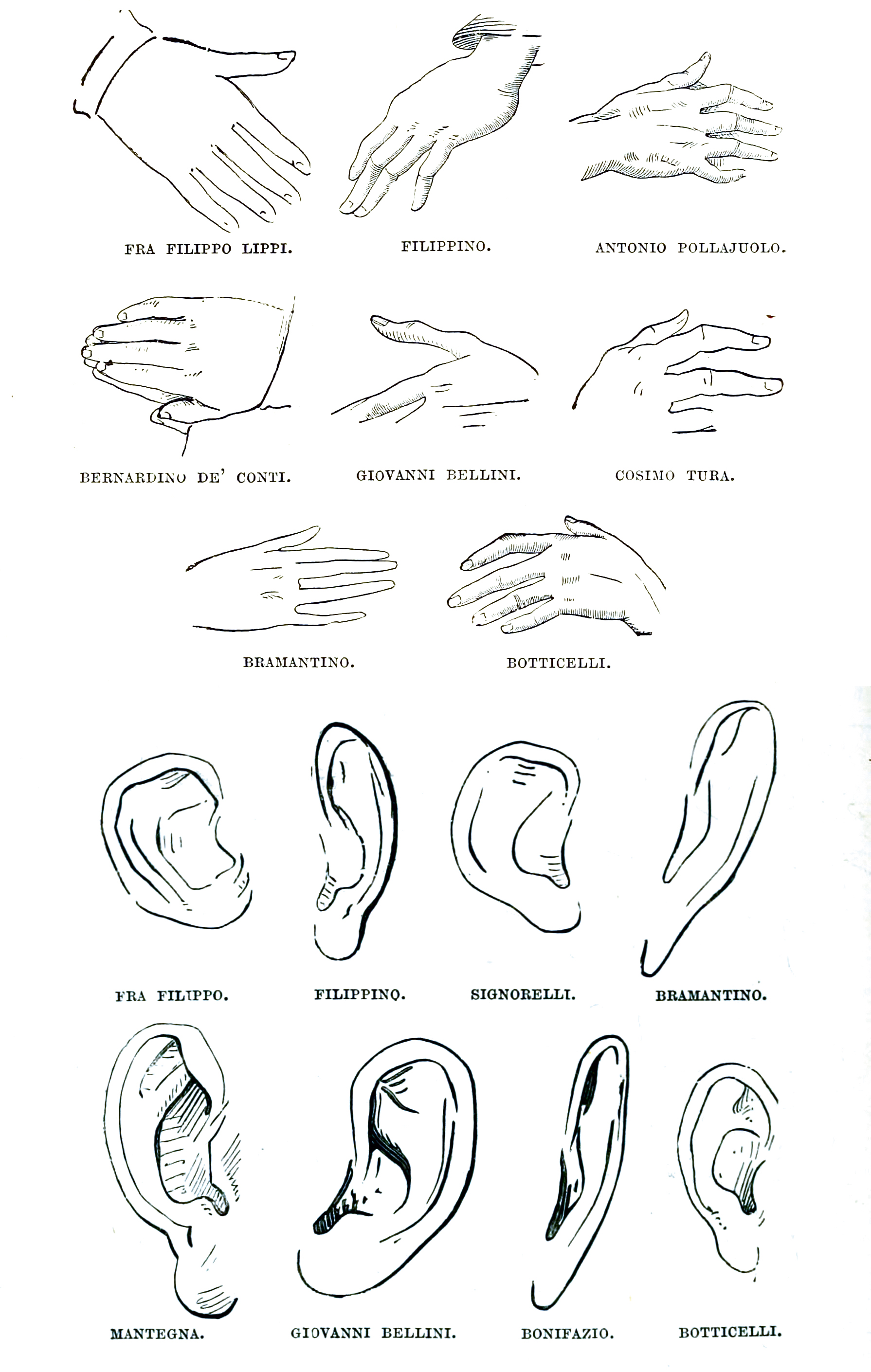
Wind's summary of the negative half of the argument is the clearest available: of composition, expression and the rest, none will reveal with certainty the hand of a particular painter, because they are studio devices which painters learn from each other. To identify the master, Morelli held, attention must go to small idiosyncrasies that seem inessential, such as the shape of a fingernail or the lobe of an ear. As these are inexpressive parts of a figure, the artist, no less than his imitator, is likely to relax in their execution; they are the places where he lets himself go.
Carlo Ginzburg lists the diagnostic sites as earlobes, fingernails, and the shapes of fingers and of toes, and records that Morelli identified and catalogued the shape of the ear in figures by Botticelli and Cosme Tura by this method. Wind describes the physical appearance of the books, which is part of the argument: Morelli's volumes look different from those of any other writer on art, sprinkled with illustrations of fingers and ears, careful records of the characteristic trifles by which an artist gives himself away, as a criminal might be spotted by a fingerprint.
One item commonly listed among the Morellian sites does not belong there. Drapery is on Morelli's excluded list. In the passage where he asks what does not identify a painter, he groups the treatment of the drapery with pose, movement, expression, type of countenance and colouring: the transmissible skills, the things a workshop teaches. Including drapery folds among the diagnostic details inverts the premise of the method.
Why it was mocked, and by whom
Contemporaries found it absurd that great pictures should be judged on earlobes. Wilhelm von Bode called Morelli a quack doctor. As late as 1919 Max Friedlaender could still refer to him as a sort of charlatan, and Wind identifies the exact shape of that charge: in Friedlaender's opinion Morelli's attributions were produced by intuition while Morelli claimed to have produced them by science, and apparently that made him a charlatan.
Morelli's own response to the aesthetic objection was to make it worse. Whoever finds my method too materialistic and unworthy of a lofty mind, he wrote, let him leave the heavy ballast of my work untouched, and soar to higher spheres in the balloon of fancy. He was not conciliating a discipline; he was declining to join it on its own terms.
The objection has not aged well because it was aesthetic rather than logical. The underlying insight, that unconsidered production is more diagnostic than considered production, turns up independently in document examination, in forensic identification and in linguistics. Wind, no admirer, conceded the point directly: against the objection that personality should not be sought where personal effort is weakest, modern psychology would certainly support Morelli.
The result that made his name, and where it stands now
The Dresden Sleeping Venus is the demonstration. Before Morelli it was catalogued in the Dresden gallery as a copy by Sassoferrato of a lost Titian; Crowe and Cavalcaselle in 1877 had given a Sleeping Venus in Darmstadt to Titian and listed the Dresden picture among five copies, describing it as assigned dubiously to Sassoferrato. In 1880 Morelli identified it as one of the very few authentic works by Giorgione.
The scale of the revision he forced is easy to underestimate. In the Dresden gallery alone, Wind records, forty-six paintings were renamed because of Morelli's discoveries, and Morelli's friend Sir Henry Layard did not exaggerate in writing that he had caused a revolution. Morelli closed his own argument on the Venus with characteristic obstinacy, asking only to be left undisturbed in his admiration of this Venus of Giorgione.
The attribution stuck, and it did not stay pure. The picture is now generally catalogued as Giorgione and Titian, Gemaeldegalerie Alte Meister, Gal.-Nr. 185, the second name recording the belief that Titian completed the landscape. That outcome is a fair verdict on the method as a whole: it moved the picture decisively out of one category and could not, by itself, settle how many hands were in it.
Freud read him, and Ginzburg built a theory on him
Sigmund Freud discussed Morelli in The Moses of Michelangelo in 1914. He recorded that long before he had any opportunity of hearing about psychoanalysis, he learnt that a Russian art connoisseur named Ivan Lermolieff had caused a revolution in the galleries of Europe by insisting that attention be diverted from the general impression and main features of a picture, laying stress instead on the significance of minor details such as the drawing of the fingernails, the lobe of an ear, and other unconsidered trifles which the copyist neglects to imitate. Freud then discovered the Italian physician behind the pseudonym, and drew the conclusion that mattered to him: this method of inquiry is closely related to the technique of psychoanalysis, which is also accustomed to divine secret and concealed things from unconsidered or unnoticed details, from the rubbish heap of our observations.
Carlo Ginzburg turned that connection into a general argument in 'Morelli, Freud and Sherlock Holmes: Clues and Scientific Method', published in the History Workshop Journal in spring 1980, translated by Anna Davin. His thesis is that an epistemological model emerged silently in the humanities at the end of the nineteenth century, one that reasons from small involuntary traces, and that it never became explicit theory. Following Enrico Castelnuovo, he set Morelli beside Conan Doyle's detective, taking as his demonstration 'The Cardboard Box' of 1893, a story that turns on two severed ears, in which Holmes literally morellizes.
Ginzburg also corrects the standard aesthetic reading of Morelli, including Wind's. Wind treated the method as a technique of visual dissociation and as a cult of the fragment, a Romantic heresy that made the artist's spirit reside in his hand. Ginzburg objects that this is unconvincing, because Morelli was not concerned with aesthetic problems at all but with problems of a preliminary philological order. Morelli was trying to establish which object was by whom before anyone discussed what it meant.
Where the method breaks, and the contracts say so
Morellian analysis fails hardest exactly where the market needs it most: workshop production. If a master trained assistants and they learned his formula for an ear, the ear stops being diagnostic of an individual and becomes diagnostic of a shop. That much has been said since the beginning. The documentary evidence makes the problem sharper than the general objection allows.
Christopher Nygren, summarising Michael Baxandall's analysis of Renaissance contracts, points out that patrons were content to have workshop assistants paint the less important elements of a painting, things like fingernails, while being very keen that the master paint the important parts. Most old master paintings are a collaborative effort between the master and his assistants, and Morelli's method does not account for it.
That is not merely a limitation. It is an inversion of the premise. Morelli assumed that composition and expression were the transmissible studio devices and that the small anatomical details were personal and involuntary. The contracts record a division of labour running the other way, with the master reserved for the passages that were seen and the assistants assigned the parts that were not. Where a workshop operated on that basis, the earlobe records the apprentice and the face records the master, which is the precise reverse of what a Morellian reading assumes.
Questions
Yes, though rarely under that name. Systematic comparison of habitual, low-attention detail across a body of securely attributed work is standard practice in attribution, and Ginzburg's point was that the underlying reasoning had become general method without ever being stated as theory.
No, and this is a common error. Morelli grouped the treatment of drapery with pose, movement, expression, type of countenance and colouring as the transmissible studio devices that do not identify a hand. His diagnostic sites are anatomical: earlobes, fingernails, the shapes of fingers and toes.
With difficulty, and it has been. A forger who has studied the habitual forms can reproduce them, which is why the method is never used alone. Its stronger use is in separating a copyist working from a finished picture from an artist inventing one.
In The Moses of Michelangelo, 1914, he described Morelli's insistence on fingernails, earlobes and other unconsidered trifles, and wrote that this method of inquiry is closely related to the technique of psycho-analysis, which likewise divines concealed things from unnoticed details.
Sources
- 1Dictionary of Art Historians, entry for Giovanni Morelli. arthistorians.info/morellig
- 2Edgar Wind, 'Critique of Connoisseurship', Reith Lectures 1960, Art and Anarchy, lecture 3, BBC Home Service, broadcast 27 November 1960. downloads.bbc.co.uk/rmhttp/...
- 3Luke Uglow, 'Giovanni Morelli and his friend Giorgione: connoisseurship, science and irony', Journal of Art Historiography no. 11, December 2014. arthistoriography.wordpress.com/wp-content/...
- 4Carlo Ginzburg, 'Morelli, Freud and Sherlock Holmes: Clues and Scientific Method', History Workshop Journal vol. 9 no. 1, Spring 1980, pp. 5-36, translated by Anna Davin. academic.oup.com/hwj/...
- 5Carlo Ginzburg, 'Clues: Roots of an Evidential Paradigm', in Clues, Myths, and the Historical Method, revised version of the 1980 essay, quoting Freud's Moses of Michelangelo. beasley.sdsu.edu/Ginzburg.pdf
- 6Freud Edition, bibliographic record for 'The Moses of Michelangelo', 1914, Standard Edition vol. 13, pp. 211-238. freudedition.net/en/...
- 7Christopher J. Nygren, 'On Giovanni Morelli, or How to See A Renaissance Painting Computationally', Computational Visual Aesthetics, University of Pittsburgh, citing Michael Baxandall on Renaissance contracts. sites.haa.pitt.edu/cva/...
More in Attribution and Authenticity
The partA Hallmark Can Be Genuine, Legal and About a Different Object
The V and A catalogues a Paul de Lamerie ewer of 1736 as a duty dodger, hallmarked 1944.
Composite Names Three Different Objects, and Only One of Them Is a Fake
Fifty-seven records here use composite, pastiche or assembled, and the words are doing three incompatible jobs.
The Frame Has Its Own Provenance
Ten records carry evidence on a frame. Van Eyck's integral frames date the panels to 1410-1440; a 1970 loan label on a frame in Maine proves nothing...