How to Research a Provenance Yourself
The archives that establish ownership are largely digitised, free and open. Here is the order to work in, the real size of each resource, and why a dead end is a finding.
Records in this piece: Portrait of a Girl
On this page 6 sections
ContentsClose
In short
- The Getty Provenance Index alone exposes more than twelve million resources from over 22,000 sales catalogues, free and downloadable.
- The Knoedler archive at the Getty Research Institute runs to 3,042.6 linear feet in 5,554 boxes, with the stock and sales books digitised.
- A single 1970 loan label on the back of a frame was the only hard documentary link in the Camden Rembrandt's history.
- The Nazi-Era Provenance Internet Portal is now an archive of about 30,000 objects from 179 museums and accepts no new records.
Work backwards, and name the document before you look for it
Start from the present owner and move back. Each holder acquired the object from someone, and the acquisition usually generated a document: an invoice, a sale record, a will, a probate inventory, an insurance schedule, a shipping manifest. Working forward from the artist means guessing at a chain. Working backwards means following one that exists, link by link, and stopping when the paper stops.
The question at every step is not who owned it next. It is what document would prove this link, and where would that document be held. Naming the document first converts an open-ended search into a finite one, and it makes failure legible: an archive checked and found empty is a result that can be written down, whereas a vague search for information cannot be closed.
This is also the discipline that the sector's own standards assume. The Association of Art Museum Directors conceded in its 1998 task force report that provenance research may take years to complete, may be inconclusive and may require additional funding. An institution that budgets for inconclusive results is telling researchers that the honest negative is an acceptable output, and it should be recorded as one.
The Getty Provenance Index is the backbone, and it is free
The single most underused resource in the field is open access and downloadable. The Getty Provenance Index covers European sales catalogues from 1650 to 1945 for Belgium, France, Germany, Great Britain, the Netherlands and Scandinavia, and the Getty states that it encompasses over twelve million resources extracted from more than 22,000 catalogues. It separately holds bibliographic information for over 8,700 German sales from 1900 to 1945, of which more than 830,000 auction records have been digitally extracted, with links to full PDFs hosted at Heidelberg University Library.
The archival inventories section covers 1520 to 1880 for France, Italy, Germany, the Netherlands and Spain, with over 276,000 individual records extracted from more than 13,000 archival documents. The collectors files run to approximately 20,000 folders. The public collections data covers Great Britain and the United States from 1500 to 1990 in over 95,000 records. There is a payments-to-artists set of roughly 1,000 payments recorded in Rome between 1576 and 1711, drawn from Richard Spear's research.
Access is not the obstacle it is assumed to be. The Getty describes the index as providing open access, offers downloadable datasets on GitHub and a SPARQL endpoint through its linked open data gateway, and is migrating the whole thing to a new platform while the legacy search stays live. A researcher with a laptop can query material that thirty years ago required travel to several countries.
Dealer archives are where the private years are recorded
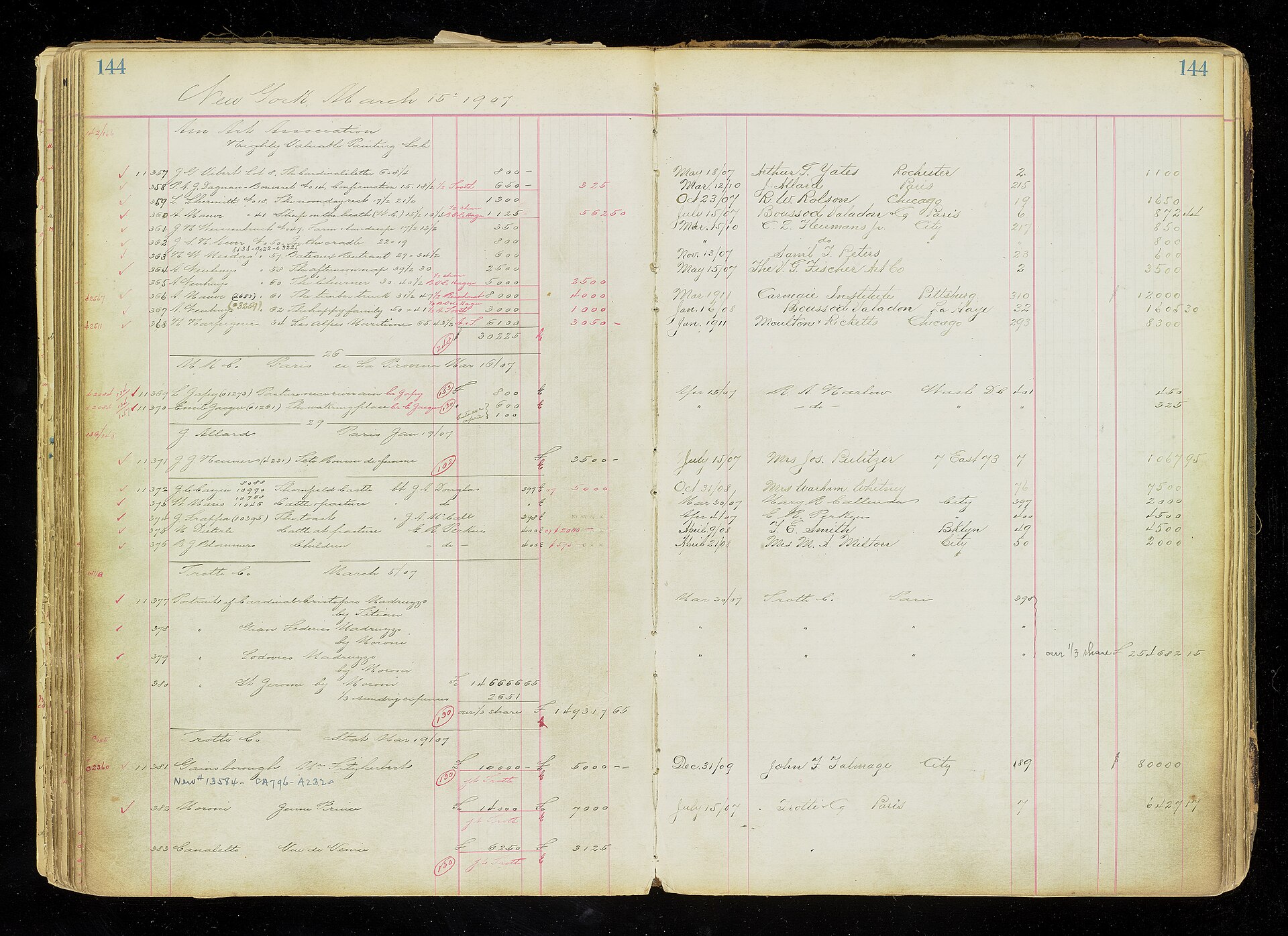
Dealer records are the great underused source, because dealers photographed and ledgered inventory systematically and their books are frequently the only record of a picture between two private owners. The Getty Provenance Index holds more than 190,000 resources from the fifteen stock books of Goupil et Cie and Boussod, Valadon et Cie in Paris covering 1846 to 1919, and over 190,000 resources from the eleven painting stock books of M. Knoedler and Co. in New York covering 1872 to 1970.
The Knoedler archive itself sits at the Getty Research Institute under accession 2012.M.54, and its scale is worth stating precisely: 3,042.6 linear feet in 5,554 boxes and seventeen flat file folders, arranged in fourteen series covering stock books, sales books, commission books, inventory cards, receiving and shipping records, correspondence, photographs, exhibition files, framing and restoration records and the Knoedler family papers. The imaging of the stock books, commission books, sales books, letter books and inventory cards has been completed with support from the National Endowment for the Humanities.
Photographic archives do the same work from the other direction. The Frick Art Reference Library's Photoarchive is a study collection of over 1.2 million photographic reproductions of works of art from the fourth century to the mid-twentieth, and the Frick describes the documentation attached to those images as continuously updated to reflect changes in attribution, ownership and condition. An image with a mount annotation can place an object in a dealer's hands in a specific year when no bill of sale survives.
The back of the picture is a document
The verso is frequently more informative than the front, and the sector treats it formally as evidence. The American Alliance of Museums' recommended procedures, drawn from the AAM, AAMD and Presidential Advisory Commission agreement of October 2000, list among the mandated categories one headed labels and marks on the reverse, frame and mount, with the instruction to describe marks and labels prior to 1960 and to indicate whether images are available. Signatures and marks on the obverse are a separate category. The reverse is not an afterthought in the standard; it has its own field.
The Camden Rembrandt is the clean demonstration. The portrait sold at Thomaston Place Auction Galleries in Maine on 24 August 2024 carried, on the verso of the frame, a label attributing the work to Rembrandt and recording that it had previously been lent to a 1970 exhibition at the Philadelphia Museum of Art. In a history otherwise almost undocumented, that label is the one hard link: it places the object in the United States, in institutional hands, and considered exhibitable, more than fifty years before it reached the saleroom.
Collectors' marks are the systematic version of the same evidence. Frits Lugt's Les Marques de collections de dessins et d'estampes was published in 1921 with a supplement in 1956, and a revised and enlarged version integrating both volumes has been available online at the Fondation Custodia since 2010, free and searchable, with print publishers', print dealers' and mounters' marks and artists' succession stamps. CODART recorded the two historical volumes at 5,215 marks when the database launched; it has been enriched continuously since.
Know what the wartime registers actually contain
The Nazi-era databases are indispensable and each has a defined and limited scope, which researchers routinely overstate. The German Lost Art Foundation's Lost Art Database documents cultural property expropriated as a result of Nazi persecution between 1933 and 1945, or for which such a loss cannot be ruled out, together with wartime losses. It is free worldwide. Its records fall into two categories, search requests and found-object reports, and the Foundation states plainly that the content of those requests and reports is based exclusively on information provided by third parties. A record is a claim, not an adjudication.
The Nazi-Era Provenance Internet Portal is no longer live. The American Alliance of Museums now hosts it as an archive holding records for nearly 30,000 objects from 179 museums, and states that it has been several years since museums were last able to make additions. Searching it establishes what American museums disclosed up to a point in the past, and nothing about what has been disclosed since.
The Art Loss Register advertises 700,000 items on its database and is a private commercial register of stolen art rather than a public one. The Cultural Plunder by the Einsatzstab Reichsleiter Rosenberg database covers the plunder of French and Belgian Jewish collections from 1940 to 1944 processed at the Jeu de Paume, bringing together the surviving ERR registration cards and photographs for more than 40,000 art objects. A clean search across all four proves that four specific bodies of records do not mention an object. It does not prove the object is clean.
Write down what you did not find
An unproductive search is a result and belongs in the record: which archive, which years, what was checked, what was absent. Without it the next researcher repeats the work, and an absence of evidence quietly hardens into evidence of absence in the retelling. The sector's published standards stop short of mandating this, which is a real gap. The closest published warrant is the National Gallery of Art's own house practice, under which notes provide sources, details of research and discussion of outstanding questions.
The practical effect on trust is considerable. A chain with an honest hole and a note naming the archive that was searched is worth more than a chain that looks unbroken and cites nothing, because the first has a stated method and the second has none. That is also how a provenance becomes reusable. A researcher who records only successes hands the next person a conclusion; a researcher who records failures hands them a map.
The material bar to entry is now low. Twelve million Getty resources, 1.2 million Frick photographs, a fully imaged Knoedler ledger series and a free Lugt database are all reachable from a desk. What remains scarce is the habit of asking, at every link, what document would prove this and whether anyone has actually looked for it. The answer is very often that nobody has.
Questions
Far less than most people assume. The Getty Provenance Index is open access with downloadable datasets, the Knoedler stock and sales books have been imaged, and the Lugt collectors' marks database is free. Physical access matters mainly for probate, notarial and family papers that have never been digitised.
Dealer photographic archives and stock books. They frequently hold the only image or ledger entry for a work during a period of private ownership, and the Getty's Goupil and Knoedler sets alone expose over 380,000 resources between them.
No. Each register has a defined scope: NEPIP is a frozen archive of about 30,000 objects from 179 museums, the ERR database covers French and Belgian plunder processed at the Jeu de Paume, and the Lost Art Database consists of third-party reports. A clean search shows those specific records are silent.
For most European pictures the record thins sharply before the later seventeenth century. The Getty's sales catalogue coverage begins in 1650 and its archival inventories in 1520, so anything earlier usually depends on individual notarial and monastic archives rather than on systematic series.
Sources
- 1Getty Research Institute, 'What's Covered in the Provenance Index'. getty.edu/databases-tools-and-technologies/...
- 2Getty Research Institute, 'FAQs: Getty Provenance Index', on open access and downloadable datasets. getty.edu/databases-tools-and-technologies/...
- 3Online Archive of California, finding aid, 'M. Knoedler & Co. records, approximately 1848-1971', Getty Research Institute, accession 2012.M.54. oac.cdlib.org/findaid/...
- 4The Frick Collection, 'Photoarchive'. frick.org/research/...
- 5American Alliance of Museums, 'Recommended Procedures for Providing Information to the Public about Objects Transferred in Europe during the Nazi Era'. aam-us.org/wp-content/...
- 6American Alliance of Museums, 'The Nazi-Era Provenance Internet Portal (NEPIP) Archive'. aam-us.org/programs/...
- 7German Lost Art Foundation, 'Lost Art Database'. kulturgutverluste.de/en/...
- 8Art Loss Register, homepage, stating the size of its database. artloss.com
- 9'Cultural Plunder by the Einsatzstab Reichsleiter Rosenberg: Database of Art Objects at the Jeu de Paume'. errproject.org/jeudepaume
- 10Fondation Custodia, 'Collectors' Marks', on the online edition of Frits Lugt, Les Marques de collections. fondationcustodia.fr/Collectors-Marks-273
- 11CODART, 'New online edition of Frits Lugt, Les marques de collections de dessins et d'estampes', 23 April 2010. codart.nl/research-study/...
- 12Thomaston Place Auction Galleries, press release on the sale of the Camden, Maine portrait, 24 August 2024, recording the 1970 Philadelphia Museum of Art loan label. prnewswire.com/news-releases/...
- 13National Gallery of Art, Washington, 'Notes to the User', on the function of provenance notes. nga.gov/research/...
More in Research and Method
The partThe First Link Is in the Maker's Own Hand
A maker's bill, workbook or memoir is the only provenance document that fixes date, cost and first owner at once.
The date on the object dates one layer of it
Seven dated objects in this archive show that a date belongs to one layer of the thing: the parchment, the copying, the printing, the compilation.
Every Record Here Ends in Questions It Could Not Answer
The 257 published records in this archive carry 1,795 open questions between them, a median of seven each, and not one record carries none.