How a Panel Painting Was Actually Built
A panel painting is a joinery problem and a glue problem before it is an image. What the wood, the gesso and the punch marks will tell you about who made it, and when.
Records in this piece: The Mocking of Christ
On this page 5 sections
ContentsClose
In short
- Italian panels are usually poplar, willow or lime; Netherlandish panels are usually Baltic oak, and only the oak can normally be tree-ring dated.
- Cennini's ground is a two-part system: coarse gesso grosso for body, then at least eight coats of gesso sottile scraped back until the surface reads like ivory.
- Punch marks in a gold ground identify a workshop and its tools rather than a hand, because punches were inherited and lent between shops.
- Most of the structural damage on the panel market was inflicted by restorers - thinning, cradling and transfer - and not by the wood.
The carpenter decides what can be proved about the picture five centuries later
A panel painting begins as timber selection, and the choice is regional enough to be diagnostic. Italian workshops used poplar, willow and lime, with occasional oak, chestnut and walnut. Netherlandish and English painters worked overwhelmingly on oak, much of it Baltic and often Polish, cut north of Warsaw and shipped down the Vistula. Southern German shops favoured pine, while lime was the wood of Albrecht Duerer and Lucas Cranach the Elder. Leonardo, working in France, used oak.
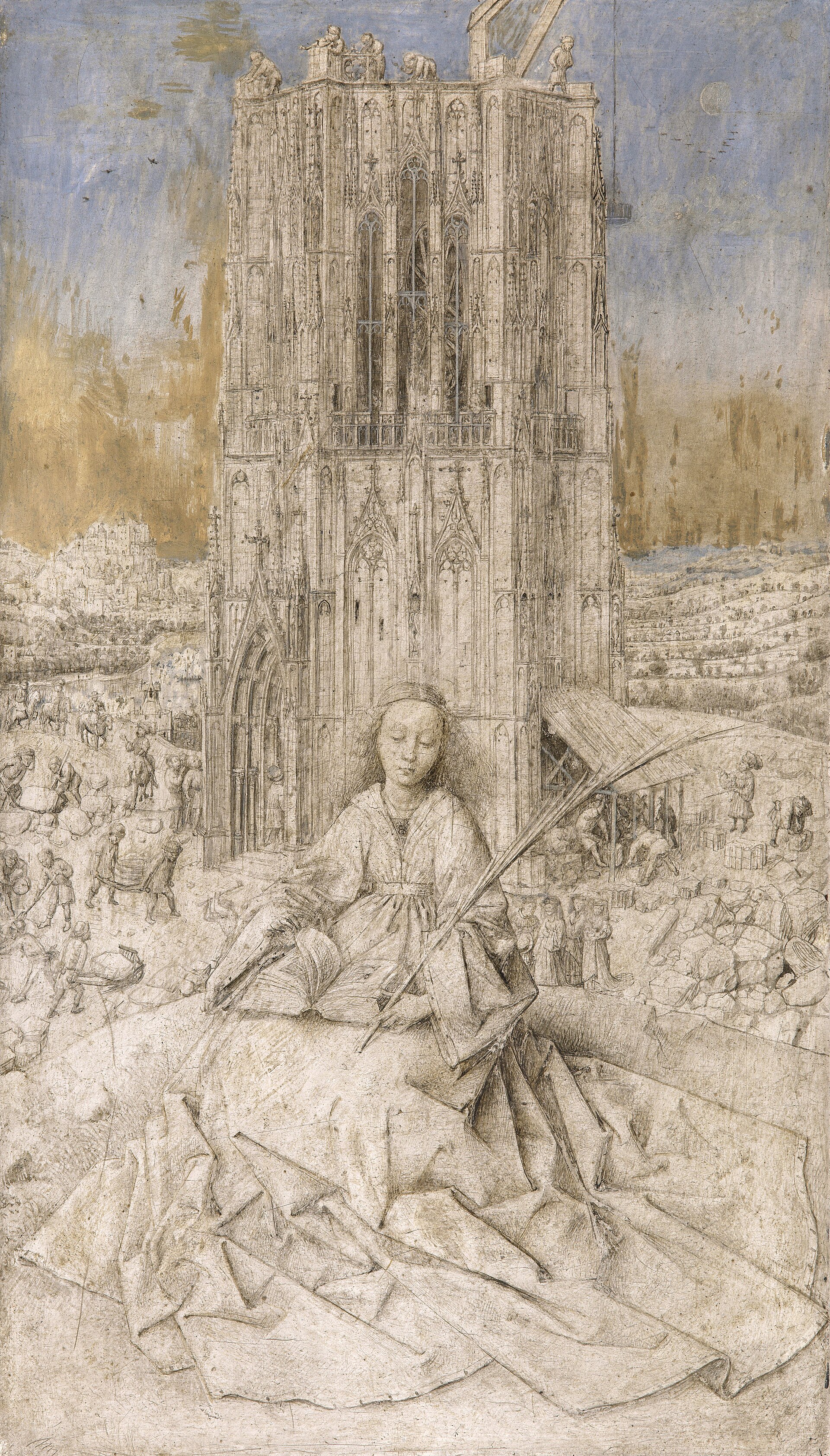
Cennino Cennini, writing probably in the 1390s and trained under Agnolo Gaddi in a line that ran back through Taddeo Gaddi to Giotto, sets out what the panel maker owed the painter. Planks were cut radially, sapwood was excluded, the surface was planed and sanded, then sized with animal-skin glue and resin and covered with linen. Radial conversion and the exclusion of sapwood are not craft superstition. They are the two decisions that most reduce how far a plank will move when the air around it changes, and they are why a well-made fourteenth-century panel can outlast a badly made nineteenth-century one.
Species also decides whether a panel can be dated at all. Oak has usable master chronologies; poplar and most Italian softwoods do not. Peter Klein's note on the panels at the National Gallery of Victoria sets out the method honestly: a growth-ring curve is measured and matched against master chronologies, and then two allowances are added. Sapwood was normally cut away, so for Baltic oak a median of fifteen sapwood rings is assumed, within a documented range of nine to thirty-six. Then seasoning, which Klein puts at roughly two to eight years for sixteenth and seventeenth century panels and ten to fifteen years for fifteenth century ones.
What comes out is a terminus post quem and nothing stronger. The NGV triptych given to the Master of the Legend of St Catherine has a latest heartwood ring of 1466 and a plausible execution date from 1491 onward. Rembrandt's Two Old Men Disputing, inscribed 1628, has a latest ring of 1603 and a plausible date from 1620. The tree-ring result is consistent with the inscription. It cannot confirm it, and any catalogue that says dendrochronology dated a picture has overstated the evidence.
The ground is where the picture actually lives
Wood is a poor painting surface, so almost nothing of the image touches it. Over the size and the linen goes gesso, in the Italian system in two grades. Gesso grosso is heated gypsum, effectively plaster of Paris, bound in animal glue and laid on thick. It gives body, fills the grain, and can be carved and built up for mouldings and raised ornament without cutting into the wood.
Gesso sottile is a different material made from the same mineral. The plaster is slaked in a large excess of water, mulled at length, wrapped in cloth, squeezed out and dried into loaves, which are then rehydrated and mixed with glue when the painter needs them. Cennini specifies at least eight coats of the sottile on the flat areas of a panel, each allowed to dry before the next. The whole surface is then rubbed with powdered charcoal and scraped back with a metal tool, repeatedly, until it is dead flat. Northern workshops usually took a shorter route, a single chalk-and-glue ground, which is one of the reasons a Netherlandish panel and a Florentine one behave differently in cross-section.
Accounts of the finished ground describe up to fifteen thin layers and a hard white surface not unlike ivory. That is the surface the gilder and the painter were actually working on, and it explains two things at once. It explains why gesso grounds are brittle and why they are only ever found on rigid supports. It also explains the characteristic craquelure of early panels, which follows the ground rather than the paint.
Linen is not only a size layer. On the Cimabue Mocking of Christ, a thinned and slightly bowed poplar panel now measuring 25.8 by 20.3 centimetres and only 1.2 centimetres thick, the gesso ground has a canvas embedded within it. Buyers meeting that description in a condition report sometimes read the cloth as a later intervention. It is period construction, and its presence and position are part of the technical case for the object rather than against it.
Gold is part of the structure, and after about 1450 it is a statement
A gold ground is not a colour applied to a finished surface. It is a layer of the panel's build, and it goes on before the paint. Over the polished gesso the gilder lays bole, a reddish clay, which does two jobs: it gives the leaf something soft to be burnished into, and it kills the greenish cast that gold leaf takes on over a white ground.
Water gilding lays the leaf a whole sheet at a time onto the wetted bole, and the leaf is then burnished, traditionally with the tooth of a dog or a wolf, or with agate. That burnish is what produces the mirror-bright surface that reads as light rather than as metal. Mordant gilding, where the leaf is stuck to an adhesive and left unburnished, gives a deliberately muted effect and was used for different purposes on the same picture. Shell gold, gold ground to a powder and used as a paint, was reserved for small areas, details and highlights inside the painted zones.
The chronology matters for diligence. Gold grounds dominated medieval panel painting and fell away in the late Middle Ages as painters developed landscape and interior backgrounds. By the fifteenth century a gold ground is a deliberate archaism, chosen for a devotional or liturgical reason. A gold ground on a panel of about 1290 tells you almost nothing, because it was the default. The same ground on a panel of about 1470 is a decision, and it should be legible as one in the rest of the object: in the patron, in the format, in the function.
Two named examples show how far the tooling of these surfaces could go. Orcagna's Crucifixion of about 1365 carries very elaborate tooling, and Simone Martini's fourteenth-century Madonnas have tooled haloes and tooled edges. In both, the ornament in the gold is doing compositional work that the paint layer never touches.
Punch marks are workshop evidence, not a signature
Once the gold is burnished it can be worked with punches and line-making tools, struck into the leaf and the gesso beneath to make repeating patterns, usually on haloes and borders and sometimes across the whole background. Cennini called this branch of the work one of the most delightful in the trade, and the tools that made it were valuable objects, passed from one painter to the next across several generations.
That inheritance is exactly what makes punchwork useful and exactly what limits it. Erling Skaug's compendium of Trecento Sienese and Florentine punchwork established that individual punch impressions can be photographed, measured and compared across pictures, and that the resulting matches map which shops were using which tools and when. The method has real evidential force in a field where signatures are almost absent and stylistic argument runs in circles.
Its limit is equally clear. A punch is a physical object that could be sold, lent, inherited or seized with a workshop's stock, so a match places a panel in a tool-sharing group rather than in a single pair of hands. The Kress conservation programme's published example is a Saint John the Baptist of before 1362 whose punch marks are consistent with those used by Pietro and Ambrogio Lorenzetti, which supports an attribution to that circle while stopping short of naming the painter.
One further point of period practice sharpens the evidence for the fourteenth century. In the Trecento the same artisans gilded and painted; the specialist gilder is a Renaissance development. A punch match in a Trecento panel therefore points at the painting workshop itself, not at a subcontracted gilding shop that might have served five unrelated masters. For the fifteenth century that assumption weakens, and the same evidence has to be argued more carefully.
Panels warp, and then restorers split them
Wood exchanges moisture with the air and moves unevenly as it does so, and a panel is a thin slab with one face sealed by ground and paint and the other left bare. It cups. Conservation practice now targets a stable environment - broadly fifty per cent relative humidity within about five per cent, and a steady temperature - precisely because the movement itself is not the enemy. Restraint is.
Historic restorers restrained it anyway. The standard nineteenth-century treatment was to plane the panel down to a fraction of its original thickness, flatten it, and glue a lattice of fixed and sliding battens, a cradle, to the back. The panel then went on trying to move against a rigid grid, and the stress was taken up in the paint layer and in new splits. Modern structural conservation is largely a discipline of undoing that work: minimal intervention, reversible adhesives, and auxiliary supports that let the wood move. The Getty devoted a symposium to the structural conservation of panel paintings in April 1995, and the proceedings mark the point at which remediating past treatments became the field's main occupation.
Transfer was the more radical option. Practised in Naples and Cremona between about 1711 and 1725 and taken up in France by the mid-eighteenth century, it involved facing the paint with paper and muslin, planing the wood away entirely from behind, removing the ground, and sticking the surviving paint film to a new canvas. Jean-Louis Hacquin, who died in 1783, ran the leading Parisian workshop, and his son Francois-Toussaint Hacquin transferred pictures brought to France under Napoleon. Jean-Michel Picault used nitrous fumes to dissolve the ground; Marie-Jacob Godefroid used steam. Sebastiano del Piombo's Raising of Lazarus was transferred in 1771.
The most-watched panel in the world shows the same story at smaller scale. The Mona Lisa is oil on a white poplar panel, 77 by 53 centimetres, with a crack running down from the top edge to the figure's hairline. Two butterfly-shaped walnut braces were let into the back to about a third of the panel's thickness between the mid-eighteenth and early nineteenth centuries. The upper brace fell out at some point between 1888 and 1905, or during the 1911 theft, and a restorer lined the socket and the crack with cloth. It now sits in a case held at fifty per cent relative humidity within ten per cent and between eighteen and twenty-one degrees, in a flexible frame fitted in 1951 whose crosspieces have twice been renewed. The picture is stable because the environment does the work that the cradle used to do badly.
Questions
Usually not. The method depends on matching a measured ring series against a regional master chronology, and the well-developed chronologies are for oak, which is why Netherlandish, German and English panels are routinely dated and Italian poplar ones are not. Where oak is present, the result is still only an earliest possible date, because sapwood was cut away and the timber was seasoned before use.
It is a condition fact rather than an authenticity fact, and it usually comes bundled with thinning, since panels were planed down before cradling. What matters commercially is whether the cradle has caused splits or paint-layer stress, and whether it has been converted or removed by a structural specialist. A cradled panel with a stable, documented treatment history is a very different object from a cradled panel that has never been opened up.
No. Sizing the wood and covering it with linen before the ground is standard practice described by Cennini, and the cloth is found within the gesso of period panels, including the Cimabue Mocking of Christ. A cloth layer applied over the paint, or a panel glued to a secondary board, is a different matter and does belong in the treatment history.
That two pictures were decorated with the same physical tool. Because punches were inherited and lent, that supports placement in a workshop or a tool-sharing circle. It becomes an attribution argument only in combination with the rest of the technical and documentary evidence.
Sources
- 1Wikipedia, 'Panel painting'. Tertiary source; the underlying claims should be replaced with the Getty and museum technical literature cited below. en.wikipedia.org/wiki/...
- 2University of Delaware, Art Conservation Department (Kress Program), 'Historical Materials/Techniques': gesso grosso and gesso sottile, Cennini's eight coats, charcoal-and-scraper finishing. sites.udel.edu/artcons/...
- 3Wikipedia, 'Gold ground': bole, water gilding, burnishing, mordant gilding, shell gold, punching. Tertiary source; replace with Skaug and the National Gallery technical bulletins. en.wikipedia.org/wiki/...
- 4Kress Paintings Conservation, 'One of Our Most Delightful Branches: Punchwork in Trecento Tuscany'. kressconservation.org/news/...
- 5Peter Klein, 'A note on dendrochronological analyses of panel paintings at the National Gallery of Victoria', NGV Art Journal 40. ngv.vic.gov.au/essay/...
- 6Wikipedia, 'Conservation and restoration of panel paintings': environmental targets, pests, minimal intervention. Tertiary source. en.wikipedia.org/wiki/...
- 7Wikipedia, 'Transfer of panel paintings': Naples and Cremona 1711-1725, the Hacquin workshop, Picault, Godefroid, Sebastiano del Piombo 1771. Tertiary source. en.wikipedia.org/wiki/...
- 8Wikipedia, 'Mona Lisa': poplar support, crack, walnut butterfly braces, display case conditions, 1951 frame. Tertiary source; the primary record is the C2RMF examination of 2004-05. en.wikipedia.org/wiki/...
- 9Getty, 'The Structural Conservation of Panel Paintings: Proceedings of a Symposium at the J. Paul Getty Museum, April 1995'. getty.edu/publications-reports/...
- 10Wikipedia, 'The Mocking of Christ (Cimabue)': egg tempera and gold leaf on a thinned poplar panel with canvas embedded in the gesso, 25.8 x 20.3 x 1.2 cm. Tertiary source; replace with the Louvre acquisition file. en.wikipedia.org/wiki/...
More in Research and Method
The partThe First Link Is in the Maker's Own Hand
A maker's bill, workbook or memoir is the only provenance document that fixes date, cost and first owner at once.
The date on the object dates one layer of it
Seven dated objects in this archive show that a date belongs to one layer of the thing: the parchment, the copying, the printing, the compilation.
Every Record Here Ends in Questions It Could Not Answer
The 257 published records in this archive carry 1,795 open questions between them, a median of seven each, and not one record carries none.