Fresco: The Giornata, and Why Fresco Fails
Buon fresco sets pigment into the wall in one chemical reaction on a seven-hour deadline. What a painter adds after the plaster dries is what a conservator later loses.
Records in this piece: The Mocking of Christ
On this page 5 sections
ContentsClose
In short
- In buon fresco the paint is in the wall rather than on it: calcium hydroxide takes up carbon dioxide and locks pigment into calcium carbonate.
- A giornata is one patch of intonaco and gives roughly seven to nine hours of work; Giotto's Scrovegni Chapel was calculated at 625 of them.
- Blues went on a secco because lime is hostile to them, which is why skies and robes are the first passages lost from a cycle.
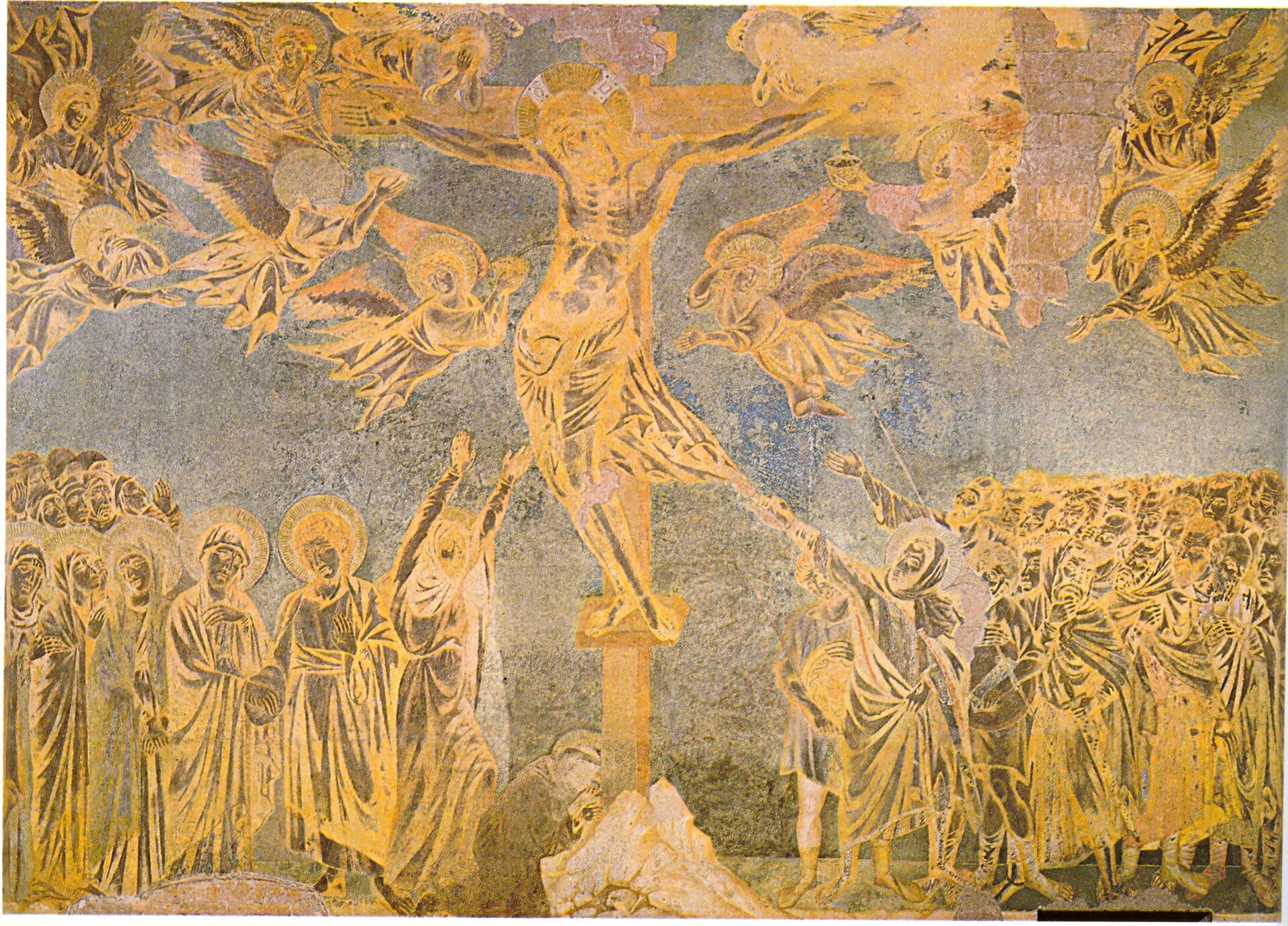
- At Assisi the lead white in Cimabue's frescoes oxidised to lead dioxide, inverting his highlights into the darkest passages on the wall.
Buon fresco is a chemical bond struck on a deadline
True fresco is not paint applied to a wall. It is paint incorporated into a wall by a single chemical reaction, and the reaction sets the working conditions for everything else.
The wall receives a rough plaster coat, the arriccio, which is left to dry for days. Onto that, on the morning of work, goes the intonaco, a thin smooth coat of lime plaster laid only over the area the painter expects to finish. Pigment is ground in water alone, with no binder, and brushed into the wet lime. As the plaster carbonates, calcium hydroxide takes up carbon dioxide from the air and converts to calcium carbonate, and the pigment particles are locked into the crystalline structure as it forms. The reaction is written simply: Ca(OH)2 plus CO2 gives CaCO3 plus water. The colour is then part of the wall's mineral fabric, which is why buon fresco does not flake in the ordinary way and why cleaning it is a different problem from cleaning a picture.
The cost is time. The plaster stays workable for something like seven to nine hours, after which it is too far gone to accept pigment properly. There is no revision, no glazing back, and no reworking on a later day. Everything a fresco painter does is done once, at speed, on a surface that is changing under the brush.
A partial compromise emerged. Mezzo-fresco, applied to an intonaco that has nearly dried, gives some of the freedom of dry working while retaining some of the durability of the true technique, and it became common practice by the sixteenth century. It is a symptom of the same pressure that produced every other departure from buon fresco: painters wanted the working conditions of a panel and the permanence of a wall, and the chemistry does not offer both.
The giornata is the real unit of a fresco, and it is legible on the wall
Because the intonaco has to be fresh, the painter plasters only what can be finished before it sets. That patch is the giornata, the day's work, and it leaves a physical seam where the next day's plaster overlaps it. In raking light those seams map the entire campaign: where work began, in which direction it advanced, how much a painter attempted at a time, and where the pace or the hand changes.
The numbers are usable. Giotto's cycle in the Scrovegni Chapel at Padua was executed between 25 March 1303 and 25 March 1305, in an interior 20.88 metres long, 8.41 metres wide and 12.65 metres high, and the giornate have been counted at 625, with a team of around forty collaborators. That converts an art-historical impression of speed into a labour figure, and it constrains the attribution debate: a cycle of that size in two years is a workshop operation, and the question is which passages the master reserved for himself.
Giornata evidence also disciplines claims about sequence. On the Sistine Chapel ceiling, painted between 1508 and 1512, the daily patches record work advancing from west to east, and they corroborate what the pictures already suggest, that Michelangelo misjudged the scale at the start and enlarged his figures as he went. The early scenes are crowded with smaller figures; the late ones are not.
For a specialist reading a condition report, the practical consequence is simple. Losses that follow a giornata boundary are structural, tied to the plaster campaign. Losses that ignore the boundaries and cluster instead by colour are chemical, tied to a pigment or a binder. The two failure modes have different prognoses and different remedies, and the seams tell you which one you are looking at before any sampling is done.
Sinopia and spolvero: the drawing that lives under the picture
Since the surface is destroyed and rebuilt each day, the composition has to exist somewhere other than the final layer. It existed on the arriccio, drawn in sinopia.
Sinopia is a dark reddish-brown earth coloured by hematite, named for the port of Sinop on the Black Sea through which Cappadocian ochre reached Europe. The painter charcoaled the composition on the rough plaster, brushed the charcoal away, and set the design down in sinopia thinned with water and no binder. The full-scale drawing then sat under the day's intonaco, invisible, with only the immediate area exposed as the painter worked toward it.
Transfer methods varied. Spolvero pounced charcoal or soot through the pricked lines of a cartoon onto the fresh plaster, and direct incision scored the design into the intonaco with a stylus, both leaving traces a conservator can read. The Sistine ceiling shows both approaches in use.
The sinopie became visible only through catastrophe and its aftermath. Twentieth-century detachment techniques, strappo and stacco, lifted fresco surfaces off the wall and exposed the drawings beneath. The Camposanto Monumentale in Pisa was hit during the fighting of 1944, its frescoes were detached, and the sinopie revealed underneath were substantial enough to justify a dedicated museum, the Museo delle Sinopie. For attribution this material is exceptionally valuable, because a sinopia is a painter drawing at full scale without an audience, and it records invention rather than execution. Detachment itself is now avoided, and the sinopie that exist are mostly the by-product of damage nobody would repeat.
The a secco layer is where cycles die
Lime is aggressive and alkaline, and several of the most important pigments cannot survive it. Blues are the acute case: azurite and lapis lazuli do not work well in wet lime, so skies, mantles and any large blue field were normally applied after the plaster dried, in a paint bound with egg, glue or oil. That layer sits on the surface instead of within it, and it has the adhesion of any other film stuck to a wall.
The consequences are consistent across the canon. When the Brancacci Chapel was restored between 1981 and 1990, the a secco work had gone: the leaves on Masaccio's trees were lost, and the azure of Christ's robe in The Tribute Money, a fresco of about 1425 measuring 247 by 597 centimetres, had lost much of its brilliance. The buon fresco beneath survived. The restoration of the Sistine ceiling between 1980 and 1994 removed later a secco retouching and applied gold, and the argument over what was original secco and what was restorers' secco is still the central controversy of that campaign.
The extreme case is Leonardo. For the Last Supper at Santa Maria delle Grazie in Milan, painted around 1495 to 1498 and measuring 460 by 880 centimetres, he abandoned fresco altogether in order to work slowly and revise, using tempera over a sealing of gesso, pitch and mastic on the wall plaster with a lead white underlayer for luminosity. The gain in modelling was real and the structural failure was immediate. The surface was flaking by 1517, described as blurred and colourless by 1532, and reduced to a muddle of blots within about sixty years. Little of the original paint remains, after restoration campaigns in 1726, 1770, 1901 to 1908, 1924, 1946 to 1954 and finally 1978 to 1999.
The lesson for anyone assessing a mural is that the fresco and the secco are two objects with two lifespans occupying one wall. A cycle can be in excellent condition as buon fresco and be missing most of what its painter regarded as the picture.
At Assisi the true fresco turned on itself
Cimabue, active from around 1240 and dead in 1302, painted an extensive cycle in the Upper Church of San Francesco at Assisi. It is now in poor condition, and the reason is not adhesion. It is the chemistry of the pigments themselves.
Fragments recovered after the 1997 earthquake were studied by a team led by Ermanno Avranovich Clerici and published in Molecules in August 2023, using multi-scale X-ray imaging. In Cimabue's Crucifixion, the lead white had converted to lead dioxide in two crystalline forms, plattnerite and scrutinyite, together with laurionite. In the wall paintings of apostles, vermilion had degraded to corderoite and calomel against darkened backgrounds. On Giotto's star-studded vault, copper blues had gone to clinoatacamite, atacamite and cumengeite, producing green discoloration. The common factor across all three pigment classes was chlorine: chlorinated metal salts were found throughout the samples and identified as the driving agent.
The visual result is what makes Assisi the standard teaching case. Lead white was the pigment of highlights, so the passages the painter made brightest are now the darkest on the wall. The tonal scale has been reversed rather than merely dulled, and the Crucifixion reads to a modern viewer something like a photographic negative of the picture Cimabue painted. No cleaning recovers it, because nothing has been added over the original. The original has become a different compound.
Set against that, the small devotional panel by the same hand is instructive. The Mocking of Christ, in egg tempera and gold leaf on gesso-prepared poplar and measuring 25.8 by 20.3 centimetres, has come down legible enough that infrared reflectography could recover Cimabue's underdrawing and support the attribution. Two objects by one painter, one on a wall in an alpine climate and one on a board indoors, have arrived in the twenty-first century in incomparable states. That is a statement about supports, binders and environments, and it should be read as one before it is read as a statement about the painter.
Questions
By raking light and by loss pattern. Buon fresco has no separate paint film, so the colour sits flush in the plaster and losses follow plaster boundaries; a secco sits on top and fails by flaking, powdering and abrasion, usually in coloured islands rather than along giornata seams. Blues, greens and gold are the passages most likely to be secco.
Indirectly but usefully. Counting the daily patches gives the campaign's length, direction and rate of work, which constrains how large a workshop must have been and where a change of hand is physically possible. It cannot name a painter, and it is best used to test attributional claims rather than to generate them.
Research into reconversion of oxidised lead white exists, but this is not a cleaning problem. The original pigment has become a different compound within the paint layer, so any treatment is a chemical transformation of original material rather than the removal of something added, and the conservation profession treats that threshold with appropriate caution.
Because it destroys the relationship between the paint and its wall and creates a new, fragile object mounted on a modern support. It was used in the twentieth century after damage such as the 1944 destruction at Pisa's Camposanto, and it produced the sinopie now in the Museo delle Sinopie, but current practice stabilises in situ wherever possible.
Sources
- 1Wikipedia, 'Fresco': arriccio and intonaco, the carbonation equation, seven to nine hours' working time, mezzo-fresco, a secco and blue pigments, spolvero. Tertiary source; replace with conservation literature on lime plaster technology. en.wikipedia.org/wiki/...
- 2Wikipedia, 'Scrovegni Chapel': campaign of 25 March 1303 to 25 March 1305, calculation of 625 giornate, workshop of about forty, interior dimensions. Tertiary source. en.wikipedia.org/wiki/...
- 3Wikipedia, 'Sinopia': hematite-based earth from Sinop, drawing on the arriccio, strappo and stacco detachment, Camposanto Pisa 1944, Museo delle Sinopie. Tertiary source. en.wikipedia.org/wiki/...
- 4Wikipedia, 'The Tribute Money (Masaccio)': c. 1425, 247 x 597 cm, losses of a secco passages recorded in the 1981-1990 restoration. Tertiary source. en.wikipedia.org/wiki/...
- 5Wikipedia, 'Sistine Chapel ceiling': 1508-1512, giornate and west-to-east progression, removal of later a secco retouching and gold in the 1980-1994 restoration. Tertiary source. en.wikipedia.org/wiki/...
- 6Wikipedia, 'The Last Supper (Leonardo)': c. 1495-1498, 460 x 880 cm, tempera over gesso, pitch and mastic with a lead white underlayer, flaking by 1517, restoration campaigns to 1999. Tertiary source. en.wikipedia.org/wiki/...
- 7E. Avranovich Clerici et al., 'Multi-Scale X-ray Imaging of the Pigment Discoloration Processes Triggered by Chlorine Compounds in the Upper Basilica of Saint Francis of Assisi', Molecules, 17 August 2023, doi 10.3390/molecules28166106. pmc.ncbi.nlm.nih.gov/articles/...
- 8Wikipedia, 'Cimabue': dates c. 1240-1302, the Upper Church cycle at Assisi and its condition. Tertiary source. en.wikipedia.org/wiki/...
- 9Wikipedia, 'The Mocking of Christ (Cimabue)': egg tempera and gold leaf on poplar, 25.8 x 20.3 cm, infrared reflectography of the underdrawing. Tertiary source; replace with the Louvre acquisition file. en.wikipedia.org/wiki/...
More in Research and Method
The partThe First Link Is in the Maker's Own Hand
A maker's bill, workbook or memoir is the only provenance document that fixes date, cost and first owner at once.
The date on the object dates one layer of it
Seven dated objects in this archive show that a date belongs to one layer of the thing: the parchment, the copying, the printing, the compilation.
Every Record Here Ends in Questions It Could Not Answer
The 257 published records in this archive carry 1,795 open questions between them, a median of seven each, and not one record carries none.