Egg Tempera and Oil: What Each Medium Can Do
Oil did not replace tempera because anyone invented it. Each medium sets a hard limit on what a painter can do, and both limits are legible on the finished surface.
Records in this piece: The Mocking of Christ
On this page 5 sections
ContentsClose
In short
- The oldest known oil paintings are mid-seventh-century Buddhist murals at Bamiyan, and Theophilus described oil paint in Europe around 1125.
- Egg tempera sets in seconds, so tone is built by hatching; it cannot be blended wet and it cannot carry deep saturation.
- Oil's slow oxidative drying is the whole advantage, and its cost is yellowing, darkening and increasing transparency with age.
- Vasari's claim that Antonello da Messina brought oil painting to Italy is not supported; his contribution was mastery of a technique already present.
Nobody invented oil painting, and the origin story is a catalogue hazard
The most persistent claim in the literature on painting technique is that oil painting was invented in fifteenth-century Flanders and carried to Italy by a single man. It is wrong twice over.
In 2008 a team from the National Research Institute for Cultural Properties in Tokyo, the Centre of Research and Restoration of the French Museums under the CNRS, the Getty Conservation Institute and the European Synchrotron Radiation Facility published the analysis of paint samples from the cave complex at Bamiyan in Afghanistan. Using synchrotron infrared micro-spectroscopy, micro X-ray fluorescence, micro X-ray absorption spectroscopy and micro X-ray diffraction, they identified drying oils, probably walnut and poppy seed, in twelve of the fifty caves examined. The murals are of the mid-seventh century AD. The same samples showed a wide range of pigments including substantial lead whites, natural resins, gums and proteinaceous material, and a resinous coating functioning as a varnish. The results appeared on 22 April 2008 in the Journal of Analytical Atomic Spectrometry.
Europe has its own early record. The monk Theophilus Presbyter described oil-bound paint in De diversis artibus around 1125, some three centuries before Jan van Eyck. Early European use was mainly for sculpture and exterior woodwork, where oil films outlast aqueous ones, and that utilitarian history is precisely why the medium was available to painters when they wanted it.
The Italian half of the myth comes from Vasari, who wrote that Antonello da Messina brought oil painting from van Eyck into Italy. Antonello, born around 1425 to 1430 and dead in February 1479, probably learned the technique from Netherlandish work circulating in Naples and Sicily and from contact with Petrus Christus in about 1456, and his Venetian period of 1475 to 1476 spread its results rather than its secret. Modern scholarship regards Vasari's account as wrong. It survives in catalogue entries because it is a good story, and it should be treated as one.
What egg does to pigment, and what it refuses to do
Egg tempera is pigment ground into egg yolk thinned with water, commonly around one part yolk to three of water, sometimes with white wine in place of water. The yolk is an emulsion, which is why an aqueous paint can carry a durable film at all, and the water leaves the film within seconds of application.
Everything characteristic about tempera follows from that drying speed. The paint cannot be moved once it is down and cannot be blended wet on the surface, so tone and modelling are built by laying many small strokes side by side, usually as cross-hatching, in thin semi-opaque or transparent layers. Each layer has to be dry before the next, and the finished surface is a satin or slight matte. Tempera also carries less pigment than an oil paint of the same body, so it rarely reaches the depth of saturation that an oil dark can reach. A tempera picture has a floor under its blacks.
Curing continues long after the film is touch-dry. An egg tempera painting needs something between three and six months before the surface stops being easily scratched, after which it becomes very durable. That durability is not only mechanical. Tempera colours are notably stable over time, where oils darken, yellow and grow more transparent. A fourteenth-century tempera panel in good condition is closer to its original colour relationships than a seventeenth-century oil of half its age.
The constraint that follows is structural. Tempera is laid on a brittle gesso ground, which requires a rigid support, which in practice means a panel. The medium, the ground and the support are one system, and this is the system Cennini codified. His Libro dell'Arte, probably written in the 1390s, survives in four manuscripts and was not printed until Giuseppe Tambroni published it in Rome in 1821 - a date worth remembering, because it is also the starting gun for every tempera revival that followed.
Oil bought time, and time bought tone
An oil paint does not dry by evaporation. It cures by oxidative polymerisation, the oil taking up oxygen and cross-linking into a solid film over days rather than seconds. That single difference is the whole argument for the medium.
Working time allows blending on the picture itself, so a transition from light to shadow can be fused rather than assembled out of strokes. It allows correction, which is why oil painters revise on the panel and tempera painters revise in the drawing. It allows the layered structure that defines fifteenth and sixteenth century practice: thin transparent glazes over a light ground, so that light passes through the coloured film, reflects off the ground and comes back through it. The rule that governs the stack is fat over lean, each successive layer carrying more oil than the one beneath, because a leaner layer drying over a fatter one cracks.
The choice of oil is a working decision with consequences. Linseed is the most versatile and the most prone to yellowing; walnut, poppy seed and safflower yellow less and dry more slowly, which is why they turn up in whites and pale blues. The trade-off is permanent and it is visible: the yellowing of a linseed-rich passage is not dirt and does not come off in a clean.
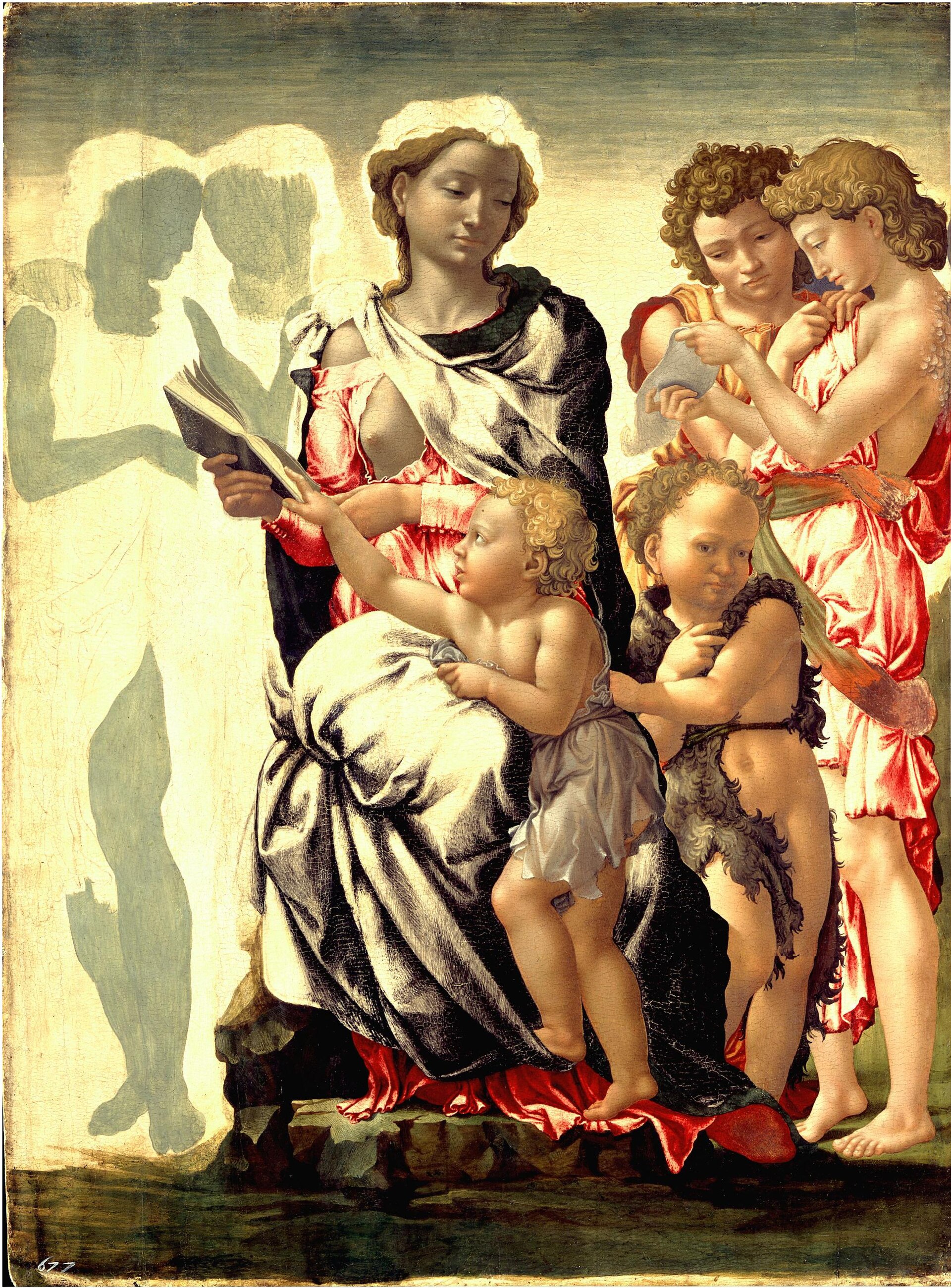
Oil also has a long-term optical fault that is useful to the researcher. As the film ages it becomes slightly more transparent, and what was covered starts to show. Pentimenti - the painter's own abandoned positions, a moved hand, a shifted contour - surface as ghosts, and underdrawing can become visible to the eye without instruments. A medium that hides revision at the time of painting gives it back a century or two later.
The transition was a slow mixture, and dating a picture by its medium is a trap
Tempera was the primary panel medium for essentially every European painter through the Middle Ages and Early Renaissance, up to about 1500. Oil superseded it in northern Europe during the fifteenth century, in Italy around 1500, and by roughly 1540 oil had displaced tempera for panel painting across most of Europe. Those are overlapping ranges, not a switchover, and the overlap is populated by hybrids.
The best documented of them is tempera grassa, egg tempera with oil added, conventionally at no more than equal volume to the yolk. It behaves partly like each parent medium and appears in exactly the decades when workshops were learning what oil could do without abandoning what they already knew. A binder analysis returning a mixed emulsion is not evidence of tampering; it is evidence of a transitional workshop.
The support changed on its own timetable. In Italy canvas had largely replaced panel by the first half of the sixteenth century, led by Mantegna and the Venetians. The Netherlands took about a century longer, and Rubens still preferred panel for precise work, joining eighteen separate boards for Het Steen in 1636. Medium, support and region therefore give three semi-independent readings, and a catalogue that assumes any one of them fixes the others is guessing.
There is a modern trap at the other end. Because Cennini was printed in 1821, egg tempera came back as a conscious revival among the Pre-Raphaelites, the Social Realists and a long line of twentieth-century painters. A hatched, matte, panel-mounted tempera surface is therefore consistent with 1380 and equally consistent with 1930. The medium narrows the field; it does not date the object.
How to read the difference off the surface
Under raking light and a loupe, a tempera surface declares itself. Modelling resolves into discrete hatched strokes that do not merge. Edges are crisp because nothing could be softened after it was laid. There is no true impasto, since the paint is applied thin. The darks stop short of full depth. Colour relationships look close to what the painter intended, because the medium has not shifted much.
An oil surface shows the opposite set. Transitions are fused where the painter wanted them fused. Impasto stands proud and catches light. Deep transparent darks are achievable and were achieved. Against that, the film has moved: a yellowed medium and a yellowed varnish, drying cracks where the layer structure was wrong, and an increased transparency that lets abandoned positions and underdrawn contours rise into view.
These are testable claims about an object rather than impressions of it. A picture catalogued as egg tempera whose flesh transitions are genuinely fused, with no hatching anywhere under magnification, has a problem that binder analysis will settle. A picture catalogued as oil whose darks are built from parallel strokes and whose surface is uniformly matte has the mirror-image problem. In both cases the medium named on the label is a factual claim about the material, and it is one of the few claims in a catalogue entry that can be checked destructively for the cost of a sample smaller than a full stop.
The Cimabue Mocking of Christ is a useful reference point for the earlier system. It is egg tempera and gold leaf on a poplar panel prepared with gesso, and its colour is legible today at close to the relationships Cimabue set down, on an object measuring 25.8 by 20.3 centimetres. The same painter's wall paintings have not survived on those terms at all, which is a fact about media and environments rather than about him.
Questions
Yes, in principle: proteinaceous and lipid binders have distinct signatures, and the standard laboratory techniques separate them on a micro-sample. The complication is mixtures, since tempera grassa and oil-over-tempera layer structures are period practice, so the useful question is which binder is in which layer rather than which binder the picture is.
Because the medium is optically stable. Tempera colours change little over time, while oil films yellow, darken and become more transparent, so an oil picture drifts away from its original tonal relationships in a way a tempera picture does not. Condition of the support and the ground is a separate question, and there tempera's brittle gesso is the more vulnerable system.
Not by itself. Oil was known in Europe from at least the twelfth century and was in experimental use in Italian workshops well before 1500, alongside tempera and in mixed emulsions. What would indicate intervention is oil sitting above an aged varnish or filling losses, which is a stratigraphy question rather than a medium question.
The claim comes from Vasari and is now regarded as wrong. Antonello most likely encountered the technique through Netherlandish pictures circulating in Naples and Sicily and through contact with Petrus Christus around 1456. His importance is that he demonstrated what the medium could do at a level that made the advantages unarguable.
Sources
- 1Wikipedia, 'Tempera': yolk emulsion and dilution, hatching, curing time of three to six months, colour stability, tempera grassa, chronology of displacement by oil. Tertiary source; replace with conservation-science literature. en.wikipedia.org/wiki/...
- 2Wikipedia, 'Oil painting': Bamiyan c. 650 AD, Theophilus c. 1125, drying oils and yellowing, fat over lean, glazing over light grounds, displacement of tempera by about 1540. Tertiary source. en.wikipedia.org/wiki/...
- 3ScienceDaily / European Synchrotron Radiation Facility, 'Ancient Buddhist Paintings From Bamiyan Were Made Of Oil', reporting results published in the Journal of Analytical Atomic Spectrometry, 22 April 2008. sciencedaily.com/releases/...
- 4Wikipedia, 'Antonello da Messina': Vasari's claim and the modern view, dates, Petrus Christus, Venetian period 1475-76. Tertiary source. en.wikipedia.org/wiki/...
- 5Wikipedia, 'Cennino Cennini': dating of Il Libro dell'Arte to the 1390s, four surviving manuscripts, first publication by Tambroni, Rome 1821. Tertiary source. en.wikipedia.org/wiki/...
- 6Tate, 'Tempera' (art term): definition as pigment bound in a water-soluble emulsion, applied to a rigid support. tate.org.uk/art/...
- 7Wikipedia, 'The Mocking of Christ (Cimabue)': egg tempera and gold leaf on gesso-prepared poplar, dimensions. Tertiary source; replace with the Louvre acquisition file. en.wikipedia.org/wiki/...
- 8Wikipedia, 'Panel painting': transition from panel to canvas in Italy and the Netherlands, Rubens's Het Steen (1636) built from eighteen panels. Tertiary source. en.wikipedia.org/wiki/...
More in Research and Method
The partThe First Link Is in the Maker's Own Hand
A maker's bill, workbook or memoir is the only provenance document that fixes date, cost and first owner at once.
The date on the object dates one layer of it
Seven dated objects in this archive show that a date belongs to one layer of the thing: the parchment, the copying, the printing, the compilation.
Every Record Here Ends in Questions It Could Not Answer
The 257 published records in this archive carry 1,795 open questions between them, a median of seven each, and not one record carries none.