Christ Preaching, Healing the Sick, and Blessing the Children ("The Hundred Guilder Print")
Rembrandt Harmensz. van Rijn · c. 1647-1649 (most institutional catalogues and the New Hollstein Rembrandt catalogue favor c. 1648; watermark analysis indicates surviving lifetime impressions were printed from around 1647-48, though some older literature extends the print's gestation earlier into the 1640s without documentary support this record could verify)
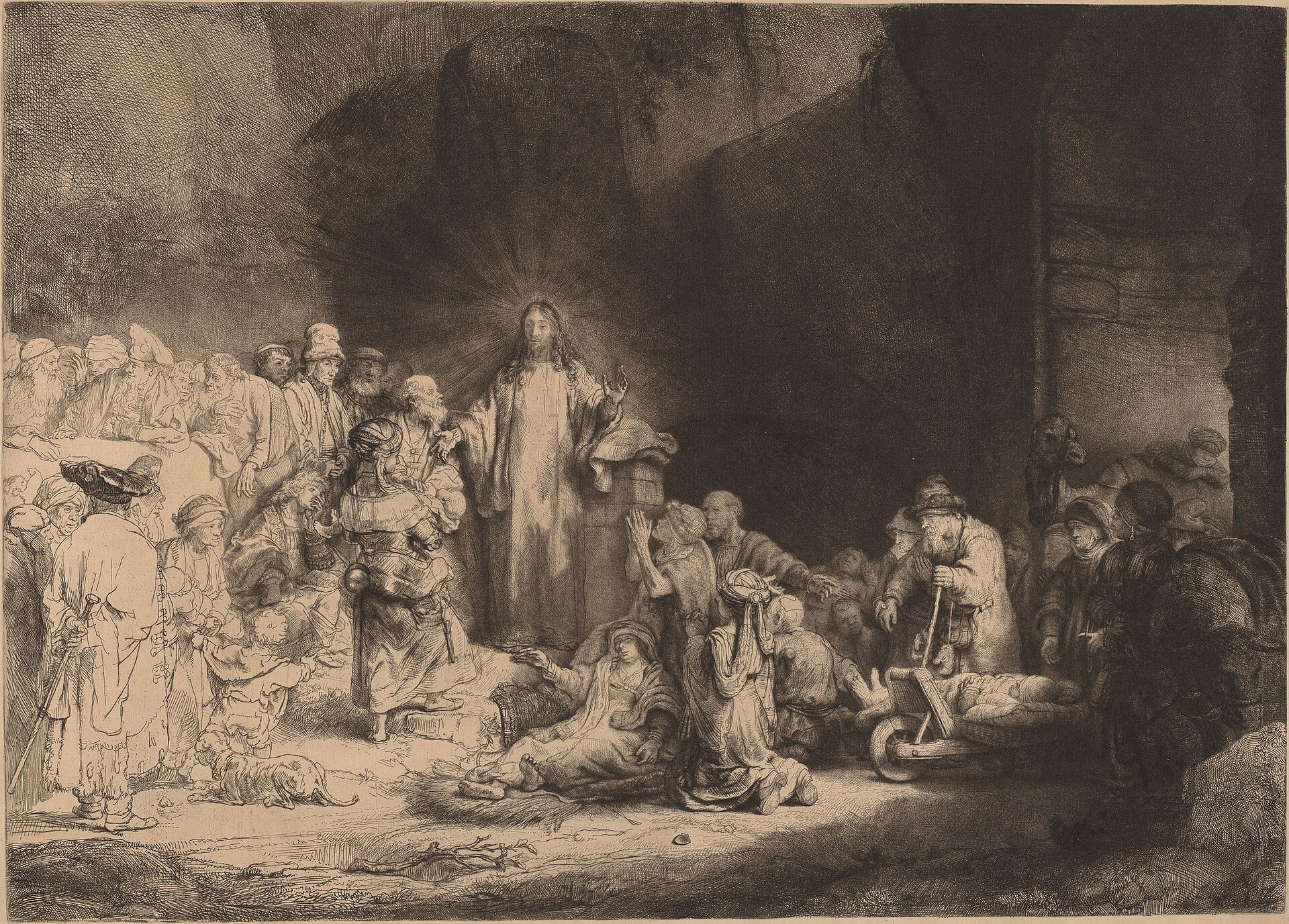
The impression at the center of this record: National Gallery of Art, Washington, accession 1943.3.7173, Rosenwald Collection, etching, drypoint and burin on Japan paper, c. 1649.
| Artist | Rembrandt Harmensz. van Rijn |
|---|---|
| Date | c. 1647-1649 (most institutional catalogues and the New Hollstein Rembrandt catalogue favor c. 1648; watermark analysis indicates surviving lifetime impressions were printed from around 1647-48, though some older literature extends the print's gestation earlier into the 1640s without documentary support this record could verify) |
| Medium | Etching, drypoint and engraving (burin) on paper; lifetime and early impressions typically on Japanese paper, later and posthumous impressions on European laid paper |
| Dimensions | Platemark approximately 278-283 x 387-395 mm, varying slightly across published measurements of different impressions; full sheets are commonly larger, trimmed sheets smaller (a comparison of five directly examined impressions in this record ranges from 250 x 283 mm, trimmed and mounted, to 282 x 395 mm on the full plate) |
| Where it is now | National Gallery of Art, Washington, D.C.last confirmed 16 September 2026 |
| Inventory number | 1943.3.7173 |
| Attribution | AcceptedThe design and the copper plate are universally accepted as Rembrandt's own work. Full note |
| Object type | |
| Period | Dutch, seventeenth century (Golden Age) |
| Cases | Has a provenance gap |
| Inscriptions | None. The plate carries no signature, monogram or date; the print is unsigned and undated, unusual for a work of this scale and ambition in Rembrandt's output. |
| Owners on record | 4 links2 documented, 2 unknown |
| Sources | 26 cited |
About this record Last verified 16 September 2026 · 26 sources cited · Change log
On this page 10 sections
ContentsClose
Rembrandt's largest and most technically ambitious etching, combining three episodes from Matthew 19 - Christ blessing the children, healing the sick, and debating the Pharisees on divorce - into a single scene built from the deepest blacks and the most delicate, unworked whites he ever set side by side on one plate. He did not sign or date it. Its popular name comes from a price of 100 guilders reported for it within his own lifetime, but the more colorful version of that story, that Rembrandt himself paid the sum to buy back his own print, has no primary source that this record's research could locate; Rembrandt scholar Seymour Slive said plainly that he had been unable to find who paid it, and this record treats the buy-back tale as unverified legend rather than settled fact.
The plate survived Rembrandt by more than a century, wearing down under repeated printing, before it passed to the London collector and amateur engraver Captain William Baillie in 1775. Baillie reworked it by his own hand, pulled about a hundred impressions from the reworked whole, then cut the copper into four pieces, reworked each fragment again, and printed the pieces separately, permanently ending the plate's existence as a single image. Impressions therefore fall into distinct, physically different classes: a very rare first state (perhaps nine impressions survive, two of them in the British Museum), a common lifetime and early-posthumous second state, and later Baillie-state and cut-fragment impressions that carry an eighteenth-century hand alongside Rembrandt's. This record centers on the National Gallery of Art's impression, from the Rosenwald Collection, and treats one richly documented English impression, now at the Morgan Library, as a separate, individually sourced chain rather than folding the two together.
Provenance
Each link is graded. Documented: a cited source supports it. Disputed: the identification is argued but not established. Unknown: no owner for that span, and the gap is not smoothed into a narrative. The grades in the glossary.
- c. 1647-1649 -Rembrandt van Rijn, Amsterdam (the copper plate and its lifetime impressions)documented
No monogram or date is etched into the plate; the date range is a scholarly reconstruction from style, technique and, for surviving lifetime paper stocks, watermark evidence, not an inscription on the object. A market price near or above 100 guilders for an impression is independently attested within Rembrandt's own lifetime by a dated letter of 1654, though no specific transaction or buyer is named in that or any other source consulted.41018
- Unrecordedunknown
No owner of the copper plate is documented for the century between Rembrandt's death in 1669 and the plate's appearance, already worn from repeated printing, in the hands of the painter and engraver John Greenwood by 1775. Separately and without any documented link established in the sources consulted, this record's own impression's individual ownership history before 1943 is likewise not established.1920
- - 1943Lessing J. Rosenwald (1891-1979)unknown
This impression carries the Rosenwald Collection credit line and National Gallery of Art accession 1943.3.7173. The date, source and price of Rosenwald's own acquisition of this specific sheet were not established by the sources this record could access; the Gallery's own object page returned a server error on every attempt made during research.12
- 1943 - presentNational Gallery of Art, Washington, D.C.documented
Part of Rosenwald's 1943 pledge of the core of his print and drawing collection to the National Gallery, the same gift that brought the Gallery's Durer Melencolia I impression recorded elsewhere in this archive; this sheet carries accession 1943.3.7173.12
Prices realised
| Date | Sale | Estimate | Result | Note |
|---|---|---|---|---|
| 26 November 2024 | Bonhams | Not stated in the source consulted | Hammer USD 18,000 With premium USD 5,040 (28 percent buyer's premium on amounts under USD 50,000) USD | New York sale 29523, lot 2. A Baillie-period impression, New Hollstein's third state of four (of the reworked, not-yet-cut plate), on laid paper carrying the Hinterding miscellaneous F.a. watermark; ex the collection of Mr and Mrs John Estabrook, Chicago. This is a posthumously reworked impression, not a lifetime Rembrandt pull, and its price reflects that specific, later class of the object rather than the rarer first or second states of Rembrandt's own plate. |
Hammer is the price at which the bidding stopped; with premium adds the fee the house charges the buyer on top. Hammer price and buyer's premium in the glossary.
Technical evidence
| Attribution note | The design and the copper plate are universally accepted as Rembrandt's own work. Unusually for a print of this ambition, he did not sign or date it in the plate; the date rests entirely on style, technique and watermark evidence, not an inscription. What this record grades separately is the plate's later history: the copper matrix was reworked, cut into four pieces and further reworked again after Rembrandt's death by the collector William Baillie, so an impression's status as a lifetime pull, an early posthumous pull, or a Baillie-state print is a distinct question from the authorship of the design, and is treated as such throughout. |
|---|---|
| Support (this impression) | Japan paper (a smooth, absorbent handmade paper imported from Japan and prized by Rembrandt for the rich tonal range it allowed in his most ambitious plates), per the National Gallery of Art's own cataloguing of accession 1943.3.7173.12 |
| Medium and technique | Etching, drypoint and engraving (burin) on a single copper plate; the left half of the composition is worked in comparatively open, linear technique, the right half in dense drypoint burr and burnished, reworked passages, producing an unusually wide tonal range on one plate.345 |
| Platemark | Approximately 278-283 x 387-395 mm across the impressions directly examined for this record; individual published measurements vary slightly by source and by how a given sheet has been trimmed.46789 |
| Signature and date | None. The plate carries no monogram or date; both are scholarly attributions based on style, technique and paper evidence rather than an inscription on the object.410 |
| States (Rembrandt's own plate) | Two states are recognized by White and Boon (1969, following Bartsch and Hind): state I, before diagonal shading was added to the donkey's neck at lower left (roughly nine impressions known, two in the British Museum), and state II, with that shading added, the state of nearly all lifetime and early posthumous impressions.41112 |
| States (New Hollstein numbering) | The New Hollstein Dutch and Flemish Rembrandt catalogue (Hinterding and Rutgers, 2013), cataloguing the print as no. 239, instead counts four states by including William Baillie's reworked edition of the whole plate (c. 1775, before he cut it apart) as a third state and impressions from the four cut, further-reworked fragments as a fourth; the New Hollstein numbering is the system used in current auction cataloguing.1314 |
| Watermark evidence (Morgan Library impression, RvR 115, a separate sheet from this record's own impression) | A Strasbourg lily watermark (fleur-de-lis in a shield, surmounted by a crown, over the letters 4 and WR) with a separate AV countermark joined by a horizontal bar (Heawood 1721A); watermark identification of this kind is the primary physical method used to localize and date the paper stock of an individual impression independent of the plate's own state.6 |
| Credit line and accession (this impression) | Rosenwald Collection, National Gallery of Art, Washington, D.C., accession 1943.3.7173, gift of Lessing J. Rosenwald, 1943.12 |
Images
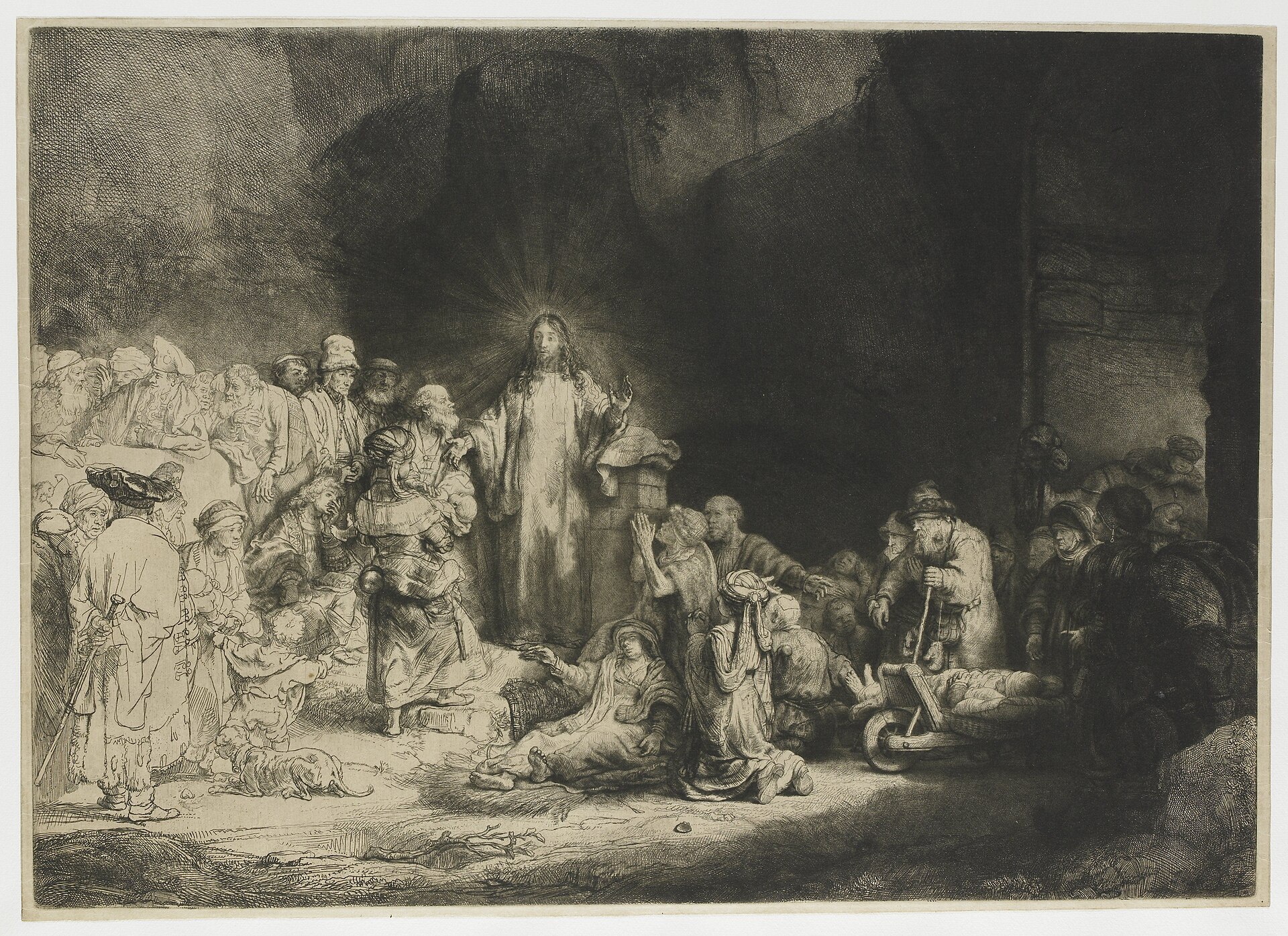
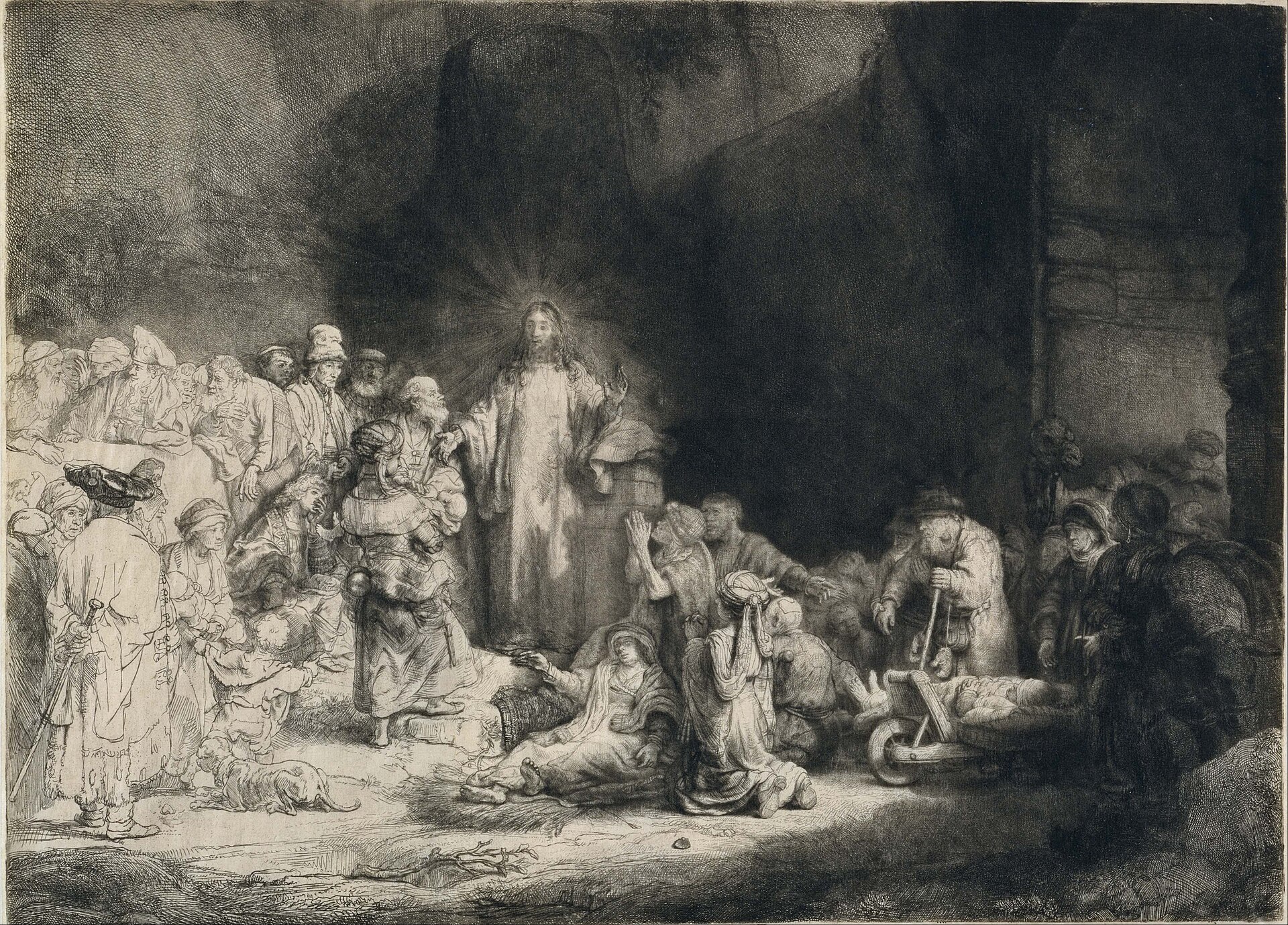
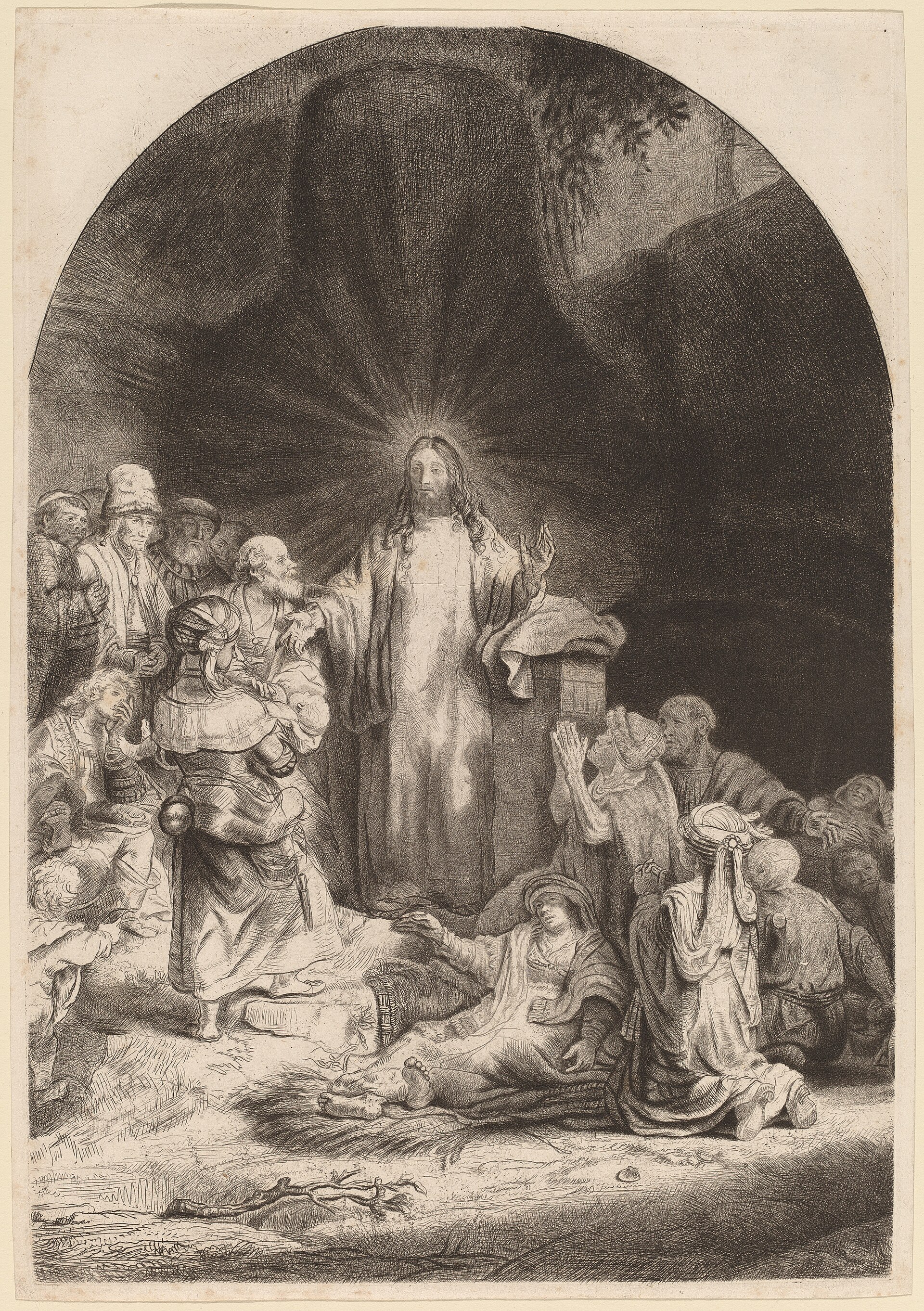
The record in full
Chapter 1What the print shows and how it is built
The sheet compresses three separate episodes from a single chapter of Matthew's Gospel into one continuous scene set outside a rocky opening, with Christ standing at the center as the hinge between...
The sheet compresses three separate episodes from a single chapter of Matthew's Gospel into one continuous scene set outside a rocky opening, with Christ standing at the center as the hinge between them. At the left, in the print's most lightly worked passage, Pharisees debate a point of law among themselves while women bring their children forward to be blessed; a bearded, balding figure usually read as Peter tries to push the children back and is answered by Christ's raised hand. Immediately beside them stands a solitary, richly dressed young man, head bowed in thought, understood as the rich young man of the same chapter, told to sell his possessions and follow Christ. At the right, in the densest and darkest passage on the plate, the sick, the lame and the destitute crowd forward to be healed, rendered in some of the heaviest drypoint burr and the richest plate tone Rembrandt ever pulled from a single copper.
The technical range is the point. Rembrandt worked the left side of the composition in an open, sketch-like line closer to drawing than to engraving, and the right side in a dense accumulation of etched line, drypoint burr and burnished correction that reads, in a well-inked, well-wiped impression, as an almost unbroken field of velvet black shading up through every intermediate grey to the near-white paper around Christ's head and the children. No other single plate in Rembrandt's output holds that range of finish and unfinish side by side on purpose.
Chapter 2The biblical program, and what it does not require
The subject is not obscure and does not need to be decoded.
The subject is not obscure and does not need to be decoded. Matthew 19 moves in sequence from the Pharisees questioning Christ on divorce, to the blessing of children brought to him despite the disciples' objection, to the rich young man who cannot give up his wealth, to Christ healing the multitudes who follow him. Rembrandt's composition compresses that sequence into one continuous space rather than a strip of separate scenes, an unusual and demanding compositional choice for a print of this size, but the underlying textual source is the biblical chapter itself, directly and without a secondary program layered on top. Scholarship on the print is largely agreed on this identification; the argument in the literature concerns how skilfully and unusually the three moments are fused into one field of action, not what the individual episodes are.
This record found no scholarly claim of a hidden doctrinal, alchemical or esoteric program beneath the surface subject, and none is asserted here. What can be said with the same evidentiary weight as an iconographic finding is that the choice of Matthew 19 as a single, fused composition - rather than the standard multi-panel or sequential treatment of the same material elsewhere in Netherlandish art - is itself Rembrandt's most significant interpretive decision on this sheet, and it is a decision about pictorial construction, not about concealed doctrine.
Chapter 3When it was made, and the limits of that dating
No source consulted for this record found a date or monogram scratched into the plate.
No source consulted for this record found a date or monogram scratched into the plate. The print's date is a scholarly reconstruction, not a fact read off the object. The range most institutions now use is c. 1647-1649: the National Gallery of Art, the Art Institute of Chicago and the Denver Art Museum each place it at or near 1648, and the Metropolitan Museum's catalogue entry gives 1649. Watermark analysis, distinguishing the different papers on which surviving sheets were pulled, indicates that impressions datable to Rembrandt's own lifetime were printed from around 1647-48 onward, which is the closest this record's sources come to pinning down when finished sheets actually left the studio.
Separately, some general accounts describe the plate as the product of a much longer gestation, worked on intermittently across the 1640s as what one writer called the critical work at the middle of Rembrandt's career. This record could not trace that longer chronology to a specific documentary source, as opposed to a stylistic argument about where the print sits in Rembrandt's development, and states the shorter, better-evidenced watermark-based range as the primary claim, with the longer gestation noted as a secondary, less firmly sourced position rather than dropped outright.
Chapter 4The states of the plate, and why two catalogues disagree on the count
Two states of Rembrandt's own, unaltered plate are recognized by every source consulted.
Two states of Rembrandt's own, unaltered plate are recognized by every source consulted. The first state lacks the diagonal hatching later added to the neck of the donkey at the lower left of the composition; it is extremely rare, with only about nine impressions known, two of which are in the British Museum. The second state adds that hatching along with further reworking, and is the state of nearly every lifetime and early-posthumous impression in public collections, including the sheets examined directly for this record at the Rijksmuseum and the Cleveland Museum of Art.
Where sources diverge is on how many states to count in total. Christopher White and Karel Boon's 1969 catalogue raisonne, following the older Bartsch and Hind numbering, describes the print as surviving in these two states of Rembrandt's own plate and treats William Baillie's later reworking as a separate matter, outside the plate's states as Rembrandt left it. The New Hollstein Dutch and Flemish catalogue (Hinterding and Rutgers, 2013), numbering the print as entry 239, instead extends the same sequence to four states by counting Baillie's large reworked edition of the whole plate, printed around 1775 before he cut it up, as a third state, and the impressions taken from the four cut and further-reworked fragments as a fourth. A specific lot offered at Bonhams in 2024, a Baillie-period impression, was catalogued under this system as New Hollstein's third state. The disagreement is not a trivial numbering quirk: it is a real scholarly question about whether a plate substantially reworked by another hand, a century after the artist's death, still belongs in the same state sequence as the artist's own print, or should be catalogued as a related but distinct object. This record follows White and Boon's narrower sense of state for Rembrandt's own two states, and describes the Baillie material as what it physically is, a reworking and dismemberment of the original plate, rather than folding it silently into the same numbered sequence.
Chapter 5The name: what is actually documented, and what is legend
The earliest evidence found for a high price attached to this print during Rembrandt's own lifetime is a letter of 9 February 1654 from the engraver Jan Meyssens of Antwerp to Carel van den Bosch...
The earliest evidence found for a high price attached to this print during Rembrandt's own lifetime is a letter of 9 February 1654 from the engraver Jan Meyssens of Antwerp to Carel van den Bosch, bishop of Bruges, describing an impression of the print as very fine and lovely, but noting that it ought to cost thirty guilders, while remarking that in Holland it had been sold various times for 100 guilders and more. This is a contemporary, dated, named document, and it establishes that a market price near or above 100 guilders was already attached to the print within Rembrandt's own lifetime. It does not say that Rembrandt himself paid that price, to anyone, for anything.
A second early reference, Zacharias Conrad von Uffenbach's travel diary of 1711, records only that the print once brought that high a price at an auction, again without naming a buyer. The specific, often-repeated story that Rembrandt personally bought back an impression of his own print for 100 guilders is traced by the Rembrandt scholar Christopher White to a later account involving the Paris print dealer Pierre-Jean Mariette; a different early account, in Edme-Francois Gersaint's 1751 catalogue raisonne of Rembrandt's etchings, the first catalogue raisonne compiled for any artist, gives a third and incompatible version, in which Rembrandt is said to have obtained the print not for cash but in exchange for a complete set of engravings by Marcantonio Raimondi that a seller had wanted 100 florins for. Seymour Slive, whose scholarship on Rembrandt's early critical reception is the closest thing to a systematic check of these claims that this record could trace, stated plainly that he had been unable to learn which collector or dealer paid 100 guilders for the etching. No source consulted for this record supplies a primary document naming Rembrandt as either buyer or seller in a 100-guilder transaction for his own print.
The honest state of the evidence, then, is this: a documented market price near 100 guilders existed during Rembrandt's lifetime, attested by a named contemporary in a dated letter; the popular embellishment that Rembrandt bought back his own etching at that price is a later, unverified, and internally inconsistent tradition, with at least two incompatible tellings (Mariette's cash purchase and Gersaint's trade for the Marcantonio set) and no primary source connecting either version to a real transaction. This record states the anecdote as legend, not fact, and records its verification as an open question rather than repeating it as settled history.
Chapter 6What 100 guilders meant
A skilled Dutch craftsman in the mid-seventeenth century, a mason or master carpenter, typically earned in the region of one guilder a day and on the order of 400 to 600 guilders a year; a...
A skilled Dutch craftsman in the mid-seventeenth century, a mason or master carpenter, typically earned in the region of one guilder a day and on the order of 400 to 600 guilders a year; a schoolmaster or clerk might earn 700 to 1,000 guilders annually. On those figures, 100 guilders represents roughly two to three months of a skilled craftsman's income, or close to a comfortable year's household rent in a city like Delft in the same period, where paintings priced between 100 and 200 guilders were themselves already described as costing several months of a craftsman's wages. A price at or above 100 guilders for a single printed sheet, rather than a painting, was a genuinely startling sum by the standards of the ordinary print trade, which is presumably why Meyssens' 1654 letter singles the print out for comment in the first place, independent of whether any particular buy-back anecdote attached to it is true.
Chapter 7Early fame and reception
Independent of the naming legend, the print was recognized as exceptional as soon as it existed.
Independent of the naming legend, the print was recognized as exceptional as soon as it existed. Amy Golahny's study of its early reception describes it as well known to collectors as soon as it was made, and argues that Jan Steen's Village Wedding of 1653, only a few years after the plate's likely completion, represents one of the earliest visual responses by another artist to Rembrandt's composition, at a moment when Golahny describes the print as circulating among collectors and at auction in a select and controlled way, rather than as a widely available commercial sheet. That combination, a print famous almost immediately but genuinely hard to obtain, is consistent with the Meyssens letter's report of an inflated resale price within the same decade, whatever the truth of any specific purchase story.
Chapter 8The plate after Rembrandt: reworking, and the plate's physical end
The copper plate survived Rembrandt's death in 1669 and continued to be printed from for more than a century, wearing progressively as repeated pulls dulled its finer lines; no source consulted for...
The copper plate survived Rembrandt's death in 1669 and continued to be printed from for more than a century, wearing progressively as repeated pulls dulled its finer lines; no source consulted for this record names a documented owner of the plate for that intervening span. By 1775 it had passed, worn, to the painter and engraver John Greenwood, from whom the London-based Irish soldier, collector and amateur printmaker Captain William Baillie (1723-1810) purchased it that year.
Baillie reworked the plate extensively by his own hand, restoring worn passages with what one account calls such care and intelligence that it takes an experienced eye not to mistake his retouching for the untouched original, and printed an edition of roughly one hundred impressions from the reworked whole. He then cut the plate into four separate pieces, reworked each fragment again, and printed the pieces as independent images in their own right; to the reduced central fragment showing Christ, he added an invented architectural arch that was never part of Rembrandt's design. The result is that the single copper Rembrandt worked no longer exists as a single object: it survives only as four physically separate, further-altered fragments, each carrying Baillie's eighteenth-century hand fused onto Rembrandt's seventeenth-century one. Fragments and impressions from this campaign are now dispersed across institutions including the Rijksmuseum, the Cleveland Museum of Art, the National Gallery of Art in Washington and the Fitzwilliam Museum in Cambridge, each catalogued as a joint work of Rembrandt and Baillie rather than as Rembrandt alone.
This is a genuine authenticity distinction, not a curatorial nicety. A lifetime or early second-state impression is Rembrandt's print, pulled from his own working of the plate. A Baillie-period impression, whether from the reworked whole or from one of the four cut fragments, is a print from a plate that a named eighteenth-century hand deliberately altered, cut apart, and in the case of the central fragment, partly invented. Cataloguing and market practice generally keep this distinction clear by labelling Baillie-state material accordingly, and this record does the same.
Chapter 9Christiaan Josi: what the documented connection actually is
Christiaan Josi (1768-1828), a Utrecht-born engraver trained in London under John Raphael Smith, is not documented in any source consulted for this record as an owner of the copper plate or of the...
Christiaan Josi (1768-1828), a Utrecht-born engraver trained in London under John Raphael Smith, is not documented in any source consulted for this record as an owner of the copper plate or of the Baillie fragments; that chain runs from Greenwood to Baillie and from Baillie's own subsequent dispersal, not through Josi. Josi's real, well-documented connection to Rembrandt's etchings is as a cataloguer and dealer, one step removed from this specific print rather than a proven direct link to it.
On the death of his relation Cornelis Ploos van Amstel in 1800, Josi inherited that celebrated Amsterdam collector's holdings and, in 1810, produced a catalogue of Ploos van Amstel's collection of Rembrandt etchings, illustrated with a portrait of Rembrandt that Josi etched himself. Ploos van Amstel was one of the most important eighteenth-century Dutch collectors of Rembrandt's prints, and Josi subsequently sold that Rembrandt etching collection to the 5th Earl of Aylesford. No source consulted for this record, however, states explicitly that an impression of the Hundred Guilder Print was among the sheets in that collection or in that 1810 catalogue; this record does not assert that it was, though given the print's already-established fame by 1654 and Ploos van Amstel's stature as a Rembrandt collector, its presence in that collection would not be surprising if it could be documented. Josi later settled in London in 1819 and died at Ramsgate in November 1828; his own collection, including, according to a contemporary description of a related Thomas Lawrence sale catalogue, rare and valuable etchings by Rembrandt, was sold at auction in March 1829 in a sale that ran to a reported twelve days.
The honest summary is that Josi is a documented, named conduit through which Rembrandt etchings, in bulk, passed from an eighteenth-century Dutch collection into the nineteenth-century English trade, and a cataloguer whose 1810 volume is a primary source for Ploos van Amstel's Rembrandt holdings generally. He is not documented, in the sources this record could verify, as the owner of any specific identified impression of this print, nor as having any role in the plate's physical reworking, which belongs entirely to Baillie. Where the task brief for this record anticipated a direct Josi-to-plate connection, this record did not find one and states that plainly rather than inventing one.
Chapter 10This impression: the National Gallery of Art sheet
The impression at the center of this record is catalogued by the National Gallery of Art, Washington, as accession 1943.3.7173, an etching, drypoint and burin impression on Japan paper, from the...
The impression at the center of this record is catalogued by the National Gallery of Art, Washington, as accession 1943.3.7173, an etching, drypoint and burin impression on Japan paper, from the Rosenwald Collection, the gift of Lessing J. Rosenwald in 1943. Rosenwald's Rembrandt holdings, like his Durer holdings recorded elsewhere in this archive, formed part of one of the largest single print and drawing gifts the Gallery has received.
This record was not able to confirm, from the sources it could directly access, this specific sheet's state within the two-state sequence described above, its individual pre-Rosenwald ownership history, or the date and manner of Rosenwald's own acquisition of it; the Gallery's own object page for this accession returned a server error in every attempt made during this research pass. That gap is recorded here as an open question rather than bridged with an assumption, consistent with the record's general practice of not asserting what its own research could not confirm.
Chapter 11A separately documented impression: the Morgan Library sheets
A different, individually and richly documented impression, entirely distinct from the National Gallery of Art sheet described above, is held by the Morgan Library and Museum in New York, catalogued...
A different, individually and richly documented impression, entirely distinct from the National Gallery of Art sheet described above, is held by the Morgan Library and Museum in New York, catalogued in its own Rembrandt print series as RvR 115. This sheet carries a Strasbourg lily watermark, a fleur-de-lis in a shield surmounted by a crown over the letters 4 and WR, together with a separate countermark reading AV joined by a horizontal bar. Watermark and countermark evidence of exactly this kind is the physical method print scholars use to localize and date paper stocks independently of a plate's own state, since a watermark records the paper mill and period of manufacture rather than anything about the printing itself.
The Morgan sheet's provenance is unusually complete for an old master print: Sir William Knighton (1776-1836), then T. J. Thomson in the first half of the nineteenth century, then Charles J. Palmer (d. 1867) of London, then William J. White (d. c. 1870) of London, then Henry Brodhurst (c. 1860) of Dale Close and Mansfield, then the American collector George W. Vanderbilt (1862-1914), from whose estate J. Pierpont Morgan purchased it in 1905. The Morgan Library's own published record separately notes holding a second early impression of the print, RvR 116, with its own distinct history. Neither Morgan sheet is the subject of this record's current_location or lead image; they are described here as a documented comparandum precisely to avoid the error the version-safety standard for this archive warns against, blending a different sheet's individually sourced chain into the provenance claimed for the Gallery's own impression.
Chapter 12Where other impressions are held
Beyond the Gallery and Morgan sheets, this record directly examined institutional records for impressions held at the Rijksmuseum in Amsterdam, which holds at least four: RP-P-OB-601 (Japanese paper...
Beyond the Gallery and Morgan sheets, this record directly examined institutional records for impressions held at the Rijksmuseum in Amsterdam, which holds at least four: RP-P-OB-601 (Japanese paper, 282 x 395 mm, catalogued as Hollstein state 74-I), RP-P-1962-1 (Japanese paper, 270 x 387 mm, from the Mr and Mrs de Bruijn-van der Leeuw bequest, Muri, Switzerland, 1962), RP-P-OB-602 (Japanese paper, 280 x 394 mm, carrying an as-yet-unidentified collector's mark, Lugt 240), and RP-P-OB-603, an unusual maculature, a discarded or trial pull combining etching, drypoint and burin with plate tone that has been drastically reworked by hand in pen and brush, a working document of the printing process rather than a finished exhibition sheet. The Rijksmuseum also holds a Baillie-period fragment, RP-P-1957-394-C, a mirror-image copy of a section of the reworked plate, purchased in 1957 with support from the F. G. Waller-Fonds.
The British Museum in London holds, among its impressions, one of the roughly nine known first-state sheets, catalogued as showing Christ in a rocky landscape before the diagonal shading was added to the donkey's neck; this record notes its existence and its rarity but has not sourced an image of it here, since the Museum's own modern photography of its holdings is licensed for reuse only on non-commercial terms, which this archive's image policy does not accept. The Cleveland Museum of Art holds a lifetime second-state impression (accession 1942.757, sheet 28.3 x 38.2 cm, bequest of John L. Severance, 1942) and a Baillie-period central-section fragment (accession 1942.116, sheet 45.3 x 23.9 cm, bequest of Julia Morgan Marlatt, 1942). The National Museum of Western Art in Tokyo holds an impression on washi paper, accession G.1981-0001. The Metropolitan Museum of Art in New York and the Fitzwilliam Museum in Cambridge each hold impressions as well, the Fitzwilliam's including Baillie-period material; this record was not able to retrieve the Metropolitan's own catalogue entry directly during this research pass, due to repeated server errors, and states its holding without the fuller detail a direct fetch would have supplied.
Chapter 13The market
This record was able to directly verify one recent auction result with hammer and premium separated: a Baillie-period impression (New Hollstein's third state of four, on laid paper carrying the...
This record was able to directly verify one recent auction result with hammer and premium separated: a Baillie-period impression (New Hollstein's third state of four, on laid paper carrying the Hinterding miscellaneous F.a. watermark, ex the collection of Mr and Mrs John Estabrook of Chicago) sold at Bonhams, New York, on 26 November 2024, lot 2 of sale 29523, hammering at USD 18,000 against a 28 percent buyer's premium on amounts under USD 50,000, for a total price of USD 23,040. This is a Baillie-state print, not a lifetime Rembrandt impression, and its price should be read as evidence for that specific, posthumously altered class of the object rather than as a benchmark for an early or first-state Rembrandt pull, which the market values far more highly and which appears at auction far less often; a superb and very rare impression was listed for an upcoming Sotheby's Old Master Prints sale in London in late 2025 as lot 520, though this record could not confirm an estimate or, since the sale had not concluded at the time of research, a result. Other reported sale prices for the print circulating in general market commentary were not independently verified against a source this record could fetch directly, and are omitted rather than repeated on the strength of a secondhand summary alone.
The artist
Rembrandt Harmensz. van Rijn
Rembrandt is documented more richly than almost any other artist of his century, through notarial records, a mortgage and bankruptcy file, guild registers, and seven surviving letters in his own hand, all to one correspondent. That paper trail is unusually good at establishing the facts of his life and, on at least one occasion, his own stated ambitions as an artist; it says nothing at all about how one particular unsigned, undated etching acquired the nickname by which it is known today, and this record does not pretend otherwise.
Related works
| Work | Relation | Where it is |
|---|---|---|
| The Hundred Guilder Print, first-state impression Rembrandt van Rijn | One of roughly nine known impressions of the rare first state, before the diagonal shading was added to the donkey's neck The British Museum holds two of the roughly nine known first-state sheets. Not illustrated in this record because the Museum's own modern photography of its holdings is licensed for non-commercial reuse only, which this archive's image policy rejects. | British Museum, London |
| The Hundred Guilder Print, RvR 115 Rembrandt van Rijn | A separately provenanced impression on paper carrying a Strasbourg lily watermark and AV countermark, with a fully documented nineteenth and early twentieth-century ownership chain distinct from this record's own impression Passed through Sir William Knighton, T. J. Thomson, Charles J. Palmer, William J. White and Henry Brodhurst to George W. Vanderbilt, from whose estate J. Pierpont Morgan bought it in 1905. The Morgan Library separately holds a second early impression, RvR 116. | Morgan Library and Museum, New York |
| The Hundred Guilder Print, central-section fragment Rembrandt van Rijn, plate reworked and cut by William Baillie | A posthumous impression from one of the four pieces into which Baillie cut the original plate around 1775, after reworking it and printing an edition of about 100 impressions from the whole Baillie added an invented architectural arch to this fragment that was never part of Rembrandt's design. Catalogued jointly to Rembrandt and Baillie, not to Rembrandt alone. | Cleveland Museum of Art (accession 1942.116) and National Gallery of Art, Washington (accession 2006.123.1 / object 136772) |
| The Hundred Guilder Print, lifetime second-state impression Rembrandt van Rijn | A directly comparable lifetime impression on Japanese paper Bequest of John L. Severance, 1942; sheet 28.3 x 38.2 cm. | Cleveland Museum of Art, accession 1942.757 |
| Village Wedding Jan Steen | One of the earliest documented visual responses by another artist to this print's composition Dated 1653, only a few years after the plate's likely completion, discussed by Amy Golahny as early evidence the print circulated among artists as well as collectors almost immediately. | Not specified in the source consulted |
| Knight, Death and the Devil / Saint Jerome in His Study Albrecht Durer | Not a related work by subject or period; noted here only as the archive's other major old-master print record, illustrating the same evidentiary standard (watermark evidence, Rosenwald Collection provenance, state cataloguing) applied to a different printmaking tradition Cross-reference for method, not for content. | National Gallery of Art, Washington |
Open questions
- Who, if anyone, actually paid 100 guilders for an impression of this print, and to whom? The only contemporary document found, the 1654 Meyssens letter, reports a market price but names no specific transaction or buyer; Seymour Slive stated he could not establish who paid it, and this record could not improve on that.
- Did Rembrandt himself ever buy back an impression of his own print, as the popular version of the story claims? No primary source for this specific claim was located; it appears to trace to an eighteenth or nineteenth-century secondhand account (via Mariette, per Christopher White) that is itself unverified and inconsistent with Gersaint's 1751 alternative version involving Marcantonio Raimondi engravings.
- What is the state, and the pre-1943 provenance, of the National Gallery of Art's own impression at the center of this record (accession 1943.3.7173)? The Gallery's object page returned a server error on every attempt made during this research pass, and no state or ownership history prior to Rosenwald's 1943 gift could be independently confirmed.
- Did an impression of this specific print pass through Christiaan Josi's hands, either in the Ploos van Amstel collection he catalogued in 1810 or in his own 1829 posthumous sale? No source consulted names this print specifically within either collection, though both collections are documented to have included Rembrandt etchings in bulk.
- Who were the owners of Rembrandt's copper plate between his death in 1669 and its appearance, already worn, in the hands of the painter John Greenwood by 1775? No source consulted names an intervening owner across that century-long gap.
- What did the Sotheby's Old Master Prints sale of late 2025 (lot 520) realize for its impression of this print? The lot was identified in the sale catalogue during this research pass, but the sale's estimate and result were not available in the source consulted.
- Which state, precisely, is the Rijksmuseum's maculature sheet RP-P-OB-603, and what does its heavy hand-reworking in pen and brush represent in Rembrandt's own working process? The Rijksmuseum's own cataloguing describes it as a working document rather than a finished state, but this record could not establish more than that from the source consulted.
- Who does the unidentified collector's mark, Lugt 240, on the Rijksmuseum's impression RP-P-OB-602 belong to? This record could not confirm the mark's identity from the sources consulted, despite searching the standard Lugt reference specifically for it.
Questions about this object
What is Christ Preaching, Healing the Sick, and Blessing the Children ("The Hundred Guilder Print")?
Christ Preaching, Healing the Sick, and Blessing the Children ("The Hundred Guilder Print") is a print, dated c. 1647-1649 (most institutional catalogues and the New Hollstein Rembrandt catalogue favor c. 1648; watermark analysis indicates surviving lifetime impressions were printed from around 1647-48, though some older literature extends the print's gestation earlier into the 1640s without documentary support this record could verify). Medium: Etching, drypoint and engraving (burin) on paper; lifetime and early impressions typically on Japanese paper, later and posthumous impressions on European laid paper.
Who made Christ Preaching, Healing the Sick, and Blessing the Children ("The Hundred Guilder Print"), and is the attribution settled?
The attribution to Rembrandt Harmensz. van Rijn is recorded here as accepted. The design and the copper plate are universally accepted as Rembrandt's own work. Unusually for a print of this ambition, he did not sign or date it in the plate; the date rests entirely on style, technique and watermark evidence, not an inscription. What this record grades separately is the plate's later history: the copper matrix was reworked, cut into four pieces and further reworked again after Rembrandt's death by the collector William Baillie, so an impression's status as a lifetime pull, an early posthumous pull, or a Baillie-state print is a distinct question from the authorship of the design, and is treated as such throughout.
Where is Christ Preaching, Healing the Sick, and Blessing the Children ("The Hundred Guilder Print") now?
National Gallery of Art, Washington, D.C. Inventory number 1943.3.7173. Last confirmed 16 September 2026. Rosenwald Collection, gift of Lessing J. Rosenwald, 1943.
What has Christ Preaching, Healing the Sick, and Blessing the Children ("The Hundred Guilder Print") sold for?
Hammer USD 18,000; with premium, USD 5,040 (28 percent buyer's premium on amounts under USD 50,000). Bonhams, 2024-11-26.
What is still unknown about Christ Preaching, Healing the Sick, and Blessing the Children ("The Hundred Guilder Print")?
Who, if anyone, actually paid 100 guilders for an impression of this print, and to whom? The only contemporary document found, the 1654 Meyssens letter, reports a market price but names no specific transaction or buyer; Seymour Slive stated he could not establish who paid it, and this record could not improve on that.
Sources
- 1National Gallery of Art, Washington, accession 1943.3.7173, 'Christ Preaching (The Hundred Guilder Print),' Rosenwald Collection (identified via the object's Wikimedia Commons file description and corroborating search-indexed National Gallery of Art catalogue text; the Gallery's own object page returned a server error on every direct access attempt during this research pass). nga.gov/artworks/...
- 2Wikimedia Commons, File:Rembrandt van Rijn - Christ Preaching (The Hundred Guilder Print) - Google Art Project.jpg, file description confirming National Gallery of Art accession 1943.3.7173 and CC0/Public Domain Mark 1.0 status. commons.wikimedia.org/wiki/...
- 3Rijksmuseum, Amsterdam, object page for 'Christ Healing the Sick (Hundred Guilder Print),' accession RP-P-OB-601. rijksmuseum.nl/en/...
- 4Wikipedia, 'Hundred Guilder Print.' Tertiary source, flagged for replacement with White and Boon's catalogue raisonne and the New Hollstein Rembrandt catalogue directly. en.wikipedia.org/wiki/...
- 5Journal of Historians of Netherlandish Art, Amy Golahny, 'Early Reception of Rembrandt's Hundred Guilder Print: Jan Steen's Emulation.' jhna.org/articles/...
- 6The Morgan Library and Museum, New York, collection object page for 'The Hundred Guilder Print,' RvR 115. themorgan.org/rembrandt/...
- 7Cleveland Museum of Art, object page for 'The Hundred Guilder Print,' accession 1942.757. clevelandart.org/art/...
- 8Cleveland Museum of Art, object page for 'The Hundred Guilder Print, central section,' accession 1942.116. clevelandart.org/art/...
- 9Rijksmuseum, Amsterdam, object page for 'Christ Healing the Sick (Hundred Guilder Print),' accession RP-P-1962-1. rijksmuseum.nl/en/...
- 10Search-indexed summary of scholarly consensus (National Gallery of Art, Art Institute of Chicago, Denver Art Museum, Metropolitan Museum catalogue language) confirming the print is unsigned and undated in the plate. Flagged as a secondary aggregation pending direct confirmation from a single institutional catalogue entry. metmuseum.org/art/...
- 11British Museum, London, collection object page, registration P_F-4-154, describing a first-state impression ('before the additional shading with diagonal lines on the neck of the donkey'). britishmuseum.org/collection/...
- 12Arthur Mayger Hind, Rembrandt, With a Complete List of His Etchings, entry for 'Christ, with the Sick around Him, receiving Little Children (the Hundred Guilder Print), B. 74,' noting the first state and its rarity (nine impressions known, two in the British Museum). Public domain text via Project Gutenberg. gutenberg.org/files/...
- 13National Galleries of Scotland, catalogue entry citing New Hollstein Dutch and Flemish 239, state ii or iii of iv (Hinterding and Rutgers, The New Hollstein: Rembrandt, 2013). nationalgalleries.org/art-and-artists/...
- 14Bonhams, New York, sale 29523, lot 2, 26 November 2024, 'Christ healing the Sick: The Hundred Guilder Print,' catalogued as New Hollstein's third state of four, with watermark, provenance and price realized. bonhams.com/auction/...
- 15Wikipedia, 'Rembrandt.' Tertiary source, flagged for replacement with a scholarly biography (e.g. Gary Schwartz or Christopher White's monographs on the artist). en.wikipedia.org/wiki/...
- 16Search-indexed scholarly translation and discussion of Rembrandt's 12 January 1639 letter to Constantijn Huygens, quoting 'the greatest and the most natural movement.' degruyterbrill.com/document/...
- 17Constantijn Huygens biographical and documentary context for the correspondence with Rembrandt. essentialvermeer.com/history/...
- 18Wikipedia, 'Hundred Guilder Print,' quoting the 9 February 1654 letter of Jan Meyssens to Carel van den Bosch, bishop of Bruges: 'in Holland [it] has been sold various times for 100 guilders and more,' 'very fine and lovely, but ought to cost 30 guilders.' en.wikipedia.org/wiki/...
- 19The Magazine Antiques, 'Object Lesson: The Revisionist Prints of William Baillie,' on Baillie's 1775 acquisition of the plate from John Greenwood, his reworking, edition, and cutting of the plate into four pieces. themagazineantiques.com/article/...
- 20Wikipedia, 'William Baillie (engineer).' Tertiary source on Baillie's biography, flagged for replacement with a specialist print-history monograph. en.wikipedia.org/wiki/...
- 21Bonhams, New York, sale 29523, lot 2, price realized data (hammer USD 18,000, 28 percent buyer's premium, total USD 23,040). bonhams.com/auction/...
- 22Wikisource, Dictionary of National Biography, 1885-1900, 'Josi, Christian,' for Josi's biography, training, his inheritance of and 1810 catalogue of Cornelis Ploos van Amstel's Rembrandt etchings, the sale of that collection to the Earl of Aylesford, his move to London in 1819, and his death and 1829 posthumous sale. en.wikisource.org/wiki/...
- 23Wikipedia, 'Christiaan Josi.' Tertiary source, flagged for replacement with the Rijksmuseum Bulletin article on Josi and Cornelis Apostool (bibliographic reference located but not directly accessible during this research pass) and with a specialist study of the Ploos van Amstel collection. en.wikipedia.org/wiki/...
- 24livingthebiblios (blog), 'The Mystery of Rembrandt's Hundred Guilder Print,' summarizing and quoting Christopher White's and Seymour Slive's scholarship on the Mariette anecdote and Von Uffenbach's 1711 diary reference. Tertiary source, flagged for replacement with Slive's Rembrandt and His Critics, 1630-1730 and White's Rembrandt as an Etcher directly. livingthebiblios.blogspot.com/2010/...
- 25Search-indexed summary of Edme-Francois Gersaint's 1751 Catalogue raisonne de toutes les pieces qui forment l'oeuvre de Rembrandt and its account of the print's name via a supposed exchange for Marcantonio Raimondi engravings. Flagged for replacement with Gersaint's catalogue text directly (digitized copies exist via the Library of Congress and the Internet Archive). fr.wikipedia.org/wiki/...
- 26The Essential Vermeer, 'Historical Value of the Guilder: Measuring Vermeer's Prices,' for seventeenth-century Dutch wage and price comparisons used to contextualize the 100-guilder sum. essentialvermeer.com/references/...
_-_Google_Art_Project.jpg)
Last verified 16 September 2026 · Published 6 August 2026
Change log
6 August 2026 - Record created at the house standard: researched narrative, technical evidence, maker dossier, graded provenance chain, prices with hammer and premium separated, related works, open questions and sources.
16 September 2026 - Re-verification pass: confirmed directly against the National Gallery of Art's own object page (nga.gov/collection/art-object-page.9969.html, accession 1943.3.7173) that the impression remains in the Rosenwald Collection, credit line and accession number unchanged, catalogue raisonne reference (White/Boon 1969, no. 74, State ii/ii) unchanged, currently not on view. No change to attribution, ownership or display status found; no new litigation, export licence or restitution activity found in fresh searches. Note for a future editor: an initial search returned a DIFFERENT NGA impression of this print (accession 1949.1.48, Gift of R. Horace Gallatin) under a similar URL - the two must not be conflated, this record is anchored specifically on 1943.3.7173.