Admonitions of the Instructress to the Court Ladies
Attributed to Gu Kaizhi · 5th-8th century AD (probably Tang dynasty, 7th-8th century); composition traditionally ascribed to Gu Kaizhi, c. 344-406
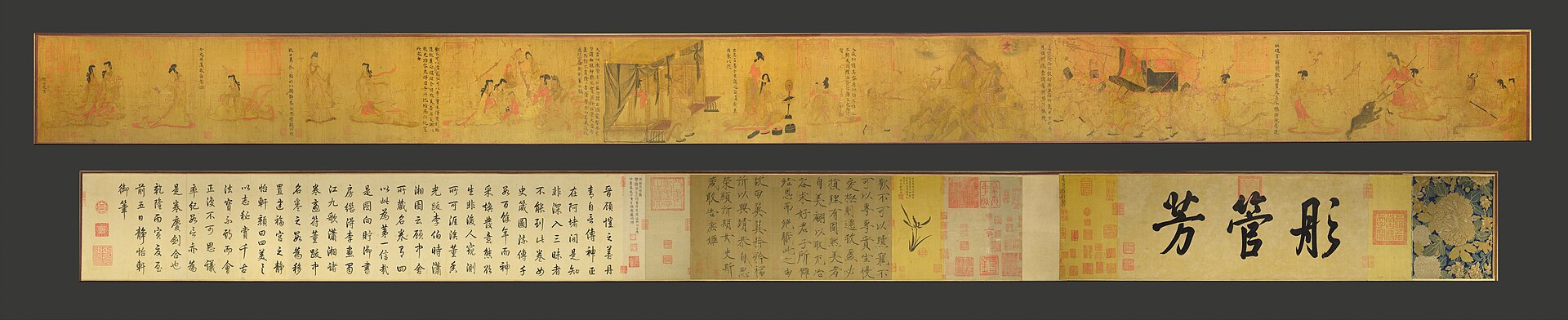
The British Museum scroll, museum number 1903,0408,0.1, in its full mounted extent. Sourced via the Google Art Project; licence verified public domain (PD-Art/CC-PD-Mark) via the Wikimedia Commons API.
| Artist | Attributed to Gu Kaizhi |
|---|---|
| Date | 5th-8th century AD (probably Tang dynasty, 7th-8th century); composition traditionally ascribed to Gu Kaizhi, c. 344-406 |
| Medium | Handscroll; ink and colour on silk, cut and mounted on panels with paper backing |
| Dimensions | Height 24.37 cm; length 343.75 cm (whole mount); painting section approximately 25 cm high |
| Where it is now | British Museum, London, Room 91alast confirmed 7 August 2026 |
| Inventory number | 1903,0408,0.1 |
| Attribution | DisputedTraditionally ascribed to the Eastern Jin painter Gu Kaizhi (c. Full note |
| Object type | Painting |
| Period | Chinese, Six Dynasties to Tang (traditional attribution: Eastern Jin) |
| Cases | Disputed attribution · Has a provenance gap |
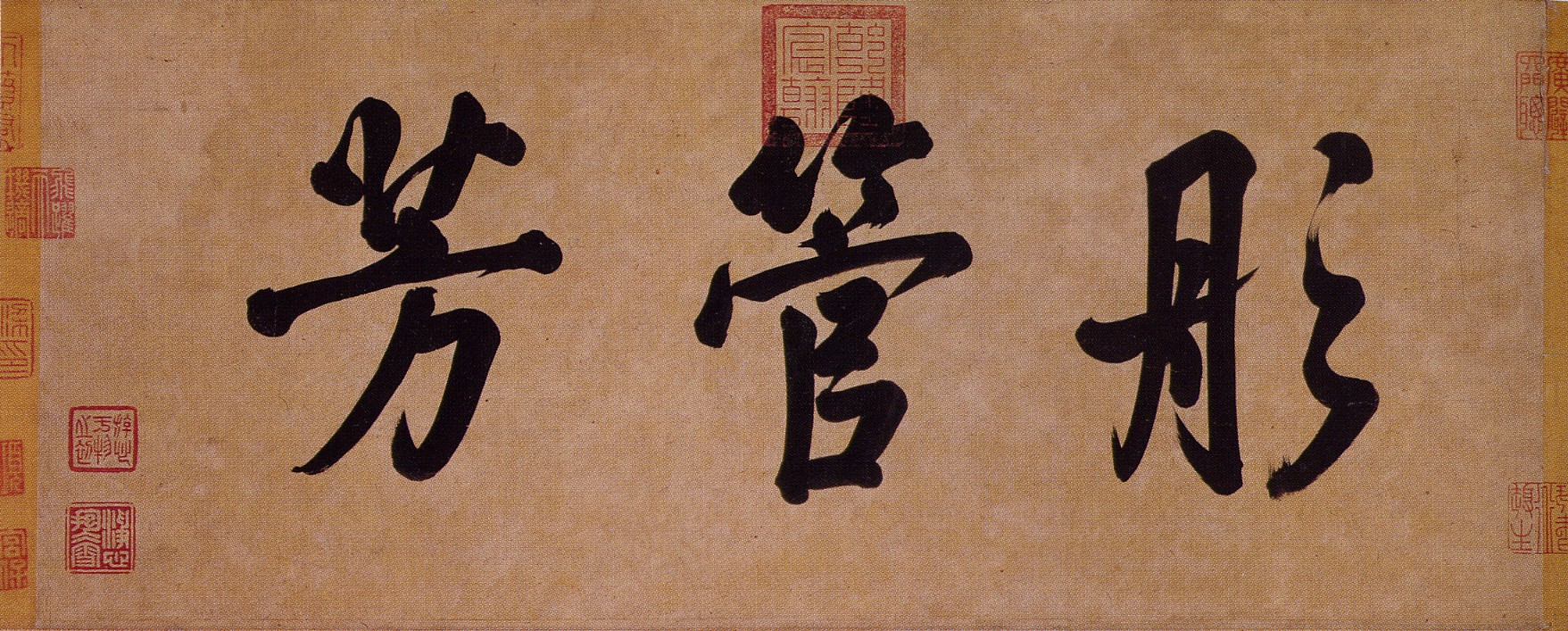
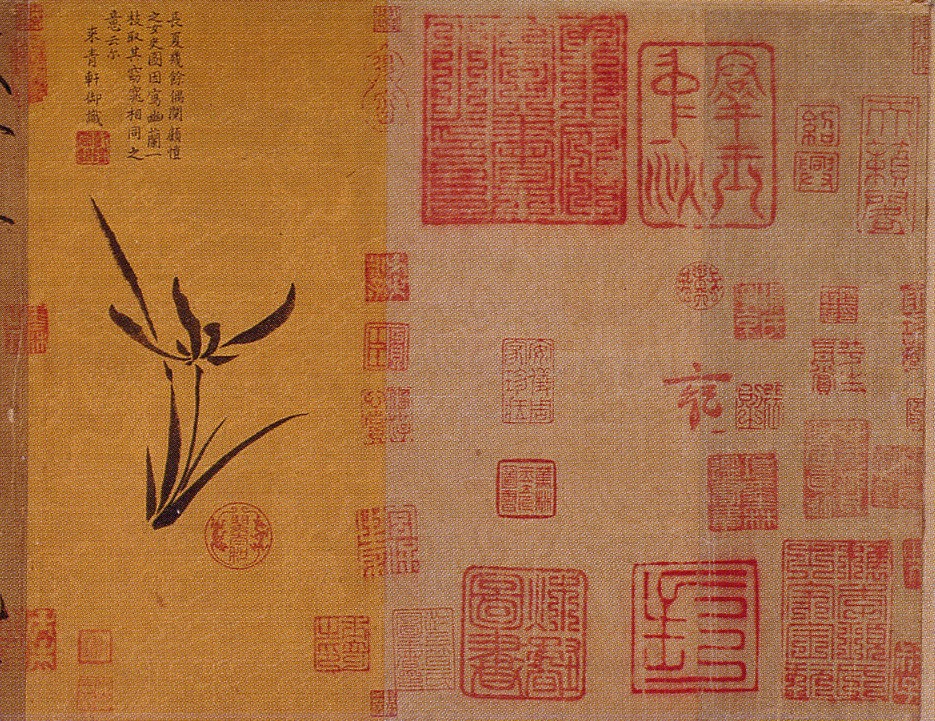
| Inscriptions | Nine surviving painted scenes (of an original twelve), each with an accompanying text panel quoting Zhang Hua's Nushi zhen (c. AD 292); a title inscription, an orchid painting, 37 seal impressions and a long colophon added by the Qianlong Emperor (r. 1735-1796) in and after 1746; a calligraphic colophon attributed to the Jin dynasty Emperor Zhangzong (r. 1189-1208); a colophon and roughly 50 seals of the Ming collector Xiang Yuanbian (1525-1590); a painting, Pine, Bamboo, Rock and Spring, by the court painter Zou Yigui (1686-1772), added at Qianlong's commission as the final section. |
| Owners on record | 10 links7 documented, 3 unknown |
| Sources | 14 cited |
About this record Last verified 7 August 2026 · 14 sources cited · Change log
On this page 10 sections
ContentsClose
A painted silk handscroll illustrating a 3rd-century Confucian text of moral instruction for palace women, traditionally ascribed to the 4th-century master Gu Kaizhi but almost certainly a Tang-dynasty copy of a lost original. It left the Qing imperial collection in 1900, during the international occupation of Beijing that followed the Boxer Rebellion, in the possession of a British Indian Army officer who sold it to the British Museum in 1903 for 25 pounds.
Conservators then cut the silk into flat panels and remounted it in a Japanese album format, a decision now treated by British Museum conservators themselves, working with Chinese specialists in a five-year study completed in 2014, as a documented conservation error. The object is displayed six weeks a year and kept in total darkness the rest of the time. It sits at the centre of China's ongoing case for the return of art removed from the country during the century of foreign military intervention, a case the British Museum's director has publicly declined to act on.
Provenance
Each link is graded. Documented: a cited source supports it. Disputed: the identification is argued but not established. Unknown: no owner for that span, and the gap is not smoothed into a narrative. The grades in the glossary.
- c. 5th-8th century - 1075 or earlierUnrecordedunknown
No owner or location is documented for the painting between its execution and its first securely datable mention. The date of the physical object is itself contested: the British Museum catalogues it to the 5th-7th century; Shane McCausland describes it as a Tang tracing copy; Kohara Hironobu has argued the accompanying calligraphy was not added until after 1075, in a deliberately archaised Tang-style hand, which would place at least the text later than the painting; Wen Fong instead reads the calligraphy as consistent with the style of the monk Zhiyong, active in the late 6th and early 7th century. See the attribution scholarship in the narrative for the full range of positions and the named scholars who hold them.459
- by 1103 - 1127Liu Youfang (Northern Song court eunuch), then imperial collection of Emperor Huizong of Songdocumented
The painter-connoisseur Mi Fu records the scroll in the possession of the eunuch Liu Youfang in his Hua shi (History of Painting), c. 1103. By 1120 it is catalogued as a work of Gu Kaizhi in the Xuanhe huapu, the painting catalogue of Emperor Huizong's imperial collection, meaning it had entered the Song court by that date.45
- 1127 - 12th centuryUncertain: Jin-dynasty court or Southern Song territoryunknown
Kaifeng fell to the Jurchen Jin in 1127 and Huizong's collection was dispersed. Whether the scroll passed into Jin court hands or remained in Song territory is not established; one end section carries seals associated with the Jin Emperor Zhangzong (r. 1189-1208), but scholars note these may have been added later, from a different source, rather than proving Jin custody at the time.45
- 16th century - 1590Wang Ao; Yan Song; the Ming court (after Yan Song's 1562 disgrace); Gu Congyi; Xiang Yuanbiandocumented
Recorded successively with the official Wang Ao (1450-1524), the disgraced minister Yan Song (1481-1568) whose confiscated property (including, it is inferred, this scroll) reverted to the Ming court in 1562, the official Gu Congyi (noted in possession by the 1560s), and finally the great Ming collector Xiang Yuanbian (1525-1590), who added roughly 50 of his own seals and a colophon, among the most extensive documented interventions any owner made on the object before Qianlong.45
- 1590 - early 18th centuryUnrecordedunknown
No owner is documented between Xiang Yuanbian's death in 1590 and the scroll's later appearance in the collection of the Tianjin salt merchant An Qi.45
- early 18th century - 1746The merchant An Qi (1683-c. 1746)documented
No owner is documented between Xiang Yuanbian's death in 1590 and the scroll's appearance in the collection of the Tianjin salt merchant An Qi, from whom the Qianlong Emperor acquired it.45
- 1746 - 1900Qianlong Emperor and the Qing imperial collectiondocumented
Qianlong remounted the scroll in 1746, added a title inscription, an orchid painting, a long colophon and, over his 60-year reign, 37 personal seal impressions; he also commissioned the court painter Zou Yigui to add a closing painting. He kept it among the 'Four Beauties' in his private Pavilion of Tranquil Ease. It remained in the Qing imperial collection, latterly stored at the Summer Palace (Yuanmingyuan/Yiheyuan complex west of Beijing) under Empress Dowager Cixi, until 1900.145
- 1900 - 1900Removed by Captain Clarence A. K. Johnson, 1st Bengal Lancersdocumented
Beijing was occupied from mid-August 1900 by the Eight-Nation Alliance force suppressing the Boxer Rebellion; the Summer Palace was burned and looted by allied troops between mid-August and October 1900. Captain Clarence Arnold Keatinge Johnson (1870-1937), an officer of British Indian cavalry stationed in the area, acquired the scroll in this period. His family later claimed he received it as a reward for escorting a Chinese noblewoman and her household to safety; this claim is undocumented and unverifiable, and the scroll's removal cannot be separated from the wider, officially tolerated looting of the palace by occupying forces of eight nations, Britain among them.123
- 1900 - 1903Captain Clarence A. K. Johnson, private possession in Britaindocumented
Johnson returned to London and in 1902 brought the scroll to the British Museum seeking an appraisal of the jade toggle fitted to it, apparently unaware of the painting's significance. Sidney Colvin, Keeper of Prints and Drawings, and his assistant Laurence Binyon recognised the work's importance.125
- 1903 - presentBritish Museum, Londondocumented
The British Museum purchased the scroll from Johnson in 1903 for 25 pounds sterling, a sum this record's editor could not find superseded or corrected in any museum or scholarly source consulted; it is treated below as confirmed rather than merely commonly cited. Colvin's contemporary condition note recorded the silk as 'much worn and rotted, and bears many traces of ancient repair,' damage compounded, according to later British Museum conservation research, by rough handling in transit.1236
Technical evidence
| Attribution note | Traditionally ascribed to the Eastern Jin painter Gu Kaizhi (c. 344-406), but the scroll carries no signature or seal of his and no work securely documented as his survives. The British Museum's own catalogue dates the physical object to the 5th-7th century; most specialists call it a Tang-dynasty (7th-8th century) tracing copy of a lost original composition, though the date of the copy, the date the accompanying calligraphy was added, and whether any of it is Gu Kaizhi's own invention at all remain argued questions among named scholars, set out below. This record treats the object as a copy of a composition associated with Gu Kaizhi's name, not as an autograph work. |
|---|---|
| Support and medium | Ink and colour on silk; the surviving nine scenes are each paired with a calligraphic text panel quoting Zhang Hua's Nushi zhen.35 |
| Dimensions | Height 24.37 cm; overall mounted length 343.75 cm, per the British Museum's own catalogue record. Some secondary sources give approximately 25 x 329 cm for the painting section alone; this record follows the museum's own published figures for the object as currently mounted.35 |
| Present mounting format | Cut from its original handscroll (rolled) format and mounted flat on panels using a Japanese byobu-derived technique, c. 1912-1915, by specialists including Sugizaki Hideaki and Urushibara Mokuchu. The Zou Yigui closing painting was detached and separately mounted as an album leaf.267 |
| Condition at acquisition, 1903 | Recorded by Keeper Sidney Colvin as 'much worn and rotted, and bears many traces of ancient repair.'13 |
| Qianlong-era additions | 37 seal impressions of the Qianlong Emperor; a title inscription and an orchid painting in his hand; a long colophon; a closing painting, Pine, Bamboo, Rock and Spring, by the court painter Zou Yigui (1686-1772), added at Qianlong's commission.45 |
| Display case (2014) | Purpose-built double-sided steel case, approximately 4 m long and 900 kg, with hydraulic lifting and drawer access; passive humidity buffering via ProSorb cassettes with Hanwell radiotelemetry monitoring; materials Oddy-tested for pollutants.6 |
| Light exposure limit | Displayed approximately six weeks a year against a strict 30 kilolux annual exposure budget, LED-lit from within the case pedestals; kept in total blackout when not on display.68 |
| Woodblock facsimile | Hand-coloured woodblock facsimile, 34 blocks, cut by Sugizaki Hideaki and printed by Urushibara Mokuchu, with text by Laurence Binyon; commissioned 1911 by the Trustees, produced London 1912-1913, edition of 100 at 7 guineas each. British Museum copy: 1913,0708,0.1.7 |
Images

The record in full
Chapter 1What survives, physically
The object the British Museum holds under number 1903,0408,0.1 is a painted silk handscroll, now cut down and mounted flat on panels rather than kept in roll form.
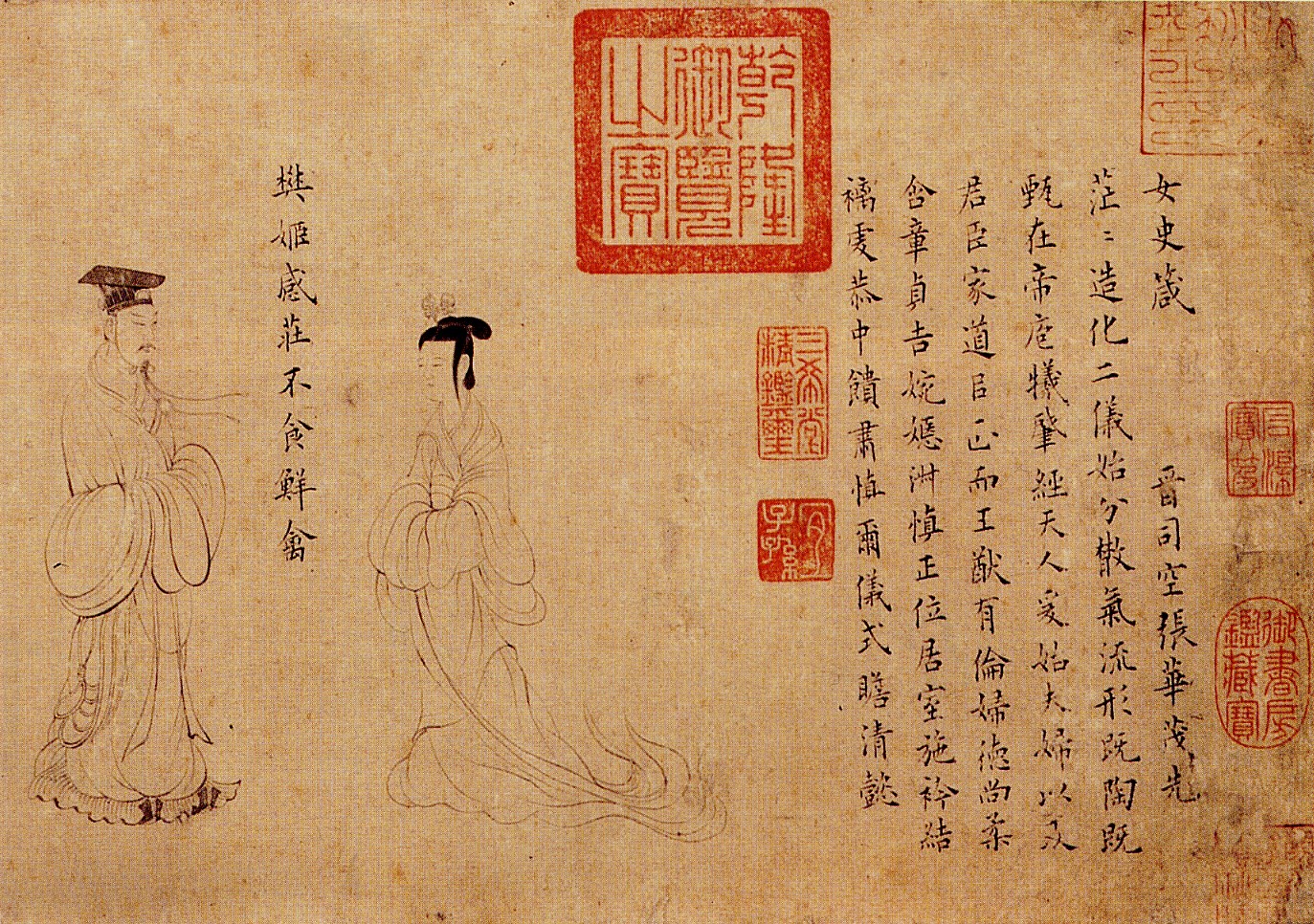
The object the British Museum holds under number 1903,0408,0.1 is a painted silk handscroll, now cut down and mounted flat on panels rather than kept in roll form. Nine painted scenes survive of an original twelve; the missing first three are presumed lost before the scroll left China, since a 12th-century paper copy made from it already appears to reconstruct rather than faithfully transmit them. Each surviving scene pairs a painted illustration with a block of calligraphy quoting the didactic text it illustrates.
Attached to the painting, and inseparable from any honest account of the object, is nearly a millennium of accretion: seals, colophons, a title inscription and an added painting, contributed by a sequence of documented owners from the Song dynasty to the Qing. The physical object today is therefore not simply a 4th-to-8th-century painting; it is that painting plus the record, in ink and seal-paste, of everyone who is known to have possessed it since at least the 11th century.
Chapter 2The text it illustrates, and what it was for
The paintings illustrate the Nushi zhen (Admonitions of the Instructress to the Court Ladies), an 80-line didactic poem composed around AD 292 by the Jin-dynasty official and poet Zhang Hua (232-300).
The paintings illustrate the Nushi zhen (Admonitions of the Instructress to the Court Ladies), an 80-line didactic poem composed around AD 292 by the Jin-dynasty official and poet Zhang Hua (232-300). Zhang wrote it, by the traditional account, to rebuke the empress consort Jia Nanfeng (257-300), whose conduct scandalised the Western Jin court, and more broadly to set out the virtues expected of women attached to the imperial household: humility, self-restraint, discretion, and the subordination of personal desire to duty.
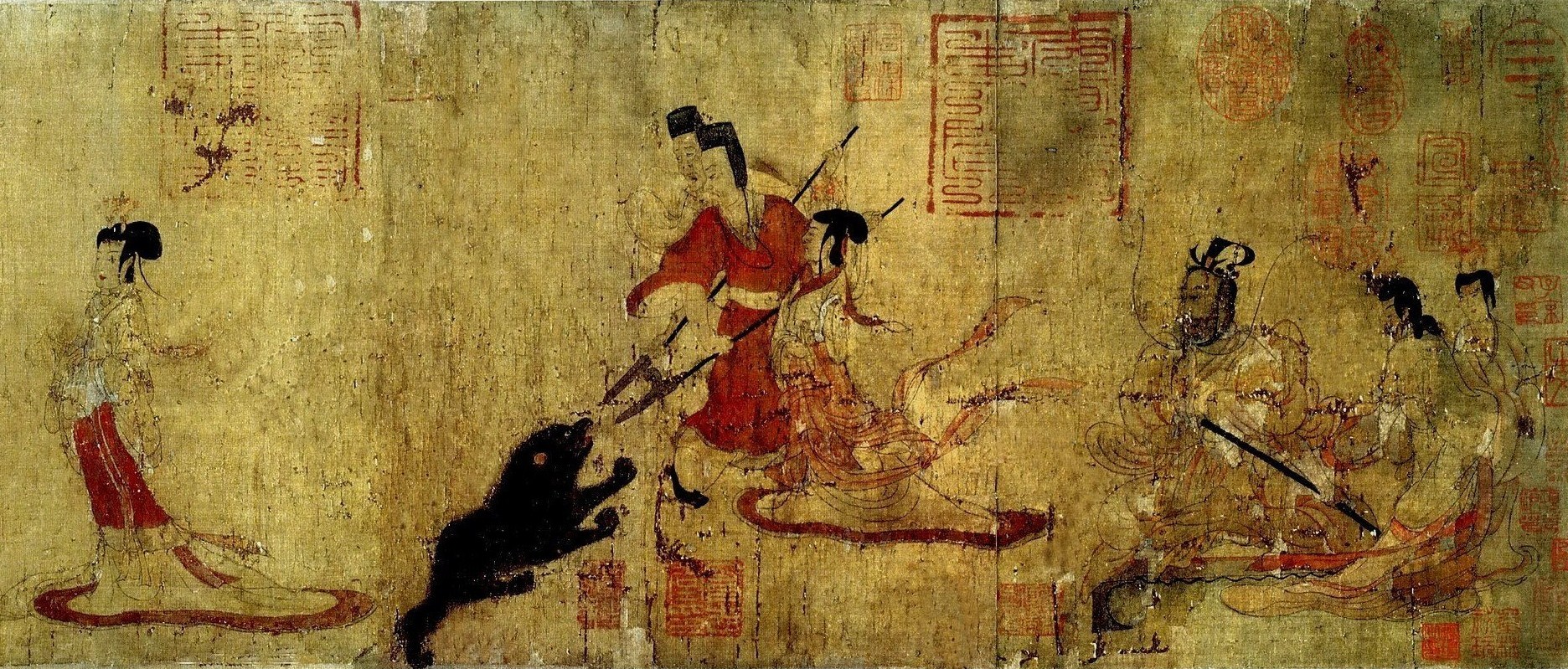
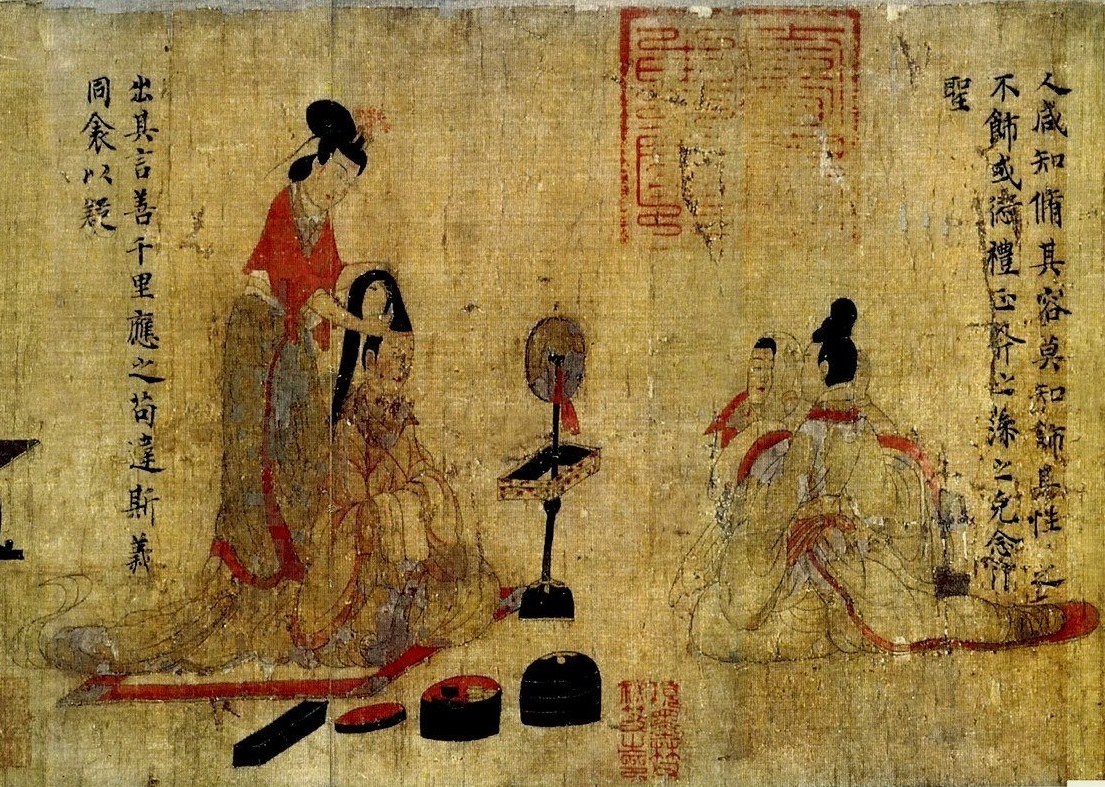
The painted scenes function as a visual conduct manual rather than as narrative for its own sake. One shows Lady Feng stepping between a charging bear and the Emperor Yuan of Han, an exemplary act of self-sacrificing courage; another shows a court lady seated at her toilette, a scene traditionally read as a warning that outward beauty requires inward self-examination to match it; a third shows the Emperor waving away a court lady approaching his sedan chair, illustrating Lady Ban Jieyu's historical refusal to ride beside Emperor Cheng of Han in order to avoid impropriety and the appearance of undue influence. Each scene is a specific, textually anchored moral example aimed at an audience of imperial consorts and attendants, not a generalised depiction of court life.
This is an ordinary, well-documented didactic function, not a hidden one: the object exists because a Confucian moral text needed a visual teaching aid for palace women, and every scene traces to a passage of Zhang Hua's poem. No esoteric or concealed programme is argued for it in the literature consulted for this record; the moral content is the entire content, stated plainly by the text panels themselves.
Chapter 3Attribution: an argument, not a fact
No painting securely documented as Gu Kaizhi's own hand survives anywhere.
No painting securely documented as Gu Kaizhi's own hand survives anywhere. The corpus attributed to him, including this scroll, the Nymph of the Luo River (surviving only in five later Song-Ming copies, a separate composition and a separate physical object in every surviving instance) and Wise and Benevolent Women (a 13th-century Song copy), is a reconstruction built by connoisseurship, catalogue tradition and, in the modern period, technical analysis. The British Museum's own online catalogue dates this object to the 5th-7th century, declining to commit to a Tang date; this record follows that caution rather than repeating the popular shorthand of 'the Tang copy' as settled fact.
Among named specialists, Shane McCausland, who organised the British Museum's 2001 international colloquium on the scroll and edited the resulting volume, argues it as a Tang-dynasty tracing copy on the basis of integrated textual and pictorial features that diverge from what is independently known of Jin-period painting. Kohara Hironobu has argued that the calligraphy accompanying the scenes was not added until after 1075, in a hand deliberately archaised to look older than it is, which would separate the date of the text from the date of the painting and push at least part of the object later than the Tang. Wen Fong has read the same calligraphy differently, finding it consistent with the style of the monk-calligrapher Zhiyong, active in the late 6th to early 7th century, which would argue for an earlier date. Chen Pao-chen, of National Taiwan University, has made the case in print for treating the painting as carrying genuine early, pre-Tang pictorial content rather than being a straightforward later tracing. Yang Xin, of Peking University, has proposed a different origin altogether: an original work commissioned at the Northern Wei court of Emperor Xiaowen (r. 471-499), rather than a copy of a Gu Kaizhi original at all.
None of these positions is settled, and this record does not arbitrate between them. What is documented, not argued, is that the calligraphic and pictorial evidence is read differently by named scholars working from the same object, and that the attribution to Gu Kaizhi himself is, at best, an attribution to a lost original he may have composed, transmitted through an unknown number of intervening copies before this one was made.
Chapter 4Through the Song, Ming and Qing collections
The earliest secure sighting is in the painter-connoisseur Mi Fu's Hua shi (History of Painting), written around 1103, which places the scroll with the court eunuch Liu Youfang.
The earliest secure sighting is in the painter-connoisseur Mi Fu's Hua shi (History of Painting), written around 1103, which places the scroll with the court eunuch Liu Youfang. By 1120 it is catalogued as a Gu Kaizhi in the Xuanhe huapu, the painting catalogue of Emperor Huizong's imperial collection, meaning it had entered Song imperial hands by then.
When Kaifeng fell to the Jurchen Jin in 1127 and Huizong's collection scattered, the scroll's custody becomes uncertain again; a seal associated with the Jin Emperor Zhangzong appears on one section, but scholars are not confident it was applied at the time rather than added from elsewhere later. The chain resumes with named Ming-dynasty owners: the official Wang Ao, the powerful and later disgraced minister Yan Song (whose confiscated property reverted to the Ming court after his 1562 fall), the official Gu Congyi, and finally the collector Xiang Yuanbian, who left roughly 50 of his own seals on the object, among the heaviest documented interventions by any single owner before the Qianlong Emperor.
After Xiang Yuanbian's death in 1590, the trail goes dark again until the scroll surfaces in the 18th century in the collection of the Tianjin merchant An Qi, from whom Qianlong acquired it.
Chapter 5Qianlong's remaking of the object
The Qianlong Emperor (r. 1735-1796) did not simply own the scroll; he physically remade it.
The Qianlong Emperor (r. 1735-1796) did not simply own the scroll; he physically remade it. In and after 1746 he had it remounted, added a title inscription in his own hand, painted an orchid onto the mount, and over the course of his sixty-year reign impressed 37 personal seals onto it, an act of ownership so dense it amounts to a form of authorship in its own right. He commissioned the court painter Zou Yigui (1686-1772) to add a closing composition, Pine, Bamboo, Rock and Spring, as the final section of the mounted scroll. He kept it, alongside three other favoured works he grouped as the 'Four Beauties,' in his private Pavilion of Tranquil Ease.
This is worth stating plainly because Western commentary on the object sometimes treats the Qianlong material as clutter obscuring an earlier, purer painting. Qianlong's seals and colophon are themselves primary evidence: of imperial taste, of the object's status at the summit of the Qing collection, and of exactly the kind of intensive, physically transformative engagement with a scroll that a Chinese collector considered a mark of honour rather than damage.
Chapter 61900: removal during the occupation of Beijing
By the 1890s the scroll was kept, under Empress Dowager Cixi's de facto rule, at the Summer Palace complex west of Beijing.
By the 1890s the scroll was kept, under Empress Dowager Cixi's de facto rule, at the Summer Palace complex west of Beijing. When the Boxer Rebellion broke out and the international legations in Beijing came under siege, an Eight-Nation Alliance force, comprising troops from Britain, France, Japan, the United States, Russia, Germany, Austria-Hungary and Italy, occupied the city from mid-August 1900. Between mid-August and October 1900 the Summer Palace was burned and systematically looted by soldiers of the occupying powers, an action distinct from, though following on from, the earlier 1860 burning of the same palace complex during the Second Opium War.
Captain Clarence Arnold Keatinge Johnson (1870-1937), an officer with British Indian cavalry (sources describe him variously as of the 1st Bengal Lancers or 1st Bengal Cavalry) stationed in the Beijing area during the occupation, acquired the scroll in this period. Johnson's descendants later told the British Museum that he received it as a personal reward from a Chinese noblewoman whose family he had escorted to safety. No document corroborates this account, and it should be read as an undocumented family tradition rather than an established fact. What is documented is the setting: an occupied capital, a burning and looted palace, and a foreign officer leaving China in possession of one of the most treasured objects in the recently displaced Qing imperial collection. Whatever the specific transaction, Johnson's acquisition took place inside, and cannot be meaningfully separated from, the wider looting of the Summer Palace by the forces of the occupying alliance.
Chapter 71903: the sale to the British Museum
Johnson returned to Britain and in 1902 brought the scroll to the British Museum, seeking only to have the jade toggle fitted to its wrapper appraised; by the museum's own account he had no idea what...
Johnson returned to Britain and in 1902 brought the scroll to the British Museum, seeking only to have the jade toggle fitted to its wrapper appraised; by the museum's own account he had no idea what the painting itself was. Sidney Colvin, Keeper of the Department of Prints and Drawings, and his assistant Laurence Binyon recognised the object's significance. The Trustees purchased it from Johnson in 1903 for 25 pounds sterling.
This figure is widely repeated and this record could not find it corrected or superseded in any museum or scholarly source consulted; it is treated here as confirmed. Twenty-five pounds in 1903 is approximately 3,900 to 4,000 pounds in 2026 terms on the UK composite consumer price index, a domestic-servant's or junior clerk's annual wage of the period, paid for what is now one of the most closely studied paintings in the British Museum's entire collection. Colvin's own contemporary condition note is blunt: the silk was, he wrote, 'much worn and rotted, and bears many traces of ancient repair.' Later British Museum conservation research attributes further damage to rough handling during the object's transit from China to London, on top of the wear Colvin had already recorded on arrival.
Chapter 8The 1910s remounting, and why it is now regarded as an error
Around 1912-1915, the British Museum had the scroll dismantled from its Chinese roller-scroll form and remounted flat, using a Japanese byobu (folding-screen) technique, carried out with the...
Around 1912-1915, the British Museum had the scroll dismantled from its Chinese roller-scroll form and remounted flat, using a Japanese byobu (folding-screen) technique, carried out with the involvement of Japanese specialists including the block-cutter Sugizaki Hideaki and the printer Urushibara Mokuchu (who worked concurrently on a woodblock facsimile of the scroll, discussed below). The painting sections were separated onto one mount and the accompanying colophons onto another; Zou Yigui's closing painting was detached and mounted as an independent album leaf.
The intention, by the standards of the time, was conservation: to stabilise a fragile, damaged silk object using techniques the museum's own staff and outside advisers judged sound. The consequence, judged by the standard a Chinese scroll-mounter would have applied, was close to the opposite. Traditional Chinese scroll-mounting is itself an intensive, retouching craft, expected to be periodically renewed by a trained specialist working with the object's original structure and materials in mind; flattening a silk scroll onto rigid panels in the Japanese album manner is a different physical treatment built for a different kind of object, and it exposed the painting to a flat, evenly distributed light and handling regime the rolled Chinese format was never meant to receive. The 2015 British Museum Technical Research Bulletin study of the scroll's condition and treatment history from 1903 to 2014 documents this sequence of interventions in detail as part of tracing how the object arrived at its 2013-2014 condition.
By the time the British Museum began the joint study that led to the object's 2014 redisplay, in-house conservation staff, including Qiu Jinxian, the museum's first Chinese-trained senior conservator of East Asian painting (in post since 1988), were explicit that the Japanese remounting technique used in the 1910s was not the appropriate treatment for a Chinese painting on silk of this kind and date, not least because Japanese scroll-mounting practice, though itself derived from Tang-dynasty Chinese methods, had diverged from the methods Chinese conservators had continued to develop through the intervening dynasties. When Qiu and her colleagues undertook fresh conservation work on the scroll in 2013, they judged it too fragile to remount as a rolled scroll at all, and instead refined the flat, panel-mounted presentation the 1910s remounting had already imposed, rather than attempting to reverse it.
Chapter 9The 2013-2014 joint study and redisplay
Following roughly a decade of preliminary research, the British Museum convened an expert meeting in July 2013 bringing together East Asian painting conservators, Chinese scroll-mounting specialists...
Following roughly a decade of preliminary research, the British Museum convened an expert meeting in July 2013 bringing together East Asian painting conservators, Chinese scroll-mounting specialists and art historians to assess the object's condition and agree a conservation and display strategy. The project, completed in June 2014 with the scroll's redisplay in a new purpose-built case, is documented in the museum's 2015 Technical Research Bulletin article on the object's condition, treatment and housing from 1903 to 2014.
The resulting case is a purpose-built, double-sided steel structure roughly 4 metres long and weighing about 900 kilograms, with a hydraulic lifting mechanism and drawer access for handling the mounted panels. Rather than mechanical air conditioning, the team chose passive humidity buffering using ProSorb conditioning cassettes, judged less prone to the fluctuations and maintenance intrusions of an active system, monitored with Hanwell radiotelemetry sensors. Display materials were vetted with Oddy testing to screen for pollutants that could react with the silk or pigments over time.
The most consequential decision was on light. The scroll is now shown for a strict, fixed six-week window each year against an annual exposure budget of 30 kilolux-hours, lit in the gallery by LED units built into the case's own pedestals, with manually operated rather than motorised blinds chosen deliberately for their mechanical reliability. Outside its display weeks, the case is kept in total blackout. This is a conservation regime built around the acknowledged, and by 2013 well understood, vulnerability of light-degraded silk and pigment, not a display schedule chosen for dramatic effect.
Chapter 10Reproduction: the 1912-1913 woodblock facsimile
Concurrent with, and connected to, the 1910s remounting, the British Museum Trustees in 1911 commissioned a hand-coloured woodblock facsimile of the entire scroll, cut by Sugizaki Hideaki and printed...
Concurrent with, and connected to, the 1910s remounting, the British Museum Trustees in 1911 commissioned a hand-coloured woodblock facsimile of the entire scroll, cut by Sugizaki Hideaki and printed by Urushibara Mokuchu, with accompanying text by Laurence Binyon. Produced in London in 1912-1913 from 34 separate blocks, the edition ran to 100 copies, sold at 7 guineas (7 pounds 7 shillings) each; the British Museum holds a copy under number 1913,0708,0.1. Copies were presented to leading sinologists of the day, including Edouard Chavannes and Raphael Petrucci, functioning as an early, deliberate act of scholarly circulation: the facsimile put a high-fidelity surrogate of the scroll into other hands and other libraries well before photographic reproduction or digitisation could do the same job.
Chapter 11The restitution question, and where it stands
The Admonitions Scroll sits inside a live, unresolved argument over Chinese cultural property removed from the country during roughly a century of foreign military intervention, from the Opium Wars...
The Admonitions Scroll sits inside a live, unresolved argument over Chinese cultural property removed from the country during roughly a century of foreign military intervention, from the Opium Wars through the 1900 occupation of Beijing to the Second World War. In August 2023, the Chinese state-run Global Times published a formal editorial call for the British Museum to return, without payment, Chinese relics it holds that were acquired through what it characterised as improper channels, part of a wider wave of restitution demands following revelations that a British Museum curator had stolen and sold items from the museum's own storerooms. UNESCO figures cited in that coverage put the number of Chinese objects in the British Museum's collection at roughly 23,000, with about 2,000 on long-term display; the Admonitions Scroll is regularly named, alongside Chinese ceramics and bronzes, as one of the collection's most prominent Chinese holdings with a documented colonial-era removal.
The British Museum has not issued a response naming the Admonitions Scroll specifically among the sources checked for this record. Institutionally, its position has been set out in general terms: in May 2025 the museum's director, Nicholas Cullinan, publicly ruled out any change to the museum's policy against permanently deaccessioning objects, which in the case of the British Museum would in any case require an Act of Parliament to alter the governing statute. Speaking about restitution demands broadly (in remarks focused on the Parthenon Marbles and the Benin Bronzes, not on this object specifically), Cullinan said he was 'more comfortable with loaning items' and proposed partnership and loan arrangements, of the kind negotiated with Greece, as an alternative to permanent return, describing the museum's aim as 'connecting countries rather than putting up barriers.' No export licence, restitution claim, or legal proceeding specific to the Admonitions Scroll has been identified in the sources consulted for this record.
Chapter 12What is happening to it now
The scroll remains on the British Museum's register as object 1903,0408,0.1, held in Room 91a.
The scroll remains on the British Museum's register as object 1903,0408,0.1, held in Room 91a. Under the conservation regime adopted in 2014, it is shown for one fixed six-week window a year and kept in total darkness for the rest; the museum's published schedule for 2026 sets its display from 13 July to 24 August. Outside that window, study access is by appointment through the museum's Asia department rather than public display.
The artist
Gu Kaizhi (courtesy name Changkang)
Nothing survives that is securely documented as Gu Kaizhi's own hand. Every painting carrying his name, including this scroll, is known only through later copies, and the case for any of them is built from period text sources describing his work and technique rather than from a signed original. Gu Kaizhi the historical figure is well attested; Gu Kaizhi the surviving painter is a reconstruction.
Exhibited
- 2014Redisplay following five-year conservation and rehousing projectBritish Museum, London, Room 91a
Related works
| Work | Relation | Where it is |
|---|---|---|
| Nushi zhen tu (Southern Song paper copy) Unknown court painter, after Gu Kaizhi | Complete 12-scene monochrome copy of the same composition, made from the British Museum scroll (or its source) during the Southern Song, believed in the reign of Emperor Xiaozong (r. 1162-1189) A different physical object from the British Museum scroll and not to be confused with it. Its completeness, all twelve scenes against the British Museum copy's surviving nine, is itself used as evidence for what the missing opening scenes of the London scroll may have looked like, though scholars debate whether its first three scenes are faithful transmission or later imaginative reconstruction. | Palace Museum, Beijing |
| Nymph of the Luo River Attributed to Gu Kaizhi | Separate composition also attributed to Gu Kaizhi, illustrating a different text (Cao Zhi's rhapsody on the Luo River goddess); survives only in five later Song-to-Ming copies A different painting on a different subject. Included here only to prevent confusion with the Admonitions Scroll; it should never be treated as an alternative version of the same object. | Palace Museum, Beijing; Liaoning Provincial Museum; Freer Gallery of Art, Washington DC (among the surviving copies) |
| Wise and Benevolent Women Attributed to Gu Kaizhi | Separate composition also attributed to Gu Kaizhi, surviving in a 13th-century Song copy A different painting on a different subject, included for the same reason as above. | Palace Museum, Beijing |
| Woodblock facsimile of the Admonitions Scroll Sugizaki Hideaki (block-cutter) and Urushibara Mokuchu (printer), after the British Museum original, text by Laurence Binyon | Hand-coloured facsimile edition of the British Museum scroll, commissioned by the Trustees and produced in London, 1912-1913 Not the original object; a contemporary reproduction made using the same specialists who remounted the scroll itself. | British Museum, London (museum number 1913,0708,0.1), and in an edition of 100 dispersed to libraries and scholars including Edouard Chavannes and Raphael Petrucci |
Open questions
- How, precisely, did Captain Johnson acquire the scroll in 1900? The family account of a reward for escorting a noblewoman to safety is undocumented and cannot be verified against any independent record.
- Where was the scroll, and in whose hands, between Xiang Yuanbian's death in 1590 and its appearance in the merchant An Qi's collection in the 18th century? No owner is documented for roughly a century and a half.
- Are the seals associated with Jin Emperor Zhangzong on the scroll evidence that it passed through Jin imperial hands after 1127, or were they added later from a different source? Scholars are divided and this record found no resolution in the literature consulted.
- When was the accompanying calligraphy actually written relative to the painting: is it contemporary with the images, as Wen Fong's comparison to the calligrapher Zhiyong implies, or added after 1075 in a deliberately archaised hand, as Kohara Hironobu argues? The dating of the object as a whole turns partly on this unresolved question.
- Were the scroll's first three scenes, missing from the British Museum object, already lost by the time the 12th-century Palace Museum paper copy was made, or were they lost later? The completeness of that copy's opening scenes is itself disputed as faithful transmission versus reconstruction.
- Has the British Museum made any statement addressing the Admonitions Scroll specifically in response to China's 2023 restitution demands, as distinct from its general public statements on restitution policy covering the collection as a whole? None was located in the sources consulted for this record.
- What became of the other three of Qianlong's 'Four Beauties' group, and did any of them leave China by the same route in 1900? This record did not attempt to trace them and flags the question as unresolved.
Questions about this object
What is Admonitions of the Instructress to the Court Ladies?
Admonitions of the Instructress to the Court Ladies is a painting, dated 5th-8th century AD (probably Tang dynasty, 7th-8th century); composition traditionally ascribed to Gu Kaizhi, c. 344-406. Medium: Handscroll; ink and colour on silk, cut and mounted on panels with paper backing.
Who made Admonitions of the Instructress to the Court Ladies, and is the attribution settled?
The attribution to Attributed to Gu Kaizhi is recorded here as disputed. Traditionally ascribed to the Eastern Jin painter Gu Kaizhi (c. 344-406), but the scroll carries no signature or seal of his and no work securely documented as his survives. The British Museum's own catalogue dates the physical object to the 5th-7th century; most specialists call it a Tang-dynasty (7th-8th century) tracing copy of a lost original composition, though the date of the copy, the date the accompanying calligraphy was added, and whether any of it is Gu Kaizhi's own invention at all remain argued questions among named scholars, set out below. This record treats the object as a copy of a composition associated with Gu Kaizhi's name, not as an autograph work.
Where is Admonitions of the Instructress to the Court Ladies now?
British Museum, London, Room 91a. Inventory number 1903,0408,0.1. Last confirmed 7 August 2026. Purchased from Captain Clarence A. K. Johnson, 1903.
What is still unknown about Admonitions of the Instructress to the Court Ladies?
How, precisely, did Captain Johnson acquire the scroll in 1900? The family account of a reward for escorting a noblewoman to safety is undocumented and cannot be verified against any independent record.
Sources
- 1100 Histories of 100 Worlds in One Object, 'The Traumatic Past of the Admonitions of the Instructress to the Court Ladies' (by Si Xiao), covering the 1900 removal, Johnson's acquisition, the 1903 sale price and Colvin's condition note, and the 1910s Japanese-technique remounting. 100histories100worlds.org/the-admonitions-scroll
- 2British Museum, collection object record for 1903,0408,0.1 (Admonitions Scroll), giving the museum's own dimensions, dating, acquisition note on Captain C. Johnson, and inscription details. britishmuseum.org/collection/...
- 3Wikipedia, 'Admonitions Scroll,' consolidating the imperial collection history, the Boxer Rebellion removal, the 1903 purchase, the 1914-1915 remounting, and the Southern Song Palace Museum copy. Flagged for replacement with McCausland's edited scholarly volume and the British Museum's own published catalogue where a claim needs primary confirmation. en.wikipedia.org/wiki/...
- 4Search-derived summary of Chen Pao-chen, 'The Admonitions Scroll in the British Museum: New Light on the Text-Image Relationships, Painting Style and Dating Problem,' in Shane McCausland (ed.), Gu Kaizhi and the Admonitions Scroll (British Museum Press, 2003), for the case that the painting carries genuine early pictorial content; and of Yang Xin's Northern Wei commission theory. The full essay was not directly accessible during this research pass and should be read in the original before further reliance. books.google.com/books/...
- 5Search-derived summary of Shane McCausland's Tang-copy attribution, Kohara Hironobu's post-1075 calligraphy dating argument and Wen Fong's Zhiyong comparison, and the Southern Song/Ming provenance chain (Mi Fu, Huizong's Xuanhe huapu, Wang Ao, Yan Song, Gu Congyi, Xiang Yuanbian, An Qi). Drawn from secondary aggregation of the scholarship rather than direct access to McCausland's edited volume or Kohara's and Fong's original essays; flagged for verification against the primary publications before further reliance. en.wikipedia.org/wiki/...
- 6Institute of Conservation (Icon), 'The Art of Preventive Conservation: Ensuring the Longevity of the Admonitions Scroll,' on the 2013 expert meeting, the 2014 redisplay case, passive humidity buffering, Oddy testing and the light-exposure regime. icon.org.uk/resource/...
- 7British Museum, collection object record for 1913,0708,0.1 (woodblock facsimile of the Admonitions Scroll), giving the makers Sugizaki Hideaki and Urushibara Mokuchu, Laurence Binyon's text, the 1911 commission, the 1912-1913 production, edition size and price, and named recipients. britishmuseum.org/collection/...
- 8British Museum, 'Admonitions of the instructress to the court ladies' exhibition/display page, for the current (2026) six-week display schedule (13 July - 24 August) and the conservation rationale for the light-exposure regime. britishmuseum.org/exhibitions/...
- 9Wikipedia, 'Gu Kaizhi,' for biographical dates, career, the Huan Xuan anecdote, the three theoretical texts, the attributed corpus (Nymph of the Luo River, Wise and Benevolent Women) and their own copy histories. Tertiary source; flagged for replacement with Zhang Yanyuan's Lidai Minghua Ji in a scholarly edition/translation (e.g. Bush and Shih, Early Chinese Texts on Painting) and with McCausland's published scholarship. en.wikipedia.org/wiki/...
- 10Search-derived summary on the Waguan Temple Vimalakirti mural (c. 363-365) and Zhang Yanyuan's Lidai Minghua Ji (9th century) as the primary source preserving Gu Kaizhi's painting theory and the eyes/spirit anecdote. Tertiary aggregation; flagged for replacement with a direct scholarly translation of Zhang Yanyuan. en.wikipedia.org/wiki/...
- 11Museums Association, 'BM director rules out restitution as he outlines plans to foster collaboration' (May 2025), for Director Nicholas Cullinan's public position on deaccessioning, loans versus permanent return, and the parliamentary constraint on the museum's governing statute. museumsassociation.org/museums-journal/...
- 12Artnet News, 'China Joins a Growing Number of Nations Demanding the British Museum Restitute Artifacts From Its Collection in the Wake of Widespread Thefts' (2023), for the August 2023 Global Times editorial demand, the context of the British Museum theft scandal, and the cited UNESCO figure of roughly 23,000 Chinese objects in the collection. news.artnet.com/art-world/...
- 13China Daily, coverage of conservator Qiu Jinxian, the British Museum's first Chinese-trained senior conservator of East Asian painting (in post since 1988), her 2013-2014 work on the Admonitions Scroll, and her assessment that the 1910s Japanese remounting technique was not suited to a Chinese silk painting of this date. chinadaily.com.cn/a/...
- 14UK inflation calculator (in2013dollars.com / ONS composite consumer price index), used to derive the approximate 2026 equivalent value of 25 pounds sterling in 1903 (approximately 3,900-4,000 pounds), cited for context on what the British Museum's purchase price meant at the time. A modern equivalent figure, not a claim about market value. in2013dollars.com/uk/...
Last verified 7 August 2026 · Published 7 August 2026
Change log
7 August 2026 - Record created at the house standard: researched narrative, technical evidence, maker dossier, graded provenance chain, prices with hammer and premium separated, related works, open questions and sources.