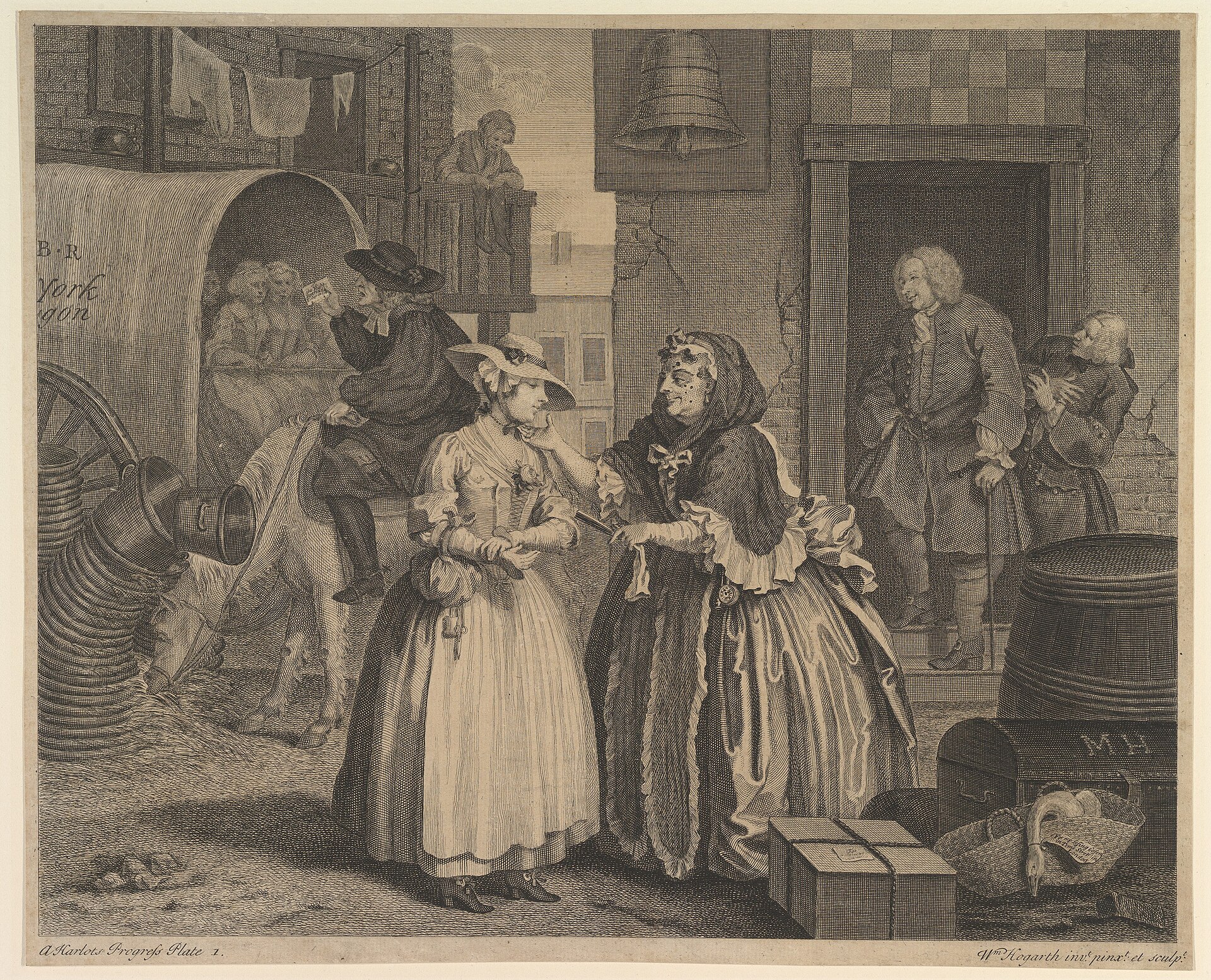
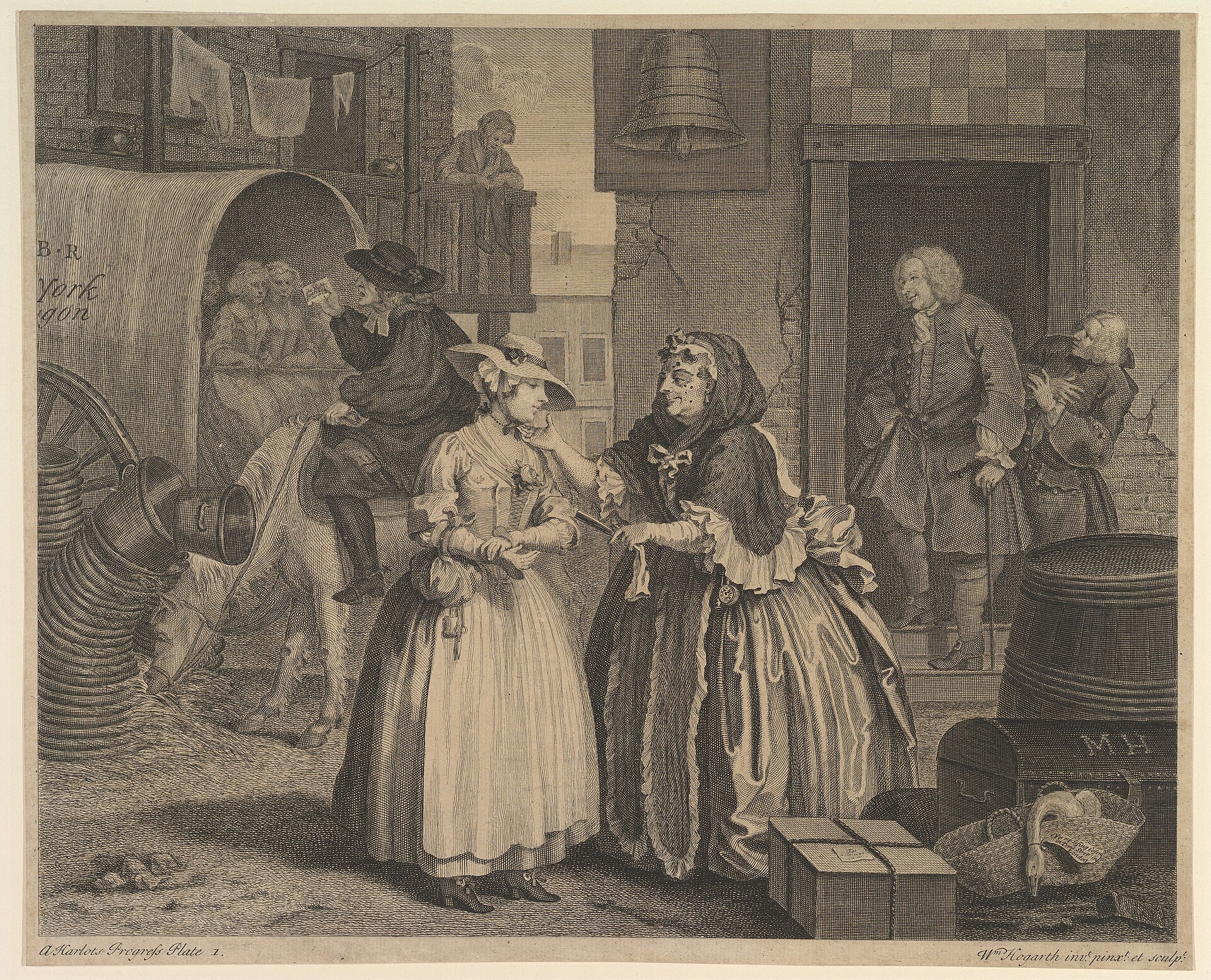
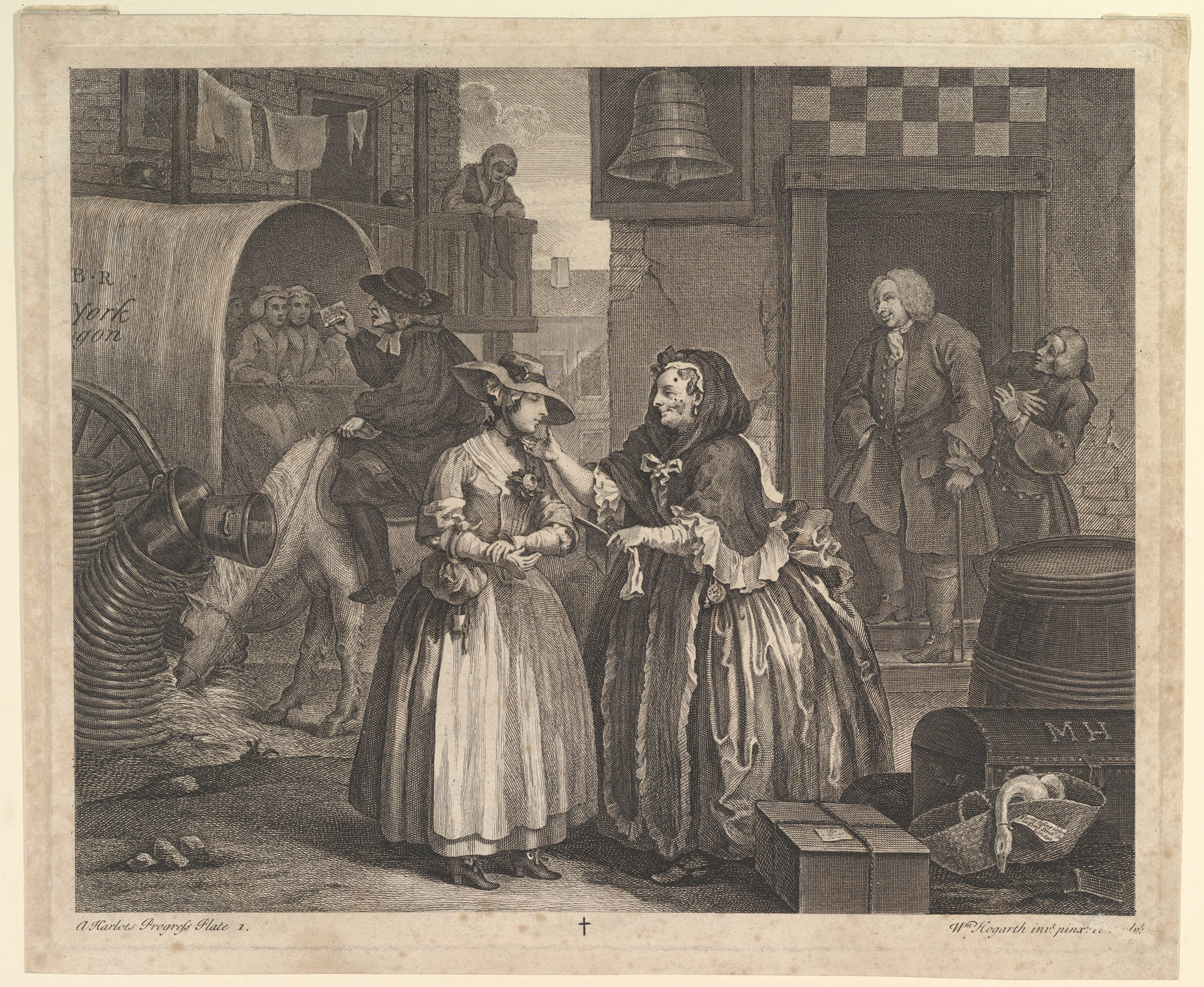
A Harlot's Progress, Plate 1
1732 · Etching and engraving on laid paper
Metropolitan Museum of Art, New York
 English · 1697-1764
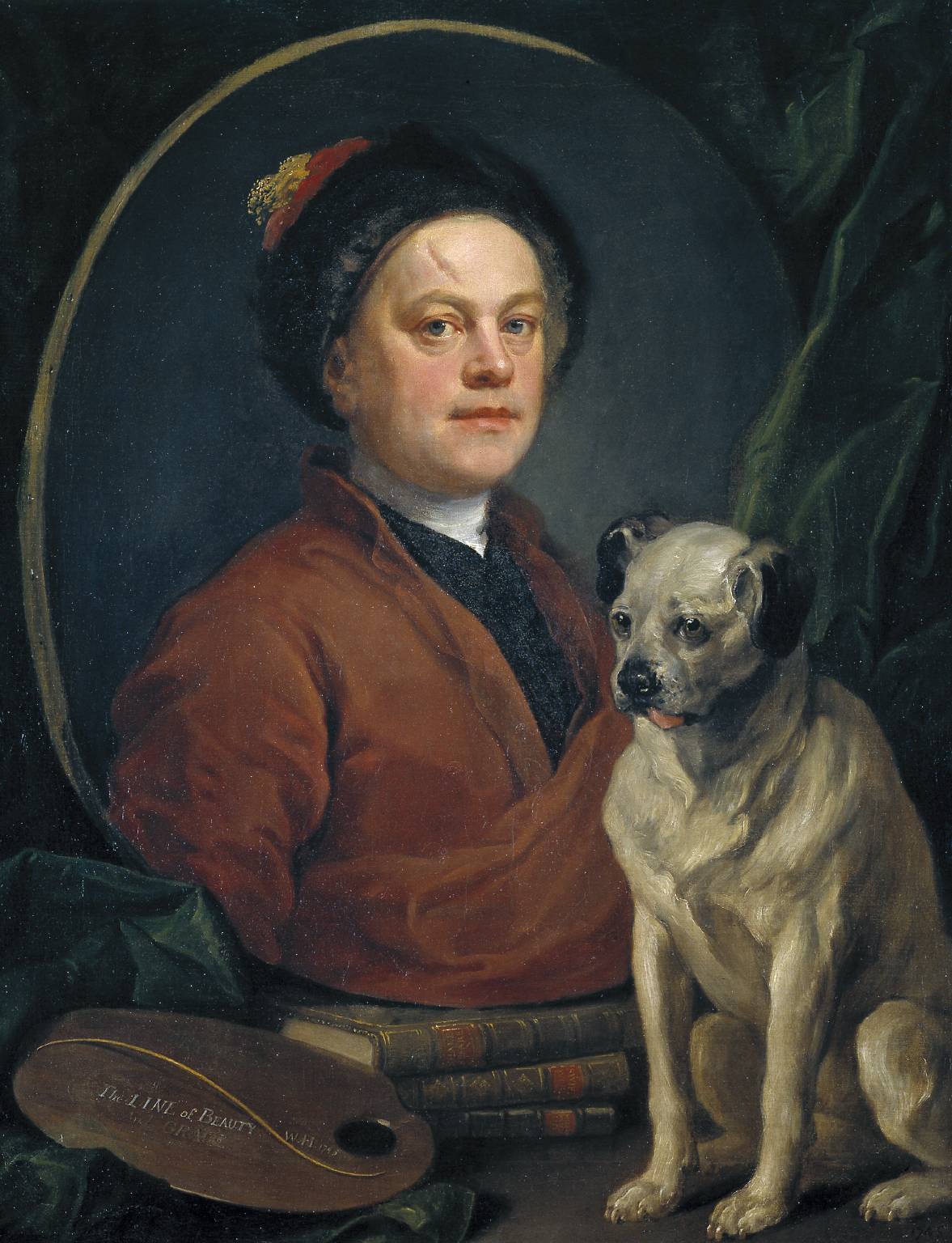
Self-portrait, 1745, with his pug Trump. The palette in the foreground carries an early, revised form of the line of beauty theory he would publish in 1753; X-radiography shows Hogarth reworked his own figure from a formal coat and wig to the informal cap and gown seen here. The self-portrait identification is not disputed in the sources checked for this record.
Tate, London| Worked as | Painter, Printmaker, Satirist, Writer |
|---|---|
| Born | 10 November 1697 · Bartholomew Close, London |
| Died | 26 October 1764 · Leicester Fields, London |
| Nationality | English |
| In this archive | 1 artwork |
| Sources | 19 cited |
| Last verified |
About this page 1 artwork in the archive · Last verified · 19 sources cited
Hogarth is the one maker in this archive whose central problem is not who made the object but who controlled the right to copy it. His narrative print series, A Harlot's Progress, A Rake's Progress, Marriage A-la-Mode, Industry and Idleness, Beer Street and Gin Lane, and An Election, were engraved by Hogarth himself or under his direction and sold in the thousands, and were pirated by rival printsellers almost as fast as they appeared. A single plate exists today as hundreds of separate physical sheets, pulled across decades from the same copper, reworked, restruck, restored, and copied outright by others, scattered now through museum print rooms on two continents. Identifying which impression, which state and which hand a given sheet represents is a genuine, documented problem, and it is the print equivalent of the attribution disputes this archive usually tracks in paintings and sculpture.
The piracy of his first series drove Hogarth to lobby Parliament for the Engravers' Copyright Act of 1735, commonly called Hogarth's Act, the first British statute to protect a visual artist's own design rather than a printed book. He also wrote the only extended aesthetic treatise produced by a major English painter of his century, The Analysis of Beauty (1753), and built an independent income from conversation-piece portraits before turning that independence into a print business that answered to no dealer. His much smaller body of paintings, roughly 240 accepted works against several hundred prints and states, now commands a market almost entirely separate from his graphic work, and the two are frequently confused by readers who know only the famous images.
Born 10 November at Bartholomew Close, London, son of the schoolmaster and failed Latin-speaking coffee-house proprietor Richard Hogarth.5
Apprenticed to the silver engraver Ellis Gamble in Leicester Fields, training in trade cards and heraldic work.5
Marries Jane Thornhill, daughter of the painter Sir James Thornhill, by elopement, 23 March, at Paddington.5
Paints, then engraves and publishes by subscription, A Harlot's Progress; 1,240 sets sold at a guinea each, over 1,200 pounds raised without a printseller's commission.17
No fewer than eight unauthorised imitations of A Harlot's Progress appear soon after publication.2
Petitions the House of Commons (7 February) with six fellow engravers; the Engravers' Copyright Act receives royal assent 15 May and takes effect 25 June, the day Hogarth publishes A Rake's Progress to claim its protection immediately.24
Founds the St Martin's Lane Academy on the equipment of his late father-in-law's defunct drawing school.5
Founding governor of the Foundling Hospital; donates his portrait of Captain Thomas Coram.5
Paints his self-portrait The Painter and His Pug, showing the line of beauty on his palette eight years before publishing the theory.16
Sells the six paintings of Marriage A-la-Mode by written bid, 6 June, to the sole bidder John Lane for 120 guineas; clears barely 100 pounds after framing costs.7
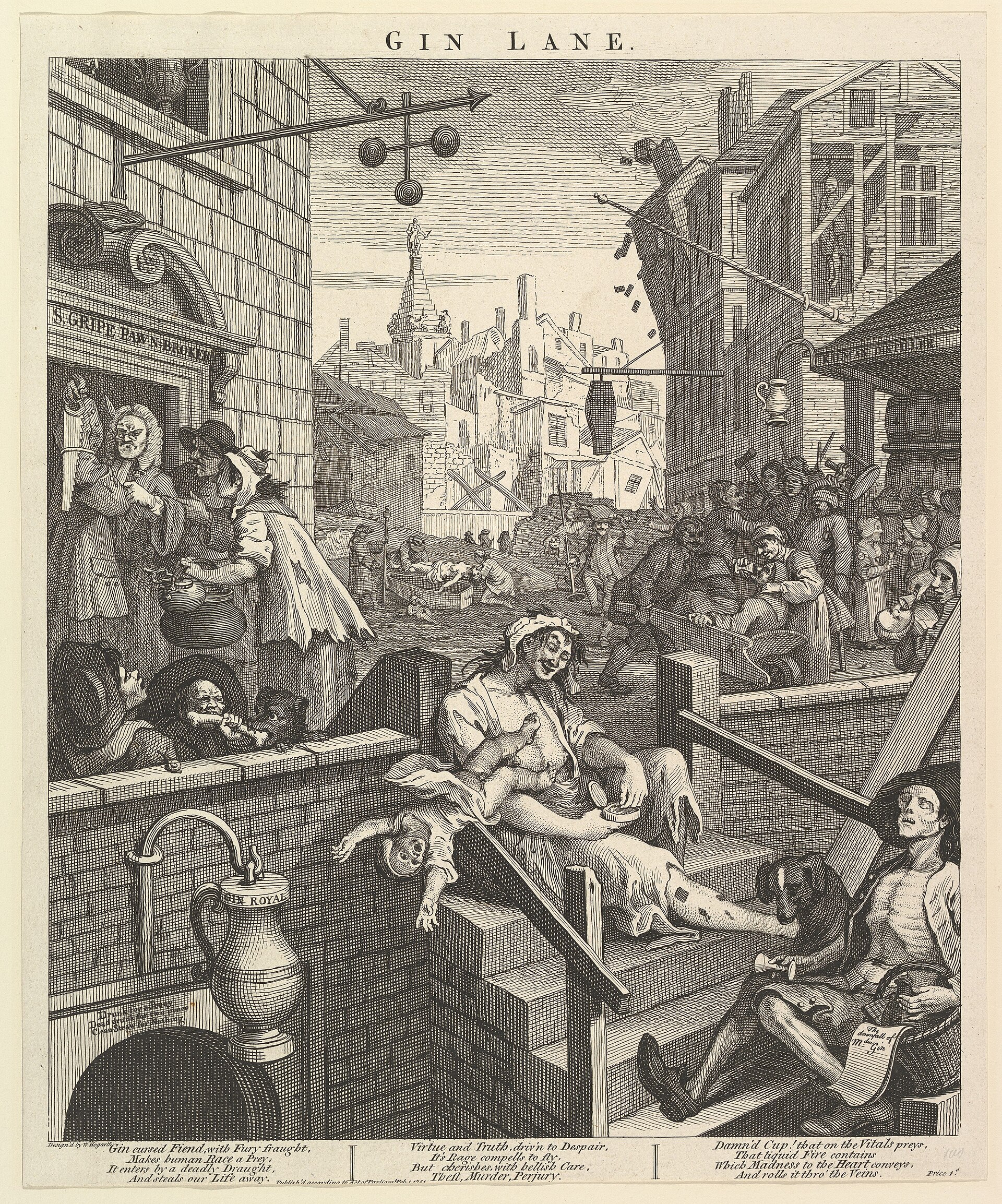
Publishes Beer Street and Gin Lane in support of the Gin Act, and The Four Stages of Cruelty.5
Publishes The Analysis of Beauty, arguing for the serpentine line of beauty as the basis of grace in art and nature.5
Talks between the St Martin's Lane Academy and the Society of Dilettanti over a national academy collapse on the question of who would appoint its president.5
Sir Richard Grosvenor commissions, then rejects, Sigismunda Mourning over the Heart of Guiscardo, priced by Hogarth against a recent 405-pound Old Master sale.5
Dies 26 October at Leicester Fields, two days after falling ill at Chiswick; buried at St Nicholas Church, Chiswick, under an epitaph composed by David Garrick.5
Parliament grants Jane Hogarth, by name, an extended 20-year copyright over William's designs, 29 June.6
Jane Hogarth dies, 13 November, after 25 years running the print business from her husband's plates; the plates pass to her cousin Mary Lewis.6
Marriage A-la-Mode offered at Christie's, 10 March; bought in, unsold, at 910 guineas.7
Marriage A-la-Mode finally sells at Christie's, 10 February, for 1,000 guineas, to John Julius Angerstein.7
A Rake's Progress sells at Christie's, 27 February, lot 86, from the dispersed Fonthill estate of William Thomas Beckford, to John Soane for 570 guineas.18
Hogarth's original copperplates pass from John Boydell's estate to the publishers Baldwin, Cradock and Joy, who issue an edition with worn plates re-engraved.6
An Election bought by John Soane in June at the estate sale of David Garrick's widow for 1,650 guineas (1,732 pounds 10 shillings).19
The National Gallery opens in Angerstein's former townhouse with Marriage A-la-Mode among its founding paintings, bought for the nation with the rest of the Angerstein collection.7
Elizabeth Einberg publishes the first complete catalogue raisonne of Hogarth's paintings for the Paul Mellon Centre, accepting a little over 240 works.15
Taste in High Life sells at Sotheby's, 5 July, for a reported 2.5 million pounds with fees, a record for the artist; the UK export bar review that follows recommends a price of 2,468,000 pounds plus VAT.89
Hogarth's paintings and his prints trade in two markets separated by several orders of magnitude, and the record of both is honestly incomplete: the guinea-era saleroom had no concept of a buyer's premium, so an eighteenth-century hammer figure is the whole price, while the two modern sales checked for this record, a 2020 print set and the 2023 painting record, are both reported only as a single combined total, with no hammer price published separately in the sources this record could reach.
| Date | Sale | Work | Result | Note |
|---|---|---|---|---|
| 6 June 1751 | Private sale by written bid | Marriage A-la-Mode, six paintings | Hammer 120 guineas (GBP 126) With premium None (no buyer's premium existed in this period) GBP | Sole bidder John Lane; after framing costs Hogarth cleared barely GBP 100. |
| 10 March 1792 | Christie's | Marriage A-la-Mode, six paintings | Hammer 910 guineas (GBP 945.50) - bid reached, lot unsold With premium None (no buyer's premium existed in this period) GBP | Bought in; reserve not met. |
| 10 February 1797 | Christie's | Marriage A-la-Mode, six paintings | Hammer 1,000 guineas (GBP 1,050) With premium None (no buyer's premium existed in this period) GBP | Bought by John Julius Angerstein; entered the National Gallery's founding collection in 1824. |
| 27 February 1802 | Christie's | A Rake's Progress, eight paintings | Hammer 570 guineas (GBP 598.50) With premium None (no buyer's premium existed in this period) GBP | Lot 86, from the dispersed Fonthill estate of William Thomas Beckford; bought by John Soane, now at Sir John Soane's Museum. |
| 1823-06 | Christie's | An Election, four paintings | Hammer 1,650 guineas (GBP 1,732.50) With premium None (no buyer's premium existed in this period) GBP | Sale of David Garrick's widow's effects; bought by John Soane, now at Sir John Soane's Museum. |
| 18 June 2020 | Bonhams | Marriage A-la-Mode, complete set of six etchings and engravings, mixed states | Hammer Not separately published in the source checked With premium Included in a total of GBP 1,785 GBP | Hammer price not stated separately in the lot listing this record could access. |
| 5 July 2023 | Sotheby's | Taste in High Life, painting | Hammer Not separately published in the sources checked With premium Included in a reported total of GBP 2.5 million GBP | Record price for the artist. The UK export bar review of 15 November 2023 separately used a recommended price of GBP 2,468,000 plus VAT of GBP 93,600; neither this nor the auction-house total isolates a hammer figure. |
Hammer is the price at which the bidding stopped; with premium adds the fee the house charges the buyer on top. Hammer price and buyer's premium in the glossary.
| Institution | City | Holdings | Note |
|---|---|---|---|
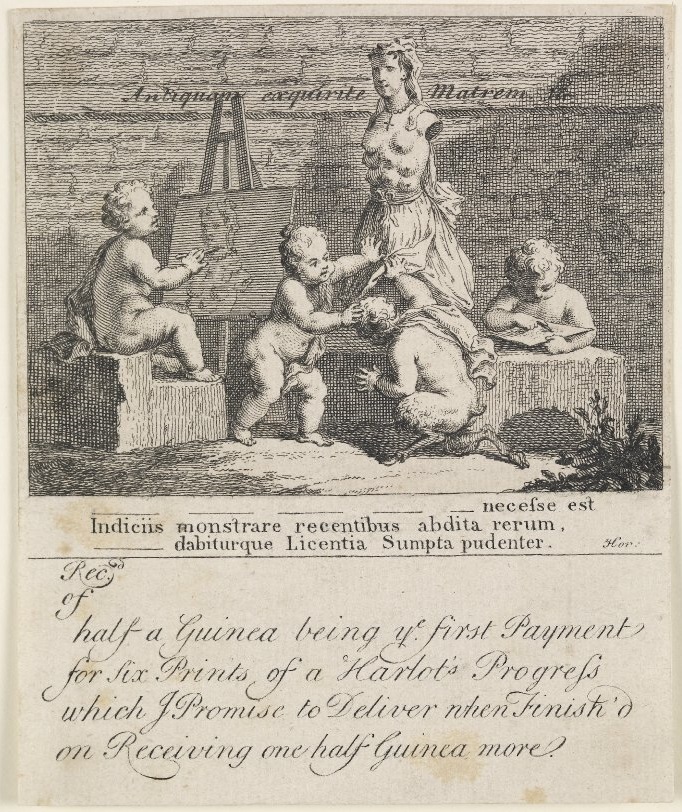
| British Museum | London | The largest single print holding, including multiple states of most major series and the Boys Peeping at Nature subscription tickets discussed on this page. | Prints and Drawings department; not all on permanent display. |
| Sir John Soane's Museum | London | The original paintings of A Rake's Progress (eight canvases) and An Election (four canvases). | Displayed for a short period each day, per Soane's own will. |
| The National Gallery | London | Marriage A-la-Mode, six paintings, NG113-NG118. | Part of the Angerstein collection that founded the Gallery in 1824. |
| Tate Britain | London | The Painter and His Pug (self-portrait, 1745) and Sigismunda Mourning over the Heart of Guiscardo (1759). | |
| The Foundling Museum | London | Portrait of Captain Thomas Coram (1740) and related Foundling Hospital material. | Successor institution to the charity Hogarth helped turn into London's first public art gallery. |
| The Metropolitan Museum of Art | New York | Multiple impressions of A Harlot's Progress, A Rake's Progress and other series, largely from the Harris Brisbane Dick Fund, 1932. | Source of the plates illustrated on this page. |
Every other maker in this archive presents a version of the same question: is this the hand of the master, the workshop, or a later copyist?
Every other maker in this archive presents a version of the same question: is this the hand of the master, the workshop, or a later copyist? Hogarth's corpus poses a different and, for a commercial art-history publication, a more immediately practical one. He designed and largely engraved his own narrative print series, so authorship of the design is rarely in doubt. What is genuinely hard to pin down is which physical sheet a reader is looking at: an impression pulled in 1732 while the copper was fresh, one pulled by Hogarth's widow Jane from the same worn plate in the 1770s, one re-engraved and restored by a later publisher in the 1820s, or an unauthorised copy made by a rival printseller within weeks of first publication, cut to the same size and sold under the same title.
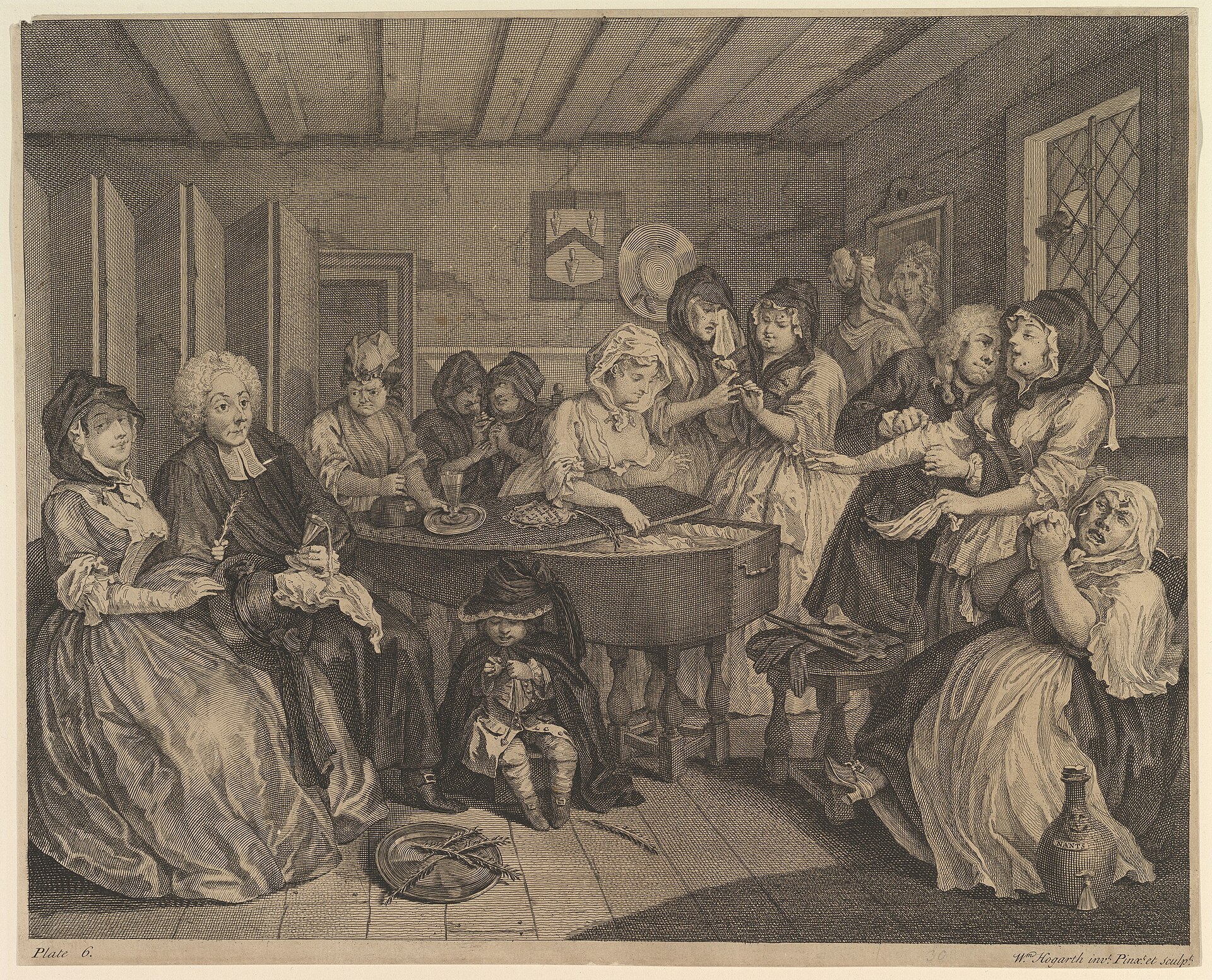
The Metropolitan Museum's two impressions of Plate 1 of A Harlot's Progress illustrate the point directly. Both are the same design, from the same plate, and both are catalogued by the Met as public-domain photography of works long out of copyright, but they are two different physical sheets, acquired sixty-one years apart from two different donors. A record that treated them as interchangeable, or as two copies of one photograph, would be making exactly the kind of category error this archive exists to correct in paintings; the print corpus simply makes the same error easier to commit, because uninformed readers assume a print is a print.
Hogarth published A Harlot's Progress, six scenes following the ruin of a country girl turned London prostitute, by subscription: a guinea a set, half paid on signing up and half on collection.
Hogarth published A Harlot's Progress, six scenes following the ruin of a country girl turned London prostitute, by subscription: a guinea a set, half paid on signing up and half on collection. According to the engraver George Vertue, whose notebooks are the main contemporary witness to the series' reception, 1,240 sets were printed and fully subscribed, and the story of the harlot had, in Vertue's words as later quoted by the National Gallery's cataloguer, captivated people of all ranks. By working entirely through his own shop rather than through the established printsellers, Hogarth had, by the time the subscription closed in April 1732, taken in over 1,200 pounds without paying a print-trade middleman a commission on any of it.
The printsellers he had cut out responded within weeks. Contemporary witness put the number of unauthorised imitations of the Harlot series at no fewer than eight, made by copying Hogarth's designs outright and selling them cheaper. This is the specific grievance, documented in Hogarth's own generation, that turned an aggrieved engraver into a legislative campaigner.
On 7 February 1735 a petition titled 'The case of designers, engravers, etchers, &c' was laid before the House of Commons.
On 7 February 1735 a petition titled 'The case of designers, engravers, etchers, &c' was laid before the House of Commons. It was signed by a small group of London printmakers, George Vertue, George Lambert, Isaac Ware, John Pine, Gerard Vandergucht and John Goupy, and led by Hogarth. The petitioners described themselves as oppressed by the tyranny of the print-selling trade, which they said took an unreasonable share of the profit and then, whenever a print succeeded, copied it outright and sold the copy in the original's place. Their central legal argument anticipated the modern distinction between an idea and its expression: a copyist, they wrote, does not steal the paper a print is made on, but steals from the artist everything that made the paper valuable, and has no more right to the resulting profit than a man who counterfeits a promissory note has to the money it draws.
The committee reported on 14 February 1735 that the petitioners had proved their case, and a bill followed. The resulting Act, 8 Geo. II c. 13, received royal assent on 15 May 1735 and took effect on 25 June 1735. It gave any person who invented and designed an engraving, etching or mezzotint the sole right to print and reprint it for fourteen years from first publication, extended that protection to a design copied only in part or with minor variations added or removed (a clause aimed directly at the kind of near-identical piracy the Harlot series had suffered), and required a proprietor's name to be engraved on every plate. A late proviso, inserted for the engraver John Pine, extended the same protection to a set of prints Pine proposed to copy faithfully from tapestries in the House of Lords and the royal Wardrobe depicting the Spanish invasion of 1588, rather than from the engraver's own invention, the one significant carve-out in an Act otherwise built around originality; a later Act in 1766 broadened this exception to cover prints copied from paintings, drawings and sculpture generally, but the 1735 text itself names only tapestry.
Hogarth timed his answer to the piracy precisely. He held back publication of his second series, A Rake's Progress, eight scenes tracing a young heir's decline into debt, prison and Bedlam, until 25 June 1735, the day the Act came into force, so that it became the first major English print series to carry the new legal protection from the moment it appeared. According to Hogarth's own biographer Ronald Paulson, the effect was close to total: aside from a few piracies printed in Dublin, outside the Act's jurisdiction, unauthorised copying of Hogarth's own work effectively disappeared until the 1750s, when the fourteen-year terms on his earliest series began to expire.
Hogarth's paintings and his prints now sell in two markets that share almost nothing except the name on the label, and the site's own house habit of separating hammer from premium runs straight into...
Hogarth's paintings and his prints now sell in two markets that share almost nothing except the name on the label, and the site's own house habit of separating hammer from premium runs straight into an honesty problem here: the record for the earlier centuries of this market is kept in guineas, in a saleroom system that had no concept of a buyer's premium at all, while the record for the last few decades is kept in pounds sterling with a premium added on top and, more often than a cataloguer would like, only the combined total is ever published.
The clearest paintings case is the set of six canvases Marriage A-la-Mode. Hogarth sold them himself, by written bid, on 6 June 1751; only one bidder showed up in person, an otherwise unknown admirer named John Lane, who raised the sole advance bid to 120 guineas (126 pounds). After framing costs of four guineas a canvas, Hogarth cleared barely 100 pounds for the set, a fact recorded because he was visibly furious about it on the day. The paintings passed on Lane's death in 1791 to Colonel John Fenton Cawthorne, who tried to sell them at Christie's on 10 March 1792; they were bought in, unsold, at 910 guineas (945 pounds 10 shillings), and bought in again at a second attempt on 21 May 1796. They finally sold at Christie's on 10 February 1797, for 1,000 guineas (1,050 pounds), to the collector John Julius Angerstein. When Angerstein's collection was bought for the nation in 1824 to found the National Gallery, Marriage A-la-Mode went with it, and the series has been on public view in London ever since.
The print market for the same image tells a completely different story of scale. The subscription price for the engraved set, one guinea, was identical to the Harlot series thirteen years earlier; a complete set of six impressions of the Marriage A-la-Mode plates, in mixed states, sold at Bonhams on 18 June 2020 for 1,785 pounds including premium, with no separate hammer figure published in the listing this record could locate. A single painting from Hogarth's smaller and rarer body of independent oils, Taste in High Life, sold at Sotheby's on 5 July 2023 for a reported 2.5 million pounds with fees, a record for the artist; the Reviewing Committee on the Export of Works of Art subsequently used a recommended price of 2,468,000 pounds plus VAT of 93,600 pounds in deferring an export licence, and neither figure in the sources checked for this record states the hammer price on its own. That gap is recorded here rather than guessed at.
Two further painting sales anchor the picture. Hogarth's own eight canvases of A Rake's Progress, dispersed from the collection of William Thomas Beckford of Fonthill, sold at Christie's on 27 February 1802 as lot 86 and were bought by the architect John Soane for 570 guineas; the four canvases of An Election were bought by Soane in June 1823, at the sale of the actor David Garrick's widow's effects, for 1,650 guineas (1,732 pounds 10 shillings). Both series remain at Sir John Soane's Museum in London, on public display for a short period each day, exactly as Soane's will requires.
In 1753 Hogarth published The Analysis of Beauty, Written with a View of Fixing the Fluctuating Ideas of Taste, printed at his own expense and sold from his house in Leicester Fields.
In 1753 Hogarth published The Analysis of Beauty, Written with a View of Fixing the Fluctuating Ideas of Taste, printed at his own expense and sold from his house in Leicester Fields. It is the only sustained aesthetic treatise produced by a major English painter of the period, and it argues that a serpentine S-curve, which Hogarth called the line of beauty, underlies grace and liveliness in natural forms and in good design alike, in preference to the straight line and the rigid symmetry he associated with academic convention. The book sets out six subsidiary principles, fitness, variety, regularity, simplicity, intricacy and quantity, and was translated within a year of publication; the German critic Gotthold Ephraim Lessing admired it enough to introduce its second edition, and its argument reached Schiller and Goethe through that route.
Hogarth had been thinking about the idea for years before he wrote it down. His 1745 self-portrait, The Painter and His Pug, shows his own oval canvas propped on a stack of English books, with a painter's palette in the foreground on which is inscribed a curving line labelled the line of beauty; the words originally continued 'and Grace' before Hogarth painted them out, evidence, on the picture's own surface, that his thinking on the subject was still being revised eight years before the book that made it famous. The same painting was reworked more substantially before it reached its final form: Hogarth is recorded as having first shown himself in a formal coat and wig, before changing to the informal cap and loose gown in which the finished portrait presents him.
Hogarth had a documented, argumentative relationship with the project that eventually became the Royal Academy of Arts, an institution founded five years after his death and one he never belonged to...
Hogarth had a documented, argumentative relationship with the project that eventually became the Royal Academy of Arts, an institution founded five years after his death and one he never belonged to because it did not yet exist in the form it took. In 1735 he set up the St Martin's Lane Academy, a life-drawing school run on the equipment of his late father-in-law James Thornhill's own failed academy, and kept it deliberately informal and self-governing, without a single president or a hierarchy of officers. He insisted this democratic structure was the correct model for training artists in England; contemporaries, and later historians, note that in practice he tolerated remarkably little dissent from his own views within it. When the Society of Dilettanti opened talks with the St Martin's Lane group in 1755 about founding a national academy, the talks broke down because the Dilettanti wanted the right to choose the new body's president, a condition Hogarth's circle would not accept.
Separately, and on his own initiative, Hogarth turned the Foundling Hospital, the charity for abandoned children founded by the retired sea captain Thomas Coram, into what historians of the institution now call London's first public gallery of contemporary art. As a founding governor from 1739, Hogarth donated his own portrait of Coram in 1740 and further paintings through the 1740s, and he actively recruited other leading painters, including Thomas Gainsborough and Joshua Reynolds, to donate work for the Hospital's walls, where the public could see it for the price of a subscription to the charity. The men Hogarth clashed with over the Royal Academy project, Reynolds prominent among them, are the same men who went on to found the institution that superseded the Foundling exhibitions as the country's showcase for living artists; Reynolds later used his own inaugural lectures as its first president to question, by name, whether Hogarth's work belonged to the grand style of history painting at all.
Hogarth's will left his copperplates to his widow, Jane Hogarth, conditional on an annuity paid out of their proceeds to his surviving sister Anne; Jane could not sell the plates outright without...
Hogarth's will left his copperplates to his widow, Jane Hogarth, conditional on an annuity paid out of their proceeds to his surviving sister Anne; Jane could not sell the plates outright without Anne's consent. Jane resumed publishing from them within a year of William's death, and on 29 June 1767 Parliament granted her, by name, an extension of the copyright on her husband's designs from the general fourteen-year term to twenty years, a private legislative favour that kept her print business protected against renewed piracy for two decades after his death. She ran that business for the rest of her life, twenty-five years as a widow, and died on 13 November 1789.
The plates then passed to her cousin Mary Lewis, who sold the rights to the publisher John Boydell for a lifetime annuity rather than a lump sum. From Boydell the plates went in 1818 to the firm of Baldwin, Cradock and Joy, who issued an edition with the more heavily worn plates re-engraved and restored; by 1835 they belonged to the publisher Henry Bohn, and in 1921 the remaining coppers were sold through the London dealer Bernard Quaritch. Every one of those transfers produced a new wave of impressions from the same designs, pulled from plates in progressively more restored and reworked condition, which is the specific mechanism by which a single Hogarth image now exists as hundreds of non-identical physical objects.
The paintings market has its own documented history of copying, distinct from the print piracy of the 1730s.
The paintings market has its own documented history of copying, distinct from the print piracy of the 1730s. The National Gallery's own catalogue of Marriage A-la-Mode records at least three separate painted or drawn copies of the series made after Hogarth's death: a set of six oil-on-canvas copies belonging by 1842 to a Dorset collector, H.R. Willett, exhibited at Leeds in 1868 as though they were the originals, bought in when offered at Christie's in 1869, sold on to a buyer named Harvey at a second Christie's sale in 1902, and untraced since; a second, unrelated set of six oil-on-canvas copies recorded in a North Carolina private collection in 1992, which does not match the description of the Willett set and appears to be nineteenth-century amateur work; and a set of pencil copies of all six scenes whose present location is unknown. None of these was ever presented as Hogarth's own hand by a scholar who examined the originals, but a set that was exhibited publicly as authentic for at least a generation, and then went untraced, is exactly the kind of object this archive would want to catch if it ever resurfaced on the market.
On the print side, this record's own image research turned up a smaller, more contained example of exactly the same problem. One of Hogarth's own designs, the etching known as Boys Peeping at Nature, was reused three times across twenty years as a subscription ticket, first for A Harlot's Progress in 1731, then reworked in 1737 for The Four Times of the Day and Strolling Actresses, and reworked again in 1751, with the offending satyr removed, for Moses Brought to Pharaoh's Daughter and St Paul before Felix. Ronald Paulson's standard catalogue numbers these three forms as states I, III and IV of the same plate. The British Museum's own record for the specific impression behind the Commons file used on this page identifies it, unambiguously, as state I, the original 1731 form; the Commons file itself is titled '2nd state'. The two do not agree, and this record follows the museum's own cataloguing rather than the uploaded filename, precisely the kind of small, checkable discrepancy that a print corpus this large will keep generating.
Hogarth trained from about 1714 as an engraver of silver plate and trade cards under Ellis Gamble, a decade of work he later described as leaving him unable to afford to do everything his growing...
Hogarth trained from about 1714 as an engraver of silver plate and trade cards under Ellis Gamble, a decade of work he later described as leaving him unable to afford to do everything his growing family required. In his own account, written up in autobiographical notes around 1763, he turned from portrait and conversation-piece painting to what he called 'painting and Engraving modern moral subject[s], a Field unbroke up in any Country or any age', because portraiture alone did not pay enough. Before that turn, it was conversation-piece commissions, small group portraits of patrons at leisure, and a scene from John Gay's hit stage production The Beggar's Opera, painted repeatedly on commission after its 1728 premiere, that gave Hogarth his first paying audience among the wealthy and his first working capital.
The clearest single link between that patronage and Hogarth's independent print career is Taste in High Life, a satire of two overdressed connoisseurs fawning over a teacup, commissioned in 1742 by the collector Mary Edwards for 60 pounds. Edwards was herself a patron unusually willing to fund work that mocked the same fashionable society she moved in, and the painting's satire of empty connoisseurship anticipates, on a single canvas, the target Hogarth returned to at length two years later in Marriage A-la-Mode.
Hogarth's membership of the Freemasons is documented in the fraternity's own surviving lodge registers, not inferred from his imagery.
Hogarth's membership of the Freemasons is documented in the fraternity's own surviving lodge registers, not inferred from his imagery. He appears on the roll of a lodge meeting at the Hand and Apple Tree tavern in Little Queen Street by 1725, and on the roll of a second lodge at the Bear and Harrow in Butcher Row by 1730; in 1735 he served as a Grand Steward at the Grand Lodge of England's annual festival, a position of some standing within the order, and designed the ceremonial jewel worn by his fellow stewards that year, a piece still associated with his name in Masonic collections.
That documented membership sits inside his printmaking rather than announced by it. Night, the fourth plate of The Four Times of the Day (1738), shows a drunken Freemason, identifiable by his regalia and by the tell-tale detail of his sash worn on the wrong side, being helped home by a link-boy while a chamber pot is emptied on his head from a window above. Hogarth was, by the date of the print, a senior officer of the same fraternity he was satirising, which scholars of the image read as a documented case of a Mason mocking his own order from the inside rather than an outsider's hostile caricature; the print carries no explanatory inscription confirming Hogarth's intent beyond the costume details themselves; this record states the argument and its evidentiary basis rather than the artist's motive as settled fact.
In 1758 the collector Sir Richard Grosvenor commissioned Hogarth to paint a picture of his own choosing.
In 1758 the collector Sir Richard Grosvenor commissioned Hogarth to paint a picture of his own choosing. Hogarth chose Sigismunda Mourning over the Heart of Guiscardo, a subject from Boccaccio, and priced it deliberately against a specific recent sale: in the same year, Sir Thomas Sebright had paid 405 pounds 5 shillings at auction for a painting of the same subject then believed to be by Correggio (it is now attributed to Francesco Furini). Hogarth, who had spent at least two hundred days on his own version and doubted the Correggio attribution outright, refused to sell his picture for less than 500 pounds. Grosvenor rejected both the picture and the price; his stated reason, that the image was too striking to live with day to day, did nothing to soften Hogarth's fury. Hogarth kept the painting, showed it to poor reviews, withdrew it from exhibition, and left instructions that it not be sold cheaply after his death. The episode fed directly into the reputation fight that outlived him: Joshua Reynolds, addressing the Royal Academy he helped found five years after Hogarth's death, used his fourteenth Discourse to question, by name, whether Hogarth had ever possessed the qualifications of a painter in the grand, academic style Sigismunda was reaching for. Horace Walpole, less formally, wrote that Hogarth's own comic instincts kept breaking into his most serious subjects whether he wanted them to or not.
Painter; Printmaker; Satirist; Writer. 1697-1764.
Born 10 November 1697, Bartholomew Close, London; died 26 October 1764, Leicester Fields, London.
The Willett set of Marriage A-la-Mode. A set of six oil-on-canvas copies of the Marriage A-la-Mode paintings, close in size to the originals, belonging by 1842 to the Dorset collector H.R. Willett and exhibited at Leeds City Art Gallery in 1868 without correction.
British Museum (London); Sir John Soane's Museum (London); The National Gallery (London); Tate Britain (London); The Foundling Museum (London); The Metropolitan Museum of Art (New York).
Hogarth's paintings and his prints trade in two markets separated by several orders of magnitude, and the record of both is honestly incomplete: the guinea-era saleroom had no concept of a buyer's premium, so an eighteenth-century hammer figure is the whole price, while the two modern sales checked for this record, a 2020 print set and the 2023 painting record, are both reported only as a single combined total, with no hammer price published separately in the sources this record could reach.
What specific paintings did Elizabeth Einberg's 2016 catalogue add to or remove from the lists compiled by earlier compilers (Nichols, Dobson)? No itemised comparison was located for this record.
Last verified
One artwork and its story every Tuesday, with the picture: who owned it, what it made, and what closes soon in the exhibition calendar. No promotion, and nothing we cannot cite.
We send one email to confirm the address and keep nothing else. Every letter carries a one-click unsubscribe. How we handle your data.
.jpg)