The Clark Sickle-Leaf Carpet
Unknown, southern Persia · Seventeenth century
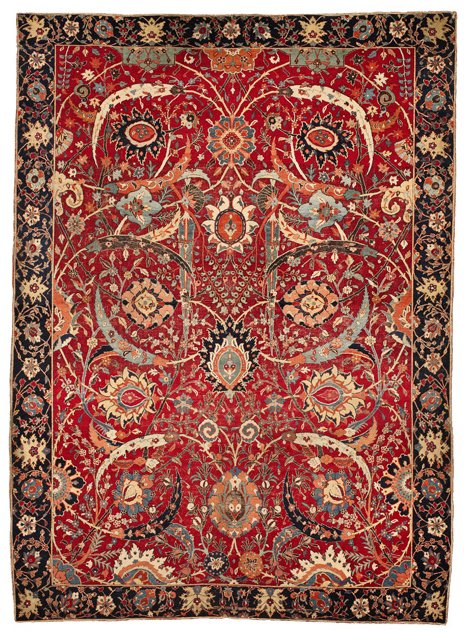
The record subject, from the Sotheby's sale photography. The carpet is shot flat and face-on, which is what makes a free-licence reproduction possible at all: a carpet photographed hanging and lit would be a photograph of a three-dimensional object and would carry fresh copyright. Licence checked at fetch time: LicenseShortName Public domain, Copyrighted False, on a PD-Art flat-reproduction claim over an auction house photograph. See notes_for_editor.
| Artist | Unknown, southern Persia |
|---|---|
| Date | Seventeenth century |
| Medium | Knotted pile, wool, silk and cotton; vase technique |
| Dimensions | Approximately 8 ft 9 in by 6 ft 5 in (2.67 x 1.96 m) |
| Where it is now | Museum of Islamic Art (MIA), Doha, Qatar Museums, accession MIA.2013.194 - publicly exhibited there since at least 2023last confirmed 19 August 2026 |
| Attribution | AttributedCatalogued by Sotheby's in 2013 as a sickle-leaf, vine scroll and palmette vase-technique carpet, probably Kirman, southeast Persia. Full note |
| Object type | Textile |
| Period | Safavid Iran, seventeenth century |
| Cases | Has a provenance gap |
| Inscriptions | None recorded |
| Owners on record | 5 links3 documented, 2 unknown |
| Sources | 9 cited |
About this record Last verified 19 August 2026 · 9 sources cited · Change log
On this page 12 sections
ContentsClose
A small seventeenth-century Persian carpet, under three metres long, that a Washington museum sold in 2013 for the highest price ever paid for a carpet at auction. It came from the collection of William Andrews Clark, the Montana copper senator, and the museum that sold it was dismantled the following year.
The figure reported everywhere, 33,765,000 dollars, is the price with buyer's premium. It is not the hammer, and it is not what the museum received either. Three different numbers describe one afternoon and this record keeps them apart.
Provenance
Each link is graded. Documented: a cited source supports it. Disputed: the identification is argued but not established. Unknown: no owner for that span, and the gap is not smoothed into a narrative. The grades in the glossary.
- early seventeenth century -Unknown, Kirman, southeast Persiaunknown
No workshop, patron or place of weaving is documented. Probably Kirman is an attribution on structure and design. If Pope's throne-dais proposal is right the carpet was made for a specific ceremonial use, but that is a proposal and no commission is recorded.1
- - before 1925Bacri Freres, Parisdocumented
The only owner Sotheby's names before Clark, and the whole of the documented pre-American chain. How and when the firm acquired the carpet, and what it sold it for, are not stated in the catalogue.1
- before 1925 - 1926William Andrews Clark, Butte, Montana and New Yorkunknown
The carpet carries Clark's name and came to the Corcoran with his collection. Clark died in 1925. The date, price and circumstances of his purchase from Bacri Freres are not established in this pass.12
- 1926 - 2013Corcoran Gallery of Art, Washington DCdocumented
The bequest reached the Corcoran in 1926, the year after Clark's death, and the museum built a wing for it. The carpet was exhibited nine times between 1948 and 2008, in Washington, New York, Cambridge, Sheffield, Birmingham and London. It was consigned to Sotheby's in 2013 with 24 other carpets from the same collection.1234
- 2013 - presentMuseum of Islamic Art (MIA), Doha, Qatar Museums, accession MIA.2013.194documented
Publicly identified via the museum's own catalogue entry and a 2026 Qatar Museums article; on view in the 2023-2024 Fashioning an Empire exhibition. The accession number's year prefix and the object's identity make it near-certain MIA was the anonymous telephone bidder at the 2013 Sotheby's sale, but no source states the acquisition directly - only the museum's current custody of the object is itself documented, not the specific link to the 2013 sale.12389
Prices realised
Two rows follow. The first is this carpet. The second is the group it was sold in, given because a single lot result is not the whole transaction: the Corcoran consigned 25 carpets, and what the museum actually received is a third figure again.
| Date | Sale | Estimate | Result | Note |
|---|---|---|---|---|
| 5 June 2013 | Sotheby's Rugs and Carpets including Classical Carpets from the William A. Clark Collection, Corcoran Gallery of Art, New York, sale N09012, lot 12 | USD 5,000,000 - 7,000,000 | Hammer USD 30,000,000 (DERIVED, not reported - see note) With premium USD 33,765,000 USD | SEPARATION OF HAMMER AND PREMIUM. The figure reported in every account, 33,765,000 dollars, is the total WITH buyer's premium; the Associated Press states explicitly that the price includes the auction house premium. No source consulted publishes a hammer figure. The hammer given here is DERIVED, not reported: applying the Sotheby's New York buyer's premium schedule of the period (25 per cent to 100,000 dollars, 20 per cent from 100,000 to 2,000,000, 12 per cent above 2,000,000) to a hammer of 30,000,000 produces 33,765,000 exactly. That the arithmetic lands on a round 30 million is strong corroboration both of the schedule and of the reported total being premium-inclusive, but the premium schedule has not been confirmed against a primary Sotheby's document and the figure must be treated as a reconstruction. Sold to an anonymous telephone bidder after a multi-bidder contest reported at about ten minutes. A world auction record for any carpet and, as reported, for any Islamic work of art, at more than three times the previous carpet record of 9.6 million dollars set at Christie's London in April 2010. |
| 5 June 2013 | Sotheby's The whole Corcoran consignment, 25 carpets | With premium USD 43,800,000 USD | The group total, premium-inclusive. The Corcoran netted 38.4 million dollars after buyer's premiums, which is the number that mattered to the museum and is not the number anyone quotes. The gap between 43.8 million gross and 38.4 million net to the consignor is the clearest illustration on this site of why hammer and premium have to be kept apart: three different figures describe one afternoon, and the largest of them never reached the seller. Proceeds were restricted to future acquisitions and could not be applied to the Corcoran's operating deficit. |
Hammer is the price at which the bidding stopped; with premium adds the fee the house charges the buyer on top. Hammer price and buyer's premium in the glossary.
Technical evidence
| Attribution note | Catalogued by Sotheby's in 2013 as a sickle-leaf, vine scroll and palmette vase-technique carpet, probably Kirman, southeast Persia. No workshop, weaver or patron is documented and none is likely to be. The attribution rests on weave structure and design, which is how the entire vase-technique group is attributed. The date has moved: earlier scholarship put the carpet in the late sixteenth century, and current opinion places it in the early seventeenth, after the Gulbenkian sickle-leaf carpet. |
|---|---|
| Structure | Vase technique. Three shoots of weft between each row of knots: the first and third wool at high tension, the second at low tension and normally silk or cotton. The warps are markedly displaced. The knot is a Persian knot open to the left. The class is defined by this structure, not by its ornament.17 |
| Materials | Wool, silk and cotton, per the Sotheby's catalogue entry.1 |
| Dimensions | Approximately 8 ft 9 in by 6 ft 5 in (2.67 x 1.96 m).1 |
| Attribution and date | Probably Kirman, southeast Persia. Sotheby's word is probably and it is retained here. Earlier scholarship dated the carpet to the late sixteenth century; current opinion places it in the early seventeenth, following the Gulbenkian sickle-leaf carpet. Charles Grant Ellis had argued it was the earliest of the sickle-leaf group.1 |
| Ground colour | Rose-red. Of the surviving sickle-leaf vase-technique carpets known, this appears to be the only one with a red ground; the others are blue.1 |
| Design | Sickle-shaped split, serrated lancet leaves encircling horizontal and angled palmettes, over a network of swirling overlapping vines and flowering branches. Leaves internally decorated with flowering vines and frequently split into two colours, with smaller contrasting leaves sprouting and curling the opposite way. Two cypress trees run vertically through the pattern; a pair of blue and white cloudbands marks the central vertical axis.1 |
| Composition | Asymmetric: three split medallions at one end, two large half-palmettes with quarter rosettes at the other, bold palmettes on the central vertical axis and half-motifs cut by the field edges. The carpet reads as one half of a mirrored design.1 |
| Source of the motif | The sickle leaf derives from the Ottoman saz leaf, which appears in imperial Ottoman design collections around 1550 and was adapted by Safavid weavers.1 |
| Condition, pile | Generally good and dense, from near-original one tenth of an inch closely shorn down to low knots and exposed foundation, particularly across the centre. Dark browns oxidised to knots and foundation in places, as is some of the deep red ground. Scattered repiling to the dark browns and the rose-red field. Scattered moth damage, mostly at the ends.1 |
| Condition, repairs | Reweaves of about 1.5 x 1 in at the upper centre edge, 1 x 1 in at the upper right corner and 1 x 1 in on the left edge; a repiled hole at the upper left corner; a repaired hole about 0.25 x 0.25 in in the field.1 |
| Condition, edges and ends | Sides retain remnants of the rose-red outer guard stripe, the warp cords partly secured by later overcasting. Ends show losses into the light blue guard stripes, with remnants of rose and dark brown outer guard stripes.1 |
| Overall condition verdict | Sotheby's summary: sound fabric, flexible handle, dense robust weave, good saturated colour.1 |
| Export status | The catalogue warned that a licence may be required to export textiles, rugs and carpets of Iranian origin from the United States, and directed buyers to the Office of Foreign Assets Control. This is sanctions law, not cultural property law.1 |
Images
The record in full
Chapter 1What it is
A knotted pile carpet in wool, silk and cotton, catalogued by Sotheby's as a sickle-leaf, vine scroll and palmette vase-technique carpet, probably Kirman, southeast Persia, measuring approximately 8...
A knotted pile carpet in wool, silk and cotton, catalogued by Sotheby's as a sickle-leaf, vine scroll and palmette vase-technique carpet, probably Kirman, southeast Persia, measuring approximately 8 feet 9 inches by 6 feet 5 inches, which is 2.67 by 1.96 metres.
That size matters to the story. This is not a palace carpet. It is a small rug, smaller than a great many domestic rugs sold every week, and it made more money than any carpet has ever made at auction.
Its design is the one it is named for: sickle-shaped leaves, vine scrolls and palmettes, with two cypress trees running vertically through the pattern and a pair of blue and white cloudbands marking the central axis. Structurally it belongs to the group known as vase-technique carpets, and that group is the reason the object is important rather than merely expensive.
Chapter 2What a vase-technique carpet actually is
The name misleads. A vase-technique carpet is not a carpet with a vase on it.
The name misleads. A vase-technique carpet is not a carpet with a vase on it. It is a carpet built a particular way, and the class was defined by the structure rather than by the ornament.
The defining feature is the weft. Between each row of knots run three shoots rather than the usual two. The first and third are wool and are woven at high tension; the second is at low tension and is normally silk or cotton. The result is that the warps are markedly displaced, one set pushed well behind the other, and the knot is a Persian knot open to the left.
This is why the group holds together as a group when the designs do not. Carpets that look nothing alike are the same class of object because a loom in the same tradition made them the same way, and it is why a small rug can sit in the same category as very large ones. It is also the reason the attribution to Kirman is as firm as it is: the structure travels with a place and a workshop tradition, and the pattern does not.
The definition is owed to May Beattie, who did the structural analysis that turned a loose stylistic grouping into a technical one. Naming a class of carpets after a motif and then defining it by its weft is an accident of scholarly history that the field has never bothered to correct.
Chapter 3The rarest pattern in the group, and the only red one
Within the vase-technique carpets, the sickle-leaf design is the rarest pattern of all.
Within the vase-technique carpets, the sickle-leaf design is the rarest pattern of all. Sotheby's states the point that gives this particular carpet its standing: of the surviving sickle-leaf pieces known, the Clark carpet appears to be the only one with a red ground.
The rest are blue. The Gulbenkian carpet in Lisbon, the closest complete comparison, has a deep blue ground and a mirrored design in more typical Safavid proportions. The Clark carpet's rose-red field is, on the present state of knowledge, unique in its class.
Uniqueness of that kind is exactly what a record price is made of. A collector buying the finest example of a rare pattern is buying one thing; a collector buying the only one in a colour is buying another, and the second is not substitutable at any price.
Chapter 4Where the leaves came from
The sickle leaf is not a Persian invention.
The sickle leaf is not a Persian invention. It descends from the Ottoman saz leaf, the curling, feathered, serrated lancet leaf that appears in imperial Ottoman design collections around 1550, and Safavid weavers took it and reworked it.
On this carpet the leaves curl, split and serrate around horizontal and angled palmettes, and are internally decorated with flowering vines, frequently split into two colours. Smaller leaves in contrasting colours sprout from the larger ones and curl the opposite way. The pattern is asymmetric across the field, with three split medallions at one end and two large half-palmettes with quarter rosettes at the other.
That asymmetry is evidence about what the object originally was, and it is dealt with below.
Chapter 5It is probably half of something
The pattern does not resolve on its own.
The pattern does not resolve on its own. Bold palmettes run along the central vertical axis and half-motifs are cut by the field edges, and the design reads as one half of a mirrored composition that would, doubled, produce the proportions a Safavid carpet of this class normally has.
Arthur Upham Pope proposed a specific explanation: that it was woven for a throne dais, a takht, so that the Shah seated on it would appear to sit within the great carpet. The idea stuck hard enough that when the carpet was exhibited in 1976 it was labelled The Corcoran Throne Rug.
It is a proposal, not a finding, and this record keeps it in that register. What is not in doubt is that the carpet as it survives is compositionally incomplete in a way that asks for an explanation, and Pope's is the only one anyone has offered.
Chapter 6The garden, and the trees that are not decoration
Two cypress trees pierce the pattern vertically, which is uncommon in sickle-leaf designs; among the comparanda only the Burrell and Victoria and Albert fragments carry them.The cypress is not filler.
Two cypress trees pierce the pattern vertically, which is uncommon in sickle-leaf designs; among the comparanda only the Burrell and Victoria and Albert fragments carry them.
The cypress is not filler. It is indigenous to Persia, it is long-lived, and on that basis it became a symbol of immortality and was attached to the Zoroastrian god Mithra. Sotheby's catalogue essay places the whole composition in the tradition of the Persian walled garden, the paradise park that runs back to Cyrus the Great in the sixth century BC, and reads the carpet as a garden in which trees and branches issue ripe fruit and flowering blossom.
A carpet is a floor. A garden carpet puts a paradise under the feet of whoever is standing on it, and if Pope is right about the throne dais, the man standing on this one was making a claim about himself.
Chapter 7The price, and which figure is which
The carpet was lot 12 at Sotheby's New York on 5 June 2013, sale N09012, against an estimate of 5 to 7 million dollars.
The carpet was lot 12 at Sotheby's New York on 5 June 2013, sale N09012, against an estimate of 5 to 7 million dollars. The figure reported in every account since is 33,765,000 dollars, and it is a premium-inclusive total, not a hammer price. The Associated Press said so at the time, in the sentence everyone quoting the number since has dropped: the price includes the auction house premium.
This is the single most common error made about the object. A price database entry, a press report and a dealer's comparable will all repeat 33.765 million as though it were the price the bidder called. It is not. The bidder called a lower number, and the difference is the auction house's commission.
The lower number can be reconstructed, and it is worth doing because the arithmetic checks itself. Sotheby's New York charged the buyer 25 per cent on the first 100,000 dollars, 20 per cent from 100,000 to 2 million, and 12 per cent on everything above 2 million. Run those rates over a hammer of 30,000,000 dollars and the total comes to 33,765,000 exactly. A hammer of precisely thirty million is what an auctioneer's bidding increments actually produce, and a premium schedule that converts a round number into the reported total to the dollar is not a coincidence.
So the hammer was almost certainly 30 million dollars and the premium 3,765,000. This record carries that figure marked DERIVED rather than reported, because the rate card has not been checked against a Sotheby's document. A reconstruction that shows its working is useful. A reconstruction that hides it is a fabrication.
There is a third figure, and it is the one the museum cared about. The Corcoran did not receive 33.765 million from this lot or 43.8 million from the sale as a whole: the 25 carpets made 43.8 million with premium, and the museum netted 38.4 million. The biggest number in the story never reached the seller.
Chapter 8What the record actually broke
The previous world auction record for a carpet was 9.6 million dollars, set at Christie's in London in April 2010.
The previous world auction record for a carpet was 9.6 million dollars, set at Christie's in London in April 2010. The Clark carpet made more than three times it in a single lot, and the result was reported as a record not only for a carpet but for any Islamic work of art.
It went to an anonymous telephone bidder after a contest reported as multi-bidder and lasting around ten minutes. That detail is worth more than it looks. A single determined buyer against a reserve produces a high price; several buyers holding on through ten minutes of bidding establishes that the price had depth, and that the next-best bid was not far below it. No underbidder has been identified, which is the piece of information a collector doing diligence would most want and the one auction houses least often give.
Chapter 9Where it came from before Clark
Sotheby's provenance section is one line long: Bacri Freres, Paris.That is the Paris dealing house through which the carpet reached William Andrews Clark, and it is the only named owner before him.
Sotheby's provenance section is one line long: Bacri Freres, Paris.
That is the Paris dealing house through which the carpet reached William Andrews Clark, and it is the only named owner before him. When Clark bought it, for how much, and what the firm knew of its history before that are not stated in the catalogue and are not established here. For an object that made thirty-three million dollars, the documented ownership chain before 1925 is a single dealer's name and nothing else.
Chapter 10Clark, and the wing he paid for
William Andrews Clark made a copper fortune in Butte, Montana, and became one of the richest men in the United States.
William Andrews Clark made a copper fortune in Butte, Montana, and became one of the richest men in the United States. He is also one of the least respectable of the great American collectors: his election to the Senate in 1899 was annulled after a bribery investigation, and he later returned to it anyway.
His collection went to the Corcoran Gallery of Art in Washington, reaching the museum in 1926, the year after his death, and the museum built a wing to hold it. The carpet stayed there for eighty-seven years and was exhibited regularly: Carpets for the Great Shah in 1948, The William A. Clark Collection in 1978, and Masterpieces: European Arts from the Collection as late as 2007. It travelled, to the Textile Museum in 1972, to Asia House Gallery in New York and the Fogg at Harvard for Shah Abbas and the Arts of Isfahan in 1973 and 1974, to Sheffield and Birmingham in 1976, to the Hayward Gallery in London in 1983, and to the Sackler in 2003.
This was not an object mouldering in a store. It was one of the best-published carpets in America, and the museum sold it anyway.
Chapter 11The deaccession, and the money it could not spend
The Corcoran consigned 25 classical sixteenth and seventeenth century carpets from the Clark collection to Sotheby's in 2013, to benefit future acquisitions.The museum was in serious financial...
The Corcoran consigned 25 classical sixteenth and seventeenth century carpets from the Clark collection to Sotheby's in 2013, to benefit future acquisitions.
The museum was in serious financial trouble at the time and the sale did not solve it, because it could not. Under the deaccessioning rules the American museum sector holds itself to, proceeds from selling works of art may be applied only to future acquisitions, never to operating costs. The Corcoran maintained that position publicly: 38.4 million dollars net, restricted to buying art, in an institution running out of money to open its doors.
That is the fact that makes this a provenance record rather than a market story. A museum sold its single most valuable object, cleared a world record, and was dismantled the following year, because the rule that stops collections being liquidated to pay bills worked exactly as it is designed to work.
In 2014 the Corcoran ceased to exist as an independent institution. Its collection went to the National Gallery of Art and its college of art and design went to George Washington University.
Chapter 12Its condition, in the auction house's own words
Sotheby's published a condition report, and it is more candid than the photographs suggest.The pile is described as generally good and dense, ranging from a near-original tenth of an inch where it is...
Sotheby's published a condition report, and it is more candid than the photographs suggest.
The pile is described as generally good and dense, ranging from a near-original tenth of an inch where it is closely shorn down to low knots and exposed foundation, particularly across the centre of the carpet. The dark browns have oxidised to the knots and foundation in places, and so has some of the deep red ground. There is scattered repiling to the dark browns and to the rose-red field, and scattered moth damage, mostly at the ends.
The listed repairs are small and specific: a reweave of about one and a half by one inch in the upper centre edge, one of about an inch square in the upper right corner, a repiled hole in the upper left corner, an inch-square reweave on the left edge, and a repaired hole a quarter of an inch across in the field. The sides keep remnants of a rose-red outer guard stripe with the warp cords partly secured by later overcasting; the ends have losses running into the light blue guard stripes.
The summary verdict is four words long and it is what a buyer pays for: sound fabric, flexible handle, dense robust weave, good saturated colour. A carpet four hundred years old that still handles well is rarer than a carpet four hundred years old.
Chapter 13Exporting it is not automatic
The catalogue carried a notice that most reporting of the sale ignored: a licence may be required to export textiles, rugs and carpets of Iranian origin from the United States, and buyers were told...
The catalogue carried a notice that most reporting of the sale ignored: a licence may be required to export textiles, rugs and carpets of Iranian origin from the United States, and buyers were told to enquire with the Office of Foreign Assets Control.
That is sanctions law, not cultural property law, and it is a different mechanism from the export controls that usually appear in provenance records. It does not protect the object or the source country; it restricts dealings in goods of Iranian origin. The practical effect is the same in one respect: a buyer of this carpet could not assume a free hand to move it across a border, and an anonymous buyer at 33.765 million dollars had a regulatory question to answer before shipping.
Chapter 14Where it is now
The buyer was not named. The carpet has not been reported on public display since the sale.An object exhibited nine times between 1948 and 2008, in Washington, New York, Cambridge, Sheffield...
The buyer was not named. The carpet has not been reported on public display since the sale.
An object exhibited nine times between 1948 and 2008, in Washington, New York, Cambridge, Sheffield, Birmingham and London, has not been seen in public since the afternoon it set the record. That is the ordinary fate of record-setting objects and it is worth stating plainly: the sale that made it famous is also what removed it from view.
The artist
The vase-technique weavers of Kirman, southeast Persia
Nothing is known about the maker of this carpet and nothing is likely to become known. The entire vase-technique group is anonymous: no signature, no workshop mark, no documented patron, no contract. What can be reconstructed is the class of object it belongs to, and that reconstruction was a technical achievement rather than a documentary one. The name the carpet carries is not the maker's but the owner's, and it belongs to a Montana copper senator who never saw Kirman.
Exhibited
- 1948Carpets for the Great Shah (3 October - 16 November 1948)Corcoran Gallery of Art, Washington DC
- 1972From Persia's Ancient Looms (23 January - 30 September 1972)The Textile Museum, Washington DC
- 1973Shah Abbas and the Arts of Isfahan (11 October - 2 December 1973)Asia House Gallery, New York
- 1974Shah Abbas and the Arts of Isfahan (19 January - 24 February 1974)Fogg Art Museum, Harvard University, Cambridge MA
- 1976Carpets of Central Persia. The carpet was labelled The Corcoran Throne RugMappin Art Gallery, Sheffield, and Birmingham
- 1978The William A. Clark Collection (26 April - 16 July 1978)Corcoran Gallery of Art, Washington DC
- 1983The Eastern Carpet in the Western World (20 May - 10 July 1983)Hayward Gallery, London
- 2003The World at our Feet (4 April - 6 July 2003)Arthur M. Sackler Gallery, Washington DC
- 2007Masterpieces: European Arts from the Collection (25 August 2007 - 6 January 2008)Corcoran Gallery of Art, Washington DC
Literature
- Arthur Upham Pope, in A Survey of Persian Art. Called the carpet definitely the finest of the group and surely one of the outstanding examples of Persian carpet weaving, and proposed that it was woven for a throne dais. Cited at second hand from the Sotheby's catalogue entry; the desk should read Pope directly and replace this. (1939)
- Sotheby's, Rugs and Carpets including Classical Carpets from the William A. Clark Collection, Corcoran Gallery of Art, New York, 5 June 2013, lot 12. The primary catalogue entry: attribution, dimensions, provenance, exhibition history, design analysis, comparanda and full condition report.
Related works
| Work | Relation | Where it is |
|---|---|---|
| The Gulbenkian sickle-leaf carpet Unknown, southeast Persia | The closest complete comparison, and now generally held to be the earlier of the two Deep blue ground, mirrored design, in the more typical Safavid proportions this carpet lacks. Its priority is the reason the Clark carpet is now dated to the early seventeenth century rather than the late sixteenth. | Calouste Gulbenkian Museum, Lisbon |
| The Jekyll carpet fragments Unknown, southeast Persia | Sickle-leaf fragments intermediate between the Clark and Gulbenkian carpets Cited by Sotheby's as sitting between the two in the design sequence. | Not established in this pass |
| The Behague carpet Unknown, southeast Persia | Later in the sickle-leaf sequence Shows the thicker, more robust foliage and more uniform leaf placement that mark the later end of the group. | Not established in this pass |
| The Brown carpet Unknown, southeast Persia | Later in the sickle-leaf sequence Grouped with the Behague carpet at the later end of the sequence. | Formerly with Miss E. T. Brown; current location not established in this pass |
| Burrell and Victoria and Albert sickle-leaf fragments Unknown, southeast Persia | Two fragments of a single carpet, and the only comparanda that share this carpet's cypress trees Cypresses are uncommon in sickle-leaf designs, which makes these fragments the closest iconographic parallel even though they are not the closest in date. | The Burrell Collection, Glasgow, and the Victoria and Albert Museum, London |
| Vase-technique fragments in European collections Unknown, southeast Persia | The wider structural group The Textile Museum holds several sickle-leaf fragments and Lyon two. A collector wanting the real cohort for this object has to count fragments, because complete examples number about half a dozen. | Museum of Islamic Art, Berlin (the Sarre fragment); The Textile Museum, Washington DC; Musee des Tissus, Lyon |
| The Ardabil Carpet Maqsud of Kashan | The other Safavid carpet in this archive, and the benchmark against which any Persian carpet price is read A century earlier, incomparably larger, and it has never been to auction. Museum carpets and market carpets are different populations. | Victoria and Albert Museum, London, and Los Angeles County Museum of Art |
Open questions
- What was the hammer price as recorded by Sotheby's? No published account states it. The 30,000,000 dollar figure in this record is derived from the premium schedule and should be replaced with a documented figure if one can be obtained.
- What were Sotheby's published buyer's premium rates in New York in June 2013? The derivation assumes 25 per cent to 100,000 dollars, 20 per cent to 2,000,000 and 12 per cent above; it has not been checked against a primary rate card.
- Who bought it? The 2013 anonymous telephone bidder was never named at the time. The carpet is now identifiable in the Museum of Islamic Art, Doha (accession MIA.2013.194), publicly exhibited since 2023 - strong circumstantial evidence MIA was that buyer, but no source states the 2013 purchase and MIA's acquisition directly; treat as a near-certain inference, not a documented fact.
- Who was the underbidder? The contest is reported as multi-bidder and lasting about ten minutes, which establishes real depth at the price, but no underbidder is identified.
- When did Bacri Freres acquire the carpet, from whom, and what did William Andrews Clark pay for it? The documented chain before 1925 is a single dealer's name.
- Did Clark's bequest impose conditions on sale, and were they engaged in 2013? The terms of the 1926 bequest have not been read in this pass.
- Is the carpet half of a mirrored design, and was it made for a throne dais? Pope's proposal explains the asymmetry and the cut half-motifs, and nothing else does, but it remains a proposal.
- Where are the Jekyll fragments, the Behague carpet and the Brown carpet now? Sotheby's names them as comparanda without locating them, and a full cohort census does not exist in public.
- Was an OFAC export licence in fact required or obtained after the sale? The catalogue raised the question and no answer is on the record.
Questions about this object
What is The Clark Sickle-Leaf Carpet?
The Clark Sickle-Leaf Carpet is a textile, dated seventeenth century. Medium: Knotted pile, wool, silk and cotton; vase technique.
Who made The Clark Sickle-Leaf Carpet, and is the attribution settled?
The attribution to Unknown, southern Persia is recorded here as attributed. Catalogued by Sotheby's in 2013 as a sickle-leaf, vine scroll and palmette vase-technique carpet, probably Kirman, southeast Persia. No workshop, weaver or patron is documented and none is likely to be. The attribution rests on weave structure and design, which is how the entire vase-technique group is attributed. The date has moved: earlier scholarship put the carpet in the late sixteenth century, and current opinion places it in the early seventeenth, after the Gulbenkian sickle-leaf carpet.
Where is The Clark Sickle-Leaf Carpet now?
Museum of Islamic Art (MIA), Doha, Qatar Museums, accession MIA.2013.194 - publicly exhibited there since at least 2023. Last confirmed 19 August 2026. Identified via MIA's own exhibition record (Fashioning an Empire: Textiles from Safavid Iran, 2023-2024) and a Qatar Museums 'stories' article (2026); the accession number's year prefix and the object's identity make it near-certain this is the anonymous telephone buyer from the 5 June 2013 Sotheby's sale, though no source states the acquisition directly.
What is still unknown about The Clark Sickle-Leaf Carpet?
What was the hammer price as recorded by Sotheby's? No published account states it. The 30,000,000 dollar figure in this record is derived from the premium schedule and should be replaced with a documented figure if one can be obtained.
Sources
- 1Sotheby's, ecatalogue entry for lot 12, A Sickle-Leaf, vine scroll and palmette Vase-technique carpet, probably Kirman, Southeast Persia, sale N09012, New York, 5 June 2013. The primary catalogue record: title, estimate, dimensions, materials, provenance (Bacri Freres, Paris), nine exhibitions, the design and comparanda essay, the Pope throne-dais proposal, the red-ground claim, the OFAC export notice and the full condition report. sothebys.com/en/...
- 2Associated Press wire report, Carpet from 17th century sells for 33.7 million dollars at auction, via The Christian Science Monitor, 6 June 2013. States that the price includes the auction house premium, that the buyer was an anonymous telephone bidder, that the bequest reached the Corcoran in 1926, and that the previous record was 9.6 million dollars for a Persian carpet at Christie's London in April 2010. csmonitor.com/Business/...
- 3Washington City Paper, The Corcoran's 40 Million Dollar Magic Carpet Ride. Reports the group result: 25 rugs from the William A. Clark collection making 43.8 million dollars, netting the Corcoran 38.4 million after buyer's premiums, with the proceeds restricted to future acquisitions and unavailable for operating costs. washingtoncitypaper.com/article/...
- 4HALI, Classical Carpets from the William A. Clark Collection at Sotheby's, New York, 5 June 2013. The specialist trade record of the consignment: 25 classical sixteenth and seventeenth century carpets sold by the Corcoran Gallery of Art to benefit future acquisitions. (hali.com restructured its site; cited via Wayback Machine snapshot, 2024-10-10.) web.archive.org/web/...
- 5Wikimedia Commons file page for the Sotheby's photograph of the Clark Sickle-Leaf carpet, carrying the catalogue description, attribution and dimensions, and the licence statement. Note that the Commons transcription says South Persia where the Sotheby's lot page says Southeast Persia. commons.wikimedia.org/wiki/...
- 6The Washington Post, Corcoran's Clark Sickle-Leaf Carpet breaks world record at Sotheby's Auction, 5 June 2013. LOCATED BUT NOT READ: the site returned HTTP 403 to direct fetch and Access Denied in the browser. Cited so the desk can find it; no figure in this record depends on it. washingtonpost.com/entertainment/...
- 7Metropolitan Museum of Art, collection record for a Vase-technique Carpet with Overlapping Cartouches, object 451348, consulted for the structural definition of the vase technique and its attribution to Kirman. TERTIARY FLAG: the three-shoot weft definition originates with May Beattie's structural analysis and the desk should cite Beattie directly. metmuseum.org/art/...
- 8Qatar Museums, 'A Masterpiece of Persian Grandeur: The Bacri-Clark Sickle-Leaf Throne Carpet', by Nicoletta Fazio, Curator for Iran and Central Asia, Museum of Islamic Art, Doha, published 2026-03-03. qm.org.qa/en/...
- 9Museum of Islamic Art, Doha, exhibition page for 'Fashioning an Empire: Textiles from Safavid Iran' (23 October 2023 - 22 June 2024), listing the carpet as 'Throne Carpet with a Sickle-Leaf Design, Iran, Kerman, 17th century CE, MIA.2013.194'. mia.org.qa/en/...

Last verified 19 August 2026 · Published 4 August 2026
Change log
2 August 2026 - Record deepened to the house standard: narrative sections, technical evidence, artist dossier, related works and open questions added; provenance chain and auction results replaced with the researched versions; sources rebuilt.
4 August 2026 - Record created at the house standard: researched narrative, technical evidence, maker dossier, graded provenance chain, prices with hammer and premium separated, related works, open questions and sources.
19 August 2026 - Re-verified: current_location was stale. The carpet is now identifiable in the Museum of Islamic Art, Doha (Qatar Museums), accession MIA.2013.194, publicly exhibited there since at least the 2023-2024 Fashioning an Empire show; the accession number strongly suggests MIA was the unnamed 2013 Sotheby's buyer, though no source states the purchase directly, so the open question on buyer identity is updated but left open rather than closed. One dead source (HALI) replaced with a working Wayback Machine snapshot; the Washington Post source remains unreadable on every method tried, as before. The placeholder-citation gap flagged since the record's first pass - Pope 1939 cited second-hand, Beattie's structural analysis cited only via the Met Museum - is still open and was not resolved in this pass. No change to attribution, dating or condition.