The Riace Bronzes
Unknown; two Greek sculptors working about a generation apart · Bronze A about 460-450 BC; Bronze B about 430-420 BC
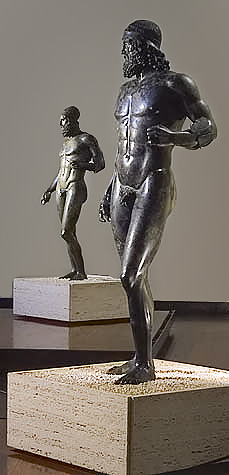
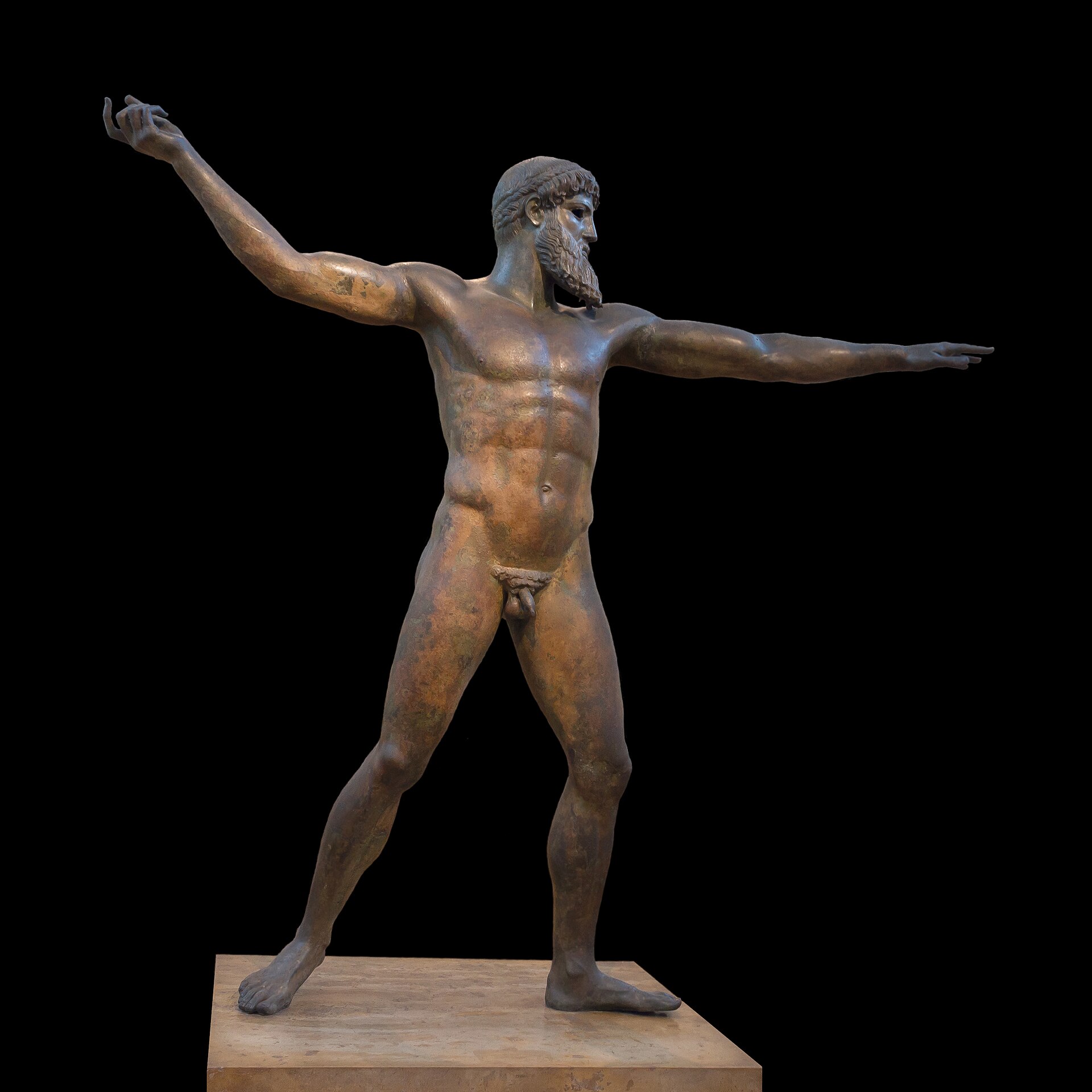
Both objects of this record, photographed together in the museum in 2007 on the travertine plinths used before the 2013 rebuilding. Which of the two stands in front is not recorded on the file page; the Italian Wikipedia caption on this same file gives the foreground figure as Statue A, the young one, and the figure behind as Statue B, the old one, and this record reports that reading without vouching for it. It is the only photograph of these objects found on Wikimedia Commons under a public-domain or CC0 licence; every other is CC BY or CC BY-SA, and several carry an Italian cultural-heritage restriction flag as well.
| Artist | Unknown; two Greek sculptors working about a generation apart |
|---|---|
| Date | Bronze A about 460-450 BC; Bronze B about 430-420 BC |
| Medium | Cast bronze, direct lost-wax, with copper, silver, ivory and calcite inlays |
| Dimensions | Bronze A 198 cm; Bronze B 197 cm. Metal wall thickness averaging 8.5 mm on A and 7.5 mm on B |
| Where it is now | Museo Archeologico Nazionale di Reggio Calabrialast confirmed 12 August 2026 |
| Attribution | UnknownNeither bronze is signed and neither is securely attributed. Full note |
| Object type | Sculpture |
| Period | Greek, fifth century BC |
| Cases | Has a provenance gap |
| Owners on record | 8 links6 documented, 2 unknown |
| Sources | 13 cited |
About this record Last verified 12 August 2026 · 13 sources cited · Change log
On this page 12 sections
ContentsClose
Two over-life-size Greek bronze warriors, lifted out of eight to ten metres of water off Riace Marina in Calabria in August 1972 and kept from the public for nine years. They are catalogued as Bronze A and Bronze B, they were made about a generation apart, and they are among the very small number of large-scale Greek bronzes that survive at all.
Almost nothing else about them is agreed. The finder's own sworn report, filed the day after the discovery, describes a group of statues and gives a depth and a distance from shore that no later account uses. What the Florence restoration of 1975 to 1980 removed from inside them cannot be put back. Whether they may ever leave Reggio Calabria has been argued over for forty years.
This record keeps A and B apart on every line. Published accounts routinely do not, and a fact about one is regularly printed under a photograph of the other.
Provenance
Each link is graded. Documented: a cited source supports it. Disputed: the identification is argued but not established. Unknown: no owner for that span, and the gap is not smoothed into a narrative. The grades in the glossary.
- fifth century BC - unknownUnknown Greek dedicator or cityunknown
Both statues retain lead tenons under the feet, which means each had been fixed to a stone base and was therefore publicly displayed somewhere before it went into the sea. Casts of the tenons were tried against the surviving bases in the sanctuary of Apollo at Delphi and matched none of them. The clay analyses point to Argos for Bronze A and Attica for Bronze B. No dedication, no inscription and no ancient text has ever been tied to them.1
- unknown - 1972None; on the seabed off Riace Marinaunknown
How they reached the sea is not established. A shipwreck is the usual assumption and is weakened by their near-intact condition. Proposals include jettison from a passing ship and, in R. Ross Holloway's 1998 account, looting by the Carthaginians in 406 or 405 BC from a Sicilian city and loss from a ship off Sicily. Nothing is documented. Roughly two and a half thousand years of this record are a blank and this publication does not fill them.1
- 1972 - presentThe Italian statedocumented
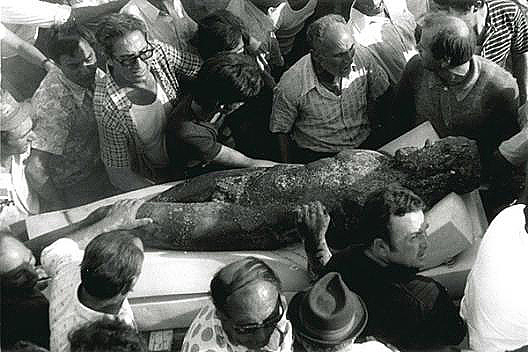
Found on 16 August 1972 by Stefano Mariottini and declared to the Soprintendenza alle Antichita della Calabria at Reggio on 17 August 1972, protocol number 2232. Archaeological objects found in Italian territory or territorial waters vest in the state. Bronze B was raised on 21 August 1972 and Bronze A the following day, after falling back to the seabed once during the lift; the Carabinieri underwater unit used a balloon inflated from the divers' own air cylinders.1
- 1972 - 1975The Italian state, at Reggio Calabriadocumented
Cleaning of the marine concretion by the restorers of the Museo Nazionale della Magna Grecia continued until January 1975, when the Reggio superintendency concluded that a full and valid restoration was beyond the equipment in its own laboratory.1
- 1975 - 1980The Italian state, at the Centro di Restauro, Florencedocumented
Transferred to the restoration centre of the Tuscan archaeological superintendency, an institution created after the Florence flood of 1966. The five-year campaign ended on 15 December 1980. It was here that radiography established that the right arm and the left forearm of Bronze B are a different casting from the rest of that statue, and that the surviving inlays were identified material by material.1
- 1980 - 1981The Italian state, on exhibitiondocumented
Shown for six months at the Museo Archeologico Nazionale in Florence from 15 December 1980, then in Rome. The Florence showing and the Rome showing that followed are what turned two archaeological finds into national property in the popular sense.1
- 1981 - 2009Museo Archeologico Nazionale di Reggio Calabriadocumented
The museum's underwater archaeology section was created on 3 August 1981 to house them, dedicated to the memory of the superintendent Giuseppe Foti, who had signed the 1972 discovery file and died shortly before the statues came back. Degradation appeared in the early 1990s and a further campaign by the Istituto Centrale per il Restauro ran from 1992 to 14 June 1995, emptying the casting core the Florence restorers had left inside and treating the copper oxides with nitrobenzene. They then went into a climate-controlled room at 40 to 50 per cent relative humidity and 21 to 23 degrees.1
- 2009 - 2013The Italian state, at Palazzo Campanella, Reggio Calabriadocumented
Moved in 2009 to the seat of the Calabrian regional council while the museum was rebuilt, into a laboratory open to the public. The work was carried out by restorers of the Istituto Superiore per la Conservazione ed il Restauro coordinated by Paola Donati and Nuccio Schepis and was completed in 2011. They returned to the museum in December 2013; the Bronzes room reopened on 21 December 2013 and the whole museum on 30 April 2016.12
Prices realised
These objects have never been on the market and cannot be. Archaeological finds made in Italian territory are inalienable state property, so there is no price, no valuation published by the state, and no comparable sale. The only monetary question that has ever attached to them is the finder's reward under Italian law, and whether one was ever paid to Stefano Mariottini is not established in the sources consulted.
Technical evidence
| Attribution note | Neither bronze is signed and neither is securely attributed. Every name attached to them - Pheidias, Myron, Alkamenes, Hageladas of Argos, Onatas, Pythagoras of Rhegion - is a modern proposal resting on style, and none has carried the field in more than fifty years of argument. The casting-core analyses place the clay of Bronze A in the plain of Argos and the clay of Bronze B in Attica, which is evidence about where each was cast rather than about whose hand made it. The two are separated by roughly a generation in the dates most commonly given. |
|---|---|
| Bronze A, height and metal | 198 cm. Average wall thickness about 8.5 mm. Silver teeth. Eyes given as calcite in the English account, having originally been supposed ivory; ivory and limestone for the sclerae in the Italian account; calcite and glass paste in the museum's own summary.134 |
| Bronze B, height and metal | 197 cm. Average wall thickness about 7.5 mm. The crown of the skull is unnaturally elongated, which held a Corinthian helmet steady without a fixing pin.13 |
| Inlays common to both | Silver eyelashes. Copper lips and copper areolae at the nipples.1 |
| Ancient repair, Bronze B only | The right arm and the left forearm are a separate casting, welded on after the statue was made, replacing the originals; the Italian account attributes the intervention to the Roman period and to damage sustained while the statue was on display. Established by radiography during the Florence campaign of 1975-1980.1 |
| Casting method | Direct lost-wax, in which the model is destroyed. The model was built up around an initial core from several hundred strips of clay mixed with animal hair; the concentric stratifications survive in the legs and chests of both.1 |
| Casting cores | Clay from inside Bronze A analysed to the plain of Argos, from inside Bronze B to fifth-century Athens. The museum's own page gives the Argolid and Attica. An alternative formulation in the same Italian source gives Argos and Laurion. Fully removed in the 1992-1995 campaign; the Florence restorers had left part of it in place.14 |
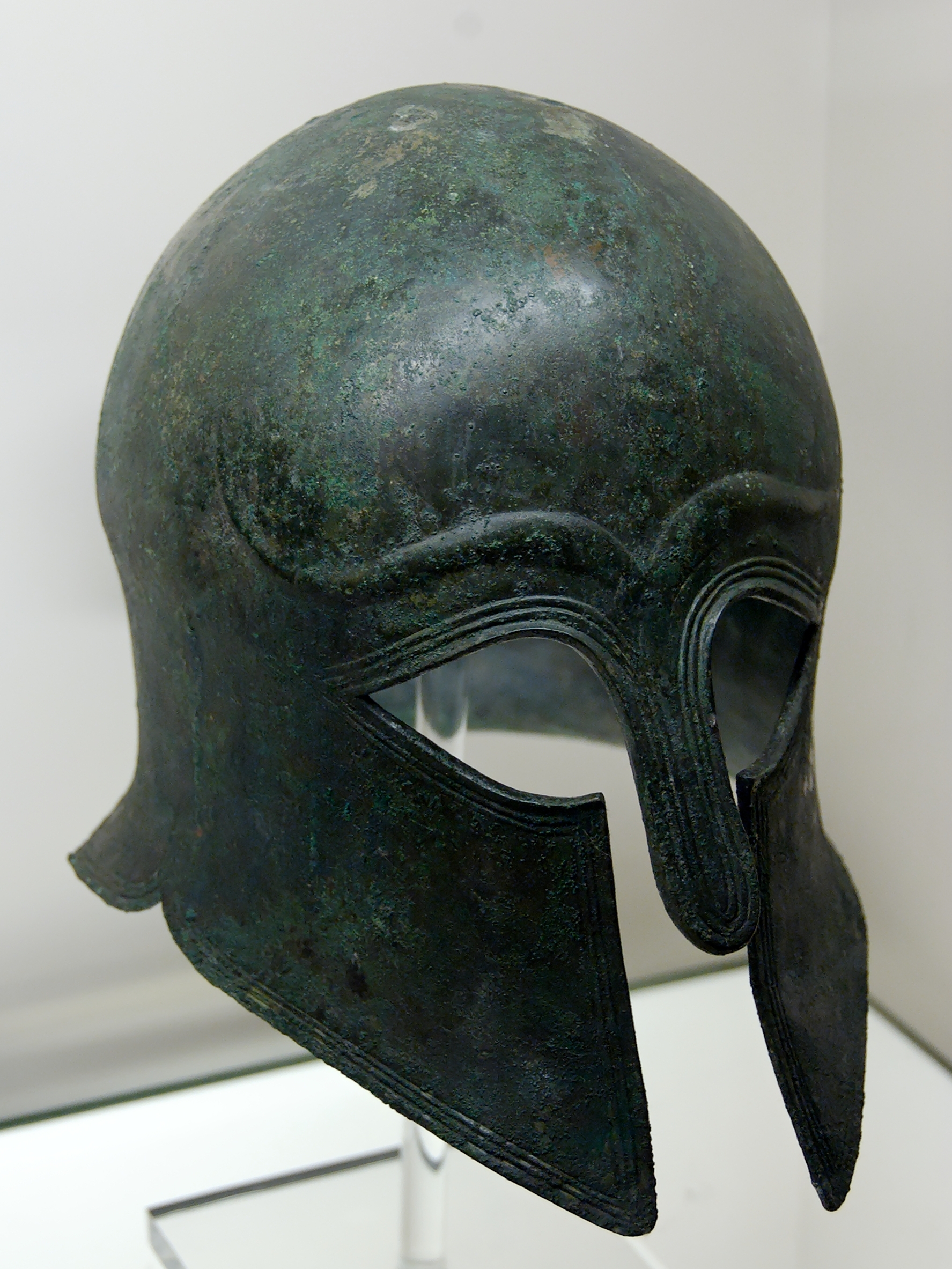
| Missing attributes | Both retain the porpax on the left arm and the hand-grips, so both carried a hoplite shield; neither shield survives. Both held a heavy hoplite spear. Bronze A wore a Corinthian helmet fixed by a crown pin over a woollen band; Bronze B wore a Corinthian helmet over a leather kyne with ear-flaps, a chin strap and a curled neck-guard, the mark of a strategos. None of the helmets, shields or spears was recovered.1 |
| Mounting in antiquity | Both retain lead tenons under the feet, evidence that each had been fixed to a stone base and publicly displayed. Casts of the tenons were compared with the surviving bases of the dedications at the sanctuary of Apollo at Delphi and matched none of them.1 |
| Present mounting | Each stands on a two-block Carrara marble anti-seismic base by ABDR Architetti Associati: four mirrored concave cups with four marble spheres between them for horizontal isolation, and stainless steel dissipative elements for vertical. Designed, built and verified by ENEA on shaking tables at the Casaccia centre using full-scale resin copies.1 |
| Environment | Climate-controlled room at 40 to 50 per cent relative humidity and 21 to 23 degrees Celsius, entered by about twenty visitors at a time through a filter room.12 |
| Structural condition, 2026 | In May 2026 museum scientific-committee member Daniele Castrizio and director Fabrizio Sudano stated that the anti-seismic marble bases installed for the 2013 return no longer reliably guarantee stability and that the room's climate control no longer reliably holds the target temperature and humidity. A renovation is approved in principle under the Strategic Plan 2026-2028 and costed at about 5 million euro, targeted for completion in 2027, and was unfunded as of the sources consulted.111213 |
Images
The record in full
Chapter 1What the finder actually wrote down, the day after
Almost every account of the discovery gives the same figures: 16 August 1972, two hundred and thirty metres off Riace Marina, eight metres of water, an arm protruding from the sand.
Almost every account of the discovery gives the same figures: 16 August 1972, two hundred and thirty metres off Riace Marina, eight metres of water, an arm protruding from the sand. Those numbers do not come from the finder.
Stefano Mariottini, a chemist from Rome diving on holiday, filed a declaration at the superintendency of antiquities for Calabria at Reggio on 17 August 1972, protocol number 2232. In it he stated that on the sixteenth, during a dive for fishing, in the locality of Riace, about one hundred and thirty kilometres along the Ionian state road, at a distance of about three hundred metres from the shore and at a depth of about ten metres, he had found a group of statues, presumably in bronze. Of the two emerging, one lay on its back, its face covered with a flowing beard of curls, arms open, one leg advanced beyond the other; the other lay on its side with a leg bent, and carried on its left arm a shield. The statues were dark brown except for some lighter parts, perfectly preserved, cleanly modelled, without obvious concretion. The dimensions were approximately one hundred and eighty centimetres.
Three hundred metres, not two hundred and thirty. Ten metres, not eight. One hundred and eighty centimetres, against measured heights of one hundred and ninety-eight and one hundred and ninety-seven. A group of statues, of which two were emerging. And a shield on the left arm of one of them, which nobody ever recovered.
Down the left-hand margin of that typed sheet is a handwritten note in red, signed by the superintendent Giuseppe Foti: the present notification follows the telephone communication of 16 August 1972, received at nine in the evening, which reported the discovery. Foti died shortly before the bronzes came back to Reggio, and the museum's underwater section is dedicated to him.
Chapter 2The recovery, and which statue came up when
The underwater unit of the Carabinieri raised the statues using a balloon inflated from the divers' own air cylinders.
The underwater unit of the Carabinieri raised the statues using a balloon inflated from the divers' own air cylinders. Bronze B came up on 21 August 1972. Bronze A came up the following day, and fell back to the seabed once before it was brought safely to the beach.
The English-language accounts sometimes give 23 August for Bronze A. The Italian account, which follows the Italian records, gives the day after the twenty-first. The discrepancy is one day and it is recorded here rather than smoothed over, because a reader checking this record against another will find the difference and is entitled to know that this publication saw it.
It was Bronze A that Mariottini saw first: the left arm was the only element showing above the sandy bottom.
Chapter 3Bronze A and Bronze B are two different objects and this record will not merge them
Bronze A is one hundred and ninety-eight centimetres tall, with an average metal wall thickness of about eight and a half millimetres.
Bronze A is one hundred and ninety-eight centimetres tall, with an average metal wall thickness of about eight and a half millimetres. He is the younger of the two, il giovane. The musculature reads as more nervous and more vital. The head carries a thick band a little above the temples, and the band is not smooth: it has a triangular projection pointing upward, which fits the angle formed on every Corinthian helmet between the neck-guard and the cheek-pieces. There is a broad bearing surface on the nape as well. A pin in the crown of the head, which has attracted some very strange explanations including a small parasol to keep birds off, is more simply read as the fixing for that helmet. Bronze A wore a Corinthian helmet pushed up on the forehead, in the convention used for a heroised warrior, so that the face remained visible and the individually cast hairs showed under the rim.
Bronze B is one hundred and ninety-seven centimetres tall, with a wall thickness of about seven and a half millimetres. He is il vecchio, calmer and more relaxed in stance. His skull is unnaturally elongated at the crown, which is a solution to the same problem handled differently: the shape held the helmet steady without a pin, at the cost of hiding the hair. In compensation the sculptor gave him something else. At the level of the eye-openings of the helmet the head carries a seating for a rectangular inset, hatched with small raised points, and on the forehead a triangle over the hair worked with the same hatching, which imitates tanned animal skin. The ears are pierced for a fixing, and the beard is cut by a deep groove that reads as a chin strap. Bronze B wore a leather cap, the kyne, under his helmet. On coinage of the fifth and fourth centuries the kyne appears beneath the Corinthian helmet with ear-flaps and a distinctive curled neck-guard, and it is the mark of a strategos, the commander of a city's army. Bronze B was made to be recognised as a general.
Both have a porpax still on the left arm, the bracket through which a hoplite shield was carried, and the hand-grips. Both held a heavy hoplite spear. Bronze A held his between index and middle finger in a way that kept the butt-spike off the ground so as not to blunt it; Bronze B held his ordinarily, in the palm.
Chapter 4Bronze B was repaired in antiquity, and the repair is the most interesting thing about either of them
The radiographs taken at Florence produced a result nobody expected.
The radiographs taken at Florence produced a result nobody expected. The right arm of Bronze B, and the left forearm to which the shield was attached, are a different casting from the rest of the statue. They were welded on later, replacing the original arms, most probably to make good damage sustained while the statue was already on display. The Italian description places the intervention in the Roman period.
This is worth dwelling on because of what it implies. Bronze B was standing somewhere, in public, long enough to be damaged; somebody thought it worth commissioning replacement arms in bronze; and the repair was competent enough that it went unnoticed until an X-ray plate was taken in the late 1970s. The object has a conservation history that begins in antiquity, and the ancient conservator is the earliest named party in its treatment record even though the name is lost.
Chapter 5The inlays, listed by statue
The Florence cleaning identified, material by material, the parts that are not bronze.
The Florence cleaning identified, material by material, the parts that are not bronze. Silver for the teeth of Bronze A. Silver for the eyelashes of both. Ivory and limestone for the whites of the eyes. Copper for the lips and for the areolae of the nipples of both.
The English account gives the eyes of Statue A as calcite, noting that they had originally been supposed to be ivory. The museum's own page gives calcite and glass paste for the eyes and copper and silver for the lips and anatomical details, without separating the statues. These are not the same statement and this record does not average them. What is common to all three sources is that the eyes are inlaid in a hard white material with a separate iris, that the lashes are silver, and that the lips and nipples are copper.
One detail from the museum's own history deserves recording because it is the kind of thing that never reaches print: an eyelash belonging to Bronze B was found abandoned in the basement of the museum and reported in the local press. A component of one of the most closely studied objects in Italian archaeology spent an unrecorded period in a store room.
Chapter 6How they were made, and what was inside them
They were cast by the direct lost-wax method, in which the original model is destroyed in the process.
They were cast by the direct lost-wax method, in which the original model is destroyed in the process. That is a demanding choice: there is no second chance and no master to fall back on, and it means that whatever the sculptor built, he built once.
The 1992 to 1995 campaign, which emptied the statues, showed how the model was made. Around an initial core, the final form was built up by laying on several hundred strips of clay mixed with animal hair to make them workable. The concentric stratifications of that clay were found in the legs and the chests of both statues. It is a slow and awkward way to work and it allowed the masses of the body and the muscles to be grown outward to the shape wanted.
The 2009 to 2011 campaign, working with endoscopes once the last of the core was out of the heads, was able to observe for the first time how the eyes and the mouths had been made and to identify analytically the materials used in them. It also recorded the nails, some square in section, that the founders had used to hold the structure steady during the pour, and gammagraphy showed the cracks and fractures in both, particularly on the nose and the beard of the young one.
Chapter 7The clay that was thrown away was the evidence
The casting core, the terra di fusione, is not waste.
The casting core, the terra di fusione, is not waste. It is a sample of the ground where the statue was cast, sitting inside the statue.
Analysis of the clay taken from the holes in the feet found that the material inside Bronze B came from fifth-century Athens and the material inside Bronze A from the plain of ancient Argos. The museum's own summary puts it as Attica and the Argolid. An earlier formulation in the same Italian account gives Argos and Laurion, which is not quite the same statement, and the difference is recorded here rather than resolved.
That single result is the strongest localisation evidence anyone has for either object, and it exists only because clay was still inside them. The Florence restorers left some of it in place. The 1992 to 1995 campaign took all of it out, for a defensible conservation reason: the core was holding moisture and the copper was corroding. But taking it out is irreversible, and the stratigraphic relationship between the clay and the metal cannot be re-examined. Every future question that would have been answered by looking at the core in situ is now closed.
This is the ordinary condition of conservation and it deserves to be stated plainly rather than presented as a controversy or hidden as an embarrassment. A treatment that saves the object can destroy the evidence, and the profession has to choose. In this case the choice was made twice, in opposite directions, by two different institutions, seventeen years apart.
Chapter 8Nine years before anyone was allowed to look
They came out of the water in August 1972.
They came out of the water in August 1972. The public first saw them in December 1980.
Cleaning at Reggio ran until January 1975, when the superintendency accepted that its own laboratory could not do the work. The statues went to the restoration centre of the Tuscan archaeological superintendency in Florence, an institution that existed because of the flood of 1966. Five years later, on 15 December 1980, the campaign closed with a six-month exhibition at the Museo Archeologico Nazionale in Florence, staged as a public tribute to the technical effort made there. Rome followed.
That exhibition is the moment the objects stopped being an archaeological find and became a national possession. The enthusiasm it started has never subsided. It is also the origin of the argument that has run ever since about whether they should travel, because it established that they could be moved and that moving them drew crowds.
Chapter 9The claim that something else was down there
In 2008 Giuseppe Bragho published a study of the official 1972 records and argued that they describe more than was recovered: not only a helmet and a shield but a third bronze statue with open arms...
In 2008 Giuseppe Bragho published a study of the official 1972 records and argued that they describe more than was recovered: not only a helmet and a shield but a third bronze statue with open arms, none of which was taken out of the water during the official recovery. He argued further that the positions in which A and B were found at the official recovery differ from the positions registered at the discovery, which would mean somebody had tried to move them in between. The suggestion is that the missing material was taken in the days before the official operation and sold abroad.
Mariottini's own declaration is the primary document behind this and it is quoted in full earlier in this record. It says a group of statues. It says two were emerging. It says one carried a shield on its left arm. No shield was recovered with the statues, although a bronze shield-grip is reported to have been found later on the same seabed.
The Italian Wikipedia article carries an editorial warning that the events as narrated are not supported by the source cited for them, which is a caution this record passes on rather than suppresses. A separate published note by F. Giudice, Il terzo Bronzo di Riace, appeared in Archeologia Viva in April 1993. In 2019 the Italian television programme Le Iene returned to the question and Mariottini declined to comment.
What can be said without going beyond the documents: the finder's sworn statement describes more objects than were recovered, and that discrepancy has never been explained on the record.
Chapter 10The Siracusan hypothesis, filed with a prosecutor and published in a geology journal
In 2025 a second and far larger challenge reached a public prosecutor: not that something extra was left on the seabed off Riace, but that the seabed itself is the wrong one.
In 2025 a second and far larger challenge reached a public prosecutor: not that something extra was left on the seabed off Riace, but that the seabed itself is the wrong one. The claim, advanced under the name of the Siracusan hypothesis, is that both bronzes were first recovered off Brucoli, near Syracuse in Sicily, around 1971, and moved to the waters off Riace before the official recovery of August 1972. The Procura della Repubblica di Siracusa opened a file on the claim in 2025 under the Italian procedure known as modello 45, used to register a report that on its face names no suspect and alleges no specific crime, as the basis for establishing whether a formal investigation is warranted. As of the sources consulted for this record the file remained open, without suspects, and its outcome had not been reported.
The scientific case was set out by Anselmo Madeddu, a physician and historian of Greek bronzework, with Rosolino Cirrincione of the University of Catania and colleagues from the universities of Ferrara, Cagliari, Bari, Pavia and Calabria, in a peer-reviewed paper, A Syracusan hypothesis on the origin of the Riace Bronzes, published in the Italian Journal of Geosciences, volume 145 (2026), pages 97 to 138. The paper argues from geochemical analysis of the clay in the ancient repair joints that it is compatible with sediment from the alluvial plain between the mouths of the Anapo and Ciane rivers south of Syracuse, and proposes that the statues were cast in a workshop in the Sibari area and later placed near Syracuse in the Dinomenid period. Separately, two brothers named Bertoni, sons of a restaurant owner at Brucoli, told an Italian television programme they recalled divers working with Jacques Cousteau bringing bronze figures ashore at Brucoli around 1971, one of them fitted with a helmet, a shield and spears; a photograph said to show two divers holding a Riace-type statue off Brucoli that year was circulated with the account.
The counter-case is direct and comes in part from a scholar already named in this record. Daniele Castrizio, the numismatist whose own proposal that the pair represent Polynices and Eteocles by Pythagoras of Rhegion is set out above, argues that the corrosion patina and the sand and gravel still adhering to both statues match the shallow Calabrian fluvial deposits recorded during the 1973 excavation at Riace, not the depth of roughly ninety metres the Brucoli account requires, and that no population of the black coral the account depends on has ever been recorded at that site. A forensic examiner, Antonella Privitera, has described the circulated photograph as a photomontage. The Cirrincione and Madeddu team has defended its peer review and its bibliography of more than a hundred sources, disputed Castrizio's standing to judge a geological method outside his own field, and said the argument belongs in refereed journals rather than social media. Neither the Ministry of Culture nor the Museo Archeologico Nazionale di Reggio Calabria had issued a public response to the hypothesis as of the sources consulted for this record.
Chapter 11The reward nobody can point to
Italian law provides a finder's reward, the premio di rinvenimento, for the discoverer of archaeological material that vests in the state.
Italian law provides a finder's reward, the premio di rinvenimento, for the discoverer of archaeological material that vests in the state. Under the framework in force in 1972 and under the current cultural heritage code, the reward can run to a substantial proportion of the value of the find.
Whether Mariottini was ever paid anything, how much, and whether there was litigation about it, is not established in any source consulted for this record. For objects of this celebrity that is a striking gap, and it is the first thing this desk would ask the Ministry of Culture. It is recorded here as an open question rather than answered by inference.
Chapter 12The names people have put on them
Fifty years of proposals, none of them accepted.
Fifty years of proposals, none of them accepted. What follows is the sequence, because the sequence is the attribution history.
Between 1979 and 1982 W. Fuchs argued that both belonged to the Athenian dedication at Delphi and were by Pheidias, an opinion shared by Alberto Busignani, Antonio Giuliano and Maurizio Harari. In 1982 Carlo Odo Pavese proposed two hoplite runners by two different Attic artists, 470 to 460 BC for A and 430 BC for B. Hans Peter Isler in 1983 and Paolo Enrico Arias in 1984 proposed two Athenian heroes, A by Pheidias about 460 to 450 and B by his school thirty years later. Claude Rolley in 1983 proposed two Attic eponymous heroes, A by an Athenian artist about 460 and B from the Pheidian school about 430. Enrico Paribeni rejected an Attic origin for A altogether and proposed a hero, perhaps Ajax the Locrian, by a Peloponnesian artist between 460 and 450, with B a general by an Atticising artist between 410 and 400. Antonino Di Vita proposed two victorious hoplite runners. Georgios Dontas proposed two Athenian eponymous heroes, A by Myron and B by Alkamenes, both about 450. In 1985 Evelyn Harrison assigned both to the Achaean dedication at Olympia and to Onatas, between 470 and 460, and P. C. Bol and O. Deubner agreed the following year. Sandro Stucchi proposed that both represent the boxer Euthymos of Locri Epizephyrii, A by Pythagoras of Rhegion just after 470 and B by a western Greek artist just before 425. R. Ross Holloway in 1998 proposed two founders of Sicilian cities by a Sicilian bronze-caster. Brunilde Sismondo Ridgway in 1981 stood alone in arguing that they are Roman, eclectic and classicising work of the first century BC or the first century AD; the thinness of the metal is the standard objection to her dating.
After the 1995 restoration the field narrowed. Paolo Moreno, working from the casting-core analyses, proposed Tydeus for Bronze A and Amphiaraos for Bronze B, two of the Seven against Thebes, with Hageladas of Argos for A about 450 and Alkamenes for B about 440. Daniele Castrizio, working from the marks left by the missing attributes, proposed Polynices for A and Eteocles for B, both by Pythagoras of Rhegion, and cites Tatian's taunt to the Greeks that they had not destroyed the memory of the fratricide by burying the statues of Polynices and Eteocles along with their maker Pythagoras. Vinzenz Brinkmann and Ulrike Koch-Brinkmann, with the support of Salvatore Settis, proposed Erechtheus and Eumolpos, from the group Pausanias saw on the Athenian acropolis, arguing from traces on the unfinished crown of B for a fox-skin cap and from the right hand for a short-handled weapon, that is, a battle-axe, which would make B a Thracian.
Nothing in that paragraph is settled. What has been effectively abandoned is the reading of the pair as athletes, because the objects held spears, and the reading of either as a historical portrait.
Chapter 13How they stand now, and what holds them up
The 2009 to 2013 work produced a display solution that is itself an object of interest.
The 2009 to 2013 work produced a display solution that is itself an object of interest. Each statue stands on a base of two superimposed blocks of Carrara marble, designed by ABDR Architetti Associati. Four concave cups are cut into the facing surfaces of the two blocks, mirroring each other, and four marble spheres sit between them. In an earthquake the lower block moves with the ground and the spheres roll in their cups, absorbing the horizontal movement instead of transmitting it upward. Stainless steel dissipative elements between the blocks handle vertical oscillation. The system is morphological rather than mechanical, which means it has almost nothing to maintain, and marble was chosen as the material most compatible with bronze. ENEA designed and built the bases and verified them on shaking tables at the Casaccia research centre, using full-scale resin copies of the statues.
The problem being solved is specific: a tall figure standing on a very small footprint is most vulnerable in the legs, and even minor oscillation can compromise the structure or topple it. Reggio Calabria sits in one of the most seismically active parts of Europe. The same approach has been discussed for Michelangelo's David.
They came back to the museum in December 2013, into a room kept effectively aseptic, entered by about twenty people at a time through a filter room. The Bronzes room reopened on 21 December 2013 and the rebuilt museum in full on 30 April 2016.
Chapter 14The 2026 warning that the anti-seismic bases are compromised
In May 2026 the same anti-seismic system described above became the subject of a public warning.
In May 2026 the same anti-seismic system described above became the subject of a public warning. Daniele Castrizio, an archaeologist at the University of Messina and a member of the museum's scientific committee, said the marble bases supporting both statues were gravely compromised and could no longer guarantee stability, so that even a moderate earthquake risked toppling the statues and shattering them. He linked the fault to the two-block, sphere-bearing system built for the 2013 return, roughly a decade earlier, and said the climate-control system in the Bronzes room no longer reliably held the temperature and humidity the statues need either. Museum director Fabrizio Sudano confirmed the assessment.
The remedy already exists on paper. The MArRC's Strategic Plan 2026-2028, presented by Sudano, lists a reconfiguration of the Bronzes room and an adjustment of the seismic bases as its lead project, budgeted at around 5 million euro, with the scientific committee's approval already given and a completion date of 2027 stated as achievable. As of the sources consulted for this record the project awaited Ministry of Culture funding and the museum was also seeking private sponsorship, offering naming rights to the renovated hall in exchange; a private backer had not been secured.
Chapter 15The corpus they belong to is very small
The reason two bronzes from a Calabrian beach could carry this weight of argument is that there is almost nothing to compare them with.
The reason two bronzes from a Calabrian beach could carry this weight of argument is that there is almost nothing to compare them with. Large-scale Greek bronze statuary was melted down. What survives, survives because it was lost at sea or buried.
The Italian account names the closest comparisons directly: the Charioteer of Delphi and the Artemision god at the National Archaeological Museum in Athens. To those the usual list adds the Marathon Boy, the Antikythera Youth, the Getty Victorious Youth, the Piombino Apollo, the Croatian Apoxyomenos, the Porticello heads that are in the same room at Reggio, and the Hellenistic prince from Punta del Serrone.
That is the entire evidential base for an art form that dominated the Greek world for four centuries. It is why a single new find changes the field, and why the argument about whether these two objects should ever be allowed to travel is not sentimental.
The artist
Unknown; two Greek sculptors of the fifth century BC
There is no maker to write about, and the honest thing to do with that space is to set out what the absence is made of. Neither bronze is signed. No ancient text has ever been tied to either. Every name on the list below is a modern attribution built from style, from the marks left by missing attributes, or from the chemistry of the clay left inside the castings. None has been accepted. What follows is therefore a dossier on the argument rather than on a man, which is the correct shape for an object of this kind and is more useful than a page about Pheidias would be.
Exhibited
- 1980-1981First public display after the Florence restoration, six monthsMuseo Archeologico Nazionale, Florence
- 1981Second showing, following FlorenceRome
- 2009-2011Restoration laboratory open to the publicPalazzo Campanella, Reggio Calabria
- 2013-Permanent display, Bronzes room reopened 21 December 2013Museo Archeologico Nazionale di Reggio Calabria
Literature
- G. Foti and F. Nicosia, I Bronzi di Riace: dal Centro di restauro della Soprintendenza archeologica della Toscana al Museo nazionale di Reggio Calabria, Florence, 1981.
- L. Vlad Borrelli and P. Pelagatti (eds), Due Bronzi da Riace: rinvenimento, restauro, analisi e ipotesi di interpretazione, Bollettino d'Arte, serie speciale III, Rome, 1984.
- Paolo Moreno, I Bronzi di Riace: il maestro di Olimpia e i Sette a Tebe, Electa, Milan, 1998.
- Daniele Castrizio, I Bronzi di Riace: ipotesi ricostruttiva, Iriti, Reggio Calabria, 2000.
- Alessandra Melucco Vaccaro and Giovanna De Palma, I bronzi di Riace: restauro come conoscenza, Artemide, Rome, 2003.
- G. Bragho, Facce di bronzo: personaggi e figuranti a Riace, Pellegrini, Cosenza, 2008; and I Bronzi di Riace nei documenti ufficiali del ritrovamento, Meligrana, 2017.
- Salvatore Settis and Maurizio Paoletti, Sul buono e sul cattivo uso dei bronzi di Riace, 2012.
- K. A. Dafas, Greek Large-Scale Bronze Statuary: The Late Archaic and Classical Periods, BICS Supplement 138, London, 2019, pp. 51-67.
Related works
| Work | Relation | Where it is |
|---|---|---|
| Charioteer of Delphi Unknown Greek | Named in the Italian account as one of the two comparisons that existed before Riace About 470 BC. One of the very few complete large Greek bronzes. | Archaeological Museum of Delphi |
| Artemision Bronze Unknown Greek | The other comparison named in the Italian account Zeus or Poseidon, about 460 BC, recovered from the sea off Cape Artemision. Like Riace, it survives because it was lost. | National Archaeological Museum, Athens |
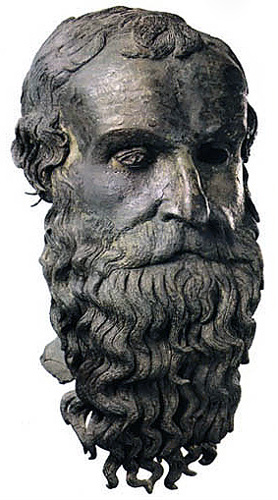
| The Porticello bronzes Unknown Greek | In the same room of the same museum The head of Basel and the head of the Philosopher, also recovered from the sea in Calabrian waters. | Museo Archeologico Nazionale di Reggio Calabria |
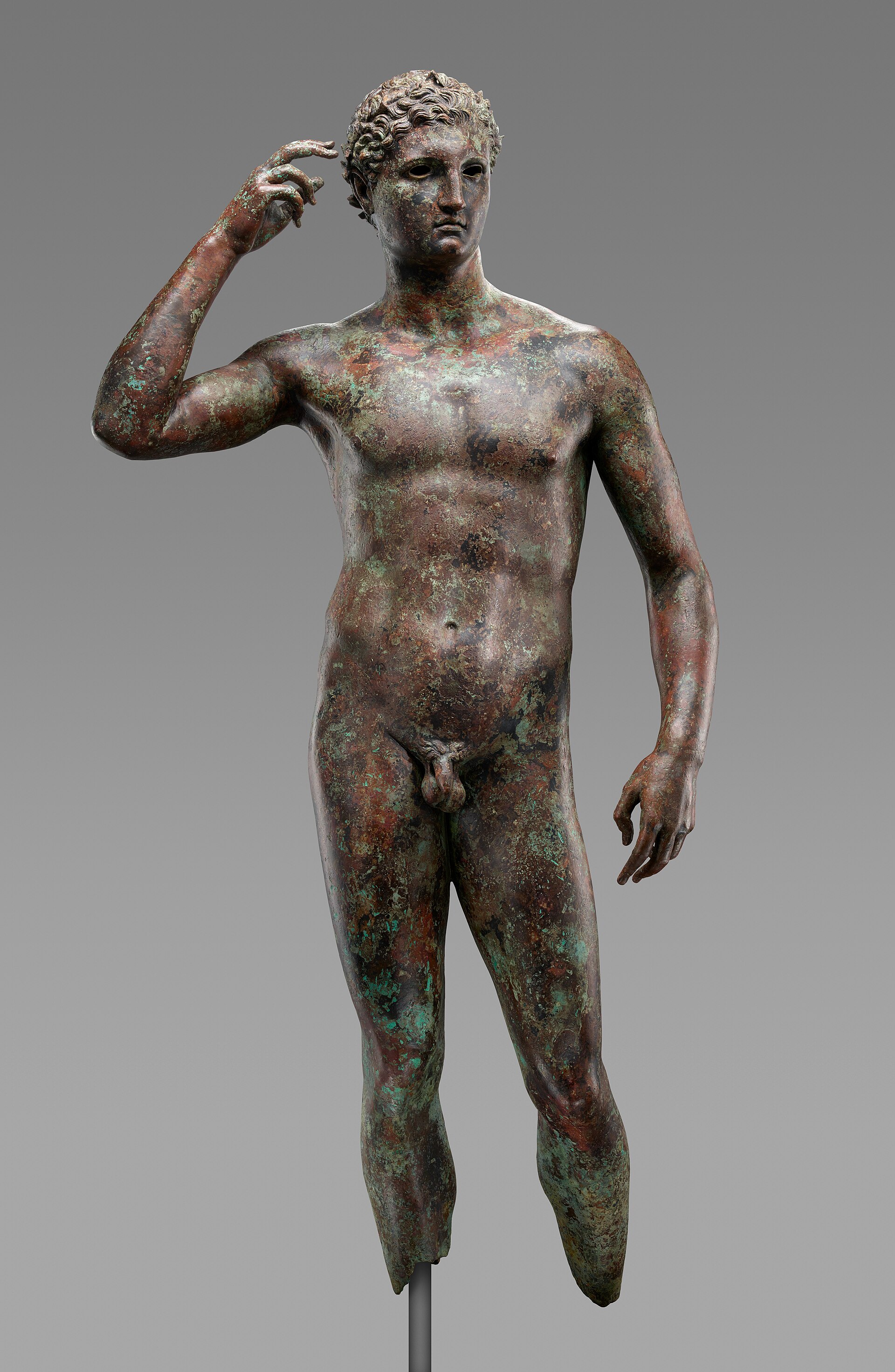
| Victorious Youth Attributed to Lysippos and disputed | Comparable survival, and a live restitution case Recovered from the Adriatic by fishermen from Fano. Italy obtained a forfeiture ruling. The contrast with Riace is instructive: one sea find stayed in Italy and became a national emblem, the other left and has been litigated for decades. | J. Paul Getty Museum, Malibu |
| Bronze statue of a man from Punta del Serrone Unknown, Hellenistic | Another large bronze from Italian waters Sometimes called the Hellenistic Prince. | Brindisi |
| The experimental reconstruction as Erechtheus and Eumolpos Liebieghaus Polychromy Research Project | A modern reconstruction, not an ancient object Made by Vinzenz Brinkmann and Ulrike Koch-Brinkmann with the support of Salvatore Settis and the Italian ministry, to test their identification. Any photograph of it is a photograph of a modern object. | Liebieghaus, Frankfurt |
Open questions
- Why does every published account give 230 metres and 8 metres when the finder's own sworn declaration of 17 August 1972 gives about 300 metres and about 10 metres? The primary document and the standard figures disagree and nobody explains the difference.
- Was Bronze A recovered on 22 or 23 August 1972? The Italian account gives the day after Bronze B, that is the twenty-second; English accounts give the twenty-third.
- Mariottini's declaration describes a group of statues, of which two were emerging, and a shield on the left arm of one. No shield was recovered. What else was on that seabed, and where did it go?
- Was Stefano Mariottini ever paid a finder's reward under Italian law, and if so how much? Nothing is established in the sources consulted.
- Which eye is missing from which statue, and what survives in each socket? The sources consulted describe the inlay materials but do not set out the present condition socket by socket, which is exactly the level of detail a reader of this record needs.
- What are the weights of Bronze A and Bronze B? Not published in any source consulted.
- What is the exact alloy of each statue, and of the ancient replacement arms of Bronze B? The 2009-2011 campaign is reported to have established the precise percentages, and they are not published in the sources consulted.
- Has any loan of either statue ever been formally proposed and refused, and by whom? The prohibition on moving them is treated as settled in general accounts without a documented decision behind it.
- Did any conservator publicly oppose the removal of the casting core in 1992-1995? The loss of stratigraphic evidence is real and the professional debate around it has not been located.
- Where was the eyelash of Bronze B reported found in the museum basement, when, and is it now reattached or catalogued?
- Has the Procura di Siracusa's modello 45 file on the Siracusan hypothesis been closed, and with what finding? It remained open and without suspects as of the sources consulted in 2026.
- Has any scholar in the Calabrian discovery tradition answered the Cirrincione and Madeddu paper in a refereed journal, beyond Castrizio's public criticism? None was located in the sources consulted.
- Has the Ministry of Culture committed funding, and on what timeline, to the seismic-base and climate-control renovation of the Bronzes room that the museum's own scientific committee has already approved? Not established in the sources consulted as of August 2026.
Questions about this object
What is The Riace Bronzes?
The Riace Bronzes is a sculpture, dated bronze A about 460-450 BC; Bronze B about 430-420 BC. Medium: Cast bronze, direct lost-wax, with copper, silver, ivory and calcite inlays.
Who made The Riace Bronzes, and is the attribution settled?
The attribution to Unknown; two Greek sculptors working about a generation apart is recorded here as unknown. Neither bronze is signed and neither is securely attributed. Every name attached to them - Pheidias, Myron, Alkamenes, Hageladas of Argos, Onatas, Pythagoras of Rhegion - is a modern proposal resting on style, and none has carried the field in more than fifty years of argument. The casting-core analyses place the clay of Bronze A in the plain of Argos and the clay of Bronze B in Attica, which is evidence about where each was cast rather than about whose hand made it. The two are separated by roughly a generation in the dates most commonly given.
Where is The Riace Bronzes now?
Museo Archeologico Nazionale di Reggio Calabria. Last confirmed 12 August 2026. Italian state property; found in Italian territorial waters in August 1972.
What is still unknown about The Riace Bronzes?
Why does every published account give 230 metres and 8 metres when the finder's own sworn declaration of 17 August 1972 gives about 300 metres and about 10 metres? The primary document and the standard figures disagree and nobody explains the difference.
Sources
- 1Wikipedia (Italian), 'Bronzi di Riace', which reproduces the text of Mariottini's declaration of 17 August 1972 (protocol 2232) and Giuseppe Foti's manuscript annotation, and sets out the restoration chronology, the inlay materials, the ancient repair to Bronze B, the casting-core analyses and the full table of attribution proposals with their authors and dates. Tertiary but unusually well documented; flagged for replacement by Foti and Nicosia, I Bronzi di Riace (Florence 1981) and by Due Bronzi da Riace, Bollettino d'Arte serie speciale III (Rome 1984). it.wikipedia.org/wiki/...
- 2Wikipedia (Italian), 'Museo archeologico nazionale di Reggio Calabria', for the 1981 creation of the underwater section, the 21 December 2013 reopening of the Bronzes room, the definitive reopening of the museum on 30 April 2016, and the description of the display conditions. Tertiary. it.wikipedia.org/wiki/...
- 3Wikipedia, 'Riace bronzes', for the metal wall thicknesses, the calcite eyes of Statue A, the Brinkmann and Settis identification as Erechtheus and Eumolpos, and the summary of Giuseppe Bragho's 2008 claims about the official 1972 records. Tertiary. en.wikipedia.org/wiki/...
- 4Museo Archeologico Nazionale di Reggio Calabria, official page on the Riace Bronzes, for the museum's own statement of the discovery, the lost-wax technique, the calcite and glass-paste eyes, the copper and silver inlays, the attribution of the casting cores to Attica and the Argolid, and the regulated access to the room. museoarcheologicoreggiocalabria.cultura.gov.it/en/...
- 5Wikimedia Commons file page for File:Bronzi di riace ritrovamento.jpg. Licence PD-Italy and PD-1996. The description calls it an old postcard, gives the author as Ernesto Franco of Bivongi, and dates it to about 1973, while the original upload log calls it a postcard by an unknown author of 1972. commons.wikimedia.org/wiki/...
- 6Wikimedia Commons file page for File:Reggio calabria museo nazionale bronzi di riace.jpg. Licence PD-self, own work, dated 2007. commons.wikimedia.org/wiki/...
- 7Il Post, 'L'indagine che ipotizza una storia molto diversa sui Bronzi di Riace', 18 May 2025, on the Procura di Siracusa file and the Brucoli claim, with a credibility assessment of the witness and photographic evidence. ilpost.it/2025/...
- 8The Journal of Cultural Heritage Crime, 'Bronzi di Riace. A Siracusa un caso di archeomafia? Piuttosto, una palese messa in scena', 15 May 2025, forensic examiner Antonella Privitera's critique of the Siracusan hypothesis, including the patina, sediment and coral evidence and the assessment that the circulated photograph is a photomontage. journalchc.com/2025/...
- 9R. Cirrincione, A. Madeddu et al., 'A Syracusan hypothesis on the origin of the Riace Bronzes: new investigations and a historical-scientific revision of literature data through an interdisciplinary geological-archaeological approach', Italian Journal of Geosciences, vol. 145 (2026), pp. 97-138, DOI 10.3301/IJG.2026.05. Peer-reviewed primary source for the geochemical claim. italianjournalofgeosciences.it/297/...
- 10Odnako, 'The Riace Bronzes question and the Sicilian hypothesis, the reply of the research group', the Cirrincione and Madeddu team's published response to Daniele Castrizio's criticism. odnako.org/the-riace-bronzes-question-and-the-sicilian-hy...
- 11StrettoWeb, 'Reggio Calabria, allarme per i Bronzi di Riace: a rischio il basamento antisismico', 7 May 2026, reporting Daniele Castrizio's warning and director Fabrizio Sudano's confirmation. strettoweb.com/2026/...
- 12CityNow, 'Bronzi di Riace, basi compromesse: problema di stabilita e microclima, Castrizio', 8 May 2026, on the compromised anti-seismic bases and microclimate control. citynow.it/bronzi-riace-basi-compromesse-problema-stabili...
- 13Il Sole 24 Ore, 'Private Funds for the Riace Bronzes. The Strategic Plan of the Museum of Reggio', on the MArRC Strategic Plan 2026-2028, the Bronze Hall renovation budget and the search for private sponsorship. en.ilsole24ore.com/art/...


Last verified 12 August 2026 · Published 4 August 2026
Change log
2 August 2026 - Record deepened to the house standard: narrative sections, technical evidence, artist dossier, related works and open questions added; provenance chain and auction results replaced with the researched versions; sources rebuilt.
4 August 2026 - Record created at the house standard: researched narrative, technical evidence, maker dossier, graded provenance chain, prices with hammer and premium separated, related works, open questions and sources.
12 August 2026 - Reverification pass. Location confirmed unchanged: Museo Archeologico Nazionale di Reggio Calabria, Italian state property, no move or loan found. All 6 previously cited source URLs re-fetched and resolve (Italian and English Wikipedia, the museum's official page, both Commons file pages); no link rot found, none replaced. Two substantive, sourced developments found and added since the record was last touched, both missing from the prior version: (1) the Siracusan hypothesis - a Procura di Siracusa modello-45 file opened in 2025 on a claim that both bronzes were first recovered off Brucoli, Sicily, around 1971 and moved to Riace before the 1972 official find, backed by a peer-reviewed geochemical paper (Cirrincione, Madeddu et al., Italian Journal of Geosciences, vol. 145, 2026, pp. 97-138) and disputed by numismatist Daniele Castrizio, already in this record for his own attribution proposal, and by forensic examiner Antonella Privitera, who calls the supporting photograph a photomontage; the outcome of the prosecutor's file and any museum or ministry response are not established and are logged as open questions. (2) A May 2026 structural warning: the same Castrizio and museum director Fabrizio Sudano stated the anti-seismic marble bases installed for the 2013 return, and the room's climate control, no longer reliably protect the statues; the museum's Strategic Plan 2026-2028 costs a fix at about 5 million euro targeting completion in 2027, approved in principle by the scientific committee but unfunded as of the sources consulted. Two narrative sections, one technical row, three open questions and seven sources (7-13) added accordingly. No existing fact was found to be wrong, no attribution consensus has changed, and no theft, security breach, or restitution ruling was found; nothing was removed.