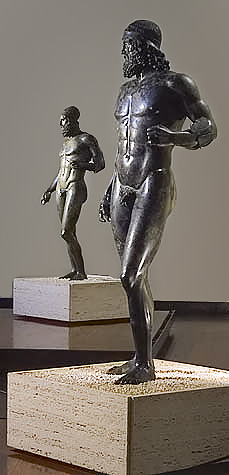
The Riace Bronzes
Bronze A about 460-450 BC · Cast bronze
Museo Archeologico Nazionale di Reggio Calabria
Museum · Museo Archeologico Nazionale di Reggio Calabria · Founded 1882
Open, admission and hours confirmed 10 August 2026 · 22 sources
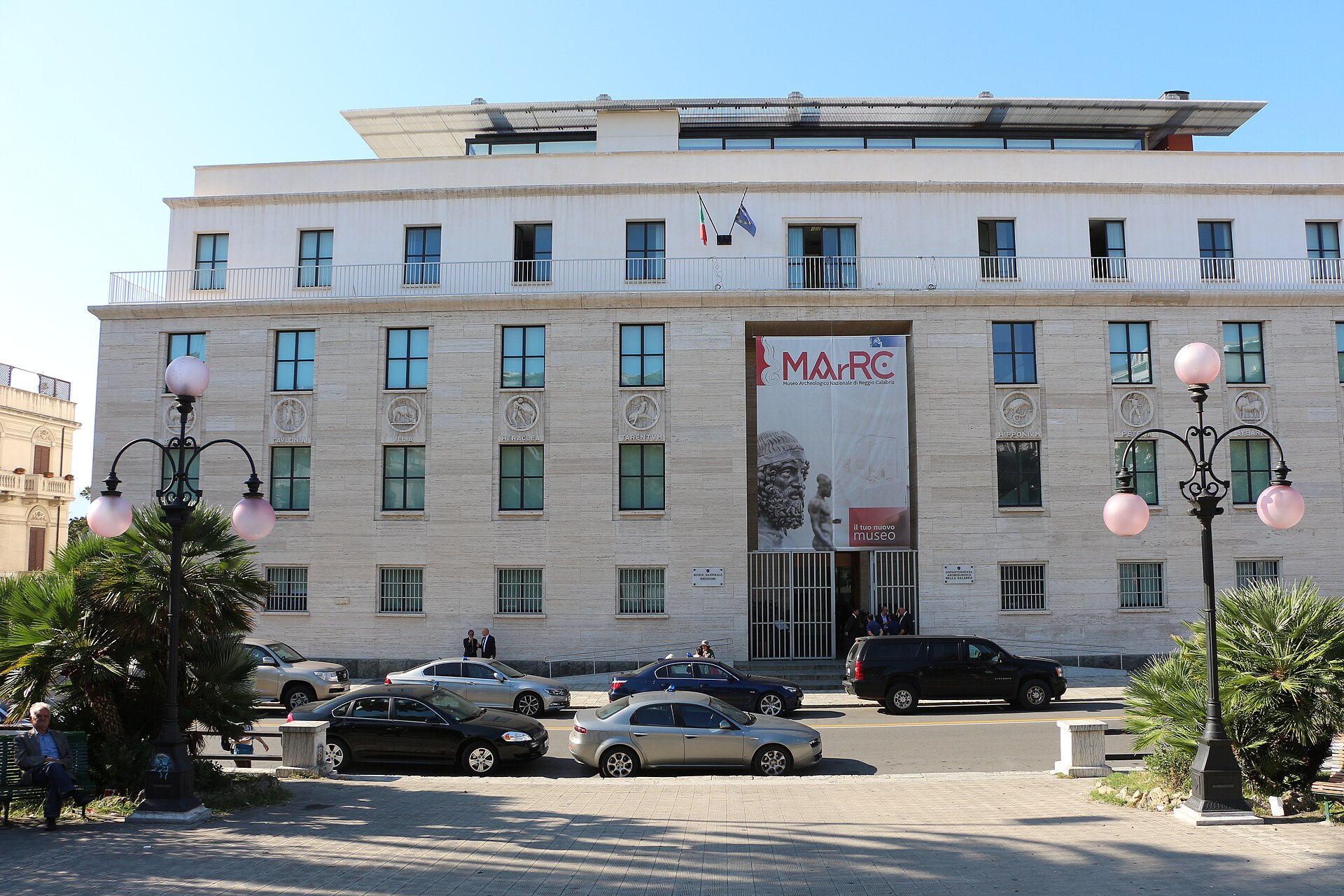
The museum's holdings run continuously from the Palaeolithic to the Roman period and are, by its own description, the primary repository for the archaeology of ancient Calabria and Magna Graecia specifically, rather than a general antiquities collection assembled by acquisition. Its distinguishing strength is depth at both ends of a single regional story: rare large-scale Greek bronze sculpture (the Riace Bronzes and the Porticello heads) at one end, and one of the most complete sequences of Calabrian prehistoric, Greek-colonial, Italic and Roman material culture, drawn overwhelmingly from controlled excavation rather than the art market, at the other.
| Local name | Museo Archeologico Nazionale di Reggio Calabria |
|---|---|
| Kind | Museum |
| Founded | 1882 as the Museo Civico; refounded as a state museum after Paolo Orsi's post-1908-earthquake proposal; the Palazzo Piacentini building opened in stages from 1954 and was officially inaugurated in 1959 |
| City and country |  Reggio Calabria, Italy Reggio Calabria, Italy |
| Address | Piazza De Nava 26, 89123 Reggio Calabria RC, Italy (visitor entrance); offices at Via Domenico Romeo 2 |
| Website | museoarcheologicoreggiocalabria.it |
| Status | Open, confirmed 5 September 2026 |
| Record last verified | 10 August 2026 |
Prices and hours change. We take them from the institution's own pages and print the day we read them, and you can check the current position at the source we used. Confirm before you travel.
Prehistory and protohistory, from the Palaeolithic (120,000-12,000 years ago) to the Iron Age on the threshold of Greek colonisation. Includes a cast of the Bos primigenius rock engraving from the Grotta del Romito at Papasidero, painted pebbles from the Grotta della Madonna, Neanderthal and Homo sapiens skeletal remains, Neolithic flint, bone and antler tools, fertility figurines and some of the earliest worked ceramics in Calabria, plus Bronze Age finds including a Minoan-derived ivory statuette from Punta di Zambrone evidencing eastern Mediterranean contact, and Iron Age gold, bronze and ivory jewellery from sites including Torre Galli and Broglio di Trebisacce.
The Greek colonisation of Calabria from the 8th century BC: coinage of Sybaris (a bull with its head turned back) and Kroton (the tripod of Delphic Apollo), an archaic Greek inscribed stele from S. Brancato di Tortora, votive deposits from the sanctuaries of Medma (Rosarno) and Hipponion (Vibo Valentia) including a finely worked Chalcidian helmet ritually bent out of shape, and material from the Mannella sanctuary at Locri dedicated to Persephone, including the Dioscuri statue group and a column from the Marasa sanctuary peristyle.
Daily life, funerary custom and the Italic peoples (Lucanians and Bruttians) who bordered Greek Calabria. Material from the theatre and residential quarters of Locri (antefixes with silen heads, a seated Aphrodite Urania figurine, domestic pinakes), one of Magna Graecia's largest collections of bronze mirrors, grave goods from the roughly 1,500 tombs of the Metauros necropolis and the Contrada Lucifero tombs at Locri showing gendered burial goods, and Hellenistic-period elite grave goods from Laos, Castellace and Varapodio, including a gold-decorated glass cup.
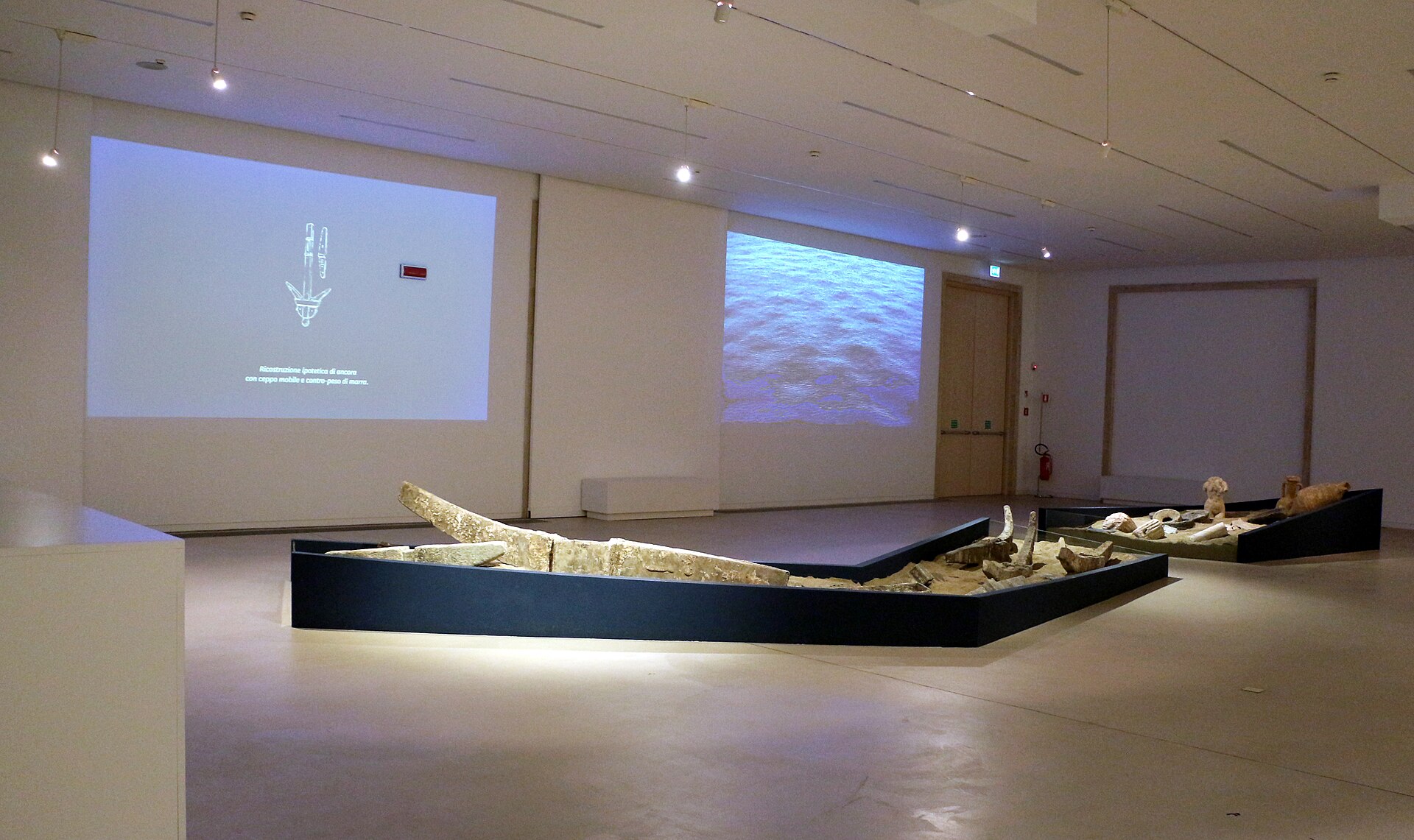
The history of the city itself, from the Chalcidian colony of Rhegion through Roman Regium Iulii, including bucchero pottery evidencing Etruscan contact, locally minted coins bearing a frontal lion's head, terracotta ballot tokens used in local elections, African red-slip tableware traded across the Roman Mediterranean, lead anchor stocks and amphorae from the ancient harbour, and, at the heart of the level in a separate climate-controlled hall, the Riace Bronzes together with the bronze fragments, amphorae and inkwells recovered from the Porticello wreck of the late 5th century BC.
A Hellenistic-period necropolis of roughly 100 tombs (4th-2nd century BC), discovered in 1932 during construction of the museum's own foundations and left in place beneath the building; the Lapidario, a collection of monumental inscriptions, marble bases, capitals and architectural fragments from Greek and Roman sites across Calabria, begun in 1882 around the visit of the German historian Theodor Mommsen; and the museum's temporary exhibition galleries.
Two life-size bronze warriors of the 5th century BC, recovered from the sea off Riace Marina in 1972, cast by the lost-wax technique with inlaid calcite-and-glass-paste eyes and copper and silver anatomical detailing; among the very few large-scale original Greek bronzes to survive, and the museum's defining holding8
Full record in this archiveA bearded bronze head recovered from the Porticello shipwreck of the late 5th century BC, alongside the Riace Bronzes one of the museum's principal survivals of large-scale Greek portrait sculpture, described by the museum itself as a rare and compelling example of ancient portraiture21
A second bronze head from the same shipwreck cargo as the Philosopher, presented by the museum alongside it as part of the same rare group of large-scale bronze fragments recovered from Porticello21
A statue group of the Dioscuri from one of Magna Graecia's most important sanctuary sites, evidence of the scale and quality of cult sculpture produced in Greek Calabria6
Terracotta votive plaques and figurines from the Persephone sanctuaries of Locri, among the richest surviving bodies of evidence anywhere for Greek sanctuary practice and belief6
A cast of one of the oldest artistic testimonies in Calabria, a rock engraving from between 120,000 and 12,000 years ago, opening the museum's chronological span at the other end from the Bronzes9
Pottery, amphorae, inkwells and the bronze heads recovered from a merchant ship that sank off Porticello, a rare intact snapshot of Mediterranean sea trade in the classical period21
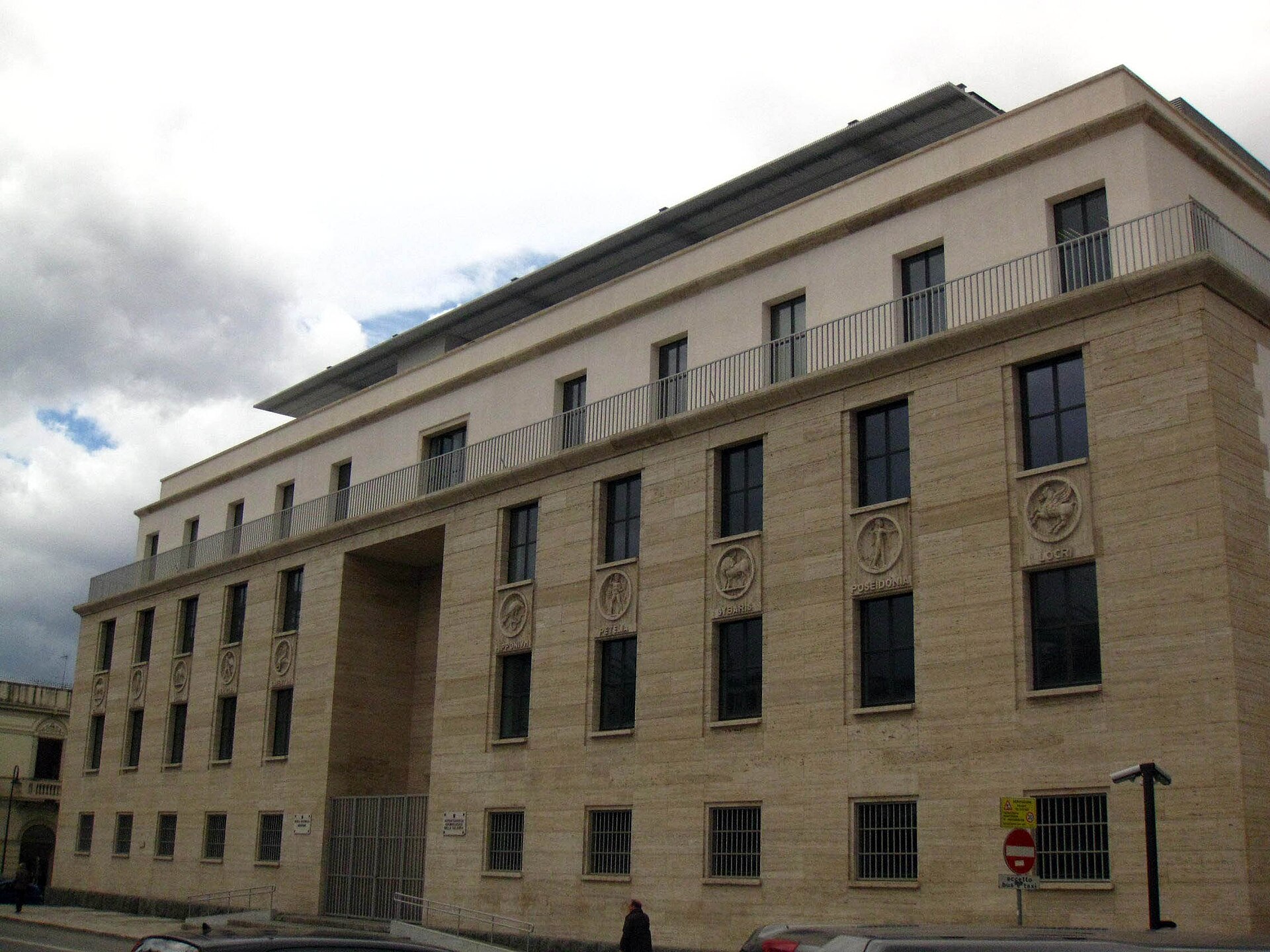
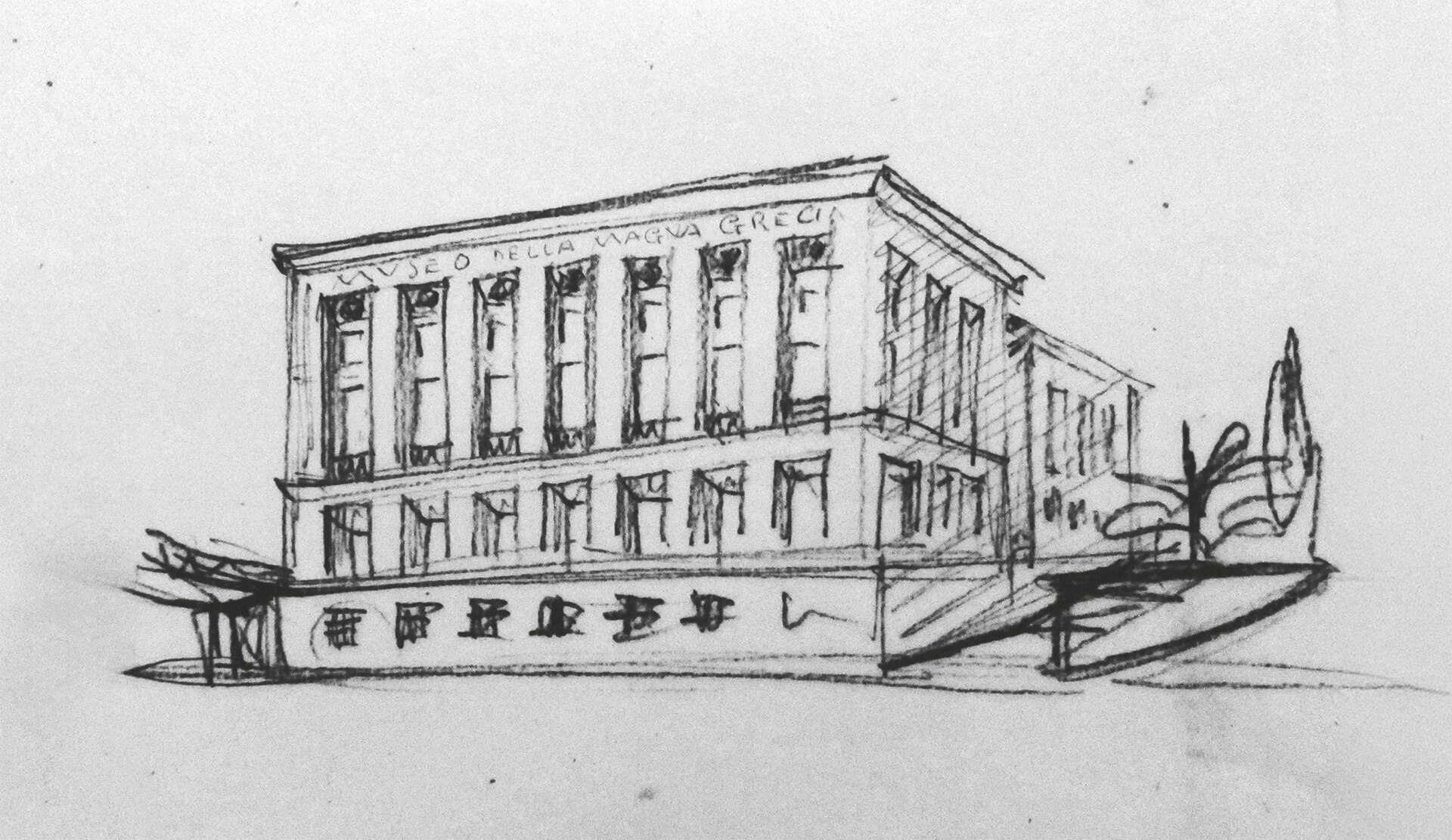
The Museo Archeologico Nazionale di Reggio Calabria occupies the Palazzo Piacentini, a rationalist building on Piazza De Nava that the museum's own history describes as the first building in Europe conceived and built specifically to house an archaeological collection. Its origin lies in a civic museum opened in Reggio Calabria on 18 June 1882, gathering local archaeological finds, Risorgimento memorabilia and paintings in the spirit of the newly unified Italian state. The city's archaeological holdings were reorganised after the catastrophic earthquake of 28 December 1908, which destroyed most of Reggio Calabria. Paolo Orsi, appointed in 1907 to head the Soprintendenza Archeologica della Calabria and already responsible for major excavations across the region, proposed using the rebuilding of the city as the occasion to create a single national museum uniting state excavation finds with the surviving civic collections.
Construction of the purpose-built museum, designed by the architect Marcello Piacentini, began in 1932, with the prince of Piedmont laying the first stone that May; the building itself is faced in travertine over a base of black lava ashlar (bugnato), a deliberately monumental rationalist statement for a young cultural institution. Work was interrupted by the Second World War, and the collections held in the new building were not reunited and put on coherent public display until 1954, with the museum's official inauguration following in 1959. Further galleries opened over the following decades: prehistory and Locri rooms in 1962, the lapidarium and picture galleries in 1969, a numismatic gallery in 1973, and, in 1981, a dedicated underwater archaeology section created specifically to house the two bronze warriors recovered off Riace nine years earlier.
The museum closed in 2009 for an extensive programme of structural restoration and gallery redesign, reopening completely renewed in 2016 after seven years of work. The central courtyard, named for Paolo Orsi, was roofed in glass as part of that renovation and given a tensile steel canopy by ABDR Architetti Associati, becoming the building's new functional and symbolic centre and the venue for the terrace events the museum now runs looking out over the Strait of Messina. Since 2014 the museum has held special autonomous status within Italy's state museum system, giving its director budgetary and organisational independence from the regional superintendency, one of a cohort of institutions granted that status in the Franceschini reform of Italian cultural administration.
The permanent collection is arranged on four exhibition levels plus a fifth given over to temporary shows, tracing the whole of Calabria's ancient history as a single continuous argument rather than as isolated period rooms. Level A opens with the earliest human presence in the region: a cast of the Bos primigenius engraving from the Grotta del Romito at Papasidero, among the oldest artistic testimony anywhere in Calabria, alongside Neanderthal and early Homo sapiens remains, Neolithic tools and figurines, and Bronze and Iron Age jewellery and grave goods, including an ivory statuette of Minoan derivation from Punta di Zambrone that is read as evidence of contact with the eastern Mediterranean many centuries before Greek colonisation proper.
Level B follows the Greek colonisation of the coast from the 8th century BC, through the coinage, inscriptions and sanctuary deposits of city-states including Sybaris, Kroton, Medma and Hipponion, and the great sanctuary sites of Locri Epizefiri, whose votive deposits to Persephone are among the richest such collections to survive from the Greek world anywhere. Level C, on the mezzanine, turns from cities and cults to daily life and death: the theatre and residential quarters of Locri, one of Magna Graecia's most important collections of bronze mirrors, and grave goods from roughly 1,500 tombs at the Metauros necropolis, read alongside Hellenistic-period elite burials of the Italic Lucanian and Bruttian peoples who bordered Greek Calabria.
Level D narrows the focus to the city in which the museum itself stands, from the Chalcidian colony of Rhegion through its Roman incarnation as Regium Iulii, before opening into the climate-controlled hall that holds the museum's most famous objects. Level E, finally, sits partly below ground: a Hellenistic necropolis of roughly a hundred tombs was discovered in 1932 during construction of the museum's own foundations and has been left in place and opened to visitors, guided on certain days by volunteers of the Touring Club Italiano, alongside the Lapidario of inscriptions and architectural fragments begun in 1882 around a visit to the city by the German historian Theodor Mommsen.
In August 1972 the chemist Stefano Mariottini, diving off Riace Marina roughly 200 metres from shore, found two bronze figures lying at a depth of about eight metres. What came up were two over-life-size bronze warriors of the 5th century BC, cast by the lost-wax process with eyes of calcite and coloured glass paste and lips, teeth and nipples worked in copper and silver, technical refinements that survive in remarkably few large Greek bronzes anywhere. Both statues originally carried separate attachments, likely a shield, spear and helmet, now lost; Statue A wears a fillet in its hair and a worked beard, while Statue B, bareheaded, is thought to have worn a raised helmet now missing. After initial recovery and stabilisation work in Reggio Calabria, both bronzes were sent to Florence for a more extensive restoration before returning to Calabria, where they have since been restored again at the museum itself. Scientific analysis of the casting earths recovered from inside the statues points to two separate origins in Greece, one consistent with Attica and the other with the Argolid, suggesting the two figures were cast in different workshops even though they were found together.
What the Bronzes represent is still argued over: proposals range from athletes to heroes of Greek myth to actual divinities, and the museum itself, in its own published account, states plainly that the identification remains unresolved. How and why two such valuable bronzes came to rest on the seabed off a stretch of Calabrian coast is equally unsettled; no wreck has ever been located at the find site despite two limited excavation campaigns and repeated sonar surveys, including a further search launched around the 2022 half-century anniversary of the discovery, prompted partly by Mariottini's own recollection of having seen what looked like more than two figures on the seabed, and by 2004 sonar data suggesting further buried metal nearby. That the wreck itself has never been found, after more than fifty years of looking, is one of the more genuinely unresolved questions attached to any object in this archive.
Access to the room holding the Riace Bronzes is deliberately restricted for conservation reasons: visitors pass through a filtered antechamber before entering a small, environmentally controlled hall, and staff manage the flow of visitors through it. Several visitors describe that management as too brisk, allowing only a minute or two of actual viewing time in front of each figure before being moved on, a complaint that recurs often enough in visitor accounts to be a genuine, specific criticism of the visit rather than an isolated one.
Three years before the Riace find, in 1969, a different shipwreck was located off Porticello, carrying a cargo dated to the late 5th or early 4th century BC: pottery, amphorae, writing equipment and fragments of bronze statuary, broken up by the sinking or by subsequent salvage attempts in antiquity. Among the bronze fragments recovered were two heads, one a bearded face that the museum itself calls the Testa del Filosofo, the Head of the Philosopher, and describes as a rare and genuinely arresting example of ancient portrait sculpture, and a second head the museum's own collection material refers to as the Testa di Basilea. Both are displayed on Level D alongside the wider Porticello cargo, in the same run of galleries that leads into the Riace Bronzes hall.
The Porticello heads receive a small fraction of the attention paid to the Riace warriors, despite representing the same rare category of surviving large-scale Greek bronze portraiture and coming from the same stretch of Calabrian coast within a few years of each other. Read together, the two eastern Ionian Sea wrecks describe a much larger and less romantic fact about the ancient Mediterranean than either shipwreck alone: that valuable bronze statuary moved by sea between Greece and its western colonies routinely enough that at least two such cargoes, from two different vessels, ended up on the seabed off the same short section of Calabrian coast within a handful of years of each other in the classical period.
The museum stands on Piazza De Nava in the centre of Reggio Calabria, a short walk from the Lungomare Falcomata seafront and from the Lido railway station, and is open Tuesday to Sunday, 9:00 to 20:00, with last entry at 19:30 and last ticket sales at the same time; it is closed on Mondays. Standard admission has stood at 10 euro since a tariff revision that took effect on 1 July 2024, alongside a reduced 2 euro rate for visitors aged 18 to 25 and a set of named annual passes introduced at the same time, intended by the museum's own account to let repeat local visitors explore the collection gradually across a year rather than in one visit. Under-18s and the categories set out in Italian ministerial decree D.M. 507/1997 are free at all times. The building is step-free with lifts to every exhibition level, offers tactile materials and audio guides for blind and partially sighted visitors, and provides a free cloakroom; an unguided visit takes around ninety minutes, longer with a guide or with the underground necropolis, which volunteers of the Touring Club Italiano staff on specified days.
Set against a collection of this depth, what the museum has not yet resolved reads as a short list rather than a long one. The identification of the two Riace warriors, as athletes, heroes or gods, remains an open question in the museum's own account, as does the location of whatever vessel originally carried them, a question active enough in 2022 to justify a fresh, costed underwater search near the fiftieth anniversary of their discovery. The 2024 tariff increase and the accompanying subscription model are recent enough that their effect on visitor numbers and on the museum's finances has not yet been independently assessed in any source consulted for this record. And the practical friction visitors describe most often, the short, closely marshalled viewing time inside the Bronzes hall itself, sits oddly next to a museum otherwise praised for giving visitors as much time as they want on four full levels of everything that came before and after the two most famous objects in the building.
Visitors consistently treat the Riace Bronzes as reason enough on their own to visit, and go on to describe a modern, clearly organised museum that rewards the extra time spent on the four other levels of Calabrian prehistory, Greek and Roman material. The most repeated practical complaints are not about the collection but about the visit to the Bronzes hall itself, which some visitors find too rushed, and about the lack of a cafe and the modest size of the shop.
Tripadvisor: 4.5 from 3,090 ratings, read 5 August 2026
A platform average is a tertiary source: it moves, it is not audited, and we quote no visitor's words.
Piazza De Nava 26, 89123 Reggio Calabria RC, Italy (visitor entrance); offices at Via Domenico Romeo 2.
Ordinario (adult): EUR 10; Ridotto giovani, 18-25: EUR 2; Under 18: free; MArRC GOLD (annual pass): EUR 22; MArRC FAMILY (annual pass): EUR 40. As confirmed 5 September 2026.
Tuesday-Sunday 09:00-20:00. Closed: Monday. As confirmed 5 September 2026.
Rail: Reggio Calabria Lido station: exit onto Piazza Indipendenza, cross it and take Via Vollaro; the museum entrance is about two minutes on foot; Rail: Reggio Calabria Centrale station: exit onto Piazza Garibaldi, follow Via Bixio, Via Pepe and Corso Vittorio Emanuele to Via Vollaro; numerous urban bus lines (5, 6, 7, 10, 11, 14, 17, 18, 103, 107, 115, 119, 121, 122, 123, 124) also connect from Centrale; Ferry/hydrofoil: About ten minutes on foot from the hydrofoil (aliscafi) terminal, via Viale D. Genoese Zerbi to the Piazza Indipendenza roundabout and then Via Vollaro; Air: Reggio Calabria "Tito Minniti" airport connects by urban bus lines 27, 28, 113, 115, 118, 119 and 122, or by car via the A3 motorway northbound, exiting at "Reggio Calabria Porto".
The Riace Bronzes (Unknown Greek workshop(s), Attica and the Argolid); Testa del Filosofo (Head of the Philosopher) (Unknown Greek sculptor, 5th century BC); Testa di Basilea, from the Porticello wreck (Unknown Greek sculptor, 5th century BC); The Dioscuri group from the Marasa sanctuary, Locri (Unknown Greek sculptor); The pinakes and votive deposits of Locri Epizefiri (Greek workshops of Locri, 6th-5th century BC); The Bos primigenius engraving, Grotta del Romito (Palaeolithic hunter-artist, Papasidero).
One artwork and its story every Tuesday, with the picture: who owned it, what it made, and what closes soon in the exhibition calendar. No promotion, and nothing we cannot cite.
We send one email to confirm the address and keep nothing else. Every letter carries a one-click unsubscribe. How we handle your data.


