Cameo: Head of Diana
Unidentified Roman cameo-glass cutter (workshop not recorded) · 25 BCE - 100 CE
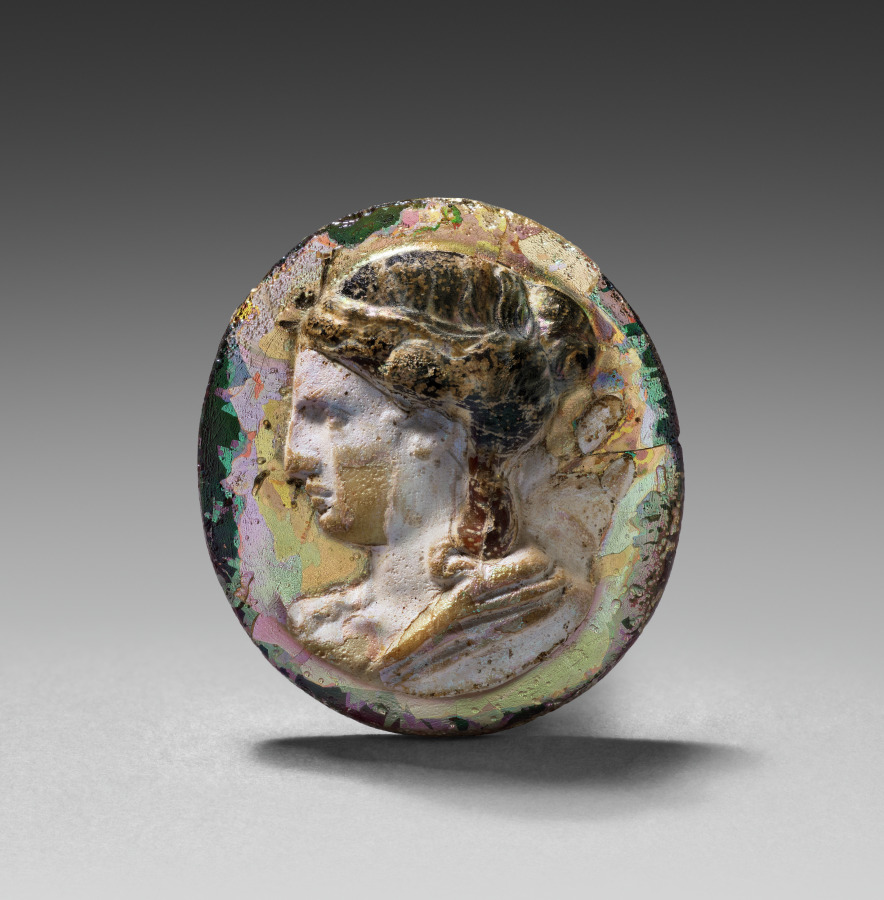
The head of Diana in white glass relief on a dark ground, facing left, with the iridescent weathering film at the rim. Cleveland Open Access, CC0.
| Artist | Unidentified Roman cameo-glass cutter (workshop not recorded) |
|---|---|
| Date | 25 BCE - 100 CE |
| Medium | Glass, at least four fused layers, carved in relief |
| Dimensions | Overall 3.7 x 3.3 cm (1 7/16 x 1 5/16 in.) |
| Where it is now | The Cleveland Museum of Art, gallery 103 Romanlast confirmed |
| Inventory number | 1965.465 |
| Attribution | UnknownCleveland lists no maker, no workshop and no find spot. Full note |
| Object type | Glass |
| Period | Roman, early Imperial |
| Cases | Has a provenance gap |
| Inscriptions | None recorded |
| Owners on record | 6 links4 documented, 2 unknown |
| Sources | 17 cited |
About this record Last verified · 17 sources cited · Change log
On this page 9 sections
ContentsClose
A Roman cameo in layered glass, 3.7 by 3.3 centimetres, showing the head of Diana in white relief on a dark ground, dated by the Cleveland Museum of Art to 25 BCE to 100 CE. It entered the museum in 1965 as a gift of the New York dealer J. J. Klejman and his wife, and has no recorded find spot or maker.
Cleveland's provenance has three lines: Bronislaw Huberman, a loan to the Kunsthistorisches Museum in Vienna for 25 years, and the museum. None carries a date or a source. The museum does not say that this is the violinist, no biography consulted mentions that he collected antiquities, and how the piece passed to Klejman is not recorded. This record sets out the gaps as gaps.
Provenance
Each link is graded. Documented: a cited source supports it. Disputed: the identification is argued but not established. Unknown: no owner for that span, and the gap is not smoothed into a narrative. The grades in the glossary.
- 25 BCE - 100 CE - unknownUnknown (maker, findspot and early owners not recorded)unknown
Cleveland records no find spot and no owner before the entry naming Bronislaw Huberman.13
- unknown - unknownBronislaw Hubermandocumented
Named as the first owner in Cleveland's provenance, with no date, place, mode of acquisition or citation. A statement by the museum only. The museum does not identify him; the name matches the violinist (1882-1947), who lived in Vienna until 1937 and died in Switzerland, but that identification is circumstantial and is not made by Cleveland. No source consulted says he collected antiquities. His Stradivari thefts of 1919 and 1936 are unrelated to this object.23678
- unknown - unknownUnknown (how the cameo left Huberman or his estate)unknown
Nothing records whether Huberman lent it personally, whether it passed to heirs after his death on 16 June 1947, or who the lender was. His papers and musical estate went to a Tel Aviv library; nothing on the rest of his estate was found.267
- unknown - 1965Kunsthistorisches Museum, Vienna (on loan, for 25 years)documented
Cleveland's provenance reads on loan to Kunsthistorisches Museum, Vienna for 25 years. No dates, lender or source given. If the loan ended in 1965 it began about 1940, which is arithmetic and not a record. Not confirmed from the Vienna museum's side.23
- unknown - 1965J. J. Klejman (John Jacob Klejman, 1906-1995), New York dealer, and Mrs. Klejmandocumented
Donors in the credit line. Cleveland's provenance does not list them as owners and does not record when or from whom they acquired the cameo; the transfer from the Huberman line to the Klejmans is a gap.134910
- 1965 - presentThe Cleveland Museum of Artdocumented
Gift of Mr. and Mrs. J. J. Klejman, accessioned 6 November 1965 as 1965.465; shown in the Golden Anniversary of Acquisitions, 10 September to 16 October 1966. Listed in gallery 103 Roman.123
Technical evidence
| Attribution note | Cleveland lists no maker, no workshop and no find spot. The culture is given as Italy, Roman. Roman cameo glass is not signed, and where the early pieces were made is not established: the capital is the usual scholarly guess and Syrian glassworkers are suggested as makers of the glass blanks. |
|---|---|
| Object | Cameo: Head of Diana; Cleveland Museum of Art accession 1965.465 (open-access object id 141925)13 |
| Date | 25 BCE - 100 CE (earliest -25, latest 100 in the open-access data)13 |
| Culture | Italy, Roman3 |
| Medium | Glass13 |
| Dimensions | Overall 3.7 x 3.3 cm (1 7/16 x 1 5/16 in.)13 |
| Layers | At least four fused layers per Cleveland: dark (hair), whitish (skin), middle tone (background), dark purple (base)3 |
| Subject | Diana, facing left, hair bound at the back, quiver over the shoulder (Cleveland's description)13 |
| Inscriptions | None recorded3 |
| Find spot | Not recorded3 |
| Surface | Iridescent weathering film, described by Cleveland as having developed over thousands of years13 |
| Credit line and accession | Gift of Mr. and Mrs. J. J. Klejman; accession date 6 November 19653 |
| Location | Gallery 103 Roman (the museum's page and data also name the David and Inez Myers Foundation Gallery in the donor text)13 |
| Cleveland publications | Lee 1966 (Bulletin 53, no. 7, ill. p. 186, no. 3); Journal of Glass Studies 9 (1967), ill. p. 133, no. 5; Cooney 1968 (Bulletin 55, no. 4, ill. fig. 2)3 |
| External identifiers | Wikidata Q60746969; two Internet Archive image sets, one titled Head of Diana and one Head of Artemis3 |
| Licence | Images and data CC0 (Cleveland Open Access)3 |
Images
The record in full
Chapter 1A goddess cut from four layers of glass, 3.7 centimetres high
The Cleveland Museum of Art catalogues this as a cameo of the head of Diana, Roman, glass, 25 BCE to 100 CE, 3.7 by 3.3 centimetres overall.
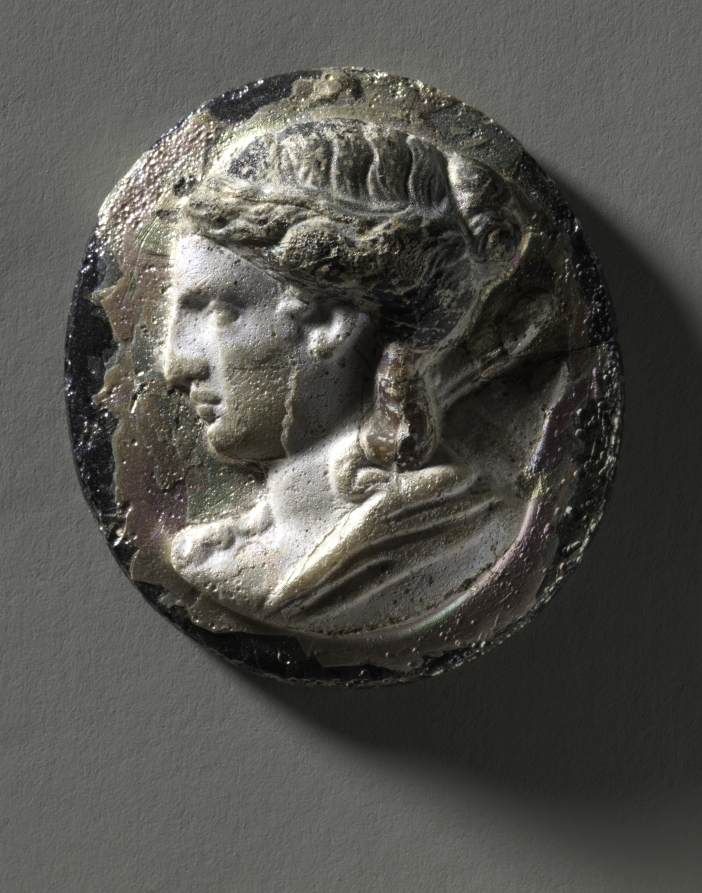
The Cleveland Museum of Art catalogues this as a cameo of the head of Diana, Roman, glass, 25 BCE to 100 CE, 3.7 by 3.3 centimetres overall. Cleveland's description reads the subject as the Roman goddess of the hunt, known to the Greeks as Artemis, facing left with her hair bound at the back of her head and her quiver of arrows visible over her shoulder. The museum's photographs show a white, close-cut profile and bust standing in relief against a darker ground, in an oval with a worn rim.
It is a small object by any measure, made to be held in the hand or set in a mount, and it belongs to the gem-sized end of a craft best known for large vessels. Its history, so far as anyone has written it down, is three lines in a museum database: a named owner with no dates, a loan to Vienna, and a gift to Cleveland in 1965. This record sets out what those three lines say, what they do not say and what is known about the things around them.
Chapter 2How a layered glass becomes a cameo
Cleveland states that Roman cameo glass was made by fusing layers of differently coloured glass on top of one another and then carving down to reveal each colour.
Cleveland states that Roman cameo glass was made by fusing layers of differently coloured glass on top of one another and then carving down to reveal each colour. It counts at least four layers in this piece: a dark layer for the hair, a whitish layer for the skin, a middle tone for the background and a dark purple layer for the base. The Corning Museum of Glass defines cameo glass in the same terms, a base of one colour covered by contrasting layers that are then shaped into a raised design, and states that the first cameo glasses were made by the ancient Romans. Corning's guide describes cutting as grinding with rotating wheels of stone, wood or cork under running water, and carving as removal with hand-held tools.
How the big vessels were formed is still argued. The Wikipedia summary of the subject, a tertiary source flagged below for replacement with Whitehouse's catalogues, records the standard account that the white layer of the Portland Vase was applied by dipping a blown bubble into white glass and cut away when cold, and the dissenting proposal of Rosemarie Lierke that Roman cameo glass was moulded rather than cold-cut. Both arguments concern vessels and plaques. No source consulted discusses how this particular piece was made, and Cleveland does not say whether the relief was cut or moulded and finished.
The same summary notes that early pieces usually have fully opaque layers, white over blue as on the Pompeii vase or white over black as on the Portland Vase, that ancient workers used drills and wheels, and that the site of production is unknown. A dark base with a pale subject is consistent with those habits, but this is a description of the family of objects and is not a finding about this one.
Chapter 3The subject and what it meant
Diana was an Italian goddess with her own cult at Nemi, and was identified with Artemis under Greek influence, taking over her appearance and attributes: a short tunic, a bow and quiver, deer and...
Diana was an Italian goddess with her own cult at Nemi, and was identified with Artemis under Greek influence, taking over her appearance and attributes: a short tunic, a bow and quiver, deer and hunting dogs, and the crescent moon. For educated Romans she was usually shown in her Greek guise. Her cult at Rome was long attached to Apollo, in the Campus Martius temple and later the temple of Apollo on the Palatine. That is the documented background to a head of Diana in Roman art in general.
Whether this head was meant as Diana alone or as a portrait wearing her attributes is not discussed in any source consulted. Cleveland reads it as the goddess, and this record follows the museum. No inscription, no mount, no ring bezel and no findspot survive to say what the object was for, so its function, whether a ring stone, an ornament sewn or set into something larger, or an inset for furniture or a vessel, is unknown. No hidden or specialist programme attaches to this object in any source found. The absence of one is a finding. The ordinary meaning of a Roman hunt goddess in profile is the whole documented meaning.
Chapter 4The date range and what it can and cannot tell
Cleveland dates the piece 25 BCE to 100 CE, a span of about a century and a quarter.
Cleveland dates the piece 25 BCE to 100 CE, a span of about a century and a quarter. The tertiary summary of Roman cameo glass puts the early period of production at about 30 BC to AD 60, and calls those dates somewhat tentative. The Portland Vase is usually dated AD 1 to 25 by the British Museum, with a 1990 study by Gudenrath, Painter and Whitehouse proposing 30 to 20 BC and low BC dates still having some scholarly support. Cleveland's range therefore begins inside that early period and runs about forty years past its usual end. The museum gives no reason for the later bound. It may reflect the possibility that small gem-like cameo glass continued to be made after the great vessels stopped, which the tertiary summary raises as a possibility, but no source consulted ties that to this object.
There is no stylistic study of this cameo in any source consulted, so the date is the museum's and nothing more specific has been confirmed here.
Chapter 5Bronislaw Huberman: a name with no dates
The first line of Cleveland's provenance reads simply Bronislaw Huberman.
The first line of Cleveland's provenance reads simply Bronislaw Huberman. There is no date, no place, no mode of acquisition and no citation under it. The museum does not say that this is the violinist, though the name is the same as that of the Polish-born violinist (1882-1947) who founded the Palestine Orchestra in 1936, lived and performed in Vienna and left it in 1937 for Switzerland, where he died on 16 June 1947. A Vienna link is the only circumstantial support for the identification in the sources consulted, and it is circumstantial only: Cleveland does not make it.
None of the biographies read for this record mentions that Huberman collected antiquities, glass or gems. The Wikipedia article says nothing about collecting beyond his violins, Encyclopedia.com and the Porta Polonica biography are likewise silent, and the last records only that portraits of him were made by Emil Orlik and Lesser Ury. That silence is a limit of what was searched, not proof that he did not collect. It does mean that the record cannot say where or when he acquired a Roman glass cameo, what else he owned, or whether he bought it at all rather than receiving or inheriting it.
One caution belongs here. Huberman's famous Stradivari, later called the Gibson, was stolen in Vienna in 1919 and recovered within three days, and was stolen again in 1936 at Carnegie Hall. That is a story about a violin. Nothing in Cleveland's entry or in any source consulted connects either theft to this cameo, and the two must not be joined.
Chapter 6The Vienna loan
The second line of the provenance says the cameo was on loan to the Kunsthistorisches Museum in Vienna for 25 years.
The second line of the provenance says the cameo was on loan to the Kunsthistorisches Museum in Vienna for 25 years. Cleveland gives no dates, no lender, no loan number and no source. The line sits between Huberman and Cleveland's own entry dated 1965, so the natural reading is that the loan came before the gift, but the museum does not say that it ended in 1965 or began at any year.
If the 25 years ended in 1965, the loan began around 1940. That is arithmetic and not a record. It would put the start after Huberman left Vienna for Switzerland in 1937 and before his death in 1947, and the last two thirds of it after his death, which would make a lender other than Huberman himself possible, such as an heir, an executor or an agent. Every one of those possibilities is open, and none is documented. Who arranged the loan is not recorded in any source consulted.
The institution itself is documented separately. The Kunsthistorisches Museum's antiquities collection began in 1798 as the imperial coin and antiquities cabinet, moved into the museum building in 1891, and counts its ancient cameos, with the Gemma Augustea bought by Rudolf II, among its highlights. The Gemma Augustea is a two-layered onyx cameo of the first decades AD, a stone object and not a glass one, and it is not a comparable for this piece beyond showing the museum's strength in the field. Whether the Kunsthistorisches Museum recorded the loan, under what inventory number and in which catalogue, has not been established.
Chapter 7J. J. Klejman and the 1965 gift
The credit line reads Gift of Mr. and Mrs.
The credit line reads Gift of Mr. and Mrs. J. J. Klejman, and the cameo entered Cleveland on 6 November 1965 according to the museum's open-access data. John Jacob Klejman (1906-1995) was a Polish-born dealer who worked in New York, with a gallery on Madison Avenue. The sources consulted give conflicting accounts of its address and years: 982 Madison Avenue is cited for about 1962 to 1964 in museum records, and sales and invoices appear in museum records from 1954 to 1972. His stock ran from African and Asian art to Near Eastern, Byzantine and Roman objects. Cleveland's database lists Klejman as donor on objects accessioned between 1965 and 1970, from a Roman-period intaglio to a Buddhist mandala and objects of the nineteenth century.
Cleveland's provenance for this cameo does not name Klejman as an owner. He appears only in the credit line, and the entry carries no date or terms for how he acquired the piece or from whom. Whether he bought it from Huberman, from the Huberman family or through another dealer is unrecorded. A neighbouring gift of the same day, the rock crystal intaglio 1965.464, has a different chain in Cleveland's entry: P. Donath, Budapest, then Mr. and Mrs. J. J. Klejman. That chain is for that object only and says nothing about the cameo.
Klejman's reputation is part of the secondary record. Thomas Hoving, in his memoir Artful Tom, as quoted in a compilation of search extracts on a provenance blog and repeated in a Wikidata entry, called him one of his favourite dealer-smugglers. That is Hoving's characterisation, offered in a memoir and not a finding, and no source consulted links it to this object. Klejman's own account of how he formed a different collection, reported by the New York Times in 1973, is likewise about other objects. For a cameo whose earlier history is not recorded, the point is the limit and not the allegation: a dealer's name in a credit line is not a provenance.
Chapter 8Published, shown and listed after 1965
Cleveland records three publications. Sherman E.
Cleveland records three publications. Sherman E. Lee's catalogue of the Golden Anniversary Acquisitions, in the Bulletin of the Cleveland Museum of Art 53, no. 7 (1966), pages 181 to 284, illustrates it on page 186 as number 3. The Journal of Glass Studies 9 (1967), pages 133 to 143, in its list of recent important acquisitions, illustrates it on page 133 as number 5. John D. Cooney's article Intaglios, Cameos, and Related Works, in the Bulletin 55, no. 4 (1968), pages 113 to 119, illustrates it as figure 2. None of the three was read for this record, so what each says about the cameo's origin or the loan is unchecked.
Cleveland lists three exhibitions, and the first is the logical one: Golden Anniversary of Acquisitions, at Cleveland, 10 September to 16 October 1966, a show of the museum's recent acquisitions in the year after the gift. The other two, Italian Drawings from the Permanent Collection (16 December 1986 to 1 March 1987) and Collecting Drawings in England (3 November 1987 to 17 January 1988), are exhibitions of drawings, and the museum gives no reason that a glass cameo would belong in either. This may be a linking error in the museum's database. It has not been resolved here and the two listings are reported as Cleveland gives them.
Chapter 9Surface and condition
Cleveland's note for visitors says that ancient glass did not glitter and that the iridescent film on this cameo developed over thousands of years.
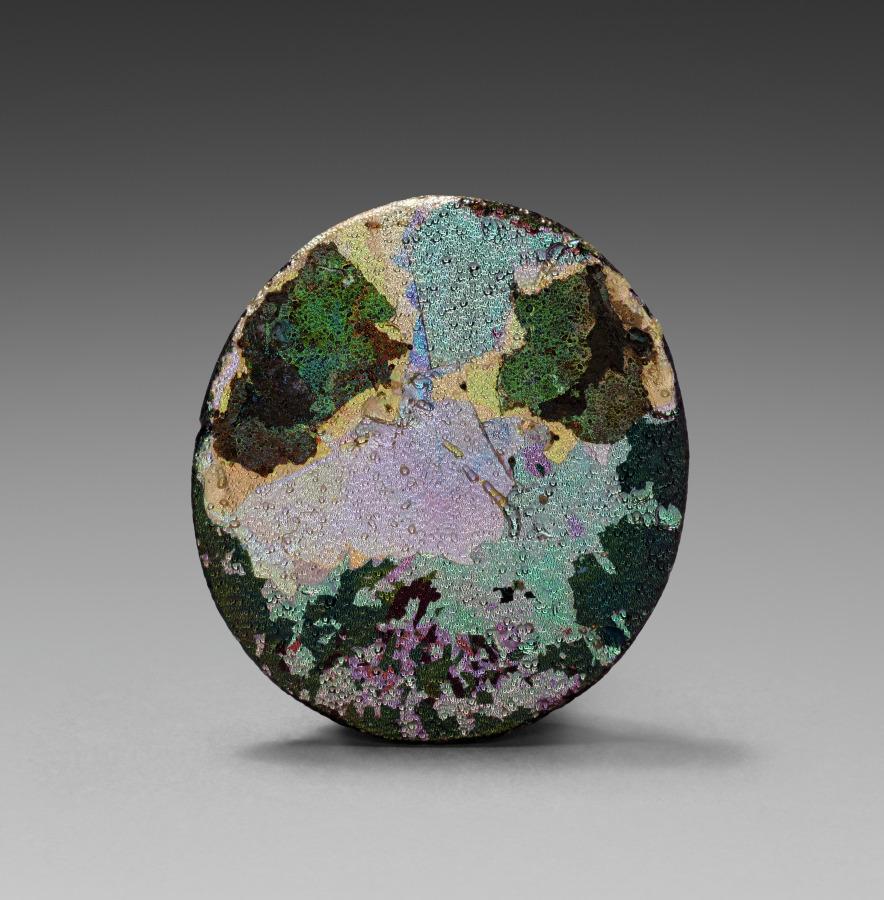
Cleveland's note for visitors says that ancient glass did not glitter and that the iridescent film on this cameo developed over thousands of years. The museum's photographs bear that out. The face and neck are a pale, slightly chalky white, and the rim and the back are covered in a thick weathering crust that shows pinks, greens, golds and violets. The back view shows large areas of surface loss and a broken edge. A fine crack crosses the neck in the front views. Cleveland publishes no conservation statement and no technical report for the piece, and the object has no recorded restoration. These notes are read from the museum's own images and are not a condition report.
Chapter 10What not to mistake it for
Several objects share its words. Cleveland also holds the Cameo of Zeus and Hera Enthroned (1966.131), a late-nineteenth-century work from the Klejman Study Collection, and a Cameo: Head of a Woman...
Several objects share its words. Cleveland also holds the Cameo of Zeus and Hera Enthroned (1966.131), a late-nineteenth-century work from the Klejman Study Collection, and a Cameo: Head of a Woman (1958.92), dated 1 to 100 CE, a bequest of Leonard C. Hanna Jr. Neither is this object. The Portland Vase and the large cameo vessels are different objects of a different scale, and other glass cameos of Diana in other museums are not this one. The Gemma Augustea in Vienna is a stone cameo and has no connection with the Cleveland glass beyond the city where this piece was lent.
The artist
Roman cameo-glass cutters (early Imperial workshops)
No maker is recorded for this cameo and none can be named. The record therefore treats the craft as the subject: a luxury glass technique of the early Roman Empire, known from about 200 fragments and 15 complete objects in the early period, whose workshops are unlocated and whose cutters are anonymous.
Related works
| Work | Relation | Where it is |
|---|---|---|
| Portland Vase Unidentified Roman glass cutter | The best-known Roman cameo glass, for the technique and the dating debate only; not this object Dated AD 1-25 by the museum; a 1990 study proposed 30-20 BC. Acquired by the museum in 1945. | British Museum, London |
| Gemma Augustea Attributed to Dioscurides or a pupil | Stone cameo in the Kunsthistorisches Museum, Vienna, where this cameo was lent; not a glass piece Double-layered onyx, dated to the second or third decade of the first century AD; bought by Rudolf II after theft from Fontainebleau in 1590. | Kunsthistorisches Museum, Vienna |
| Intaglio with the Tail of a Sea Monster (1965.464) Unidentified | Gift of the same donors in the same accession year; different object and different chain Rock crystal and gilt silver, 300s CE, Early Christian; Cleveland's provenance reads P. Donath, Budapest; Mr. and Mrs. J. J. Klejman, New York. | Cleveland Museum of Art |
| Cameo: Head of a Woman (1958.92) Unidentified | Another Roman cameo at Cleveland; not this object Dated 1-100 CE; Bequest of Leonard C. Hanna Jr. | Cleveland Museum of Art |
| Cameo of Zeus and Hera Enthroned (1966.131) Unidentified | Another Klejman gift at Cleveland; not this object Dated late 1800s; Klejman Study Collection. | Cleveland Museum of Art |
Open questions
- Is the Bronislaw Huberman in Cleveland's provenance the violinist of that name (1882-1947)? Cleveland gives no dates or description, and the Vienna link is circumstantial.
- Did Huberman collect antiquities at all? No biography consulted mentions it. When, where and from whom did he acquire a Roman glass cameo, if he did?
- Who lent the cameo to the Kunsthistorisches Museum, and in which years? Cleveland gives only 25 years. If the loan ended in 1965 it began about 1940, after Huberman left Vienna and before he died.
- Who arranged the loan, and does the Kunsthistorisches Museum hold a loan record or an inventory entry?
- How and when did the cameo pass from Huberman or his heirs to J. J. Klejman? Cleveland's provenance omits Klejman as an owner, and Huberman's estate after 1947 is not documented in any source consulted.
- Why does Cleveland attach two drawings exhibitions of 1986-88 to a glass cameo? Is it a database linking error?
- What do the three Cleveland publications of 1966-68 say about its origin and the loan? None has been read for this record.
- Was it a ring stone, an inset or an ornament? No mount, bezel or find spot is recorded.
- Is the head Diana alone or a portrait with her attributes? No source consulted takes up the question.
- Was the relief cut or moulded? No technical examination is published.
Questions about this object
What is Cameo: Head of Diana?
Cameo: Head of Diana is a glass, dated 25 BCE - 100 CE. Medium: Glass, at least four fused layers, carved in relief.
Who made Cameo: Head of Diana, and is the attribution settled?
The attribution to Unidentified Roman cameo-glass cutter (workshop not recorded) is recorded here as unknown. Cleveland lists no maker, no workshop and no find spot. The culture is given as Italy, Roman. Roman cameo glass is not signed, and where the early pieces were made is not established: the capital is the usual scholarly guess and Syrian glassworkers are suggested as makers of the glass blanks.
Where is Cameo: Head of Diana now?
The Cleveland Museum of Art, gallery 103 Roman. Inventory number 1965.465. Last confirmed 23 November 2026. Gift of Mr. and Mrs. J. J. Klejman; accessioned 6 November 1965.
What is still unknown about Cameo: Head of Diana?
Is the Bronislaw Huberman in Cleveland's provenance the violinist of that name (1882-1947)? Cleveland gives no dates or description, and the Vienna link is circumstantial.
Sources
- 1The Cleveland Museum of Art, collection page, Cameo: Head of Diana, 1965.465 (description, credit line, gallery, Did You Know note). clevelandart.org/art/...
- 2The Cleveland Museum of Art, print page for 1965.465 (provenance read verbatim: Bronislaw Huberman; on loan to Kunsthistorisches Museum, Vienna for 25 years; The Cleveland Museum of Art 1965-; exhibition history; citations). clevelandart.org/print/...
- 3Cleveland Museum of Art Open Access API, record 141925 (accession 1965.465; dimensions, dates, provenance, description, citations, accession date 1965-11-06, images, CC0, external identifiers). openaccess-api.clevelandart.org/api/...
- 4Cleveland Museum of Art Open Access API, search for Klejman (donor credit lines of 1965-1970, including 1965.464, 1966.131). openaccess-api.clevelandart.org/api/...
- 5Cleveland Museum of Art Open Access API, record for 1965.464, Intaglio with the Tail of a Sea Monster (a different object; provenance P. Donath, Budapest; Klejman). Cited with the cameo search at source 17 for the objects named as not this one. openaccess-api.clevelandart.org/api/...
- 6Wikipedia, 'Bronislaw Huberman' (birth, Vienna, 1937 move to Switzerland, death 16 June 1947, Palestine Orchestra, Stradivari thefts of 1919 and 1936; no mention of art collecting). en.wikipedia.org/wiki/...
- 7Encyclopedia.com, 'Huberman, Bronislaw' (death in Switzerland in 1947; papers and musical estate given to the Central Music Library, Tel Aviv; no mention of art collecting). encyclopedia.com/religion/...
- 8Porta Polonica, 'Bronislaw Huberman: From child prodigy to resistance fighter against National Socialism' (biography; portraits by Orlik and Ury; no mention of collecting). porta-polonica.de/en/...
- 9Open Art Data blog, 'Colonial-Era Art Provenance and dealer JJ Klejman' (compilation of search-result snippets on Klejman: dates, gallery addresses, museum sales, Hoving's remark). Secondary blog; its quotations were not checked against the originals. openartdata.org/2019/...
- 10Wikidata, John J. Klejman (Q94876051): art dealer and collector, 1906-1995, New York; occupation smuggler listed with Artful Tom as the cited source. wikidata.org/wiki/...
- 11Wikipedia, 'Cameo glass' (periods of Roman production, survivors, layer schemes, tools, unknown site, small gem-like pieces, Whitehouse). en.wikipedia.org/wiki/...
- 12Wikipedia, 'Portland Vase' (dating AD 1-25 and the 1990 proposal of 30-20 BC, dip-overlay method, Lierke's moulding theory). en.wikipedia.org/wiki/...
- 13Corning Museum of Glass, Ancient and Islamic Glass and Glassmaking guide, 'Glass Cutting' (definition of cameo glass, first made by the Romans, cutting and carving, further reading). libguides.cmog.org/ancientglass/...
- 14Kunsthistorisches Museum Vienna, Collection of Greek and Roman Antiquities (history from 1798, move in 1891, cameos and the Gemma Augustea). khm.at/en/...
- 15Wikipedia, 'Gemma Augustea' (double-layered onyx, date, history to Rudolf II). en.wikipedia.org/wiki/...
- 16Wikipedia, 'Diana (mythology)' (attributes, equation with Artemis, cult with Apollo). en.wikipedia.org/wiki/...
- 17Cleveland Museum of Art Open Access API, search for cameo (1958.92 Cameo: Head of a Woman; 1966.131 Cameo of Zeus and Hera Enthroned; titles, dates and credit lines of objects not to be confused with this one). openaccess-api.clevelandart.org/api/...
Last verified · Published
Change log
23 November 2026 - Record created at the house standard: researched narrative, technical evidence, maker dossier, graded provenance chain, prices with hammer and premium separated, related works, open questions and sources.