Transverse Flute
Theobald Boehm · 1828-1832
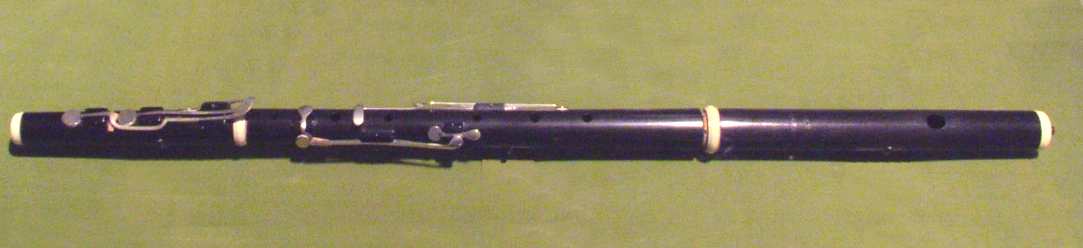
The record subject. Ebony, silver, and ivory, made in Theobald Boehm's own Munich workshop between 1828 and 1832. The museum's own open-access photograph of the accessioned object, marked Public Domain on the object's own catalogue page. Also held on Wikimedia Commons under the same Museum-supplied file.
| Artist | Theobald Boehm |
|---|---|
| Date | 1828-1832 |
| Medium | Ebony, silver, and ivory |
| Dimensions | Total length 669 mm (head joint 229 mm, middle section 289 mm, foot joint 151 mm) |
| Where it is now | Metropolitan Museum of Art, New Yorklast confirmed |
| Inventory number | 2009.333a-k |
| Attribution | AcceptedThe Metropolitan Museum of Art attributes this flute directly and without qualification to Theobald Boehm's own workshop in Munich, active from 1828. Full note |
| Object type | Musical instrument |
| Period | German, nineteenth century |
| Cases | Has a provenance gap |
| Inscriptions | No maker's stamp or inscription is described in the sources consulted. |
| Owners on record | 3 links2 documented, 1 unknown |
| Sources | 11 cited |
About this record Last verified · 11 sources cited · Change log
On this page 9 sections
ContentsClose
A wooden transverse flute made in Theobald Boehm's own Munich workshop sometime between 1828 and 1832, the exact five years in which Boehm reformed the flute and, in doing so, opened one of the longest-running priority disputes in the history of musical instruments. Boehm met the amateur inventor William Gordon in London in 1831, judged his mechanical ideas unsound, and unveiled his own ring-key redesign in November 1832; Gordon's widow and several of Gordon's later partisans, including a Paris Conservatoire professor and a prominent English flute maker, spent the following six decades arguing that the invention was really Gordon's, a claim revived with particular force after Boehm's death in 1881 and never formally settled by anyone.
This particular instrument, ebony with silver keywork and ivory joint bands, sits inside the disputed years rather than after them, and the museum's own photograph is consistent with an earlier stage of Boehm's keywork rather than the full November 1832 specification, though this record does not claim that as established fact. Its ownership history is almost entirely blank between manufacture and the Metropolitan Museum's 2009 purchase, a gap of roughly one hundred and seventy-five years that this record states plainly rather than fills with invention.
Provenance
Each link is graded. Documented: a cited source supports it. Disputed: the identification is argued but not established. Unknown: no owner for that span, and the gap is not smoothed into a narrative. The grades in the glossary.
- 1828 - 1832Made in Theobald Boehm's own workshop, Munichdocumented
The Metropolitan Museum dates the instrument to this five-year span, which begins with Boehm opening his own Munich workshop in 1828 and ends with his public debut of the ring-key redesign on 1 November 1832. It is not established from the sources consulted which side of that redesign this specific instrument falls on.15
- 1832 - 2009Unknownunknown
No owner, dealer, or collection is documented for this instrument across roughly one hundred and seventy-five years. The gap is recorded rather than bridged with a guess.1
- 2009 - presentMetropolitan Museum of Art, New Yorkdocumented
Purchased in 2009 using funds from the Robert Alonzo Lehman Bequest. The seller and sale price are not published in the sources consulted.1
Technical evidence
| Attribution note | The Metropolitan Museum of Art attributes this flute directly and without qualification to Theobald Boehm's own workshop in Munich, active from 1828. No maker's stamp or inscription is described in the sources consulted, so the documentary basis for the attribution is not established beyond the museum's own catalogue record. The museum's date bracket, 1828-32, spans both Boehm's earliest patented conical flutes and the pivotal ring-key redesign he unveiled in November 1832, and it is not established from the sources consulted which side of that redesign this particular instrument falls on. The maker is not in question. What the instrument physically represents within Boehm's own reform is. |
|---|---|
| Body material | Ebony, turned in three joints (head, middle section, foot joint).1 |
| Keywork and mounts | Silver keys and mounts; ivory banding at the joint sockets.1 |
| Dimensions | Total length 669 mm. Head joint 229 mm, middle section 289 mm, foot joint 151 mm.1 |
| Classification | Aerophone, side-blown transverse flute, conical bore.1 |
| Date bracket and its significance | Dated 1828-1832 by the Metropolitan Museum, spanning the exact years between Boehm opening his own Munich workshop and his public debut of the ring-key redesign on 1 November 1832. The museum's own bracket does not specify which side of that redesign the instrument falls on.12 |
| Patent basis | Boehm's earliest conical flutes, including any made in this date range, were produced under a ten-year Bavarian patent for an improved conical wooden flute granted 20 May 1829 and later extended by five years.5 |
| Inscription | No maker's stamp or inscription is described in the sources consulted. Whether the instrument is signed is not established.1 |
| Visible keywork, from the museum's photograph | The published photograph shows keys and at least one ring-mounted touchpiece concentrated near the head joint and the top of the middle joint, with plain open tone holes lower on the body. This record treats that as an observation from the image, not a confirmed mechanical description.1 |
Images



The record in full
Chapter 1What it is
A wooden transverse flute in three joints, its body turned from ebony and banded at the sockets with ivory, its keywork cut and mounted in silver.
A wooden transverse flute in three joints, its body turned from ebony and banded at the sockets with ivory, its keywork cut and mounted in silver. Photographed lying open on the Metropolitan Museum's turntable, it shows a small cluster of keys and at least one ring-mounted touchpiece crowded around the head joint and the top of the middle joint, while the lower body carries plain open tone holes of the older, simpler kind. It is not, in other words, a flute whose every hole is sealed under a ring key in the way a modern student flute's are. It sits somewhere between the eight-keyed flute that every European orchestra played in 1820 and the fully vented instrument that would make its maker's name a household word among flautists.
The Metropolitan Museum catalogues it plainly as a Transverse Flute, made by Theobald Boehm in Munich, and dates it 1828 to 1832. That five-year bracket is not vague cataloguing. It is the exact span of the most contested five years in the modern flute's history, and this instrument was made somewhere inside it.
Chapter 2A goldsmith's flute
Theobald Boehm was trained as a goldsmith and jeweller in his father's Munich workshop, which he ran himself between 1817 and 1822 before returning fully to music.
Theobald Boehm was trained as a goldsmith and jeweller in his father's Munich workshop, which he ran himself between 1817 and 1822 before returning fully to music. That training is the reason his name belongs on a flute at all: he brought a metalworker's tolerance for precision, not a woodwind maker's inherited habit, to an instrument that had barely changed its acoustic layout in a century. He had already been appointed first flautist of the Royal Bavarian Orchestra at twenty-one, so he came to instrument design as a performer dissatisfied with what performers were given, not as a craftsman looking for a new line of business.
In 1828, unhappy with the flutes available to him from other makers, Boehm opened his own workshop in Munich. On 20 May 1829 the Bavarian state granted him a ten-year patent, later extended by five years, for an improved conical wooden flute. Every flute his workshop produced between 1828 and the 1847 cylindrical redesign that made him famous falls under that first patent's shadow, including, on the museum's own dating, this one.
Chapter 3Gordon, London, and the meeting that mattered
In 1831 Boehm travelled to London and met an amateur flautist and former army officer, William Gordon, who had been working independently on his own mechanical improvements to the flute.
In 1831 Boehm travelled to London and met an amateur flautist and former army officer, William Gordon, who had been working independently on his own mechanical improvements to the flute. Gordon's widow later testified, in 1838, that her husband's aim had been perfect accuracy of intonation combined with easier fingering and a wider range. What survives of Gordon's own account is thin; detailed documentation of exactly what his flute did was never systematically preserved.
Boehm's own description of Gordon's instrument, written afterward, called its mechanism ingeniously conceived but overcomplicated and acoustically unsound, and said examining it strengthened his own conviction that nothing short of a complete redesign of the flute would do. He nonetheless later gave Gordon practical help, placing a workshop and a skilled craftsman at Gordon's disposal in Munich in 1833. Whatever passed between the two men in London in 1831, they did not part as rivals at the time.
Chapter 4The redesign, and what Boehm said his real achievement was
Boehm returned to Munich in 1831 and, by his own account, deliberately settled on a ring-key system he said he had already been considering before he ever met Gordon.
Boehm returned to Munich in 1831 and, by his own account, deliberately settled on a ring-key system he said he had already been considering before he ever met Gordon. He produced the new instrument in the middle of 1832 and played it in public for the first time on 1 November 1832, in a Munich concert. It used acoustically calculated tone-hole positions and larger holes than any earlier flute had dared, covered by an interlocking system of open rings rather than solid key cups, so a player's fingers no longer had to physically reach every hole in a comfortable hand position.
Boehm himself later insisted, in terms later flute historians have taken seriously, that his fame did not chiefly rest on the 1832 key mechanism at all. What he considered his real contribution, developed further after 1832 and brought to completion in his 1847 cylindrical flute, was the substitution of measured acoustic theory for the trial-and-error empiricism that every flute maker before him had relied on. That distinction between the mechanism and the acoustics is the hinge the entire priority dispute turns on, and it is Boehm's own framing of it, not a later scholar's.
Chapter 5The claim that would not die
The first public challenge to Boehm's priority came from Auguste Victor Coche, a professor at the Paris Conservatoire, in 1838.
The first public challenge to Boehm's priority came from Auguste Victor Coche, a professor at the Paris Conservatoire, in 1838. Coche alleged, backed by testimony from Gordon's widow, that the flute bearing Boehm's name had in fact been discovered and invented by Gordon, and published comparative material treating Boehm as a mere modifier of another man's idea. In 1844 the London flute maker Richard Ward, who had built instruments to Gordon's own specifications, pressed the same claim on Gordon's behalf in a pamphlet titled The Flute Explained.
The English flautist and writer Clinton is the strangest witness in the whole affair. In his own instruction manual of the early 1840s he praised Boehm without reservation. By 1855, in a book called Practical Hints, he had reversed himself completely and credited the invention to Gordon instead. No source consulted here explains why he changed his mind, and that reversal has never been satisfactorily accounted for.
Chapter 6Rockstro's verdict, and the fight after Boehm was dead
The dispute went quiet during most of Boehm's later life, then flared again after his death in 1881.
The dispute went quiet during most of Boehm's later life, then flared again after his death in 1881. Richard Shepherd Rockstro's 1890 treatise The Flute treated Boehm as, in substance, an impostor who had taken credit for another man's mechanical idea. Because Boehm could no longer answer for himself, the posthumous defence fell to others: the piano maker Henry Fowler Broadwood and the Munich acoustics professor Carl von Schafhaeutl, who had worked with Boehm directly on the 1847 acoustic research, both wrote in his defence once Rockstro's book revived the charge.
Writing some years later, the flute historian H. Macaulay Fitzgibbon surveyed the entire quarrel and called it, in a phrase that has stuck, a storm in a teacup. He pointed out that every one of Gordon's partisans, Coche, Ward, and Clinton among them, went on to produce and sell rival flutes of their own during Boehm's lifetime, which does not prove they were wrong about Gordon but does mean none of them were disinterested judges. The flute maker Richard Carte, who knew both men, made the simpler point that Boehm and Gordon remained on cordial terms after 1831, which sits uneasily with any story of one man stealing the other's idea outright.
Chapter 7What the dispute actually settled, and what it did not
No court, society, or professional body ever formally adjudicated the Boehm-Gordon question, and this record does not attempt to arbitrate what more than a century of specialists could not.
No court, society, or professional body ever formally adjudicated the Boehm-Gordon question, and this record does not attempt to arbitrate what more than a century of specialists could not. What can be stated plainly is where the argument's boundary actually sits. The 1832 ring-key mechanism is the part that is genuinely contested: Gordon had unquestionably built ring-and-key experiments of his own before Boehm's 1831 visit to London, and the exact degree to which Boehm's 1832 design depended on having seen them is not something the surviving evidence resolves. The 1847 cylindrical bore and the acoustic calculation behind it are not seriously contested by anyone; no rival claimant produced comparable acoustic research, and this is the achievement Boehm himself pointed to as his real one.
That distinction matters for an instrument dated 1828-32, because it was made entirely within the contested decade and before the uncontested one. Whatever this flute is, it is not evidence in the settled part of Boehm's career. It is evidence, if it is evidence of anything specific at all, only for the part that forty years of flautists, dealers, and rival manufacturers could not agree on while Boehm was alive to defend himself.
Chapter 8This instrument, specifically
Set against that history, what can be said about this particular flute is more modest than the controversy around it.
Set against that history, what can be said about this particular flute is more modest than the controversy around it. It was made in Boehm's own Munich workshop at some point between the shop's 1828 opening and the November 1832 debut of the ring-key model, a five-year span the Metropolitan Museum has not narrowed further in its published catalogue record. The photograph the museum has released shows a flute with some keywork and at least one ring-mounted touchpiece concentrated near the head and the top joint, and plain open holes lower down the body, which is consistent with an instrument from Boehm's first patented conical series rather than with a flute built to the full November 1832 specification, though this record treats that reading as an observation from the photograph, not a confirmed technical finding, since no full mechanical description of the instrument's keywork was located in the sources consulted.
The materials themselves carry information beyond decoration. Ebony was the premium body wood for a concert flute in this period, denser and more stable than the boxwood used for cheaper instruments, and silver keywork over an ebony body was the standard combination for an instrument made for a serious player rather than for the general trade. A goldsmith's son making that choice for his own product line was not being ostentatious. He was building the instrument to the standard he had been trained to work to before he ever touched a flute.
Chapter 9From Munich to Fifth Avenue
The instrument's documented history begins with its manufacture in Boehm's workshop and resumes only in 2009, when the Metropolitan Museum purchased it using funds from the Robert Alonzo Lehman...
The instrument's documented history begins with its manufacture in Boehm's workshop and resumes only in 2009, when the Metropolitan Museum purchased it using funds from the Robert Alonzo Lehman Bequest. No dealer, prior owner, sale, or collection is named in the sources consulted for the roughly one hundred and seventy-five years between those two points. That is a real gap, not a rounding error in the research, and it is recorded here as one rather than bridged with a guess.
Chapter 10What it must not be confused with
The Metropolitan Museum's own Musical Instruments department holds at least two other flutes connected to this same history, and neither should be taken for this one.
The Metropolitan Museum's own Musical Instruments department holds at least two other flutes connected to this same history, and neither should be taken for this one. A second Boehm flute in the same department, dated only to after 1832, is a different accessioned object with no public-domain image available, made after the exact redesign this instrument may or may not itself embody. A third Met flute, made by the later firm of Boehm & Mendler around 1870, postdates both the 1832 ring-key design and the 1847 cylindrical redesign by decades, and represents the mature commercial product of the partnership Boehm formed with the watchmaker Karl Mendler in the 1850s, not the disputed early phase of his career at all.
The Smithsonian's National Museum of American History separately holds a Boehm-system flute stamped Rudall & Rose, the London firm licensed from 1843 to manufacture Boehm's 1832 design under its own name, and a second flute catalogued simply as a Theobald Boehm Flute. Both are different physical objects in a different collection, and neither is illustrated or otherwise drawn on in this record.
The artist
Theobald Boehm
Boehm is unusual among the makers covered by this publication in that his central controversy is not about who owned his work but about who actually invented it. He trained as a goldsmith, became a professional flautist, and only then became an instrument designer, and the case against him, revived seriously more than once after his death, was that the mechanical idea at the heart of his most famous invention belonged to another man.
Related works
| Work | Relation | Where it is |
|---|---|---|
| Transverse Flute (after 1832) Theobald Boehm | A second, later Boehm flute in the same Metropolitan Museum department A different accessioned object, dated after 1832, made once the ring-key redesign was complete. No public-domain image of this instrument is available, and it is not illustrated here. Not to be confused with the record subject. | Metropolitan Museum of Art, New York (accession 2009.332a-f) |
| Transverse Flute Boehm & Mendler | Later commercial production by Boehm's own firm after his partnership with Karl Mendler Made around 1870, decades after both the 1832 and 1847 redesigns, under the stamp the firm used from 1862 onward. | Metropolitan Museum of Art, New York (accession 1998.358) |
| Rudall & Rose Boehm (1832 Model) System Flute Rudall & Rose | A licensed maker's version of Boehm's 1832 design Rudall & Rose of London were licensed from 1843 to manufacture Boehm's 1832 ring-key design under their own name. | National Museum of American History, Smithsonian Institution, Washington DC |
| Theobald Boehm Flute Theobald Boehm | A separate Boehm flute in a different collection A distinct physical object from the record subject, not examined for this record. | National Museum of American History, Smithsonian Institution, Washington DC |
Open questions
- Does this instrument carry the full ring-key mechanism Boehm debuted on 1 November 1832, or does it represent an earlier stage of his 1828-29 patented conical flute? The Metropolitan Museum's own date bracket spans both possibilities and the museum's published record does not resolve it.
- Who owned this flute between its manufacture in Boehm's workshop and the Metropolitan Museum's purchase in 2009? No dealer, collection, or intermediate owner is named in the sources consulted for a gap of roughly a century and three-quarters.
- Is the instrument stamped or signed? No inscription is described in the sources consulted, and it is not established whether one exists.
- Does any flute actually made by William Gordon himself survive today for direct physical comparison with Boehm's 1832 design? The sources consulted describe Gordon's mechanical ideas but not the present whereabouts, or survival, of an instrument he built.
- Was this flute made for a specific patron or player, or as ordinary workshop stock? Nothing in the sources consulted addresses the circumstances of its original commission or sale.
Questions about this object
What is Transverse Flute?
Transverse Flute is a musical instrument, dated 1828-1832. Medium: Ebony, silver, and ivory.
Who made Transverse Flute, and is the attribution settled?
The attribution to Theobald Boehm is recorded here as accepted. The Metropolitan Museum of Art attributes this flute directly and without qualification to Theobald Boehm's own workshop in Munich, active from 1828. No maker's stamp or inscription is described in the sources consulted, so the documentary basis for the attribution is not established beyond the museum's own catalogue record. The museum's date bracket, 1828-32, spans both Boehm's earliest patented conical flutes and the pivotal ring-key redesign he unveiled in November 1832, and it is not established from the sources consulted which side of that redesign this particular instrument falls on. The maker is not in question. What the instrument physically represents within Boehm's own reform is.
Where is Transverse Flute now?
Metropolitan Museum of Art, New York. Inventory number 2009.333a-k. Last confirmed 26 August 2026. Purchase, Robert Alonzo Lehman Bequest, 2009.
What is still unknown about Transverse Flute?
Does this instrument carry the full ring-key mechanism Boehm debuted on 1 November 1832, or does it represent an earlier stage of his 1828-29 patented conical flute? The Metropolitan Museum's own date bracket spans both possibilities and the museum's published record does not resolve it.
Sources
- 1Metropolitan Museum of Art, object page for Transverse Flute, Theobald Boehm, 1828-32, accession 2009.333a-k (catalogue tombstone data and Public Domain image rights badge). metmuseum.org/art/...
- 2Wikipedia, 'Theobald Boehm', for birth and death dates and the Royal Bavarian Orchestra appointment. en.wikipedia.org/wiki/...
- 3H. Macaulay Fitzgibbon, The Story of the Flute, Chapter 4, for the Boehm-Gordon meeting, Boehm's own account of the 1832 redesign, the claims of Coche, Ward, and Clinton, Rockstro's 1890 treatise, and Fitzgibbon's 'storm in a teacup' verdict, via Wikisource. en.wikisource.org/wiki/...
- 4Wikipedia, 'Boehm system', for the general description of the 1832 conical and 1847 cylindrical designs and their industrial adoption. en.wikipedia.org/wiki/...
- 5The Babel Flute, 'Theobald Boehm as a Flute Maker', for the goldsmith training, the 1828 workshop, the 1829 Bavarian patent, the Mendler partnership timeline, and Boehm's quoted remark on quality over quantity. thebabelflute.com/theobald-bohm-as-a-flute-maker
- 6VM Collectables, 'The conical ring-key flute - game changer of 1832', for the 1 November 1832 Munich concert debut and the licensing of the design to Godfroy (Paris) and Rudall & Rose (London, from 1843). vmcollectables.com/historical-background/...
- 7Metropolitan Museum of Art Open Access API, object records 506166 (Transverse Flute, after 1832, no public-domain image) and 503510 (Transverse Flute, Boehm & Mendler, ca. 1870, Public Domain), consulted for related works. collectionapi.metmuseum.org/public/...
- 8National Museum of American History, Smithsonian Institution, object listings for 'Rudall & Rose Boehm (1832 Model) System Flute' and 'Theobald Boehm Flute', consulted for related works only; neither object was examined in detail for this record. americanhistory.si.edu/collections/...
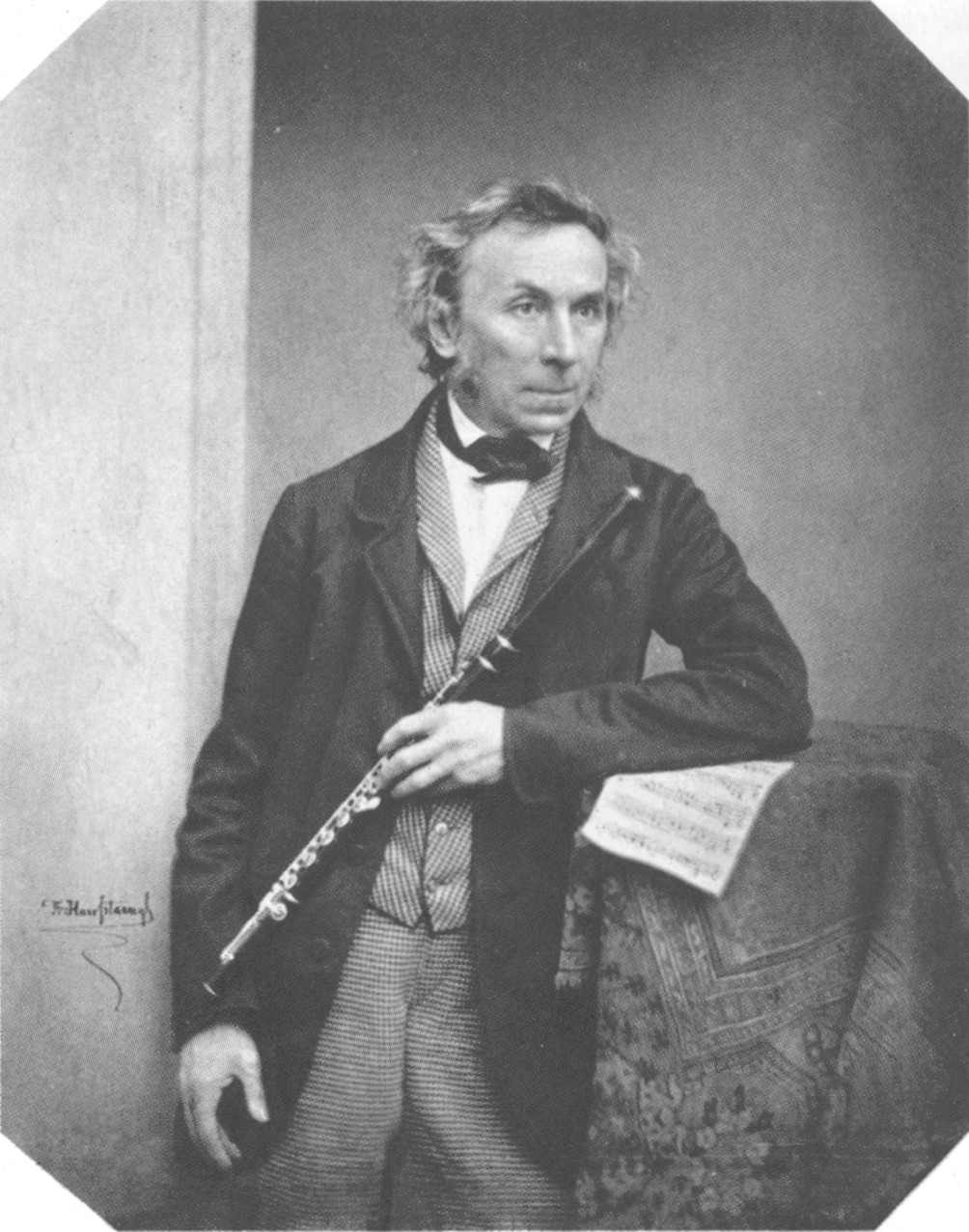
- 9Wikimedia Commons, File:Theobald Boehm.jpg, portrait photograph by Franz Hanfstaengl, circa 1852, as Public domain via file . commons.wikimedia.org/wiki/...
- 10Wikimedia Commons, File:Boehm's Flute of 1829 and File:Boehm's Flute of 1832 (both page 51, The Story of the Flute, H. commons.wikimedia.org/wiki/...
- 11Wikimedia Commons, File:Flute in C by Theobald Boehm, metal flute made by Boehm himself, No. 19, Munich, c. 1850, from the Dayton C. commons.wikimedia.org/wiki/...

.png)

Last verified · Published
Change log
26 August 2026 - Record created at the house standard: researched narrative, technical evidence, maker dossier, graded provenance chain, prices with hammer and premium separated, related works, open questions and sources.