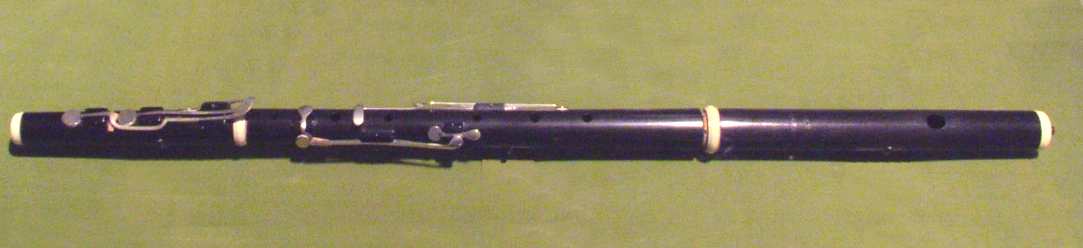
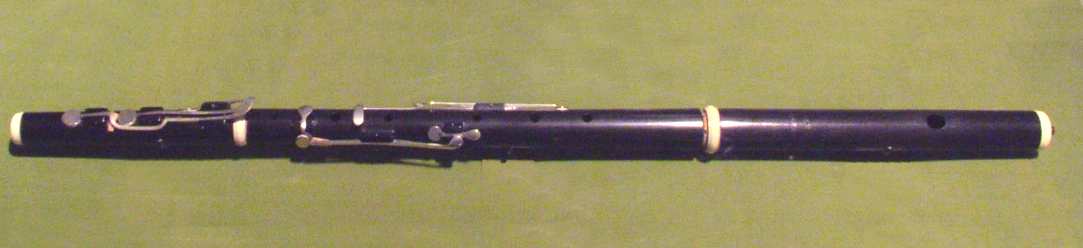
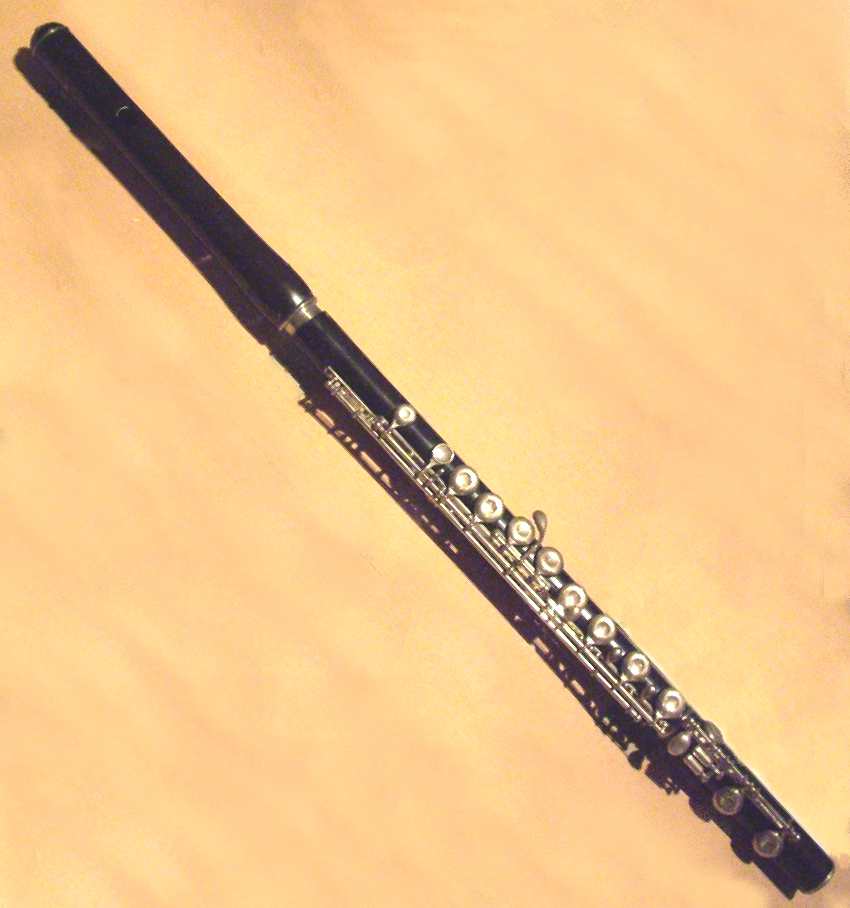
Transverse Flute
1828-1832 · Ebony
Metropolitan Museum of Art, New York
 German (Bavarian) · 1794-1881
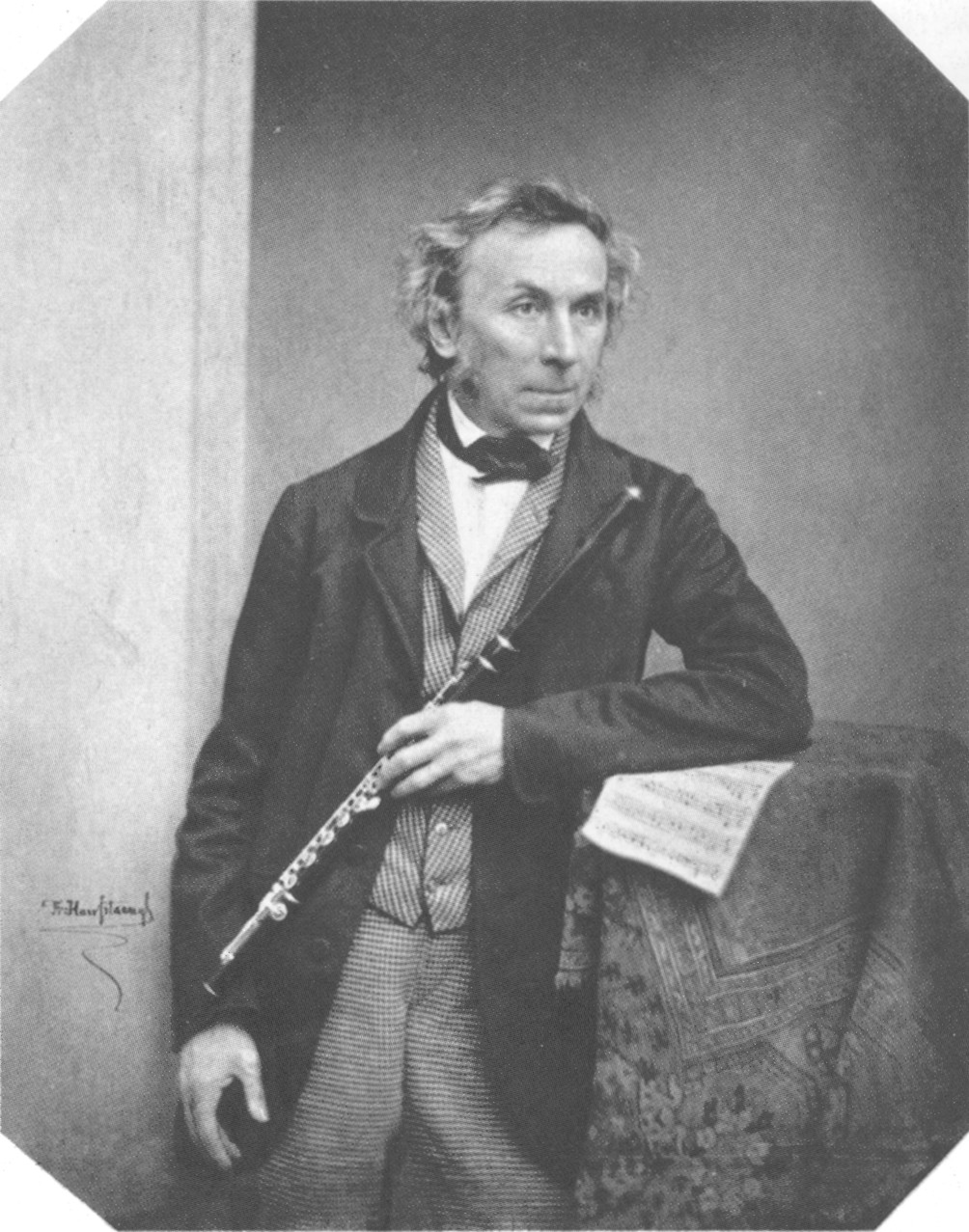
Photograph by the Munich portraitist Franz Hanfstaengl, taken about 1852, when Boehm was in his late fifties, some fifteen years before his death. A smaller duplicate print of what appears to be the same sitting, held separately on Commons and captioned there as 'Boehm at age 60,' suggests a date closer to 1854; both file pages agree it is Hanfstaengl's work and that it is Boehm himself, and the identification is not disputed in any source consulted for this page. It is the only surviving photograph of Boehm found for this page; no painted portrait made from a sitting in his own lifetime was located.
Franz Hanfstaengl, self-scanned upload, via Wikimedia Commons| Worked as | Flautist, Instrument maker, Inventor, Composer |
|---|---|
| Born | 9 April 1794 · Munich, Electorate of Bavaria |
| Died | 25 November 1881 · Munich, Kingdom of Bavaria (German Empire) |
| Nationality | German (Bavarian) |
| In this archive | 1 artwork |
| Sources | 21 cited |
| Last verified |
About this page 1 artwork in the archive · Last verified · 21 sources cited
Theobald Boehm trained as a goldsmith, not as an instrument maker, and it is worth holding on to that fact because almost everything unusual about him follows from it. He was already a professional flautist, appointed first flute of the Royal Bavarian Orchestra in 1818 at twenty-four, before he built an instrument of his own; he redesigned the flute twice, fifteen years apart, using the metalworking skill his father had taught him rather than any formal training in acoustics; and the fingering system that carries his name today, used on French and English flutes within a decade and adapted to the clarinet within Boehm's own lifetime, was met at home in Bavaria and Germany with real hostility, from Wagner's flute players downward, for most of his career.
What a reader most needs to know and rarely finds stated plainly: the two things popular accounts most confidently report about Boehm, that his acoustic theory came from the physicist Carl von Schafhautl and that he fought off a rival claim from the amateur inventor William Gordon, are both more complicated on the documentary record than the summary version allows. Schafhautl's own published finger-hole calculations, by his own later admission, did not actually work when Boehm built flutes to them; the theory needed empirical correction, which means the '1847 flute built on scientific principles' is at best half true. And the Boehm-Gordon dispute, which filled entire books written against each other by Christopher Welch and Richard Shepherd Rockstro in the 1880s and 1890s, is described by Boehm's own great-great-grandson, working from the family and workshop archive, as a quarrel that barely existed between the two men themselves and was mostly manufactured after both were dead by a disappointed third party. Both disagreements are argued below with the historians named on each side, not resolved in Boehm's favour by default.
He died owing his reputation almost entirely to France, England and the United States. The German press did not mark his death at all.

Born 9 April in Munich, son of the goldsmith Carl Friedrich Boehm and Anna Franziska, nee Sulzbacher.1317
Builds his first flute, an improvement on a four-key model by Grenser, with his teacher Johann Nepomuk Kapeller.17
Joins the Royal Bavarian Court Orchestra as first flautist.9
Marries Anna Rohrleitner of Munich, 20 October.15
Opens his own flute workshop in Munich.17
Granted a ten-year Bavarian patent, 20 May, for improved conical wooden flutes of the old construction.17
In London, hears Charles Nicholson's powerful tone and examines Gordon's experimental flute; resolves on a complete reconstruction of the flute.1517
Unveils the conical ring-key flute, the first Boehm-system instrument, in a Munich concert on 1 November. Not patented.1715
Patents an improved piano jointly with Karl von Schafhautl, contested by Danchel and Greiner; begins iron-purification work with Schafhautl that occupies him for most of the decade.18
Presents the Boehm flute to the Academy of Sciences in Paris (8 May); Camus, Dorus and Coche adopt it; Godfroy and Lot build the first French-made example in October.17
The Academie des Beaux-Arts credits Coche's and Buffet's modifications over Boehm's own design (24 March); Mrs Gordon's letter of 20 May first raises the suspicion, later propagated by Coche, that Gordon was the true inventor; Buffet patents changes to the Boehm flute (17 November).17
Awarded the Bavarian Knight's Cross of the Order of St Michael for the iron-purification work; sells his flute workshop to his assistant Rudolf Greve, 6 May.1718
The Boehm flute is introduced in England by John Clinton; Rudall and Rose begin manufacturing it in London.17
Alfred G. Badger begins building Boehm flutes in New York, following James Larrabee's earlier example of about 1844.17
Greve's licence to use the Boehm name on his flutes lapses.17
Completes the cylindrical metal flute, serial no. I, in June, after roughly two years studying acoustics with Schafhautl; patented in Bavaria, then in France on 12 July (no. 6050, agent Joseph Merle), then in England a few weeks later via John Mitchell Rose of Rudall and Rose.161721
Fits a Bb thumb lever below the C thumb key on flute no. 24 (February); Giulio Briccialdi's rival arrangement, placed above the C thumb key, follows in May-June and prevails commercially.17
Wins the highest medal for his flute at the London industrial exhibition; Richard Carte's own competing patent flute, riding on Boehm's 1847 patent, appears the same year.1716
Introduces an improved key mechanism used on only a small number of flutes; resumes making wooden cylindrical flutes in November.17
Invents the cylindrical alto flute in G; the first example is sold in January to Marcel Ciemirsky in Lemberg.17
Karl Mendler, a watchmaker who had joined the workshop in 1854, receives his licence as an instrument maker.17
The firm becomes Boehm and Mendler; Boehm is recorded studying how to correct acoustic defects in the clarinet.1718
Sends a revised version of his acoustic 'Schema' for tone-hole placement to the Paris world exhibition; the organ builder Cavaille-Coll criticises it, then retracts the criticism in 1883.17
Celebrates his golden wedding, 30 October, surrounded by seven sons, one daughter and thirty grandchildren; writes to Bornschein that overflow orders are being sent to Louis Lot in Paris.1517
Publishes Die Flote und das Flotenspiel, his treatise on the flute's acoustic, technical and artistic characteristics; around this time writes to Broadwood recounting the 1831 Nicholson episode.1319
Dies in Munich on the evening of Friday 25 November; American newspapers, led by the New York Herald, publish lengthy obituaries while the German press stays almost silent.15
No documented auction result, hammer or premium, for a flute made in Boehm's own workshop or either of his two named partnerships was found among the specialist auction houses checked for this page. This is almost certainly a function of scarcity rather than indifference: total lifetime production across every workshop and partnership was under 800 instruments, and the largest identified surviving group, assembled by the American collector Dayton C. Miller, sits permanently in the Library of Congress rather than in circulation.
The one current figure this page can offer is a dealer's asking price, not a completed sale: a New York specialist dealer listed in 2026, at 20,000 US dollars, a wooden flute stamped with Boehm's name that the dealer's own description states was actually built in Louis Lot's Paris workshop with the keywork finished under Boehm's supervision, a hybrid class of instrument the dealer describes as extremely rare. Anyone establishing a genuine market figure for an autograph Boehm-workshop flute would need access to private-treaty or specialist-society sales this page did not locate, not the public auction record.
| Institution | City | Holdings | Note |
|---|---|---|---|
| Metropolitan Museum of Art | New York | At least four instruments spanning both Boehm eras: a conical flute from Boehm's own first workshop (1828-32), a conical Boehm & Greve flute (about 1840), a cylindrical Boehm & Mendler flute (about 1870) and a cylindrical Boehm & Mendler alto flute (about 1880). | Open access; images released CC0. |
| Library of Congress, Dayton C. Miller Flute Collection | Washington, D.C. | The largest identified surviving group of Boehm-workshop instruments, assembled by the collector and acoustics professor Dayton C. Miller (died 1941) alongside comparative flutes by Louis Lot and Rudall, Carte. | Institutional research collection; not consulted directly by image for this page. |
| Smithsonian, National Museum of American History | Washington, D.C. | A Boehm-system flute made in Munich in 1848, close to the definitive cylindrical redesign. | This page could not clear a free-licence image of this specific object; the museum's own site returned a bot-verification wall on every route tried. |
| Museum of Musical Instruments, University of Leipzig | Leipzig | A two-part oboe with Boehm-style keywork made in the workshop of Boehm & Mendler around 1864, documenting Boehm's own experiment beyond the flute. | Not consulted directly for this page; cited via Ludwig Boehm's published research. |
Boehm was born in Munich on 9 April 1794, the son of the goldsmith Carl Friedrich Boehm and his wife Anna Franziska, nee Sulzbacher, the daughter of a court haberdasher.
Boehm was born in Munich on 9 April 1794, the son of the goldsmith Carl Friedrich Boehm and his wife Anna Franziska, nee Sulzbacher, the daughter of a court haberdasher. He learned his father's trade as a child and ran the family workshop himself for stretches of his adult life, in 1817 and again from 1819 to 1822, alongside his musical career. That training is the reason he could redesign a flute's keywork with his own hands rather than commissioning someone else to realise his ideas: the metalworking skill came first, the instrument came later.
He built his own first flute in 1810, an improvement on a four-key model by the Dresden maker Grenser, working with his flute teacher Johann Nepomuk Kapeller. He became first flautist of the Isartortheater in Munich in 1812 and joined the Royal Bavarian Court Orchestra in 1818, by which time he was already selling flutes made to his own specifications by other Munich instrument makers as a sideline. In 1820 he married Anna Rohrleitner of Munich; the couple would go on to have eight children, seven sons and one daughter, and celebrate their golden wedding in 1870.
Boehm's own account, given late in life in a letter of 1871 to his English patron J.
Boehm's own account, given late in life in a letter of 1871 to his English patron J. S. Broadwood, states the turning point without qualification: 'I did as well as any continental flutist could have done, in London, in 1831, but I could not match Nicholson in power of tone, wherefore I set to work to remodel my flute. Had I not heard him, probably the Boehm flute would never have been made.' Charles Nicholson was an English virtuoso whose flutes had unusually large finger holes and a correspondingly loud, forceful tone; Boehm, playing the refined but comparatively quiet flutes of the Continental tradition, judged himself outmatched on volume alone.
While in London that year he also examined a flute built by an amateur inventor, Captain (later given as William or James in different sources) Gordon, and judged it acoustically defective and its key mechanism needlessly complicated. He began his first experimental work on a new instrument in the London workshop of Gerock and Wolf before returning to Munich to continue it. Both encounters, Nicholson's tone and Gordon's flawed prototype, are cited in Boehm's own later writing as confirming him in the conviction that nothing short of a complete reconstruction of the flute's fingering could actually fix its problems.
Boehm unveiled his first reformed flute in a Munich concert on 1 November 1832.
Boehm unveiled his first reformed flute in a Munich concert on 1 November 1832. It kept the conical wooden bore that every flute had used for roughly a century and a half, but replaced the old closed-standing key system, in which most keys sat shut until a finger pressed them open, with an open-standing system: every key was normally up, and the player's fingers closed holes directly or, through rings mounted on rotating axles, closed a second hole further down the tube at the same time a nearer one was covered. Fourteen tone holes, enlarged and repositioned according to acoustic principle rather than wherever a finger happened to fall, now had to be governed by nine available fingers, and the ring-key mechanism was the engineering answer to that arithmetic.
Boehm did not patent this instrument. He later described the three governing rules of the finished key system in an 1856 article: pressing the E and F keys closes the G key at the same time; pressing F sharp closes G and B together; pressing B flat closes B. None of those relationships existed on the preliminary Gerock and Wolf model of 1831, which only linked E and F sharp to G, confirming that the definitive scheme took shape gradually over the following year, in Munich, not in a single London breakthrough. The 1832 flute won a silver medal at the Munich industrial exhibitions of both 1834 and 1835, but its wider adoption stalled for most of the decade because Boehm himself was largely absent from flute-making, occupied instead with an unrelated steel-purification project in England and Bavaria carried out with his friend Karl von Schafhautl.
How to tell a genuine 1832-system flute by eye: the body still tapers visibly toward the foot, in the old conical style, and the ring keys sit on exposed rod-and-post mechanisms with the touch levers of the F sharp and B flat keys reaching across the body on curved metal fingers, called clutches, to close a second key cup they do not sit above. This is the detail that most reliably separates an 1832 Boehm-system flute from an ordinary pre-Boehm simple-system instrument of the same date, which has no rings at all and a much smaller, sparser scatter of closed-standing keys.
Karl von Schafhautl, later professor of geology and mining science at Munich, met Boehm in 1828 and became his closest collaborator and, from 1844, his neighbour.
Karl von Schafhautl, later professor of geology and mining science at Munich, met Boehm in 1828 and became his closest collaborator and, from 1844, his neighbour. Their partnership ran far beyond the flute: together they patented an improved piano design in 1834 after a dispute with the Munich instrument makers Danchel and Greiner who had tried to steal the idea, fought a related patent case in London against a third party, and spent much of 1834 to 1839 developing and marketing, with real if temporary commercial success, a chemical process for purifying malleable iron during the puddling process, work for which Boehm was awarded the Bavarian Knight's Cross of the Order of St Michael in 1839. This was a genuine, long, and mutually reliant friendship between an engineer of unusual manual skill and a trained physicist, not a one-off consultation.
The specifically acoustic side of the collaboration is where the popular account overreaches. Schafhautl published a paper on the theory of covered cylindrical and conical pipes and German flutes in Schweigger's Jahrbuch fur Chemie und Physik in 1833-34, and Boehm's later flutes are conventionally described as built on the theory it set out. But Schafhautl's own later account, quoted at length by the flute historian Christopher Welch, concedes that the mathematics of finger-hole placement is so complicated that his formulae, however close, never quite matched reality: whenever Boehm built a flute with holes positioned exactly where Schafhautl's calculations said they should go, Welch reports, 'there were always a few vibrations in excess or defect,' and only further empirical adjustment by Boehm himself closed the gap. Welch adds that no physicist of the first rank, naming Lord Rayleigh among those qualified to judge, had by 1892 actually verified Schafhautl's theory against the finished instrument. The honest description of the 1847 flute is therefore not 'built on scientific principles' without qualification, but built on a partial and admittedly imperfect theory, corrected the rest of the way by Boehm's own patient, empirical trial and error over some three hundred recorded experiments. Which half of the credit belongs to theory and which to Boehm's craft is not settled by any source consulted for this page, and it is worth noting that Schafhautl was also the source, twelve years after Boehm's death, of the family's own commissioned biography of him, so the same man who gets credited with the science is also the primary author of the legend.
The conical flute never satisfied Boehm completely, particularly its high and low registers.
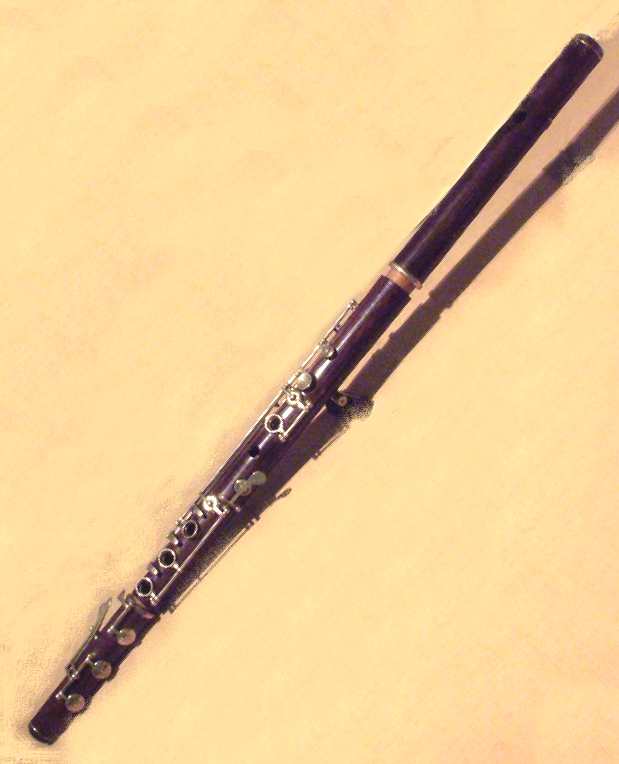
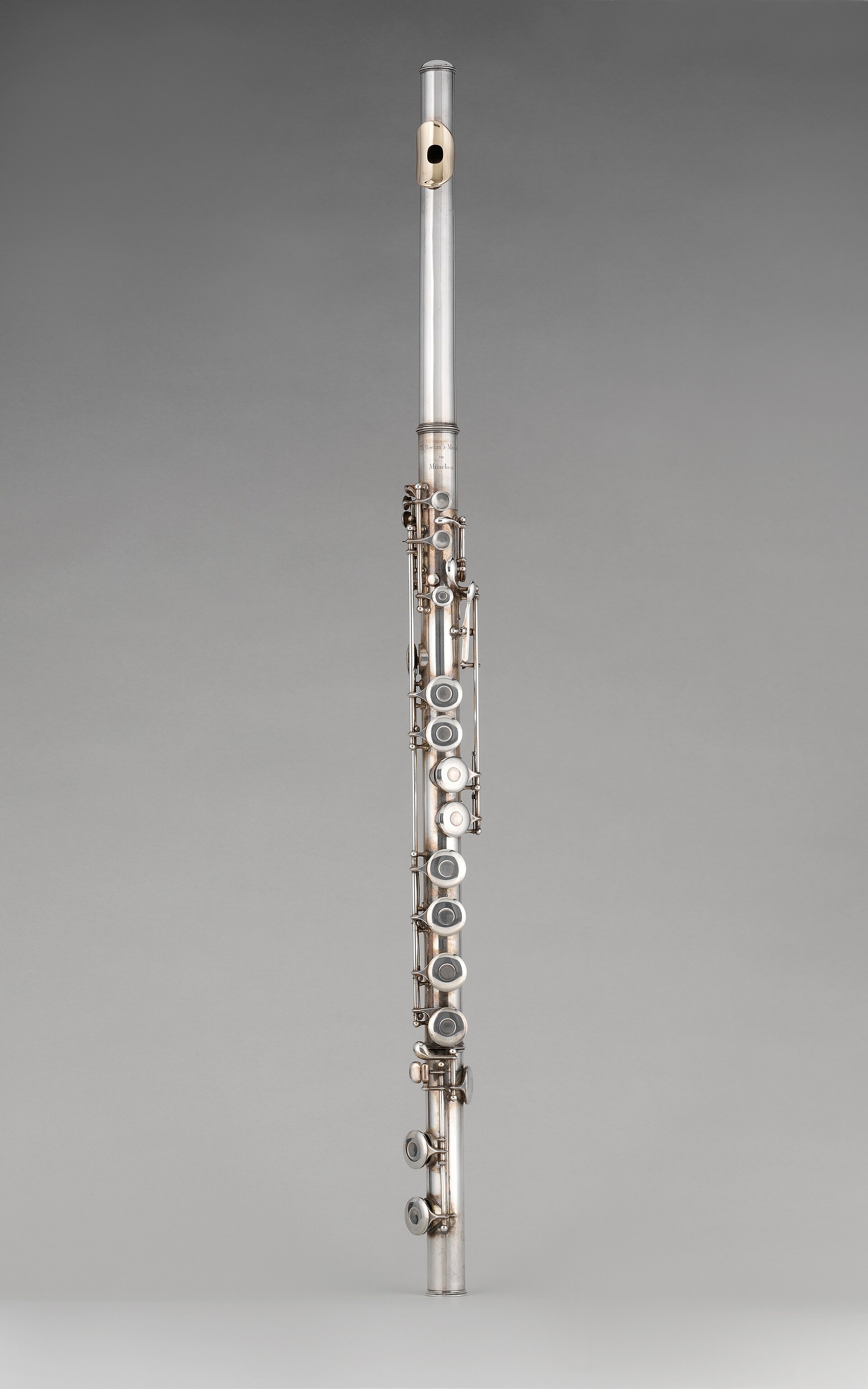
The conical flute never satisfied Boehm completely, particularly its high and low registers. From about 1846 he studied the acoustics of cylindrical against conical tubes with Schafhautl for roughly two years and concluded, in his own later summary, that a cylindrical bore gave better acoustic conditions than a conical one and that metal permitted more precise, more stable hole placement than wood. In June 1847, with flute serial number I, he completed the second and definitive model: a cylindrical tube of brass, silver or German silver, its tone holes enlarged again and now, from about the twelfth instrument onward, uniformly closed by covered key cups rather than open rings, retaining the open-standing key logic of 1832 but married to a wholly different bore and a substantially heavier, more elaborate mechanism.
The 1847 British patent taken out on Boehm's behalf described the new head joint's internal profile as 'conical, or rather in the form of a parabola'; Boehm's own unpublished essay used different, more qualified words for the same feature (see below). It is neither, strictly. As the flute historians Adrian Duncan and Terry McGee demonstrated by measuring an original Boehm head joint against a true mathematical parabola of the same length and diameter, the actual bore is a combination of a near-parabolic curve, a short cylindrical section at the tuning-slide end, and, in Boehm's own description though not confirmed on any surviving example examined for this page, a hemispherical termination at the stopper. Boehm's own qualified phrase, 'approached the parabola,' was accurate; the London maker Richard Carte's later marketing claim that the head joint's parabolic form actively concentrated and accelerated sound waves the way a parabolic mirror concentrates light was, on the same analysis, physically meaningless, since no dimension of a flute head joint approaches the scale at which such reflection could occur. The lesson generalises: even the participants who understood the instrument best routinely overstated, for sound commercial reasons, exactly how scientific its design really was.
How to tell an 1847-system flute by eye: the body is a plain, gently tapering metal cylinder rather than a visibly conical wooden tube, the head joint's external silhouette curves inward toward the embouchure hole rather than continuing the body's straight taper, and, on the later covered-key examples, the tone holes are sealed under solid padded cups rather than open rings. A specimen stamped with a maker's name from Munich, Paris or London but still showing the older conical wooden body with exposed ring keys is an 1832-system instrument regardless of its date of manufacture, since both systems continued to be made and sold side by side for decades after 1847.
The 1847 flute was patented in Bavaria and then in France, where the specification, number 6050, was filed on 12 July 1847 on Boehm's behalf by the Paris patent agent Joseph Merle, covering, in its...
The 1847 flute was patented in Bavaria and then in France, where the specification, number 6050, was filed on 12 July 1847 on Boehm's behalf by the Paris patent agent Joseph Merle, covering, in its own words, 'an improvement in the manufacture of flutes.' A British patent followed a few weeks later, taken out by John Mitchell Rose of the London firm Rudall and Rose, covering, more broadly than some contemporaries credited it with, the construction 'of flutes of all descriptions, clarionets and other similar wind instruments, of metal instead of wood.' The French rights were bought that same year by Vincent Hippolyte Godfroy and Louis Lot for 6,000 francs; the London rights went to Rudall and Rose, whose later successor firm, Rudall, Carte and Co., published Boehm's own English-language account of the invention in 1882.
Rudall and Rose's own designer, Richard Carte, built a competing patented flute in 1851 that combined elements of the old fingering with Boehm's cylinder bore, and in his 1851 pamphlet promoting it he twice misstated the content of Boehm's own patent: he claimed it covered only the flute and not the choice of material, when the specification explicitly extends to clarinets and other wind instruments made of metal, and he presented the parabolic head joint as a piece of applied acoustic theory that, on examination, does not survive scrutiny. Both errors sat in print for well over a century before flute historians identified them. Separately, the French maker Louis Auguste Buffet patented his own changes to the Boehm flute on 17 November 1838, after the Academie des Beaux-Arts in Paris judged, in March of that year, that his and Victor Coche's modifications rather than Boehm's own original design deserved the credit, a verdict Boehm's supporters have always treated as the Academy rewarding the wrong man's paperwork over the actual inventor's demonstrated instrument.
No episode in Boehm's career has generated more printed argument than the question of what he owed to Gordon.
No episode in Boehm's career has generated more printed argument than the question of what he owed to Gordon. The English flute historian Richard Shepherd Rockstro, in his 1890 Treatise on the Flute, argued at length that Boehm had absorbed essential elements of Gordon's mechanism without proper acknowledgement; the maker Cornelius Ward, more cautiously, wrote that 'it is said, with some reason, that he adopted a great part of the captain's contrivance.' Christopher Welch's 1892 rebuttal, History of the Boehm Flute, was written specifically to answer Rockstro point by point, reprinting Schafhautl's own biographical memoir of Boehm alongside a lengthy technical cross-examination of Rockstro's claims; on the specific question of the crescent-shaped key that Rockstro and Gordon's circle treated as Gordon's original contribution, Welch cites Rockstro's own later finding that the design had already been published by a Dr Pottgiesser three years before Gordon began his experiments. The French flautist Victor Coche, for his part, argued in print that Gordon rather than Boehm was the true inventor of the new flute, a claim resting substantially on a letter written by Gordon's widow in May 1838, after her husband's death, expressing that suspicion.
Boehm's own great-great-grandson Ludwig Boehm, working from the family and workshop archive rather than from either side's polemic, states flatly that 'Theobald Boehm and James Gordon were always on friendly terms, there was in fact no controversy,' and that Gordon's own 1834 flute prospectus explicitly thanks Boehm for the idea of replacing a double F key with a single F sharp key. On this account, the entire dispute was substantially Coche's invention, motivated by Boehm's refusal to enter a business relationship with him, built on a grieving widow's private suspicion rather than on anything Gordon himself claimed while alive. What both sides agree on, whichever account of the dispute one credits, is that even Gordon's own partisans conceded that the F sharp key and the D-shake mechanism belonged to Boehm outright; a claim that French makers, including Aristide Farrenc, independently examined and rejected Gordon's own flute as acoustically defective could not be confirmed in the primary sources consulted for this page and is not repeated as fact here. This page states both positions and names who holds each rather than choosing between a Victorian pamphlet war and a family's later reassurance; neither side's account has been independently tested against primary correspondence by anyone consulted for this page.
Boehm's early flutes, both his own and those of his successor firm Boehm and Greve, were built from dense tropical hardwoods, principally cocuswood, with silver or nickel-silver keywork; boxwood was...
Boehm's early flutes, both his own and those of his successor firm Boehm and Greve, were built from dense tropical hardwoods, principally cocuswood, with silver or nickel-silver keywork; boxwood was used for lower-cost fittings such as the crutch. The move to an all-metal body for the 1847 design was not a matter of fashion or cost but of the acoustic reasoning described above: Boehm concluded that a cylindrical metal tube, unlike wood, could be worked to a precise and stable internal profile that would not shift with humidity or seasoning the way wood does, and that its thin walls, once the necessary rigidity was engineered into the keywork rather than the tube, produced a more flexible, and in Boehm's own judgement more beautiful, tone. He returned briefly to wooden cylindrical flutes from November 1854, the first two going to the New York-based Philipp Ernst, evidence that he did not consider metal an unqualified improvement in every respect, only the superior choice for the standard instrument.
Boehm's own account of his standards is unusually well documented because so many of his business letters survive. To the London piano maker and patron J. S. Broadwood he wrote in 1867 that he had employed the watchmaker Karl Mendler as his assistant for fourteen years and had 'never allowed him to occupy more than two workers because quality is more important than quantity.' To a Mr Bornschein in 1870 he was blunter still: 'I only have two workmen and one partner with whose help only two flutes per month can be made'; and, further in the same letter, 'if you compare my flutes with others, you will find that the difference is the same as between a chronometer and an ordinary watch.' The same letter records that Boehm was, by 1870, subcontracting overflow orders to his friend and former licensee Louis Lot in Paris, 'who undoubtedly does the best work,' meaning that some flutes stamped with Boehm's own name in this period were, by his own admission, built in Paris and only finished or approved in Munich, a detail confirmed independently today by dealers who still encounter such instruments and describe them, correctly, as Lot-built with Boehm keywork rather than as autograph Boehm flutes.
No catalogue raisonne of Boehm's output exists, but the workshop's own ledgers, preserved and published by his descendant Ludwig Boehm, give a firmer count than most nineteenth-century makers can...
No catalogue raisonne of Boehm's output exists, but the workshop's own ledgers, preserved and published by his descendant Ludwig Boehm, give a firmer count than most nineteenth-century makers can offer. Boehm's own first workshop, 1828 to 1839, made roughly 150 flutes, including a documented 65 between May 1828 and November 1830. The Boehm and Greve partnership, 1839 to 1846, made a further roughly 100. Boehm's second solo workshop, 1847 to 1861, making the new cylindrical model, produced about 150 more, an average of ten a year confirmed by a testimony given on Karl Mendler's behalf. The Boehm and Mendler partnership, 1862 until Mendler's retirement in 1888, produced roughly 400, about fifteen a year, split roughly evenly between silver and wood. Summed, Boehm's workshops account for something under 800 instruments across sixty years, a tiny output next to contemporary factory-scale makers such as Rudall, Carte in London, which is itself part of why an autograph Boehm flute is rare on today's market.
Serial numbers and workshop stamps, changing four times over the period (T. BOEHM / MUNCHEN, then TH. BOEHM / A / MUNICH, then, on the cylindrical flutes from 1847, TH. BOEHM / IN / MUNCHEN with a serial number running to roughly 73 before some flutes dropped the word 'in,' and finally BOEHM & MENDLER), are the actual dating evidence for a given instrument, not the wood-versus-metal question alone, since both conical and cylindrical models remained in simultaneous production for decades. No documented case of a deliberately forged maker's stamp on a Boehm-workshop flute was found in the sources consulted for this page; the closer and better-attested risk, illustrated by the Lot-subcontracted instruments described above, is an authentic period stamp on an instrument whose body was not actually made in Boehm's own workshop, which is a labour-history problem rather than a forgery in the ordinary sense.
The Boehm flute reached Paris in 1837, when the flautist Paul-Hippolyte Camus finally took possession of an instrument after two years of Boehm merely demonstrating one without leaving it for...
The Boehm flute reached Paris in 1837, when the flautist Paul-Hippolyte Camus finally took possession of an instrument after two years of Boehm merely demonstrating one without leaving it for examination; Louis Dorus and Victor Coche adopted it soon after, and Clair Godfroy, with his son-in-law Louis Lot, built the first French-made example that October. England followed in 1843 through John Clinton and the firm of Rudall and Rose; the United States followed within two years, Alfred Badger in New York beginning construction in 1845 after James Larrabee had already built an earlier example around 1844.
The system's spread to other instruments is a separate and more qualified story than popular accounts suggest. The clarinettist Hyacinthe Klose and the maker Auguste Buffet developed the Boehm-system clarinet between 1839 and 1843, borrowing the ring-key and needle-spring mechanism directly from Boehm's flute and publishing a tutor and patenting the design in the mid-1840s; but, as the instrument's own modern reference literature states plainly, 'Boehm himself was not involved in its development,' and the clarinet's very different overblowing interval, a twelfth rather than an octave, meant Klose and Buffet had to depart from Boehm's own key logic at several points. The name is, on this evidence, closer to a tribute than a genealogy. Boehm's own workshop did experiment directly with other instruments: a two-part oboe with Boehm-style keywork was made by Boehm and Mendler around 1864, now in the university musical-instrument collection in Leipzig, and in 1862 Boehm was recorded as personally studying how to correct defects in the clarinet, though nothing published in the sources consulted for this page shows that study reaching a finished, marketed instrument.
Reception divided sharply by country. Berlioz is reported to have said the old conical flute was now fit only for fairground music once he had heard the cylindrical Boehm instrument. In Germany the reaction ran the other way for decades: the Dresden flautist Anton Bernhard Furstenau published a detailed rejection in 1838, arguing that the new flute's very evenness of tone destroyed the old instrument's character and left it sounding, in the middle register, 'like an instrument other than the flute'; Richard Wagner reportedly called the cylindrical Boehm flute a 'power tube,' and the Munich flautist Rudolf Tillmetz, a Boehm pupil publicly criticised by Wagner after the 1882 premiere of Parsifal for playing too loudly, concluded Wagner had been right and switched back to a conical Boehm-system instrument for the rest of his career. Some of Munich's flute players were still preferring the conical model into the 1920s. Boehm's own death, in November 1881, went almost unremarked in the German press; the American flautist Eugen Weiner wrote to Boehm's daughter that over a hundred musicians had called on him in New York to ask after the news, and added, 'How very annoying for us Germans in a foreign country,' at finding almost nothing about it printed at home.
Boehm and Anna Rohrleitner celebrated their golden wedding on 30 October 1870, surrounded, according to Schafhautl's account, by seven sons, one daughter and thirty grandchildren; two more...
Boehm and Anna Rohrleitner celebrated their golden wedding on 30 October 1870, surrounded, according to Schafhautl's account, by seven sons, one daughter and thirty grandchildren; two more grandchildren and the couple's own deaths followed within the next eleven years. Of the seven sons, none inherited their father's musical gift, but several inherited his mechanical bent: Ludwig managed the Maffei locomotive works in Munich for forty years, Carl was secretary and cashier to a Bavarian prince, Theobald the younger carried on the family's original goldsmith and jewellery trade, Wilhelm managed the Stuttgart gasworks, and August worked as a cashier in the Munich post office. Boehm's unmarried daughter Mary cared for him in his final years, alongside near-nightly visits from Schafhautl, by then his oldest surviving friend.
He continued teaching his last pupil to the end, working daily on his flutes' acoustics and correspondence even after selling his workshop equipment to Mendler, and reportedly told a visitor near the end, 'I should like to live a few years longer, but the Lord's will be done.' He died on the evening of Friday 25 November 1881, in the house in Munich where he had been born. The record of his reputation after death is itself a finding worth stating plainly: Germany's press was almost silent, while American newspapers, led by the New York Herald, ran lengthy obituaries, and a poem in his memory was published as far from Munich as a German-language newspaper in Louisville, Kentucky. A flute maker who spent his career fighting for acceptance in his own country was, at his death, mourned mainly abroad.
No documented auction result, hammer or premium, for an autograph Boehm, Boehm and Greve, or Boehm and Mendler flute was found in the sources reachable for this page, despite searches of the major...
No documented auction result, hammer or premium, for an autograph Boehm, Boehm and Greve, or Boehm and Mendler flute was found in the sources reachable for this page, despite searches of the major specialist auction houses that regularly sell antique wind instruments. This is very likely a function of the small original production run, well under 800 instruments across sixty years, and of where survivors have ended up: institutional collections rather than the trade. The single largest holding is the Dayton C. Miller Collection at the Library of Congress in Washington, assembled by the American acoustics professor and flute collector Dayton C. Miller, who owned more than 200 flutes by the time of his 1922 survey, including an original Boehm instrument, roughly fifteen Boehm and Mendler examples, and comparative instruments by Louis Lot and Rudall, Carte; Miller judged a low-pitch silver Boehm and Mendler flute with the open G-sharp key unsurpassed in beauty of tone by any other instrument he owned. The Metropolitan Museum in New York holds at least four flutes from Boehm's own workshop and its two successor partnerships, spanning the conical and cylindrical periods; further examples are recorded at the Smithsonian's National Museum of American History, though this page was not able to clear a free-licence image of that specific instrument.
The one current market data point this page located is a New York specialist dealer's 2026 listing, at an asking price of 20,000 US dollars, for a wooden flute stamped TH. BOEHM, MUNICH, which the dealer's own listing states plainly was actually built in Louis Lot's Paris workshop with the keywork finished under Boehm's supervision in Munich, described as one of only a small number of such hybrid instruments known to survive. That is a dealer's asking price, not a completed sale, and it is offered here only because it independently confirms the Lot-subcontracting arrangement documented in Boehm's own 1870 correspondence above, not as evidence of what an autograph instrument would fetch at auction. Anyone pricing an original Boehm-workshop flute today is, on the evidence gathered for this page, pricing an object that essentially does not trade in public sale rooms.
Flautist; Instrument maker; Inventor; Composer. 1794-1881.
Born 9 April 1794, Munich, Electorate of Bavaria; died 25 November 1881, Munich, Kingdom of Bavaria (German Empire).
Stamped Boehm, built by Lot. Boehm's own 1870 correspondence records that he was sending overflow orders to Louis Lot's Paris workshop under pressure of demand; a small number of flutes stamped TH. BOEHM, MUNICH in this period were, on this evidence and on independent dealer description, actually built in Paris with only the keywork finished or approved in Munich.
Metropolitan Museum of Art (New York); Library of Congress, Dayton C. Miller Flute Collection (Washington, D.C.); Smithsonian, National Museum of American History (Washington, D.C.); Museum of Musical Instruments, University of Leipzig (Leipzig).
No documented auction result, hammer or premium, for a flute made in Boehm's own workshop or either of his two named partnerships was found among the specialist auction houses checked for this page. This is almost certainly a function of scarcity rather than indifference: total lifetime production across every workshop and partnership was under 800 instruments, and the largest identified surviving group, assembled by the American collector Dayton C.
Whether Schafhautl's acoustic theory of finger-hole placement was ever independently verified against the finished flute by a physicist of the first rank; Welch states in 1892 that it had not been, and no later verification was found in the sources consulted for this page.
Last verified
One artwork and its story every Tuesday, with the picture: who owned it, what it made, and what closes soon in the exhibition calendar. No promotion, and nothing we cannot cite.
We send one email to confirm the address and keep nothing else. Every letter carries a one-click unsubscribe. How we handle your data.


