Christ Crucified between the Two Thieves ("The Three Crosses")
Rembrandt Harmensz. van Rijn · 1653 for the plate's first three states (state III signed and dated "Rembrandt f 1653" at the bottom centre); the plate's fourth and fifth states, radically reworked, are dated by different scholars to as early as later in 1653-54, to c. 1658, or to c. 1660-61 - a genuine, unresolved dating disagreement addressed in the narrative below
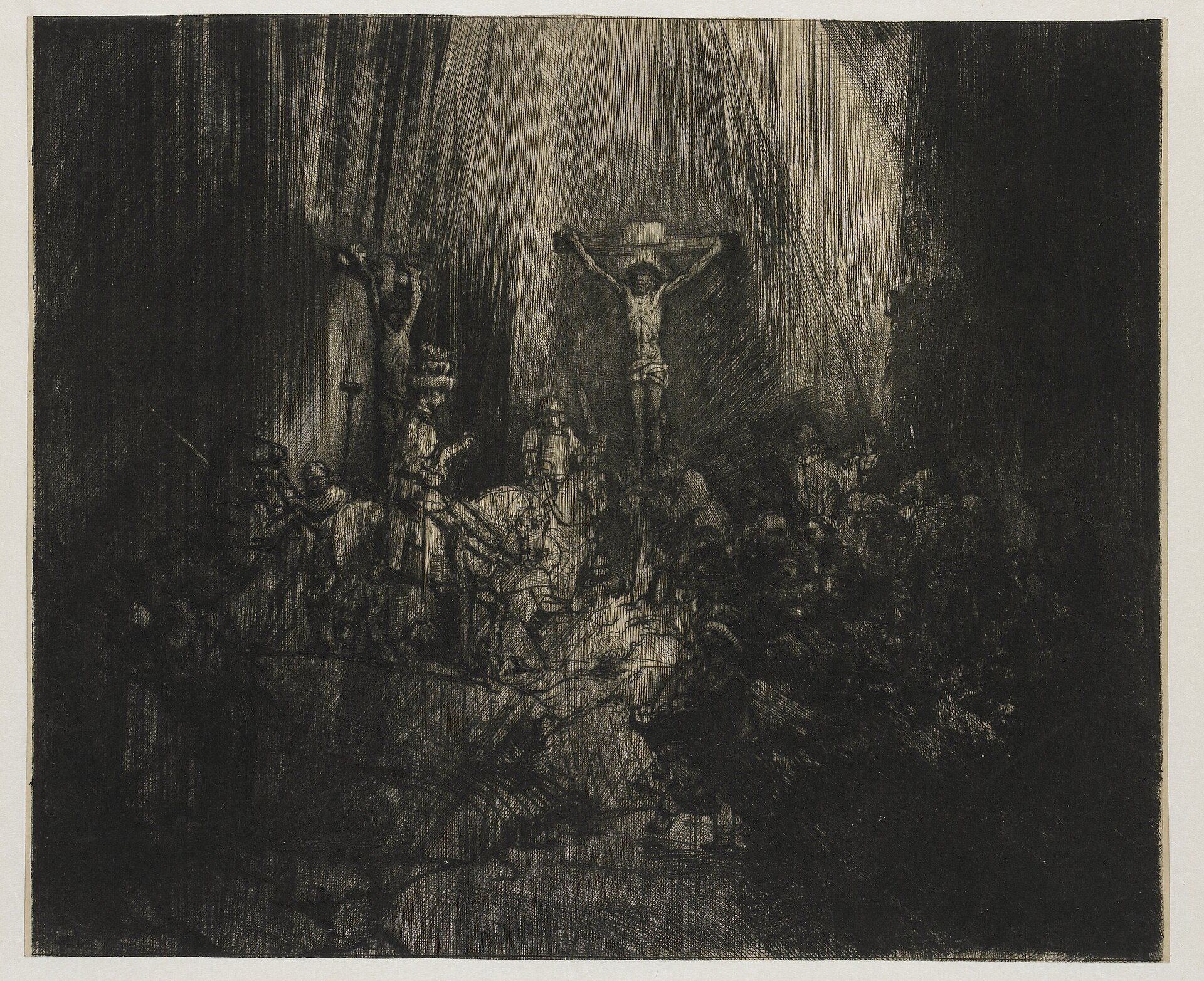
The impression at the centre of this record: Rijksmuseum RP-P-1962-40, New Hollstein 274-4(5), drypoint on Japanese paper, De Bruijn-van der Leeuw Bequest, 1962. The plate's darkened, radically reworked state, made after Rembrandt had already signed and dated an earlier, clean version of the same image.
| Artist | Rembrandt Harmensz. van Rijn |
|---|---|
| Date | 1653 for the plate's first three states (state III signed and dated "Rembrandt f 1653" at the bottom centre); the plate's fourth and fifth states, radically reworked, are dated by different scholars to as early as later in 1653-54, to c. 1658, or to c. 1660-61 - a genuine, unresolved dating disagreement addressed in the narrative below |
| Medium | Drypoint, extensively reworked with additional drypoint and engraving (burin) in the plate's later states, printed with surface tone; this impression on Japanese paper |
| Dimensions | Platemark and sheet size vary across surviving impressions by state, trimming and mounting, from roughly 364 x 443 mm to 390 x 456 mm; the Rijksmuseum's primary impression discussed in this record (RP-P-1962-40) measures 375 x 450 mm |
| Where it is now | Rijksmuseum, Amsterdamlast confirmed |
| Inventory number | RP-P-1962-40 |
| Attribution | AcceptedThe design, the copper plate, and every documented state of it are universally accepted as Rembrandt's own work; no source consulted for this record disputes his sole authorship. Full note |
| Object type | |
| Period | Dutch, seventeenth century (Golden Age) |
| Cases | Has a provenance gap |
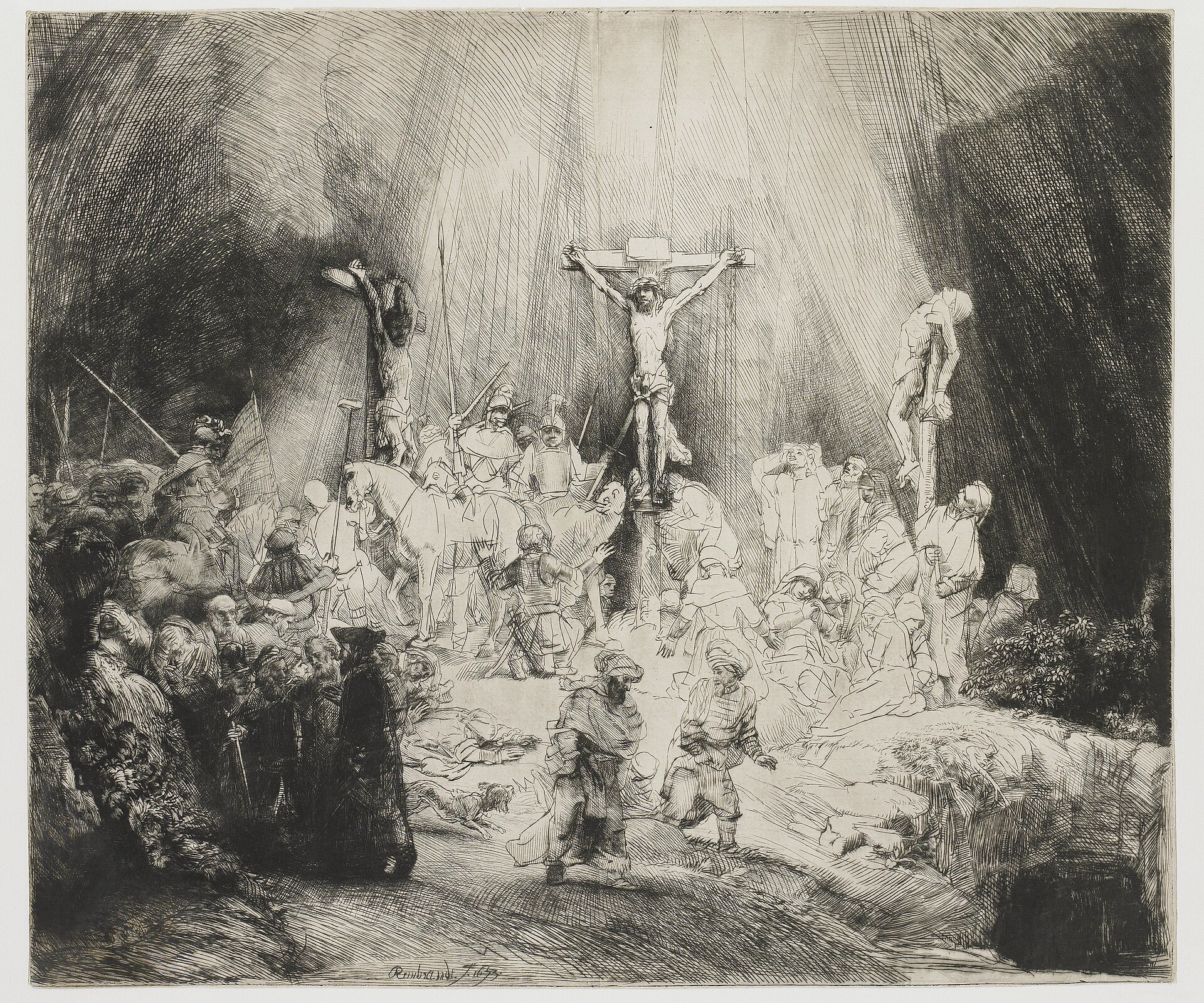
| Inscriptions | Signed and dated "Rembrandt f 1653" at the bottom centre of the plate from the third state onward; the inscription survives, unaltered, on the radically reworked fourth and fifth states. The primary impression discussed here carries an unidentified collector's mark catalogued as Lugt 228. |
| Owners on record | 5 links4 documented, 1 unknown |
| Sources | 32 cited |
About this record Last verified · 32 sources cited · Change log
On this page 10 sections
ContentsClose
In 1653 Rembrandt finished, signed and dated a large drypoint of Christ's crucifixion built almost entirely from scratched, unworn burr rather than etched line - a technical risk almost no printmaker before him had taken at this scale. He considered it done: the plate carries his signature and the date at the third state. Then, at a point scholars still cannot agree on, he went back into the same copper and tore it apart. Figures were scraped and burnished into oblivion, a horseman and a man in an improbable tall hat appeared where a crowd had stood, and thick, driving diagonal strokes turned an already sombre scene into something close to total darkness. States I to III and states IV and V are so different from each other that this record treats them, deliberately, the way it would treat two related but distinct objects - because for more than a century after Rembrandt's death, print connoisseurs were not sure the two halves of this sequence came from the same plate at all.
This record anchors on the Rijksmuseum's impression of the fourth state, printed on Japanese paper, one of two Three Crosses impressions the museum received in successive years from the Amsterdam collectors Isaac de Bruijn and Johanna Geertruida de Bruijn-van der Leeuw. The museum also holds an impression of the clean, signed third state and a first-state impression pulled, unusually, on vellum rather than paper - so the whole arc from finished image to its own destruction and remaking sits, physically, in the same print room. The reasons scholars give for why Rembrandt did this range from the practical (drypoint burr wears out fast) to the deliberately experimental (a documented practice, across several of his late plates, of manufacturing collectible variation) to the theological (a literal staging of the Gospel of Luke's darkness at the ninth hour). This record states plainly what it could and could not confirm about each explanation, and about when, exactly, the second half of this story happened.
Provenance
Each link is graded. Documented: a cited source supports it. Disputed: the identification is argued but not established. Unknown: no owner for that span, and the gap is not smoothed into a narrative. The grades in the glossary.
- 1653 -Rembrandt van Rijn, Amsterdam (the plate and its first three states)documented
Rembrandt signed and dated the plate's third state "Rembrandt f 1653" at the bottom centre, evidence that he considered the image finished at that point. The plate remained his own property and working tool.913
- 1653 - c. 1661Rembrandt van Rijn, Amsterdam (the plate, reworked into states IV and V)documented
Rembrandt himself reworked the plate, scraping and burnishing away large portions of the earlier composition. That the reworking happened, and that it was Rembrandt's own act, is documented; exactly when within this range is not, and three different dates (within months of 1653, c. 1658, and c. 1660-61) appear across the sources consulted.791013
- Unidentified collector (mark catalogued as Lugt 228)unknown
This specific impression carries a stamped collector's mark catalogued as Lugt 228. The Rijksmuseum's own online entry does not identify the collector, and this record could not establish the identity or a date from the sources consulted.1
- - 1961/1962Isaac de Bruijn (1872-1953) and Johanna Geertruida de Bruijn-van der Leeuw (1877-1960), Spiez and Muri, Switzerlanddocumented
The couple assembled a significant Rembrandt print collection, documented as active, informed buyers in the 1930s London old-master print trade (a 1936 Kinnaird-collection purchase at GBP 47,500 and a 1936 Oppenheimer-sale purchase for 700 guineas via the dealer P. and D. Colnaghi and Co.). The exact date and source of their acquisition of this specific impression is not stated in the sources consulted; the couple's Rembrandt holdings were donated to the Rijksmuseum in 1949 subject to usufruct, transferred to the museum in 1960, with this specific sheet and its vellum-impression companion following by bequest in 1962 and 1961 respectively.1225
- 1962 - presentRijksmuseum, Amsterdamdocumented
Received by bequest in 1962 as part of the Mr and Mrs De Bruijn-van der Leeuw bequest; catalogued as RP-P-1962-40.1
Prices realised
| Date | Sale | Estimate | Result | Note |
|---|---|---|---|---|
| 23 October 2024 | Christie's, New York Exceptional Impressions: The Alan and Marianne Schwartz Collection, sale 23636 (sale id 30738), Rockefeller Center, 23 October 2024, 14:00 UTC, lot 20 | USD 1,000,000 - 1,500,000 | Hammer USD 1,100,000 DERIVED, not published. Derived under the schedule in the Conditions of Sale the lot page links (ConditionsOfSale-NewYork-19OCT23.pdf): 26 per cent of hammer up to and including USD 1,000,000, 21 per cent of the part over 1,000,000 up to 6,000,000. 1,260,000 + 1.21 x 100,000 = 1,381,000; hammer 1,100,000, a round bidding figure. Label stays DERIVED. With premium USD 1,381,000 premium-inclusive, as printed on the house lot page and carried in the sale's lot-search JSON (price_realised 1381000); press reports of '$1.38m' round to 1,380,000, which understates the house figure by USD 1,000. USD | Lot page read 2026-09-15 at rung 1, HTTP 200, in full; lot-search JSON read the same day; the two agree. Impression as catalogued: drypoint, 1653, laid paper, watermark Strasbourg Bend (Hinterding D.a), 'a brilliant, highly atmospheric impression of the extremely rare second state (of five), before the additional rework in the foreground and before Rembrandt's signature and date', plate 385 x 452 mm, sheet 387 x 454 mm. The record's note that the state 'is not established' is answered: SECOND state. Provenance as printed by the house: Jan Chalon (1738-1795), Amsterdam, Paris and London (Lugt 439); Walter Shropshire, London, his stock catalogue n. 42; Jonathan Blackburne (1721-1786), Hale Hall and Liverpool, inscribed W. S. and dated 1772, his posthumous sale Hutchins, London, 20 March 1786, lot 821; Joseph Browne, Shepton Mallet, his posthumous sale Gerard, London, 23 May 1791, 2nd day lot 52; Daniel Daulby (1745/6-1798), Liverpool, his posthumous sale Christie's 14-17 May 1800, probably lot 129; Edward Rudge (1763-1846), Abbey Manor, Evesham, by descent to John Edward Rudge, his sale Christie's 16-17 December 1924 lot 103 (GBP 1,155; to Colnaghi; cited in Lugt); P. and D. Colnaghi, London; Eldridge Reeves Johnson (1867-1945), Wilmington, house sale Philadelphia 1962; Dr Otto Schaefer (1912-2000), Schweinfurt (Lugt 5881), his sale Sotheby's New York 13 May 1993 lot 22, sold after the sale to Harris. The house essay states that of the second state 'only one other impression is known outside a public collection'. Second confirmation of the figure: HENI's sale report of 24 October 2024 gives '$1.38m, 38% above its $1m low estimate' and a sale total of USD 9.89m; the lot search gives 126 lots listed, 121 with a price, sum USD 9,893,182, which is the calendar's published total. |
| 7 December 2023 | Christie's, London Old Masters Part I, sale 20685 (sale id 29467), King Street, 7 December 2023, 14:30 GMT. NOT the Josefowitz print sale 22952 held the same evening; the Josefowitz estate placed this lot and the Ecce Homo in the paintings sale., lot 19 | GBP 1,000,000 - 1,500,000 | Hammer GBP 980,000 DERIVED, not published. Derived from 1,225,800 under the buyer's premium schedule in the Conditions of Sale the lot page links (conditionsofsale-london-aug2023): 26 per cent of hammer up to and including GBP 800,000, 21 per cent of the part over 800,000 up to 4,500,000. 800,000 x 1.26 = 1,008,000; (1,225,800 - 1,008,000) / 1.21 = 180,000; hammer 980,000, a round bidding figure. Label stays DERIVED. With premium GBP 1,225,800 premium-inclusive, as printed on the house lot page ('Price realised GBP 1,225,800') and carried in the sale's lot-search JSON (price_realised 1225800). The figure of GBP 870,000 previously carried on this row was a rounding of GBP 869,400, the premium-inclusive result of lot 17 of the same sale, The Three Trees - a different print. GBP | Lot page read 2026-09-15 at rung 1, HTTP 200, in full, and the sale's lot-search JSON read the same day; the two agree. Impression as catalogued: drypoint, 1653, laid paper, watermark Strasbourg Bend (Hinterding D.a.b), 'a very fine impression of the extremely rare third state (of five)', much burr, selectively wiped plate tone, plate 387 x 455 mm, sheet 396 x 465 mm. Provenance as printed by the house: Hofbibliothek Vienna; Albertina, Vienna (Lugt 5d, with their stamp and de-accession stamp); their duplicates sale, C. G. Boerner, Leipzig, 3 May 1932, lot 61 (M 23,000; to Dr Kann for Schocken); Salman Schocken (1877-1959); Sotheby's London 29 November 1966 lot 16 (GBP 30,000; to Maison); Faerber and Maison, London; Charles C. Cunningham Jr. (Lugt 4684); Robert M. Light, Santa Barbara; Sam Josefowitz (Lugt 6094), acquired 1982 through Laube; by descent. Literature as printed: Bartsch, Hollstein 78; Hind 270; New Hollstein 274 (this impression cited); Stogdon 40 (this impression illustrated). INDEPENDENT CONFIRMATION of the figure: Christie's own lot essay for the Schwartz impression (sale 23636, October 2024) cites 'the Albertina duplicate from the Josefowitz Collection (Christie's, London, 7 December 2023, sold for US$ 1,542,000)', which is GBP 1,225,800 at 1.258, the rate of the day. A secondary blog reproducing the house press text prints 'Sold for GBP 1,225,800' for this lot but misprints the Saint Jerome in the print sale as 1,522,500 against the house's 1,552,500, so it corroborates and is not relied on. SALE-LEVEL: lot 20 of the same sale, the Josefowitz fifth-state Ecce Homo, estimate GBP 1,000,000-1,500,000, carries is_unsold true on its page; bought in. |
| 17 March 2015 | Sotheby's Prints and Multiples, London, sale L15160, lot 49, lot 49 | GBP 200,000 - 300,000 | Hammer Not found in the sources consulted With premium Not found in the sources consulted GBP | A fourth-state impression, described in the catalogue as fine, with rich burr and dramatic tonal contrast, in good condition with a repaired tear, foxing and minor creasing. Provenance: ex-collection Adalbert von Lanna (Lugt 2773), the noted Prague old-master print collector. This record confirmed the lot description and estimate directly but could not establish the price realized from the sources it could access. |
Hammer is the price at which the bidding stopped; with premium adds the fee the house charges the buyer on top. Hammer price and buyer's premium in the glossary.
Technical evidence
| Attribution note | The design, the copper plate, and every documented state of it are universally accepted as Rembrandt's own work; no source consulted for this record disputes his sole authorship. What this record grades separately, because the print itself makes it unavoidable, is which state and which impression is in front of the viewer at any given moment. The plate was reworked by Rembrandt's own hand into a second, radically different image, and the two are so different in appearance that, in the account given by more than one institution consulted here, later connoisseurs did not immediately accept that both came from the same copper. This record anchors on a single impression, the Rijksmuseum's Japanese-paper impression of the fourth state, and treats every other state and sheet discussed as a distinct, separately sourced comparandum. |
|---|---|
| Support (this impression) | Japanese paper (handmade, gampi-fibre paper imported via the Dutch East India Company from around the 1640s), per the Rijksmuseum's own cataloguing of RP-P-1962-40.119 |
| Medium and technique | Drypoint on a copper plate, worked almost entirely without etching in its first three states; the fourth and fifth states add extensive further drypoint and burin (engraving) work over large, deliberately scraped and burnished passages of the original composition.157 |
| Platemark and sheet | 375 x 450 mm for this impression; comparable impressions elsewhere range from roughly 364 x 443 mm to 390 x 456 mm depending on state, trimming and mounting.12413 |
| Catalogue numbers | Bartsch 78; Hollstein (Dutch) 78; New Hollstein Dutch and Flemish (Rembrandt) 274. This impression is state 4 of 5 (274-4(5)).1 |
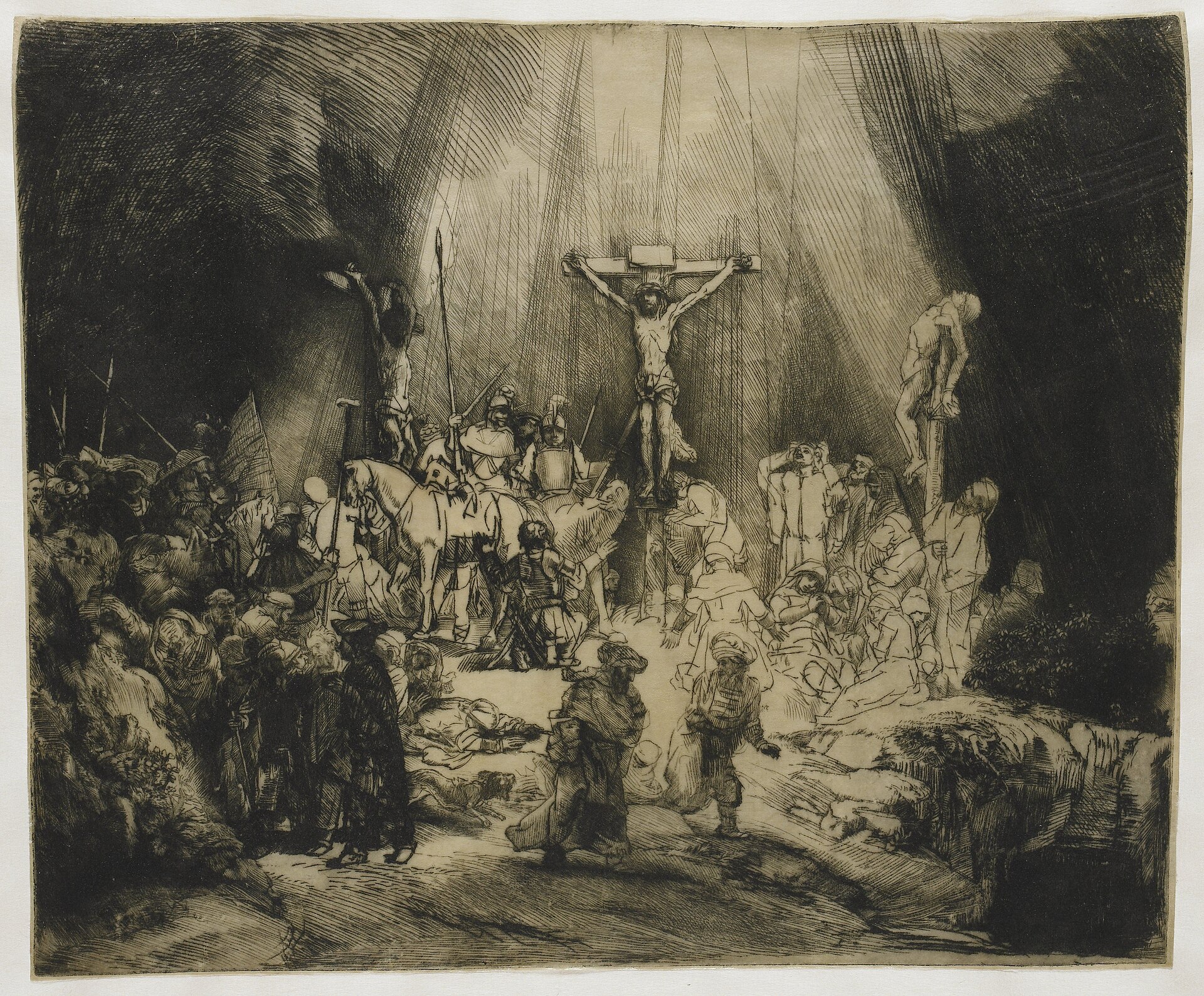
| States, in outline | States I to III (1653): a legible, populated crucifixion scene, progressively deepened in tone; state III is signed and dated. States IV and V (reworking date disputed, see narrative): large portions of the earlier composition scraped and burnished away, replaced with new figures (including a mounted soldier in a tall hat) and heavy diagonal drypoint shading that darkens most of the scene.157913 |
| Signature and date | "Rembrandt f 1653," bottom centre, added at the third state and retained unaltered through the later reworked states.913 |
| Collector's mark (this impression) | Lugt 228, unidentified in the sources consulted.1 |
| Collector's mark (other Rijksmuseum impressions) | Lugt 240, appearing on the museum's other three Three Crosses impressions (RP-P-OB-616, RP-P-OB-617, RP-P-OB-618). The same mark recurs on this museum's Rembrandt Hundred Guilder Print impression and its Durer Rhinoceros impression, both recorded elsewhere in this archive; its identity is not established in any source consulted.345 |
| Paper across the Rijksmuseum's own holdings | Vellum for the museum's first-state impression (RP-P-1961-1196A); ordinary European paper for its third-state impression (RP-P-OB-617); Japanese paper for this record's primary fourth-state impression (RP-P-1962-40) - three different supports for three different states in the same collection.124 |
| Credit line and acquisition (this impression) | Mr and Mrs De Bruijn-van der Leeuw Bequest, Muri, Switzerland; received by bequest in 1962.1 |
Images
The record in full
Chapter 1What this record anchors on
The impression at the centre of this record is Rijksmuseum object RP-P-1962-40: a drypoint printed on Japanese paper, sheet 375 by 450 millimetres, catalogued by the museum itself under Bartsch 78...
The impression at the centre of this record is Rijksmuseum object RP-P-1962-40: a drypoint printed on Japanese paper, sheet 375 by 450 millimetres, catalogued by the museum itself under Bartsch 78, Hollstein (Dutch) 78 and New Hollstein (Rembrandt) 274, state 4 of 5. It came to the museum by bequest in 1962 from Mr and Mrs De Bruijn-van der Leeuw of Muri, Switzerland, and carries an as-yet-unidentified collector's stamp catalogued as Lugt 228. This is not a lifetime-clean, gallery-friendly impression of a settled composition. It is a sheet from the plate's second life: the state Rembrandt produced only after scraping away large parts of the image he had already signed and dated as finished three years, or perhaps as many as seven or eight years, earlier.
The print as a whole shows Christ on the central cross between the two thieves, with Mary supported by the Evangelist John, Roman soldiers on foot and on horseback, and a crowd of bystanders arranged around the base of the crosses, worked in a scene the Rijksmuseum's own catalogue text describes simply as Christ hanging between two thieves, surrounded by apostles, his mother, followers and soldiers. What separates this print from almost anything else in Rembrandt's graphic output is that it was executed, in its first three states, almost entirely in drypoint - scratching a needle directly into the copper rather than biting a line with acid - a technique that, at this scale and level of ambition, the museum's own text states had almost never been done before. Drypoint gives a line a soft, velvety burr, but that burr is fragile: it flattens and disappears after a small number of pulls through a printing press. Rembrandt built his single most ambitious composition of the early 1650s on the medium least suited to being printed more than a few dozen times, and that fact turns out to be central to everything that happened to the plate afterward.
Chapter 2The subject, and the darkness the Gospel itself specifies
The scene is drawn from the Passion narrative shared, with variations, across all four Gospels: Christ crucified between two convicted thieves, one traditionally read as penitent and one not, with...
The scene is drawn from the Passion narrative shared, with variations, across all four Gospels: Christ crucified between two convicted thieves, one traditionally read as penitent and one not, with the Virgin, the beloved disciple, Roman soldiers and a crowd gathered at the foot of the crosses. The Rijksmuseum's own cataloguing cites Matthew 27:34-44, Mark 15:23-32, Luke 23:33-43 and John 19:18-24 for the print as a whole. One detail specific to Luke's account becomes unavoidable once the plate's fourth state is in front of you: Luke 23:44-45 states that from the sixth hour until the ninth, darkness came over the whole land, because the sun's light failed. States I to III show that darkness only as an atmospheric backdrop to a legible, populated scene. State IV does something closer to literalizing the text: thick, driving diagonal drypoint strokes fall across both sides of the composition like curtains closing in on Christ, obscuring most of the crowd that had been clearly visible moments (in the plate's working life) before.
Curators at more than one institution holding a fourth-state impression read this as a genuine shift in what the image is doing, not merely how it looks. The Cleveland Museum of Art's own catalogue text for its impression describes the intensified blackness as an active force that threatens to extinguish the light of Christ, explicitly tying the change to Luke's account of darkness covering the earth. A description associated with the Smith College Museum of Art's impression goes further, arguing that where state III let the viewer experience the crucifixion's trauma through the bystanders' visible reactions, state IV removes nearly all of them and concentrates attention on Christ alone in the dark, a shift severe enough, in that reading, to cast doubt on the redemption narrative the earlier states more straightforwardly told. This record treats both readings as exactly what they are: documented curatorial interpretations of a real, physical change to the plate, not a claim about what Rembrandt privately believed. No source consulted here supplies a document in which Rembrandt explains his own religious intention for this print, and this record does not supply one either.
Chapter 3States I to III: the print Rembrandt considered finished
Three states of the plate are documented before the radical reworking, and by the account given across the institutional sources consulted, the changes between them are changes of degree rather than...
Three states of the plate are documented before the radical reworking, and by the account given across the institutional sources consulted, the changes between them are changes of degree rather than of kind: further shading and tonal deepening added state by state, with the overall cast of figures and the composition's basic structure staying legible and consistent throughout. It was only at the third state that Rembrandt added his signature and the date, Rembrandt f 1653, at the bottom centre of the plate - an act one museum's own catalogue text reads plainly as evidence that Rembrandt regarded this state as finished and ready for the market. Sources consulted for this record differ on exactly how many impressions of the earliest states survive; one secondary account puts the figure at roughly twenty-one known impressions of the first state and roughly ten of the second, though this record could not verify that count against a primary catalogue directly and states it here as reported rather than confirmed.
The Rijksmuseum holds impressions from two points in this clean sequence: a first-state impression pulled, unusually, on vellum rather than paper (RP-P-1961-1196A, from the same De Bruijn-van der Leeuw bequest, one year before the museum's Japanese-paper fourth-state sheet arrived), and a third-state impression on paper (RP-P-OB-617), carrying the recurring, unidentified Lugt 240 mark discussed further below. Both show the print as Rembrandt left it before he went back into the plate: a crowded, legible crucifixion scene, tonally dark in places but with every figure the composition requires still visible.
Chapter 4State IV: the plate remade
What happened between the third state and the fourth is not a further refinement.
What happened between the third state and the fourth is not a further refinement. It is, in the words used by more than one institution holding an impression of it, a re-invention of the print - compositionally, tonally, and in what the image means. Rembrandt scraped and burnished away large portions of the figures he had drawn at the sides of the composition, replacing much of the crowd with heavy, driving parallel drypoint lines that read, in a well-inked impression, as an almost solid field of shadow. New elements were drawn into the reworked space: two mounted soldiers introduced at the left, a redrawn group around Mary and John at the right, and, most discussed in the literature consulted for this record, a mounted figure in a tall, non-European hat where a differently dressed, kneeling centurion had stood in the earlier states. The Roman soldiers' medieval-style armour and feathered plumes, present in states I to III, were replaced in the reworking by the more exotic hat, a costume change more than one source treats as a deliberate revision of Rembrandt's own earlier, historically inconsistent staging rather than an accident of the burnishing process. The second thief's cross, at the right, is thrown into a shadow deep enough that the figure is far harder to read than it was before.
Every institutional description of this transition consulted for this record agrees on the scale of the change; the Fitzwilliam Museum's own text for its own third-state impression calls the resulting fourth state much more sombre, much more bleak, and describes the narrative as having shifted backward in time, from the moment just after Christ's death to the moment of his own cry of abandonment. This is the single most dramatic plate reworking documented for any print in Rembrandt's output, and it is the reason this record exists in the form it does: an ordinary catalogue entry for a signed, dated, finished print from 1653 would not prepare a reader for what the same copper produced afterward.
Chapter 5Why Rembrandt did it: several explanations, and one this record could not confirm
The sources consulted for this record offer three genuinely distinct explanations for the reworking, and none of them, on the evidence available here, is a story about rescuing a print that had...
The sources consulted for this record offer three genuinely distinct explanations for the reworking, and none of them, on the evidence available here, is a story about rescuing a print that had failed to sell.
The first is practical. Drypoint burr wears down under the mechanical pressure of a printing press far faster than an etched or engraved line does; the Cleveland Museum of Art's own catalogue text states that the plate's delicate burr had already worn after roughly forty impressions of the first three states, and that Rembrandt reworked the plate, at least in part, simply to keep using a copper that could no longer print the image as originally drawn. On this account the dramatic result is a byproduct of a mundane maintenance problem: once large passages had to be re-cut or replaced anyway, Rembrandt chose to replace them with something new rather than a repair of the old.
The second explanation is deliberately artistic. Robert Fucci, whose 2015 exhibition and catalogue Rembrandt's Changing Impressions at Columbia University's Wallach Art Gallery examined roughly eighteen of Rembrandt's most dramatically altered late plates as a group, argues that Rembrandt thematized the notion of change itself in his printmaking practice, using successive states of the same plate to create multiple variations of a single image, both as an artistic experiment in what drypoint and burnishing could do and as a way of giving serious collectors comparative material worth owning in more than one form. On this reading the Three Crosses is not an isolated case of a plate going wrong; it is one of Rembrandt's clearest demonstrations of a working method he pursued deliberately across his late career.
The third explanation is theological, and is really a description of the reworking's effect rather than a claim about Rembrandt's stated intent: whatever the technical or commercial reasons behind it, the resulting image visualizes Luke's account of darkness at the crucifixion more literally and more completely than the earlier states did, shifting the emotional register described above from public spectacle to isolation. This record found no source that frames the reworking as an attempt to rescue a commercially unsuccessful print - the market evidence discussed below, including a documented culture of collectors actively seeking out variant states, points the other way, toward Rembrandt's plates as objects whose value the artist himself had reason to multiply, not repair.
Chapter 6When state IV was actually made: a dating dispute the sources do not agree on
Exactly when Rembrandt carried out the reworking is a genuinely unsettled question, and this record states the disagreement rather than picking a side it cannot support.
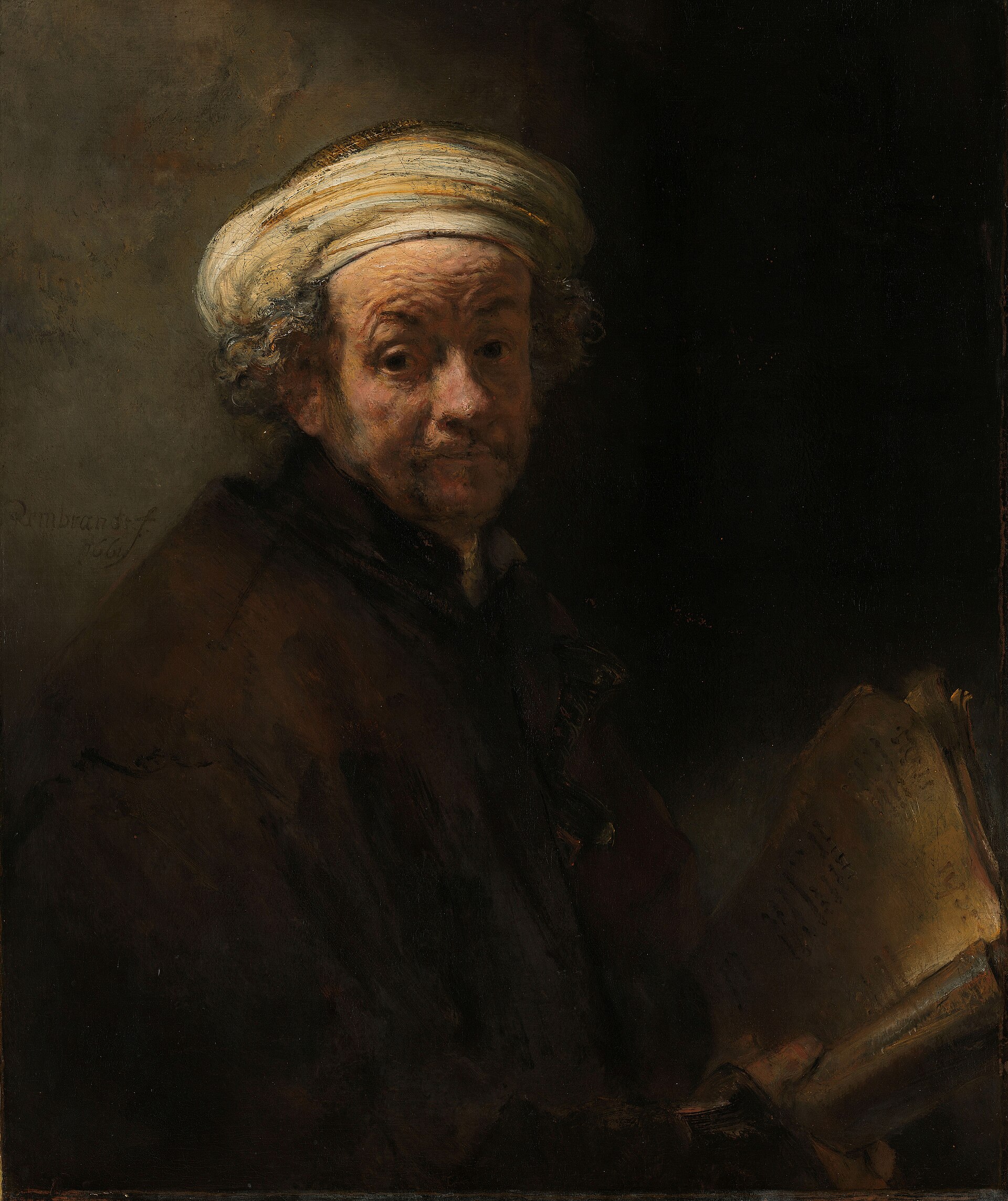
Exactly when Rembrandt carried out the reworking is a genuinely unsettled question, and this record states the disagreement rather than picking a side it cannot support. Three distinct dates appear across the institutional sources consulted here, and they are not close together. The Fitzwilliam Museum's own text states that Rembrandt reworked the plate within a few months of signing the third state in 1653, putting the whole sequence inside a single year or two. A Sotheby's London cataloguing of a fourth-state impression, offered as lot 49 in its 17 March 2015 Prints and Multiples sale, instead dates the reworking to circa 1658. A third position, long the standard art-historical dating and still the one used in the title of the Mildred Lane Kemper Art Museum's own impression (catalogued as The Three Crosses, 1660-61), places the reworking as late as 1660 or 1661, on the strength of a specific stylistic comparison: the tall hat worn by the mounted figure introduced in state IV closely resembles the hat worn by the central figure of Claudius Civilis in Rembrandt's 1661 painting The Oath of the Batavians, now in the Nationalmuseum, Stockholm. The circa 1660-61 date, if correct, would place the reworking in the same narrow span of years as Rembrandt's 1661 painted Self-Portrait as the Apostle Paul, now in the Rijksmuseum, a work this record includes as an artist portrait precisely because it falls inside that same disputed window.
That stylistic argument has since been challenged on harder evidence. According to a summary of Erik Hinterding's research consulted for this record, watermark analysis - identifying the paper mill and production period of the specific sheets on which early fourth-state impressions survive, independent of any argument from costume or brushwork - strongly suggests otherwise, and does not support the circa 1660-61 date the stylistic comparison to the Oath of the Batavians had implied. Hinterding is a co-author, with Jaco Rutgers, of the New Hollstein Rembrandt catalogue (2013), the modern reference this record cites throughout for state numbers, and watermark evidence of exactly this kind is the same physical method this archive's other Rembrandt print record, on the Hundred Guilder Print, describes being used to date that print's own lifetime impressions. This record was not able to obtain Hinterding's specific proposed date directly, only the fact that his watermark evidence displaces the stylistic one; it states that limitation here rather than picking a number to fill the gap, and records the state's true reworking date as an open question below.
Chapter 7Japanese paper, and why this impression is on it
The task this record was set requires an explicit answer, not an inference: is the Rijksmuseum impression at the centre of this record printed on Japanese paper?
The task this record was set requires an explicit answer, not an inference: is the Rijksmuseum impression at the centre of this record printed on Japanese paper? Yes. The museum's own catalogue entry for RP-P-1962-40 states the medium as drypoint, printed on Japanese paper, and the file's own Wikimedia Commons record confirms the same description. This is not the only paper Rembrandt used for this print; the Rijksmuseum's own first-state impression (RP-P-1961-1196A) is printed on vellum, not paper at all, described in the museum's own text as pulled on costly vellum, and its third-state impression (RP-P-OB-617) is on ordinary European paper. Three different supports, for three different states, in the same print room, from the same broad decade - a genuine demonstration of how deliberately Rembrandt varied the physical material his prints were pulled on.
Rembrandt is documented as one of the first Western artists to print etchings on Japanese paper, beginning around 1647 and continuing to his last etching in 1665, using it regularly for both plates and drawings. The Japanese sheets he favoured were gampi-fibre papers, light-brown to light-yellow or ivory in colour, with a smooth, shiny surface markedly different from the rough, matte European laid paper otherwise available to him; that surface did full justice to drypoint work specifically, since fine, absorbent paper of this kind picks up the subtle, velvety tonal range a burred drypoint line can produce far more faithfully than a coarser sheet does. How the paper reached Rembrandt's workshop is not established in the sources consulted; gampi papers arrived in the Netherlands via the Dutch East India Company from around the 1640s, but the exact channel by which Rembrandt himself acquired sheets, and how much he paid for them, is not documented in any source this record could verify. What is documented is the effect on this specific state and impression: the same driving, near-total darkness that defines state IV reads, on the warm, luminous surface of Japanese paper, with a tonal richness the coarser European sheet used for the Rijksmuseum's own third-state impression does not reproduce.
Chapter 8This impression's own collectors: the De Bruijn-van der Leeuw bequest
The Rijksmuseum's credit line for this impression names Mr and Mrs De Bruijn-van der Leeuw Bequest, Muri, Switzerland, with the object entering the museum's collection by bequest in 1962.
The Rijksmuseum's credit line for this impression names Mr and Mrs De Bruijn-van der Leeuw Bequest, Muri, Switzerland, with the object entering the museum's collection by bequest in 1962. The couple were the Amsterdam-connected collectors Isaac de Bruijn (1872-1953) and his wife, Johanna Geertruida de Bruijn-van der Leeuw (1877-1960), who lived in Spiez and later Muri, near Bern, and who assembled one of the more significant private holdings of Rembrandt's graphic work in the first half of the twentieth century. Rather than a single clean gift, the couple's arrangement with the museum was structured in stages: they donated works in 1949 while retaining usufruct - the right to keep and enjoy the objects during their own lifetimes - with the collection physically transferring to the Rijksmuseum only in 1960, and further individual objects, including the two Three Crosses impressions discussed in this record, arriving by bequest in 1961 and 1962 respectively, in the years immediately following Johanna's death.
The couple were active, informed buyers in the international print market of their day, not passive inheritors of a family collection. One documented purchase places them at a Rembrandt sale from the Kinnaird collection on 28 May 1936, where they paid 47,500 pounds sterling, and at the Henry Oppenheimer sale in London of 10-13 July 1936, where they acquired a further work for 700 guineas through the London dealership P. and D. Colnaghi and Co. Those purchase prices and that named dealer establish the couple as serious participants in the mid-1930s London old-master print trade, buying at the same level and through the same channels as the era's major institutional and private collectors, in the years immediately before the Second World War disrupted that market. This record was not able to establish, from the sources it could access, exactly when or from whom the couple acquired either of their two Three Crosses impressions specifically, as distinct from the general fact of their participation in that market; that gap is recorded as an open question below.
Chapter 9The Rijksmuseum's other impressions, and a mark this archive keeps meeting
Beyond the two De Bruijn-van der Leeuw sheets, the Rijksmuseum holds at least three further impressions of this print: RP-P-OB-616 and RP-P-OB-617, both cited to Bartsch 78 and New Hollstein 274 as...
Beyond the two De Bruijn-van der Leeuw sheets, the Rijksmuseum holds at least three further impressions of this print: RP-P-OB-616 and RP-P-OB-617, both cited to Bartsch 78 and New Hollstein 274 as states 1 and 3 of 5 respectively, and RP-P-OB-618, a further impression of state 4. All three carry the same collector's stamp, catalogued as Lugt 240, and none of the museum's own online catalogue entries consulted for this record identifies the collector behind that mark.
This is not the first time this mark has surfaced in this archive's own research. This record's sister record on Rembrandt's Hundred Guilder Print documents the identical Lugt 240 stamp on that print's own Rijksmuseum impression (RP-P-OB-602), and this archive's record on Durer's Rhinoceros documents a Lugt 240 stamp on that sheet's Rijksmuseum impression as well - three separate prints, by two different artists, in three different centuries of manufacture, all carrying the same numbered mark inside the same print room. The Hundred Guilder Print record's own research already raised, without confirming, the possibility that Lugt 240 functions as an internal Rijksmuseum print-room stamp rather than a private collector's mark, given how differently dated and differently subjected the objects that carry it are. This record cannot resolve that question any more than its predecessor could, but records the pattern's third occurrence here as a finding in its own right: whatever Lugt 240 turns out to be, it is not confined to one collection, one artist, or one moment in this print room's history, and a future editor with direct access to the Lugt reference catalogue should settle the question once, for all three records at once.
Chapter 10The pendant: Christ Presented to the People
The Rijksmuseum's own catalogue text for its vellum first-state impression of the Three Crosses describes the print as the pendant to Christ Presented to the People, on the opposite partition wall...
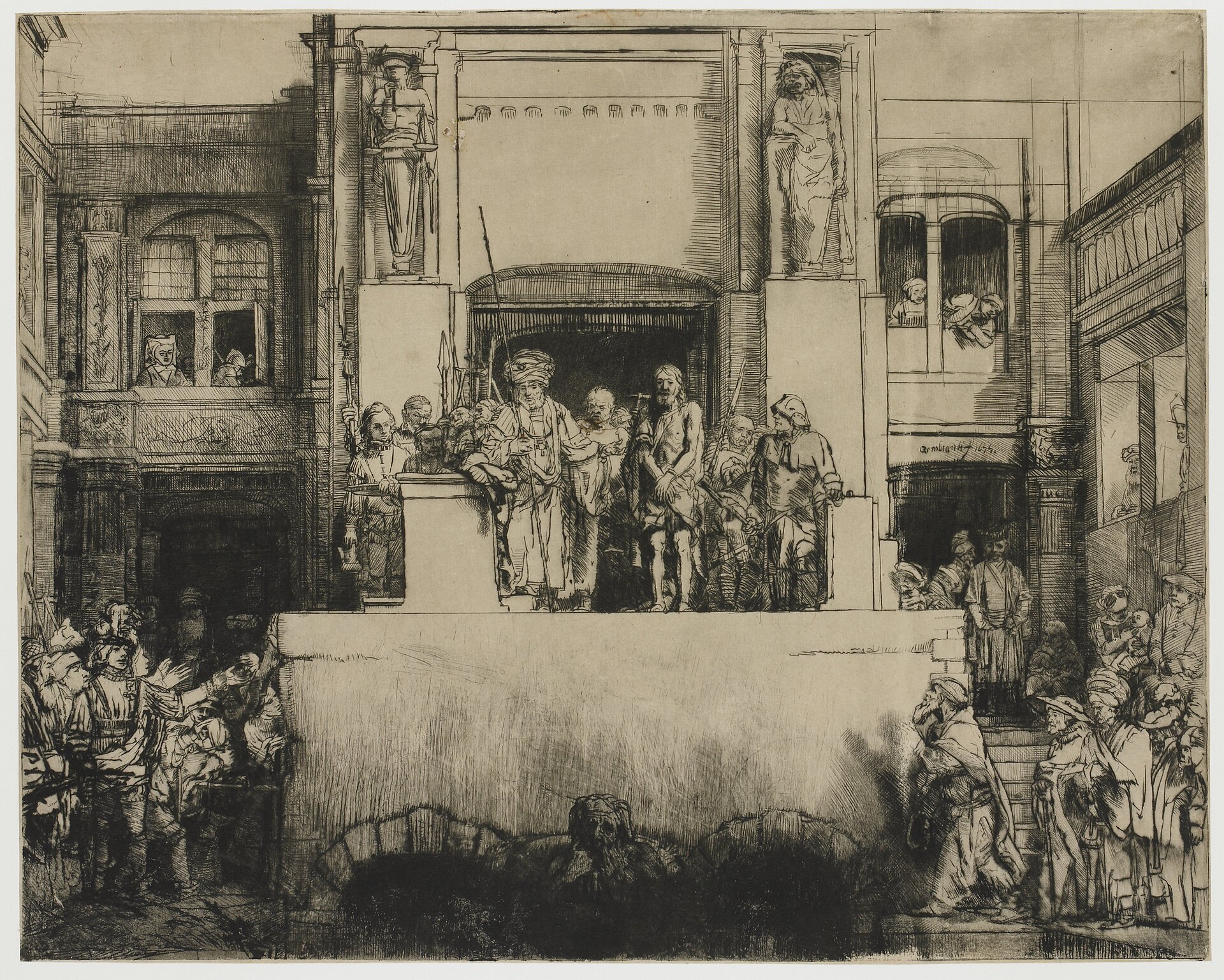
The Rijksmuseum's own catalogue text for its vellum first-state impression of the Three Crosses describes the print as the pendant to Christ Presented to the People, on the opposite partition wall - the museum's own curatorial framing for how the two prints are displayed and understood as a pair, rather than a claim about a documented joint commission. Christ Presented to the People, Rembrandt's other large-scale drypoint of the Passion, showing Pilate presenting Christ to the crowd before the crucifixion (Ecce Homo, John 19:4-6), is close in size to the Three Crosses - both prints among the two largest Rembrandt ever made - and exists in its own sequence of eight documented states, all dated to around 1655, two years after the Three Crosses was first signed. The Rijksmuseum holds its own impression of that print as well, RP-P-OB-611, an impression of a later state (the museum's own record for this sheet notes an annotation reading 6de druk extra raar (sixth impression, extra rare), a sixth-state impression marked by an early owner as exceptionally rare).
Read together, the two prints bracket the Passion narrative - Christ shown to the crowd before his death, and Christ dying on the cross - in the same technique, at nearly the same scale, within a few years of each other, at the height of Rembrandt's ambition as a printmaker working almost exclusively in drypoint. Christ Presented to the People was itself extensively reworked across its eight states, including, in its most discussed alteration, the removal of a foreground crowd Rembrandt had originally etched at the bottom of the composition and replaced with an empty platform - a different kind of dramatic revision on a different plate, made by the same hand within the same few years, that this record notes as context without asserting a documented, contractual pairing between the two prints beyond the museum's own descriptive framing.
Chapter 111653: what else was on Rembrandt's ledger the year he signed this plate
Rembrandt dated the plate's third state 1653 in the same year his own finances were, on the documentary record, under acute strain.
Rembrandt dated the plate's third state 1653 in the same year his own finances were, on the documentary record, under acute strain. His ownership of the large house he had bought on the Sint Antoniesbreestraat in 1639 took full legal effect only after a judicial delivery on 8 January 1653, a transfer that removed any further possibility of delaying the outstanding purchase payment. Forced into an immediate cash need, Rembrandt took out a series of loans in what one scholarly account of his finances describes as panic; among them, the Amsterdam patrician and later burgomaster Cornelis Witsen lent Rembrandt 4,180 guilders that same January, recorded in an aldermen's letter that stipulated a general hypothec, a lien over his general assets rather than a specific one. His financial position did not recover: the documentary record shows it deteriorating steadily through the first half of the 1650s, brought on, by the same account, considerably by Rembrandt's own financial mismanagement, and culminating in the formal declaration of insolvency in 1656, with debts eventually totalling roughly 13,000 guilders.
This record does not claim a documented causal link between the Witsen loan and the decision, whenever exactly it was taken, to rework this specific plate; no source consulted draws that connection explicitly, and this record will not manufacture one. What can be stated plainly is that the print exists, was signed, and entered active commercial and collecting circulation in the same calendar year Rembrandt was scrambling for cash to keep the roof over his own workshop - a coincidence of timing worth recording precisely because Rembrandt's own market for prints, discussed below, was already functioning as a source of income he had every incentive to protect and extend.
Chapter 12The market for impressions of this print
Three documented sales of impressions of this print, spanning more than a decade, are directly traceable in the sources consulted for this record, and they illustrate different tiers of the same...
Three documented sales of impressions of this print, spanning more than a decade, are directly traceable in the sources consulted for this record, and they illustrate different tiers of the same market rather than a single price for a single object. At Christie's New York, on 23 October 2024, an impression of the Three Crosses was the star lot of Exceptional Impressions: The Alan and Marianne Schwartz Collection, an auction that totalled 9.89 million dollars; the print itself sold for a total of 1,380,000 dollars, 38 percent above its 1,000,000-dollar low estimate. The source consulted for this figure states only the combined total and does not separately report a hammer price and buyer's premium, and this record does not back-calculate one from the other.
A second sale, identified through search-engine-indexed reporting rather than a direct fetch of Christie's own sale records (the primary listing returned an access error on every attempt made during this research), places a third-state impression from the celebrated Rembrandt print collection of Sam Josefowitz (1921-2015) at Christie's London on 7 December 2023, as lot 17, with a reported total of 870,000 pounds sterling against a 300,000-pound low estimate; press coverage around the wider Josefowitz dispersal describes this specific lot as the most expensive of five highlighted impressions drawn from more than seventy Rembrandt prints in that collector's holdings. This record flags that figure as resting on secondary, search-indexed reporting rather than a source it could read directly, consistent with this archive's practice of stating that distinction plainly rather than presenting an unverified figure with false confidence.
A third data point, independently and directly confirmed, is an estimate rather than a result: Sotheby's London offered a fourth-state impression as lot 49 in its Prints and Multiples sale (L15160) of 17 March 2015, with an estimate of 200,000 to 300,000 pounds, described in the catalogue as a fine impression with rich burr and dramatic tonal contrast, in good condition with a repaired tear, foxing and minor creasing, and with a distinguished provenance: ex-collection Adalbert von Lanna, the great Prague old-master print collector, whose mark is catalogued as Lugt 2773. This record could not establish the lot's price realized from the sources it could access and states that gap here rather than guessing at it. Taken together, these three data points place documented impressions of this print, across three different states and three different auction houses, consistently in the low hundreds of thousands to low millions of dollars, a market that rewards early or dramatically reworked, well-provenanced sheets rather than a single settled price for the print as an undifferentiated object.
Chapter 13Exhibition history, and this archive's other Rembrandt print
The Three Crosses, in its third state, was included in Rembrandt: The Late Works, the joint National Gallery, London and Rijksmuseum, Amsterdam exhibition that ran in London from 15 October 2014 to...
The Three Crosses, in its third state, was included in Rembrandt: The Late Works, the joint National Gallery, London and Rijksmuseum, Amsterdam exhibition that ran in London from 15 October 2014 to 18 January 2015, drawing roughly 40 paintings, 20 drawings and 30 prints organized thematically around self-scrutiny, experimental technique and the observation of everyday life in Rembrandt's final years - an exhibition the National Gallery's own reporting states was seen by more than a quarter of a million visitors, one of the most attended in the gallery's history. Its inclusion in a show explicitly built around Rembrandt's experimental technique is consistent with, though this record does not treat it as proof of, the dating that would place the plate's dramatic reworking in that same late period of his career; as set out above, the sources consulted disagree on whether that late dating is actually correct.
This archive already holds a record on Rembrandt's other great mid-century drypoint, the Hundred Guilder Print (Christ Preaching, Healing the Sick, and Blessing the Children), and the two objects are worth distinguishing clearly rather than folding together. The Hundred Guilder Print's own dramatic later alteration was posthumous and physical: the London collector William Baillie bought the worn plate in 1775, reworked it by his own hand, printed roughly a hundred impressions, and then cut the single copper into four separate pieces, each further reworked and printed independently - an alteration made by a different, named eighteenth-century hand more than a century after Rembrandt's death. The Three Crosses tells a different story: every state discussed in this record, from the signed, finished third state to the darkened fourth and fifth, was made by Rembrandt himself, within his own working lifetime, whatever the correct date for that second campaign of work turns out to be. Both prints show a Rembrandt plate transformed almost beyond recognition; only one of the two transformations belongs to Rembrandt.
The artist
Rembrandt Harmensz. van Rijn
By 1653 Rembrandt had spent nearly two decades building, and was in the same year straining under, the financial architecture of an independent Amsterdam workshop: a large mortgaged house, a print-publishing operation that sold directly to collectors as far away as Italy, and a growing personal debt he would not resolve before his own insolvency three years later. The print at the centre of this record was made, signed, and then deliberately destroyed and remade inside that same stretch of years, by an artist whose printmaking practice, on the evidence of his other late plates, treated a finished, signed, saleable image as a starting point rather than an endpoint.
Related works
| Work | Relation | Where it is |
|---|---|---|
| Christ Presented to the People Rembrandt van Rijn | The Rijksmuseum's own curatorial framing calls this print the pendant to the Three Crosses; a comparably large drypoint of the Passion, c. 1655, reworked across eight of its own documented states Shows Pilate presenting Christ to the crowd before the crucifixion, the episode preceding the Three Crosses in the Passion narrative. | Rijksmuseum, Amsterdam (RP-P-OB-611, a later state) |
| The Three Crosses, state I (5), on vellum Rembrandt van Rijn | An earlier, clean state of the same plate, pulled on vellum rather than paper From the same De Bruijn-van der Leeuw bequest as this record's primary impression, received one year earlier, in 1961. | Rijksmuseum, Amsterdam (RP-P-1961-1196A) |
| The Three Crosses, state III (5), signed and dated Rembrandt van Rijn | The last of the plate's clean states, the version Rembrandt signed and dated as finished before the radical reworking Carries the unidentified Lugt 240 collector's mark shared with two other Rijksmuseum Three Crosses impressions. | Rijksmuseum, Amsterdam (RP-P-OB-617) |
| The Three Crosses, state IV (5), ex-Lanna Rembrandt van Rijn | A separately provenanced impression of the same reworked state as this record's primary impression Ex-collection Adalbert von Lanna, the Prague old-master print collector (Lugt 2773); estimated GBP 200,000-300,000. Price realized not established in the sources consulted. | Sold Sotheby's, London, 17 March 2015, lot 49 |
| Christ Preaching, Healing the Sick, and Blessing the Children ("The Hundred Guilder Print") Rembrandt van Rijn | This archive's other major Rembrandt print record; a useful contrast rather than a close comparandum That print's plate was altered posthumously, by the collector William Baillie in 1775, and physically cut into four pieces. Every state of the Three Crosses discussed in this record, by contrast, is Rembrandt's own lifetime work on his own plate. | National Gallery of Art, Washington, D.C. |
Open questions
- When, precisely, did Rembrandt rework the plate into its fourth state? Sources consulted give three different answers - within months of 1653, circa 1658, and circa 1660-61 - and this record could not obtain Erik Hinterding's own specific watermark-based date, only the fact that his research displaces the once-standard stylistic dating.
- What happened to the copper plate after Rembrandt's death in 1669? No source consulted for this record traces its ownership, unlike the well-documented posthumous chain (Greenwood, then Baillie, in 1775) established for this archive's Hundred Guilder Print record.
- Who does the collector's mark Lugt 228, on this record's primary impression, belong to? Not identified in the sources consulted.
- Who does the collector's mark Lugt 240, recurring on three of the Rijksmuseum's other Three Crosses impressions and on this museum's Durer and Hundred Guilder Print impressions recorded elsewhere in this archive, actually belong to? Not identified in any source consulted across any of the three records.
- From whom, and when, did Isaac de Bruijn and Johanna Geertruida de Bruijn-van der Leeuw acquire either of their two Three Crosses impressions specifically? Their general participation in the 1930s London print trade is documented; the specific acquisition of these two sheets is not.
- Was the hammer price of the 2024 Christie's Schwartz Collection sale, or the reported 2023 Christie's Josefowitz Collection sale, ever published separately from the buyer's premium? Not found in the sources consulted; both figures given in this record are combined totals.
- Did the plate's fourth-state reworking coincide, in any documented way, with Rembrandt's 1653 financial crisis, or is the shared year a coincidence? No source consulted draws this connection explicitly, and this record does not assert one.
Questions about this object
What is Christ Crucified between the Two Thieves ("The Three Crosses")?
Christ Crucified between the Two Thieves ("The Three Crosses") is a print, dated 1653 for the plate's first three states (state III signed and dated "Rembrandt f 1653" at the bottom centre); the plate's fourth and fifth states, radically reworked, are dated by different scholars to as early as later in 1653-54, to c. 1658, or to c. 1660-61 - a genuine, unresolved dating disagreement addressed in the narrative below. Medium: Drypoint, extensively reworked with additional drypoint and engraving (burin) in the plate's later states, printed with surface tone; this impression on Japanese paper.
Who made Christ Crucified between the Two Thieves ("The Three Crosses"), and is the attribution settled?
The attribution to Rembrandt Harmensz. van Rijn is recorded here as accepted. The design, the copper plate, and every documented state of it are universally accepted as Rembrandt's own work; no source consulted for this record disputes his sole authorship. What this record grades separately, because the print itself makes it unavoidable, is which state and which impression is in front of the viewer at any given moment. The plate was reworked by Rembrandt's own hand into a second, radically different image, and the two are so different in appearance that, in the account given by more than one institution consulted here, later connoisseurs did not immediately accept that both came from the same copper. This record anchors on a single impression, the Rijksmuseum's Japanese-paper impression of the fourth state, and treats every other state and sheet discussed as a distinct, separately sourced comparandum.
Where is Christ Crucified between the Two Thieves ("The Three Crosses") now?
Rijksmuseum, Amsterdam. Inventory number RP-P-1962-40. Last confirmed 13 August 2026. Mr and Mrs De Bruijn-van der Leeuw Bequest, Muri, Switzerland, received by bequest in 1962.
What has Christ Crucified between the Two Thieves ("The Three Crosses") sold for?
Hammer USD 1,100,000 DERIVED, not published. Derived under the schedule in the Conditions of Sale the lot page links (ConditionsOfSale-NewYork-19OCT23.pdf): 26 per cent of hammer up to and including USD 1,000,000, 21 per cent of the part over 1,000,000 up to 6,000,000. 1,260,000 + 1.21 x 100,000 = 1,381,000; hammer 1,100,000, a round bidding figure. Label stays DERIVED.; with premium, USD 1,381,000 premium-inclusive, as printed on the house lot page and carried in the sale's lot-search JSON (price_realised 1381000); press reports of '$1.38m' round to 1,380,000, which understates the house figure by USD 1,000. Christie's, New York, 2024-10-23.
What is still unknown about Christ Crucified between the Two Thieves ("The Three Crosses")?
When, precisely, did Rembrandt rework the plate into its fourth state? Sources consulted give three different answers - within months of 1653, circa 1658, and circa 1660-61 - and this record could not obtain Erik Hinterding's own specific watermark-based date, only the fact that his research displaces the once-standard stylistic dating.
Sources
- 1Rijksmuseum, Amsterdam, catalogue entry for The Three Crosses, object number RP-P-1962-40. rijksmuseum.nl/en/...
- 2Rijksmuseum, Amsterdam, catalogue entry for The Three Crosses, object number RP-P-1961-1196A. rijksmuseum.nl/en/...
- 3Rijksmuseum, Amsterdam, catalogue entry for The Three Crosses, object number RP-P-OB-616. rijksmuseum.nl/en/...
- 4Rijksmuseum, Amsterdam, catalogue entry for The Three Crosses, object number RP-P-OB-617. rijksmuseum.nl/en/...
- 5Rijksmuseum, Amsterdam, catalogue entry for The Three Crosses, object number RP-P-OB-618. rijksmuseum.nl/en/...
- 6Wikipedia, 'The Three Crosses.' source, with the New Hollstein Rembrandt catalogue and Christopher White's Rembrandt as an Etcher directly. en.wikipedia.org/wiki/...
- 7Cleveland Museum of Art, catalogue entry for Christ Crucified between the Two Thieves: 'The Three Crosses,' accession 1959.241. clevelandart.org/art/...
- 8Amanda Shubert, 'Rembrandt's The Three Crosses,' Smith College Museum of Art blog, 18 April 2012. scma.smith.edu/blog/...
- 9Fitzwilliam Museum, Cambridge, catalogue entry for The Three Crosses, accession AD.2015.7. fitzmuseum.cam.ac.uk/explore-our-collection/...
- 10Mildred Lane Kemper Art Museum, Washington University in St. Louis, artwork essay for Rembrandt van Rijn, The Three Crosses, 1660-61, on the Pisanello-medal and Oath of the Batavians dating argument and Erik Hinterding's watermark-based revision of it. Identified via search-engine-indexed content; direct fetch of the page returned an access error during this research pass. kemperartmuseum.wustl.edu/research/...
- 11Dan Starling, 'After Rembrandt's The Three Crosses,' essay citing Robert Fucci's Rembrandt's Changing Impressions on the costume revision between the third and fourth states and the experimental-innovation reading of the reworking. danstarling.com/rembrandtessay.html
- 12Robert Fucci, Rembrandt's Changing Impressions, exhibition catalogue, Miriam and Ira D. Wallach Art Gallery, Columbia University, with David Freedberg and Deborah Cullen (Wallach Art Gallery / Verlag der Buchhandlung Walther Konig, 2015). wallach.columbia.edu/publications/...
- 13Sotheby's, London, Prints and Multiples sale L15160, lot 49, Rembrandt Harmensz. van Rijn, The Three Crosses, 17 March 2015. sothebys.com/en/...
- 14Heni, 'Rembrandt Leads Christie's $9.89m Exceptional Impressions: The Alan and Marianne Schwartz Collection Auction in New York,' 23 October 2024. heni.com/news/...
- 15Antiques Trade Gazette, 'Remarkable Rembrandt print prices as Christie's disperses Sam Josefowitz collection,' January 2024, on the 7 December 2023 Christie's London sale. Identified via search-engine-indexed content; direct fetch of the article returned an access error (403) on every attempt made during this research pass, so the GBP 870,000 / lot 17 figure in this record rests on that indexed summary rather than a directly read primary listing. antiquestradegazette.com/print-edition/...
- 16Rijksmuseum, Amsterdam, catalogue entry for Christ Presented to the People, object number RP-P-OB-611. rijksmuseum.nl/en/...
- 17Wikipedia, 'Christ Presented to the People.' source, with the New Hollstein Rembrandt catalogue directly. en.wikipedia.org/wiki/...
- 18Leiden University, 'Rembrandt made a mess of his legal and financial life,' 2021, on the 8 January 1653 judicial delivery of the Breestraat house, the resulting loans taken in panic, and the Cornelis Witsen loan of January 1653. universiteitleiden.nl/en/...
- 19Washi Arts, 'Rembrandt's Etchings and Japanese Washi Paper from Echizen,' 2015, on Rembrandt's use of Japanese gampi-fibre paper from c. 1647 to 1665 and its visual and tonal properties. washiarts.com/blog/...
- 20Rijksmuseum, Amsterdam, catalogue entry for Self-Portrait as the Apostle Paul, object number SK-A-4050. rijksmuseum.nl/en/...
- 21National Gallery, London, press materials and reporting on 'Rembrandt: The Late Works,' 15 October 2014 - 18 January 2015, a joint exhibition with the Rijksmuseum, Amsterdam. nationalgallery.org.uk/whats-on/...
- 22GAMEO (Global Anabaptist Mennonite Encyclopedia Online), 'Rembrandt Harmensz van Rijn (1607-1669),' on Rembrandt's family's mixed Catholic, Calvinist, Remonstrant and Mennonite ties and the absence of documented formal church membership. Identified via search-engine-indexed content. gameo.org/index.php
- 23Arnold Houbraken, De Groote Schouburgh der Nederlantsche Konstschilders en Schilderessen (Amsterdam, 1718-21), for the reported remark 'Because I want to keep my spirit unfettered, I seek freedom, not honor,' attributed to Rembrandt via testimony from his own former pupils. Identified via search-engine-indexed secondary discussion; this record treats the remark as a reported anecdote from a biography written decades after Rembrandt's death, not as a document in Rembrandt's own hand. en.wikiquote.org/wiki/...
- 24Secondary summary of the 1679 inventory of the Amsterdam print dealer Clement de Jonghe, listing 74 of Rembrandt's copper plates, two years after Rembrandt's death. news.masterworksfineart.com/2019/...
- 25Secondary biographical summary of the collectors Isaac de Bruijn and Johanna Geertruida de Bruijn-van der Leeuw, their 1936 London old-master print purchases, and the 1949/1960/1961-62 staged bequest to the Rijksmuseum. commons.wikimedia.org/wiki/...
- 26Christie's, 'Lot 19, Rembrandt, Christ crucified between the two Thieves: 'The Three Crosses' - Old Masters Part I, sale 20685, 7 December 2023'. Sale, lot, estimate, premium-inclusive price GBP 1,225,800, third state, watermark, dimensions, the Albertina-to-Josefowitz provenance and the literature. Accessed 2026-09-15. christies.com/en/...
- 27christies.com, web page cited for the Christie's, London sale of 2023-12-07. christies.com/en/...
- 28Christie's, 'Conditions of Sale, London, August 2023'. The buyer's premium schedule behind the DERIVED hammer of GBP 980,000. Accessed 2026-09-15. christies.com/media-library/...
- 29Christie's, 'Lot 20, Rembrandt, Christ crucified between the two Thieves: 'The Three Crosses' - Exceptional Impressions: The Alan and Marianne Schwartz Collection, sale 23636, 23 October 2024'. Sale, lot, estimate, premium-inclusive price USD 1,381,000, second state, the eleven-owner provenance from Chalon to Schaefer, and the house's own citation of the December 2023 sale at US$ 1,542,000. Accessed 2026-09-15. christies.com/en/...
- 30Christie's, 'Lot 17, Rembrandt, The Three Trees - Old Masters Part I, sale 20685, 7 December 2023'. GBP 869,400, the figure the record had rounded to 870,000 and attached to the Three Crosses. Accessed 2026-09-15. christies.com/en/...
- 31christies.com, web page cited for the Christie's, New York sale of 2024-10-23. christies.com/en/...
- 32Christie's, 'Conditions of Sale, New York, 19 October 2023'. The buyer's premium schedule behind the DERIVED hammer of USD 1,100,000. Accessed 2026-09-15. christies.com/-/...
Last verified · Published
Change log
13 August 2026 - Record created at the house standard: researched narrative, technical evidence, maker dossier, graded provenance chain, prices with hammer and premium separated, related works, open questions and sources.
25 September 2026 - Prices realised revised by the auction watch of 2026-09-15: the 2023-12-07 Christie's, London row corrected (wrong sale, wrong lot, wrong figure); the 2024-10-23 Christie's, New York row corrected (figure carried as USD 1,380,000 from press rounding).