Marine Chronometer
Pierre Le Roy · 1766
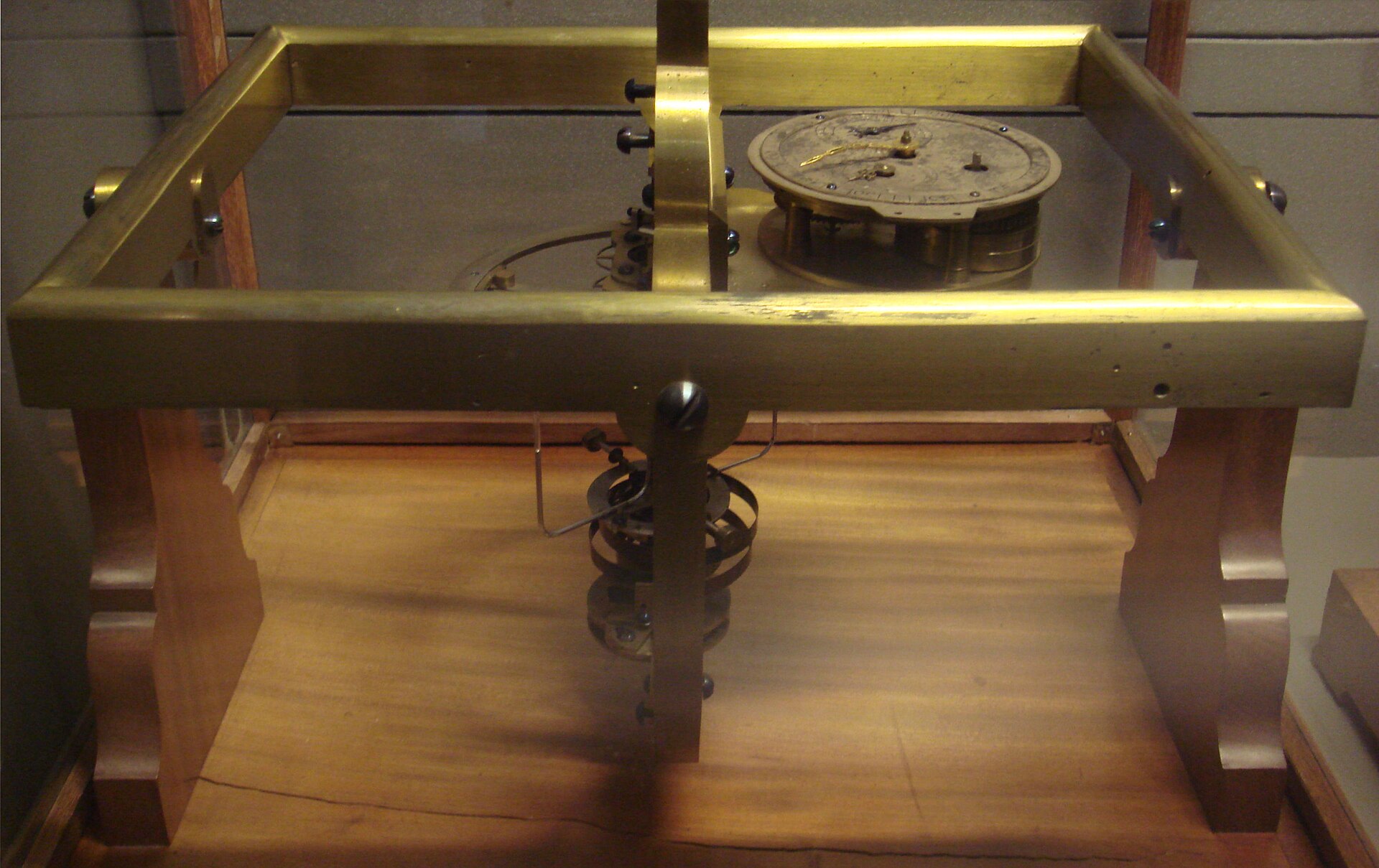
The object described in this record, CnAM 1395, photographed in its gimballed case. Confirmed via the Wikimedia Commons category for this specific inventoried object.
Musee des Arts et Metiers, Paris; photograph by PHGCOM · CC BY-SA 3.0| Artist | Pierre Le Roy |
|---|---|
| Date | 1766 |
| Medium | Wood, steel, brass and glass; detent escapement, temperature-compensated bimetallic balance, isochronous balance spring |
| Dimensions | 35 x 25 x 25 cm (outer gimbal box) |
| Where it is now | Musee des Arts et Metiers (Conservatoire national des arts et metiers), Parislast confirmed 18 September 2026 |
| Inventory number | CnAM 1395 (01395-0000-) |
| Attribution | AcceptedMade by Pierre Le Roy, horloger du roi, and identified without dispute as his work by the Conservatoire national des arts et metiers, which has held it since at least the early twentieth century and gives it inventory number 01395-0000. Full note |
| Object type | Clocks and instruments |
| Period | French, eighteenth century |
| Cases | Has a provenance gap |
| Inscriptions | Not established from the sources consulted. |
| Owners on record | 7 links6 documented, 1 unknown |
| Sources | 11 cited |
About this record Last verified 18 September 2026 · 11 sources cited · Change log
On this page 9 sections
ContentsClose
A small brass, steel and wood marine timekeeper of 1766, built by the Parisian royal clockmaker Pierre Le Roy and tested at sea aboard the corvette Aurore in 1767. It carries, in one working object, the three mechanisms that every marine chronometer built afterward actually used: a detached detent escapement, a temperature-compensated balance and an isochronous balance spring. John Harrison solved the longitude problem first and more famously, but the trade that followed did not copy Harrison's H4; it copied this.
Le Roy entered the machine, and a duplicate of it, for the Academie des Sciences' Meslay prize. The two Le Roy watches were the only entries actually produced for the 1767 trial; his rivals' machines were withdrawn or damaged before the ship sailed. Le Roy won the double prize in 1769, was outmanoeuvred in reputation by his rival Ferdinand Berthoud regardless, and died in 1785 without ever receiving the recognition or the money that Harrison had received from the British Parliament for less durable ideas.
The object has been at the Conservatoire national des arts et metiers, in Paris, since before 1923, when the horologist and historian Rupert Gould examined it there and wrote what remains the most-cited English-language judgment on it: that the credit for designing the first modern chronometer belongs to Le Roy, and to Le Roy alone.
Provenance
Each link is graded. Documented: a cited source supports it. Disputed: the identification is argued but not established. Unknown: no owner for that span, and the gap is not smoothed into a narrative. The grades in the glossary.
- 1766 - 1766Pierre Le Roydocumented
Built by Le Roy in his workshop with lodgings in the royal galleries of the Louvre, where he held the post of horloger du roi. He presented the finished machine to Louis XV in 1766 and submitted it, with a duplicate of the same design, to the Academie des Sciences for the Meslay longitude prize.12
- 1767 - 1767Academie des Sciences, via the Marquis de Courtanvauxdocumented
Tested aboard the corvette Aurore, a vessel purpose-built at Courtanvaux's own expense for the trial, on a roughly three-month coastal cruise from Le Havre via Calais, Dunkirk, Rotterdam, Brielle and Amsterdam and back to Le Havre, departing 14 May and returning by 28 August 1767. Le Roy's machine and its duplicate were the only timekeepers actually produced for the trial; entries by Romilly and Tavernier were withdrawn after Romilly's machine was accidentally damaged during a preliminary shore test. Courtanvaux's own report to the Academie records the first watch's error at 38 seconds over 46 days of steady comparison and the second, later-built watch's error at 7.5 seconds over the same period; a separate secondary tally elsewhere gives the first watch an error of 4 minutes 52 seconds over a 52-day outbound leg and 51 seconds on the return leg. Both figures are given here because the sources consulted do not agree, and this record does not resolve the discrepancy by picking one.134
- 1769 - 1769Pierre Le Roydocumented
Tested again aboard the frigate L'Enjouee on a roughly six-month voyage from Le Havre to Newfoundland, Cadiz and back to Brest. Results were of the same order as the first trial. The Academie awarded Le Roy its double Meslay prize for the timekeeper and the accompanying memoir, while noting in its report that one trial had shown a sudden acceleration of 11 to 12 seconds per day even on land, so that, in the Academie's own words, the desired degree of perfection had not yet been obtained.15
- 1771 - 1771Pierre Le Roydocumented
Entered again, alongside a new competition for a second Academie prize, in the frigate La Flore against a weight-driven machine by Arsandeaux and a pendulum clock by Biesta. Le Roy again won, though less decisively than before; the ship struck Wilmington rock off Antigua during the voyage, breaking a thermometer on his first machine and putting it out of action as a timekeeper for the rest of the trial.1
- 1771 -Pierre Le Roy, then unrecordedunknown
Le Roy is recorded as considering his design essentially finished after 1771, beginning work on a further machine late in life of which no details survive, and dying in 1785. No source consulted documents how or when this specific object passed out of his hands and into what became the Conservatoire national des arts et metiers, founded in 1794 in the nationalised buildings of the former Priory of Saint-Martin-des-Champs. The museum's early holdings absorbed royal and Academie instrument collections in the Revolutionary period, which is the plausible route, but this record has found no accession document naming this object and does not assert the route as fact.1
- - 1923Conservatoire national des arts et metiersdocumented
Rupert Gould examined the object at the Conservatoire des Arts et Metiers in the early 1920s for his 1923 monograph, describing it there as 'the wonderful machine preserved in the Conservatoire des Arts et Metiers.' This is the earliest source consulted that places the object in the museum by name, and it had evidently been there for some time already.1
- 1923 - presentMusee des Arts et Metiers (Conservatoire national des arts et metiers), Parisdocumented
Held continuously as inventory CnAM 01395-0000-, on the museum's own online collections database and mirrored on Wikidata. It is displayed among the museum's horology holdings alongside instruments by Antide Janvier and Ferdinand Berthoud.67
Technical evidence
| Attribution note | Made by Pierre Le Roy, horloger du roi, and identified without dispute as his work by the Conservatoire national des arts et metiers, which has held it since at least the early twentieth century and gives it inventory number 01395-0000. Le Roy built more than one marine timekeeper across the 1760s; this catalogue record follows the museum's own identification of CnAM 1395 as the example tested aboard the corvette Aurore in 1767, without independently re-verifying the museum's internal distinction between Le Roy's first and second machines. |
|---|---|
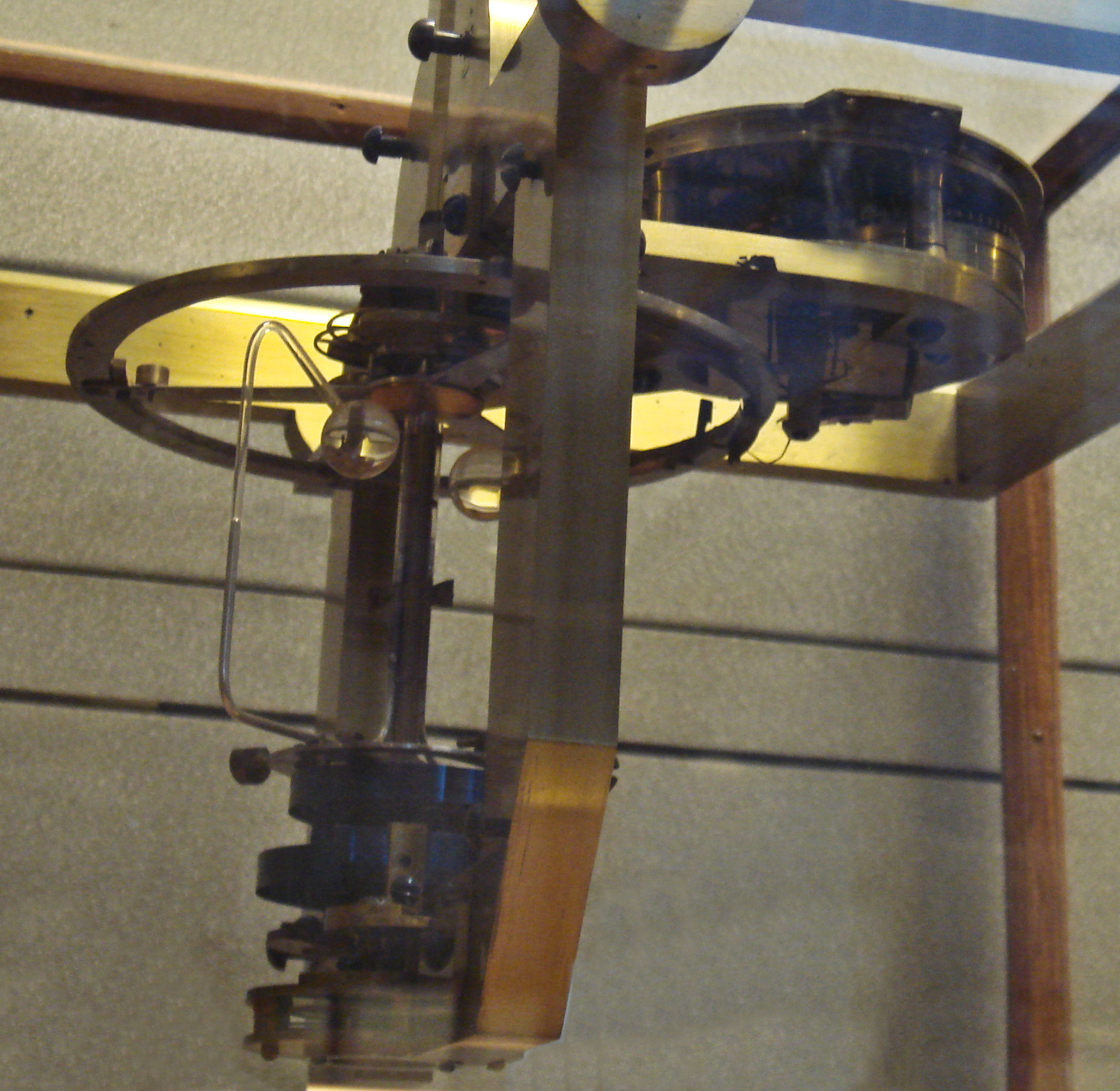
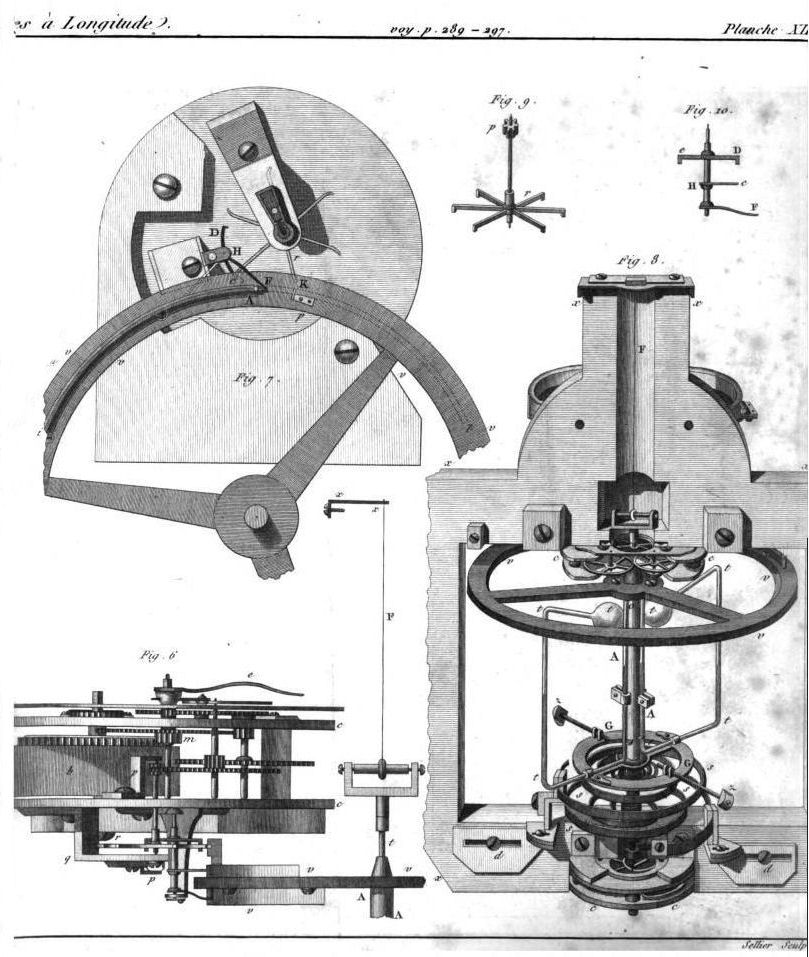
| Escapement | Detached detent escapement of Le Roy's own design, first communicated to the Academie des Sciences in 1748 and refined through the 1750s and 1760s. Unlocking and impulse occur close to the dead point of the balance's swing, and impulse is given at the balance rim rather than near its centre, which Gould identifies as unusually stabilising. No control springs are used on the detent itself, unlike most escapements developed after it.1 |
| Balance and compensation | A balance compensated for temperature change by a laminated brass-and-steel construction, arrived at after Le Roy experimented with calibrating a machine's rate against recorded temperature readings, a method he judged impractical at scale and abandoned in favour of built-in mechanical compensation.1 |
| Balance spring | An isochronous balance spring, its correct coil length established by Le Roy through direct experiment; he and Berthoud both claimed the discovery, and Le Roy published his findings first, in a memoir of 1763.1 |
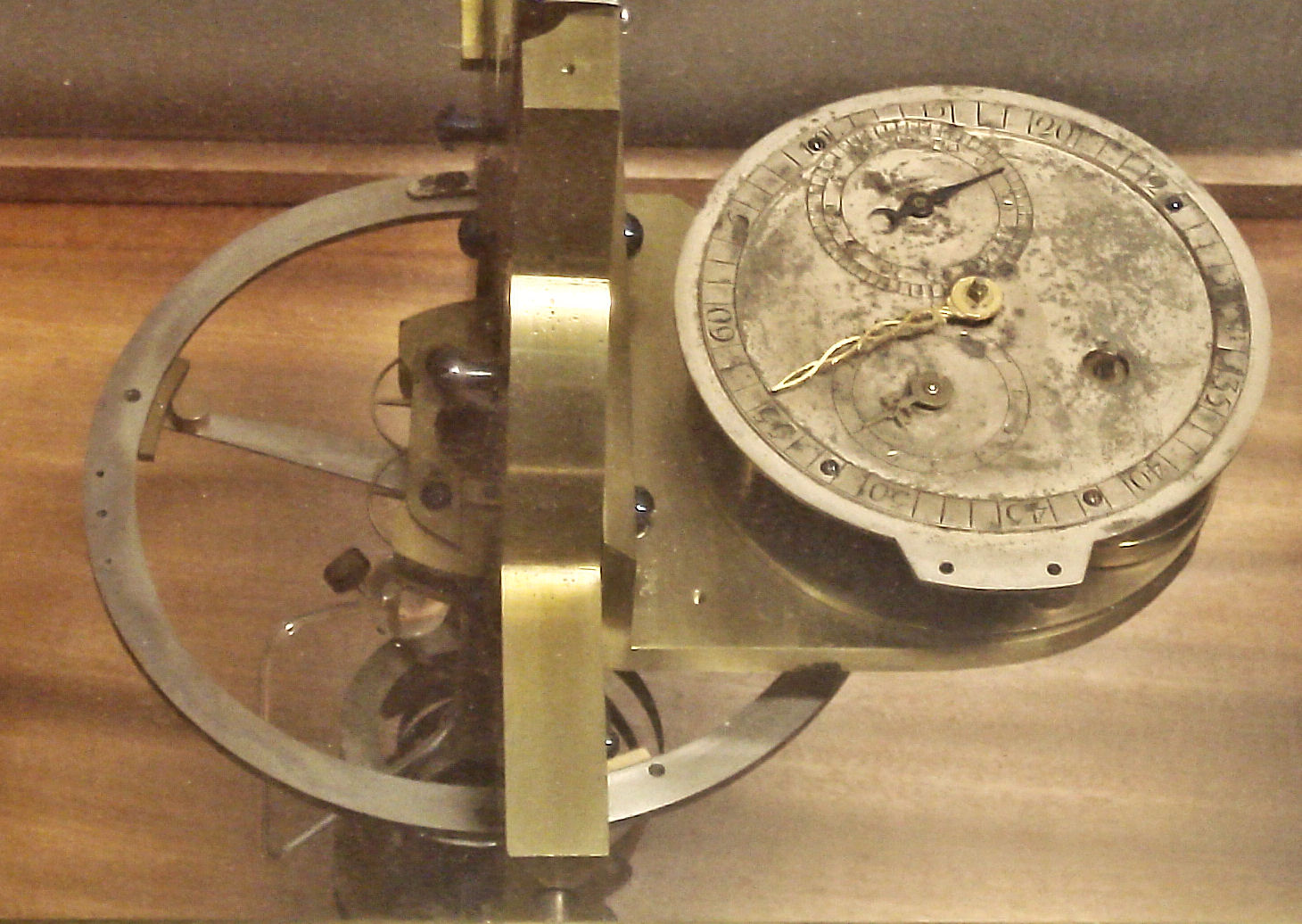
| Going train | A going barrel in place of a fusee and chain, eliminating the need for separate maintaining-power gear; four wheels and their pinions, none larger than 73 teeth or 12 leaves respectively, a notably low gear count next to Harrison's H4, whose third wheel carried 140 teeth. Runs for 38 hours on a single winding, wound from the dial side.1 |
| Jewelling | None. The pivots run in plain brass holes; jewelling of pivot holes was not yet practised on the Continent at the time this machine was built.1 |
| Case and gimbals | Housed in a gimballed box approximately 35 by 25 by 25 centimetres, of wood, steel and brass with glazed viewing panels. The gimbals were damped by springs and restricted to an arc of about 20 degrees; the box interior was padded, and a circular pad was fitted beneath the balance casing to absorb shock.6 |
| Recorded accuracy | Sources consulted disagree. The Academie's own 1767 report, as translated by Gould, records an error of 38 seconds over 46 days for the first machine and 7.5 seconds over 46 days for the second. A separate secondary tally gives 4 minutes 52 seconds over a 52-day outbound leg and 51 seconds on the return leg for the first machine. Both are recorded here rather than resolved.134 |
Images
The record in full
Chapter 1What it is
A marine timekeeper about 35 by 25 by 25 centimetres in its gimballed outer box, of wood, steel, brass and glass, built to keep time at sea accurately enough to fix a ship's longitude by comparison...
A marine timekeeper about 35 by 25 by 25 centimetres in its gimballed outer box, of wood, steel, brass and glass, built to keep time at sea accurately enough to fix a ship's longitude by comparison with a known reference time. It is not a large or visually imposing object. Its importance is entirely inside the movement.
Inside that movement Le Roy combined, for the first time in one working machine, a detached detent escapement of his own design, a balance compensated for changes of temperature by a bimetallic mechanism, and a balance spring whose length he had determined, by experiment, to bring its coils to isochronism. Each of the three had been attempted separately by other makers. Le Roy built the machine that used all three together, with a going barrel in place of the fusee-and-chain drive common in English work, four wheels and their pinions, and no jewelling at all, since the process was not yet in use on the Continent. The pivots turn in plain brass holes.
Chapter 2The man who made it
Pierre Le Roy was born in Paris in 1717, the eldest son of Julien Le Roy, himself a celebrated clockmaker who held the post of horloger du roi with lodgings in the royal galleries and who died in...
Pierre Le Roy was born in Paris in 1717, the eldest son of Julien Le Roy, himself a celebrated clockmaker who held the post of horloger du roi with lodgings in the royal galleries and who died in 1754, at which point Pierre succeeded him in the post. Three of Pierre's brothers went into other branches of the Enlightenment sciences: Jean-Baptiste Le Roy became a physicist and a fellow of the Royal Society, Julien-David Le Roy an architect and antiquarian, and Charles Le Roy a physician. The family produced clockmakers for four generations before Pierre and remained active in the trade after him; a short-lived manufactory of marine timekeepers was founded under royal patronage in 1787, two years after Pierre's death, with the cooperation of several of his relatives.
Le Roy communicated his invention of a detached escapement to the Academie des Sciences as early as 1748, and by his own account it was not entirely without precedent: he acknowledged that the elder Dutertre had shown a similar device years before, and that the germ of the idea existed earlier still. He continued to refine the escapement, the compensation balance and the isochronous spring through the 1750s and early 1760s, presenting a memoir on his balance-spring findings to the Academie in 1763. He is recorded receiving the English writer Samuel Johnson at his workshop in Paris in 1775; Johnson's travel notes call him 'a man of character in his business... A decent man,' who showed his visitor a small clock made to find the longitude.
Chapter 3The rivalry with Ferdinand Berthoud
Le Roy's other lifelong subject was Ferdinand Berthoud, a Swiss clockmaker working in Paris who pursued the same problem by a different route: steady, incremental trial and error across a long series...
Le Roy's other lifelong subject was Ferdinand Berthoud, a Swiss clockmaker working in Paris who pursued the same problem by a different route: steady, incremental trial and error across a long series of machines, rather than Le Roy's single scientifically argued design. The two men were bitter and public rivals. Both claimed priority on the isochronous balance spring; Le Roy published his findings first, in 1763, while Berthoud's first marine timekeeper, described in print in 1763, was by Le Roy's own account still built on the crude lines of Harrison's early machines, the same machines Le Roy had personally examined in London in 1738.
Le Roy pressed his case in print. In 1768 he published a comparison of his own work against Harrison's fourth timekeeper, titled Expose succinct des travaux de MM. Harrison et Le Roy, closing it with a tribute of respect to Harrison as a venerable old man and a wish that his own labour might one day receive similar recognition. It never did in his lifetime. Berthoud, for all that his machines never beat Le Roy's in a single Academie trial, built and sold vastly more of them, more than fifty timekeepers across some eighty voyages by one tally, and in 1770 received the coveted title Horloger de la Marine, the naval clockmaking appointment Le Roy never held. Berthoud's greater output and greater public reputation left Le Roy, by most accounts, disillusioned; he appears to have scaled back further development work after the early 1770s. The Conservatoire national des arts et metiers today holds work by both men, including, by one nineteenth-century count, thirteen of Berthoud's own Horloges Marines.
Chapter 4The Academie's prize and the Aurore
The Academie royale des sciences administered a bequest from the Comte de Meslay, established in 1714, whose smaller prize was reserved for the best method of finding longitude at sea.
The Academie royale des sciences administered a bequest from the Comte de Meslay, established in 1714, whose smaller prize was reserved for the best method of finding longitude at sea. Le Roy entered his 1766 machine, along with a duplicate of the same design, for the prize; the Academie postponed its decision until the machines could be tested at sea. Francois-Cesar Le Tellier, Marquis de Courtanvaux, a member of the Academie, funded the construction of a corvette, the Aurore, purely for that purpose, designed by the naval architect Nicolas Ozanne and built at Le Havre.
When the trial came, in the spring and summer of 1767, Le Roy's two machines were the only ones actually produced for testing. Other entrants withdrew: Romilly's machine was accidentally damaged during a preliminary shore test by a member of the Academie, and Tavernier withdrew his own entry in sympathy. Le Roy travelled to Le Havre with his machines in a post-chaise, and the shocks of the road journey broke the fine wire supporting the balance of his first machine; he had it repaired overnight at his inn and reached the ship with both instruments running. The Aurore then made a roughly three-and-a-half-month cruise along the coasts of France, Flanders and Holland, putting into port repeatedly so the watches' rates could be checked against astronomical observation.
Courtanvaux's own report to the Academie, as later translated by Rupert Gould, records the first watch's error at 38 seconds across 46 days of comparison, and the second, more recently completed watch's error at only 7.5 seconds across the same period. A separate figure circulating in later secondary accounts gives the first watch an error of 4 minutes 52 seconds over a 52-day outbound leg and 51 seconds on the shorter return leg. This record has not been able to reconcile the two figures from the sources consulted and presents both rather than choosing between them.
Chapter 5The double prize, and the trials that followed
The Academie tested Le Roy's machines a second time in 1769, aboard the frigate L'Enjouee, on a longer voyage from Le Havre to Newfoundland, on to Cadiz and back to Brest, lasting some twenty-four...
The Academie tested Le Roy's machines a second time in 1769, aboard the frigate L'Enjouee, on a longer voyage from Le Havre to Newfoundland, on to Cadiz and back to Brest, lasting some twenty-four weeks. The results held to the same standard as the first trial, and the Academie awarded Le Roy its double Meslay prize, covering both the timekeeper and his written memoir describing it. The Academie's own report was not uncomplicated praise: it noted that in one trial the watch had accelerated suddenly by eleven or twelve seconds a day even on dry land, and concluded plainly that the desired degree of perfection had not yet been reached.
A further Academie prize was offered in 1771, tested aboard the frigate La Flore against a weight-driven machine by Arsandeaux and a pendulum clock by Biesta. Le Roy's machines won again, though less decisively; during the voyage the ship struck Wilmington rock off Antigua, and the resulting shock broke a thermometer on his first machine, disabling it as a timekeeper for the rest of the trial. After this, Le Roy appears to have judged his design essentially complete. He wrote that he had tried, almost daily since finishing his last marine watch, to find some advantageous change to make, and concluded that nothing remained but to execute the machines well. He later began work on a further, unrecorded machine in his final years, of which no details survive. He died on 25 or 26 August 1785; sources consulted give both dates and this record does not resolve the discrepancy.
Chapter 6The Harrison question
The popular account of who solved the longitude problem centres John Harrison, most influentially through Dava Sobel's bestselling 1995 book Longitude, which tells Harrison's story as a lone struggle...
The popular account of who solved the longitude problem centres John Harrison, most influentially through Dava Sobel's bestselling 1995 book Longitude, which tells Harrison's story as a lone struggle against an obstructive scientific establishment, resolved by his fourth timekeeper, H4, and its 1761-64 trials. That story is accurate as far as it goes. It is not the whole picture of how the marine chronometer, as a type of instrument, actually came to exist.
Harrison solved the specific engineering problem in front of him by building an extraordinarily dense, extraordinarily skilled watch: a remontoire, a maintaining-power mechanism, an automatic regulator, diamond pallets, unusually high tooth counts in its wheels and pinions, and lavish jewelling throughout. No other maker duplicated H4's mechanism afterward, in France or in England; it worked, once, by mastery rather than by a method others could repeat. Rupert Gould, examining both machines for his 1923 history, put the comparison in terms he did not soften: 'Harrison built a wonderful house on the sand; but Le Roy dug down to the rock.' Le Roy, working from an entirely different premise and without any knowledge of H4's internal mechanism, which was not published until 1767, a year after Le Roy presented his own machine to Louis XV, isolated the sources of error instead of compensating for them piece by piece: a detached escapement that barely touched the balance, a balance whose temperature response was built into its own construction rather than adjusted afterward, and a spring whose isochronism came from getting its length right in the first place. Gould's verdict, after describing the mechanism in detail, was unequivocal: 'the credit of having designed and constructed the first modern chronometer is entirely his, and his alone,' and, in Gould's closing assessment of Le Roy's career, 'he stands alone, the father of the chronometer as we know it.'
The historical argument for this is not French chauvinism; it is a question of lineage. The English makers who actually built the trade that followed, John Arnold and Thomas Earnshaw, did not copy Harrison's remontoire-and-jewelling approach. They refined Le Roy's detached detent escapement into the simpler spring-detent form that became, in Earnshaw's hands, the standard chronometer escapement used for the next century and a half; his 1943 obituarist among French hydrographic writers found the subject of Le Roy's originality still worth a dedicated review nearly two centuries after the fact. Harrison's H4 is rightly celebrated as the machine that proved the longitude problem could be solved by a clock at all. It is not the machine whose internal logic the trade then built on. That machine is this one.
Chapter 7What is still owed to Harrison
None of this diminishes what Harrison achieved first: a working proof, years before Le Roy's machine existed, that a sufficiently accurate timekeeper could survive a transatlantic voyage and hold its...
None of this diminishes what Harrison achieved first: a working proof, years before Le Roy's machine existed, that a sufficiently accurate timekeeper could survive a transatlantic voyage and hold its rate. Le Roy had the advantage of building after that proof existed in the world, even though he could not see how Harrison had done it. The Academie des Sciences' own prize structure, funded since 1714, predates the British Parliament's 1714 Longitude Act only by coincidence of date, not by priority of achievement, and it was Harrison, not Le Roy or Berthoud, who first collected a comparable national reward, roughly 20,000 pounds sterling from the British government, against the far smaller medal Le Roy received in France for what French commentators, including a later reviewer writing for M. Gros, called a comparatively greater sacrifice of fortune and twenty years of his life. Crediting Le Roy with the surviving mechanism is not the same claim as crediting him with being first; both claims are documented, and they are not the same claim.
The artist
Pierre Le Roy
Pierre Le Roy inherited a royal clockmaking appointment from his father, spent two decades building the mechanical case for a scientific rather than a brute-force solution to marine timekeeping, and died without the fame or the fortune that went to his rivals on either side of the Channel. What he left behind is not a legend but a working object and a set of mechanisms that quietly became the standard the trade actually used.
Related works
| Work | Relation | Where it is |
|---|---|---|
| Watch Pierre Le Roy | An ordinary pocket watch by the same maker, distinct from his marine timekeepers Shows Le Roy's output as a conventional Paris watchmaker alongside his marine chronometry; not examined in detail for this record. | The Metropolitan Museum of Art, New York |
| Horloges Marines (multiple) Ferdinand Berthoud | Rival marine timekeepers by the maker Le Roy never beat in reputation though never lost to in an Academie trial By one nineteenth-century count the Conservatoire held thirteen of Berthoud's marine timekeepers; both makers' rival instruments are now held by the same institution that holds this one. | Musee des Arts et Metiers, Paris |
| John Harrison's Marine Timekeepers, H1 to H4 John Harrison, with James Harrison and John Jefferys | The English timekeepers whose 1761-64 trials preceded Le Roy's chronometer and whose internal mechanism, published in 1767, Le Roy could not have seen before completing his own design Cross-referenced by name only; see the existing Iconotheca record for the object-level detail on H1-H4. | Royal Museums Greenwich (already catalogued in this corpus) |
| Marine Timekeeper known as H5 John Harrison and Son, London | Harrison's final timekeeper, part of the same English lineage already covered in this corpus Cross-referenced by name only; not re-described here. | The Clockmakers' Museum, Science Museum, London (already catalogued in this corpus) |
Open questions
- How and when did this specific object pass from Pierre Le Roy's possession into what became the Conservatoire national des arts et metiers? No source consulted documents an accession event; the museum was founded in 1794 from nationalised buildings and collections, which is a plausible but unconfirmed route.
- Which of the two figures for the 1767 Aurore trial's accuracy is correct: the 38 seconds and 7.5 seconds over 46 days translated by Gould directly from the Academie's report, or the 4 minutes 52 seconds and 51 seconds over 52 and an unspecified return-leg figure found in later secondary accounts? The two do not obviously describe the same measurement window and this record has not been able to reconcile them.
- Does CnAM 1395 correspond to Le Roy's first watch (the one damaged en route to Le Havre and later disabled again off Antigua) or his second, more accurate watch, or is it a later, separate machine altogether? The museum's own record does not specify, and Le Roy is documented as having built more than two examples across his career, including a smaller 'petite ronde' variant that performed poorly and is explicitly not this object.
- Did Pierre Le Roy die on 25 or 26 August 1785? Gould's 1923 account, closest in time among the sources consulted, gives the 25th; other secondary sources give the 26th.
- What happened to the unfinished machine Le Roy is recorded as having begun in his final years? No source consulted records whether it was completed, by whom, or where it might now be, if it survives at all.
- Is there a surviving contemporary portrait of Pierre Le Roy? Gould, writing in 1923 as the leading English-language authority on the subject, stated he could not find one and suspected none existed. A file on Wikimedia Commons uploaded in 2009 and labelled as an eighteenth-century portrait of Le Roy, sourced only to an unspecified 'Haute Horlogerie archive,' has not been independently verified against Gould's judgment and is not used as an image in this record for that reason.
Questions about this object
What is Marine Chronometer?
Marine Chronometer is a clocks and instruments, dated 1766. Medium: Wood, steel, brass and glass; detent escapement, temperature-compensated bimetallic balance, isochronous balance spring.
Who made Marine Chronometer, and is the attribution settled?
The attribution to Pierre Le Roy is recorded here as accepted. Made by Pierre Le Roy, horloger du roi, and identified without dispute as his work by the Conservatoire national des arts et metiers, which has held it since at least the early twentieth century and gives it inventory number 01395-0000. Le Roy built more than one marine timekeeper across the 1760s; this catalogue record follows the museum's own identification of CnAM 1395 as the example tested aboard the corvette Aurore in 1767, without independently re-verifying the museum's internal distinction between Le Roy's first and second machines.
Where is Marine Chronometer now?
Musee des Arts et Metiers (Conservatoire national des arts et metiers), Paris. Inventory number CnAM 1395 (01395-0000-). Last confirmed 18 September 2026. Museum inventory number, confirmed against the museum's own online collections database and against Wikidata Q86837647, which mirrors the museum's cataloguing.
What is still unknown about Marine Chronometer?
How and when did this specific object pass from Pierre Le Roy's possession into what became the Conservatoire national des arts et metiers? No source consulted documents an accession event; the museum was founded in 1794 from nationalised buildings and collections, which is a plausible but unconfirmed route.
Sources
- 1Rupert T. Gould, The Marine Chronometer: Its History and Development (London: J. D. Potter, 1923), chapter VI, 'Le Roy and Berthoud'. archive.org/details/...
- 2Wikipedia, 'Pierre Le Roy'. Tertiary source; used for orientation and cross-checked against Gould and the corvette Aurore article, flagged for replacement with a scholarly biography where one becomes available. en.wikipedia.org/wiki/...
- 3Wikipedia, 'French corvette Aurore (1767)'. Tertiary source giving the Aurore's construction, funding by Courtanvaux, and a route and error tally for the 1767 trial that differs from the figures translated by Gould from the Academie's own report; both are given in this record. en.wikipedia.org/wiki/...
- 4Corvette Aurore trial report, as translated by Rupert Gould from the Marquis de Courtanvaux's account to the Academie des Sciences, in The Marine Chronometer (1923), pp. 91-92. archive.org/details/...
- 5Academie des Sciences, report on the 1769 sea trials, as translated by Rupert Gould in The Marine Chronometer (1923), p. 92. archive.org/details/...
- 6Wikidata, 'Le Roy Marine clock - CnAM 1395' (Q86837647), mirroring the Conservatoire national des arts et metiers' own collections record for inventory 01395-0000-. wikidata.org/wiki/...
- 7Wikimedia Commons, extended metadata for File:Pierre Le Roy chronometer full view 1766.jpg, confirming licence CC BY-SA 3.0 and photographer PHGCOM, and Category:Le Roy Marine clock - CnAM 1395, confirming the four files in that category depict the same catalogued object. commons.wikimedia.org/wiki/...
- 8The Ministry of Horological Affairs (Carlos Torres), 'The Other Side of the Channel'. An independent horological-history blog, not a peer-reviewed source, used here only for its framing of the popular Harrison-centred narrative against the technical-historical case for Le Roy; flagged for replacement with a peer-reviewed article if one is located. horologicalaffairs.com/the-other-side-of-the-channel
- 9Smithsonian National Air and Space Museum and National Museum of American History, 'Innovations in France', Time and Navigation. timeandnavigation.si.edu/navigating-at-sea/...
- 10P. de Vanssay de Blavous, review of works by Paul Ditisheim, Roger Lallier, L. Reverchon and Commandant Vivielle on Pierre Le Roy, The International Hydrographic Review, vol. XX (1943). Cited here only for its bibliographic existence, as evidence that French hydrographic and horological scholarship continued to treat Le Roy as a subject of serious study into the twentieth century; the article's own text could not be extracted from the scanned PDF and no claim in this record is attributed to its content. journals.lib.unb.ca/index.php/...
- 11Wikipedia, 'Julien Le Roy'. Tertiary source, used only for Julien Le Roy's dates and royal appointment, cross-checked against Gould. en.wikipedia.org/wiki/...
Last verified 18 September 2026 · Published 18 September 2026
Change log
18 September 2026 - Record created at the house standard: researched narrative, technical evidence, maker dossier, graded provenance chain, prices with hammer and premium separated, related works, open questions and sources.