The Parthenon Sculptures in the British Museum
Pheidias, general overseer of the Parthenon's sculptural programme under Pericles; the individual carvers of specific pediment figures, metopes and frieze blocks are not named in any surviving source · c. 447-432 BC, as part of the Parthenon's building programme; the frieze is usually dated to the earlier part of that range, c. 442-438 BC, and the pediment sculptures to the final years, 438-432 BC
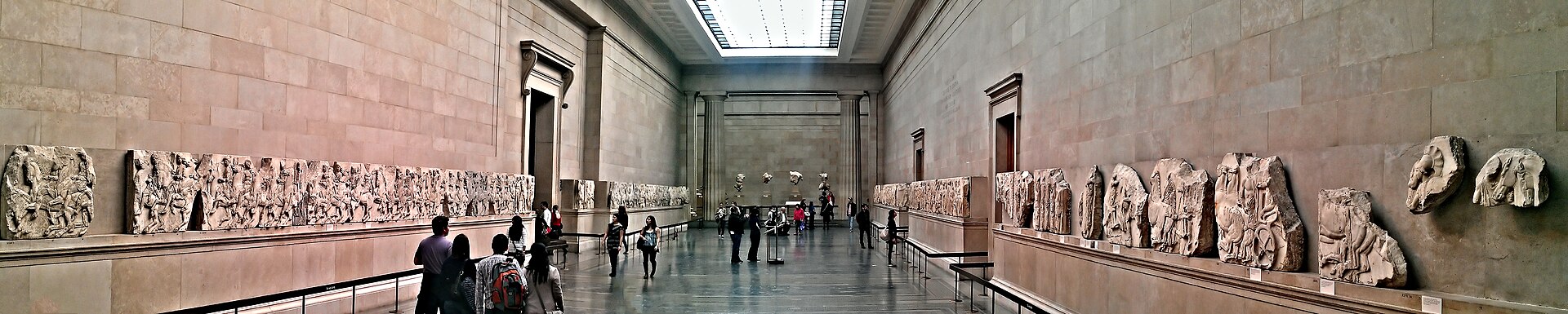
The British Museum's Duveen Gallery, Room 18, showing pediment figures, metopes and frieze blocks together as they are displayed today. Photographed at the British Museum, London.
Photograph by Andres Rueda, via Wikimedia Commons, CC BY 2.0| Artist | Pheidias, general overseer of the Parthenon's sculptural programme under Pericles; the individual carvers of specific pediment figures, metopes and frieze blocks are not named in any surviving source |
|---|---|
| Date | c. 447-432 BC, as part of the Parthenon's building programme; the frieze is usually dated to the earlier part of that range, c. 442-438 BC, and the pediment sculptures to the final years, 438-432 BC |
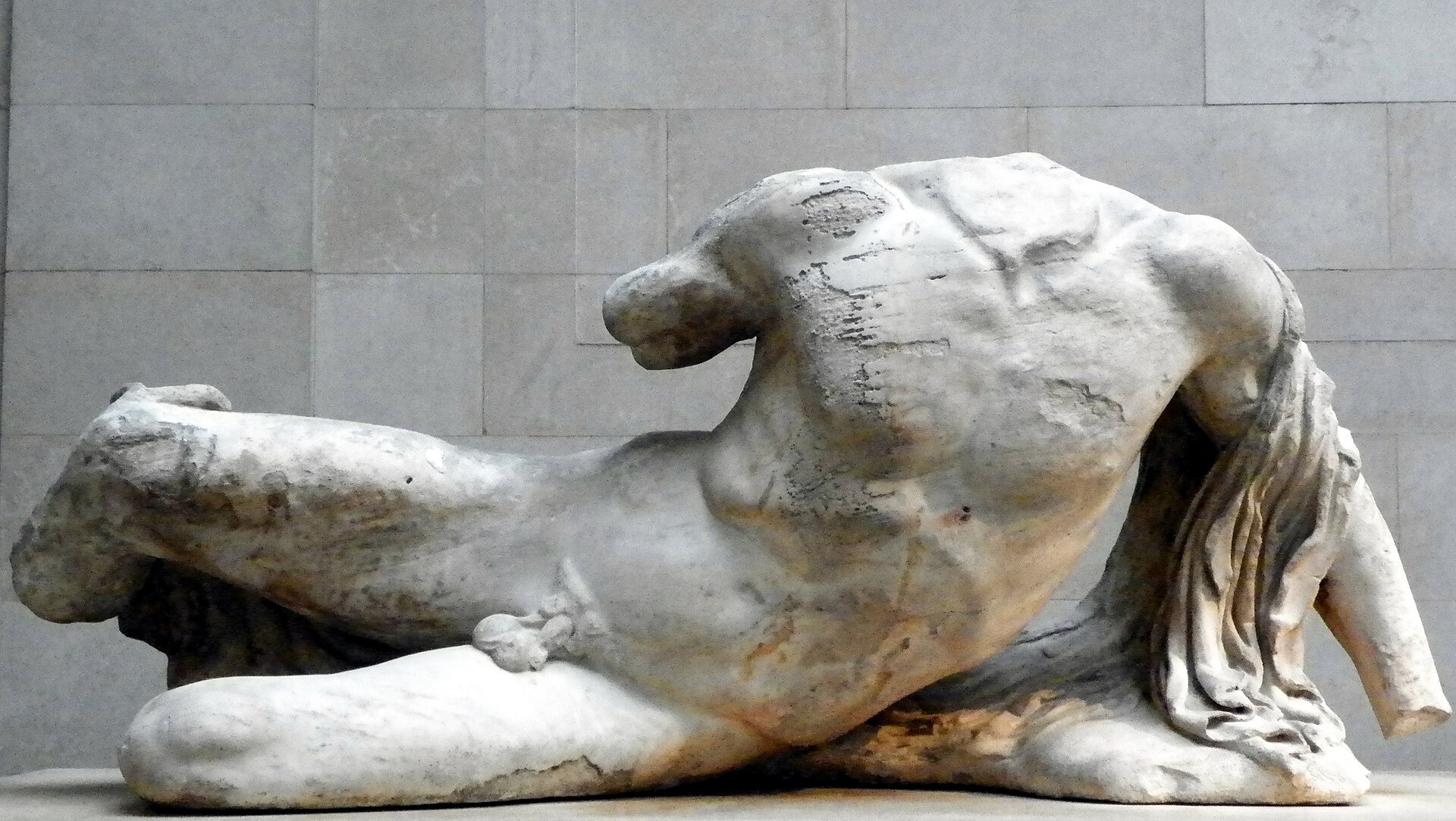
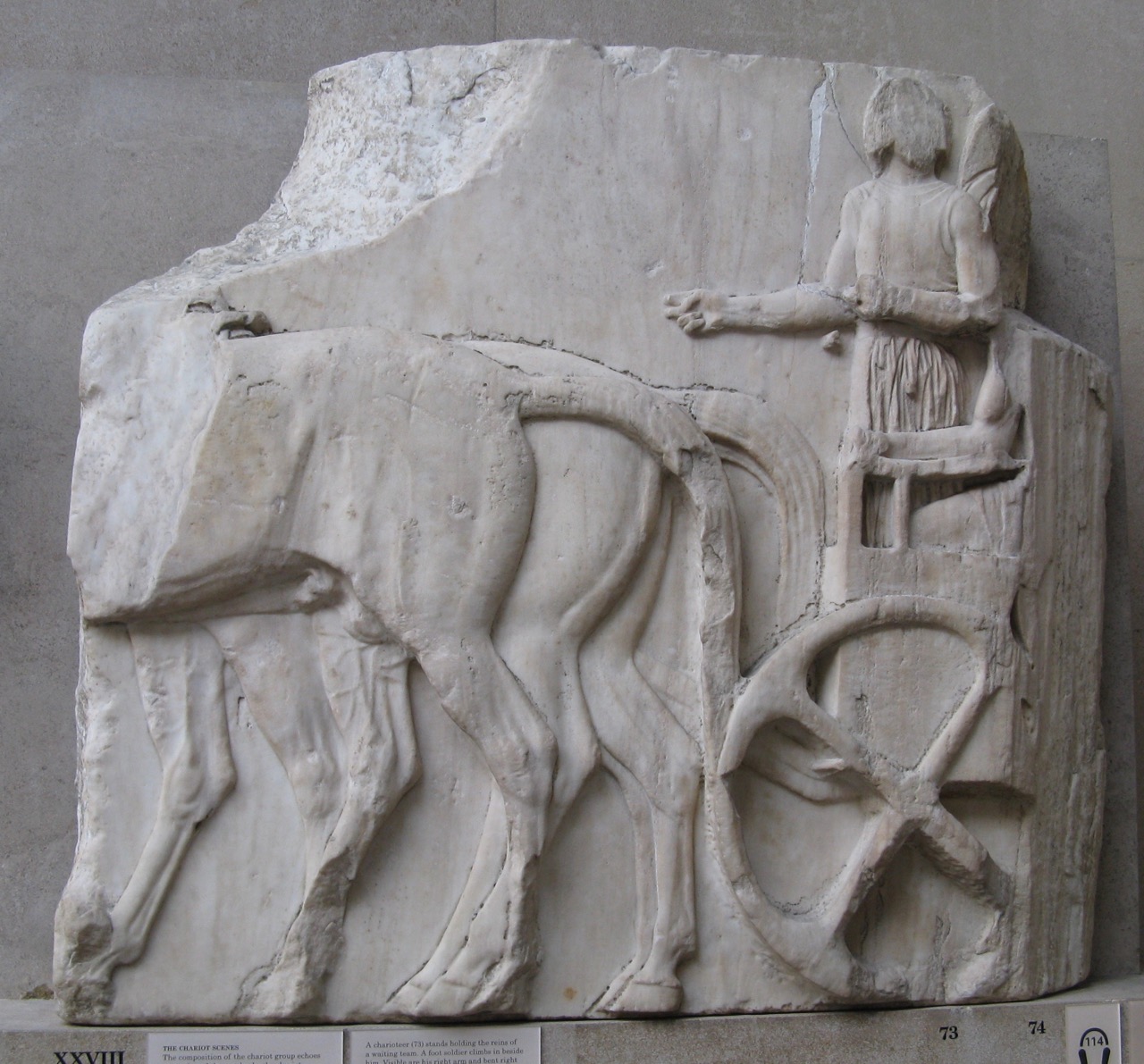
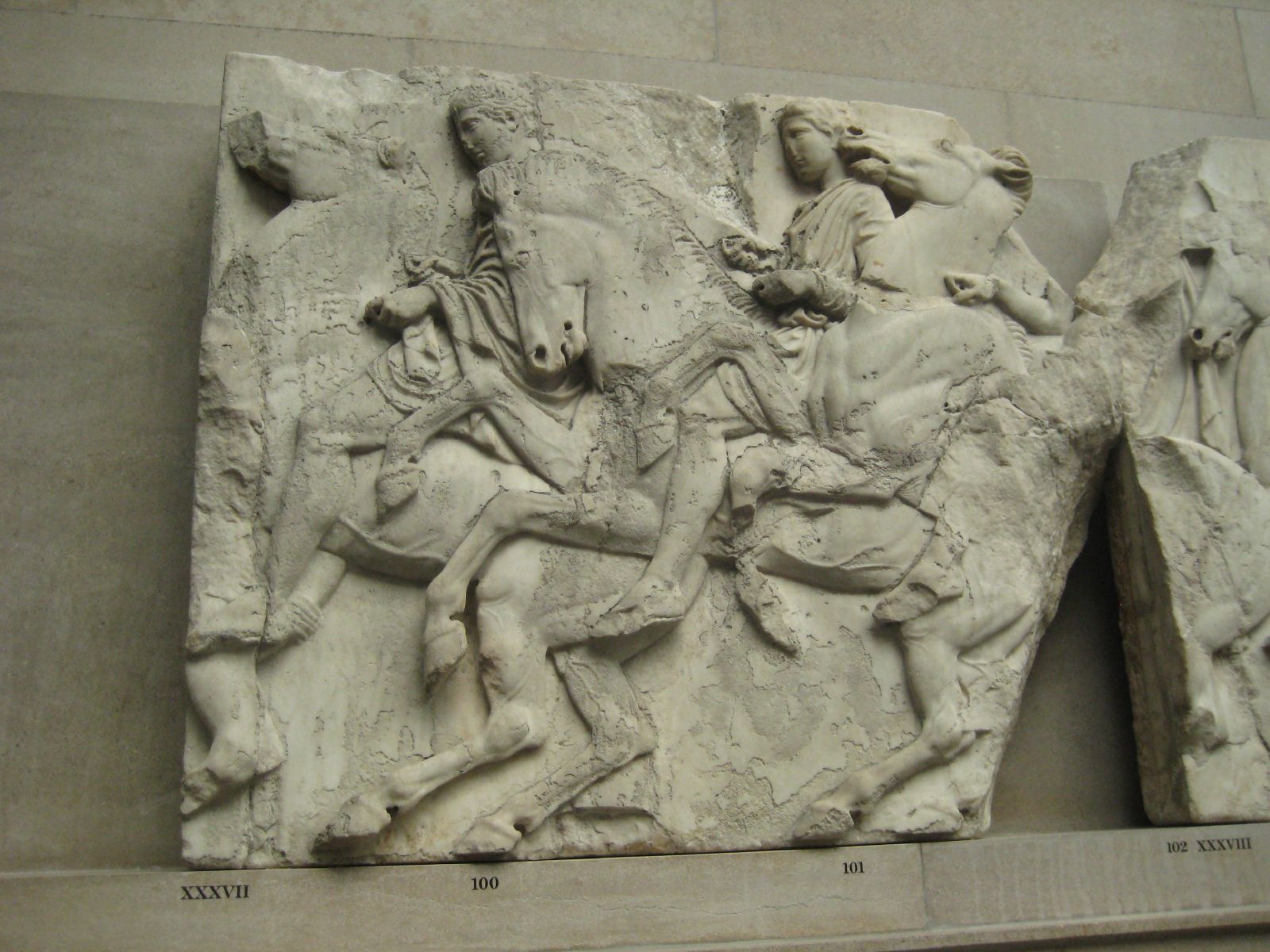
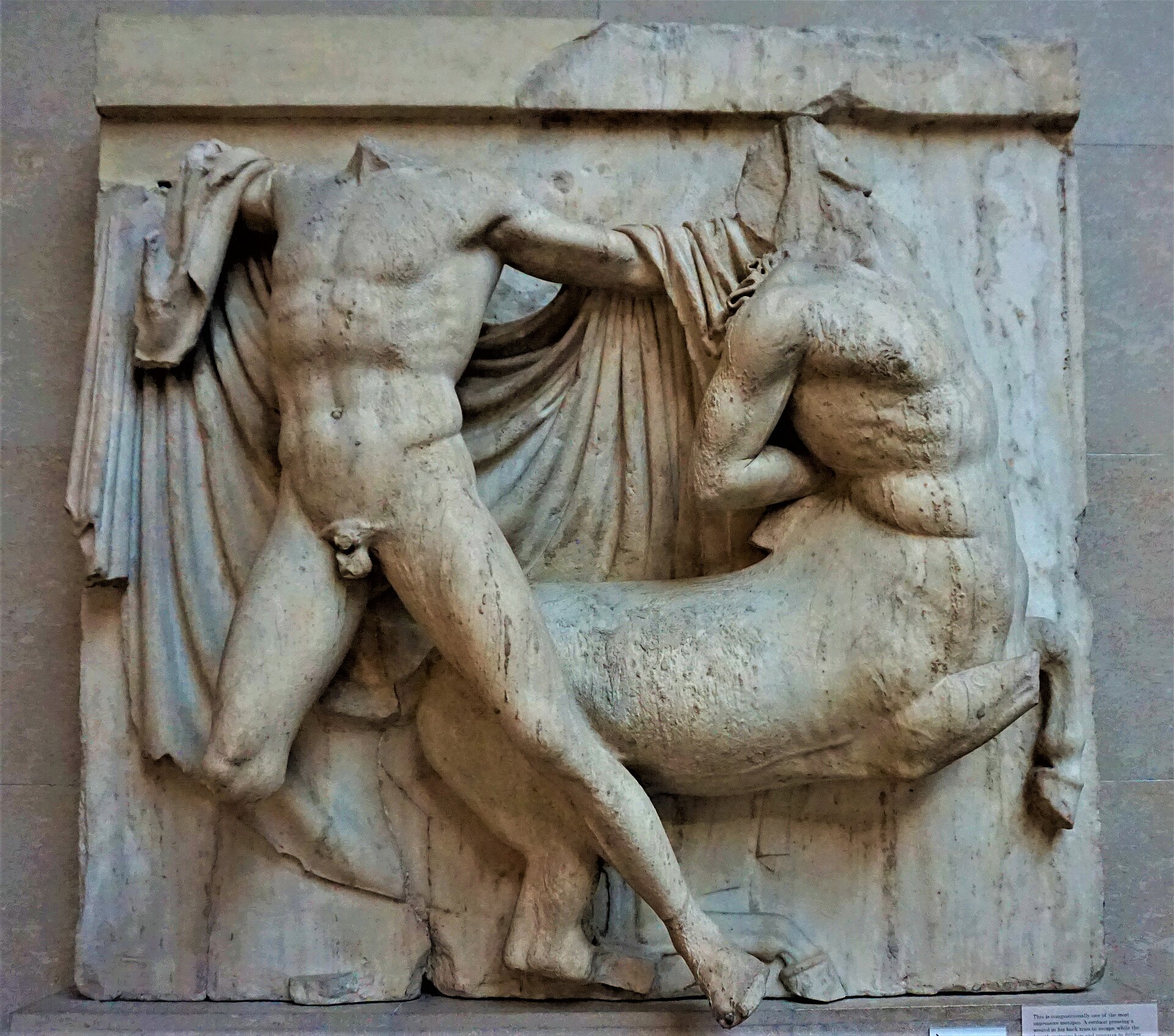
| Medium | Pentelic marble, quarried from Mount Pentelicus northeast of Athens; the pediment figures were carved fully in the round, the metopes in high relief, and the frieze in continuous low relief |
| Dimensions | The group has no single set of dimensions. The British Museum's holding comprises 17 over-lifesize figures from the pediments, 15 of the Parthenon's original 92 metopes, and 56 blocks (about 75 m / 247 ft) of the roughly 160 m frieze that ran around the exterior of the cella wall, together with one caryatid from the Erechtheion and four slabs from the parapet of the Temple of Athena Nike. About 128 m (80 per cent) of the original frieze survives worldwide across all locations; the British Museum's 56 blocks are the largest single share. |
| Where it is now | The British Museum, London, Room 18 (the Duveen Gallery) and the adjoining Rooms 18a and 18blast confirmed |
| Inventory number | No single accession number covers the group; each piece carries its own British Museum registration number rather than one collective inventory entry |
| Attribution | AcceptedAncient testimony, chiefly Plutarch's Life of Pericles, states that Pheidias held general charge of Pericles' whole building programme on the Acropolis, including the Parthenon's sculptural decoration, and that all the other artists and craftsmen worked under his superintendence. Full note |
| Object type | Sculpture |
| Period | Classical Greek, Athens under Pericles, fifth century BC |
| Cases | Restituted or repatriated |
| Inscriptions | None on the sculptures themselves. The frieze, metopes and pediment figures carry no dedicatory or identifying text; what is known of their subjects comes from iconographic reading and from Pausanias's second-century AD description of the Acropolis, not from any inscription on the marble. |
| Owners on record | 9 links8 documented, 1 disputed |
| Sources | 20 cited |
About this record Last verified · 20 sources cited · Change log
On this page 9 sections
ContentsClose
Seventeen over-lifesize marble figures from the Parthenon's two pediments, 15 of its 92 carved metopes, and 56 blocks, about 75 metres, of the temple's 160-metre frieze, together with a caryatid from the Erechtheion and four slabs from the Temple of Athena Nike: this is what the British Museum holds of a monument that Pericles' Athens finished decorating in 432 BC. Agents working for Thomas Bruce, 7th Earl of Elgin, then Britain's ambassador to the Ottoman Sultan, cut most of it away from the building between 1801 and 1805, under the authority of an Ottoman document whose original has never been found; only an Italian translation of it survives. Elgin sold the collection to the British Government in 1816 for 35,000 pounds, well under half of what he said he had spent, after a Parliamentary Select Committee that year concluded, in its own words, that the acquisition had been honourably and meritoriously conducted.
Greece's government first formally asked for the sculptures back in October 1983, a year after its Culture Minister, Melina Mercouri, put the case to a UNESCO conference in Mexico City. Greece built the Acropolis Museum, which opened in 2009, largely to answer the British Museum's argument that Athens had nowhere adequate to display the material were it returned. The dispute has not moved past that point: the British Museum's Trustees state, in their own published position, that they hold clear legal title under the British Museum Act 1963 and would consider only a loan that acknowledges that ownership, while Greece's government has for decades declined to request or accept a loan on those terms. A meeting between the two countries' prime ministers collapsed in November 2023 over the issue, and as of a UNESCO committee session in May 2026, talks between the British Museum's chairman and Greek officials over a proposed long-term loan arrangement, described by the Museum as a "Parthenon Partnership," remain, in the Museum's own account, ongoing but not concluded.
Provenance
Each link is graded. Documented: a cited source supports it. Disputed: the identification is argued but not established. Unknown: no owner for that span, and the gap is not smoothed into a narrative. The grades in the glossary.
- c. 447 BC - 432 BCThe Parthenon, Athens, dedicated to Athena Parthenosdocumented
Carved as part of the Parthenon's building programme under Pericles, with Pheidias credited by Plutarch as general overseer of the sculptural decoration. Individual attribution of specific pieces to named sculptors is not established by any source.220
- c. AD 500 - 1460sChurch of the Virgin Mary of the Athenians (Christian conversion of the Parthenon)documented
The building was converted into a Christian church; the middle section of the east pediment was removed to insert an apse, destroying about a dozen original statues.2
- 1460s - 1687Ottoman Empire (Parthenon used as a mosque, then as a garrison magazine)documented
The Parthenon became a mosque in the early 1460s and remained substantially intact until the Ottoman garrison began using it to store gunpowder.2
- 26 September 1687 - 1687Building destroyed by Venetian bombardmentdocumented
A Venetian mortar shell detonated the gunpowder stored inside the Parthenon during the siege of Athens, blowing off the roof, destroying much of both long colonnades and a large further share of the surviving sculpture. The building has been a ruin since.2
- 31 July 1801 - 1805Removed by agents of Thomas Bruce, 7th Earl of Elgin, British Ambassador to the Ottoman Sultandisputed
Removal was conducted under a document obtained in July 1801, whose original Turkish text has never been located; only an Italian translation survives, and its legal scope and authenticity are disputed among historians (Demetriades, Williams, Eldem) and, more recently, by the governments of Turkey (statement, May 2024) and Greece (statement to UNESCO's ICPRCP, 22 May 2026). The British Museum's Trustees state that Elgin acted with the full knowledge and permission of the legal authorities of the day in both Athens and London.15610
- 1802 - 1812In transit to England, Thomas Bruce, 7th Earl of Elgindocumented
Shipped from Athens via Malta in a series of consignments. One shipload, aboard the brig Mentor, sank off the island of Cythera in 1804; the cargo was salvaged in full at Elgin's expense. The final shipment reached London in 1812.510
- 1807 - 1816Private collection of Thomas Bruce, 7th Earl of Elgin, Londondocumented
Displayed privately from 1807, initially in a shed at Elgin's Park Lane house. Elgin's finances collapsed under the cost of the removal and transport, compounded by a public divorce from Mary Nisbet from 1807, leading him to seek a government purchase.510
- June 1816 - presentThe British Museum, London (Trustees, under the British Museum Act 1963)documented
Purchased from Elgin for 35,000 pounds following a House of Commons Select Committee report finding the acquisition 'honourably and meritoriously' conducted; the House of Commons voted the funds 82 to 30. On public display since 1817, in the purpose-built Duveen Gallery (Room 18) since the 1930s. Subjected to an abrasive, damaging cleaning campaign in 1937-38 at the instigation of the donor Joseph Duveen.1356710
- 1982 - presentHeld by the British Museum; ownership and the legality of the original removal both publicly and repeatedly disputed by the Greek governmentdocumented
A continuing, unresolved public and diplomatic dispute, not a change of custody. Melina Mercouri's July 1982 UNESCO address; Greece's formal October 1983 request and its April 1984 UK rejection; the 2009 opening of the Acropolis Museum; Greece's 2013 UNESCO mediation request, declined by the UK Government and the British Museum in 2015; the ICPRCP's September 2021 recommendation, rejected by the UK Government; the November 2023 collapse of a planned Sunak-Mitsotakis meeting; ongoing 'Parthenon Partnership' loan talks under British Museum chairman George Osborne, described in December 2024 as still some distance from agreement; and the ICPRCP's 25th session, 22 May 2026, at which 20 states formally backed Greece's position. No loan, restitution, or change in the British Museum's stated legal position has resulted from any of the above as of this record's last verification.48111213141517
Technical evidence
| Attribution note | Ancient testimony, chiefly Plutarch's Life of Pericles, states that Pheidias held general charge of Pericles' whole building programme on the Acropolis, including the Parthenon's sculptural decoration, and that all the other artists and craftsmen worked under his superintendence. No signature survives on any surviving piece, which is normal for Greek sculpture of this date. Modern scholarship accepts Pheidias's overall direction of the programme but is explicit that this is not the same as establishing which individual hand carved any specific pediment figure, metope or frieze block; stylistic variation across the metopes in particular has long been read as evidence of several different sculptors or workshop teams executing Pheidias's design. This record follows that distinction rather than naming a single artist for the whole group. |
|---|---|
| Material | Pentelic marble throughout, quarried from Mount Pentelicus, about 16 km northeast of Athens; a fine-grained white marble with a faint golden cast owing to its trace iron content.610 |
| Composition of the British Museum's holding | 17 figures from the east and west pediments; 15 of the Parthenon's original 92 metopes; 56 blocks (approximately 75 m / 247 ft) of the roughly 160 m frieze; one caryatid from the Erechtheion; four slabs from the parapet of the Temple of Athena Nike.136910 |
| Frieze survival worldwide | Of the frieze's original 160 m run, about 128 m (roughly 80 per cent) survives across all locations: 56 blocks in London, about 40 blocks in the Acropolis Museum, Athens, and the remainder in fragments held by the Louvre, the Antonio Salinas Museum, Palermo, and the National Museum of Denmark, Copenhagen.916 |
| Placement and carving technique | Pediment figures were carved fully in the round to fill the temple's triangular gables; metopes were carved in high relief and set above the exterior colonnade between the triglyphs; the frieze was carved in continuous low relief and ran around the outside of the cella wall, inside the outer colonnade, where it was never easy to view closely even when the building was intact.26 |
| Date of manufacture | c. 447-432 BC as part of the Parthenon's overall building programme; the frieze is generally placed earliest in that range, c. 442-438 BC, and the pediment sculptures latest, 438-432 BC.29 |
| 1937-38 cleaning damage | Workers, acting on the instruction of the donor Joseph Duveen, scrubbed several sculptures with copper tools and an abrasive (carborundum) for roughly fifteen months to remove the marble's natural patina, stopped in September 1938. An internal board of inquiry at the time found the resulting damage "obvious" and impossible to exaggerate. The historian William St Clair later put the loss of historic surface at up to 80 per cent on the affected pieces; a 2023 technical study by Emma Payne assessed the damage as comparatively minor set against two millennia of prior weathering. Both assessments are recorded; this record does not choose between them.67 |
| Display history at the British Museum | On public display, in one form or another, since 1817, initially in a series of temporary rooms; the purpose-built Duveen Gallery, Room 18, funded by the art dealer Joseph Duveen, has housed the collection since the 1930s.123 |
| Earliest visual record predating major loss | Drawings of the pediments made in 1674 for the Marquis de Nointel by the French artist Jacques Carrey, thirteen years before the 1687 gunpowder explosion, are the fullest surviving visual record of pedimental figures now lost entirely and are used by scholars to reconstruct the original composition.6 |
Images
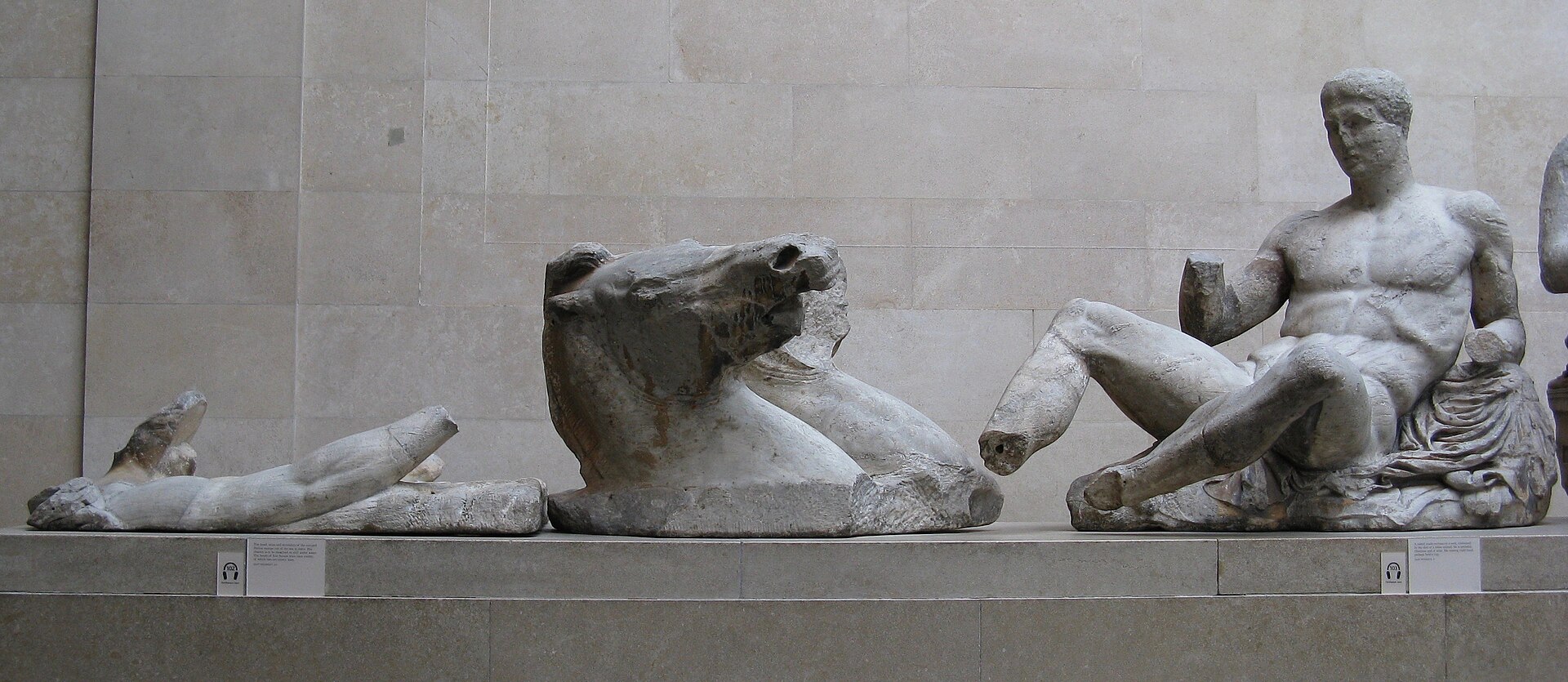
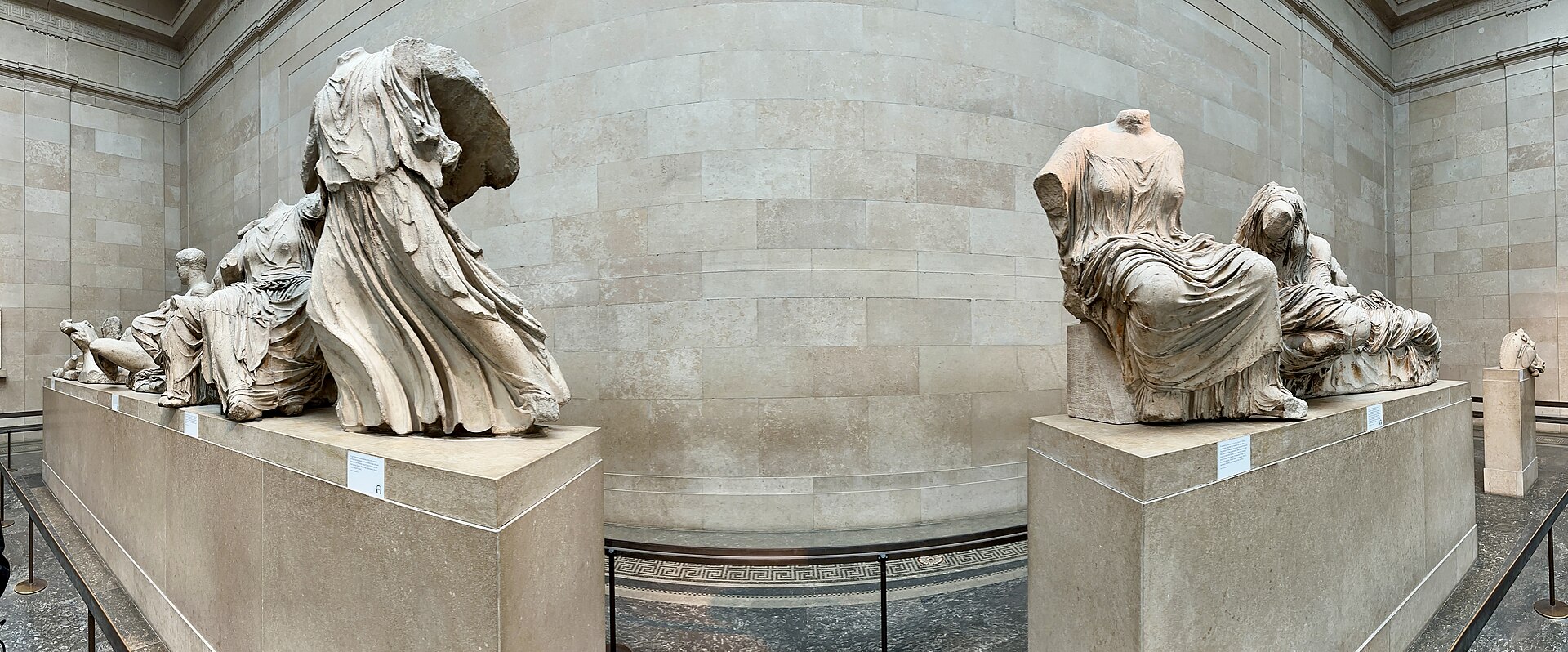
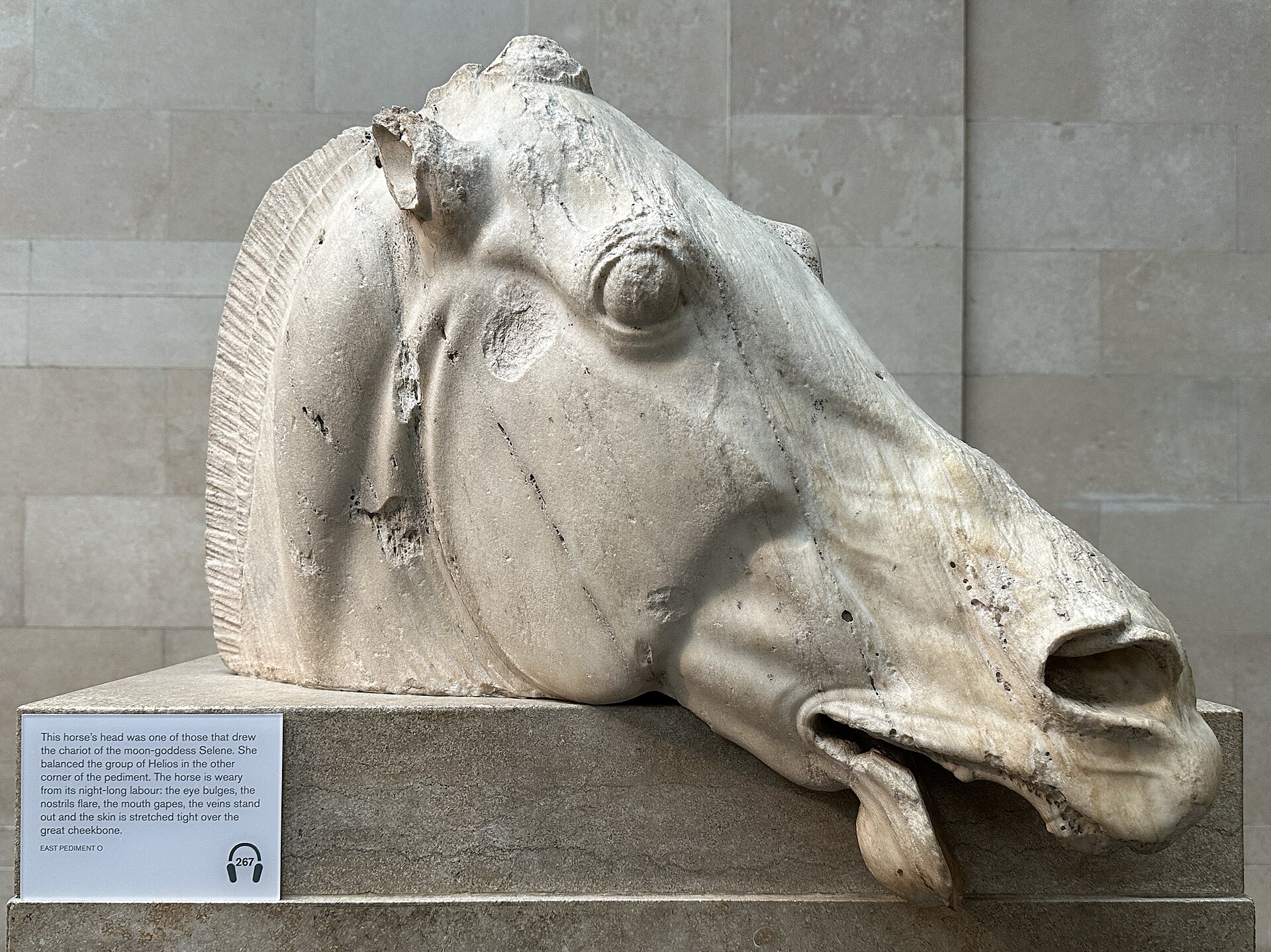
The record in full
Chapter 1What this record covers, and what it does not
This record treats the British Museum's holding of Parthenon sculpture as a single collective object, on the same principle the corpus already applies to the Bayeux Tapestry and the Staffordshire...
This record treats the British Museum's holding of Parthenon sculpture as a single collective object, on the same principle the corpus already applies to the Bayeux Tapestry and the Staffordshire Hoard: a large, physically connected group that only makes sense described together. The British Museum's own published figures give the group as 17 figures from the east and west pediments, 15 of the Parthenon's original 92 metopes, and 56 blocks, roughly 75 metres or 247 feet, of the continuous frieze that ran for about 160 metres around the outside of the cella wall. The same holding also includes one of the six caryatids from the nearby Erechtheion and four slabs from the parapet of the Temple of Athena Nike, both separate buildings on the Acropolis rather than the Parthenon itself, acquired by Elgin's agents in the same campaign and displayed with the Parthenon material in the Museum's Room 18.
What this record does not cover, and what a reader must not confuse it with, is the roughly equal share of the same original sculptural decoration now held by the Acropolis Museum in Athens, opened in 2009, which is a different set of physical objects from the same monument, not a duplicate or a rival claim to the same marble. Nor does it cover the smaller fragments held by the Louvre in Paris, the Antonio Salinas Regional Archaeological Museum in Palermo, the National Museum of Denmark in Copenhagen, and, until 2023, the Vatican Museums, each discussed below in its own right and each version-checked against this record's own sourcing before being named.
Chapter 2The building, and the man who directed its decoration
The Parthenon was built on the Acropolis of Athens between 447 and 438 BC as a temple to Athena Parthenos, under the statesman Pericles, at the height of Athens's imperial wealth after the Persian...
The Parthenon was built on the Acropolis of Athens between 447 and 438 BC as a temple to Athena Parthenos, under the statesman Pericles, at the height of Athens's imperial wealth after the Persian Wars. Its sculptural decoration took until 432 BC to complete: pediment figures carved fully in the round filling the two triangular gables at the building's east and west ends, 92 metopes in high relief set above the colonnade on all four sides, and a continuous low-relief frieze running around the top of the cella wall, inside the outer colonnade, where it was harder for an ordinary viewer to see closely.
Ancient testimony credits the sculptor Pheidias with overall direction of the whole programme. Plutarch, writing more than five centuries later in his Life of Pericles, states that Pheidias had general charge of all the works, and that all the other artists and craftsmen worked under his superintendence, a position Plutarch says Pheidias held through his friendship with Pericles rather than through any office of state. Plutarch's own assessment of the finished work, in the same passage, is that the results arose no less towering in their grandeur than inimitable in the grace of their outlines, and that each piece looked, even in his own later time, as fresh as if it had just been carved. This is a fact about what Plutarch believed and wrote in the first or second century AD, not a contemporary fifth-century BC record, and this record treats it as such.
What Plutarch's account does not settle, and what no surviving source settles, is which individual sculptor carved any specific pediment figure, metope or frieze block. No piece is signed, which was normal practice for Greek architectural sculpture of this date. Stylistic variation across the metopes in particular, some markedly more accomplished in composition and finish than others, has long been read by scholars as evidence that several sculptors or workshop teams executed Pheidias's overall design rather than one hand carving the whole decoration. Pheidias himself is independently and securely documented as the sculptor of the Parthenon's cult statue, the colossal gold-and-ivory Athena Parthenos that stood inside the building, and of the comparable seated Zeus at Olympia, one of the Seven Wonders of the ancient world; neither of those two documented works survives.
Chapter 3From temple to church to mosque to ruin
The Parthenon survived largely intact as a functioning temple for close to a thousand years.
The Parthenon survived largely intact as a functioning temple for close to a thousand years. Around AD 500 it was converted into a Christian church dedicated to the Virgin Mary, a use it kept for roughly a millennium; the conversion involved removing the entire middle section of the east pediment to cut a door and apse into that end of the building, destroying about a dozen of the original pedimental statues in the process, according to the British Museum's own account of the building's history. Mainland Greece passed under Ottoman rule by 1460, and the Parthenon became a mosque in the early 1460s, with a minaret added at one corner; it functioned as a mosque, still substantially whole, for more than two centuries.
The building's fate turned catastrophic in 1687. Venice was besieging Ottoman-held Athens, the Ottoman garrison was using the Parthenon itself as a gunpowder magazine, and a Venetian mortar shell hit the building on 26 September 1687, detonating the stored powder. The explosion blew off the roof, brought down much of the colonnade on both long sides, and destroyed a large further portion of the surviving sculptural decoration. The building has been a ruin ever since. By 1800, on the British Museum's own account, only about half of the original sculptural decoration remained on the building or in any recoverable form at all; the other half had already been lost to the church conversion, the 1687 explosion, and centuries of ordinary weathering and stone-robbing. The 1674 drawings made for the Marquis de Nointel by the French artist Jacques Carrey, thirteen years before the explosion, are the fullest visual record of what the pediments looked like before that loss and are used by scholars today to reconstruct figures now missing entirely.
Chapter 4Elgin's embassy, and the document his agents worked under
Thomas Bruce, 7th Earl of Elgin, arrived in Constantinople in November 1799 as Britain's ambassador to the Ottoman Sultan, at a moment when Britain and the Ottoman Empire were allied against...
Thomas Bruce, 7th Earl of Elgin, arrived in Constantinople in November 1799 as Britain's ambassador to the Ottoman Sultan, at a moment when Britain and the Ottoman Empire were allied against Napoleon's occupation of Egypt. Elgin was an enthusiastic collector of antiquities, and in 1800 he sent his embassy secretary, William Richard Hamilton, to Athens with a team of artists led by the Neapolitan painter Giovanni Battista Lusieri, initially to draw, measure and take plaster casts of the Acropolis monuments, which stood inside an active Ottoman garrison and could not be accessed without official permission.
Philip Hunt, Elgin's chaplain and secretary, obtained a document from the Ottoman authorities in Constantinople in July 1801, addressed to the local Ottoman officials in Athens, authorising Elgin's artists to draw, model, erect scaffolding, excavate where inscriptions might be found, and, in the document's own translated words, to take away any pieces of stone with old inscriptions or figures on them, provided no opposition was made. That document's original, in Ottoman Turkish, has never been located in any archive, Ottoman or British; what survives is an Italian translation, made for and kept among Hunt's own papers, from which the English translation used ever since has itself been rendered. Whether the underlying document was a firman proper, meaning an order issued directly in the Sultan's name, or a lesser instrument such as a mektub or buyruldu issued by an official acting for him, is disputed among specialists: the historian Vassilis Demetriades has argued in print that the document's form marks it as a mektub without the binding force of a true firman, while the art historian Dyfri Williams has argued that the term firman was used broadly enough in Ottoman administrative practice that the distinction does not undermine its authority. The historian Edhem Eldem has argued the document is probably authentic in substance despite the loss of the Turkish original. In May 2024 the government of Turkey stated, through its own officials, that no Ottoman document authorising the removal exists in Turkish archives, and characterised Elgin's actions as unauthorised; Greece's delegation to UNESCO's Intergovernmental Committee for Promoting the Return of Cultural Property, addressing the same body on 22 May 2026, likewise asserted that no authenticated imperial firman for the removal exists. The British Museum's own published position, in its Trustees' statement, states that Lord Elgin acted with the full knowledge and permission of the legal authorities of the day in both Athens and London and that his conduct was investigated and cleared by the 1816 Parliamentary Select Committee. This record grades the firman's authenticity and legal scope as disputed rather than settled in either direction.
Chapter 5What was actually cut away, 1801 to 1805
Removal began on 31 July 1801 and continued, under Lusieri's on-site supervision, for roughly four years.
Removal began on 31 July 1801 and continued, under Lusieri's on-site supervision, for roughly four years. Hunt's own later account describes pressing the Ottoman disdar, the garrison commander at Athens, for an increasingly broad reading of the July 1801 document, moving from taking loose fragments and making casts to detaching sculptures still fixed to the standing building, including cutting figures from the pediments and prising metopes and frieze blocks from the walls, in some cases sawing through the marble behind a relief to reduce its weight for transport. Elgin's agents removed roughly half of the sculptural decoration that still survived on the building or among its fallen debris by 1801: most of the pediment figures still in place, 15 metopes, and 56 blocks of frieze, plus a caryatid taken whole from the Erechtheion's south porch and four slabs from the parapet of the Temple of Athena Nike. Hunt records considering removing all six of the Erechtheion's caryatids if a ship large enough could be found; none was, and Elgin took only the one.
The physical work caused damage independent of the removal itself. Contemporary and later accounts describe blocks being sawn, chiselled and, in places, broken in the process of detachment and lowering, and the marble left exposed on the building's remaining fabric was in some cases further weathered by the fresh cuts. Transport was equally fraught. Shipments left for England between 1802 and 1812; one of them, aboard the brig Mentor, sank in a storm off the Greek island of Cythera in 1804. The entire cargo was eventually salvaged, at Elgin's own expense, though the operation took time and added to his costs. Elgin left his ambassadorial post in 1803 and, held for a period by French authorities while travelling home during a renewed war with France, did not reach England until 1806; the last shipment of marbles did not arrive until 1812.
Chapter 6Elgin's ruin, and the sale to the nation
Elgin financed the entire operation, transport included, from his own resources, and it broke him financially.
Elgin financed the entire operation, transport included, from his own resources, and it broke him financially. He later put his total outlay at roughly 74,000 pounds. From 1807 the collection was displayed privately in London, first in a shed at his Park Lane house, drawing both admiration from artists such as Benjamin Robert Haydon and hostility from critics including Lord Byron, who attacked Elgin in print as a vandal profiting from Greece's ruin. Compounding by a bitterly public divorce from his wife Mary Nisbet from 1807, whose fortune had helped fund the original expedition, Elgin's finances collapsed to the point that he petitioned the government to buy the collection outright.
A House of Commons Select Committee examined the question in early 1816, taking evidence on both the legality of the original acquisition and the collection's artistic merit. Its report, published that year, concluded that the sculptures had been, in the committee's own words, honourably and meritoriously acquired, and recommended a price well below what Elgin sought: 35,000 pounds against the roughly 74,000 he claimed to have spent, a gap Parliament left deliberately in place because members did not want Elgin to profit from the transaction. The House of Commons voted the funds by 82 votes to 30 in June 1816, and an Act of Parliament that year vested the collection in the Trustees of the British Museum in perpetuity. The sculptures went on permanent public display at the Museum from 1817.
Chapter 7Two centuries in Bloomsbury, and the scandal of 1937-38
The collection has remained on continuous public display at the British Museum since 1817, now in the purpose-built Duveen Gallery, Room 18, funded by the art dealer Joseph Duveen.
The collection has remained on continuous public display at the British Museum since 1817, now in the purpose-built Duveen Gallery, Room 18, funded by the art dealer Joseph Duveen. It was Duveen who, disliking the honey-brown patina the marble had acquired over more than two thousand years and wrongly believing Greek marble had originally been plain white, arranged for museum workers to scrub the surfaces of several of the sculptures with copper tools and an abrasive called carborundum between 1937 and 1938, over roughly fifteen months, before the work was halted in September 1938. An internal board of inquiry convened at the time found the resulting damage, in its own words, obvious and impossible to exaggerate. The historian William St Clair later concluded that as much as 80 per cent of the historic surface of the affected pieces had been lost to the scraping. The Museum's own curator Ian Jenkins has argued that natural weathering over two millennia remains the dominant cause of surface loss on the sculptures as a whole, and a 2023 technical study by the researcher Emma Payne assessed the 1930s damage, taken in that longer context, as comparatively minor. This record records both assessments rather than choosing between them; what is not disputed is that the scrubbing happened, on Duveen's instigation, and that the Museum's own contemporaneous board of inquiry called the result severe.
Chapter 8Greece's claim takes formal shape
Requests for return did not begin with the modern campaign.
Requests for return did not begin with the modern campaign. The newly independent Kingdom of Greece asked Britain, in 1836, for the return of the Temple of Athena Nike frieze slabs specifically; Britain's response in 1846 was to send plaster casts rather than the originals. Athens made a further unsuccessful request for the frieze in 1890, and a Greek diplomat in London raised the question of architectural fragments again in 1927. None of these earlier approaches produced a change of ownership or, on the sources consulted for this record, a substantive British government response beyond the 1846 casts.
The modern campaign dates from July 1982, when Melina Mercouri, then Greece's Minister of Culture, addressed UNESCO's World Conference on Cultural Policies in Mexico City and formally proposed the sculptures' return, framing the request not as a claim to individual artworks but as a call to reunite a single fragmented monument. "We are not asking for the return of a work of art or a statue," Mercouri told the conference. "We are asking for the return of a part of a unique monument, a symbol of a civilization." The conference adopted a resolution supporting reunification and describing the sculptures' removal as having mutilated the monument; the resolution carried no binding force on Britain. Greece's government followed with a formal state-to-state request for the return of all the sculptures removed from the Acropolis in October 1983; the UK Government rejected that request in April 1984, and Greece listed the dispute with UNESCO the same year.
Chapter 9The Acropolis Museum, built to answer one argument
For much of the dispute's modern history the British Museum's position, as summarised in evidence to the UK Parliament's Culture, Media and Sport Committee in 2000, rested partly on the claim that...
For much of the dispute's modern history the British Museum's position, as summarised in evidence to the UK Parliament's Culture, Media and Sport Committee in 2000, rested partly on the claim that Greece lacked an adequate modern facility to conserve and display the material were it returned. Greece's government responded by commissioning a new Acropolis Museum, sited at the foot of the Acropolis itself, which opened in 2009. Its top-floor Parthenon Gallery is built to the same dimensions as the temple's own cella and oriented to match it exactly, with floor-to-ceiling glass giving a direct sightline to the Parthenon on the rock above; the frieze, metopes and pediment sculptures Greece already holds are displayed there in their original relative sequence, with the pieces held in London represented by plain white plaster casts rather than left as gaps. The British Museum's own Trustees' statement, addressing this argument directly, says that neither of the claims that Greece cannot properly display or conserve the material is one the Trustees actually make, and states that the Museum admires the Acropolis Museum's display of the sculptures Athens holds, complemented by casts of those in London and elsewhere.
Chapter 10UNESCO, mediation offered and declined
Greece has pursued the dispute at UNESCO's Intergovernmental Committee for Promoting the Return of Cultural Property to its Countries of Origin, the ICPRCP, since first placing it on that body's...
Greece has pursued the dispute at UNESCO's Intergovernmental Committee for Promoting the Return of Cultural Property to its Countries of Origin, the ICPRCP, since first placing it on that body's agenda in 1984. In 2013 Greece formally asked UNESCO's Director-General to open mediation between Greece, the UK Government and the British Museum, under the Committee's 2010 mediation and conciliation rules; both the UK Government and the British Museum declined the proposal in 2015, the Government stating in its formal response that it saw nothing in Greece's approach to suggest any purpose other than achieving the permanent transfer of the sculptures on terms that would deny the Museum's ownership, and concluding that mediation would not carry the debate substantially forward. The British Museum, in its own separate reply the same year, said it preferred to explore collaboration directly between institutions rather than through a government-to-government process, and that this, rather than any objection to UNESCO itself, was why it declined.
At its 22nd session in September 2021, the ICPRCP voted for the first time to include a recommendation on the Parthenon Sculptures in its formal decision document, calling on the United Kingdom to reconsider its position and enter bona fide dialogue with Greece and describing the dispute as intergovernmental in nature; the UK Government rejected that recommendation. At the Committee's 25th session, concluding on 22 May 2026, Greece's delegation again presented its case, arguing that Elgin's acquisition was illegal, that no authenticated Ottoman document survives to authorise it, that the original removal caused severe and irreversible damage compounded by later restoration attempts, and that the Museum continues to fall short in how it manages the material; the delegation also told the Committee that the UK Government had attempted, without bringing the matter before Parliament, to exempt sixteen national museums, the British Museum among them, from provisions of the Charities Act 2022 that would otherwise let museums dispose of objects on moral grounds, a specific procedural claim this record has not been able to independently verify beyond the Greek delegation's own statement and flags accordingly. The UK's delegation reiterated its position that the sculptures were legally acquired and that current UK law bars their permanent return, citing the scale of the Museum's visitor numbers as a public benefit. Twenty states, including Italy, Brazil, Colombia, China and Egypt, formally voiced support for Greece's position at that session, with a further group of observer states, including Cyprus, Turkey and Mexico, doing the same; Turkey's delegation used the same session to repeat its position that no Ottoman document exists to legitimise the original removal.
Chapter 11The British Museum's legal position, stated in its own words
The Trustees of the British Museum set out their position in a published statement addressing what they describe as common misconceptions about the case.
The Trustees of the British Museum set out their position in a published statement addressing what they describe as common misconceptions about the case. On legality, the statement says plainly: "Lord Elgin, the British diplomat who transported the sculptures to England, acted with the full knowledge and permission of the legal authorities of the day in both Athens and London," and that his conduct "was thoroughly investigated by a Parliamentary Select Committee in 1816 and found to be entirely legal." On ownership, the Trustees state that the Museum "is not a government body, and the collections do not belong to the British Government," and that they hold the collection "not only for the British people, but for the benefit of the world public." The Museum's legal authority to dispose of collection items is set by the British Museum Act 1963, which bars the Trustees from permanently disposing of objects except in narrow circumstances defined by section 5: a duplicate, an object unfit to be retained that can be disposed of without detriment to students or the public, an object given or bequeathed after 1963 whose donor consents to its disposal, or an object no longer of use for the Museum's purposes. The Trustees' statement asserts that the Museum has never actually been asked by Greece for a loan of the sculptures, only for their permanent transfer, and that the Trustees' own precondition for considering any loan, of the Parthenon material or otherwise, is that the borrowing institution first acknowledges the Museum's ownership of the object, a precondition Greece's successive governments have declined to meet. The Museum cites its 2014 loan of the pediment figure of the river god, sometimes identified as Ilissos, to the State Hermitage Museum in St Petersburg as an instance of a Parthenon piece travelling on loan under that precondition; Greece's government at the time criticised the loan as having been arranged without consulting Athens.
Chapter 12November 2023: a cancelled meeting
The dispute broke into open diplomatic conflict in November 2023.
The dispute broke into open diplomatic conflict in November 2023. Greek Prime Minister Kyriakos Mitsotakis, in a BBC interview broadcast on Sunday 26 November 2023 ahead of a scheduled visit to London, compared Britain's holding of half the Parthenon sculptures to cutting the Mona Lisa in half, and described the original removal as having, in his words, been essentially stolen from Greece. British Prime Minister Rishi Sunak's office cancelled a planned bilateral meeting between the two leaders the following Tuesday; a source close to Sunak said it had become impossible for the meeting to go ahead following the Prime Minister's public comments on the sculptures beforehand, and Sunak's office stated that specific assurances on the topic had been given and then broken, a claim a Greek government source denied, saying discussions had proceeded smoothly until late the previous afternoon. Mitsotakis, offered a substitute meeting with Deputy Prime Minister Oliver Dowden, declined it. Talks between the two governments over the sculptures stalled for a period following the episode.
Chapter 13The Parthenon Partnership: talks toward a loan, still unresolved
Discussions between the British Museum and Greece resumed and, according to press reporting from late 2022 onward, gathered pace under George Osborne, appointed the Museum's chairman that year.
Discussions between the British Museum and Greece resumed and, according to press reporting from late 2022 onward, gathered pace under George Osborne, appointed the Museum's chairman that year. The Times reported in mid-2025 that Osborne was negotiating a reciprocal arrangement under which a substantial part of the London-held sculptures would go to Athens on a long-term loan in exchange for a rotating programme of ancient Greek objects from Greek collections being shown in London, timed, according to that reporting, to coincide with the British Museum's own planned closure for redevelopment of its Bloomsbury site later in the decade. A British Museum spokesperson, quoted in coverage of that report, confirmed only that "discussions with Greece about a Parthenon Partnership are on-going and constructive," describing the aim as striking a balance between sharing the Museum's objects worldwide and maintaining the integrity of its collection.
Osborne himself, speaking in December 2024, said the two sides had made a lot of progress but remained, in his words, still some distance from any kind of agreement, and noted that UK Prime Minister Keir Starmer's position, that the matter was one for the Museum's Trustees rather than the Government, made the negotiation easier to conduct. Because the British Museum Act 1963 bars permanent disposal, any such deal, on the reporting reviewed for this record, would have to take the legal form of a loan rather than a transfer of ownership, sidestepping the Act rather than amending it; commentary on the negotiations has separately noted that the Charities Act 2022 created a distinct route, allowing certain national museums to dispose of objects where a moral obligation to do so is established, that campaigners on both sides of the dispute have flagged as a possible alternative legal path, though neither the Museum nor the UK Government has stated, on the sources consulted here, that this route is actually being used for the Parthenon material. As of the ICPRCP's 25th session on 22 May 2026, Greece's own delegation told the committee that progress remained stalled specifically because the UK side continued to insist that any resolution take the form of a temporary loan rather than permanent return, and no further public statement from the Museum updating Osborne's December 2024 assessment has been located for this record.
Chapter 14Not to be confused with: the rest of the Parthenon's decoration
Version safety matters more on this record than almost any other in the corpus, because the same original decorative scheme is now physically split across at least six locations, and each split-off...
Version safety matters more on this record than almost any other in the corpus, because the same original decorative scheme is now physically split across at least six locations, and each split-off group is frequently and wrongly described in casual writing as if it were the same holding as this one. The Acropolis Museum in Athens holds a share of the surviving decoration roughly comparable in scale to the British Museum's, including 40 frieze blocks, displayed since 2009 in a purpose-built gallery aligned with the Parthenon itself; it is not part of this record and its objects are physically different marble from the pieces described here. The Louvre in Paris and the National Museum of Denmark in Copenhagen each hold smaller fragments, acquired independently of Elgin's campaign and outside the scope of this record.
Two further holdings changed hands recently enough to matter to any reader coming to this subject through recent news. The Vatican Museums held three fragments, a horse's head from the west pediment, a young man's head holding a discus, and the head of a bearded man, for roughly two centuries before Pope Francis, acting on his own initiative announced on 16 December 2022, donated them to Ieronymos II, Archbishop of Athens and All Greece, as what the Vatican and Greece's Ministry of Culture both described as a spiritual and ecumenical gift between church leaders rather than a state-to-state restitution; the fragments went on display at the Acropolis Museum from 24 March 2023. The University of Palermo's collection, later the Antonio Salinas Regional Archaeological Museum, held a fragment of Artemis's foot and drapery from the east frieze, known as the Fagan fragment after the British consul Robert Fagan whose widow sold it to the university in 1820; it went on loan to the Acropolis Museum in 2008 and was formally and permanently transferred to Greek ownership in a ceremony on 4 June 2022. Neither the Vatican's former holding nor the Palermo fragment was ever part of the British Museum's collection, and neither transfer altered the British Museum's own holding or its Trustees' stated legal position on the material it retains, which is the subject of this record.
The artist
Pheidias (also transliterated Phidias), general overseer of the Parthenon's sculptural decoration under Pericles; the individual sculptors who executed most of the pediments, metopes and frieze under his direction are unnamed in any surviving source
No single artist can honestly be named for this whole body of work, and naming one would repeat exactly the kind of flattening this publication exists to correct. What ancient sources document is a director: Pheidias, given general charge of the Parthenon's sculptural programme, along with the rest of Pericles' Acropolis building works, and credited with designing and probably supervising the carving of the pediments, metopes and frieze without there being any evidence he personally carved most of the individual pieces himself. He is independently and much more securely documented as the actual sculptor of two other works, the Parthenon's own cult statue and the seated Zeus at Olympia, neither of which survives. This dossier covers Pheidias as the documented overseer of the programme and states plainly, rather than papering over, how much about the individual hands behind this record's own object remains unknown.
Related works
| Work | Relation | Where it is |
|---|---|---|
| Parthenon sculptures held by the Acropolis Museum, Athens Same original workshop under Pheidias's direction | The largest other surviving share of the same original sculptural decoration; physically different marble, not a duplicate of this holding Displayed since 2009 in a purpose-built gallery matching the Parthenon's own dimensions and orientation, with the pieces held in London represented by plain white plaster casts rather than left as gaps. | Acropolis Museum, Athens, Greece |
| Three Parthenon fragments formerly in the Vatican Museums Same original workshop under Pheidias's direction | A horse's head, a youth's head and a bearded man's head, held by the Vatican for roughly two centuries and returned to Greece Donated by Pope Francis to Ieronymos II, Archbishop of Athens and All Greece, on his own initiative announced 16 December 2022, and framed by both sides as a spiritual gift between church leaders rather than a state-to-state restitution. Never part of the British Museum's collection. | Now the Acropolis Museum, Athens (transferred 2023) |
| The Fagan fragment (foot and drapery of Artemis, east frieze) Same original workshop under Pheidias's direction | A single frieze fragment, on loan to the Acropolis Museum from 2008 and permanently transferred to Greek ownership in 2022 Acquired independently of Elgin's campaign by the British consul Robert Fagan in the early nineteenth century and sold to the University of Palermo by his widow in 1820. Never part of the British Museum's collection. | Formerly Antonio Salinas Regional Archaeological Museum, Palermo, Sicily; now Acropolis Museum, Athens |
| Parthenon fragments in the Louvre and the National Museum of Denmark Same original workshop under Pheidias's direction | Smaller surviving fragments of the frieze and metopes, held independently of both the British Museum's and the Acropolis Museum's holdings Acquired through separate nineteenth-century collecting activity, not through Elgin's 1801-1805 campaign. Distinguished here specifically to prevent the common error of treating any Parthenon fragment in any museum as part of this record's holding. | Musee du Louvre, Paris; National Museum of Denmark, Copenhagen |
| Athena Parthenos and the Zeus of Olympia Pheidias | Pheidias's own independently documented sculptural works, as distinct from the Parthenon's architectural decoration he oversaw but likely did not personally carve Cited here to show what can and cannot be securely attributed to Pheidias personally, as against the wider Parthenon sculptural programme he directed. | Both lost; known only from ancient description and later copies |
Open questions
- Did an authentic Ottoman firman, issued directly in the Sultan's name, ever exist for the removal of standing sculpture, as against permission only to draw, cast and remove loose fragments? The original Turkish document has never been located; only an Italian translation survives, and specialists (Demetriades, Williams, Eldem) disagree on whether the surviving document even represents the right category of Ottoman instrument.
- Has Greece's government ever filed, or formally threatened, a legal claim or litigation over ownership, as distinct from a diplomatic or UNESCO request? Reporting from 2015 describes Greece's culture ministry seeking and then rejecting legal advice on litigation in favour of a diplomatic and political approach; no filed claim has been identified in the sources consulted for this record.
- What is the exact current legal mechanism, if any, by which the UK Government has sought to exempt the British Museum from provisions of the Charities Act 2022 concerning disposal on moral grounds? This claim was made by Greece's own delegation to UNESCO's ICPRCP on 22 May 2026 and has not been independently verified against a primary UK government or parliamentary source for this record.
- Will the 'Parthenon Partnership' loan talks between George Osborne and Greek officials conclude, on what precise terms, and within what timeframe relative to the British Museum's planned Bloomsbury redevelopment? As of the sources consulted for this record (through the ICPRCP's May 2026 session), no agreement had been announced.
- What overall percentage of historic surface loss on the British Museum's sculptures is actually attributable to the 1937-38 Duveen cleaning, as against two thousand years of prior weathering and the violence of the original removal itself? St Clair's 80 per cent figure and Payne's 2023 reassessment as comparatively minor have not been reconciled in the sources used here.
- Which specific sculptors, beyond Pheidias as overseer, actually carved the individual metopes and pediment figures now in London? No ancient source names any of them, and this record treats the question as open rather than assigning names on stylistic inference alone.
Questions about this object
What is The Parthenon Sculptures in the British Museum?
The Parthenon Sculptures in the British Museum is a sculpture, dated c. 447-432 BC, as part of the Parthenon's building programme; the frieze is usually dated to the earlier part of that range, c. 442-438 BC, and the pediment sculptures to the final years, 438-432 BC. Medium: Pentelic marble, quarried from Mount Pentelicus northeast of Athens; the pediment figures were carved fully in the round, the metopes in high relief, and the frieze in continuous low relief.
Who made The Parthenon Sculptures in the British Museum, and is the attribution settled?
The attribution to Pheidias, general overseer of the Parthenon's sculptural programme under Pericles; the individual carvers of specific pediment figures, metopes and frieze blocks are not named in any surviving source is recorded here as accepted. Ancient testimony, chiefly Plutarch's Life of Pericles, states that Pheidias held general charge of Pericles' whole building programme on the Acropolis, including the Parthenon's sculptural decoration, and that all the other artists and craftsmen worked under his superintendence. No signature survives on any surviving piece, which is normal for Greek sculpture of this date. Modern scholarship accepts Pheidias's overall direction of the programme but is explicit that this is not the same as establishing which individual hand carved any specific pediment figure, metope or frieze block; stylistic variation across the metopes in particular has long been read as evidence of several different sculptors or workshop teams executing Pheidias's design. This record follows that distinction rather than naming a single artist for the whole group.
Where is The Parthenon Sculptures in the British Museum now?
The British Museum, London, Room 18 (the Duveen Gallery) and the adjoining Rooms 18a and 18b. Inventory number No single accession number covers the group; each piece carries its own British Museum registration number rather than one collective inventory entry. Last confirmed 14 August 2026. Purchased from Thomas Bruce, 7th Earl of Elgin, by the British Government for 35,000 pounds following the report of a House of Commons Select Committee, June 1816; transferred to the Trustees of the British Museum by Act of Parliament the same year and held since under the British Museum Act 1963.
What is still unknown about The Parthenon Sculptures in the British Museum?
Did an authentic Ottoman firman, issued directly in the Sultan's name, ever exist for the removal of standing sculpture, as against permission only to draw, cast and remove loose fragments? The original Turkish document has never been located; only an Italian translation survives, and specialists (Demetriades, Williams, Eldem) disagree on whether the surviving document even represents the right category of Ottoman instrument.
Sources
- 1British Museum, 'Parthenon Sculptures - the Trustees' statement', accessed 2026-08-14. The Museum's own published legal and policy position, addressing common misconceptions about ownership, legality and loan requests. britishmuseum.org/about-us/...
- 2British Museum (blog), 'An introduction to the Parthenon and its sculptures', published 11 January 2018. britishmuseum.org/blog/...
- 3British Museum, 'Greece: Parthenon' (Room 18 gallery page), accessed 2026-08-14. britishmuseum.org/collection/...
- 4House of Commons Library, 'The Parthenon Sculptures', research briefing SN02075, accessed 2026-08-14. UK Government and British Museum official positions, the 1816 Select Committee, UNESCO mediation correspondence 2013-2015. commonslibrary.parliament.uk/research-briefings/...
- 5Smithsonian Magazine, 'How the Much-Debated Elgin Marbles Ended Up in England'. smithsonianmag.com/history/...
- 6Wikipedia, 'Elgin Marbles'. en.wikipedia.org/wiki/...
- 7Wikipedia, '1937-1938 Elgin Marbles cleaning scandal'. en.wikipedia.org/wiki/...
- 8Wikipedia, 'Acropolis Museum'. en.wikipedia.org/wiki/...
- 9Wikipedia, 'Parthenon Frieze'. en.wikipedia.org/wiki/...
- 10Encyclopaedia Britannica, 'Elgin Marbles', revised by Meg Matthias, accessed 2026-08-14 (article dated 14 July 2026 per masthead). britannica.com/topic/...
- 11GreekReporter (Tasos Kokkinidis), 'Melina Mercouri's 1982 Speech That Changed the Parthenon Marbles Debate', 30 July 2026. greekreporter.com/2026/...
- 12GreekReporter (Tasos Kokkinidis), 'Greece, British Museum Discuss Long-Term Parthenon Marbles Loan', 9 June 2025. The Times' original reporting on the Osborne-led negotiations, and the British Museum's own 'Parthenon Partnership' quote. greekreporter.com/2025/...
- 13GreekReporter (Tasos Kokkinidis), 'UNESCO Calls on UK and Greece to Intensify Parthenon Marbles Talks', 23 May 2026. Report of the ICPRCP's 25th session, concluding 22 May 2026, including Greece's Ministry of Culture statement and the list of supporting states. greekreporter.com/2026/...
- 14The National Law Review, 'Part II - The Debate over the Parthenon Sculptures: Cultural Assets'. Legal analysis of the firman's status and the inapplicability of the 1970 UNESCO Convention, the UNIDROIT Convention and the Hague Convention to the 1801-1805 removal. natlawreview.com/article/...
- 15Al Jazeera, 'Parthenon marbles row derails talks between UK's Sunak, Greece's Mitsotakis', 28 November 2023. aljazeera.com/news/...
- 16Balkan Insight (Eleni Stamatoukou), 'Vatican Returns Three Fragments of Parthenon Marbles to Greece', 8 March 2023. balkaninsight.com/2023/...
- 17Museums Association, 'Parthenon sculptures deal "still some distance" away, says Osborne', December 2024. museumsassociation.org/museums-journal/...
- 18Acropolis Museum, 'The permanent reunification of the Fagan fragment at the Acropolis Museum', official museum page. theacropolismuseum.gr/en/...
- 19GreekReporter, 'Parthenon Marbles Fragment Returns Home to the Acropolis Museum', 10 January 2022. greekreporter.com/2022/...
- 20Plutarch, Life of Pericles, chapter 13, translated by John Dryden, revised by Arthur Hugh Clough, via Wikisource. Primary ancient source (though written centuries after the events it describes) for Pheidias's role as general overseer of the Periclean building programme. en.wikisource.org/wiki/...
Last verified · Published
Change log
14 August 2026 - Record created at the house standard: researched narrative, technical evidence, maker dossier, graded provenance chain, prices with hammer and premium separated, related works, open questions and sources.