Acropolis Museum
Museum · Mouseio Akropolis · Founded 2009
Open, admission and hours confirmed 8 August 2026 · 18 sources
On this page 17 sections
ContentsClose
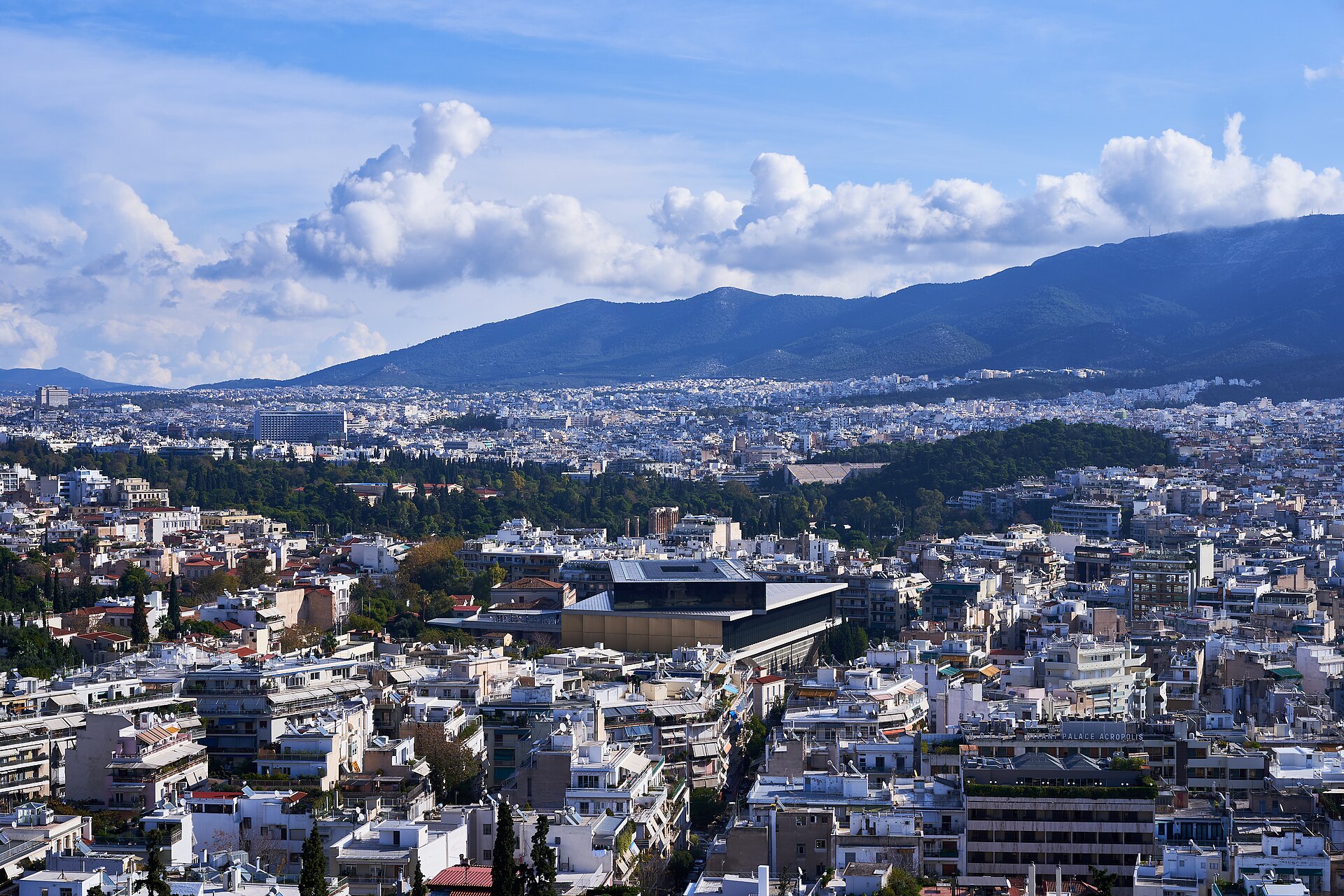
The Acropolis Museum's strength is depth on a single subject rather than encyclopaedic range: everything in the building was found on or around the Acropolis of Athens, spanning the Bronze Age through the end of antiquity and into the Byzantine period, with the sculptural decoration of the Parthenon and the five surviving Erechtheion Caryatids as its centre of gravity. The Level -1 excavation adds a second, unplanned collection of the same rigour, an entire Athenian neighbourhood of houses and workshops uncovered while building the museum's own foundations. What the museum does not hold, chiefly roughly half the surviving Parthenon frieze, fifteen of its best-preserved metopes and one Caryatid, all in the British Museum, is displayed as a plaster cast in the exact place the original would occupy, so the collection reads as complete in outline even where it is incomplete in substance.
| Local name | Mouseio Akropolis |
|---|---|
| Kind | Museum |
| Founded | 2009 |
| City and country |  Athens, Greece Athens, Greece |
| Address | Dionysiou Areopagitou 15, 11742 Athens, Greece |
| Website | theacropolismuseum.gr |
| Status | Open, confirmed 8 August 2026 |
| Record last verified | 2 September 2026 |
Visiting
- Hours
- Monday, summer season (1 April to 31 October)09:00 to 17:00Last entry 16:30.
- Tuesday to Sunday, summer season09:00 to 20:00Last entry 19:30.
- Friday, summer season09:00 to 22:00Extended hours; last entry 21:30. The second-floor restaurant stays open until midnight on Fridays and Saturdays.
- Monday to Thursday, winter season (1 November to 31 March)09:00 to 17:00Last entry 16:30. Corrected 2026-09-02: the museum's own opening-hours page does not hold winter hours flat across the week - only Monday-Thursday sit at 09:00-17:00.
- Friday, winter season09:00 to 22:00Last entry 21:30, the same Friday extension as summer season. Added 2026-09-02.
- Saturday and Sunday, winter season09:00 to 20:00Last entry 19:30. Added 2026-09-02.
- Closed
- 1 January. Orthodox Easter Sunday. 1 May. 25 and 26 December. Reduced hours 09:00 to 15:00 on Christmas Eve and New Year's Eve (24 and 31 December). Reduced hours on Orthodox Good Friday, 12:00 to 18:00, and Orthodox Holy Saturday, 09:00 to 15:00. Extended to midnight on the evenings of the August full moon and the European Night of Museums.
- Admission
- General admission, summer season (1 April to 31 October)EUR 20In force since 1 November 2024.
- Reduced admission, summer seasonEUR 10Eligibility documents required at the Ticket Desk; the museum publishes a separate list of who qualifies.
- General admission, winter season (1 November to 31 March)EUR 20Combined ticket price with the archaeological sites is handled separately; this is the Museum-only figure in force since 1 November 2024.
- Reduced admission, winter seasonEUR 10
Free entry: 6 March, Melina Mercouri Day. 25 March, national holiday. 18 May, International Day of Museums. 28 October, national holiday. Free or reduced admission is also available year-round to specific categories of visitor (students, children, disabled visitors and a companion, and others) against eligibility documents at the Ticket Desk; the museum publishes the full list separately rather than as a single flat rule- Tickets
- etickets.theacropolismuseum.gr The museum's own ticket page.
- Do I need to book?
- No advance timed ticket is stated as mandatory, but the museum sells e-tickets through its own site and warns visitors in a fraud notice to buy only through the official .gr domain, not a lookalike .org site that copies its design to collect payments.
- Address
- Dionysiou Areopagitou 15, 11742 Athens, Greece MapMetro Akropoli station, Line 2 (red line), about a two to three minute walk; the station has two exits, on Makrygianni Street and on Athanasiou Diakou Street, and is fully accessible
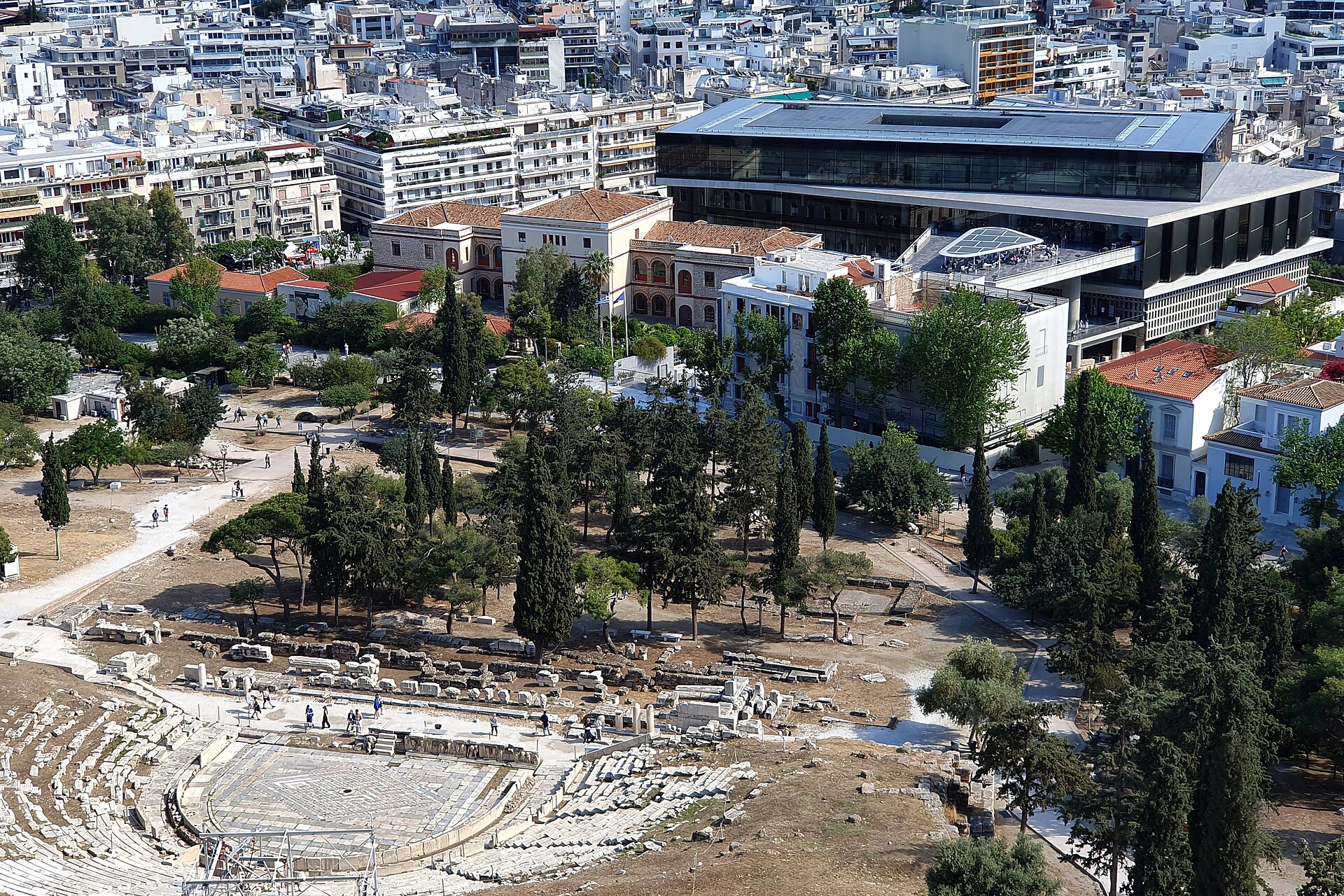
On foot The museum stands on Dionysiou Areopagitou Street opposite the Theatre of Dionysus, on the south slope of the Acropolis, about 300 metres from the ancient monuments themselves - Website
- theacropolismuseum.gr
- Telephone
- +30 210 900 0900
- [email protected]
Before you go how long, access, photography, bags, eating, shop
- How long to allow
- The Director General has put average attendance at about 7,000 visitors a day in peak season; a first-time visit that takes in all four levels, including the Level -1 excavation and the Parthenon Gallery, runs to two to three hours.
- Access
- The building is wheelchair accessible throughout, with ramps at the entrances, lifts between floors, accessible restrooms, and free admission for disabled visitors plus one companion against eligibility documents. Braille guides are published in six languages and tactile tours with touchable replicas are offered for blind and low-vision visitors; sign-language tours and audio guides serve visitors who are deaf or hard of hearing. Guide dogs are explicitly permitted inside the galleries.
- Photography
- Amateur photography and filming without flash is allowed in every gallery except the Archaic Acropolis Gallery, where it is prohibited. Flash, tripods and other professional equipment are not allowed anywhere in the building.
- Bags
- Two cloakrooms on the ground floor hold backpacks and bulky items; all bags pass through X-ray security screening at entry, so the museum advises arriving with as little as possible.
- Eating
- A cafe and a second-floor restaurant with a view toward the Acropolis operate through the museum's normal opening hours; the restaurant stays open until midnight on Fridays and Saturdays.
- Shop
- Museum shops trade during the same hours as the galleries and close fifteen minutes before the building does.
Prices and hours change. We take them from the institution's own pages and print the day we read them, and you can check the current position at the source we used. Confirm before you travel.
What is inside
Level -1, the archaeological excavation
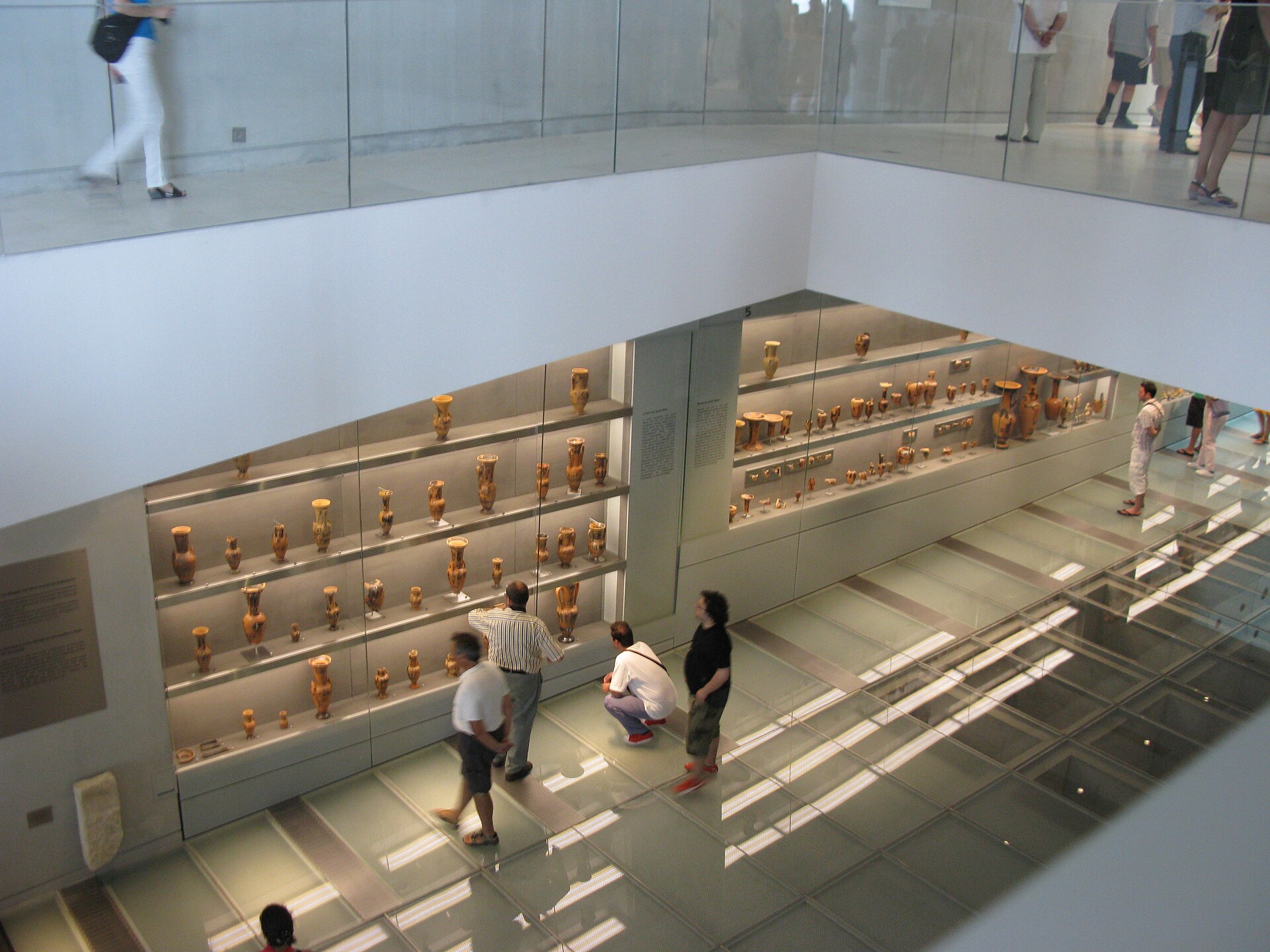
Glass floors and a glass-floored ramp let visitors look straight down into the ruins of an ancient Athenian neighbourhood, uncovered during the Makrygianni excavation of 1997 to 2002 when the site was cleared to build the museum. The find was substantial enough that Tschumi's drawings were changed to preserve it rather than build over it, and the museum opened a dedicated Excavation Museum on this level for its fifteenth anniversary in 2024, showing about 1,150 objects from more than 4,500 years of the neighbourhood's life: houses, workshops, water and drainage systems, and the domestic and commercial fittings of people who were never famous enough to be written down elsewhere.
Photograph by Tilemahos Efthimiadis · CC BY-SA 2.0 Ground floor, the Gallery of the Acropolis Slopes
A single long gallery on a gently rising glass-floored ramp, following the shape of the slope itself, holding finds from the sanctuaries and settlements that grew up on the sides of the rock across every period of its use: votive offerings, small sanctuaries to Asclepius, Aphrodite, Eros and other cults that never stood on the summit, domestic pottery and the everyday material the summit collections do not carry.
Photograph by Tilemahos Efthimiadis · CC BY-SA 2.0 First floor, the Archaic Acropolis Gallery
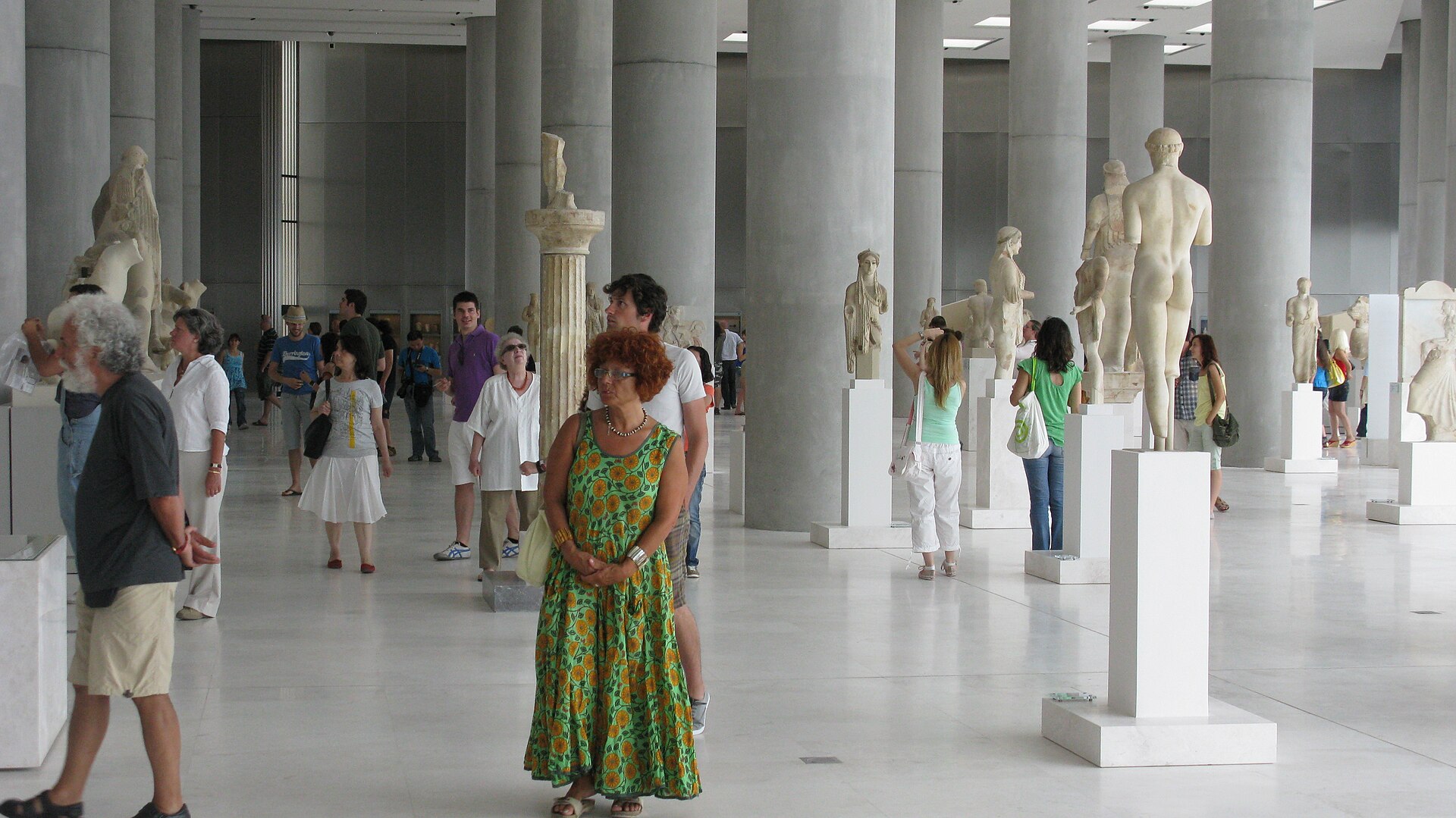
A colonnaded hall arranged as a walk-through of the summit's own history from the second millennium BC to the end of antiquity, built around the sixth-century BC dedications thrown into pits on the Acropolis by the Athenians after the Persian sack of 480 BC and recovered by later excavation: the korai, the Moschophoros, and the pedimental sculptures of the earlier, smaller temples that stood on the rock before the Parthenon. Photography is not permitted in this gallery specifically, the one exception to the museum's general amateur-photography policy.
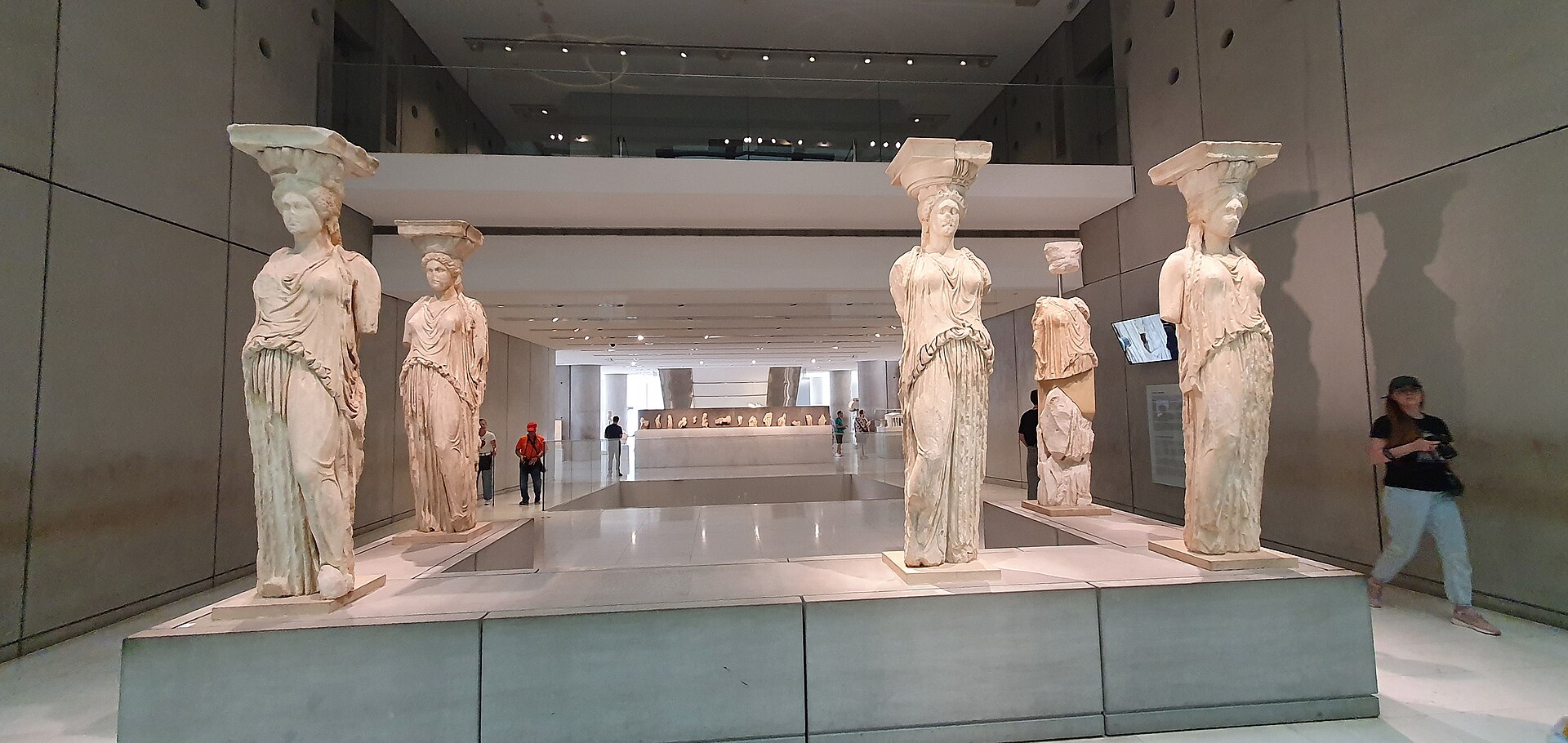
Photograph by Yair-haklai · CC BY-SA 4.0 First floor, the Caryatids of the Erechtheion
Five of the six original caryatids that supported the south porch of the Erechtheion, moved indoors in 1978-79 and replaced on the building itself by casts, stand together on a low base in their original formation. The space for the sixth is left empty rather than filled with a plaster substitute; that statue was removed by Lord Elgin's agents and is in the British Museum. An academic study published in the Journal of Conservation and Museum Studies argues the room gives the figures markedly worse conditions than the Parthenon sculptures receive one floor up: a windowless concrete chamber lit by skylights and spotlights rather than the daylight of the top-floor gallery, no sightline to the Erechtheion itself, and no reconstructed entablature to show that the figures were load-bearing architecture rather than freestanding statues.
Photograph by Pinterpandai.com · CC BY-SA 3.0 Third floor, the Parthenon Gallery
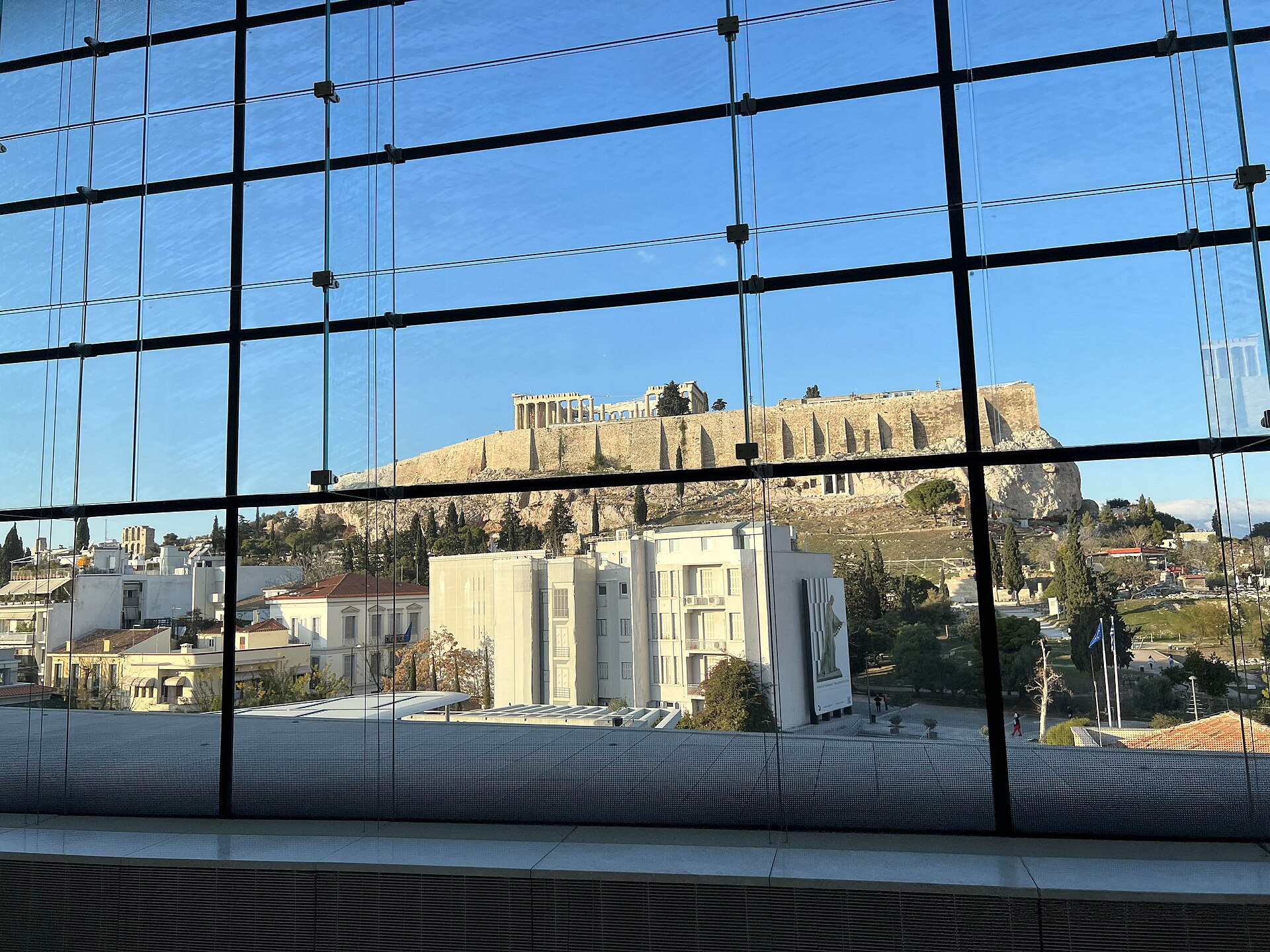
A glass-walled rectangular hall, rotated to match the orientation of the Parthenon's cella and roughly its dimensions, ringed with the same number of steel columns as the temple had marble ones. The frieze blocks run around the outer wall in the sequence they held on the building, lowered for easier viewing; the metopes hang in pairs between the columns; the pedimental figures stand on low plinths at each end, visible from every side. The museum fills every sculpture it does not hold with a plain plaster cast of the original, so a visitor walks the complete decorative scheme of the temple with the gaps in Athens's own collection made visible rather than smoothed over, while the glass walls give a direct sightline to the actual Parthenon on the hill above.
What to see first
The Caryatids of the Erechtheion
Athenian workshop, about 415 BCFive of the six original porch caryatids stand together in Athens; the sixth was taken by Lord Elgin's agents and is in the British Museum, and the museum leaves its place on the base empty rather than casting a substitute.8
The Peplos Kore
Archaic Athenian workshop, about 530 BCOne of the best known of the pit-buried korai recovered after the Persian sack of 480 BC, a standing girl in a plain wool peplos with traces of the original paint still visible on the surface.5
The Moschophoros, the Calf-Bearer
Athenian workshop, about 570 BCA bearded man carrying a calf across his shoulders for sacrifice, one of the earliest Athenian votive statues to survive largely intact and a fixture of the Archaic Gallery.5
Nike Adjusting Her Sandal
Workshop of the Temple of Athena Nike, about 410 BCA relief slab from the parapet of the small temple beside the Propylaia, showing a winged Victory bent to unfasten her sandal, the drapery clinging to the body beneath it in the so-called wet-drapery style the period is known for.5
The Rampin Rider
Athenian workshop, about 550 BCThe body stayed in Athens; the head was bought by the collector Georges Rampin and is now in the Louvre. A cast reunites the two in the gallery, one of the plainer examples the museum has of a figure literally divided between two capitals.6
The Parthenon frieze and pediment sculptures
Workshop associated with Phidias, 447 to 432 BCThe originals Athens holds are hung and stood in the actual sequence and orientation of the temple itself, in a glass hall built to that temple's proportions; every piece the museum does not hold is filled with a plain plaster cast rather than left blank.9
The Bluebeard pediment
Athenian workshop, about 570 BCA limestone pediment from an early temple on the site, showing a three-bodied, snake-tailed male figure with a bright blue-tinted beard, one of the few large-scale examples of surviving Archaic polychromy from the Acropolis.5
Exhibitions on now
- On now6 Oct 2025 to 31 Oct 2026Confirmed 24 Aug 2026, 4 weeks ago
Past exhibitions here
- Closed16 Jun to 6 Sep 2026Confirmed 24 Aug 2026 · check before you travel
A museum built to win an argument
The Acropolis Museum opened on 20 June 2009, on Dionysiou Areopagitou Street about 300 metres from the rock its collection was taken from, and it was designed from the first sketch to make a case. Every earlier Acropolis museum had stood on the summit itself, cramped and increasingly unfit for what excavation kept bringing up, and none of them had room to display the full architectural sculpture of the Parthenon in the sequence it originally held on the building. The new museum's founding purpose, stated plainly on its own pages, was to give Greece a building good enough that the argument for returning the Parthenon sculptures from the British Museum could no longer be answered by pointing at Athens's own facilities. That is not incidental context for a visit; it is the design brief, and it explains choices later critics single out for praise and for complaint alike: the top-floor gallery built to the temple's own proportions, the direct sightline from that gallery to the Parthenon on the hill, and the plaster casts standing in the exact place of every sculpture the museum does not hold.
The old museum, and why it stopped being enough
The first Acropolis museum was built into a hollow south-east of the Parthenon after Greek independence, approved in 1863 and completed by 1874; a second, larger building went up in 1888 as excavation kept adding finds, and a further structure built after the Second World War operated on the rock until 2007. All three shared the same problem: they sat on the summit itself, within the archaeological site, with no room to grow and every extension competing with the monuments for space and for the load the ground could bear. The Committee for the Conservation of the Acropolis Monuments, formed in 1975, and the 1979 removal of the Caryatids from the weathering exterior of the Erechtheion to indoor protection, made the case that a museum on the rock could never properly house what excavation and conservation kept producing. The idea of a new museum off the summit dates to a competition first attempted in 1976.
Four competitions, one excavation, and a building nobody expected to find
Getting to Bernard Tschumi's building took four attempts. The first two competitions, in 1976 and 1979, were restricted to Greek architects and produced no winner, largely because the proposed sites turned out to be unsuitable. A third, international competition in 1989 was won by the Italian architects Manfredi Nicoletti and Lucio Passarelli, and construction reached the stage of excavating foundations before archaeologically sensitive remains under the site stopped the work; the competition was formally annulled in 1999. A fourth competition, run to European Union procurement rules by the Organization for the Construction of the New Acropolis Museum, was won in 2000 by Bernard Tschumi working with the Athens architect Michalis Fotiadis. The site, the former Makrygianni gendarmerie barracks opposite the Theatre of Dionysus, needed a limited number of expropriations of surrounding private houses to clear, and the neoclassical Weiler building on the same plot was kept and now houses the separate Museum of the Center for the Acropolis Studies. Preliminary excavation between 1997 and 2002 found the ruins of an entire ancient Athenian neighbourhood under the footprint of the planned museum: houses, workshops, streets, water systems, spanning more than 4,500 years of continuous habitation. Tschumi's drawings were revised so the building could be raised on concrete piers above the ruins rather than through them, and the foundations were completed on 30 January 2004. The museum opened five years later, on 20 June 2009.
Base, ramp and glass box: how the building argues its case
The finished building runs to about 23,000 square metres, 14,000 of them exhibition space, in reinforced concrete and steel with glass facades of low-iron, UV-coated glass carrying a pattern of ceramic dots to cut solar heat. Tschumi describes it as three parts: a base that floats on more than a hundred concrete piers above the excavated neighbourhood, its ground floor and lower level reached by a glass-floored ramp that lets visitors look straight down at the ruins as they climb; a middle zone holding the double-height Archaic Gallery, arranged as a walk through the history of the summit from the Bronze Age to the end of antiquity; and a top-floor glass rectangle, the Parthenon Gallery, rotated away from the rest of the building's grid to align exactly with the orientation of the Parthenon's own cella, ringed with steel columns matching the temple's column count. The frieze runs around the gallery's core in the sequence it held on the building; the metopes hang between the columns; the pediment figures stand at either end. Every piece the museum does not hold is filled with a plain plaster cast rather than a gap, so a visitor sees the complete scheme with the absences marked rather than hidden, and the glass walls put the real Parthenon in view at the same time.
The Caryatids, and a building that treats its own holdings unevenly
Not every part of the collection gets the top floor's treatment. The five Caryatids from the south porch of the Erechtheion, moved indoors in 1978 to 1979 and replaced on the building itself by casts, are displayed one floor down from the Parthenon Gallery, in a windowless chamber lit by skylights and spotlights rather than daylight. A 2016 paper in the Journal of Conservation and Museum Studies by James M. Beresford argues this is not a neutral design choice: the room gives no sightline to the Erechtheion the figures came from, orients them roughly 65 degrees off the alignment they held in the temple's south porch, in a way the enclosed room makes impossible to notice, and includes no reconstructed entablature to show that the figures were load-bearing architecture rather than freestanding sculpture. Beresford reads the disparity as evidence of where the museum's own priorities sit: the missing sixth Caryatid, held in the British Museum, gets an empty space on the display plinth rather than a cast, exactly like the Parthenon frieze upstairs, but the room around the other five gets none of the light or orientation that makes the top floor's argument work.
A building criticised for what it does to its own street
The praise the building receives for its interior logic has not been unanimous about what it does outside its own walls. Writing in Architectural Review in 2010, Jan Lepicovsky argued the museum reads as a foreign embassy dropped into a nineteenth-century Athenian neighbourhood rather than a civic building that belongs to it: a single security-screened entrance, perimeter fencing, and landscaping he compared to a golf course's manicured, uninviting greens. He argued the design assumed the surrounding older buildings would eventually be cleared for unobstructed sightlines to the Acropolis, and that for an architect whose own theoretical writing is largely about the experience of moving through cities, the museum gives remarkably little back to the street it stands on. That criticism sits alongside, not against, the building's central success: nobody disputes that the top-floor gallery does what it was built to do.
Melina Mercouri's campaign, and what the museum says now
The building's public purpose has a name attached to it. Melina Mercouri, the actress who became Greece's Minister of Culture, began an international campaign for the return of the Parthenon sculptures from the British Museum, and the museum credits her explicitly on its own pages, alongside archival footage from a 2004 BBC documentary and material from the Melina Mercouri Foundation, as the person who made the case a matter of global attention rather than a bilateral dispute. That campaign has not closed. In 2025 the museum's Director General, Nikolaos Stampolidis, used the aftermath of a theft at the Louvre to renew the argument in public, saying the Louvre owes the Acropolis Museum the return of Parthenon fragments in its own collection, and telling an assembly of the International Association for the Reunification of the Parthenon Sculptures that the museum was built as, in his words, a house built to protect and highlight the sculptures. Three years earlier, in April 2022, he had put the position more bluntly to reporters: an act of the British Parliament would be enough to return the friezes to Greece, and it was time for the matter to be closed. The museum has also recorded partial wins for that argument: a fragment returned by the Antonino Salinas Museum in Palermo, and three fragments returned by the Vatican Museums, both framed on the museum's own site as the road the British Museum and British Parliament could still follow. None of this is scholarly detachment, and the museum does not present it as such; it is an institution that is a party to the dispute its own top floor is built to argue, and that is the honest way to read the building.
What visitors say
The museum reports 3,904,768 visitors between January 2023 and December 2024, averaging around 7,000 a day at peak, and its own Director General has called it a record. What visitors and critics agree on is the architecture's central idea: a building that rises, floor by floor, toward a top-floor gallery built to the Parthenon's own proportions with a direct sightline to the temple itself, so the walk through the collection ends by looking at the building the sculptures came from. Where opinion splits is everything the building does before that payoff. An architecture review in Architectural Review called the museum's relationship with its own neighbourhood a failure, closed off behind fencing and security like an embassy rather than open to the city around it. A conservation-studies paper argues the museum's own hierarchy of care is visible in how differently two sets of sculptures from the same building complex are treated: the Parthenon marbles get daylight, a purpose-built hall and a sightline to the monument, while the Caryatids from the Erechtheion, one floor down, stand in a windowless concrete room under spotlights with no reconstructed entablature and no view out. And built into the design itself, not added by any critic, is the museum's own case in an active dispute: the plaster casts standing in for the sculptures in the British Museum, and the space on the Caryatid plinth left empty rather than filled, are the museum arguing its own restitution claim with the fabric of the building.
What is praised, what is criticised
- Praised: the vertical route through four levels, from a glass-floored ramp over the excavation to a top-floor gallery aligned with the Parthenon itself, so the building's own geometry explains the collection as you walk it
- Praised: genuine, checked accessibility: ramps and lifts to every level, Braille guides in six languages, tactile tours for blind visitors, sign-language tours, and free entry for disabled visitors and a companion
- Praised: the density of major Archaic sculpture recovered from the Persian-sack pits in one gallery, in daylight, at eye level, rather than dispersed across a larger encyclopaedic museum
- Praised: free public wifi throughout and a top-floor restaurant with an Acropolis view that stays open until midnight on Fridays and Saturdays, giving the building a life beyond a single timed visit
- Criticised: Architectural Review's 2010 assessment of the building as fenced off from its own 19th-century neighbourhood, reachable through a single security-screened entrance, and offering the surrounding streets little in return for the ground it occupies
- Criticised: a 2016 study in the Journal of Conservation and Museum Studies arguing the Caryatids receive markedly worse display conditions than the Parthenon sculptures one floor above them: a windowless chamber, filtered and spotlit rather than natural light, no sightline to the Erechtheion, and no explanation of their original load-bearing role
- Criticised: the Archaic Acropolis Gallery bans photography outright, the one gallery in the building where the museum's general amateur-photography policy does not apply, which a visitor moving from floor to floor will not expect
- Criticised: the building's own design choices, the empty Caryatid space and the plaster-cast frieze, are simultaneously the museum's most honest curatorial gesture and an unresolved argument with another institution that a visitor cannot avoid taking a side on simply by walking through
Questions about Acropolis Museum
Where is Acropolis Museum?
Dionysiou Areopagitou 15, 11742 Athens, Greece.
How much does it cost to visit?
General admission, summer season (1 April to 31 October): EUR 20; Reduced admission, summer season: EUR 10; General admission, winter season (1 November to 31 March): EUR 20; Reduced admission, winter season: EUR 10. As confirmed 2 September 2026.
When is it open?
Monday, summer season (1 April to 31 October) 09:00-17:00; Tuesday to Sunday, summer season 09:00-20:00; Friday, summer season 09:00-22:00; Monday to Thursday, winter season (1 November to 31 March) 09:00-17:00; Friday, winter season 09:00-22:00; Saturday and Sunday, winter season 09:00-20:00. Closed: 1 January. Orthodox Easter Sunday. As confirmed 2 September 2026.
How do you get there?
Metro: Akropoli station, Line 2 (red line), about a two to three minute walk; the station has two exits, on Makrygianni Street and on Athanasiou Diakou Street, and is fully accessible; On foot: The museum stands on Dionysiou Areopagitou Street opposite the Theatre of Dionysus, on the south slope of the Acropolis, about 300 metres from the ancient monuments themselves.
What should you see first?
The Caryatids of the Erechtheion (Athenian workshop, about 415 BC); The Peplos Kore (Archaic Athenian workshop, about 530 BC); The Moschophoros, the Calf-Bearer (Athenian workshop, about 570 BC); Nike Adjusting Her Sandal (Workshop of the Temple of Athena Nike, about 410 BC); The Rampin Rider (Athenian workshop, about 550 BC); The Parthenon frieze and pediment sculptures (Workshop associated with Phidias, 447 to 432 BC).
What we could not confirm
- Whether the museum's own admission price structure has a genuinely separate winter-season figure from the summer one, or whether the 20 euro general and 10 euro reduced prices now apply year-round; the visit page states both a 1 November 2024 price change and a winter/summer split without fully reconciling the two on the page as fetched.
- The current status of any Greek-UK negotiation over the Parthenon Sculptures. The museum's own pages state the campaign and cite specific partial returns from Palermo and the Vatican, but do not claim an agreement with the British Museum or Parliament, and the director's public statements through 2025 describe the dispute as open rather than resolved.
- Whether the roughly 65-degree misalignment of the Caryatids from their original Erechtheion orientation, reported in Beresford's 2016 paper, has been addressed in any later reinstallation; no more recent source revisiting the point was found.
Images
Sources
- 1The Acropolis Museum, official website homepage: address, phone number, and a statement that the building has incorporated the archaeological ruins found on its own site into its design. Read 8 August 2026. theacropolismuseum.gr/en
- 2The Acropolis Museum, Plan your visit: summer and winter opening hours by day, reduced Christmas and Easter hours, extended hours on the August full moon and European Night of Museums, closed days, and general and reduced admission prices of 20 euro and 10 euro in force since 1 November 2024. Verified against the raw fetched HTML, not only a summarising read, on 8 August 2026. theacropolismuseum.gr/en/plan-your-visit
- 3The Acropolis Museum, Organise your visit: address, phone, and the visit-organisation navigation hub. Read 8 August 2026. theacropolismuseum.gr/en/organise-your-visit
- 4The Acropolis Museum, FAQ: photography and filming rules including the Archaic Acropolis Gallery exception, cloakroom and bag-screening policy, guide dogs permitted, and free public wifi in all public areas. Read 8 August 2026. theacropolismuseum.gr/en/faq
- 5The Acropolis Museum, Explore the collections and Exhibition areas: the four-level layout (Level -1 excavation, ground floor Gallery of the Acropolis Slopes, first floor Archaic Acropolis Gallery and Erechtheion material, third floor Parthenon Gallery), and named objects including the Moschophoros, Peplos Kore, Nike Adjusting Her Sandal, and Archaic pediment sculpture. Read 8 August 2026. theacropolismuseum.gr/en/explore-collections
- 6The Acropolis Museum, Museum history and Museum building: the pre-2009 museums on the summit (1865 to 1874, 1888, and the post-war building operating until 2007), the 1975 Committee for the Conservation of the Acropolis Monuments, the 1979 removal of the Caryatids, the 2000 competition awarded to Bernard Tschumi with Michalis Fotiadis, the 23,000 square metre building with 14,000 of exhibition space, foundations completed 30 January 2004, and opening on 20 June 2009. Read 8 August 2026. theacropolismuseum.gr/en/museum-history
- 7Wikipedia, Acropolis Museum: cross-checked, tertiary, for the four design competitions of 1976, 1979, 1989 and 2000, the 1989 competition won by Manfredi Nicoletti and Lucio Passarelli and annulled in 1999 over archaeologically sensitive remains, and the Makrygianni site and Weiler building. Used only to corroborate facts already stated on the museum's own pages, never for a price, hour or standalone claim. Read 8 August 2026. en.wikipedia.org/wiki/Acropolis_Museum
- 8James M. Beresford, 'The Caryatids in the New Acropolis Museum: Out of Sight, Out of Light, Out of Mind', Journal of Conservation and Museum Studies, 2016. Peer-reviewed criticism of the Caryatids' display conditions versus the Parthenon Gallery, the roughly 65-degree misalignment from their original orientation, and the absence of a reconstructed entablature. Read 8 August 2026. jcms-journal.com/articles/10.5334/jcms.130
- 9The Acropolis Museum, The Parthenon Gallery: the gallery's rotation and dimensions matching the Parthenon's cella, the frieze, metope and pediment arrangement, and the explicit statement that the exhibition combines original marble sculptures with plaster copies of pieces retained in the British Museum or other foreign museums. Read as raw fetched text on 8 August 2026. theacropolismuseum.gr/en/exhibit-halls/parthenon-gallery
- 10This is Athens (official Athens tourism guide), Akropoli metro station, Line 2: walking distance and directions from the station to the museum, and the station's full accessibility. Tertiary, used only for transport directions. Read 8 August 2026. accessibleroutes.thisisathens.org/en/mobility-ancient-athens-uncovered/akropoli-metro-station-line-2/
- 11ArchDaily, 'New Acropolis Museum / Bernard Tschumi Architects': the base/middle/top design concept in the architects' own words, the Makrygianni excavation of 1997 to 2002 that led to revised drawings, and materials and structural credits. Read 8 August 2026. archdaily.com/61898/new-acropolis-museum-bernard-tschumi-architects
- 12Jan Lepicovsky, 'The Acropolis Museum: An Unhappy Fit', Architectural Review, 8 June 2010, reproduced at greekarchitects.gr. Critical review of the building's relationship to its surrounding streets, its single security-screened entrance, and its interior circulation. Read 8 August 2026. greekarchitects.gr/en/architectural-review/the-acropolis-museum-an-unhappy-fit-id2353
- 13GreekCityTimes, 'Acropolis Museum: We have excellent relations with the British Museum, we hope the Sculptures will return soon', December 2023, and Mitsotakis coverage November 2025, plus BCRPM (British Committee for the Reinstatement of the Parthenon Marbles), record visitor numbers, June 2025, giving 3,904,768 visitors January 2023 to December 2024 and roughly 7,000 visitors a day in peak season as stated by Director General Nikolaos Stampolidis. Tertiary for the visitor figure, attributed to the museum's own director. Read 8 August 2026. parthenonuk.com/latest-news/67-2025-news/996-the-acropolis-museum-s-record-visitor-numbers
- 14Digital Journal, 'Time to close Parthenon marbles row: Acropolis museum director', 14 April 2022. Direct quotation of Director General Nikos Stampolidis: 'It's time for the matter to be closed' and 'An act of the English parliament would be enough to return the friezes to Greece.' Read 8 August 2026. digitaljournal.com/world/time-to-close-parthenon-marbles-row-acropolis-museum-director/article
- 15GreekReporter, 'Acropolis Director Urges Louvre: Return Your Parthenon Marbles', 23 October 2025, and BCRPM coverage of the September 2025 International Association for the Reunification of the Parthenon Sculptures general assembly at the Acropolis Museum, quoting Stampolidis describing the museum as 'a house built to protect and highlight the sculptures.' Read 8 August 2026. greekreporter.com/2025/10/23/acropolis-director-urges-louvre-return-parthenon-marbles/
- 16The Acropolis Museum, Melina's campaign for the return of the Parthenon sculptures, and The permanent reunification of Parthenon fragments from the Vatican Museums to the Acropolis Museum: the museum's own pages crediting Melina Mercouri's international campaign, drawing on a 2004 BBC documentary and the Melina Mercouri Foundation, and naming the Fagan fragment (Palermo) and the Vatican fragments as the model the museum wants the British Museum and British Parliament to follow. Read 8 August 2026. theacropolismuseum.gr/en/multimedia/melinas-campaign-return-parthenon-sculptures
- 17Wikimedia Commons API, Category:Acropolis Museum, Category:Acropolis Museum Building in Athens and file-level extmetadata for every plate on this page. Every image was licence-checked per file from extmetadata.LicenseShortName, downloaded and inspected by eye, and cross-checked against its recorded GPS coordinates where present, before use. Queried 8 August 2026. commons.wikimedia.org/wiki/Category:Acropolis_Museum_Building_in_Athens
- 18Wikidata, Acropolis Museum (Q421084): machine identity, used only to fix the entity and cross-checked against the museum's own published address and coordinates. Tertiary. wikidata.org/wiki/Q421084