The Wedding Feast at Cana (Les Noces de Cana)
Paolo Caliari, called Veronese · 1562-1563 (contract 6 June 1562; delivery due September 1563)
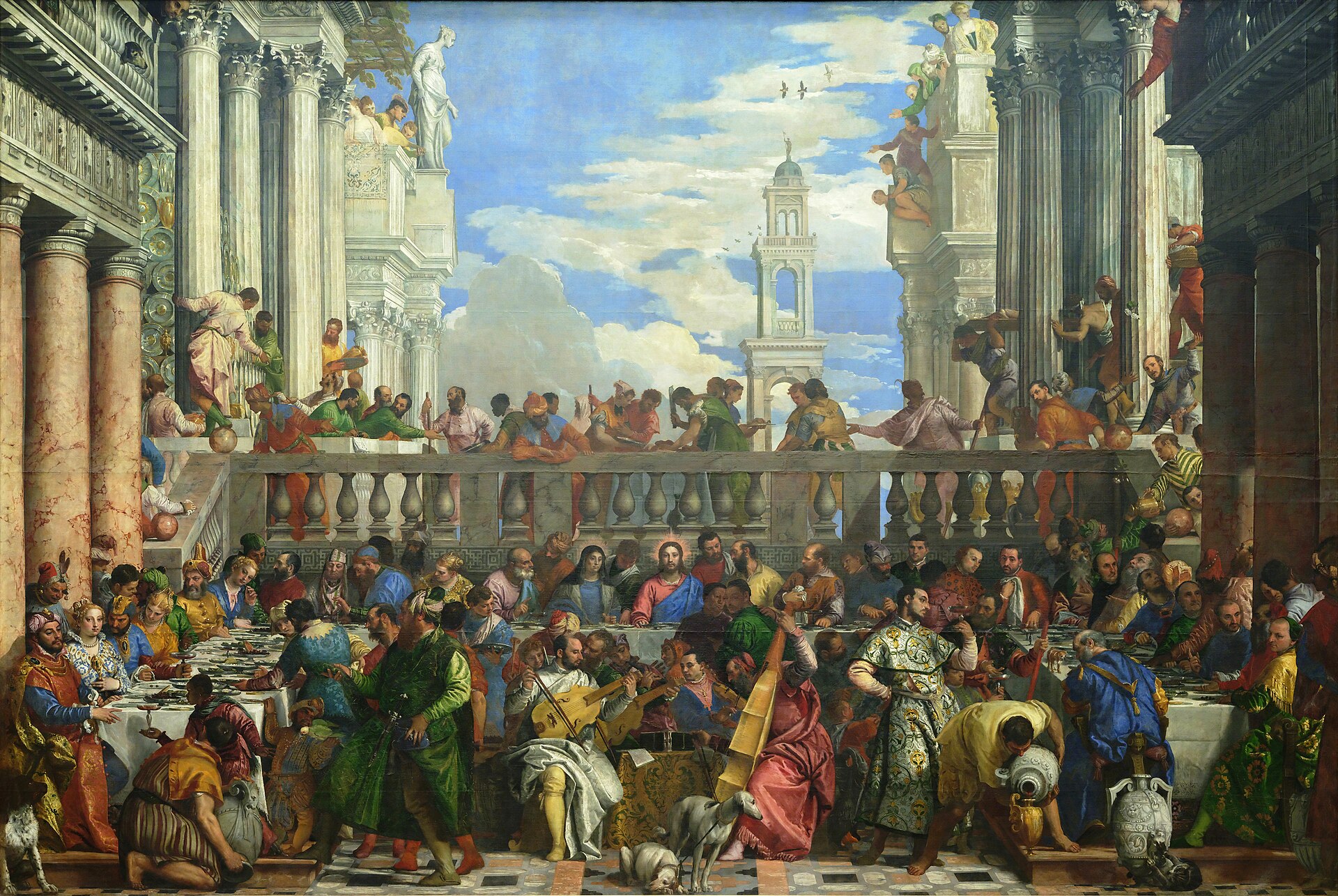
This IS the picture described in this record: Veronese, Les Noces de Cana, Louvre INV 142; MR 384, 6.77 x 9.94 m. Public domain photograph of 10068 x 6742 pixels credited on Commons to Shonagon, 5 April 2024.
| Artist | Paolo Caliari, called Veronese |
|---|---|
| Date | 1562-1563 (contract 6 June 1562; delivery due September 1563) |
| Medium | Oil on canvas |
| Dimensions | 6.77 x 9.94 m (about 67.29 square metres) |
| Where it is now | Musee du Louvre, Paris, Denon wing, level 1, room 711 (Salle des Etats)last confirmed |
| Inventory number | INV 142; MR 384 |
| Attribution | AcceptedDocumented commission to Paolo Caliari by contract of 6 June 1562; the Louvre catalogues it as by Veronese. Full note |
| Object type | Painting |
| Period | Italian, Venetian Renaissance, sixteenth century |
| Cases | Seized, looted or confiscated |
| Inscriptions | None recorded in the sources read. |
| Owners on record | 6 links6 documented |
| Sources | 45 cited |
About this record Last verified · 45 sources cited · Change log
On this page 9 sections
ContentsClose
The largest painting in the Louvre, 6.77 by 9.94 metres, was made on a contract of 6 June 1562 for the refectory Palladio was finishing at San Giorgio Maggiore in Venice. Veronese was to paint the banquet at Cana with as many figures as would fit, in the best colours, for a reported 324 ducats, a barrel of wine and his meals. It hung there for 234 years, above the abbot's table in a room where the monks ate in silence.
Napoleon's commissioners took it in 1797 under the treaty of Milan, ripped it from its stretcher along rows of hidden nails, rolled it to Toulon and Paris, and had it divided in Paris after the November 1798 exhibition, on Cynthia Saltzman's account as Uglow gives it. In 1815 the Louvre kept it, Denon pleading that it could not be moved, and sent Le Brun's smaller Le Repas chez Simon to Venice in exchange. It is known by several titles, and its guest list and musicians are tradition, not record.
A digital facsimile by Factum Arte has hung in the original refectory since 11 September 2007. The original was cleaned in 1989 to 1992, an exercise remembered for the green coat under a red repaint and for two accidents in 1992, and it hangs opposite the Mona Lisa in the Salle des Etats. It belongs to the French state, no sale of it appears in any source read, and the dispute over the 1815 exchange has not produced a return.
Provenance
Each link is graded. Documented: a cited source supports it. Disputed: the identification is argued but not established. Unknown: no owner for that span, and the gap is not smoothed into a narrative. The grades in the glossary.
- 1562-06-06 - 1563Benedictine monastery of San Giorgio Maggiore, Venice (abbot Girolamo Scrocchetto; Father Alessandro da Bergomo; cellarer Mauritio da Bergomo)documented
Commissioned by contract of 6 June 1562 for the end wall of Palladio's new refectory. Hanson, following Habert (1993), reports that three monks signed, that the subject was the banquet at Cana with as many figures as would fit, and that Veronese was to use the most costly pigments and deliver by the feast of the Madonna in September 1563; citing Cooper she gives the fee as 324 ducats, a barrel of wine and meals in the refectory. French Wikipedia reports a payment of 300 ducats on 6 October 1563, on a receipt it says is kept in the Archivio di Stato di Venezia. I did not see either document.4122033
- 1563 - 1797Refectory of San Giorgio Maggiore, Venicedocumented
Hung above the abbot's table in Palladio's refectory for about 234 years. Benedetto Guidi's poem of 1565 records artists coming to see it; on 17 December 1705 the monks restricted copying to royal requests according to Lowe, and Hanson says the refectory was closed to visitors in 1705. Boschini praised it in 1660. 4710
- 1797 - 1798French Republic (commissioners acting under the Treaty of Milan of 16 May 1797; list drawn by Claude-Louis Berthollet)documented
Chosen as number 7 on Berthollet's list under the treaty clause requiring twenty paintings and five hundred manuscripts. Ripped off its stretcher along rows of hidden nail holes, wound on a cylinder, crated and shipped by frigate to Toulon, then by barge (Uglow) or via Arles (Greenberger) to Paris; about ten months per the Christian Science Monitor. Pietro Edwards, Venice's inspector of public pictures, advised and protested. English Wikipedia gives 11 September 1797; no primary record of the day was seen.571834
- 1798 - 1815French State: Museum central des arts, then the Louvre (Musee Napoleon from 1803)documented
Entered the Louvre in July 1798 (31 July per French Wikipedia). Divided at the central seam and mounted on two stretchers in Paris, after the November 1798 exhibition, on a decision of the Administrative Council, per Uglow; moved and reassembled for the imperial wedding of 1810. Louvre records acquisition mode as military conquest (1798).151820
- 1815 - 1815French State, by exchange with the Emperor of Austriadocumented
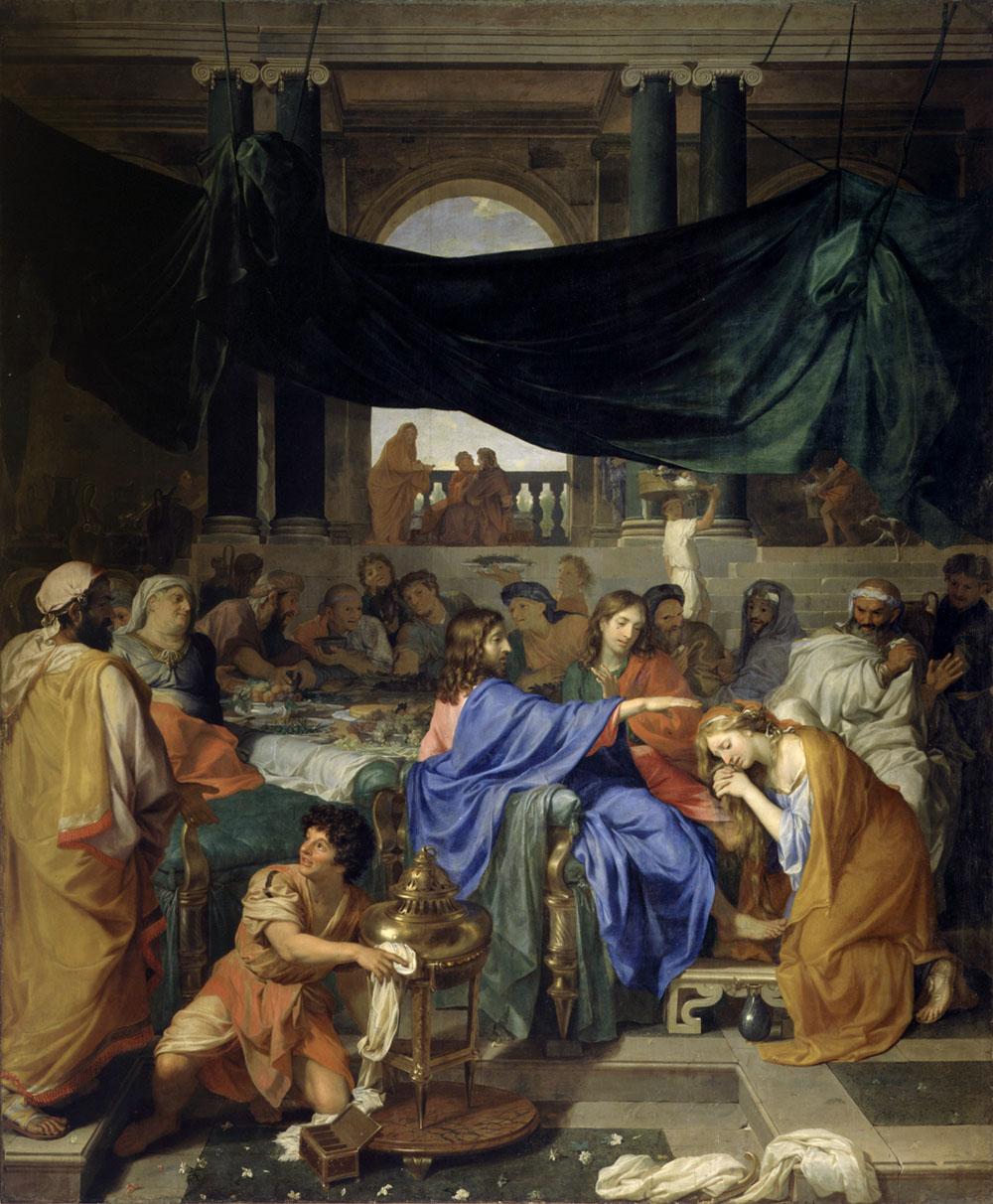
At the 1815 restitutions the Austrian commissioner (Rosa, per Chalton) was persuaded by Denon not to take it, citing the difficulty of moving it; Le Brun's Le Repas chez Simon (385 x 316 cm) went to Venice instead. The Napoleonic inventory note is quoted by Chalton as recording it as ceded to the King of France by the Emperor of Austria. Whether the exchange is legally sound is contested: in 1994 Francesco Sisinni argued it was inequitable and legally questionable because no Italian state then existed (Italian Wikipedia).25131419
- 1815 - presentFrench State, Musee du Louvre, Paris (Departement des Peintures)documented
INV 142; MR 384; Denon wing, level 1, room 711 (Salle des Etats) per the Louvre catalogue. Moved for safety in 1870 and 1939; cleaned 1989-1992; torn in June 1992; recorded in 2006 for the Venice facsimile. A facsimile has hung in the original refectory since 11 September 2007. A Nouvelle Renaissance project announced in January 2025 will move the Mona Lisa out of the room; no change to the Veronese's position was announced in the sources read.16911202829
Technical evidence
| Attribution note | Documented commission to Paolo Caliari by contract of 6 June 1562; the Louvre catalogues it as by Veronese. RMN says it was probably painted with the help of his brother Benedetto and workshop members; no source read separates the hands. |
|---|---|
| Support | Canvas. Cynthia Saltzman, as reviewed by Jenny Uglow, describes six long strips of linen stitched together so tightly that the 724-square-foot surface looked like one cloth, nailed to a wooden stretcher and primed with gesso.5 |
| Medium | Oil on canvas. The contract is reported to have required the most costly pigments, with lapis-lazuli ultramarine named in one summary.1418 |
| Dimensions | 6.77 m high x 9.94 m wide, about 67.29 square metres; 22.2 x 32.6 feet in the review of Saltzman. The Louvre and AGORHA both give 6.77 x 9.94 m.13518 |
| Weight | More than 1.5 tons in its frame according to the ARCA blog; English Wikipedia gives 1.5 tons for the painting as raised in June 1992.818 |
| Figures | About 130 in the Louvre's wording; 132 life-size figures in RMN's count. Hanson counts 25 seated guests (four women, twenty-one men) and notes that servants and officials outnumber guests by nearly two to one.2421 |
| Original hang | On the end wall of Palladio's refectory above the abbot's table, framed by a cornice, with no frame of its own according to Adam Lowe; RMN says more than 2 m above the floor. In the Louvre it is in a heavy gilt frame with its lower edge about 80 cm from the floor, again per Lowe.41021 |
| Structural history | Ripped along three rows of hidden nail holes when taken off its stretcher in Venice (Saltzman via Uglow); divided at the central seam in Paris after the November 1798 exhibition and mounted on two stretchers (Uglow, on Saltzman's account); other sources say it was cut into strips in Venice (Lowe), or into seven pieces (French and Italian Wikipedia), a count that does not match Saltzman's six strips of linen. Seams and joins were rejoined and are said to show in the surface.591920 |
| Pigments, steward's tabard | Lead yellow and a copper green are reported in the green layer that lay under a brownish red over-painting; orpiment and realgar (arsenic sulphides) are reported in the red over-painting. Reported by Adam Lowe, who does not say where the analysis was published; the 1992 Louvre catalogue is the likely place and I did not read it.1036 |
| Palette as described | Blues of powdered lapis lazuli, dusky reds, oranges, evening yellows, greens and whites are listed by Saltzman as summarised by Uglow. No published pigment survey of the whole canvas was found.5 |
| Imaging | X-rays of the picture were published by the Louvre in the early 1990s, according to Lafarga and co-authors. Factum Arte recorded the surface in 2006 at 1:1 (1,591 scans, about 400 GB) with 450 photographs and 3D scans of about ten square metres; I found no public release of the archive.922 |
| Condition events | 1797 removal (ripped, or cut into strips, according to different sources); division in Paris after November 1798 per Uglow; 1810 move for the imperial wedding; cleaned in the 1850s under Villot with later criticism; evacuated 1870 and 1939; cleaned 1989-1992; torn in five places in June 1992 in architectural areas.58101820 |
| Inscriptions | None recorded in the sources read.1 |
| Contract fee in period terms | 324 ducats, taken as the accounting ducat of 124 soldi, is 40,176 soldi. Against Pullan's average master mason or carpenter wage of 34 soldi a day in 1566-74 that is about 1,182 days (a little under five years at 250 working days a year); against a journeyman's 22 soldi it is about 1,826 days. It is about eight times the largest single charity grant of the Scuola di San Marco in the 1550s (40 ducats) and more than six times Tintoretto's c. 1578 price of 50 ducats a canvas for the Doge's Palace, excluding materials. Meals and a barrel of wine were extra. No modern currency equivalent is given because no source supplies a method.41516173335 |
| Related drawings | Squared brown-ink and wash sketch, RF 39031 (Sagredo collection, bought 1983, attribution disputed); pen and wash copy INV 4693, 53.3 x 68.5 cm, from the Jabach collection into the Cabinet du Roi in 1671; workshop drawing INV 4722, 43.4 x 56.3 cm, in the Musee Napoleon inventory.252639 |
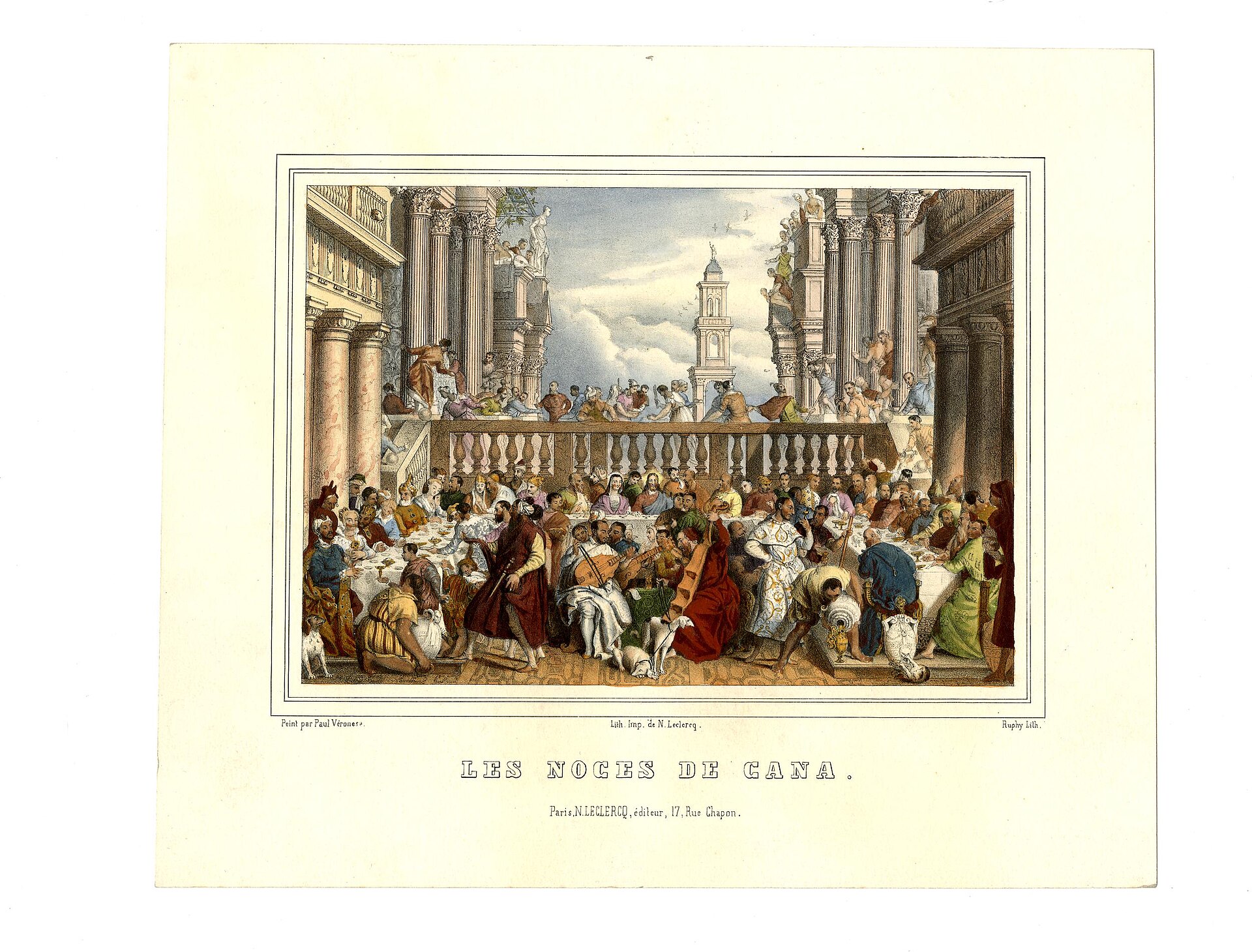
| Copies and prints | Recorded in French public collections include a copy for Duke Leopold by Claude Charles (Nancy, 2.5 x 3.32 m, ordered 1702), a seventeenth-century copy at Nantes (160 x 216.5 cm) and an engraving by N. Cochin at the Bibliotheque nationale; AGORHA lists further copies.33738404344 |
| Guest identifications | Traditional only. Vittoria Colonna died on 25 February 1547 and Pietro Aretino on 21 October 1556, both before the contract of 1562, so lists naming them among the guests cannot be portraits from life. Hanson sets the eighteenth-century identifications aside as unverified.445 |
| Display history | Hung in the Salon Carre in the nineteenth century (a Louvre painting of 1895, RF 1976 6, names the Cana in its title); now in the Salle des Etats, room 711, opposite the Mona Lisa, which is due to move to its own room under the Nouvelle Renaissance project announced in January 2025.12272829 |
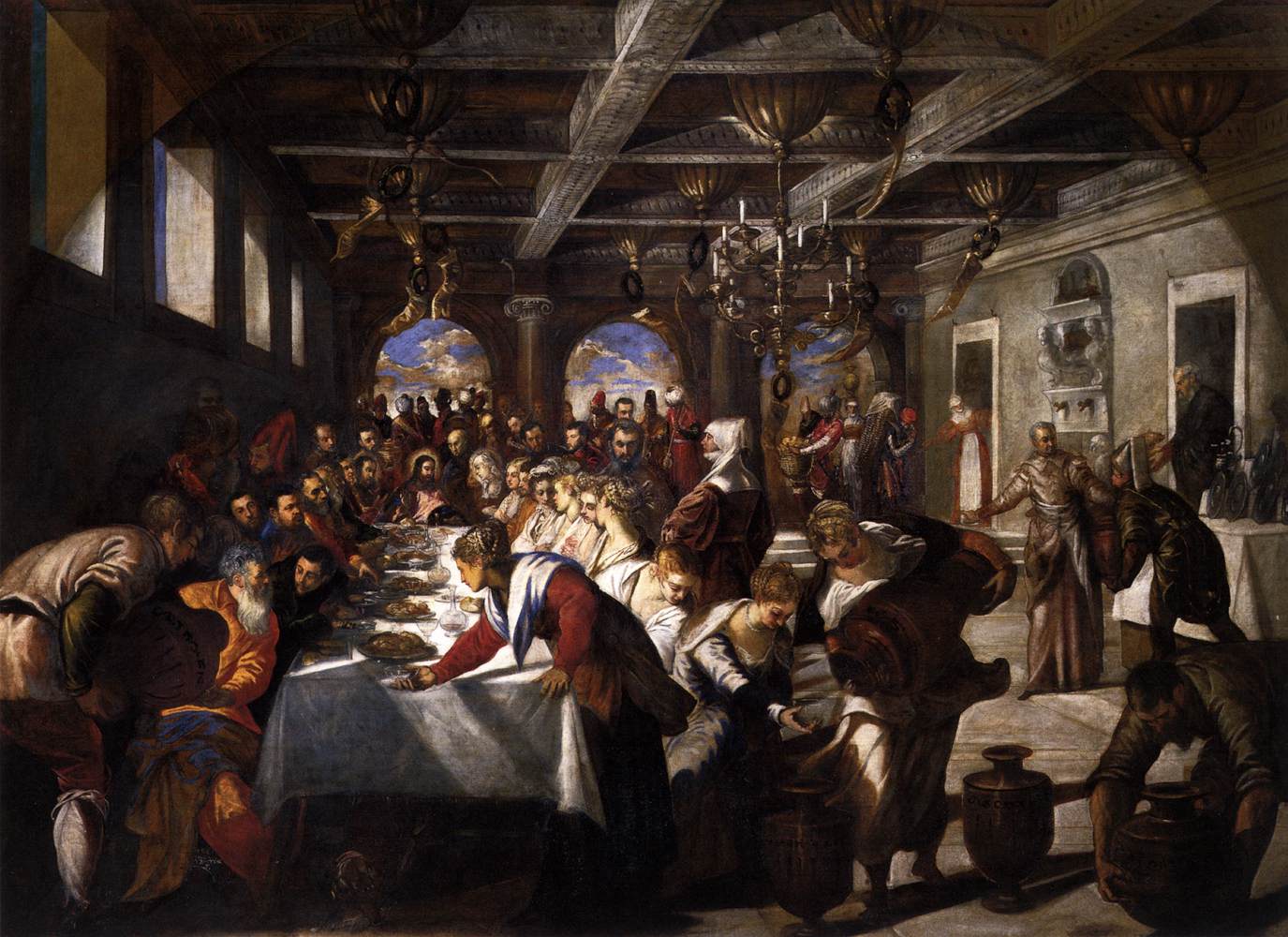
| Other Cana pictures not to be confused | Tintoretto, 1561, 435 x 535 cm, Santa Maria della Salute; Veronese, 1571-72, 207 x 457 cm, Dresden; Veronese's Feast in the House of Levi, 1573, 555 x 1280 cm, Accademia, Venice; an anonymous sixteenth-century Les Noces de Cana, 148 x 112 cm, inventory 71 142, at Beauvais.30313242 |
| Open photograph | Public domain photograph on Wikimedia Commons, 10068 x 6742 px, credited to Shonagon, 5 April 2024.41 |
| Inventory numbers | Musee du Louvre INV 142; MR 384.13 |
Images
The record in full
Chapter 1A wall-sized canvas of about 130 figures, made to be read from below
The picture is oil on canvas, 6.77 metres high and 9.94 metres wide, painted in 1562 and 1563 for the refectory of the Benedictine convent of San Giorgio Maggiore in Venice.
The picture is oil on canvas, 6.77 metres high and 9.94 metres wide, painted in 1562 and 1563 for the refectory of the Benedictine convent of San Giorgio Maggiore in Venice. The Louvre calls it the biggest painting in the museum and counts about 130 characters in it; the publisher RMN-Grand Palais counts 132 figures at life size. Jenny Uglow, reviewing Cynthia Saltzman's book on the picture, gives the canvas as 22.2 by 32.6 feet and reports Saltzman's account that Veronese's assistants cut six long strips of linen and stitched them so tightly that the 724-square-foot surface looked like a single cloth, before it was nailed to its stretcher and primed with gesso.
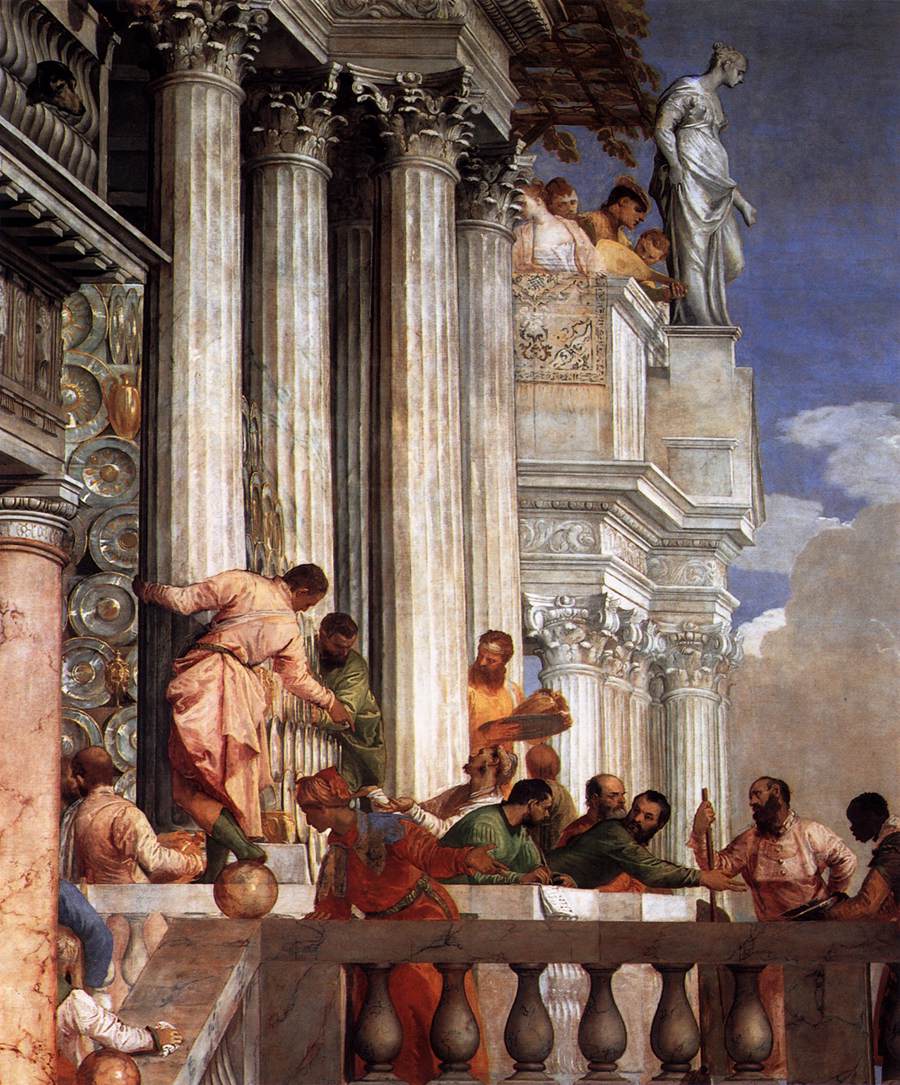
Kate Hanson's reading of the composition gives the plain arithmetic. A U-shaped table on a raised pedestal fills the lower part of the picture, with four women and twenty-one men seated at it; the bride and groom sit at the far left end and Christ, Mary and some disciples in the middle, in quieter dress than anyone else. Servants and stewards outnumber the guests by nearly two to one in Hanson's count. Above a balustrade the picture opens into carvers and servants at work, colonnades and a wide blue sky. RMN's analysts add that the pavement's vanishing lines converge above the balustrade while those of the architecture run toward Christ, so the lower half reads as a stage and the upper half as a quiet, vertical counterweight with birds crossing the sky.
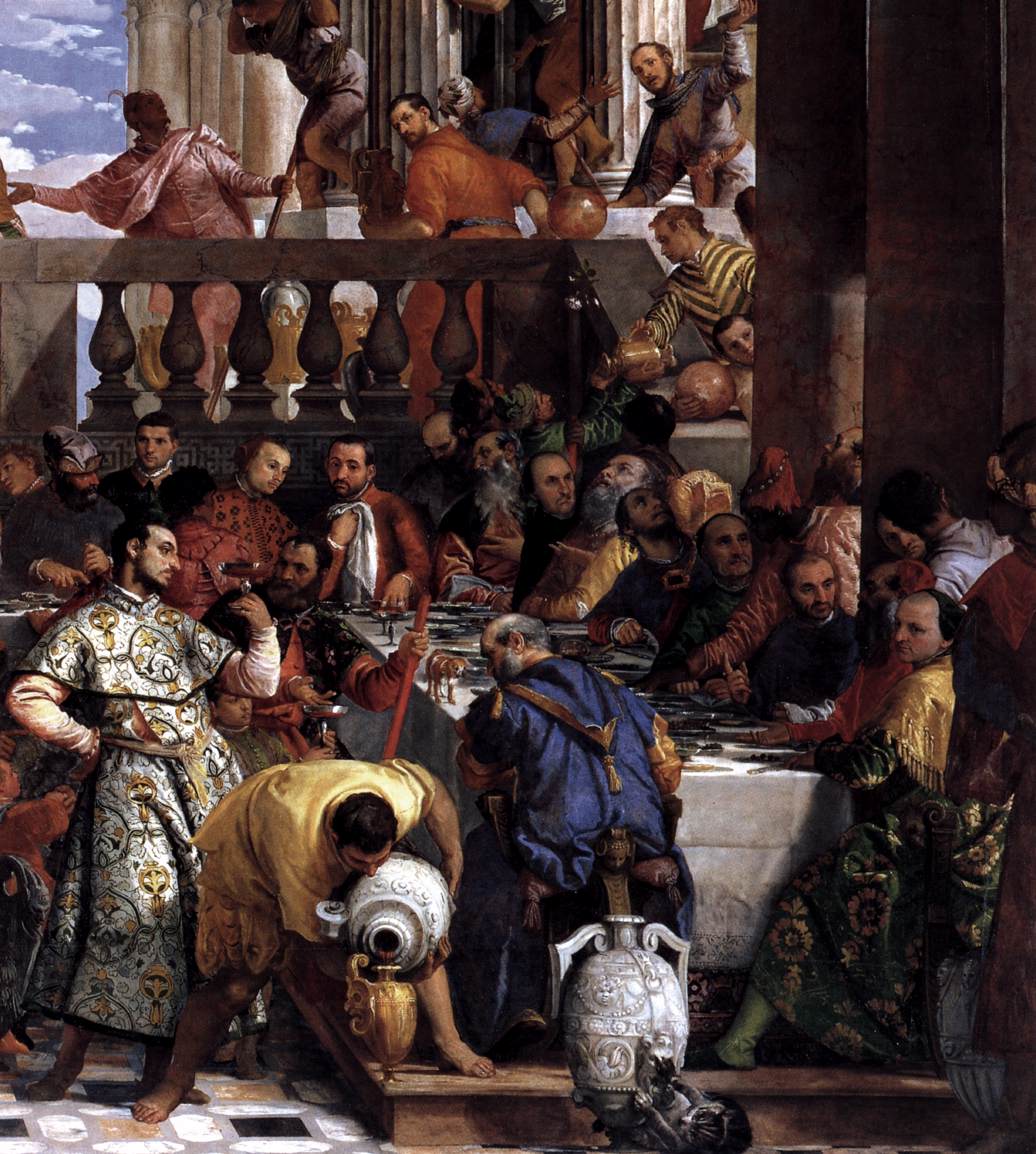
Only Christ, Mary and the apostles wear plain, timeless drapery. Everyone else is dressed in silks and brocades, and the turbans and a parrot are read by RMN as a pointer to Venice's trade with the East. The miracle itself is not at the centre. It happens at the far right, where servants fill and pour from stone jars and the wine steward looks at his glass; Hanson stresses that, as in the Gospel of John, only the servants know where the wine came from.
RMN says Veronese painted it in fifteen months, probably helped by his brother Benedetto and members of his workshop. The Louvre's bibliography does not give an hour-by-hour account of who painted what, and no source I could read separates the hands.
Chapter 2The contract of 6 June 1562 asked for a subject, a crowd and the best colours
The contract survives, and Hanson calls it rare insight into the particulars of the commission.
The contract survives, and Hanson calls it rare insight into the particulars of the commission. Working from Jean Habert's 1993 article, she says three monks signed it: Girolamo Scrocchetto, abbot from 1551 to 1564, Father Alessandro da Bergomo and the cellarer Mauritio da Bergomo. It named the subject as the banquet of Christ's miracle at Cana in Galilee, to be painted with as many figures as could be fitted in comfortably. Veronese was to fill the allotted space, to use the most costly and precious pigments, and to deliver for the feast of the Madonna in September 1563. For this, Hanson citing Cooper reports, he was to receive 324 ducats, a barrel of wine and his meals in the refectory where he worked.
Other accounts add or alter terms. English Wikipedia, whose own text is flagged as needing a better source, says the monks also promised to pay his personal and domestic maintenance and names the colour as lapis-lazuli ultramarine, under the Latin phrase optimi colori. A popular early twentieth-century biography says the painter was to be furnished with canvas and colours. French Wikipedia reports that on 6 October 1563 Veronese was paid 300 ducats, on a receipt it says is kept in the Archivio di Stato di Venezia; it does not say whether that was the whole fee, and it also gives 8 September 1563 as the date by which the picture was to be finished. I could not open the contract, the receipt or the English translation, which Hanson places in Chambers, Pullan and Fletcher, Venice: A Documentary History, 1450-1630 (1992), so the price, the colour clause and the receipt are recorded here as reported and not reconciled.
Why Veronese? Tracy Cooper, as summarised by Hanson, thinks the monks chose a painter who had already worked with their architect Palladio at the Villa Barbaro at Maser and who had painted a refectory feast, the Feast in the House of Simon, for the Benedictines of Santi Nazaro e Celso in Verona in 1556. Veronese was thirty-four, RMN says. Cooper's reading is an argument from the record rather than a statement in it, and the contract as reported does not say why he was chosen.
Chapter 3What 324 ducats meant in 1562
Wikipedia's article on the Venetian lira gives the accounting ducat as 6.2 lire, or 124 soldi, with 20 soldi to the lira, and warns that in the sixteenth century the accounting ducat drifted below...
Wikipedia's article on the Venetian lira gives the accounting ducat as 6.2 lire, or 124 soldi, with 20 soldi to the lira, and warns that in the sixteenth century the accounting ducat drifted below the gold coin called the zecchino. The contract as reported does not say which it means, so every figure below uses the accounting ducat and is a floor. On that basis 324 ducats is 40,176 soldi.
Brian Pullan's study of Venetian poor relief, built on the payroll of the Scuola Grande di San Rocco, gives the day wage of a master mason or carpenter as 34 soldi on average over 1566 to 1574, rising to 49 by 1591 to 1600, and that of a journeyman as 22 soldi in the same early period; for 1571 to 1574 he gives 24 soldi for a builder's journeyman. At 34 soldi, 324 ducats is about 1,182 days of a master mason's pay. Assuming a working year of 250 days, the convention of the welfare-ratio method used in recent Venetian wage studies, that is a little under five years. At 22 soldi it is about 1,826 days, or just over seven years. The wage figures begin four years after the contract, so these are indications, not measurements.
Pullan also records a charity burial costing a Venetian Scuola 26 lire, just over 4 ducats, and a grant of 40 ducats in the 1550s, to a man named Sebastiano Bonaldi to furnish his daughter's dowry, which he describes as the largest single charity grant made by the Scuola di San Marco in that decade. The fee for the Cana therefore equals roughly eight of those dowry grants. Closer to the trade, an old encyclopedia text reproduced on Wikipedia has Tintoretto painting four canvases for the Doge's Palace at 50 ducats each, excluding materials, around 1578; the Cana fee is more than six of those.
Two things keep the 324 from being a profit figure. The fee had to carry the workshop, and the sources do not agree on who paid for canvas and colours, which at this scale and with lapis-lazuli blue would have been a large cost. Meals and a barrel of wine were extra, and no source puts a price on them. A popular early twentieth-century biography converted the fee to 972 francs and then to 7,000 francs of its own day without naming a method; that figure is recorded here as an example of an unsupported equivalent, not as evidence.
Chapter 4Palladio's refectory: the room the picture was made for
The Palladio Museum's catalogue entry dates Palladio's work on the refectory from July 1560 to 1563.
The Palladio Museum's catalogue entry dates Palladio's work on the refectory from July 1560 to 1563. He reshaped and completed a building laid out some twenty years earlier. A broad stair led to a first portal modelled on a Roman original, then to a vestibule with a white and red floor and two red marble washing basins, then to a second portal and the hall. The hall has a barrel vault that turns into a groin vault at the centre to admit two large thermal windows. The same entry says the Cana was commissioned in 1562, was undoubtedly conceived in relation to the Palladian space and the great thermal window above it, and was finished in a little over a year. It adds that the monks insisted on keeping the older sixteenth-century windows, which Palladio only framed.
Hanson places the canvas on the end wall above the abbot's table, framed at the top by Palladio's cornice, which she notes was unusual because Veronese normally painted his own architecture. RMN says it hung more than two metres above the floor. Lowe, who made the later facsimile and so argues from a stake, adds that in the refectory the picture was lit from large east and west windows, that at about five in the evening on a summer day the light in the room agrees with the light and shadow in the painted scene, and that it had no frame at all, so Palladio's architecture ran into Veronese's painted architecture. In Paris, he writes, it is in a heavy gilt frame, about 80 centimetres off the floor and under even overhead light.
The room was a place of silence. Under the Rule of Saint Benedict, as Hanson summarises it, monks ate without speaking while a reading was given, and asked for what they needed by signs. Hanson, citing Habert, reports that Veronese also painted two angels above the refectory door, now lost, said to hold a card reading SILENTIUM. Her own observation is that the loudest painting imaginable, with its music and conversation, hung in the quietest room.
The refectory was not a closed room. Benedetto Guidi, a monk of the house, wrote a poem in 1565 recording that sculptors and painters came to admire the picture three, four and six times over. Lowe says the monks decided on 17 December 1705 to limit copying to royal requests; Hanson, following Priever, says the refectory was closed to visitors in 1705. In 1660 Marco Boschini, quoted by Greenberger, called it magic rather than painting. The refectory was also remade: Lowe describes 1950 photographs showing a floor inserted at window level, a theatre above and a wood workshop below, and a restoration in the 1950s whose details he calls speculative.
Chapter 5A miracle laid out as a Venetian banquet: the programme as the sources document it
Most of what is said about the meaning of this picture is argument by named scholars, and it is graded here that way.
Most of what is said about the meaning of this picture is argument by named scholars, and it is graded here that way. What is documented is the order: a Benedictine house asked for the banquet at Cana, with as many figures as would fit, for its dining room. Hanson, following Creighton Gilbert, places that request inside a long tradition of refectory suppers meant to give monks a pattern to imitate; feasts had been painted in Tuscan refectories since the fifteenth century, Leonardo brought the type to Milan in 1495, and Venice saw it only in the middle of the sixteenth century, with Veronese's Simon (1556-60) and Tintoretto's Cana of 1561. That the Cana prefigures the Eucharist, with wine standing for blood, is called traditional by Hanson, and RMN says the same.
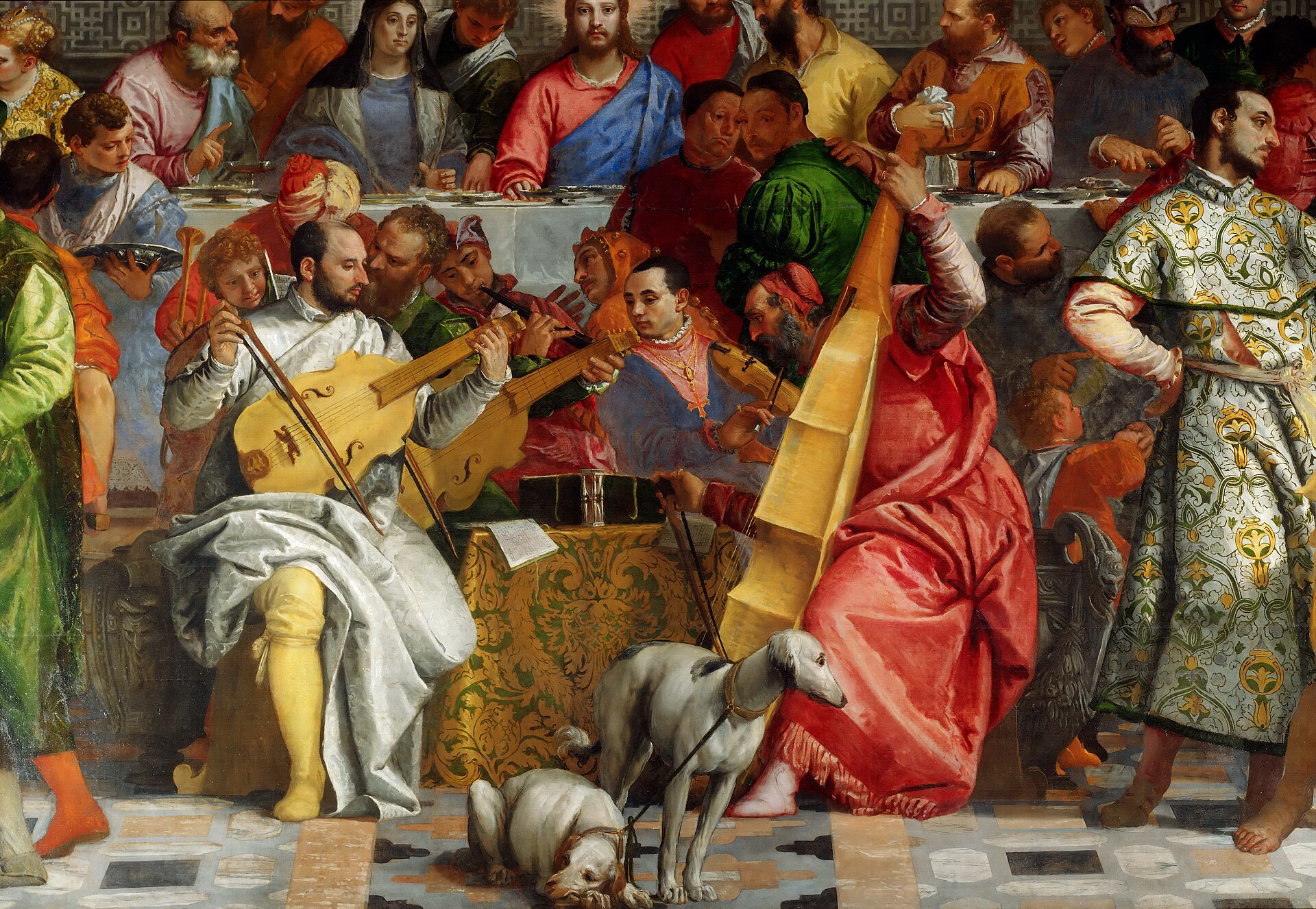
Argued, not documented, are the details. The carver working on a lamb above Christ's head is read by Hanson as an allusion to the Crucifixion, and she attributes to David Rosand the observation of a central axis running from the carver through Christ to an hourglass on the musicians' table; the hourglass, in Rosand's reading as Hanson reports it, recalls Christ's words to his mother in John that his hour is not yet come. Albert Pomme de Mirimonde gave a whole article to the hourglass, music and dance in this picture in the Gazette des beaux-arts in 1976, which I have seen only as a bibliographic entry. RMN reads the wine flask set between the balustrade posts as a pointer to blood to be shed, and the leashed hounds in the foreground as fidelity, with a joke about marriage. Hanson adds that the kitchen is still carving meat while the guests have reached dessert, which is usually explained as the lamb being a sign and not a dish.
Hanson's own contribution is the language of the table. The guests are at the last course: quince, grapes, dates and sweetmeats, and she records that none of them lifts food to the mouth. She sets this beside the Venetian Senate's sumptuary law of 1562, which, as she quotes it from Chambers and Pullan, banned trout, sturgeon, pasties, confections and all things made of sugar from banquets, and permitted only modest confections and simple fruit at collations; she reads the restrained dessert as a nod to the law, and adds at once that the laws were rarely obeyed. She reads the red wine against Renaissance advice to move from light wines to dark, and against Galenic ideas of digestion, so that the miracle also corrects a meal. She reads Christ's stillness and frontal gaze as that of an icon and as a pattern for the silent monks. These are readings, put forward by one scholar in 2010, and the contract as reported says nothing of them.
Philipp Fehl, as Hanson reports, proposed a different literary source, Pietro Aretino's Humanity of Christ of 1535, for the worldly splendour of the wedding, and thought Veronese put a portrait of Aretino in the picture. Hanson also notes that interpretations of the Cana have been coloured by the Inquisition trial over the Feast in the House of Levi ten years later, and she argues that the Cana should be read in its own moment, when the Council of Trent had just closed.
There is no evidence in the sources I read for a hidden programme, a cipher or a private belief behind the picture. The documented meaning is the ordinary one for a monastic refectory: a miracle that looks forward to the Mass, set in the rich world the monks themselves lived in. A recent proposal that a figure in the central group was first painted as Giorgione is a claim about identity and is taken up in the next section.
Chapter 6The musicians and the guests: tradition, proposal and evidence
The picture is famous for a group of four musicians in the middle foreground.
The picture is famous for a group of four musicians in the middle foreground. The tradition, as Hanson sets it out following Andreas Priever, names the man in white playing a viola as Veronese himself, with Tintoretto beside him on a second viola, Jacopo Bassano on a flute or cornetto and Titian in red on the large bass viol; Wikipedia adds that the poet Pietro Aretino stands beside Titian. English Wikipedia quotes Boschini's Ricche minere of 1674 as the source of the idea, in a passage that gives the instruments differently: the old man on the bass is Titian, the flute is Giacomo Bassano, the violin Tintoretto and the fourth, in white, playing the viola, Paolo himself. The earliest source I could see is Boschini, whom English Wikipedia quotes from the 1674 edition of his Ricche minere and French Wikipedia cites in an edition of 1664, about a century after the picture was finished; his instruments do not match the modern list. Grade: traditional, with an early printed source and no contemporary document.
Manuel Lafarga and co-authors propose in a book of 2017 (second edition 2018, published by Lafarga and Sanz) and on their website theweddingatcana.org that the man bending to speak in Veronese's ear is the Spanish musical theorist Diego Ortiz, a viola da gamba master who was chapel master at Naples, and that X-rays of the canvas published by the Louvre in the early 1990s show a different face beneath his, that of Giorgione, in memory of whom, they say, Titian wears a second gold ring. Italian and English Wikipedia report the Ortiz idea as a recent study. I found it argued only by its authors, on their own open-access site, and I did not find it discussed in the Louvre sources I read. Grade: argued by two authors, not tested in print that I could read.
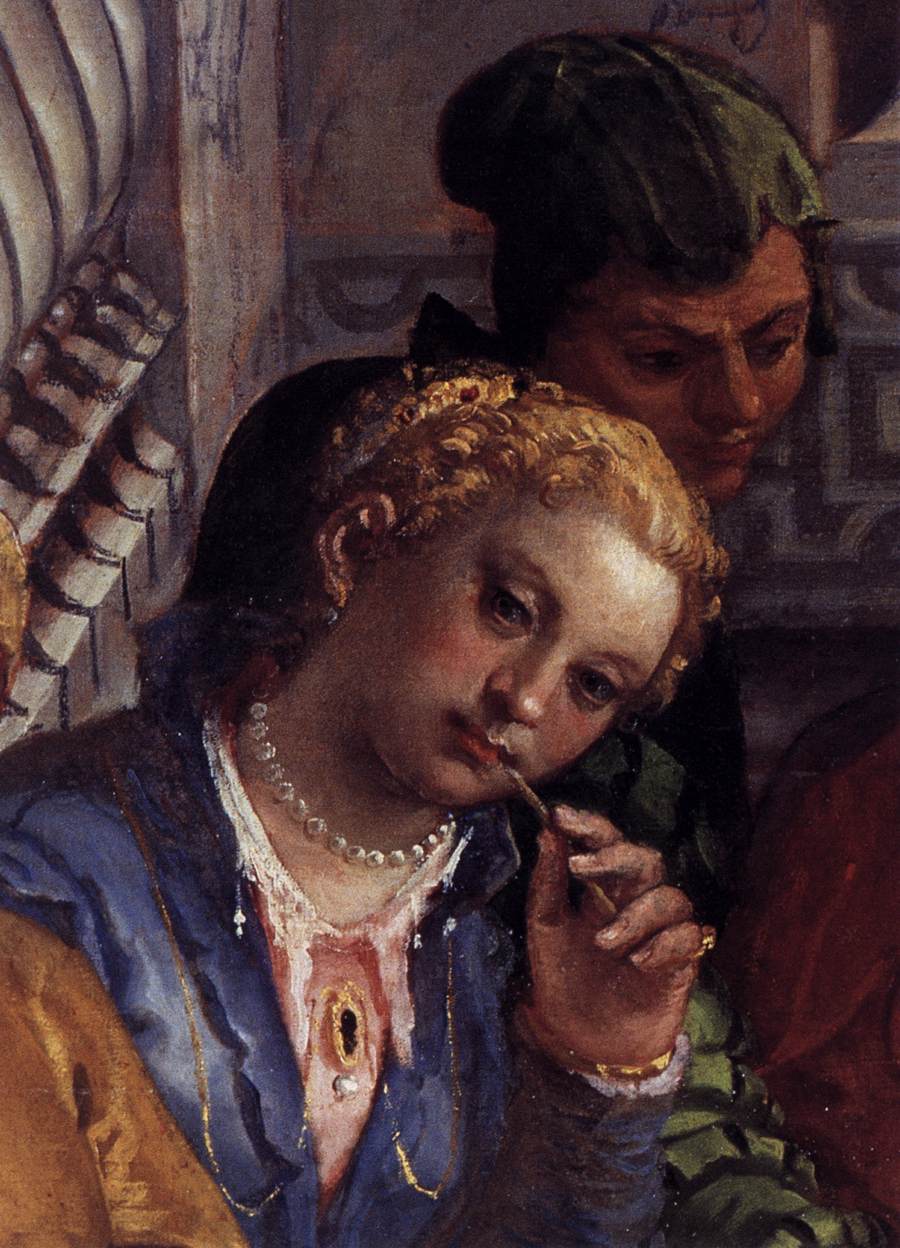
The guest list is the weakest part of the tradition. English Wikipedia names Eleanor of Austria, Francis I, Mary I of England, Suleiman the Magnificent, Charles V, Vittoria Colonna, Marcantonio and Daniele Barbaro, Giulia Gonzaga, Cardinal Pole, the jester Triboulet and Sokollu Mehmed Pasha. An early twentieth-century popular biography gives a different set, with the bridegroom as the Marquis del Vasto, the bride as Eleanor of Austria, and a sultan it calls Achmed II beside a Vittoria Colonna holding a toothpick. Hanson sets aside the eighteenth-century identifications of the guests as unverified and declines to build on them. I have followed her. English Wikipedia's own pages give Vittoria Colonna's death as 25 February 1547 and Pietro Aretino's as 21 October 1556, both before the contract was signed, which is one plain reason the traditional identifications cannot all be portraits from life. A resemblance is not a source, and none of the lists comes with a document from 1562 or 1563.
The early biography also says that the standing man in brocade with a cup is Veronese's brother Benedetto. That claim, like the others, is not supported in any document I could read, and the Louvre's catalogue entry, as I could read it, makes none of these identifications.
Chapter 7How the canvas left Venice in 1797
The legal instrument was a treaty clause.
The legal instrument was a treaty clause. After the Great Council voted the Republic out of existence in May 1797, Uglow reports, Napoleon dictated terms from Milan on 16 May under which Venice was to pay a fine, supply ships and surrender twenty paintings and five hundred manuscripts. Greenberger adds that the French general in chief was to choose them and that the chemist Claude-Louis Berthollet, who had no art-historical training, drew up the list in eight days, with the Cana at number 7 between two other Veroneses.
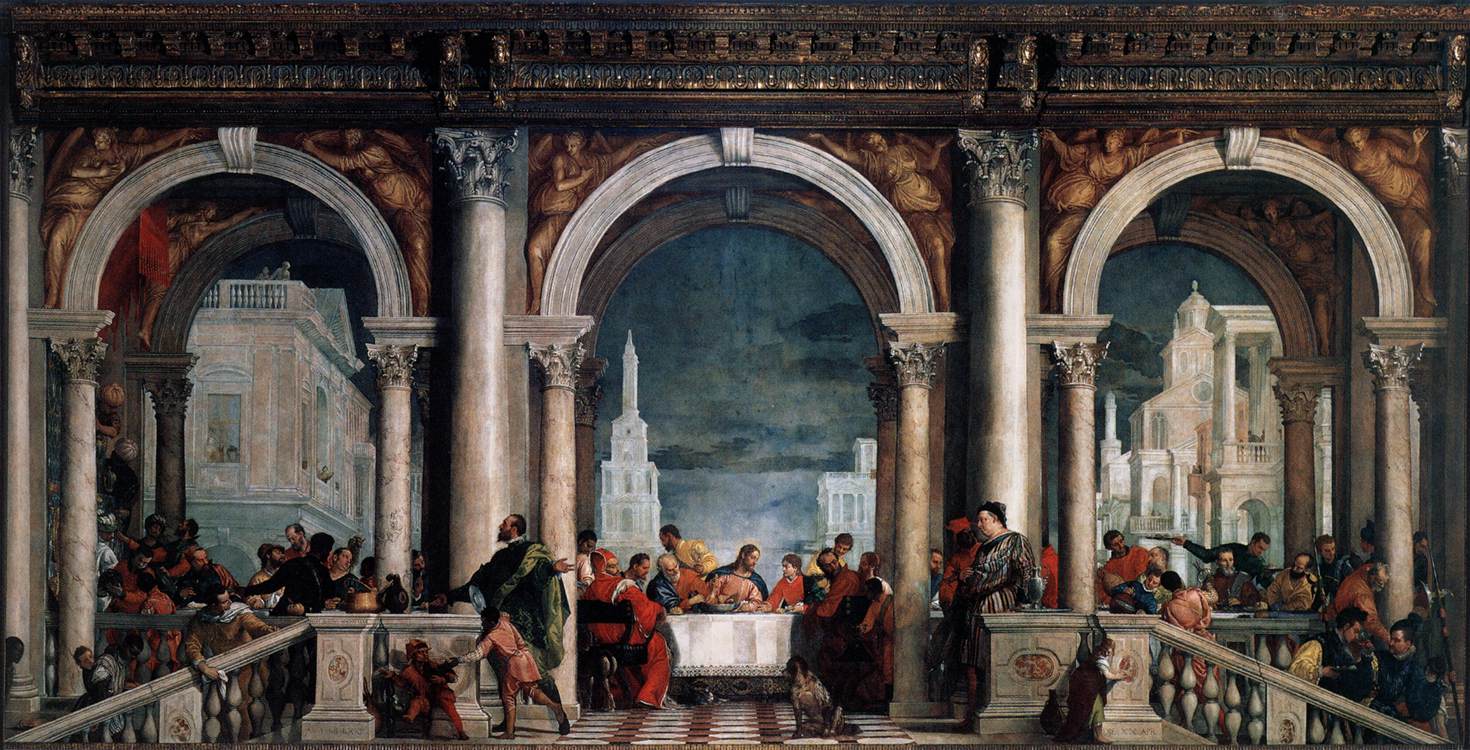
The Venetian restorer Pietro Edwards, inspector general of the city's public pictures, was ordered to advise the French. Uglow, following Saltzman, says he read the list with horror: it named three Tintorettos, three Titians and six major Veroneses, including the Cana and the smaller Feast in the House of Simon at San Sebastiano, all fixed in their architectural settings. His warning that they were in a dangerous state backfired, in that the French swapped one Tintoretto for another enormous Veronese, the Feast in the House of Levi. The Feast in the House of Levi is today in the Gallerie dell'Accademia in Venice.
Removal at San Giorgio went badly. Uglow reports that as workmen separated the canvas from its stretcher it ripped along a horizontal row of nails hidden under the paint, probably put there by earlier Venetian restorers when the canvas began to sag, and that as it fell a second row, and then a third, came to light, with lines of large nail holes running through the sky, along the balustrade and through the crowd. Dismantling the Venetian pictures took three weeks. The canvases were wound on cylinders, crated and put on an armed frigate for Toulon. Uglow has them go by barge up the Rhone and Saone and through canals; Greenberger has the Veronese reach Arles, where it was put on a ship with pictures taken from Rome. The Christian Science Monitor's review of Saltzman says the transport took ten months. The painting reached Paris in July 1798, and the Louvre's catalogue records it as taken in 1797 and brought to the Louvre in 1798, by military conquest.
The day of the removal is stated as 11 September 1797 on English Wikipedia and is the anniversary on which the facsimile was unveiled in Venice 210 years later; Greenberger says only that by September 1797 the picture was off the wall. I could not see a primary record of the day. If the removal was in September it preceded the Treaty of Campo Formio of 17 October 1797, which Chalton and French Wikipedia give as the context; the legal basis in Uglow and in the ARCA blog is the treaty of Milan of May 1797.
The accounts of what was done to the canvas do not agree, and this record keeps all of them. Uglow, from Saltzman, has it ripped and rolled in Venice, then divided in Paris after the November 1798 exhibition. Wikipedia, in English, has French soldiers cutting and rolling it for transport; in French and Italian it says it was cut into seven pieces and rejoined in France; the ARCA blog says it was cut to be moved and reassembled; the New York Times, quoted on the Factum Arte site in 2007, speaks of raised seams where the panels that Napoleon's troops cut it into were rejoined. Lowe, writing for the makers of the facsimile, says the copy reproduces the horizontal cuts that Napoleon's orderlies made to tear the painting from the wall strip by strip before rolling it. Chalton's notice says only that it was moved in 1797 after being cut up. The counts do not agree either: Saltzman, via Uglow, has the canvas made of six strips of linen, while French Wikipedia says seven. The Louvre's online entry does not describe how it was divided.
Chapter 8Paris: restored, divided on one account and moved for a wedding
The painting reached the Louvre in July 1798, which French Wikipedia dates to 31 July when the work entered the Museum central des arts.
The painting reached the Louvre in July 1798, which French Wikipedia dates to 31 July when the work entered the Museum central des arts. According to Uglow, the Salon Carre was already hung with pictures from Parma, Piacenza, Milan, Modena, Cento and Bologna, and a November 1798 exhibition added 82 more taken from Venice, Rome and other cities, but not the Cana, which was still being restored. At that point the Louvre's Administrative Council took what Uglow calls the drastic decision to unstitch the central seam, divide the canvas and mount the halves on separate stretchers; paint shards fell as it was cut, and painting over the join gave the restorers continuing work. No source I could read names the restorer.
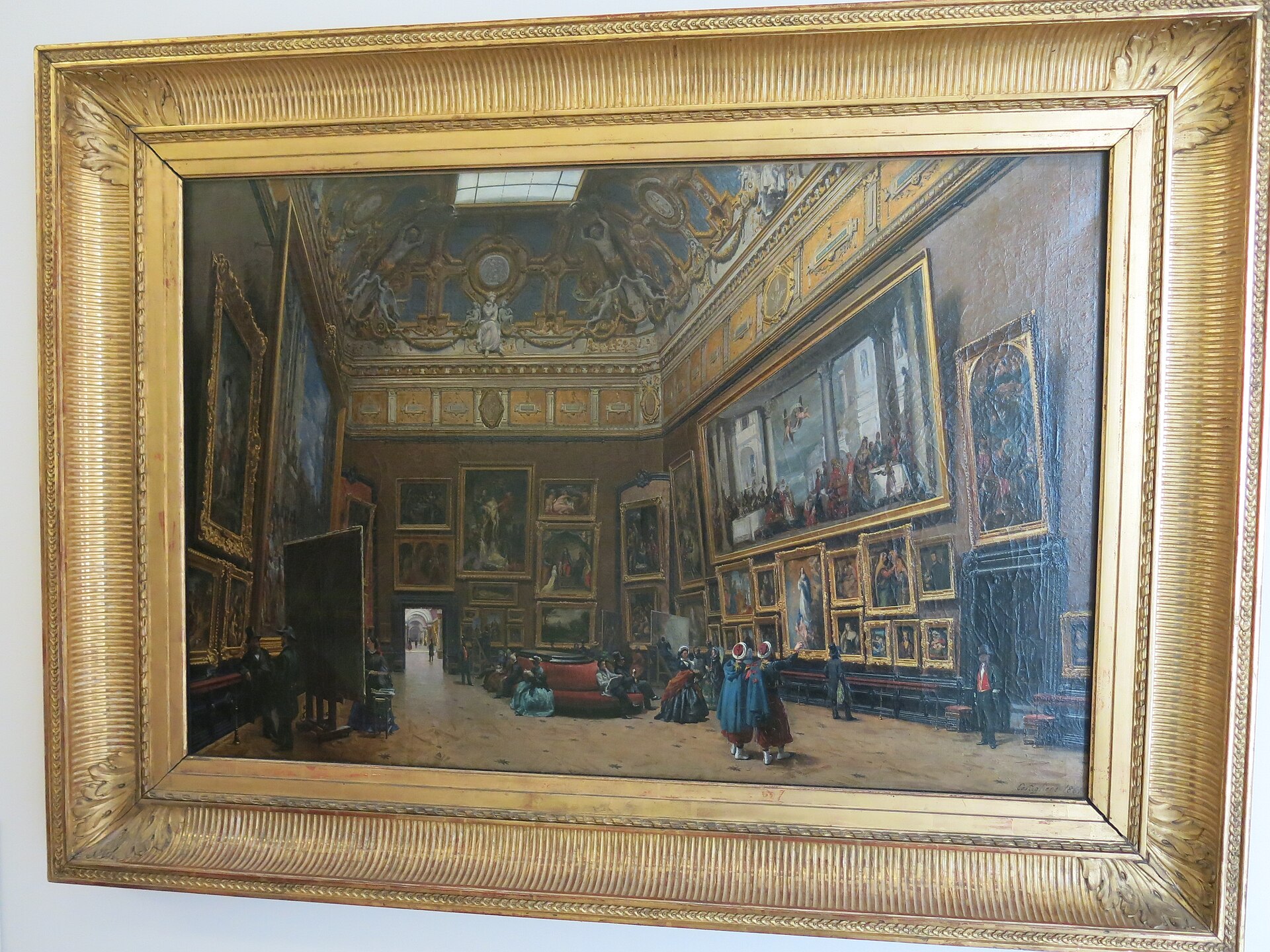
In 1810, when Napoleon married Marie-Louise of Austria, the Salon Carre where the Cana hung was stripped, on his furious orders and against advice, so that tiers of seating could be built, and the canvas was moved and perilously reassembled again, according to Uglow. The ARCA blog quotes an unnamed commentator who has Napoleon say that since it cannot be moved it should be burned, and says Denon ignored him; the post gives no source and I do not rely on it. A painting of the Salon Carre dated 1895 and now in the Louvre, by Marco Terinzio Muller de Shongor, carries the Cana in its title, which confirms that the picture was a fixture of that room.
Napoleon, in Uglow's account, had little personal interest in art but understood it as propaganda. The Louvre of the Italian trophies, with the Grande Galerie running to the Tuileries, was a showpiece of the regime, and the Cana was one of its largest. English Wikipedia says the store of looted art had become the Musee Napoleon by 1803. The money and the people involved in the early restorations are not recorded in the sources I could read, and Lowe writes that records of the interventions made in the eighteenth and nineteenth centuries are almost non-existent.
Chapter 91815: why it stayed
When the allies came to take back what France had seized, Venice was under Austrian rule and Austria pressed for the return of the bronze horses of San Marco.
When the allies came to take back what France had seized, Venice was under Austrian rule and Austria pressed for the return of the bronze horses of San Marco. Uglow says the Louvre's director Dominique-Vivant Denon brushed aside all requests for the return of art after Napoleon's first fall, and that after Waterloo the second Treaty of Paris still said nothing about looted art. The sculptor Antonio Canova campaigned for the Italian works. In the end many pieces came back, among them the horses, but not the Cana: Denon said it was so frail that if the Austrians moved it they might as well destroy it.
Chalton's notice names the Austrian commissioner as Rosa and says Denon proposed to exchange the Veronese for Charles Le Brun's picture of the Magdalen at the Pharisee's table, valued at less, on the ground that the Veronese could not be transported without damage. Chalton adds the objection that it had been moved in 1797 and was moved whole in 1870 and 1939, and quotes the note in the Napoleonic inventory of 1815 that the Cana was ceded to the King of France by the Emperor of Austria in exchange for the Le Brun destined for San Giorgio Maggiore. The Louvre's own site confirms that it stayed in France in exchange for Le Brun's Feast in the House of Simon, and its catalogue of a Le Brun drawing records that the painting was exchanged in 1815 against the Veronese and is today in the Gallerie dell'Accademia in Venice; no source I read says when it reached Venice. Chalton gives the Le Brun as 385 by 316 centimetres, too small to fill the wall it was sent to replace. Greenberger reports that Canova claimed in a letter of that year that he was never given a say in the Veronese's fate, and that Denon resigned a few days after the deal.
Whether the fragility argument was honest is a question on which the sources divide, and this record does not decide it. English Wikipedia calls Denon's claim false. Chalton points out that the painting had been moved before and was moved again, which he treats as undercutting it. The Christian Science Monitor's reviewer notes the irony that the French, who by Saltzman's account had nearly destroyed the canvas when they ripped it from the wall and damaged it further in transit and repair, then cited its condition to keep it. Uglow says only that Denon claimed it was frail.
The legal consequence is also contested. Italian Wikipedia says France asserts title on the 1815 exchange, and that in 1994 Francesco Sisinni, then director at the Italian Ministry of Cultural Heritage, argued that the agreement was inequitable and legally questionable because no Italian state existed at the time; nothing came of it. Greenberger writes that because of the agreement Venetians cannot file a legal claim; he gives no authority for that, and I found no court case in the sources.
Chapter 10Condition: nail rows, seams, scrubbing and a green coat that was red
The picture's surface is a record of what has been done to it.
The picture's surface is a record of what has been done to it. On Saltzman's account, as Uglow gives it, it was ripped along nail rows in Venice and divided at the central seam in Paris, while other sources say it was cut into strips in Venice; Lowe writes that when the painting was cut and stripped from the wall it suffered significant paint loss, and that it was restored several times with almost no surviving documentation. A restoration in the 1850s under the supervision of a M. Villot drew accusations that it had been disfigured by excessive scrubbing; Lowe quotes the critic Planche on the loss of aerial perspective and Delacroix's diary entry of 12 October 1853 saying that the painting had been killed under Villot's guidance. Both quotations are Lowe's, given from sources I did not see.
In 1870 the canvas was packed into a box at Brest for the Franco-Prussian War and returned in 1871; in 1939 it was rolled and sent to hiding places in the south of France. French Wikipedia lists Chambord, Louvigny and the abbey of Loc-Dieu, returns it in November 1942, and adds that a restoration commission in 1947 found it in good condition apart from paint loss along the left column edge where the roll had sagged. The Louvre's own page says only that it was moved in 1870 and 1939.
The great cleaning ran from 1989 to 1992, in the open on scaffolding, by a team of six conservators who are named in French Wikipedia as Marie-Alice Belcour, Geraldine Guillaume-Chavannes, Franziska Hourriere, Genevieve Lepavec, Nathalie Pincas and Nicole Tournay. An exhibition and catalogue followed, Les Noces de Cana de Veronese: une oeuvre et sa restauration, at the Louvre from 16 November 1992 to 29 March 1993. It was also controversial. An artists' group called APIAH protested, according to English Wikipedia, above all at the removal of a brownish red layer from the tabard of the steward at lower left, which revealed green beneath. French Wikipedia says it was debated whether the change was a pentimento by Veronese or an earlier intervention.
Lowe offers the fullest account, with the caveat that he makes the facsimile and has an interest in what it should copy. He writes that experts dated the red addition to some time between 1607 and the middle of the nineteenth century, that all the early copies show the figure in red, and that it is certain the green was painted first. He argues just as firmly that the red was added before or soon after the picture was finished, because a later change would have needed scaffolding in a working monastery and there is no record of an instruction or a commission, and he thinks it probably the work of Veronese himself in 1563. No document of the monks is cited for this. He reports lead yellow and a copper green in the green layer, and orpiment and realgar, arsenic sulphides, in the red over-painting, and suggests that these may have lost sulphur and darkened to a dull brown, with a possible role for old acidic linseed oil or a nineteenth-century cleaning. That is a hypothesis in a conference paper, not a published analysis. The red can no longer be put back, and he asks why the area was not documented and reproduced before it was removed.
In June 1992 the canvas was first spattered by rainwater from a leak and, two days later, as the 1.5-ton painting was being raised, a support frame collapsed. English Wikipedia, citing the New York Times, says the metal framework punctured and tore the canvas in five places, in architectural areas and not faces; the ARCA blog says five tears, one of them four feet long; French Wikipedia, with a date of 3 June, names Yves Lepavec as the conservator who treated the support. X-rays of the picture were published by the Louvre in the early 1990s, according to Lafarga and co-authors, who are the only source I found that uses them.
Chapter 11Fame, copies and the people who looked
The picture was famous before it was taken.
The picture was famous before it was taken. Guidi's poem of 1565 and Boschini's remark of 1660 are the early notices; Uglow, from Saltzman, reports that it was reproduced in prints and acclaimed across Europe, that Louis XIV tried to buy it and was rebuffed, and that Diderot called it one of the most beautiful pieces in the world. Greenberger adds that Jacques-Louis David called it the greatest known picture in the world and took it as inspiration for his Coronation, that Delacroix said he would never miss it on a visit to the Louvre, and that Van Gogh took it as evidence that painters should use colour more expressively. None of those judgments comes with a price.
The record of copies is long and shows how the composition travelled. The French database RETIF lists, among others, a painted copy now in Nancy made by Claude Charles, ordered by Duke Leopold in 1702 and measuring 2.5 by 3.32 metres; a seventeenth-century copy in Nantes, 160 by 216.5 centimetres, from the Cacault collection and bought by the city in 1810; a reduced copy of the left part by Albert Maignan in Amiens; and a copy at Orleans given in 1826 (138 x 182 cm), with AGORHA listing further copies in other regional museums and a parish church. AGORHA also records an engraving by N. Cochin and two eighteenth-century drawings by Saint-Non of the musicians; I did not find where they are held. The Louvre has three drawings: a pen and wash copy that came from Jabach into the Cabinet du Roi in 1671; a workshop drawing in the Napoleonic inventory; and a squared sketch from the Sagredo collection, bought in 1983, which Bacou and Chastel accepted and Cocke and Pignatti rejected, and which a 2022 note by Sergio Marinelli gives to Matteo Ingoli.
The scholarly literature runs from Berenson's lists of 1932 through Brejon de Lavergnee's 1981 summary catalogue and Foucart-Walter's of 2007, to Habert and Volle's restoration catalogue of 1992, Cocke's Veronese: Piety and Display of 2001 and Pomme de Mirimonde's studies of the music in the picture between 1965 and 1976; the Louvre's online entry lists more, up to 2025. A public domain photograph of the picture on Wikimedia Commons, 10068 by 6742 pixels and credited to Shonagon on 5 April 2024, is the best open image I found. I found no public release of Factum Arte's 1,591-file scan archive.
Chapter 12A copy goes home: the 2007 facsimile and the argument about originals
In autumn 2006 the Louvre agreed with the Fondazione Giorgio Cini, which now occupies the monastery, to let Factum Arte of Madrid record the painting.
In autumn 2006 the Louvre agreed with the Fondazione Giorgio Cini, which now occupies the monastery, to let Factum Arte of Madrid record the painting. The conditions, as Factum describes them, were strict: no contact, no outside lighting or scaffolding, work only when the museum was closed and nothing left in the room in public hours. The team built a colour scanner on a telescopic mast that reached eight metres, recording at 1:1 from eight centimetres away. The painting was scanned in 37 columns and 43 rows, 1,591 files in all, about 400 gigabytes, and photographed in 450 sections; about ten square metres of the lower part were recorded in 3D at 400 to 700 microns. Colour was matched by hundreds of hand-made colour sticks held against the surface. Recording took place in November and December 2006, and the making in Madrid between January and August 2007.
The facsimile was printed twice in register on gesso-coated canvas and spliced in irregular cuts that follow features in the picture, mounted on ten aluminium honeycomb panels, retouched by hand at the joins and varnished. It was unveiled on 11 September 2007 on the end wall of the refectory. Factum gives its installed size as 9.55 by 6.98 metres, which is not the Louvre's 9.94 by 6.77 and is not explained in the page. The New York Times, quoted on Factum's site, said the copy reproduces the raised seams where the panels were rejoined after the canvas was cut up; Chalton says it reproduces the folds from the transport.
The facsimile started a debate. In November 2007 an interdisciplinary group that included Bruno Latour, Carlo Ginzburg, Joseph Koerner and Adam Lowe met to discuss it, and the transcripts were published in 2010 as Coping with the Past. Lowe argued that originality lies in the career of an object and that the useful question is whether a copy is well or badly made; he attributes objections to a fixed idea of originality. Uglow, in a 2021 letter, wrote that the reproduction recreates the impact of the painting in its original setting and told readers who could to go and see it. Chalton calls it a rare case of a copy standing in for a restitution, notes that the Louvre's wall label does not mention it, and dates its inauguration to 2009, which every other source reads as 11 September 2007. In 2009 the filmmaker Peter Greenaway made a multi-screen installation about the picture in the refectory during the Venice Biennale, according to Hanson.
Chapter 13The politics of a wall
The painting has been a restitution case for as long as anyone has been looking.
The painting has been a restitution case for as long as anyone has been looking. Lowe writes that in 1958 Andre Malraux said in a lecture at San Giorgio that if he ever had power the first thing he would do was return the Veronese, and that soon after, when Malraux was France's Minister of Culture, Vittorio Cini asked for it and was told that intellectually it belonged in the refectory but politically it could never go back. That is Lowe's account and I have not seen a document of it. Chalton and French Wikipedia (which cites Herskovitch and Rykner, 2011) say that in the early 1990s, as the restoration finished, the lawyer Arno Klarsfeld and Carla Bruni campaigned for its return; I found no contemporary press report of it. Chalton says and that in 2010, when Bruni was France's first lady, a Venetian official wrote her an open letter reported in the Corriere del Veneto; the Christian Science Monitor and Italian Wikipedia, which names the official as Ettore Beggiatto, agree on the letter. Italian Wikipedia puts the 1994 approach by Francesco Sisinni on record. None of these produced a return.
The Louvre's position is in its wall label. Greenberger, citing Saltzman, reports that as of 2020 it read that the picture was a revolutionary seizure of 1797, and Chalton says the label mentions both the seizure and the 1815 transaction but not the Venetian copy. In 2008 Lowe wrote that most now accept the removal was a mistake but that the picture and its reputation had been well served by its time in the Louvre, and that at some point commercial or political pressure might move it elsewhere, naming Abu Dhabi as a possibility; this is his speculation, offered as a warning. Lowe and the ARCA blog both give about nine million visitors a year to the room.
What is happening to it now is a rehang. In January 2025 President Emmanuel Macron announced that the Mona Lisa would move to a dedicated room within a ten-year renovation called the Nouvelle Renaissance du Louvre, with a new entrance by 2031, because crowds around Leonardo's portrait leave the Venetian pictures around it unseen. Entrevue quotes Sebastien Allard, head of the Louvre's paintings department, as saying the Mona Lisa eclipses everything around it, and adds its own view that the lighting and hang of the Venetian pictures could then be rethought. In the sources I read there is no announcement of any change to where or how the Cana will hang, no loan request from Venice and no new technical study of the canvas.
Chapter 14Names, numbers and look-alikes
The Louvre's title is Les Noces de Cana and its inventory numbers are INV 142 and MR 384.
The Louvre's title is Les Noces de Cana and its inventory numbers are INV 142 and MR 384. The room is 711 in the Denon wing, level 1. The picture appears in English as The Wedding at Cana, The Wedding Feast at Cana and The Marriage at Cana, and in Italian as Nozze di Cana or Le nozze di Cana. The Web Gallery of Art files it as Marriage at Cana, 1563. No signature or inscription is recorded in any of the sources I read.
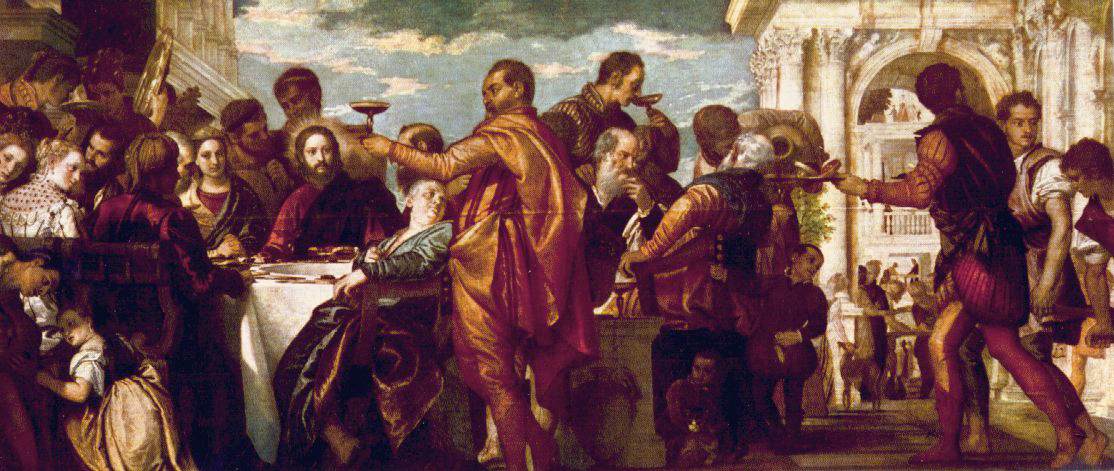
Several things share the name and are not it. Veronese painted a second, much smaller Cana around 1571 to 1572 for the Coccina family of Venice, 207 by 457 centimetres, now in Dresden. Tintoretto's Marriage at Cana of 1561, 435 by 535 centimetres, hangs in the sacristy of Santa Maria della Salute and came from the refectory of the Crociferi. Veronese's Feast in the House of Levi of 1573, 555 by 1280 centimetres, is in the Gallerie dell'Accademia, was painted for the refectory of Santi Giovanni e Paolo and is the subject of the Inquisition trial. The Feast in the House of Simon pictures are separate Veronese commissions. In addition the 2007 Venetian facsimile is a copy, and a different, anonymous sixteenth-century Les Noces de Cana, 148 by 112 centimetres, inventory 71 142, is in the museum at Beauvais, whose number is easily misread as INV 142.
The artist
Paolo Caliari, called Veronese
The Cana sits between two documented moments in Veronese's career: the contract of 1562 and, ten years later, the Inquisition hearing over the Feast in the House of Levi, whose transcript preserves his own answers. Born in Verona to a stonecutter, he moved to Venice in 1553 and had already worked with Palladio at the Villa Barbaro when the monks of San Giorgio Maggiore hired him. A surviving contract gives the Cana a firmer documentary starting point than most of his work, in Hanson's account.
Related works
| Work | Relation | Where it is |
|---|---|---|
| Marriage at Cana Jacopo Tintoretto | Rival Venetian treatment of the same subject, 1561, shortly before the contract; Hanson says it helped popularise the type 435 x 535 cm; came from the refectory of the Crociferi. Not the picture in this record. | Sacristy of Santa Maria della Salute, Venice |
| Marriage at Cana Paolo Veronese | Veronese's own later, smaller version 207 x 457 cm, 1571-72, made for the Coccina family palace in Venice. Not the picture in this record. | Gemaeldegalerie Alte Meister, Dresden |
| Feast in the House of Levi Paolo Veronese | The last of his great refectory suppers, painted ten years later; subject of the 1573 Inquisition trial 555 x 1280 cm, 1573. Not the picture in this record; it is in the Accademia today. | Gallerie dell'Accademia, Venice |
| Le Repas chez Simon Charles Le Brun | The painting exchanged in 1815 for the Cana; it went to Venice 385 x 316 cm according to Chalton; a Louvre drawing of the composition (INV 27638) records the exchange. No source read says when it arrived in Venice. | Gallerie dell'Accademia, Venice (in storage, per Italian Wikipedia) |
| Feast in the House of Simon (Turin) Paolo Veronese | Earlier Veronese banquet picture that Italian Wikipedia lists as preceding the Cana Commons gives 411.6 x 474.5 cm. Not the Cana and not the later Simon pictures in Milan and Versailles. | Galleria Sabauda, Turin |
| Les Noces de Cana (facsimile) Factum Arte after Veronese | Digital facsimile in the original refectory since 11 September 2007, commissioned by the Fondazione Giorgio Cini with the Louvre A copy. Installed size given by Factum as 9.55 x 6.98 m. | Refectory of San Giorgio Maggiore, Venice |
| Les Noces de Cana, squared sketch Attributed to Veronese or Matteo Ingoli | Compositional drawing for the painting; attribution disputed (Bacou and Chastel accepted; Cocke and Pignatti rejected; Marinelli 2022 suggests Ingoli) Brown ink and wash over black stone, 19.6 x 33 cm; Sagredo collection; bought 1983. | Musee du Louvre, RF 39031 |
| Les Noces de Cana, copy by Claude Charles Claude Charles after Veronese | Early eighteenth-century painted copy ordered by Duke Leopold in 1702 2.5 x 3.32 m. | Musee des Beaux-Arts, Nancy |
Open questions
- What does the receipt of 6 October 1563 say? French Wikipedia reports a payment of 300 ducats on that date and says the receipt is kept in the Archivio di Stato di Venezia; I did not see the document, and the page does not say whether the 300 was the whole fee or a final instalment of the 324 that Hanson, citing Cooper, reports.
- How was the canvas divided? Uglow, from Saltzman, has it ripped along nail rows and rolled in Venice and divided in Paris after the November 1798 exhibition; Lowe says it was cut strip by strip in Venice; French and Italian Wikipedia say seven pieces, which does not match Saltzman's six strips of linen; English Wikipedia and the New York Times (quoted by Factum Arte) say it was cut for transport. The 1992 Louvre catalogue should settle the structure but was not reachable.
- On which day in 1797 was it taken from the wall? English Wikipedia says 11 September; Greenberger says only September; no primary record was found.
- Is any figure in the central music group identified by a document of 1562 or 1563? Boschini's list of 1674 and Priever's modern list disagree about the instruments, and the proposals that Diego Ortiz and Giorgione are in the group rest on two authors' reading of X-rays that I could not independently check.
- When was the steward's tabard painted red, and by whom? Experts quoted by Lowe date it between 1607 and the middle of the nineteenth century; Lowe himself argues for 1563 and Veronese; the cleaning removed it.
- Who restored the canvas in 1798 and 1799 and who made the repairs recorded in the nineteenth century? No source read names them, and Lowe says records are almost non-existent.
- Who paid for canvas and colours under the 1562 contract? Hanson reports that the painter was to use the costliest pigments; a popular early biography says the monks furnished canvas and colours; the contract was not seen.
- What is the full pigment record? Only the lead-yellow, copper-green, orpiment and realgar findings at the steward's tabard are reported in sources I could read; the 1992 catalogue's scientific contributions (Faillant-Dumas, Rioux, Volle) and any Louvre survey from 2021 were not found online.
- Why is the installed facsimile 9.55 x 6.98 m when the Louvre gives 9.94 x 6.77 m? Factum's page does not explain it.
- What value has the painting been insured at? No figure is published in the sources read.
- Where will it hang once the Mona Lisa leaves the Salle des Etats under the Nouvelle Renaissance project, and will its label mention the Venetian facsimile? No announcement was found.
Questions about this object
What is The Wedding Feast at Cana (Les Noces de Cana)?
The Wedding Feast at Cana (Les Noces de Cana) is a painting, dated 1562-1563 (contract 6 June 1562; delivery due September 1563). Medium: Oil on canvas.
Who made The Wedding Feast at Cana (Les Noces de Cana), and is the attribution settled?
The attribution to Paolo Caliari, called Veronese is recorded here as accepted. Documented commission to Paolo Caliari by contract of 6 June 1562; the Louvre catalogues it as by Veronese. RMN says it was probably painted with the help of his brother Benedetto and workshop members; no source read separates the hands.
Where is The Wedding Feast at Cana (Les Noces de Cana) now?
Musee du Louvre, Paris, Denon wing, level 1, room 711 (Salle des Etats). Inventory number INV 142; MR 384. Last confirmed 8 October 2026. Taken from the refectory of San Giorgio Maggiore in 1797 under the treaty of Milan; entered the Louvre in 1798; kept in 1815 in exchange for Charles Le Brun's Le Repas chez Simon.
What is still unknown about The Wedding Feast at Cana (Les Noces de Cana)?
What does the receipt of 6 October 1563 say? French Wikipedia reports a payment of 300 ducats on that date and says the receipt is kept in the Archivio di Stato di Venezia; I did not see the document, and the page does not say whether the 300 was the whole fee or a final instalment of the 324 that Hanson, citing Cooper, reports.
Sources
- 1Musee du Louvre, collections database, 'Les Noces de Cana', Paolo Caliari called Veronese, INV 142; MR 384 (dimensions 6.77 x 9.94 m, painted 1562-1563, Denon wing level 1 room 711, 'preleve en 1797 / transporte au Louvre en 1798', acquisition mode military conquest 1798, bibliography to 2025). Consulted 8 October 2026. collections.louvre.fr/en/...
- 2Musee du Louvre, 'From the Mona Lisa to The Wedding Feast at Cana - The Salle des Etats' (size, about 130 characters, 1815 exchange for Le Brun, moved in 1870 and 1939). Consulted 8 October 2026. louvre.fr/en/...
- 3AGORHA (INHA), notice for the Louvre painting, with the RETIF and Pomme de Mirimonde databases: historical comment 'saisie revolutionnaire en 1797; entree au Louvre en 1798', catalogue bibliography (Berenson 1932, Brejon de Lavergnee 1981, Foucart-Walter 2007, Pomme de Mirimonde 1965-1976) and links to recorded copies and prints. agorha.inha.fr/ark:/...
- 4Kate H. Hanson, 'The Language of the Banquet: Reconsidering Paolo Veronese's Wedding at Cana', InVisible Culture 14 (University of Rochester, 2010), with footnotes citing Habert 1993, Cooper 1991, Cocke 2001, Rosand 1997, Fehl 1981, Priever 2000 and the Chambers, Pullan and Fletcher translation of the contract. Peer-reviewed journal article, secondary. rochester.edu/in_visible_culture/...
- 5Jenny Uglow, 'Napoleon's Greatest Trophy', The New York Review of Books, 21 October 2021 (review of Cynthia Saltzman, Plunder: Napoleon's Theft of Veronese's Feast, 2021). Secondary, summarises Saltzman's archival account of the 1797 removal and the 1798 cutting. nybooks.com/articles/...
- 6Jenny Uglow, letter 'Veronese Preserv'd', The New York Review of Books, 2 December 2021 (the 2007 facsimile, Factum Arte, Fondazione Giorgio Cini, Louvre cooperation). nybooks.com/articles/...
- 7Alex Greenberger, 'The Louvre's Looted Renaissance Masterpiece: New Book Explores the Plundering of a Veronese Painting', ARTnews, 10 May 2021 (review of Saltzman; Berthollet's list, 1815 deal, Canova, Denon, the Louvre wall label). Journalism, secondary. artnews.com/art-news/...
- 8Arthur Tompkins, 'Art Theft History: Judge Arthur Tompkins Writes about Veronese's The Wedding at Cana', ARCA blog, March 2011 (weight, 1810 anecdote, 1870 and 1939 moves, 1992 tears). Blog post, secondary. art-crime.blogspot.com/2011/...
- 9Factum Arte, 'A facsimile of the Wedding at Cana by Paolo Veronese' (recording conditions, 1,591 scans, 3D scanning, printing, installed size 9.55 x 6.98 m, recorded November-December 2006, made January-August 2007, press quotes 2007). Maker's own account, so an interested source. factum-arte.com/pag/...
- 10Adam Lowe, 'Returning Les Noces de Cana by Paolo Caliari', Factum Arte, January 2008 (refectory and Louvre display compared, 1850s and 1989-91 cleanings, the steward's tabard, orpiment and realgar, 1958 request, 1705 copying ban). Written by the maker of the facsimile, so an interested source. factum-arte.com/pag/...
- 11Factum Arte, 'Coping with the Past', book page for Pasquale Gagliardi, Bruno Latour and Pedro Memelsdorff (eds), Civilta Veneziana Studi 52 (Olschki, 2010): the November 2007 Dialogo di San Giorgio on the facsimile. factum-arte.com/pag/...
- 12Palladio Museum (CISA), Mediateca Palladio, 'Refettorio del monastero di San Giorgio Maggiore, Venezia' (building 1560-1563, vault, windows, relation to the Cana). mediateca.palladiomuseum.org/palladio/...
- 13Musee du Louvre, collections database, drawing 'Le repas chez Simon' by Charles Le Brun, INV 27638 (records the 1815 exchange against the Veronese, the painting now in the Galleria dell'Accademia, Venice). collections.louvre.fr/en/...
- 14Quentin Chalton, 'Les Noces de Cana, lorsque la copie tient lieu de restitution', Media' Pat', Le Mans Universite, 2023 (1815 exchange and the Inventaire Napoleon note, Le Brun size, campaigns for return, facsimile, Louvre label). Student master's notice, secondary. media-pat.univ-lemans.fr/les-noces-de-cana-lorsque-la-cop...
- 15Brian Pullan, Rich and Poor in Renaissance Venice: The Social Institutions of a Catholic State, to 1620 (Oxford: Blackwell, 1971), full text as hosted on dokumen.pub (master mason and journeyman day wages 1566-74 and 1571-4; charity burial and dowry sums). dokumen.pub/rich-and-poor-in-renaissance-venice-the-socia...
- 16Wikipedia, 'Venetian lira' (ducat as accounting unit of 6.2 lire or 124 soldi; sixteenth-century divergence of the accounting ducat and the gold zecchino). en.wikipedia.org/wiki/...
- 17Oxford Academic, 'Decline of a Fully Matured Economy: Rural and Urban Real Wages in the Republic of Venice, 1390-1790', Economic History Review (2026), abstract and method (Allen welfare ratio, 250 working days a year). academic.oup.com/ereh/...
- 18Wikipedia, 'The Wedding at Cana (Veronese)' (contract summary, 1797 date, 1989-92 restoration and the APIAH protest, 1992 accidents, musicians tradition). en.wikipedia.org/wiki/...
- 19Wikipedia (Italian), 'Nozze di Cana (Veronese)' (cut into seven pieces, 1815, 1994 request by Francesco Sisinni, 2010 letter, Diego Ortiz proposal). it.wikipedia.org/wiki/...
- 20Wikipedia (French), 'Les Noces de Cana (Veronese)' (31 July 1798 entry, 1870 Brest, 1939 evacuation, 1947 commission, restorers' names, 1992 tear, Boschini). fr.wikipedia.org/wiki/...
- 21RMN-Grand Palais, Panorama de l'art, 'Les Noces de Cana' (132 figures, fifteen months, hung over 2 m, composition and details). Museum-publisher analysis, secondary. panoramadelart.com/analyse/...
- 22Manuel Lafarga and co-authors, theweddingatcana.org (X-ray based proposals on the central musicians: Diego Ortiz, and Giorgione beneath him). Authors' own open-access site, a proposal not endorsed in the museum sources read. theweddingatcana.org
- 23Transcript of the trial of Veronese, 18 July 1573 (English translation), Renaissance Through Contemporary Art History, Utah Valley University open textbook. uen.pressbooks.pub/arth2720/...
- 24Wikipedia, 'Paolo Veronese' (birth, name, training, move to Venice 1553, workshop, death 19 April 1588). en.wikipedia.org/wiki/...
- 25Musee du Louvre, collections database, drawing 'Les Noces de Cana', RF 39031 (squared sketch, Sagredo collection, bought 1983; attribution disputed). collections.louvre.fr/en/...
- 26Musee du Louvre, collections database, drawing 'Les Noces de Cana' after Veronese, INV 4693 (Jabach collection, Cabinet du Roi 1671). collections.louvre.fr/en/...
- 27Musee du Louvre, collections database, 'Vue du Salon Carre du Louvre, avec les Noces de Cana de Veronese', Marco Terinzio Muller de Shongor, 1895, RF 1976 6. collections.louvre.fr/en/...
- 28Entrevue, 'Musee du Louvre : quelles peintures vont profiter du demenagement de la Joconde ?' (Sebastien Allard on the Salle des Etats after the Mona Lisa moves). entrevue.fr/culture/...
- 29L'actualite, 'La Joconde aura sa propre salle dans le cadre d'une renovation de 10 ans du Louvre', 28 January 2025 (Nouvelle Renaissance du Louvre announcement). lactualite.com/actualites/...
- 30Web Gallery of Art, Tintoretto, 'Marriage at Cana' (1561, 435 x 535 cm, Santa Maria della Salute, from the Crociferi refectory). wga.hu/html_m/...
- 31Web Gallery of Art, Veronese, 'Marriage at Cana' (1571-72, 207 x 457 cm, Dresden). wga.hu/html_m/...
- 32Web Gallery of Art, Veronese, 'Feast in the House of Levi' (1573, 555 x 1280 cm, Gallerie dell'Accademia). wga.hu/html_m/...
- 33Fr. (Francois) Crastre, Veronese (early twentieth century, English translation), Project Gutenberg eBook 41974: a popular account repeating the contract terms and the traditional guest identifications. gutenberg.org/cache/...
- 34Christian Science Monitor, review of Plunder: Napoleon's Theft of Veronese's Feast, 12 August 2021 (ten months in transit, 2010 letter to Carla Bruni). csmonitor.com/Books/...
- 35Wikipedia, 'Tintoretto' (payments of 50 ducats per canvas excluding materials, c. 1578, Doge's Palace; 2,447 ducats in all from the Scuola di San Rocco). en.wikipedia.org/wiki/...
- 36Philharmonie de Paris, catalogue record for Les Noces de Cana de Veronese: une oeuvre et sa restauration (Musee du Louvre, 16 November 1992 - 29 March 1993), Departement des Peintures and Service de restauration des musees de France. collectionsdumusee.philharmoniedeparis.fr/collectionsdumu...
- 37AGORHA (INHA, RETIF), painted copy at the Musee des Beaux-Arts, Nancy (Claude Charles, ordered by Duke Leopold in 1702, 2.5 x 3.32 m). agorha.inha.fr/ark:/...
- 38AGORHA (INHA), engraving after the composition by N. Cochin, Bibliotheque nationale de France, linked to Pomme de Mirimonde's study of the hourglass (Gazette des beaux-arts, 1976). agorha.inha.fr/ark:/...
- 39Musee du Louvre, collections database, drawing 'Les Noces de Cana', INV 4722, workshop of Veronese, formerly 'imitation of Veronese', Musee Napoleon inventory. collections.louvre.fr/en/...
- 40AGORHA (INHA, RETIF), painted copy at the Musee d'arts de Nantes (160 x 216.5 cm, seventeenth century, Cacault collection, bought by the city 1810). agorha.inha.fr/ark:/...
- 41Wikimedia Commons file description (via the Commons API) for the lead photograph, 'Les Noces de Cana - Paolo Veronese - Musee du Louvre Peintures INV 142 ; MR 384.jpg' (public domain, 10068 x 6742 px, photograph credited to Shonagon, 5 April 2024). commons.wikimedia.org/wiki/...
- 43AGORHA (INHA, RETIF), reduced copy of the left part by Albert Maignan, Musee de Picardie, Amiens (MP.Mn.4698, bequest 1908). agorha.inha.fr/ark:/...
- 44AGORHA (INHA, RETIF), copy at the Musee des Beaux-Arts, Orleans (138 x 182 cm, given by M. Miron de Lamotte in 1826). agorha.inha.fr/ark:/...
- 45Wikipedia, 'Pietro Aretino' and 'Vittoria Colonna' (death dates 21 October 1556 and 25 February 1547). en.wikipedia.org/wiki/...
- 42POP (Ministere de la Culture), Joconde notice 000PE026531: a different, anonymous sixteenth-century 'Les Noces de Cana', 148 x 112 cm, inventory 71 142, MUDO Musee de l'Oise, Beauvais (cited only to prevent confusion with INV 142). pop.culture.gouv.fr/notice/...

Last verified · Published
Change log
8 October 2026 - Record created at the house standard: researched narrative, technical evidence, maker dossier, graded provenance chain, prices with hammer and premium separated, related works, open questions and sources.