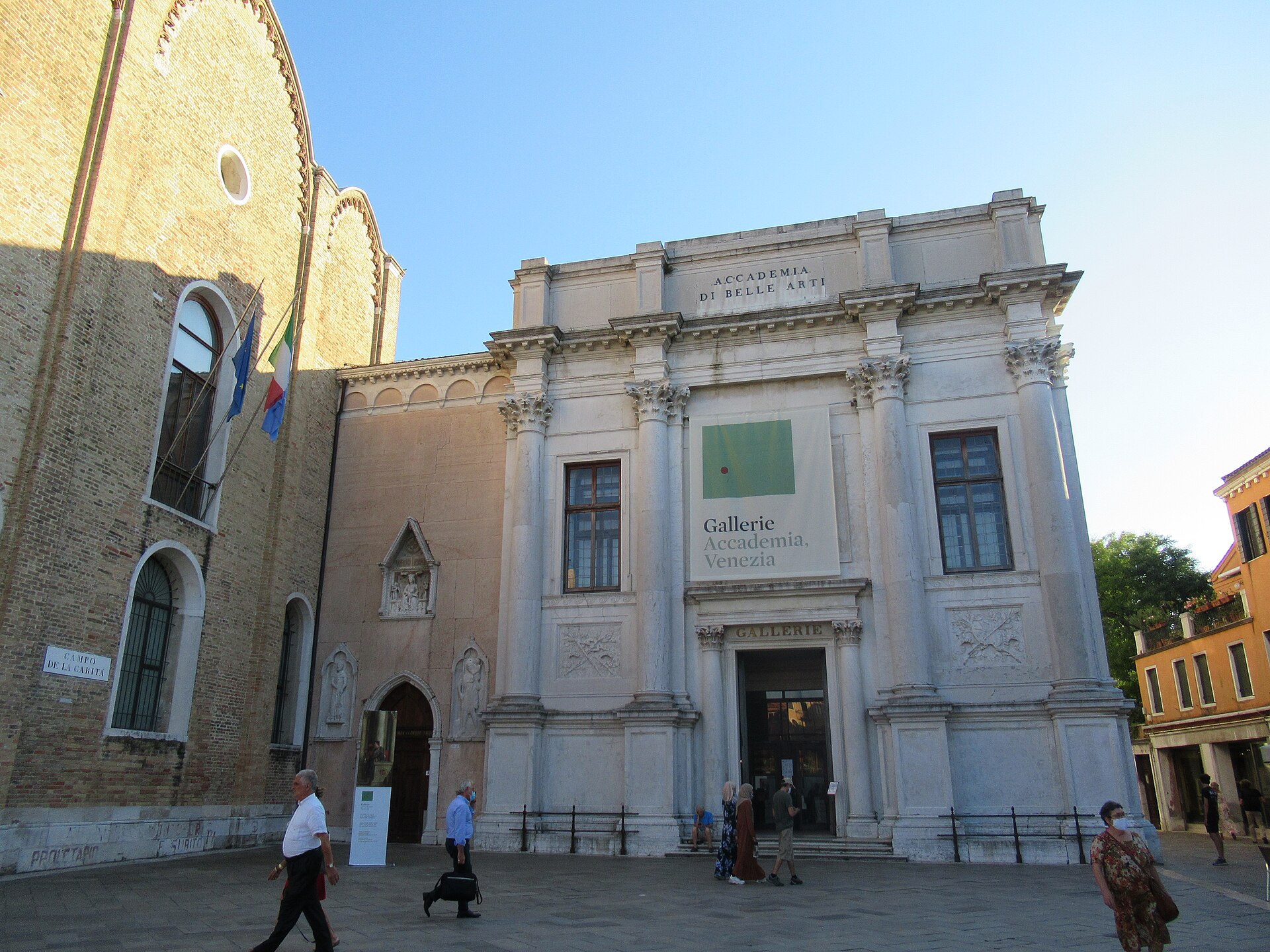
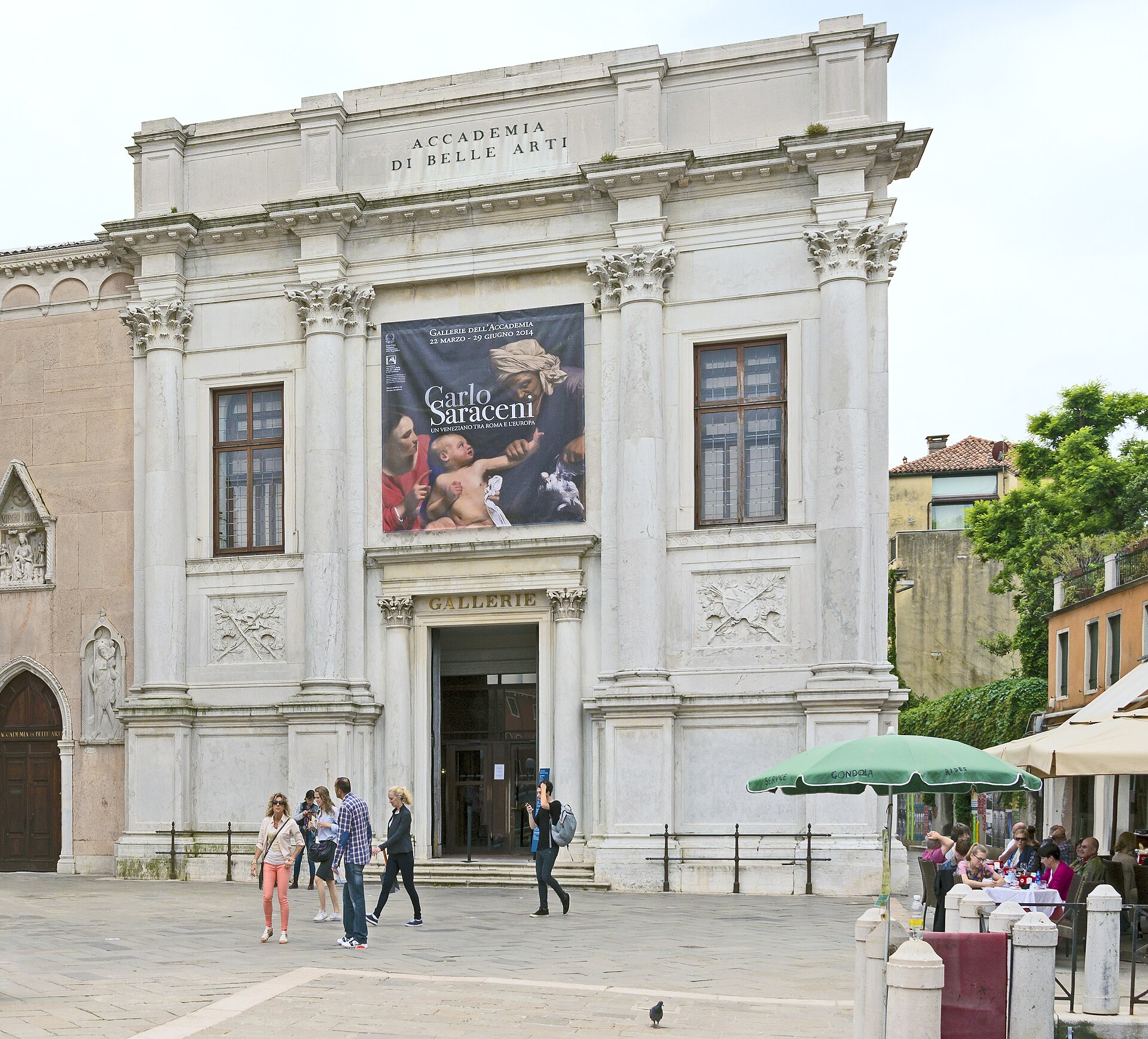
The entrance facade of the Gallerie dell'Accademia on Campo della Carita, Venice, with ACCADEMIA DI BELLE ARTI still lettered above the door from the building's decades as a teaching academy.
Photograph by Congolandia.g · CC BY-SA 4.0Gallerie dell'Accademia
Museum · Gallerie dell'Accademia di Venezia · Founded 1750
Open, admission and hours confirmed 25 August 2026 · 19 sources
On this page 17 sections
ContentsClose
The deepest single holding of Venetian painting anywhere, covering roughly 1300 to 1880 inside a building that is itself three stitched-together religious institutions rather than a purpose-built gallery. Giorgione's unresolved Tempest, Veronese's Inquisition-defying Feast in the House of Levi, Carpaccio's St Ursula and True Cross cycles, and altarpieces by three generations of the Bellini family sit alongside Tintoretto, Titian and, on the ground floor, Canova's Neoclassical marbles and the 18th-century view painters. The single most famous object in the building, Leonardo's Vitruvian Man, is also the one visitors are least likely to actually see: fragility keeps it in storage all but a few weeks roughly every six years, a policy the museum has twice defended in court, once to keep the drawing from leaving Venice for the Louvre, and once to stop a German toy company reproducing its image without payment.
| Local name | Gallerie dell'Accademia di Venezia |
|---|---|
| Kind | Museum |
| Founded | 1750 (the Accademia di Belle Arti di Venezia founded 24 September 1750, statute 1756); the gallery became an independent museum in 1879 and the two institutions shared this building until 2004, when the art school moved out to the Ospedale degli Incurabili |
| City and country |  Venice, Italy Venice, Italy |
| Address | Campo della Carita, Dorsoduro 1050, 30123 Venezia, Italy |
| Website | gallerieaccademia.it/en |
| Status | Open, confirmed |
| Record last verified |
Visiting
- Hours
- Tuesday to Sunday09:00 to 19:00Ticket sales end at 18:00. Visitors are ushered toward the exit starting half an hour before closing, i.e. from 18:30
- MondayClosed. The museum's own opening-hours page lists hours only for Tuesday to Sunday and directs visitors to a separate calendar for exceptions and holiday closures
- Closed
- Monday. See the museum's own opening calendar for holiday exceptions.
- Admission
- Full price (Intero)EUR 20Sold online through TicketOne, the only authorised online reseller, or at the ticket office
- Reduced, EU citizens 18-25EUR 2Under-26 EU citizens; the museum also accepts Italy's 18app culture-voucher scheme for 18-year-old residents
- Free, under 18FreeAlways free, a category the museum highlights for family visits
- Arteritivo, ages 26-35EUR 15Individual ticket for visitors aged 26 up to (not including) 35, valid Fridays 17:15-19:00 only, last entry 18:00
- Groups, 'Insieme' rate, adults 26+EUR 17Groups of 10-25 adults over 26; school groups capped at 30 pupils including teachers, other groups at 25 including the guide. Booking is by phone only, no online option, credit card or bank transfer only
- Dorsoduro Museum Mile combined ticketEUR 17For visitors already holding a ticket to one of the other Dorsoduro Museum Mile venues (Palazzo Cini Gallery, Peggy Guggenheim Collection, Punta della Dogana)
Free entry: First Sunday of every month (Domenica al Museo). 6 January 2026 (Epiphany). 8 March 2026, women visitors only (International Women's Day). 5 April 2026 (Easter). 25 April 2026 (Liberation Day). 2 June 2026 (Republic Day). 1 November 2026 (All Saints). 4 November 2026 (National Unity Day). No booking is taken on free days; entry is first-come, first-served, though Membership Card, Dorsoduro Museum Mile and ICOM holders keep priority skip-the-line access- Tickets
- gallerieaccademia.it/en/visit/opening-hours-a... The museum's own ticket page.
- Do I need to book?
- Not compulsory, but online purchase through TicketOne is recommended to skip the ticket-office queue. Groups can only book by phone
- Address
- Campo della Carita, Dorsoduro 1050, 30123 Venezia, Italy MapVaporetto (waterbus) Lines 1, 2 and N stop at Accademia, a few steps from the museum entrance, on the Grand Canal side of the Ponte dell'Accademia (the bridge itself is named for the museum, not the reverse)
Walking About 15 minutes from St Mark's Square, 20 minutes from Piazzale Roma, 25 minutes from Santa Lucia railway station, or 5 minutes from the Zattere waterfront, all on foot through Dorsoduro - Website
- gallerieaccademia.it/en
- Telephone
- 041 522 2247
- [email protected]
Before you go how long, access, photography, bags, eating, shop
- How long to allow
- Twenty-four numbered rooms on the first floor cover Venetian painting from about 1300 to 1600, arranged in roughly chronological order; thirteen further rooms on the ground floor, numbered separately in Arabic numerals, cover 1600 to 1880 and include the Canova sculpture rooms. As of August 2026 five first-floor rooms (Sale XVIII to XXIII) are closed for restoration work, and the Gabinetto dei Disegni e delle Stampe, the Print and Drawing Room that holds the Vitruvian Man, is closed to consultation for the same reason, with no reopening date yet given
- Access
- The barrier-free entrance is on the right side of the building, on Calle della Carita, with lifts and lifting platforms to reach the upper floor; staff are available to help visitors find the easiest route through the historic rooms. Accessible toilets are on the ground floor
- Photography
- Not addressed in detail on the museum's public visiting-information pages beyond the standard cloakroom and bag rules below
- Bags
- Backpacks and bulky bags are not allowed into the galleries to protect the artworks. Free lockers, maximum 45 x 35 x 65 cm, are provided at the cloakroom, which requires a EUR 1.00 coin as a deposit
- Eating
- Not listed on the museum's own visitor-services page
- Shop
- Not detailed beyond audioguide sales; audioguides cost EUR 6.00, in Italian, English, French, German, Japanese and Spanish, plus a children's version from age six in Italian, English and French, and a free LIS (Italian Sign Language) video guide covering the permanent collection and the current temporary exhibition, available via web app or a loaned device
Prices and hours change. We take them from the institution's own pages and print the day we read them, and you can check the current position at the source we used. Confirm before you travel.
What is inside
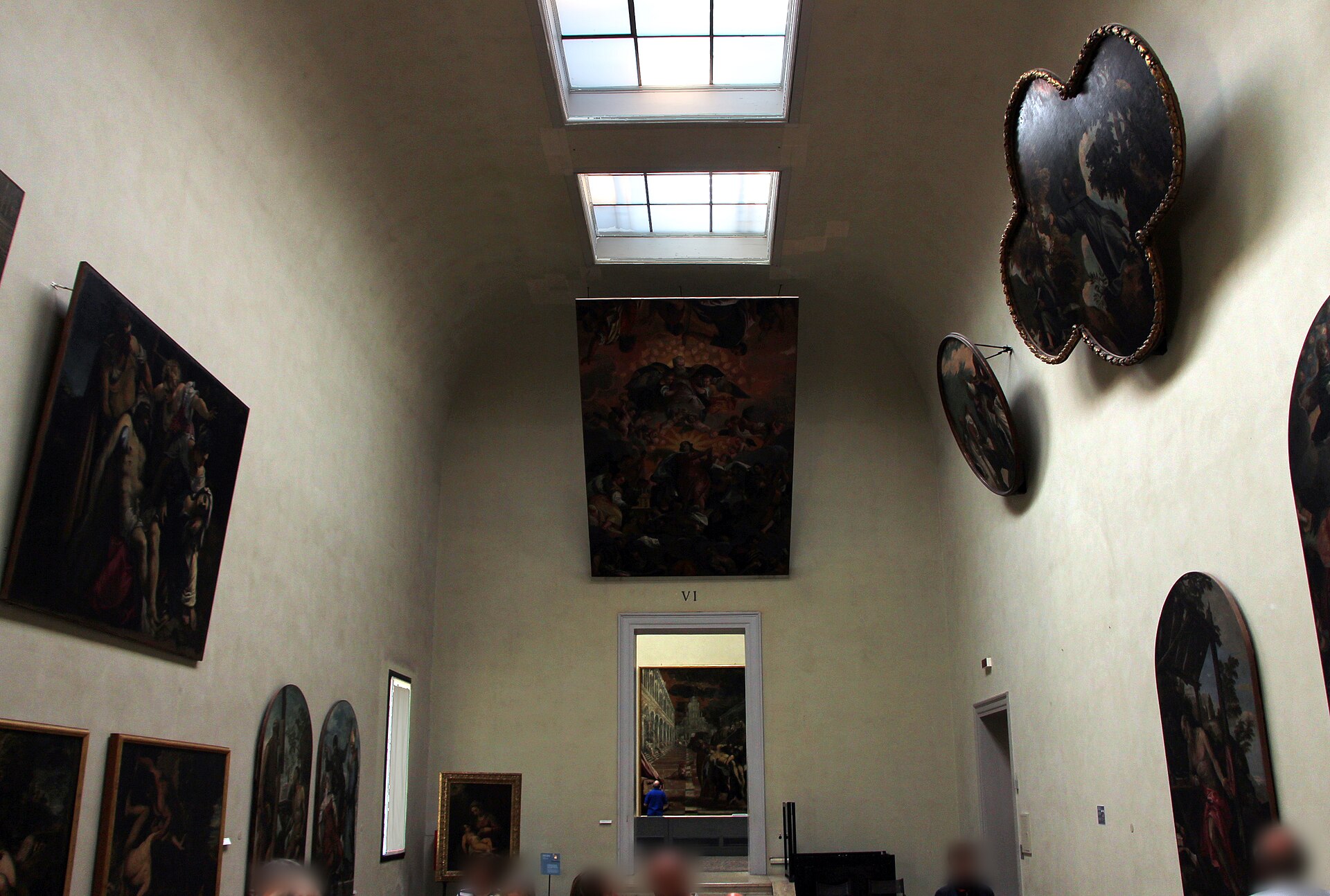
Photograph by Sailko · CC BY-SA 3.0 Sale I-VII, the 14th- and 15th-century rooms
The visit begins here, moving through Venetian gold-ground painting (Paolo Veneziano, Jacobello del Fiore, Lorenzo Veneziano) into the early Renaissance: the Bellini family, Vittore Carpaccio, Andrea Mantegna, Piero della Francesca and Cosme Tura. Sala VI holds Cima da Conegliano and further Bellini and Paris Bordon panels among a dense hang of tondi and altarpieces. Sala VII holds Hieronymus Bosch's Hermit Saints triptych, an unusual Netherlandish presence in a collection otherwise almost entirely Venetian
Sala VIII, Giorgione and the Venetian High Renaissance
Holds Giorgione's The Tempest and Old Woman alongside works by Sebastiano del Piombo and Titian. The Tempest is one of the most written-about paintings in the collection precisely because its subject is unresolved: a soldier and a nursing woman under a storm-lit sky, with no settled account of what story, if any, the picture illustrates. We could not verify a free-licence photograph of this specific room and it renders here as text only
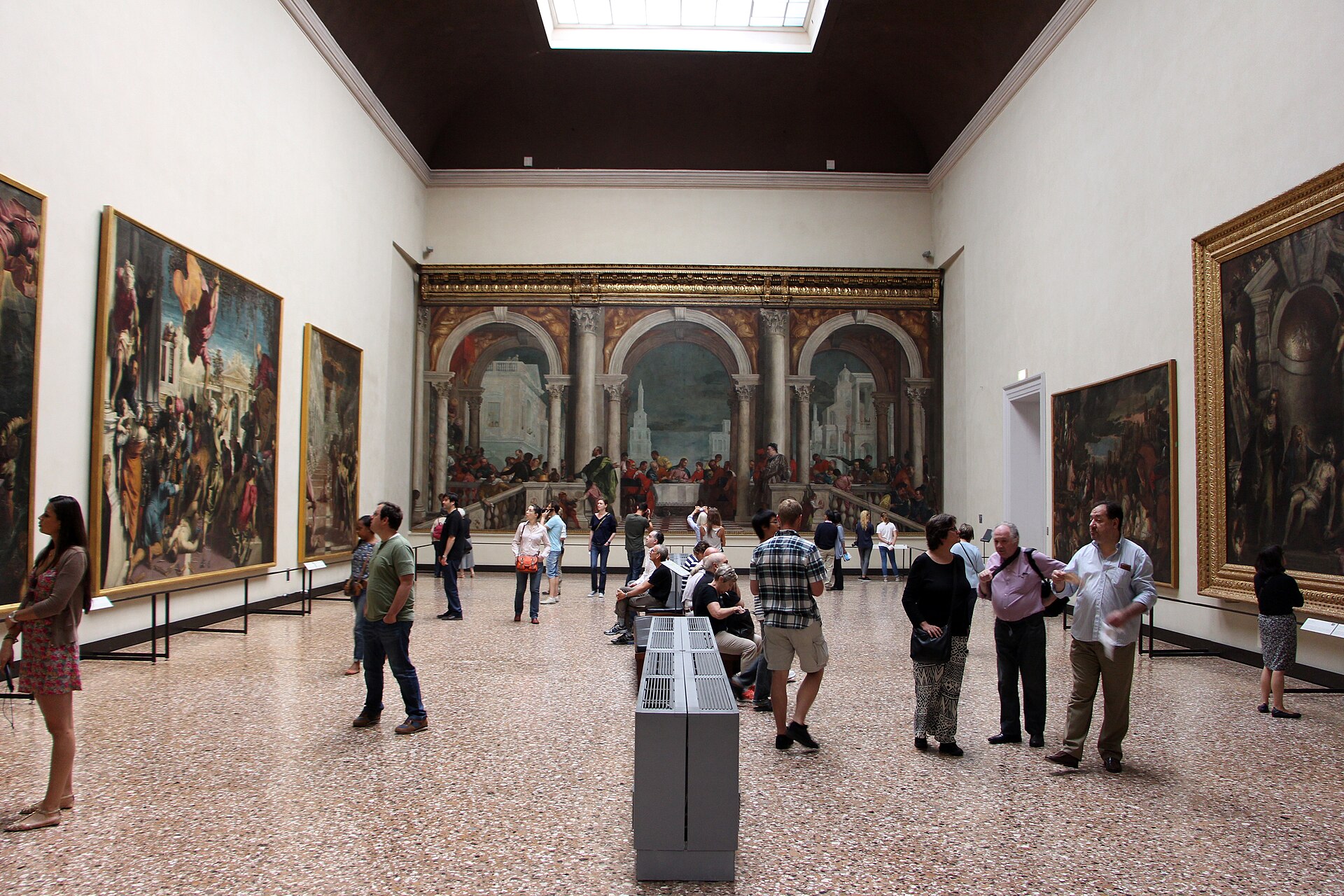
Photograph by Sailko · CC BY-SA 3.0 The Veronese room
Built to hold Paolo Veronese's Feast in the House of Levi, at 555 by 1,309 cm one of the largest canvases of the 16th century. Painted in 1573 to replace a Titian Last Supper destroyed by fire in the refectory of Santi Giovanni e Paolo, it was itself hauled before the Venetian Inquisition for irreverence, crowded as it is with dwarfs, jesters, a man with a nosebleed and drunken German soldiers around Christ's table. Veronese did not repaint a single figure; he simply retitled the picture after a different, less doctrinally central Gospel banquet, and the case was closed
Sale XI-XVI, Tintoretto, Titian and the later 16th-17th century
Includes Tintoretto's Miracle of the Slave (Saint Mark Freeing a Slave), one of his best-known narrative paintings, and Titian's Presentation of the Virgin, a large late altarpiece. Further rooms carry Jacopo and Leandro Bassano and, where the sequence runs into the 1700s, early Giambattista Tiepolo. We could not verify a free-licence photograph of these specific rooms
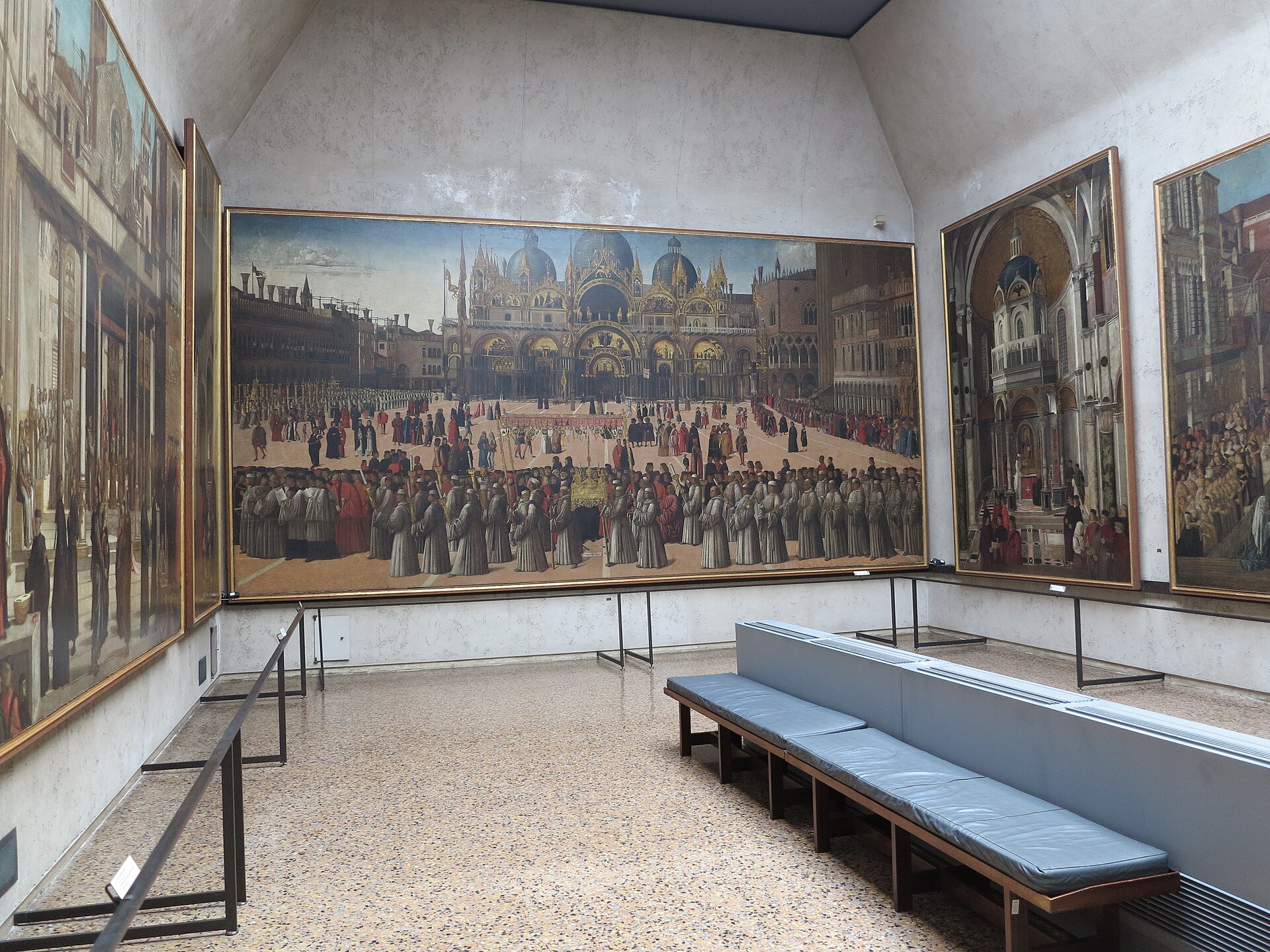
Photograph by Mongolo1984 · CC BY-SA 3.0 The Cycle of the Miracles of the True Cross (currently closed)
Historically shown in the room formerly numbered Sala XX, this cycle of large narrative canvases by Gentile Bellini, Vittore Carpaccio and other late-15th-century Venetian painters depicts the posthumous miracles worked by a relic of the True Cross owned by the Scuola Grande di San Giovanni Evangelista, including Bellini's Procession in Piazza San Marco, a rare documentary view of the square as it looked in the 1490s. As of August 2026 this room is one of five first-floor rooms (Sale XVIII to XXIII) closed for restoration, with no published reopening date, so a visitor cannot currently see this cycle in the galleries even though it remains part of the collection
Ground-floor Sale 1-13: Canova, Tiepolo, Canaletto, Hayez
The 17th- to 19th-century half of the museum, reached after descending from the first floor: Antonio Canova's Neoclassical marbles occupy two dedicated rooms, Giambattista Tiepolo and Pietro Longhi represent the 18th century, Canaletto and Francesco Guardi carry the view-painting tradition, and Francesco Hayez's large history paintings close the chronological sequence around 1880, the museum's own stated cut-off date for its permanent collection
Gabinetto dei Disegni e delle Stampe (Print and Drawing Room, closed)
The museum's works on paper, including Leonardo da Vinci's Vitruvian Man, are kept here under light- and climate-controlled conditions rather than on permanent display; the room is temporarily closed to consultation for restoration work, with no date given for reopening. The Vitruvian Man itself is shown in the galleries only for a few weeks roughly every six years, most recently including a loan to the Louvre in Paris from 24 October 2019 to 24 February 2020 after a legal fight over whether it could travel at all (see narrative)
What to see first
The Tempest
Giorgione, c. 1506-1508The single most argued-over painting in the collection: a soldier stands at left, a nursing woman sits at right, lightning splits the sky between them, and no proposed narrative source, biblical, mythological or literary, has settled the question of what is actually being depicted. Technical study has shown Giorgione painted over an earlier, different composition beneath it, adding another layer of unresolved intent.8
Vitruvian Man
Leonardo da Vinci, c. 1490The museum's single most famous object and the one a visitor is least likely to actually see: a study in metalpoint, pen and wash on paper, it is fragile enough that it is displayed only a few weeks roughly every six years, and is otherwise kept in dark, climate-controlled storage. In 2019 the heritage group Italia Nostra won a temporary Veneto regional court injunction blocking its loan to the Louvre, arguing Italian law bars lending works too fragile to travel safely; the Italian government appealed and the loan went ahead, with conservators from Florence's Opificio delle Pietre Dure judging the risk acceptable on condition the drawing then spend ten years in storage afterward. The museum separately fined the German toy company Ravensburger over an unauthorised 1,000-piece puzzle using the drawing's image (see narrative), a wholly different, non-conservation legal action over the same object.9
Feast in the House of Levi
Paolo Veronese, 1573One of the largest canvases of the 16th century at 555 by 1,309 cm, painted as a Last Supper for the Dominican refectory of Santi Giovanni e Paolo, replacing a Titian destroyed by fire. Its crowd of dwarfs, drunken soldiers and a man with a bleeding nose around Christ's table drew a formal Inquisition hearing for irreverence; rather than repaint anything, Veronese simply renamed it after a different Gospel banquet in which sinners were explicitly present, and the tribunal did not pursue the matter further.10
Cycle of St Ursula
Vittore Carpaccio, 1490sA cycle of large narrative canvases telling the legend of St Ursula, originally painted for the Scuola di Sant'Orsola, densely packed with observed Venetian architecture, costume and shipping that make the cycle a documentary source for the city's own appearance in the 1490s as much as a religious narrative.8
San Giobbe Altarpiece
Giovanni Bellini, c. 1487A sacra conversazione originally painted for the church of San Giobbe, its illusionistic architecture designed to continue the lines of the church's actual chapel, one of the clearest surviving examples of a Venetian altarpiece still legible for how its architecture once extended its real setting.8
Saint Mark Freeing a Slave (Miracle of the Slave)
Tintoretto, 1548One of Tintoretto's early breakthrough narrative paintings, showing one of St Mark's posthumous miracles, the saint diving down from the top of the canvas to break the instruments of torture threatening a slave below; the steep foreshortening and violent motion established the dramatic manner Tintoretto built his career on.8
Cycle of the Miracles of the True Cross
Gentile Bellini, Vittore Carpaccio and others, 1490sA set of large narrative canvases commissioned by the Scuola Grande di San Giovanni Evangelista showing miracles credited to their relic of the True Cross, including Gentile Bellini's Procession in Piazza San Marco, a rare and closely observed record of what the square looked like in the 1490s. The room historically housing this cycle is currently closed for restoration (see Inside), so it is not visible to a visitor in August 2026 despite remaining part of the collection.11
Exhibitions on now
Past exhibitions here
- Closed3 Apr to 9 Oct 2022Confirmed · check before you travel
Three suppressed religious buildings, stitched into one museum
The building a visitor enters was never designed to be a museum. It combines three separate institutions that the Napoleonic administration disbanded in the early 1800s: the Scuola Grande di Santa Maria della Carita, the oldest of Venice's six great lay confraternities, founded in 1260 with a building on the site from 1343; the adjoining convent of the Canonici Lateranensi, begun in 1561 to a design by Andrea Palladio and never fully completed; and the church of Santa Maria della Carita itself, whose facade was finished in 1441 by Bartolomeo Bon. The Accademia di Belle Arti di Venezia, the teaching academy that would eventually house this collection, had been founded separately in 1750, with a formal statute from 1756, Giovanni Battista Piazzetta as its first director and Giambattista Tiepolo as its first president. In 1807, once the academy had been re-founded by Napoleonic decree as the Accademia Reale di Belle Arti, it was moved into the newly vacated Carita complex, and the combined collection opened to the public on 10 August 1817.
One building, two institutions, until 2004
The gallery did not become a separate legal entity from the art school for another sixty-two years: the Gallerie dell'Accademia split off as an independent museum only in 1879, while the Accademia di Belle Arti kept teaching inside the same rooms. That shared occupancy lasted until 2004, when the art school finally relocated to the former Ospedale degli Incurabili elsewhere in Dorsoduro, leaving the Carita complex entirely to the museum for the first time in nearly two centuries. The Ponte dell'Accademia, the wooden bridge across the Grand Canal a few steps away, and the Accademia vaporetto stop both take their name from the teaching academy rather than from the gallery, a small piece of Venetian naming that outlived the split by well over a century.
The picture almost nobody sees
The museum's single most requested object is also its least frequently displayed. Leonardo's Vitruvian Man is a drawing in metalpoint, pen and wash on paper, and its custodians treat that fragility as close to absolute: it is shown in Venice for only a few weeks roughly once every six years and otherwise kept in dark, humidity-controlled storage in the Gabinetto dei Disegni e delle Stampe, itself currently closed to consultation for restoration work with no published reopening date. In September 2019 the French and Italian culture ministers agreed to lend the drawing to the Louvre's blockbuster Leonardo exhibition, alongside four further Leonardo drawings from the Uffizi. The heritage group Italia Nostra challenged the loan at the Veneto regional administrative court, arguing Italian law forbids lending works too fragile to travel or display safely; the court initially agreed and temporarily blocked not just this loan but the wider France-Italy exchange agreement behind it. Italy's culture minister Dario Franceschini appealed, citing a positive risk assessment from the Opificio delle Pietre Dure, Florence's leading conservation laboratory, which judged the loan risk acceptable on condition the drawing then spend ten years afterward in storage to recover. The appeal succeeded, and the Vitruvian Man was shown at the Louvre from 24 October 2019 to 24 February 2020, the exhibition it had been fought over reaching its close two months before that ten-year storage clock had even properly started.
A painting that survived the Inquisition by changing its name
Paolo Veronese's Feast in the House of Levi, at 555 by 1,309 centimetres one of the largest canvases painted anywhere in the 16th century, was commissioned in 1573 as a Last Supper to replace a Titian of the same subject destroyed by fire in the refectory of the Dominican church of Santi Giovanni e Paolo. What Veronese delivered was not a solemn sacrament scene but a crowded, theatrical Venetian banquet, dwarfs, jesters, a man with a bleeding nose and drunken German soldiers arranged around Christ's table under an elaborate painted arcade. The Holy Inquisition's tribunal in Venice summoned Veronese and put the offence to him directly, irreverence and indecorum, with the far graver word heresy raised in the questioning over why he had filled a sacred subject with buffoons and scurrility. Veronese did not alter a single figure in response. He simply retitled the canvas after a different, less doctrinally weighted New Testament banquet from Luke's Gospel, one in which the text itself specifies that sinners were present at the table, and the case went no further. The picture that survives under that second title is functionally the same picture the Inquisition objected to.
The museum in court a second time, over the same drawing's image
Fragility was not the only battle the museum fought over the Vitruvian Man. Since 2019, the year director Giulio Manieri Elia was appointed, the Gallerie dell'Accademia has pursued institutions and companies it says have used the drawing's image commercially without permission or payment, invoking Italy's Cultural Heritage and Landscape Code, which lets state-held cultural institutions charge concession fees for commercial reproduction of works in their care regardless of the work's copyright status, expired centuries ago in Leonardo's case. The clearest test came against the German toy company Ravensburger, which had sold a 1,000-piece Vitruvian Man jigsaw puzzle in Italy since 2009. The museum sent a cease-and-desist letter in 2019 demanding 10 percent of the puzzle's sales proceeds; Ravensburger refused, and in autumn 2022 the Court of Venice sided with the museum, ordering the company to stop manufacturing the puzzle and any related merchandise and to pay a EUR 1,500 daily fine running from 17 November 2022, rejecting Ravensburger's argument that Italian cultural heritage law could not reach a company operating outside Italy. That is not where it ended. Ravensburger sued in its own country, and on 14 March 2024 the Landgericht Stuttgart found for the company, holding that Italy's Cultural Heritage Code cannot be applied extraterritorially and that Ravensburger may go on selling the puzzle outside Italy; the Stuttgart Higher Regional Court later dismissed an appeal by the Italian Culture Ministry and the museum, leaving a further appeal to the German Federal Court of Justice as the remaining option. So the two jurisdictions have reached opposite answers on the same puzzle, and the practical outcome outside Italy went against the museum. This is a separate case from, and should not be confused with, the Florence Galleria dell'Accademia's own 2023 lawsuit against the publisher of GQ Italia over an altered image of Michelangelo's David: same legal principle, same country, two different Accademia museums in two different cities.
What is currently closed, and what a visitor cannot see right now
As of August 2026 five first-floor rooms, numbered Sale XVIII through XXIII in the museum's own visit itinerary, are closed for restoration work, and the museum's own published room map flags the closures directly rather than only in fine print. The most significant casualty is the room historically holding the Cycle of the Miracles of the True Cross, a set of large late-15th-century narrative canvases by Gentile Bellini, Vittore Carpaccio and others depicting miracles credited to a relic owned by the Scuola Grande di San Giovanni Evangelista; Bellini's Procession in Piazza San Marco within that cycle is one of the most detailed surviving records of how the square actually looked in the 1490s, and it is currently not on view. The Gabinetto dei Disegni e delle Stampe, the print and drawing room that is the Vitruvian Man's normal home even when the drawing itself is not shown, is likewise closed to consultation, with no reopening date published on the museum's own site at the time this page was researched.
A historic collection with a live contemporary programme
The permanent collection stops around 1880, but the museum does not otherwise behave like a closed historical archive. As of August 2026 it is running Transforming Energy, a exhibition of new work by the performance artist Marina Abramovic, on view until 18 October 2026 inside the same rooms and courtyard that once housed a 13th-century religious confraternity. Placed against the institutional history above, the temporary show reads less as a departure than as the latest instance of a building that has been repeatedly repurposed, from Scuola Grande to Napoleonic academy to independent state museum, continuing to add new uses on top of the old ones rather than freezing around them.
What visitors say
Visitors consistently describe the Gallerie dell'Accademia as the deepest single collection of Venetian painting anywhere, and just as consistently note that its single most famous object, the Vitruvian Man, is essentially never on the wall. The rooms devoted to Giorgione, Veronese, Titian, Tintoretto and Bellini draw the most attention; the 17th-to-19th-century ground floor is comparatively lightly visited even though it holds Canova's sculpture rooms.
What is praised, what is criticised
- Praised: the depth and density of Venetian painting across three centuries in one building, rather than scattered case-by-case across churches and scuole around the city
- Praised: specific rooms built or adapted around a single canvas, the Veronese room in particular, which lets an oversized altarpiece be seen at something closer to the scale and distance it was designed for
- Praised: the relatively short, walkable route on the first floor compared with larger encyclopaedic museums, which most visitors report finishing in two to three hours
- Criticised: the near-permanent absence of the Vitruvian Man from display, which the museum's own conservation policy dictates but which disappoints visitors who come specifically expecting to see it
- Criticised: the current closure of five first-floor rooms (Sale XVIII-XXIII) and the Print and Drawing Room for restoration work, with no published reopening date, which removes the Cycle of the Miracles of the True Cross from view entirely for now
- Criticised: the strict group-booking rules, phone-only reservation with no online option and a bank-transfer or card-only payment requirement, which visitors organising larger private or school groups have found cumbersome next to the simplicity of individual online ticketing
Questions about Gallerie dell'Accademia
Where is Gallerie dell'Accademia?
Campo della Carita, Dorsoduro 1050, 30123 Venezia, Italy.
How much does it cost to visit?
Full price (Intero): EUR 20; Reduced, EU citizens 18-25: EUR 2; Free, under 18: free; Arteritivo, ages 26-35: EUR 15; Groups, 'Insieme' rate, adults 26+: EUR 17. As confirmed 25 August 2026.
When is it open?
Tuesday to Sunday 09:00-19:00; Monday closed. Closed: Monday. See the museum's own opening calendar for holiday exceptions. As confirmed 25 August 2026.
How do you get there?
Vaporetto (waterbus): Lines 1, 2 and N stop at Accademia, a few steps from the museum entrance, on the Grand Canal side of the Ponte dell'Accademia (the bridge itself is named for the museum, not the reverse); Walking: About 15 minutes from St Mark's Square, 20 minutes from Piazzale Roma, 25 minutes from Santa Lucia railway station, or 5 minutes from the Zattere waterfront, all on foot through Dorsoduro.
What should you see first?
The Tempest (Giorgione, c. 1506-1508); Vitruvian Man (Leonardo da Vinci, c. 1490); Feast in the House of Levi (Paolo Veronese, 1573); Cycle of St Ursula (Vittore Carpaccio, 1490s); San Giobbe Altarpiece (Giovanni Bellini, c. 1487); Saint Mark Freeing a Slave (Miracle of the Slave) (Tintoretto, 1548).
What we could not confirm
- No reopening date has been published for the five closed first-floor rooms (Sale XVIII-XXIII) or for the Gabinetto dei Disegni e delle Stampe; the Cycle of the Miracles of the True Cross is consequently off view for an unstated period.
- The museum's own site does not state when the Vitruvian Man was last shown or when it is next due to be shown; the 'few weeks roughly every six years' figure comes from press coverage of the 2019 Louvre dispute rather than from a published exhibition calendar.
- Whether Ravensburger ever paid the accumulating EUR 1,500-per-day Italian fine is still not stated in any source found; what is now established is that the company won in Germany in March 2024 and on appeal, so the Italian order is effective only within Italy.
Images
Sources
- 1Wikidata, Gallerie dell'Accademia (Q338330): label, description as an art museum in Venice, Italy, coordinates 45 25'51.881"N 12 19'41.300"E matching the brief's 45.43108,12.32814, founder Napoleon, inception 1750, official website, visitor figures by year. Used to confirm this is the Venice institution and not the separate Florence Galleria dell'Accademia (Q10855544). Fetched and raw-verified 7 August 2026. wikidata.org/wiki/Q338330
- 2Gallerie dell'Accademia di Venezia, official homepage: current closure/reopening status banner, named current masterpieces (The Tempest, Feast in the House of Levi, Hermit Saints Triptych, Saint Mark Freeing a Slave, Madame Letizia Bonaparte, Polyptych of the Coronation of the Virgin), the Transforming Energy: Marina Abramovic exhibition (to 18 October 2026), address and vaporetto stop. Fetched and read in full, 7 August 2026. gallerieaccademia.it/en/
- 3Gallerie dell'Accademia, official How to get here page: walking times and distances from Piazzale Roma, Santa Lucia station, St Mark's Square and the Zattere; vaporetto lines 1, 2 and N to the Accademia stop. Fetched and read in full, 7 August 2026. gallerieaccademia.it/en/visit/how-to-get-here/
- 4Gallerie dell'Accademia, official Opening hours and tickets page: hours (Tuesday-Sunday 9:00-19:00), all admission tiers and prices, free-admission days for 2026, group booking rules and phone number, accessibility provisions, audioguide and LIS video-guide details, cloakroom rules. Fetched and read in full, 7 August 2026. gallerieaccademia.it/en/visit/opening-hours-and-tickets/
- 5Gallerie dell'Accademia, official Contatti page: institutional phone (0415222247/0412413942), email [email protected], PEC, address, director Giulio Manieri Elia and full staff/department listing. Fetched and read in full, 7 August 2026. gallerieaccademia.it/contatti/
- 6The Art Newspaper, 'Italian court blocks loan of Leonardo's Vitruvian Man to Louvre', by Cristina Ruiz, 9 October 2019: the Veneto regional administrative court's initial injunction, Italia Nostra's Lidia Fersuoch and her legal argument, minister Dario Franceschini's planned appeal, and the Opificio delle Pietre Dure's conservation assessment including the ten-year post-loan storage recommendation. Fetched and read in full, 7 August 2026. theartnewspaper.com/2019/10/09/italian-court-blocks-loan-of-leonardos-vitruvian-man-to-louvre
- 7Artnet News, 'The Italian Museum That Owns Leonardo's Vitruvian Man Has Successfully Sued to Stop Production of a 1,000-Piece Puzzle Based on the Work', by Taylor Dafoe, 30 March 2023: the Court of Venice's autumn 2022 ruling against Ravensburger, the EUR 1,500 daily fine from 17 November 2022, the 2019 cease-and-desist and 10-percent royalty demand, and director Giulio Manieri Elia's quote to La Repubblica. Explicitly distinguishes this Venice Vitruvian Man case from the separate Florence Galleria dell'Accademia David/GQ Italia case reported in the same article's related links. Fetched via the in-app browser after a direct HTTP fetch returned a bot-block challenge page; read in full, 7 August 2026. news.artnet.com/art-world/ravensburger-da-vinci-vitruvian-man-puzzle-ruling-gallerie-dell-accademia-2276738
- 8Fetched and read in full, 7 August 2026. en.wikipedia.org/wiki/Gallerie_dell%27Accademia
- 9WebSearch summary corroborated against The Art Newspaper (source 6): Leonardo da Vinci's Vitruvian Man, display frequency and the 2019 Louvre loan dispute. Louvre exhibition dates (24 October 2019 to 24 February 2020) taken from Wikipedia's Gallerie dell'Accademia article (source 8); a direct fetch of Smithsonian Magazine's own report on the story returned a bot block via both a direct HTTP request and the in-app browser (which redirected to unrelated Smithsonian content on repeated attempts) and was not used further. en.wikipedia.org/wiki/Gallerie_dell%27Accademia
- 10Fetched and read in full, 7 August 2026. en.wikipedia.org/wiki/The_Feast_in_the_House_of_Levi
- 11Gallerie dell'Accademia, official Percorsi di visita (visit itinerary) page: full first-floor (Sale I-XXIV, Roman numerals) and ground-floor (Sale 1-13, Arabic numerals) room-by-room listing with named artists per room, and the explicit closure notice for Sale XIX, XX, XXI, XXII and XXIII for restoration work. Fetched and read in full, 7 August 2026. gallerieaccademia.it/vivi-museo/percorsi-di-visita/
- 12Gallerie dell'Accademia, official catalogue entry for the Vitruvian Man (Studio di proporzioni del corpo noto come Uomo vitruviano): 'Stato: Non esposta' (status: not on display), provenance via Giuseppe Bossi's 1807 purchase from the De Pagave/Monti collection, and the Gabinetto dei Disegni e delle Stampe's current closure for restoration with no stated reopening date. Fetched and read in full, 7 August 2026. gallerieaccademia.it/en/opera/studio-di-proporzioni-del-corpo-noto-come-uomo-vitruviano/
- 13Wikimedia Commons, File:Ingresso delle Gallerie dell'Accademia.jpg: CC BY-SA 4.0, author Congolandia.g, camera-location geotag matching the museum's own coordinates, confirmed by eye as the Campo della Carita entrance with ACCADEMIA DI BELLE ARTI lettering. Used as the lead plate. commons.wikimedia.org/wiki/File:Ingresso_delle_Gallerie_dell%27Accademia.jpg
- 14Wikimedia Commons, File:Accademia (Venice).jpg: CC BY-SA 4.0, author Didier Descouens, Commons 'valued image', confirmed by eye as the same facade at closer range; description credits the design to Giorgio Massari, realised by Bernardino Maccarucci in 1766. commons.wikimedia.org/wiki/File:Accademia_(Venice).jpg
- 15Wikimedia Commons, File:Courtyard-Gallerie dell'Accademia (Venice).jpg: CC BY-SA 4.0, author Yair Haklai, confirmed by eye as the Palladian courtyard; description states it is part of the 1560 extension of the former Lateran convent. commons.wikimedia.org/wiki/File:Courtyard-Gallerie_dell%27Accademia_(Venice).jpg
- 16Wikimedia Commons, File:Gallerie dell'accademia, una sala 01.JPG: CC BY-SA 3.0, author Sailko, confirmed by eye as a first-floor room (doorway marked Sala VI visible) hung with Venetian Renaissance panels and tondi. Used as the Sale I-VII wing plate. commons.wikimedia.org/wiki/File:Gallerie_dell%27accademia,_una_sala_01.JPG
- 17Wikimedia Commons, File:Gallerie dell'accademia, una sala 02.JPG: CC BY-SA 3.0, author Sailko, confirmed by eye as the room holding Veronese's Feast in the House of Levi under its painted arcade. Used as the Veronese-room wing plate. commons.wikimedia.org/wiki/File:Gallerie_dell%27accademia,_una_sala_02.JPG
- 18Wikimedia Commons, File:Sala Storie della reliquia della Croce, galleria dell'Accademia.JPG: CC BY-SA 3.0, author Mongolo1984, confirmed by eye as the room historically holding the Cycle of the Miracles of the True Cross, including Gentile Bellini's Procession in Piazza San Marco. Used as the closed-room wing plate, captioned to note the room's current restoration closure. commons.wikimedia.org/wiki/File:Sala_Storie_della_reliquia_della_Croce,_galleria_dell%27Accademia.JPG
- 19Center for Art Law, case review of Ravensburger v. Italian Ministry of Culture (Landgericht Stuttgart, judgment of 14 March 2024, 17 O 247/22), with Artnet News, 'German Toy Company Scores Victory in Spat Over Leonardo Vitruvian Man Puzzle', and Communia's report that the Stuttgart court rejected the extraterritorial reach of the Italian cultural heritage code. The Stuttgart Higher Regional Court subsequently dismissed the appeal brought by the Italian Culture Ministry and the Gallerie dell'Accademia. itsartlaw.org/2024/10/19/case-review-ravensburger-v-italian-ministry-of-culture/

.jpg)
.jpg)


