Medici Porcelain Ewer
Manufacture des Medicis (Casino di San Marco workshop, under the patronage of Francesco I de' Medici) · Louvre catalogue bracket 1585-1600 (fourth quarter of the 16th century); the Casino di San Marco workshop's documented active production window is c. 1575-1587
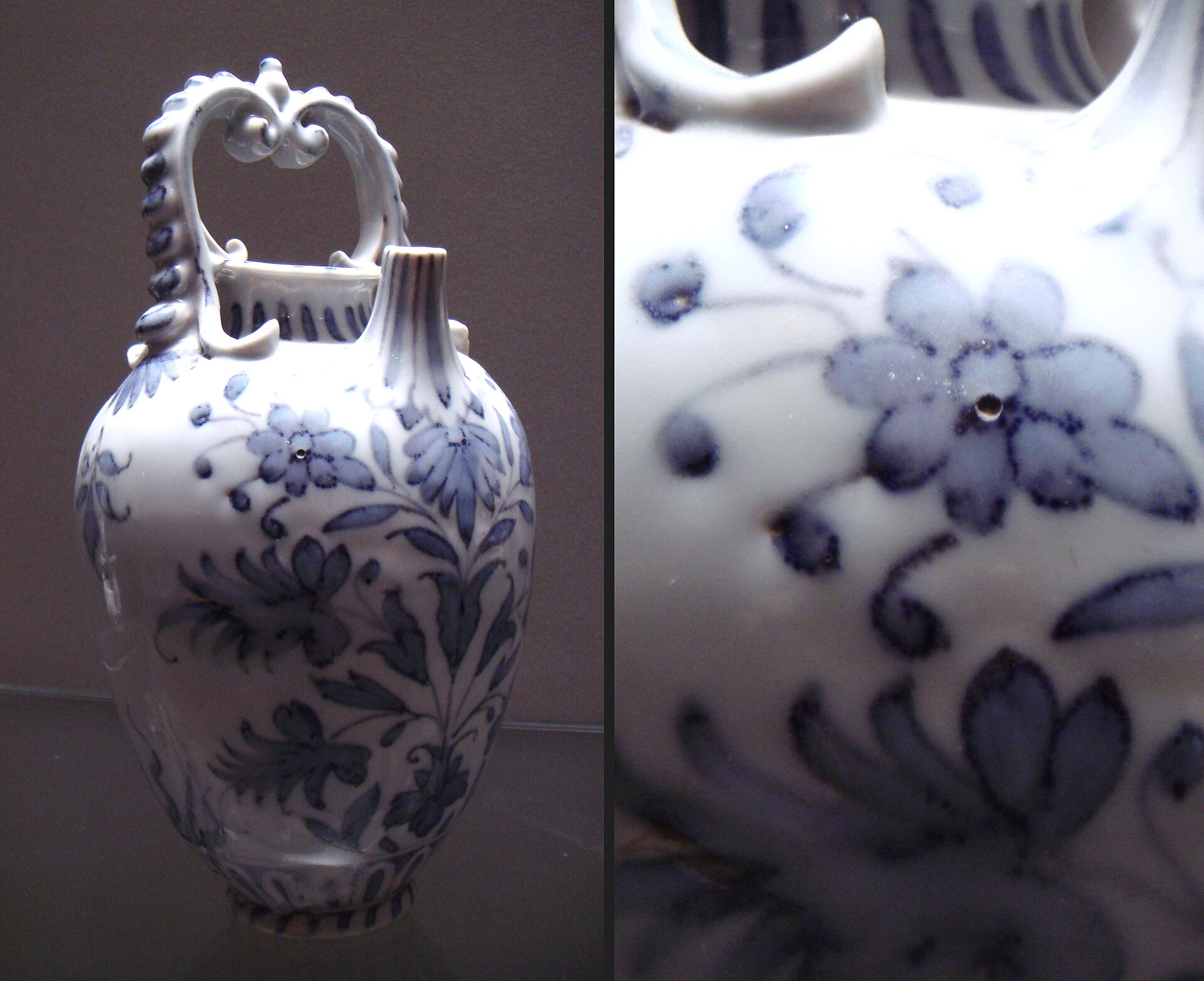
The record subject, in full view and in close-up detail of its cobalt-blue floral decoration, showing the small firing impurities and glaze bubbles typical of this frit-based body. Photographed at the Louvre by Wikimedia user World Imaging; this file alone, among the sibling photographs from the same session, is directly categorized by Wikimedia Commons under this object's Louvre inventory number, OA 2734.
Musee du Louvre, Paris; photograph by World Imaging (Wikimedia Commons, CC BY-SA 3.0)| Artist | Manufacture des Medicis (Casino di San Marco workshop, under the patronage of Francesco I de' Medici) |
|---|---|
| Date | Louvre catalogue bracket 1585-1600 (fourth quarter of the 16th century); the Casino di San Marco workshop's documented active production window is c. 1575-1587 |
| Medium | Soft-paste (fritware) porcelain, tin-opacified lead glaze, painted decoration in underglaze cobalt blue |
| Dimensions | Height 20.5 cm; diameter 11.3 cm |
| Where it is now | Musee du Louvre, Paris, Departement des Objets d'art du Moyen Age, de la Renaissance et des temps moderneslast confirmed |
| Inventory number | OA 2734 |
| Attribution | AcceptedAttributed to the Medici grand-ducal porcelain manufactory on the basis of body and glaze composition (a soft-paste, frit-based body with a tin-opacified lead glaze and underglaze cobalt-blue decoration) consistent with the small surviving corpus, and confirmed by a painted underglaze mark on the underside combining the dome of Florence Cathedral (Santa Maria del Fiore) with a capital letter F, one of the two devices associated with the workshop founded under Francesco I de' Medici. Full note |
| Object type | Ceramic |
| Period | Italian Renaissance, late sixteenth century, Grand Duchy of Tuscany |
| Cases | Has a provenance gap |
| Inscriptions | No text inscription. A painted underglaze-blue mark on the underside shows the dome of Florence Cathedral (Santa Maria del Fiore) surmounted by a capital letter F, per the Louvre's own catalogue description. |
| Owners on record | 4 links2 documented, 2 unknown |
| Sources | 13 cited |
About this record Last verified · 13 sources cited · Change log
On this page 9 sections
ContentsClose
A small blue-and-white ewer, 20.5 centimetres tall, made in Florence in the last quarter of the sixteenth century at the world's first successful European porcelain workshop, a furnace built inside Grand Duke Francesco I de' Medici's private laboratory-palace, the Casino di San Marco. It is one of perhaps sixty to seventy such pieces to survive anywhere, and one of the smaller number that still carries the workshop's own painted mark, the dome of Florence Cathedral over a capital F.
The Louvre holds it, and three related but distinct pieces, in the Departement des Objets d'art. This one was bought by the French state in 1885 for 3,500 francs from an otherwise undocumented owner; the other three came in two years earlier as part of the bequest of Baron Jean-Charles Davillier, a historian who had written one of the first serious studies of the factory's output. The recipe the workshop used was never written down in a form that survived Francesco's death in 1587, and was only pieced back together through chemical analysis of the surviving pieces themselves, most recently by Raman spectroscopy carried out directly on museum objects in the early 2000s.
Where the piece stood before 1885, and who "Pennelli" was, is not recorded in any source consulted for this record. That gap is honest rather than filled in, in keeping with how little is documented about almost anything Medici porcelain touched between the 1772 dispersal of the Tuscan grand-ducal stock and its slow re-collection by nineteenth-century connoisseurs like Davillier.
Provenance
Each link is graded. Documented: a cited source supports it. Disputed: the identification is argued but not established. Unknown: no owner for that span, and the gap is not smoothed into a narrative. The grades in the glossary.
- c. 1575-1587 - 1587Casino di San Marco workshop, under Francesco I de' Medici, Grand Duke of Tuscanydocumented
Made at the experimental porcelain furnace inside the Casino di San Marco, Florence, during the workshop's active production period. Production is documented to have ceased at or shortly after Francesco I's death on 19 October 1587, with no secure evidence of further manufacture afterward. The Louvre's own catalogue bracket for this specific piece, 1585-1600, runs slightly past that date; this record treats the wider date as the museum's cataloguing convention rather than evidence of continued production, since no source consulted documents porcelain manufacture at the Casino after 1587.156
- 1587 -Unknownunknown
No owner, location or event is documented for this specific piece between its manufacture and its appearance in the hands of a previous owner recorded by the Louvre only by the surname "Pennelli" ahead of the 1885 purchase. Whether it passed through the Medici grand-ducal collections themselves, was dispersed at the 1772 Palazzo Vecchio auction of Tuscan porcelain stock along with much of the rest of the surviving production, or left Florence by another route, is not stated in any source consulted.1
- - 1885"Pennelli" (otherwise unidentified in the sources consulted)unknown
The Louvre's own provenance note for OA 2734 names only a prior owner or vendor recorded as "Pennelli," with no first name, nationality or further identification given. This record does not guess at who that was.1
- 1885 - presentMusee du Louvre, Paris (French state)documented
Purchased by the French state on 26 February 1885 for 3,500 francs. The Louvre's own record cites the acquisition file as AN 20144787/9. The piece has remained in the Departement des Objets d'art since, and was on display in Room 516 of the Richelieu wing when photographed in 2009; the Louvre's online collection database records it as not currently on display.110
Technical evidence
| Attribution note | Attributed to the Medici grand-ducal porcelain manufactory on the basis of body and glaze composition (a soft-paste, frit-based body with a tin-opacified lead glaze and underglaze cobalt-blue decoration) consistent with the small surviving corpus, and confirmed by a painted underglaze mark on the underside combining the dome of Florence Cathedral (Santa Maria del Fiore) with a capital letter F, one of the two devices associated with the workshop founded under Francesco I de' Medici. Most surviving Medici porcelain is unmarked, or marked inconsistently; this piece is among the minority that carries the mark, which is one reason the Louvre's identification of it is treated as secure rather than stylistic guesswork. |
|---|---|
| Body | Soft-paste (fritware) porcelain: white Vicenza clay combined with ground quartz or rock crystal, feldspar, and calcium compounds (alpha- and beta-wollastonite identified by later analysis), fired at a lower temperature than true hard-paste porcelain.58 |
| Glaze | Transparent lead glaze opacified with a calcium-phosphate source consistent with calcined bone, a technique with roots in Islamic ceramic practice, rather than the tin oxide used in ordinary European maiolica.58 |
| Decoration | Floral sprigs painted in underglaze cobalt blue across the full body, following the general model of Chinese blue-and-white and, in vocabulary, Ottoman Iznik ceramics reaching Florence through Medici trade contacts.15 |
| Dimensions | Height 20.5 cm; diameter 11.3 cm.1 |
| Mark | Painted underglaze-blue mark on the underside: the dome of Florence Cathedral (Santa Maria del Fiore) surmounted by a capital letter F, one of two devices (the other being the Medici palle) associated with the Casino di San Marco workshop, applied inconsistently across the surviving corpus.15 |
| Firing evidence | Small dark impurity specks in the glaze and visible pinholes or bubbles at the surface, characteristic of a frit-based body fired at the edge of sixteenth-century Florentine kiln capability; visible on this piece under close photographic inspection.10 |
| Handle and spout form | Single scrolled handle rising to an open, heart-shaped loop above the rim; short pouring spout set into the neck below the rim.110 |
| Modern scientific analysis | On-site, non-invasive Raman spectroscopy of Medici porcelain body and glaze, published by Colomban, Milande and Lucas in the Journal of Raman Spectroscopy in 2004, providing the basis for the current understanding of the body and glaze chemistry described above.8 |
| Department and inventory | Musee du Louvre, Departement des Objets d'art du Moyen Age, de la Renaissance et des temps modernes, inventory number OA 2734.1 |
Images
The record in full
Chapter 1What it is
A small ewer, or chevrette, in white porcelain painted in monochrome blue: 20.5 centimetres tall and 11.3 centimetres across at its widest, with a single scrolled handle that rises into an open...
A small ewer, or chevrette, in white porcelain painted in monochrome blue: 20.5 centimetres tall and 11.3 centimetres across at its widest, with a single scrolled handle that rises into an open heart-shaped loop above the rim, a short pouring spout set into the neck, and an ovoid body covered edge to edge in flowering sprigs picked out in cobalt underglaze. Turned upside down, the foot carries a small painted mark, the dome of Florence Cathedral above a capital F, the closest thing this workshop had to a signature.
Close inspection of the glaze shows what a fully successful porcelain body would not: small dark specks where impurities in the frit fired unevenly, and tiny pinholes and bubbles trapped in the surface where the glaze did not settle perfectly smooth. These are not damage. They are exactly what a soft-paste, frit-based body pushed to the edge of what a sixteenth-century Florentine kiln could achieve looks like, and they are part of why this object matters more than its size suggests.
Chapter 2A furnace inside a palace
The piece was made at a workshop that did not resemble a commercial pottery in any way.
The piece was made at a workshop that did not resemble a commercial pottery in any way. It operated inside the Casino di San Marco, a palace built for Francesco I de' Medici, Grand Duke of Tuscany, by his court architect Bernardo Buontalenti between 1568 and 1574, on a site near Piazza San Marco in Florence. Francesco intended the building as both a residence and, in his own words as later summarised by scholars, a laboratory of alchemical and physical experiments, and he moved the Medici grand-ducal foundry there, converting part of the complex into rooms for glassmaking, pharmacy, and porcelain.
This is not incidental dressing. The porcelain furnace shared a roof, and very likely shared workers, with an alchemical laboratory and a glass workshop that later produced Antonio Neri's L'arte vetraria of 1612, the first serious European treatise on glass technology. Francesco's court biography consistently describes him as more interested in scientific and mechanical pursuits than in the business of ruling, and the porcelain project reads as one output, among several, of that interest rather than a stand-alone commercial venture.
Chapter 3Why porcelain, and why then
By the middle of the sixteenth century, Chinese blue-and-white porcelain was reaching Florence through Medici trade contacts and diplomatic exchange in small but conspicuous quantities, prized for a...
By the middle of the sixteenth century, Chinese blue-and-white porcelain was reaching Florence through Medici trade contacts and diplomatic exchange in small but conspicuous quantities, prized for a combination of qualities no European ceramic could match: translucency, hardness, and extreme thinness fired without collapsing. Ottoman and Iznik blue-and-white wares, closer at hand and more available, offered a related but distinct model that Florentine painters drew on for some of the same floral vocabulary seen on this piece.
The Venetian ambassador Andrea Gussoni reported to his own government in 1575 that Francesco had found a way to make what he called "the porcelain of India," adding that it had taken ten years of work and that, in the end, a traveller from the Levant had shown Francesco the way to succeed. That single sentence is the closest thing to a contemporary account of how the secret was actually obtained, and it is treated in the scholarship as a documented, if frustratingly brief, record rather than legend: an eyewitness diplomatic report, not a later retelling.
Chapter 4The craftsmen
Vasari's own writing already places Buontalenti at work trying to discover porcelain as early as 1568, before any success is documented, which makes him the earliest named figure associated with the...
Vasari's own writing already places Buontalenti at work trying to discover porcelain as early as 1568, before any success is documented, which makes him the earliest named figure associated with the project, in his capacity as court architect and engineer rather than as a potter. The maiolica painter Flaminio Fontana, from a family of ceramicists with roots in Urbino, is separately documented as having been paid for twenty-five to thirty pieces delivered to the Medici factory in 1578, which places a specific, named decorator inside the workshop during its active years.
A third figure, the Delft-born goldsmith and gem-cutter Jacques Bylivelt, who had joined the Medici court workshops in 1573 to head the hardstone and jewellery workshop, is documented in 1590, three years after Francesco's death, drawing up an inventory as he oversaw the transport of 154 pieces of porcelain, 64 of them identified specifically as Medici production, from the Villa Medici in Rome back to Florence. Bylivelt's inventory description of one vessel's neck, shaped, in his words, in the manner of a reed cut down the middle, is detailed enough that it has been matched by curators to the distinctive split-necked form still held today as the Louvre's own OA 3101. Beyond these three names, the great majority of hands that actually worked the clay, mixed the frit, and fired the kiln are not identified in any source consulted for this record.
Chapter 5How it was made
Medici porcelain is not porcelain in the sense the word describes Chinese or Japanese hard-paste wares, fired from kaolin at very high temperature.
Medici porcelain is not porcelain in the sense the word describes Chinese or Japanese hard-paste wares, fired from kaolin at very high temperature. It is a soft-paste, or frit, body: white Vicenza clay mixed with ground rock crystal or quartz sand, feldspar, and calcium compounds, fired at a lower temperature and covered with a lead glaze deliberately opacified, in the manner of Islamic and Iznik ceramics, using calcined bone or a related calcium-phosphate source rather than the tin oxide used in ordinary European tin-glazed maiolica. Decoration was painted directly onto this glaze in cobalt blue, sometimes outlined in manganese, and fired again, producing the grey-toned blues visible on this piece rather than the purer blue of Chinese originals.
The process pushed contemporary Florentine kiln technology to its limit. Achieving a translucent, thin-walled body at these temperatures without warping or collapse required firing conditions that period sources describe as producing very high costs and, on the evidence of the surviving pieces themselves, a high failure rate: nearly every known example carries some combination of firing cracks, glaze bubbles, or the kind of dark impurity specks visible on this ewer's surface under close inspection.
Chapter 6How production ended
Francesco I de' Medici died on 19 October 1587.
Francesco I de' Medici died on 19 October 1587. No source consulted for this record documents any secure evidence of porcelain manufacture at the Casino di San Marco after his death, and the standard scholarly position, reflected in the reference works cited here, is that production ceased at or very close to that date. An inventory drawn up at Francesco's death recorded 310 pieces of porcelain in the grand-ducal collection, a figure worth holding onto for what it says about scale: several hundred pieces existed at the moment production stopped, against the sixty to seventy, by differing modern counts, that are known to survive today.
Francesco's brother and successor, Cardinal Ferdinando de' Medici, inherited the collection and, on becoming Grand Duke, had part of it moved from the Villa Medici in Rome to Florence; the 1590 transport overseen by Jacques Bylivelt, discussed above, is the documented record of that move. A large portion of what remained in Tuscan grand-ducal storage was later dispersed at an auction held at the Palazzo Vecchio in 1772, the point after which individual pieces begin to scatter into private and, eventually, museum hands across Europe with little continuous paper trail.
Chapter 7How many survive, and where
Modern scholarship gives different counts depending on the cut-off date and the criteria used.
Modern scholarship gives different counts depending on the cut-off date and the criteria used. The Metropolitan Museum of Art's own published figure is 59 surviving examples; older surveys, including the standard illustrated catalogues by Giuseppe Liverani (1936) and by Giuseppe Cora and Angiolo Fanfani (1986), are more often summarised in secondary literature as putting the number nearer sixty to seventy. This record treats the exact figure as unsettled rather than picking one estimate to state as fact.
Whichever count is used, the surviving pieces are concentrated in a small number of institutions: the Musee du Louvre, the Metropolitan Museum of Art, the Victoria and Albert Museum, the National Gallery of Art in Washington, the J. Paul Getty Museum, and the Sevres - Cite de la ceramique, which alone holds about ten examples, along with the Museo Nazionale del Bargello and other Florentine collections closer to the object's origin. The Louvre's own four Medici porcelain pieces, described further below, are a small but genuine part of that total.
Chapter 8What the rest of the type has sold for
This ewer itself was bought by the French state in 1885, not at public auction, so it carries no hammer price of its own to report.
This ewer itself was bought by the French state in 1885, not at public auction, so it carries no hammer price of its own to report. Other pieces of Medici porcelain have appeared on the open market since, and they establish what this small class of object is worth to collectors when it does trade, which is useful context for a piece the Louvre bought outright. A Medici porcelain vase dated to 1575 sold in Paris in 1995 for a reported price of around 870,000 pounds sterling, quoted in secondary reporting as approximately 6,430,000 French francs. A Medici porcelain cruet of about the same date sold at Christie's in 1999 for 287,000 pounds.
Neither sale involved this object, and this record does not treat those figures as evidence of this ewer's value. They are recorded here only because they show what the wider market has been willing to pay for authenticated pieces of the same rare, twelve-year production run, which is the only real comparison available for an object that has not itself been back on the market since 1885.
Chapter 9Authenticating a piece with almost no signature
Establishing that any individual object is genuine Medici production, rather than a later or contemporary imitation, is a live problem for this material precisely because so few pieces are marked...
Establishing that any individual object is genuine Medici production, rather than a later or contemporary imitation, is a live problem for this material precisely because so few pieces are marked, and the marks that do exist, the domed-F device or the Medici palle, appear inconsistently even among pieces otherwise agreed to be authentic. In practice, museums and scholars build a case from several kinds of evidence together: documented descent from the Medici grand-ducal collections where a paper trail survives, comparison of a piece's decorative vocabulary and potting against securely marked or documented examples, and, increasingly, direct chemical and microscopic analysis of the body and glaze against the now well-characterised composition of confirmed Medici porcelain.
This particular ewer sits on the more secure end of that spectrum for a specific reason: it is marked. The painted dome-and-F device on its underside removes one layer of the usual uncertainty that surrounds unmarked pieces, although the Louvre's own broad cataloguing date range of 1585-1600, which extends past the 1587 end of documented production, is a reminder that even a marked piece is not dated with full precision.
Chapter 10The recipe that had to be rediscovered
No workshop formula for Medici porcelain survived in a form later chemists could simply read and reproduce.
No workshop formula for Medici porcelain survived in a form later chemists could simply read and reproduce. What contemporaries wrote down, in the Gussoni report and scattered court records, describes the fact of success and something of its cost, not the technical recipe itself, and once the Casino di San Marco furnace stopped operating after 1587, the specific combination of clay, frit and glaze chemistry that had been worked out over roughly a decade of experimentation was not carried forward by any documented successor workshop in Italy.
Understanding how the body and glaze were actually put together has therefore depended entirely on later scientific analysis of the objects that survive. Non-invasive Raman spectroscopy carried out directly on museum pieces by Philippe Colomban, Veronique Milande and Helene Lucas, published in the Journal of Raman Spectroscopy in 2004, identified the body's characteristic components, including alpha- and beta-wollastonite, quartz, feldspar and cassiterite, and showed the glaze's opacification relied on calcium phosphate consistent with a calcined-bone source rather than the tin oxide of ordinary maiolica, a technique with roots in Islamic ceramic practice. That analysis, done more than four centuries after this ewer left the kiln, is the closest anyone has come to reading the recipe the Casino's craftsmen never wrote down for posterity.
Chapter 11Three siblings in the same room
This ewer is not the Louvre's only piece of Medici porcelain.
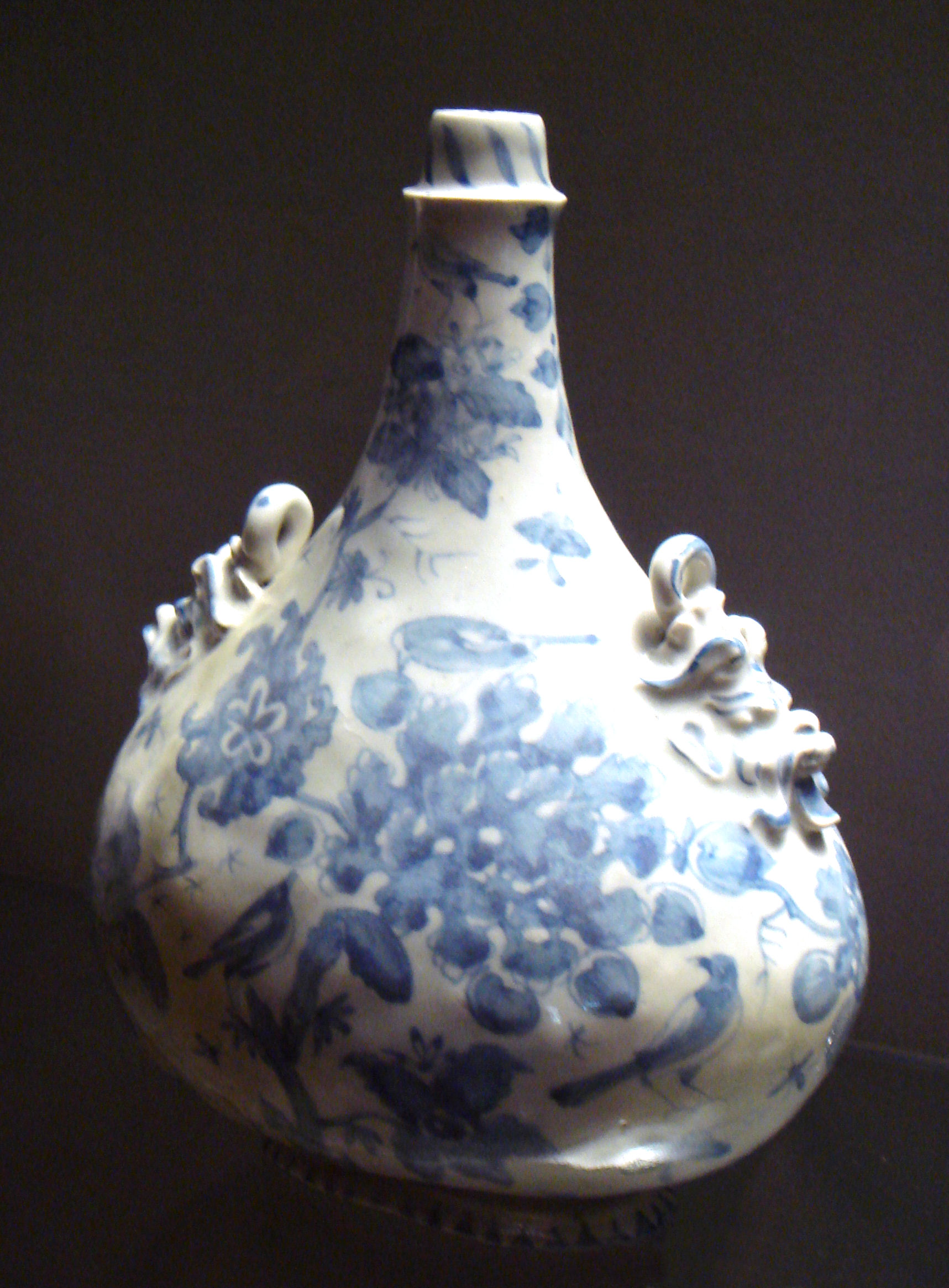
This ewer is not the Louvre's only piece of Medici porcelain. The museum holds three further examples, all bequeathed together in 1883 by Baron Jean-Charles Davillier, a French collector and one of the first serious historians of the ware, whose 1882 study Les origines de la porcelaine en Europe remains a cited reference in the Louvre's own catalogue entries for these objects. They are a two-handled gourd-shaped bottle painted with flowers and birds (OA 3102), a ribbed, pear-shaped vase with rosette medallions (OA 3104), and an ovoid drinking vase with two scroll handles and a distinctive split-reed neck (OA 3101), the same neck form Jacques Bylivelt described in his 1590 transport inventory.
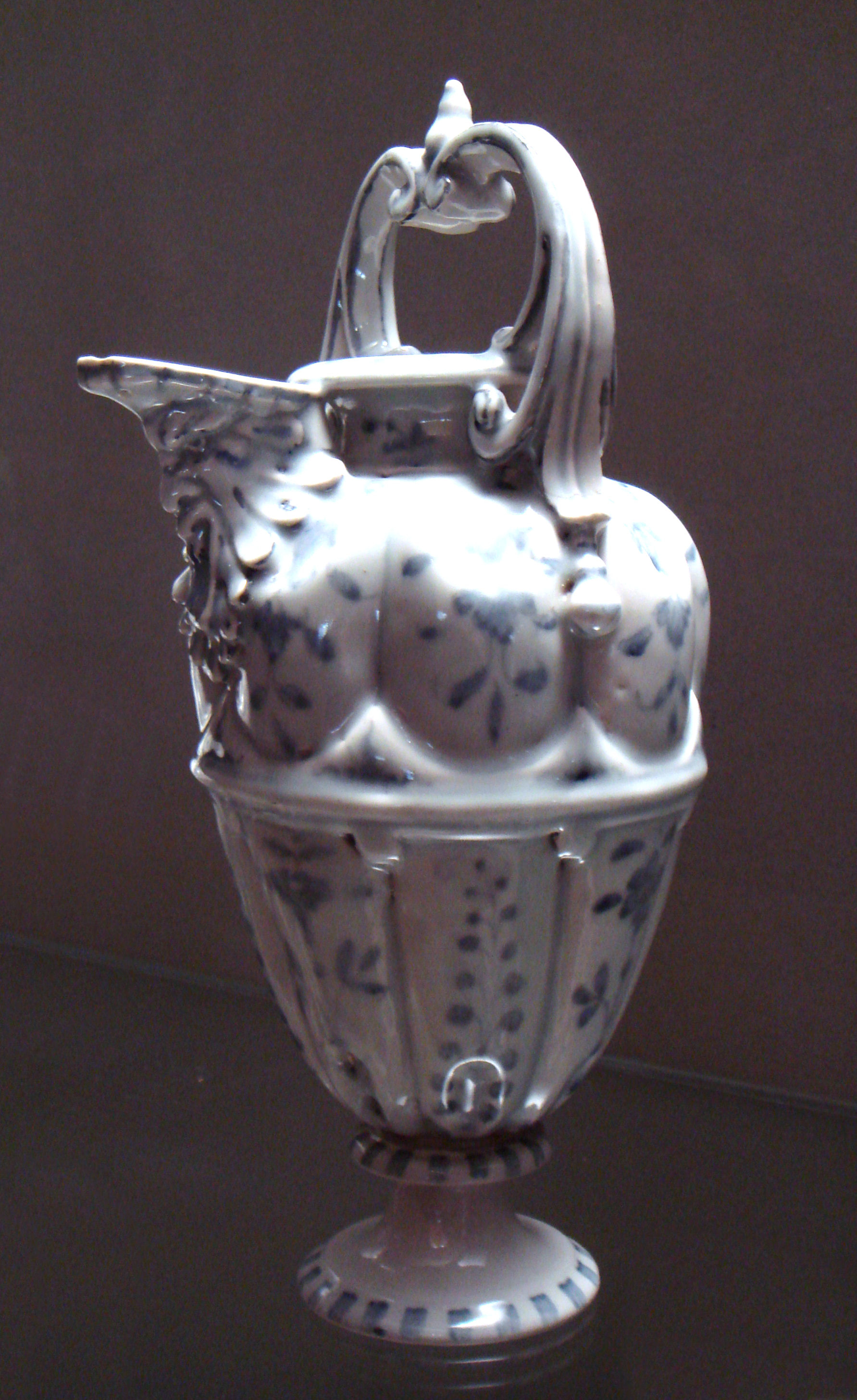
Photographs of the Davillier gourd and the Davillier ribbed vase, taken by the same Wikimedia contributor in the same Louvre gallery in 2009, are included with this record as clearly labelled comparanda from the same small holding, not as this object. They are worth including precisely because they show how varied Medici porcelain's surviving forms are even within a single museum's four pieces: an ewer, a gourd, a ribbed pear-shaped vase, and a two-handled drinking vase, all from a workshop that operated for barely twelve years.
Chapter 12From an unrecorded owner to the French state
Against the depth of documentation available for the object's manufacture and technical composition, its ownership history before 1885 is close to a blank.
Against the depth of documentation available for the object's manufacture and technical composition, its ownership history before 1885 is close to a blank. The Louvre's own record names a previous owner or vendor only as "Pennelli," with no further identification, immediately before the French state's purchase of the piece on 26 February 1885 for 3,500 francs, a transaction recorded under archival reference AN 20144787/9. Nothing in the sources consulted for this record establishes how or when the ewer left Florence, whether it passed through the 1772 Palazzo Vecchio dispersal of grand-ducal porcelain stock, or where it was in the roughly three centuries between the workshop's closure and its appearance in French hands.
That gap is stated here rather than smoothed over. A collector or curator working from this record should treat the object's history as beginning, in documented terms, only in 1885, with everything earlier resting on the general history of the workshop rather than on any paper trail specific to this piece.
Chapter 13What is still unresolved
Two kinds of open question run through this object: how it is dated, and where it was before the paper trail begins.
Two kinds of open question run through this object: how it is dated, and where it was before the paper trail begins. The Louvre's own catalogue bracket of 1585-1600 sits awkwardly against a production history that every other source consulted dates as ending in 1587, and no source resolves that tension directly. Separately, the identity of "Pennelli," the piece's last owner before the state's purchase, and the object's whereabouts for roughly three centuries before that, are not recovered in any source available for this record.
Both gaps are recorded as gaps. Neither is bridged with a guess.
The artist
Francesco I de' Medici, Grand Duke of Tuscany, patron; with Bernardo Buontalenti, Flaminio Fontana and Jacques Bylivelt among the documented craftsmen of the Casino di San Marco workshop
No single named artist made this ewer, and that is true of essentially every piece of Medici porcelain that survives. The workshop that produced it existed for barely twelve years inside a Florentine palace built as much as a laboratory as a residence, under the personal direction of a ruling prince more interested, by every account of his own court, in furnaces and chemistry than in government. Where the record allows individual craftsmen to be named at all, this dossier names them; where it does not, that silence is itself part of the object's history.
Related works
| Work | Relation | Where it is |
|---|---|---|
| Gourde a deux passants Manufacture des Medicis | Separate Louvre-held Medici porcelain piece, same small departmental holding A two-handled, gourd-shaped bottle painted with flowers and birds. Part of the 1883 bequest of Baron Jean-Charles Davillier, not the same acquisition as this ewer. A different, separately accessioned object; not this piece. | Musee du Louvre, Paris (OA 3102) |
| Vase piriforme a col etroit et deux anses Manufacture des Medicis | Separate Louvre-held Medici porcelain piece, same small departmental holding A ribbed, pear-shaped vase with rosette and palmette medallions. Also part of the 1883 Davillier bequest. A different, separately accessioned object; not this piece. | Musee du Louvre, Paris (OA 3104) |
| Vase a boire ovoide a deux anses surmonte d'un long col Manufacture des Medicis | Separate Louvre-held Medici porcelain piece, same small departmental holding An ovoid drinking vase with two scroll handles and a distinctive split-reed neck, a form matched by curators to Jacques Bylivelt's 1590 transport inventory description. Also part of the 1883 Davillier bequest. No Wikimedia Commons photograph of this specific piece was identified for this record; it is described here from the Louvre's own catalogue text only. | Musee du Louvre, Paris (OA 3101) |
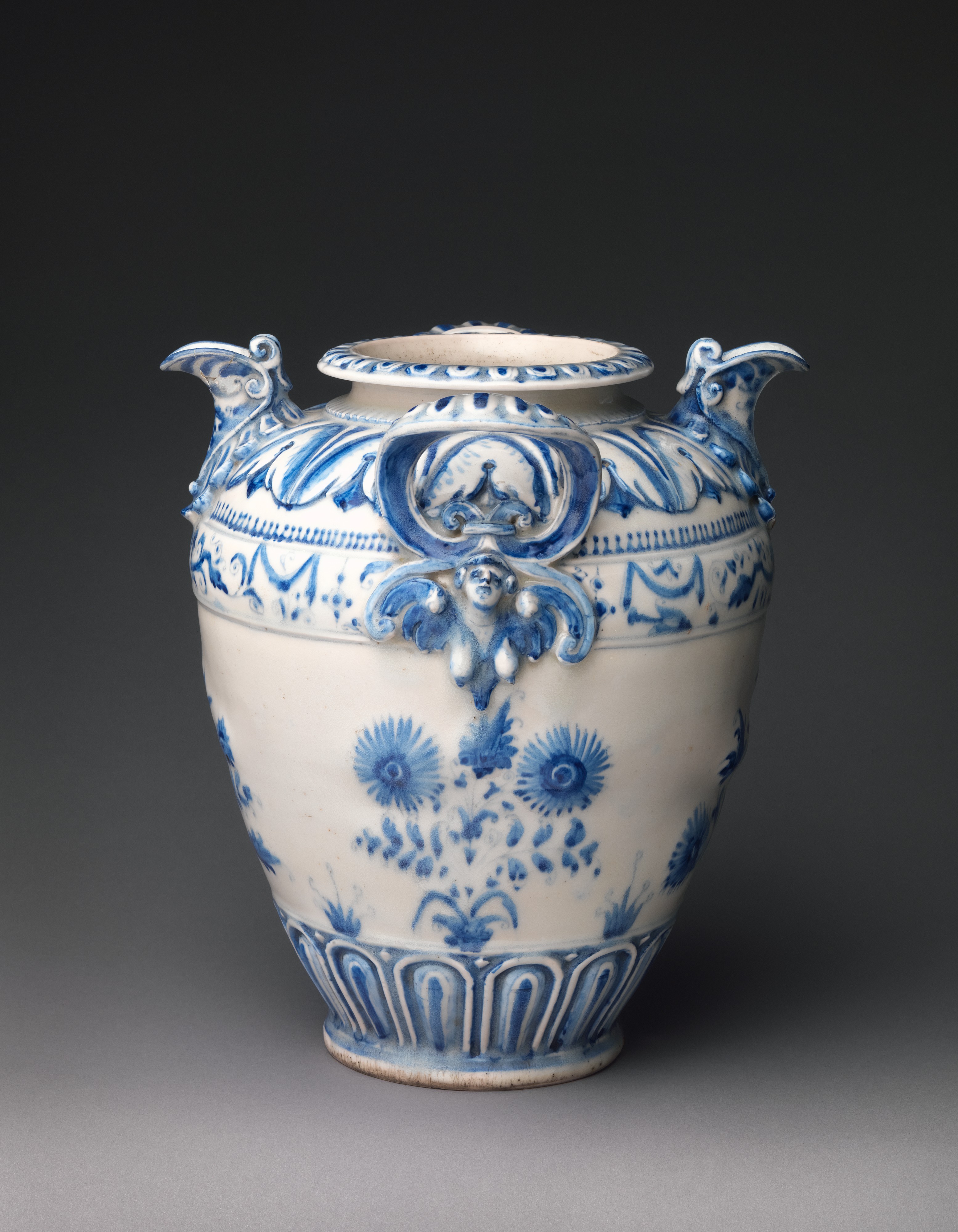
| Ewer (Brocca) Medici Porcelain Manufactory | Comparable Medici porcelain ewer form, different institution Gift of J. Pierpont Morgan, 1917. A different, larger ewer from the same workshop, included as comparanda from a different collection, not as this object. | Metropolitan Museum of Art, New York (accession 17.190.2046) |
| Studiolo of Francesco I Various, under the direction of Vincenzo Borghini and Giorgio Vasari | The patron's own documented cabinet of curiosities and alchemical workroom, physically separate from the Casino di San Marco but expressing the same interests Decorated with, among other panels, Giovanni Stradano's painting of alchemists at work and Giovanni Maria Butteri's painting of a glassworks, documenting Francesco's alchemical and manufacturing interests independently of the porcelain workshop itself. | Palazzo Vecchio, Florence |
Open questions
- Who was "Pennelli," the owner or vendor from whom the French state purchased this ewer in 1885? No further identification is given in the sources consulted.
- Where was the piece, and in whose hands, between the end of documented production in 1587 and its appearance in the Pennelli provenance immediately before 1885? No source consulted bridges this gap.
- Does the Louvre's own catalogue date bracket of 1585-1600 for this piece reflect a real possibility of porcelain production continuing briefly past Francesco I's death in 1587, or is it simply a broad cataloguing convention? The sources consulted do not resolve this directly.
- What is the correct current count of surviving Medici porcelain pieces worldwide? The Metropolitan Museum's published figure of 59 sits against older secondary summaries of 60 to 70; this record does not adjudicate between them.
- Who, beyond Bernardo Buontalenti, Flaminio Fontana and Jacques Bylivelt, actually worked the clay, mixed the frit and fired the kiln at the Casino di San Marco? The great majority of hands involved are not named in any source consulted.
- Did this piece ever form part of the Medici grand-ducal collections directly, or did it leave Florence by some other route entirely? No documented link between the object and the 1587 or 1588 Medici inventories has been identified.
Questions about this object
What is Medici Porcelain Ewer?
Medici Porcelain Ewer is a ceramic, dated louvre catalogue bracket 1585-1600 (fourth quarter of the 16th century); the Casino di San Marco workshop's documented active production window is c. 1575-1587. Medium: Soft-paste (fritware) porcelain, tin-opacified lead glaze, painted decoration in underglaze cobalt blue.
Who made Medici Porcelain Ewer, and is the attribution settled?
The attribution to Manufacture des Medicis (Casino di San Marco workshop, under the patronage of Francesco I de' Medici) is recorded here as accepted. Attributed to the Medici grand-ducal porcelain manufactory on the basis of body and glaze composition (a soft-paste, frit-based body with a tin-opacified lead glaze and underglaze cobalt-blue decoration) consistent with the small surviving corpus, and confirmed by a painted underglaze mark on the underside combining the dome of Florence Cathedral (Santa Maria del Fiore) with a capital letter F, one of the two devices associated with the workshop founded under Francesco I de' Medici. Most surviving Medici porcelain is unmarked, or marked inconsistently; this piece is among the minority that carries the mark, which is one reason the Louvre's identification of it is treated as secure rather than stylistic guesswork.
Where is Medici Porcelain Ewer now?
Musee du Louvre, Paris, Departement des Objets d'art du Moyen Age, de la Renaissance et des temps modernes. Inventory number OA 2734. Last confirmed 5 September 2026. Purchased by the French state, 26 February 1885, for 3,500 francs, from a previous owner recorded only as "Pennelli"; archived under reference AN 20144787/9. Not currently on display per the Louvre's own online collection database; photographed on display in Room 516, Richelieu wing, in 2009.
What is still unknown about Medici Porcelain Ewer?
Who was "Pennelli," the owner or vendor from whom the French state purchased this ewer in 1885? No further identification is given in the sources consulted.
Sources
- 1Musee du Louvre, Louvre Collections online database, "Chevrette ou aiguiere ovoide a une anse et un bec," OA 2734. collections.louvre.fr/en/...
- 2Musee du Louvre, Louvre Collections online database, "Vase a boire ovoide a deux anses surmonte d'un long col," OA 3101. collections.louvre.fr/en/...
- 3Musee du Louvre, Louvre Collections online database, "Gourde a deux passants," OA 3102. collections.louvre.fr/en/...
- 4Musee du Louvre, Louvre Collections online database, "Vase piriforme a col etroit et deux anses," OA 3104. collections.louvre.fr/en/...
- 5Wikipedia, "Medici porcelain," consolidating Vasari's and the Venetian ambassador Andrea Gussoni's contemporary accounts, the 1588 post-mortem inventory, and Metropolitan Museum and Victoria and Albert Museum curatorial descriptions. en.wikipedia.org/wiki/...
- 6Wikipedia, "Casino Mediceo di San Marco," for the building's construction under Bernardo Buontalenti (1568-1574) and its later use as a scientific and manufacturing complex. en.wikipedia.org/wiki/...
- 7Wikipedia, "Studiolo of Francesco I," for the iconographic programme of Francesco's private study in the Palazzo Vecchio, including Giovanni Stradano's painting of alchemists and Giovanni Maria Butteri's painting of a glassworks among its wall panels. en.wikipedia.org/wiki/...
- 8Colomban, Ph., Milande, V. and Lucas, H., "On-site Raman analysis of Medici porcelain," Journal of Raman Spectroscopy, vol. 35, no. 1 (2004), pp. 68-72. analyticalsciencejournals.onlinelibrary.wiley.com/doi/...
- 9"Casino di San Marco: 'The House of Nature'," Cabinet magazine, on the building's laboratories for alchemy, glassmaking, porcelain and pharmacy under Francesco I and their survival into the seventeenth century. cabinet.ox.ac.uk/casino-di-san-marco-house-nature
- 10Wikimedia Commons, File:Medici porcelain with surface detail Florence 1575 1587.jpg, photograph by Wikimedia user World Imaging, own work, photographed at the Louvre, 2009, categorized by Commons directly under Louvre inventory number OA 2734, CC BY-SA 3.0. commons.wikimedia.org/wiki/...
- 11Wikimedia Commons, File:Medici porcelain ewer 1575 1587.jpg, photograph by Wikimedia user World Imaging, own work, photographed at the Louvre, 2009, CC BY-SA 3.0. commons.wikimedia.org/wiki/...
- 12Wikimedia Commons, File:Medici porcelain gourd 1575 1587.jpg, photograph by Wikimedia user World Imaging, own work, photographed at the Louvre, 2009, CC BY-SA 3.0. commons.wikimedia.org/wiki/...
- 13The Metropolitan Museum of Art, "Ewer (Brocca)," Medici Porcelain Manufactory, accession 17.190.2046, Gift of J. Pierpont Morgan, 1917. Open access, public domain. metmuseum.org/art/...


Last verified · Published
Change log
5 September 2026 - Record created at the house standard: researched narrative, technical evidence, maker dossier, graded provenance chain, prices with hammer and premium separated, related works, open questions and sources.