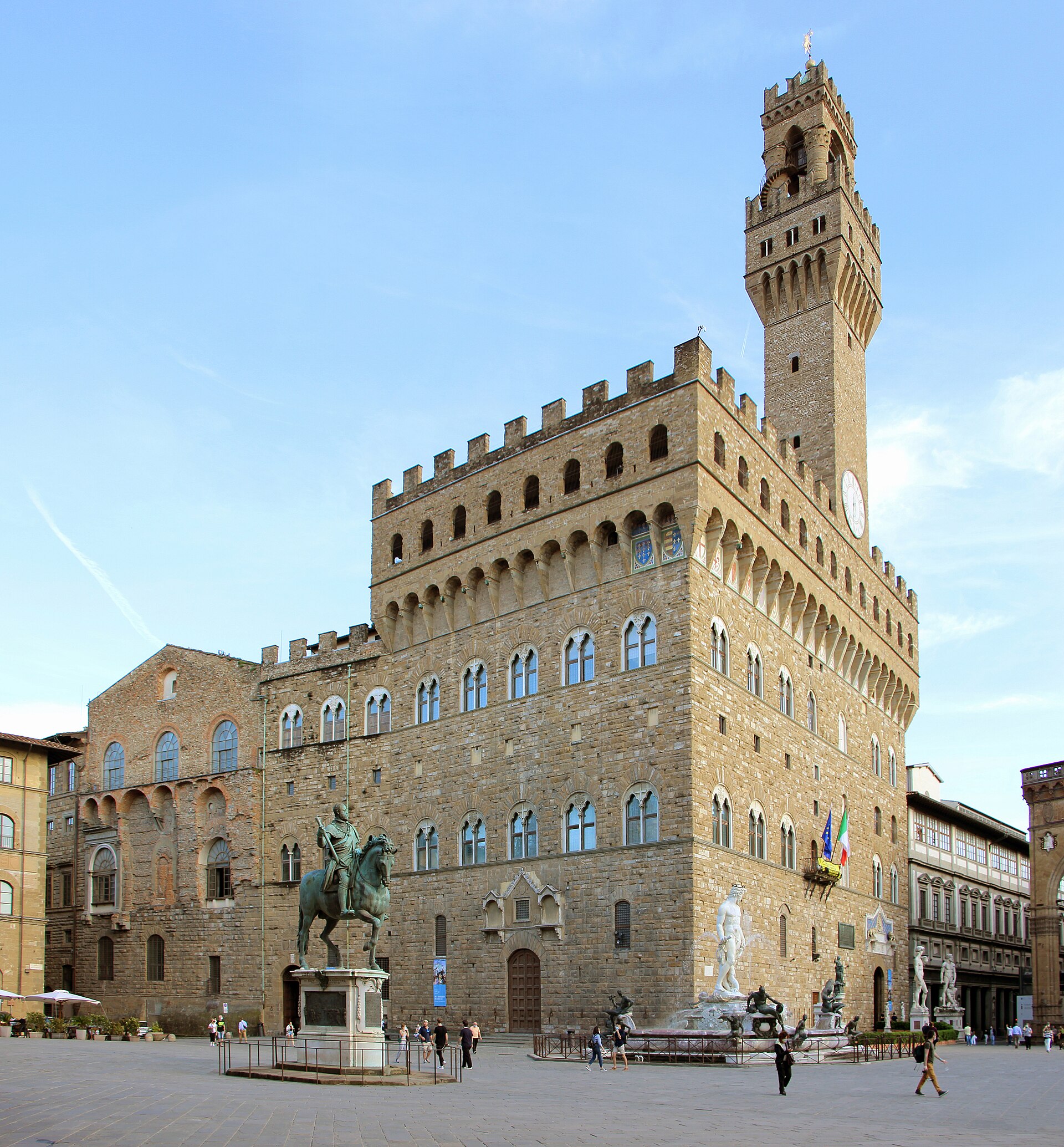
Palazzo Vecchio seen from Piazza della Signoria, Florence.
Francesco Bini (Sailko) · CC BY-SA 4.0Palazzo Vecchio
Museum · Founded 1299
Open, admission and hours confirmed 9 September 2026 · 15 sources
On this page 15 sections
ContentsClose
Palazzo Vecchio's holdings are inseparable from the building itself. Its Renaissance sculpture, Donatello's Judith and Holofernes and Michelangelo's Genius of Victory, and its fresco cycles, Vasari's Salone dei Cinquecento and Studiolo, Bronzino's chapel, and Ghirlandaio's Sala dei Gigli, were made for these specific rooms and have never left them. The museum's strength is site-specific decoration and civic history rather than a portable collection that could be lent elsewhere or compared gallery to gallery.
| Kind | Museum |
|---|---|
| Founded | 1299 |
| City and country |  Florence, Italy Florence, Italy |
| Address | Piazza della Signoria, 50122 Firenze, Italy |
| Website | cultura.comune.fi.it/pagina/musei-civici-fiorentini/museo-di-palazzo-vecchio |
| Status | Open, confirmed |
| Record last verified |
Visiting
- Hours
- Mon-Wed, Fri-Sun09:00 to 19:00Museum. Ticket office closes one hour before museum closing time.
- Thu09:00 to 14:00Museum, shortened Thursday hours.
- Mon-Wed, Fri-Sun09:00 to 17:00Arnolfo Tower and battlements. Arrive 15 minutes before closing; closed during rain or high wind.
- Thu09:00 to 14:00Arnolfo Tower, shortened Thursday hours.
- Admission
- Museum - FullEUR 18
- Museum - Reduced (age 18-25 / university students)EUR 12
- Museum - Under 18Freefree entry
- Arnolfo Tower and battlements - FullEUR 20sold as a separate ticket from the museum
- Arnolfo Tower and battlements - Reduced (age 18-25)EUR 13sold as a separate ticket from the museum
- Roman theatre excavations, guided tourEUR 5Saturday and Sunday only, 12:00 and 12:45, groups capped at 15 people
- Tickets
- bigliettimusei.comune.fi.it The museum's own ticket page.
- Do I need to book?
- No advance booking for individual museum entry. Guided tours and activities (Secret Passages, atelier workshops, family tours) are run by Fondazione MUS.E and must be reserved in advance.
- Address
- Piazza della Signoria, 50122 Firenze, Italy MapBus ATAF city bus lines C1 or C2 stop close to Piazza della Signoria
- Website
- cultura.comune.fi.it/pagina/musei-civici-fiorentini/museo-di-palazzo-vecchio
- Telephone
- +39 055 276 8325
- [email protected]
Before you go how long, access, photography, bags, eating, shop
- How long to allow
- One to two hours for the museum rooms alone; longer if the Arnolfo Tower, the Roman theatre excavations or a guided tour are added.
- Access
- Step-free access is via the side entrance on Via dei Gondi, with a lift to the upper floors. An inclusive-access programme funded under Italy's PNRR cultural-accessibility measure has added tactile stations, tactile boards and audio-described tours for blind, low-vision and deaf visitors.
- Photography
- The museum's own visitor page directs anyone wanting to photograph or film beyond personal use to apply for authorisation through the municipal culture office; casual visitor photography is not restricted on the page.
Prices and hours change. We take them from the institution's own pages and print the day we read them, and you can check the current position at the source we used. Confirm before you travel.
What is inside
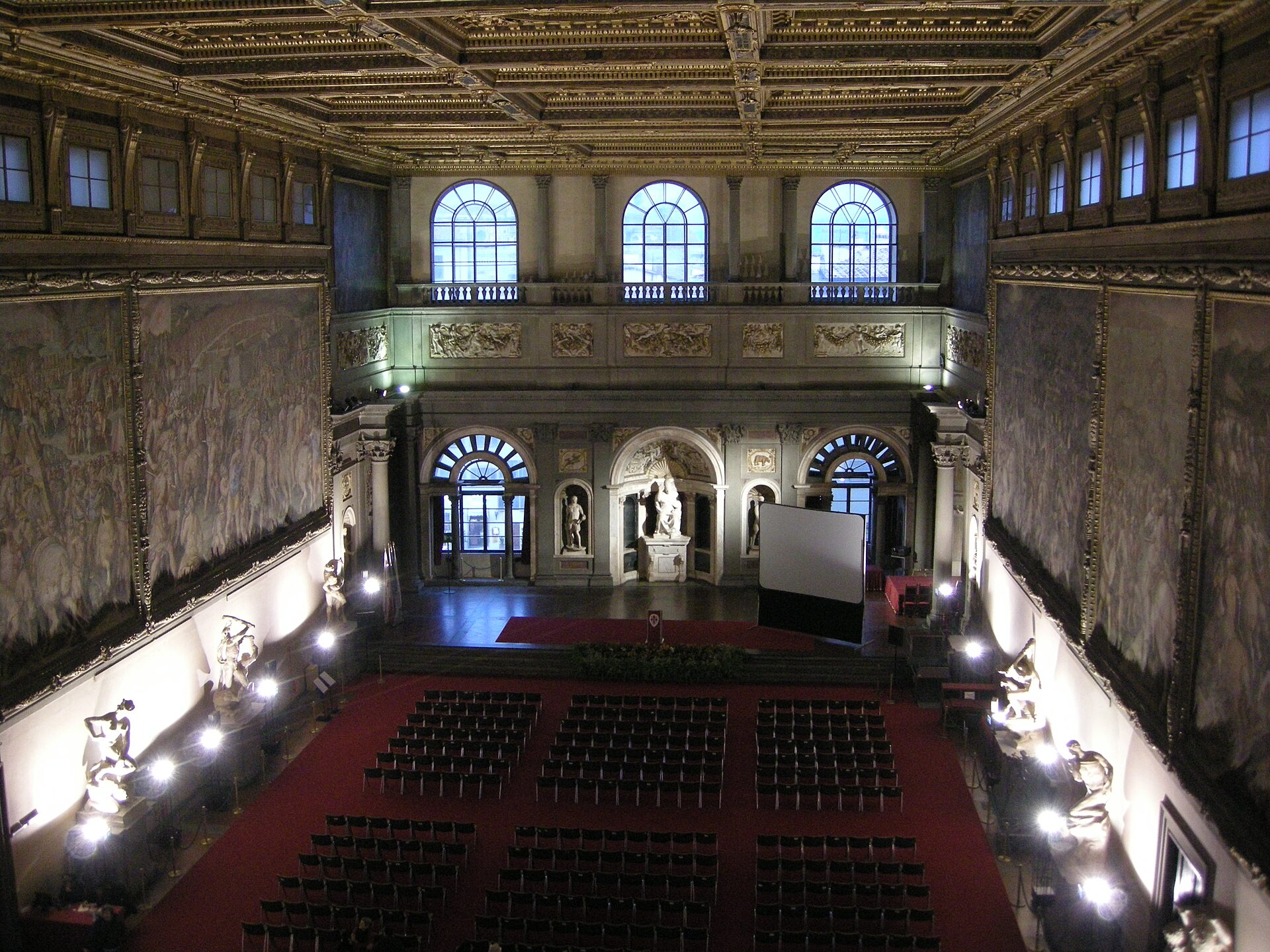
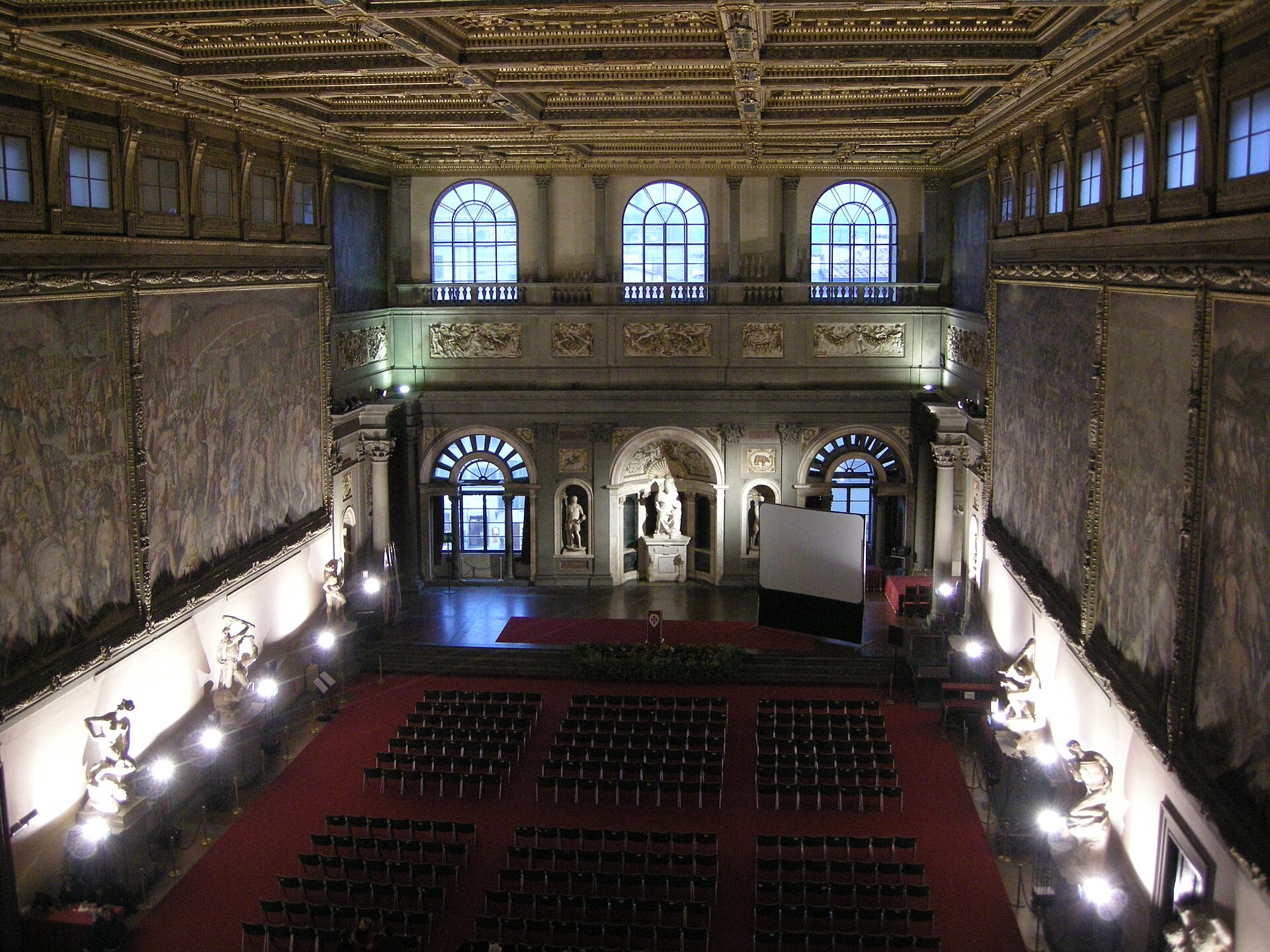
Photograph by sailko · CC BY-SA 3.0 Salone dei Cinquecento
The great council hall built from 1495 for Girolamo Savonarola's 500-member Grand Council, later enlarged by Cosimo I. Its walls and ceiling carry Giorgio Vasari's fresco cycle of Florentine victories over Pisa and Siena, painted over the site of the unfinished, lost murals Leonardo da Vinci and Michelangelo had begun here. Michelangelo's marble Genius of Victory stands in a niche facing the entrance.
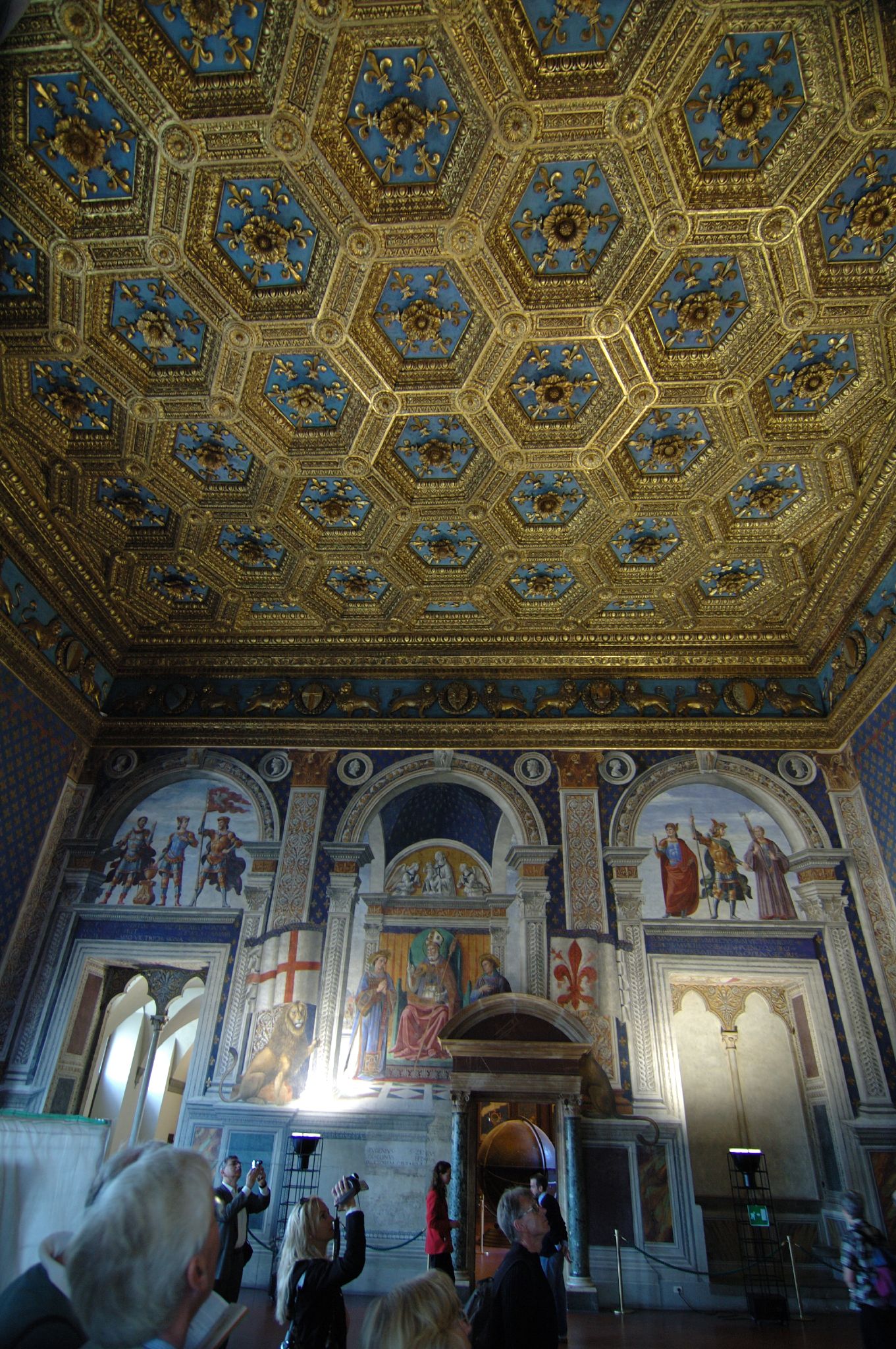
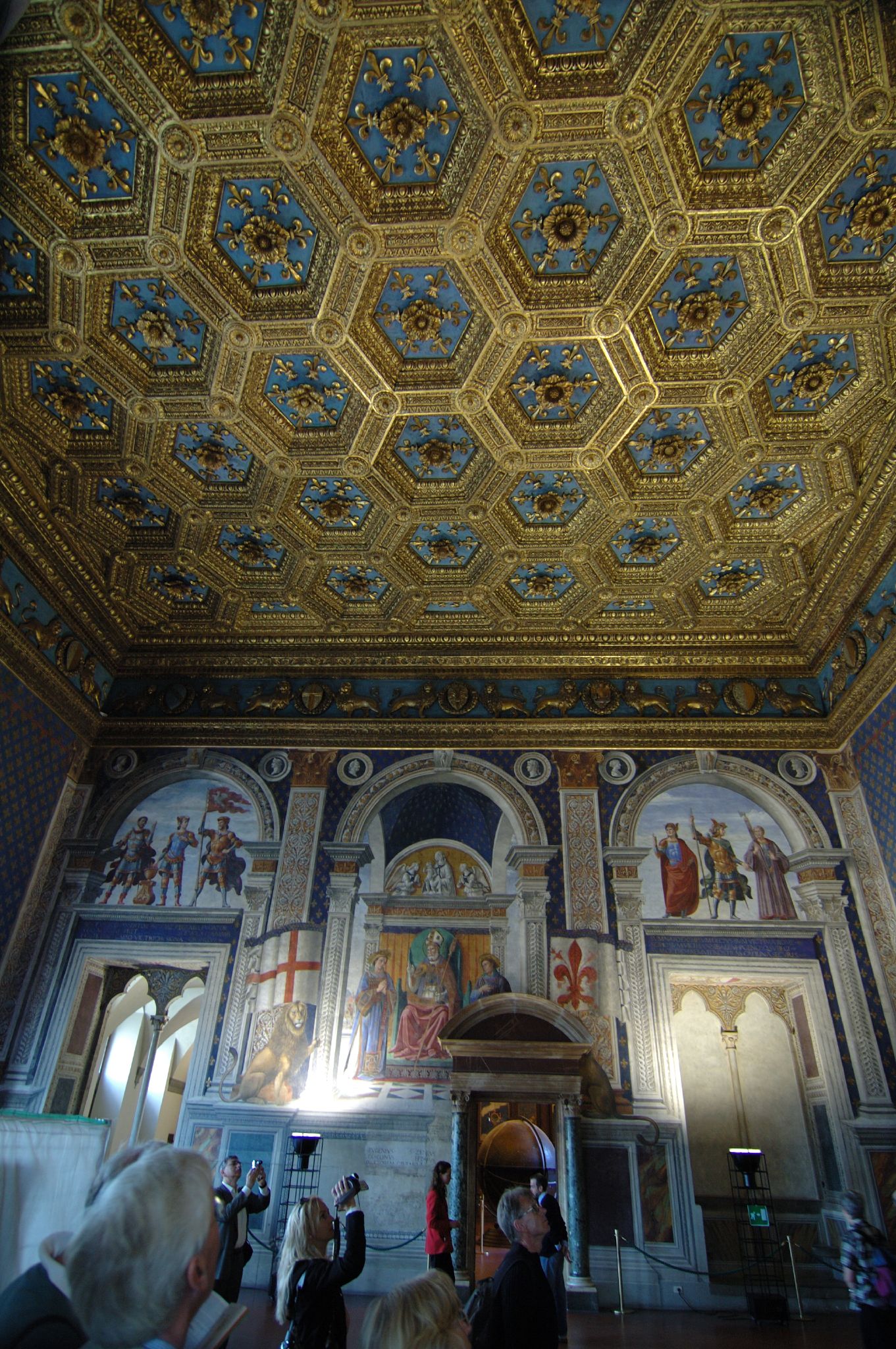
Photograph by gaspa · CC BY 2.0 Sala dei Gigli
A hall named for the fleur-de-lis pattern on its coffered ceiling by Benedetto and Giuliano da Maiano. It holds Donatello's bronze Judith and Holofernes and Domenico Ghirlandaio's fresco of Saint Zenobius enthroned among figures of Republican and Imperial Rome.
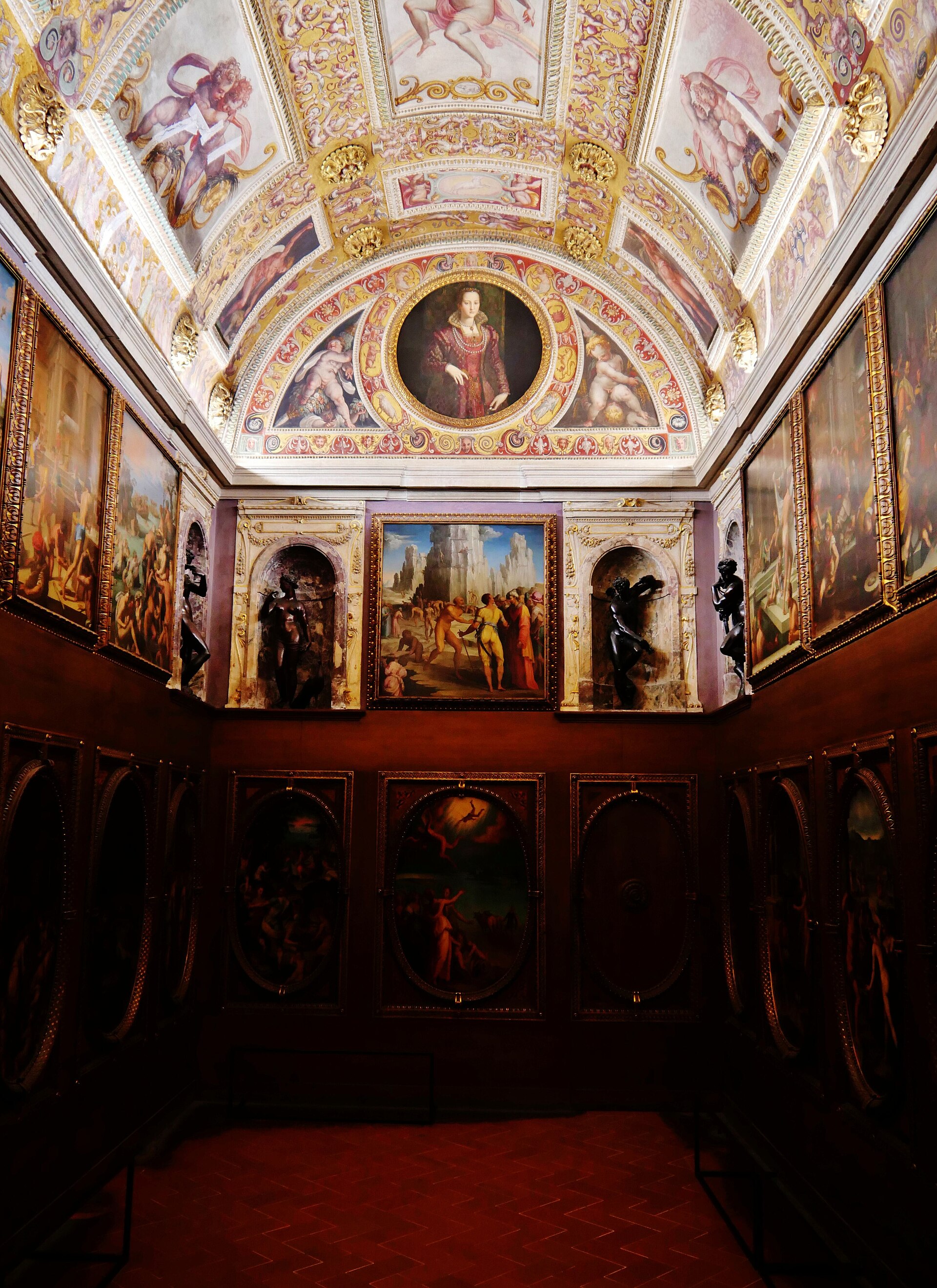
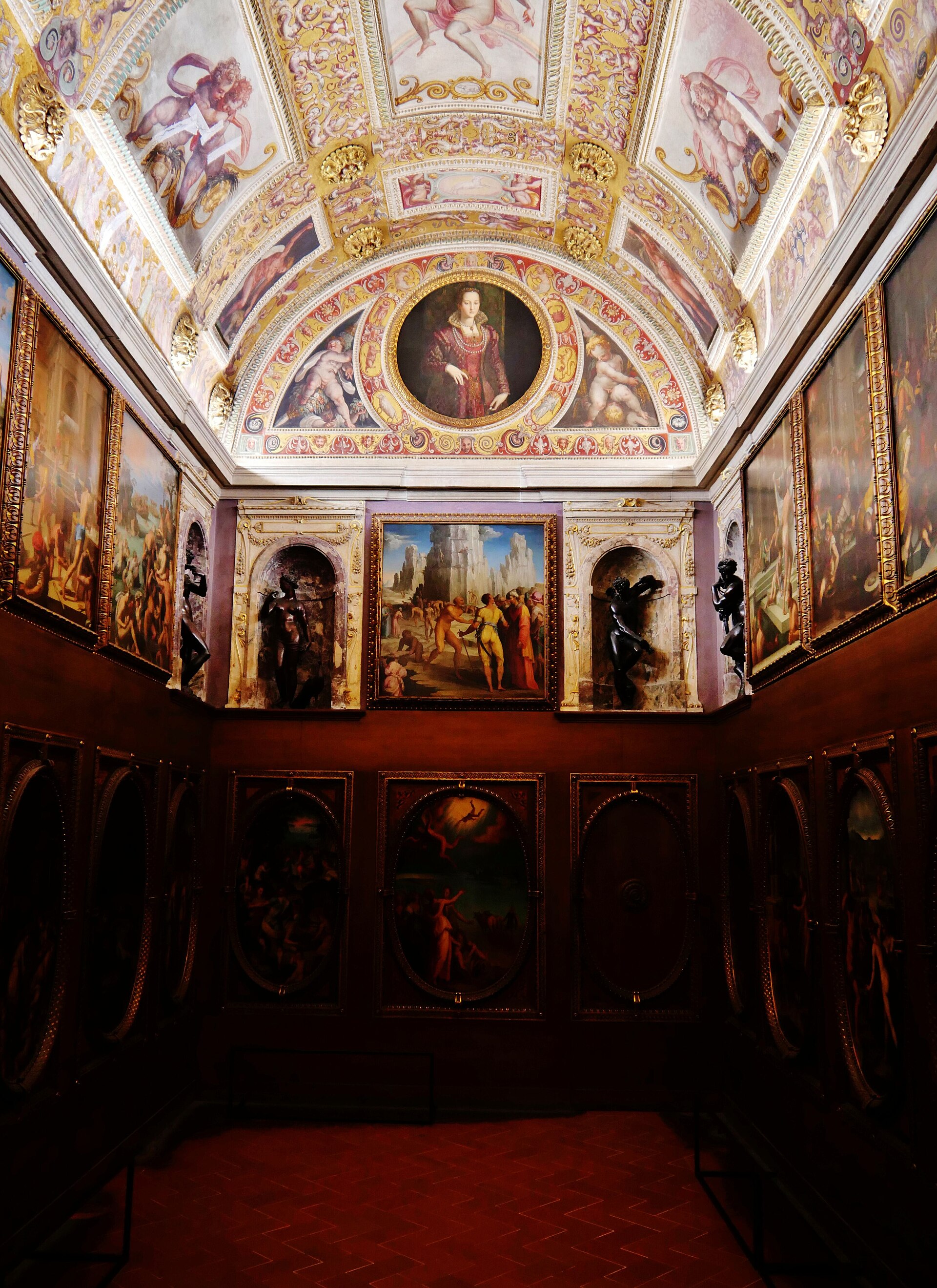
Photograph by Zairon · CC BY 4.0 Studiolo of Francesco I
A small, windowless study designed by Vasari between 1570 and 1575 for Grand Duke Francesco I. Every painted panel and bronze statuette, including work by Giambologna, conceals a real storage cabinet built for the duke's specimens and curiosities.
Apartments of Eleonora di Toledo
The rooms decorated for Cosimo I's Spanish duchess when the Medici moved their seat of government here in 1540, including her small private chapel frescoed by Agnolo Bronzino, one of his most complete surviving cycles.
Quartiere degli Elementi
Cosimo I's own suite of five halls and two loggias on the theme of the classical elements, frescoed with mythological and allegorical scenes by Vasari and his workshop.
Torre di Arnolfo and battlements
The palace's 95-metre crenellated tower, reached by roughly 400 narrow steps, with a walkway along the battlements giving views across the city. Closed to visitors during rain or high wind, and to children under six at any time.
Roman theatre excavations
Beneath the palace, excavated remains of the first-century AD theatre of the Roman colony of Florentia, including stretches of Roman wall and a paved street, on which the medieval palace was later built. Open Saturdays and Sundays on guided tours only.
What to see first
The Genius of Victory
Michelangelo Buonarroti, 1533-1534Carved in marble for a tomb of Pope Julius II that was never built as planned, then donated to the Medici after the sculptor's death and placed facing the entrance of the Salone dei Cinquecento, where it stands as one of the few late Michelangelo marbles outside the Vatican or the Galleria dell'Accademia.5
Judith and Holofernes
Donatello, bronze, 1450sOne of the first Renaissance bronzes designed to be seen from every side, made for the Medici and moved to the Palazzo della Signoria as a public monument after the family's first expulsion in 1495, when the image of a tyrant beheaded by a virtuous woman carried an explicit civic message.5
The Battle of Anghiari (lost)
Leonardo da Vinci, begun 1503-1505, unfinished and now lostLeonardo's experimental wax-based fresco technique failed to dry properly and the mural was abandoned unfinished; it is one of the most sought-after lost works in Western painting, and the wall that replaced it still carries Vasari's hidden clue to the mystery.11
Vasari's Battle of Marciano and the 'cerca trova' flag
Giorgio Vasari and workshop, 1563-1565Vasari's fresco of the Battle of Marciano in Val di Chiana carries a painted flag reading 'cerca trova' (seek and you shall find), interpreted by researcher Maurizio Seracini as a clue to a cavity behind the wall where Leonardo's abandoned mural may survive; a 2011-2012 endoscopic search reported pigment traces before being halted after conservators objected to further drilling into an intact Vasari original.10
The Studiolo of Francesco I
Designed by Giorgio Vasari with painters and sculptors including Giambologna, 1570-1575A complete, intact princely study built for a single, introverted patron to store his curiosities and conduct research, with every decorative surface doubling as a hidden cabinet door; one of the most fully preserved Mannerist interiors anywhere.5
Chapel of Eleonora di Toledo
Frescoes by Agnolo Bronzino, 1540sPainted for Cosimo I's duchess inside her own private apartments, this small chapel is one of Bronzino's most completely preserved fresco cycles and a rare intact record of a Medici woman's personal devotional space.5
The Roman theatre beneath the palace
1st century AD, Roman colony of FlorentiaExcavated remains of Florence's Roman-era theatre survive directly under the palace floor, showing that the medieval seat of government was built on top of the city's earliest public architecture.9
Sala delle Carte Geografiche (Guardaroba)
Maps by Egnazio Danti and later Stefano Bonsignori, commissioned by Cosimo I from 1563Cosimo's private wardrobe room was painted, door by door, with an inventory of the entire known world, alongside a six-foot rotating globe that was the largest built up to that date.9
Past exhibitions here
- Closed23 Aug to 13 Sep 2026Confirmed · check before you travel
A fortress built to be a town hall
Construction began in 1299 on the design of Arnolfo di Cambio, the same master builder responsible for Florence's cathedral. The site had just been cleared of the towers of the Uberti family, Ghibelline nobles driven out after the Guelph faction took control of the city, and the new building rose as the seat of the Priori, the guild-elected magistrates who ran the Florentine Republic. It was made to be defensible as much as dignified: thick rusticated stone walls, a crenellated roofline borrowed from the fortress towns of the Tuscan countryside, and a single asymmetric tower, the Torre di Arnolfo, rising 95 metres above the piazza. Known first as the Palazzo della Signoria after the ruling council that met inside it, the building has served as Florence's seat of government for more than seven centuries without interruption.
From the Signoria to the Medici, and the name that stuck
The name Palazzo Vecchio dates from the 1540s. Cosimo I de' Medici, Duke of Florence, moved his court into the old Palazzo della Signoria in 1540, occupying the historic centre of republican power and putting his own stamp on it, and commissioned Giorgio Vasari and a large workshop to redecorate room after room with frescoes celebrating the Medici dynasty. When Cosimo later moved his official residence across the Arno to the enlarged Palazzo Pitti, the building he left behind picked up the name it has carried ever since: Palazzo Vecchio, the old palace. Since 1872 it has also housed the office of the mayor of Florence and the seat of the city council, so the ceremonial floors open to visitors sit directly above rooms where the city's actual government still meets.
The hall where two masters left nothing finished
The single most consequential room in the building is the Salone dei Cinquecento, built from 1495 for the 500-member Grand Council that Girolamo Savonarola's short-lived republic assembled after the first expulsion of the Medici. In 1503 the council commissioned Leonardo da Vinci to fresco one long wall with the Battle of Anghiari, a Florentine victory of 1440. Leonardo experimented with mixing wax into his pigments and tried to speed the drying with braziers of hot coals; by the accounts that survive, the wax melted in the heat and the paint ran down the wall before the work was finished. Michelangelo was given the opposite wall for a Battle of Cascina and got no further than the preparatory drawings before Pope Julius II called him to Rome to paint the Sistine ceiling. Neither mural survives today. When Cosimo I enlarged the hall in the 1560s, Vasari and his assistants covered both walls with a new fresco cycle celebrating Florentine victories over Pisa and Siena, and left a cryptic message, 'cerca trova' (seek and you shall find), on a painted flag some 12 metres up the wall that faces the site of Leonardo's lost work. In 2011 and 2012 the researcher Maurizio Seracini used endoscopic probes through small holes drilled in Vasari's fresco to search the cavity behind it, and reported pigment traces consistent with paint used elsewhere by Leonardo. More than a hundred art historians and conservators signed a petition against further drilling into an intact and valuable Vasari mural to chase an unconfirmed one beneath it, and the investigation was shelved in September 2012 without being resolved either way. Michelangelo's marble Genius of Victory, carved between 1533 and 1534 for a tomb of Julius II that was never built as planned, stands in the hall facing the entrance, donated to the Medici after the sculptor's death.
The private rooms behind the balcony
A balcony above the Salone dei Cinquecento leads into the rooms Cosimo I kept for himself and his family. The Quartiere degli Elementi, a suite of five halls and two loggias, is frescoed throughout with mythological and allegorical scenes on the theme of the classical elements, again by Vasari and his workshop. Across the balcony are the Apartments of Eleonora di Toledo, decorated for Cosimo's Spanish duchess, whose small private chapel carries one of Agnolo Bronzino's most complete surviving fresco cycles. The Sala dei Gigli, named for the fleur-de-lis pattern covering its coffered ceiling by Benedetto and Giuliano da Maiano, holds Donatello's bronze Judith and Holofernes, made for the Medici in the 1450s and moved here as a civic monument after the family's first expulsion in 1495, alongside Domenico Ghirlandaio's fresco of Saint Zenobius enthroned among figures of Republican and Imperial Rome. Off the same suite is the Studiolo of Francesco I, a small windowless study designed by Vasari between 1570 and 1575 for Cosimo's introverted heir, where every painted panel and bronze statuette by Giambologna conceals a real cabinet that once held Francesco's specimens and curiosities.
What lies under the floor and above the battlements
Excavations beneath the palace, opened to the public on a limited guided schedule, expose the remains of the Roman theatre of Florentia, the first-century colony on whose ruins the medieval city and eventually the palace itself were built; visitors can see stretches of Roman wall and a paved street below the current ground level. At the opposite extreme, the Torre di Arnolfo climbs 95 metres over roughly 400 narrow steps to a battlement walkway with views across the city, closed during high wind, rain or extreme heat, and to children under six at any time. On the second floor, Cosimo I commissioned the Sala delle Carte Geografiche, or Guardaroba, where the cartographer and Dominican friar Egnazio Danti, and later Stefano Bonsignori, painted the known world onto the doors of the duke's wardrobe cabinets, alongside a six-foot rotating globe that was the largest built to that date.
A working town hall, and what today's visitors find
Restoration continues on the building. In 2023, work on a disused escape staircase built for Cosimo and Eleonora uncovered mid-16th-century grotesque frescoes, hidden under later plaster and attributed to the circle of Marco Marchetti da Faenza. Visitors consistently single out the scale of the Salone dei Cinquecento and the guided Secret Passages tour of the palace's hidden stairs and rooms as the best reasons to come, and several note that the building draws noticeably shorter queues than the Uffizi or the Accademia a few streets away. The recurring complaints are practical rather than curatorial: the Arnolfo Tower is sold on a ticket separate from the museum, so a visitor who decides partway through a visit to climb it has to go back down to the ticket office rather than upgrading on the spot, and the upper floors and tower stairwell have no air conditioning, which tells in Florence's summer heat.
What visitors say
Visitors consistently rate Palazzo Vecchio among Florence's best-value major sights: cheaper and markedly less crowded than the Uffizi or the Accademia a few streets away, with frescoed halls that reward slow looking. The recurring frustrations are practical rather than curatorial: the Arnolfo Tower is ticketed separately from the museum, so a visitor who decides mid-visit to climb it must return to the ticket office rather than upgrading on the spot, and the upper floors and tower stairwell are not air-conditioned, which tells in Florence's summer heat.
What is praised, what is criticised
- Praised: the scale and detail of Vasari's frescoes in the Salone dei Cinquecento
- Praised: the guided Secret Passages tour through the palace's hidden stairs and rooms
- Praised: shorter queues than the Uffizi and the Accademia, even in peak season
- Criticised: the Arnolfo Tower is sold on a separate ticket, forcing a second trip to the ticket office to add it mid-visit
- Criticised: no air conditioning on the upper floors or in the tower stairwell during summer heat
Ratings on other platforms
Tripadvisor: 4.6 from 9,493 ratings, read 9 September 2026
A platform average is a tertiary source: it moves, it is not audited, and we quote no visitor's words.
Questions about Palazzo Vecchio
Where is Palazzo Vecchio?
Piazza della Signoria, 50122 Firenze, Italy.
How much does it cost to visit?
Museum - Full: EUR 18; Museum - Reduced (age 18-25 / university students): EUR 12; Museum - Under 18: free; Arnolfo Tower and battlements - Full: EUR 20; Arnolfo Tower and battlements - Reduced (age 18-25): EUR 13. As confirmed 9 September 2026.
When is it open?
Mon-Wed, Fri-Sun 09:00-19:00; Thu 09:00-14:00; Mon-Wed, Fri-Sun 09:00-17:00; Thu 09:00-14:00. As confirmed 9 September 2026.
How do you get there?
Bus: ATAF city bus lines C1 or C2 stop close to Piazza della Signoria.
What should you see first?
The Genius of Victory (Michelangelo Buonarroti, 1533-1534); Judith and Holofernes (Donatello, bronze, 1450s); The Battle of Anghiari (lost) (Leonardo da Vinci, begun 1503-1505, unfinished and now lost); Vasari's Battle of Marciano and the 'cerca trova' flag (Giorgio Vasari and workshop, 1563-1565); The Studiolo of Francesco I (Designed by Giorgio Vasari with painters and sculptors including Giambologna, 1570-1575); Chapel of Eleonora di Toledo (Frescoes by Agnolo Bronzino, 1540s).
What we could not confirm
- Whether any trace of Leonardo da Vinci's Battle of Anghiari survives behind Vasari's fresco in the Salone dei Cinquecento remains unresolved. The 2011-2012 endoscopic search reported pigment consistent with Leonardo's palette but was halted in September 2012 after conservators objected to further drilling into Vasari's intact original, and no further investigation had been authorised as of this research.
Images
Sources
- 1Museo di Palazzo Vecchio, Cultura - Comune di Firenze (official museum page) cultura.comune.fi.it/pagina/musei-civici-fiorentini/museo-di-palazzo-vecchio
- 2Orari e biglietti, Museo di Palazzo Vecchio, Cultura - Comune di Firenze cultura.comune.fi.it/pagina/musei-civici-fiorentini-museo-di-palazzo-vecchio/orari-e-biglietti
- 3Visita il museo, Museo di Palazzo Vecchio, Cultura - Comune di Firenze cultura.comune.fi.it/pagina/musei-civici-fiorentini-museo-di-palazzo-vecchio/visita-il-museo
- 4Museo di Palazzo Vecchio, Fondazione MUS.E musefirenze.it/en/museum/museo-di-palazzo-vecchio/
- 5Palazzo Vecchio, Wikipedia () en.wikipedia.org/wiki/Palazzo_Vecchio
- 6Palazzo Vecchio, Tripadvisor attraction page and reviews () tripadvisor.com/Attraction_Review-g187895-d195010-Reviews-Palazzo_Vecchio-Florence_Tuscany.html
- 7Palazzo Vecchio Staircase Restoration Work Reveals 16th-Century Frescoes, Italy Magazine, 19 April 2023 italymagazine.com/featured-story/palazzo-vecchio-staircase-restoration-work-reveals-16th-century-frescoes
- 8Palazzo Vecchio, Wikidata Q271928 () wikidata.org/wiki/Q271928
- 9Palazzo Vecchio in Florence, VisitFlorence.com visitflorence.com/florence-monuments/palazzo-vecchio.html
- 10The Battle of Anghiari (Leonardo), Wikipedia () en.wikipedia.org/wiki/The_Battle_of_Anghiari_(Leonardo)
- 11Palazzo Vecchio, Frommer's, by Stephen Keeling frommers.com/destinations/florence/attractions/palazzo-vecchio/
- 12File:Piazza della signoria, palazzo vecchio, veduta 01.jpg, Wikimedia Commons (licence record) commons.wikimedia.org/wiki/File:Piazza_della_signoria,_palazzo_vecchio,_veduta_01.jpg
- 13File:Salone dei cinquecento, veduta 01.JPG, Wikimedia Commons (licence record) commons.wikimedia.org/wiki/File:Salone_dei_cinquecento,_veduta_01.JPG
- 14File:Palazzo vecchio, sala dei gigli 00.jpg, Wikimedia Commons (licence record) commons.wikimedia.org/wiki/File:Palazzo_vecchio,_sala_dei_gigli_00.jpg
- 15File:Firenze Palazzo Vecchio Interno Studiolo di Francesco I 1.jpg, Wikimedia Commons (licence record) commons.wikimedia.org/wiki/File:Firenze_Palazzo_Vecchio_Interno_Studiolo_di_Francesco_I_1.jpg


