The Lydian Hoard
Lydian goldsmiths and silversmiths of the Usak tumuli · About 560-540 BC
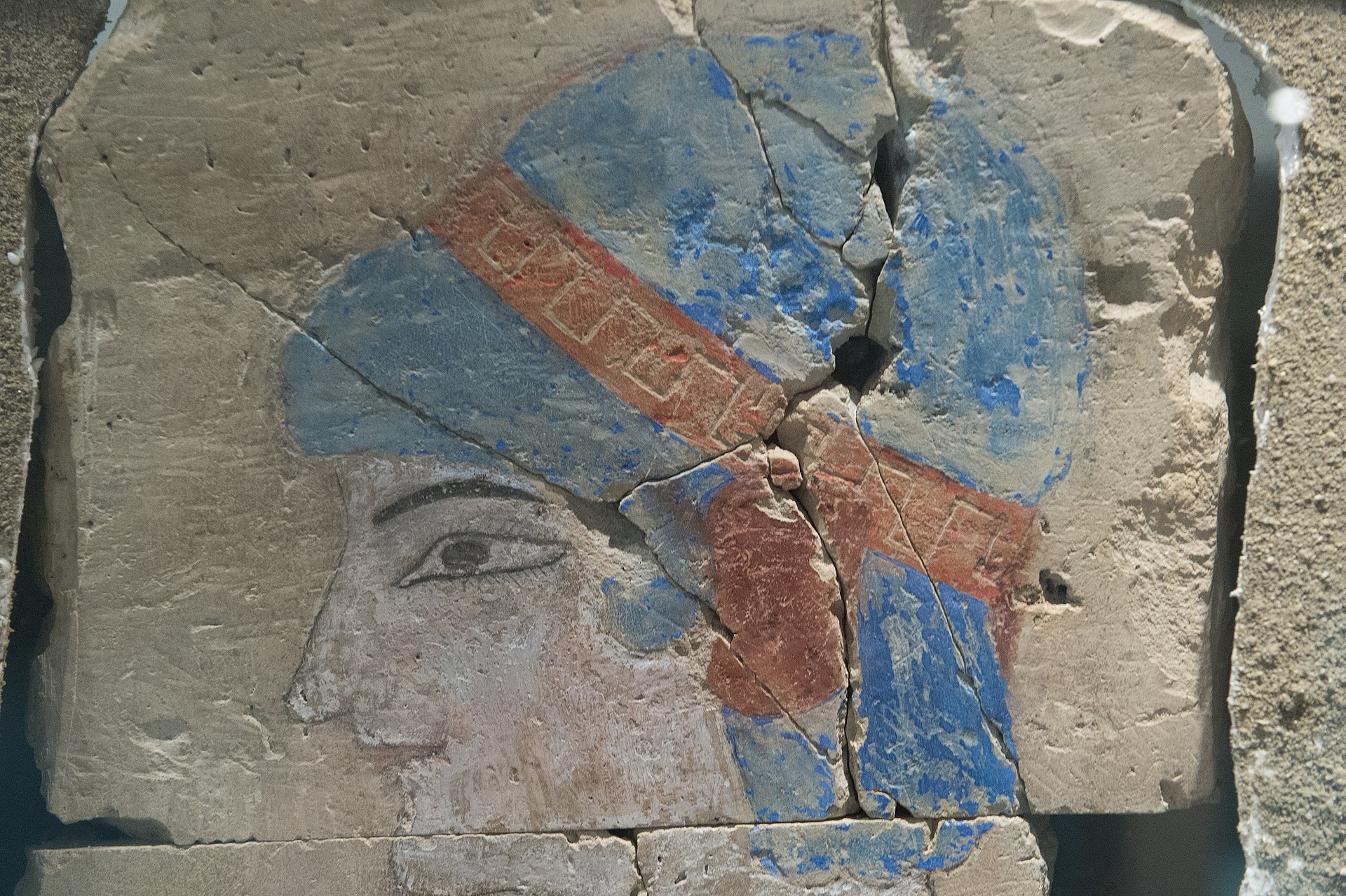
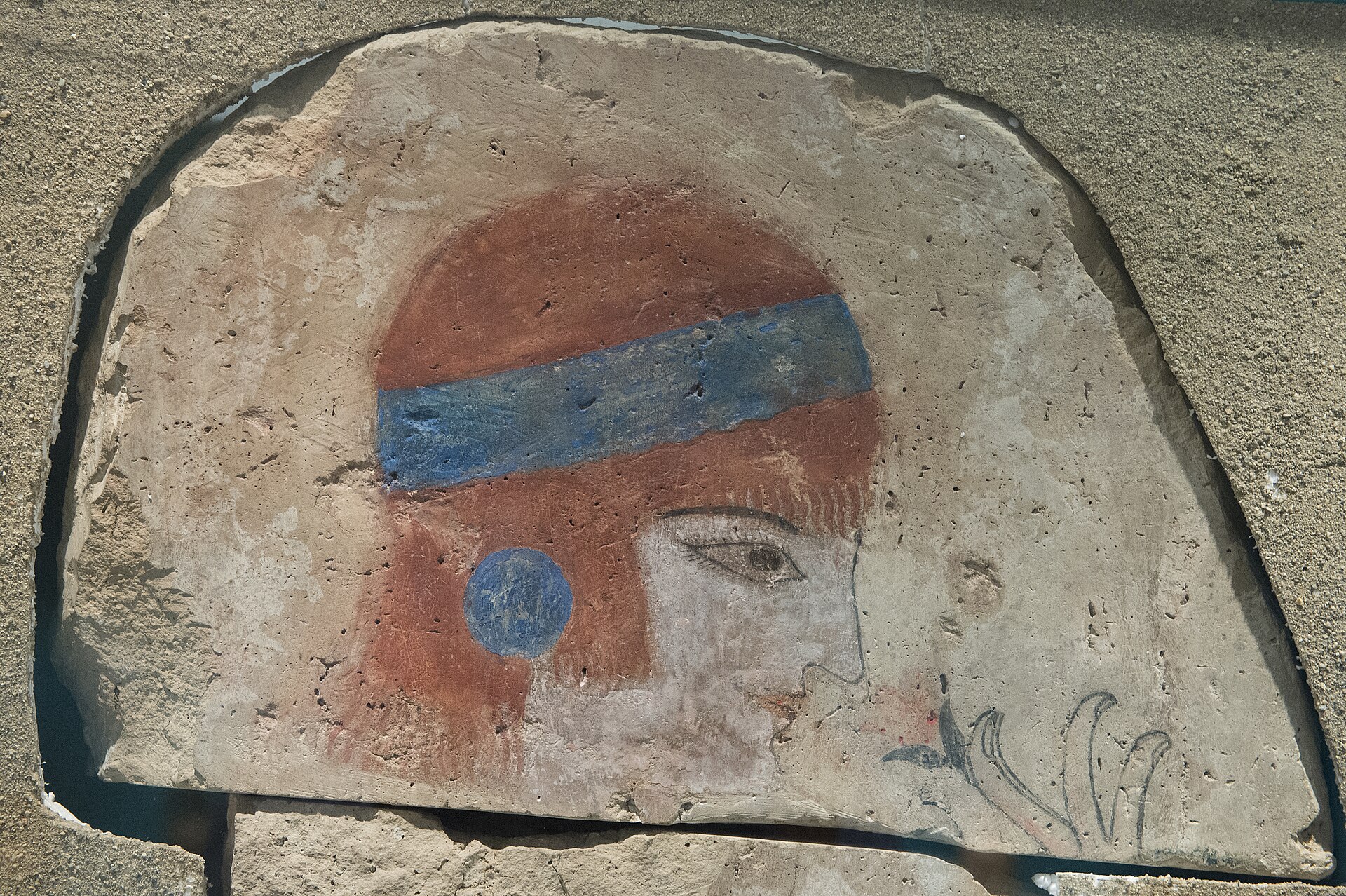
A head in profile under a blue cap with a red band, painted in earth and vegetable pigment on the plaster of the burial chamber at Aktepe, one of the three tumuli named in this record, and now in the Usak Museum of Archaeology. The breaks running through the face are where the chisels went in. The museum's own gallery notice, transcribed in full on the source file, states that smugglers who found the chamber in 1968 cut the paintings off both side walls in pieces and sold them for 40,000 lira. It was plaster like this that broke the case: in pre-trial discovery the fragments held in New York were measured against the gaps they had been cut from, and they fitted.
Usak Museum of Archaeology; photograph by Dosseman, CC BY-SA 4.0 via Wikimedia Commons| Artist | Lydian goldsmiths and silversmiths of the Usak tumuli |
|---|---|
| Date | About 560-540 BC |
| Medium | Gold, silver, electrum, bronze and marble, with painted plaster wall paintings cut from tomb chambers |
| Dimensions | 363 objects. The gold hippocamp brooch is barely 4 cm high and weighs 14.3 g |
| Where it is now | Usak Museum of Archaeology, Usak, Turkeylast confirmed 3 August 2026 |
| Attribution | WorkshopNo maker, workshop or hand has been proposed for any object in the group, and no attribution question has ever arisen in the case. Full note |
| Object type | Antiquity |
| Period | Lydian, sixth century BC |
| Inscriptions | None recorded in the sources consulted |
| Owners on record | 10 links9 documented, 1 disputed |
| Sources | 4 cited |
About this record Last verified 12 August 2026 · 4 sources cited · Change log
On this page 12 sections
ContentsClose
Three hundred and sixty-three objects - gold and silver vessels and jewellery, a pair of marble sphinxes, and painted plaster hacked off the walls of the tomb chambers themselves - dug out of burial mounds near the village of Gure in the Usak region of western Turkey in the middle 1960s, and sold within months to the Metropolitan Museum of Art. The museum put them in its storerooms for close to twenty years and, when it finally showed some of them in 1984, labelled them East Greek.
Turkey demanded them back in 1986, was refused, and sued in Manhattan on 29 May 1987. The decisive ruling was not about ownership. It was about time: in 1990 Judge Vincent L. Broderick refused to dismiss the case on limitation, applying the New York rule that a claim against a possessor of stolen property does not accrue until the owner demands the object and is refused, and noting that the Met had kept the collection out of sight until 1984. That opened discovery, and discovery is what won it. The museum's own acquisition minutes came out, the curator who bought the objects testified that no effort had been made to establish where they came from, and Turkish archaeologists matched fragments of wall painting in New York to the holes they had been cut from in Usak. In September 1993 the Met settled and sent everything home.
Then the sting. In April 2006 the newspaper Milliyet reported that the masterpiece of the hoard, a gold brooch in the form of a hippocamp, had been stolen from its case at the Usak museum and replaced with a counterfeit; the original weighs 14.3 grams and the substitute weighed 23.5. Weeks later the culture ministry named the suspect: Kazim Akbiyikoglu, the museum's own director, the archaeologist who had given evidence against the Met and flown to New York to identify the objects. He was arrested with ten others, admitted selling museum property to cover gambling debts, and was jailed for thirteen years. The brooch surfaced in Germany and was announced as returning to Turkey in November 2012.
Provenance
Each link is graded. Documented: a cited source supports it. Disputed: the identification is argued but not established. Unknown: no owner for that span, and the gap is not smoothed into a narrative. The grades in the glossary.
- c. 560-540 BC - 1965Deposited in burial tumuli near Gure, Usak regiondocumented
Lydian tomb furnishings of the sixth century BC, from the tumuli named as Ikiztepe, Aktepe and Toptepe. The find context was destroyed by the excavation that removed them: no plan, no assemblage record, no skeletal record beyond a looter's statement that the body had gone to dust and a hunk of hair.12
- 1965 - 1966Farmers of Gure and Usak, unnamed in the sources consulteddocumented
Digging began at Ikiztepe in 1965. Turkish police recovered part of the material in 1966 and it went into Turkish museums; those recovered pieces later served as the comparison set that proved the case. A tomb was opened with black powder on the night of 6 June 1966. The looters were identified after one of them went to the police following a quarrel over dividing the money, but by then the objects were abroad.123
- 1966 - 1966Ali Bayirlar, dealer, Izmirdocumented
The looters sold to Bayirlar, an antiquities smuggler operating out of Izmir, who sold on to New York and Switzerland. He was identified by the Turkish police at the time.12
- 1966 - 1970John J. Klejman, Madison Avenue, New York; and George Zacos, Switzerlanddocumented
Klejman is reported by the New York Times in 1973 to have bought about 219 pieces for around 500,000 dollars and sold them to the museum in 1966, 1967 and 1968. Asked in 1973 where the treasures had come from, the Met's curator of Greek and Roman Art referred the question to Klejman.12
- 1966 - 1993The Metropolitan Museum of Art, New Yorkdocumented
Acquired in three batches between 1966 and 1970 on the recommendation of Dietrich von Bothmer, curator of Greek and Roman Art, and approved by the acquisitions committee of the Board of Trustees. Published purchase figures conflict at 500,000 dollars (Klejman's cost), 1.2 million, 1.5 million and 1.7 million dollars; none is an auction result. Held in storerooms for more than a decade and displayed from 1984 as East Greek treasure. Documents produced in discovery showed that staff were likely aware the provenance was controversial when the objects were bought.123
- 1987 - 1993Subject of Republic of Turkey v. Metropolitan Museum of Artdocumented
Formal demand July 1986, refused. Suit filed 29 May 1987 in the Southern District of New York; Turkey represented by Harry Rand and Lawrence Kaye. The Met moved to dismiss on the three-year limitation period. Motion denied in 1990 by Judge Vincent L. Broderick, 762 F. Supp. 44 (S.D.N.Y. 1990), applying the demand and refusal rule and treating the museum's concealment of the collection until 1984 as relevant to the reasonableness of the demand.12
- 1993 - 1995Republic of Turkey; touring exhibitiondocumented
The Met agreed in September 1993 to return the collection out of court. The agreement was a settlement, not a judgment: no court ruled on ownership. It included a cooperation clause covering conservation, reciprocal loans, excavation in Turkey and study fellowships. The objects reached Turkey in October 1993 and were exhibited in Istanbul, Ankara and other cities, on one account for two years in the Museum of Anatolian Civilizations.12
- 1995 - presentUsak Museum of Archaeology, Usakdocumented
Transferred to Usak in 1995, joining the pieces the Turkish police had recovered from the same tombs in 1966. Attendance over the five years to 2006 was reported at 769 visitors. Ozgen Acar states that he asked the ministry to install a security system on the transfer and that there was none, or none that worked.12
- c. March-August 2005 - 2012Stolen; the hippocamp brooch alonedocumented
THE OBJECT-LEVEL BREAK IN THE CHAIN. The gold hippocamp was removed from its case and replaced with a counterfeit weighing 23.5 g against the original's 14.3 g. Reported by Milliyet in April 2006. The museum's director Kazim Akbiyikoglu, who had given evidence for Turkey in the New York litigation, was named as a suspect weeks later, arrested with ten others (charges reported 14 July 2006), admitted selling museum property to pay gambling debts and was sentenced to thirteen years. From 2006 the counterfeit was itself displayed at Usak as the exhibit of its own theft.123
- 2012 - presentUsak Museum of Archaeology; the hippocamp brooch restored to the collectiondisputed
The original brooch was traced to Germany and announced in November 2012 as returning to Turkey, shown temporarily at the Museum of Anatolian Civilizations in Ankara before going back to Usak. Graded disputed rather than documented because the sources consulted do not name who held it in Germany, on what basis it was surrendered, or by what test the returned object was identified as the original rather than a second copy. For an object whose theft was detected only by weighing it, that gap matters.3
Prices realised
Nothing in the Lydian Hoard has ever been offered at public auction. There is no hammer price, no premium and no estimate anywhere in this case. The only figures that exist are private purchase sums and they conflict: about 500,000 dollars reported in 1973 as the dealer J. J. Klejman's own cost for about 219 pieces; roughly 1.2 million dollars for about 200 pieces in 1967 and 1968 in one tertiary account; 1.5 million dollars paid by the Metropolitan Museum over several years in Sharon Waxman's account; and 1.7 million dollars in Ozgen Acar's, with the observation that the museum then spent at least twice that amount on legal costs. This record does not choose between them.
Technical evidence
| Attribution note | No maker, workshop or hand has been proposed for any object in the group, and no attribution question has ever arisen in the case. That is itself worth stating: this is a record in which connoisseurship plays no part at all. Every contested proposition about these objects has been settled or left unsettled by a document - an acquisition committee minute, a looter's statement, a court's ruling on limitation, a museum register and a set of scales. |
|---|---|
| Composition of the group | About 363 objects of the sixth century BC: gold and silver vessels, jewellery and ornaments, a pair of marble sphinxes, and sections of painted plaster wall cut from the tomb chambers.12 |
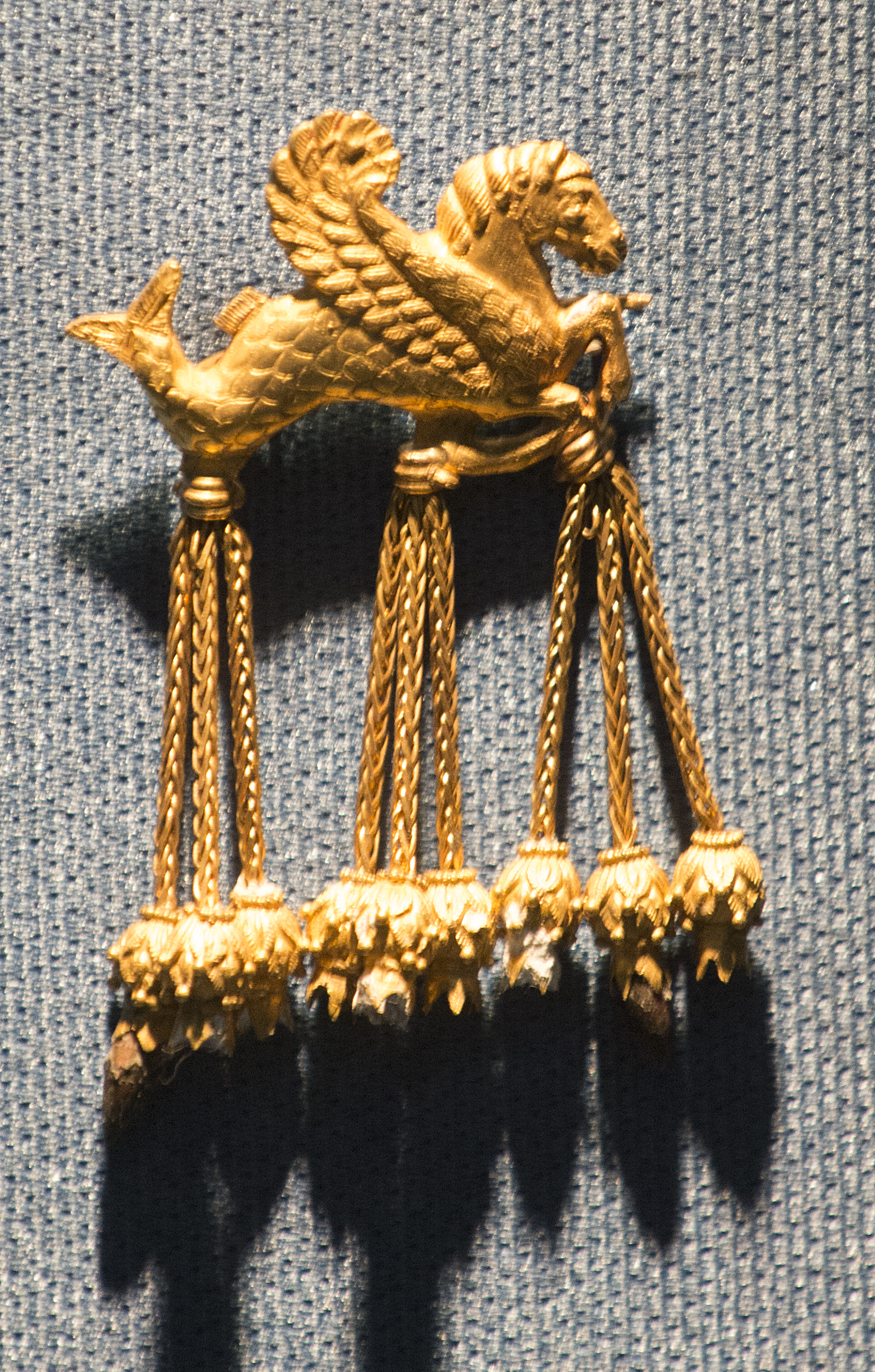
| The hippocamp brooch | Gold brooch in the form of a hippocamp, a horse with wings and a fish's tail. Barely an inch and a half high, with three sets of three hanging golden braids each ending in a ball worked as a pomegranate. Weight 14.3 g. Described as having no parallel.2 |
| The counterfeit | The substitute placed in the Usak museum case, probably between March and August 2005 and exposed in April 2006, weighed 23.5 g against the original's 14.3 g. The forgery was detected by weight, not by eye.23 |
| Find context | Burial tumuli near the village of Gure, Usak region, western Turkey, in the territory of ancient Lydia. The tombs named in the accounts are Ikiztepe, Aktepe and Toptepe. Bodies were laid on a bed and surrounded by precious objects; one chamber yielded 125 pieces.12 |
| Method of entry | A looter's statement to the Turkish police describes digging in shifts for nine or ten days, reaching blocking stones about 1.5 m high and 80 cm wide that five or six men could not lift, failing to break them with sledgehammers and pokers, and opening the main entrance with black powder on the night of 6 June 1966.23 |
| The wall paintings | Painted plaster was cut from the tomb walls and travelled with the rest. In pre-trial discovery, fragments in the Metropolitan Museum were measured against the surviving walls at Usak and found to fit the gaps. This mechanical fit was the strongest single item of evidence in the case.12 |
| How it was catalogued at the Met | Held in the Department of Greek and Roman Art, not Ancient Near Eastern Art. Kept in storerooms for more than a decade; a few pieces appeared in a 1972 survey exhibition without being published in the catalogue; about fifty pieces went on permanent display in 1984 labelled East Greek treasure.12 |
| Photography | No free-licence photograph of any object in this hoard exists. The images of the Usak Museum material on Wikimedia Commons are CC BY-SA 4.0, and a photograph of a three-dimensional object carries fresh copyright regardless of the object's age. This record therefore carries no plate of the hoard itself, which is stated on the page rather than covered with a substitute.4 |
Images
The record in full
Chapter 1What was taken, and from where
The group consists of about three hundred and sixty-three objects of the sixth century BC: gold and silver vessels, jewellery and ornaments, a pair of marble sphinxes, and sections of painted plaster...
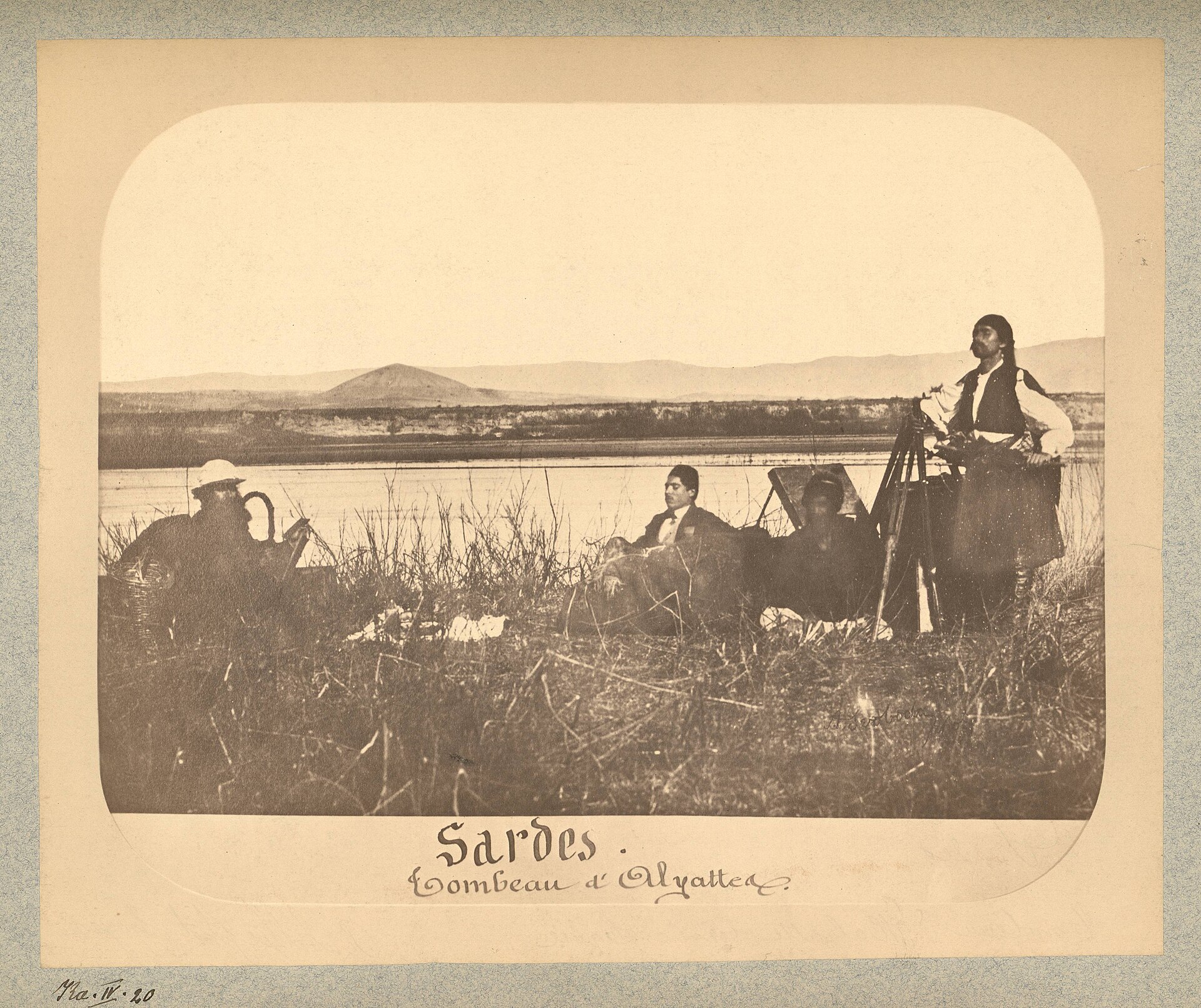
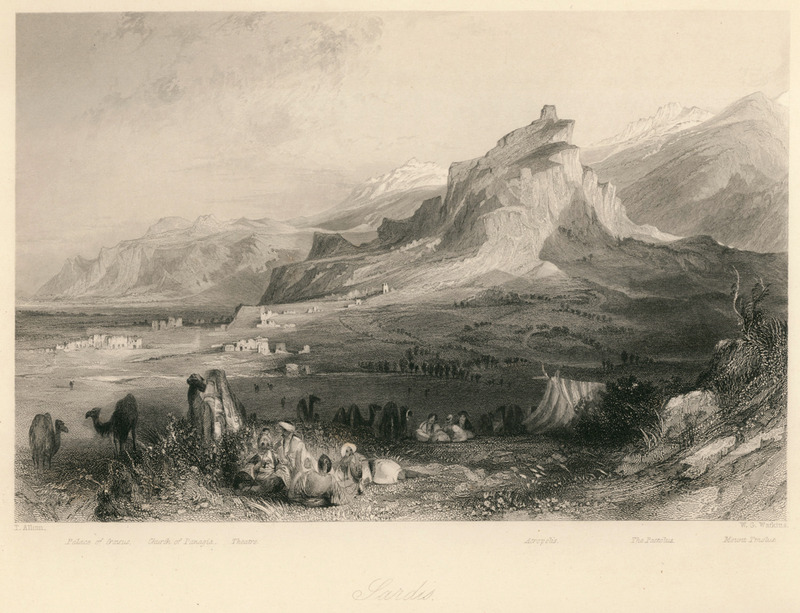
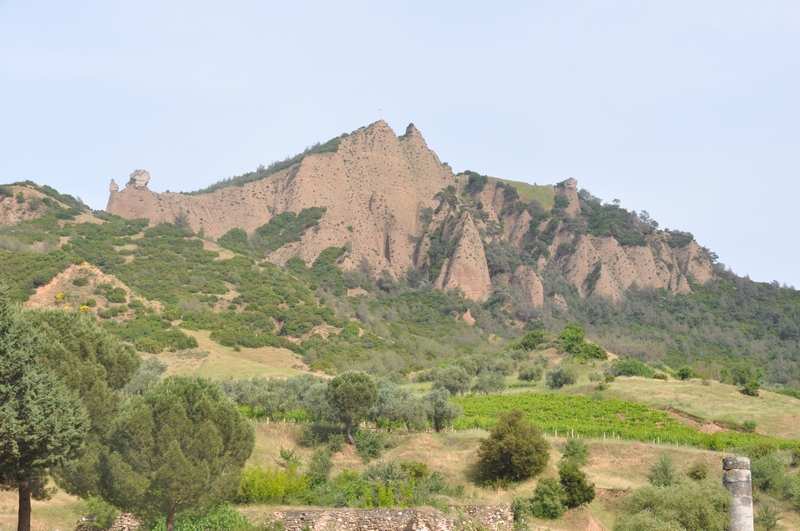
The group consists of about three hundred and sixty-three objects of the sixth century BC: gold and silver vessels, jewellery and ornaments, a pair of marble sphinxes, and sections of painted plaster wall from the tomb chambers. It came from burial tumuli around the village of Gure in the Usak region of western Anatolia, the heartland of the kingdom of Lydia, whose capital was Sardis and whose last king was Croesus.
Three tumuli are named in the accounts: Ikiztepe, Aktepe and Toptepe. Lydian tombs of the class are furnished rather than merely filled. The body lay on a bed and the precious objects were arranged around it, so what came out was not a hoard in the sense of buried valuables but the contents of a room, with its own internal arrangement, which is exactly what an undocumented excavation destroys first.
The masterpiece was small. A gold brooch in the form of a hippocamp, a horse with wings and a fish's tail, standing barely an inch and a half high, carrying three sets of three hanging golden braids each ending in a ball worked as a pomegranate. Land, water and air in one object. There is no other like it, and everything in the second half of this record happens to that brooch.
Chapter 2Black powder, and a corpse that was mostly dust
The digging began in 1965, when farmers from Gure and Usak broke into the tumulus called Ikiztepe.
The digging began in 1965, when farmers from Gure and Usak broke into the tumulus called Ikiztepe. Turkish police learned of it and recovered some material in 1966, which went into Turkish museums; those pieces later became the comparison set that made the whole case provable. Most of what came out of the ground was already abroad.
Word spread locally that the first diggers had been paid, and others went at the neighbouring mounds, Aktepe and Toptepe. One tomb was entered on the night of 6 June 1966 by blowing in the roof. A looter's statement to the police, quoted at length in Sharon Waxman's account, describes digging in shifts for nine or ten days, reaching stone blocks a metre and a half high and eighty centimetres wide that five or six men could not lift, failing to break them with sledgehammers and pokers, and finally opening the main entrance with black powder.
Inside, the body had gone to dust and a hunk of hair. The gold and silver were undamaged. That one chamber gave up a hundred and twenty-five pieces.
The looters were eventually identified because one of them went to the police after a quarrel over dividing the money. By then the objects had been sold overseas. It is worth holding on to the sequence: the Turkish state knew within months that tombs in the Usak region had been emptied, had recovered part of the material, and had a name - Ali Bayirlar, a dealer in Izmir - for the man the looters sold to.
Chapter 3The label was the hiding place
Bayirlar sold to John J. Klejman, who kept a gallery on Madison Avenue, and to George Zacos, a Swiss dealer.
Bayirlar sold to John J. Klejman, who kept a gallery on Madison Avenue, and to George Zacos, a Swiss dealer. The Metropolitan Museum of Art acquired the material in three batches between 1966 and 1970, on the recommendation of Dietrich von Bothmer, curator of Greek and Roman Art, who presented it to the acquisitions committee of the Board of Trustees.
It then went into the storerooms and stayed there for more than a decade. A handful of pieces appeared in a survey exhibition in 1972 without being published in the catalogue. When part of the group finally went on permanent display in 1984 - some fifty pieces - the label read East Greek treasure.
That phrase is the centre of this record. It is not a lie in the sense that a forged export licence is a lie. It is a curatorial description that is technically arguable and functionally protective: East Greek covers the Aegean coast broadly and points away from inland Lydia, which is where anyone looking for the Usak material would look. The museum was not concealing the objects by then; it was concealing the question. A visitor could stand in front of them and a Turkish official could read the catalogue, and neither would be prompted to ask where in Anatolia they came from.
What the museum itself understood is on the record from two directions. Turkish enquiries in 1970 drew a denial from Theodore Rousseau, the Met's chief curator, that anything had been exported illegally, together with the remark that there seemed to be hearsay built around something that might have a kernel of truth in it. Asked by the New York Post where the treasures came from, von Bothmer's answer was to refer the question to Klejman. And Thomas Hoving, the director, later wrote in his memoir that everyone at the museum believed the material had been illegally dug up, that if the Turks produced proof it would go back, and that the museum had taken its chances when it bought.
Chapter 4Four different prices, and none of them a hammer
Nothing in this case was ever bought at auction, so no hammer price and no buyer's premium exist anywhere in it.
Nothing in this case was ever bought at auction, so no hammer price and no buyer's premium exist anywhere in it. What exist are four different private-purchase figures, published by four different people, and they do not reconcile.
In 1973 the New York Times art critic John Canaday, working from a story the museum itself leaked, reported that 219 Greek gold and silver pieces had been bought for about 500,000 dollars by the dealer J. J. Klejman and sold on to the museum in 1966, 1967 and 1968 - a figure that is Klejman's cost, not the Met's. Sharon Waxman gives 1.5 million dollars paid by the Met over several years. Ozgen Acar, interviewed by the UNESCO Courier in 2001, put the Met's outlay at 1.7 million dollars and made the point that the museum then spent at least twice that on legal expenses fighting to keep the objects. A widely circulated tertiary account gives roughly 200 pieces for 1.2 million dollars in 1967 and 1968.
A record that quoted one of these as the price would be tidier and would be wrong. The honest statement is that the Metropolitan Museum of Art paid somewhere between 1.2 and 1.7 million dollars for the Lydian Hoard, in instalments, between 1966 and 1970, and that the museum's own accounts of the transaction have never been published in a form that settles it. On Acar's arithmetic the litigation cost more than the objects did.
Chapter 5Sixteen years without publishing a word
In 1970 the British journalist Peter Hopkirk of the Sunday Times called on Ozgen Acar, then ten years into a career at the Turkish daily Cumhuriyet, and told him he was chasing a treasure smuggled...
In 1970 the British journalist Peter Hopkirk of the Sunday Times called on Ozgen Acar, then ten years into a career at the Turkish daily Cumhuriyet, and told him he was chasing a treasure smuggled out of Turkey and bought in secret by an American museum. They agreed to work it together and publish simultaneously. They got nowhere. In Usak nobody had heard of a golden hoard; at the Met, the curator of Ancient Near Eastern Art told Acar there was nothing of the kind in his department, which was true, because the objects were in Greek and Roman.
Hopkirk gave up. Acar did not, and he did not publish either. For sixteen years he worked the story in his own time, travelling the six hours by bus to Usak every five or six months, becoming a familiar face, waiting for the resentment of the people who had missed out on the money to come to the surface. Eventually it did, in fragments: someone had been paid for digging in the tumuli. On one visit a villager took him into the street and told him six or seven men were about to rob a mound. Acar passed it to the local authorities, and the archaeologist assigned to excavate the site instead was the curator of the Usak museum, Kazim Akbiyikoglu. That is how the two men met.
The break came in 1984 in a gallery in New York. Acar, who had moved to the United States and was watching the Met's exhibitions and catalogues, saw fifty pieces on display that matched the descriptions he had spent fourteen years assembling. They were labelled East Greek treasure. He said afterwards that by then he knew the objects like the lines of his own palm.
He took what he had to the Turkish minister of education, including police photographs of the material seized from the looters in the 1960s set against the pieces at the Met. Then he published: seven articles in Milliyet in 1986, the first under an eight-column headline saying that the Turks wanted the Lydian and Croesus treasures back.
Chapter 6The ruling that mattered was about time, not about title
Turkey made a formal demand for return in July 1986 and sent its consul general to meet museum officials.
Turkey made a formal demand for return in July 1986 and sent its consul general to meet museum officials. The demand was refused. On 29 May 1987 the Republic of Turkey filed suit against the Metropolitan Museum of Art in the federal court in Manhattan, represented by the American lawyers Harry Rand and Lawrence Kaye. For a source nation with no track record of suing a major foreign institution, that was an extraordinary step.
The Met did what any defendant would do. It moved to dismiss, on the ground that the applicable three-year limitation period had long since run, and that Turkey had in any case failed to make its demand within a reasonable time after identifying the possessor. The motion was not a side issue. Had it succeeded, the museum would have held an enforceable ruling sanctioning its title, and the merits would never have been reached.
In 1990 Judge Vincent L. Broderick denied it. Republic of Turkey v. Metropolitan Museum of Art, 762 F. Supp. 44 (S.D.N.Y. 1990). The court applied the New York demand and refusal rule: against a possessor of stolen property, the cause of action does not accrue until the true owner demands the object back and is refused. Turkey demanded in 1986 and sued in 1987, comfortably inside three years of accrual. The court further held that the timing of the demand was reasonable in light of the fact that the museum had kept the collection in its storerooms until 1984.
Read that second holding again. The museum's own decision to keep the objects out of public view for eighteen years, which had protected it from a claim, became the reason the claim was allowed to proceed. Concealment did not start the clock; it stopped it.
Chapter 7Discovery is what won it
With the motion denied, the case went into pre-trial discovery, and this is the part of the story a collector should study rather than the part about looting.The museum was required to produce...
With the motion denied, the case went into pre-trial discovery, and this is the part of the story a collector should study rather than the part about looting.
The museum was required to produce documents, and among them were the minutes of the acquisitions committee meeting at which the purchase had been approved. In pre-trial testimony the curator who bought the collection stated that no effort had been made to determine where the objects had actually come from. Lawyers and archaeologists acting for Turkey were allowed to examine the objects themselves. Among those who came was Kazim Akbiyikoglu of the Usak museum, who swore an affidavit setting out what he knew of their origin.
Then the physical evidence. Turkish archaeologists compared the Met's pieces against the material the police had recovered from the looters in 1966 and held in Turkish museums. And the fragments of painted plaster in New York were measured against what was left on the walls of the tombs at Usak, and they fitted the gaps. Looters cooperating with the investigation described the objects they had taken, and the descriptions matched the collection in Manhattan.
None of this is connoisseurship and none of it required an expert opinion on style. A cut edge that matches the wall it was cut from is a mechanical fit, in the same class of evidence as the woodworm tunnels that reunited a dismembered Cimabue diptych. It cannot be argued about.
Chapter 8September 1993: a settlement, not a judgment
The museum tried to salvage terms. One proposal was a form of joint custody in which the hoard, by then established at 363 pieces, would spend five years in New York and five in Turkey; the Turkish...
The museum tried to salvage terms. One proposal was a form of joint custody in which the hoard, by then established at 363 pieces, would spend five years in New York and five in Turkey; the Turkish side says the offer covered only a small part of the material. Around Christmas 1992 the Met's president William Luers and its director Philippe de Montebello travelled to Turkey to put a deal to the minister of culture, Fikri Saglar. He declined to meet them.
Facing trial, the Met agreed in September 1993 to return everything. Its statement conceded two things that no major American museum had conceded before: that Turkish authorities had produced evidence that most of the material may indeed have been removed clandestinely from tombs in the Usak region, much of it only months before the museum acquired it; and that the museum had learned through discovery that its own records suggested some of its staff in the 1960s were likely aware, as they acquired the objects, that the provenance was controversial.
This is a settlement and not a judgment, and the difference is not cosmetic. No court ever held that Turkey owned the Lydian Hoard. No precedent binding on any other museum was created about title to looted antiquities. What was created was the 1990 limitation ruling, which is a genuine precedent and which is about procedure, plus a demonstration that discovery in an American court will pull a museum's acquisition minutes into the open. The settlement also carried a cooperation clause: conservation work, reciprocal loans, archaeological excavation in Turkey and study fellowships in both countries.
The objects reached Turkey in October 1993, a month after the concession. They were shown in Istanbul, Ankara and other cities - two years in the Museum of Anatolian Civilizations in Ankara on one account - and in 1995 they went to the Usak Museum of Archaeology, where they joined the pieces the police had recovered from the same tombs thirty years earlier.
Chapter 9Seven hundred and sixty-nine visitors
In 2006 the senior culture official in Usak reported that over the previous five years the museum's total attendance had been 769 people.
In 2006 the senior culture official in Usak reported that over the previous five years the museum's total attendance had been 769 people. He noted, in mitigation, that only about 17,000 tourists had come to the region at all in that period. The Metropolitan's spokesman Harold Holzer observed that the number of people who had seen those treasures in Turkey was roughly equal to one hour's worth of visitors at the Met.
The remark is easy to file as institutional spite and harder to answer. The case for returning objects to the place they were made rests partly on meaning and partly on access, and the second half of it failed here. Acar's own campaign slogan, which went up as a poster in libraries, classrooms, shops and municipal offices across the region, was that history is beautiful where it belongs. The hoard belonged in Usak on any reading of that sentence, and for five years an average of three people a week went to look at it.
Acar had also asked the ministry to install a working security system when the collection moved to Usak. There was none, or none that functioned.
Chapter 1014.3 grams against 23.5
In April 2006 Milliyet ran a front page reporting that the gold hippocamp on display in the Usak museum - the object whose image appeared daily on the masthead of the local newspaper and which had...
In April 2006 Milliyet ran a front page reporting that the gold hippocamp on display in the Usak museum - the object whose image appeared daily on the masthead of the local newspaper and which had become the emblem of the town - was a fake.
The police examined the brooch in the case. It was a fake. The proof was not stylistic and did not require an art historian. The original weighs 14.3 grams. The object in the case weighed 23.5. The substitution is thought to have taken place between March and August 2005, so the counterfeit had sat on public display for something close to a year, photographed and reproduced as the town's symbol, before anyone put it on a balance.
A museum register is a document like an export licence or a court order, and it can be falsified in the same way. The difference is that a register is meant to be the control on everything else. When the register is wrong, there is nothing behind it.
Chapter 11The man who brought it home
Weeks after the Milliyet story the culture ministry announced that the director of the Usak museum was suspected.
Weeks after the Milliyet story the culture ministry announced that the director of the Usak museum was suspected. It was Kazim Akbiyikoglu.
He was the local archaeologist Acar had first dealt with in the 1970s, when a tip-off about a tumulus about to be robbed was passed to the authorities and Akbiyikoglu was sent to excavate it properly. He had spent twenty years fighting smugglers in the region and trying to get the police to act. He had given the affidavit in the New York litigation and travelled to the United States to examine the objects. He had adopted Acar's campaign as his own. His father had been a member of parliament and he was among the most respected archaeologists in Turkey. Acar went on television to defend him and, by his own account, could not sleep for a fortnight.
What had happened in between is recorded plainly enough. The work had cost him his marriage; his wife left him for the mayor of Usak, and in 2005 she and her new husband were killed in a road accident with Akbiyikoglu's two children in the back of the car. He was arrested with ten others - the charges against the group were reported in the Turkish Daily News on 14 July 2006 - and he admitted selling museum property to pay gambling debts. He was sentenced to thirteen years.
The temptation is to write this as tragedy and stop. The useful reading is narrower. Every control in this case had failed at the point where a single person was trusted without verification: the acquisitions committee that approved a purchase nobody had researched, the label that nobody questioned for eighteen years, and finally a museum director with keys to his own vitrines in a building with no working alarm.
Chapter 12Which hippocamp is which
Three physical objects have been called the hippocamp, and any picture, label or catalogue entry that does not say which one it shows is worthless.
Three physical objects have been called the hippocamp, and any picture, label or catalogue entry that does not say which one it shows is worthless. This record sets them out because the confusion is not hypothetical: it has already been printed on the front page of a newspaper every day for a year.
The original. Looted from a tumulus near Gure in the middle 1960s, sold through Ali Bayirlar to Klejman, bought by the Metropolitan Museum of Art between 1966 and 1970, returned to Turkey under the September 1993 settlement, and on display at Usak from 1995. Weight 14.3 grams.
The counterfeit. Substituted for the original in its case at the Usak museum, probably between March and August 2005, exposed in April 2006. Weight 23.5 grams. It was afterwards itself put on display at the Usak museum as the exhibit of its own theft, which is where Sharon Waxman photographed it for the 2008 publication of her book. Between 2006 and 2012, therefore, the object a visitor to Usak saw in the hippocamp's place was the fake, correctly labelled as such.
The original again. Traced to Germany and announced in November 2012 as returning to Turkey, shown temporarily at the Museum of Anatolian Civilizations in Ankara, and returned to the Usak Museum of Archaeology.
The archive carries no photograph of any of the three. No free-licence image of the Lydian Hoard exists: the photographs of the Usak material on Wikimedia Commons are all CC BY-SA, and a photograph of a three-dimensional object carries its own copyright however old the object. Rather than show a picture of something else and let a reader assume, this record shows nothing of the hoard at all and says so. Given that the entire second half of this story is a substitution nobody noticed, an unlabelled plate here would be the exact error the publication exists to prevent.
Chapter 13What the case actually established
Turkey did not win a judgment and no court decided who owned the Lydian Hoard.
Turkey did not win a judgment and no court decided who owned the Lydian Hoard. What the case produced was narrower and more durable.
First, a limitation precedent: 762 F. Supp. 44 stands for the proposition that a foreign state's claim against an American museum is not automatically stale, that the clock runs from demand and refusal, and that a possessor who keeps material out of public view cannot then complain that nobody claimed it. Second, a demonstration that discovery reaches acquisition files, committee minutes and curatorial testimony, which is a far more effective instrument against an institutional buyer than any convention. Third, a template: the settlement paired unconditional return with a cooperation programme of loans, excavation and fellowships, and that pairing has been the shape of nearly every museum restitution agreement since.
The consequences ran outward quickly. Turkey pursued Sotheby's, sued for objects held in Germany and London, and went after the Telli family, a smuggling network Acar had written about; the family sued him, he was acquitted, and he then received death threats and later learned of a plan to abduct him and ship him abroad in a crate with an oxygen tank. The Getty Museum gave up a sculpture cut from a sarcophagus at Perge, and a German foundation surrendered other parts of the same piece. Engin Ozgen, Turkey's Director General of Monuments and Museums, called the settlement an extraordinary victory.
And the object at the centre of it was stolen again thirteen years later, by the man who had gone to New York to identify it, out of a museum with no working alarm, and was not missed for the better part of a year. Restitution is a transfer of custody. It is not, by itself, custody.
The artist
The goldsmiths of Lydia, sixth century BC
Nobody has ever proposed a name, a workshop or a hand for anything in this group, and no attribution question has arisen in sixty years of argument about it. That absence is worth stating plainly, because it is what makes the case unusual. Everything contested here has been settled or left unsettled by paperwork: a committee minute, a looter's statement, a ruling on a limitation period, a museum register and a set of scales. What can be said about the makers is contextual and it is solid: they worked in the richest kingdom of sixth-century Anatolia, for a court that had just done something no court had done before, and they furnished tombs.
Exhibited
- 1972A few pieces shown in a survey exhibition, not published in the catalogueMetropolitan Museum of Art, New York
- 1984About fifty pieces placed on permanent display labelled East Greek treasureMetropolitan Museum of Art, New York
- 1993Return exhibition after repatriation, Istanbul, Ankara and other citiesMuseum of Anatolian Civilizations, Ankara, and others
- 1995Permanent display of the returned collectionUsak Museum of Archaeology, Usak
- 2012Temporary display of the recovered hippocamp brooch after its return from GermanyMuseum of Anatolian Civilizations, Ankara
Literature
- Kaye, Lawrence M. and Main, Carla T., 'The Saga of the Lydian Hoard Antiquities: From Usak to New York and Back Again', in Tubb, K. W. (ed.), Antiquities, Trade or Betrayed: Legal, Ethical and Conservation Issues, London: Archetype, 1995, 150-162. Written by one of Turkey's own lawyers in the case.
- Greenfield, Jeannette, The Return of Cultural Treasures, Cambridge: Cambridge University Press, 2007, 420-422.
- Boylan, Patrick J., 'Illicit Trafficking in Antiquities and Museum Ethics', in Tubb, K. W. (ed.), Antiquities, Trade or Betrayed, London: Archetype, 1995, 94-104.
- Waxman, Sharon, Loot: The Battle over the Stolen Treasures of the Ancient World, New York: Times Books, 2008, chapter 6.
Related works
| Work | Relation | Where it is |
|---|---|---|
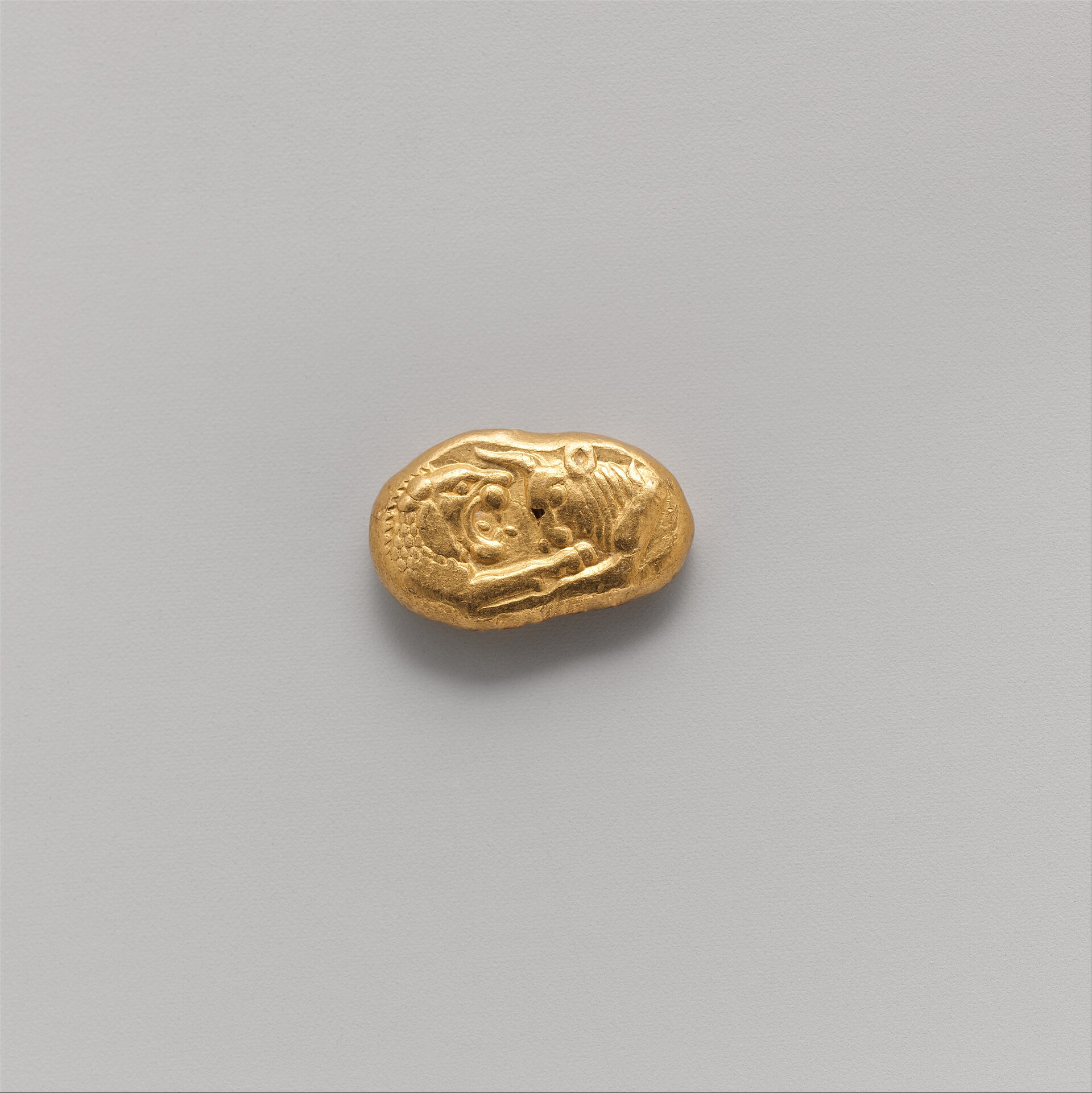
| Lydian gold stater of Croesus Lydian mint, Sardis | Comparandum acquired lawfully; the same culture, the same decades, a clean chain About 560-546 BC, credited as the gift of the American Society for the Excavation of Sardis in 1926. Lydian gold that reached the same museum forty years earlier through an excavation society, and stayed. | Metropolitan Museum of Art, New York, 26.59.2 |
| The Perge sarcophagus sculpture Roman, Asia Minor | Later Turkish recovery in the sequence this case began Cut up by looters and dispersed. The Getty Museum relinquished one part and a German foundation gave up others after the Lydian Hoard settlement emboldened Turkish claims. | Antalya, Turkey |
| The Euphronios Krater Euxitheos, potter; Euphronios, painter | The other Metropolitan Museum antiquities case, decided the other way round Bought by the Met in 1972 on a false Beirut ownership story and given up to Italy in 2006. Where the Lydian case was won by discovery in an American court, that one was won by a police raid on a Geneva warehouse and a negotiated accord. | Museo Nazionale Cerite, Cerveteri |
| The pieces recovered by the Turkish police in 1966 Lydian goldsmiths of the Usak tumuli | The comparison set that made the case provable Seized from the looters before they left Turkey and held in Turkish museums for thirty years. They are why photographs existed to set against the objects in New York, and in 1995 they were reunited with the rest. | Usak Museum of Archaeology, Usak |
Open questions
- Is the hippocamp now at Usak the object the Metropolitan Museum returned in 1993? It is asserted to be the original recovered from Germany in 2012, but the sources consulted do not state who held it, on what basis it was surrendered, or what test established that it was the original rather than a second copy. For an object whose substitution was detected only by weighing it, that is a live question and not a pedantic one.
- What did the Metropolitan Museum actually pay? Four published figures - about 500,000 dollars as the dealer's cost, 1.2 million, 1.5 million and 1.7 million - circulate for the same acquisition, and the museum's own accounts have never been published in a form that settles it.
- Was the collection acquired in three batches or four, and over which years? The Geneva case note says three batches between 1966 and 1970; the 1973 New York Times account says 1966, 1967 and 1968.
- Is the count of 363 objects complete? It is the figure agreed in the settlement, not an excavated inventory. How much left the tumuli and never reached the Met is unknown.
- Where is the counterfeit hippocamp now, and is it still exhibited? It was on display at Usak as the record of its own theft in 2008. No later account of its status was located.
- How many other objects did Kazim Akbiyikoglu remove? He admitted selling museum property to cover gambling debts and was tried with ten others. No published inventory of what was taken or recovered was located.
- Do the tomb wall paintings survive, and in what condition? They were the decisive evidence in discovery because the fragments fitted the walls they were cut from, but no conservation record for either the fragments or the tombs was located.
- Has the cooperation clause in the 1993 settlement ever been performed or audited? It provided for conservation, reciprocal loans, excavation in Turkey and fellowships. No assessment of what was delivered was located.
Questions about this object
What is The Lydian Hoard?
The Lydian Hoard is an antiquity, dated about 560-540 BC. Medium: Gold, silver, electrum, bronze and marble, with painted plaster wall paintings cut from tomb chambers.
Who made The Lydian Hoard, and is the attribution settled?
The attribution to Lydian goldsmiths and silversmiths of the Usak tumuli is recorded here as workshop. No maker, workshop or hand has been proposed for any object in the group, and no attribution question has ever arisen in the case. That is itself worth stating: this is a record in which connoisseurship plays no part at all. Every contested proposition about these objects has been settled or left unsettled by a document - an acquisition committee minute, a looter's statement, a court's ruling on limitation, a museum register and a set of scales.
Where is The Lydian Hoard now?
Usak Museum of Archaeology, Usak, Turkey. Last confirmed 3 August 2026. Returned by the Metropolitan Museum of Art under a settlement of September 1993; exhibited in Ankara and other Turkish cities before transfer to Usak in 1995.
What is still unknown about The Lydian Hoard?
Is the hippocamp now at Usak the object the Metropolitan Museum returned in 1993? It is asserted to be the original recovered from Germany in 2012, but the sources consulted do not state who held it, on what basis it was surrendered, or what test established that it was the original rather than a second copy. For an object whose substitution was detected only by weighing it, that is a live question and not a pedantic one.
Sources
- 1Chechi, A., Bandle, A. L. and Renold, M.-A., 'Case Lydian Hoard - Turkey and Metropolitan Museum of Art', Art-Law Centre, University of Geneva, ArThemis platform, February 2012. Read in full as the source PDF. The chronology, the demand and refusal analysis of 762 F. Supp. 44, the discovery process including the acquisition committee minutes and the wall painting matches, the terms of the 1993 settlement including the cooperation clause, and Ozgen Acar's figure of 1.7 million dollars against legal costs of at least twice that. plone.unige.ch/art-adr/...
- 2Waxman, Sharon, 'Chasing the Lydian Hoard', Smithsonian Magazine, 14 November 2008, an excerpt from Loot: The Battle over the Stolen Treasures of the Ancient World (Times Books, 2008). Acar and Hopkirk in 1970, the sixteen-year investigation, the 1984 sighting of the East Greek label, the looter's statement, the Klejman and Zacos chain, the Hoving memoir passage, the 29 May 1987 filing, the discovery evidence, the September 1993 concession, the 769 visitors and the Holzer remark, the 14.3 against 23.5 grams, and the Akbiyikoglu biography. smithsonianmag.com/history/...
- 3Wikipedia, 'Karun Treasure'. Tertiary source, used for the 6 June 1966 entry to the Toptepe tomb, the dating of the substitution to between March and August 2005, the thirteen-year sentence and the 2012 recovery of the brooch from Germany. Flagged for replacement with Kaye and Main 1995, the Turkish Daily News reporting of 14 July 2006 and the Turkish court record. en.wikipedia.org/wiki/...
- 4Wikimedia Commons file page for the Metropolitan Museum's CC0 photograph of Lydian gold stater 26.59.2, carrying the museum's own catalogue data: date about 560-546 BC, department of Greek and Roman Art, and the credit line 'Gift of The American Society for the Excavation of Sardis, 1926'. Licence verified per file from the Commons API extmetadata LicenseShortName. commons.wikimedia.org/wiki/...

Last verified 12 August 2026 · Published 4 August 2026
Change log
2 August 2026 - Record deepened to the house standard: narrative sections, technical evidence, artist dossier, related works and open questions added; provenance chain and auction results replaced with the researched versions; sources rebuilt.
4 August 2026 - Withheld from publication. This archive lists an object only when a photograph OF THAT OBJECT can be reproduced under a free licence. No such photograph has been found for this one, so the record is held rather than published beside pictures of other things. It will be released if a free reproduction appears.
4 August 2026 - Record created at the house standard: researched narrative, technical evidence, maker dossier, graded provenance chain, prices with hammer and premium separated, related works, open questions and sources.
12 August 2026 - Periodic re-verification, no factual change. Checked: (1) current location - confirmed still Usak Museum of Archaeology, Usak; the museum closed temporarily for air conditioning and prior roof repair work (reported by egedeyenigun.com, 11 November 2025), with reopening for the 2026 tourism season and the Karun Treasures said to return to display in improved climate-controlled conditions; no move, loan, security incident or damage reported, so current_location is unchanged. (2) No new scholarship on attribution, dating or the extent of the hoard was located. (3) No new litigation, claim, further theft or restitution development involving this hoard was found; a web and Turkish-language search for 2025-2026 news returned nothing beyond routine museum-visit coverage. (4) All four cited source URLs re-checked and still resolve: source 1 (Geneva Art-Law Centre ArThemis) and source 4 (Wikimedia Commons gold stater file page) load directly; source 2 (Smithsonian Magazine) returned an HTTP 403 to a direct fetch, which is a bot block per house rule rather than a dead link, and was confirmed live and unchanged via browser retry; source 3 (Wikipedia, Karun Treasure) still loads and content is unchanged. No field required correction.