Half Armor attributed to Don Gonzalo Fernandez de Cordoba y Fernandez de Cordoba, Duke of Sessa (1520/1524-1578)
Lucio Piccinino (also called Lucio Marliani), Milanese armor workshop · Partially mid-16th century (elements traditionally placed ca. 1560-1570); comprehensively reworked, completed and re-decorated in Paris in the 19th century
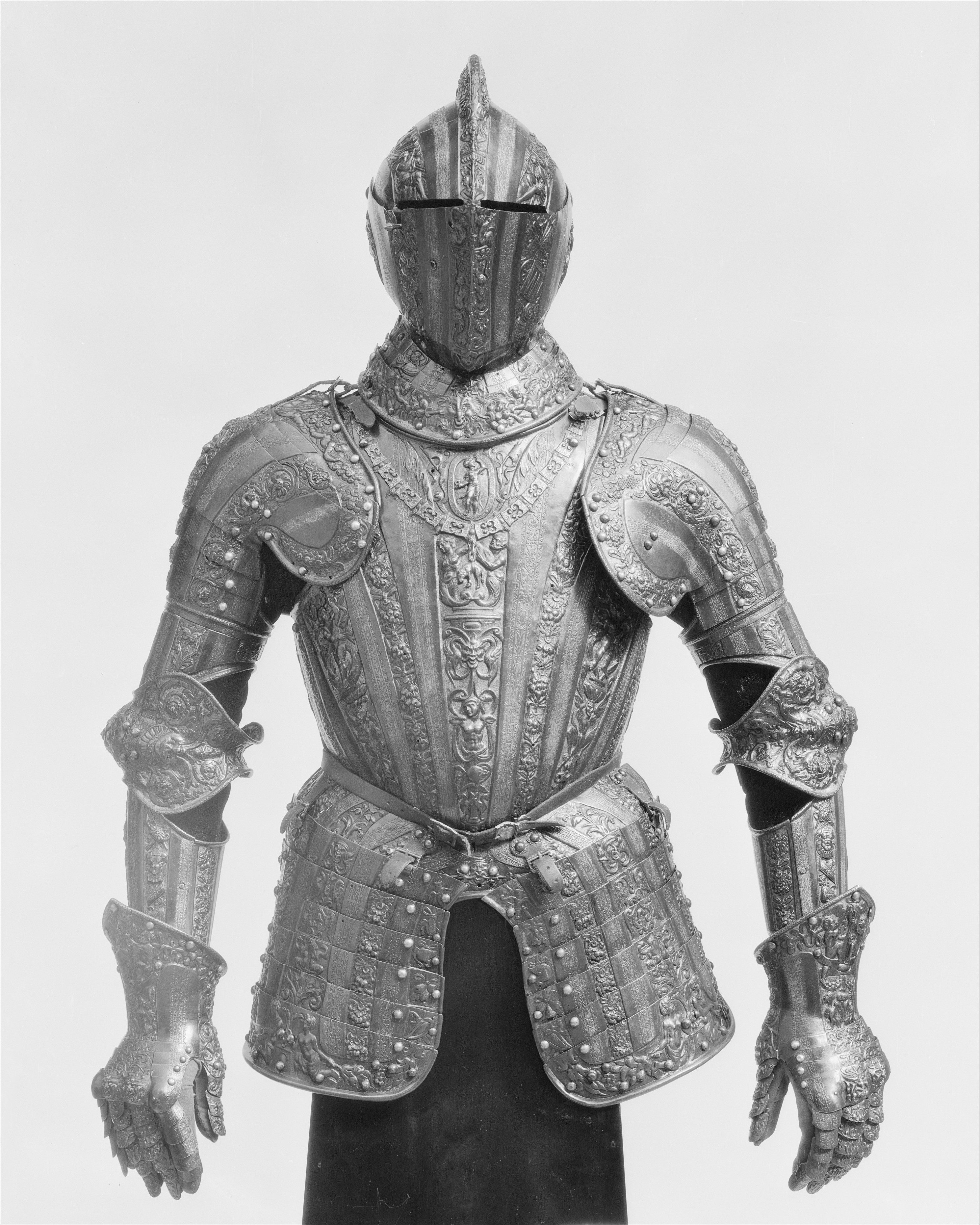
The armor as it appears today: mid-16th-century steel elements combined with substantial 19th-century Parisian completion and gilt decoration, catalogued by the Metropolitan Museum's own date field as 'partially mid-16th century, comprehensively reworked in the 19th century.'
| Artist | Lucio Piccinino (also called Lucio Marliani), Milanese armor workshop |
|---|---|
| Date | Partially mid-16th century (elements traditionally placed ca. 1560-1570); comprehensively reworked, completed and re-decorated in Paris in the 19th century |
| Medium | Steel and gold, etched, embossed and gilt; later steel, leather and textile completions |
| Dimensions | Weight approximately 30 lb. 7 oz. (13.8 kg) overall; helmet component approximately 7 lb. 11 oz. (3.5 kg) |
| Where it is now | Metropolitan Museum of Art, New Yorklast confirmed |
| Inventory number | 04.3.270a-o |
| Attribution | DisputedNo element carries a maker's mark or signature. Full note |
| Object type | Arms and armour |
| Period | Italian Renaissance parade-armor tradition (Milan), overlaid with 19th-century Parisian restoration and completion |
| Cases | Disputed attribution · Has a provenance gap |
| Inscriptions | None recorded on any element. No signature, maker's mark or armorer's stamp is documented for this object or for any other work given to Lucio Piccinino. |
| Owners on record | 8 links6 documented, 1 disputed, 1 unknown |
| Sources | 11 cited |
About this record Last verified · 11 sources cited · Change log
On this page 9 sections
ContentsClose
The Metropolitan Museum's own catalogue date for this half armor reads, in full: partially mid-16th century, comprehensively reworked in the 19th century. That sentence, not the attribution to the Milanese embosser Lucio Piccinino or the identification with Gonzalo Fernandez de Cordoba, Duke of Sessa, is the object's real subject. The armor entered the Museum in 1904 as part of its founding purchase of the Paris collection of the Duc de Dino, catalogued and attributed by Dino's own paid adviser, Baron de Cosson, who linked it to a 1643 Spanish inventory describing a Sessa-owned harness - a full, head-to-foot suit, where the Metropolitan's object is explicitly upper body only.
Piccinino signed nothing; every attribution to him, on this piece and on every other, rests on stylistic comparison to a single textually-documented commission for the Duke of Parma, now in Vienna. The Duke of Sessa was a real, thoroughly documented Spanish grandee, twice governor of Milan and a Golden Fleece knight from 1555, but no direct record ties him to an order from Piccinino, and the two men's working lives, on the dates given in the sources consulted, overlap by at most a few years.
Later Museum scholarship has identified this specific object as one of the more elaborate examples of the 19th-century armor market's practice of composing, altering and completing older steel into a saleable Renaissance masterpiece, sold with a documentary-sounding pedigree assembled from real but disconnected fragments. That does not make the piece worthless or the story invented from nothing. It makes it exactly what its own catalogue entry already says: a genuine mid-16th-century core, substantially rebuilt and re-sold, three centuries later, as something more complete and more famous than what survived.
Provenance
Each link is graded. Documented: a cited source supports it. Disputed: the identification is argued but not established. Unknown: no owner for that span, and the gap is not smoothed into a narrative. The grades in the glossary.
- by 1643 - 1643Dukes of Infantado (Mendoza family), Guadalajara, Spain - armoury inventory recorddisputed
A 1643 inventory of the Infantado family armoury is reported to record a cap-a-pie (full, head-to-foot) harness described as having belonged to the Duke of Sessa, decorated with the Order of the Golden Fleece - an emblem consistent with Gonzalo Fernandez de Cordoba, 3rd Duke of Sessa, who was elected to the Order in 1555. The identification of this inventory entry with the object now in New York is unverified: the inventory describes a full suit, while the Metropolitan's object is a half armor, upper body only. Graded disputed rather than documented for that reason. This is de Cosson's own claim, made while cataloguing the piece for sale (see below) - Pyhrr 2012 reports it as de Cosson's assertion, not as independently confirmed.74
- 1643 - ca. 1865-1870Unrecordedunknown
No source consulted for this record traces ownership of the Sessa-associated harness, or of the separate armor later combined with it (see the next entry), between the 1643 Infantado inventory and the mid-1860s.
- ca. 1865-1870 - ca. 1865-1870Unrecorded (location: Spain)documented
A photograph by the Madrid studio of Jean (Juan) Laurent, probably taken about 1865-70, shows elements of what would become this armor while still in Spain, before Spitzer's workshop altered them (see next entry). The Metropolitan's own 2012 scholarship uses this photograph to reconstruct the object's original, unaltered appearance and to establish that its steel elements were genuinely in Spain at this date - the one fixed point of documented physical location between the disputed 1643 inventory and the object's appearance on the Paris market two decades later.7
- by 1895 - 1895Frederic Spitzer collection, rue Villejust (now rue Paul Valery), Parisdocumented
The Metropolitan's own 2012 curatorial reconstruction (Pyhrr) identifies this piece by name as having been assembled and altered within the collection of Frederic Spitzer (1815-1890), one of the best-known and, by the Museum's own description, most infamous dealers of the 19th century. Forensic comparison against the ca.1865-70 Laurent photograph establishes that the finished object combines elements of TWO different, fire-damaged armors - a breastplate, backplate, right tasset and probably the gorget from one; a helmet, arm defenses and gauntlets, mostly modern replacements, from a second, unrelated armor with different edge decoration. Both source armors were re-gilt, and the etched decoration on the breastplate and backplate was reworked to add extra bands purely for ornamental effect. Pyhrr states this embellishment approach is 'a hallmark of Spitzer's restoration philosophy.' Spitzer himself was dead by 1890; the alteration is understood to have been carried out by his workshop before the collection came to sale.7
- 10-14 June 1895 - 10-14 June 1895Maurice de Talleyrand-Perigord, Duc de Dino, Parisdocumented
Dino bought this armor, one of his four most expensive armor purchases, at the Spitzer collection's historic sale in Paris, 10-14 June 1895, where he was the single most important buyer, spending over 150,000 francs. The Museum's own 2012 scholarship states plainly that most of the armors Dino bought at this sale, including his four best, later proved to be disappointments - composites or fakes recognized only after further study.7
- 1895 - 1904Maurice de Talleyrand-Perigord, Duc de Dino, Parisdocumented
Baron Ferdinand de Cosson, engaged from about 1896 as Dino's paid cataloguing adviser, attributed the already-assembled piece stylistically to 'the leading Milanese armorer of the period, Lucio Piccinino,' and connected it, via the 1643 Infantado inventory, to the Duke of Sessa - in the same campaign that also identified weaker or fake pieces in the collection for de Cosson to recommend selling off separately at Christie's rather than including in the sale to the Metropolitan. The attribution and ownership story therefore postdate, and were not involved in, the Spitzer-era physical alteration of the piece itself.7
- 1904 - 1904Metropolitan Museum of Art, purchased as part of the Duc de Dino collectiondocumented
The Museum purchased the Duc de Dino's collection of nearly 500 pieces of arms and armor in April 1904, sight unseen and without reference to de Cosson's own privately printed catalogue, for just over $250,000 - its largest single purchase to date. Trustee Rutherfurd Stuyvesant, in Paris at the time, was alerted to the collection's imminent sale at Christie's, London (scheduled for 3 June 1904) by a cable from J. P. Morgan, and cabled the Museum's president urging immediate purchase before the collection went to public auction. Bashford Dean was engaged as guest curator to receive, catalogue and install the acquisition, work that led directly to the founding of the Department of Arms and Armor.78
- 1904 - presentMetropolitan Museum of Art, New Yorkdocumented
Credited Rogers Fund, 1904; accession number 04.3.270a-o; object ID 21996.1
Technical evidence
| Attribution note | No element carries a maker's mark or signature. The Metropolitan Museum catalogues the piece as 'attributed to' Lucio Piccinino, an attribution that originates with Baron Ferdinand de Cosson, the paid cataloguing adviser to the Duc de Dino, whose Paris collection this object passed through before 1904. The attribution rests entirely on stylistic resemblance to a small group of comparison pieces, chief among them a documented but likewise unsigned parade armor made for Alessandro Farnese, Duke of Parma, now in Vienna. Because the physical object itself is a 19th-century composite over a mid-16th-century core, the stylistic argument is being made partly on decoration that postdates Piccinino's working life by two to three centuries. |
|---|---|
| Medium | Steel and gold; etched, embossed and gilt decoration over a forged steel ground, with later steel, leather and textile completions.1 |
| Weight | Total weight approximately 30 lb. 7 oz. (13.8 kg); helmet component approximately 7 lb. 11 oz. (3.5 kg).1 |
| Classification and components | Catalogued as Armor for Man, half armor; accessioned as fourteen or more separate elements under 04.3.270a through o.1 |
| Object date (Museum's own field) | Partially mid-16th century, comprehensively reworked in the 19th century - the Metropolitan's own primary date field for this object, not an inference drawn by this record.1 |
| Credit line and accession | Rogers Fund, 1904; accession number 04.3.270a-o; object ID 21996. The '04' prefix places the piece inside the Museum's 1904 accession year, coincident with the purchase of the Duc de Dino collection.17 |
| Comparable Museum classification | The Department's own 'Composed Armor' classification (e.g., accession 29.156.66, dated ca. 1480 and later, assembled from Italian, Spanish and German elements) formally describes the practice of combining components from multiple makers, regions and periods into a single ensemble - the same phenomenon documented for this piece, though it is not catalogued under that heading.3 |
| Marks and inscriptions | No maker's mark, signature or armorer's stamp is recorded on any element. Piccinino's near-contemporary Pompeo della Cesa, by contrast, signed his work 'Pompeo,' making the total absence of any mark on this armor and on every other piece given to Piccinino a documented feature of his output, not an archival gap.19 |
Images
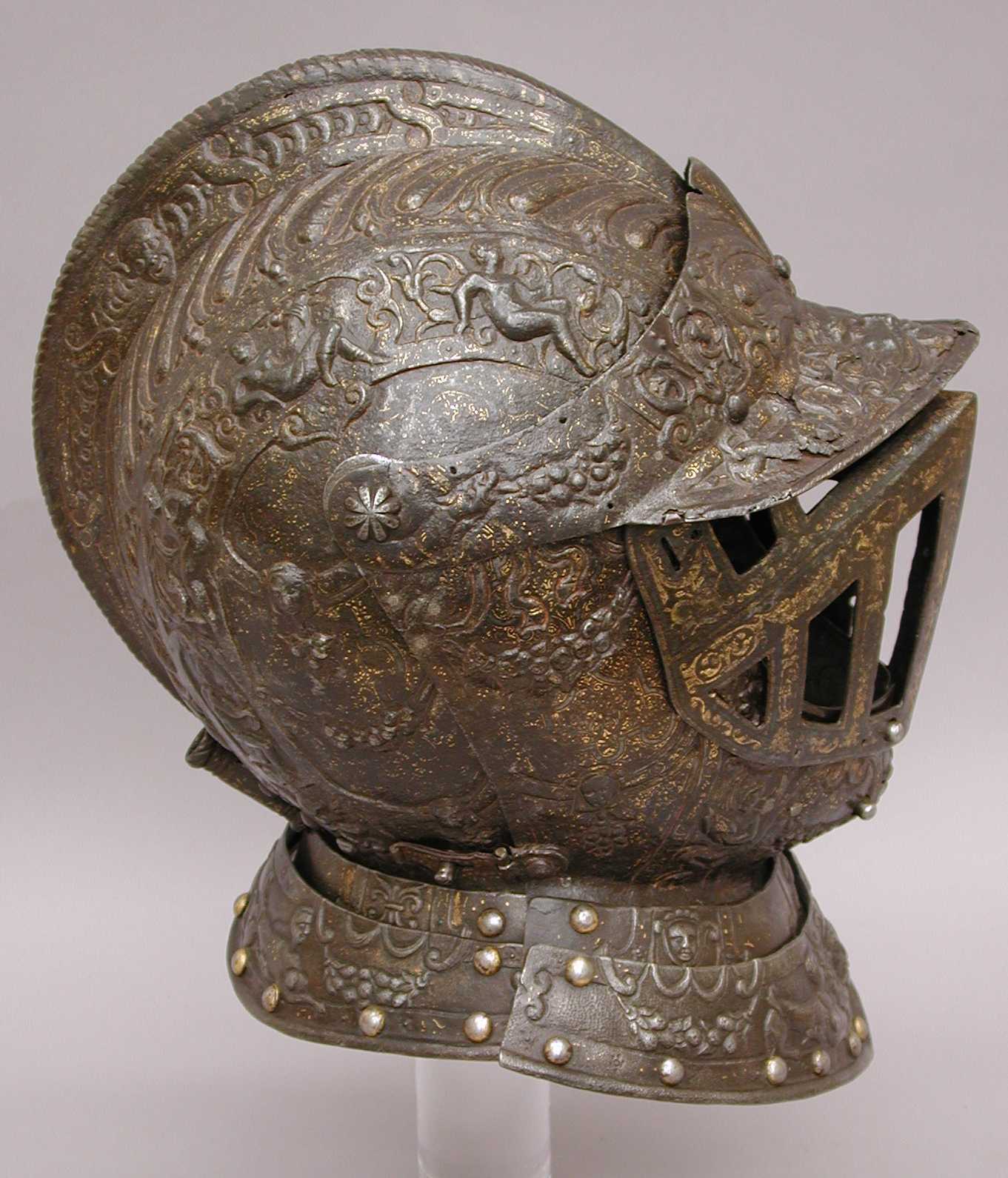
The record in full
Chapter 1A half armor, not a suit
The Metropolitan Museum's own object name for this piece is exact and worth taking literally: a half armor.
The Metropolitan Museum's own object name for this piece is exact and worth taking literally: a half armor. It covers the torso and arms, not the legs. Its accession number, 04.3.270a-o, spans fourteen or more separately catalogued elements, and its recorded weight is about 30 pounds 7 ounces (13.8 kg) for the body components with the helmet, at roughly 7 pounds 11 ounces (3.5 kg), counted apart. The medium is given simply as steel and gold, meaning a ground of forged and blued steel plate carrying etched, embossed and gilt decoration, the standard vocabulary of Milanese parade armor in the third quarter of the sixteenth century.
What a visitor sees in the gallery is therefore a coherent, densely decorated upper-body harness in the all'antica style associated with the last generation of great Milanese embossers. What the object actually is, according to the Museum's own catalogue field for its date, is something else: partially mid-16th century, comprehensively reworked in the 19th century. That sentence is the subject of this record. It is not a caveat buried in a footnote; it is the Museum's own primary date field for the piece, and it deserves to be read as carefully as the attribution itself.
Chapter 2Two dates in one catalogue entry
Museums routinely give composite objects a date range or a phrase like 'later additions.' This entry does something more specific.
Museums routinely give composite objects a date range or a phrase like 'later additions.' This entry does something more specific. It splits the object into two distinct manufacturing episodes separated by roughly three centuries: a mid-16th-century core, and a 19th-century campaign the Museum calls comprehensive rather than partial. That word choice matters. A partially reworked armor might mean a replaced strap, a re-blued surface, a single re-cut plate. A comprehensively reworked armor means the object as displayed is substantially a product of the second campaign, using some genuine older material as a starting point rather than as the finished thing itself.
This is not a unique problem in the Museum's own arms and armor holdings. The Department maintains a formal classification, 'Composed Armor,' for suits assembled from multiple makers, regions and periods into a single ensemble - one such piece, accession 29.156.66, spans components dated 'ca. 1480 and later' assembled from Italy, Spain and Germany into one functional harness. The Sessa half armor is not formally catalogued under that heading, but the phenomenon it describes, of a 19th-century hand completing an incomplete or damaged older object into something more saleable and more spectacular, is exactly what the Museum's own date field is reporting here.
Chapter 3The market that made objects like this
The second half of the 19th century saw sustained, well-financed demand among European and American collectors for Renaissance parade armor: pieces embossed, damascened and gilt to the point of...
The second half of the 19th century saw sustained, well-financed demand among European and American collectors for Renaissance parade armor: pieces embossed, damascened and gilt to the point of covering the entire steel surface with figural and ornamental relief, worn once, if ever, and made as much to display wealth and classical learning as to stop a blade. Genuine surviving examples from named Milanese workshops were and remain rare. Damaged, incomplete, or anonymous older steel, however, was comparatively available, and a market of dealers, restorers and expert advisers grew up in Paris specifically to supply the gap between demand and surviving supply.
The Metropolitan's own arms and armor collection was built, at its founding, directly out of this market. Its core 1904 purchase was the entire collection of Maurice de Talleyrand-Perigord, Duc de Dino, formed in Paris; its second foundational gift, in 1913, was the collection of William H. Riggs, an American who spent decades acquiring in Europe. Modern Museum scholarship on the Dino purchase specifically - not a hostile outside critique, but the Museum's own later curatorial research - has concluded that a meaningful number of the collection's best-known and most frequently published pieces are composites or outright 19th-century fabrications dressed in Renaissance style. This armor is one of the pieces that scholarship identifies by name.
Chapter 4Who the Duke of Sessa actually was
Before addressing what happened to the object, it is worth being precise about the man it is named for, because the Cordoba family used the same small set of names across generations and it is easy...
Before addressing what happened to the object, it is worth being precise about the man it is named for, because the Cordoba family used the same small set of names across generations and it is easy to conflate them. This armor's title names Don Gonzalo Fernandez de Cordoba y Fernandez de Cordoba, 3rd Duke of Sessa, born at Cartagena on 27 July 1520 and dead at Villaviciosa de Odon on 3 December 1578. He was not the celebrated 'Great Captain,' the earlier Gonzalo Fernandez de Cordoba (1453-1515), 1st Duke of Sessa and viceroy of Naples, who was this man's great-grandfather. He was, rather, that man's grandson through his mother.
Orphaned young - his mother died in childbirth in 1524, his father on campaign in Italy in 1526 - he was raised at Granada by his grandmother, the Great Captain's widow, and educated in the standard humanist-courtly curriculum of Latin, Greek, music, fencing and horsemanship. He inherited his father's library of some ninety books. He married Maria Sarmiento de Mendoza, daughter of Francisco de los Cobos, Secretary of State to Charles V, in 1538; the marriage produced no children. He served as Captain General of the Spanish forces in Italy and Great Admiral of the Kingdom of Naples, sat on the Royal Council for Italy and the Royal War Council, and governed the Duchy of Milan twice, in 1558-1560 and again in 1563-1564. In 1555 he was elected a knight of the Order of the Golden Fleece, the 213th to hold the honor. He died without an heir; his titles passed to his sister Francisca.
This is a real, well-documented sixteenth-century figure, twice governor of the very city where Piccinino's workshop operated, and a man whose career gave him both the means and the occasion to commission or receive parade armor of exactly this kind. None of that, on its own, establishes that he owned this particular object.
Chapter 5How a Piccinino attribution is normally made
Lucio Piccinino left no signed or marked work.
Lucio Piccinino left no signed or marked work. That single fact governs everything written about him. The 16th-century Milanese chronicler Paolo Morigia, in his 1595 La Nobilta di Milano, names him as the son of the sword-cutler Alessandro Piccinino (who died in 1589) and brother of another sword-cutler, Federico, and credits him with 'outstanding armours for His Serene Highness the Duke of Parma' - a documented commission, since lost as an original contract but recorded in print within Piccinino's own working lifetime. That Farnese commission, made around 1576-1580 for Alessandro Farnese, Duke of Parma and Piacenza, and now held by the Kunsthistorisches Museum in Vienna (inventory A 1132), is the anchor of the entire attribution network built around Piccinino's name. It is itself unsigned; it is accepted as his because Morigia's text ties a documented patron and date to a physical object that has descended, without a plausible break, in a traceable line.
Every other 'Piccinino' - the Metropolitan's own Armor of the Dukes of Alba (acc. 14.25.714a-h, j, gift of William H. Riggs, 1913), a Wallace Collection ceremonial armor in London (inv. A51), a Victoria and Albert Museum breastplate assembled from the 1855 Bernal sale, and this half armor - is attributed by comparing its embossed ornament, its damascening technique and its compositional habits to that one Vienna benchmark. The Wallace Collection's own catalogue entry is candid about the limits of this method: its armor's traditional association with a specific 16th-century duke is noted as one whose 'source of this information has not been traced.' The V&A breastplate's attribution likewise 'depends stylistically' on the Vienna suit being correctly identified in the first place. Piccinino attribution, across the field, is a chain of resemblance radiating from a single textually-supported hub, not a body of independently signed work.
Sources differ on even the basic facts of Piccinino's life. The Metropolitan's own artist record gives him as active circa 1575-1590. Oxford Reference gives active dates of 1578-1595. The Wallace Collection gives a specific lifespan, 1538-1607, under the fuller name Lucio Marliani, called Piccinino. This record states that spread rather than resolving it, because no source consulted here reconciles the three.
Chapter 6A narrow window for a real commission
Put the two documented timelines side by side.
Put the two documented timelines side by side. The Duke of Sessa died on 3 December 1578. Piccinino's activity is nowhere documented before about 1575. If both date ranges are accepted at face value, the two men's working lives overlapped by at most three years, and there is no direct record - no contract, no inventory entry written in Sessa's lifetime, no correspondence - placing an order between them in that window or any other. A commission is not implausible: Sessa had twice governed Milan, the city where Piccinino worked, and had the wealth and rank for exactly this kind of armor. But plausibility is not documentation, and no source found in this research supplies the missing document.
Chapter 7The 1643 inventory, and a mismatch worth naming
The Sessa identification does not rest on nothing.
The Sessa identification does not rest on nothing. An inventory of the armoury of the Dukes of Infantado, compiled in 1643, is reported to record a cap-a-pie harness - a complete suit running from head to foot - described as having belonged to the Duke of Sessa, with the Order of the Golden Fleece worked into its decoration. That detail lines up with an independently verifiable fact: Gonzalo Fernandez de Cordoba, 3rd Duke of Sessa, was elected to the Golden Fleece in 1555, so a harness bearing that emblem and traditionally tied to his name is at least chronologically coherent with his real biography.
What the inventory does not do is identify the object now in New York. Two problems stand between the 1643 entry and this armor. First, no continuous chain of ownership connects an Infantado family harness of 1643 to a Paris art dealer's collection roughly two and a half centuries later; the intervening period is undocumented in every source consulted for this record. Second, and more concretely, the 1643 entry describes a cap-a-pie suit, meaning full armor including leg defenses, while the Metropolitan's object is explicitly a half armor, upper body only. A head-to-foot harness and a half armor are not interchangeable descriptions of the same physical thing. Either the Infantado inventory describes a different, more complete suit that has since been broken up or lost its lower elements without record, or the identification linking this armor to that inventory entry was made loosely, after the fact, to supply a prestigious owner for an object that needed one. Neither possibility is resolved in the material available.
Chapter 8Baron de Cosson and the making of the Dino collection
The person who put the Piccinino attribution and the Sessa identification together, in the form the Metropolitan Museum inherited in 1904, was Baron Ferdinand de Cosson, an English authority on arms...
The person who put the Piccinino attribution and the Sessa identification together, in the form the Metropolitan Museum inherited in 1904, was Baron Ferdinand de Cosson, an English authority on arms and armor engaged from about 1896 as the Duc de Dino's paid adviser. By the time de Cosson made that attribution, the armor's physical alteration was already finished - it had happened years earlier, under a previous owner, and is described in the next section. De Cosson's documented working method for the Dino collection had two sides. He recommended that the duke remove weaker pieces and outright fakes from the collection before any sale, and a group of such pieces was in fact sent to Christie's in London rather than kept. But the pieces he judged worth keeping and cataloguing, he also attributed - and it is de Cosson's own attribution that assigns this armor to 'the leading Milanese armorer of the period, Lucio Piccinino,' and de Cosson's own note that links it, via the 1643 inventory, to the Dukes of Infantado and, through them, to the Duke of Sessa.
This is the central fact this record exists to state plainly. The attribution and the ownership story attached to this object were not independently established by later, disinterested scholarship examining an unremarkable piece of steel. They were assembled by the same adviser, working for the same seller, in the same cataloguing campaign that prepared the collection for sale - a seller with a direct financial interest in every attribution and every noble name he could responsibly attach to the pieces he recommended keeping. That does not make either claim false. Morigia's text on Piccinino and the 1555 Golden Fleece election are real, checkable facts, and de Cosson was a genuine specialist, not a con man. But it means the Piccinino/Sessa story reads, on the evidence gathered here, as a period sales narrative built from real documentary fragments rather than as a chain of custody independently verified after the fact. Later Museum scholarship - specifically Stuart W. Pyhrr's 2012 reconstruction of the Dino collection's formation, published in the Metropolitan Museum Journal - treats this piece by name as 'composed, extensively altered, and completed in France in the 19th century.' Pyhrr's own research, read directly for this record, traces exactly whose workshop did that work, and it was not Dino's or de Cosson's.
Chapter 9Two armors, not one
The Museum's own 2012 research goes further than a general 'reworked in the 19th century' finding.
The Museum's own 2012 research goes further than a general 'reworked in the 19th century' finding. It identifies WHO altered the piece, and shows, physically, what was done. Before this armor reached Paris it belonged to Frederic Spitzer (1815-1890), a Vienna-born Paris dealer whose home on the rue Villejust was known as the Musee Spitzer - a man the Museum's own scholarship describes as 'one of the best-known and most infamous dealers of the century,' whose stock included genuine masterpieces alongside sophisticated fakes credited to his own workshop's cunning. Dino bought this armor at the historic sale of Spitzer's collection in Paris, 10-14 June 1895, as one of his four most expensive armor purchases that week - and the Museum's own account states plainly that most of Dino's best Spitzer-sale armors, this one included, later 'proved to be disappointments.'
A photograph survives that fixes what the piece looked like before Spitzer's workshop touched it. Taken by the Madrid studio of Jean Laurent, probably around 1865-70, it shows the constituent elements still in Spain, years before they reached the Paris market. Comparing that photograph against the armor as it exists today, Pyhrr's research reaches a specific, checkable conclusion: the object combines pieces from two different, unrelated armors, both damaged - fire scale survives inside several elements, suggesting both originally came through a collection damaged by fire. The breastplate, backplate, right tasset and probably the gorget, all with smooth plain edges, belong to one armor. The helmet, arm defenses and gauntlets, edged with a guilloche (interlace) pattern, belong to a second, and several of those elements are modern replacements skilfully decorated to match the old work around them. The left tasset now on the armor is not the one shown in the Laurent photograph at all - it is a modern replacement, made to match its genuine but altered right-hand counterpart. Spitzer's workshop then reworked the breastplate and backplate again: the Laurent photograph shows three wide embossed bands alternating with wide etched bands; the object today has five narrower embossed bands separated by narrow etched bands added between them, achieved by hammering the original etched decoration smooth and re-embossing over it. Pyhrr's account calls this kind of purely ornamental over-decoration, serving no practical purpose on an already elaborate armor, a hallmark of Spitzer's own restoration practice. Every surface was then regilt, so that the only original color surviving anywhere on the piece is a trace of gold damascening on the breastplate and backplate.
The genuine, unaltered left tasset that matches the real right-hand one (before Spitzer's workshop changed it) did not go to New York at all. It is recorded as surviving separately, in the Musee de l'Armee, Paris. Other fragments of the second, guilloche-edged armor are recorded in collections in Rome, Florence and Philadelphia. No source consulted for this record has traced whether those fragments have themselves been reunited, studied together, or published as a group since 2012.
Chapter 10The 1904 purchase and the founding of a department
The Duc de Dino's collection, nearly five hundred pieces of European arms and armor formed in Paris, came onto the market via Christie's in June 1904.
The Duc de Dino's collection, nearly five hundred pieces of European arms and armor formed in Paris, came onto the market via Christie's in June 1904. The Metropolitan's trustee Rutherfurd Stuyvesant learned of the sale and moved to secure the collection for the Museum rather than let it go to auction; the Museum bought it as a block, reportedly for a then-record sum, before the works were dispersed lot by lot. Reports of the price cluster around 250,000, though the sources consulted for this record do not consistently specify whether that figure is US dollars or French francs, and it describes the entire nearly-500-piece purchase rather than any value attached to this armor individually; a specific, sourced price for this object alone was not found. Bashford Dean, a Columbia zoologist and armor collector who had no prior curatorial post at the Museum, was brought in as guest curator specifically to receive, catalogue and install the new acquisition. That 1904 purchase is the direct origin of what became, formally, the Department of Arms and Armor, with Dean advancing from guest curator in 1904 to honorary curator in 1906 and founding curator in 1912.
This half armor's accession number, 04.3.270a-o, places it precisely inside that founding purchase: the '04' prefix is the Museum's 1904 accession year, and the credit line is Rogers Fund, 1904, the general acquisitions fund the Museum used to complete the Dino purchase. In other words, this object is not a later, marginal addition to the arms and armor collection. It came in with the collection's founding gift, catalogued and attributed by the seller's own adviser, at the exact moment the department that would eventually become one of the most respected in the world was being built.
Chapter 11The Riggs gift, and why the comparison matters
Nine years after the Dino purchase, in 1913, the Museum received a second foundational collection: nearly two thousand pieces assembled over roughly fifty years by William H.
Nine years after the Dino purchase, in 1913, the Museum received a second foundational collection: nearly two thousand pieces assembled over roughly fifty years by William H. Riggs, an American who spent most of his adult life in Europe pursuing individual pieces of historic arms and armor, and whose gift the Museum's own curator, Bashford Dean, had spent close to a decade persuading him to make. The Metropolitan's other Piccinino-attributed armor, the Armor of the Dukes of Alba, entered the collection through this route in 1913, not through the 1904 Dino purchase.
The distinction is not incidental to this record. A collection built by one obsessive individual collector over half a century, piece by piece, is a different kind of object than a dealer-advised bloc purchased in a single transaction from a seller whose own paid specialist had a financial stake in every attribution he offered. Both routes produced objects now in the same museum, catalogued under the same department, and both routes have produced genuine masterpieces. But when this record's central finding, that the Sessa armor's authenticity narrative was built by the seller's own adviser rather than independently verified afterward, is stated plainly, the Riggs-gift Alba armor is the clearest illustration, inside the Metropolitan's own walls, of what the alternative looks like: a Piccinino attribution supported by a documented, disinterested chain of ownership rather than a sales campaign.
Chapter 12A title that has softened over time
The object's own title, as the Museum gives it, has not stayed fixed.
The object's own title, as the Museum gives it, has not stayed fixed. An earlier version of the catalogue title, still visible in image records distributed through the Museum's open-access program, read 'Half Armor Probably Made for Don Gonzalo Fernandez de Cordoba y Fernandez de Cordoba, Duke of Sessa.' The title in current use on the Museum's own collection pages reads 'attributed to' rather than 'probably made for.' Read side by side, the change moves from a phrasing that asserts a specific original owner with some hedging on certainty, to a phrasing that hedges the maker's identity instead and drops the claim about the original owner from the main title into a subordinate clause.
This is a small, precise thing, but it is exactly the kind of change a catalogue makes when new research complicates an old story without fully overturning it. It is consistent with, though not proof of, the broader pattern this record documents: a period sales identification, made by an interested party in 1904 or before, gradually loosening its grip on the Museum's own language as later scholarship examined the Dino collection's formation more critically.
Chapter 13What the surface can and cannot tell a specialist
The Museum's medium field for this object reads simply: steel, gold.
The Museum's medium field for this object reads simply: steel, gold. That is accurate as a list of materials and unhelpful as a guide to dating, because both a genuine mid-16th-century Milanese embosser and a highly skilled 19th-century Parisian restorer working in the same idiom used the same materials and largely the same techniques: forged steel plate, relief embossing raised from the reverse and chased from the front, and gold (with silver) damascening inlaid into cross-hatched or scored steel. Etching, embossing and gilding do not carry an internal chemical signature of their date the way, for instance, a pigment or a canvas weave sometimes can; a 19th-century hand copying 16th-century ornament with 16th-century tools and materials can produce decoration that is extremely difficult to separate from genuine period work on visual inspection alone. This is precisely why the objects in this category tend to be identified not by connoisseurship applied to the decoration itself, but by external evidence - inconsistent plate thickness or construction between elements, non-period fasteners or linings, mismatched wear patterns, or, as in this case, documentary research into the collection's own formation and the adviser who assembled its attributions. No metallurgical or technical imaging study of this specific armor is cited in any source consulted for this record; the 'comprehensively reworked' judgment in the Museum's own catalogue rests on curatorial and documentary research (principally Pyhrr's 2012 study of the Dino collection), not on a published material analysis of this object's plates.
Chapter 14What is unresolved
Three things remain genuinely open. How much of the surviving object is 16th-century steel and how much is 19th-century work has never, so far as this research could establish, been settled by a...
Three things remain genuinely open. How much of the surviving object is 16th-century steel and how much is 19th-century work has never, so far as this research could establish, been settled by a published technical or metallurgical examination of the piece itself; the record relies on curatorial judgment. Whether the object identified in the 1643 Infantado inventory is this armor, a different armor now lost, or a documentary coincidence exploited by a 19th-century cataloguer remains unproven either way. And no source found here names the specific Parisian workshop or restorer responsible for the 19th-century campaign, only the collector, Dino, and the adviser, de Cosson, who received and catalogued the finished result.
None of that makes the object less worth looking at. It is, on the Museum's own evidence, a genuine artifact of two different centuries: whatever mid-16th-century Milanese steel survives within it, and a full, skilled demonstration of what the 19th-century armor trade could build on top of that core to satisfy a market that wanted Renaissance splendor more than it wanted an unbroken chain of proof.
The artist
Lucio Piccinino, also recorded as Lucio Marliani, called Piccinino
Piccinino is described, wherever he is described at all, as the last of the great Milanese armor embossers, the craftsman who carried the all'antica parade-armor style forward after Filippo Negroli's generation. Almost nothing about him is documented in the ordinary sense of contracts, payments or a signed body of work. What survives is a single, near-contemporary printed account naming him and crediting him with one specific commission, and a modern connoisseurship built outward from that one anchor to cover several dozen objects in museums across Europe and America, this armor among them.
Related works
| Work | Relation | Where it is |
|---|---|---|
| Left tasset (genuine, unaltered counterpart to the Met armor's right tasset) Unattributed - the same source armor as part of the Met piece | The one surviving element that shows what the Met breastplate group looked like before Spitzer's workshop reworked it - it was never separated from its own original form the way the Met's matching right tasset and left-tasset replacement were Identified by Pyhrr (2012) as the genuine mate to the Met armor's altered right tasset, both originally part of the same 16th-century Spanish armor later split up when the piece passed through Spitzer's Paris workshop in the 1880s-90s. No image of this tasset was sourced for this record; included as a documented related fragment, not as a plate. | Musee de l'Armee, Paris (inv. G.PO1260) |
| Armor of the Dukes of Alba Lucio Piccinino | Another Piccinino-attributed armor at the same museum, acquired through a different, independently documented route Gift of William H. Riggs, 1913, dated ca. 1575-85; probably made for two sons of Fernando Alvarez de Toledo, 3rd Duke of Alba. A useful contrast: a Piccinino attribution supported by a coherent acquisition history and an intact ensemble, rather than a reconstructed sales narrative. | Metropolitan Museum of Art, New York (acc. 14.25.714a-h, j) |
| Armor Garniture of Alessandro Farnese, Duke of Parma Lucio Piccinino | The one Piccinino commission with a textual documentary anchor, and the stylistic benchmark against which every other 'Piccinino' attribution, including this one, is ultimately measured Made ca. 1576-1580; referenced in Paolo Morigia's 1595 La Nobilta di Milano as Piccinino's work for the Duke of Parma. Unsigned, but tied to a documented patron and date by a contemporary printed source. | Kunsthistorisches Museum, Vienna (inv. A 1132) |
| Parts of a Ceremonial Armour in the Mannerist Style Attributed to Lucio Piccinino (Lucio Marliani) | Another Piccinino-attributed armor whose traditional association with a named 16th-century patron is explicitly flagged by its own holding institution as untraceable Traditionally linked to Alfonso II d'Este, Duke of Ferrara; the Wallace Collection's own catalogue states that 'the source of this information has not been traced' - the same evidentiary problem this record identifies for the Sessa attribution. | Wallace Collection, London (inv. A51) |
| Breastplate Workshop of Lucio Piccinino | A third stylistically-attributed Piccinino piece, illustrating the same comparison method applied across the field Attribution 'depends stylistically' on the correct identification of the Vienna Farnese armor, per the V&A's own catalogue note; provenance runs through the 1855 Bernal sale and the Londesborough collection. | Victoria and Albert Museum, London (bequeathed by David M. Currie, 1921) |
| Composed Armor Multiple, unattributed | Comparanda for the Museum's formal treatment of assembled, multi-period armor Dated ca. 1480 and later; components sourced from Italy, Spain and Germany and combined into one functional suit. Shows that 'composed' armor is a recognized, named category in this collection, not a problem unique to the Sessa piece. | Metropolitan Museum of Art, New York (acc. 29.156.66b-g, i-j, l-w) |
Open questions
- Does the 1643 Infantado armoury inventory actually describe the object now in New York, or a different, more complete cap-a-fully-armed harness that has since been broken up, lost its lower elements, or never physically corresponded to this half armor at all? The inventory records a head-to-foot suit; the Metropolitan's object is explicitly upper-body only.
- What proportion of the surviving armor, by element or by surface area, is genuine mid-16th-century steel versus 19th-century replacement or completion? Pyhrr's 2012 research, comparing the object against a ca.1865-70 Laurent photograph, establishes which elements belong to which of two source armors and identifies the left tasset and several helmet/arm-defense elements as outright modern replacements - but no published metallurgical or technical-imaging study of the specific plates was located, so the photographic/stylistic reconstruction has not been independently confirmed by physical analysis of the metal itself.
- Which specific craftsman or workshop within Frederic Spitzer's Paris operation physically carried out the re-embossing, regilding and replacement work? Pyhrr's account attributes the alteration to Spitzer's ownership and calls the ornamental over-decoration 'a hallmark of Spitzer's restoration philosophy,' but does not name an individual restorer or metalworker responsible.
- Is there any direct documentary link - contract, inventory entry, correspondence - placing an order between Gonzalo Fernandez de Cordoba, Duke of Sessa (d. 1578), and Lucio Piccinino, whose documented activity does not clearly begin before about 1575? The two men's working lives overlap by at most a few years on the dates given in the sources consulted, and no direct record of a transaction between them was found.
- What happened to the two source armors, if anything is recorded, in the roughly two and a quarter centuries between the 1643 Infantado inventory and their documented presence in Spain around 1865-70 (the Laurent photograph)? No source consulted for this record traces that interval, or establishes whether the Infantado inventory's suit is genuinely one of these two armors at all rather than a third, still-unidentified harness.
- Have the related fragments recorded in the Musee de l'Armee (Paris), and in Rome, Florence and Philadelphia, been reunited, jointly technically examined, or published as a group at any point since Pyhrr's 2012 article? No source consulted for this record addresses anything after 2012.
Questions about this object
What is Half Armor attributed to Don Gonzalo Fernandez de Cordoba y Fernandez de Cordoba, Duke of Sessa (1520/1524-1578)?
Half Armor attributed to Don Gonzalo Fernandez de Cordoba y Fernandez de Cordoba, Duke of Sessa (1520/1524-1578) is an arms and armour, dated partially mid-16th century (elements traditionally placed ca. 1560-1570); comprehensively reworked, completed and re-decorated in Paris in the 19th century. Medium: Steel and gold, etched, embossed and gilt; later steel, leather and textile completions.
Who made Half Armor attributed to Don Gonzalo Fernandez de Cordoba y Fernandez de Cordoba, Duke of Sessa (1520/1524-1578), and is the attribution settled?
The attribution to Lucio Piccinino (also called Lucio Marliani), Milanese armor workshop is recorded here as disputed. No element carries a maker's mark or signature. The Metropolitan Museum catalogues the piece as 'attributed to' Lucio Piccinino, an attribution that originates with Baron Ferdinand de Cosson, the paid cataloguing adviser to the Duc de Dino, whose Paris collection this object passed through before 1904. The attribution rests entirely on stylistic resemblance to a small group of comparison pieces, chief among them a documented but likewise unsigned parade armor made for Alessandro Farnese, Duke of Parma, now in Vienna. Because the physical object itself is a 19th-century composite over a mid-16th-century core, the stylistic argument is being made partly on decoration that postdates Piccinino's working life by two to three centuries.
Where is Half Armor attributed to Don Gonzalo Fernandez de Cordoba y Fernandez de Cordoba, Duke of Sessa (1520/1524-1578) now?
Metropolitan Museum of Art, New York. Inventory number 04.3.270a-o. Last confirmed 20 August 2026. Rogers Fund, 1904, as part of the Museum's 1904 purchase of the collection of Maurice de Talleyrand-Perigord, Duc de Dino.
What is still unknown about Half Armor attributed to Don Gonzalo Fernandez de Cordoba y Fernandez de Cordoba, Duke of Sessa (1520/1524-1578)?
Does the 1643 Infantado armoury inventory actually describe the object now in New York, or a different, more complete cap-a-fully-armed harness that has since been broken up, lost its lower elements, or never physically corresponded to this half armor at all? The inventory records a head-to-foot suit; the Metropolitan's object is explicitly upper-body only.
Sources
- 1Metropolitan Museum of Art, Collection record for object 21996, 'Half Armor attributed to Don Gonzalo Fernandez de Cordoba y Fernandez de Cordoba, Duke of Sessa (1520/1524-1578),' attributed to Lucio Piccinino. Data retrieved via the Museum's open Collection API. metmuseum.org/art/...
- 2Metropolitan Museum of Art, Collection record for object 22184, 'Armor of the Dukes of Alba,' Lucio Piccinino. metmuseum.org/art/...
- 3Metropolitan Museum of Art, Collection record for object 23209, 'Composed Armor.' metmuseum.org/art/...
- 4Wikipedia, 'Gonzalo Fernandez de Cordoba (1520-1578).' Biography of the 3rd Duke of Sessa, 1st Duke of Baena. en.wikipedia.org/wiki/...
- 5Wallace Collection Online, catalogue entry for 'Parts of a Ceremonial Armour in the Mannerist Style,' inventory A51, attributed to Lucio Marliani, called Piccinino. wallacelive.wallacecollection.org/eMP/...
- 6Victoria and Albert Museum, Collections record for a breastplate attributed to the workshop of Lucio Piccinino, ex-Bernal, Londesborough and Currie collections. collections.vam.ac.uk/item/...
- 7Stuart W. Pyhrr, 'Armor for America: The Duc de Dino Collection,' Metropolitan Museum Journal, vol. 47 (2012), pp. 219-221 and fig. 61-63 (the Sessa armor discussion), p. 201-2 and 220 (Baron de Cosson), and the Rutherfurd Stuyvesant/1904 purchase narrative throughout. Directly fetched and read in full (pdftotext extraction of the Museum's own PDF, 48 pages); the figure 61 caption itself reads 'Embossed parade armor, reputedly of the duke of Sessa. Italian (probably Milan), ca. 1560, composed, extensively altered, and completed in France in the 19th century.' resources.metmuseum.org/resources/...
- 8Metropolitan Museum of Art, 'Bashford Dean and the Arms and Armor Collection of William H. Riggs,' Now at the Met blog, 2014. metmuseum.org/blogs/...
- 9Wikipedia, 'Pompeo della Cesa.' Used for the contrast with Piccinino: della Cesa signed his work 'Pompeo.' en.wikipedia.org/wiki/...
- 10Oxford Reference, entry for 'Lucio Piccinino,' Italian armour embosser, fl. 1578-95. oxfordreference.com/view/...
- 11Wikimedia Commons, Category:Lucio Piccinino, listing the Met open-access image of this object under an earlier catalogue title, 'Half Armor Probably Made for Don Gonzalo Fernandez de Cordoba y Fernandez de Cordoba, Duke of Sessa,' MET 70971, alongside the Museum's current title using 'attributed to.' commons.wikimedia.org/wiki/...
Last verified · Published
Change log
20 August 2026 - Record created at the house standard: researched narrative, technical evidence, maker dossier, graded provenance chain, prices with hammer and premium separated, related works, open questions and sources.