Guelph Cross
Unknown goldsmith, Lower Italian or Sicilian workshop · First half of the 12th century (c. 1100-1150); the engolpion above the relic chamber is earlier, 11th century
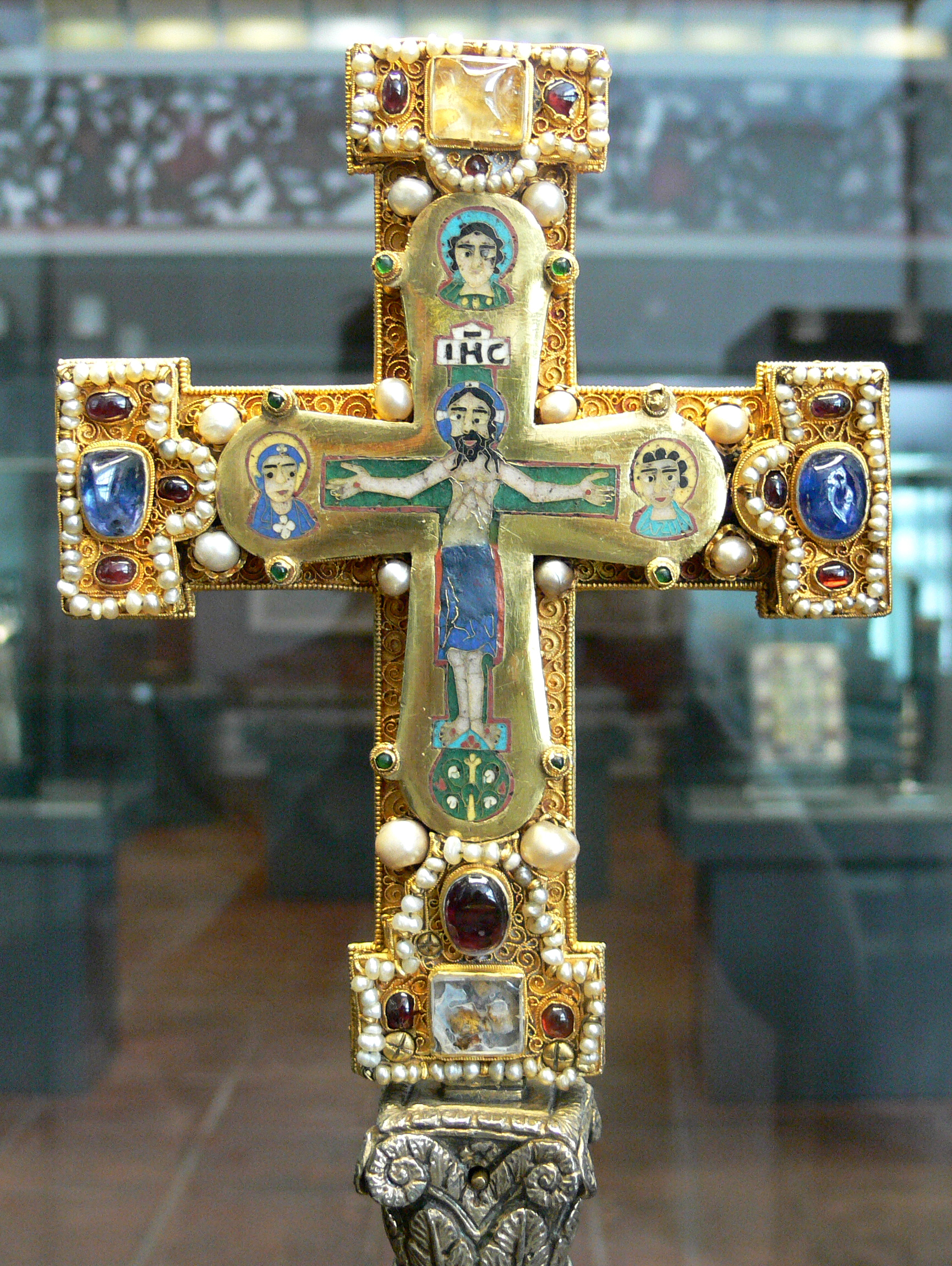
Detail of the front face, showing the crucified Christ and the fine gold filigree and cloisonne enamel work characteristic of the Lower Italian or Sicilian workshop tradition.
| Artist | Unknown goldsmith, Lower Italian or Sicilian workshop |
|---|---|
| Date | First half of the 12th century (c. 1100-1150); the engolpion above the relic chamber is earlier, 11th century |
| Medium | Cloisonne (cell-sunk, Senkschmelz) enamel on gold; gold sheet and gold filigree; niello; gemstones and pearls; wood core; foot of cast silver, parcel-gilt |
| Dimensions | 33.1 x 12.5 cm overall, with its silver foot; 15.4 cm without the foot |
| Where it is now | Kunstgewerbemuseum, Staatliche Museen zu Berlin (Museum of Decorative Arts, Berlin State Museums); historically shown at the Kulturforum, Berlinlast confirmed |
| Inventory number | W 1 |
| Attribution | AcceptedNo maker, workshop name, or patron is documented. Full note |
| Object type | Goldsmith's work |
| Period | Romanesque, South Italian or Sicilian (Norman Kingdom of Sicily), 12th century |
| Cases | Has a provenance gap · Restituted or repatriated |
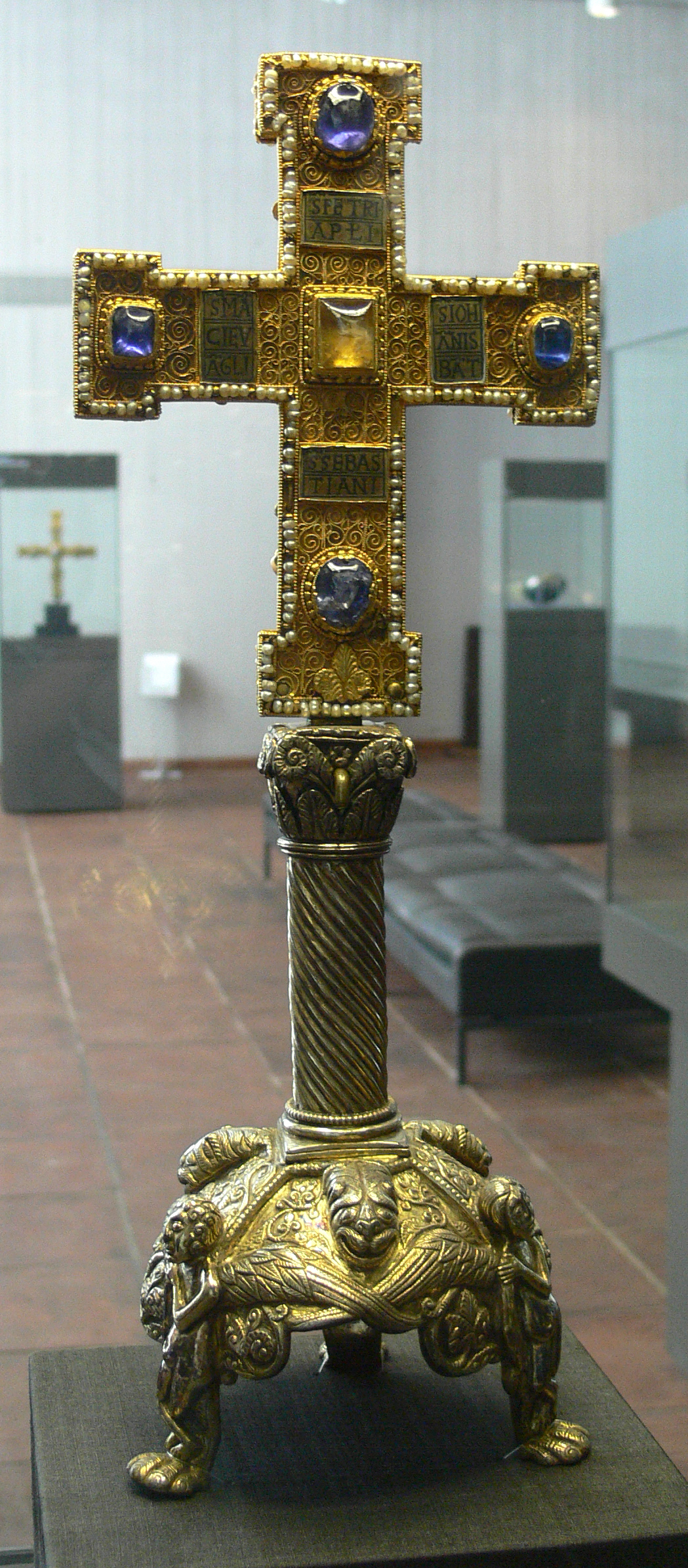
| Inscriptions | Nielloed inscription on the reverse naming relics of the Apostles Peter and Mark, of John the Baptist, and of Saint Sebastian, in addition to the particle of the True Cross visible under rock crystal at the lower end of the front face |
| Owners on record | 10 links9 documented, 1 unknown |
| Sources | 19 cited |
About this record Last verified · 19 sources cited · Change log
On this page 9 sections
ContentsClose
A portable reliquary cross made in a Lower Italian or Sicilian workshop in the first half of the twelfth century, holding a particle of the True Cross under rock crystal and, by its own nielloed inscription, relics of Peter, Mark, John the Baptist and Sebastian besides. It came into the treasury of Brunswick Cathedral at an undocumented date, at least a century after that treasury's own eleventh-century founding gift, and stayed there until the House of Guelph sold the entire 82-piece treasure to a consortium of four Frankfurt dealers in 1929.
This cross was one of 42 pieces the consortium had not managed to sell by 1933. In 1935, amid the Nazi state's escalating economic campaign against Jewish-owned businesses, the consortium sold those 42 pieces to the Prussian state for 4.25 million Reichsmarks. Germany's Advisory Commission on Nazi-looted cultural property (the Limbach Commission) ruled in 2014 that this was not a forced sale; the dealers' heirs, who argue that it was, took the dispute to the United States Supreme Court, which in 2021 decided only a jurisdictional question about the Foreign Sovereign Immunities Act and never ruled on whether the sale itself was coerced. The case was dismissed on remand in 2022 and 2023 without reaching that question.
The cross itself has not been to auction and carries no market price of its own; it has been German state property since 1935 and, since 2015, protected by name as nationally valuable cultural property. It is not currently on public display, having been withdrawn for a future permanent presentation of the Guelph Treasure whose date has not been set.
Provenance
Each link is graded. Documented: a cited source supports it. Disputed: the identification is argued but not established. Unknown: no owner for that span, and the gap is not smoothed into a narrative. The grades in the glossary.
- Unidentified patron or church, Lower Italy or Sicilydocumented
Made in a Lower Italian or Sicilian workshop in the first half of the twelfth century, incorporating an older, eleventh-century Byzantine-style engolpion. The dating and regional attribution are the holding institution's own stylistic and technical judgement; no maker or original patron is named in any source consulted.131415
- - 1929House of Guelph, treasury of Brunswick Cathedral (St. Blasius), Braunschweigunknown
No source consulted records when or how this cross joined the Brunswick treasury, whose own founding gift (a different portable altar and two different crosses, all eleventh-century Lower Saxon work now in Cleveland) predates it by roughly a century. By the 1920s the whole treasury, including this cross, was physically held at Gmunden, Austria, following the House of Guelph's loss of the Brunswick throne in 1918.116
- 1929-10-05 - 1935-06-14Consortium of Frankfurt dealers: J. & S. Goldschmidt (Julius Goldschmidt), Z.M. Hackenbroch (Zacharias M. Hackenbroch), and I. Rosenbaum OHG (Isaak Rosenbaum and Saemy Rosenberg), joined over time by further stakeholders including Hermann Netter, Alfons Heilbronner, and interests connected to Mendelssohn & Co. of Amsterdamdocumented
Bought the entire Guelph Treasure from the House of Guelph on 5 October 1929 for RM 7.5 million, paid over four instalments across twelve months, three weeks before the Wall Street Crash. The House of Guelph had spent most of the 1920s trying and failing to sell the treasure to Duveen Brothers, the Metropolitan Museum, the Victoria and Albert Museum, Austria, the German Reich, and the city and province of Hannover, all on grounds of price; this establishes the 1929 sale as an ordinary market transaction driven by the sellers' own financial pressure, unconnected to the buyers' religion. The consortium's internal composition and stakes shifted repeatedly and are only partly documented.1
- 1929 - 1933Same consortium; this cross remained unsolddocumented
The consortium sold roughly half the treasure by 1931 through exhibitions in Frankfurt, Berlin, and six American cities. This cross was specifically offered to the Metropolitan Museum of Art in December 1930 for USD 280,000; the Museum's own applied-arts curator considered it one of the most important pieces still available, but no purchase was made. It remained with the consortium as one of the 42 pieces still unsold when Germany's political situation changed in 1933.1
- 1935-06-14 - 1935-07-19Prussian State, acting through Dresdner Bank and the Berlin state museumsdocumented
Sold under a contract dated 14 June 1935 for RM 4.25 million, agreed after Dresdner Bank's opening bid of RM 3.7 million (10 April 1935) and the consortium's counter of RM 4.35 million (26 April 1935). Payment was split between a broker's commission, a direct payment to the Hackenbroch firm, and a currency-controlled blocked Reichsmark account in Saemy Rosenberg's name, spendable only on further artworks for export; the Prussian state museums gave up several of their own paintings and sculptures to fund this part of the price, over internal objection from at least two department heads. The Prussian Cultural Heritage Foundation's own archival account states it found no evidence that Hermann Goering was personally involved in these negotiations, though a 1934 memorandum drafted after consulting him had proposed, and then abandoned, a straw-man bidding tactic in his name. The pieces were handed over in Amsterdam on 17-19 July 1935 and shipped to Germany.1
- 1935 - 2008Prussian State, later the Stiftung Preussischer Kulturbesitz (SPK), Kunstgewerbemuseum, Berlindocumented
Held without any restitution claim being raised for over seventy years.1
- 2008 - 2014-03-20Same; claim pendingdocumented
Heirs of the four consortium principals filed a restitution claim with the SPK in 2008, arguing the 1935 sale was in substance forced by Nazi antisemitic economic persecution and the resulting collapse of the market for art in Jewish hands. Germany's Advisory Commission on the return of cultural property seized as a result of Nazi persecution (the Limbach Commission) reviewed the claim on the basis of the SPK's own detailed historical account and, on 20 March 2014, recommended against restitution, finding the price adequate for the depressed market of the time and no evidence the dealers were pressured in the negotiations themselves.123612
- 2014-04-04 - 2015-02-10Samedocumented
Registered by the Federal Republic of Germany as nationally valuable cultural property; registration opened two weeks after the Commission's recommendation and was finalised on 10 February 2015.14
- 2015-02-24 - 2023-07-17Same; litigated in United States federal courtsdocumented
Heirs sued Germany and the SPK in the US District Court for the District of Columbia in February 2015 under the Foreign Sovereign Immunities Act. The district court and DC Circuit denied Germany's motion to dismiss; the Supreme Court, in Federal Republic of Germany v. Philipp (3 February 2021), held unanimously that the FSIA's expropriation exception incorporates a domestic takings rule under which a state's taking of its own nationals' property is not a taking in violation of international law for FSIA purposes, and remanded for the lower courts to consider whether the dealers should nonetheless not be treated as German nationals in 1935 given their persecution as Jews. On remand, the district court dismissed the case on 25 August 2022 for failure to plead adequate facts on that nationality question; the DC Circuit affirmed on 17 July 2023. No US court at any stage ruled on whether the underlying 1935 sale was in fact coerced.57891011
- 2026 - presentKunstgewerbemuseum, Staatliche Museen zu Berlindocumented
The Kunstgewerbemuseum's own published information states the Guelph Treasure, including this cross, is not currently on display, having been withdrawn in preparation for a new permanent presentation whose opening date has not been announced.4
Technical evidence
| Attribution note | No maker, workshop name, or patron is documented. The attribution to a Lower Italian or Sicilian workshop and the dating to the first half of the twelfth century rest on technique and style: the cloisonne enamel is worked in the cell-sunk (Senkschmelz) method associated with Byzantine-derived South Italian and Sicilian goldsmithing of the Norman period, and this is the basis on which the Kunstgewerbemuseum and the German national cultural-property register both catalogue the piece. The object is also composite: the small engolpion mounted above the main relic chamber is itself older, an eleventh-century, Byzantine-influenced pectoral cross that was incorporated into the larger reliquary rather than made for it. No named individual goldsmith has ever been proposed for either part. |
|---|---|
| Support | Wood core beneath the gold and enamel construction.1314 |
| Medium and technique | Cloisonne enamel on gold worked in the cell-sunk (Senkschmelz) method; gold sheet and gold filigree; niello; gemstone and pearl settings.131415 |
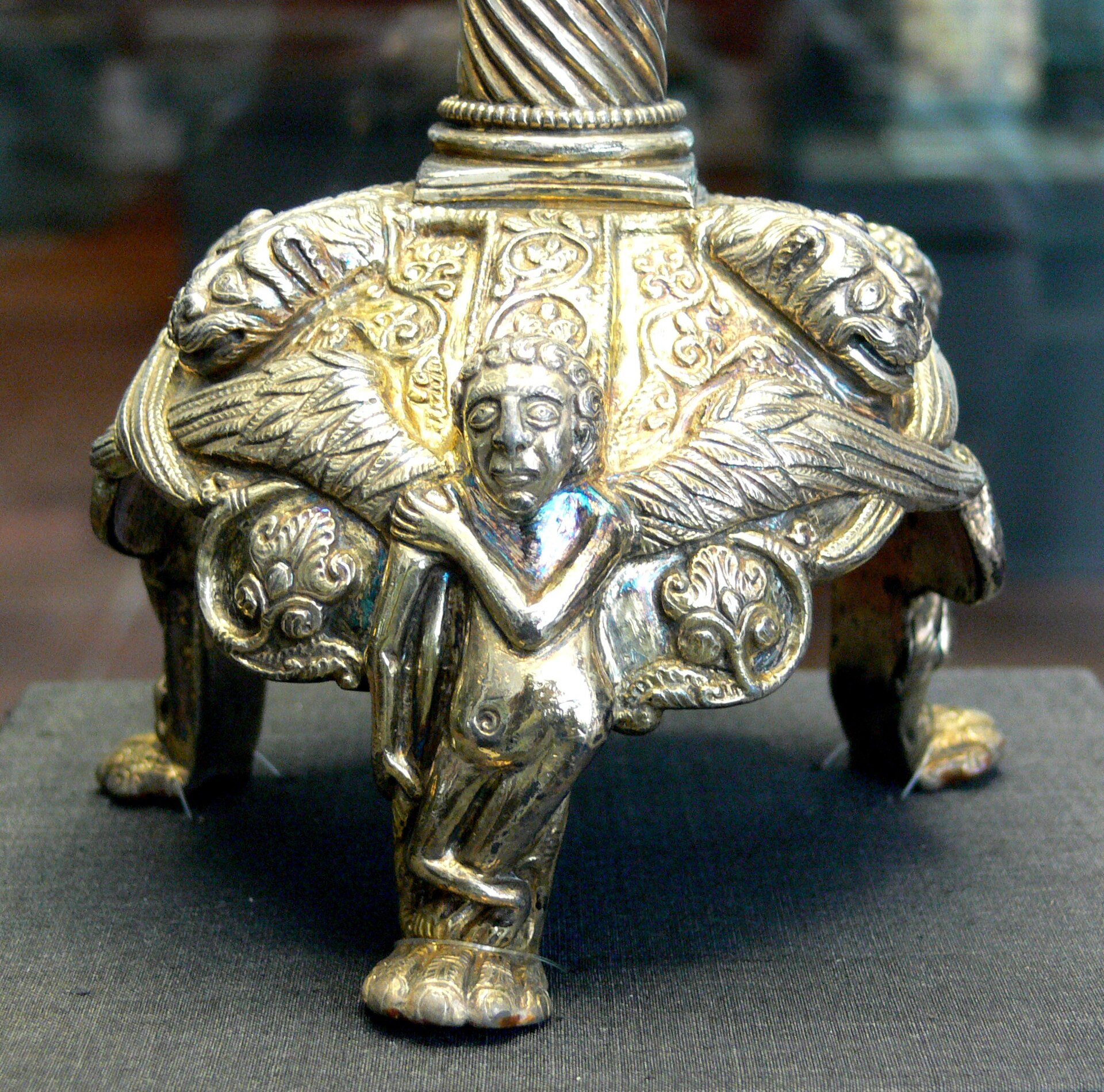
| Foot | Cast silver, parcel-gilt, decorated with figures described in the museum's own cataloguing as geniuses of death with lowered torches and a victory pillar, reusing classical funerary iconography to construct what the museum's text calls a reliquary grave.15 |
| Dimensions | 33.1 x 12.5 cm overall with the silver foot; 15.4 cm without the foot.14 |
| Dating | First half of the 12th century (c. 1100-1150) for the cross itself; the engolpion above the relic chamber is an earlier, 11th-century, Byzantine-influenced pectoral cross incorporated into the larger reliquary.131415 |
| Relic chamber | A particle of the True Cross is set under rock crystal at the lower end of the front face. A nielloed inscription on the reverse names further relics of the Apostles Peter and Mark, of John the Baptist, and of Saint Sebastian.1315 |
| Figural programme, front | Christ on the cross, flanked by half-length figures of the Virgin, John the Evangelist and the Archangel Michael.15 |
| Inventory and legal status | Kunstgewerbemuseum inventory W 1. Listed by the Federal Republic of Germany as nationally valuable cultural property; registration procedure opened 4 April 2014, finalised 10 February 2015.14 |
Images
The record in full
Chapter 1What it is
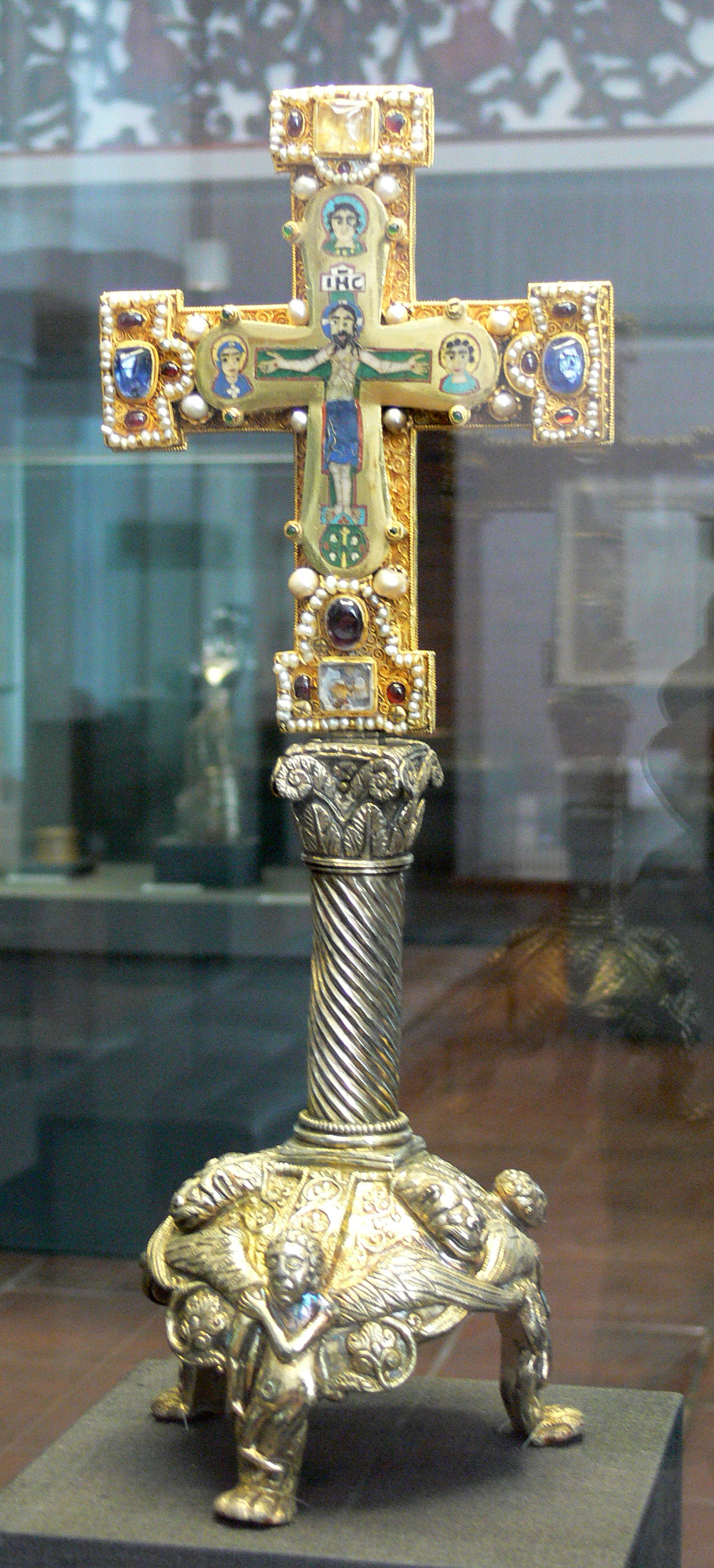
The Guelph Cross is small enough to be carried: 33.1 centimetres tall on its silver foot, 12.5 centimetres across the arms.
The Guelph Cross is small enough to be carried: 33.1 centimetres tall on its silver foot, 12.5 centimetres across the arms. The body of the cross is built up in cloisonne enamel on gold, using the cell-sunk (Senkschmelz) technique in which the enamel is set into cells cut down into a thickened gold ground rather than raised on applied gold walls - a Byzantine method that Lower Italian and Sicilian goldsmiths of the Norman period adopted and made their own. Gold filigree, niello and settings of gemstones and pearls cover the surface over a wood core, and the whole stands on a foot of cast, partially gilded silver.
At the lower end of the front face, a fragment of the True Cross is set behind a window of rock crystal, the standard medieval device for making a relic visible without exposing it to touch or the air. The reverse carries a nielloed inscription naming further relics held inside the object: pieces of the Apostles Peter and Mark, of John the Baptist, and of Saint Sebastian. A crucified Christ on the front face is flanked by half-length figures of the Virgin, John the Evangelist and the Archangel Michael. The object is not the work of a single moment: the small engolpion mounted above the main relic chamber is older than the rest of the cross, an eleventh-century pectoral cross of Byzantine character that was taken up and built into the larger reliquary rather than made for it.
Chapter 2A tomb built around a splinter of wood
The silver foot is not a plain stand. It carries figures the Kunstgewerbemuseum's own cataloguing describes as geniuses of death, shown with lowered, extinguished torches, together with a pillar read...
The silver foot is not a plain stand. It carries figures the Kunstgewerbemuseum's own cataloguing describes as geniuses of death, shown with lowered, extinguished torches, together with a pillar read as a sign of victory - a pairing of motifs lifted from Roman funerary sculpture, where the inverted torch was a standard sign that a life had been put out. On a Roman sarcophagus that pairing marks a grave. Set beneath a reliquary that holds a fragment of the cross on which Christ died, the same pairing does the opposite work: it turns the object's base into a miniature tomb over which a sign of victory already stands, so that the foot itself argues, in a visual language borrowed wholesale from pagan funerary art, that this particular death was reversed. The museum's own published description names the result a reliquary grave, and no other reading of that combination of figures at the base of a True Cross reliquary has been proposed in the sources consulted.
This is not a hidden programme requiring a specialist to unlock it. Housing multiple relics in one portable object - an apostle here, a martyr there, John the Baptist, and the most prestigious relic of all set at the centre - was ordinary practice for a well-funded cathedral treasury wanting to concentrate as much sanctity as possible into objects that could be carried in procession or displayed on a major feast day. What is worth recording precisely, because it is documented in the object's own material rather than argued from resemblance, is that an older, already-holy object - the eleventh-century engolpion - was folded into the newer cross rather than discarded when the larger reliquary was made. Reusing an object already invested with relic status, instead of starting again with new material, was itself a way of transferring authority from the old object to the new one; this record treats that transfer as a documented fact about the object's construction, not as an argued claim about anyone's belief, because no source consulted records why the choice was made, only that it was made.
Chapter 3A treasury built up over three centuries
The Guelph Treasure did not arrive at Brunswick Cathedral as a single gift.
The Guelph Treasure did not arrive at Brunswick Cathedral as a single gift. Its founding donation came from Countess Gertrude of Brunswick and her husband, Count Liudolf, who had founded the church in 1030; when Liudolf died in 1038, Gertrude gave a portable altar and two reliquary crosses in his memory. Those three objects - now the Portable Altar of Countess Gertrude and its two accompanying crosses - are eleventh-century, Lower Saxon work, and they are not this object. All three are today in the Cleveland Museum of Art, having left the treasury by a different and undisputed route described below.
This cross is a later, separate addition to the same treasury, made a century or so after Gertrude's gift, in a different region, in a different technique, by a different and unnamed hand. Exactly when it joined the Brunswick collection, and through whose gift, is not documented in any source this record located; the treasury simply grew across the eleventh to fifteenth centuries as later members of the House of Guelph and the Brunswick chapter added further reliquaries, altars, crosses, monstrances and vessels, of which this cross is one. By the twentieth century the assembled treasury numbered 82 pieces.
Chapter 4A duke who needed the money
The House of Guelph had been trying to sell the treasure since the early 1920s, and it had nothing to do with who might eventually buy it.
The House of Guelph had been trying to sell the treasure since the early 1920s, and it had nothing to do with who might eventually buy it. Ernest Augustus, Duke of Brunswick, had lost his throne in the 1918 revolution and was living at Gmunden in Austria; the Guelph Treasure was one of the family's few remaining large assets. Robert Langton Douglas of the National Gallery of Ireland inspected it in 1921 and judged the asking price too high; Duveen Brothers negotiated on and off through the 1920s and walked away in 1927 when the Domed Reliquary alone was priced at USD 1 million, which the firm's own correspondence called ridiculous. The Metropolitan Museum of Art was approached by December 1927 and its own applied-arts director, Joseph Breck, described the ten-to-twelve-million-dollar asking price for the whole treasure as obviously absurd. The Victoria and Albert Museum negotiated from 1928 and was offered the whole collection for as little as 527,000 pounds sterling by September 1928, and still declined. Austria considered a state purchase option and let it lapse in January 1930. The German Reich, the Prussian state, and the city and province of Hannover were all separately approached in 1927 to 1929 and all declined, Hannover on the explicit ground that a municipal government could not make such a purchase in hard economic times.
Every one of these approaches predates any Nazi involvement by years; the party under financial pressure throughout was the House of Guelph, not the eventual buyers. On 5 October 1929, having failed to place the collection with a museum, a government, or a single wealthy buyer, the House of Guelph's Supreme Administration sold the entire 82-piece treasure to a consortium of three Frankfurt antiquities dealerships - J. & S. Goldschmidt, Z.M. Hackenbroch, and J. Rosenbaum - for 7.5 million Reichsmarks, payable in four instalments over twelve months, with a clause returning to the House of Guelph any resale profit above that price. The named individuals behind the three firms were Julius Goldschmidt, Zacharias M. Hackenbroch, Isaak Rosenbaum, and Saemy Rosenberg. Three weeks later the Wall Street Crash began the collapse of the market the consortium had just bought into.
Chapter 5Half a treasure crosses the Atlantic
The consortium spent the next two years trying to recover its outlay in a market that had just fallen apart under it.
The consortium spent the next two years trying to recover its outlay in a market that had just fallen apart under it. An eight-week sales exhibition at the Stadel Art Institute in Frankfurt ran from August to September 1930, accompanied by a lavish 200-page catalogue with gold-stamped etchings and a morocco leather cover, compiled by the museum directors Otto von Falke, Robert Schmidt and Georg Swarzenski. A Berlin exhibition followed in October 1930. The unsold 64 pieces were then shipped via Rotterdam to the United States for a six-city tour: New York's Goldschmidt and Reinhardt Galleries, the Cleveland Museum of Art, the Detroit Institute of Arts, the Pennsylvania Museum of Art in Philadelphia, the Art Institute of Chicago, and San Francisco's M. H. de Young Memorial Museum, running from late November 1930 into December 1931.
American buyers took roughly half the remaining treasure. William M. Milliken, curator and later director of the Cleveland Museum of Art, personally bought six pieces for his own house for USD 259,500 in 1930; the museum itself separately secured the Portable Altar of Countess Gertrude and its two accompanying eleventh-century crosses - Gertrude's own founding gift to the treasury - for USD 320,000 in 1931, receiving a monstrance as a further inducement and returning one previously acquired object in part payment. In Chicago, Marion Chauncey McCormick bought the Reliquary Cross with the Arms of the Veltheim Family and three further pieces through Goldschmidt, and Kate S. Buckingham bought two monstrances the same way; the Antiquarian Society acquired a cross through Rosenbaum. The Nelson-Atkins Museum of Art in Kansas City bought a reliquary monstrance holding a relic of Saint John the Baptist from J. & S. Goldschmidt in 1931 - a scientific study long afterward dated the bone inside it to 660-770 AD, several centuries before the reliquary itself was made, which is a separate and unrelated finding about that object rather than this one. The Fogg Art Museum at Harvard, the Focke-Museum in Bremen, and a number of private collectors in Germany, Sweden, Britain and the United States bought smaller pieces the same way.
This cross was not among them. Julius Goldschmidt offered it directly to the Metropolitan Museum during the New York exhibition in December 1930, at USD 280,000; Joseph Breck told the Museum's purchasing committee it was one of the most important pieces still available. No purchase was made, and no further negotiation over it is recorded. It is the dividing line in this object's history that matters here: every one of the pieces named in this section left the consortium's hands in an ordinary, undisputed market transaction completed in 1930 or 1931, years before the Nazi seizure of power in January 1933 and entirely unconnected to it. This cross did not sell, and so it remained with the consortium as one of the pieces still on hand when the political situation in Germany changed.
Chapter 6The Reich takes an interest
Little sales activity is documented for 1931 to 1933.
Little sales activity is documented for 1931 to 1933. It resumes in November 1933, ten months after the Nazi seizure of power, when Georg Swarzenski drew the Frankfurt Lord Mayor Friedrich Krebs's attention to the remaining treasure; Krebs took the matter to the Reich Chancellery, framing the proposed purchase as a way of restoring German national honour and reporting that the greater part of the Guelph Treasure had already gone to the Cleveland museum and that the rest could now be bought at about a third of its earlier value. The Chancellery said it had no funds and passed the matter to the Ministry of the Interior, which passed it on again with a negative recommendation.
A second approach followed the same month: Adolf Feulner, director of the Frankfurt Museum of Applied Arts, wrote to Friedrich Schmidt-Ott of the Association for the Promotion of Sciences and Humanities, who replied that it would be very welcome if the Prussian state could now make amends for the mistakes of the previous government in having rejected the purchase back in 1930. That framing is worth recording exactly as it appears in the archive: the impulse driving the renewed interest, in the words of the officials involved, was to correct an earlier missed opportunity to keep a national treasure in Germany, not, at this stage, anything to do with the sellers' religion. The political tone changed by mid-1934. A memorandum drafted at the instigation of a Prussian ministerial director in July 1934 argued that once Prussia was absorbed into the Reich it would be positioned to bring the historically, artistically and nationally-politically valuable Guelph Treasure into the Reich alongside other treasures - language that frames the acquisition explicitly as a matter of national prestige. In the same period, after consultation with Hermann Goering, then Prussian Minister-President, a plan was floated to place a straw-man bidder in the negotiations to keep the price down, with the real buyer's identity concealed. The Prussian Cultural Heritage Foundation's own account of the archival record states plainly that this plan was never put into action, and that it found no evidence Goering was personally involved in the negotiations that actually took place.
Chapter 7What 4.25 million Reichsmarks bought
From January 1934 the negotiations were run by Theodor Stern, a director of Dresdner Bank, acting for the Prussian State, through an intermediary, Alfons Heilbronner, an art dealer heavily indebted...
From January 1934 the negotiations were run by Theodor Stern, a director of Dresdner Bank, acting for the Prussian State, through an intermediary, Alfons Heilbronner, an art dealer heavily indebted to the same bank. Stern knew the consortium's original 1929 outlay had been RM 7.5 million and that it had recovered only around RM 1.5 million from sales since. His stated strategy, recorded in his own internal notes, was never to make the first offer and to let the seller name a figure first, precisely so as not to drive the price up. Reports reaching him through Heilbronner in 1934 put the consortium's minimum at RM 6 to 6.5 million; a museum expert's own internal assessment thought even a state offer of RM 3.5 million would be cheap. Dresdner Bank's first formal bid, on 10 April 1935, was RM 3.7 million. Saemy Rosenberg, described in the bank's own records as leader of the owner consortium, countered on 26 April with RM 4.35 million net. The bank asked for time to consider so wide a spread; the Reich Finance Minister proposed trimming RM 250,000 to offset an anticipated import sales tax; the consortium's final counter-offer, RM 4.25 million, was accepted.
The contract was signed on 14 June 1935 between Dresdner Bank, representing the Prussian State, and the consortium firms and individuals, for the 42 pieces still unsold, this cross among them. The purchase price was split three ways: RM 100,000 as a broker's commission, RM 3,371,875 paid to the Hackenbroch firm, and RM 778,125 credited to a blocked Reichsmark account in Saemy Rosenberg's name. That last figure is the one this record flags for particular attention. Germany's currency-exchange controls, in force since 1931, meant the portion of the price owed to the consortium's foreign members could not simply be paid out as usable cash; instead it sat in a blocked account that Rosenberg could spend, within four weeks, only on works of art bought either on the open market or from the inventories of the Prussian state museums themselves, under a price-setting mechanism the contract also specified. Dresdner Bank's own negotiators agreed to guarantee the foreign sellers free disposal of the resulting artworks and to absorb the risk of any loss on their resale, which is the bank's own account of how it cushioned an otherwise restrictive mechanism - but the mechanism itself, a state-controlled conversion of part of the price into art rather than currency, is exactly the kind of below-the-surface constraint that the plain headline figure of RM 4.25 million does not show. The state museums duly gave up two paintings, six sculpture-division pieces, and twelve pieces from the Berlin Palace Museum's own holdings to fund this part of the deal, over the recorded objection of at least two museum department heads who did not want to part with a Lancret painting from the Frederick the Great collection or a prized Islamic silk animal carpet bought by Wilhelm von Bode in 1894. Those substitute pieces went on to disperse across four further decades and three continents - one, a Verrocchio bronze candelabra, reached the Rijksmuseum by way of the Amsterdam banker Fritz Mannheimer; another, a fifteenth-century bronze then attributed to Bertoldo, passed through a Vienna collection to the Museum Boymans-van Beuningen in Rotterdam only in 1994; a fourth was sold outright to the Metropolitan Museum for USD 75,000 and remains there.
Chapter 8Who actually held the stakes
The consortium was never a fixed group of four men.
The consortium was never a fixed group of four men. By the time of the 1935 sale, documented stakes included a 25 per cent share held by Hermann Netter, co-owner of the Robert Koch jewellery dealership - a tax-audit record shows he received exactly RM 1 million for that quarter-share in July 1935 - and a further 2.5 per cent held through an Amsterdam subsidiary of the Goldschmidt firm, and another 2.5 per cent by Heilbronner himself. Indications, without a documented percentage, point to a stake held by the Mendelssohn & Co. banking house or its principal, Fritz Mannheimer, and to unspecified British participation, of which only the dealership S. J. Phillips is named; the banker Willy Dreyfus and the dealerships A. S. Drey of Munich and J. Gluckselig & Sohn of Vienna are also documented as involved. Hackenbroch and Rosenberg had themselves sold down parts of their original holdings to Goldschmidt over the years - Hackenbroch had borrowed against a twentieth share as early as December 1929 and held only a fortieth by 1935. None of this changes who owned the treasure in law, but it means the plain phrase the consortium obscures a shifting group of German and foreign dealers, bankers and investors whose individual circumstances in 1935 are, for the most part, not documented in the sources this record consulted.
Chapter 9Two claims, one commission
No dispute was raised for over seventy years.
No dispute was raised for over seventy years. In 2008, heirs of the four consortium principals filed a claim for the treasure's return with the Prussian Cultural Heritage Foundation (SPK), the public body that had inherited the Prussian state museums' holdings after the war. Their case, as later set out in US court filings, was that the 1935 transaction was a forced sale in substance if not in form: that the Nazi state's antisemitic economic policy, the boycott and exclusion of Jewish-owned businesses, and the resulting collapse of the market specifically for art in Jewish dealers' hands left the consortium no real choice but to accept whatever the Prussian State offered, however the paperwork was drawn up.
Germany's Advisory Commission on the return of cultural property seized as a result of Nazi persecution, chaired by Professor Dr. Jutta Limbach and commonly called the Limbach Commission, examined the claim on the basis of the SPK's own detailed historical account, and on 20 March 2014 recommended against restitution. In the SPK's own words, its conclusion was that the purchase price could be deemed adequate given the then-prevailing economic crisis and market situation, and that the consortium and the individuals behind it had had free disposal of that price once received; contemporary press coverage of the recommendation quoted the Commission's finding that, far from selling under duress, the consortium had been trying to unload the treasure for years, and that there was no indication the dealers were pressured in the negotiations themselves, for instance by Goering. The heirs did not accept that conclusion and continued to press their claim, now in the United States.
It is worth stating plainly what this record found and did not find. The SPK's detailed factual account, which this record draws on extensively above, is the institution's own submission, made in its own interest as the party resisting the claim; it is also, on its face, a heavily documented, archive-referenced account, and the Limbach Commission's public recommendation adopted its central conclusions. This record located no independently published, line-by-line statement of the Commission's own reasoning beyond the SPK's account and press summaries of the recommendation; a reader who needs the Commission's reasoning in a form independent of the party that supplied the underlying facts will need to consult the Commission's own file, which this record's research could not obtain.
Chapter 10A jurisdictional ruling, not a verdict on 1935
Having lost before the Commission, the heirs - Alan Philipp, Gerald G.
Having lost before the Commission, the heirs - Alan Philipp, Gerald G. Stiebel and Jed R. Leiber - sued Germany and the SPK in the United States District Court for the District of Columbia in February 2015, invoking the expropriation exception to the Foreign Sovereign Immunities Act, which allows a foreign state to be sued in US courts over property taken in violation of international law. The district court and, on appeal, the DC Circuit both denied Germany's motion to dismiss, rejecting Germany's separate argument that international comity required deference to the Advisory Commission's recommendation or exhaustion of German remedies first.
Germany appealed to the US Supreme Court, which decided the case, Federal Republic of Germany v. Philipp, unanimously on 3 February 2021. The Court's holding was narrow and procedural: Chief Justice Roberts wrote that the FSIA's expropriation exception incorporates what is called the domestic takings rule, under which a sovereign state's taking of its own nationals' property is not, for purposes of that US statute, a taking in violation of international law - regardless of how the taking is otherwise judged. The Court did not decide, and was not asked to decide, whether the 1935 sale of the Guelph Treasure was in fact coerced; it decided only that US courts generally lack jurisdiction under the FSIA over a foreign state's dealings with its own nationals' property, and it sent the case back to the lower courts to consider the heirs' further argument that the consortium members should not be treated as German nationals in 1935, given their legal and social exclusion as Jews under the Nazi state.
On remand, the district court dismissed the case on 25 August 2022, holding that the heirs had not pleaded specific enough facts to establish that the dealers were not German nationals at the time of the sale - general allegations about the treatment of Jews under the Nazi regime were not, in the court's view, sufficient on their own. The DC Circuit Court of Appeals affirmed that dismissal on 17 July 2023. At no point in this sequence, from the original 2015 filing through the 2023 appellate decision, did any US court rule on whether the 1935 transaction was in substance forced; every ruling turned on jurisdiction and on how the heirs had pleaded the nationality question, not on the facts of the sale itself. Conflating the case's dismissal with a finding that the sale was legitimate would misstate what the courts actually decided.
Chapter 11Protected, and currently off view
Two weeks after the Limbach Commission's March 2014 recommendation, Germany opened a registration procedure to list the Guelph Cross, by name, as nationally valuable cultural property under its...
Two weeks after the Limbach Commission's March 2014 recommendation, Germany opened a registration procedure to list the Guelph Cross, by name, as nationally valuable cultural property under its cultural property protection law; the listing was finalised on 10 February 2015. That status does not resolve the ownership dispute - the heirs continued to litigate in the United States for another eight years after the listing - but it does mean that, whatever happens to the underlying claim, the object cannot now leave Germany without triggering the full apparatus of national cultural-property export control, a protection the state extended to the object within weeks of winning the argument that it was entitled to keep it.
As of this record's research, the Kunstgewerbemuseum's own published information states that the Guelph Treasure, including this cross, is not currently on public display: the objects have been withdrawn from their previous presentation at the Kulturforum in Berlin in preparation for a new permanent installation, whose opening has not been announced. A reader relying on older descriptions of the treasure's display location should treat them as superseded until that new presentation opens.
The artist
Unknown goldsmith or workshop, Lower Italy or Sicily, first half of the 12th century
No maker's name attaches to this object, and none is likely to. Cloisonne enamel of this quality, worked in the cell-sunk technique, was a specialised, expensive craft transmitted from Byzantium into the goldsmith workshops of Norman-ruled South Italy and Sicily, where a mixed Greek, Latin and Islamic artistic culture under Roger II and his successors produced some of the most technically accomplished metalwork and textiles in twelfth-century Europe. The attribution of this cross to that milieu rests entirely on technique and style, since no contract, inventory entry, or signature survives to name either the workshop or the patron who commissioned it. What follows describes the tradition the object belongs to, not a documented individual career, because no individual career is documented.
Related works
| Work | Relation | Where it is |
|---|---|---|
| Portable Altar of Countess Gertrude, with two accompanying reliquary crosses Lower Saxon workshop, 11th century | The Guelph Treasury's own founding gift (c. 1038), by the countess whose donation began the collection this cross later joined Sold by the consortium to Cleveland for USD 320,000 in 1931, in the same undisputed American dispersal that this cross was offered into and withdrawn from unsold. | Cleveland Museum of Art |
| Reliquary Monstrance with a relic of Saint John the Baptist German workshop, c. 1400 | Another piece of the Guelph Treasure sold in the undisputed 1930-31 American dispersal Bought from J. & S. Goldschmidt in 1931. A later scientific study dated the bone relic inside it to 660-770 AD, centuries before the reliquary itself was made. | Nelson-Atkins Museum of Art, Kansas City |
| Reliquary Cross with the Arms of the Veltheim Family German workshop, Guelph Treasure | Sold in the same 1930-31 American dispersal Bought by Marion Chauncey McCormick through Julius Goldschmidt in 1931. | Art Institute of Chicago |
| "French Madonna" (Berlin Sculpture Collection, inv. 8010) Not established in sources consulted | One of the Berlin state museum pieces given up in lieu of cash to fund the 1935 purchase of this cross and the other 41 disputed pieces Passed from Saemy Rosenberg's blocked-mark account into private hands and was sold to the Metropolitan Museum for USD 75,000; it remains there. | Metropolitan Museum of Art, New York |
| Domed Reliquary Guelph Treasure workshop, medieval | Sibling piece from the same disputed group of 42 pieces sold in 1935 One of the treasure's largest and most valuable individual pieces; repeatedly priced by prospective 1920s buyers at USD 1 million or more and never sold before 1935, remaining in Berlin along with this cross. | Kunstgewerbemuseum, Berlin |
Open questions
- When and by what route did this specific twelfth-century South Italian or Sicilian cross enter the Brunswick Cathedral treasury? It postdates the treasury's eleventh-century founding gift by roughly a century, and no source consulted records its acquisition.
- Who commissioned the cross in Southern Italy or Sicily, and for what church or patron, before it reached Brunswick?
- What happened to this object physically during the Second World War - was it evacuated from Berlin, and if so when and to where? No source consulted addresses this directly for this specific piece.
- Beyond the abandoned 1934 straw-man proposal made in his name, was Hermann Goering personally involved at any point in the actual 1935 negotiations? The SPK's own archival account states it found no evidence that he was, which sits uneasily against the standard shorthand, repeated even in the heirs' own US court filings, that the treasure was sold 'to agents of Hermann Goering.'
- Given that part of the 1935 price was paid not in cash but into a currency-controlled blocked account redeemable only for further artworks, what was the real, spendable value the consortium's foreign members actually received, as against the nominal RM 4.25 million headline figure? This bears directly on whether 'an adequate price' is the right test to apply.
- What became of the Jason Vase, Small Quartz Jug, Porcelain Vase and Tapestry - Berlin museum pieces given up in lieu of cash in the 1935 deal, whose trail the SPK's own account states it lost because the corresponding museum records were destroyed during the war?
- When will the Guelph Treasure's announced new permanent presentation open, and where within it will this cross be shown? No date had been set as of this record's research.
Questions about this object
What is Guelph Cross?
Guelph Cross is a goldsmith's work, dated first half of the 12th century (c. 1100-1150); the engolpion above the relic chamber is earlier, 11th century. Medium: Cloisonne (cell-sunk, Senkschmelz) enamel on gold; gold sheet and gold filigree; niello; gemstones and pearls; wood core; foot of cast silver, parcel-gilt.
Who made Guelph Cross, and is the attribution settled?
The attribution to Unknown goldsmith, Lower Italian or Sicilian workshop is recorded here as accepted. No maker, workshop name, or patron is documented. The attribution to a Lower Italian or Sicilian workshop and the dating to the first half of the twelfth century rest on technique and style: the cloisonne enamel is worked in the cell-sunk (Senkschmelz) method associated with Byzantine-derived South Italian and Sicilian goldsmithing of the Norman period, and this is the basis on which the Kunstgewerbemuseum and the German national cultural-property register both catalogue the piece. The object is also composite: the small engolpion mounted above the main relic chamber is itself older, an eleventh-century, Byzantine-influenced pectoral cross that was incorporated into the larger reliquary rather than made for it. No named individual goldsmith has ever been proposed for either part.
Where is Guelph Cross now?
Kunstgewerbemuseum, Staatliche Museen zu Berlin (Museum of Decorative Arts, Berlin State Museums); historically shown at the Kulturforum, Berlin. Inventory number W 1. Last confirmed 3 September 2026. Held by the Prussian state and its successor institution since the 1935 purchase of the 42 then-unsold pieces of the Guelph Treasure; formally registered by the Federal Republic of Germany as nationally valuable cultural property (national wertvolles Kulturgut), registration opened 4 April 2014 and finalised 10 February 2015. As of this record's research the Kunstgewerbemuseum states the Guelph Treasure, including this cross, is not currently on display, the objects having been withdrawn in preparation for a new permanent presentation whose opening date has not been announced.
What is still unknown about Guelph Cross?
When and by what route did this specific twelfth-century South Italian or Sicilian cross enter the Brunswick Cathedral treasury? It postdates the treasury's eleventh-century founding gift by roughly a century, and no source consulted records its acquisition.
Sources
- 1Stiftung Preussischer Kulturbesitz, 'Restitution Request "Guelph Treasure" (Welfenschatz): Account of the established historical facts on the basis of the provenance research carried out by the Prussian Cultural Heritage Foundation,' as of 30 November 2010 - the SPK's own detailed, archive-referenced factual submission to the Advisory (Limbach) Commission, signed by SPK president Hermann Parzinger. This is the institution's own account, prepared for and adopted in substance by the Commission's 2014 recommendation; flagged as an interested party's submission rather than an independent history. preussischer-kulturbesitz.de/fileadmin/...
- 2Stiftung Preussischer Kulturbesitz, press release, 'SPK welcomes recommendation of the Advisory Commission on the Welfenschatz restitution request,' 20 March 2014. preussischer-kulturbesitz.de/en/...
- 3SPK-Magazin, 'Why was the Sale of the Guelph Treasure not a Forced Sale?' spkmagazin.de/en/...
- 4SPK-Magazin, 'What is the Guelph Treasure?' - includes current display status and object description. spkmagazin.de/en/...
- 5Stiftung Preussischer Kulturbesitz, press release, 'U.S. Courts Lack Jurisdiction for Guelph Treasure Lawsuit, Appeals Court Confirms,' 17 July 2023. preussischer-kulturbesitz.de/en/...
- 6Wikipedia, 'Guelph Treasure' - consolidating press coverage of the 1929 sale, the 1930-31 American dispersal, and the 2014 Commission recommendation. en.wikipedia.org/wiki/...
- 7Wikipedia, 'Federal Republic of Germany v. Philipp' - summary of the Supreme Court proceeding. en.wikipedia.org/wiki/...
- 8Federal Republic of Germany v. Philipp, 592 U.S. ___ (2021), opinion of the Court, via Justia U.S. Supreme Court Center. supreme.justia.com/cases/...
- 9The Art Newspaper, 'US district court dismisses Guelph Treasure Nazi restitution case,' 2 September 2022. theartnewspaper.com/2022/...
- 10The Art Newspaper, 'Once again, a US court dismisses Guelph Treasure art lawsuit,' 18 July 2023. theartnewspaper.com/2023/...
- 11Institute of Art and Law, 'Dismissal of Heirs' Claims for Guelph Treasure.' ial.uk.com/dismissal-of-heirs-claims-for-guelph-treasure
- 12Sullivan & Worcester Art Law Report (via JDSupra mirror, original blog.sullivanlaw.com URL now 404), 'U.S. Supreme Court Will Hear Germany's Appeal to Keep the Guelph Treasure, Taken by Nazi Agents in 1935' - source for the heirs' own characterisation of their claim in US court filings. jdsupra.com/legalnews/...
- 13museum-digital: Staatliche Museen zu Berlin, object record for 'Welfenkreuz aus dem Welfenschatz,' Kunstgewerbemuseum inventory W 1. smb.museum-digital.de/object/...
- 14Kulturgutschutz Deutschland (Federal Government Commissioner for Culture and the Media), national register of protected cultural property, entry for the Welfenkreuz, Berlin. kulturgutschutz-deutschland.de/DE/...
- 15Google Arts & Culture, in partnership with the Staatliche Museen zu Berlin, 'Guelph Cross from the Guelph Treasure' - catalogue description including the museum's own 'reliquary grave' iconographic reading of the foot. artsandculture.google.com/asset/...
- 16Cleveland Museum of Art, object page for the Portable Altar of Countess Gertrude, accession 1931.462.a. clevelandart.org/art/...
- 17Art Institute of Chicago, object page for the Reliquary Cross with the Arms of the Veltheim Family. artic.edu/artworks/...
- 18Nelson-Atkins Museum of Art, object page for the Monstrance (Reliquary with a relic of Saint John the Baptist). art.nelson-atkins.org/objects/...
- 19Deutsche Bundesbank, 'Purchasing power comparisons of historical amounts of money' - cited for the Bundesbank's own caution that consumer-price-index purchasing-power comparisons are of particularly limited informative value for amounts spanning the Depression-era Reichsmark, which is why this record does not attempt a modern equivalent for the 1929 or 1935 prices. bundesbank.de/en/...
Last verified · Published
Change log
3 September 2026 - Record created at the house standard: researched narrative, technical evidence, maker dossier, graded provenance chain, prices with hammer and premium separated, related works, open questions and sources.