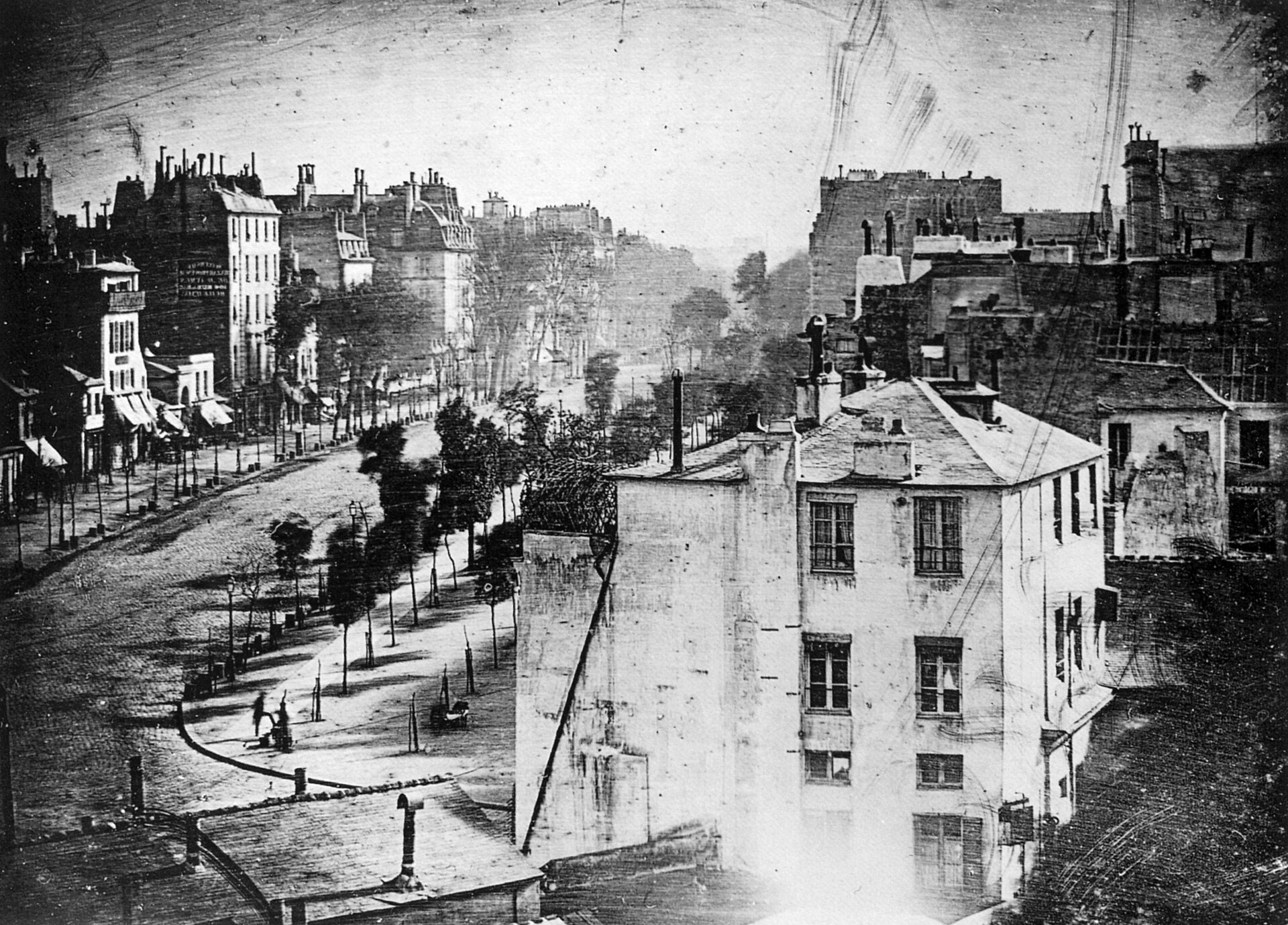
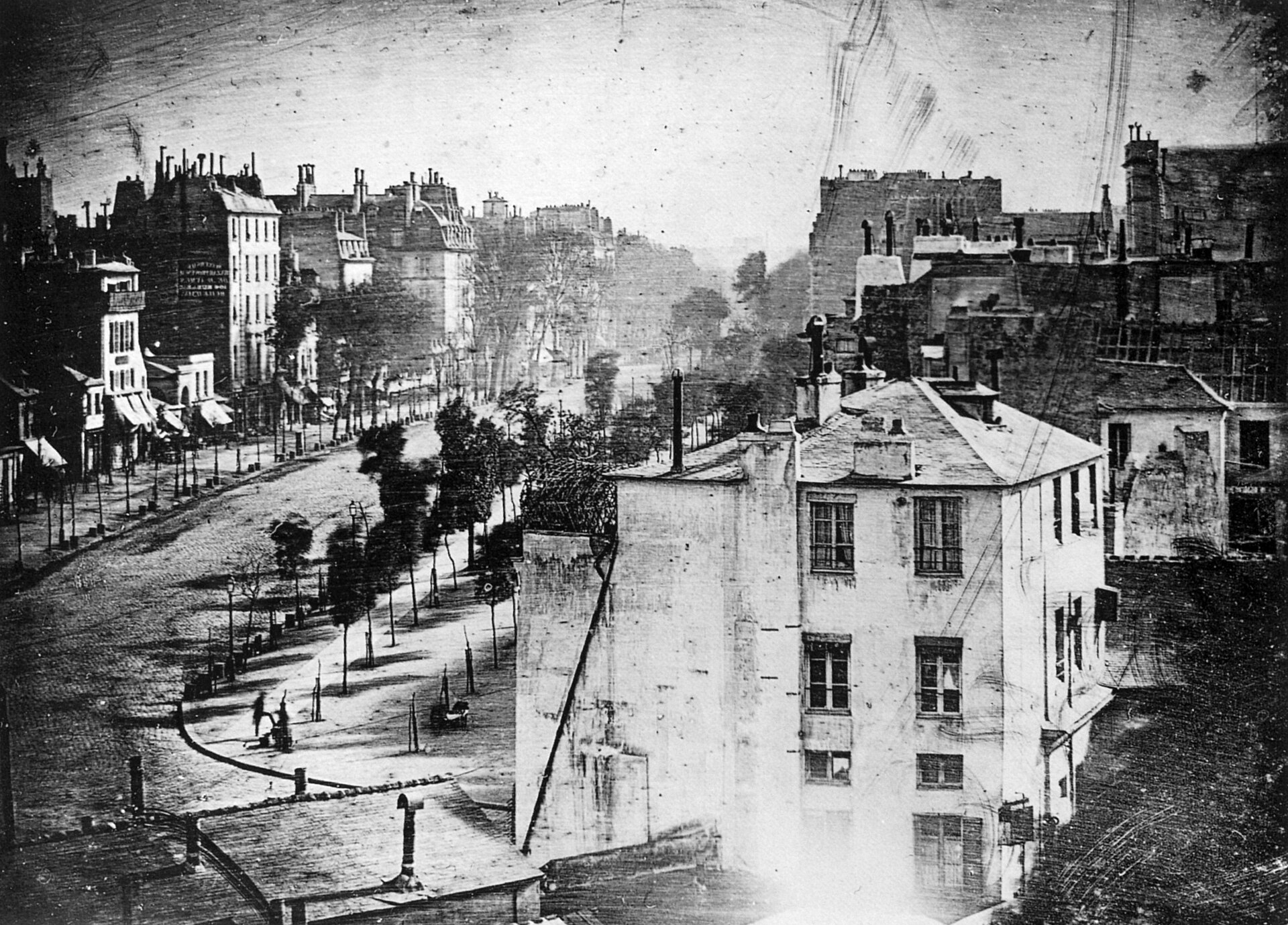
Boulevard du Temple
1838 · Daguerreotype
Bayerisches Nationalmuseum, Munich, Germany
 French · 1787-1851
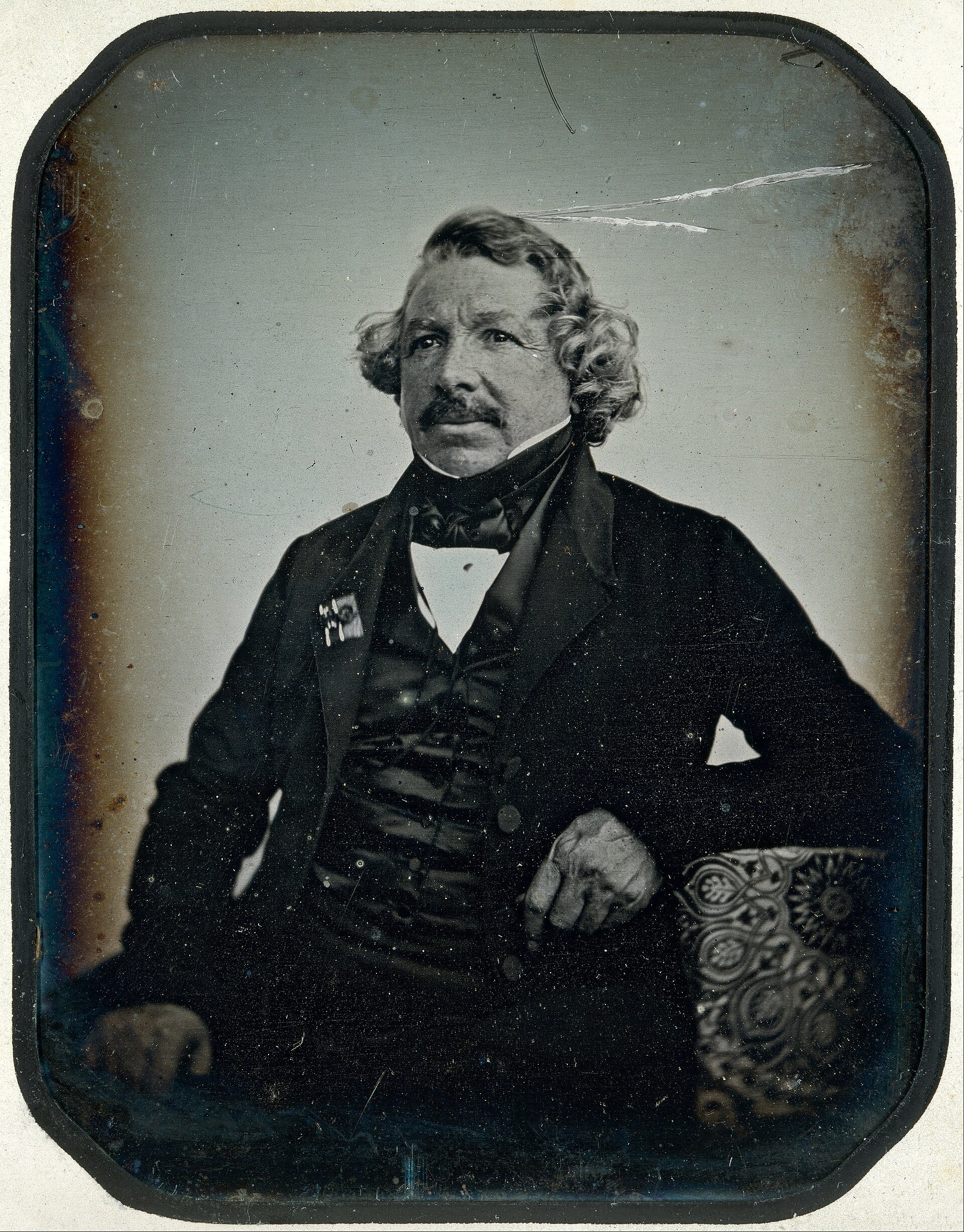
Daguerreotype portrait of Daguerre by his pupil and friend Jean-Baptiste Sabatier-Blot, 1844, five years after the public disclosure of the process. Generally treated as Daguerre's oldest surviving photographic portrait and his only dated one. Daguerre was reported to be a reluctant sitter, which is given as one reason so few photographic portraits of him exist.
Via Google Art Project and Wikimedia Commons| Worked as | Inventor, Painter, Theatrical scene designer |
|---|---|
| Born | 18 November 1787 · Cormeilles-en-Parisis, Kingdom of France |
| Died | 10 July 1851 · Bry-sur-Marne, France |
| Nationality | French |
| Movement | Romanticism, in his painted gothic ruin studies and Diorama work |
| In this archive | 2 artworks |
| Sources | 24 cited |
| Last verified |
About this page 2 artworks in the archive · Last verified · 24 sources cited
The process is named for one man and was built by two. Daguerre's name attached itself to the daguerreotype because he controlled the announcement in 1839, not because he worked alone: the process descended directly from a decade of heliographic experiment by his partner Nicephore Niepce, who had already fixed an image from nature a decade before Daguerre changed anything. Niepce died in 1833 still years from a workable exposure time. What Daguerre then added, working from Niepce's own notes and materials under a contract both men had signed, was a development step using mercury vapor that turned an exposure of many hours into one of minutes, and a fixing method that made the image permanent. He also, by the documented terms of his renegotiated contract with Niepce's son and heir, had the company's own name changed to put himself first and the coming invention became his alone in the public record. This page treats that as what the sources show it to be: a genuine and only partly resolved priority dispute, not a settled biography.
Before any of it, Daguerre was a working theater man: a scene painter trained under a panorama specialist, then the co-inventor and sole proprietor of the Diorama, an illusionist light show that made him rich and gave him the optical and chemical habits of mind he brought to photography. After 1839 he barely touched the process that carried his name, retired to a village outside Paris, and left behind a body of authenticated photographic work so small that today it barely exists as a market category at all: institutions hold nearly everything that survives, forgers have taken to faking his signature precisely because a genuine one is such a rarity, and no scholar consulted in this research publishes a complete count of what is securely his.
The single hardest fact to pin down, and the one most worth knowing, is arithmetic rather than art history: the 1839 government settlement gave Daguerre and Niepce's son Isidore identical base pensions of 4,000 francs a year for the photographic invention. Daguerre's total of 6,000 francs included an extra 2,000 francs paid for an unrelated matter, his mechanism for moving the Diorama's scenery. The invention that made him famous was priced, by the state that bought it, as worth exactly what it was worth to the man whose name never made it onto the process at all.
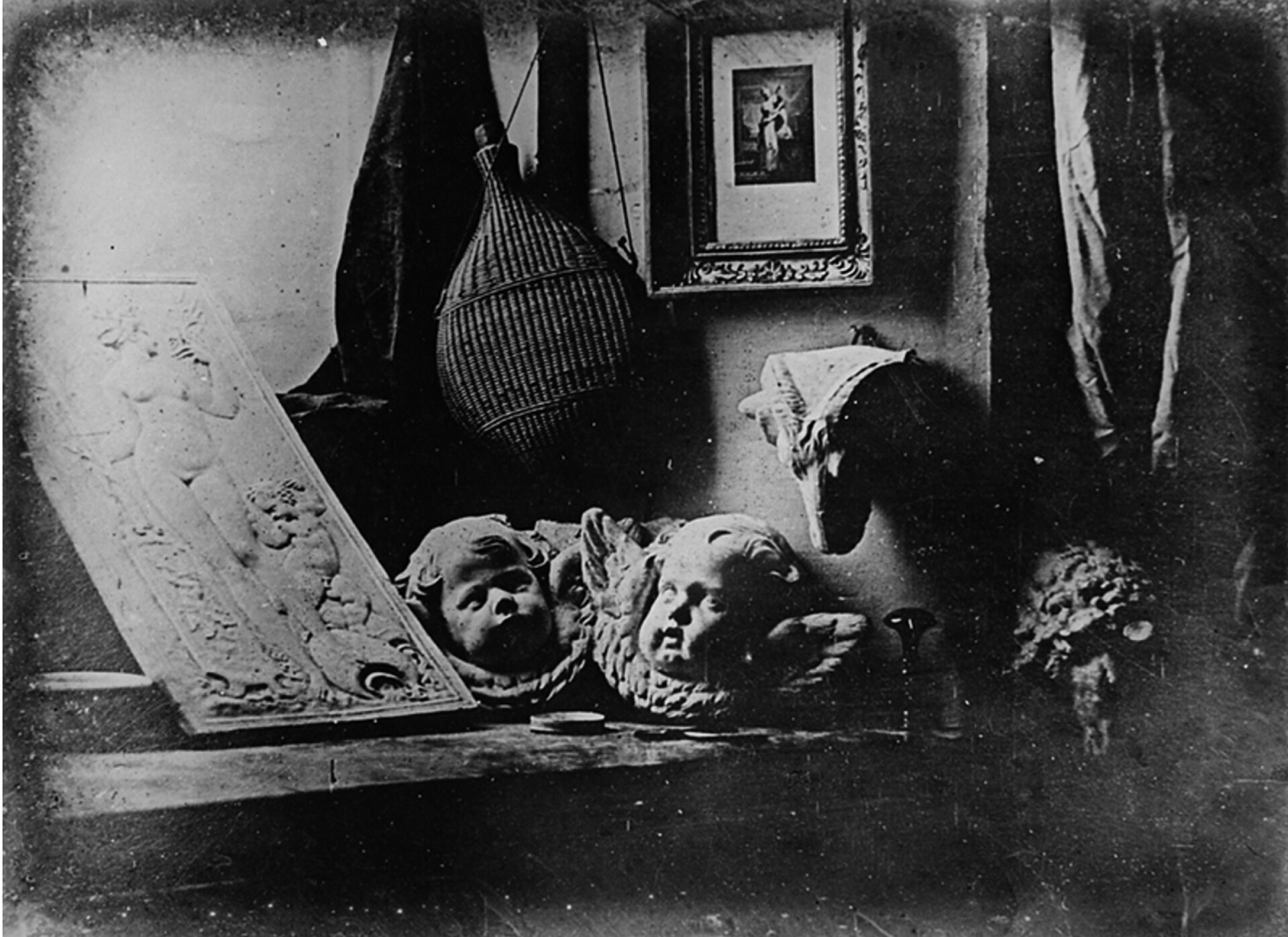
1838 · Daguerreotype
Bayerisches Nationalmuseum, Munich, Germany
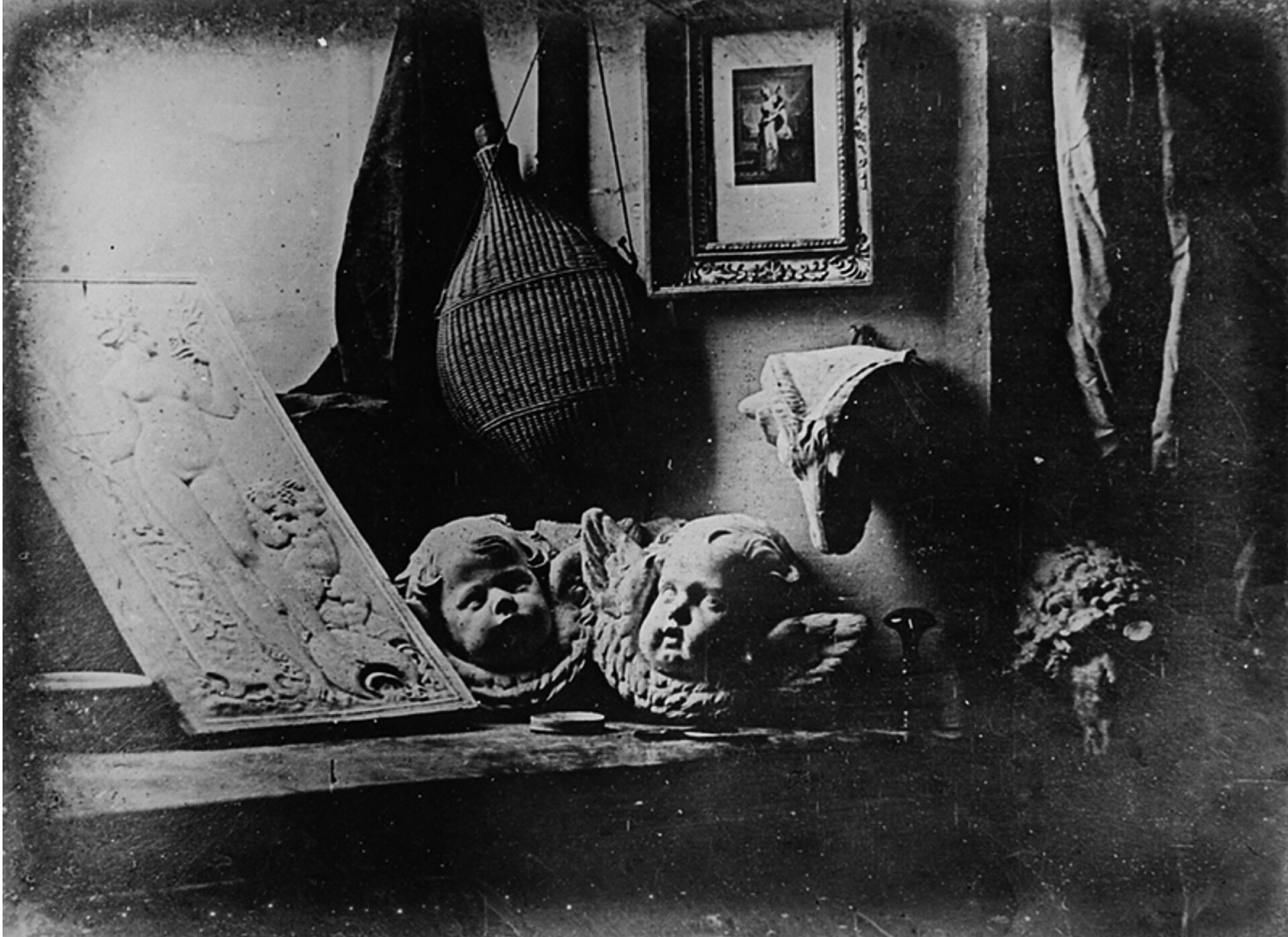
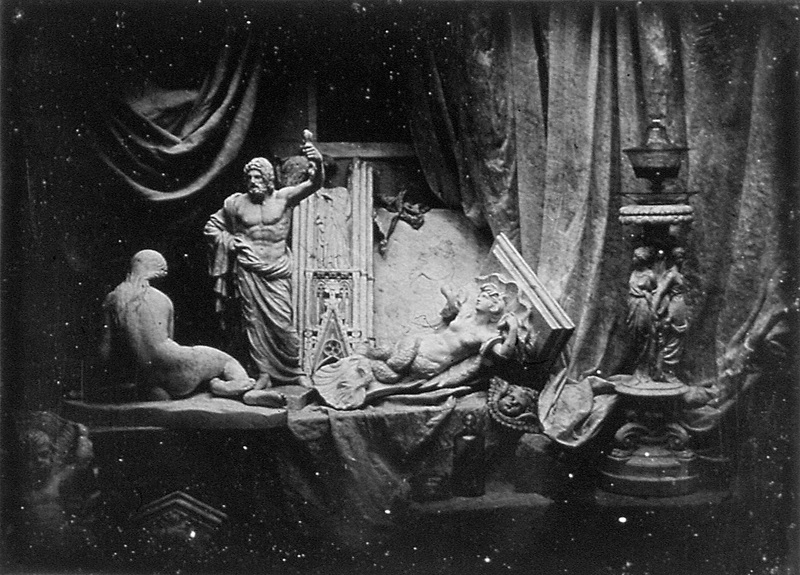
1837 · Daguerreotype
Societe francaise de photographie, Paris
Born 18 November in Cormeilles-en-Parisis.1
Elected Knight of the Legion of Honor for the Diorama, fifteen years before the daguerreotype was announced.3
Meets Nicephore Niepce in Paris in December, on Niepce's way to England.3
Signs a ten-year partnership contract with Niepce in December to develop heliography further.34
Daguerre and Niepce jointly develop the physautotype, an improvement on heliography still measured in hours of exposure.3
Niepce dies suddenly; his son Isidore succeeds him in the partnership under its survivorship clause.34
Daguerre finds that mercury vapor develops a latent image, cutting exposure from hours to minutes.14
Daguerre fixes the developed image in a hot salt solution, completing a practical process; the earliest surviving demonstration plates, including L'Atelier de l'artiste, date from this year.147
On 7 January Francois Arago announces the invention, without technical detail, to the Academie des Sciences.12
On 8 March a fire destroys the Diorama building, consuming a large share of Daguerre's early experimental plates, notes and equipment.1
An act of 15 June settles life pensions of 4,000 francs each to Daguerre and to Isidore Niepce, plus 2,000 francs to Daguerre separately for his Diorama scenery mechanism.4
On 14 August, five days before the French disclosure, Daguerre personally registers a British patent, the one territory where the process was not free.1
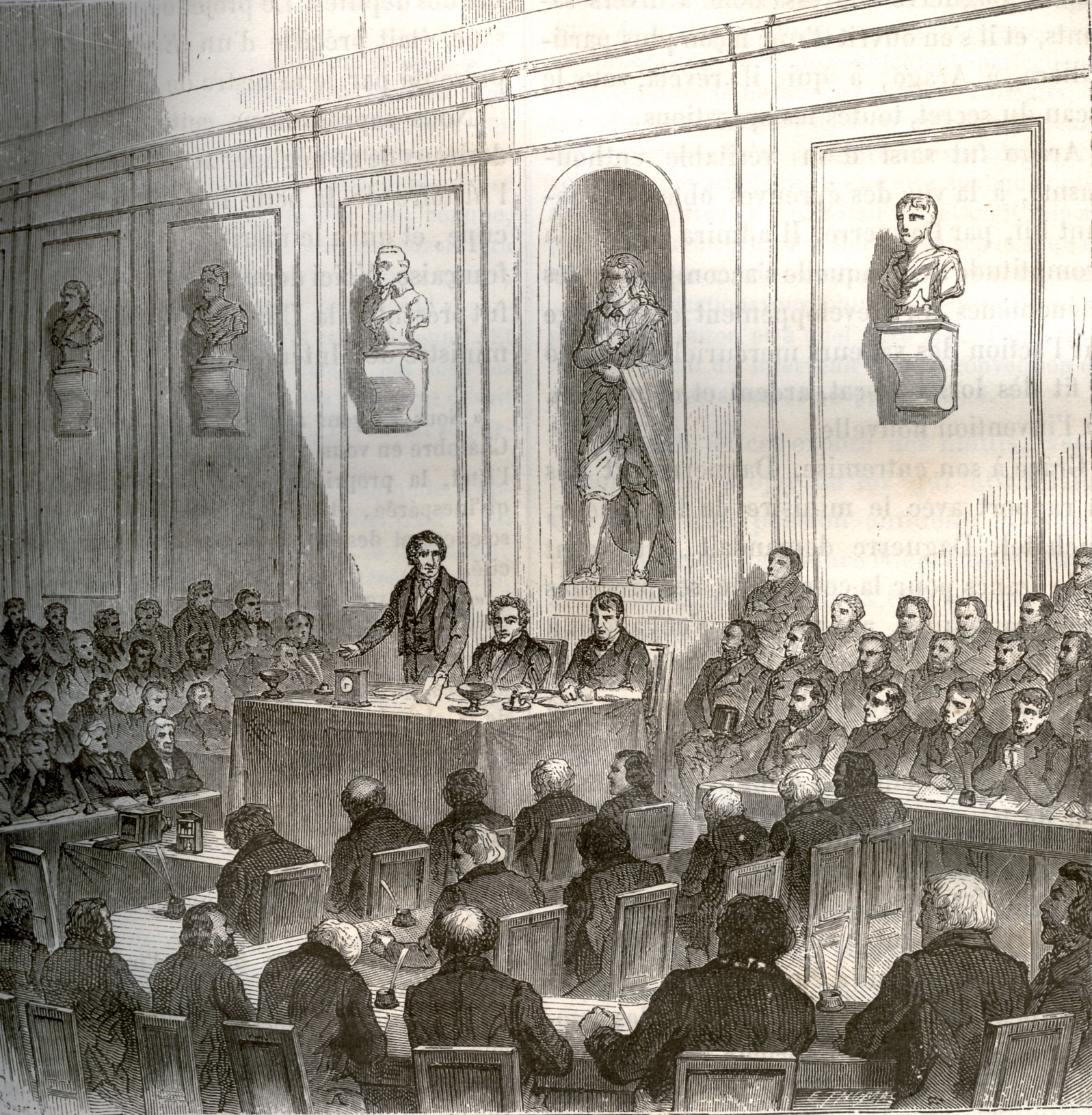
On 19 August Arago presents the full process to a joint session of the Academies; the French state declares it free to the world outside Britain.124
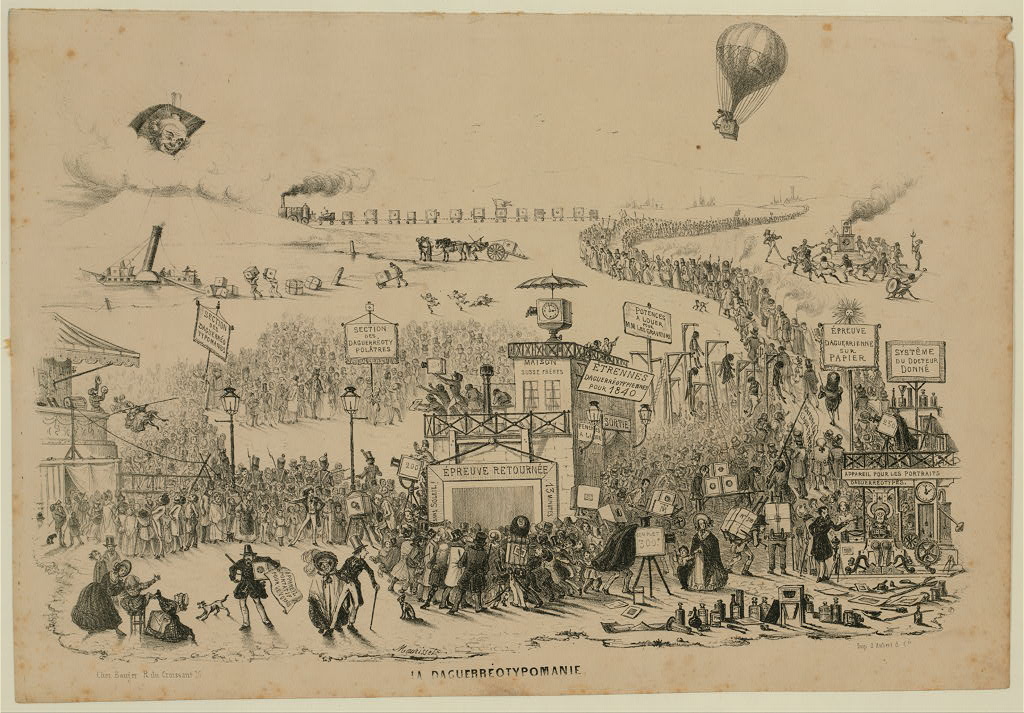
In December, Theodore Maurisset's satirical lithograph La Daguerreotypomanie is published in La Caricature, recording the public craze that followed disclosure.1516
Isidore Niepce publishes, at his own expense, a 72-page pamphlet arguing that his father, not Daguerre, was the true inventor of the process.2324
Jean-Baptiste Sabatier-Blot makes Daguerre's best-documented photographic portrait, his only dated one.14
Dies 10 July at Bry-sur-Marne, outside Paris, where he had retired after 1839.12
The Boulevard du Temple presentation set is transferred from the Bavarian royal collection to the Bayerisches Nationalmuseum.6
The Kynzvart Daguerreotype, Daguerre's 1839 gift to Prince Metternich, is inscribed on the UNESCO Memory of the World Register.8
Almost nothing genuinely photographic by Daguerre's own hand reaches the open market, because almost everything that survives is already in institutional custody. This research located a single identifiable sale of a photographic plate catalogued under his name, a portrait daguerreotype offered with an estimate only, and no confirmed hammer price accessible in this pass. What does trade with some regularity is everything around the invention rather than the invention's own product: his 1839 manual, in its many first-edition issues, and a small, genuinely scarce body of pre-photographic drawings. Forged Daguerre signatures on daguerreotypes by other hands have been identified and publicly flagged, a market response to scarcity rather than a market in his own work.
| Date | Sale | Work | Result | Note |
|---|---|---|---|---|
| 26 June 2025 | Christie's | The Maillet Daguerreotype Collection (whole sale, 200-plus lots, not a single Daguerre work) | Hammer USD 1,618,722 total for the sale With premium Not separately confirmed in this research pass USD | Described as the most significant daguerreotype auction in roughly 25 years; top lot a Robert Cornelius portrait at USD 60,480. Included for market context; no source consulted identifies a lot in this sale as being by Daguerre's own hand. |
Hammer is the price at which the bidding stopped; with premium adds the fee the house charges the buyer on top. Hammer price and buyer's premium in the glossary.
| Institution | City | Holdings | Note |
|---|---|---|---|
| Bayerisches Nationalmuseum | Munich, Germany | The 1839 three-panel presentation set given to Ludwig I of Bavaria: the Boulevard du Temple morning and midday views and a studio still life, inventory R 6312.1-8, held as facsimiles in the original passepartout and frame; the fate of the original plate material is disputed in the sources. | Transferred from the Bavarian royal collection in 1868. |
| Societe francaise de photographie | Paris, France | L'Atelier de l'artiste, a 1837 demonstration still life, and, separately, a Cailleux-dedicated 1837 still life independently described elsewhere as Daguerre's oldest surviving plate. | The SFP's own acquisition history for either plate before its 1854 founding is undocumented in the sources consulted. |
| National Technical Museum, Prague (on long-term loan from Kynzvart Castle) | Prague, Czech Republic | A 1839 still life of plaster casts, the Kynzvart Daguerreotype, given by Daguerre to the Austrian chancellor Prince Metternich shortly before public disclosure. | Inscribed on the UNESCO Memory of the World Register in 2017. |
| Musee Daguerre (Association Louis Daguerre) | Bry-sur-Marne, France | Daguerre's former house, now a municipal museum holding collections related to his life and work; this record has not established what, if any, of his original apparatus it holds. | The town where Daguerre retired in 1839, died in 1851 and is buried. |
| Church of Saint-Gervais-Saint-Protais | Bry-sur-Marne, France | The sole surviving Diorama painting out of everything Daguerre and Bouton exhibited in France and England: a trompe-l'oeil gothic church interior installed behind the altar in 1839. | Restored 2006-2013 with Getty Foundation support after decades of neglect and earlier damaging restoration attempts. |
Daguerre did not arrive at photography from science.
Daguerre did not arrive at photography from science. He trained as a decorator, apprenticed in the workshop of the Paris Opera's set designer Ignazio Degotti and, separately, under Pierre Prevost, a specialist in panoramas, the huge circular painted rooms that put a standing audience inside a painted landscape. Daguerre learned to use a camera obscura from Prevost, who used one to lay out his panoramic canvases, and got his own optical instruments from the same supplier Prevost and Niepce both used, Vincent Chevalier, a fact that put Daguerre one introduction away from the man he would later partner with.
His own theatrical career was a real success on its own terms. Sets he designed for the Ambigu-Comique and the Opera between 1817 and 1822 drew praise specifically for their lighting effects, moonrises and moving suns rendered on canvas well enough to be remembered by name. In 1822, with a second Prevost pupil, Charles Marie Bouton, he opened the Diorama: a purpose-built theater in Paris showing enormous double-sided paintings, up to 22 meters wide, lit alternately from the front and through the canvas to simulate day turning to night for an audience of 350 on a rotating floor. Bouton withdrew from the partnership early; Daguerre ran it alone and, by one account, it earned him something like 200,000 francs a year at its peak. He was elected a Knight of the Legion of Honor in 1824, on the strength of the Diorama alone, fifteen years before anyone outside his own circle had heard of a daguerreotype.
Nicephore Niepce had a working, if barely usable, photographic process before Daguerre owned a camera for the purpose at all.
Nicephore Niepce had a working, if barely usable, photographic process before Daguerre owned a camera for the purpose at all. By 1826 or 1827 Niepce had fixed an image from nature, a view from an upstairs window at his house at Le Gras, onto a pewter plate coated with bitumen of Judea, a light-sensitive asphalt varnish that hardened where light struck it and could be washed away where it did not. He called the process heliography. The exposure needed was measured in hours, by most accounts eight or more, which made it useless for anything that could move, including a human being, and the resulting image was faint and difficult to read. It is, on the evidence, the earliest surviving photograph of any kind, and it predates anything Daguerre made by roughly a decade.
The two men met in December 1827, when Niepce passed through Paris on his way to England and saw the Diorama; they met again in February 1828 on Niepce's return, and corresponded afterward. In 1829 Niepce, not Daguerre, proposed a formal partnership to develop the process further, and the contract was signed that December. What Daguerre supplied at that point was not a rival chemistry but a documented skill set Niepce did not have: camera design, and years of practical experience manipulating light and image at scale in the Diorama. What changed the process technically, in the years that followed, changed under Daguerre's hand, after Niepce's death, using discoveries Niepce never lived to see.
The partnership agreement Niepce and Daguerre signed in December 1829 ran for ten years and contained a specific survivorship clause: if either partner died, his natural heir would take his place in...
The partnership agreement Niepce and Daguerre signed in December 1829 ran for ten years and contained a specific survivorship clause: if either partner died, his natural heir would take his place in the company for the remainder of the term. That clause is not a formality. It is the exact mechanism that put Niepce's son Isidore, a man with no independent command of his father's chemistry, into a legal partnership with Daguerre after 1833, and it is the mechanism Daguerre used, deliberately and by the sources' own account, to manage a far weaker partner than the one he had started with.
Working together, the two men achieved one further joint result before Niepce died: the physautotype of 1832, an improvement on heliography using lavender oil-based resin rather than bitumen, still slow, still a long way from a usable exposure time. Niepce died suddenly in 1833, four years into a ten-year contract, without ever seeing an exposure shorter than hours. Everything that made the daguerreotype practical came after that date, and came from Daguerre working alone under the surviving contract with a partner who could not meaningfully check his work.
The technical distance between Niepce's heliography and Daguerre's daguerreotype is not stylistic, it is measurable in hours against minutes, and the sources are specific about when each piece of it...
The technical distance between Niepce's heliography and Daguerre's daguerreotype is not stylistic, it is measurable in hours against minutes, and the sources are specific about when each piece of it arrived. In 1835 Daguerre found that an image too faint to see on an iodine-sensitized silver plate, a latent image, could be brought up to full visibility by exposing the plate to mercury vapor, which condensed selectively onto the parts of the plate that had been struck by light. That single change is what cut the exposure time from hours to minutes and made photographing a person, in principle, survivable. A popular version of the discovery holds that Daguerre found it by accident, leaving an exposed plate in a chemical cupboard that happened to contain a broken mercury thermometer, and that story has been repeated by Daguerre himself in some accounts; this record treats it as a widely circulated origin story rather than a verified laboratory event, since no source consulted traces it to an eyewitness record independent of Daguerre's own later telling.
In 1837 Daguerre solved the second problem, permanence, fixing the mercury-developed image in a hot solution saturated with ordinary table salt, so the plate would no longer darken further when exposed to light. That is the process, silvered copper, iodine sensitization, mercury development, salt fixing, that produced the small number of demonstration plates Daguerre made and gave away between 1837 and the 1839 disclosure, including the earliest of the plates now held by the Societe francaise de photographie. Salt fixing is itself a dating marker: John Herschel had discovered in 1819 that sodium thiosulfate, hypo, would dissolve unexposed silver halide far more effectively, but he did not communicate that discovery to Daguerre until early 1839, so any plate genuinely made before that date was necessarily fixed in salt, not hypo, a distinction conservators can in principle use to test a disputed early dating.
Isidore Niepce could not reproduce his father's chemistry, and the sources describe Daguerre using that weakness directly: he let Isidore's own experiments fail while he quietly finished a process...
Isidore Niepce could not reproduce his father's chemistry, and the sources describe Daguerre using that weakness directly: he let Isidore's own experiments fail while he quietly finished a process that would shortly make Niepce's slower ones obsolete. When Daguerre judged the process ready to offer for publication, he required, as a condition of going forward, that the surviving company's trading name be changed from a Niepce-Daguerre partnership to one styled around himself: a company to exploit a discovery credited to Daguerre and, secondarily, to the late Nicephore Niepce. Isidore agreed, apparently believing the change was procedural. It was not. From that point the invention had a legal name, and the legal name was Daguerre's.
Francois Arago, the astronomer and permanent secretary of the Academie des Sciences, became the process's political sponsor and negotiated the state purchase that made it public. Even sympathetic, scholarly accounts of the episode describe Arago's advocacy as shifting credit toward Daguerre as it proceeded, at Niepce's expense; his 19 August 1839 announcement to the joint session of the Academies gave heliography and the physautotype only brief mention and barely named Niepce at all, reserving the substantive presentation for the daguerreotype alone. Isidore Niepce's response came two years later: in August 1841 he published, at his own expense, a 72-page pamphlet titled, in translation, History of the Discovery Improperly Called the Daguerreotype, Preceded by a Notice on Its True Inventor, the Late Mr. Joseph-Nicephore Niepce, arguing explicitly that his father had invented the process and that Daguerre's contribution was, at most, a refinement of it. The pamphlet did not change the public record. The name that had already been announced to the world stayed the one that stuck, and this record treats the disagreement exactly as the sources leave it: documented that Daguerre required the renaming and that Isidore protested it in print, argued rather than settled as to which man's contribution the historical record ought to weight more heavily.
An act of the French government dated 15 June 1839 settled the terms publicly disclosed two months later: the state would acquire the rights to the daguerreotype and give it, with one exception, free...
An act of the French government dated 15 June 1839 settled the terms publicly disclosed two months later: the state would acquire the rights to the daguerreotype and give it, with one exception, free to the world. In compensation, it granted life pensions. Isidore Niepce received 4,000 francs a year. Daguerre received the same base figure, 4,000 francs a year, for the photographic invention, plus a separate 2,000 francs a year for an unrelated piece of intellectual property entirely: his mechanism for the Diorama's moving scenery. Popular accounts of the settlement, including most that circulate online, collapse this into a single figure, Daguerre 6,000 francs against Niepce's son 4,000, that reads as a straightforward statement of whose contribution the state valued more highly. The underlying act does not support that reading: for the invention itself, the two men were paid identically.
The one exception to the process being free to the world was Great Britain and its colonies, where Daguerre had personally registered a patent on 14 August 1839, five days before the French government's own disclosure made everyone else's use of the process free. A British user paid a fee that a French, German or American user never did, for exactly the same chemistry, because Daguerre moved to protect it there before the announcement that made it a gift everywhere else.
Between 1837, when Daguerre first had a working process, and August 1839, when he disclosed it, photography did not exist as a public fact.
Between 1837, when Daguerre first had a working process, and August 1839, when he disclosed it, photography did not exist as a public fact. What Daguerre had instead was a small number of finished plates he could put in front of the specific people whose support he needed: scientists who might vouch for the process, officials who might help secure a state reward, and crowned heads whose patronage carried weight a working inventor could not buy any other way. A scholarly account in the journal Genesis records that Daguerre distributed plates to a range of political, scientific and artistic figures during this period, and that fewer than twenty of them are known to survive today, scattered across institutions. This record's own object among them, the Societe francaise de photographie's L'Atelier de l'artiste, a 1837 still life of plaster casts under raking window light, chosen for its total stillness rather than for anything it depicted, carries no dedication and its route into the SFP's collection before the society's own founding in 1854 is undocumented. A second, separately dated 1837 SFP still life, dedicated on its verso to Alphonse de Cailleux, director of the Louvre, is independently described elsewhere as Daguerre's actual oldest surviving plate, a claim the SFP's own holdings have not been reconciled to resolve. A later demonstration piece, dated 1839 and dedicated to the Austrian chancellor Prince Metternich, now sits at the National Technical Museum in Prague on long-term loan from Kynzvart Castle and was inscribed on the UNESCO Memory of the World Register in 2017.
Most of what Daguerre made before disclosure is gone. On 8 March 1839, five months before the public announcement, a fire destroyed the Diorama building in Paris, consuming daguerreotype specimens, notebooks and equipment stored on an upper floor. No source consulted itemizes exactly what burned. What can be said is structural: an inventor's early experimental output was concentrated in one building, and that building burned down within roughly two years of his first working plate, which is one plain reason the corpus of authenticated early Daguerre photographs is as small as it is.
The best-known surviving object attributed to Daguerre is a view down the Boulevard du Temple in Paris, made from a window near his own apartment beside the Diorama, most literature placing the...
The best-known surviving object attributed to Daguerre is a view down the Boulevard du Temple in Paris, made from a window near his own apartment beside the Diorama, most literature placing the exposure in the spring of 1838. An exposure of several minutes erased every moving carriage, cart and pedestrian on what was, in 1838, one of the busiest streets in Paris, leaving what reads at first glance as an empty boulevard. In the lower left corner, a shape held still long enough to register: a man having his boots polished, and by one later reading, credited to the critic David Bate, a second, fainter figure beside him, the bootblack himself, visible only as a blur because his work kept him in continuous motion. Neither man has ever been identified by name.
This is not the only surviving image from that session, and treating it as such is a common and specific error. Daguerre made a second exposure of the identical view at midday, from the same window, showing the same buildings and street furniture with no figures visible at all, the deliberate control that shows what the street looked like with nothing to distinguish it. He mounted the two street views with a third plate, an unrelated studio still life of plaster casts, into a three-panel presentation set, and gave the whole set, with a dedication in his own name, to Ludwig I, King of Bavaria, in 1839. It went on public display at the Munich Kunstverein that October and reached the Bayerisches Nationalmuseum, which holds it today, by transfer in 1868. Every source consulted agrees the original plates were later damaged by a cleaning attempt; the sources disagree by more than a decade on when, and one serious academic account states the original of the morning view was destroyed outright, leaving only an empty frame. What is reproduced today as the Boulevard du Temple photograph descends from a copy negative the historian Beaumont Newhall made in 1936 or 1937, before whichever damage occurred. This record's own published entry on the object, daguerre-boulevard-du-temple, sets the full disputed chronology out in detail and is not repeated here beyond what a reader of this page needs to know: the image everyone has seen is a reproduction of a reproduction, of a plate that may or may not still physically exist.
Within weeks of the 19 August 1839 disclosure, the process had been improved enough to make portraits, and Paris went into a documented public frenzy over it.
Within weeks of the 19 August 1839 disclosure, the process had been improved enough to make portraits, and Paris went into a documented public frenzy over it. Dozens of studios opened within months, offering to daguerreotype anyone who could pay, and the craze spread through the provinces, into the rest of Europe and, with particular staying power, to the United States. The satirist Theodore Maurisset caught the moment in a lithograph published, per the Library of Congress and the Getty's own catalog record for the print, in December 1839, in the journal La Caricature: a crowded, chaotic scene of Parisians of every description queueing, posing and profiting from the new machine, a popular obsession barely four months old rendered as farce while it was still happening. The print is sometimes dated 1840 in general circulation, likely from later reprintings; the primary publication and the institutional catalog records agree on December 1839, and this record follows them.
The craze was, among other things, a demonstration of exactly how completely the public discourse had already settled on Daguerre's name alone. Niepce is absent from the satire entirely, four months after Arago's own announcement had already reduced him to a passing mention. A private, decade-long partnership had become, in the space of one season, a single man's invention in the popular imagination, and the popular imagination has not meaningfully revised that view since.
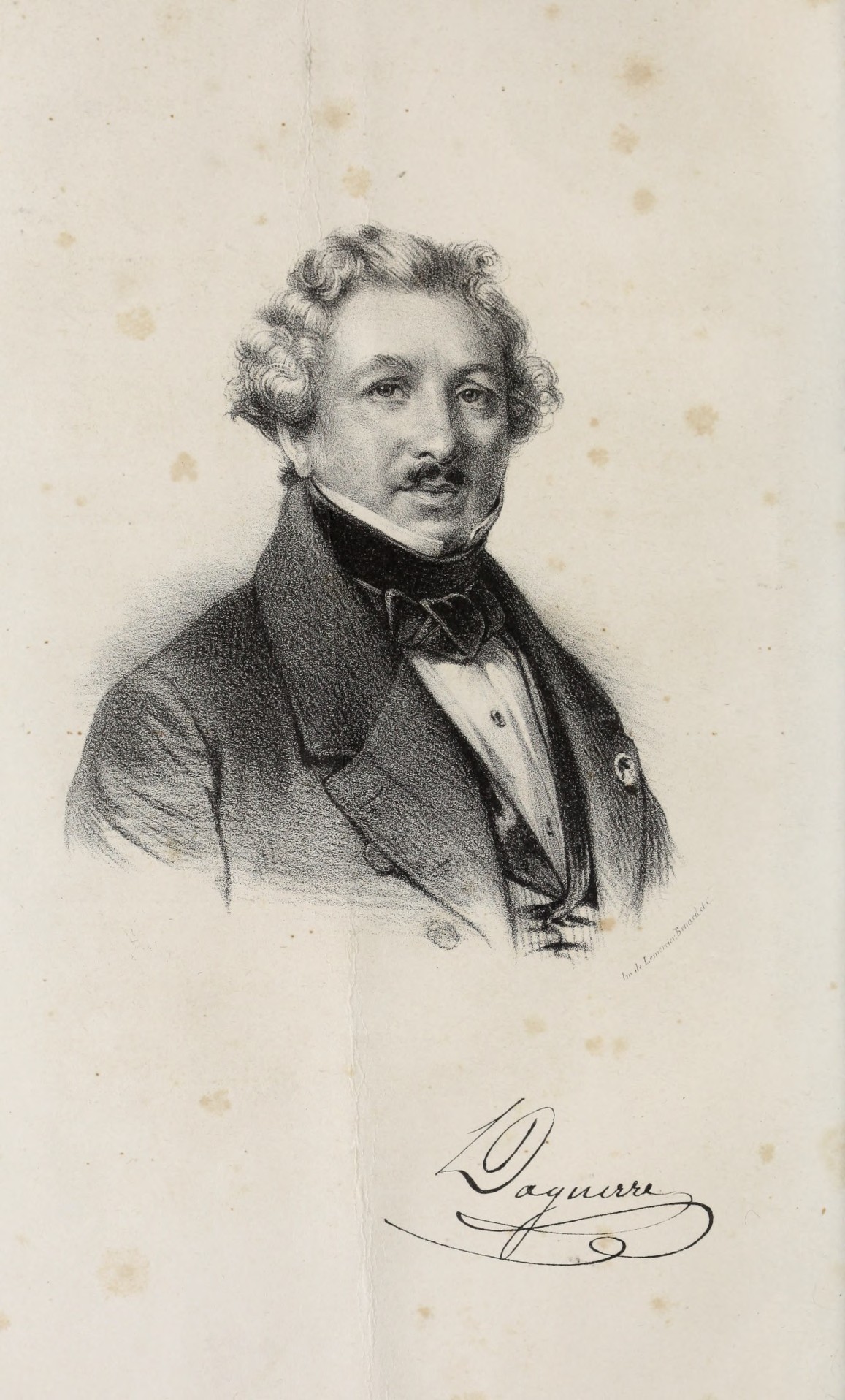
Daguerre is reported to have been reluctant to sit for his own invention, which is given as one reason so few daguerreotype portraits of him survive relative to his fame.
Daguerre is reported to have been reluctant to sit for his own invention, which is given as one reason so few daguerreotype portraits of him survive relative to his fame. The best documented is a plate made in 1844 by Jean-Baptiste Sabatier-Blot, a painter and photographer who had been Daguerre's pupil and friend and who is recorded as having made at least two portraits of him around that date; Sabatier-Blot was, by the mid-1840s, among the most sought-after portraitists working the Parisian daguerreotype trade. The 1844 sitting is generally treated as Daguerre's oldest surviving photographic portrait and his only dated one; he was fifty-seven. A separate, earlier likeness exists in an unsigned lithograph printed in Daguerre's own 1839 manual, Historique et Description des Procedes du Daguerreotype et du Diorama, made to accompany the text he was legally obliged to publish once the state had bought his rights. Neither image shows a man especially eager to be looked at by the process he had just given the world.
What happened to Daguerre's own working apparatus, chemicals and remaining plates after his death in 1851 is not documented in any source this research located, and this record does not fill that gap...
What happened to Daguerre's own working apparatus, chemicals and remaining plates after his death in 1851 is not documented in any source this research located, and this record does not fill that gap with a guess. What can be said concretely concerns the two things that are known to have survived him. His final years were spent at Bry-sur-Marne, outside Paris, where he retired after 1839 and where he died and is buried; the house he lived in is today a municipal museum run by the Association Louis Daguerre, holding collections related to his life and work, though this record has not established which, if any, of his personal apparatus is among them. Separately, the town's church of Saint-Gervais-Saint-Protais holds the sole surviving Diorama painting out of everything Daguerre and Bouton exhibited across France and England: an enormous trompe-l'oeil gothic church interior, installed behind the altar in 1839 and engineered, through layered translucent paint and changeable front and back lighting, to make candles appear to flicker and the architecture fade convincingly from day to night. Declared a historical monument in 1913, the painting suffered damaging restoration attempts and long neglect before a campaign begun by the town's mayor in 2007, with Getty Foundation support, restored it between 2006 and 2013. It is the clearest surviving physical link between the theatrical illusionist Daguerre was for two decades and the inventor he became for the last twelve years of his life, and it exists today because a small town outside Paris chose to keep it rather than because any archive systematically preserved his working effects.
Genuine photographic plates that can be confidently placed in Daguerre's own hand are rare enough that this research located only one identifiable sale of one: a sixth-plate daguerreotype portrait of...
Genuine photographic plates that can be confidently placed in Daguerre's own hand are rare enough that this research located only one identifiable sale of one: a sixth-plate daguerreotype portrait of a sitter named Leocardie Cotte, dated 1844, catalogued under Daguerre's name and offered by the French house Osenat in November 2013 with a pre-sale estimate of 20,000 to 25,000 euros. This record could not access the confirmed hammer price for that lot in this research pass, and states that gap plainly rather than repeating the estimate as a result. What trades far more often and far more visibly is not photographs at all: Daguerre's 1839 manual, which went through 39 editions, reprints and translations within eighteen months of publication, appears regularly at Christie's, Sotheby's, Bonhams and comparable houses, with rare early issues reaching the 20,000 to 40,000 dollar range; a small, documented body of his pre-photographic drawings, ink and wash studies and a distinctive smoke-and-soot technique called dessin-fumee that he used for gothic ruin studies in the 1820s, also surfaces periodically in the low thousands of euros, described by the specialists who catalog it as genuinely scarce. Christie's June 2025 sale of the Maillet Daguerreotype Collection, more than two hundred lots gathered over six decades and billed as the most significant daguerreotype auction in a generation, totaled 1,618,722 dollars with its top lot a Robert Cornelius portrait at 60,480 dollars; no source consulted for this record identifies a plate by Daguerre's own hand among its results.
That scarcity has a predictable consequence. In 2018 the photography writer Michael Mattis, writing in The Eye of Photography, alerted the collecting community to a run of daguerreotypes carrying fraudulent signatures attributed to Gustave Le Gray, Louis-Auguste Bisson, Th. Jacobi and Daguerre himself. Mattis's own comparison is worth repeating for what it says about rarity rather than fraud: a genuinely signed Daguerre or Le Gray plate is rarer on the market than an unrecorded Vermeer or Leonardo would be. The auctions offering the fake-signed plates were blocked once questions were raised, after scrutiny from the dealer and collector Frederic Hoch and the experts Mike Robinson and Bruno Tartarin, who identified physical inconsistencies in the individual plates; the Daguerreian Society now maintains a shared repository of images of known fraudulent examples. A forger fakes a Daguerre signature for the same reason a real one is so hard to find at auction: there is almost nothing genuine left to buy.
Inventor; Painter; Theatrical scene designer. 1787-1851.
Born 18 November 1787, Cormeilles-en-Parisis, Kingdom of France; died 10 July 1851, Bry-sur-Marne, France.
Fraudulently signed daguerreotypes, identified 2018. The photography writer Michael Mattis, writing in The Eye of Photography, alerted collectors and dealers to a group of genuine 1840s-50s daguerreotypes carrying fake signatures attributing them to Gustave Le Gray, Louis-Auguste Bisson, Th. Jacobi and, among them, Louis Daguerre.
Bayerisches Nationalmuseum (Munich, Germany); Societe francaise de photographie (Paris, France); National Technical Museum, Prague (on long-term loan from Kynzvart Castle) (Prague, Czech Republic); Musee Daguerre (Association Louis Daguerre) (Bry-sur-Marne, France); Church of Saint-Gervais-Saint-Protais (Bry-sur-Marne, France).
Almost nothing genuinely photographic by Daguerre's own hand reaches the open market, because almost everything that survives is already in institutional custody. This research located a single identifiable sale of a photographic plate catalogued under his name, a portrait daguerreotype offered with an estimate only, and no confirmed hammer price accessible in this pass.
What became of Daguerre's own photographic apparatus, chemicals, notebooks and any remaining plates after his death in 1851? No source consulted documents their disposition.
Last verified
One artwork and its story every Tuesday, with the picture: who owned it, what it made, and what closes soon in the exhibition calendar. No promotion, and nothing we cannot cite.
We send one email to confirm the address and keep nothing else. Every letter carries a one-click unsubscribe. How we handle your data.


.jpg)


.jpg)