Sofa
John Henry Belter · c. 1850-1860
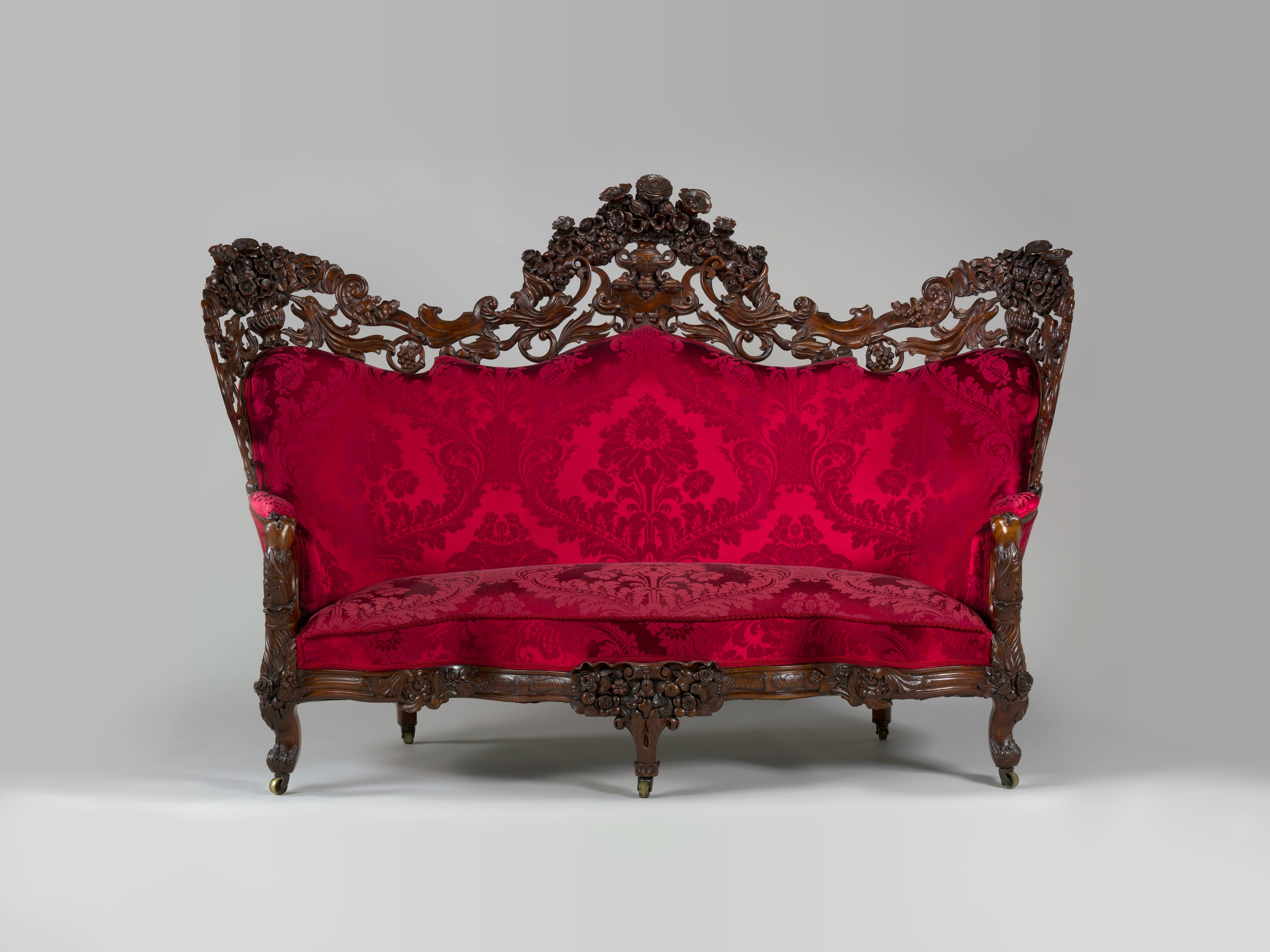
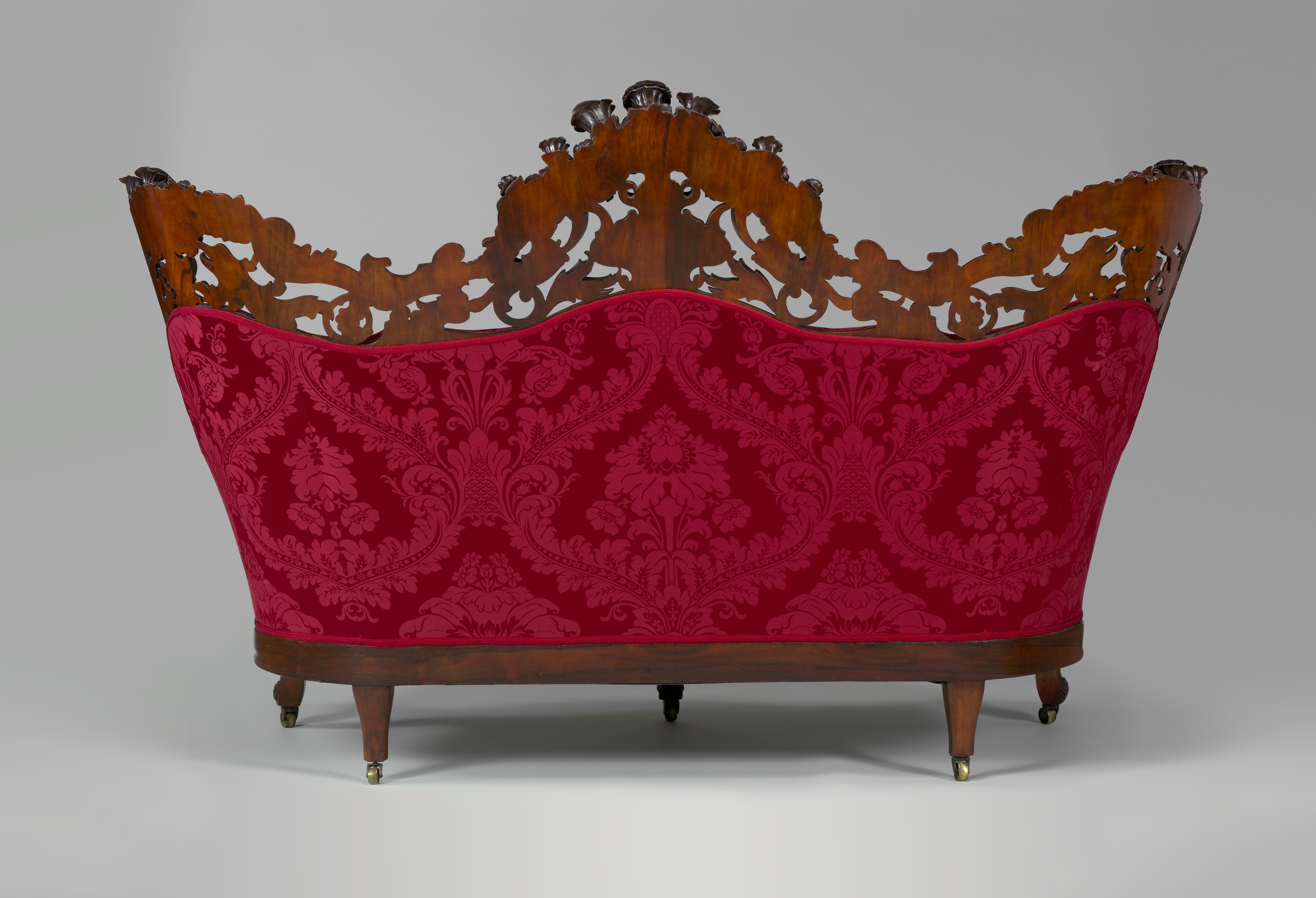
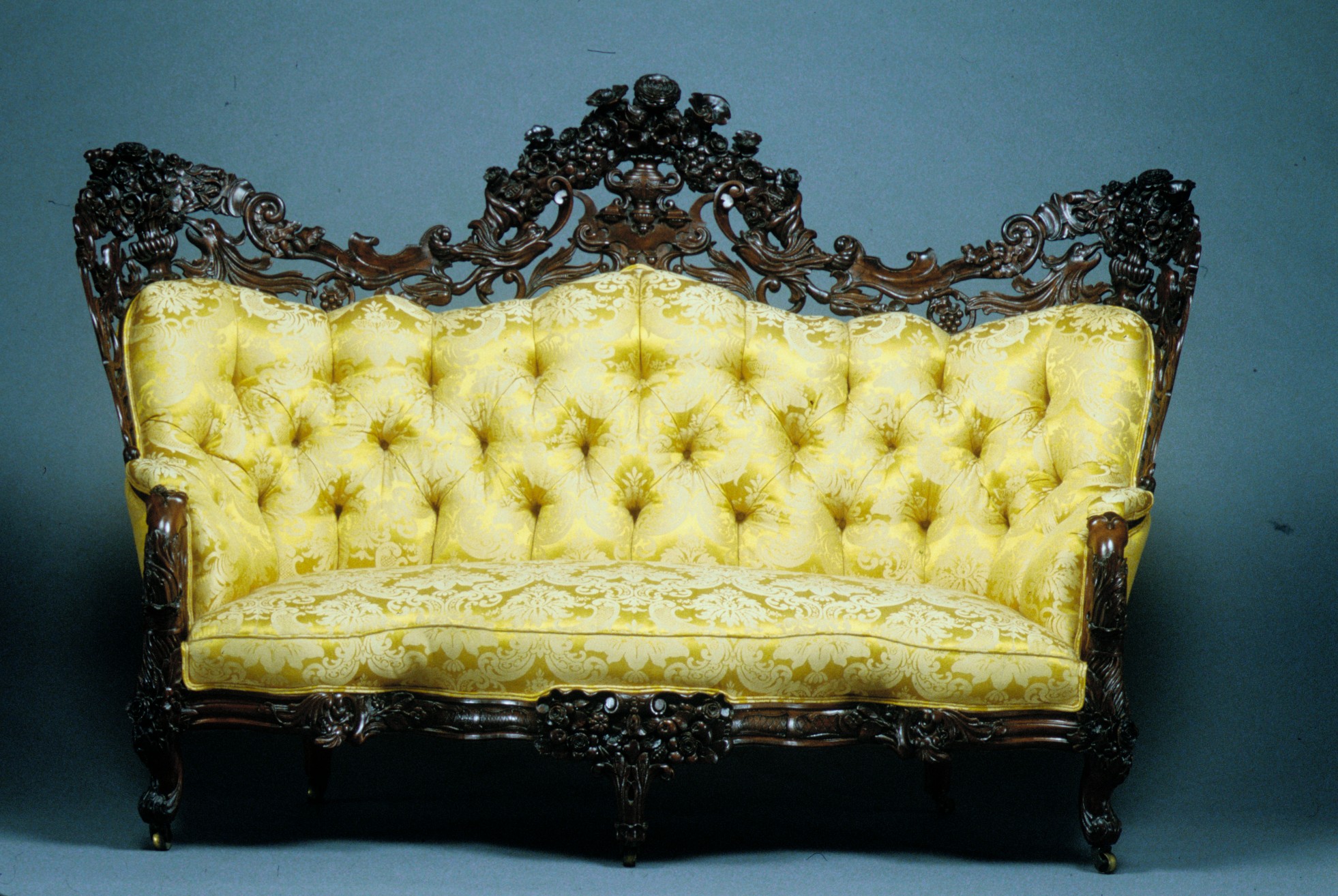
The sofa as photographed by the Metropolitan Museum of Art for its own online catalogue of accession 1999.396.
| Artist | John Henry Belter |
|---|---|
| Date | c. 1850-1860 |
| Medium | Laminated and carved rosewood with rosewood veneer; chestnut and pine secondary woods; modern upholstery over some surviving original underupholstery |
| Dimensions | 135.3 x 167.6 x 63.5 cm (53 1/4 x 66 x 25 in.) |
| Where it is now | The Metropolitan Museum of Art, New York, The American Wing, Gallery 736last confirmed |
| Inventory number | 1999.396 |
| Attribution | AcceptedThe Metropolitan Museum's own database lists the maker of this sofa simply as 'John Henry Belter,' without the 'Attributed to' qualifier the Met attaches to several of its other Belter-labelled holdings, among them the 1957 Leonard-gift sofa (57.130.1), armchair (57.130.2) and tete-a-tete (57.130.7), and the 1980 Manney-gift center table (1980.510.1). Full note |
| Object type | Furniture |
| Period | American, mid-nineteenth century (Rococo Revival) |
| Cases | Has a provenance gap |
| Inscriptions | None. The sofa is unmarked and unlabelled, consistent with the general practice of Belter's shop, which is not known to have labelled or signed the great majority of its output. |
| Owners on record | 3 links2 documented, 1 unknown |
| Sources | 18 cited |
About this record Last verified · 18 sources cited · Change log
On this page 10 sections
ContentsClose
A parlor sofa in laminated and carved rosewood, made in New York around 1850-1860 and catalogued by the Metropolitan Museum of Art as the work of John Henry Belter, the German-born cabinetmaker whose patented method of steaming and pressing cross-grained laminated wood let his shop carve and pierce curved forms that solid wood of the same thickness could not survive. Purchased by the Museum in 1999 with the Friends of the American Wing Fund and the Lila Acheson Wallace Gift, it carries no label, signature or mark of any kind, which is normal rather than exceptional for Belter's firm and is the direct cause of a market-wide problem: because his shop essentially never signed its work and left no surviving sales records, 'Belter' and 'attributed to Belter' have been applied for more than a century to a body of unmarked Rococo Revival rosewood furniture, some of it by named competitors such as Charles Baudouine, far larger than his own workshop plausibly produced.
Checked directly against the Museum's own database, this sofa is one of only two Belter-related seating objects in its American Wing catalogued without the 'Attributed to' qualifier the Museum applies to several of its other Belter holdings, including the pieces that dress its own dedicated Belter period room. That is a real distinction in the Museum's own records, not a claim manufactured for this page, and it sits alongside a genuine, unresolved gap: no owner, dealer or sale for this specific sofa is documented anywhere between its manufacture and the Museum's 1999 purchase, and no purchase price has been published.
This record treats the attribution as the Museum's own considered working position while stating exactly what kind of evidence that position rests on: construction and comparison, not a maker's mark on the object itself, and it separates every fact and figure attached to this individual sofa from the far larger, and far less certain, market in furniture that merely carries Belter's name.
Provenance
Each link is graded. Documented: a cited source supports it. Disputed: the identification is argued but not established. Unknown: no owner for that span, and the gap is not smoothed into a narrative. The grades in the glossary.
- c. 1850 - c. 1860Workshop of John Henry Belter, trading as J. H. Belter & Co., New Yorkdocumented
Made in New York City. The Metropolitan Museum's own database lists the maker without an 'Attributed to' qualifier, while also naming 'or J. H. Belter & Co.' as an alternate constituent; no label or signature survives on the object itself, and the firm's own sales records do not survive. See the attribution note above for the full grading of this claim.13
- c. 1860 - 1999Unknownunknown
No owner, dealer, or sale is documented in any source consulted for this record across roughly a century and a quarter. This sofa should not be assumed to share the Manney collection provenance of some of the Museum's other Belter-attributed holdings; nothing in the sources found connects it to that collection or to any other named collection before 1999.
- 1999 - presentMetropolitan Museum of Art, New Yorkdocumented
Purchased in 1999 with funds from the Friends of the American Wing Fund and the Lila Acheson Wallace Gift. No dealer or seller is named in the sources consulted, and no purchase price has been published in them.1
Prices realised
| Date | Sale | Estimate | Result | Note |
|---|---|---|---|---|
| 31 January 2015 | Neal Auction Company | Not established in sources consulted | Hammer Not separately published With premium Not separately published USD | COMPARANDA ONLY, not a sale of the object described in this record. A parlor suite (loveseat, sofa, pair of side chairs, pair of armchairs) catalogued as American Rococo carved and laminated rosewood, attributed to John Henry Belter, reported sold for a total of 83,650 USD by secondary sale-price aggregators. Those aggregators give a single 'sold for' figure and do not state whether it is a hammer price or a price including buyer's premium; this record states that ambiguity rather than resolving it by assumption. |
Hammer is the price at which the bidding stopped; with premium adds the fee the house charges the buyer on top. Hammer price and buyer's premium in the glossary.
Technical evidence
| Attribution note | The Metropolitan Museum's own database lists the maker of this sofa simply as 'John Henry Belter,' without the 'Attributed to' qualifier the Met attaches to several of its other Belter-labelled holdings, among them the 1957 Leonard-gift sofa (57.130.1), armchair (57.130.2) and tete-a-tete (57.130.7), and the 1980 Manney-gift center table (1980.510.1). At the same time the object record carries a second, alternate maker constituent, 'or J. H. Belter & Co.,' leaving open whether the individual Belter or an employee of his firm actually built it. No label, signature or maker's mark survives on this sofa, and none is known to survive on almost any product of Belter's shop; the firm kept no sales ledger that has come down to scholars. The case for Belter rests on construction (the multi-layer cross-grained lamination his 1858 patent describes) and on comparison with the small number of labelled or firmly documented pieces, not on a mark found on the object itself. This record treats 'John Henry Belter' as the Metropolitan Museum's own working attribution for this specific sofa, while stating plainly that the evidence behind it is comparative and typological rather than documentary. |
|---|---|
| Primary materials | Solid and laminated rosewood, with rosewood veneer, for the show surfaces and carved elements.1 |
| Secondary woods | Chestnut and pine, used structurally beneath the rosewood veneer and laminate.1 |
| Lamination construction | Steamed, cross-grained laminated rosewood built up in multiple layers and pressed in a mold to curve in more than one plane; the Metropolitan Museum's own description of this construction type for this object cites as many as twenty-one layers in the most elaborate related work. This follows the general method of Belter's 23 February 1858 patent, US 19,405.16 |
| Upholstery | Modern upholstery over some surviving original underupholstery.1 |
| Dimensions | 135.3 x 167.6 x 63.5 cm (53 1/4 x 66 x 25 in.)1 |
| Marks and labels | None survive. The sofa is unmarked and unlabelled; no maker's mark, paper label or signature was recorded by the Museum.17 |
| Cataloguing status (Metropolitan Museum database) | Listed as 'John Henry Belter,' with a secondary alternate-maker constituent 'or J. H. Belter & Co.,' and without the 'Attributed to' qualifier the Museum uses for several of its other Belter-related holdings.1 |
| Current display | The American Wing, Gallery 736 (not the Museum's dedicated Richard and Gloria Manney John Henry Belter Rococo Revival Parlor period-room installation, which is in Gallery 739 and dressed with other, more heavily qualified Belter-attributed pieces).117 |
Images
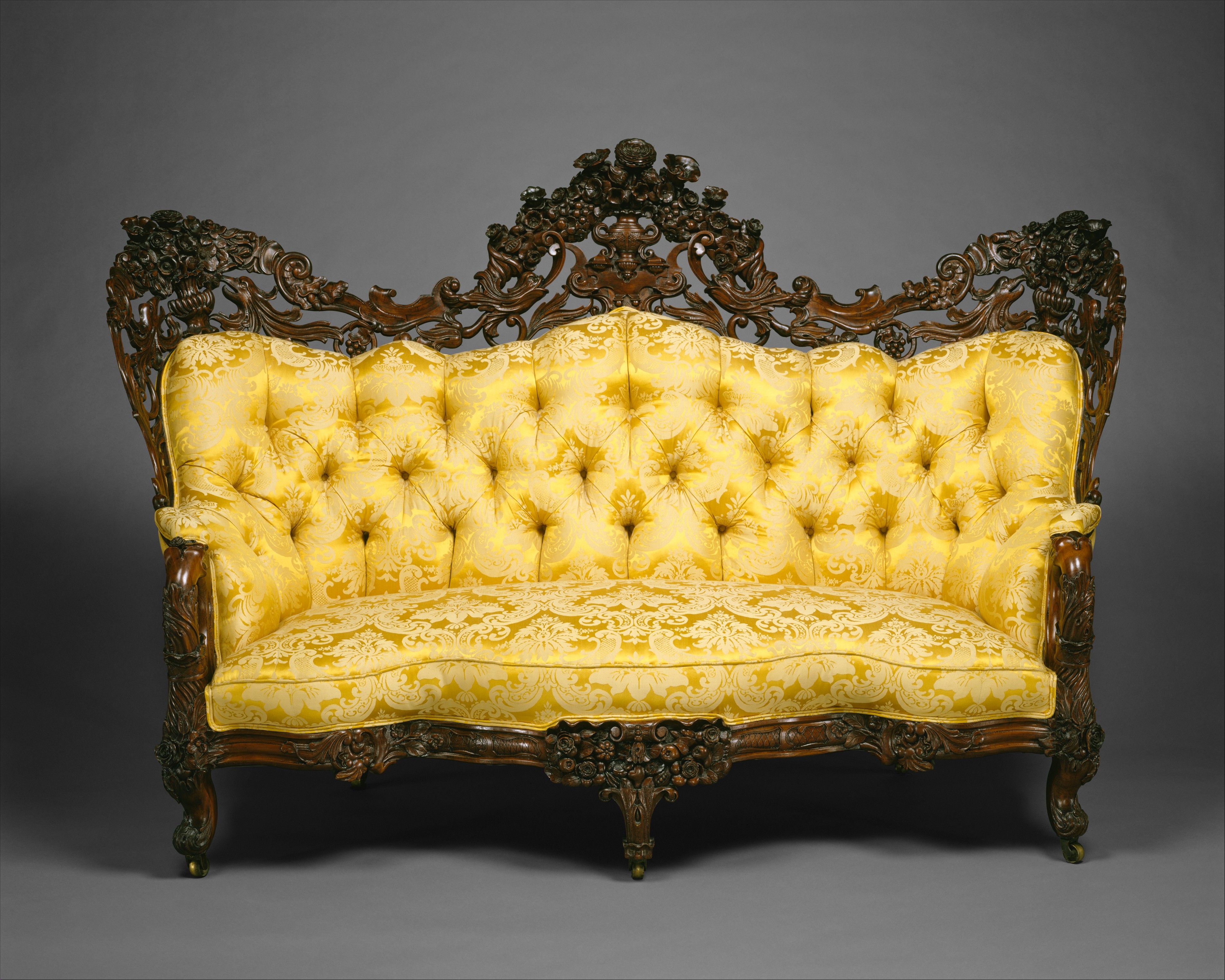
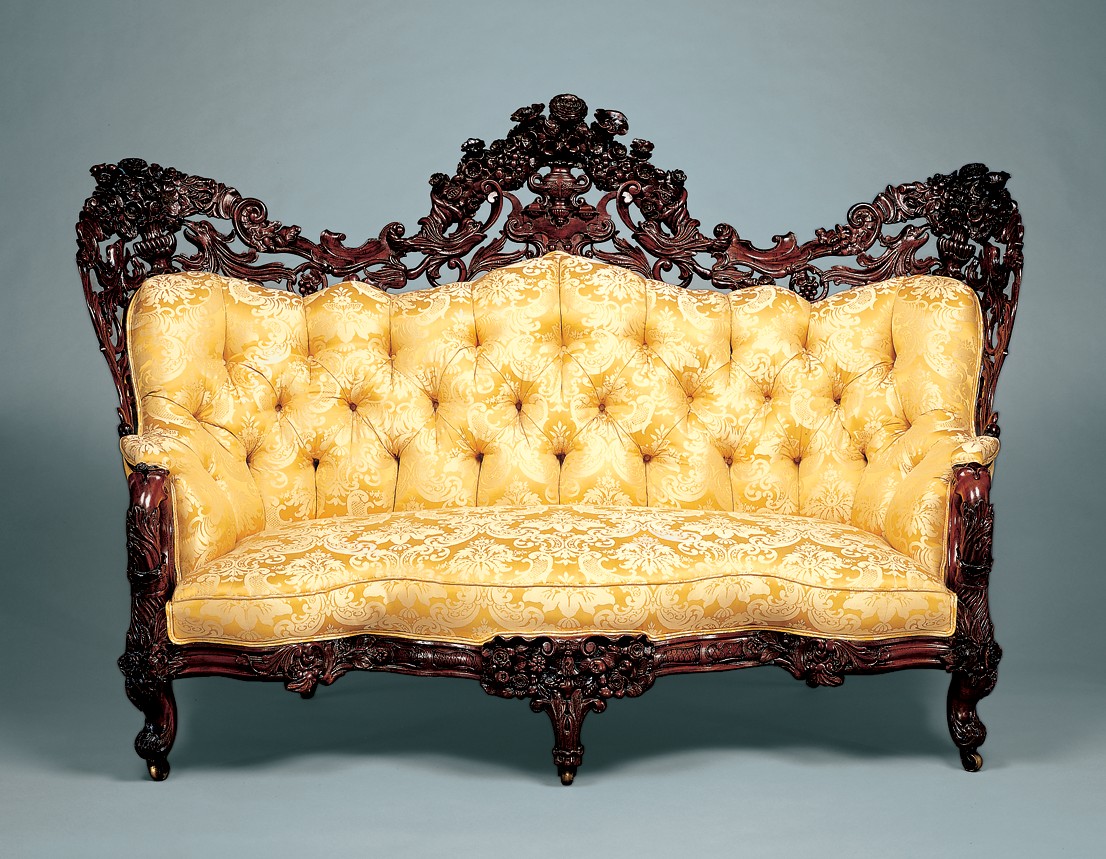
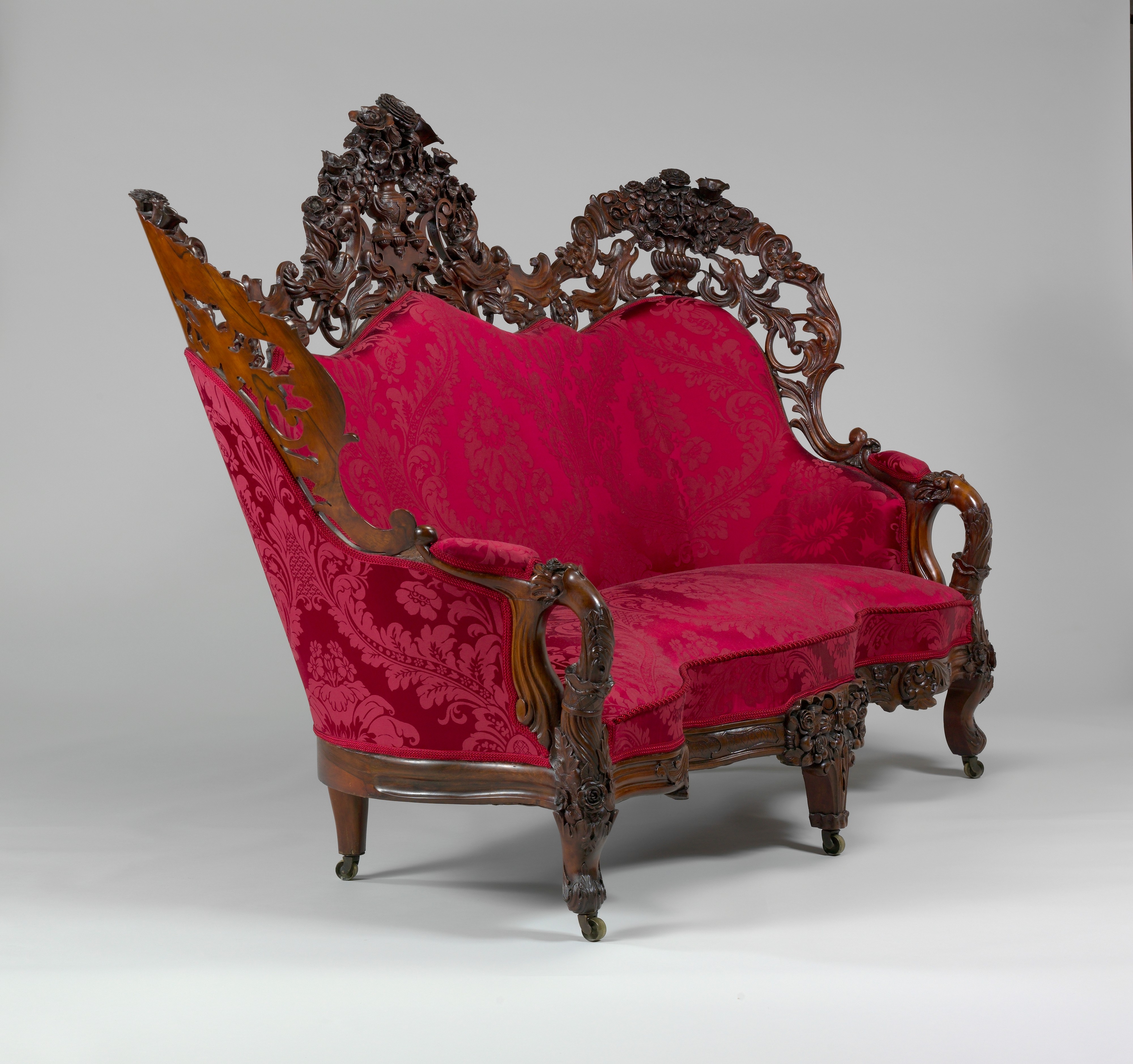
The record in full
Chapter 1What it is
A parlor sofa in laminated and carved rosewood, 135.3 centimetres high, 167.6 wide and 63.5 deep, built for display rather than for a single sitter's comfort.
A parlor sofa in laminated and carved rosewood, 135.3 centimetres high, 167.6 wide and 63.5 deep, built for display rather than for a single sitter's comfort. The Metropolitan Museum's own record describes its construction as steamed and pressure-bent laminated rosewood built up in cross-grained layers, of a kind that, in the most elaborate related work of this type, the Museum states can run to as many as twenty-one sheets, producing a curved and pierced silhouette that solid carved wood of the same thinness could not hold without breaking.
The show wood is solid and veneered rosewood; the Museum's own materials list gives chestnut and pine as the secondary, structural woods, and notes that the upholstery is modern over some surviving original underupholstery. No maker's mark, paper label or signature survives on it, which is normal for this shop rather than exceptional, and is itself one of the central facts a reader needs before trusting any attribution attached to it.
Chapter 2How it was made
The technique is Belter's own patented refinement of an older idea.
The technique is Belter's own patented refinement of an older idea. Cabinetmakers had glued thin wood veneers into curved laminated sheets before Belter; what his 23 February 1858 patent, United States Patent 19,405, 'Improvement in the Method of Manufacturing Furniture,' actually covers is more specific: building a panel from two or more layers of pressed-work staves, each layer's grain running against its neighbor's, glued and then steamed and pressed in a mold so that the panel curves in more than one plane at once. Ordinary pressed work of the period could bend into a simple cylinder section; Belter's method could produce something closer to a portion of a hollow sphere, curved in every direction, and the staggered joints between layers gave the resulting panel far greater transverse strength than an equivalent thickness of solid carved wood.
That strength is what let his shop pierce and carve the panels as deeply as they did, cutting through the laminated shell to leave open, lace-like scrollwork that a solid board of the same thickness would have snapped in the making or in ordinary use. The patent itself is the clearest primary evidence for the whole enterprise: it is a real, dated, numbered legal document describing a real mechanical advantage, not a later invention of dealers wanting a good story.
Chapter 3The man and the shop
He was born Johann Heinrich Belter in 1804, in Hilter near Osnabruck in Germany, and trained as a cabinetmaker's apprentice in Wurttemberg, in the tradition of rich Black Forest carving.
He was born Johann Heinrich Belter in 1804, in Hilter near Osnabruck in Germany, and trained as a cabinetmaker's apprentice in Wurttemberg, in the tradition of rich Black Forest carving. He emigrated to New York in 1833 and became a naturalized citizen in 1839. Sources place his New York shop at an address on Broadway by the mid-1840s, and by 1854 he had built a substantial multi-story factory in the city; the business is recorded operating under the name J. H. Belter and Co. with three brothers-in-law, Jonathan, William and Frederick Springmyer, involved in it.
Belter died on 15 October 1863, reportedly of tuberculosis, in his late fifties. The Springmyer brothers-in-law tried to continue the firm; it did not survive the postwar economic disruption and had failed by around 1867. No sales ledger, workshop daybook or client list is known to survive from the whole run of the business. That absence, more than any single fact about carving style, is the reason his name causes so much trouble in the market today.
Chapter 4The central problem: a name applied far beyond the hand that earned it
Belter's firm essentially never labelled or signed its furniture, and it kept no records that have come down to later scholars.
Belter's firm essentially never labelled or signed its furniture, and it kept no records that have come down to later scholars. The direct market consequence, repeated by multiple independent sources describing the trade today, is that 'Belter' and 'attributed to Belter' are now applied to a body of laminated and carved rosewood Rococo Revival furniture far larger than his own shop plausibly produced. One furniture conservator's assessment states it plainly: 'not all items purported as Belter will actually live up to the name,' because the name became a catch-all descriptor for the whole style rather than a mark of the specific workshop. A furniture-history exhibit from Truman State University makes the same point from the other direction: 'Belter's company did not keep records or leave maker's marks on pieces, making it difficult to identify his furniture.' A 2009 newspaper piece on an owner's parlor chair, built around a professional appraisal, opens from the premise that true Belter is hard to spot and that an 'attributed to' qualifier is the honest, and common, outcome at auction.
This is not a new problem invented by the modern trade. For most of the century after his death, 'Belter' functioned as shorthand for an entire class of elaborately carved American Rococo Revival seating furniture, whoever actually made it, and it was only from the mid-twentieth century onward that furniture scholars began separating his own shop's work from that of his contemporaries with any rigor.
Chapter 5Baudouine and the other competitors
Belter's technique and his commercial success were both copied quickly, and by makers with the resources to copy him well.
Belter's technique and his commercial success were both copied quickly, and by makers with the resources to copy him well. Charles A. Baudouine (1808-1895) ran what was, by the 1850s, arguably the largest cabinet shop in New York, employing some two hundred workers including around seventy skilled cabinetmakers, producing Rococo Revival furniture in carved and laminated rosewood alongside French-inspired carved-solid pieces. Like Belter, Baudouine rarely labelled his work. The consequence, described directly by a dealer specializing in the period, is that Baudouine's unmarked rosewood 'keeps getting called Belter' simply because both makers worked the same wood in the same style at the same moment in the same city, and only one of the two names survived in popular memory. Baudouine closed his furniture business around 1856, several years before Belter's death, and moved into real estate.
Other named makers worked the same ground: J. and J. W. Meeks and Mitchell and Rammelsberg of Cincinnati both produced naturalistic carved Rococo Revival rosewood furniture that is regularly confused with Belter's in the trade. One diagnostic some conservators and dealers use to separate Belter's own shop's seating furniture from this wider field is the laminated back itself: Belter is generally credited with six or more glued cross-grained layers in a chair or sofa back, where several competitors used only three to five, producing a visibly thinner, weaker panel. That is a real physical test, not a stylistic impression, but it distinguishes laminated construction generally associated with Belter's practice from carved-solid competitors; it does not by itself distinguish Belter's own laminated work from a good unlabelled imitator using the same number of layers.
Chapter 6Grading this sofa specifically, not the name in general
Set against that background, this sofa sits in a comparatively strong position within the Met's own Belter holdings, and the Museum's own database shows exactly how.
Set against that background, this sofa sits in a comparatively strong position within the Met's own Belter holdings, and the Museum's own database shows exactly how. Checked directly against the Museum's collection records, this sofa (1999.396) and one other piece, a slipper chair acquired in 1951 (51.79.9), are the only two Belter-related seating pieces in the American Wing that the Museum lists as 'John Henry Belter' without an 'Attributed to' qualifier. Every other Belter-related seat furniture object checked for this record, the 1957 Leonard-gift sofa (57.130.1), armchair (57.130.2) and tete-a-tete (57.130.7), and the 1980 Manney-gift center table (1980.510.1), carries the explicit 'Attributed to John Henry Belter, or attributed to J. H. Belter & Co.' formula.
That is a real, checkable distinction in the Museum's own cataloguing, and it is worth taking seriously without overstating it. It does not mean a label or signature has been found on this sofa; none has. It means the Museum's curators judged the comparative and constructional evidence for this particular object strong enough to drop the qualifying word it uses elsewhere. It is also worth noting what this sofa is not: it is not part of the Museum's period-room display of Belter's work. The Richard and Gloria Manney John Henry Belter Rococo Revival Parlor, the American Wing's dedicated recreated parlor setting built around architectural elements from a Classical Revival villa in Astoria, Queens, is installed in Gallery 739 and dressed with the Manney-gift and Leonard-gift pieces, which are the more heavily qualified 'attributed to' objects. This sofa, the Museum's more confidently labelled example, stands instead in Gallery 736. The two facts sit oddly together and neither source consulted for this record explains the discrepancy; it is recorded here as a finding, not resolved.
Chapter 7The individual maker and the firm: a distinction most accounts blur
'John Henry Belter' and 'J. H. Belter and Co.' are not automatically the same thing, and the sources consulted for this record do not allow that question to be answered with confidence for this...
'John Henry Belter' and 'J. H. Belter and Co.' are not automatically the same thing, and the sources consulted for this record do not allow that question to be answered with confidence for this specific sofa. By the 1850s Belter's operation was a substantial manufactory with, by report, a multi-story factory building and a workforce well beyond a single master and a few apprentices; furniture bearing his name from this period is furniture of his firm's production, carved and assembled by his employees under his patents and, presumably, under some level of his personal design direction and oversight. Whether Belter personally touched any single surviving object, this one included, is generally unanswerable and is not what the attribution claims. The honest reading, consistent with how the Metropolitan Museum's own constituent list treats it (naming both the man and, as an alternative, the firm), is that 'Belter' on furniture of this date means the product of his workshop operating under his patented process, not necessarily his own hands on the tools.
Chapter 8What the wood meant
Rosewood, imported from Brazil, was already the costliest fashionable cabinet wood available in the mid-nineteenth-century American market, prized for its dense grain and near-black figuring and, by...
Rosewood, imported from Brazil, was already the costliest fashionable cabinet wood available in the mid-nineteenth-century American market, prized for its dense grain and near-black figuring and, by the same measure, for how visibly it signalled expense in a parlor meant to be seen by callers. Because it was expensive and difficult to obtain in large sound sections, most rosewood furniture of the period used it as veneer over cheaper structural wood rather than as solid stock throughout, exactly the mixed construction (rosewood and rosewood veneer over chestnut and pine) that the Metropolitan Museum records for this sofa. Brazilian rosewood, Dalbergia nigra, had already become significantly depleted through nineteenth-century exploitation by the time later conservation assessments were made; it is listed as Vulnerable by the IUCN and has carried the most restrictive CITES Appendix I trade protection since 1992, a legal consequence of exactly the kind of demand this furniture represents. Belter's lamination process was, among other things, a way of making a very expensive material go further and behave better structurally than solid carving of the same wood could, which was as much a commercial argument to a customer as an engineering one.
Chapter 9The room this sofa was built for
A matched Rococo Revival parlor suite of this kind, typically a pair of sofas, armchairs, four or more side chairs, a center table and an etagere upholstered in a single fabric, was assembled for the...
A matched Rococo Revival parlor suite of this kind, typically a pair of sofas, armchairs, four or more side chairs, a center table and an etagere upholstered in a single fabric, was assembled for the front parlor of an affluent mid-century American household, the room in which a family received callers and staged its own respectability. Furnishing and running that room was, by the conventions of the period, understood as the domain of the women of the household, and the room's function was performative as much as domestic: a sofa like this one was there to be seen holding a caller in comfort as much as to be sat on by the family alone. The style itself, adapted from a simplified Louis XV rocaille vocabulary of scrolls, shells, flowers, fruit and foliage, was read by contemporaries as specifically feminine and French, in deliberate contrast to the plainer, more masculine Grecian and Empire furniture it displaced in fashionable taste through the 1850s. None of this is particular to this sofa as an individual object; it is the ordinary, documented social function of the furniture type it belongs to, and it is worth stating plainly rather than treating it as a hidden meaning, because it explains why a customer paid a very high price for elaborate, structurally difficult carving on a piece of seating furniture rather than for a good chair.
Chapter 10How it reached the Metropolitan Museum
The Museum's credit line records the sofa as a purchase in 1999, funded by the Friends of the American Wing Fund together with the Lila Acheson Wallace Gift.
The Museum's credit line records the sofa as a purchase in 1999, funded by the Friends of the American Wing Fund together with the Lila Acheson Wallace Gift. No dealer, previous private owner, prior exhibition or sale record for this specific sofa before 1999 was found in any source consulted for this record. That is a real gap, not an oversight in the research: the Museum's own online catalogue record for this object, as indexed and quoted by search engines at the time of writing, gives medium, dimensions, credit line and a short descriptive note, but no provenance list of the kind the Museum publishes for some other American Wing highlights. This sofa should not be assumed to share the ownership history of the Museum's other Belter-related pieces; in particular, it is not part of the 1980 gift of Gloria and Richard Manney, whose Belter collection, described as the largest in the world, went in large part to the Winterthur Museum, with a smaller group, including the 1980.510.1 center table, given to the Metropolitan Museum that same year. This sofa's own route from an 1850s New York workshop to a museum purchase nearly a century and a half later is, on the evidence available here, simply unrecorded.
The Friends of the American Wing Fund is a museum support group whose gifts are typically applied to targeted acquisitions the curatorial department has identified as filling a specific gap in the collection; a sofa the Museum was prepared to catalogue without an 'attributed to' qualifier, at a moment when its existing Belter holdings were all more heavily qualified, is a plausible explanation for a deliberate, gap-filling purchase, though no acquisition memo or curatorial statement to that effect was located in the sources consulted.
Chapter 11The market for Belter and Belter-attributed furniture
Genuine, well-documented Belter and Belter-attributed furniture trades constantly at American regional and specialist auction houses, at prices that are modest by the standards of the fine-art market...
Genuine, well-documented Belter and Belter-attributed furniture trades constantly at American regional and specialist auction houses, at prices that are modest by the standards of the fine-art market and that vary enormously with how confident the attribution and how good the condition. A parlor suite (a loveseat, a sofa, a pair of side chairs and a pair of armchairs) catalogued as American Rococo carved and laminated rosewood, attributed to John Henry Belter, sold at Neal Auction Company on 31 January 2015 for 83,650 dollars according to the secondary sale-price aggregators consulted for this record; those aggregators report a single 'sold for' figure and do not separate a hammer price from a buyer's premium, so this record cannot state which figure that total represents, and says so rather than guessing. Individual chairs, tables and case pieces attributed to Belter or to his immediate competitors routinely appear at auction in the low thousands to tens of thousands of dollars, an order of magnitude below the prices commanded by, for instance, labelled or documented Duncan Phyfe furniture of the preceding generation, let alone European Old Master paintings or sculpture. This record is not aware of a published sale of this specific sofa at any point, before or after 1999; the figures above are comparanda for the wider market in Belter and Belter-attributed furniture, not a sale of the object described here.
Chapter 12What was said about him at the time and after
Belter's own commercial reputation was not universally admiring even in his lifetime: a nineteenth-century credit assessment of his firm is reported to have judged the quality of his furniture too...
Belter's own commercial reputation was not universally admiring even in his lifetime: a nineteenth-century credit assessment of his firm is reported to have judged the quality of his furniture too high for the business to be reliably profitable. After his death, and after the style itself fell from fashion, later nineteenth-century taste turned hard against exactly the kind of elaborate naturalistic carving his shop specialized in. The architecture and design critic Mariana Griswold Van Rensselaer, writing in Lippincott's Magazine in 1880 in an essay on decorative art and its 'dogmas,' dismissed this kind of ornamental furniture-carving as 'false and detestable,' a judgment representative of the reformist Aesthetic Movement view that dense naturalistic Rococo Revival carving was a debased, machine-assisted excess rather than honest craft. Belter's individual reputation was substantially rehabilitated by furniture scholars only in the second half of the twentieth century, once collectors and museums began doing the comparative, constructional work needed to separate his shop's output from the wider mass of furniture the market had been calling by his name for a century.
Chapter 13What is still unresolved
Several ordinary questions a reader would expect settled about a museum-quality nineteenth-century American object are not settled here, and are recorded as open rather than papered over.
Several ordinary questions a reader would expect settled about a museum-quality nineteenth-century American object are not settled here, and are recorded as open rather than papered over. Nothing in the sources consulted names a first owner, a dealer, or any owner at all for this sofa between its manufacture and the Museum's 1999 purchase. No purchase price for the 1999 acquisition is published in any source consulted. No exhibition history beyond the sofa's current display in the American Wing was located. And the plainest interpretive question of all, whether 'John Henry Belter' on this object means the founder's own hand, his firm's general production under his direction, or simply the best comparative guess available for an unmarked, unlabelled piece of laminated rosewood furniture, is not resolved by any source used here, including the Museum's own catalogue record, which hedges the same way by naming both the man and the firm as possible makers.
The artist
John Henry Belter (born Johann Heinrich Belter)
Belter's firm produced some of the most technically ambitious seating furniture made in nineteenth-century America, and it did so almost entirely without putting its own name on the work. That single fact, more than any biographical detail, governs how his name has to be handled: a century and a half of unmarked, unlabelled production has left 'Belter' attached today to a body of furniture far larger than his shop, and it means that almost every specific claim below describes the man and the documented shape of his career, not a signature found on any one surviving object.
Related works
| Work | Relation | Where it is |
|---|---|---|
| Sofa Attributed to John Henry Belter, or attributed to J. H. Belter & Co. | Another Belter-attributed sofa in the same Museum, catalogued with the qualifier this sofa's own record does not carry Gift of Mrs. Charles Reginald Leonard, 1957. Different dimensions and a different, more heavily qualified attribution than the sofa described in this record; the two should not be conflated. | Metropolitan Museum of Art, New York (accession 57.130.1) |
| Armchair Attributed to John Henry Belter, or attributed to J. H. Belter & Co. | Part of the same 1957 Leonard-gift suite as the related sofa above Displayed with the Museum's Manney parlor period room, Gallery 739. | Metropolitan Museum of Art, New York (accession 57.130.2) |
| Tete-a-tete Attributed to John Henry Belter, or attributed to J. H. Belter & Co. | Part of the same 1957 Leonard-gift suite Gift of Mrs. Charles Reginald Leonard, in memory of Edgar Welch Leonard, Robert Jarvis Leonard, and Charles Reginald Leonard, 1957. | Metropolitan Museum of Art, New York (accession 57.130.7) |
| Center table Attributed to John Henry Belter, or attributed to J. H. Belter & Co. | Another qualified Belter attribution in the same Museum, from a different, later gift Gift of Gloria and Richard Manney, 1980, from the Manney collection, described elsewhere as the largest collection of Belter furniture in the world; most of that collection went to the Winterthur Museum. | Metropolitan Museum of Art, New York (accession 1980.510.1) |
| Slipper chair John Henry Belter, or J. H. Belter & Co. | The only other Belter-related seating object in the Museum's American Wing catalogued, like this sofa, without the 'Attributed to' qualifier Gift of Mr. and Mrs. Lowell Ross Burch and Miss Jean McLean Morron, 1951. Also displayed in Gallery 736, alongside this sofa. | Metropolitan Museum of Art, New York (accession 51.79.9) |
| Sofa John Henry Belter | A different, independently documented Belter sofa used here only as construction and market comparanda, never as a source for this record's own object Provenance recorded by the V&A: formerly Sir Alfred Owen, New Hall, Warmley, Sutton Coldfield; sold Phillips, Knowle, 27 October 1982, lot 100; acquired by the V&A in 1983. This is not the object described in this record and shares no provenance with it. | Victoria and Albert Museum, London |
Open questions
- Who owned, sold or dealt this sofa between its manufacture in New York, c. 1850-1860, and the Metropolitan Museum's purchase in 1999? No prior owner, dealer or sale is named in any source consulted.
- What did the Museum pay for the sofa in 1999? No purchase price is published in the sources consulted.
- Was this specific sofa exhibited, lent or published anywhere before entering the Museum, or since? No exhibition history beyond its current gallery display was located.
- Did John Henry Belter personally have a hand in this object, or was it built entirely by employees of J. H. Belter & Co. under his patented process and general direction? The Museum's own constituent list names both possibilities and does not resolve between them, and neither does any other source consulted.
- How many patents did Belter actually hold, three or four? Three (1847, 1856, 1858) are corroborated by more than one source consulted directly for this record; a fourth, dated 1860 and said to cover a bureau drawer, appears in some secondary accounts but could not be independently verified here.
- Why does this sofa, the Museum's more confidently labelled Belter object, stand in Gallery 736 while the Museum's dedicated, name-bearing Belter period room in Gallery 739 is dressed instead with more heavily qualified 'attributed to' pieces? No source consulted explains the discrepancy.
- Exactly how many laminated layers make up this sofa's own curved elements? The Museum's published description gives a figure, up to twenty-one layers, for the general construction type rather than an itemized report on this specific sofa, and no dendrochronological or other technical imaging report on this object was located.
Questions about this object
What is Sofa?
Sofa is a furniture, dated c. 1850-1860. Medium: Laminated and carved rosewood with rosewood veneer; chestnut and pine secondary woods; modern upholstery over some surviving original underupholstery.
Who made Sofa, and is the attribution settled?
The attribution to John Henry Belter is recorded here as accepted. The Metropolitan Museum's own database lists the maker of this sofa simply as 'John Henry Belter,' without the 'Attributed to' qualifier the Met attaches to several of its other Belter-labelled holdings, among them the 1957 Leonard-gift sofa (57.130.1), armchair (57.130.2) and tete-a-tete (57.130.7), and the 1980 Manney-gift center table (1980.510.1). At the same time the object record carries a second, alternate maker constituent, 'or J. H. Belter & Co.,' leaving open whether the individual Belter or an employee of his firm actually built it. No label, signature or maker's mark survives on this sofa, and none is known to survive on almost any product of Belter's shop; the firm kept no sales ledger that has come down to scholars. The case for Belter rests on construction (the multi-layer cross-grained lamination his 1858 patent describes) and on comparison with the small number of labelled or firmly documented pieces, not on a mark found on the object itself. This record treats 'John Henry Belter' as the Metropolitan Museum's own working attribution for this specific sofa, while stating plainly that the evidence behind it is comparative and typological rather than documentary.
Where is Sofa now?
The Metropolitan Museum of Art, New York, The American Wing, Gallery 736. Inventory number 1999.396. Last confirmed 4 September 2026. Purchase, Friends of the American Wing Fund and Lila Acheson Wallace Gift, 1999.
What has Sofa sold for?
Hammer Not separately published; with premium, Not separately published. Neal Auction Company, 2015-01-31.
What is still unknown about Sofa?
Who owned, sold or dealt this sofa between its manufacture in New York, c. 1850-1860, and the Metropolitan Museum's purchase in 1999? No prior owner, dealer or sale is named in any source consulted.
Sources
- 1Metropolitan Museum of Art, Collection API, object record for 'Sofa,' accession 1999.396 (objectID 7586), including medium, dimensions, credit line, constituents, gallery number and open-access images. collectionapi.metmuseum.org/public/...
- 2Metropolitan Museum of Art, 'Sofa' object page, accession 1999.396, consulted via search-engine indexing of the page's descriptive text after repeated direct-access rate-limiting; content corroborated across independent queries. Flagged for direct re-verification against the live page. metmuseum.org/art/...
- 3Wikipedia, 'John Henry Belter.' source, with primary biographical or archival scholarship. en.wikipedia.org/wiki/...
- 4M. S. Rau, 'The Genius of John Henry Belter' (dealer blog essay on Belter's biography, patents and business history). rauantiques.com/blogs/...
- 5Wood Menders, 'A Look at a Rococo Revival Furniture Master's Work' (conservator's essay on Belter's patents, technique and the modern attribution problem). woodmenders.com/rococo-revival-furniture-masters-work
- 6United States Patent Office, US19405A, John H. Belter, 'Improvement in the Method of Manufacturing Furniture,' 23 February 1858, via Google Patents. patents.google.com/patent/...
- 7Truman State University, 'The Creators,' Pickler Furniture exhibit (biographical and business-history essay on Belter, including the absence of surviving shop records and marks). exhibits.truman.edu/picklers/...
- 8Wikipedia, 'Charles Baudouine.' source, with primary or scholarly furniture-history literature. en.wikipedia.org/wiki/...
- 9LiveAuctioneers, price guide for John Henry Belter (aggregated auction results, including the 31 January 2015 Neal Auction Company parlor suite sale), cross-checked against independent search-engine summaries of the same result. liveauctioneers.com/price-guide/...
- 10American Heritage, 'The Belter Chair,' March 1989, Volume 40, Issue 2 (biographical and market-history essay). americanheritage.com/belter-chair
- 11cgpartifact (WordPress), 'Plain and Simple: John Henry Belter's Influence on American Decorative Arts,' 19 December 2013, including the 1880 Van Rensselaer critique and the generic modern use of 'Belter-style.' cgpartifact.wordpress.com/2013/...
- 12Tucson.com (Arizona Daily Star), 'Belter furniture hard to spot; hers isn't one,' 27 December 2009 (appraisal-column essay on the difficulty of authenticating Belter furniture). tucson.com/lifestyles/...
- 13Victoria and Albert Museum, 'Sofa | Belter, John Henry,' museum object record (used only as construction and market comparanda for a different, independently provenanced sofa; not a source for the object described in this record). collections.vam.ac.uk/item/...
- 14Wikidata, item Q29382950 ('Sofa,' Metropolitan Museum of Art, inventory 1999.396). wikidata.org/wiki/...
- 15Antiques and The Arts Weekly, 'Richard Manney, 88, Ad Exec, Collector & Philanthropist,' 16 July 2024 (obituary, used to establish the scale and disposition of the Manney Belter collection and to distinguish it from this sofa's own, separate 1999 acquisition). antiquesandthearts.com/richard-manney-88-ad-exec-collecto...
- 16Wikipedia, 'Dalbergia nigra' (Brazilian rosewood), for conservation status and CITES trade history. en.wikipedia.org/wiki/...
- 17Metropolitan Museum of Art, 'Rococo Revival Parlor,' American Wing period rooms page, consulted via search-engine indexing of the page's descriptive text (Gallery 739, Manney parlor, Whittemore villa architectural elements) after repeated direct-access rate-limiting. Flagged for direct re-verification against the live page. metmuseum.org/about-the-met/...
- 18Metropolitan Museum of Art, Collection API, comparative object records for other Belter and Belter-attributed holdings: Sofa, accession 57.130.1 (objectID 7585); Armchair, accession 57.130.2 (objectID 261); Tete-a-tete, accession 57.130.7 (objectID 8489); Slipper Chair, accession 51.79.9 (objectID 7553); Center table, accession 1980.510.1 (objectID 2251). Used to establish the 'Attributed to' cataloguing distinction discussed in this record. collectionapi.metmuseum.org/public/...
Last verified · Published
Change log
4 September 2026 - Record created at the house standard: researched narrative, technical evidence, maker dossier, graded provenance chain, prices with hammer and premium separated, related works, open questions and sources.