Hedwig Beaker
Unidentified workshop, attributed to Norman Sicily · 12th century (conventionally dated 1100-1199; precise date and origin disputed)
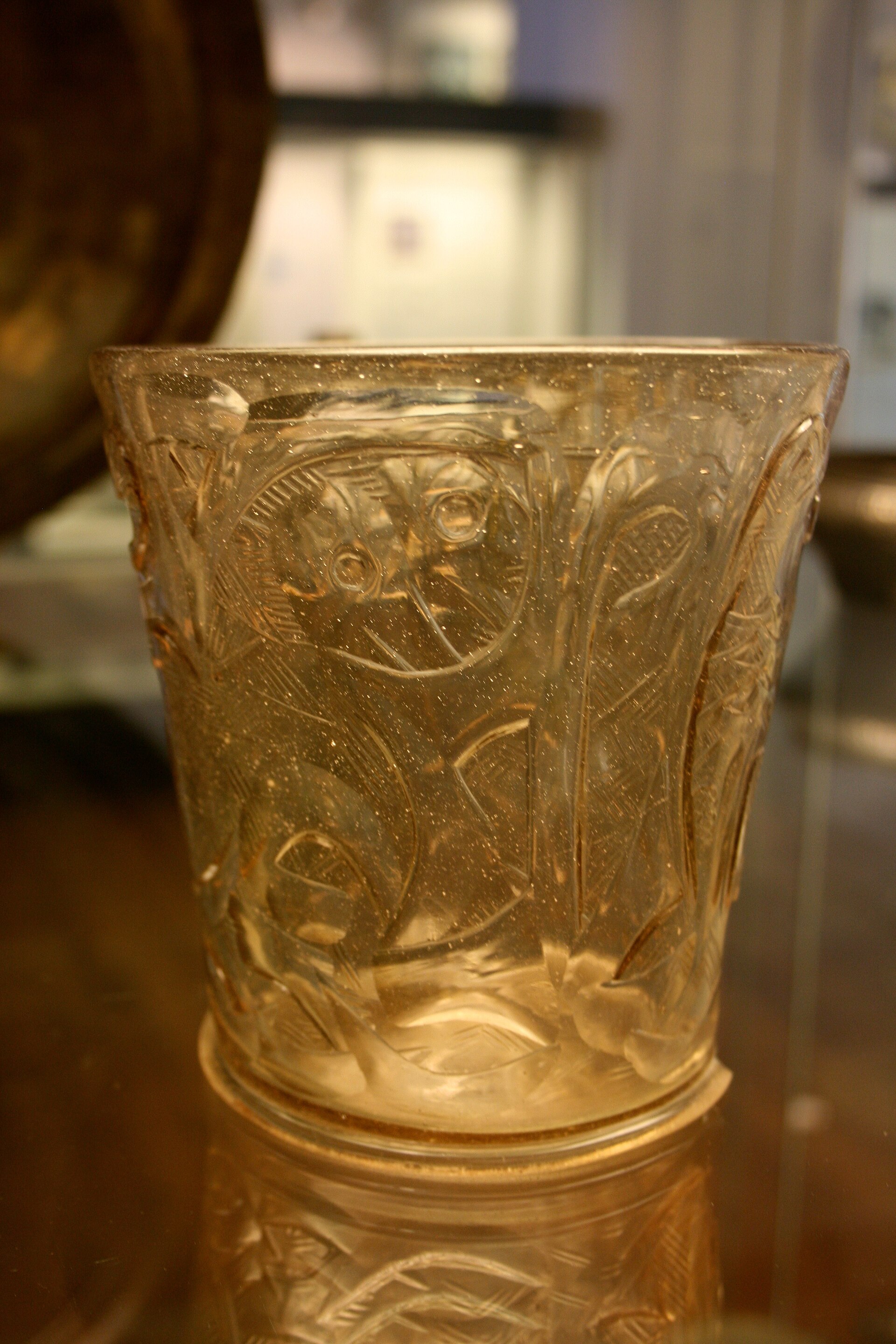
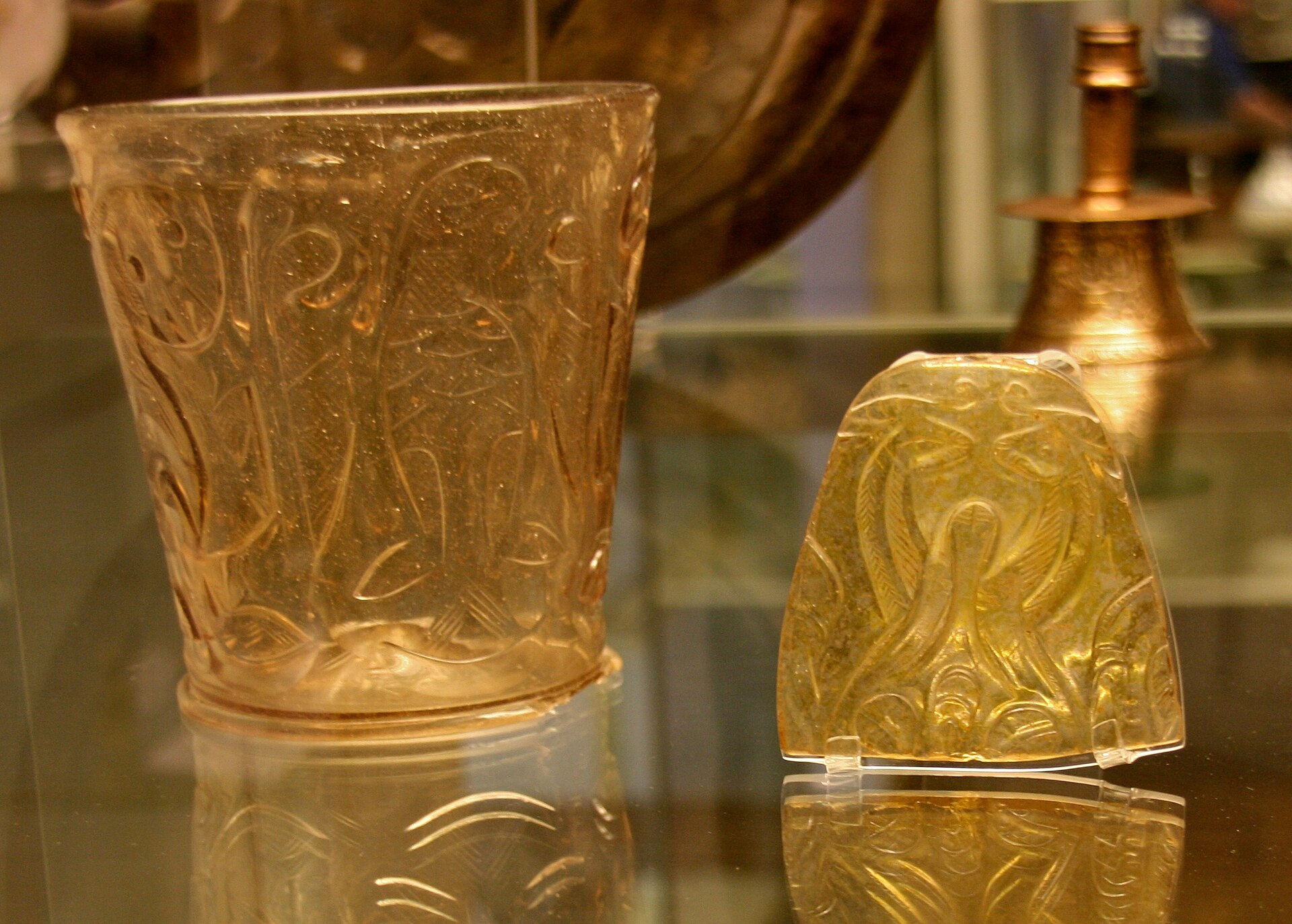
The beaker photographed complete, in a straightforward frontal museum view showing the full band of relief decoration around the body. Photograph by Mike Peel (www.mikepeel.net), CC BY-SA 4.0.
British Museum, London; photograph Mike Peel (www.mikepeel.net) · CC BY-SA 4.0| Artist | Unidentified workshop, attributed to Norman Sicily |
|---|---|
| Date | 12th century (conventionally dated 1100-1199; precise date and origin disputed) |
| Medium | Wheel-cut relief glass, brownish tinted with fine bubbles |
| Dimensions | Height 14.00 cm; diameter at rim 14.00 cm; diameter at base 10.80 cm; thickness at rim 0.50 cm |
| Where it is now | British Museum, Londonlast confirmed 23 September 2026 |
| Inventory number | 1959,0414.1 |
| Attribution | DisputedNo Hedwig beaker carries a maker's mark, a signature or a documented commission. Full note |
| Object type | Glass |
| Period | Medieval, Norman Sicily or the eastern Mediterranean, 12th century |
| Cases | Disputed attribution · Has a provenance gap |
| Inscriptions | None. No inscription, maker's mark or later mount survives on this example. |
| Owners on record | 4 links2 documented, 1 disputed, 1 unknown |
| Sources | 12 cited |
About this record Last verified 23 September 2026 · 12 sources cited · Change log
On this page 9 sections
ContentsClose
A thick-walled beaker of brownish glass, cut in high relief with an eagle flanked by a lion and a winged griffin, one of only about fourteen complete survivors of a small and much-argued-over medieval type. For a century it was placed with Islamic glassworkers in Fatimid Egypt; in 2005 the glass historian Rosemarie Lierke argued at length for the Norman court of Sicily instead, a case that has won real support without closing the question, since a rival historian has rejected her comparanda point by point and a chemical analysis of a related fragment points back toward the Levant.
The type takes its name from Saint Hedwig of Silesia, to whom a fourteenth-century legend attaches a miracle of water turning to wine under her sceptical husband's eyes; no source ties this specific beaker to Hedwig herself, only to the type that carries her name. Its own documented history is short and honest about its gaps: nothing is known of it before 1959, when the British Museum bought it from the London dealer Margaret H. Drey with funds from the Brooke Sewell Bequest.
Even how it was made is disputed. The conventional account has the relief ground into cold, finished glass with rotary abrasive wheels; Lierke has proposed instead that it was pressed and turned while the glass was still hot, against a mould made for one use only. Neither the origin nor the technique is settled, and this record treats both as open.
Provenance
Each link is graded. Documented: a cited source supports it. Disputed: the identification is argued but not established. Unknown: no owner for that span, and the gap is not smoothed into a narrative. The grades in the glossary.
- 12th century -Unidentified workshop, attributed to Norman Sicily (attribution disputed; Fatimid Egypt or the Levant remain argued alternatives)disputed
No document names a maker, patron or place of manufacture. The Norman-Sicilian attribution was set out at length by Rosemarie Lierke in 2005 and has been adopted by a number of specialists and museums since, but it has been rejected on stylistic grounds by Hannes Moehring and sits against compositional evidence from a related fragment pointing to the Levant. This record does not treat either attribution as settled.125612
- - by 1959Unknownunknown
No owner, collection, exhibition or sale is documented between the beaker's manufacture and its appearance with a London dealer in 1959. This is a genuine, undocumented gap of roughly eight centuries, not an oversight in this record's research.14
- by 1959 - 1959Margaret H. Drey, London dealerdocumented
The British Museum acquired the beaker from the dealer Margaret H. Drey in 1959. How the beaker reached Drey, and from whom, is not stated in the sources consulted.14
- 1959 - presentBritish Museum, Londondocumented
Purchased in 1959 with funds from the Brooke Sewell Bequest and registered as museum number 1959,0414.1. Percy Thomas Brooke Sewell had died in 1958; the acquisition is credited in the Museum's own records as his gift because it was funded from the bequest he left, though the purchase itself took place after his death. Published by R.H. Pinder-Wilson as 'A Hedwig Glass for the Museum', British Museum Quarterly, 1960. No purchase price was located in the sources consulted.14
Technical evidence
| Attribution note | No Hedwig beaker carries a maker's mark, a signature or a documented commission. For over a century the type was placed in a Byzantine or Fatimid Egyptian and Syrian milieu on grounds of style and material. In 2005 the glass historian Rosemarie Lierke argued at book length for a Norman-Sicilian origin, probably Palermo, proposing that Christian patrons and Islamic-trained craftsmen at the Hauteville court produced the mixed Christian-Islamic imagery seen on the group. The Sicilian attribution has since been repeated by a number of specialists and museums, including the British Museum's own catalogue, but it has not closed the question: the historian Hannes Moehring published a detailed rebuttal of Lierke's Sicilian case on stylistic and comparative grounds, and a 2009 chemical analysis of a related fragment found a glass composition consistent with Levantine soda-ash glass rather than a Sicilian source. This record treats Norman Sicily as the majority attribution now current, not as settled fact. |
|---|---|
| Form | Thick-walled bucket-form beaker with a pronounced pontil mark on the concave base; originally fitted with a ring foot, now broken off and missing.1 |
| Dimensions | Height 14.00 cm; diameter at rim 14.00 cm; diameter at base 10.80 cm; thickness at rim 0.50 cm.1 |
| Glass | Brownish-tinted glass with fine bubbles throughout, consistent with the group's general character; no compositional analysis of this specific beaker was located in the sources consulted.1 |
| Decoration technique (majority account) | Wheel-cut relief: the ground around the eagle, lion and griffin is cut back in irregular facets to leave the figures standing proud, with a smaller and narrower wheel used for finer internal detail such as the lion's mane and the wing feathers.13 |
| Decoration technique (minority account) | Rosemarie Lierke proposes that the relief was formed while the glass was still hot, pressed and rotated against a single-use plaster mould, rather than cut cold; she does not rule out the conventional account in the same publication.56 |
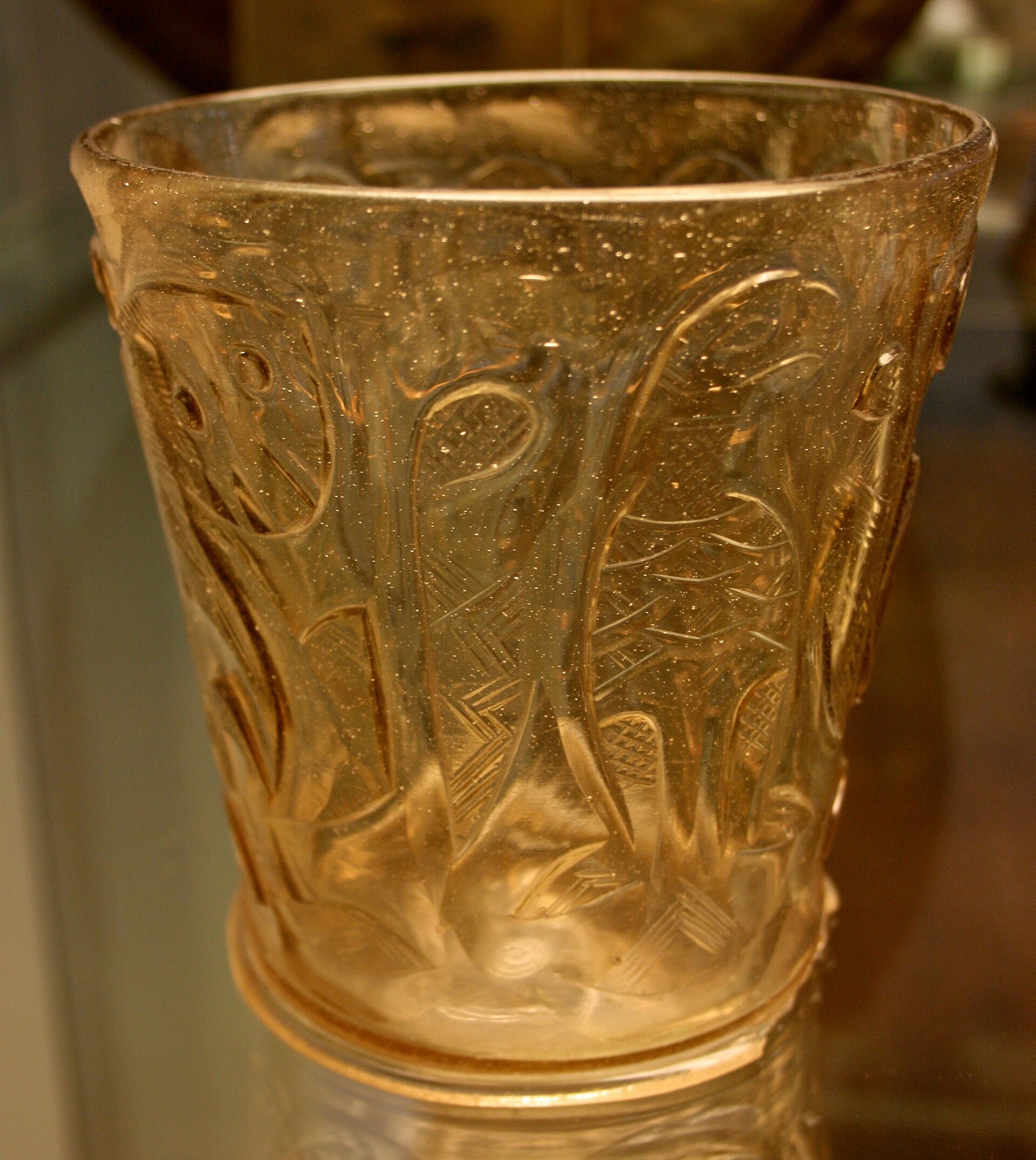
| Iconography | A continuous band showing an eagle with outstretched wings flanked by a lion and a winged griffin, the animals separated by a stylised floral device of paired half-palmettes.1 |
| Condition | The original ring foot has broken away and is lost; the vessel is otherwise substantially complete. No conservation or restoration history was located in the sources consulted.1 |
| Inscriptions and marks | None survive on this beaker. Compare the Rijksmuseum's Hedwig beaker, which carries a later, unrelated seventeenth-century inscription recording an owner's belief in its great age; this example carries no comparable addition.8 |
| Comparanda in the corpus | The type's size range is illustrated by other complete examples, including the Rijksmuseum's beaker (height 14.7 cm) and the example at the Corning Museum of Glass; both belong to the same closed group of roughly fourteen complete survivors as the British Museum beaker.89 |
| Public interpretation | Featured as the subject of an episode of A History of the World in 100 Objects, the joint BBC Radio 4 and British Museum series, broadcast 22 June 2010.10 |
Images
The record in full
Chapter 1What it is
A thick-walled beaker of brownish glass flecked with fine bubbles, standing 14 centimetres tall and almost as wide at the rim.
A thick-walled beaker of brownish glass flecked with fine bubbles, standing 14 centimetres tall and almost as wide at the rim. The form is a plain, heavy bucket shape, its walls left thick enough to carry deep relief carving, its base pulled into a pronounced pontil mark where the glassworker's rod was snapped away. It once stood on a separate ring foot; that foot has since broken off and is now missing, so the vessel today rests directly on its concave base.
Around the body runs a single continuous band of decoration cut in high relief: an eagle with wings fully outstretched, flanked on one side by a lion and on the other by a winged griffin, the three animals separated by a stylised floral device of paired half-palmettes set one above the other. The ground around the figures is worked in irregular facets, and the finer internal detail, the lion's mane, the feathering on the eagle's and griffin's wings, is picked out with a narrower wheel than the one used to block out the main forms. It is a drinking vessel too heavy and too wide at the rim to drink from easily, which is itself a clue that display, not use, was always part of its purpose.
Chapter 2How it was cut
The relief was produced by grinding the glass down around the figures with rotary abrasive wheels of different sizes, the same family of technique used on engraved rock crystal and hardstone vessels...
The relief was produced by grinding the glass down around the figures with rotary abrasive wheels of different sizes, the same family of technique used on engraved rock crystal and hardstone vessels, so that the animals stand proud of a recessed background. This is the technique art historians mean when they call the group wheel-cut relief glass, and it is the account given in the British Museum's own catalogue entry for this beaker and repeated across the standard literature on the type.
That account has a rival. The German glass historian and practising glassworker Rosemarie Lierke, in the same 2005 book that argued for a Sicilian origin, proposed that the relief was not cut cold into a finished blank at all. Her account has the still-hot, plastic glass rotated against a plaster mould, made for a single use and then broken away, an approach she likens to an ancient potter's technique rather than to gem engraving. Lierke does not present this as certain; in the same publication she allows, in her own words, that the traditional cold-cutting explanation cannot be excluded. The reviewer Siegmar Geiselberger, writing in Pressglas-Korrespondenz within months of publication, called it the most coherent account of the group offered to date, without independently confirming it. No named rebuttal of the pressing-and-turning claim specifically has been located for this record; the rebuttals that exist, discussed below, are aimed at Lierke's proposed origin rather than at her manufacturing technique. The question of how the relief was actually formed, cold-cut or hot-worked on a rotating mould, is therefore still open, and readers should treat it as open rather than resolved in either direction.
Chapter 3The legend of Saint Hedwig
The type takes its name from Hedwig of Andechs, called Hedwig of Silesia, who was born around 1174 and died in 1243.
The type takes its name from Hedwig of Andechs, called Hedwig of Silesia, who was born around 1174 and died in 1243. She married Henry I of Silesia, known as Henry the Bearded, and the couple had seven children before, in 1209, both took vows of continence. Hedwig gave away her wealth to found religious houses and a hospital, went about barefoot even in winter, and was canonised in 1267.
The legend attached to beakers of this type, recorded in a manuscript from the court of Duke Ludwig I dated 1353, holds that Hedwig drank only water out of ascetic discipline, to her husband's visible irritation, and that on at least one occasion Henry snatched the cup from her hand or watched her raise it to her lips, only to find that the water in it had turned to wine. This is reported tradition, not an event that can be documented to the twelfth or thirteenth century, and it should be read as exactly that: a fourteenth-century pious story attached retrospectively to a class of object, not a contemporary record of anything that happened to this particular beaker. No source consulted for this record claims that the British Museum's own example was ever in Hedwig's possession; the association, where it is made at all for this object, is with the type she gave her name to, not with a documented chain of ownership reaching back to her.
Chapter 4From the Middle East to Norman Sicily: the reattribution
Scholarship on where the Hedwig beakers were made has moved more than once.
Scholarship on where the Hedwig beakers were made has moved more than once. Early twentieth-century specialists, among them Eugen von Czihak, placed the group with Islamic glassworkers in Fatimid Cairo, and this Egyptian or wider Middle Eastern attribution was carried forward by Robert Schmidt and Carl Johan Lamm. It faced a persistent problem: despite extensive excavation in Egypt and the Levant, no fragment or sherd of a Hedwig beaker has ever been recovered from a Middle Eastern site, which is an unusual silence for a type supposedly produced there in some quantity.
In 2005 Rosemarie Lierke set out, in a full-length study titled Die Hedwigsbecher: das normannisch-sizilische Erbe der staufischen Kaiser, a case for the Norman kingdom of Sicily, and Palermo in particular, arguing that the royal workshops there brought together Christian patrons and Islamic-trained craftsmen in a setting that could account for the group's mixed Christian and Islamic visual vocabulary. Her book covers the glasses and their later metal mounts, their manufacture, their style and decoration, and, distinctly, their relationship to the tradition of hardstone and rock-crystal cutting. The Sicilian attribution has attracted real support and now appears as the working attribution in a number of museum catalogues, the British Museum's included.
It has not gone unchallenged. The historian Hannes Moehring published a systematic review rejecting the Sicilian case on four grounds: that faceted glasswork of this kind has earlier precedent in Iran and Egypt than in Sicily; that a comparison Lierke draws between the beakers' lions and a rock-crystal lion at Karlsruhe does not hold up in the rendering of mane and muzzle; that her reading of triangular motifs as coded references to Sicily or to King Roger II does not apply consistently across the surviving examples; and that the angular, archaic character of the decoration has no real parallel in documented Fatimid crystal work either, which undercuts an Egyptian attribution without necessarily proving a Sicilian one. Moehring's own conclusion is that the origin remains unsolved, with Fatimid Egypt or the Crusader states still, in his view, the more plausible candidates. A separate line of evidence points the same way: a 2009 chemical analysis by Karl Hans Wedepohl and A. Kronz of a Hedwig beaker fragment excavated at the royal palace of Buda in Budapest found a soda-ash glass composition low in magnesium oxide, consistent with glass made on the Levantine coast rather than with the potash-influenced glass traditions of Sicily and southern Italy. That analysis was carried out on a different, fragmentary example of the type, not on the British Museum beaker, and this record does not extend its finding to the object described here; it is included because it bears directly on the live debate over where the whole group, including this beaker, was made.
Chapter 5The wider group
This beaker is one of a small, closed corpus.
This beaker is one of a small, closed corpus. Around fourteen complete Hedwig beakers are known to survive worldwide, along with roughly a dozen additional fragments recovered from sites across central and eastern Europe. Complete examples are held at, among other places, the Rijksmuseum in Amsterdam, the Corning Museum of Glass in New York state, the Germanisches Nationalmuseum in Nuremberg, and in the cathedral treasuries of Halberstadt, Minden and Krakow, with two further examples at the former abbey of Notre-Dame d'Oignies in Namur. Several were given precious-metal mounts at some point after their manufacture and pressed into service as reliquaries or chalices; this example was not, and survives as plain glass.
Because the corpus is so small, every member of it carries disproportionate evidential weight, and a single new find, or a single new scientific analysis, can shift the balance of an argument that rests on a dozen or so objects in total. That is worth stating plainly: this is not a debate with a large body of comparanda behind it, on either side.
Chapter 6The animals: what is known and what is not
The eagle, lion and griffin that fill the decorative band are a shared vocabulary of Byzantine, Fatimid and Norman-Sicilian courtly art, where such animals routinely stood for princely strength...
The eagle, lion and griffin that fill the decorative band are a shared vocabulary of Byzantine, Fatimid and Norman-Sicilian courtly art, where such animals routinely stood for princely strength, vigilance and protection without needing a specific coded programme attached to any one commission. No source consulted for this record documents a patron, a commission contract or a contemporary text that assigns a specific meaning to this particular combination of eagle, lion and griffin on this particular beaker. Given the object's complete anonymity, no maker, no named first owner, no inscription, that absence is itself the honest finding: there is a plausible general courtly and apotropaic reading of the imagery, and there is no documented specific one for this object, and the two should not be blurred together.
Chapter 7Before 1959: an undocumented gap
Where this specific beaker was for the roughly eight centuries between its manufacture and its appearance in London in 1959 is not recorded in any source consulted for this entry.
Where this specific beaker was for the roughly eight centuries between its manufacture and its appearance in London in 1959 is not recorded in any source consulted for this entry. No earlier owner, collection, sale or exhibition has been traced. That is a genuine and, on present evidence, permanent gap in the object's history, not a placeholder for a chain that research has simply not yet filled in.
Chapter 8Acquisition by the British Museum, 1959
The Museum's own record of the acquisition was published by R.H.
The Museum's own record of the acquisition was published by R.H. Pinder-Wilson under the title A Hedwig Glass for the Museum in the British Museum Quarterly in 1960. The beaker was purchased from the London dealer Margaret H. Drey, with the purchase funded from the Brooke Sewell Bequest. Percy Thomas Brooke Sewell, a merchant banker with a particular interest in the arts of India and East Asia, had died in 1958, and the fund he left to the Museum continued to be used for acquisitions credited in his name; that is why this beaker, though technically bought rather than given outright by Brooke Sewell in his lifetime, is registered and commonly described as his gift. It entered the collection as museum number 1959,0414.1.
Chapter 9Public life since 1959
The beaker has had a comparatively quiet institutional life since its acquisition: no recorded sale, no litigation, no export dispute, because it has not moved.
The beaker has had a comparatively quiet institutional life since its acquisition: no recorded sale, no litigation, no export dispute, because it has not moved. Its most visible public moment came on 22 June 2010, when it was the subject of an episode of A History of the World in 100 Objects, the joint BBC Radio 4 and British Museum series written and presented by the Museum's then director Neil MacGregor. The fourteen-minute programme used the beaker to discuss the coexistence of trade and religious conflict around the Mediterranean during the Crusades, with contributions from the economic historian David Abulafia and the historian of the Crusades Jonathan Riley-Smith, framing an object made by, on the majority attribution, craftsmen trained in an Islamic tradition that came to be venerated through the legend of a Christian saint.
Chapter 10What is still unresolved
Three separate questions remain open about this object, and they are not the same question.
Three separate questions remain open about this object, and they are not the same question. Where it was made is disputed between a Norman-Sicilian and a Levantine or Egyptian origin, with named scholars on both sides and no consensus in the sources consulted. How its relief was formed, cold-cut with rotary wheels in the conventional account or shaped hot against a single-use mould as Lierke proposes, is a second, separate dispute, and evidence bearing directly on it, as opposed to on the origin question, is thin. And where the object itself was for some eight hundred years before a London dealer had it in 1959 is not a live scholarly debate at all; it is simply unknown, and this record treats it as unknown rather than filling the gap with plausible-sounding guesswork.
The artist
Unidentified glass workshop, attributed by most current specialists to Norman Sicily, probably Palermo
No maker of any Hedwig beaker is named in any surviving document. There is no signature, no workshop mark, no contract, and no contemporary text that describes a Hedwig beaker being made at all; the type is known entirely from the roughly fourteen complete objects and dozen-odd fragments that survive, plus a fourteenth-century legend attached to it after the fact. Everything said about the workshop, where it worked, who worked in it, and how it cut or formed the glass, is inference built from the objects themselves and from the wider craft context of the twelfth-century Mediterranean, not from a documented biography. That is the correct frame for reading every fact below.
Related works
| Work | Relation | Where it is |
|---|---|---|
| Hedwig Beaker Unidentified workshop, Hedwig-glass type | Another complete example of the same small corpus; carries an added seventeenth-century inscription of a later owner's, no comparable addition survives on the British Museum beaker. Height 14.7 cm. This is a different object with its own separate history; nothing about its inscription or provenance should be read onto the British Museum beaker. | Rijksmuseum, Amsterdam (BK-NM-712) |
| Beaker with Lions (Hedwig Beaker) Unidentified workshop, Hedwig-glass type | Another complete example of the same corpus, illustrating the type's size range. A smaller example than the British Museum beaker, part of the same closed group of roughly fourteen complete survivors. | Corning Museum of Glass, New York |
| Hedwig beaker fragment, excavated at the royal palace of Buda Unidentified workshop, Hedwig-glass type | The fragment whose 2009 chemical analysis (Wedepohl and Kronz) produced the Levantine-glass compositional evidence discussed in this record's origin debate. Composition data applies to this fragment only, not to the British Museum beaker. | Excavated Budapest; analysis published 2009 |
| The Palmer Cup Unidentified Islamic-tradition workshop | A different type of medieval Islamic-manufacture glass vessel that entered European, and eventually British, ownership and use; a structural parallel for how Islamic-world glass moved into Latin Christian hands in the medieval period, not a Hedwig beaker itself. Included as a comparandum for the pattern of cross-cultural medieval glass reception, not as a member of the Hedwig-glass corpus. | British Museum, London |
Open questions
- Where was this beaker between its twelfth-century manufacture and its appearance with the London dealer Margaret H. Drey by 1959? No owner, collection or sale is documented for roughly eight centuries.
- Was the relief decoration cut cold with rotary abrasive wheels, as the conventional account holds, or shaped hot against a single-use mould, as Rosemarie Lierke has proposed? The two accounts remain genuinely unresolved against each other.
- Was the vessel made in Norman Sicily, as Lierke's 2005 study and much subsequent museum cataloguing holds, or in Fatimid Egypt or the wider Levant, as Hannes Moehring's rebuttal and the 2009 compositional analysis of the Budapest fragment both suggest? No consensus exists in the sources consulted.
- Was this specific beaker ever associated, in any documented way, with Saint Hedwig of Silesia herself, or does the association rest entirely on the type's later name and legend? No source consulted claims a documented link between this object and Hedwig in her lifetime or soon after.
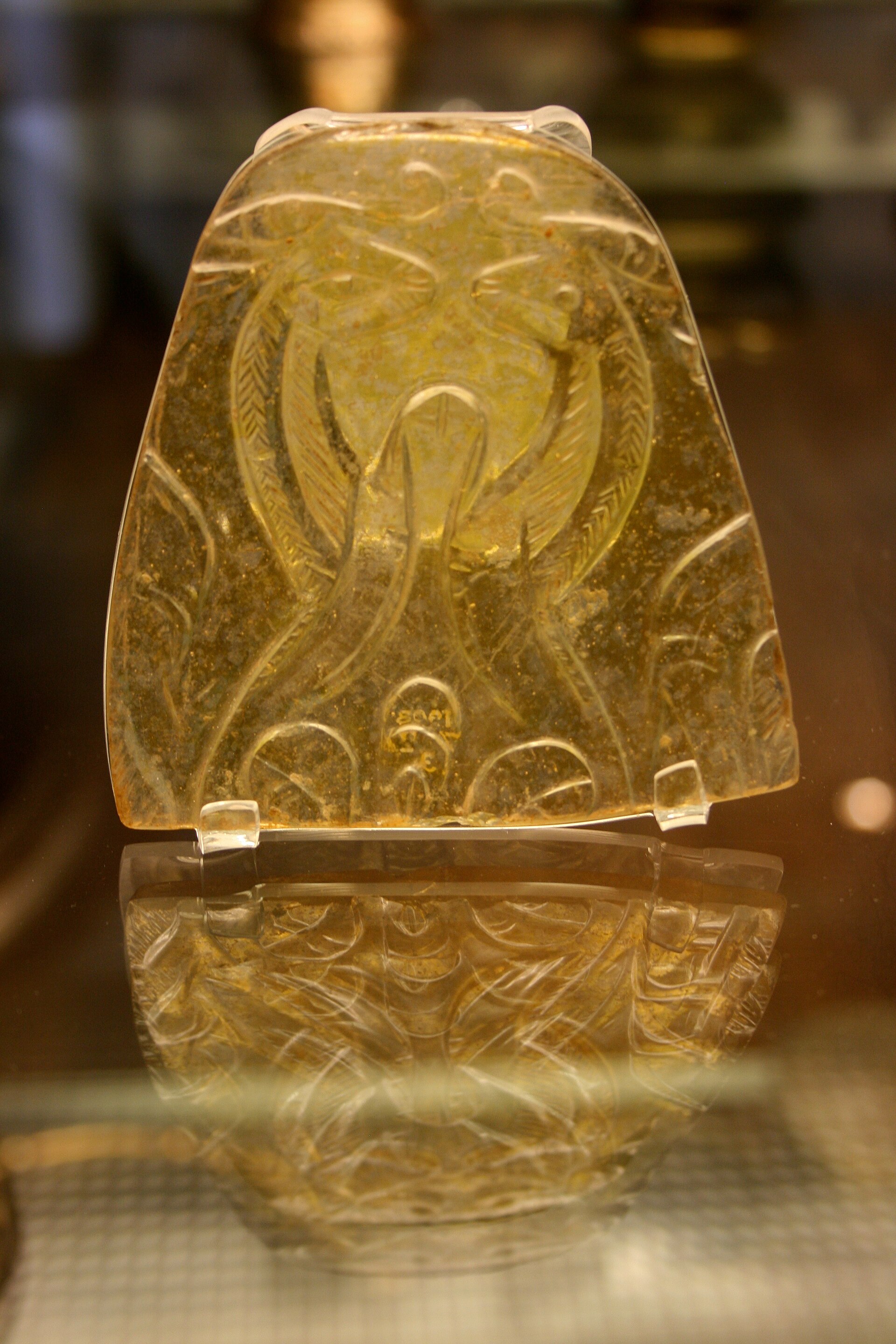
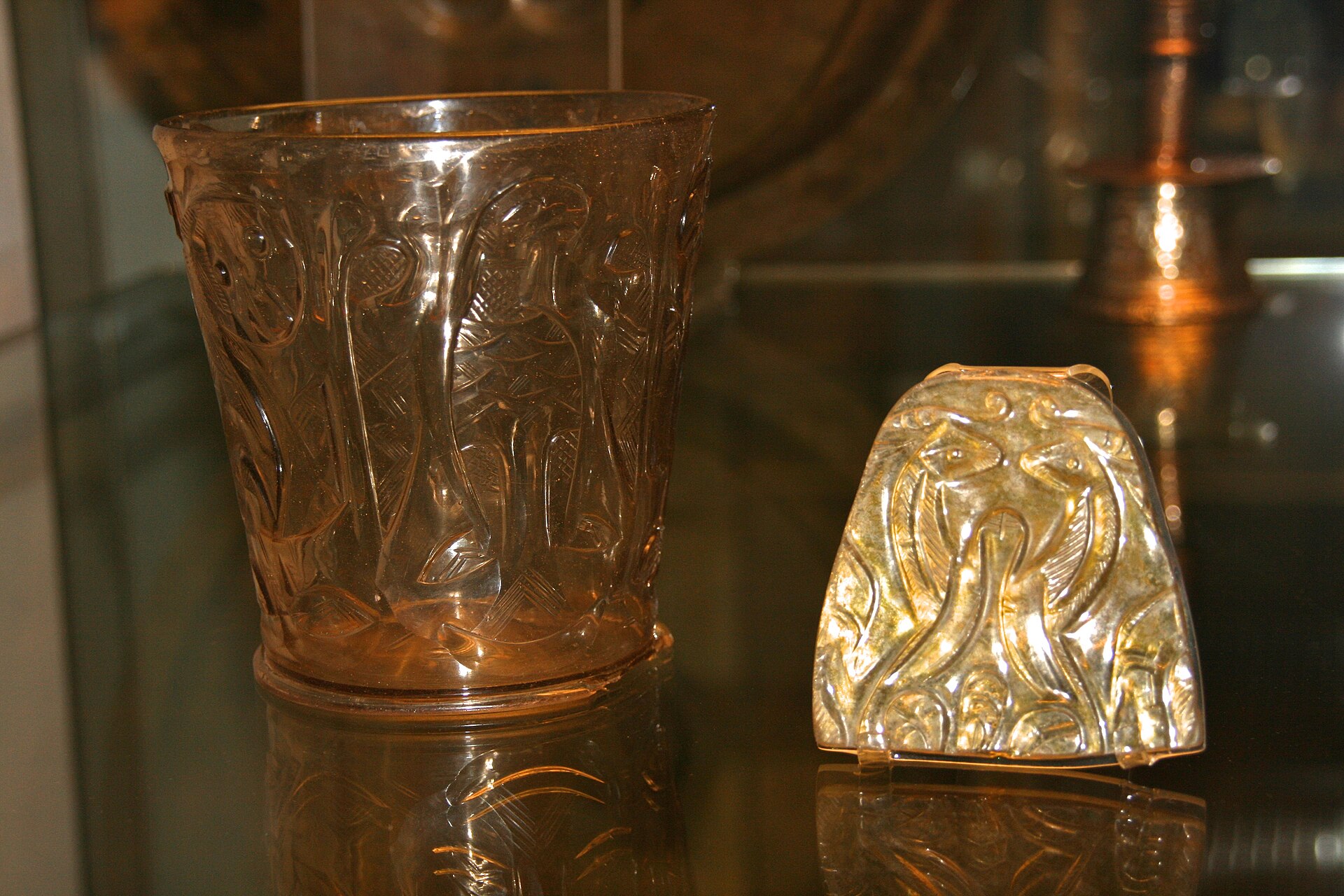
- What is the relationship, if any, between this beaker and the glass fragment recorded under museum number 1903,0721.3, photographed and displayed alongside it in the Museum's own image series? The connection, if there is one, is not explained in the sources consulted for this record.
- Did the vessel's ring foot survive intact into the twentieth century and break afterward, or was it already lost before 1959? No condition record earlier than the Museum's own custody was located.
Questions about this object
What is Hedwig Beaker?
Hedwig Beaker is a glass, dated 12th century (conventionally dated 1100-1199; precise date and origin disputed). Medium: Wheel-cut relief glass, brownish tinted with fine bubbles.
Who made Hedwig Beaker, and is the attribution settled?
The attribution to Unidentified workshop, attributed to Norman Sicily is recorded here as disputed. No Hedwig beaker carries a maker's mark, a signature or a documented commission. For over a century the type was placed in a Byzantine or Fatimid Egyptian and Syrian milieu on grounds of style and material. In 2005 the glass historian Rosemarie Lierke argued at book length for a Norman-Sicilian origin, probably Palermo, proposing that Christian patrons and Islamic-trained craftsmen at the Hauteville court produced the mixed Christian-Islamic imagery seen on the group. The Sicilian attribution has since been repeated by a number of specialists and museums, including the British Museum's own catalogue, but it has not closed the question: the historian Hannes Moehring published a detailed rebuttal of Lierke's Sicilian case on stylistic and comparative grounds, and a 2009 chemical analysis of a related fragment found a glass composition consistent with Levantine soda-ash glass rather than a Sicilian source. This record treats Norman Sicily as the majority attribution now current, not as settled fact.
Where is Hedwig Beaker now?
British Museum, London. Inventory number 1959,0414.1. Last confirmed 23 September 2026. Purchased 1959 from the London dealer Margaret H. Drey, funded by the Brooke Sewell Bequest and registered in the Museum's records as the gift of P.T. Brooke Sewell, who had died in 1958.
What is still unknown about Hedwig Beaker?
Where was this beaker between its twelfth-century manufacture and its appearance with the London dealer Margaret H. Drey by 1959? No owner, collection or sale is documented for roughly eight centuries.
Sources
- 1British Museum, collection online, 'beaker', museum number 1959,0414.1. britishmuseum.org/collection/...
- 2Wikipedia, 'Hedwig glass'. Tertiary source consolidating the origin-attribution history, the corpus list and the Saint Hedwig legend; flagged for replacement with the primary scholarship it cites (Ettinghausen and Grabar 1987; Wedepohl and Kronz 2009; Lierke 2005). en.wikipedia.org/wiki/...
- 3Discover Islamic Art (Museum With No Frontiers), 'Beaker'. Secondary catalogue entry citing Brend (1991), Tait (1991) and Whitehouse (2002) in its own bibliography. islamicart.museumwnf.org/database_item.php
- 4R.H. Pinder-Wilson, 'A Hedwig Glass for the Museum', British Museum Quarterly, vol. 22, no. 1/2 (1960), pp. 43-45. Consulted via its JSTOR record; full text is paywalled and was not read beyond the citation and abstract-level detail surfaced there. jstor.org/stable/...
- 5Siegmar Geiselberger, review of Rosemarie Lierke, Die Hedwigsbecher: das normannisch-sizilische Erbe der staufischen Kaiser (Ruhpolding: Rutzen, 2005), in Pressglas-Korrespondenz, issue 2005-4. yumpu.com/de/...
- 6Hannes Moehring, 'Die Hedwigsbecher - Das Raetsel ihrer Herkunft', review of Lierke, Die Hedwigsbecher. kunstbuchanzeiger.de/de/...
- 7Wikipedia, 'Rosemarie Lierke'. Tertiary source for her biography and the general reception of her work as controversial; flagged for replacement with a scholarly biographical notice. en.wikipedia.org/wiki/...
- 8Rijksmuseum, 'Hedwig beaker', object number BK-NM-712. rijksmuseum.nl/en/...
- 9Corning Museum of Glass, 'Beaker with Lions (Hedwig Beaker)'. glasscollection.cmog.org/objects/...
- 10'A History of the World in 100 Objects', episode 'Hedwig glass beaker', BBC Radio 4 and the British Museum, presented by Neil MacGregor with David Abulafia and Jonathan Riley-Smith, broadcast 22 June 2010. podcasts.apple.com/gb/...
- 11Wikimedia Commons, File:Hedwig glass 1.jpg through File:Hedwig glass 7.jpg, photographs by Mike Peel (www.mikepeel.net), licensed CC BY-SA 4.0. commons.wikimedia.org/wiki/...
- 12Wikipedia (German), 'Hedwigsbecher'. Tertiary source consulted for cross-checking the corpus list and the absence of a documented textual source for the legend beyond the 1353 court manuscript; flagged for replacement with primary scholarship. de.wikipedia.org/wiki/...

Last verified 23 September 2026 · Published 23 September 2026
Change log
23 September 2026 - Record created at the house standard: researched narrative, technical evidence, maker dossier, graded provenance chain, prices with hammer and premium separated, related works, open questions and sources.