The Scream
Edvard Munch · 1895
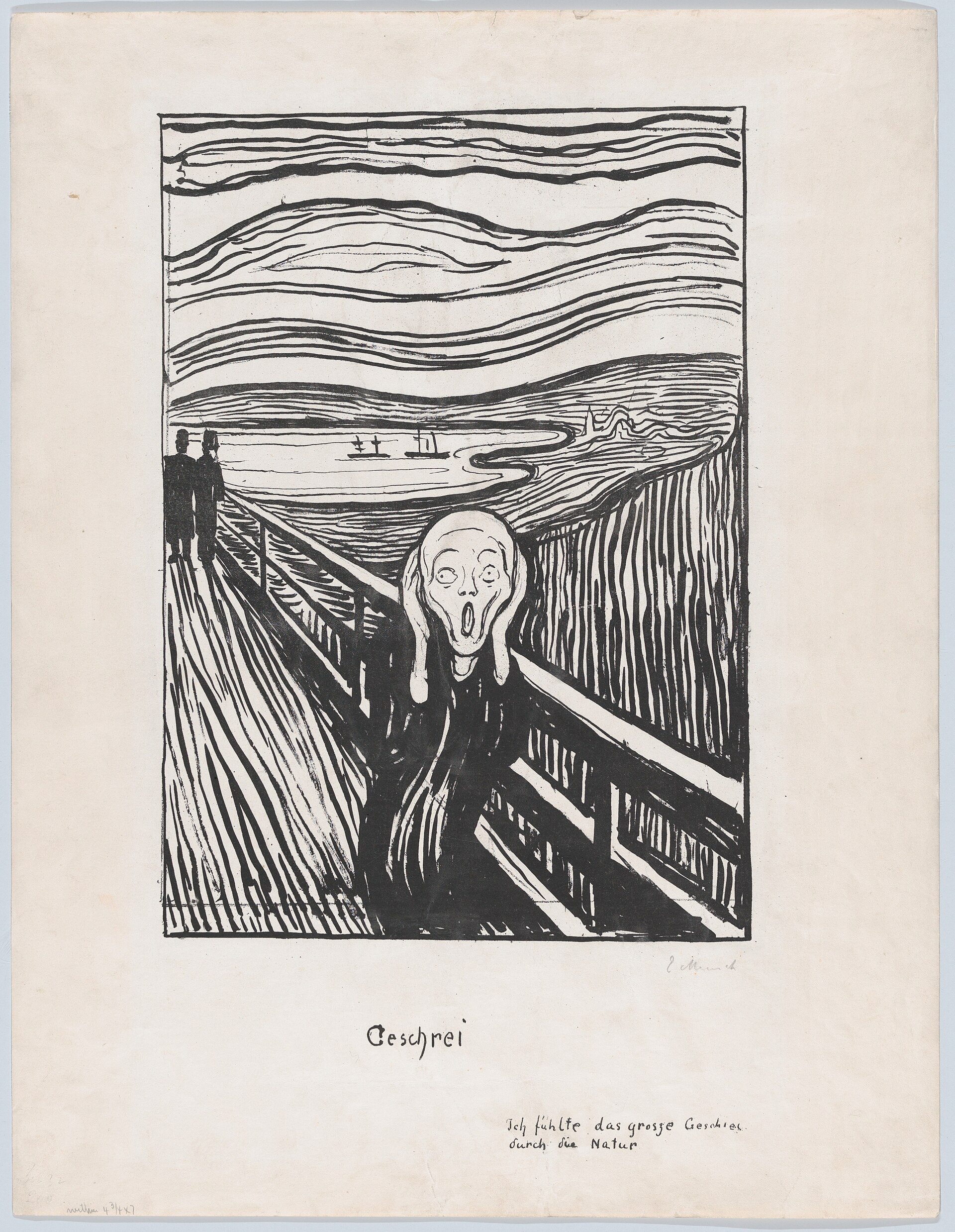
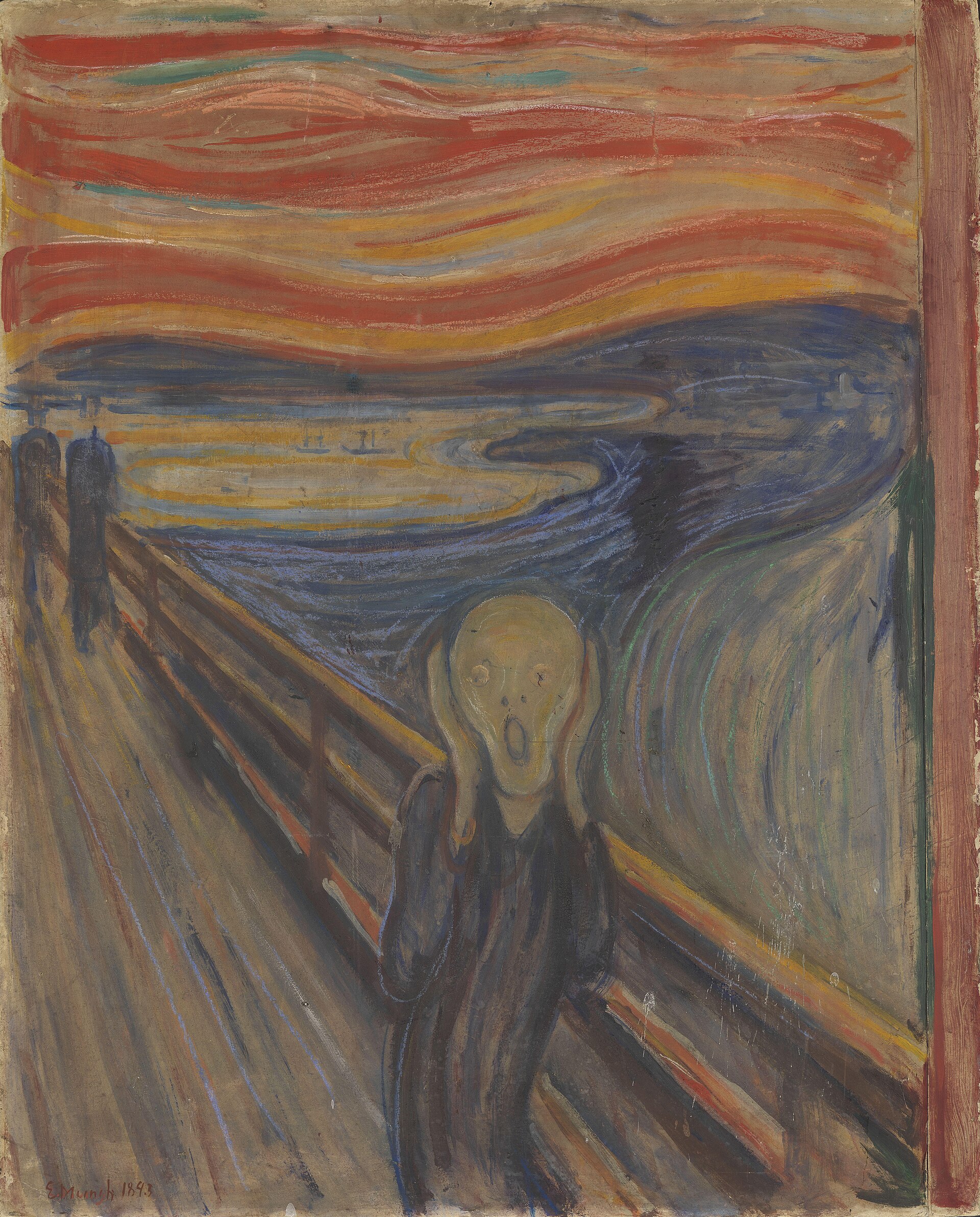
The object described in this record: the Metropolitan Museum's own lithograph impression, Woll G 38, black and white, carrying both the printed title 'Geschrei' and the full inscription. Photograph donated by the Met itself to Wikimedia Commons in 2017 under CC0.
| Artist | Edvard Munch |
|---|---|
| Date | 1895 |
| Medium | Lithograph in black ink on wove paper, printed from a single limestone block |
| Dimensions | Image 35.7 x 23.6 cm (14 1/16 x 9 5/16 in); sheet 51.4 x 39.7 cm (20 1/4 x 15 5/8 in) |
| Where it is now | Metropolitan Museum of Art, New York, Department of Drawings and Printslast confirmed |
| Inventory number | 1984.1203.1 |
| Attribution | AcceptedSigned with Munch's monogram and dated 95 within the image itself, printed as part of the same lithographic pull rather than added afterward. Full note |
| Object type | |
| Period | Norwegian Symbolism, 1890s |
| Cases | Has a provenance gap |
| Inscriptions | Printed within the stone, lower right of the image: the monogram signature 'E Munch' and the date '95'. Below the image: the German title 'Geschrei' and, beneath it, the line 'Ich fuehlte das grosse Geschrei durch die Natur' (I felt the great scream through nature). All three elements are part of the same lithographic pull, confirmed by direct examination of the Metropolitan Museum's own donated photograph of this sheet. |
| Owners on record | 5 links4 documented, 1 unknown |
| Sources | 18 cited |
About this record Last verified · 18 sources cited · Change log
On this page 10 sections
ContentsClose
This is not the painting. It is one sheet from an unrecorded print run of about thirty to forty-five lithographs that Munch pulled from a single stone in 1895, a black and white impression carrying both the German title 'Geschrei' and the full line 'Ich fuehlte das grosse Geschrei durch die Natur' printed into the same stone as the image. It reached the Metropolitan Museum in 1982 through the bequest of Scofield Thayer, the Dial magazine's editor and a voracious buyer of works on paper in the early 1920s, and was formally accessioned in 1984.
No sale record exists for this particular sheet. A different, black and white impression of the same edition, once owned by Munch's patron Olaf Schou, came up at Sotheby's London in 2016 with an estimate of 800,000 to 1,200,000 pounds; a completely different object in a completely different medium, a 1895 pastel version of the same motif, sold at Sotheby's New York in 2012 for 119,922,600 dollars. Neither of those is this print, and this print was never involved in either of the two thefts that made the painted Scream world-famous for the wrong reasons, in 1994 and 2004.
The Met's own public catalogue currently flags this object as not public domain, while Wikimedia Commons hosts a CC0-dedicated photograph of the same sheet donated by the Met itself in 2017. Both facts are true at once and neither source resolves the other.
Provenance
Each link is graded. Documented: a cited source supports it. Disputed: the identification is argued but not established. Unknown: no owner for that span, and the gap is not smoothed into a narrative. The grades in the glossary.
- 1895 -Edvard Munchdocumented
Printed by Munch from a single lithographic stone in 1895, one of an estimated thirty to forty-five impressions pulled before the stone was ground down. No formal edition or print run record survives.4568
- 1895 - c. 1921Unknownunknown
No owner is documented for this sheet between its printing in 1895 and its presence in Scofield Thayer's collection. Thayer's main period of active buying was 1921 to 1923, but no source consulted confirms this print was acquired within that window specifically, rather than earlier or later.9
- c. 1921-1923 (inferred) - 1982Scofield Thayerdocumented
Held in the collection of Scofield Thayer, editor and co-publisher of The Dial, who assembled roughly six hundred works on paper in London, Paris, Berlin and Vienna between 1921 and 1923. The Met's own credit line confirms Thayer as the immediately preceding owner; the exact acquisition date and any dealer are not documented in sources consulted.19
- 1982 - 1984Estate of Scofield Thayerdocumented
Thayer died 9 July 1982 in Edgartown, Massachusetts, aged 93, having drawn up a will in 1925 leaving his collection to the Metropolitan Museum of Art. Roughly four hundred items entered the museum by this bequest; this print was formally accessioned in 1984.19
- 1984 - presentMetropolitan Museum of Art, New Yorkdocumented
Accession number 1984.1203.1, Department of Drawings and Prints. Current public-domain status is inconsistently stated between the museum's own collection API and its own 2017 Wikimedia Commons donation of a photograph of this sheet; see the open questions.12
Prices realised
No auction transaction is recorded for the Met's own impression: it reached the museum by bequest, not by purchase, and no sale of this specific sheet is documented in the sources consulted. For comparison only, and explicitly not this object: a black-and-white impression of the same 1895 lithograph, carrying the same title and full German inscription, with provenance to Olaf Schou (acquired from the artist's circle c. 1900) and by descent through his brother Christian Schou, was offered at Sotheby's London, Impressionist & Modern Art Evening Sale, 21 June 2016, lot 6, estimate GBP 800,000-1,200,000; the hammer or sold price was not found in the sources consulted. Separately, and far more widely reported, a completely different 1895 object in a completely different medium, a pastel, sold at Sotheby's New York on 2 May 2012 for USD 119,922,600 including premium, then a record for any work of art at auction; that pastel remains in a private collection and is not this lithograph.
Technical evidence
| Attribution note | Signed with Munch's monogram and dated 95 within the image itself, printed as part of the same lithographic pull rather than added afterward. Catalogued as Woll G 38 in Gerd Woll's Edvard Munch: The Complete Graphic Works (2012), the standard reference for Munch's prints. There is no attribution dispute for this print. The only unresolved attribution-adjacent question in the wider Scream group concerns the dating of the Munch Museum's second painted version (traditionally 1893, argued by some scholars to be nearer 1910), which does not touch this lithograph. |
|---|---|
| Support | Wove paper.6 |
| Medium | Lithograph in black ink, printed from a single limestone block; no hand-colouring on this sheet.123 |
| Dimensions | Image 35.7 x 23.6 cm (14 1/16 x 9 5/16 in); sheet 51.4 x 39.7 cm (20 1/4 x 15 5/8 in).1 |
| Signature and date | Monogram 'E Munch' and the date '95 printed within the stone at the lower right of the image, part of the same pull as the image itself.23 |
| Printed text | 'Geschrei' beneath the image, and beneath that 'Ich fuehlte das grosse Geschrei durch die Natur', both printed from the stone. This sheet carries the full text; some impressions from the same edition carry only the title, some carry neither, and some have had the text trimmed away after printing.2356 |
| Textual variant | Title plus full inscription, the variant referred to in the print trade as Woll's variation A; the same variant as the impressions examined at Thielska Galleriet and the Staatsgalerie Stuttgart, and the impression sold at Sotheby's London in 2016.3712 |
| Edition size | No formal edition was published or numbered. Estimates in the sources consulted range from about thirty impressions to about forty-five; the run is generally said to have ended when the printer's stone was ground down.458 |
| Accession and credit line | Accession number 1984.1203.1, Department of Drawings and Prints. Credit line: Bequest of Scofield Thayer, 1982. The 1984 accession year reflects the gap between Thayer's death in 1982 and formal cataloguing.19 |
Images
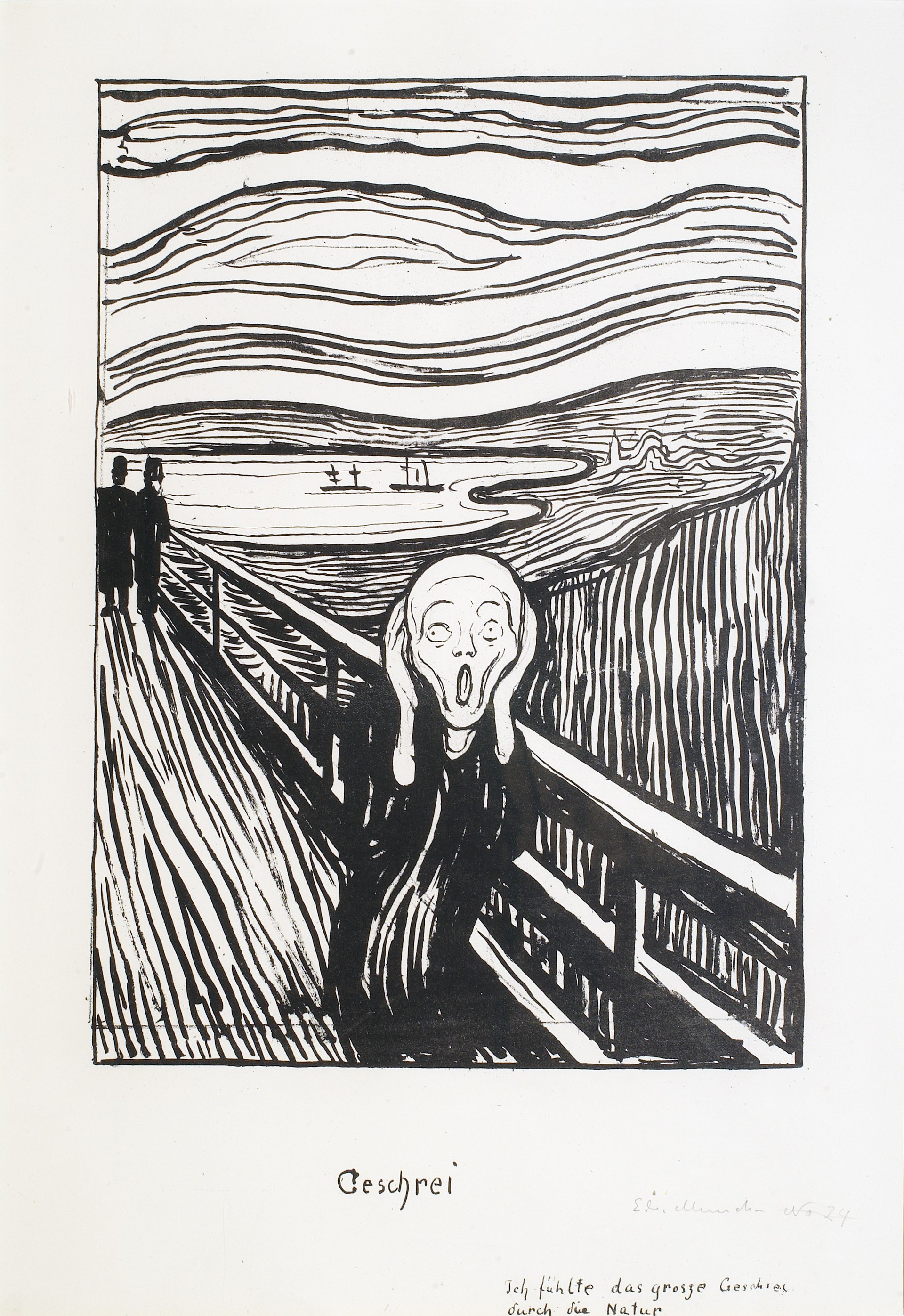
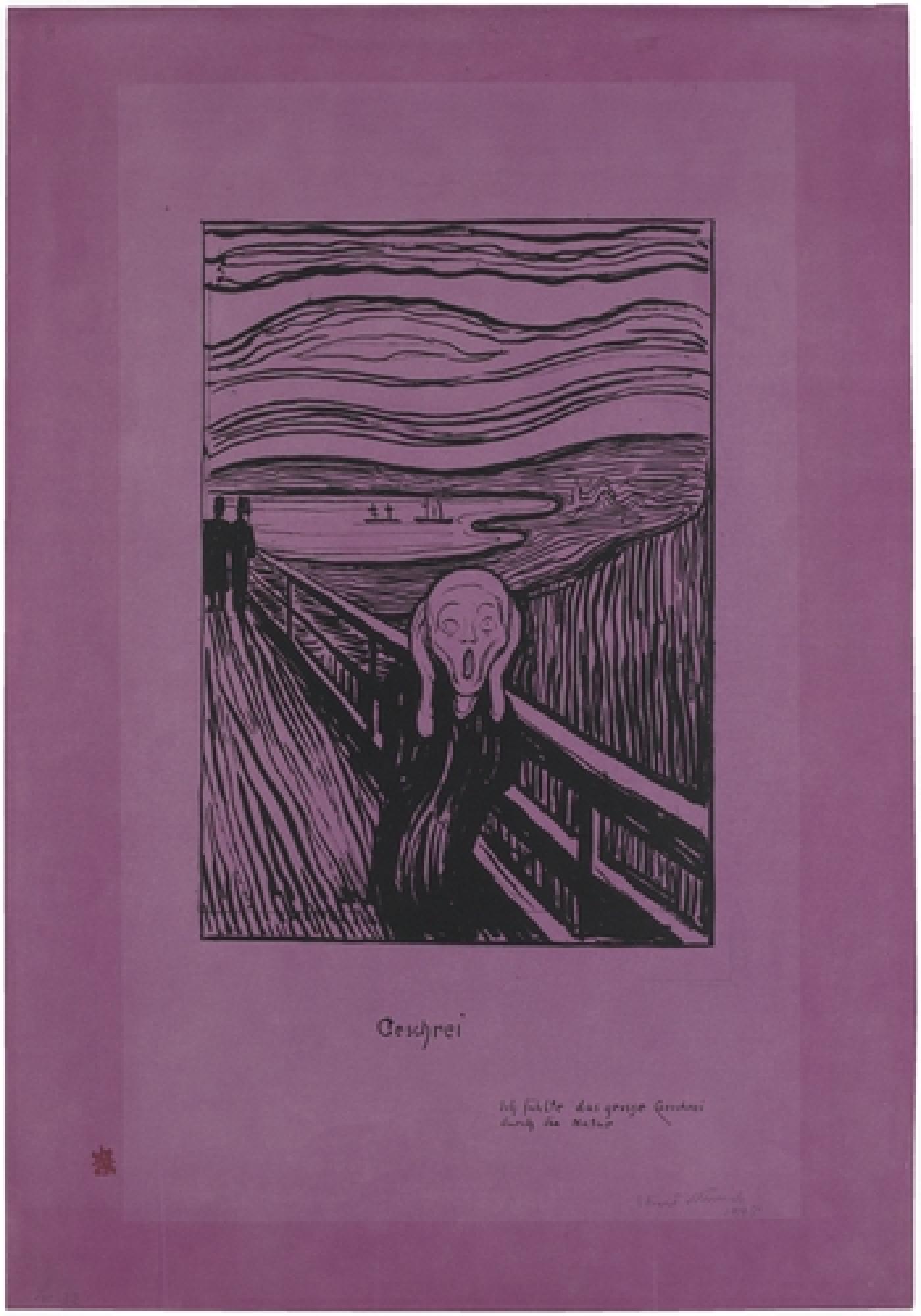
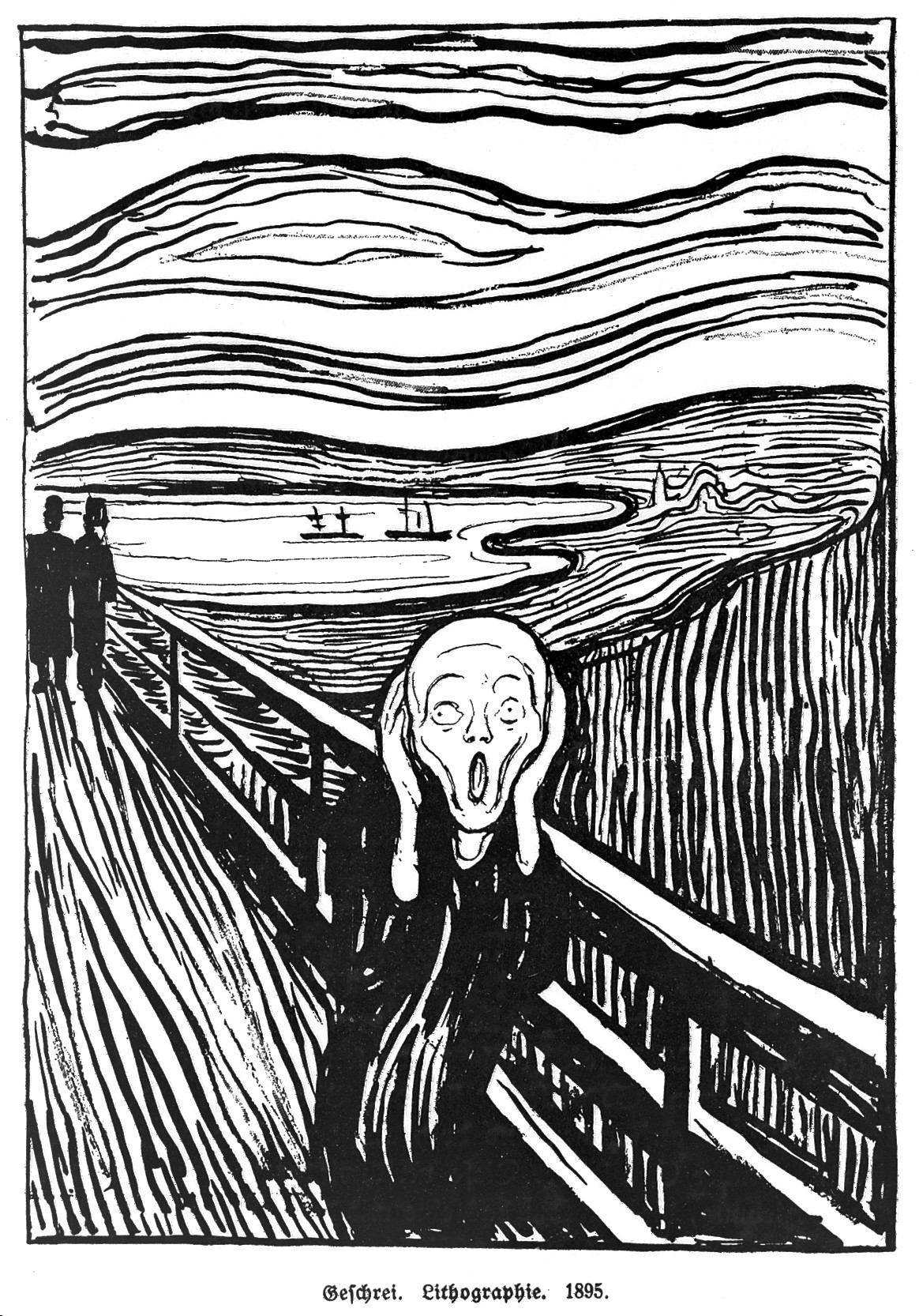
The record in full
Chapter 1What the Met physically owns
The sheet measures 51.4 by 39.7 centimetres, with the printed image occupying 35.7 by 23.6 centimetres of it.
The sheet measures 51.4 by 39.7 centimetres, with the printed image occupying 35.7 by 23.6 centimetres of it. It is a lithograph pulled in black ink from a single stone, on wove paper, with no hand-colouring. Direct examination of the Metropolitan Museum's own donated photograph of the sheet (the file the museum itself gave to Wikimedia Commons) shows the full text block intact: Munch's monogram and the date '95 printed at the lower right of the image, the German title 'Geschrei' beneath it, and beneath that the line 'Ich fuehlte das grosse Geschrei durch die Natur'. All three are part of the same lithographic pull, not additions in another hand or medium.
This is one physical sheet among an unknown but limited number pulled from the same stone in 1895. It is not the 1893 painting in Oslo, not either of the pastel versions, and not any of the other surviving lithograph impressions in other collections. Every claim in this record concerns this sheet specifically unless stated otherwise.
Chapter 2One motif, several physically separate objects
The Scream motif exists as a sequence of distinct objects made between 1892 and 1895, most of them one-of-a-kind, and confusing them with each other is the most common error made about this image.
The Scream motif exists as a sequence of distinct objects made between 1892 and 1895, most of them one-of-a-kind, and confusing them with each other is the most common error made about this image. Munch's friend Christian Skredsvig recorded that Munch had long wanted to paint a memory of a blood-red sunset while the two of them were staying near Nice in the winter of 1891-92; the first realisation was the painting Sick Mood at Sunset. Despair (1892, oil on canvas, now Thielska Galleriet, Stockholm), a conventionally composed figure study with none of the later distortion.
The image then changed sharply in style over roughly a year. Two painted versions of The Scream itself followed: one dated 1893, tempera and crayon on cardboard, now in the National Museum of Norway (formerly the National Gallery), Oslo, accession NG.M.00939; and a second, in the Munch Museum, Oslo, MM.M.00514, whose date is disputed between 1893 and a proposed 1910 based on pigment analysis. Two large drawn or pastelled versions also exist: one in crayon, Munch Museum, and a second in pastel dated 1895, which remained in private hands and was not seen publicly for decades until it sold at auction in 2012. This lithograph, also 1895, is the last object in the sequence and the only one made as a print rather than a unique work.
Chapter 3Why a print, after the image already existed as a painting
Munch had been painting versions of the motif since 1892 and had shown The Scream in Berlin in December 1893 as part of a six-picture sequence he titled Love, the beginning of what he would later...
Munch had been painting versions of the motif since 1892 and had shown The Scream in Berlin in December 1893 as part of a six-picture sequence he titled Love, the beginning of what he would later call the Frieze of Life. He was working through the mid-1890s inside the Scandinavian and German bohemian circle that met at the Berlin wine bar Zum schwarzen Ferkel, which included August Strindberg, Stanislaw Przybyszewski and Dagny Juel, and he had begun making his first etchings and drypoints in Berlin in the workshop of the printmaker L. Angerer.
Munch stated his own reason for taking up graphic media directly: 'My intention in working with graphics was to bring my art into many homes.' A painting is one object that one owner can hold. A lithograph stone can produce many sheets, each cheap enough that a person who could never buy a Munch painting could own one. That is the entire economic logic of why the image exists twice, in two different media, two years apart.
Chapter 4The reversal problem
A lithograph stone prints in mirror reverse of whatever is drawn or inked onto it.
A lithograph stone prints in mirror reverse of whatever is drawn or inked onto it. Because Munch already had a painted composition he wanted the print to match, he had to draw or ink the image onto the stone backwards, so that the sheet coming off the press would read in the same left-right orientation as the 1893 painting rather than its mirror image. This is a real, verifiable technical fact about how the print was made, not a curatorial flourish: it is why the man on the bridge, the receding rail and the fjord behind him sit on the same sides of the sheet as they do in the painted versions.
Chapter 5The walk, the text, and where the two accounts differ
The line printed beneath the image on this sheet is drawn from an autobiographical text Munch had written some years before the print was made, describing a walk at sunset near Kristiania (now Oslo)...
The line printed beneath the image on this sheet is drawn from an autobiographical text Munch had written some years before the print was made, describing a walk at sunset near Kristiania (now Oslo) with two friends: the sky turning blood red, a feeling of exhaustion, and, in his own words, sensing 'a great scream through nature'. The Munch Museum dates the origin of this text to Nice, in the winter of 1891-92, the same stay during which Skredsvig recorded his own account of the episode.
The two accounts are not a flat contradiction, but they are not the same story either. Munch's own text is a first-person description of the anxiety attack itself, written as if experienced in the moment. Skredsvig's, published in his own memoir in 1908, frames the same period as Munch having long wished to paint a specific memory of a blood-red sunset, and being saddened because he doubted painting was equal to the task, which is a claim about intention and technical doubt rather than a description of a walk. Whether Skredsvig's account describes the same originating moment as Munch's diary text, an earlier stage of the same memory, or a version filtered through what Munch later told him, is not resolved in the sources consulted here.
Chapter 6An edition without an edition
No formal print run was ever published or numbered.
No formal print run was ever published or numbered. The Munch Museum, which holds six impressions itself, states plainly that it does not know exactly how many were pulled and estimates the figure at around thirty. Print-trade cataloguing around the 2016 Sotheby's sale of a comparable impression put the number nearer forty-five, and attributed the eventual end of the run to Munch's Berlin printer grinding the stone down before further pulls could be taken, whether by accident or through ordinary studio practice of that period. No source consulted here gives a definitive, sourced total.
The impressions that survive are not uniform. Some are plain black and white, exactly like this one. At least one, held by the Munch Museum, was hand-coloured by Munch himself in watercolour. Some carry only the title 'Geschrei'; some carry the title and the full line beneath it, the variant cataloguers refer to as Woll's variation A; and on a number of surviving sheets the text has simply been trimmed away by past owners or framers, so it no longer exists on the object even though it was originally printed there.
Chapter 7This impression, precisely
The Met's sheet is plain black and white, with no hand-colouring, and carries both the title 'Geschrei' and the full inscription 'Ich fuehlte das grosse Geschrei durch die Natur', confirmed by direct...
The Met's sheet is plain black and white, with no hand-colouring, and carries both the title 'Geschrei' and the full inscription 'Ich fuehlte das grosse Geschrei durch die Natur', confirmed by direct examination of the museum's own photograph rather than inferred from a general description of the edition. That places it in the same textual variant as the impression at Thielska Galleriet in Stockholm and the impression at the Staatsgalerie Stuttgart, both examined for this record, and in the same variant as the Olaf Schou impression sold at Sotheby's in 2016. It is not, on that basis, a uniquely rare textual state; the rarity claims made in the auction trade attach to the black-and-white, fully inscribed sheets as a group relative to the trimmed or textless ones, not to any single sheet within that group including this one.
Chapter 8Scofield Thayer and the route to the Met
Scofield Thayer edited and co-published the literary magazine The Dial from 1919 to 1926, introducing American readers to T.S.
Scofield Thayer edited and co-published the literary magazine The Dial from 1919 to 1926, introducing American readers to T.S. Eliot, Ezra Pound and Thomas Mann among others. Between 1921 and 1923 he assembled, with considerable speed, a collection of roughly six hundred works, most of them on paper, buying in London, Paris, Berlin and Vienna; while a patient of Sigmund Freud in Vienna he also acquired a substantial group of Klimt and Schiele works then almost unknown in the United States. He drew up a will in 1925 leaving the collection to the Metropolitan Museum of Art. He died on 9 July 1982 in Edgartown, Massachusetts, at 93, and roughly four hundred items from his collection entered the Met by bequest; this lithograph was accessioned in 1984, the ordinary administrative gap between a bequest taking effect and an individual object being formally catalogued.
No source consulted here documents when, from whom, or through which dealer Thayer acquired this specific print. His main buying window for works on paper, 1921 to 1923, would place any purchase roughly a quarter-century after the print was pulled, but that is inference from his general collecting pattern, not a documented transaction for this object, and it is recorded here as an open question rather than a fact.
Chapter 9An open-access status that contradicts itself
Wikimedia Commons hosts a photograph of this exact sheet, donated to Commons by the Metropolitan Museum of Art itself as part of the museum's own open-access programme, dedicated under a CC0 waiver...
Wikimedia Commons hosts a photograph of this exact sheet, donated to Commons by the Metropolitan Museum of Art itself as part of the museum's own open-access programme, dedicated under a CC0 waiver with no rights reserved. That donation is dated in the file's own record to 2017. The Metropolitan Museum's current public collection database, queried directly for this object in the course of researching this record, returns the field 'isPublicDomain' as false for the same accession number.
Both statements come from the museum itself, at different points in time, and this record does not attempt to adjudicate between them. It states the conflict plainly so that a reader relying on either fact alone is warned that the other one exists.
Chapter 10The market for the edition, and the sale that is not this object
No auction transaction is documented for the Met's own sheet; it entered the collection by bequest, not by purchase, and nothing in the sources consulted suggests it was ever offered for sale before...
No auction transaction is documented for the Met's own sheet; it entered the collection by bequest, not by purchase, and nothing in the sources consulted suggests it was ever offered for sale before or after Thayer owned it.
For comparison only, and explicitly not this object: a black-and-white impression of the same 1895 lithograph, carrying the same title and full German inscription, with a documented line of descent from Olaf Schou, a Norwegian industrialist and one of Munch's principal patrons who is recorded as having acquired it from the artist's circle around 1900, then by descent through his brother Christian Schou to the consignors, was offered at Sotheby's London, Impressionist & Modern Art Evening Sale, 21 June 2016, lot 6, estimated at 800,000 to 1,200,000 pounds. The hammer or final sold price for that lot was not found in the sources consulted for this record.
Separately, and far more widely reported in the press, an entirely different 1895 object in an entirely different medium, a pastel on board that had remained in private hands and out of public view for decades, sold at Sotheby's New York on 2 May 2012 for 119,922,600 dollars including buyer's premium, a record at the time for any work of art at auction. That pastel is not a print, is not this lithograph, and remains in a private collection. It shares only a year and a motif with the object described in this record.
Chapter 11Theft, and why it does not touch this object
The Scream motif has been physically stolen twice, and both thefts targeted paintings, not prints.
The Scream motif has been physically stolen twice, and both thefts targeted paintings, not prints. On 12 February 1994, during the Lillehammer Winter Olympics, two thieves climbed a ladder into the National Gallery in Oslo and cut the 1893 painted Scream from its mount; the museum refused a one-million-dollar ransom demand, and the painting was recovered undamaged on 7 May 1994. On 22 August 2004, two armed men entered the Munch Museum in daylight, pulled the museum's painted Scream from the wall and took the painting Madonna on their way out; both were recovered in 2006, the Scream with moisture damage to one corner and Madonna with tears and two holes.
Both stolen works were unique paintings, each irreplaceable in a way no single sheet from a print edition of thirty to forty-five impressions can be. This lithograph, including the Met's sheet, was in New York for both events and was never involved in either theft. The two thefts belong in this record only as evidence of how famous and how vulnerable the painted image had become by the 1990s and 2000s, a fame this print helped build by putting the composition into private homes decades earlier, but they are not part of this object's own history.
Chapter 12Condition, display, and what is not documented
No conservation or condition report for this specific sheet was found in the sources consulted.
No conservation or condition report for this specific sheet was found in the sources consulted. The Metropolitan Museum's public collection record associates the object with gallery number 099 as of the API query made for this record; works on paper in the Drawings and Prints department are conventionally rotated on and off view to limit light exposure rather than kept on permanent display, so a gallery number recorded today should not be read as a permanent location. No exhibition history for this specific sheet, at the Met or on loan elsewhere, was found in the sources consulted.
The artist
Edvard Munch
Munch is most famous today for a painting, but the object in this record is a print, and the distinction matters to his own career. He turned to lithography, etching and woodcut in Berlin in the early 1890s specifically because a print could leave his studio in numbers a painting never could, and by his own account that was the point.
Related works
| Work | Relation | Where it is |
|---|---|---|
| Sick Mood at Sunset. Despair Edvard Munch | Earliest painted realisation of the memory behind the motif 1892, oil on canvas. A conventional figure composition, before the distorted 'screaming' head appeared. | Thielska Galleriet, Stockholm |
| The Scream (1893 painting) Edvard Munch | The best-known painted version of the same motif; a different object and medium from this print Tempera and crayon on cardboard. Stolen 1994 and recovered the same year; not this lithograph. | National Museum of Norway (Nasjonalmuseet), Oslo, NG.M.00939 |
| The Scream (second painted version) Edvard Munch | Second painted version of the motif, dating disputed between 1893 and c. 1910 Tempera and oil on cardboard. Stolen 2004 and recovered 2006 with moisture damage; not this lithograph. | Munch Museum, Oslo, MM.M.00514 |
| The Scream (pastel, 1895) Edvard Munch | A separate, unique 1895 object in a different medium, made the same year as this print Sold Sotheby's New York, 2 May 2012, for USD 119,922,600 including premium. Not a print and not this object. | Private collection |
| The Scream, other impressions of Woll G 38 Edvard Munch | Other surviving sheets from the same 1895 lithograph edition The edition is estimated at roughly thirty to forty-five sheets in total; each is a physically separate object with its own condition and textual state. | Munch Museum, Oslo (6 impressions, including one hand-coloured by Munch); Museum of Modern Art, New York; Thielska Galleriet, Stockholm; Staatsgalerie Stuttgart |
| The Scream, ex-Olaf Schou impression Edvard Munch | Comparable black-and-white, fully inscribed impression from the same edition, sold at auction Provenance to Olaf Schou, c. 1900, by descent through Christian Schou. Estimate GBP 800,000-1,200,000; sold price not found. | Sold Sotheby's London, 21 June 2016, lot 6; present location not established in sources consulted |
Open questions
- When, from whom, and through what dealer did Scofield Thayer acquire this print? No source consulted documents the transaction; it is inferred only from his general 1921-1923 buying pattern.
- Why does the Met's own public collection API currently return isPublicDomain: false for this object while Wikimedia Commons hosts a CC0-dedicated photograph of the same sheet donated by the Met itself in 2017? Neither source resolves the other.
- What is the true total number of impressions Munch pulled from the stone before it was ground down? Estimates in the sources consulted range from about thirty to about forty-five, and no source gives a sourced, definitive census of the edition.
- Has this specific sheet ever been the subject of a technical condition or paper analysis, comparable to the pigment analyses carried out on the Munch Museum's painted versions? None was found.
- What price did the ex-Olaf Schou impression achieve at Sotheby's London on 21 June 2016? The estimate is documented; the hammer or sold price is not, in the sources consulted.
- Has the Met's impression been lent for exhibition, and if so where and when? No exhibition history for this specific sheet was found.
Questions about this object
What is The Scream?
The Scream is a print, dated 1895. Medium: Lithograph in black ink on wove paper, printed from a single limestone block.
Who made The Scream, and is the attribution settled?
The attribution to Edvard Munch is recorded here as accepted. Signed with Munch's monogram and dated 95 within the image itself, printed as part of the same lithographic pull rather than added afterward. Catalogued as Woll G 38 in Gerd Woll's Edvard Munch: The Complete Graphic Works (2012), the standard reference for Munch's prints. There is no attribution dispute for this print. The only unresolved attribution-adjacent question in the wider Scream group concerns the dating of the Munch Museum's second painted version (traditionally 1893, argued by some scholars to be nearer 1910), which does not touch this lithograph.
Where is The Scream now?
Metropolitan Museum of Art, New York, Department of Drawings and Prints. Inventory number 1984.1203.1. Last confirmed 21 August 2026. Bequest of Scofield Thayer, 1982; formally accessioned 1984.
What is still unknown about The Scream?
When, from whom, and through what dealer did Scofield Thayer acquire this print? No source consulted documents the transaction; it is inferred only from his general 1921-1923 buying pattern.
Sources
- 1Metropolitan Museum of Art, public collection record for object 340029, 'The Scream,' Edvard Munch, accession 1984.1203.1. metmuseum.org/art/...
- 2Wikimedia Commons, file description and licensing metadata for 'File:The Scream MET DP860367.jpg', donated by the Metropolitan Museum of Art under CC0. commons.wikimedia.org/wiki/...
- 3Direct visual examination of the Metropolitan Museum's own donated photograph of this sheet (full-resolution file hosted on Wikimedia Commons), confirming black-and-white state, absence of hand-colouring, and the printed title and full inscription. upload.wikimedia.org/wikipedia/...
- 4Museum of Modern Art, New York, collection record for 'Edvard Munch. The Scream. 1895; signed 1896', on the estimated number of impressions, hand-colouring, the printed inscription, and the mirror-reversal printing process. moma.org/collection/...
- 5Munchmuseet (Munch Museum, Oslo), '5 things you should know about The Scream', on the estimated edition size, the museum's six impressions including one hand-coloured by Munch, and the trimming of the inscription on some surviving sheets. munch.no/en/...
- 6Petra Pettersen, 'Edvard Munch - The Scream', International Journal of Conservation Science, vol. 13, Special Issue 1 (December 2022), pp. 1405-1420. Munchmuseet curatorial research on the full sequence of drawings, paintings and the 1895 lithograph, the dating debate, and the Berlin exhibition and review history. ijcs.ro/public/...
- 7Sotheby's, Impressionist & Modern Art Evening Sale, London, 21 June 2016, lot 6, catalogue entry for a comparable black-and-white, fully inscribed impression of the same lithograph, ex-Olaf Schou. sothebys.com/en/...
- 8justcollecting.com, 'Edvard Munch's The Scream lithograph to sell at Sotheby's', on the estimated edition size of about forty-five impressions and the printer's stone being ground down. news.justcollecting.com/edvard-munchs-the-scream-lithogra...
- 9Wikipedia, 'Scofield Thayer', for his biography, his collecting activity between 1921 and 1923, and his 1982 bequest to the Metropolitan Museum. Lauder Research Center provenance file on Thayer, which could not be retrieved during this research session (repeated 429/rate-limit responses from metmuseum.org). en.wikipedia.org/wiki/...
- 10Norwegian Arts, 'Edvard Munch: The graphic works' (archived), for Munch's own quoted statements on black as a colour, on his intention in taking up graphic media, and on his Berlin printmaking beginnings with L. Angerer. norwegianarts.org.uk/edvard-munch-the-graphic-works
- 11Wikipedia, 'Edvard Munch', for basic biographical facts (birthplace, dates, childhood deaths). en.wikipedia.org/wiki/...
- 12Wikimedia Commons category 'The Scream (Woll G 38) by Edvard Munch' and associated file metadata, used to identify and verify licensing of comparanda impressions at Thielska Galleriet and the Staatsgalerie Stuttgart, and the Wellcome Collection reproduction. commons.wikimedia.org/wiki/...
- 13Scholarly literature on Munch's 1908 breakdown and treatment under Dr. Daniel Jacobson in Copenhagen, indexed via PubMed, 'Edvard Munch's crisis in 1908 and French medicine: His doctors, treatments, and sources of information', Journal of the History of the Neurosciences. pubmed.ncbi.nlm.nih.gov/38889452
- 14Wikipedia, 'Degenerate art', for the 1937 Nazi purge of German state museum collections and Munch's inclusion among the affected artists. en.wikipedia.org/wiki/...
- 15Wikipedia, 'Munch Museum', for the 1944 bequest to the City of Oslo, the museum's 1963 founding and 2021 relocation, and the scale of its graphic holdings. en.wikipedia.org/wiki/...
- 16CNN, ''The Scream' sold for nearly $120 million', on the 2 May 2012 Sotheby's New York sale of the 1895 pastel version, a separate object from this lithograph. cnn.com/2012/...
- 17Britannica, 'Today in History: February 12, The Theft of The Scream', on the 1994 theft of the painted Scream from the National Gallery, Oslo. britannica.com/today-in-history/...
- 18NPR, 'Munch's Masterpieces Said to Be Recovered', on the 2004 theft and 2006 recovery of the painted Scream and Madonna from the Munch Museum, Oslo. npr.org/2006/...


Last verified · Published
Change log
21 August 2026 - Record created at the house standard: researched narrative, technical evidence, maker dossier, graded provenance chain, prices with hammer and premium separated, related works, open questions and sources.