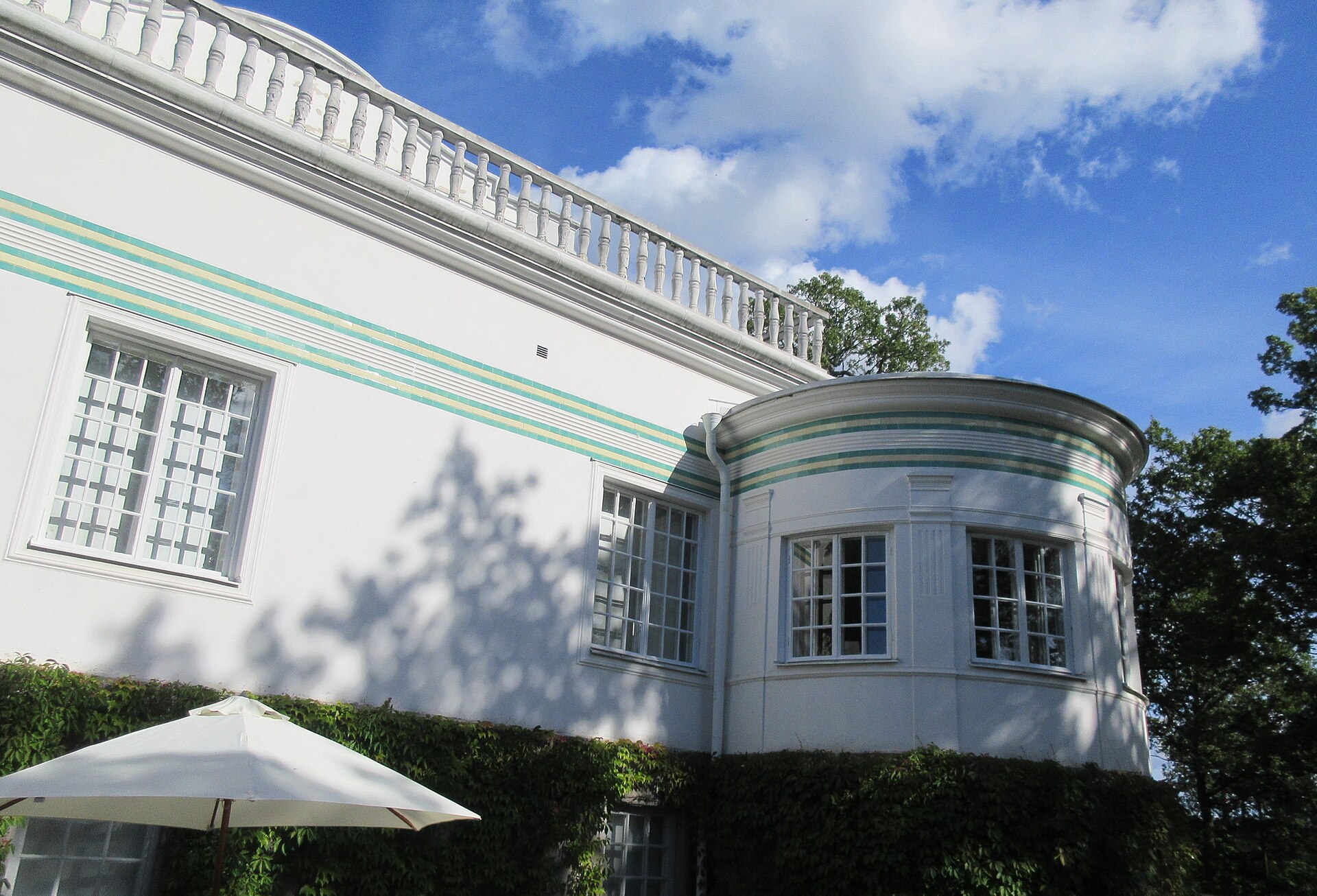
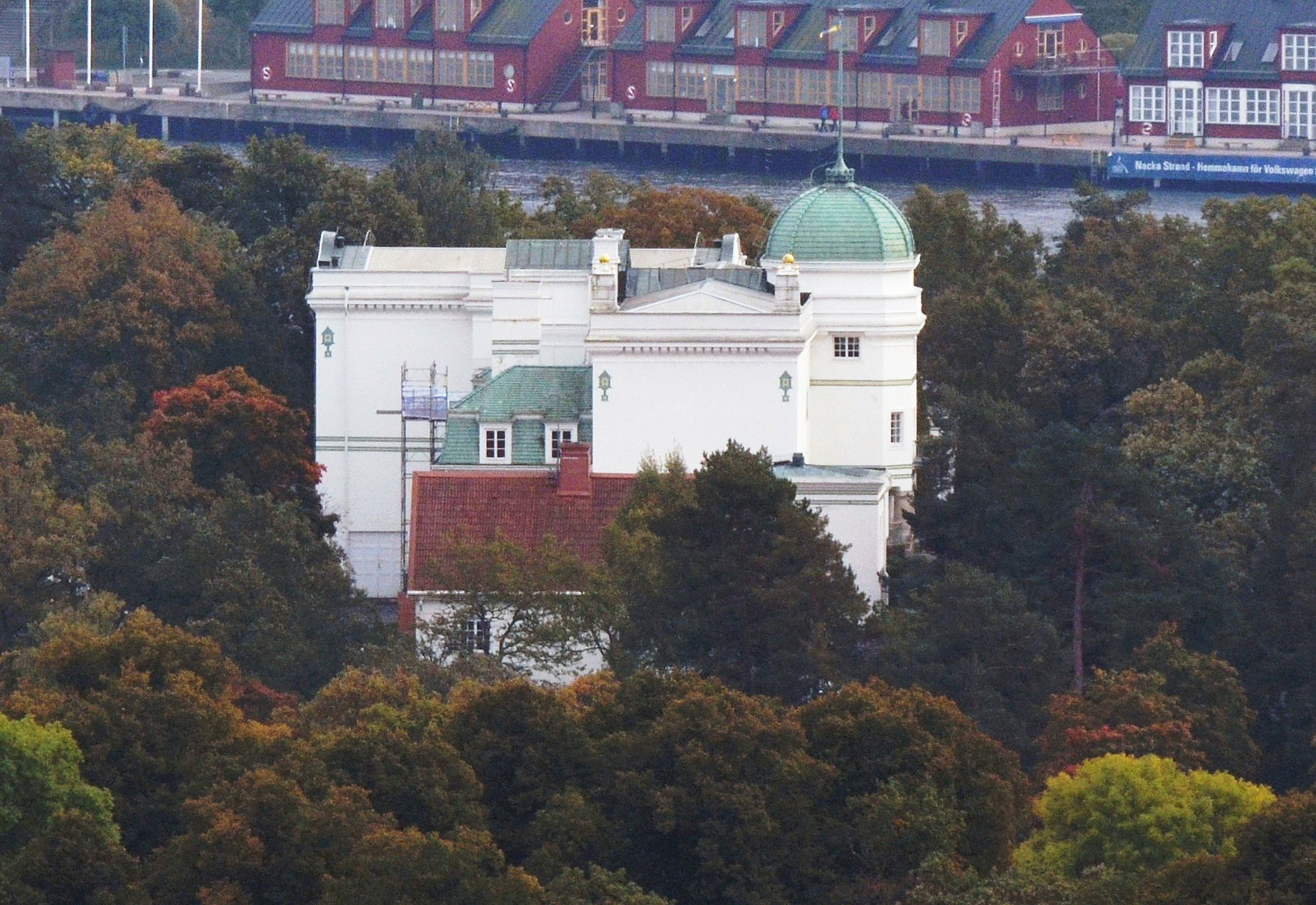
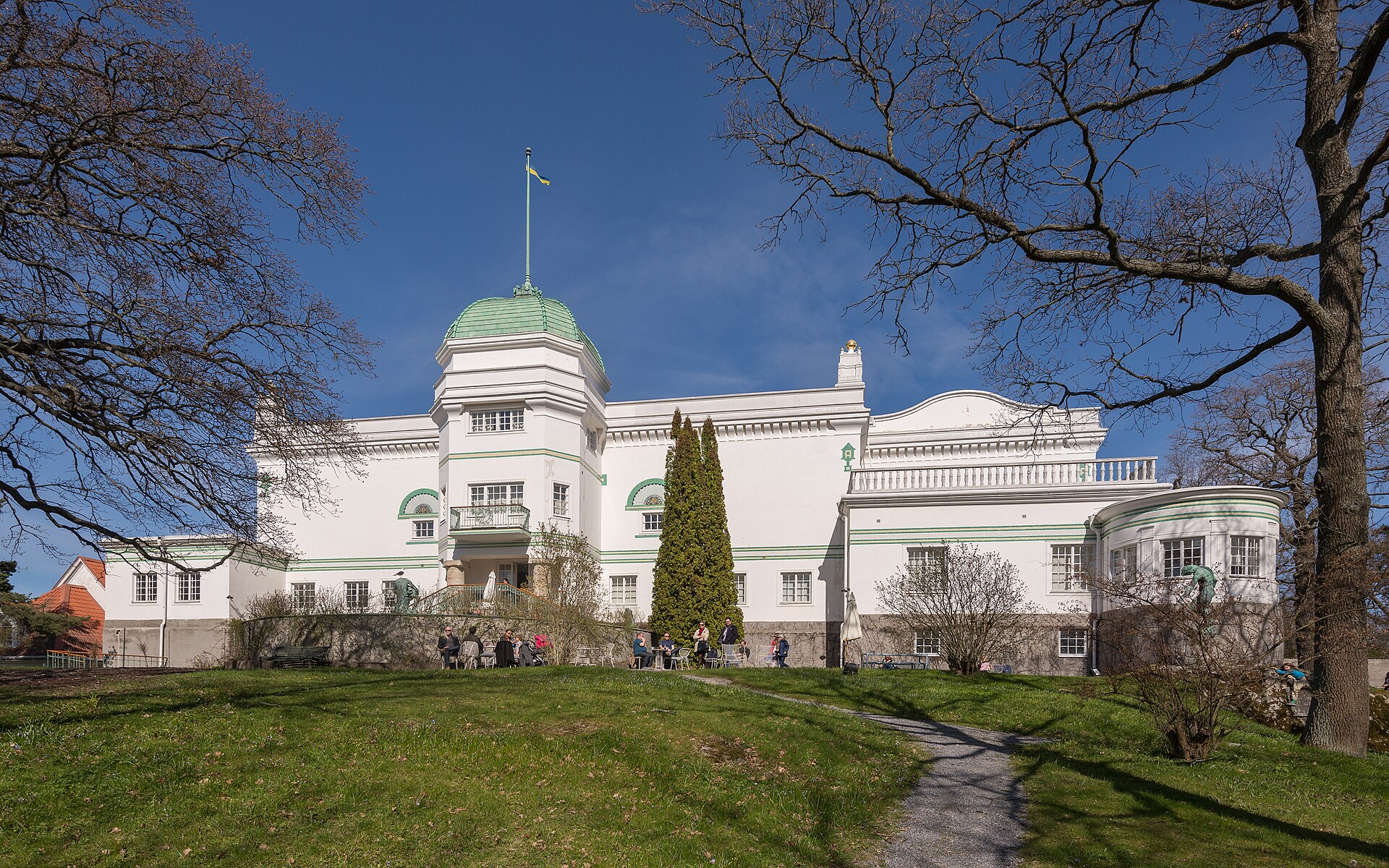
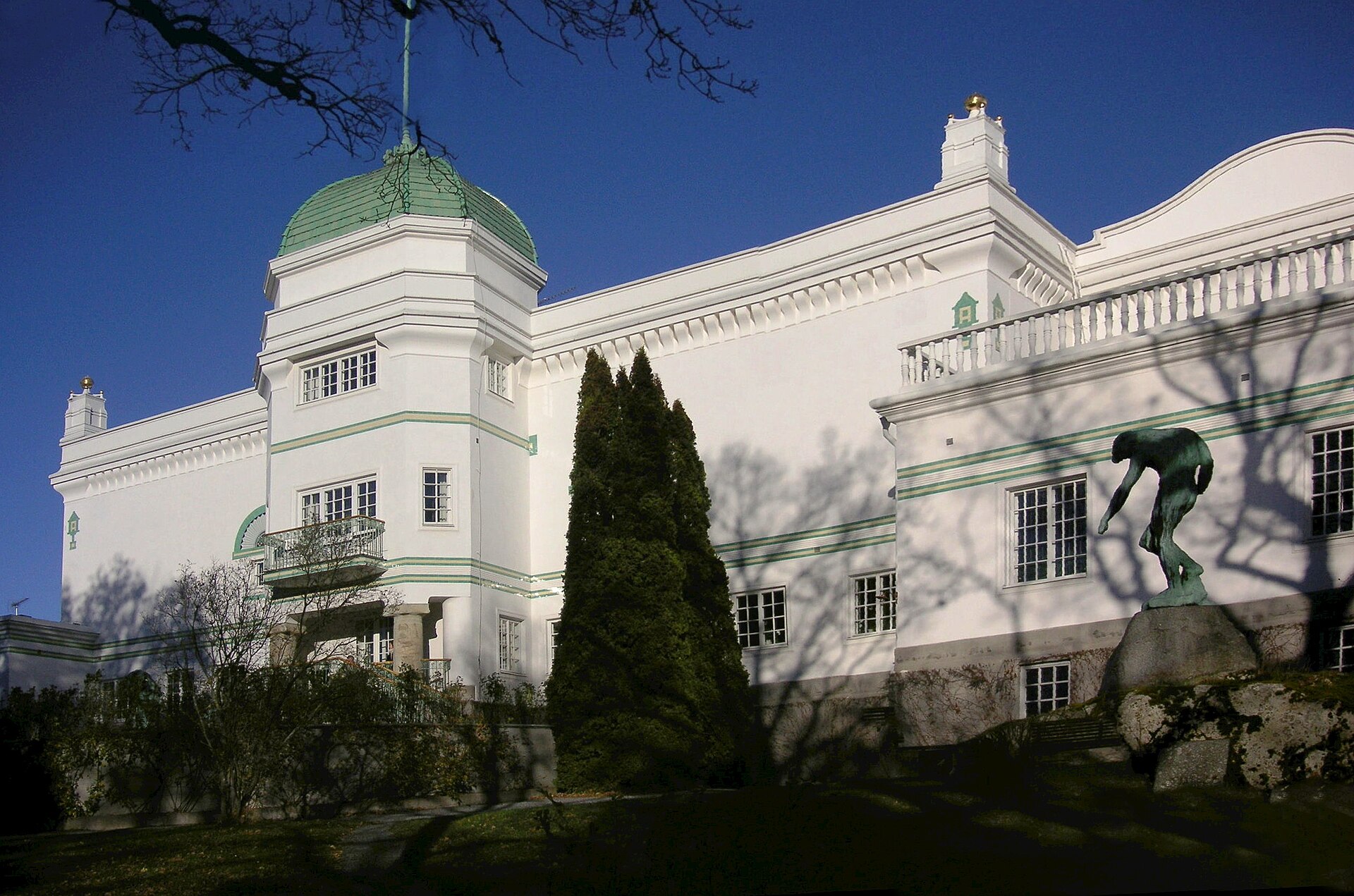
Ferdinand Boberg's Art Nouveau villa on Blockhusudden, Djurgarden, built 1904-1907 for Ernest Thiel and a state museum since 1926.
Bysmon, CC BY-SA 4.0Thiel Gallery
Museum · Thielska Galleriet · Founded 1926
Open, admission and hours confirmed 9 September 2026 · 18 sources
On this page 16 sections
ContentsClose
The collection's real strength is Edvard Munch: twelve oil paintings and ninety-nine prints, the largest holding of his work outside Norway, built through Ernest Thiel's personal patronage and friendship with the artist and organised around the 1906 Nietzsche commission. Around that sits the Nordic circle Thiel actually knew socially: Liljefors, Zorn, Jansson, Larsson and Josephson. A small foreign wing, a single Gauguin watercolour and a single Toulouse-Lautrec, marks the edge of Thiel's ambitions beyond Scandinavia. It is a collector's cabinet rather than a survey museum, and its authority rests on the fact that Thiel bought most of it directly from artists who were his contemporaries and, in several cases, his friends.
| Local name | Thielska Galleriet |
|---|---|
| Kind | Museum |
| Founded | 1926 |
| City and country |  Stockholm, Sweden Stockholm, Sweden |
| Address | Sjotullsbacken 8, 115 25 Stockholm, Sweden |
| Website | thielskagalleriet.se/en |
| Status | Open, confirmed |
| Record last verified |
Visiting
- Hours
- Tue-Sun12:00 to 17:00November-April, and Tue/Wed/Fri-Sun year-round
- Thu12:00 to 20:00May-October only, except 8 October
- Closed
- Monday, year-round. 26-27 September (dated exception published on the museum's own site).
- Admission
- AdultSEK 160A 350 SEK annual season ticket is also sold, giving free entry for 12 months plus a 10 percent museum shop discount
- Student / Senior (65+)SEK 140
- Group (10 or more)SEK 130per person
- Under 19Freefree
- ICOM / KRO / SMI / RSM / SVB card holders, authorised Stockholm guides, Djurgarden museum staff, Friends of the Thiel Gallery, press, Ukrainian passport holdersFreefree admission on presentation of the relevant card or passport
- Tickets
- thielskagalleriet.se/en/visit-us/opening-hour... The museum's own ticket page.
- Do I need to book?
- No advance booking for individual visitors; groups of 10 or more are asked to book ahead
- Address
- Sjotullsbacken 8, 115 25 Stockholm, Sweden MapBus Bus 67 (renumbered from 69) runs Odenplan to Blockhusudden and stops at the Thiel Gallery; the museum's own announcement put the line on a 15-minute frequency from spring 2025 to make the trip to eastern Djurgarden easier
- Website
- thielskagalleriet.se/en
- Telephone
- +46 8 662 58 84
- [email protected]
Before you go how long, access, photography, bags, eating, shop
- How long to allow
- Not stated by the museum; TripAdvisor visitors repeatedly describe it as a compact, easily manageable house rather than a long visit
- Access
- The museum's own accessibility page states the building is not yet fully adapted for visitors with disabilities: there is no lift and no accessible toilet, and the main entrance has several low steps. A rear entrance facing the park, with fewer steps, is offered in summer. All staircases have handrails, and parking is available directly outside the museum gates. The shop and temporary exhibitions are on the ground floor; the permanent collection is on the second and third floors.
- Photography
- Not stated on the museum's own site as researched for this page
- Bags
- Not stated on the museum's own site as researched for this page
- Eating
- A cafe operates in what were the villa's kitchens and staff quarters, converted for the purpose in 1932; visitors single it out by name for its food
- Shop
- A museum shop on the ground floor sells items inspired by the collection, with a 10 percent discount for season-ticket holders
Prices and hours change. We take them from the institution's own pages and print the day we read them, and you can check the current position at the source we used. Confirm before you travel.
What is inside
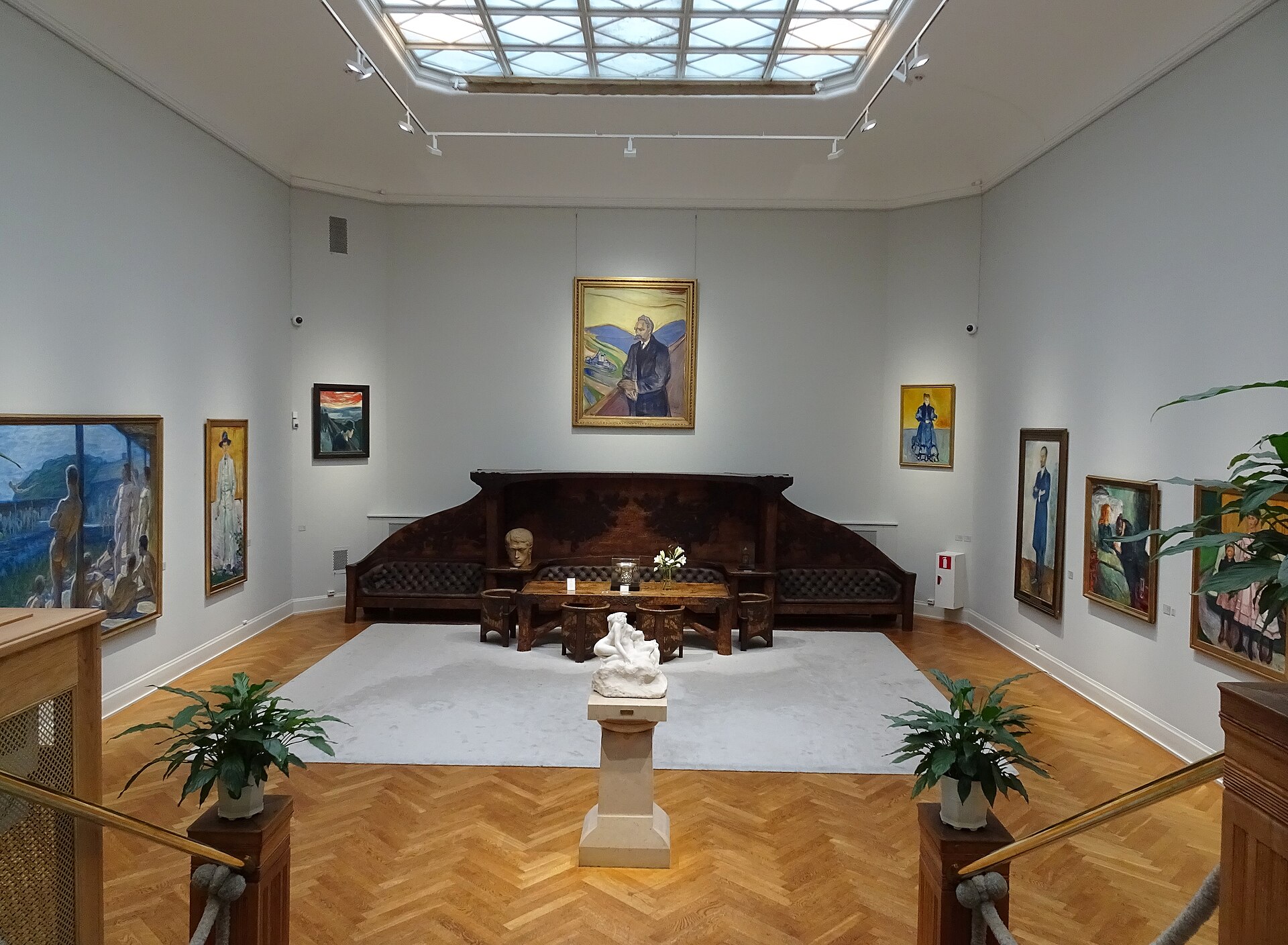
Photograph by Holger.Ellgaard · CC BY-SA 4.0 The Munch Room (Munchsalen)
An eastern extension architect Ferdinand Boberg added once Ernest Thiel's Munch holdings outgrew the original 1905 building. It now holds the core of what the museum itself describes as the largest and most distinguished collection of Edvard Munch's work outside Norway: twelve oil paintings and ninety-nine prints, including the 1906 portrait of Friedrich Nietzsche, 'Despair' (1892) and 'The Sick Child' (1907).
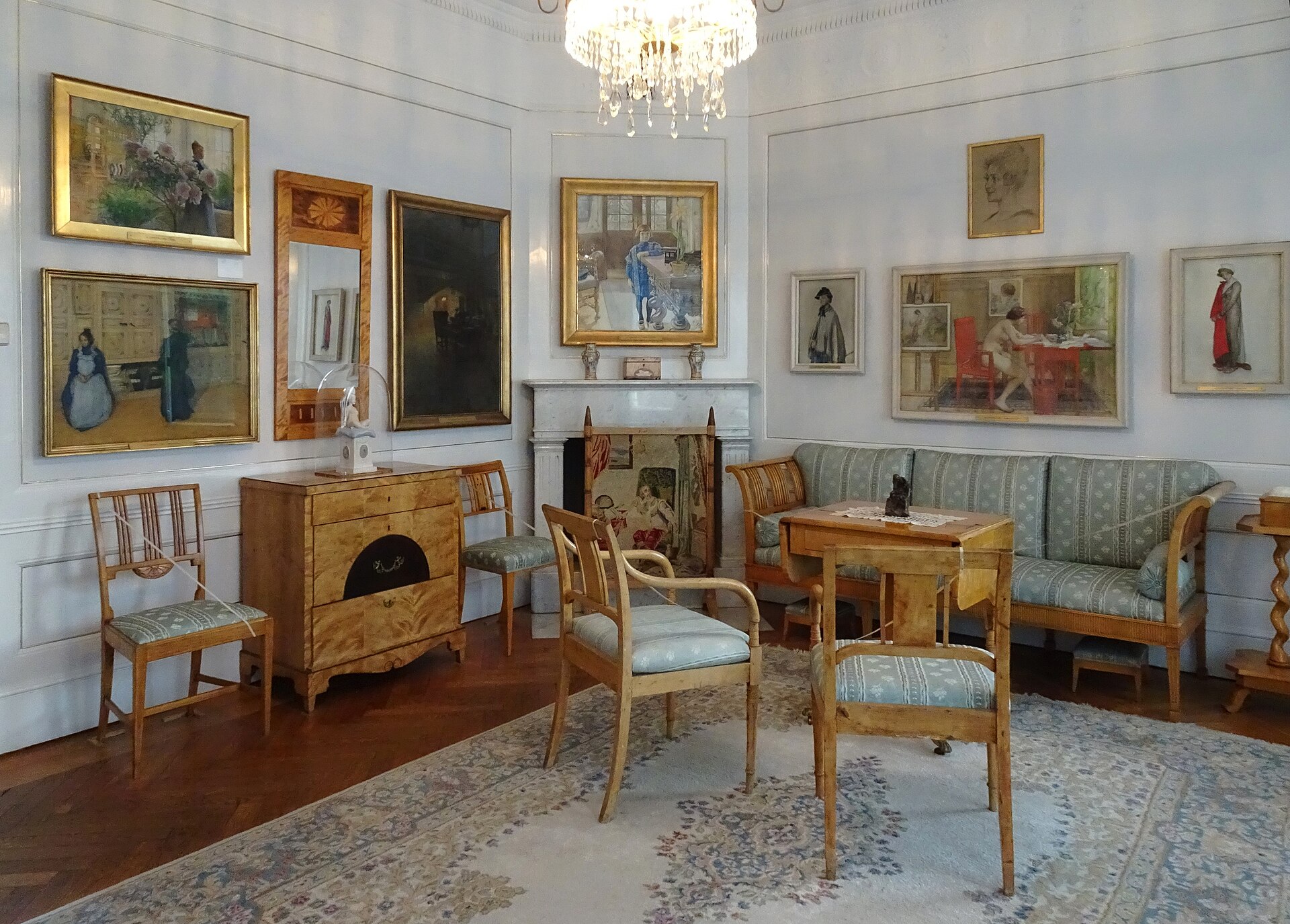
Photograph by Holger.Ellgaard · CC BY-SA 4.0 The Carl Larsson Room (Larssonrummet)
A room named for and hung with work by Carl Larsson, one of the three Swedish painters, alongside Bruno Liljefors and Eugene Jansson, with whom Thiel kept a close personal friendship rather than a purely commercial relationship.
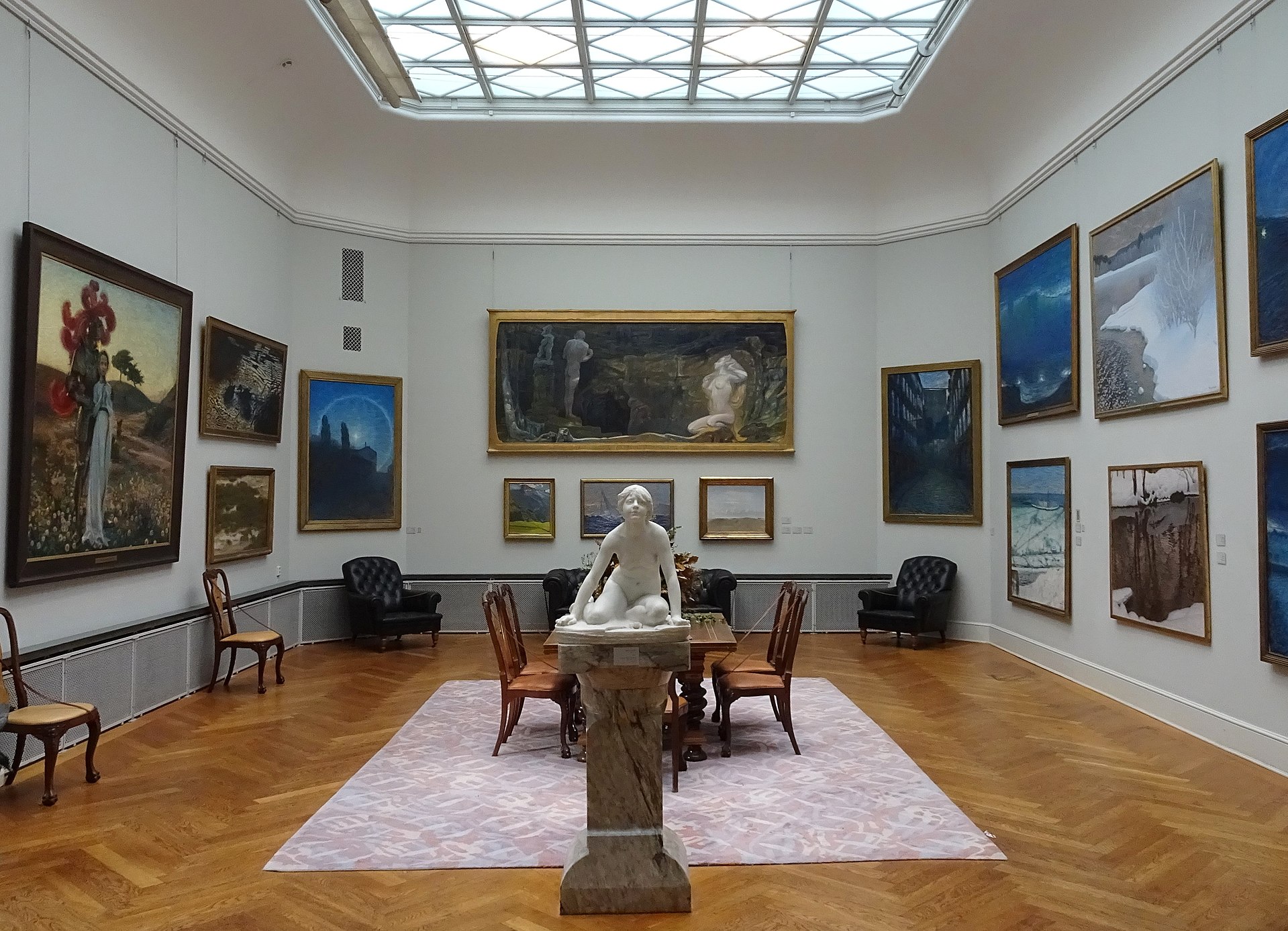
Photograph by Holger.Ellgaard · CC BY-SA 4.0 The Western Gallery (Vastra galleriet)
One of two large upper-storey halls with glass roofs that Boberg built to Thiel's own specification for lighting, room disposition and colour. It carries part of the core hang of Nordic painting: Liljefors, Zorn, Josephson and Jansson.
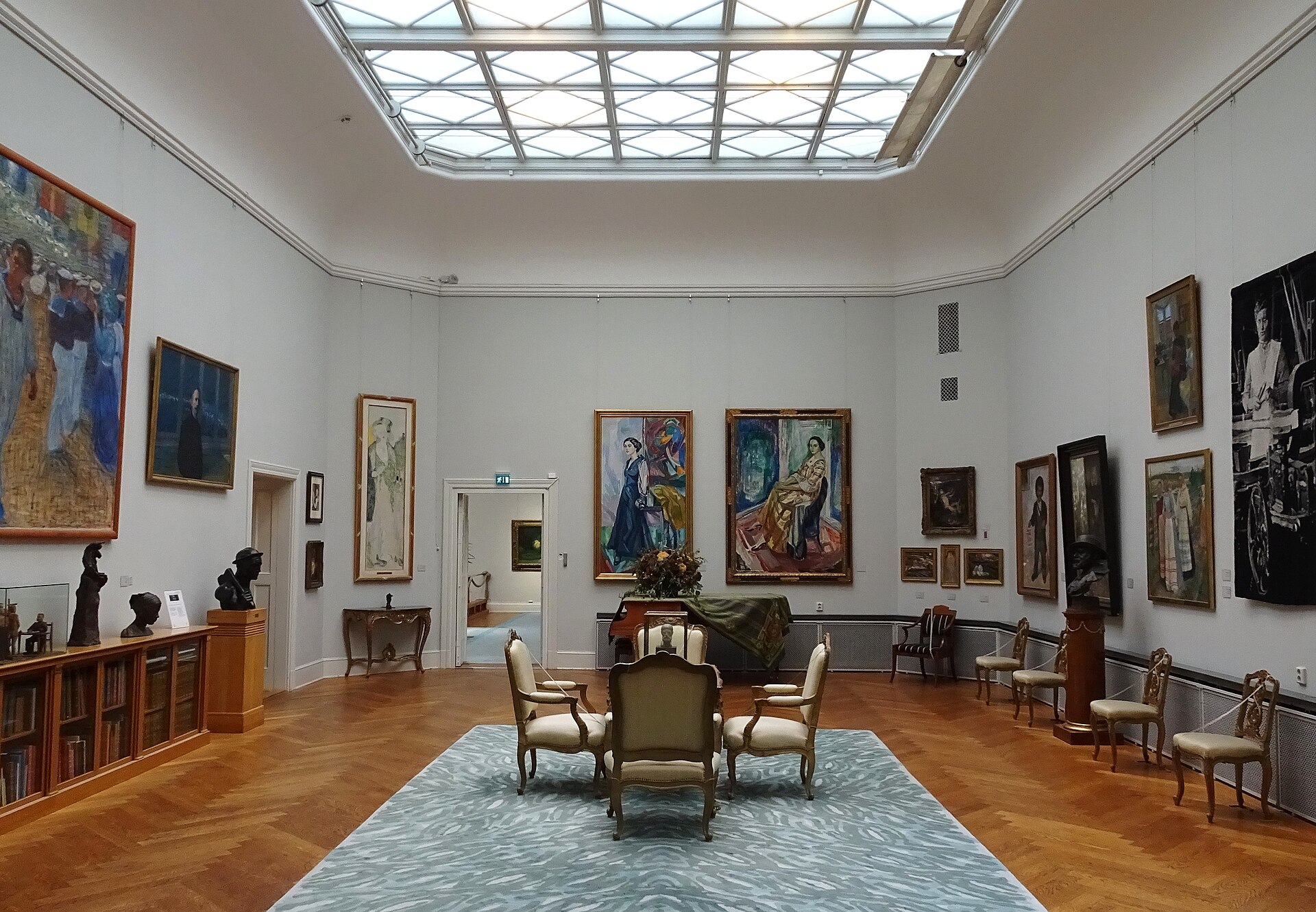
Photograph by Holger.Ellgaard · CC BY-SA 4.0 The Eastern Gallery (Ostra galleriet)
The matching glass-roofed hall on the other side of the upper storey, continuing the same top-lit hang of Nordic paintings from Thiel's own circle.
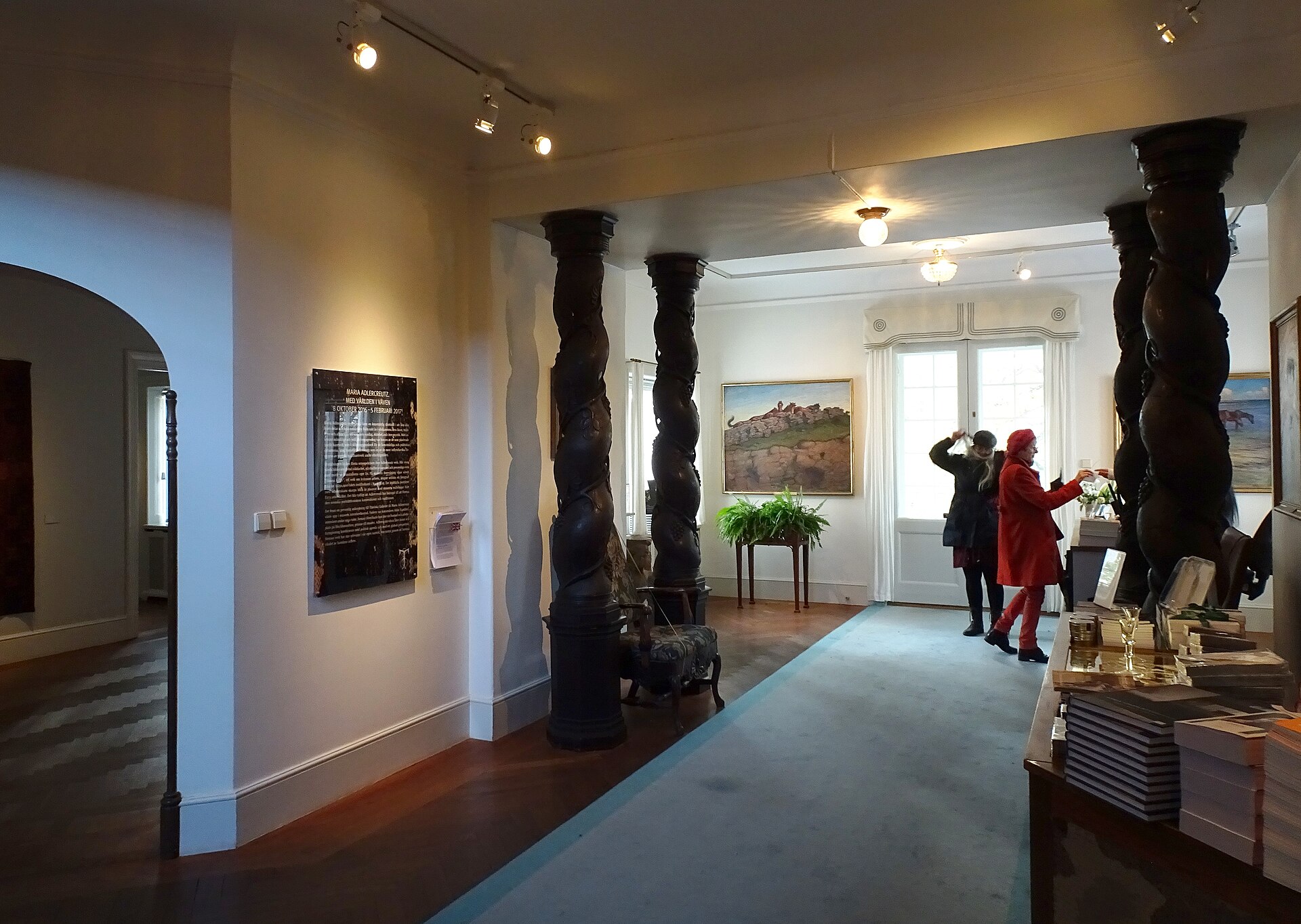
Photograph by Holger.Ellgaard · CC BY-SA 4.0 Entrance Hall and Staircase (Entrehall)
The grand entry sequence into the villa, part of the interior Thiel had Boberg design down to the lighting and the choice of colours, and the visitor's first sight of the house as a designed whole rather than a converted home.
The Turret Room (Tornrummet)
A room at the top of the villa holding Friedrich Nietzsche's own death mask alongside further prints by Edvard Munch, the painter Thiel chose to portray the philosopher he translated into Swedish. No free-licence photograph of this specific room was found on Wikimedia Commons for this page; it is described in text only.
The sculpture grounds
The villa's grounds on the Blockhusudden headland, overlooking the water, hold sculpture by Auguste Rodin and Gustav Vigeland placed outdoors around the building. No free-licence photograph verified as showing this specific display was found for this page.
What to see first
Friedrich Nietzsche
Edvard Munch, 1906Ernest Thiel commissioned this monumental (201 x 160 cm) posthumous portrait of Nietzsche in 1905, five years after the philosopher's death, because he considered Munch the foremost artistic interpreter of Nietzsche's spirit; Munch worked from photographs. It anchors the museum's Munch room and its own account of why the collection exists.6
Despair
Edvard Munch, 1892Described by the museum itself as the first version of the composition Munch developed into 'The Scream', making it one of the more historically important single canvases in the collection.6
The Sick Child
Edvard Munch, 1907One of Munch's repeated treatments of his sister Sophie's death from tuberculosis, part of the twelve oils and ninety-nine prints that make up the largest Munch holding outside Norway.6
Ballet Scene (Balettscen)
Henri de Toulouse-Lautrec, 1886Bought by Thiel in 1916 for 27,000 francs, it is the collection's sole Toulouse-Lautrec and one of only a handful of French works among an otherwise Nordic-dominated hang, evidence Thiel's taste ran beyond his own artistic circle.10
Study from Tahiti
Paul Gauguin, watercolour, 1892The collection's only Gauguin, from his first Tahiti period, and the other main marker (with the Toulouse-Lautrec) of Thiel's international, not purely Scandinavian, ambitions as a collector.14
The Fjaestad sofa
Gustaf Fjaestad, 1907-1908A monumental sofa carved from a single piece of wood, later completed with matching armchairs; a rare piece of applied art and furniture-making amid a collection otherwise dominated by paintings and prints.10
Morning Mood by the Sea (Morgonstamning vid havet)
Bruno Liljefors, 1896Thiel's first major purchase, bought in 1896 for 2,000 kronor; the single work that started the collection that grew into the museum.10
Death mask of Friedrich Nietzsche
Cast, kept in the Turret RoomA direct physical relic of the philosopher whose Swedish translation Thiel undertook and whose portrait he commissioned from Munch, displayed in the same small room as further Munch prints.5
Exhibitions on now
- On now30 May 2026 to 24 Jan 2027Confirmed , 5 weeks ago
Past exhibitions here
- Closed13 Jun to 20 Sep 2026Confirmed · check before you travel
A bank clerk who kept buying pictures
Ernest Jacques Thiel was born in Norrkoping in 1859, the son of a Belgian Catholic engineer and a mother of German-Jewish heritage. Educated in Stockholm and trained as a merchant in Hamburg, he joined Stockholms Enskilda Bank in 1877, ran the Stockholm office of Hernosands Enskilda Bank by 1884, and in 1891 founded his own institution, Stockholms Kredit- och Diskontoforening, later Aktiebolaget Stockholms Diskontobank, which he directed until 1901. He was, in other words, a banker rather than an inherited fortune, and the collection that now fills the Thiel Gallery was built on money he made himself.
His first major purchase came in 1896: Bruno Liljefors's 'Morgonstamning vid havet' (Morning Mood by the Sea), bought for 2,000 kronor. It was the seed of everything that followed. As the collection grew, his apartment on Strandvagen became too small to hold it, and Thiel commissioned the architect Ferdinand Boberg to build him a house on Djurgarden that could. Construction ran 1904 to 1907 on Blockhusudden's highest point, a spot known as Eolskulle, in a style that mixes Italian Renaissance proportion with the geometric restraint of the Viennese Art Nouveau school: plain white facades, uncluttered surfaces, sparse decoration. The initial 1905 phase of the building was already too small for what Thiel kept buying, and Boberg added an eastern extension, the Munch room, to take the expanding collection of a single artist Thiel had come to prize above all others.
Nietzsche, and the Munch collection built around him
Thiel was a devoted reader of Friedrich Nietzsche and translated his work into Swedish himself. He came to regard Edvard Munch as the foremost artistic interpreter of Nietzsche's spirit and ideas, and in 1905, five years after the philosopher's death, commissioned Munch to paint his portrait. Munch had never met Nietzsche and worked from photographs, delivering in 1906 a monumental posthumous portrait, 201 by 160 centimetres, that the gallery still holds under its own accession number, TG 292.
Thiel became Munch's foremost collector and patron, assembling what the museum itself describes as the largest and most distinguished collection of Munch's work outside Norway: twelve oil paintings and ninety-nine prints. Among them are 'Despair' (1892), which the museum's own account calls the first version of the composition Munch developed into 'The Scream'; 'On the Bridge' (1903); and 'The Sick Child' (1907), one of several treatments Munch made of his sister's death from tuberculosis. A small turret room at the top of the villa carries the connection further: it holds Nietzsche's own death mask, kept alongside further Munch prints, so that the philosopher's death mask and the painter's images of him share the same small space, exactly as the banker who translated one and commissioned the other arranged it.
From private villa to a museum bought by lottery
The deflation crisis of 1920 to 1922 destroyed much of Thiel's wealth: his equity portfolio collapsed in value and he could no longer service his debts. In 1923, ninety-three works from the collection were shown at the Gothenburg Exhibition and seen by 50,000 visitors, a public airing of Thiel's situation as he tried and failed to find a private buyer for the whole collection. He turned to the Swedish state, and on 19 December 1924 the government approved the purchase of the villa, the collection and its fixtures for 1.5 million kronor, roughly 40 million kronor in 2016 terms, financed through a special lottery rather than out of tax revenue.
The Foundation Thielska Galleriet was set up the same year to hold the collection and the building, governed by a board the state appoints; the painter Prince Eugen served as its first chairman, with the writer Tor Hedberg as vice-chairman. The gallery opened to the public on 7 January 1925, initially on Wednesdays and Sundays only, closed again for rehanging, and reopened on 26 January 1926. Admission was free at first; a 25-ore entrance fee was introduced in autumn 1926. The building has been protected as a Swedish historic monument, a byggnadsminne, since 1958.
The building today
The house Thiel built still organises the collection room by room rather than by chronology or school. Two large upper-storey galleries, lit from glass roofs exactly as Thiel specified to Boberg, carry the core hang of the Nordic painters he collected in life: Liljefors, Zorn, Josephson and Jansson. A room named for Carl Larsson, one of the three Swedish painters with whom Thiel kept a close personal friendship alongside Liljefors and Jansson, holds Larsson's work specifically. The grand entrance hall and staircase were designed as a single sequence, down to the lighting and the choice of colours, and the turret rooms at the top of the building hold the Nietzsche material described above.
The house has changed since 1907. In 1932 the old kitchens and staff quarters were converted into curator's quarters, later becoming the museum's cafe, and former bedrooms became temporary exhibition space. A 1999 restoration aimed to recover the building's original appearance after decades of institutional use, and a further interior modernisation followed in 2004 and 2005. Outdoors, the grounds on Blockhusudden hold sculpture by Auguste Rodin and Gustav Vigeland, set among the trees and water views that made the site Thiel's choice in the first place.
The 2000 robbery that is still unsolved
Swedish television's own retrospective on the country's dramatic art robberies records that in 2000, six paintings were stolen from the Thiel Gallery at night: four by Anders Zorn, one by Bruno Liljefors and one by Olof Sager-Nelson, with a combined value later estimated at 25 to 30 million kronor. The thieves escaped by car, reportedly with a boat waiting, and got away before police reached the building. None of the six works has been recovered, and the same SVT retrospective, published years afterward, still lists the case among those that were never solved. The museum's own website does not mention the theft; a visitor relying on it alone would not know six of the works once shown there are still missing.
The Foundation today, and its place among Stockholm's museums
The state owned Villa Eolskulle outright from 1982. On 1 November 2021, the Foundation Thielska Galleriet reacquired ownership of the building itself through a private donation; the underlying land remains state property, managed by the Royal Djurgarden Administration and leased to the Foundation. A support organisation, the Friends of the Thiel Gallery, was founded in 1978 and remains active, with its members among those who receive free admission. The gallery's director since 2020 has been Asa Cavalli-Bjorkman.
The Thiel Gallery is a single collector's former home, run by its own foundation, on the eastern tip of Djurgarden. It is a separate institution from Stockholm's larger state galleries that visitors sometimes mention in the same breath: not the Nationalmuseum on Sodra Blasieholmshamnen, and not the Moderna Museet on the neighbouring island of Skeppsholmen. What it offers instead is what a state survey museum cannot: a house one man built to hold pictures he had a personal relationship with, largely bought directly from artists he knew while they were both alive.
What visitors say
Visitors consistently describe the Thiel Gallery as a hidden gem: a substantial collection of late nineteenth- and early twentieth-century Nordic and international art shown inside Ernest Thiel's own turn-of-the-century villa, on a quiet headland of Djurgarden with its own waterside grounds and a cafe, and without the crowds of Stockholm's larger state museums.
What is praised, what is criticised
- Praised: The Munch holdings, which the museum itself describes as the largest and most distinguished collection of the artist's work outside Norway, with the 1906 Nietzsche portrait and 'Despair' repeatedly named by visitors as the reason to come.
- Praised: The building itself: Ferdinand Boberg's Art Nouveau villa, its glass-roofed upper galleries and its waterside grounds are named almost as often as the paintings, as being worth the visit in their own right.
- Praised: The cafe in the former kitchens and staff quarters, singled out by name by several visitors for its food.
- Criticised: The museum's own accessibility page states plainly that the building is not yet fully adapted for visitors with disabilities: there is no lift and no accessible toilet on the premises.
- Criticised: The same page notes the main entrance has several steps, with only a seasonal, less-stepped rear entrance offered as an alternative in summer.
Ratings on other platforms
TripAdvisor: 4.5 from 324 ratings, read 9 September 2026
A platform average is a tertiary source: it moves, it is not audited, and we quote no visitor's words.
Questions about Thiel Gallery
Where is Thiel Gallery?
Sjotullsbacken 8, 115 25 Stockholm, Sweden.
How much does it cost to visit?
Adult: SEK 160; Student / Senior (65+): SEK 140; Group (10 or more): SEK 130; Under 19: free; ICOM / KRO / SMI / RSM / SVB card holders, authorised Stockholm guides, Djurgarden museum staff, Friends of the Thiel Gallery, press, Ukrainian passport holders: free. As confirmed 9 September 2026.
When is it open?
Tue-Sun 12:00-17:00; Thu 12:00-20:00. Closed: Monday, year-round. 26-27 September (dated exception published on the museum's own site). As confirmed 9 September 2026.
How do you get there?
Bus: Bus 67 (renumbered from 69) runs Odenplan to Blockhusudden and stops at the Thiel Gallery; the museum's own announcement put the line on a 15-minute frequency from spring 2025 to make the trip to eastern Djurgarden easier.
What should you see first?
Friedrich Nietzsche (Edvard Munch, 1906); Despair (Edvard Munch, 1892); The Sick Child (Edvard Munch, 1907); Ballet Scene (Balettscen) (Henri de Toulouse-Lautrec, 1886); Study from Tahiti (Paul Gauguin, watercolour, 1892); The Fjaestad sofa (Gustaf Fjaestad, 1907-1908).
What we could not confirm
- Whether any of the six paintings stolen from the gallery in 2000 (four by Zorn, one by Liljefors, one by Sager-Nelson) have since surfaced on the market or in any recovery effort is not addressed on the museum's own site and was not found in the sources used for this page.
- The exact scope of the 2004-2005 interior modernisation, and what if anything it altered in Boberg's original interiors beyond the 1999 restoration, is not detailed in the sources used for this page.
Images
Sources
- 1The Thiel Gallery, official site home page, read 2026-09-09 thielskagalleriet.se/en/
- 2The Thiel Gallery, 'Opening hours and admission', read 2026-09-09 thielskagalleriet.se/en/visit-us/opening-hours-admission/
- 3The Thiel Gallery, 'The Thiel Gallery' (building history page), read 2026-09-09 thielskagalleriet.se/en/museum/
- 4The Thiel Gallery, 'The Collection', read 2026-09-09 thielskagalleriet.se/en/the-collection/
- 5The Thiel Gallery, 'The permanent collection', read 2026-09-09 thielskagalleriet.se/en/utstallning/the-permanent-collection/
- 6The Thiel Gallery, 'Munch! - Nietzsche, Thiel and Scandinavia's greatest artist', read 2026-09-09 thielskagalleriet.se/en/utstallning/munch/
- 7The Thiel Gallery, 'Welcome!' (visit planning page), read 2026-09-09 thielskagalleriet.se/en/visit-us/welcome/
- 8The Thiel Gallery, 'Accessibility', read 2026-09-09 thielskagalleriet.se/en/visit-us/accessibility/
- 9The Thiel Gallery, 'Okad turtathet pa buss 67', read 2026-09-09 thielskagalleriet.se/okad-turtathet-pa-buss-67/
- 10Swedish Wikipedia, 'Thielska galleriet', read 2026-09-09 sv.wikipedia.org/wiki/Thielska_galleriet
- 11English Wikipedia, 'Thiel Gallery', read 2026-09-09 en.wikipedia.org/wiki/Thiel_Gallery
- 12English Wikipedia, 'Ernest Thiel', read 2026-09-09 en.wikipedia.org/wiki/Ernest_Thiel
- 13SVT Nyheter, 'Dramatiska konstkupperna - sa gick det sen', read 2026-09-09 svt.se/kultur/dramatiska-konstkupperna-sa-gick-det-sen
- 14Wikidata, WikiProject sum of all paintings, Collection/Thielska galleriet, read 2026-09-09 wikidata.org/wiki/Wikidata:WikiProject_sum_of_all_paintings/Collection/Thielska_galleriet
- 15AFAR, 'Thielska Galleriet', read 2026-09-09 afar.com/places/thielska-galleriet-stockholm
- 16TripAdvisor, 'Thiel Gallery (Thielska Galleriet)', aggregate rating page, read 2026-09-09 tripadvisor.com/Attraction_Review-g189852-d207783-Reviews-Thiel_Gallery_Thielska_Galleriet-Stockholm.html
- 17Wikimedia Commons, File:Edvard_Munch_Friedrich_Nietzsche_Thielska_292.tif, file description page, read 2026-09-09 commons.wikimedia.org/wiki/File:Edvard_Munch_Friedrich_Nietzsche_Thielska_292.tif
- 18Wikidata, Q252259 (Thiel Gallery) wikidata.org/wiki/Q252259