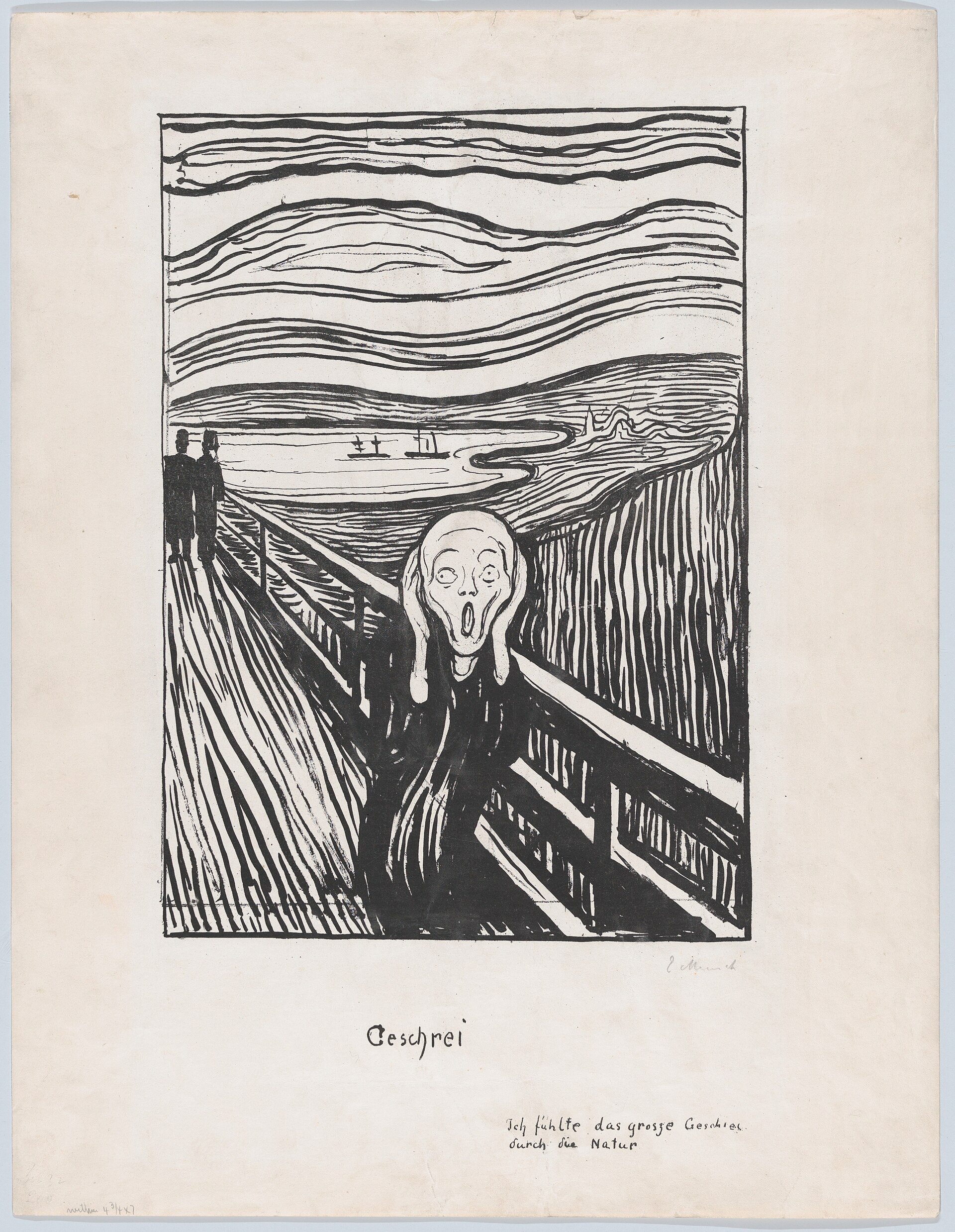
The Scream
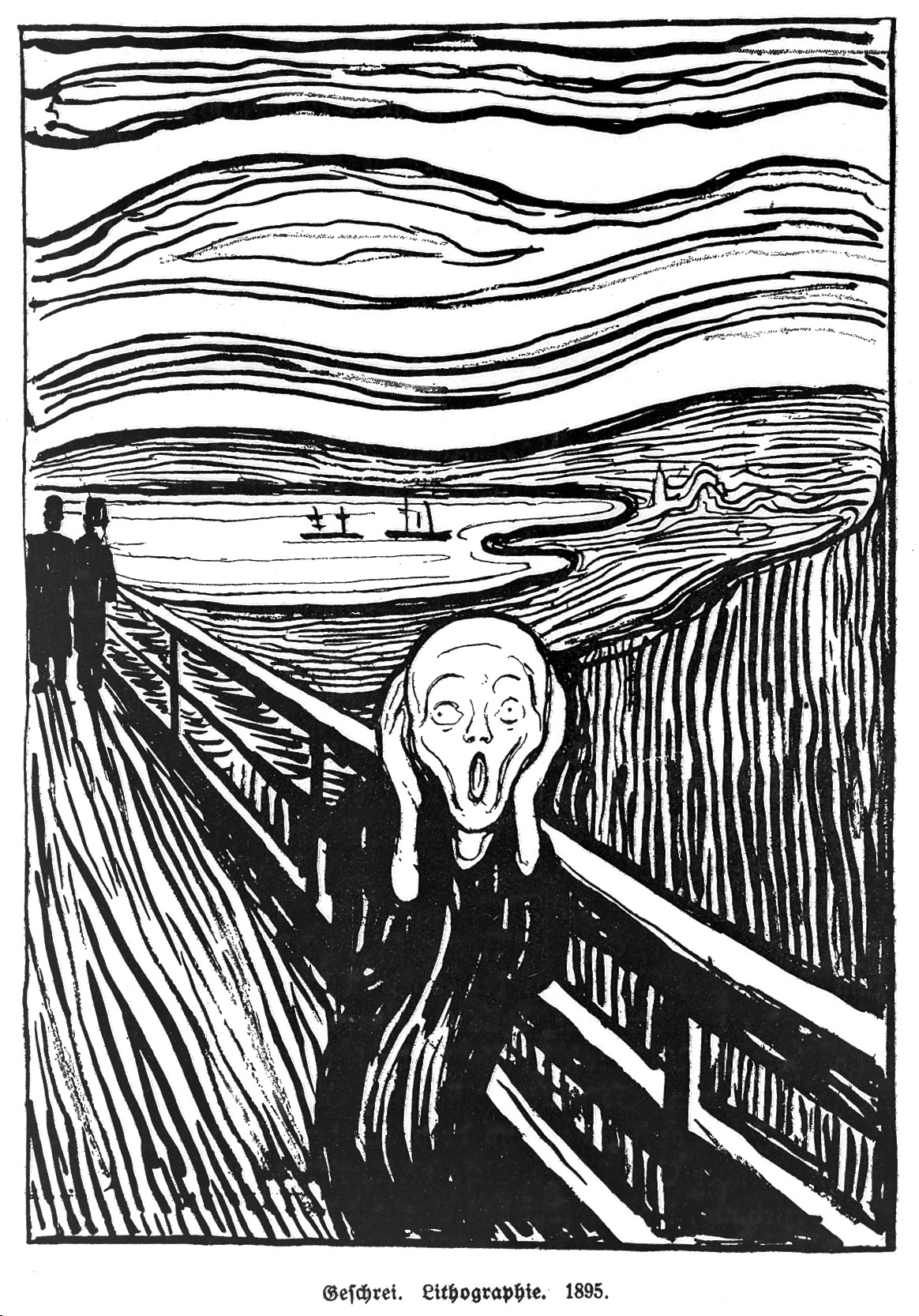
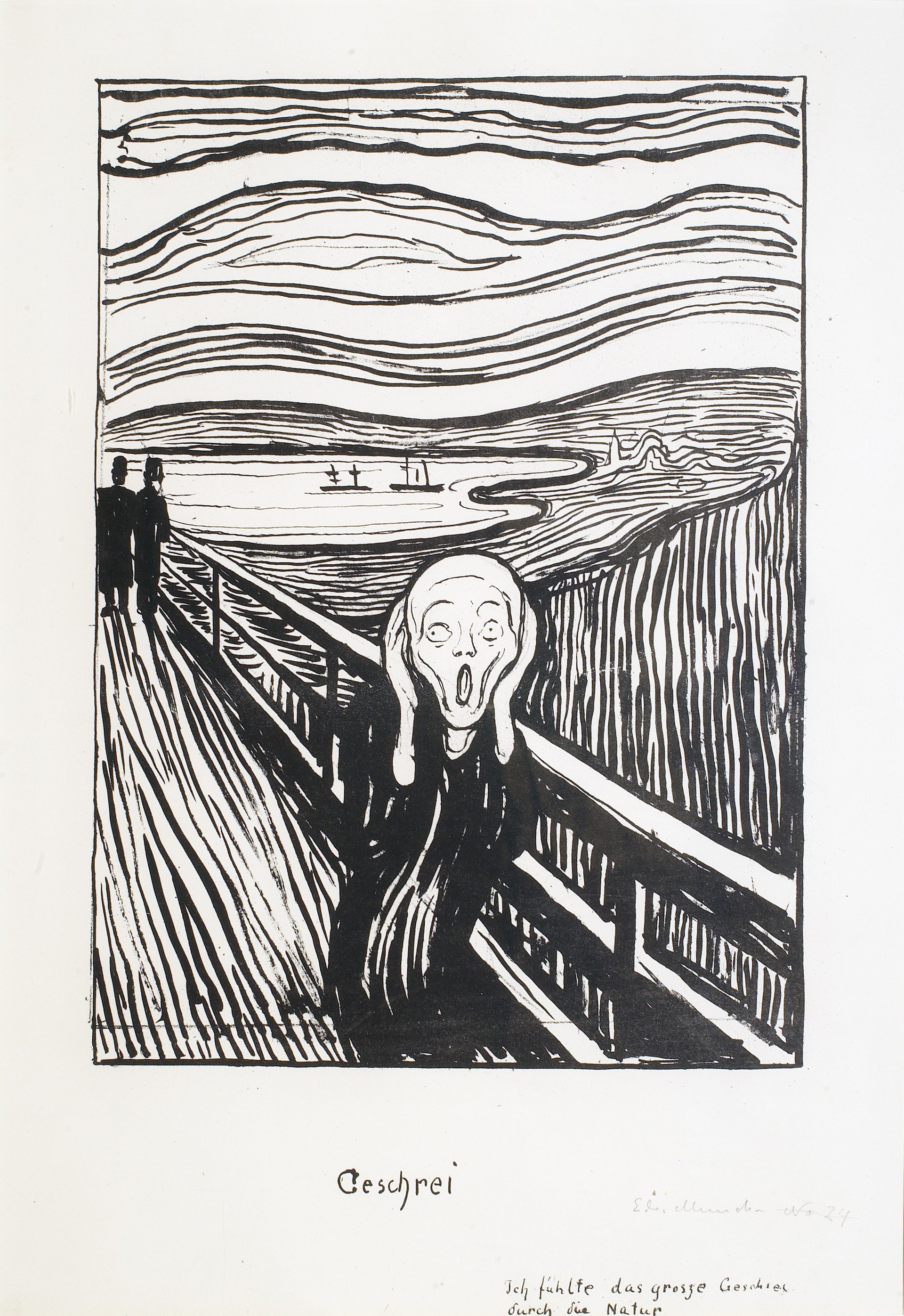
1895 · Lithograph in black ink on wove paper
Metropolitan Museum of Art, New York
 Norwegian · 1863-1944
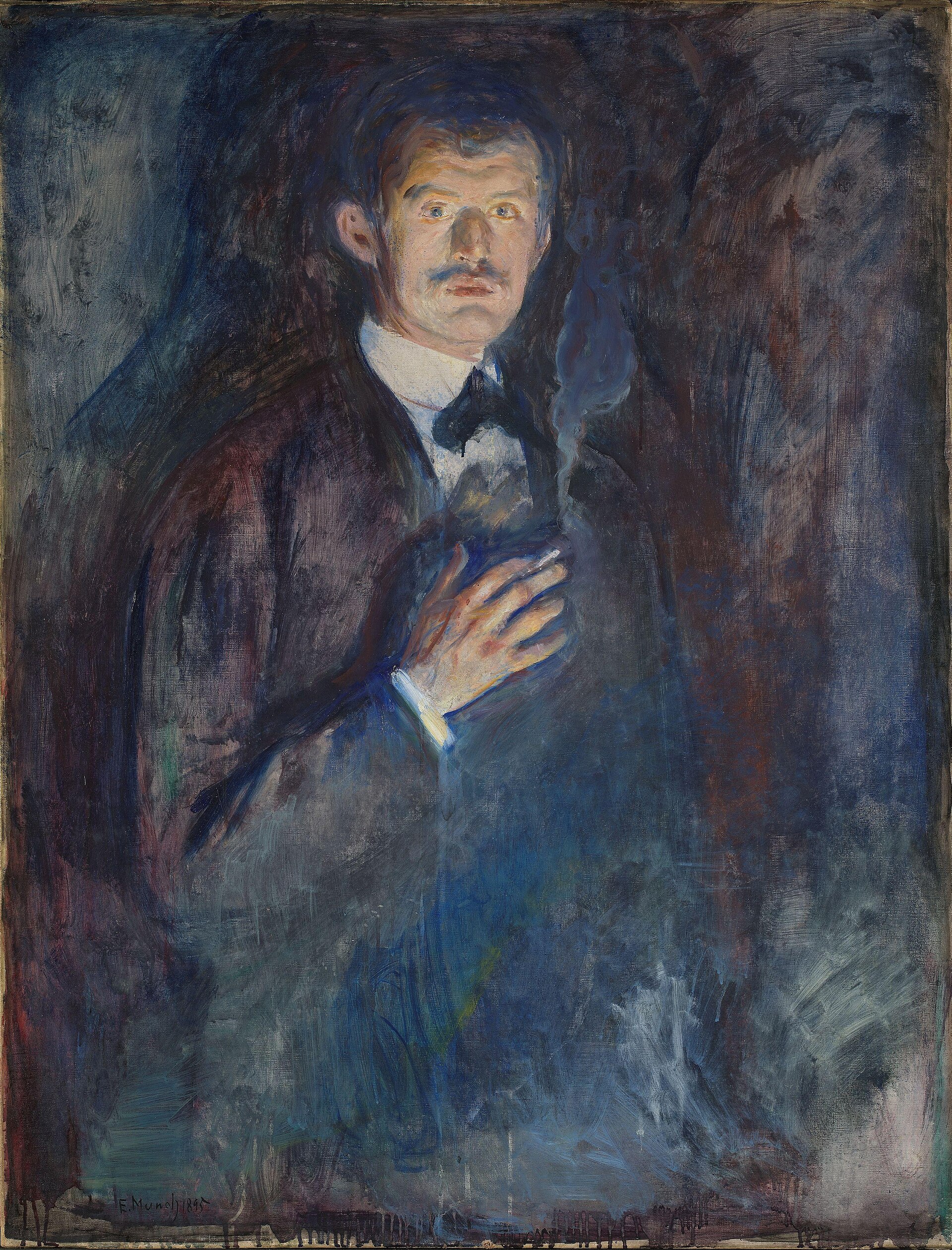
Self-Portrait with Cigarette, 1895, National Museum of Norway (NG.M.00470). Painted the same year as the Scream lithograph and the pastel version later sold in 2012. Firmly identified as Munch's own self-portrait, not a contested sitter identification.
National Museum of Art, Architecture and Design, Oslo| Worked as | Painter, Printmaker, Lithographer, Woodcut artist |
|---|---|
| Born | 12 December 1863 · Adalsbruk, Loten, Norway |
| Died | 23 January 1944 · Ekely, near Oslo, Norway |
| Nationality | Norwegian |
| Movement | Symbolism, forerunner of Expressionism |
| In this archive | 1 artwork |
| Sources | 20 cited |
| Last verified |
About this page 1 artwork in the archive · Last verified · 20 sources cited
Edvard Munch painted four versions of the single image that made him famous, sold none of the two most valuable ones (they were stolen from state collections instead), and inscribed one of them in pencil with a note calling its own painter a madman. The movement his name is most attached to does not appear on his own account of how the picture was made: he wrote in his diary that he heard a scream pass through nature and painted the sky the colour of the sound.
What a reader is less likely to already know is how contested the object itself is. There is no single Scream. There are two paintings, in tempera and in pastel, one crayon drawing, and a lithograph printed in an edition of roughly forty-five before Munch let the stone be resurfaced, plus an unknown number of the artist's own later hand-colourings of black-and-white impressions. Each lives in a different city under a different security regime, for a reason: two of them have already been stolen once, in two separate armed and unarmed raids a decade apart, both recovered, both still bearing the physical damage of the theft.
The record our own object belongs to, a 1895 lithograph now in the Metropolitan Museum, is one print pulled from that small edition. This page exists to place it inside the whole corpus: which Scream is which, where each one has been, what has happened to it, and what in Munch's biography and reading actually produced the image, as distinct from what later readers decided it meant.
Born 12 December in Adalsbruk, Loten, Norway.3
His mother, Laura Cathrine Munch, dies of tuberculosis; Munch is five.1
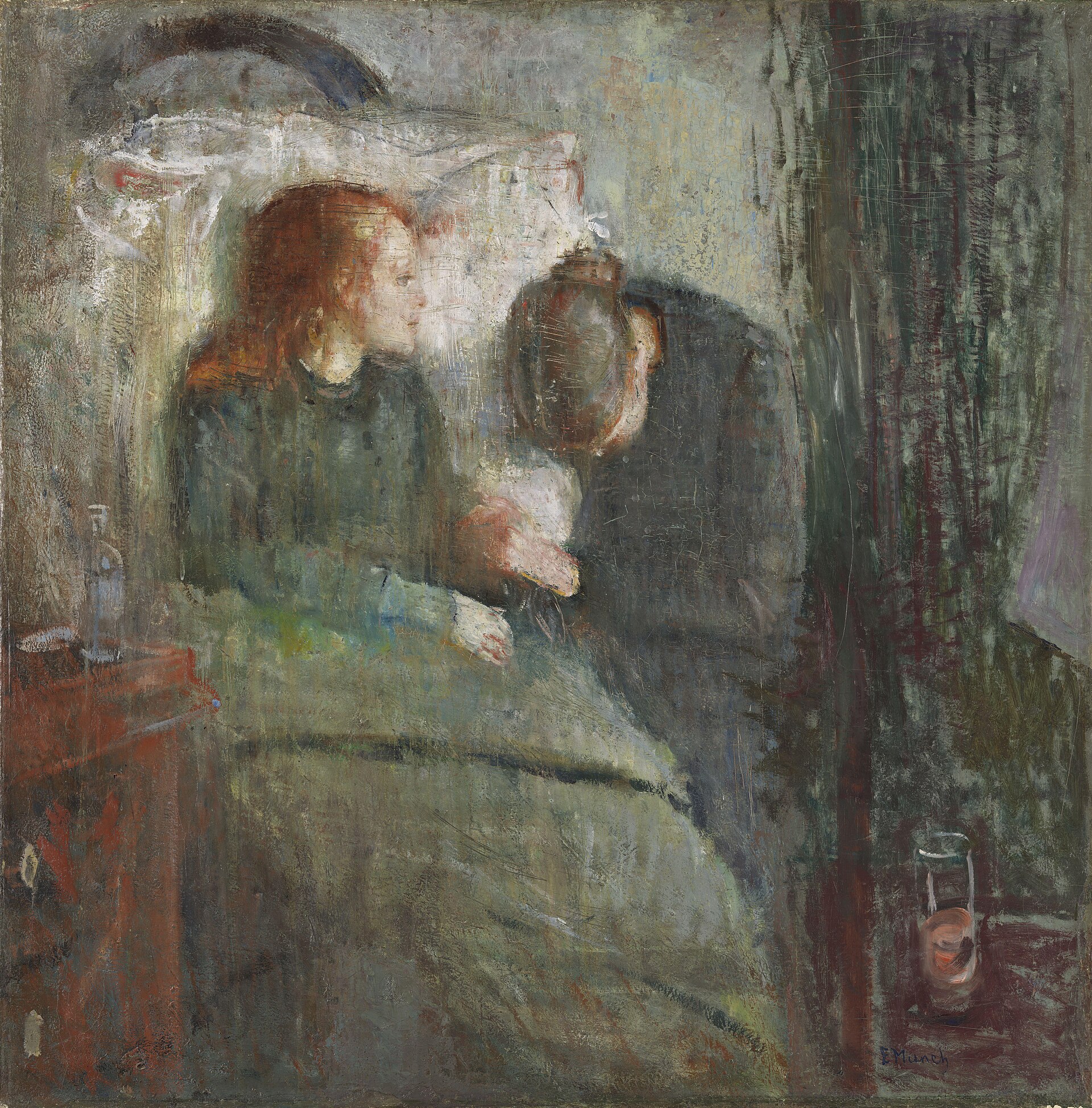
His sister Johanne Sophie Munch dies of tuberculosis at fifteen; Munch is fourteen. He returns to the subject in The Sick Child for over forty years.19
Enrolls at the Royal School of Art and Design, Kristiania; studies partly under Christian Krohg.3
Draws his first version of The Sick Child, based on his sister's death.19
First solo exhibition, Kristiania.3
In Paris; possibly saw the Chachapoya mummy exhibited at the Exposition Universelle, later argued by Robert Rosenblum (1978) as a source for The Scream's figure.20
22 January diary entry, written in Nice, records the walk and the sensed scream that becomes the picture's subject.2
5 November, exhibition of 55 works opens at the Verein Berliner Kunstler, Berlin; closed within about a week after a backlash from union members. Munch settles in Berlin.2
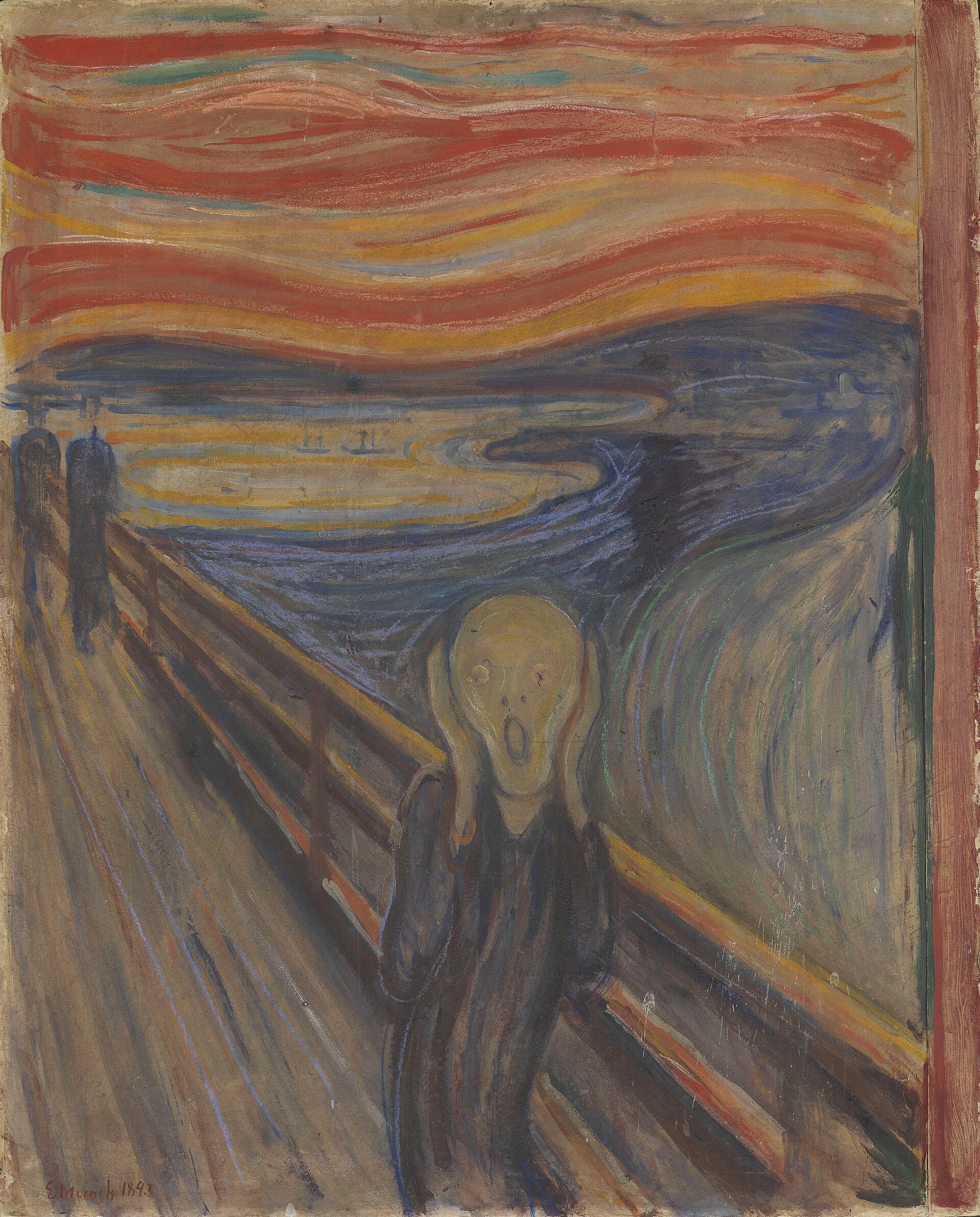
Paints the tempera and crayon Scream (now National Museum of Norway, NG.M.00939) and a crayon version (Munch Museum).2
Begins printmaking seriously, in etching and lithography.14
Draws The Scream directly onto a lithographic stone; roughly forty-five impressions printed before the stone is resurfaced. Paints the pastel version later sold in 2012. Exhibits the first Frieze of Life at Ugo Barroccio's gallery, Berlin, in March.102
Berlin Secession exhibition: Munch designs the hang himself, showing the Frieze of Life as a continuous sequence for the first time.2
Paints a further tempera version of The Scream (Munch Museum) - the version stolen in 2004.2
Suffers a breakdown; voluntarily enters Dr Daniel Jacobson's clinic, Copenhagen, for approximately eight months of rest, diet and non-convulsive electrotherapy.318
Buys the Ekely estate outside Oslo; completes murals for the University of Oslo's Aula.3
Revises his will, bequeathing nearly all remaining work to the City of Oslo, prompted by concern for its safety under German occupation.3
Dies 23 January at Ekely, aged 80.3
The Munch Museum opens in Oslo, built around the 1940 bequest.1
12 February, the National Museum's 1893 tempera Scream is stolen in a ladder break-in; recovered undamaged 7 May via a British-Norwegian police sting.45
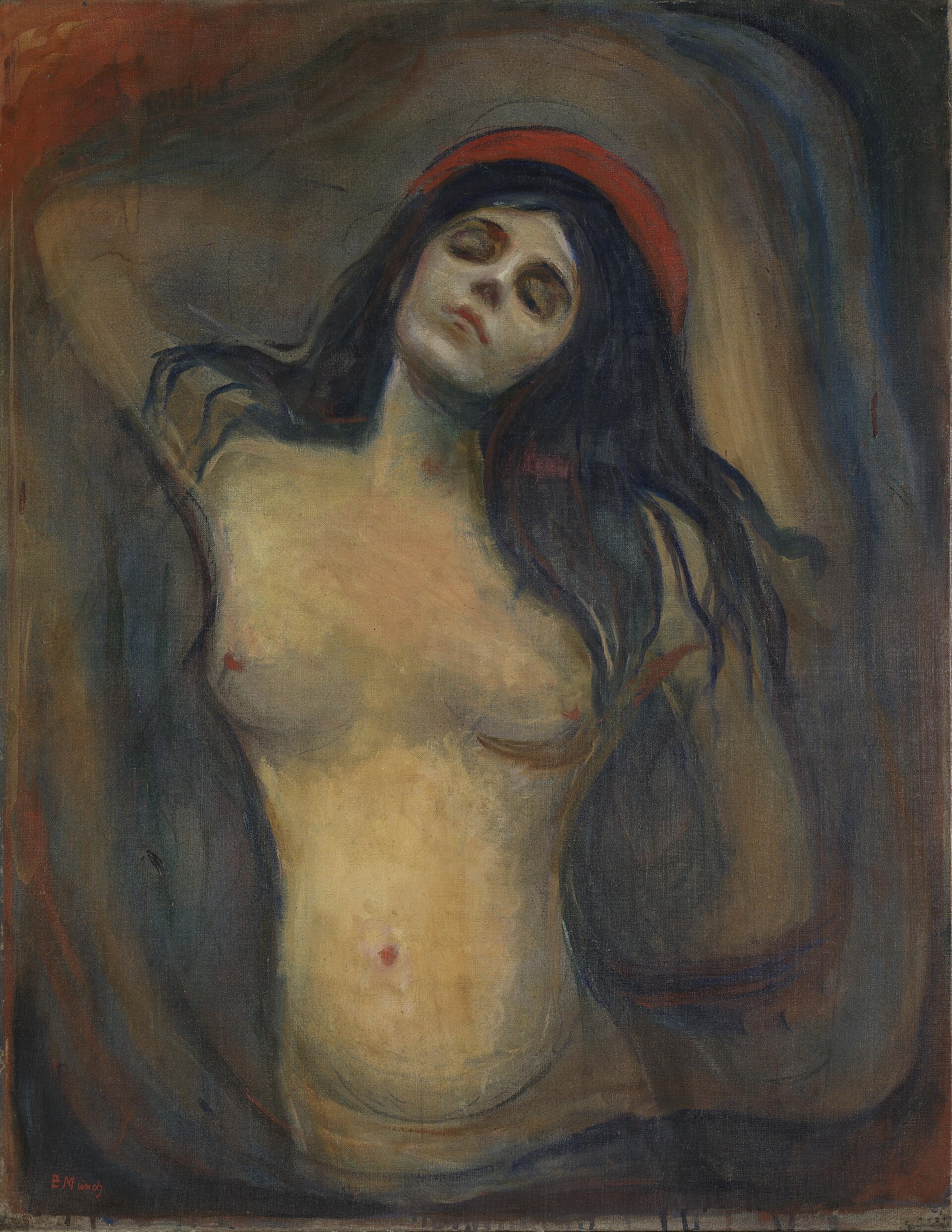
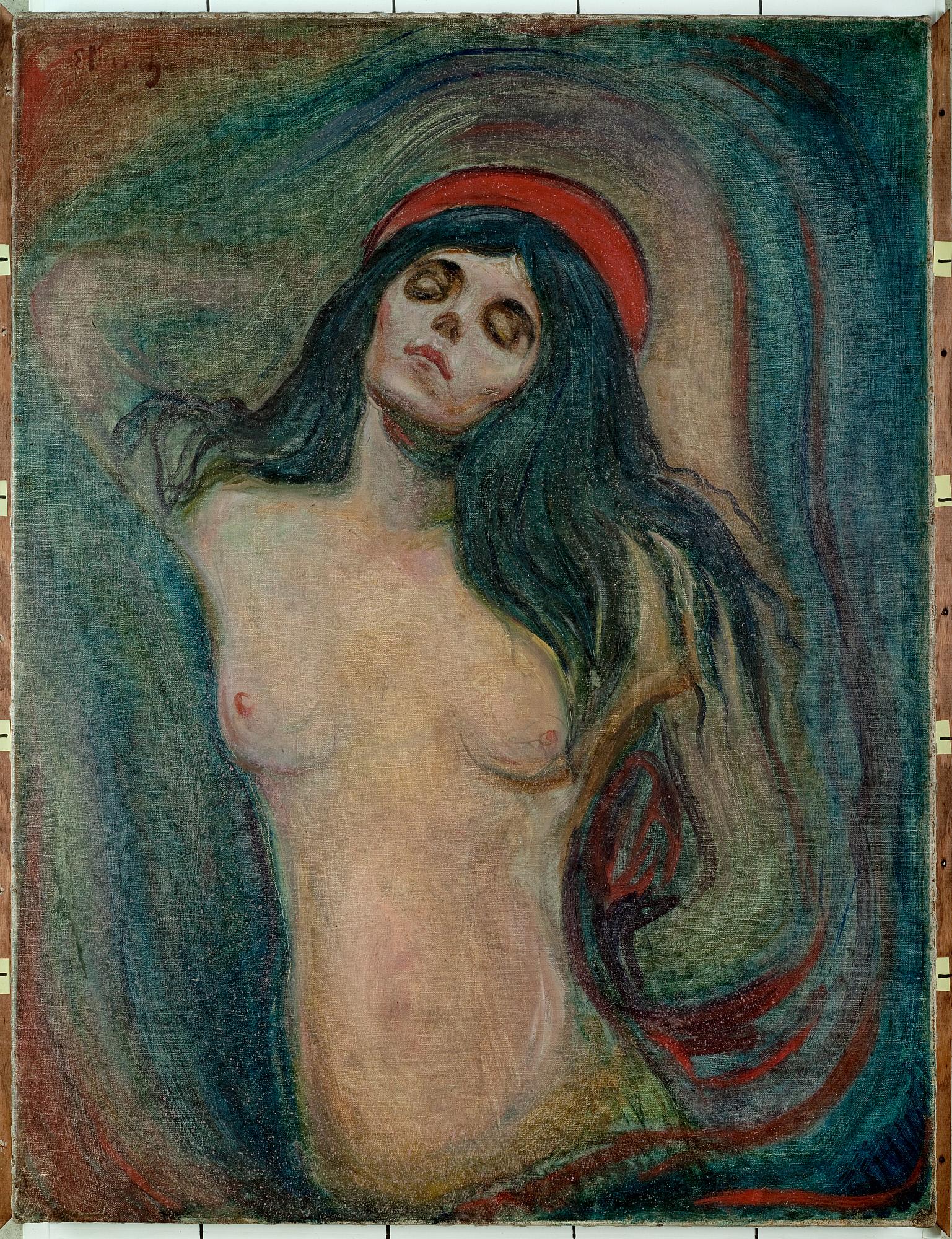
22 August, armed men steal the 1910 Scream and the Munch Museum's Madonna in a daylight raid; both recovered 31 August 2006, both damaged.67
2 May, the 1895 pastel Scream sells at Sotheby's New York for a hammer of 107,000,000 US dollars, 119,922,500 with premium, then an auction record for any work of art.89
National Museum of Norway publishes infrared findings confirming the 'painted by a madman' pencil inscription on the 1893 tempera is in Munch's own hand.11
The market in Munch's work runs on two entirely different tracks that are frequently confused in reporting. The unique paintings - above all the four Scream originals and other Frieze of Life subjects such as Madonna and Vampire - trade rarely, in the low tens of millions at auction for a strong minor subject up to the single unrepeated 107 million dollar hammer for the 1895 pastel Scream in 2012, the only one of the four to have remained in private hands. The prints, by contrast, come to market regularly: lithograph and woodcut impressions of common subjects can be found in the low five to six figures, while a fine, well-provenanced impression of The Scream lithograph specifically - a rarer, more sought subject within the print oeuvre - has made seven figures at least once, in the GBP 1,500,000 result reported for a 2016 Sotheby's sale.
| Date | Sale | Work | Result | Note |
|---|---|---|---|---|
| 2 May 2012 | Sotheby's | The Scream (1895, pastel on board) | Hammer USD 107,000,000 With premium USD 119,922,500 total with buyer's premium USD | Then the highest hammer price and highest total price ever paid for a work of art at auction. Pre-sale estimate approximately USD 80,000,000. Buyer not disclosed by Sotheby's at the time; later press identification of the purchaser is unverified by this publication. |
| 2016 | Sotheby's | The Scream (1895 lithograph, black-and-white impression) | Hammer not separately reported in sources consulted With premium GBP 1,500,000 reported total GBP | Reported in secondary art-market coverage as a total price; this publication has not located the Sotheby's lot record itself and flags the figure for verification and for hammer/premium separation against the primary sale result. |
Hammer is the price at which the bidding stopped; with premium adds the fee the house charges the buyer on top. Hammer price and buyer's premium in the glossary.
| Institution | City | Holdings | Note |
|---|---|---|---|
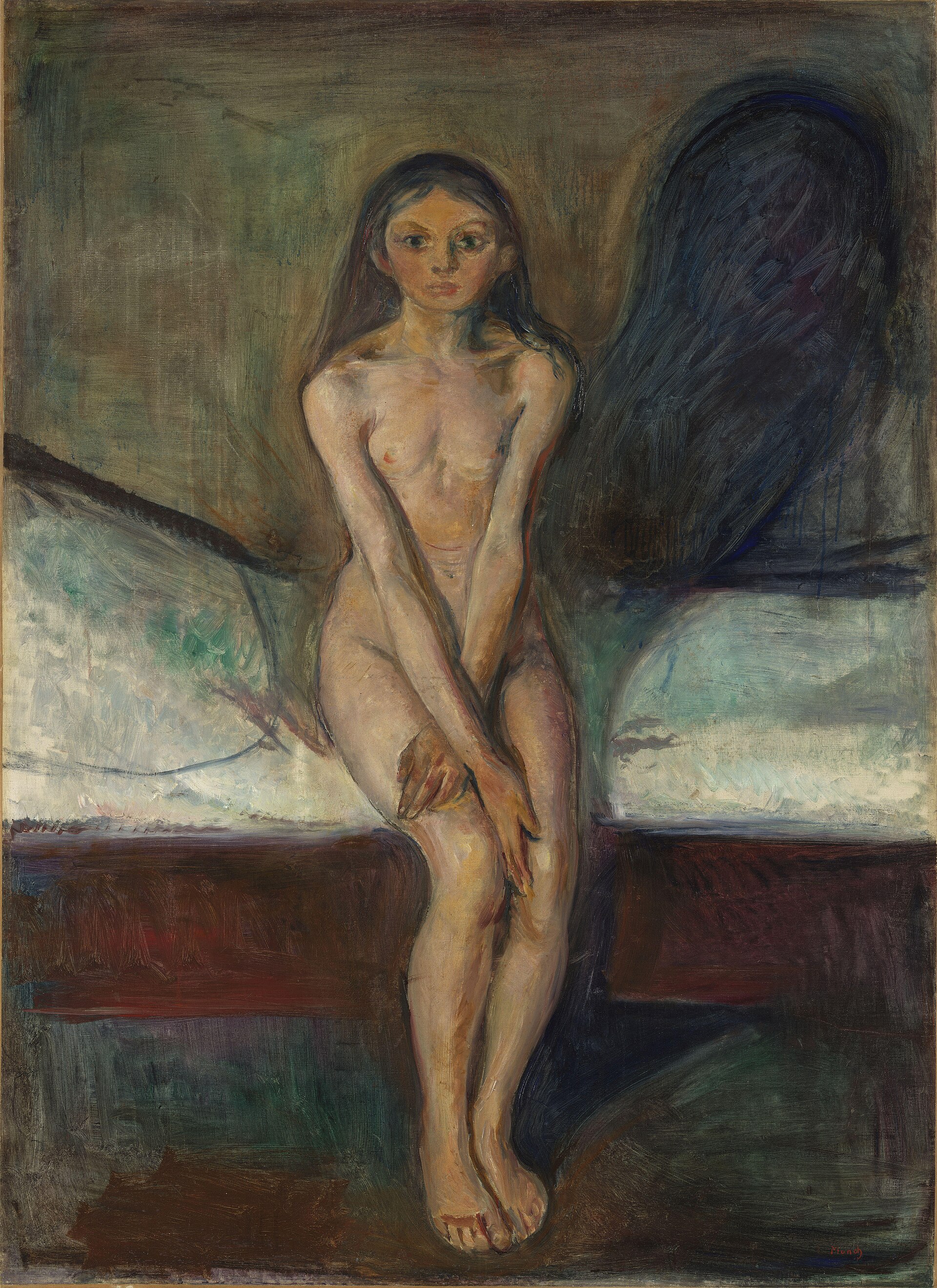
| National Museum of Norway (Nasjonalmuseet) | Oslo | The 1893 tempera and crayon Scream (NG.M.00939), the 1894 Madonna (NG.M.00841), the 1885-86 first version of The Sick Child (NG.M.00839), and the 1895 Puberty (NG.M.00807), among others. | Formerly the National Gallery of Norway; the Scream and Madonna are usually on permanent gallery display. |
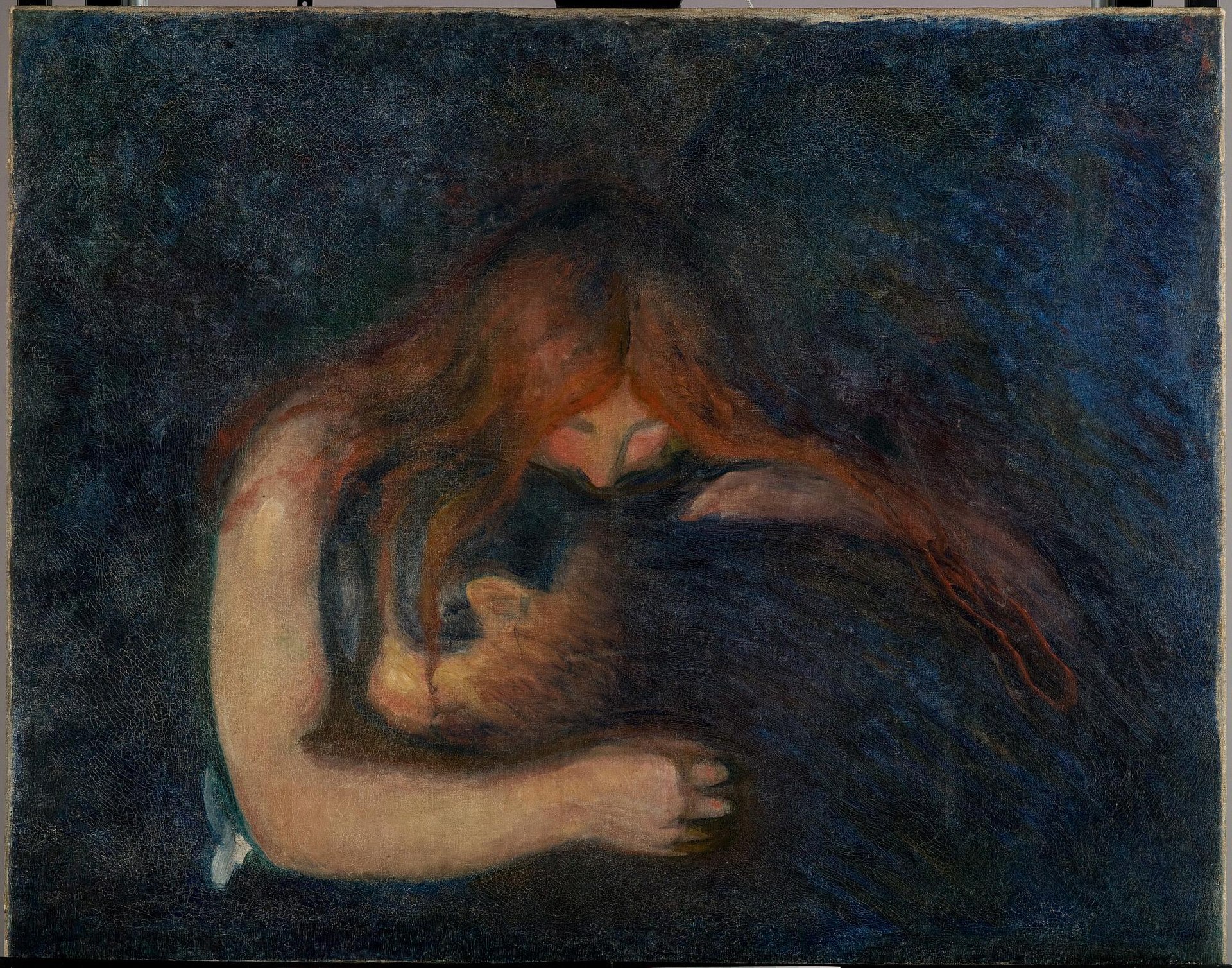
| Munch Museum (Munchmuseet) | Oslo | The bulk of the 1940 bequest: a second 1893 Scream (crayon), the 1910 tempera Scream, the Munch Museum's own Madonna (MM.M.00068), Vampire (MM.M.00292), a later Puberty (MM.M.00450), and the graphic-works archive of some 18,000 prints. | Purpose-built as the repository of Munch's own estate; relocated to a new building at Bjorvika in 2021. |
| Metropolitan Museum of Art | New York | A hand-inked black impression of the 1895 Scream lithograph, accession 1984.1203.1 - the object behind this publication's own record. | |
| Thielska Galleriet | Stockholm | A Scream lithograph impression and Munch's portrait of Friedrich Nietzsche, from the private collection of the banker Ernest Thiel, a patron who commissioned the Nietzsche portrait and separately funded the Nietzsche Archive in Weimar. | |
| Staatsgalerie Stuttgart | Stuttgart | A Scream lithograph impression. | |
| Wellcome Collection | London | A Scream lithograph impression, held within the Wellcome Library's historical medical-art holdings. |
Munch made the composition now called The Scream (Norwegian: Skrik) in four distinct physical objects between 1893 and 1910, in three different media, plus a print.
Munch made the composition now called The Scream (Norwegian: Skrik) in four distinct physical objects between 1893 and 1910, in three different media, plus a print. The first, in tempera and crayon on cardboard, 91 by 73.5 centimetres, is dated 1893 and belongs to the National Museum of Norway (formerly the National Gallery), Oslo, inventory NG.M.00939. A second, worked in crayon on cardboard the same year, belongs to the Munch Museum, Oslo. A third, in pastel on board, is dated 1895; it passed through a single private hand for most of the twentieth century and was sold at Sotheby's New York in May 2012, where it set the auction record of its day. A fourth, a tempera on board dated about 1910, belongs to the Munch Museum and is the one taken in the 2004 armed robbery.
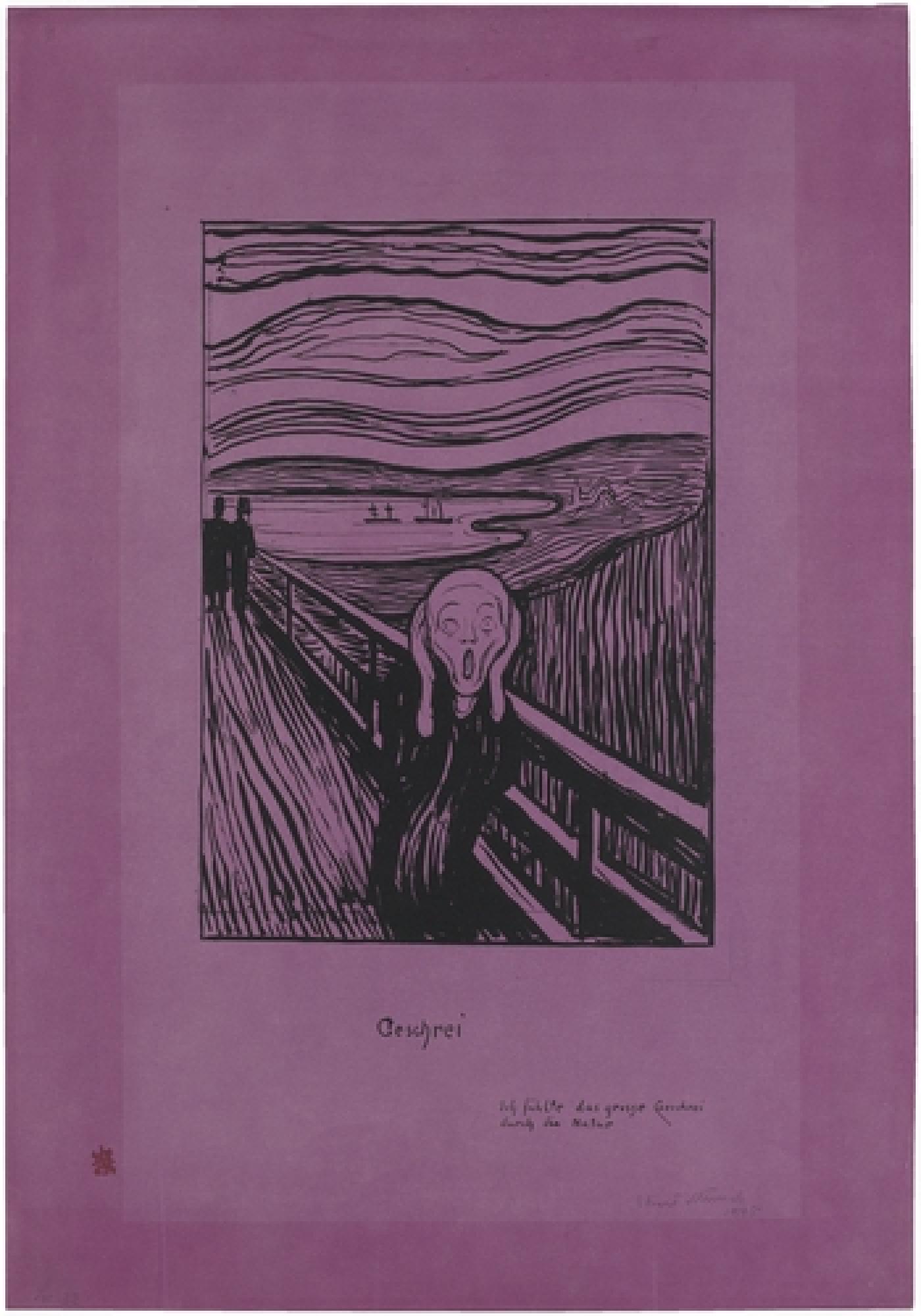
Alongside the four unique originals, Munch drew the composition onto a lithographic stone in 1895 and printed it in black and white; the standard account of the edition, repeated by dealers handling impressions at auction, puts the run at roughly forty-five sheets before the stone was resurfaced, some of which Munch later hand-coloured individually in watercolour or crayon, so that no two coloured lithograph impressions are identical. The Metropolitan Museum's 1984.1203.1, the object behind this publication's own record, is one sheet from that print run rather than a copy of any single painted version - the lithograph is its own original, drawn directly onto the stone, not a reproduction of the 1893 tempera.
Reporting on any single Scream sale or theft routinely drops this distinction, describing whichever version is in the news as though it were the only one. A reader comparing our gallery of five plates against any other Scream story should expect the object identified by inventory number and holding institution, not by the title alone.
Munch's own account survives in more than one version, in his diaries and later transcribed onto the frame of the 1895 pastel itself.
Munch's own account survives in more than one version, in his diaries and later transcribed onto the frame of the 1895 pastel itself. The clearest is a diary entry he dated to 22 January 1892, written in Nice: he was walking along a path with the city on one side and the fjord below, the sun setting, the sky turning blood red; he stopped, exhausted, and sensed a scream passing through nature, so vivid that he felt he heard it. He wrote that he painted the clouds as actual blood, and that the colour shrieked.
A longer, more anguished version of the same memory is inscribed by Munch's own hand in pencil on the frame of the 1895 pastel: walking with two friends, the sky suddenly blood red, leaning on a fence trembling with anxiety while his friends walked on, sensing an infinite scream passing through nature. Both texts describe an episode of acute anxiety triggered by a sunset seen from a specific path above Oslo, near the later site of an abattoir and a mental asylum; scholars connect the surroundings to Munch's own family history of mental illness, documented in his diaries and letters, without claiming the picture is a clinical self-portrait.
In 1978 the art historian Robert Rosenblum proposed, in Symbols and Images of Edvard Munch, that the screaming figure's form derives from a Chachapoya mummy from Peru that was exhibited at the 1889 Exposition Universelle in Paris and that Munch is placed in Paris at the right period to have seen, alongside Paul Gauguin, who used the same mummy as a source for more than twenty of his own works. This is an argued position, held by Rosenblum and repeated by later writers on the mummy's afterlife in European art, not a documented fact: no letter or diary entry of Munch's names the mummy, and the resemblance is visual. The house position on this page is to record it as Rosenblum's argument and Munch's own diary account as the documented one, not to average the two into a single origin story.
Infrared examination by the National Museum of Norway, published in 2021 ahead of a major Munch exhibition, established that a faint pencil inscription in the top left corner of the 1893 tempera...
Infrared examination by the National Museum of Norway, published in 2021 ahead of a major Munch exhibition, established that a faint pencil inscription in the top left corner of the 1893 tempera version reads, in Norwegian, that the work could only have been painted by a madman. The handwriting is Munch's own. Curators date the addition to around 1895, after the picture had already been exhibited publicly in Kristiania to a hostile reception that Munch recorded feeling wounded by in his diaries.
The inscription is on this specific object, the National Museum's tempera, and on no other version - it does not appear on the Munch Museum crayon or tempera versions, nor on the pastel sold in 2012, whose own inscription is the longer diary-style poem on its frame rather than a note about the artist's sanity. The two inscriptions are frequently conflated in popular writing about the picture; they are on different objects and say different things.
On 12 February 1994, the same morning the Winter Olympics opened in Lillehammer, two men used a ladder to reach a second-floor window of the National Gallery in Oslo, broke in, and cut the 1893...
On 12 February 1994, the same morning the Winter Olympics opened in Lillehammer, two men used a ladder to reach a second-floor window of the National Gallery in Oslo, broke in, and cut the 1893 tempera Scream from its mount, leaving a note reading Thanks for the poor security. The theft took under a minute and the museum's alarm, once triggered, brought no response in time to stop it.
The thieves demanded a ransom of roughly one million US dollars; the Norwegian state refused to pay. Norwegian police, working with the British Metropolitan Police's art squad, ran a sting in which undercover officers posed as buyers willing to pay the sum. The painting was recovered undamaged on 7 May 1994 from a hotel room in Asgardstrand, the coastal town south of Oslo where Munch had kept a house. Several men were convicted, including Paal Enger, who received a sentence of roughly six and a half years and had a previous conviction for stealing a different Munch painting, Vampire, in 1988.
On 22 August 2004, two masked men entered the Munch Museum in Oslo in broad daylight, one carrying a handgun, and pulled the 1910 tempera Scream and the Munch Museum's own version of Madonna from the...
On 22 August 2004, two masked men entered the Munch Museum in Oslo in broad daylight, one carrying a handgun, and pulled the 1910 tempera Scream and the Munch Museum's own version of Madonna from the wall in front of visitors and staff before escaping in a car. Unlike the 1994 theft, this one was witnessed directly and was captured on the museum's own security cameras.
Both paintings remained missing for two years, with no confirmed sighting and periodic fears among investigators that they had been damaged, destroyed, or broken up for parts of the frame's gold trim. Norwegian police recovered both works on 31 August 2006; officers did not disclose the exact circumstances of the recovery beyond stating that both pictures had stayed inside Norway throughout. Both had suffered real physical damage in the two years of concealment: moisture damage to the lower left corner of the Scream and several tears plus two small holes in Madonna's arm, later stabilised by museum conservators. In 2006, before the paintings were found, six men were tried for the robbery and three were convicted and sentenced to prison terms of four to eight years for driving, providing the getaway car, or planning the raid: Bjoern Hoen received seven years, Petter Tharaldsen eight, and Petter Rosenvinge four. The identity of whoever physically held and returned the paintings during the two missing years has not been established in the public record.
From the early 1890s Munch worked toward assembling his most personal pictures into a single continuous sequence he eventually called the Frieze of Life, a cycle intended to be walked through and...
From the early 1890s Munch worked toward assembling his most personal pictures into a single continuous sequence he eventually called the Frieze of Life, a cycle intended to be walked through and read as one connected statement on love, anxiety and death rather than viewed as separate finished paintings. He first showed a self-contained group under the title A Human Life at the end of 1893 in Berlin, then a fuller Frieze of Life at Ugo Barroccio's gallery in Berlin in March 1895.
The decisive installation came at the Berlin Secession in 1902, where for the first time Munch designed the hanging himself so the pictures ran continuously around the walls of the antechamber, divided into sections he grouped loosely around the seed of love, the flowering and passing of love, life anxiety, and death - The Scream sits in the anxiety section alongside Despair and Anxiety, other paintings from the same walk and the same sky. He showed further versions of the cycle at Blomqvist in Kristiania in 1903 and 1904. Munch never fixed a single canonical Frieze of Life; the roster of which pictures belonged in it, and in what order, changed across each exhibition he mounted, and no complete original hang survives intact in one place - the National Museum in Oslo maintains a permanent room reconstructing the sequence from the works it holds.
Munch enrolled at the Royal School of Art and Design in Kristiania in 1881, where the naturalist painter Christian Krohg was among his teachers.
Munch enrolled at the Royal School of Art and Design in Kristiania in 1881, where the naturalist painter Christian Krohg was among his teachers. Through Krohg's circle he was drawn into the Kristiania Bohemians, a group of writers and artists centred on the nihilist Hans Jaeger, whose 1885 novel Fra Kristiania-Bohemen was seized and banned for obscenity and blasphemy shortly after publication, and who served jail time over it.
Munch later wrote plainly that his ideas developed under the bohemians, or rather under Jaeger specifically, who urged him to stop painting what he saw and instead paint what he had lived - to put his own nervous and emotional state directly onto the canvas, a programme sometimes summarised as soul painting. The group's satirical Nine Commandments, printed in the journal Impressionisten in February 1889 and popularly but disputedly attributed to Jaeger himself, called among other things for writing one's own life and for taking one's own life as the final bohemian act; Jaeger's closest associate Hans Christian Blich later did shoot himself in 1889, in circumstances the group's own writings connected to the code. This is the documented intellectual milieu Munch is describing when he later called his art an accounting of his own life, and it sits directly behind the diary-entry method he used for The Scream: recording an experienced episode of dread as a physical event in paint rather than as an illustrated idea.
In November 1892, at 28, Munch was invited to show 55 works at the Verein Berliner Kunstler, the established Union of Berlin Artists.
In November 1892, at 28, Munch was invited to show 55 works at the Verein Berliner Kunstler, the established Union of Berlin Artists. The exhibition, which opened on 5 November, provoked a backlash among the union's own more conservative members, who voted to close it after roughly a week, calling the work repugnant, ugly and offensive to established taste. The press dubbed the episode the Munch Affair.
Munch, by his own later account, found the whole controversy more amusing than wounding, and the closure made him a name in Berlin rather than an outsider to it: he settled in the city for most of the following sixteen years. The union's internal split over the closure fed directly into the formation of the Verein der XI and, within a few years, the Berlin Secession, so the scandal that shut Munch's own show is counted among the direct causes of the exhibiting body that gave his generation of German and Scandinavian painters an alternative to the official academy.
Technical analysis of the 1910 Scream (the Munch Museum's tempera, the version stolen in 2004), published using non-invasive spectroscopy and synchrotron X-ray techniques, established that Munch...
Technical analysis of the 1910 Scream (the Munch Museum's tempera, the version stolen in 2004), published using non-invasive spectroscopy and synchrotron X-ray techniques, established that Munch painted with cadmium sulfide yellows and other synthetic pigments applied in thin, unvarnished layers, and that the bright cadmium yellow sky and lake have measurably degraded, oxidising in places to a pale, flattened cadmium sulfate that has lost most of its original saturation. Researchers found moisture, not light, to be the primary driver of that degradation, which reopened a long-running debate about whether the surface condition of Munch's paintings is accidental or intentional.
Some conservators and scholars have argued Munch exposed paintings to snow and rain deliberately, calling it a kill-or-cure treatment consistent with his own recorded contempt for finish and varnish; others hold the more probable explanation is that the pictures suffered ordinary weathering from years of storage in Munch's own draughty, unheated outdoor studios at Ekely and elsewhere, where he is documented to have left canvases stacked outside for extended periods. Both positions are held by named conservators in the technical literature and neither is proven to the exclusion of the other; this page records both rather than picking one, because the paint chemistry evidence supports either origin equally.
Munch took up printmaking seriously from 1894, working in etching, lithography and, from 1896, woodcut, and produced several hundred distinct print compositions across those media over the rest of...
Munch took up printmaking seriously from 1894, working in etching, lithography and, from 1896, woodcut, and produced several hundred distinct print compositions across those media over the rest of his career; when he died his estate's holdings of prints, bequeathed with the rest of his studio contents to the City of Oslo, ran to roughly 18,000 individual sheets. In woodcut he developed a jigsaw method unusual for the medium: sawing the block into interlocking pieces with a fretsaw, inking each piece a different colour separately, then reassembling the pieces like a puzzle and printing the whole composite block in a single pass, which let him print flat, unmodulated fields of colour with a hairline of bare paper between them rather than the overlaid colour separations other printmakers used - visible in prints such as Two Human Beings (The Lonely Ones) and Moonlight, where the white line between figures reads as a literal gap of isolation.
The Scream lithograph is a drawn original on stone rather than a reproduction of a painted version, made in 1895 and, on the standard dealer account repeated at auction, printed in a run of roughly forty-five sheets in black before the stone was resurfaced; an unknown further number were hand-coloured individually by Munch afterward, so no two coloured sheets match exactly. Impressions come to market irregularly rather than on any published index. A black-and-white lithograph impression sold at Sotheby's in 2016 for GBP 1,500,000; other individual impressions have been estimated in dealer and auction-house material in the GBP 800,000 to 1,200,000 range depending on condition, edition state (with or without the printed text and title) and whether the sheet was hand-coloured. This publication has not independently verified a complete, publicly available auction record for every impression sold and treats the individual prices above as reported by the auction houses and dealers who handled those specific lots, flagged for replacement with the primary sale records.
By late 1908 Munch, then living an itinerant life across Germany, Norway and France, and drinking heavily by his own and contemporaries' accounts, was suffering hallucinations, delusions of...
By late 1908 Munch, then living an itinerant life across Germany, Norway and France, and drinking heavily by his own and contemporaries' accounts, was suffering hallucinations, delusions of persecution, and physical symptoms including partial paralysis on one side of his body. He voluntarily admitted himself to the private nerve clinic of the psychiatrist Daniel Jacobson in Copenhagen, where he remained for roughly eight months. Treatment there followed the clinic's standard regimen of rest, diet, massage, and non-convulsive electrotherapy; Jacobson allowed him to keep drawing, painting and taking photographs once he had stabilised, and Munch made a portrait of Jacobson and a small sketch of himself undergoing an electrotherapy session, both now held with the Munch Museum's holdings. Munch maintained sustained sobriety during the stay for what contemporaries described as the first time in years.
He did not return to the acute, exposed-nerve subject matter of the Frieze of Life period after the clinic; his later work runs to landscapes, portraits of patrons and public commissions, most visibly the Oslo University Aula murals completed in 1916. This page reports the 1908-09 episode as Munch's documented clinical history, not as a diagnosis retrospectively applied to any specific earlier painting: no source establishes that The Scream depicts a specific clinical episode rather than the anxiety attack Munch describes in his own diary fifteen years before the breakdown.
The most substantial documented forgery case involving Munch's name is recent and Spanish.
The most substantial documented forgery case involving Munch's name is recent and Spanish. A collector, Guillermo Chamorro, consigned 29 works attributed to Munch, Saul Steinberg and Roy Lichtenstein, including several purported Scream-related pieces collectively valued in press reporting at 250,000 to 300,000 euros, to the Hampel Fine Art auction house in Munich. Suspicion raised by Munch's estate led to seizure by police; experts identified inconsistencies including calligraphy on the purported Munch works that did not match Munch's documented hand elsewhere. A Spanish provincial court convicted Chamorro of fraud and intellectual-property offences and sentenced him to four years in prison, a sentence upheld on later appeal reporting.
An earlier case, in 1985, involved a forged painting submitted to a major Stockholm auction house accompanied by a fabricated certificate of authenticity purporting to be signed by John H. Langeland, then executive director of the Munch Museum, with Langeland's own signature forged onto the document; this publication has not located a primary account naming the specific painting or its eventual disposition and flags the episode for further verification. No forgery case located in researching this page involves any of the five works illustrated on this page's own gallery.
In 1940, with Norway under German occupation and Munch, then in his late seventies, concerned for the safety of his remaining studio contents at Ekely, he revised his will to leave nearly everything...
In 1940, with Norway under German occupation and Munch, then in his late seventies, concerned for the safety of his remaining studio contents at Ekely, he revised his will to leave nearly everything still in his possession to the City of Oslo rather than to any private heir. On his death in January 1944 the bequest was found to comprise roughly 1,100 paintings, 4,500 drawings and 18,000 prints, along with sketchbooks, letters, photographic negatives and sculpture, forming the founding collection of what became the Munch Museum when it opened in Oslo in 1963. The scale of the single-artist bequest is unusual among painters of Munch's rank precisely because so much of his most personal and experimental work, including studies never publicly exhibited in his lifetime, passed intact into public ownership at once rather than being dispersed through the trade over decades, which is part of why the Munch Museum, rather than an auction record, remains the primary evidentiary base for dating and authenticating his less exhibited work.
Painter; Printmaker; Lithographer; Woodcut artist. 1863-1944.
Born 12 December 1863, Adalsbruk, Loten, Norway; died 23 January 1944, Ekely, near Oslo, Norway.
Guillermo Chamorro, Spain, prosecuted 2020s. A Spanish collector consigned 29 works attributed to Munch, Saul Steinberg and Roy Lichtenstein, including several purported Scream-related pieces, to the Hampel Fine Art auction house in Munich, collectively valued in press reporting at EUR 250,000 to 300,000.
National Museum of Norway (Nasjonalmuseet) (Oslo); Munch Museum (Munchmuseet) (Oslo); Metropolitan Museum of Art (New York); Thielska Galleriet (Stockholm); Staatsgalerie Stuttgart (Stuttgart); Wellcome Collection (London).
The market in Munch's work runs on two entirely different tracks that are frequently confused in reporting. The unique paintings - above all the four Scream originals and other Frieze of Life subjects such as Madonna and Vampire - trade rarely, in the low tens of millions at auction for a strong minor subject up to the single unrepeated 107 million dollar hammer for the 1895 pastel Scream in 2012, the only one of the four to have remained in private hands.
Who physically held the two 2004-stolen paintings during the two years before their 2006 recovery? Norwegian police have never disclosed the circumstances of the recovery beyond stating both works remained in Norway throughout.
Last verified
One artwork and its story every Tuesday, with the picture: who owned it, what it made, and what closes soon in the exhibition calendar. No promotion, and nothing we cannot cite.
We send one email to confirm the address and keep nothing else. Every letter carries a one-click unsubscribe. How we handle your data.