Plate from the Society of the Cincinnati Service of George Washington
Chinese export porcelain workshops, Jingdezhen and Canton · ca. 1785
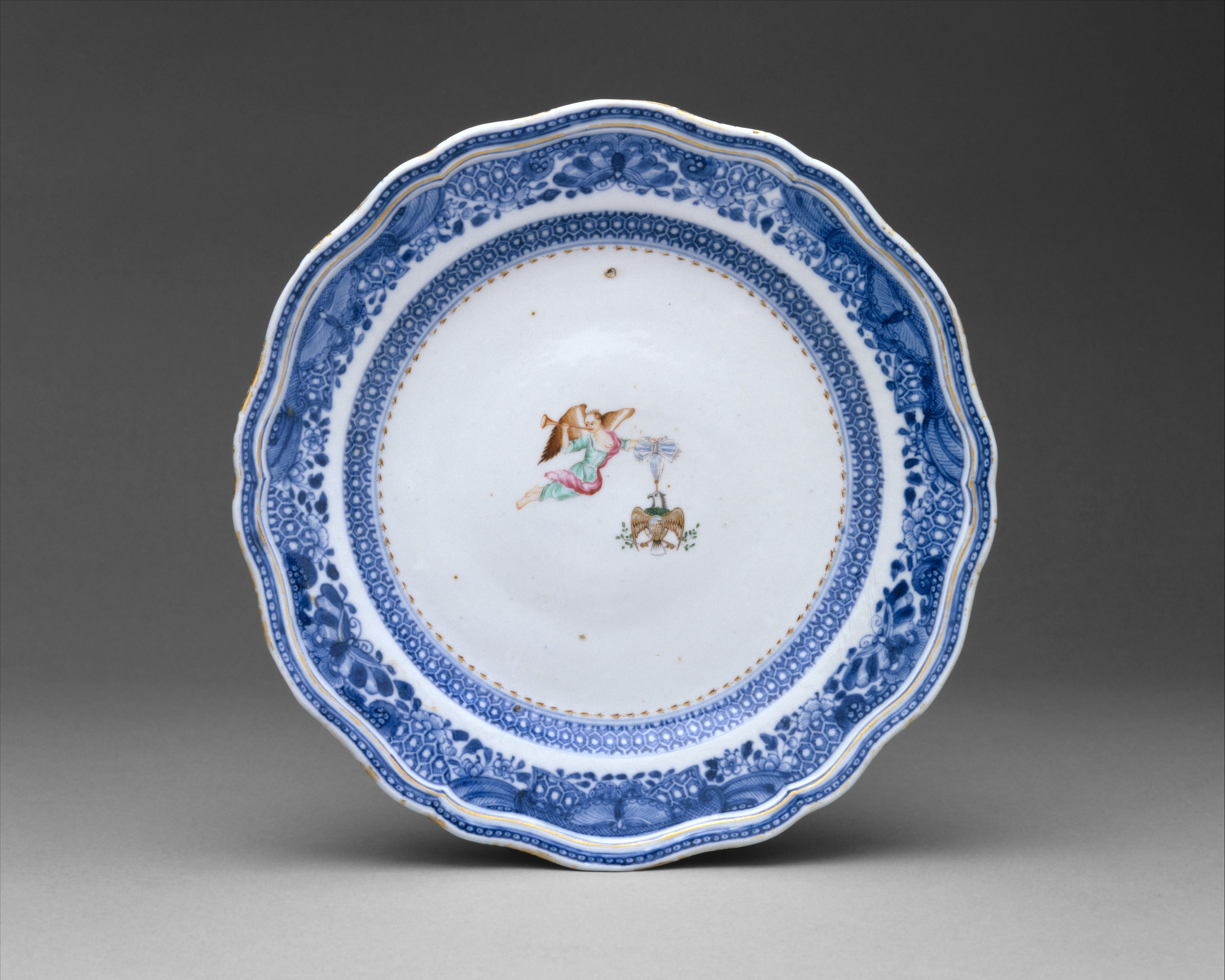
The record subject. Hard-paste porcelain, Fitzhugh border, diam. 24.1 cm. The central figure is Fame, blowing her horn and displaying the eagle badge of the Society of the Cincinnati on a blue ribbon.
| Artist | Chinese export porcelain workshops, Jingdezhen and Canton |
|---|---|
| Date | ca. 1785 |
| Medium | Hard-paste porcelain, underglaze cobalt blue (Fitzhugh border) with overglaze polychrome enamel and gilding (Angel of Fame and eagle insignia) |
| Dimensions | Diam. 24.1 cm (9 1/2 in.) |
| Where it is now | Metropolitan Museum of Art, New York, The American Wing (Gallery 704)last confirmed |
| Inventory number | Accession 17.73 (Object ID 5977) |
| Attribution | AcceptedNo workshop or individual painter is named for Chinese export porcelain of this class; pieces were potted and decorated anonymously to the specifications supplied by Western supercargoes. Full note |
| Object type | Ceramic |
| Period | Qing dynasty export ware, made for the American market |
| Cases | Seized, looted or confiscated · Restituted or repatriated · Has a provenance gap |
| Inscriptions | No mark or inscription recorded in the sources consulted. |
| Owners on record | 8 links6 documented, 1 disputed, 1 unknown |
| Sources | 17 cited |
About this record Last verified · 17 sources cited · Change log
On this page 10 sections
ContentsClose
One plate from the 302-piece Chinese export service that Henry "Light-Horse Harry" Lee bought for George Washington in 1786, painted with the Fitzhugh border and the winged figure of Fame holding the badge of the Society of the Cincinnati, the hereditary officers' society that Jefferson, Franklin and Aedanus Burke had spent the previous three years attacking as the seed of an American nobility. Washington commissioned it as the Society's own first president, two years after he had personally forced the hereditary clause out of its charter under threat of resignation, and used it at Mount Vernon and in his presidential households.
The service descended through Martha Washington's family to Arlington House, was seized with the rest of the Custis-Lee property when the Civil War began, spent forty years on federal museum display, and was released back to the family only in 1901. It has been scattered ever since among at least seven public collections, and the pattern's fame has made it one of the most reproduced and one of the most forged classes of American-market export porcelain there is. This plate's own route from that dispersal into the Metropolitan Museum in 1917 is not documented in the sources consulted; it enters this record only at the point the Museum's own accession begins.
Provenance
Each link is graded. Documented: a cited source supports it. Disputed: the identification is argued but not established. Unknown: no owner for that span, and the gap is not smoothed into a narrative. The grades in the glossary.
- c. 1784 - 1786Chinese export porcelain workshops, Jingdezhen and Canton, to the commission of Samuel Shaw for the Society of the Cincinnatidocumented
Documented for the pattern and the 302-piece service generally, not for this individual plate; L'Enfant's eagle design was approved 10 June 1783, carried to Canton by Shaw in 1784, and executed by an unnamed Chinese enameller about 1784-85.234
- 1786 - 1799George Washington, Mount Vernon and the presidential households in New York and Philadelphiadocumented
Documented for the service generally. Purchased through Henry Lee from Constable, Rucker & Co. for about $150; sources differ on the exact month of purchase and delivery (see open questions).29
- 1799 - 1857Martha Washington, then George Washington Parke Custis, Arlington Housedocumented
Documented for the service generally by the Diplomatic Reception Rooms' own account; the exact date and mechanism of the transfer from Martha Washington's household to her grandson is not given in the sources consulted.9
- 1857 - 1861Mary Anna Randolph Custis Lee and Robert E. Lee, Arlington Housedocumented
Documented for the service generally. Custis's will passed Arlington and its contents to his daughter for her lifetime, with remainder to her eldest son, George Washington Custis Lee.911
- 1861 - 1901Confiscated by Union forces; held and displayed at the United States Patent Office and the Smithsonian Institution's National Museumdocumented
Documented for the service generally, and distinct from the separate real-estate confiscation of Arlington House itself, which was resolved through the courts in 1882-83 rather than by executive order.91011
- 1901 -Released by order of President McKinley to the Custis-Lee familydisputed
The fact of the 1901 release, including the china, is documented in outline by the Diplomatic Reception Rooms' own catalogue and by secondary literature citing a 2016 doctoral dissertation. The exact date within 1901, the legal mechanism, and the identity of the specific recipient are inconsistently reported in the sources consulted and have not been resolved here; see open questions.910
- 1901 - 1917Unknownunknown
No source consulted traces this individual plate, as opposed to the service generally, through this period. It may have remained with the family group released in 1901, or it may have already separated from the main body of the service at an earlier, unrecorded date.
- 1917 - presentMetropolitan Museum of Art, New Yorkdocumented
Acquired with the Rogers Fund, 1917. No dealer or seller is named in the sources consulted.1
Prices realised
No auction history for this specific plate was found in the sources consulted; it entered the Metropolitan Museum by direct purchase with the Rogers Fund in 1917, not through a recorded public sale. A related plate from the same service entered the State Department's Diplomatic Reception Rooms by private purchase from a named owner, Mrs. Ludwell L. Montague, again not at auction.
Technical evidence
| Attribution note | No workshop or individual painter is named for Chinese export porcelain of this class; pieces were potted and decorated anonymously to the specifications supplied by Western supercargoes. The commission itself is documented rather than the hand: Samuel Shaw, an original member of the Society of the Cincinnati and the first American consul to China, carried Pierre L'Enfant's drawing of the Society's eagle insignia to Canton and arranged for a Chinese enameller to render it on porcelain already fashionable in the Fitzhugh export pattern. |
|---|---|
| Body | Hard-paste porcelain, potted for the Chinese export trade to Western order; the Society's own museum dates production of this pattern to Jingdezhen, about 1784-85.12 |
| Decoration | Underglaze cobalt blue Fitzhugh border (spearhead rim, four floral reserves, butterfly and foliage panels) with a central reserve in overglaze polychrome enamel and gilding showing the winged figure of Fame in a green robe, blowing a horn and displaying the eagle insignia of the Society of the Cincinnati on a blue ribbon.123 |
| Dimensions | Diameter 24.1 cm (9 1/2 in.).1 |
| Date range | Manufacture about 1785 (Museum's own bracket: 1782-1785); Washington's full 302-piece service purchased and delivered in 1786.129 |
| Accession and credit line | Accession 17.73, Object ID 5977, Rogers Fund, 1917. Department: The American Wing. On view, Gallery 704.1 |
| Pattern name | Fitzhugh border, a design already standard in the Canton export trade before this commission, named for the East India Company figure associated with it.2 |
| Design authorship | Eagle insignia designed by Major Pierre L'Enfant, approved by the Society of the Cincinnati on 10 June 1783; carried to Canton by Samuel Shaw in 1784 and simplified in execution from Shaw's original, more elaborate iconographic proposal.23 |
| Forensic method applied to the pattern (not to this plate specifically) | Non-destructive X-ray fluorescence spectroscopy, used by Winterthur and by researchers publishing in Ceramics in America to detect anachronistic elements (chromium, zinc, tin oxide, bismuth) in later-added or wholly spurious Cincinnati-pattern decoration; no such report specific to accession 17.73 was found.1213 |
Images
The record in full
Chapter 1What it is
A circular hard-paste porcelain plate, 24.1 centimetres across, painted in the underglaze-blue Fitzhugh border pattern already common on Chinese export porcelain made for the American market in the...
A circular hard-paste porcelain plate, 24.1 centimetres across, painted in the underglaze-blue Fitzhugh border pattern already common on Chinese export porcelain made for the American market in the 1780s: a spearhead rim enclosing four flower-filled reserves separated by ornamental panels of butterflies and foliage. At the centre, in overglaze enamel and gilding, stands a winged female figure in a green robe, blowing a horn, holding out an oval badge slung from a blue ribbon on which an eagle is displayed. That badge is the insignia of the Society of the Cincinnati, and the plate is one surviving piece of the dinner and tea service George Washington bought bearing it.
The Metropolitan Museum catalogues the piece simply as "Plate," Chinese, for the American market, dated about 1785, and holds it in the American Wing under accession number 17.73 (object 5977), acquired with the Rogers Fund in 1917. Its own catalogue tags the object under the heading "Eagles and Angels," which is as good a plain description of the decoration as any.
Chapter 2A badge simplified in the making
The insignia itself was not the Society's founders' first idea rendered whole.
The insignia itself was not the Society's founders' first idea rendered whole. Major Pierre L'Enfant, the French engineer-officer who later laid out Washington City, designed the Society's eagle device and had it approved on 10 June 1783, within a month of the Society's founding. Samuel Shaw, a Massachusetts artillery officer and an original member of the Society, carried L'Enfant's watercolour drawings with him to China in 1784 with instructions considerably more ambitious than what reached the plate: Shaw wanted, in his own words, "the American Cincinnatus, under the conduct of Minerva, regarding Fame" receiving the emblems of America from the hand of Minerva and proclaiming them to the world.
The Chinese enameller working from Shaw's sketch could not, or did not, execute that programme. What survives on this plate and its companions is a reduction of it: Fame alone, in a green robe, blowing her horn and displaying the eagle badge on its ribbon. The simplification is itself evidence of how a Western commission actually crossed into a Chinese workshop in this period, as a drawing handed to a supercargo and reinterpreted by a painter who had never seen Minerva, Cincinnatus or the scene Shaw had in his head.
Chapter 3How a design reached Canton
Shaw sailed from New York on 22 February 1784 as supercargo, the officer responsible for a ship's cargo and trade, aboard the Empress of China, the first American vessel to trade directly with China.
Shaw sailed from New York on 22 February 1784 as supercargo, the officer responsible for a ship's cargo and trade, aboard the Empress of China, the first American vessel to trade directly with China. The ship reached Canton on 30 August 1784, joining British, Dutch, French and Danish traders already operating there under the Canton System, the arrangement by which the Qing state confined all Western trade to a handful of licensed Chinese merchant houses at the single port of Canton and forbade direct dealings with Chinese officials. It was, Shaw recorded, the first time the Chinese had had occasion to distinguish Americans from Englishmen at all.
The ship left Canton on 27 December 1784 and reached New York again on 11 May 1785 with a cargo of tea and cloth. It was on this voyage, or the one immediately following it, that Shaw placed the porcelain order carrying L'Enfant's design; the plate pattern itself is dated by the Society's own museum to production in Jingdezhen about 1784-85, meaning the finished ware reached the American market within roughly a year of the drawing leaving New York, itself a fast turnaround for a design that had to travel from a New York meeting hall to a Chinese workshop and back as a finished object, dependent on the season's single trading window and the several months each way of ocean passage. Shaw returned to China in 1786 as the first United States consul at Canton, formalising a relationship he had begun as a private trader.
Chapter 4Henry Lee's commission for Washington
The full 302-piece dinner and tea service that included this plate was not Shaw's personal gift to Washington but a purchase Washington made through an intermediary.
The full 302-piece dinner and tea service that included this plate was not Shaw's personal gift to Washington but a purchase Washington made through an intermediary. Henry "Light-Horse Harry" Lee, the cavalry officer and future governor of Virginia, wrote to Washington that a service in the pattern could be had for about $150, made, in Lee's words, doubly valuable and handsome by the presence of the Society's insignia. Washington instructed Lee to complete the purchase, which was transacted through the New York firm of Constable, Rucker & Co. Sources consulted here differ by a month on exactly when: the Society's own account places Washington's purchase in July 1786, with the service reaching Mount Vernon by 31 October 1786; the State Department's account of a companion plate places Lee's New York purchase in August 1786 and Washington's receipt of it in September. Both agree on the year and the price, and on Lee as the negotiating agent; the exact month has not been reconciled here.
At $150 for 302 pieces bearing the emblem of a society already at the centre of a fierce national argument about aristocracy, the price is strikingly low against the china's later reputation, though no period wage or cost comparison that would give that figure real weight in the sources consulted here has been found, and none is asserted.
Chapter 5A society born controversial
The Society of the Cincinnati was founded on 13 May 1783 at a dinner of Continental Army officers at the Verplanck house in Fishkill, New York, conceived by Henry Knox, presided over by Friedrich...
The Society of the Cincinnati was founded on 13 May 1783 at a dinner of Continental Army officers at the Verplanck house in Fishkill, New York, conceived by Henry Knox, presided over by Friedrich Wilhelm von Steuben, with Alexander Hamilton as orator. Its stated purposes were to preserve the wartime fellowship of the officer corps, maintain a charitable fund for indigent members and their families, and press the unresolved question of the officers' promised pensions. Its charter also provided that membership would descend to each officer's eldest male heir in perpetuity, and it named George Washington its first president general in December 1783, an office he held until his death in 1799.
The hereditary clause provoked an immediate and serious backlash. In October 1783 Aedanus Burke, a South Carolina judge, published Considerations on the Society or Order of Cincinnati under the pseudonym Cassius, arguing that the Society would create, in his phrase, a race of hereditary patricians or nobility that would in time subvert the republic. The pamphlet was reprinted across American and European cities and provoked a wave of published replies on both sides. Benjamin Franklin, writing a private letter to his daughter Sarah Bache in January 1784 that he never sent to America or authorised for publication there, wondered how a number of private persons should think proper to distinguish themselves and their posterity by "an Order of hereditary Knights, in direct Opposition to the solemnly declared Sense of their Country," and mocked the Society's eagle badge as looking more like a turkey, adding that the turkey was, in truth, the more respectable bird of the two. Thomas Jefferson, writing to Washington on 16 April 1784 in answer to Washington's own request for a frank opinion, warned that a hereditary order's honours might one day "draw into the order all the men of talents, of office and wealth" and that hereditary branches of government were, by experience, "the patrons of privilege and prerogative"; Jefferson told Washington plainly that he wished to see him "standing on ground separated from" the Society, so that the character history would hand down from the Revolution would in no way be compromised. In France, the Comte de Mirabeau published his own pamphlet, Considerations sur l'ordre de Cincinnatus, in 1784-85, extending Burke's argument to hereditary honour of every kind and printing, as an appendix, Washington's own circular letter to the state societies.
Chapter 6The reform that did not hold
Washington took the criticism seriously enough to draft his own "Observations on the Institution of the Society of Cincinnati" ahead of the Society's first general meeting, held in Philadelphia in...
Washington took the criticism seriously enough to draft his own "Observations on the Institution of the Society of Cincinnati" ahead of the Society's first general meeting, held in Philadelphia in May 1784, in which he weighed proposals running as far as dissolving the Society outright. He arrived at the meeting, by one account, prepared to press for abolition, and backed away from that only once L'Enfant brought word that the French crown had approved a French chapter of the order. What Washington did press through, under an implicit threat that he would resign the presidency general otherwise, was a revised charter, called the Institution, that dropped hereditary succession, dropped honorary memberships, and carried an informal understanding that members would not wear the eagle badge in public.
The revised Institution was sent to the state societies for ratification. Most approved it. New York, New Hampshire and Delaware refused. And once the public controversy had cooled, the general society quietly reverted to the original, hereditary Institution of 1783, which has remained the basis of membership ever since; only the French chapter, which had abolished heredity under royal sanction, never restored it before the monarchy that had licensed it collapsed. The reform that made headlines in 1784, in other words, did not survive the decade that produced it.
Chapter 7The china Washington ordered anyway
Washington's own china is worth reading against that sequence rather than apart from it.
Washington's own china is worth reading against that sequence rather than apart from it. He asked Jefferson's frank opinion of the Society in April 1784, drafted his own paper proposing its reform that May, and by his own later account regarded the hereditary clause as genuinely dangerous to the republic he had just helped create. Two years later, in 1786, with the hereditary Institution already sliding back into force behind the scenes, he instructed Lee to complete the purchase of a 302-piece service bearing the Society's eagle in the hand of Fame, and used it prominently at Mount Vernon and in the presidential households in New York and Philadelphia during his own administration. The same man who told Jefferson he wanted distance from the Society's hereditary ambitions ate from porcelain broadcasting its badge at his own table for the rest of his life. Nothing in the sources consulted here suggests Washington saw a contradiction in this, and this record does not supply one for him; it states the sequence and leaves the reader to weigh it.
Chapter 8From Mount Vernon to Arlington House
After Washington's death the service remained in the family.
After Washington's death the service remained in the family. Martha Washington passed it to her grandson, George Washington Parke Custis, who displayed the Washington relics, including the Cincinnati china, at Arlington House, the mansion he built across the Potomac from the new federal city and treated as something close to a shrine to his adoptive grandfather. Custis died in 1857, leaving Arlington and its contents to his only child, Mary Anna Randolph Custis Lee, who was married to Robert E. Lee, with the estate to pass on her death to their eldest son, George Washington Custis Lee.
The Lees left Arlington in 1861 as the Civil War began, and Union forces occupied the property for the duration of the war.
Chapter 9Two confiscations, not one
What happened next split into two separate legal tracks that are easy to conflate and worth keeping apart.
What happened next split into two separate legal tracks that are easy to conflate and worth keeping apart. The real estate itself was confiscated under wartime tax law: Congress had authorised the assessment of property taxes in "insurrectionary districts," the Arlington estate was assessed $92.07 in 1862, commissioners refused Mary Custis Lee's attempt to pay it by proxy while she was unable to cross Union lines in person, and the property was sold at auction on 11 January 1864, with the federal government itself the sole bidder at $26,800, below its own assessed value of $34,100. Quartermaster General Montgomery Meigs ordered part of the grounds turned into a military cemetery that same year, a decision his own account and later historians have read as at least partly a deliberate act of retribution against Lee. The Supreme Court found that sale unconstitutional on 4 December 1882, in a 5-4 decision written by Justice Samuel Freeman Miller holding that the in-person payment requirement had denied the Lees due process, and awarded title to George Washington Custis Lee; rather than disturb a cemetery that already held thousands of graves, Congress bought the land back from him for $150,000 on 31 March 1883, with Secretary of War Robert Todd Lincoln accepting the transfer for the government.
The Washington relics, including the surviving Cincinnati porcelain, were confiscated separately, as personal property taken from the house itself rather than real estate sold for unpaid tax, and were not covered by the 1882-83 land settlement at all. They were held and displayed by the federal government, at the United States Patent Office and later the Smithsonian Institution's National Museum, for roughly forty years, from the early 1860s until 1901.
Chapter 10The 1901 return
The State Department's own catalogue entry for a related plate from this service states plainly that after the Arlington confiscation, President William McKinley ordered the government-held...
The State Department's own catalogue entry for a related plate from this service states plainly that after the Arlington confiscation, President William McKinley ordered the government-held Cincinnati china released to the Custis-Lee family, naming both Mary Custis Lee and Mary Anna Randolph Custis Lee as recipients. Wikipedia's account of Mary Custis Lee (Robert E. Lee's daughter, 1835-1918), citing a 2016 University of Delaware dissertation by Hannah Boettcher on the Washington relics' passage through museums between 1901 and 1918, likewise records that the family's heirlooms were "confiscated by the Union Army and restored to the family in 1901."
Beyond that outline, the claim needs more verification than the sources consulted here could supply, and this record says so rather than smoothing it over. Mary Anna Randolph Custis Lee, Robert E. Lee's widow, had died in 1873, twenty-eight years before 1901, and could not literally have received anything that year; the State Department's naming of her as a 1901 recipient alongside her daughter is almost certainly a compression of the family's decades-long claim into a single sentence rather than a claim that she was alive to receive it. Nor have the sources consulted here yielded an exact date within 1901, the specific department or legal instrument McKinley used to authorise the release, or confirmation of which family member, the daughter Mary Custis Lee or her brother George Washington Custis Lee, who held formal title to Custis's estate under his will, was the recipient of record. What can be said with confidence is that the release happened, that it happened in 1901, that the china was part of it, and that Mary Custis Lee is the family member credited with the inventory and provenance work that let the collection be reconstituted afterward; the mechanism itself belongs among this record's open questions.
Chapter 11Scattering across a nation's museums
Pieces of Washington's service have been dispersing into public collections for more than a century since the 1901 release, and this record can confirm several of them independently rather than...
Pieces of Washington's service have been dispersing into public collections for more than a century since the 1901 release, and this record can confirm several of them independently rather than repeat an unverified full list. The Society of the Cincinnati's own museum, at Anderson House in Washington and now operated as the American Revolution Institute, holds three dinner plates and a platter from the service. Mount Vernon holds pieces returned, in effect, to Washington's own house. The Cincinnati Art Museum holds at least one platter, photographed on display. The National Gallery of Art in Washington holds at least one plate, dated to the same 1784-85 Jingdezhen production. The State Department's Diplomatic Reception Rooms hold a plate, accession RR-1972.0027, which its own catalogue records as purchased from a private owner, a Mrs. Ludwell L. Montague, with acquisition funds donated by H. Richard Dietrich Jr., a rare instance in this object's literature of an actual named seller for a piece of the service. Henry Francis du Pont assembled a group of pieces from Custis-Lee descendants for what became the Winterthur Museum, part of the bequest that founded the collection.
No scholarly reconstruction attempting to total every surviving piece of the original 302 and place all of them has turned up in the sources consulted here, and this record does not claim to offer one; it lists only the holdings independently verified above, and marks the fuller census as an open question rather than guessing at it.
Chapter 12This plate's own path: Rogers Fund, 1917
Where this specific plate stood in that dispersal is, on the evidence available here, simply not documented.
Where this specific plate stood in that dispersal is, on the evidence available here, simply not documented. The Metropolitan Museum's own accession record begins the object's history with the Rogers Fund purchase of 1917, sixteen years after the family recovered the china from federal custody, and gives no seller's name, no dealer, and no note connecting the piece to the Custis-Lee family, Arlington House, or the 1901 release. It is entirely possible this plate followed that route and simply was not catalogued with the connection noted at the time of purchase; it is equally possible it had already left the main body of the service earlier, whether sold, given away, or separated before the Civil War, since nothing in Washington's or Custis's lifetime bound every piece of a 302-piece dinner and tea service to travel together forever. This record states that gap as a gap rather than bridging it with either story, in keeping with the discipline this publication holds itself to; readers should treat any claim linking accession 17.73 specifically, rather than the service generally, to Arlington House or the 1901 release as unverified until a documented seller or intermediate owner surfaces.
Chapter 13A pattern built to be faked
The fame and rarity of genuine Cincinnati porcelain made it, almost from the moment collectors began paying real money for it, one of the most imitated classes of American-market export ware.
The fame and rarity of genuine Cincinnati porcelain made it, almost from the moment collectors began paying real money for it, one of the most imitated classes of American-market export ware. Two separate documented episodes make the point. Ceramics in America's 2016 research identified roughly twenty pieces of spurious "Cincinnati" porcelain that surfaced on the antiques market in the mid-1920s and early 1930s, decorated with a nude figure of Fame and an eagle across four different border patterns and bearing invented personal initials on shields, sold to serious collectors, including Henry Francis du Pont himself, who paid $350 for one fake tea caddy in 1925 and $850 for a second in 1927 believing both genuine. The fakes were eventually exposed on stylistic grounds, since an eighteenth- or early nineteenth-century American buyer is very unlikely to have commissioned porcelain decorated with an undraped Fame, on physical grounds, since raking light revealed ghosted borders and decoration beneath the added design and the new painting was of visibly inferior quality, and by X-ray fluorescence spectroscopy, which found zinc, tin oxide opacifier, bismuth in the gilding and chromium in the sepia enamel, none of them consistent with genuine late eighteenth-century Chinese manufacture.
Separately, Winterthur's "Treasures on Trial" study of a Society of the Cincinnati plate used the same nondestructive XRF technique to establish that a genuine eighteenth-century blank had been refired, apparently around 1975, to add spurious Cincinnati decoration and raise its value; the added green enamel contained chromium, a colourant not known to have been used in China before the twentieth century, along with a zinc flux and an anomalously high cobalt concentration, and the plate's reverse showed grey staining consistent with a second firing. Neither episode implicates this specific Metropolitan Museum plate, which has no publicly reported technical examination casting doubt on it and has been in an institutional collection, on and off display, since 1917; but the pattern's own history of forgery is precisely why any single piece's authenticity rests on this kind of physical testing rather than on the emblem alone, and no published XRF or raking-light report specific to accession 17.73 was found in the sources consulted here.
Chapter 14What the emblem asked a Chinese painter, and an American table, to carry
The badge at the centre of this plate was never a private mark.
The badge at the centre of this plate was never a private mark. It was the visible sign of an argument still being fought in print on both sides of the Atlantic when the porcelain that carries it was fired: whether men who had led a revolutionary army against inherited privilege were entitled to found an inherited order of their own. Fame, as the figure was originally conceived by Shaw, was meant to proclaim the Society's honours to the world; what a Chinese enameller working from a borrowed drawing actually painted was a simplified emblem stripped of the classical apparatus Shaw had wanted, which is itself a small, documented instance of how an American political symbol was translated, and reduced, by a maker outside the culture that produced its meaning. There is no evidence in the sources consulted here that the porcelain itself was read by contemporaries as making any claim beyond ordinary membership display, of the kind other veterans' and fraternal societies of the period put on their china, silver and prints; the controversy over the Society lived in pamphlets, letters and state legislatures, not, so far as the record here shows, in any argument specifically about the tableware. Recording that absence plainly, rather than inventing a hidden meaning for the plate itself, is the more honest finding.
Chapter 15Condition, marks, and what remains untested
The Museum's own record gives no marks or inscriptions for this piece and no published condition report was found in the sources consulted.
The Museum's own record gives no marks or inscriptions for this piece and no published condition report was found in the sources consulted. The plate has been treated by the Museum as public domain and has supplied its own primary photograph for open licensing, which is how the image accompanying this record became available. Beyond that, this record can state only what is missing: no scientific analysis of this specific plate's enamel or body, of the kind Winterthur and the Chipstone researchers have applied to other pieces of the pattern, appears to have been published, and no conservation history is recorded anywhere in the sources consulted.
The artist
Anonymous Chinese export porcelain workshops, Jingdezhen (body) and Canton (overglaze decoration), working to commissions placed through American and European supercargoes
No maker's name attaches to this plate, and none would have been expected to. Export porcelain made for the Atlantic trade in the 1780s was produced within a division of labour that did not record individual hands: bodies were thrown, fired and given their underglaze-blue decoration far inland at Jingdezhen, then shipped to Canton, where painters added overglaze enamel and gilding to patterns and devices supplied by the foreign merchants who had ordered them. The commissioning intermediary is documented here even though the painter is not: Samuel Shaw, a Massachusetts artillery officer, an original member of the Society of the Cincinnati, and eventually the first United States consul in China, is the named link between an American political emblem and the workshop that painted it.
Related works
| Work | Relation | Where it is |
|---|---|---|
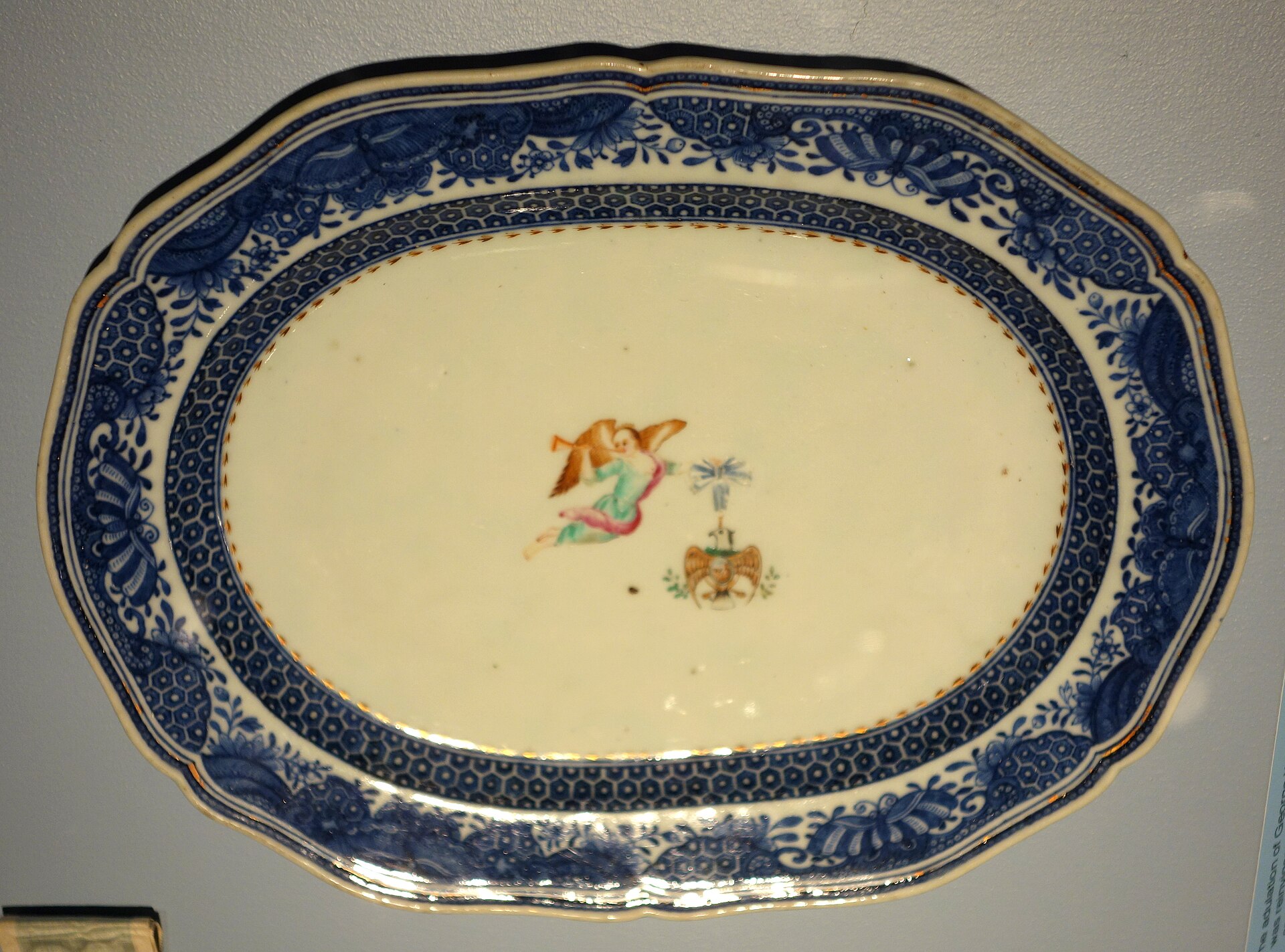
| Platter, part of the same 302-piece Washington service Chinese export porcelain workshops, Jingdezhen and Canton | Same service, same commission Photographed on display; the caption there identifies it directly as part of Washington's own 302-piece service. | Cincinnati Art Museum |
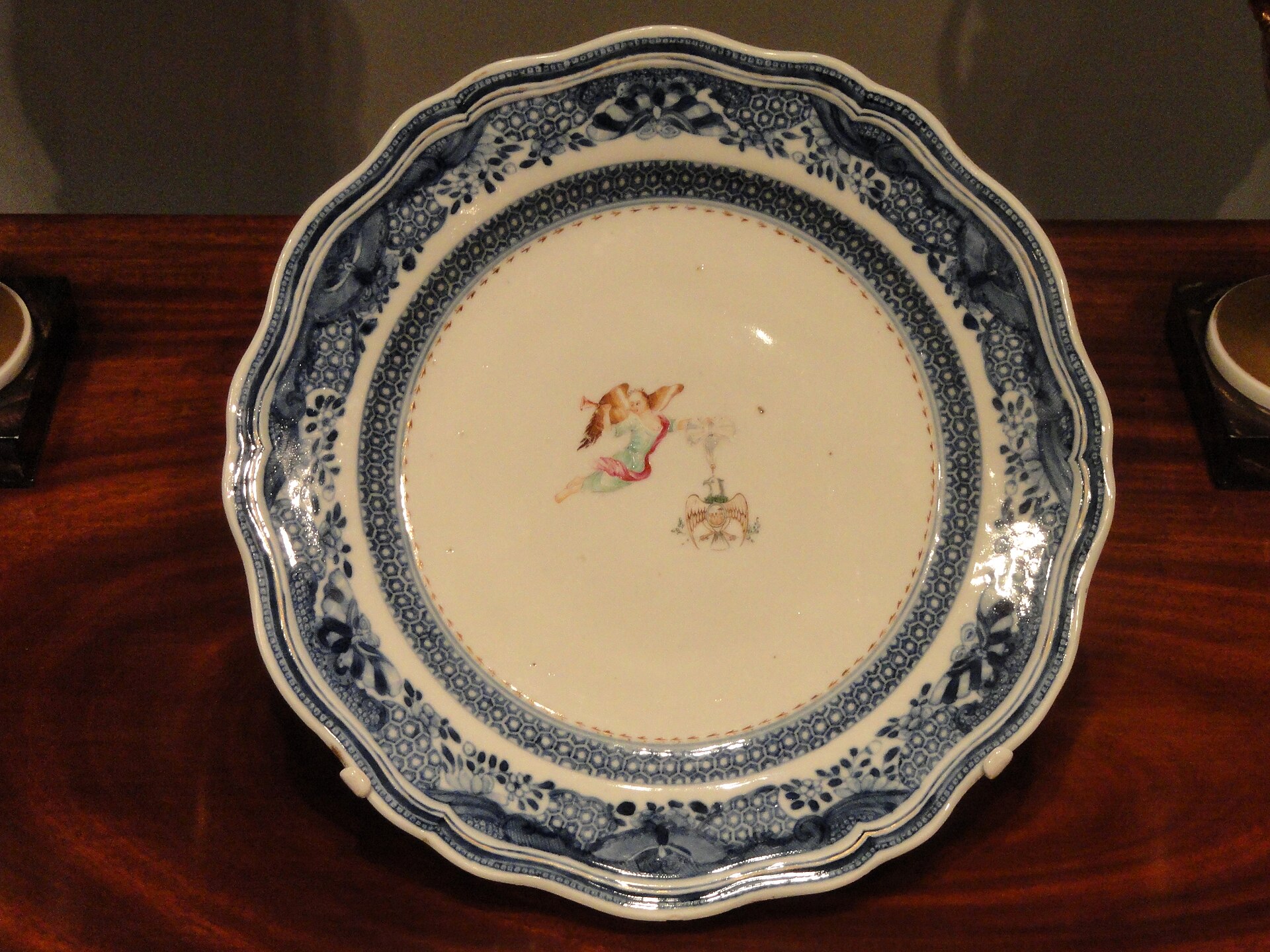
| Plate, Fitzhugh border with Angel of Fame Chinese export porcelain workshops, Jingdezhen and Canton | Same service or same production run, 1784-85 Catalogued to the same 1784-85 Jingdezhen production. | National Gallery of Art, Washington |
| Three dinner plates and a platter from Washington's service Chinese export porcelain workshops, Jingdezhen and Canton | Same service Held by the Society whose insignia the service carries; also holds later, border-less Shaw-commissioned tea services made for individual members. | Society of the Cincinnati museum, Anderson House, Washington (American Revolution Institute) |
| Pieces from Washington's service acquired from Custis-Lee descendants Chinese export porcelain workshops, Jingdezhen and Canton | Same service Formed the core of Henry Francis du Pont's Cincinnati porcelain holdings, part of the collection that founded Winterthur. | Winterthur Museum, Winterthur, Delaware |
| Plate, accession RR-1972.0027 Chinese export porcelain workshops, Jingdezhen and Canton | Same service Purchased from a private owner, Mrs. Ludwell L. Montague, with funds donated by H. Richard Dietrich Jr.; one of the few pieces of the service with a named modern seller on record. | Diplomatic Reception Rooms, U.S. Department of State |
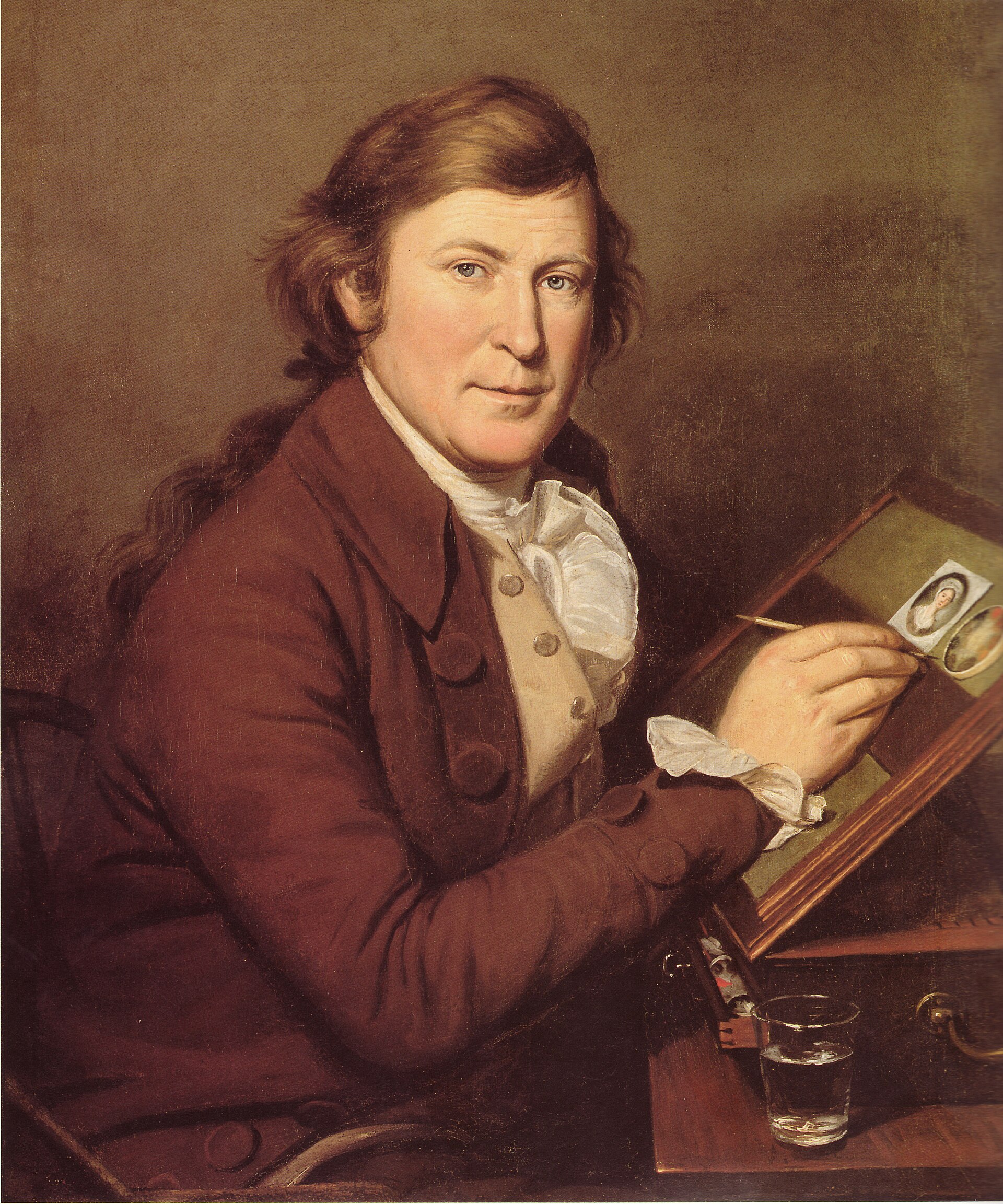
| James Peale Painting a Miniature Charles Willson Peale | Depicts the actual Society of the Cincinnati eagle badge, on its blue ribbon, worn by a documented member This is NOT the Washington service or any piece of it. Painted 1795, it shows the badge the plate's central figure holds, worn as intended by a living Continental Army veteran, and is included here only to show the object the porcelain's emblem depicts. | Detroit Institute of Arts |
Open questions
- Where was this specific plate between its manufacture about 1785 and the Metropolitan Museum's Rogers Fund purchase in 1917? The Museum's own record supplies no earlier owner, and nothing in the sources consulted here ties accession 17.73 in particular, as opposed to the service generally, to Arlington House or the 1901 family release.
- Who sold this plate to the Museum in 1917, and through what dealer, if any? No seller or intermediary is named in the sources consulted.
- What was the exact date and legal or administrative mechanism of the 1901 release of the Cincinnati china from federal custody, and which family member, Mary Custis Lee or her brother George Washington Custis Lee, was the recipient of record? The State Department's own account names both Mary Custis Lee and Mary Anna Randolph Custis Lee, the second of whom had died in 1873; that inconsistency has not been resolved here and needs a primary source, ideally the National Archives record or Hannah Boettcher's 2016 dissertation on the subject, which this record was not able to consult directly.
- Has this specific plate ever been tested by X-ray fluorescence or examined under raking light, the methods that have exposed both a group of 1920s-30s forgeries and at least one later-enriched genuine piece elsewhere in this pattern? No published technical report on accession 17.73 was found.
- How many of the original 302 pieces survive today, and in how many collections? This record independently verifies holdings at the Society of the Cincinnati's own museum, Mount Vernon, Winterthur, the Cincinnati Art Museum, the National Gallery of Art, the State Department and the Metropolitan Museum, but no scholarly total or full census was found, and none is claimed here.
- Is there a primary-source statement from Samuel Adams specifically on the Society of the Cincinnati, as distinct from his later, general correspondence on hereditary government? Secondary literature credits him with opposing the Society, but no directly quotable statement of his on this particular controversy was confirmed in the sources consulted, unlike the documented statements of Franklin, Jefferson and Burke.
- Which month in 1786 did Henry Lee actually complete the purchase, and which month did the finished service reach Washington? The Society's own account gives July 1786 for purchase and 31 October 1786 for arrival at Mount Vernon; the State Department's account of a related plate gives August 1786 for the New York purchase and September 1786 for Washington's receipt of it. The discrepancy has not been reconciled here.
Questions about this object
What is Plate from the Society of the Cincinnati Service of George Washington?
Plate from the Society of the Cincinnati Service of George Washington is a ceramic, dated ca. 1785. Medium: Hard-paste porcelain, underglaze cobalt blue (Fitzhugh border) with overglaze polychrome enamel and gilding (Angel of Fame and eagle insignia).
Who made Plate from the Society of the Cincinnati Service of George Washington, and is the attribution settled?
The attribution to Chinese export porcelain workshops, Jingdezhen and Canton is recorded here as accepted. No workshop or individual painter is named for Chinese export porcelain of this class; pieces were potted and decorated anonymously to the specifications supplied by Western supercargoes. The commission itself is documented rather than the hand: Samuel Shaw, an original member of the Society of the Cincinnati and the first American consul to China, carried Pierre L'Enfant's drawing of the Society's eagle insignia to Canton and arranged for a Chinese enameller to render it on porcelain already fashionable in the Fitzhugh export pattern.
Where is Plate from the Society of the Cincinnati Service of George Washington now?
Metropolitan Museum of Art, New York, The American Wing (Gallery 704). Inventory number Accession 17.73 (Object ID 5977). Last confirmed 3 September 2026. Rogers Fund, 1917.
What is still unknown about Plate from the Society of the Cincinnati Service of George Washington?
Where was this specific plate between its manufacture about 1785 and the Metropolitan Museum's Rogers Fund purchase in 1917? The Museum's own record supplies no earlier owner, and nothing in the sources consulted here ties accession 17.73 in particular, as opposed to the service generally, to Arlington House or the 1901 family release.
Sources
- 1Metropolitan Museum of Art, Collection API record for Object ID 5977 (Accession 17.73), Plate, Chinese, for American market, ca. 1785, Rogers Fund, 1917. collectionapi.metmuseum.org/public/...
- 2American Revolution Institute of the Society of the Cincinnati, 'Society of the Cincinnati Porcelain.' americanrevolutioninstitute.org/masterpieces-in-detail/...
- 3The Society of the Cincinnati, 'The Society of the Cincinnati Chinese Export Porcelain.' Institutional history; treated here as the Society's own account rather than a neutral third party. societyofthecincinnati.org/the-society-of-the-cincinnati-...
- 4Wikipedia, 'Empress of China (1783).' Flagged as a source for the voyage dates and Canton System detail; recommended for replacement with a scholarly history of the Old China Trade. en.wikipedia.org/wiki/...
- 5Wikipedia, 'Society of the Cincinnati.' Flagged as a source for the founding, the 1783-84 controversy, and the 1784 reform and its reversal; recommended for replacement with Minor Myers, Jr., 'Liberty Without Anarchy: A History of the Society of the Cincinnati,' or an equivalent scholarly monograph. en.wikipedia.org/wiki/...
- 6Wikipedia, 'Aedanus Burke.' Flagged as a source; recommended for replacement with a facsimile or critical edition of Burke's 1783 pamphlet itself. en.wikipedia.org/wiki/...
- 7Thomas Jefferson to George Washington, 16 April 1784, hosted in transcription at Wikisource. Recommended cross-check against the critical edition at Founders Online, National Archives. en.wikisource.org/wiki/...
- 8The Papers of George Washington (University of Virginia), 'Observations on the Institution of the Society of Cincinnati,' May 1784. washingtonpapers.org/documents/...
- 9U.S. Department of State, Diplomatic Reception Rooms, 'Chinese Export Porcelain Plate from George Washington's Society of the Cincinnati Service.' diplomaticrooms.state.gov/objects/...
- 10Wikipedia, 'Mary Custis Lee,' citing Hannah Boettcher, 'Mary Custis Lee unpacks the Washington relics: a revolutionary inheritance in museums, 1901-1918' (University of Delaware, 2016). en.wikipedia.org/wiki/...
- 11Smithsonian Magazine, 'How Arlington National Cemetery Came to Be.' smithsonianmag.com/history/...
- 12Winterthur Museum, 'Treasures on Trial: The Art and Science of Detecting Fakes,' Society of Cincinnati case study. treasuresontrial.winterthur.org/evidence/...
- 13Chipstone Foundation, Ceramics in America 2016, 'A Group of Spurious Chinese Export Porcelain Decorated with the Arms of the Society of the Cincinnati.' chipstone.org/article.php/...
- 14Wikimedia Commons, File:Object 17.73, Plate - Chinese, for American market, The Metropolitan Museum of Art.jpg, sourced from the Metropolitan Museum's Open Access programme. commons.wikimedia.org/wiki/...
- 15Wikimedia Commons, File:Platter, part of 302-piece service commissioned by George Washington... Cincinnati Art Museum - DSC04568.JPG, photograph by Daderot, CC0. commons.wikimedia.org/wiki/...
- 16Wikimedia Commons, File:Society of the Cincinnati Plate, Jingdezhen, China, 1784-1785, hard-paste porcelain - National Gallery of Art, Washington - DSC09695.JPG, photograph by Daderot, CC0. commons.wikimedia.org/wiki/...
- 17Wikimedia Commons, File:James peale painting a miniature charles willson peale.jpg, painting by Charles Willson Peale, 1795, Detroit Institute of Arts, public domain. commons.wikimedia.org/wiki/...


Last verified · Published
Change log
3 September 2026 - Record created at the house standard: researched narrative, technical evidence, maker dossier, graded provenance chain, prices with hammer and premium separated, related works, open questions and sources.