The Staffordshire Hoard
Unknown Anglo-Saxon goldsmith or goldsmiths' workshop(s), Mercia and/or East Anglia · Individual objects span, on stylistic evidence, the later 6th century to the earlier 8th century AD; the hoard's burial is most often placed c. 650-675 AD, though this date is contested (see narrative)
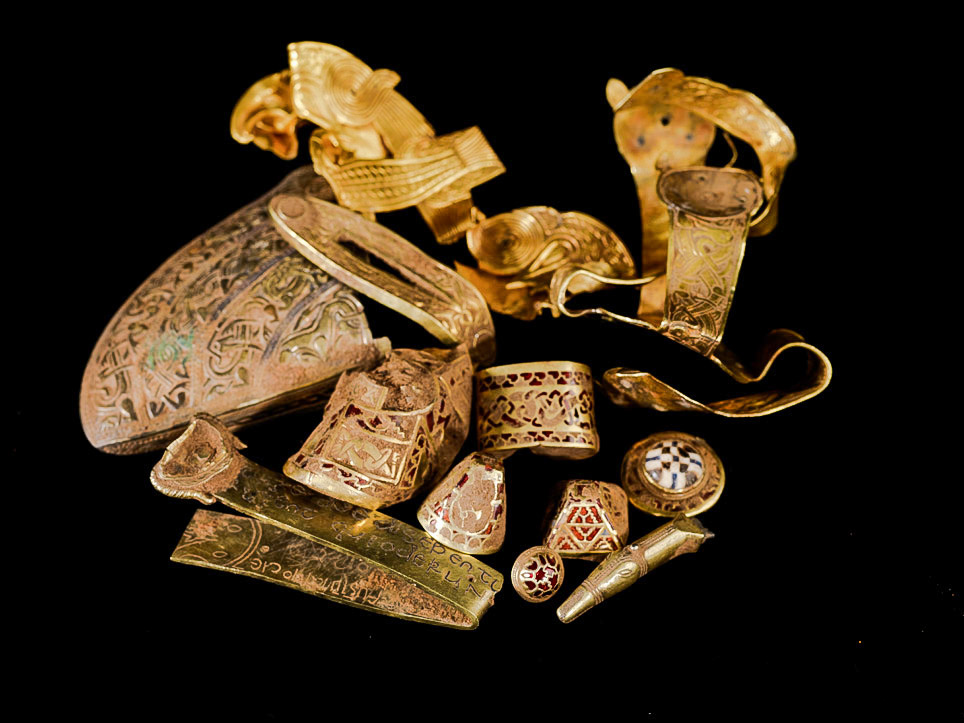
A labelled group of pieces from the hoard as declared Treasure. This shows real, catalogued objects from the find, not a reconstruction.
David Rowan, Birmingham Museum and Art Gallery, via Wikimedia Commons, CC BY 2.0| Artist | Unknown Anglo-Saxon goldsmith or goldsmiths' workshop(s), Mercia and/or East Anglia |
|---|---|
| Date | Individual objects span, on stylistic evidence, the later 6th century to the earlier 8th century AD; the hoard's burial is most often placed c. 650-675 AD, though this date is contested (see narrative) |
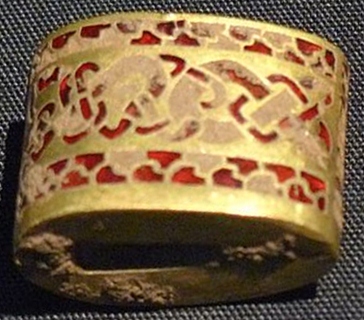
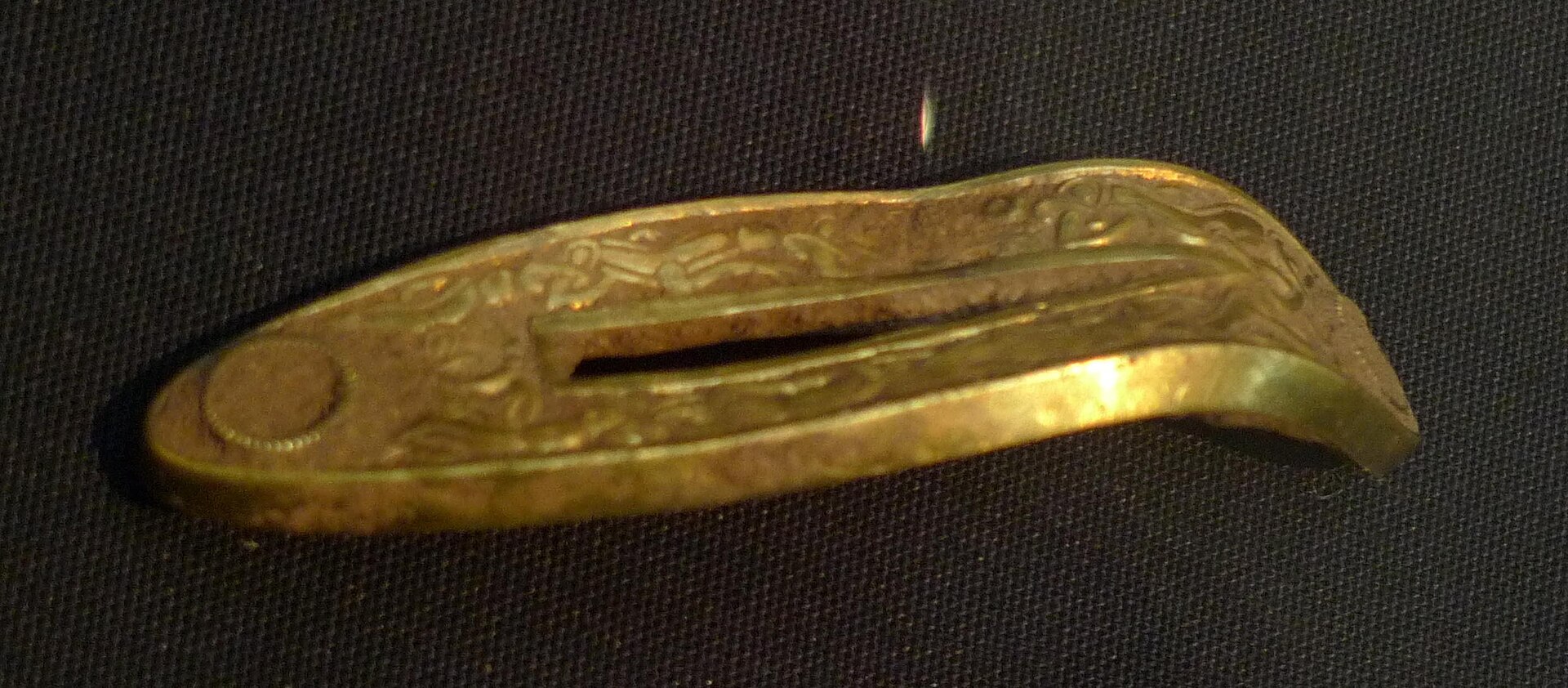
| Medium | Gold, silver and silver-gilt, with garnet cloisonne, gold filigree, niello and glass, mostly in the form of dismantled sword, helmet and other war-gear fittings |
| Dimensions | Approximately 4,600 individual pieces and fragments in aggregate; about 5.1 kg of gold and 1.4 kg of silver, with roughly 3,500 separate pieces of cloisonne garnet (individual piece measurements are given in Technical, where recorded in the sources consulted) |
| Where it is now | Jointly owned and displayed by Birmingham Museums Trust (Birmingham Museum & Art Gallery) and the Potteries Museum & Art Gallery, Stoke-on-Trent, with selected pieces also shown at Tamworth Castle and Lichfield as partners in the 'Mercian Trail' presentation of the findlast confirmed |
| Inventory number | No single accession number covers the whole dispersed assemblage; individual pieces carry a 2019 Society of Antiquaries catalogue number (e.g. no. 539 for the great gold cross) and, for many, a separate Portable Antiquities Scheme Find-ID (e.g. FindID 28631 for the pectoral cross). See the Technical section on the hoard's overlapping numbering systems. |
| Attribution | UnknownNo maker's name, mark or workshop stamp survives on any of the roughly 4,600 pieces in the hoard. Full note |
| Object type | Arms and armour |
| Period | Anglo-Saxon England, Mercian kingdom, 7th century (with some heirloom pieces reaching back to the 6th century) |
| Inscriptions | A bent gold strip (catalogued, per Wikipedia's synthesis of the primary literature, as St.H 550) carries an incomplete, twice-misspelled Latin inscription in Insular half-uncial script quoting Numbers 10:35 in the Vulgate: 'Surge Domine et dissipentur inimici tui et fugiant qui oderunt te a facie tua' (Rise up, Lord, and let your enemies be scattered, and let those who hate you flee from your face). No maker's mark, owner's name or other inscription survives on any other piece. |
| Owners on record | 7 links6 documented, 1 disputed |
| Sources | 23 cited |
About this record Last verified · 23 sources cited · Change log
On this page 9 sections
ContentsClose
In July 2009 the metal detectorist Terry Herbert found the largest hoard of Anglo-Saxon gold and silver metalwork ever recovered, in a field near Hammerwich, Staffordshire, on land farmed by Fred Johnson. Unlike a grave find such as Sutton Hoo, there was no body, no ship, and, so far as excavation could establish, no burial pit at all: around 4,600 pieces, some 5.1 kg of gold and 1.4 kg of silver, had been dismantled from swords, at least one helmet and a handful of Christian objects, and left in the ground with no one ever returning for them.
Valued at 3.285 million GBP by the Treasure Valuation Committee and bought for the nation in 2010 after a public campaign led by the Art Fund, the hoard is now jointly held by Birmingham Museums Trust and the Potteries Museum & Art Gallery, Stoke-on-Trent. A second find in the same field in 2012 added a further 81 Treasure-declared pieces. What the hoard is actually for remains disputed: battlefield loot, a votive offering, a war leader's bullion reserve and collected tribute have all been argued by named specialists, and none has settled the question. Even the burial date is not fixed beyond a commonly cited but contested window of about 650 to 675 AD.
This record treats the hoard as the dispersed, still partly unresolved find that it is: not the Sutton Hoo helmet, a different object from a different county and a different kind of site, and not the Cheapside Hoard, a wholly unrelated Jacobean jewellers' cache. Every claim below is tied, where the sources allow, to a specific catalogued piece.
Provenance
Each link is graded. Documented: a cited source supports it. Disputed: the identification is argued but not established. Unknown: no owner for that span, and the gap is not smoothed into a narrative. The grades in the glossary.
- Later 6th century AD - earlier 8th century ADUnknown Anglo-Saxon warrior elite and Mercian, and possibly East Anglian, goldsmiths across at least two or three generationsdocumented
The individual objects survive and their manufacture is not in question; what is genuinely uncertain is the exact span this covers (stylistic dating places the oldest identified piece, a silver sword pommel, at c. 550 AD and the youngest at c. 630-660 AD) and by whom, since no maker's mark survives on any piece.52
- c. 650-675 AD (most commonly cited; disputed, see narrative) - 5 July 2009No one; the dismantled objects lay buried, disturbed only by post-medieval and modern ploughingdisputed
Both the exact date and the reason for burial are unresolved scholarly questions, not settled facts; see narrative for the battlefield-loot, votive, treasury and tribute theories, and for the palaeographic dating dispute between Michelle Brown and Elisabeth Okasha. The field was ploughed in autumn 2008, which scattered the objects through the topsoil ahead of discovery.14145
- 5-10 July 2009 - September 2009Discovered by metal detectorist Terry Herbert on land owned by farmer Fred Johnson; reported to Duncan Slarke, Portable Antiquities Scheme Finds Liaison Officer for Staffordshiredocumented
Herbert had a prior written agreement with Johnson to split any reward equally. He recovered around 500 items over five days before reporting the find; a 1 x 1 m test pit dug by Stephen Dean of Staffordshire County Council and Ian Wykes recovered a further roughly 100 items, after which Birmingham Archaeology was commissioned to excavate the site systematically, recovering around 800 more objects by hand across 152 sq m.1318
- September 2009 - 25 November 2009Declared Treasure at a coroner's inquest; valued by the Treasure Valuation Committeedocumented
The Treasure Valuation Committee, chaired by Professor Norman Palmer, met at the British Museum on 25 November 2009 and valued the hoard at 3.285 million GBP under the Treasure Act 1996. Both museums seeking to acquire it, and both Herbert and Johnson, accepted the figure.172
- 13 January 2010 - 2010Public fundraising campaign led by the Art Funddocumented
The Art Fund launched a public appeal on 13 January 2010 with an initial GBP 300,000 grant, assisted by the Wolfson Foundation, and pledges of GBP 100,000 each from Birmingham and Stoke-on-Trent City Councils. The National Heritage Memorial Fund contributed GBP 1.285 million and the public gave a further GBP 900,000, including GBP 640,000 raised through the Art Fund's own members and supporters, reaching the full GBP 3.285 million several weeks ahead of the campaign's own deadline.1213
- 2010 - presentJointly acquired by Birmingham Museums Trust and the Potteries Museum & Art Gallery, Stoke-on-Trent, on behalf of the nationdocumented
Terry Herbert and Fred Johnson each received half of the 3.285 million GBP valuation under the Treasure Act 1996's finder and landowner reward provisions. The two museums have since displayed the hoard jointly, with further pieces shared with Tamworth Castle and Lichfield as partners in a 'Mercian Trail' presenting different aspects of the find.121321
- November 2012 - January 2013A further 91 pieces recovered from the same field by Archaeology Warwickshire and metal detectorists after renewed ploughingdocumented
81 of the 91 objects were declared Treasure at a coroner's inquest in January 2013, including a further large gold cross fragment and a second helmet cheek-piece; the remaining 10 were classed as non-Treasure wastage. These were added to the joint Birmingham/Stoke collection, bringing the assemblage to its current total of almost 4,600 pieces.172
Technical evidence
| Attribution note | No maker's name, mark or workshop stamp survives on any of the roughly 4,600 pieces in the hoard. The objects were made by more than one hand across at least a century: a silver sword pommel decorated in a Scandinavian or Germanic style is datable on stylistic grounds to about 550 AD and was almost certainly already an heirloom when the hoard's youngest pieces, pommels with paired ring-knobs of about 630-660 AD, were newly made. A 2022 exhibition pairing Staffordshire Hoard material with finds from Sutton Hoo argued, on stylistic comparison alone, that some Staffordshire pieces may share an East Anglian workshop origin with Sutton Hoo material. This is a proposed connection, not a documented one; no piece carries any evidence of where it was actually made. |
|---|---|
| Aggregate composition | Approximately 4,600 individual pieces and fragments recovered in total across the 2009 and 2012 finds; about 5.1 kg of gold and 1.4 kg of silver in aggregate, with roughly 3,500 separate pieces of garnet used in cloisonne work. Early press estimates from autumn 2009 gave lower, rounder figures (initially around 1,500 pieces, later 3,500 to 3,940) that were revised upward as recovery, the 2012 find and cataloguing continued.12317 |
| Object types represented | Between about 86 and 94 sword pommel caps by different published counts, the largest such single-context assemblage on record, together with numerous hilt plates and hilt collars, and an estimated one-third of the hoard's mass from a single dismantled helmet. Almost no coins, no brooches or other female dress fittings, and very few iron blades or the belt and scabbard fittings that would normally accompany a hilt survive.8114 |
| The great gold cross | A large gold cross, catalogue no. 539 in the 2019 Society of Antiquaries volume, missing some of its original garnet settings and folded or bent before burial. May originally have served as an altar or processional cross, or as decoration for a gospel book cover. One of only two complete or near-complete objects in the whole assemblage.29 |
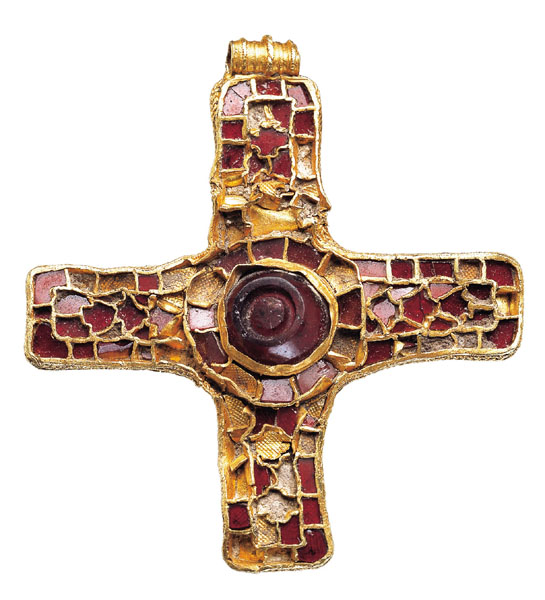
| The pectoral cross | A smaller equal-armed gold cross pendant, Portable Antiquities Scheme Find-ID 28631, set with cloisonne garnets over calcium-carbonate backing around a central cabochon garnet; originally carrying about 95 garnets, of which 58 survive. Dated stylistically to about 620-660 AD. The other complete or near-complete object in the hoard.20 |
| The inscribed gold strip | A bent gold strip, catalogued per Wikipedia's synthesis of the primary literature as St.H 550, measuring 179 x 15.8 x 2.1 mm when unfolded, bearing an incomplete and twice-misspelled Latin inscription in Insular half-uncial script quoting Numbers 10:35 in the Vulgate. Palaeographers disagree on the date its lettering implies; see narrative.21514 |
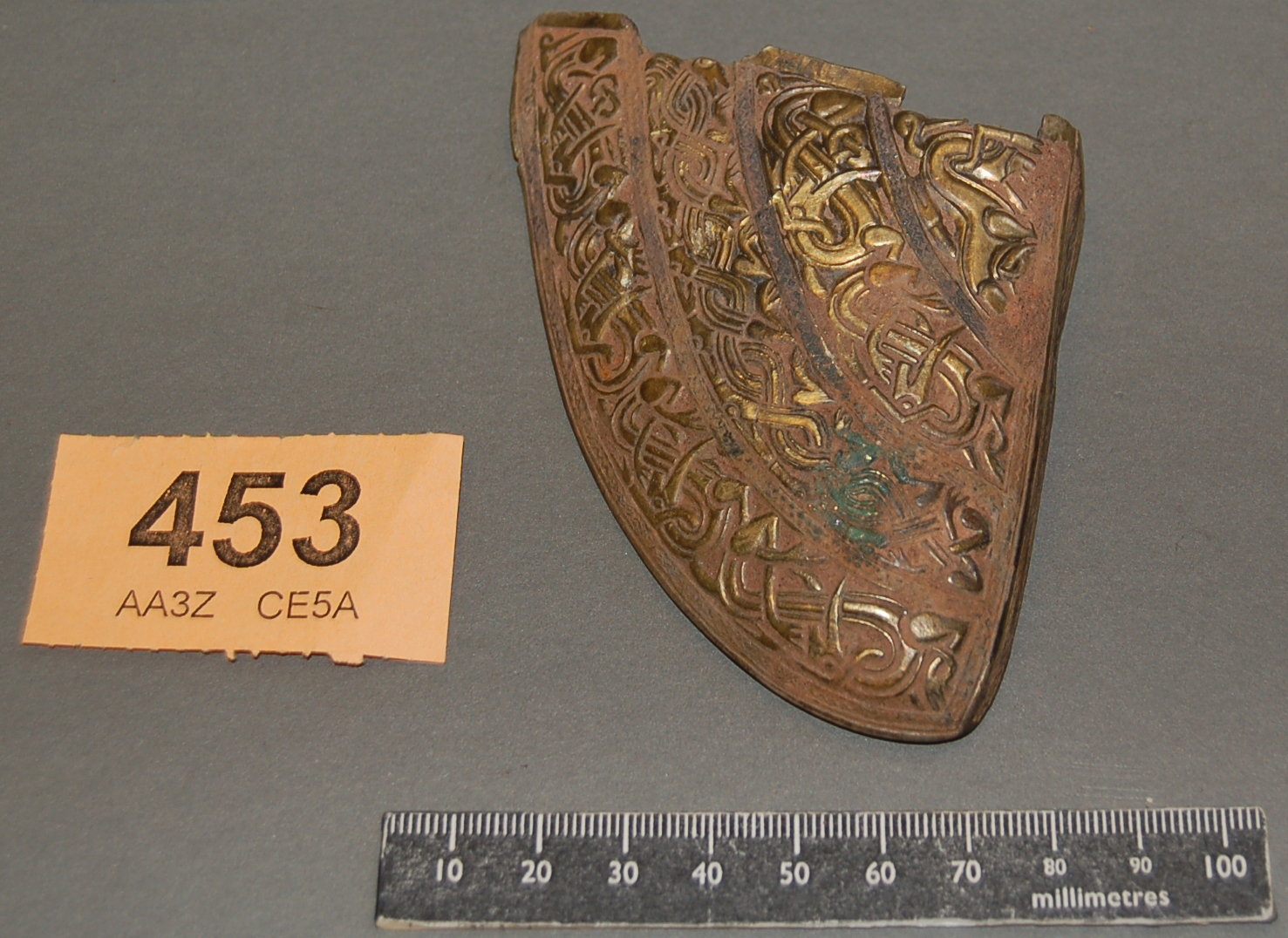
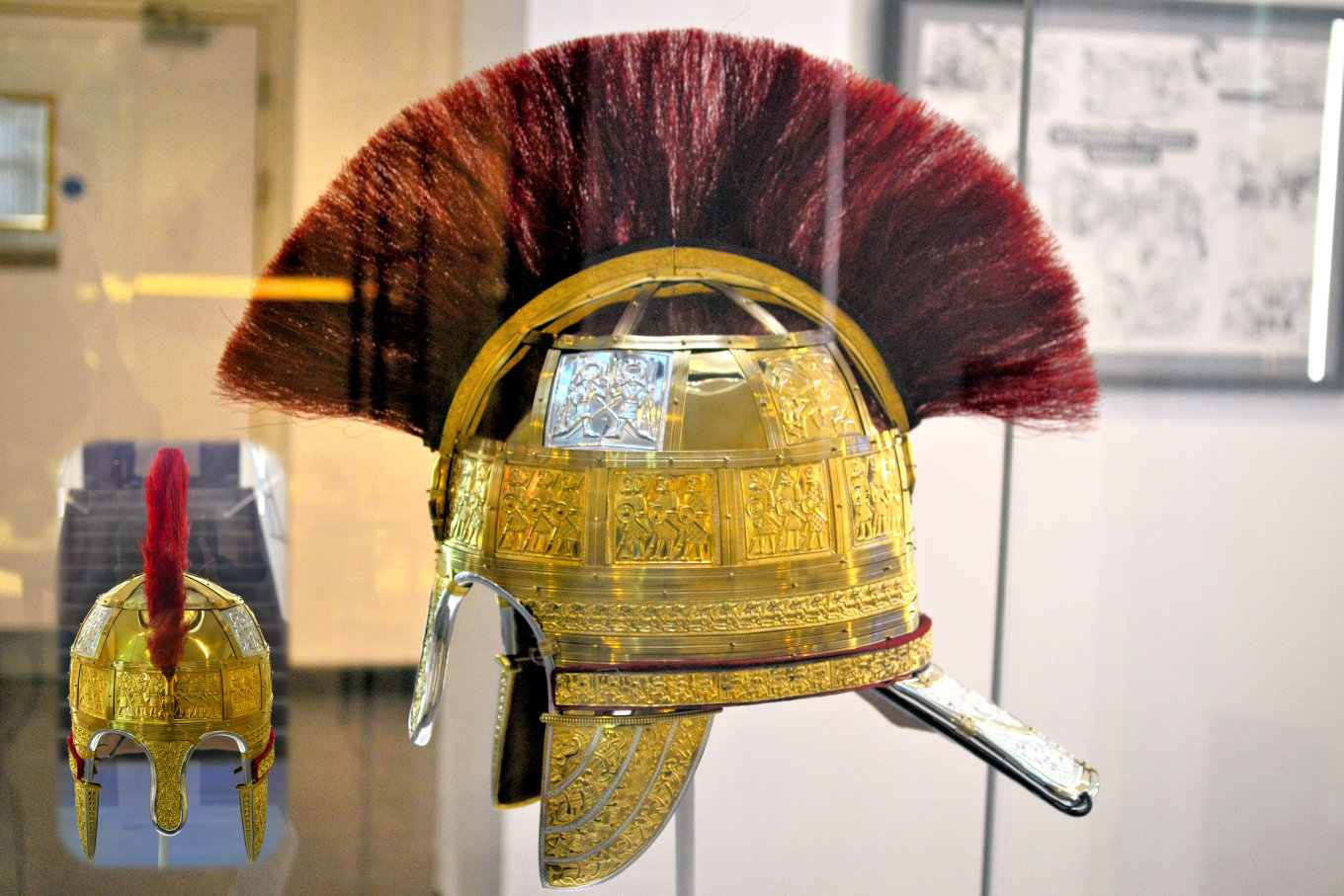
| The helmet | An estimated one-third of the recovered material by fragment count belongs to a single dismantled helmet: silver sheet decorated with die-stamped panels of warriors and zoomorphic ornament, then fire-gilded; reeded silver strips, rivets and U-sectioned edging strips for assembly onto a leather-and-organic base of which no physical trace survives. At least two cheek-pieces are known, one recovered in 2009 and a second only identified among the November 2012 finds.86710 |
| Depletion gilding | Scanning electron microscopy by Dr Eleanor Blakelock (British Museum), on a pilot sample of 16 objects later expanded to over 130 pieces, found gold-silver alloy surfaces artificially enriched to about 6-10 percent silver against a core of 25-50 percent silver: evidence of deliberate depletion gilding to make relatively low-purity gold read as purer to the eye than it actually was.16 |
| Filigree colour contrast | On filigree-decorated pieces including the pectoral cross, the fine gold wire ornament was left at a different, brighter alloy from its own backing sheet, which was itself surface-enriched; the resulting colour contrast between wire and ground appears to be a deliberate visual effect rather than an accident of manufacture.16 |
| Cataloguing history | Objects were first given temporary 'K' numbers during initial recording in 2009-2010 by Kevin Leahy, the Portable Antiquities Scheme's National Finds Adviser for early medieval metalwork. A new, permanent set of catalogue numbers was assigned during the 2014-2019 Historic England-funded research project as fragments were cleaned, physically rejoined and reinterpreted, and it is this second numbering, plain numbers such as 539, 541 and 550, that appears in the 2019 Society of Antiquaries monograph and its online catalogue. The Portable Antiquities Scheme's own database separately assigns each Treasure case a Find-ID. This record could not fully reconcile which original K-number corresponds to which final catalogue number for every object named here, from the sources consulted; where a confirmed mapping could not be established, only the later catalogue number or PAS Find-ID actually found in a source is given.2920 |
| Dating range | Individual objects span, on stylistic grounds, the later 6th to the earlier 8th century AD. The hoard's deposition itself is most often cited as c. 650-675 AD, but this is a conventional working date rather than a settled consensus; see narrative for the palaeographic dispute over the inscribed strip and for minority arguments for a considerably later deposition date.1214 |
Images
The record in full
Chapter 1What it is
The Staffordshire Hoard is not one object but around 4,600 pieces and fragments of gold and silver metalwork, overwhelmingly stripped from war-gear: sword hilt fittings, an estimated one-third of the...
The Staffordshire Hoard is not one object but around 4,600 pieces and fragments of gold and silver metalwork, overwhelmingly stripped from war-gear: sword hilt fittings, an estimated one-third of the whole by mass from a single dismantled helmet, and almost nothing else, aside from a small group of Christian objects. In aggregate it holds about 5.1 kg of gold and 1.4 kg of silver, decorated with roughly 3,500 separate pieces of cloisonne garnet. Almost none of it is whole: swords are represented by their gold and garnet hilt fittings but hardly ever by an iron blade, and the helmet survives only as a large but incomplete set of decorated silver panels with no trace of the iron or leather structure that would have held them together.
There is no coinage, no brooch, no item of female dress and, so far as the excavators and later researchers could establish, no grave, no body and no ship. That absence is as important as anything present: this is not a burial in the way Sutton Hoo is a burial. It is a deliberately assembled and then deliberately buried collection of dismantled, mostly martial, metalwork, and the two questions every subsequent piece of research keeps returning to are why it was dismantled and why it was buried.
Chapter 2How it was found
Terry Herbert, a 55-year-old detectorist who had been unemployed because of a disability and had detected for more than eighteen years with the Bloxwich Research and Metal Detecting Club, was...
Terry Herbert, a 55-year-old detectorist who had been unemployed because of a disability and had detected for more than eighteen years with the Bloxwich Research and Metal Detecting Club, was searching a field in the parish of Ogley Hay, near the village of Hammerwich in south Staffordshire, on Sunday 5 July 2009. He had written permission from the landowner, farmer Fred Johnson, and a prior written agreement that any reward would be split equally between them.
The findspot lies on the north-western spur of a low ridge about 3.5 km west of Wall, the Roman settlement of Letocetum, directly beside the A5, which follows the line of the Roman Watling Street. Over the following five days Herbert recovered around 500 items lying loose in the plough soil and on the surface, ranging from the cheek-piece of a helmet and a folded gold cross down to strips of gold weighing less than a gram. He correctly judged that the material was not coming from any surviving buried feature, and reported the find to Duncan Slarke, the Portable Antiquities Scheme's Finds Liaison Officer for Staffordshire.
Chapter 3The excavation
A meeting at Birmingham Museum and Art Gallery, attended by Bill Klemperer and Lisa Moffett of English Heritage, agreed a strategy for recovering the rest of the material.
A meeting at Birmingham Museum and Art Gallery, attended by Bill Klemperer and Lisa Moffett of English Heritage, agreed a strategy for recovering the rest of the material. Stephen Dean, Principal Archaeologist of Staffordshire County Council, and a colleague, Ian Wykes, first dug a single 1 x 1 m test pit, which alone produced about a hundred further items of gold, garnet-inlaid gold and silver-gilt, all recovered from the topsoil; no artefact was found in the subsoil, and no feature could be identified.
Birmingham Archaeology, the commercial fieldwork unit of the University of Birmingham's Institute of Archaeology and Antiquity, was then commissioned to continue, with Alex Jones directing the work on the ground. English Heritage and Staffordshire County Council jointly funded the excavation, the council also paying for night security because of the risk of nighthawking on a highly visible site bounded by roads on three sides. A total of 152 sq m was hand-excavated in 1 m squares, every spit of soil scanned with a metal detector, recovering around 800 further objects; a magnetometer survey covered 5.3 ha around the findspot. A second stage of fieldwork in March 2010, comprising a resistivity survey and trial trenching, was intended to place the hoard in its immediate landscape context.
No archaeological feature that could be securely linked to the hoard was ever found. The one substantial cut recorded, a shallow ditch aligned north-west to south-east in the south-western corner of the excavated area, proved on excavation to be of natural, clay-filled origin, and two nearby palisade trenches produced no datable material and were judged to belong, if anything, to an undated farmstead unconnected with the hoard. Whatever pit the objects were originally placed in had been entirely destroyed by later ploughing; the excavators' own conclusion was that the objects were recovered essentially where the plough had spread them, most densely around the original findspot, with heavier pieces dragged further by repeated cultivation than lighter ones.
Chapter 4A second find in the same field, 2012
In November 2012, after the field had been ploughed again, archaeologists from Archaeology Warwickshire returned with metal detectorists and recovered a further 91 items, including additional gold...
In November 2012, after the field had been ploughed again, archaeologists from Archaeology Warwickshire returned with metal detectorists and recovered a further 91 items, including additional gold and silver fragments and, among them, a further large piece of gold cross and a second helmet cheek-piece. At a coroner's inquest in January 2013, 81 of the 91 new finds were declared Treasure; the remaining ten were assessed as non-ancient wastage rather than genuine hoard material.
The 2012 pieces were added to the collection already held jointly by Birmingham Museums Trust and the Potteries Museum, bringing the assemblage to its present total of almost 4,600 pieces. The fact that further material turned up three years after the original, thoroughly fieldwalked and magnetometer-surveyed excavation is itself informative: it shows how completely the original burial context had been destroyed by ploughing, and how widely a single dispersal event, or several, had scattered even quite substantial pieces through the topsoil.
Chapter 5What is actually in it
Counts vary slightly between publications as cataloguing has continued, but the shape of the assemblage is consistent.
Counts vary slightly between publications as cataloguing has continued, but the shape of the assemblage is consistent. There are somewhere between 86 and 94 richly decorated sword pommel caps, by far the largest number ever recovered from a single context, together with numerous gold hilt plates and hilt collars, several with fine filigree ornament. An estimated one-third of the hoard's total mass, by fragment count, belongs to a single dismantled helmet.
Only two objects in the entire assemblage are complete or close to complete. One is a large folded gold cross, catalogued as no. 539 in the 2019 Society of Antiquaries volume, missing some of its original garnet settings and possibly made to serve as an altar or processional cross, or as decoration for the cover of a gospel book. The other is a smaller, equal-armed gold pectoral cross (Portable Antiquities Scheme Find-ID 28631), set with cloisonne garnets that originally numbered about 95, of which 58 survive, around a central cabochon garnet. A third Christian object, a bent gold strip inscribed with a Latin quotation from the Book of Numbers, and a unique gold mount combining cloisonne garnet work with millefiori glass, catalogued as no. 541 and informally nicknamed the mystery object by researchers because its original function is still not agreed, complete the small group of pieces that stand apart from the martial material. Five small gold snake or serpent fittings, some fitted with pins, have also been recovered; whether these were worn, carried, or served some other purpose is not established.
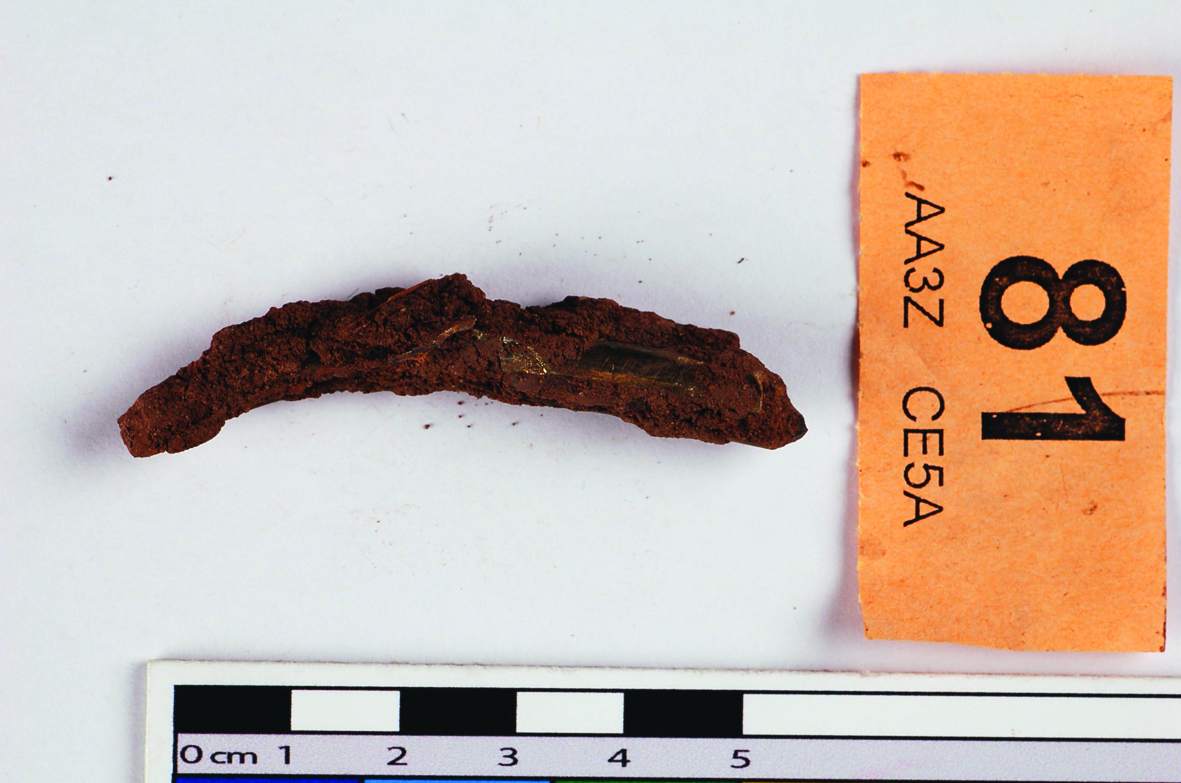
What is absent is as telling as what survives. There are no coins, no brooches and nothing identifiable as female dress equipment, and remarkably few iron sword blades or the belt and scabbard fittings that would ordinarily accompany a hilt of this quality, as if the hilts had been deliberately separated from everything else that once went with them. One further item recovered from the same plough soil and formally processed through the Treasure Act inquest alongside the ancient material was a twentieth-century key ring, catalogued as no. 890: a mundane, entirely modern object that happened to be lying in the same field and had to be identified and excluded from the ancient assemblage rather than assumed to belong to it.
Chapter 6How it was made
The metalworking on display is technically accomplished and repeatedly deceptive about its own material.
The metalworking on display is technically accomplished and repeatedly deceptive about its own material. Scanning electron microscopy carried out by Dr Eleanor Blakelock of the British Museum, on a pilot sample of sixteen objects later expanded to more than 130, found that many gold-silver alloy surfaces had been artificially depleted of silver, so that a piece with a core of 25 to 50 percent silver could present a surface reading of only 6 to 10 percent: enough to look like far purer gold than the metal underneath actually was. As Blakelock has put it, for all we know it was the colour of the gold that was the priority, not its purity. On filigree pieces such as the pectoral cross, the fine gold wire ornament and its backing sheet were enriched to different degrees, producing a deliberate colour contrast between the pattern and the ground it sits on.
The helmet's decorative silver sheet was made by die-stamping, pressing a design cut into a hard die into thin silver, and was then fire-gilded so that the finished object would have read as solid gold rather than gilded silver. The same basic method, though not the same physical dies, decorates the Sutton Hoo helmet and the boat-grave helmets excavated at Vendel and Valsgarde in Sweden, evidence of a shared North Sea craft tradition among Anglo-Saxon and Scandinavian smiths rather than proof that any of these objects came from the same workshop.
No maker's mark survives on any piece, and the raw material's own origin is debated. By the mid-seventh century, Anglo-Saxon gold coinage was becoming progressively debased with silver, giving some of it a silvery tinge, and it has been suggested, though not proven in the sources consulted, that recycled coinage of this kind supplied some of the hoard's gold. David Symons, a curator involved in the hoard's research, has put the scale of the raw material in context: by his estimate the fragments contain about 11 lb of gold, the equivalent of more than 3,000 contemporary gold coins and, in his words, certainly whoever owned the Hoard was very high status, there's three times as much gold as at Sutton Hoo, and it came from elite warriors.
Chapter 7The dating debate: what the objects date to is not what the burial dates to
Two different questions get run together in most short accounts of the hoard, and they have different answers.
Two different questions get run together in most short accounts of the hoard, and they have different answers. When were the objects made, and when were they buried? On the first question there is broad agreement across a wide range: stylistically, individual pieces run from the later sixth century to the earlier eighth. A silver sword pommel decorated in a Scandinavian or Germanic style has been placed at around 550 AD, a century before the hoard's newest pommels, decorated with paired ring-knobs and datable to about 630-660 AD, were made. Whatever else is uncertain, the objects buried together were not all made together; some were already old when the newest pieces were new.
On the second question, when the burial itself took place, there is no settled consensus, only a conventional and widely repeated window of about 650 to 675 AD, tied loosely to the reign and death of the Mercian king Penda. That window rests substantially on the stylistic dating of the objects themselves plus an assumption about historical context rather than on any independent, agreed method of dating the deposit. The clearest evidence of real scholarly disagreement is the inscribed gold strip. Its lettering has been read by Michelle Brown, a specialist in medieval manuscript studies, as consistent with a seventh or earlier eighth century date, on the basis of its use of half-uncial forms; Elisabeth Okasha, working from the same physical evidence, has identified features, including the use of insular majuscule forms, that in her reading point to an eighth or ninth century date instead. Nicholas Brooks has noted explicitly that using the dating of manuscript handwriting to date an inscribed object is a hazardous typological exercise, precisely because Brown and Okasha have reached different conclusions from the same script. Beyond this, other researchers have proposed considerably later deposition dates altogether, associating the burial with renewed Mercian conflict around 716 or with the civil war between King Offa and the usurper Beornred in 757, rather than with Penda's mid-seventh-century wars. This record does not treat any single date as settled. The manufacture range is wide and largely agreed; the burial date is neither.
Chapter 8Why was it buried: the unresolved dispute
No theory of why the hoard was buried commands anything like consensus, and the genuine, still-open state of the argument is itself the most important thing to report accurately about this object.The...
No theory of why the hoard was buried commands anything like consensus, and the genuine, still-open state of the argument is itself the most important thing to report accurately about this object.
The battlefield loot or trophy theory has the most support among the specialists who worked on the Historic England-funded research project, Chris Fern among them: the objects were violently dismantled, chopped up with little regard for their own decoration, the assemblage is overwhelmingly martial and entirely male in character, and stripping an enemy's sword hilt or helmet of its precious fittings would have been both a practical way to render a defeated man's war-gear worthless to him and a way of stripping away his identity as its owner. On this reading the hoard may represent booty gathered across several battles with different peoples over a period of decades, rather than the spoils of one engagement, which would also explain the wide date-range among the pieces.
A second, related but distinct reading treats the fragments as a portable store of bullion rather than trophies as such. David Symons has argued that reducing precious sword and helmet fittings to small, easily divided pieces would have given a war leader a form of currency he could use to pay his followers, in a kingdom that was not yet minting gold coinage in any comparable quantity. Nicholas Brooks, in a comment reported by the excavators, proposed a further alternative: that the objects could represent tribute collected by a Mercian king rather than spoils taken personally in battle, although their damaged and dismembered state sits awkwardly with the idea of tribute, which would usually have been handed over intact.
A fourth reading treats the burial itself, not just the dismantling, as the meaningful act: a votive or ritual deposit. Leslie Webster has compared the hoard directly to the barrow-treasure scene in the Old English poem Beowulf, thought to have been composed in Mercia, in which golden objects taken earlier from a hoard are deliberately placed back in a barrow and left to the earth, gold in the dust, where it still remains, as useless to men as it was before. Webster describes the poem's narrative as led by the need to consign the ill-gotten treasure back to earth, and the comparison raises the possibility that burying the Staffordshire material was itself understood as a kind of ritual disposal of tainted or dangerous wealth, rather than a temporary hiding place intended for recovery. A further variant of this reading, reported by Tom Shippey from the full academic publication, treats the destruction as ideologically driven: a deliberate act of destroying the symbols of a defeated lord's authority, to prevent his heirs or followers from reclaiming legitimacy through his old regalia.
None of these has been established over the others, and they are not all mutually exclusive; a collection assembled as trophies over years could still have been finally buried for votive reasons. What can be said plainly is that whoever buried the material never came back for it, and an unmarked field beside a busy Roman road, chosen (on one reading) precisely because it was easy to find again, was in the event never revisited. As one review of the case has put it, that in itself is a bad sign.
Chapter 9One event, or several, over decades
A closely related and equally unresolved question is whether the hoard was buried in a single episode or accumulated in the ground across more than one occasion.
A closely related and equally unresolved question is whether the hoard was buried in a single episode or accumulated in the ground across more than one occasion. The excavators themselves noted, from the character of the material recovered in 2009, that the presence of around ninety sword pommels of consistently high quality gave the impression of a careful selection built up over a period of time, rather than the spoils of a single battle, describing the assemblage as having the feel of a trophy hoard.
The wide stylistic date-range among the objects, from a mid-sixth-century heirloom pommel to pieces made only shortly before probable deposition, is consistent with either reading: a single burial of wealth accumulated gradually before that one event, or several separate depositions added to the same spot over years. Archaeology cannot settle the question from the ground itself. No stratified sequence, no separate pits, and no datable feature of any kind survived the destruction wrought by centuries of ploughing, so any answer has to come from the objects and their find-relationships to each other rather than from excavated context.
Chapter 10The Christian objects, and what their company says
The folded gold cross, the smaller pectoral cross and the inscribed gold strip are a small minority within an assemblage that is otherwise overwhelmingly martial and, in its imagery, largely in a...
The folded gold cross, the smaller pectoral cross and the inscribed gold strip are a small minority within an assemblage that is otherwise overwhelmingly martial and, in its imagery, largely in a pre-Christian idiom. The inscribed strip's own text, drawn from Numbers 10:35, is itself a war-cry rather than a devotional formula: rise up, Lord, and let your enemies be scattered, and let those who hate you flee from your face. Its presence alongside sword fittings is therefore not, on its own, evidence of any tension between Christian and martial identity; the same words could have accompanied an army with an entirely orthodox Christian self-understanding.
What is genuinely disputed is why the large cross, in particular, had been folded and damaged before burial, alongside the strip, which was also bent. One reading treats the folding as purely practical, a way of fitting a large liturgical object into whatever container or space the depositor had available. A second treats it as an act of desecration, consistent with looting Christian material during a period, associated with Penda's reign, when the Mercian kingdom's ruling elite was still substantially pagan; Bede records Penda himself as remaining a pagan even while tolerating Christianity among his own family. A third reading, harder to distinguish from the second on the physical evidence alone, treats the folding as an act of reverence rather than desecration: a way of ritually retiring a damaged sacred object rather than discarding it carelessly. None of these readings is established as correct in the sources consulted, and this record does not choose between them.
Chapter 11Penda, Mercia and the country the hoard sat in
The findspot sits inside the historical heartland of the kingdom of Mercia during a period when Mercia was aggressively expanding at the expense of its neighbours.
The findspot sits inside the historical heartland of the kingdom of Mercia during a period when Mercia was aggressively expanding at the expense of its neighbours. The Mercian prince and later king Penda fought a string of major battles across the second quarter of the seventh century: at Hatfield Chase in 633, in alliance with Cadwallon of Gwynedd, where the Northumbrian king Edwin was killed; at Maserfield, near Oswestry, in 642, in alliance with Cynddylan of Powys, where Edwin's successor Oswald was killed; against the East Angles around 635, where Bede records the deaths of the retired king Sigeberht and his successor Ecgric, both descendants of Raedwald, who is himself the leading candidate for the person buried under the Sutton Hoo ship; and finally at the unlocated battle of the Winwaed in 655, where Penda was killed or fatally wounded by the Northumbrian king Oswiu.
Welsh poetic sources add a further, more local episode. The elegy Marwnad Cynddylan describes a raid on a place called Caer Lwytgoed by men of Powys under a leader named Morfael, in which, according to the poem, they took fifteen hundred head of cattle, eighty horses and harnesses besides: extreme booty, in the poem's own phrase. Caer Lwytgoed has been identified by several scholars with the Roman site of Letocetum at Wall, close to the hoard's findspot, and the raid has traditionally been read as an attack on a monastic community established in the vicinity of Lichfield, though the historian Jenny Rowland has argued instead that the men of Powys were fighting in support of Cadwallon and Penda against a Northumbrian-aligned target, which would make the monks served by that target's own religious community rather than a target in themselves.
Local place-names hint, without proving anything about the hoard directly, at a landscape where pre-Christian belief still had a presence: Wednesbury and Wednesfield both derive from the name of the god Woden, and the place-name Weeford, from the Old English weoh, meaning a pagan shrine, has been read as evidence for a heathen temple somewhere along Watling Street to the east of the findspot. Two nearby settlements are both called Hammerwich, from Old English hamor and wic, the hammer-working or trading place, which could indicate a metalworking association with the district; the excavators are explicit, however, that no direct archaeological link between either place-name and the hoard itself has been established, and the finding should be read as suggestive landscape context rather than as evidence bearing directly on the object.
Chapter 12The helmet, and its unfinished reconstruction
An estimated one-third of the roughly 4,600 recovered pieces, by one account well over a thousand individual fragments, belongs to a single dismantled helmet, making it only the sixth substantially...
An estimated one-third of the roughly 4,600 recovered pieces, by one account well over a thousand individual fragments, belongs to a single dismantled helmet, making it only the sixth substantially represented Anglo-Saxon helmet known, after Benty Grange (found 1848), Sutton Hoo (1939), Coppergate in York (1982), Wollaston or Pioneer in Northamptonshire (1997) and Shorwell on the Isle of Wight (2004). Each of those is a separate object from a separate site and should never be confused with the Staffordshire material or with each other.
The surviving decoration is silver sheet, die-stamped with panels showing marching and kneeling warriors, mounted and priestly figures, and zoomorphic ornament, then fire-gilded so that the finished helmet would have looked entirely gold rather than silver. Reeded silver strips and rivets held the decorated sheet to the helmet's structural base, and U-sectioned edging strips probably clamped the sheet and an underlying leather layer together. At least two cheek-pieces are known, one recovered during the 2009 excavation and a second only identified among the additional material found in November 2012.
What is entirely missing is the helmet's own skeleton. No iron cap, and no trace of the leather or other organic structure that would once have supported the decorated sheet, survives; unlike Sutton Hoo, where an iron cap was recovered and a physical helmet could eventually be reassembled around it, the Staffordshire helmet's decorated panels have nothing solid left to be reassembled onto. Because physical reassembly of an actual object was therefore not possible, a project led by the School of Jewellery at Birmingham City University, working from 2014 with laser-scanned and CAD-modelled data taken from the surviving fragments, produced two full-scale replica reconstructions, using computer-milled and hand-finished dies to re-strike new silver sheet matching the original panels, with a blacksmith and a leather-worker supplying the missing iron and leather elements based on archaeological inference rather than surviving physical evidence. The two replicas, one for each owning museum, were unveiled together on 3 November 2018.
Both institutions involved are explicit that this is an informed interpretation of how the helmet probably looked, not a certain recreation of it. Tom Shippey, reviewing the full academic publication that followed the research project, notes a further, more fundamental uncertainty: given how much of the reconstruction rests on comparing and pattern-matching a large number of small, damaged fragments rather than on any surviving overall shape, it is not impossible that the fragments actually come from more than one helmet. The identification of a second cheek-piece only in the 2012 finds, three years after the main excavation, is a reminder that the fragment set used to build the 2018 replicas may itself still be incomplete.
Chapter 13Valuation and the fight to keep it in the region
The Treasure Valuation Committee, an independent panel chaired by Professor Norman Palmer, met at the British Museum on 25 November 2009 and valued the hoard at 3.285 million GBP under the Treasure...
The Treasure Valuation Committee, an independent panel chaired by Professor Norman Palmer, met at the British Museum on 25 November 2009 and valued the hoard at 3.285 million GBP under the Treasure Act 1996. Both museums hoping to acquire it, Birmingham Museum and Art Gallery and the Potteries Museum and Art Gallery, and both Terry Herbert and Fred Johnson, accepted the figure. Under the Act's reward provisions, finder and landowner were each entitled to half.
Raising that sum for two regional museums, rather than allowing the hoard to be sold on the open market, required a dedicated public campaign. The Art Fund launched the appeal on 13 January 2010 with an initial grant of 300,000 GBP, assisted by the Wolfson Foundation, and pledges of 100,000 GBP each from Birmingham and Stoke-on-Trent City Councils. The National Heritage Memorial Fund contributed 1.285 million GBP, and the public gave a further 900,000 GBP, of which 640,000 GBP was raised through the Art Fund's own members and supporters, with further trusts making up the balance. The full 3.285 million GBP was secured several weeks ahead of the campaign's own deadline, and the hoard was formally acquired jointly by Birmingham Museums Trust and the Potteries Museum and Art Gallery in 2010, becoming, by the Art Fund's own description, the most valuable Treasure find ever made on British soil.
The human aftermath of that sum is less well documented but worth recording plainly. A year after the discovery, Herbert, still using the same battered metal detector that had found the hoard, said he remained exactly the same person and felt a bit bewildered by what had happened. According to at least one account from within the detecting community, the windfall caused a lasting rift between Herbert and Johnson that had not been repaired by the time that account was written; this record notes the claim but treats it cautiously, since it rests on a single source not corroborated elsewhere in the material consulted.
Chapter 14After acquisition: research, redisplay, and what is still unresolved
Historic England and the two owning museums funded a major research project running from 2014, involving specialists including Chris Fern, Tania Dickinson and Leslie Webster, which physically...
Historic England and the two owning museums funded a major research project running from 2014, involving specialists including Chris Fern, Tania Dickinson and Leslie Webster, which physically rejoined many fragments, produced the helmet reconstructions unveiled in November 2018, and culminated in the 2019 publication of The Staffordshire Hoard: An Anglo-Saxon Treasure, a research report of the Society of Antiquaries of London running to more than 580 pages, followed by a shorter book for general readers by Fern and Jenni Butterworth in 2022. It is this project's renumbered catalogue, rather than the temporary numbers first assigned during initial recording in 2009-2010, that is now the closest thing to a standard reference for individual pieces.
The Potteries Museum's own Staffordshire Hoard gallery in Stoke-on-Trent was substantially redisplayed in 2023, removing an earlier reproduction helmet in favour of clearer interpretive material and adding regional early medieval comparanda from nearby sites at Wychnor, Stapenhill and Catholme, to place the hoard within its wider Mercian landscape rather than presenting it in isolation. In the summer of 2022, a group of Staffordshire Hoard pieces, including a gold and garnet sword pommel, a filigree hilt collar, a mount with horse-head terminals, a zoomorphic seax collar and a gilded silver pommel cap, travelled to Sutton Hoo in Suffolk for the exhibition Swords of Kingdoms: The Staffordshire Hoard at Sutton Hoo, which ran from 19 May to 30 October 2022 after a two-year pandemic delay from its original planned date. Original Sutton Hoo material on loan from the British Museum, including a gold and garnet shoulder clasp, a gold and garnet sword pyramid and a gold coin, was shown alongside it: the first time objects from the two collections had been displayed together. Curators involved, including Sutton Hoo's Laura Howarth and the Staffordshire Hoard specialist Chris Fern, presented the pairing explicitly as a meeting of two of the most important, but distinct, Anglo-Saxon discoveries in England, and argued, on stylistic grounds, that some Staffordshire pieces may have been made in the same East Anglian workshops that produced material found at Sutton Hoo. That connection remains an argued proposal rather than a documented fact.
The two finds should not be run together. Sutton Hoo is a 1939 excavation of an intact, furnished ship burial in a different county, Suffolk, with a body-shaped void, grave goods still in their original relationships, and a named leading candidate for its occupant, Raedwald. The Staffordshire Hoard is a 2009 metal-detector find in Staffordshire of dismantled, dispersed war-gear fragments with no burial, no body and no grave goods in the conventional sense at all. Nor should either be confused with the wholly separate Cheapside Hoard, a cache of roughly 500 pieces of Elizabethan and Jacobean jewellers' working stock found in a London cellar in 1912 and generally thought to have been buried around the time of the English Civil War in the 1640s, now held mainly by the Museum of London: a different period, a different country's material culture, and a different reason for burial, a jeweller's stock hidden for safekeeping rather than war-gear disposed of after battle. All three are major, genuinely important English hoards; none of the three is the other.
The artist
Unknown Anglo-Saxon goldsmith or goldsmiths' workshop(s), Mercia and/or East Anglia, active later 6th to earlier 8th century AD
No name, mark or workshop stamp survives on any of the roughly 4,600 pieces in the hoard. What can be reconstructed is a set of shared techniques and, on the stylistic evidence of individual pieces, a working span of well over a century rather than a single generation of smiths. Some objects, such as a silver sword pommel decorated in a Scandinavian or Germanic style datable to around 550 AD, were already old by the time the hoard's newest pieces were made in the second and third quarters of the seventh century; they were almost certainly heirlooms by the time they were buried, not contemporary work. This dossier therefore covers a craft tradition and its methods, not an individual hand or even a single confirmed workshop, and its findings should be read with the same caution any maker-unknown treatment requires.
Related works
| Work | Relation | Where it is |
|---|---|---|
| The Sutton Hoo Helmet and ship-burial assemblage Unknown workshop, East Scandinavian-influenced, early 7th century | A separate, earlier-excavated Anglo-Saxon find; the two hoards were displayed together for the first time in 2022 Not the same find. Sutton Hoo is an intact 1939 excavation of a furnished ship burial in Suffolk; the Staffordshire Hoard is a 2009 metal-detector find of dismantled, dispersed war-gear fragments in Staffordshire with no burial, body or grave goods in the conventional sense. Some Staffordshire pieces may share workshop origins with Sutton Hoo material on stylistic grounds, per the 2022 joint exhibition, but this is argued, not documented. Already catalogued on this site as sutton-hoo-helmet-british-museum. | British Museum, London |
| The Cheapside Hoard Unidentified Jacobean-era goldsmith(s) and jeweller(s) | No historical or physical connection; cited here only to prevent confusion between two unrelated finds both loosely described as major English hoards A wholly different find: about 500 pieces of Elizabethan and Jacobean jewellers' working stock, discovered in a London cellar in 1912 and thought to have been buried around the time of the English Civil War in the 1640s. Different period, different country of manufacture, different reason for burial. Already catalogued on this site as the-cheapside-hoard. | Museum of London |
| Benty Grange helmet Unknown Anglo-Saxon workshop | Comparandum: a separate Anglo-Saxon helmet find, notable for a boar-crest finial paralleling the boar and animal ornament found on other Anglo-Saxon helmets of the period Found in a barrow excavation in Derbyshire in 1848. Not from Staffordshire; a separate object and a separate find. | Weston Park Museum, Sheffield |
| Vendel and Valsgarde boat-grave helmets Unknown Scandinavian workshop(s) | Closest well-published parallel for the die-stamping and fire-gilding technique used on the Staffordshire helmet's decorative sheet Sixth- and seventh-century boat-grave helmets from eastern Sweden, excavated 1881-83 (Vendel) and in the 1920s (Valsgarde); part of the same broad North Sea craft tradition, not the same objects or the same hand. | Swedish History Museum / Gustavianum, Uppsala University, Sweden |
| Coppergate helmet Unknown Anglo-Saxon workshop | Another separate, substantially complete Anglo-Saxon helmet, useful for comparison precisely because, unlike the Staffordshire helmet, it survived whole enough to be lifted and displayed without a modern replica Found in 1982 during roadworks in York. A different object from a different site; not part of the Staffordshire Hoard. | Yorkshire Museum, York |
Open questions
- Why was the hoard buried at all: as battlefield loot, a votive or ritual deposit, a war leader's bullion reserve for paying followers, or collected tribute? The excavators and later researchers have proposed all four readings and none has been established over the others.
- Was the hoard deposited in a single event, or added to on separate occasions over years or decades? The wide stylistic date-range of the objects, from a c. 550 AD heirloom pommel to c. 630-660 AD new work, is consistent with either answer, and no datable archaeological feature survived the site's ploughing history to settle it from the ground itself.
- When exactly was it buried? The commonly cited window of c. 650-675 AD rests on stylistic dating of the objects and an assumed link to Penda's Mercia; the inscribed gold strip's lettering has been dated as early as the 7th century by Michelle Brown and as late as the 8th or 9th century by Elisabeth Okasha from the same physical evidence, and other researchers have argued for a considerably later deposition, during renewed Mercian conflict around 716 or the Offa-Beornred civil war of 757.
- Do all the helmet fragments belong to one helmet? The attribution of roughly a third of the hoard's mass to a single dismantled helmet rests on comparison and pattern-matching across many small, damaged pieces rather than on any surviving overall shape, and Tom Shippey's review of the full academic publication notes it is not impossible that some fragments belong to a second helmet.
- What was the unique cloisonne-and-millefiori-glass mount, catalogue no. 541 and nicknamed 'the mystery object' by researchers, actually for? A tentative link to ecclesiastical headwear has been proposed but, so far as the sources consulted show, not confirmed.
- Did the findspot itself carry symbolic meaning, or was it chosen only because it was easy to find again? The excavators recorded both readings as live possibilities and found no archaeological evidence, such as a shrine or barrow, to decide between them.
- Where was the gold itself sourced? A link to recycled or debased mid-7th-century gold coinage has been proposed to explain the silvery tinge of some pieces, but the sources consulted do not report a scientific sourcing study establishing where the raw bullion actually came from, unlike the study that has traced Sutton Hoo's garnets to Sri Lanka and India.
Questions about this object
What is The Staffordshire Hoard?
The Staffordshire Hoard is an arms and armour, dated individual objects span, on stylistic evidence, the later 6th century to the earlier 8th century AD; the hoard's burial is most often placed c. 650-675 AD, though this date is contested (see narrative). Medium: Gold, silver and silver-gilt, with garnet cloisonne, gold filigree, niello and glass, mostly in the form of dismantled sword, helmet and other war-gear fittings.
Who made The Staffordshire Hoard, and is the attribution settled?
The attribution to Unknown Anglo-Saxon goldsmith or goldsmiths' workshop(s), Mercia and/or East Anglia is recorded here as unknown. No maker's name, mark or workshop stamp survives on any of the roughly 4,600 pieces in the hoard. The objects were made by more than one hand across at least a century: a silver sword pommel decorated in a Scandinavian or Germanic style is datable on stylistic grounds to about 550 AD and was almost certainly already an heirloom when the hoard's youngest pieces, pommels with paired ring-knobs of about 630-660 AD, were newly made. A 2022 exhibition pairing Staffordshire Hoard material with finds from Sutton Hoo argued, on stylistic comparison alone, that some Staffordshire pieces may share an East Anglian workshop origin with Sutton Hoo material. This is a proposed connection, not a documented one; no piece carries any evidence of where it was actually made.
Where is The Staffordshire Hoard now?
Jointly owned and displayed by Birmingham Museums Trust (Birmingham Museum & Art Gallery) and the Potteries Museum & Art Gallery, Stoke-on-Trent, with selected pieces also shown at Tamworth Castle and Lichfield as partners in the 'Mercian Trail' presentation of the find. Inventory number No single accession number covers the whole dispersed assemblage; individual pieces carry a 2019 Society of Antiquaries catalogue number (e.g. no. 539 for the great gold cross) and, for many, a separate Portable Antiquities Scheme Find-ID (e.g. FindID 28631 for the pectoral cross). See the Technical section on the hoard's overlapping numbering systems.. Last confirmed 13 August 2026. Acquired for the nation in 2010 under the Treasure Act 1996, following valuation by the Treasure Valuation Committee and a public fundraising campaign led by the Art Fund.
What is still unknown about The Staffordshire Hoard?
Why was the hoard buried at all: as battlefield loot, a votive or ritual deposit, a war leader's bullion reserve for paying followers, or collected tribute? The excavators and later researchers have proposed all four readings and none has been established over the others.
Sources
- 1Dean, S., Hooke, D. and Jones, A., 2010. 'The Staffordshire Hoard: The Fieldwork.' The Antiquaries Journal, 90, pp. 139-152. doi.org/10.1017/...
- 2Wikipedia, 'Staffordshire Hoard'. (eds), The Staffordshire Hoard: An Anglo-Saxon Treasure, Society of Antiquaries of London Research Report 80 (2019), which could not be directly accessed in full text during this research session. en.wikipedia.org/wiki/...
- 3Birmingham Museums Trust, 'The discovery of the Staffordshire Hoard'. birminghammuseums.org.uk/resources/...
- 4Tom Shippey, 'In an Unmarked Field: The Staffordshire Hoard', London Review of Books, vol. 42 no. 5, review of Fern, Dickinson and Webster (eds), The Staffordshire Hoard: An Anglo-Saxon Treasure (2019). lrb.co.uk/the-paper/...
- 5Current Archaeology, 'Rethinking the Staffordshire Hoard: Piecing together the wealth of Anglo-Saxon kings'. archaeology.co.uk/articles/...
- 6Ann-Marie Carey, 'Recreating the Staffordshire Hoard Helmet: A Collaboration of Digital and Fine Metals Skills', The Alchemist, issue 117, London Bullion Market Association. lbma.org.uk/alchemist/...
- 7Medievalists.net, 'Staffordshire Hoard helmet reconstructions revealed', November 2018. medievalists.net/2018/...
- 8Historic England (Heritage Calling blog), 'What Does the Staffordshire Hoard Tell Us?', 20 January 2023. heritagecalling.com/2023/...
- 9Chris Fern and Jenni Butterworth, 'The Staffordshire Hoard in ten objects', Liverpool University Press Blog, 4 May 2022. liverpooluniversitypress.blog/2022/...
- 10Wikipedia, 'Staffordshire helmet'. en.wikipedia.org/wiki/...
- 11Fern, C., Dickinson, T. and Webster, L. (eds), The Staffordshire Hoard: An Anglo-Saxon Treasure, Society of Antiquaries of London Research Report 80 (2019). cambridge.org/core/...
- 12Art Fund, 'Staffordshire hoard'. artfund.org/our-purpose/...
- 13SOFII, 'The Art Fund: the battle to save the Staffordshire Hoard' (fundraising case study). sofii.org/case-study/...
- 14Current Archaeology, 'Staffordshire Hoard: trophies of warrior kings'. archaeology.co.uk/articles/...
- 15BabelStone Blog, 'The Staffordshire Hoard: Anglo-Saxon Epigraphy and the Manuscript Tradition', December 2009. babelstone.co.uk/Blog/...
- 16Current Archaeology, 'Secrets of the Staffordshire Hoard: skills of the Saxon smiths revealed' (Dr Eleanor Blakelock's depletion-gilding analysis). archaeology.co.uk/articles/...
- 17BBC News, 'Staffordshire Hoard inquest rules most new items treasure', January 2013. feeds.bbci.co.uk/news/...
- 18Express & Star, 'Golden times ahead for Staffordshire Hoard millionaire'; and Medievalists.net, 'How the Staffordshire Hoard was Discovered' (Terry Herbert biographical detail and the finder/landowner reward split). expressandstar.com/news/...
- 19Detecting.org.uk, 'The Staffordshire Hoard, the Anglo-Saxon find of the century!' (cited only for the claim of a lasting rift between the finder and the landowner; not corroborated elsewhere in the sources consulted). detecting.org.uk/staffordshirehoard
- 20Flickr photography by Jon Callas and David Rowan), consulted individually per file for licence verification via the Commons API. commons.wikimedia.org/wiki/...
- 21Museums + Heritage Advisor, case study on the Staffordshire Hoard gallery at Birmingham Museum and Art Gallery, describing the 'Mercian Trail' partner-museum arrangement (Birmingham, the Potteries Museum, Tamworth Castle and Lichfield). museumsandheritage.com/advisor/...
- 22Museum Crush, 'Anglo-Saxon treasures from the Staffordshire Hoard head to Sutton Hoo' (on the 2022 exhibition 'Swords of Kingdoms: The Staffordshire Hoard at Sutton Hoo'). museumcrush.org/anglo-saxon-treasures-from-the-staffordsh...
- 23Howard Williams (Archaeodeath blog), 'The Staffordshire Hoard redisplayed and revisited in 2023', 20 July 2023, on the Potteries Museum's 2023 gallery redisplay. howardwilliamsblog.wordpress.com/2023/...
Last verified · Published
Change log
13 August 2026 - Record created at the house standard: researched narrative, technical evidence, maker dossier, graded provenance chain, prices with hammer and premium separated, related works, open questions and sources.