Section of the Grizzly Giant with Galen Clark, Mariposa Grove, Yosemite
Carleton E. Watkins · 1865-66, printed ca. 1876
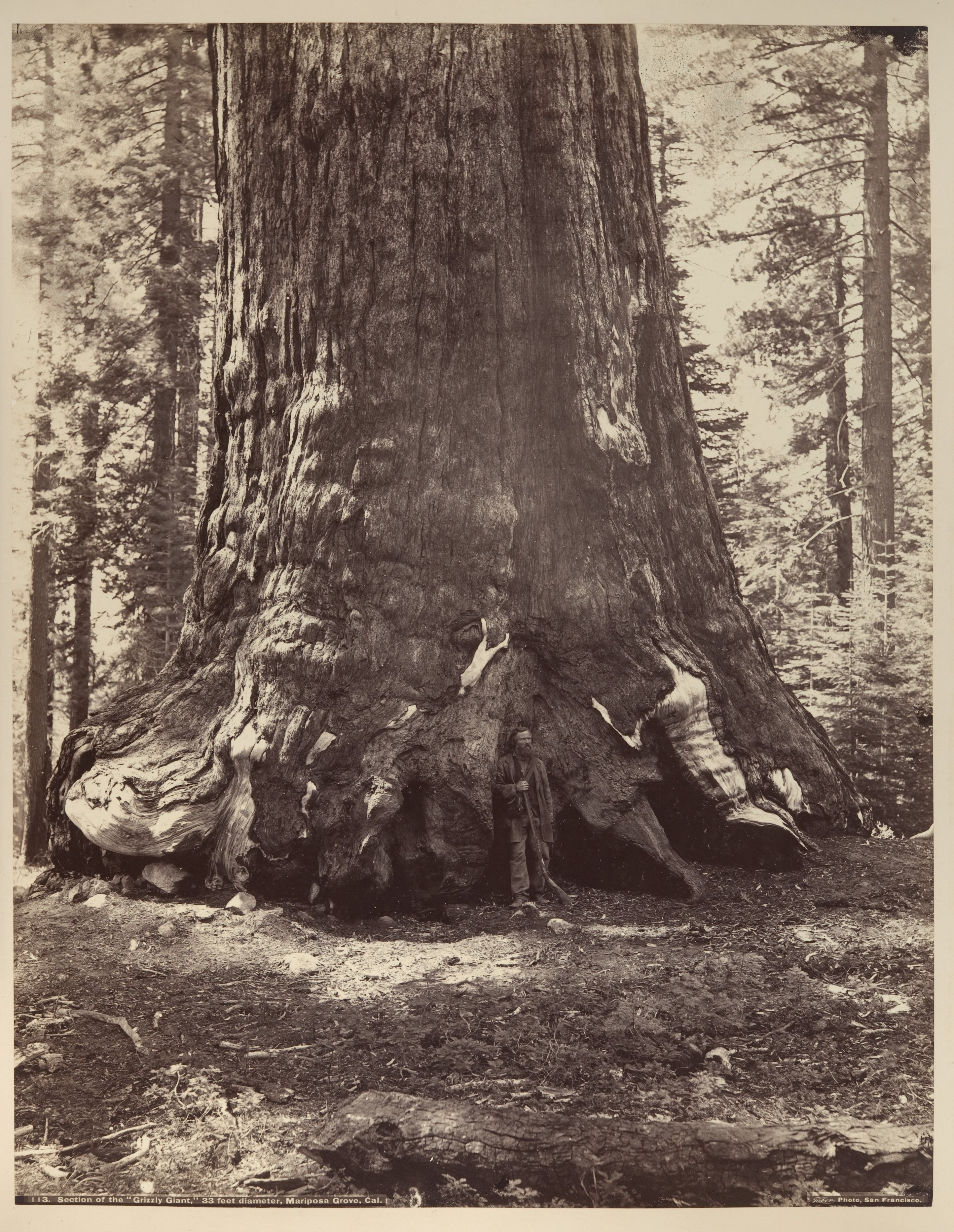
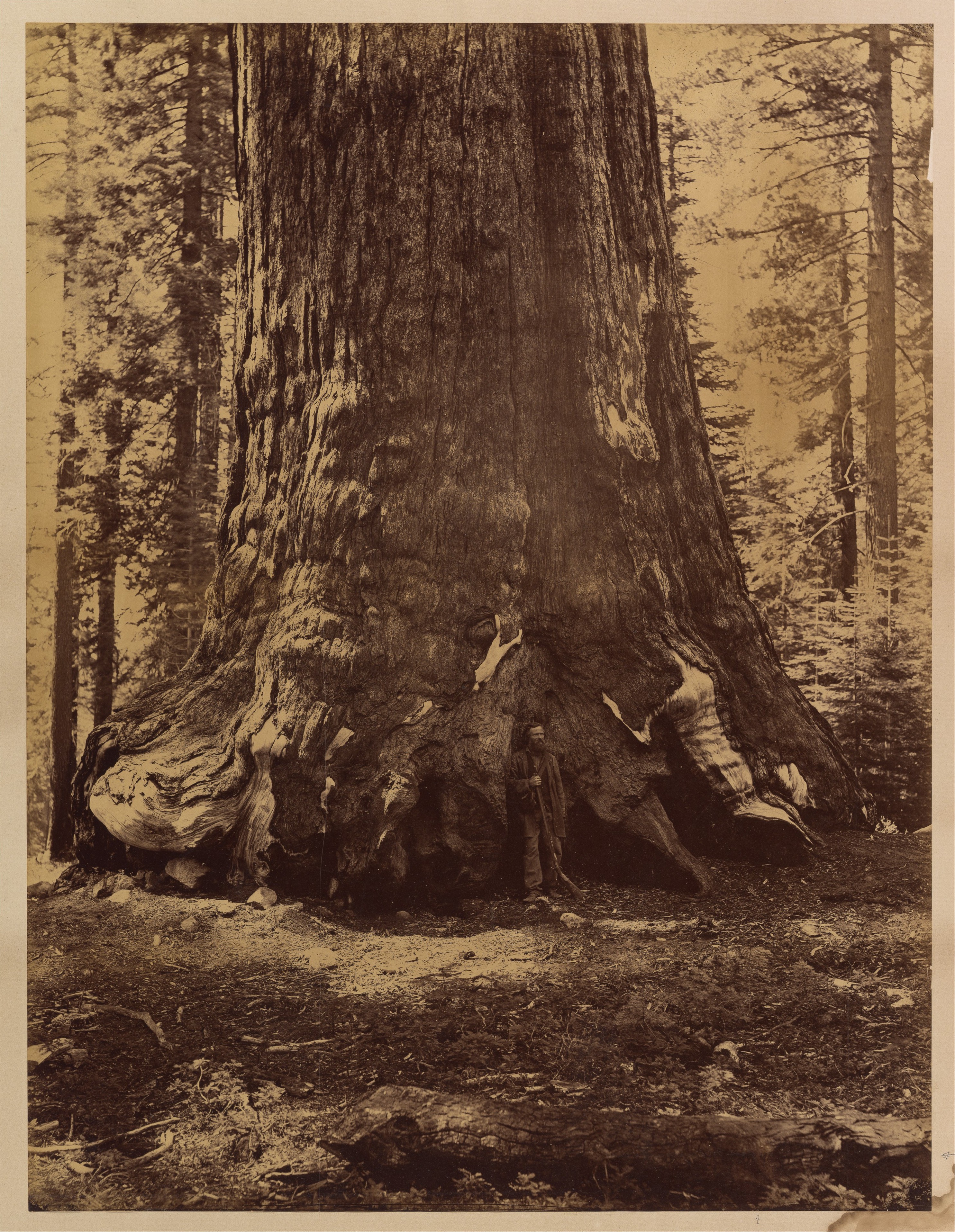
The Metropolitan Museum print under study, 1972.643.3, albumen silver print, 1865-66, printed ca. 1876. CC0 open access image of this exact print.
| Artist | Carleton E. Watkins |
|---|---|
| Date | 1865-66, printed ca. 1876 |
| Medium | Albumen silver print from glass negative |
| Dimensions | 52.2 x 40.6 cm (20 9/16 x 16 in.) |
| Where it is now | Metropolitan Museum of Art, New Yorklast confirmed |
| Inventory number | 1972.643.3 |
| Attribution | AcceptedThe Metropolitan Museum credits the photograph to Carleton E. Full note |
| Object type | Photograph |
| Period | American, nineteenth century |
| Cases | Seized, looted or confiscated · Has a provenance gap |
| Inscriptions | None recorded in the Museum's online record. |
| Owners on record | 6 links3 documented, 1 disputed, 2 unknown |
| Sources | 23 cited |
About this record Last verified · 23 sources cited · Change log
On this page 9 sections
ContentsClose
A large albumen print of about 1876 from Carleton Watkins's mammoth-plate negative of 1865-66: Galen Clark, first guardian of Yosemite, standing at the base of the Grizzly Giant in the Mariposa Grove. The print is in the Metropolitan Museum, and its date places it in the years after Watkins lost his negatives to creditors and to I. W. Taber, who went on printing the Yosemite views without crediting him.
Watkins photographed Clark at this tree on two campaigns five years apart, and the neighbouring pictures share nearly the same title. The record separates the 1865-66 negative from the 1861 view, notes that the 1865-66 plate post-dates the 1864 Yosemite Act and so cannot have influenced it, and sets out where the sources disagree: the year of the loss, the printer, the date of one related print and the tree's age.
Provenance
Each link is graded. Documented: a cited source supports it. Disputed: the identification is argued but not established. Unknown: no owner for that span, and the gap is not smoothed into a narrative. The grades in the glossary.
- 1865 - 1866Carleton E. Watkins, San Franciscodocumented
Negative made on the second Yosemite campaign, catalogued 1865-66 and numbered 113 in Watkins's own series. Exhibited at Paris in 1867 and in 1868 and 1869 per the Naef note.14
- 1866 - 1875Watkins's Yosemite Art Gallery stockdocumented
The negative stayed in Watkins's inventory until the mid 1870s; the exact date of its loss is disputed between 1875 and 1876.31213
- 1875 - 1876J. J. Cook and I. W. Taberdisputed
Sources agree Watkins lost his negatives and gallery. They differ on whether the creditor was Cook with Taber, or Taber alone, and on the year. The mechanism is not documented in sources fetched.3121315
- c. 1876 -Printer of Met 1972.643.3unknown
The Met dates the paper about 1876. The Met-derived text says Taber printed this image without credit, but the print's own imprint was not seen. Printer unconfirmed.13
- c. 1876 - 1972Unknownunknown
No owner is documented between printing and acquisition.1
- 1972 - presentMetropolitan Museum of Art, New Yorkdocumented
Accession 1972.643.3, The Elisha Whittelsey Collection, The Elisha Whittelsey Fund, 1972.1
Technical evidence
| Attribution note | The Metropolitan Museum credits the photograph to Carleton E. Watkins. The negative is accepted as Watkins's (his number 113). The paper print is catalogued as printed about 1876, after Watkins lost his negatives, and may have been printed by I. W. Taber; the printer is not established. |
|---|---|
| Process | Albumen silver print from a glass negative (wet collodion mammoth plate)13 |
| Image size | 52.2 x 40.6 cm (20 9/16 x 16 in.), vertical1 |
| Negative date | 1865-66, Watkins number 113, Naef catalogue number 10514 |
| Print date | Ca. 1876 per the Metropolitan Museum; printer not established13 |
| Camera and plate | Custom camera for large glass plates of about 18 x 22 inches22 |
| Credit line | The Elisha Whittelsey Collection, The Elisha Whittelsey Fund, 19721 |
| Getty print of same negative | 84.XM.493.11, 52.2 x 41.1 cm, mount 71.1 x 55.9 cm, inscribed 1134 |
| Inscriptions on this print | None recorded in the Museum's online record1 |
Images
The record in full
Chapter 1A print of about 1876 from a negative of 1865-66, in the Metropolitan Museum
This record concerns one impression: accession 1972.643.3 in the Metropolitan Museum of Art, an albumen silver print from a glass negative, 52.2 x 40.6 cm, catalogued by the Museum as 1865-66...
This record concerns one impression: accession 1972.643.3 in the Metropolitan Museum of Art, an albumen silver print from a glass negative, 52.2 x 40.6 cm, catalogued by the Museum as 1865-66, printed ca. 1876 [1]. The subject is the base of the tree known as the Grizzly Giant in the Mariposa Grove, with the guide and first guardian of Yosemite, Galen Clark, standing in front of it to give the scale. The Museum credits the photograph to Carleton E. Watkins and gives its credit line as The Elisha Whittelsey Collection, The Elisha Whittelsey Fund, 1972 [1].
The date pair matters more than usual. 1865-66 is when the negative is catalogued as having been made. About 1876 is when this paper was printed, and that falls in the years in which Watkins had lost control of his negatives. Everything below keeps those two events apart, and keeps this impression apart from the several neighbouring pictures of the same tree that carry nearly the same title.
The Museum's collection record names Watkins alone as the artist [1]. Whether the impression carries a Watkins imprint, a Taber imprint or none could not be established from the sources fetched for this record; the Museum's own page, which would say, was rate-limited when requested. That is recorded under open questions rather than guessed at.
Chapter 2What the object is, physically
The medium is albumen silver print from a glass negative [1].
The medium is albumen silver print from a glass negative [1]. The image measures 52.2 x 40.6 cm (20 9/16 x 16 in.), a vertical format [1]. The Museum's record gives no sheet or mount size for this print [1].
For comparison, the Getty print of the same negative, 84.XM.493.11, measures 52.2 x 41.1 cm and sits on a mount of 71.1 x 55.9 cm; its mount is inscribed in pencil 'Section of the Grizzly Giant' and, at lower left, '113', which is Watkins's own view number [4]. The Met's second print of the subject, 1970.540.6, is given as image 52.4 x 39.8 cm on a sheet of 60.5 x 48.4 cm [2]. A few millimetres of difference in the image width across impressions is ordinary for hand-trimmed albumen prints; it does not by itself show a different negative, and it does not prove the same one either.
The Museum's online record gives no inscriptions, marks or condition notes for 1972.643.3 [1]. No mount, frame or glazing history is documented in the sources consulted.
Chapter 3The tree, and the man standing at its foot
The Grizzly Giant is a giant sequoia in the Mariposa Grove, in what is now Yosemite National Park.
The Grizzly Giant is a giant sequoia in the Mariposa Grove, in what is now Yosemite National Park. According to the encyclopedia account, the publisher James M. Hutchings named it the 'Grizzled Giant' in 1859 on Galen Clark's advice, and it was generally called the Grizzly Giant by 1888; Hutchings wrote that it 'looks at you as defiantly as the oldest veteran grizzly bear ever could' [16]. The same article gives its height as 63.7 m and ground circumference as 29.5 m, and says fire has removed over 80 percent of its bark and sapwood [16]. Its age is stated as about 2,995 years (plus or minus 250) in the Grizzly Giant article, while the Mariposa Grove article gives roughly 1,900 to 2,400 years [16][17]. These two figures contradict each other inside the same encyclopedia, and neither is a primary measurement.
Galen Clark (1814-1910) was born in Shipton, Lower Canada, went to California in 1854, and in 1857, told he had six months to live of a lung infection, moved to the mountains [18]. The National Park Service says he settled at Wawona in 1857, built a log cabin by a river ford, and that Clark's Station there fed and housed visitors; it also says that he is believed to be the first known to count and measure the Mariposa trees, though not the first to see them [20]. He was the first guardian of the Yosemite Grant, serving for 24 years in total with an interruption from 1880 to 1889 [18][20]. He was poor at business: to keep the Wawona stop afloat he borrowed money and took out a mortgage, and he sold out to the Washburn brothers in 1874 [20]. He later lived for a time in the Spiritualist colony of Summerland near Santa Barbara and wrote several books, among them The Big Trees of California (1907) [18][20].
John Muir met Clark at Wawona on his first visit to Yosemite and, in the passage the Park Service quotes, wrote that he would lie down on any ground without troubling to move the stones [20]. In 1871 Clark took Ralph Waldo Emerson and Muir to the Mariposa Grove and showed Emerson a lower branch of the Grizzly Giant 6 feet 7 inches across [20]. In the print under study he is a small standing figure with a rifle at the foot of a trunk the camera can only partly contain.
Clark was in his early fifties when this negative was made. Within a decade of it he had sold the station that fed and housed visitors to the grove, because the debt he had taken on could not be cleared [20]. The photograph shows none of that. It sold to the public as a view of a natural wonder, and the record claims nothing more about the figure than his identity and his role as a scale.
Chapter 4A negative of 1865-66 and a neighbour from 1861: keeping the versions apart
Watkins photographed the Grizzly Giant on two campaigns, and the catalogue of his mammoth plates by Weston Naef (Carleton Watkins: The Complete Mammoth Photographs, 2011), as carried on...
Watkins photographed the Grizzly Giant on two campaigns, and the catalogue of his mammoth plates by Weston Naef (Carleton Watkins: The Complete Mammoth Photographs, 2011), as carried on CarletonWatkins.org, separates them. The 1861 campaign is represented by his number 112, 'The Grizzly Giant, Mariposa Grove, Yosemite' (Naef cat. 101), which the catalogue note says is one of thirty selected by Watkins in April 1863 for the first publicly issued set of mammoth prints from his 1861 negatives, and by number 111, 'Section of the Grizzly Giant, Mariposa Grove, Yosemite' (Naef cat. 103; Getty 84.XM.493.17), dated 1861 [5][7]. The Getty authority record dates the latter 1861 and notes 'Galen Clark at foot of Grizzly Giant. Mammoth' [10]. The Park Service likewise illustrates Clark at the base of the tree in 1861 [20].
The 1865-66 campaign is represented by number 110, 'The Grizzly Giant with a Group of Hunters at the Foot of the Tree' (Naef cat. 102), and by number 113, 'Section of the Grizzly Giant with Galen Clark' (Naef cat. 105), which is the negative behind the Met print studied here [4][6]. Naef's note on 110 says the camera was several metres closer to the tree and pointed more steeply upward than in cat. 101, 'made about five years earlier' [6]. The note on 113 says the figure is Clark, 'the first keeper of Yosemite', and tells the reader to compare it with the 1861 image of Clark in number 111 and to compare 'Taber 921' [4]. Number 113 is recorded as exhibited at the 1867 Paris exposition and in 1868 and 1869 at what the catalogue abbreviates 'MI Fair' [4].
So there are at least two different photographs of Clark at the foot of this tree, five years apart, with the same man, a similar title and a similar vertical format. Museums date them differently: the Met and SFMOMA give 1865-66 for their prints titled 'Section of the Grizzly Giant with Galen Clark' [1][11], the Getty gives 1861 for its 'Section Grizzly Giant' [10] and 1865-66 for its number 113 [4]. A reader who matches a picture by title alone can land on the wrong campaign. The Met impression discussed here is title-matched to number 113 and dated 1865-66 by the Museum; no source fetched states a negative number on the Met print itself.
There is a further inconsistency in the database that this record does not resolve. The entry for number 109, 'Section of the Grizzly Giant' (Denver Art Museum 1991.370), is dated 1865-66 yet carries a note that the print was 'taken the same day as CEW 112', comparing ice on the tree and Clark's clothing and rifle, and calling it one of three very closely related views of Clark at the Grizzly Giant (the Getty, the Yosemite museum and Denver) [8]. Number 112 is dated 1861 on its own page [5]. Either 109 belongs to 1861 or the note is wrong; the date on the entry and the note cannot both stand.
Finally, an unnumbered 'Section of the Grizzly Giant' dated 1872-1874 (Naef cat. 106) exists in a mammoth album acquired by Andrew Smith Gallery in May 2008 [9]. It is a third, later campaign or a later print of an earlier negative; the entry does not say which, and the object is not the one in this record.
Chapter 5How the picture was made
Watkins worked with a custom camera for plates of about 18 by 22 inches, larger than most large-format negatives of the day.
Watkins worked with a custom camera for plates of about 18 by 22 inches, larger than most large-format negatives of the day. The National Geographic account says he packed roughly a ton, about 2,000 pounds, of glass, flammable chemicals and a makeshift darkroom on mules, and that it describes the steps as transporting the gear, coating the plate in darkness, exposing it immediately and processing it to fix the image [22]. Luminous-Lint's text says he was a virtuoso of the difficult wet-collodion process with mammoth glass plates [3]. A bad exposure meant a new plate, and a changed angle could mean another expedition [22].
Against that background, Naef notes a habit on number 110: Watkins is 'distinguished by pairs of pictures made at the same location', some made minutes or hours apart with small changes and some, like the Grizzly Giant pair, on a return visit after years [6]. The Luminous-Lint text says Watkins posed Clark to illustrate the tree's scale [3].
What the paper trail does not say is how many 1865-66 exposures of this view were made, or which plate survives. The negative was among the stock lost to Watkins in the mid 1870s (see below), and the negatives he kept or remade were largely lost in 1906 [13]. No surviving glass negative of number 113 is recorded in the sources consulted.
Chapter 6Why it was made, and what a viewer in 1866 or 1876 was meant to see
The commercial purpose is plainly documented.
The commercial purpose is plainly documented. Watkins made his living from sales of California views to tourists and, in the Met-derived text, 'no doubt' made this image to impress Easterners and promote the West as America's Garden of Eden, posing Clark at the base of the tree to show its scale; Big Trees and the Valley were on every early tourist's route [3]. That reading is the cataloguer's, and the phrase 'no doubt' marks inference.
The evidence for a documented intellectual use is stronger for the Grizzly Giant as a type than for this print. Olmsted's 1865 report, quoted by Diamant, speaks of the darkest hour of the war when 'the paintings of Bierstadt and the photographs of Watkins' had given the people of the Atlantic states an idea of the sublimity of Yosemite [21]. Diamant's footnote reconstructs a distribution of Watkins's early Yosemite portfolios to Oliver Wendell Holmes and Emerson through Thomas Starr King, to Louis Agassiz through Frederick Billings, to the botanist Asa Gray through William Brewer on behalf of Josiah Whitney, and, 'apparently', to Senator Conness through Israel Ward Raymond, and says the reproduction and distribution required considerable money and time [21]. The encyclopedia account adds that Gray used Watkins's photographs in an 1872 lecture that helped lead to state protection of the grove, and that Albert Bierstadt's 1876 painting The Great Trees, Mariposa Grove, California supported the conservation movement [16]. Graded: documented that the photographs circulated; argued, by Diamant and the encyclopedia, that they shaped conservation attitudes.
The entry for number 112 notes that the 1861 view 'relates to a painting by Bierstadt' [5]. Nothing in the fetched sources shows that the 1865-66 print under study was used in the same way, and nothing says what Watkins himself believed about the tree beyond the pictures and the title. No book belonging to him, no society membership and no letter on the subject was found in the sources consulted. The absence of a recoverable private programme is a finding: this was a commercial landscape photograph made for sale, with a documented public afterlife, and the record asserts nothing hidden under it.
Chapter 7The Lincoln story and what the dates allow
A familiar account says Watkins's Yosemite photographs persuaded Congress and Abraham Lincoln to sign the Yosemite Grant.
A familiar account says Watkins's Yosemite photographs persuaded Congress and Abraham Lincoln to sign the Yosemite Grant. The encyclopedia version says the photographs are credited with helping persuade Congress and Lincoln [14], and the National Geographic account says the 1861 photographs reached Washington and drew the attention of Congress, and possibly Lincoln [22]. The Act was signed on 30 June 1864 [17][19].
Diamant's 2014 article is the sceptical scholarly check: he writes that there is 'no record of Lincoln's personal involvement in any deliberations over the Yosemite bill', that very little is known about what motivated Raymond's early 1864 letter to Conness asking for protective legislation, and that the Civil War and Thomas Starr King's wartime service played an outsized part; he allows that photography, painting and writing helped create a favourable environment [21]. He does not claim to refute the photograph story, and neither does this record.
The dates give one hard limit. The Act passed in June 1864; the Met negative was made in 1865-66, so it cannot have been in anyone's portfolio during the Act's passage. Only the 1861 plates could have been. Anyone citing this particular image for the Lincoln story is citing the wrong campaign. Graded: contested for the 1861 plates; excluded by date for the 1865-66 negative.
Chapter 8The loss of the negatives, and who printed what afterwards
By the mid 1870s Watkins lost his gallery and negative stock.
By the mid 1870s Watkins lost his gallery and negative stock. The sources disagree on the date and the mechanism. The Huntington Library's finding aid says he suffered severe financial reverses in 1875, losing his negative inventory to the competitor Isaiah H. Taber [12]. CarletonWatkins.org says that during the financial crisis of 1875 he lost his studio and negatives to a creditor, J. J. Cook, and that Cook and Taber took over the Yosemite Art Gallery, after which Taber sold stereoviews under the I. W. Taber label keeping Watkins's original view numbers and titles [13]. The Luminous-Lint text puts the bankruptcy in 1876 and says Taber, without crediting him, went on printing the most famous of the early Yosemite images, this one among them [3]. The encyclopedia account says Cook took the gallery and that Cook and Taber reproduced his work without credit [14]. The Taber article says Taber worked in the studio of Bradley and Rulofson from 1864 until 1873, opened his own studio in 1871, and became known for reproducing Watkins after his bankruptcy, without credit; it does not say how he obtained the negatives [15].
The question of who Cook was to Taber, and by what legal act each took what, is not answered by any fetched source. The dates 1875 and 1876 differ by a year; the 1874 date some sources are reported to use was not verified here.
Watkins's response was the New Series, begun in the mid 1870s, with numbering from 3000 and Yosemite views from 3001; the page says he published more than 2,300 New Series titles over the next decade [13]. The encyclopedia account says he recreated the lost images [14]. The Naef note on number 113 tells the reader to compare 'Taber 921' [4], and the Luminous-Lint text says Taber printed this very subject [3].
The consequence for this impression is direct. The Met dates the print about 1876 [1], within a year of the loss on every source that dates it, since those give 1875 or 1876 [3][12][13]. If it was printed by Taber from Watkins's old negative, the museum's artist line is the maker of the negative and not of the paper. The record states that possibility; it does not assert it, because no print mark or Met provenance entry was seen.
Watkins did try to protect himself. CarletonWatkins.org says that after Eastern firms pirated his images he began copyrighting his work in 1867, with copyright dates, imprinted titles and numbers on his stereoviews [13]. The encyclopedia account says that 19th-century law did not cover photographs by copyright and that he had no legal recourse against the copying [14]. Those two statements pull in opposite directions and neither is a legal source; the legal position of the Taber reprints is therefore unresolved here.
Chapter 9What happened to Watkins afterwards
Watkins married Frances Henrietta Snead in 1879 and had two children, Julia and Collis [12].
Watkins married Frances Henrietta Snead in 1879 and had two children, Julia and Collis [12]. Declining health curtailed his work in the early 1890s; his last major commission was in 1894 [12]. The earthquake and fire of 1906 destroyed his San Francisco studio and its contents [12]. Shortly afterwards he entered the Napa State Asylum for the Insane, where he died in 1916 [12]. CarletonWatkins.org says the earthquake destroyed the studio together with the negatives of his life's work [13]. The encyclopedia account says he was committed in 1910 and buried in an unmarked grave [14]; the Huntington finding aid says 'shortly thereafter', so the date of admission differs between sources.
Taber's own negatives also perished in 1906: the Taber article says his San Francisco studio, gallery and negative collection were destroyed and that this ended his career; he died in 1912 [15]. Whatever stock of Watkins negatives had passed to him, no source here says any survived.
Chapter 10This impression's own history, and what is known of the others
The print history of 1972.643.3 is thin.
The print history of 1972.643.3 is thin. The Museum's record gives the credit line and accession year, 1972, and nothing earlier [1]. Nothing was found in the sources fetched that names who held the print between its making about 1876 and the Elisha Whittelsey Fund purchase or gift in 1972. The history of the Whittelsey Collection and Fund was not investigated for this record, and whether the print came by gift or purchase is not stated in the record fetched.
Other impressions of the 1865-66 view, or of closely related views, give a cohort: the Getty's 84.XM.493.11 (number 113; provenance to 1900 listed as Samuel Wagstaff, source 1984 Getty notes) [4]; the Met's second print, 1970.540.6, Rogers Fund 1970, dated 1865-66 without a printing date [2]; and SFMOMA 99.251, Madeleine H. Russell Fund of the Columbia Foundation, acquired 1999, 51.8 x 39.6 cm [11]. The SFMOMA and Met 1970.540.6 titles match the Met 1972.643.3 title exactly. Whether all four are impressions of the same negative was not verified here by any measurement of the plate edges or damage marks.
No auction result for any of these impressions was found in the sources fetched. A 2018 Sotheby's London sale lot of twenty-one Watkins mammoth prints includes a print described in its condition report as a section of the Grizzly Giant, but the page does not show the price or the provenance, and it is not an impression of this record [23]. The record therefore has no sale to report and invents none.
Chapter 11Titles and numbers this picture has carried
Migrating titles are a direct cause of version confusion, so they are listed.
Migrating titles are a direct cause of version confusion, so they are listed. The Met uses 'Section of the Grizzly Giant with Galen Clark, Mariposa Grove, Yosemite' [1]; the same title is used by SFMOMA, the Getty for number 113 and the Met for 1970.540.6 [2][4][11]. The Getty's authority record for the 1861 print is '[Section Grizzly Giant, Mariposa Grove]' with the variant 'Section of the Grizzly Giant, Mariposa Grove', and its mount is inscribed 'Section Grizzly Giant, Mariposa Grove' with 'Watkins #41' as the Wagstaff inventory number [10]. Number 113 is, on its Getty mount, inscribed 'Section of the Grizzly Giant' and '113' [4]. Other titles for related Watkins numbers listed on CarletonWatkins.org include 'Section of the Grizzly Giant, 33 feet diameter, Mariposa Grove, Mariposa County, Cal.' (number 94) and 'Section of the Grizzly Giant, 33 feet in Diameter, Mariposa Co., Cal.' (number 1164, listed twice) [5].
Naef catalogue numbers in the 100s run in a set: cat. 101 for number 112, 102 for 110, 103 for 111, 104 for 109, 105 for 113 and 106 for the unnumbered album print [4][5][6][7][8][9]. The Taber counterpart is cited as Taber 921 [4].
Chapter 12What is still unresolved
The record cannot yet say whether this paper print carries a Taber imprint, who printed it, or what the Museum's own provenance field says.
The record cannot yet say whether this paper print carries a Taber imprint, who printed it, or what the Museum's own provenance field says. It cannot settle the 1861 or 1865-66 date of number 109, the exact date and mechanism of the loss of the negatives, or the age of the tree. It cannot name a negative number on the print itself. Each is listed below as a specific question, and none is bridged with a guess.
The artist
Carleton Emmons Watkins
Carleton E. Watkins (1829-1916), born in Oneonta, New York, went to California in 1851 and trained under the San Francisco studio photographers Robert H. Vance and James May Ford [12]. He photographed Yosemite for the first time in 1861 with a mammoth-plate camera and again in 1865-66 [12][22]. His business failed in the mid 1870s and his negative stock passed to a competitor. He rebuilt it as the New Series and lost most of what remained in 1906.
Related works
| Work | Relation | Where it is |
|---|---|---|
| Section of the Grizzly Giant with Galen Clark, Mariposa Grove, Yosemite (1970.540.6) Carleton E. Watkins | Second Met impression under the same title, dated 1865-66 with no printing date Image 52.4 x 39.8 cm; Rogers Fund 1970. Same negative not verified here. | Metropolitan Museum of Art, New York |
| Section of the Grizzly Giant with Galen Clark (number 113) Carleton E. Watkins | Getty impression of the same Naef catalogue entry (cat. 105) Mount inscribed 113; provenance to 1900 listed as Samuel Wagstaff. | J. Paul Getty Museum, 84.XM.493.11 |
| Section of the Grizzly Giant, Mariposa Grove (number 111) Carleton E. Watkins | 1861 view of Clark at the foot of the same tree; NOT the 1865-66 negative Naef cat. 103; Getty dates it 1861. | J. Paul Getty Museum, 84.XM.493.17 |
| The Grizzly Giant with a Group of Hunters at the Foot of the Tree (number 110) Carleton E. Watkins | The other 1865-66 view of the tree; camera closer and steeper Naef cat. 102; exhibited Paris 1867. | California State Library, 188 |
| The Grizzly Giant, Mariposa Grove, Yosemite (number 112) Carleton E. Watkins | 1861 full-tree view, in the first public mammoth set of April 1863 Naef cat. 101. | J. Paul Getty Museum, 85.XM.361.21 |
| Section of the Grizzly Giant with Galen Clark (SFMOMA 99.251) Carleton E. Watkins | Another albumen print under the Met title, dated 1865-66 51.8 x 39.6 cm; acquired 1999. | San Francisco Museum of Modern Art |
| The Great Trees, Mariposa Grove, California (1876) Albert Bierstadt | Painting said to have supported the conservation movement; the number 112 entry notes a Bierstadt relation Reported on the Grizzly Giant encyclopedia page [16]. | Not established in sources consulted |
Open questions
- Does Met 1972.643.3 carry a Taber imprint, a Watkins imprint or none, and what does the Museum's own provenance field say? The Museum's page was rate-limited when fetched.
- Which negative number, if any, is on the print or its mount, and does it match number 113 or the Taber number 921?
- Is number 109 a print of 1861 or of 1865-66? Its entry carries the date 1865-66 and a note that it was taken the same day as number 112, which is dated 1861.
- Was the loss of the negatives in 1874, 1875 or 1876, and by what instrument did J. J. Cook and I. W. Taber each acquire what they did? The fetched sources disagree on date and do not give the mechanism.
- Are Met 1972.643.3, Met 1970.540.6, SFMOMA 99.251 and Getty 84.XM.493.11 impressions of one negative? Only a comparison of plate edges and flaws could say.
- What is the Grizzly Giant's age, given encyclopedia figures of about 2,995 years and 1,900 to 2,400 years in two articles, and the Met-derived text's 'three-hundred-year old'?
- Who held 1972.643.3 between about 1876 and the Whittelsey Fund purchase or gift in 1972?
Questions about this object
What is Section of the Grizzly Giant with Galen Clark, Mariposa Grove, Yosemite?
Section of the Grizzly Giant with Galen Clark, Mariposa Grove, Yosemite is a photograph, dated 1865-66, printed ca. 1876. Medium: Albumen silver print from glass negative.
Who made Section of the Grizzly Giant with Galen Clark, Mariposa Grove, Yosemite, and is the attribution settled?
The attribution to Carleton E. Watkins is recorded here as accepted. The Metropolitan Museum credits the photograph to Carleton E. Watkins. The negative is accepted as Watkins's (his number 113). The paper print is catalogued as printed about 1876, after Watkins lost his negatives, and may have been printed by I. W. Taber; the printer is not established.
Where is Section of the Grizzly Giant with Galen Clark, Mariposa Grove, Yosemite now?
Metropolitan Museum of Art, New York. Inventory number 1972.643.3. Last confirmed 18 November 2026. Met Open Access record 260317, metadata dated 2025-03-06; gallery field blank, on-view status not established.
What is still unknown about Section of the Grizzly Giant with Galen Clark, Mariposa Grove, Yosemite?
Does Met 1972.643.3 carry a Taber imprint, a Watkins imprint or none, and what does the Museum's own provenance field say? The Museum's page was rate-limited when fetched.
Sources
- 1Metropolitan Museum of Art, Open Access object record 260317 (accession 1972.643.3), collection API JSON, metadata dated 2025-03-06. collectionapi.metmuseum.org/public/...
- 2Metropolitan Museum of Art, Open Access object record 259683 (accession 1970.540.6), collection API JSON. collectionapi.metmuseum.org/public/...
- 3Luminous-Lint, image LL/105780, Carleton E. luminous-lint.com/phoenix.php/...
- 4CarletonWatkins.org, Watkins #113, 'Section of the Grizzly Giant with Galen Clark, Mariposa Grove, Yosemite' (Getty 84.XM.493.11; catalogue notes citing Naef, Carleton Watkins: The Complete Mammoth Photographs, cat. no. 105). carletonwatkins.org/getviewbyid.php
- 5CarletonWatkins.org, Watkins #112, 'The Grizzly Giant, Mariposa Grove, Yosemite' (Getty 85.XM.361.21; Naef cat. no. 101), including its list of similar titles. carletonwatkins.org/getviewbyid.php
- 6CarletonWatkins.org, Watkins #110, 'The Grizzly Giant with a Group of Hunters at the Foot of the Tree' (California State Library 188; Naef cat. no. 102). carletonwatkins.org/getviewbyid.php
- 7CarletonWatkins.org, Watkins #111, 'Section of the Grizzly Giant, Mariposa Grove, Yosemite' (Getty 84.XM.493.17; Naef cat. no. 103). carletonwatkins.org/getviewbyid.php
- 8CarletonWatkins.org, Watkins #109, 'Section of the Grizzly Giant, Mariposa Grove, Yosemite' (Denver Art Museum 1991.370; Naef cat. no. 104). carletonwatkins.org/getviewbyid.php
- 9CarletonWatkins.org, unnumbered 'Section of the Grizzly Giant' 1872-1874, from a mammoth album acquired by Andrew Smith Gallery in May 2008 (Naef cat. no. 106). carletonwatkins.org/getviewbyid.php
- 10Getty Research Institute, Cultural Objects Name Authority record 700005817, '[Section Grizzly Giant, Mariposa Grove]', J. Paul Getty Museum 84.XM.493.17. getty.edu/cona/...
- 11San Francisco Museum of Modern Art, Carleton E. Watkins, 'Section of the Grizzly Giant with Galen Clark, Mariposa Grove, Yosemite', accession 99.251. sfmoma.org/artwork/...
- 12The Huntington Library, Finding aid to the Carleton E. Watkins Mammoth Plate Photograph Albums, Online Archive of California (biographical note). oac.cdlib.org/findaid/...
- 13CarletonWatkins.org, 'About Watkins' (biographical page). carletonwatkins.org/about_watkins.php
- 14Wikipedia, 'Carleton Watkins' (; replace with Palmquist 1983, Naef 2011 and Hutchinson 2004). en.wikipedia.org/wiki/...
- 15Wikipedia, 'I. W. en.wikipedia.org/wiki/...
- 16Wikipedia, 'Grizzly Giant' (). en.wikipedia.org/wiki/...
- 17Wikipedia, 'Mariposa Grove' (). en.wikipedia.org/wiki/...
- 18Wikipedia, 'Galen Clark' (). en.wikipedia.org/wiki/...
- 19Wikipedia, 'Yosemite Grant' (). en.wikipedia.org/wiki/...
- 20National Park Service, Yosemite National Park, 'Galen Clark' (last updated 15 July 2019). nps.gov/yose/...
- 21Diamant, 'Lincoln, Olmsted, and Yosemite: Time for a Closer Look', The George Wright Forum vol. 31 no. 1 (2014), pp. 10-16. georgewright.org/311diamant.pdf
- 23Sotheby's London, English Literature sale L18404, lot 396, twenty-one mammoth albumen prints by C. Watkins (condition report only; no price or provenance shown). sothebys.com/en/...
- 22National Geographic, 'Carleton Watkins's Mammoth Vision of Yosemite'. nationalgeographic.com/photography/...
Last verified · Published
Change log
18 November 2026 - Record created at the house standard: researched narrative, technical evidence, maker dossier, graded provenance chain, prices with hammer and premium separated, related works, open questions and sources.