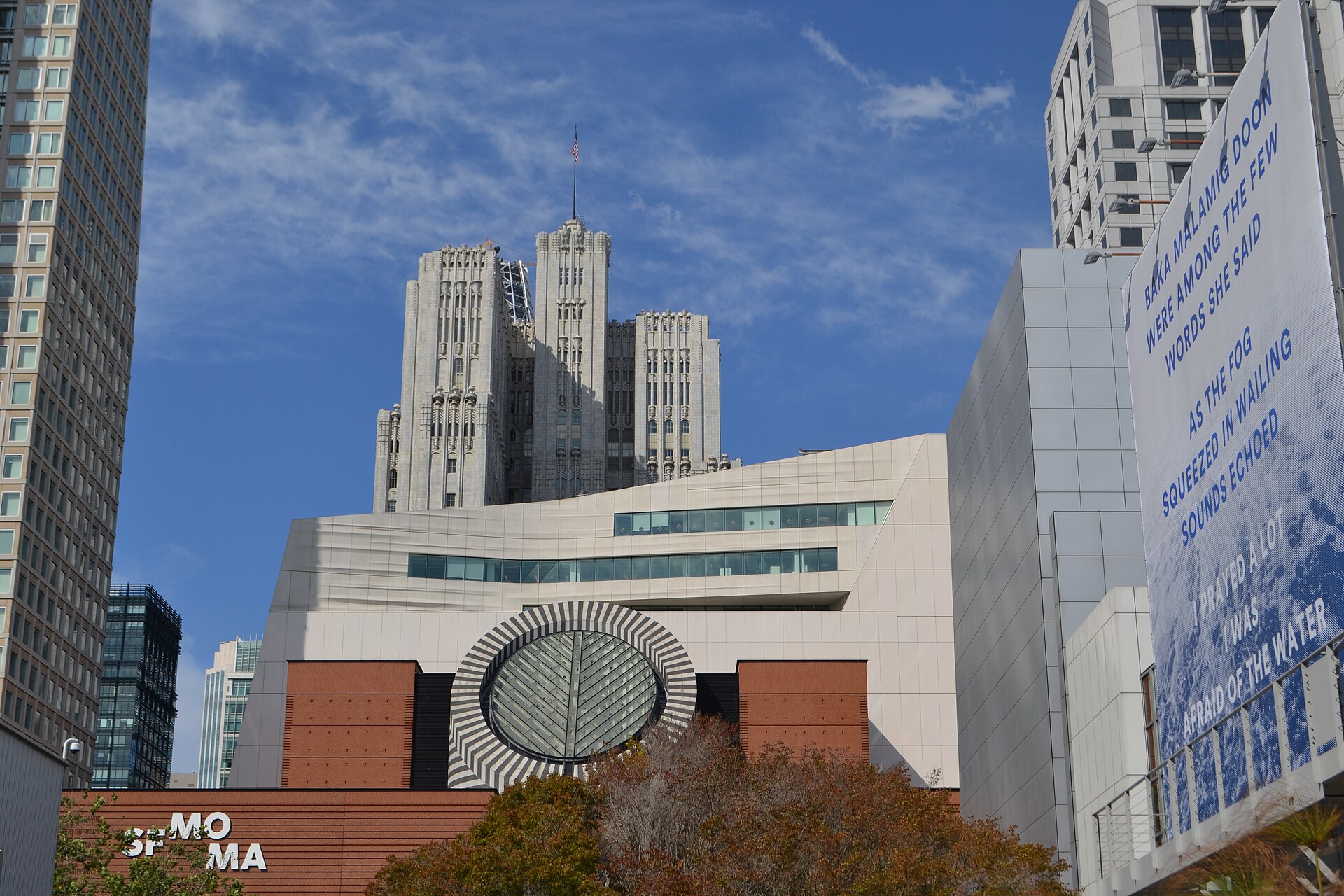
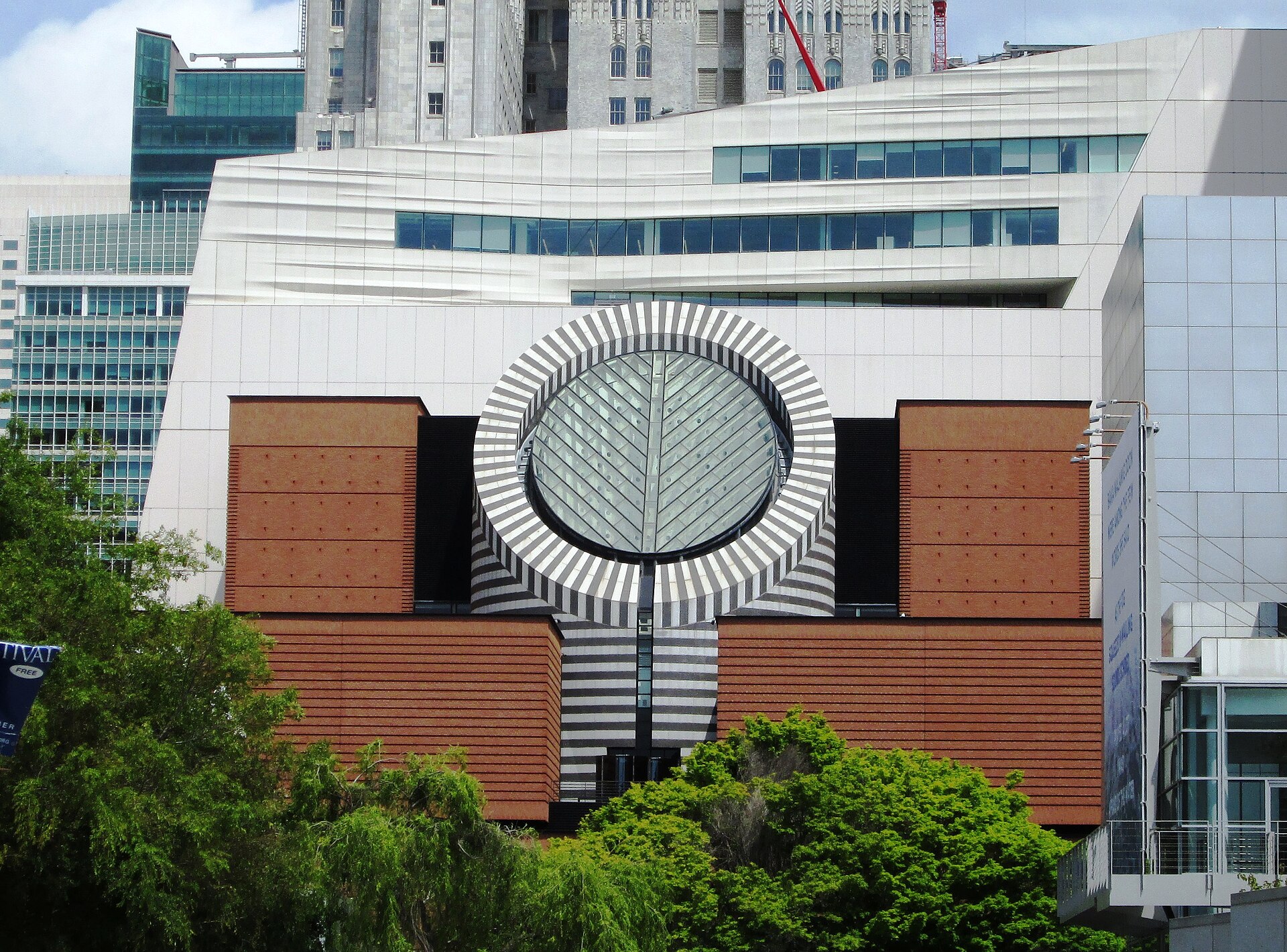
SFMOMA's Third Street facade, with Mario Botta's striped oculus at the centre of the original 1995 building and the rippled white mass of the 2016 Snohetta expansion rising behind it. The SFMOMA lettering is visible at street level.
Photograph by Minette Lontsie · Photograph by Serieminou · CC BY-SA 4.0San Francisco Museum of Modern Art
Museum · Founded 1935
Open, admission and hours confirmed 12 September 2026 · 22 sources
On this page 15 sections
ContentsClose
SFMOMA's deepest strength is photography: more than 17,800 works dating from 1839 to the present, anchored by the Prentice and Paul Sack Photographic Trust and shown in the dedicated Pritzker Center on Floor 3. Its second strength, the Fisher Collection, concentrates on American and European postwar and contemporary painting and sculpture, with unusually deep individual holdings of Calder, Kelly, Warhol and Bourgeois rather than a single example of each.
| Kind | Museum |
|---|---|
| Founded | 1935, as the San Francisco Museum of Art; renamed with 'Modern' added in 1975 |
| City and country |  San Francisco, United States San Francisco, United States |
| Address | 151 Third Street, San Francisco, CA 94103, United States |
| Website | sfmoma.org |
| Status | Open, confirmed |
| Record last verified |
Visiting
- Hours
- Monday-Tuesday10:00 to 17:00
- WednesdayClosed
- Thursday12:00 to 20:00
- Friday-Sunday10:00 to 17:00
- Closed
- Wednesday, every week. The museum's own visit page confirms the galleries and cafes are closed 14-16 September 2026 for a private event, with the Museum Store on Floor 1 remaining open to the public via its Third Street entrance. Museum Store hours run slightly later than gallery hours: Monday-Tuesday and Friday-Sunday 11:00-17:00, Thursday 12:00-20:00, closed Wednesday.
- Admission
- MemberFreeFree. Discounted memberships for seniors, young adults and working artists start at 90 dollars a year
- AdultUSD 30
- Senior, 65 and olderUSD 25
- Student, full-time with IDUSD 23
- Age 18 and youngerFreeFree at all times, in perpetuity, per the museum's own stated policy
Free entry: Age 18 and younger: free every day, in perpetuity, with no conditions. Free Family Days: general admission free for up to two adults accompanying one child or teen (18 or younger); surcharged exhibitions are excluded and tickets are released two weeks in advance; the next confirmed date at the time of this reading is 25 October 2026. Free Community Days: free museum-wide admission for all visitors, paired with community programming; the museum's own page listed the next date as TBD at the time of this reading. Museums for All: San Francisco residents with a valid Medi-Cal, CalFresh, SNAP or EBT card, plus proof of residency, receive up to four adult tickets at no cost. Blue Star Museums: free general admission for active-duty and veteran US military ID holders, for themselves and up to five guests during the Armed Forces Day to Labor Day period and one guest the rest of the year. Conference and convention attendees at the neighbouring Moscone Center receive a 4 dollar discount on showing their badge- Tickets
- tickets.sfmoma.org/tickets The museum's own ticket page.
- Do I need to book?
- No for general admission, though the museum recommends booking timed tickets online in advance; some special exhibitions carry a separate surcharge
- Address
- 151 Third Street, San Francisco, CA 94103, United States MapBART and Muni Metro Montgomery Street and Powell Street stations are both within a few blocks; the Transbay Transit Center is two blocks away
Bus Muni bus lines 8, 8AX, 8BX, 14, 14R, 15, 30, 45, 91, 101, 130 and 150 all stop within a block of the museum near Third and Mission Streets
Car and parking SFMOMA's own garage at 147 Minna Street is a few steps from the Third Street entrance, open 7 a.m. to 11 p.m. daily; members get 25 percent off and non-members 10 percent off parking, validated in the Haas, Jr. Atrium, for the first three and a half hours
On foot Steps from Yerba Buena Gardens, in the South of Market district. The Museum of the African Diaspora, the Contemporary Jewish Museum and the Yerba Buena Center for the Arts are separate institutions nearby and are not part of SFMOMA - Website
- sfmoma.org
- Telephone
- +1 415 357 4000
- [email protected]
Before you go how long, access, photography, bags, eating, shop
- How long to allow
- The museum publishes no suggested duration. Seven gallery floors plus about 45,000 square feet of free, ticket-free public space make a first visit a matter of choosing floors rather than covering the whole building
- Access
- Visitor Experience staff wearing red lanyards can help with gallery-policy questions; wheelchairs and cane chairs are available free of charge at coat check, and service animals are welcome. Fuller accessibility accommodations are described on the museum's own accessibility pages
- Photography
- Personal photography for visitors' own use appears to be permitted; selfie sticks, tripods and other photography accessories are prohibited in the galleries, and filming staff in a way that disrupts their work is not allowed
- Bags
- Backpacks and child carriers may not be worn on the back inside the galleries; carry by hand below the waist, wear on the front, or check at coat check. No oversized bags, wagons or metal-framed carriers; a single stroller can be borrowed from coat check on a first-come, first-served basis
- Eating
- Museum Store on Floor 1, reached from the Third Street lobby, with its own hours slightly later than the galleries
- Shop
- Museum Store on Floor 1, with online ordering
Prices and hours change. We take them from the institution's own pages and print the day we read them, and you can check the current position at the source we used. Confirm before you travel.
What is inside
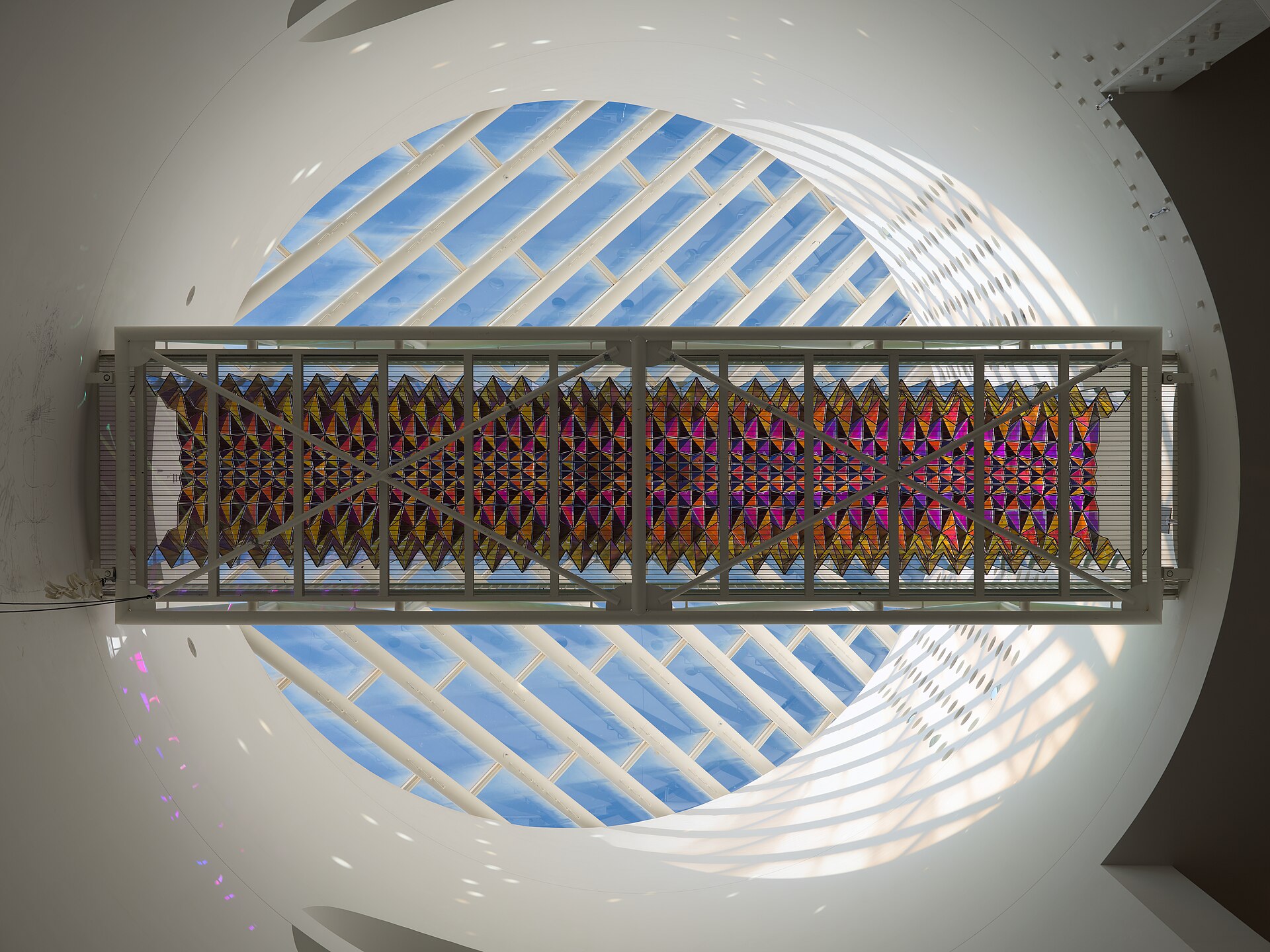
Photograph by Dllu · CC BY-SA 4.0 The Botta rotunda and its oculus
The cylindrical skylight Mario Botta cut through the centre of his 1995 building, striped in black and white marble on the outside and open to the sky above the lobby. It is the museum's clearest architectural signature, and every later renovation, including the 2016 expansion, has had to build around it rather than remove it.
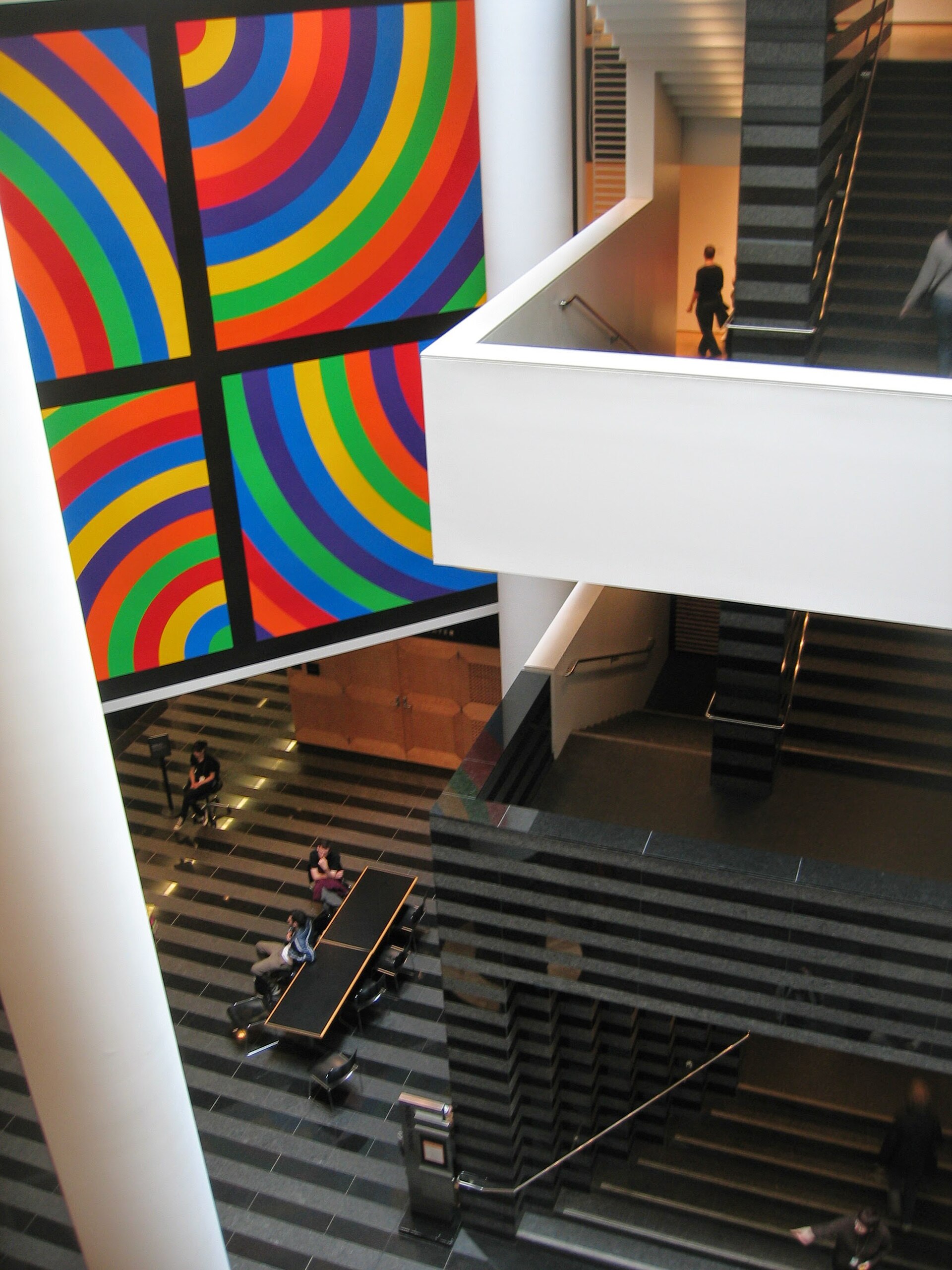
CC0 The Haas, Jr. Atrium and the grand stair
The museum's main lobby, named for the family whose Elise S. Haas bequest built much of the early painting collection. Julie Mehretu's two-canvas commission HOWL, eon (I, II) flanks the staircase, and Barbara Stauffacher Solomon's 2016 lobby piece Strips of Stripes wraps the surrounding walls and ceiling in stripes that echo Botta's own striped exterior.
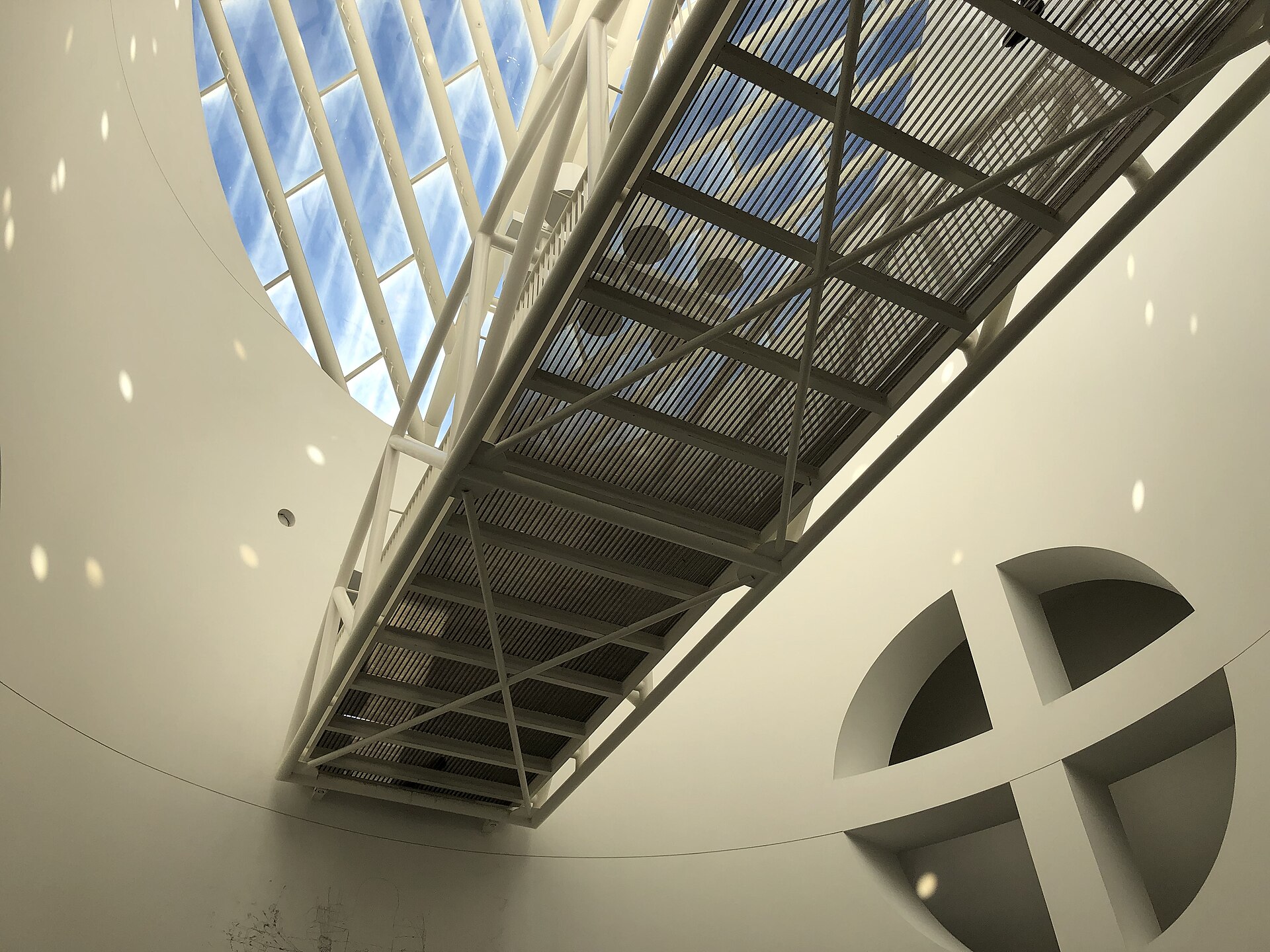
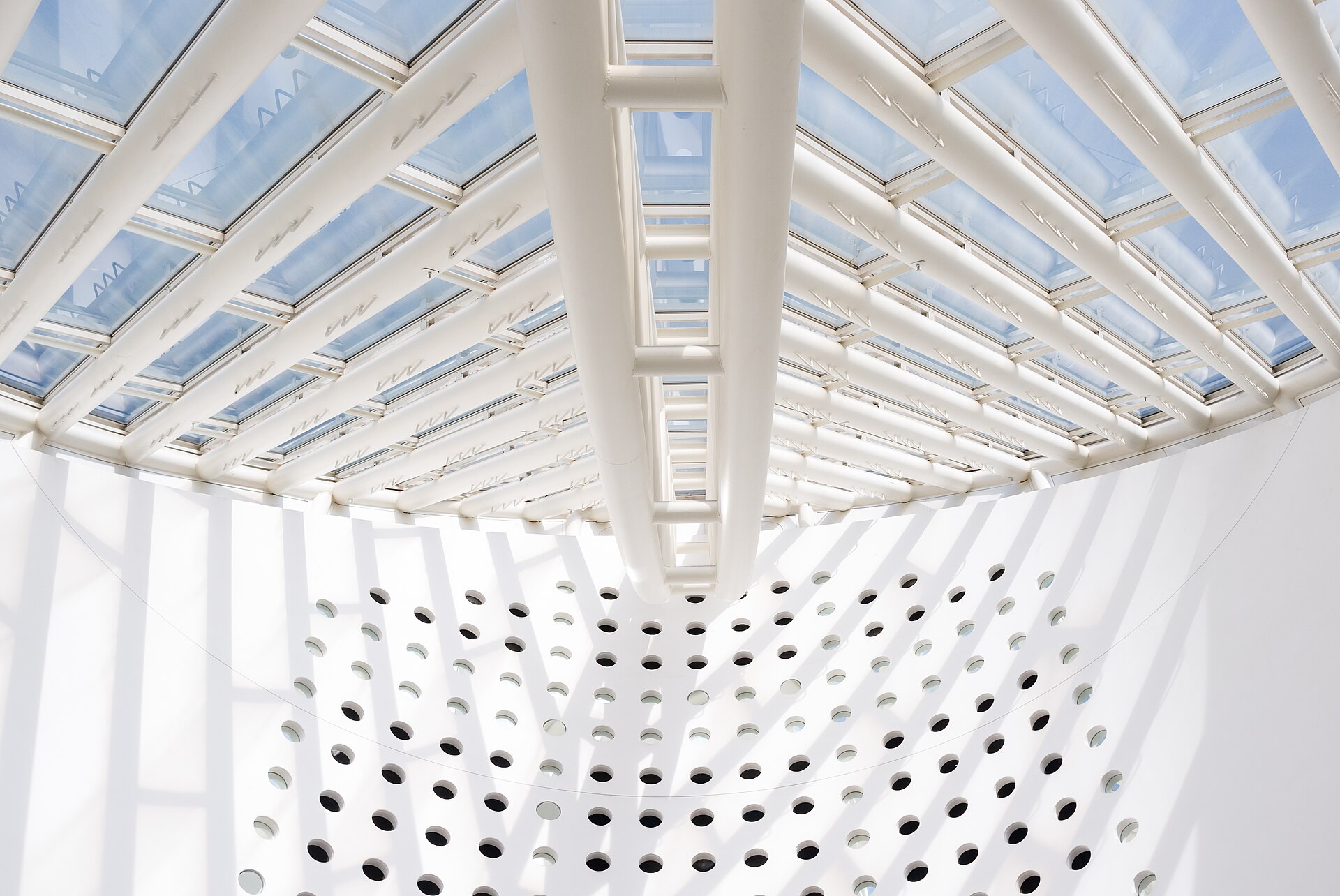
Photograph by Na onwiki · CC BY-SA 4.0 The skybridge over the oculus
A steel and glass walkway that the 2016 expansion threaded across the top of Botta's oculus to connect the two buildings' upper floors, visible from the lobby as a diagonal line cutting across the round skylight. It is one of the few points in the museum where both architects' work reads as a single composition.
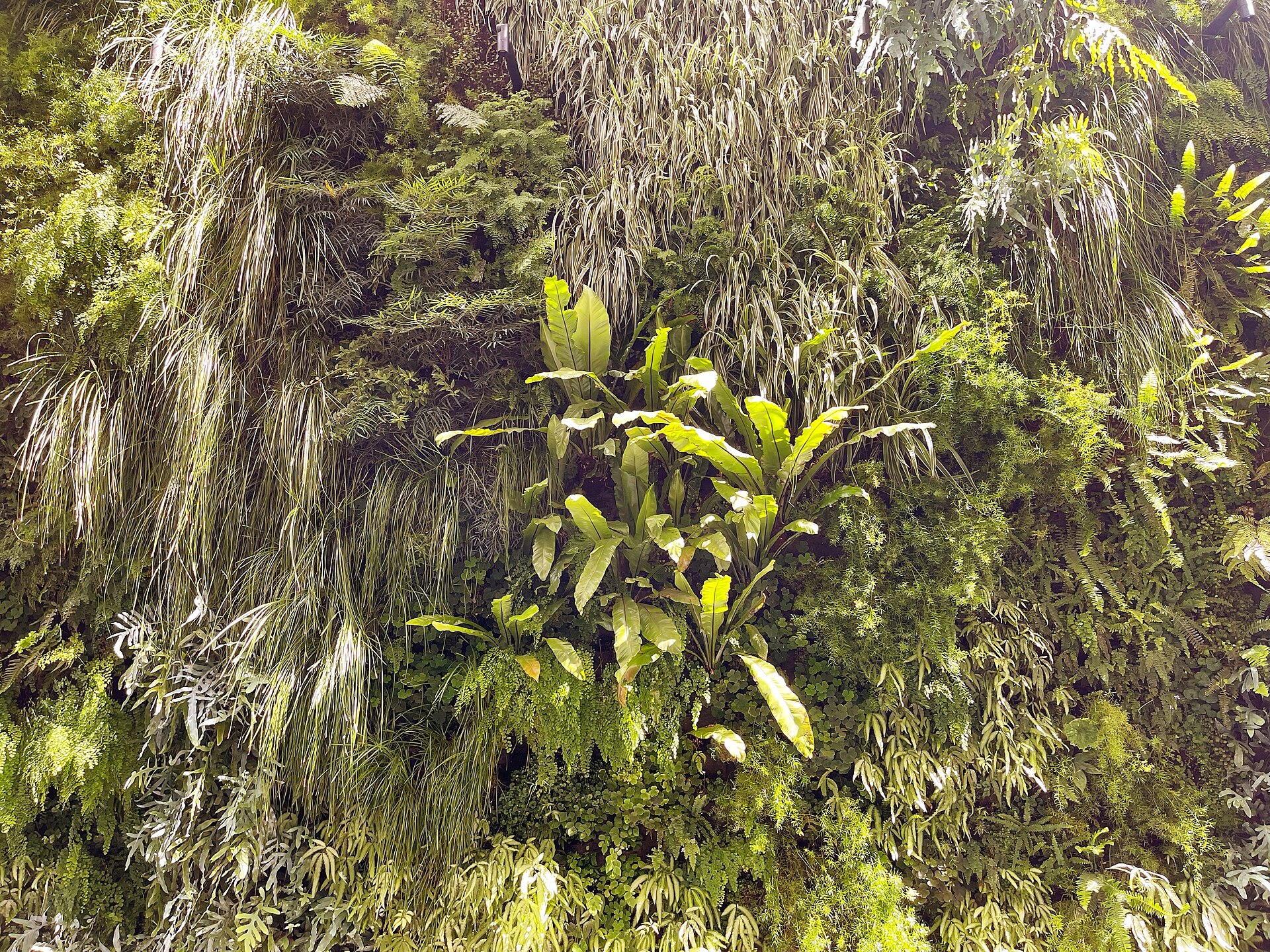
Photograph by Missvain · CC BY 4.0 The outdoor sculpture terraces and the Living Wall
Three outdoor levels, on Floors 3, 5 and 7, carrying a rotating selection of indoor and outdoor sculpture from the permanent collection. The third-floor terrace is backed by a four-storey vertical garden of about 19,000 plants across 21 native species, planted for the 2016 opening and maintained as one of the largest public living walls in San Francisco.
The Pritzker Center for Photography
A 15,000 square foot suite filling most of Floor 3, built for the 2016 expansion around a photography collection of more than 17,800 works dating from 1839 to the present, anchored by the Prentice and Paul Sack Photographic Trust. It holds rotating exhibition and permanent-collection galleries, a print study centre for scholars and students, and an interactive Photography Learning Lounge. No free-licence photograph of this specific space was located on Commons at the time of this research.
The Doris and Donald Fisher Collection floors
Floors 4 through 6, built to hold the roughly 1,100 postwar and contemporary works the Gap co-founders promised to the museum in 2009: dedicated single-artist rooms for Alexander Calder, Ellsworth Kelly, Sol LeWitt and Agnes Martin sit alongside rotating thematic hangs such as Ways of Seeing and Memory and Matter. No free-licence photograph of these gallery interiors was located on Commons at the time of this research.
What to see first
Femme au chapeau (Woman with a Hat)
Henri Matisse, 1905The portrait of the artist's wife whose unmixed, unnaturalistic colour scandalised the 1905 Paris Salon d'Automne and helped give Fauvism its name. It entered the collection with the Elise S. Haas bequest of 1991 and is on view on Floor 4.9
Frieda and Diego Rivera
Frida Kahlo, 1931A double portrait Kahlo painted while in San Francisco for her husband's mural commission nearby; part of Albert Bender's founding gift and one of the earliest Kahlo paintings to enter any US public collection, on view on Floor 2.9
The Flower Carrier
Diego Rivera, 1935Bought by the museum's earliest benefactor Albert Bender in the year it was painted and given straight to the collection; still on view on Floor 2 and among the most reproduced single images in the museum's holdings.9
No. 14, 1960
Mark RothkoThe Rothko the museum chose to keep in 2019 when it deaccessioned a second, less-exhibited 1960 canvas at auction; the museum's own account of that sale calls this painting a cornerstone of the collection, and it remains on permanent view.11
Nine Marilyns [Reversal Series]
Andy Warhol, 1979/1986A later, darker reworking of Warhol's own 1962 Marilyn silkscreens in negative; part of the Fisher Collection and on view on Floor 4 as part of the museum's Ways of Seeing hang.9
Spider
Louise Bourgeois, 1995An eleven-foot steel spider from Bourgeois's best-known sculptural series; the museum's own curators describe it as deliberately ambiguous between monstrous and protective. On view on Floor 6, part of the Fisher Collection.9
Spectrum I
Ellsworth Kelly, 1953The first of eight Spectrum paintings Kelly made between 1953 and 2014, and the anchor of a gallery devoted jointly to Kelly, Calder and Sol LeWitt; came in through the Fisher Collection and a promised gift from Helen and Charles Schwab.9
PH-969
Clyfford Still, 1954One of twenty-eight paintings Still gave the museum directly in 1975, the gift that let SFMOMA dedicate a permanent gallery to his work; on view on Floor 2 as part of 1900 to Now: SFMOMA's Collection.9
Exhibitions on now
Past exhibitions here
- Closed16 May to 13 Sep 2026Confirmed · check before you travel
- Closed23 May to 6 Sep 2026Confirmed · check before you travel
One address, two buildings, sixty years apart
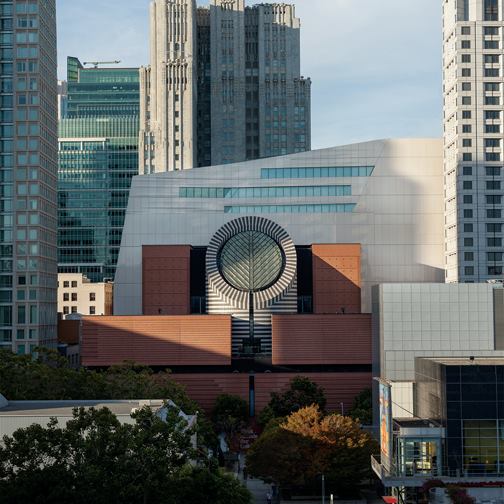
SFMOMA has stood at 151 Third Street since 18 January 1995, the sixtieth anniversary of its 1935 founding as the San Francisco Museum of Art. The building a visitor walks into today is really two buildings wearing one skin. Mario Botta's original block is a symmetrical brick and stone volume built around a cylindrical skylight, an oculus that drops light straight down onto the museum's central stair. In 2016 the Norwegian and New York firm Snohetta wrapped a second, much larger structure around and behind it, clad in rippled off-white fibreglass-reinforced polymer panels the architects said were meant to evoke the fog that sits over this part of the South of Market district most mornings. The oculus survived both buildings, and it is still the clearest way to tell which half of the museum a visitor is standing in.
From a fourth-floor gallery to a Third Street museum
The museum that became SFMOMA opened on 18 January 1935 on the fourth floor of the War Memorial Veterans Building on Van Ness Avenue, under its founding director Grace McCann Morley, and had no purpose-built home of its own for the first sixty years of its life. The San Francisco collector Albert M. Bender gave the new museum several hundred works in its opening year, including Diego Rivera's The Flower Carrier and Frida Kahlo's Frieda and Diego Rivera, and went on to donate more than 1,100 objects before his death in 1941; that gift still furnishes much of the painting collection on Floor 2. The museum recognised photography as a fine art in 1936, under curator John Humphrey, years before most American art museums did the same. The word Modern was added to the name only in 1975, the same year the painter Clyfford Still gave the museum twenty-eight of his own canvases. The Van Ness building closed to the public on 5 September 1994, and the new Botta-designed museum on Third Street opened four months later.
The 2016 expansion, and what critics made of it
SFMOMA closed for three years from 2013 to build the Snohetta expansion, and reopened on 14 May 2016 with nearly three times its previous gallery space and about 45,000 square feet of free, art-filled public space that needs no ticket at all. The museum's own figures describe the new photography galleries on Floor 3 as the largest space permanently dedicated to the medium in any American art museum. Architecture critics were far less united than the museum's own press materials. Writing in the Guardian, Oliver Wainwright likened the new facade to a gigantic meringue; a New York Times report compared it to a cruise ship; and several critics singled out the decision to replace Botta's original granite staircase under the oculus with a new wooden one as the addition's single most contested move. Others, including critics at the Wall Street Journal and Architectural Record, judged the result a considered, workable marriage between a 1995 building and a 2016 one. Both readings are on the record, and neither has displaced the other.
What is actually inside
The collection SFMOMA shows today comes from two very different sources, layered on top of each other. The founding-era gifts, from Bender's 1935 to 1941 donations through the Elise S. Haas bequest of 1991 that brought in Matisse's Femme au chapeau, and the Still gift of 1975, still furnish the Floor 2 galleries devoted to painting from 1900 onward. The Doris and Donald Fisher Collection, promised to the museum in 2009 and installed across the new building's upper floors, is a different kind of holding altogether: about 1,100 postwar and contemporary works, assembled by the Gap's founders over four decades, that gave SFMOMA in a single gift more depth in Calder, Warhol, Kelly and their contemporaries than most museums acquire in a century. The two collections rarely share a room, so a visitor moving from Floor 2 to Floor 4 is really moving between two separate private collecting lives that happen to sit under the same roof.
What the museum has had to answer for
SFMOMA's recent history includes two episodes that test how the institution talks about its own decisions. In 2019 the museum sold Rothko's Untitled, 1960, at Sotheby's for just over 50 million dollars, using the proceeds to buy work by ten artists, including Frank Bowling, Alma Thomas and Lygia Clark, and to endow a new acquisitions fund; the critic Lee Rosenbaum called the sale a trade of depth for breadth, and pointed out that the museum had asked Rothko himself to exchange the painting into its collection decades before deciding it was expendable. In May 2025 the museum laid off 29 staff, about eight percent of its workforce, days after the federal government withdrew funding from more than a dozen Bay Area arts organisations, including a 210,000 dollar accessibility grant to SFMOMA itself; the union representing most of the affected employees asked that the cuts come from the top of the organisation instead. Both episodes are part of the record a visitor is buying a ticket into, not a footnote to it.
What visitors say
SFMOMA is reviewed as one of the largest, most reliably well-stocked museums of modern and contemporary art on the West Coast, with the Fisher Collection giving it a depth in postwar American and European art that few American museums outside New York can match. The friction in the record is institutional rather than curatorial: a contested 2019 deaccession of a Rothko painting, a mixed critical verdict on the 2016 Snohetta building, and a 2025 round of staff layoffs during a wider funding squeeze on Bay Area arts institutions. Visitors on review platforms consistently praise the permanent collection, the free ground-floor spaces and the building's scale, while flagging the 30 dollar adult ticket, the Wednesday closure and, at times, the sheer size of the building as the main friction points of a visit.
What is praised, what is criticised
- Praised: the Fisher Collection's depth in individual artists rather than one example each: dedicated rooms for Calder, Kelly, Sol LeWitt and Agnes Martin that few museums outside a handful of majors can match
- Praised: about 45,000 square feet of free, ticket-free public art across Floors 1 and 2, including Julie Mehretu's atrium diptych and Barbara Stauffacher Solomon's lobby stripe commission, reachable without buying admission at all
- Praised: free admission for everyone 18 and younger, in perpetuity, alongside a calendar of Free Family Days and Free Community Days
- Praised: the Pritzker Center for Photography, the largest space permanently dedicated to the medium in any American art museum, built around a collection of more than 17,800 photographic works
- Criticised: the 2019 sale of Rothko's Untitled, 1960, at Sotheby's, which the critic Lee Rosenbaum characterised as trading the collection's depth for new acquisitions, and noted that the museum had itself asked Rothko to exchange the painting into its holdings decades before deciding it was expendable
- Criticised: architecture critics were split on the 2016 Snohetta expansion: several disliked the rippled white facade and the removal of Botta's original oculus staircase, while others judged the addition a considered, deferential fit alongside the older building
- Criticised: 29 staff, about 8 percent of the workforce, laid off in May 2025 amid a structural budget deficit, falling visitor numbers and the loss of a federal accessibility grant, a cut the staff union asked the museum to make from the top of the organisation instead
- Criticised: the 30 dollar adult ticket price, and a Wednesday closure that a visitor arriving mid-week has to plan around
Ratings on other platforms
Yelp: 4.2 from 992 ratings, read 12 August 2026
A platform average is a tertiary source: it moves, it is not audited, and we quote no visitor's words.
Questions about San Francisco Museum of Modern Art
Where is San Francisco Museum of Modern Art?
151 Third Street, San Francisco, CA 94103, United States.
How much does it cost to visit?
Member: free; Adult: USD 30; Senior, 65 and older: USD 25; Student, full-time with ID: USD 23; Age 18 and younger: free. As confirmed 12 September 2026.
When is it open?
Monday-Tuesday 10:00-17:00; Wednesday closed; Thursday 12:00-20:00; Friday-Sunday 10:00-17:00. Closed: Wednesday, every week. The museum's own visit page confirms the galleries and cafes are closed 14-16 September 2026 for a private event, with the Museum Store on Floor 1 remaining open to the public via its Third Street entrance. As confirmed 12 September 2026.
How do you get there?
BART and Muni Metro: Montgomery Street and Powell Street stations are both within a few blocks; the Transbay Transit Center is two blocks away; Bus: Muni bus lines 8, 8AX, 8BX, 14, 14R, 15, 30, 45, 91, 101, 130 and 150 all stop within a block of the museum near Third and Mission Streets; Car and parking: SFMOMA's own garage at 147 Minna Street is a few steps from the Third Street entrance, open 7 a.m. to 11 p.m. daily; members get 25 percent off and non-members 10 percent off parking, validated in the Haas, Jr. Atrium, for the first three and a half hours; On foot: Steps from Yerba Buena Gardens, in the South of Market district. The Museum of the African Diaspora, the Contemporary Jewish Museum and the Yerba Buena Center for the Arts are separate institutions nearby and are not part of SFMOMA.
What should you see first?
Femme au chapeau (Woman with a Hat) (Henri Matisse, 1905); Frieda and Diego Rivera (Frida Kahlo, 1931); The Flower Carrier (Diego Rivera, 1935); No. 14, 1960 (Mark Rothko); Nine Marilyns [Reversal Series] (Andy Warhol, 1979/1986); Spider (Louise Bourgeois, 1995).
What we could not confirm
- No free-licence photograph of the Pritzker Center for Photography's interior, or of the Fisher Collection galleries on Floors 4 through 6, was located on Wikimedia Commons at the time of this research. Both wings are recorded here without a plate rather than with a substitute room.
- The museum's own Free Community Days page listed its next date as TBD at the time of this reading (12 August 2026); the date should be re-checked before publication if this page is refreshed.
- Whether the sale of Rothko's Untitled, 1960, met the letter of the Association of Art Museum Directors' deaccessioning guidelines is not disputed in the sources read for this page; what is disputed is whether it was the right editorial choice for the collection, and that disagreement is presented here as such rather than resolved.
Images
Sources
- 1SFMOMA, Visit: standard hours for each day, the 14-16 September 2026 gallery and cafe closure with the Museum Store exception, general admission ticket prices (member free, adult 30 dollars, senior 25 dollars, student 23 dollars, 18 and younger free), San Francisco CityPASS and Go City discounts, the Moscone Center convention-badge discount, the 151 Third Street address, and the telephone number. Fetched as raw HTML on 12 August 2026. sfmoma.org/visit/
- 2SFMOMA, About SFMOMA: the museum's own description of itself as one of the largest museums of modern and contemporary art in the United States, the LEED Gold-certified building credited to Snohetta and Mario Botta jointly, the seven gallery floors, the 45,000 square feet of free public space, the mission statement, and Christopher Bedford named as director. Raw HTML, 12 August 2026. sfmoma.org/about/
- 3SFMOMA, Our History: the full institutional timeline used throughout this page, including the 18 January 1935 opening on Van Ness Avenue under founding director Grace McCann Morley, the Albert M. Bender gift and his more than 1,100 donated objects, the 1936 recognition of photography as a fine art under John Humphrey, Modern added to the name in 1975 alongside the Clyfford Still gift of 28 paintings, the 5 September 1994 closure of the Van Ness building, the 18 January 1995 opening on Third Street, the 2009 Fisher Collection announcement and Rooftop Garden, the 2010 selection of Snohetta, the 2013 closure for expansion, and Christopher Bedford's appointment in 2022. Raw HTML, 12 August 2026. sfmoma.org/read/our-history/
- 4SFMOMA, Our Expansion: the three-year closure, the 14 May 2016 reopening, nearly three times the prior gallery space, 19 inaugural exhibitions, the Pritzker Center for Photography filling most of Floor 3, and the nearly 45,000 square feet of free public space with free admission for visitors 18 and younger in perpetuity. Raw HTML, 12 August 2026. sfmoma.org/about/our-expansion-2016/
- 5SFMOMA, Free to See: the 45,000 square feet of no-ticket-required public art, Jake Elwes's Zizi in Motion at the Floor 1 Third Street entrance, Yuri Suzuki's Arborhythm at the Howard Street entrance, Gene Luen Yang's Bay Area Hoops mural on Floor 2, Barbara Stauffacher Solomon's Strips of Stripes lobby commission connecting the 1996 Botta building and the 2016 Snohetta expansion, and Julie Mehretu's HOWL, eon (I, II) diptych flanking the main staircase in the Haas, Jr. Atrium. Raw HTML, 12 August 2026. sfmoma.org/visit/free-to-see/
- 6SFMOMA, Deals + Discounts: Blue Star Museums terms for active and veteran military ID holders, discounted memberships from 90 dollars a year, SFUSD employee tickets, the Museums for All programme for San Francisco residents on Medi-Cal, CalFresh, SNAP or EBT, the Discover & Go library pass programme, San Francisco CityPASS and Go City savings, corporate member benefits, and reciprocal ICOM and CIMAM admission terms. Raw HTML, 12 August 2026. sfmoma.org/deals-discounts/
- 7SFMOMA, Free Days at SFMOMA: Free Family Days terms (free general admission for up to two adults accompanying one child or teen, tickets released two weeks in advance, surcharged exhibitions excluded), the next listed Free Family Day of 25 October 2026, and Free Community Days terms with the next date listed as TBD at the time of this reading. Raw HTML, 12 August 2026. sfmoma.org/free-days/
- 8SFMOMA, Getting Here: proximity to the Montgomery Street and Powell Street BART and Muni Metro stations, the Muni bus lines with stops within a block, the Transbay Transit Center two blocks away, the museum's own parking garage at 147 Minna Street with its hours and rates and member and non-member discount terms, bike parking at the Howard Street entrance, and the three named entrances (151 Third Street, the Howard Street entrance into the free Roberts Family Gallery, and the Joyce and Larry Stupski Entrance at Minna Street for after-hours events). Raw HTML, 12 August 2026. sfmoma.org/visit/getting-here/
- 9SFMOMA's own online collection database and individual artwork records: Femme au chapeau (Woman with a Hat), Henri Matisse, 1905, accession 91.161, bequest of Elise S. Haas 1991, on view Floor 4; Frieda and Diego Rivera, Frida Kahlo, 1931, accession 36.6061, Albert M. Bender Collection, on view Floor 2; The Flower Carrier, Diego Rivera, 1935, accession 35.4516, Bender gift, on view Floor 2; Nine Marilyns [Reversal Series], Andy Warhol, 1979/1986, accession FC.229, Fisher Collection, on view Floor 4; Spider, Louise Bourgeois, 1995, accession FC.555.A-J, Fisher Collection, on view Floor 6; Spectrum I, Ellsworth Kelly, 1953, accession 99.353, Fisher Collection and promised gift of Helen and Charles Schwab, on view Floor 5; and PH-969, Clyfford Still, 1954, accession 75.33, gift of the artist 1975, on view Floor 2. Every artwork status quoted here was read directly from the museum's own artwork page on 12 August 2026 and the pages themselves note that locations are subject to change. sfmoma.org/artists-artworks/
- 10SFMOMA, The Pritzker Center for Photography: more than 17,800 photographic works dating from 1839 to the present, the Center filling most of Floor 3 at 15,000 square feet, described as the largest space permanently dedicated to photography in any US art museum, the print study centre, the Photography Learning Lounge, and the Paul Sack Photographic Trust. Raw HTML, 12 August 2026. sfmoma.org/artists-artworks/pritzker-center-photography/
- 11SFMOMA press release, 'SFMOMA Announces Deaccession to Benefit the Acquisitions Fund and Strategically Diversify the Collection', released 15 February 2019: the planned sale of Rothko's Untitled, 1960, at Sotheby's, the museum's AAMD-guided deaccessioning rationale, director Neal Benezra's stated reasoning, and the museum's own description of the retained Rothko, No. 14, 1960, as a cornerstone of the collection permanently on view. Raw HTML, 12 August 2026. sfmoma.org/press-release/rothko-deaccession-2019/
- 12Lee Rosenbaum, 'Wroth Over Rothko: SFMOMA's Distasteful Disposal', CultureGrrl (ArtsJournal), 5 March 2019: the criticism of the Rothko sale as trading collection depth for new acquisitions, the note that SFMOMA had itself asked Rothko to exchange the consigned painting into its collection decades earlier, curator Gary Garrels's account of the value of monographic single-artist galleries (Still, Klee, Kelly, Johns and Rauschenberg), and the estimated 35 to 50 million dollar sale price. Raw HTML fetched directly on 12 August 2026; all characterised statements were read in these bytes before use. artsjournal.com/culturegrrl/2019/03/wroth-over-rothko-sfmomas-distasteful-disposal.html
- 13Katie DeBenedetti, 'SFMOMA Lays Off 29 Employees, Citing Low Attendance and Financial Strain', KQED, 7 May 2025, updated 5:39 p.m. PT: the layoff of 29 employees (20 full-time, 9 part-time, plus 13 unfilled positions eliminated), about 8 percent of the workforce, director Christopher Bedford's public letter, the union Office and Professional Employees International Union Local 29 representing 26 of the affected staff and calling for cuts 'from the top', the museum's revised expected annual attendance of 600,000, and the Trump administration's withdrawal of a 210,000 dollar federal accessibility grant days before the layoffs. Raw HTML, 12 August 2026. kqed.org/news/12039221/sfmoma-lays-off-29-employees-citing-low-attendance-financial-strain
- 14Dan Howarth, 'Critics react to Snohetta's SFMOMA extension', Dezeen, 18 May 2016: a roundup of the 2016 reopening's architectural reception, naming and quoting Oliver Wainwright (the Guardian), Christopher Hawthorne (LA Times), Jori Finkel (New York Times), Alexandra Lange (Curbed), John King (San Francisco Chronicle), Julie V. Iovine (Wall Street Journal) and Josephine Minutillo (Architectural Record), including the removal of Botta's original oculus staircase as the most contested single change. Read directly on the live rendered page on 12 August 2026. dezeen.com/2016/05/18/critics-reaction-san-francisco-museum-modern-art-sfmoma-extension-snohetta-mario-botta/
- 15Yelp business listing, San Francisco Museum of Modern Art: aggregate rating of 4.2 out of 5 from 992 reviews, confirmed directly on the live page by screenshot on 12 August 2026. yelp.com/biz/san-francisco-museum-of-modern-art-san-francisco-6
- 16Wikidata, San Francisco Museum of Modern Art (Q913672): coordinates 37.785718, -122.401051, inception 1935, and the official website sfmoma.org, cross-checked against the museum's own site. wikidata.org/wiki/Q913672
- 17SFMOMA, Guidelines for Visiting SFMOMA: the visitor conduct and prohibited-items rules, the coat check terms and size limits, wheelchairs and cane chairs free of charge at coat check, Visitor Experience staff identifiable by red lanyards, the selfie-stick and tripod restriction, the backpack and stroller rules for the galleries, and the ticketing and arrival terms for timed exhibitions. Raw HTML, 12 August 2026. sfmoma.org/visit/visitor-guidelines/
- 18Three files in the Exterior category filed under a sequential 'California 06/09/10' batch (by the same uploader) were rejected on inspection: 06 shows a downtown service alley with the Salesforce Tower in the distance, not the museum, and 09 and 10 could not be verified before this page was written; none of the three is used here. commons.wikimedia.org/wiki/Category:San_Francisco_Museum_of_Modern_Art
- 19SFMOMA, Visit: re-confirmation fetch. Admission prices unchanged (member free, adult 30 dollars, senior 25 dollars, student 23 dollars, 18 and younger free); hours unchanged (Monday-Tuesday and Friday-Sunday 10 a.m. to 5 p.m., Thursday noon to 8 p.m., closed Wednesday); the galleries and cafes are confirmed closed 14-16 September 2026 for a private event, with the Museum Store remaining open via the Third Street entrance; telephone 415.357.4000 unchanged. Fetched as raw HTML on 12 September 2026. sfmoma.org/visit/
- 20SFMOMA, Free Days at SFMOMA: re-confirmation fetch. Free Family Days next date still 25 October 2026; Free Community Days still lists no upcoming date. Fetched as raw HTML on 12 September 2026. sfmoma.org/free-days/
- 21SFMOMA, Deals + Discounts: re-confirmation fetch. Blue Star Museums, Museums for All, discounted memberships from 90 dollars a year, San Francisco CityPASS, Go City, SFUSD employee tickets, Discover & Go library passes and ICOM/CIMAM reciprocal admission all confirmed unchanged in terms. Fetched as raw HTML on 12 September 2026. sfmoma.org/deals-discounts/
- 22SFMOMA, Contact Us: general contact details. Address 151 Third Street unchanged; phone 415.357.4000 unchanged; general email [email protected] (not previously recorded on this page); fax 415.357.4037. Fetched as raw HTML on 12 September 2026. sfmoma.org/about/contact-us/