Grand Piano
Bartolomeo Cristofori · 1720
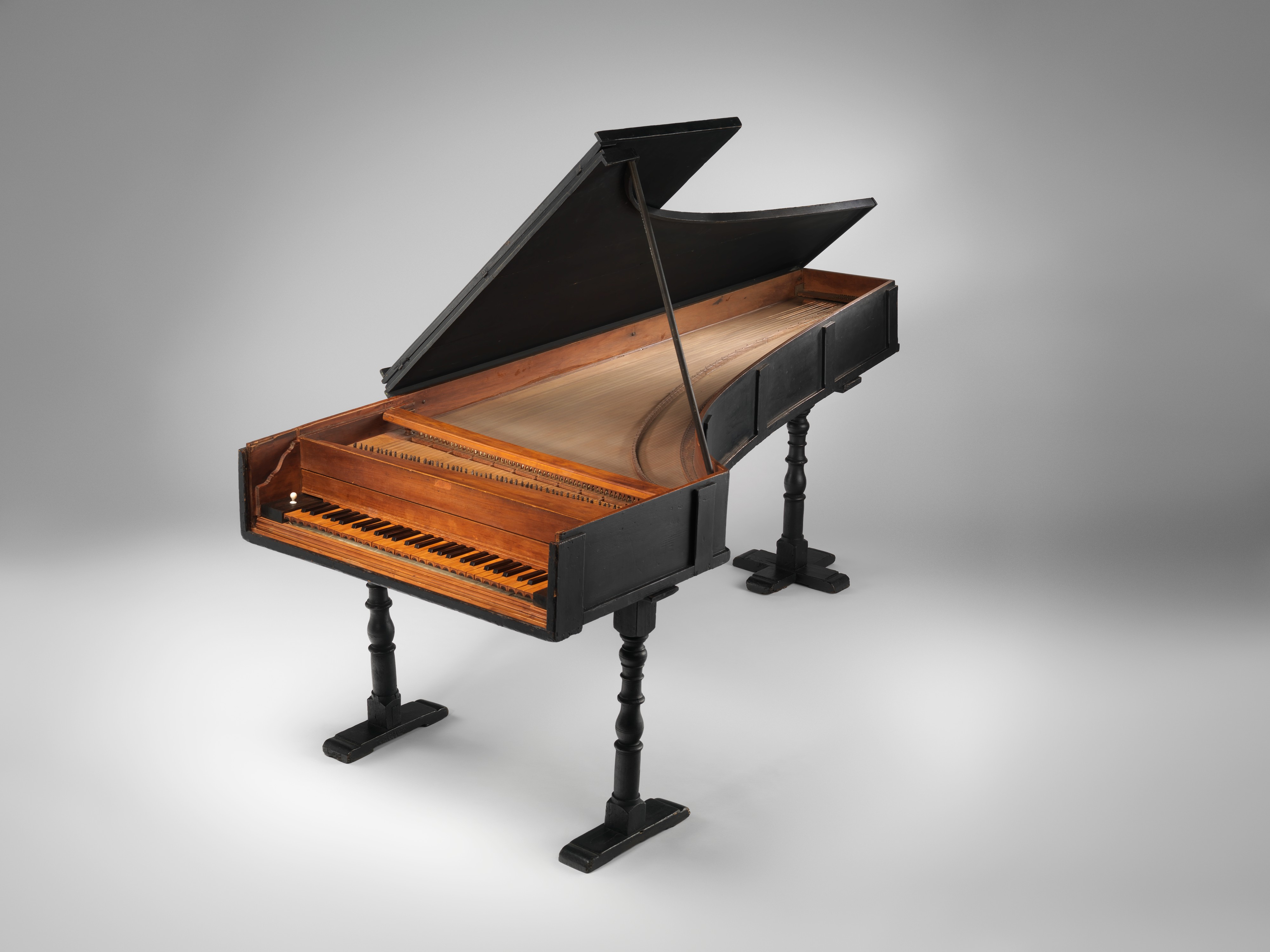
The record subject, and the oldest surviving piano. A plain wing-shaped case of cypress, 228.6 cm long, with one keyboard, fifty-four keys, no pedals and no stops. The soundboard inside it dates from 1938.
| Artist | Bartolomeo Cristofori |
|---|---|
| Date | 1720 |
| Medium | Cypress, boxwood, paint, leather, fir |
| Dimensions | Height 86.5 cm; width parallel to the keyboard 95.6 cm; case length 228.6 cm |
| Where it is now | Metropolitan Museum of Art, New York, Gallery 684last confirmed 4 August 2026 |
| Inventory number | 89.4.1219a-c |
| Attribution | AcceptedAccepted as the work of Bartolomeo Cristofori and as the oldest surviving piano. Full note |
| Object type | Musical instrument |
| Period | Italian, Florence, early eighteenth century |
| Cases | Has a provenance gap |
| Inscriptions | In ink on the present hammer rail, possibly originally the nameboard: BARTHOLOMAEUS DE CHRISTOPHORIS PATAVINUS INVENTOR FACIEBAT FLORENTIAE MDCCXX. In ink at the left of the hammer rail: Restaurato l'Anno 1875 da Cesare Ponsicchi, Firenze. The letter I on the bottom rail supporting the intermediate levers. |
| Owners on record | 7 links6 documented, 1 unknown |
| Sources | 7 cited |
About this record Last verified 21 August 2026 · 7 sources cited · Change log
On this page 12 sections
ContentsClose
The oldest surviving piano, made in Florence in 1720 by the man who invented the instrument, and the only one of the three surviving Cristoforis that can still be played. It has been in the Metropolitan Museum since 1889 as part of the Crosby Brown Collection.
It is also the most altered of the three. Its soundboard was replaced in 1938 and its fifty-four-note compass was shifted by about half an octave, so the instrument recorded as the world's oldest piano does not sound like the object Cristofori built; the instrument-maker Denzil Wraight's assessment is that its original condition has been irretrievably lost. The maker's inscription is written in ink on the present hammer rail, which the Museum believes may originally have been the nameboard, so even the 1720 sits on a component that has moved.
The chain runs through two Mocennis, a Florentine named Diego Martelli, and an American banker's wife. It was restored in Florence in 1875 by Cesare Ponsicchi, who signed the rail and published the first Italian history of the piano the following year - one year after Leo Puliti's research had taken the credit for the invention back from Gottfried Silbermann.
Provenance
Each link is graded. Documented: a cited source supports it. Disputed: the identification is argued but not established. Unknown: no owner for that span, and the gap is not smoothed into a narrative. The grades in the glossary.
- 1720 - unknownMade in Florence by Bartolomeo Cristoforidocumented
Inscribed in ink FACIEBAT FLORENTIAE MDCCXX on the present hammer rail. Cristofori had been in Medici service since 1688, but no bill for any pianoforte survives among the many bills he submitted, so no document names a commissioner, a price or a destination for this instrument.14
- 1720 - the nineteenth centuryUnrecordedunknown
The Museum's provenance line begins with Dr Fabio Mocenni and gives him no dates. Nothing is recorded of the instrument's whereabouts for roughly a century and a half after it was made, including whether it ever left Florence.
- before 1875 - unknownDr Fabio Mocennidocumented
First named owner on the Museum's provenance line. No dates are given and nothing further about him appears in the sources consulted.1
- unknown - unknownErnesta Mocennidocumented
Second on the Museum's line, presumably by family descent from Fabio Mocenni, though the Museum does not state the relationship.1
- unknown - before 1889Diego Martellidocumented
Named on the Museum's provenance line as 'Signor Diego Martelli', with no dates. The Florentine art critic Diego Martelli (1839-1896) - champion of the Macchiaioli, friend of Pissarro, twice painted by Degas in 1879 - was in Florence throughout the period in which this instrument was restored there in 1875 and sold to an American collector by 1889. No source consulted makes the identification, and this record does not assert it.17
- before 1889 - 1889Mary Elizabeth Adams Brown, New Yorkdocumented
Mrs John Crosby Brown assembled the collection of musical instruments that carries her family name. No purchase price, date or agent is published for this instrument.1
- 1889 - presentMetropolitan Museum of Art, New Yorkdocumented
Accession 89.4.1219a-c, credit line The Crosby Brown Collection of Musical Instruments, 1889. Soundboard replaced 1938; shown in Keynotes: Two Centuries of Piano Design in 1985; on view in Gallery 684 in 2026.12
Prices realised
This instrument has never been offered at public auction in any record consulted. It moved from Florence to New York by private sale before 1889 and entered the Museum as part of a gift, so there is no hammer price and no premium anywhere in its chain. No figure is published for what Mary Elizabeth Adams Brown paid for it, or to whom.
Technical evidence
| Attribution note | Accepted as the work of Bartolomeo Cristofori and as the oldest surviving piano. The inscription is in ink on the present hammer rail, a component the Museum notes was possibly originally the nameboard, rather than cut into the structure - so the date is carried by a moveable part of a rebuilt instrument. No serious challenge to the attribution has been published. The same museum has withdrawn a Cristofori attribution from a double bass whose label it now calls spurious, which is the measure of how the name is policed. |
|---|---|
| Materials | Cypress, boxwood, paint, leather, fir.12 |
| Dimensions | Height overall 86.5 cm; width parallel to the keyboard 95.6 cm; case length perpendicular to the keyboard 228.6 cm. Case depth without the lid 23.5 cm.1 |
| Strings | Longest string 188.6 cm; shortest string 12 cm; the string for c2 measures 27.9 cm. Three-octave span across the keyboard 49.5 cm.1 |
| Compass | Fifty-four keys, against eighty-eight on a modern grand. No pedals and no stops; the two other surviving Cristoforis both have an una corda stop and this one does not.134 |
| Compass ALTERED | The fifty-four-note range was shifted by about half an octave by later hands, from F', G', A' to c''' up to C to f'''.4 |
| Soundboard REPLACED | Replaced in 1938. The soundboard is what makes the sound; the instrument is playable and its timbre is not evidence for how a Cristofori piano sounded.4 |
| Maker's inscription | In ink, on the present hammer rail, which the Museum notes was possibly originally the nameboard: BARTHOLOMAEUS DE CHRISTOPHORIS PATAVINUS INVENTOR FACIEBAT FLORENTIAE MDCCXX.1 |
| Restorer's inscription | In ink at the left of the same hammer rail: Restaurato l'Anno 1875 da Cesare Ponsicchi, Firenze.1 |
| Third marking | The letter I, on the bottom rail supporting the intermediate levers.1 |
| Action | Escapement, check, jack-mounted damper, and a soundboard isolated from the tension-bearing parts of the case. Thicker strings at higher tension than a harpsichord. The Museum's position is that no action of comparable sensitivity and reliability was devised for another seventy-five years.13 |
| Classification | Chordophone-Zither-struck-piano.2 |
Images
The record in full
Chapter 1The oldest piano in the world, and how much of it is not original
This is the earliest surviving piano. Three instruments by Bartolomeo Cristofori are known, all from the 1720s, and this one, dated 1720, is the oldest of them.
This is the earliest surviving piano. Three instruments by Bartolomeo Cristofori are known, all from the 1720s, and this one, dated 1720, is the oldest of them. It has been in the Metropolitan Museum since 1889 and it can still be played; recordings have been made on it, and the Museum lists three: Scarlatti's sonata in G minor, K373, played by Martin Souter on a 1999 disc titled Keyboard Classics: Period Music Performed on the World's Oldest Piano, and two pieces by Domenico Zipoli recorded by Susan Alexander-Max in 2004.
It is also the most heavily rebuilt of the three. The soundboard was replaced in 1938. The compass of fifty-four notes was shifted by about half an octave, from F', G', A' to c''' up to C to f'''. The instrument-maker and scholar Denzil Wraight's judgement is that its original condition has been irretrievably lost, and that it cannot indicate what it sounded like when new.
Both of those things are true at once, and the tension between them is what this record is about. The object is genuine, foundational and irreplaceable. Very little of what a visitor hears when it is played is what Cristofori built.
Chapter 2What Cristofori actually invented
Cristofori was appointed in 1688 to the Florentine court of Grand Prince Ferdinando de' Medici to look after the harpsichords and eventually the whole instrument collection.
Cristofori was appointed in 1688 to the Florentine court of Grand Prince Ferdinando de' Medici to look after the harpsichords and eventually the whole instrument collection. He was thirty-three, he came from Padua, and Ferdinando paid him more than his predecessor.
The problem he solved was that a harpsichord plucks. A quill takes the same amount of string whatever the player does with the key, so a harpsichord cannot get louder or softer under the hand. A clavichord can, but it is so quiet as to be useless beyond a few feet. Cristofori built a keyboard instrument in which a hammer strikes, and then solved the four consequential problems at once: an escapement that lets the hammer fall away from the string the instant it has struck, so the string is not damped by the thing that sounded it; a check that stops the hammer bouncing back and re-striking; a damper on a jack to silence the string when the key is released; and the isolation of the soundboard from the tension-bearing parts of the case so that it can vibrate freely. He also used thicker strings at higher tension than a harpsichord would carry.
The Museum's own assessment is that the action was so well designed that nothing of comparable sensitivity and reliability was devised for another seventy-five years, and that the highly complex action of the modern piano descends directly from it. The complexity was the commercial problem: it was expensive, later eighteenth-century makers dropped features to save money, and those features were then reinvented one at a time over the following decades.
Chapter 3The 1700 inventory gives the piano a birthdate
The first unambiguous evidence for the instrument is an inventory of Medici instruments of 1700.
The first unambiguous evidence for the instrument is an inventory of Medici instruments of 1700. Its entry begins Un Arpicembalo di Bartolomeo Cristofori di nuova inventione, che fa' il piano, e il forte - an arpicembalo by Bartolomeo Cristofori, of new invention, that makes the soft and the loud, with two sets of strings at unison pitch and a case of cypress without a rose. Arpicembalo, harp-harpsichord, was Cristofori's own word for it.
A separate note by a Florentine court musician, Federigo Meccoli, records that the arpicimbalo del piano e forte was first made by Cristofori in 1700. That is about as precise a birthdate as any invention of the period has.
What does not survive is a bill. Stewart Pollens, who has done the archival work on Cristofori, notes that among the many bills Cristofori submitted to his employer there are none for pianofortes, and reads this as suggesting that he was expected to hand the results of his experiments to the court. The consequence for this object is direct: there is no document recording who commissioned it, who paid for it, or where it stood.
Chapter 4Maffei gave it its name, and its first bad review
In 1711 the poet and journalist Scipione Maffei published a description of the instrument in the Giornale de' letterati d'Italia, based on an interview with Cristofori.
In 1711 the poet and journalist Scipione Maffei published a description of the instrument in the Giornale de' letterati d'Italia, based on an interview with Cristofori. Maffei called it a gravicembalo col piano, e forte, a harpsichord with soft and loud, which is the first appearance of the name the instrument still carries in Italian and in the abbreviation everyone uses.
Maffei also recorded the trade's reaction, and it was not enthusiastic. Some professionals, he wrote, had not given the invention all the applause it merited, complaining that the sound was too soft and too dull. A contemporary harpsichord was louder and more brilliant. What it could not do was answer to the strength of the player's touch, and it took most of a century for that to be understood as the more important property.
Maffei's description included a diagram of the action. Translated into German, it was reprinted in Johann Mattheson's Critica musica of 1725, where the Saxon organ builder Gottfried Silbermann probably read it; Silbermann began building pianos on Cristofori's design in the 1730s. That printed diagram is why the invention survived at all, and it is also why, in late eighteenth-century France, the piano came to be credited to Silbermann rather than to Cristofori.
Chapter 5The signature is in ink, on a rail that has moved
The inscription reads BARTHOLOMAEUS DE CHRISTOPHORIS PATAVINUS INVENTOR FACIEBAT FLORENTIAE MDCCXX - Bartolomeo Cristofori of Padua, inventor, made this at Florence, 1720.It is worth reading the...
The inscription reads BARTHOLOMAEUS DE CHRISTOPHORIS PATAVINUS INVENTOR FACIEBAT FLORENTIAE MDCCXX - Bartolomeo Cristofori of Padua, inventor, made this at Florence, 1720.
It is worth reading the Museum's own description of where that inscription is. It is in ink, and it is on the present hammer rail, possibly originally the nameboard. In other words the maker's inscription is not cut, stamped or branded into the structure; it is written on a component that the Museum believes has been repurposed from elsewhere in the instrument. The date on which the object rests is carried by a moveable part.
That is not an argument that the piano is not by Cristofori. Nobody disputes that it is. It is an argument for reading the 1720 with the care one would give any inscription on a rebuilt object, and for noticing that the Museum has published the doubt itself rather than smoothing it over. A third marking, the letter I, is on the bottom rail that supports the intermediate levers.
Chapter 6Cesare Ponsicchi, 1875
Beside the maker's inscription, at the left of the same hammer rail, is a second one in ink: Restaurato l'Anno 1875 da Cesare Ponsicchi, Firenze.
Beside the maker's inscription, at the left of the same hammer rail, is a second one in ink: Restaurato l'Anno 1875 da Cesare Ponsicchi, Firenze. Restored in the year 1875 by Cesare Ponsicchi of Florence.
A restorer who signs and dates his work on the same rail as the maker is telling you how the object was regarded in 1875: as an important historical instrument, not as furniture. Ponsicchi is the Florentine who the following year published the first Italian history of the piano and its origins, at a moment when Leo Puliti's research of 1874 was re-establishing Cristofori's priority against the Silbermann attribution that had held in France.
So the sequence in Florence in the mid-1870s runs: the scholarship correcting the invention's authorship, the restoration of the oldest surviving example, and the writing of the first book about it, all in one city within about three years, with the restorer as one of the authors. The piano was being repaired by the people who were rewriting its significance.
Chapter 7The Martelli in the chain is probably the man Degas painted
The Museum's provenance line runs: Dr Fabio Mocenni; Ernesta Mocenni; Signor Diego Martelli; Mary Elizabeth Adams Brown.Diego Martelli is not a name one expects in a keyboard provenance.
The Museum's provenance line runs: Dr Fabio Mocenni; Ernesta Mocenni; Signor Diego Martelli; Mary Elizabeth Adams Brown.
Diego Martelli is not a name one expects in a keyboard provenance. The Florentine of that name, 1839 to 1896, was the art critic who championed the Macchiaioli, hosted them at his estate at Castiglioncello, founded two art journals, was the earliest serious Italian advocate of Impressionism, was a close friend of Pissarro, and sat twice to Degas in 1879, one of those portraits now hanging in the Scottish National Gallery. He was in Florence in precisely the years in which this instrument was restored there and then sold abroad.
The Museum gives no dates for its Martelli and no source consulted here makes the identification, so this record does not assert it. It records it as the obvious and unconfirmed possibility that it is, because if it holds then the oldest piano in existence spent part of the nineteenth century in the hands of the man Degas painted, and no catalogue anywhere says so.
Chapter 8Mrs Brown, 1889
The piano entered the Museum in 1889 in the Crosby Brown Collection of Musical Instruments, formed by Mary Elizabeth Adams Brown, wife of the New York banker John Crosby Brown.
The piano entered the Museum in 1889 in the Crosby Brown Collection of Musical Instruments, formed by Mary Elizabeth Adams Brown, wife of the New York banker John Crosby Brown. Its accession number, 89.4.1219, places it inside a very large single gift: numbers in the same accession run past 3,100.
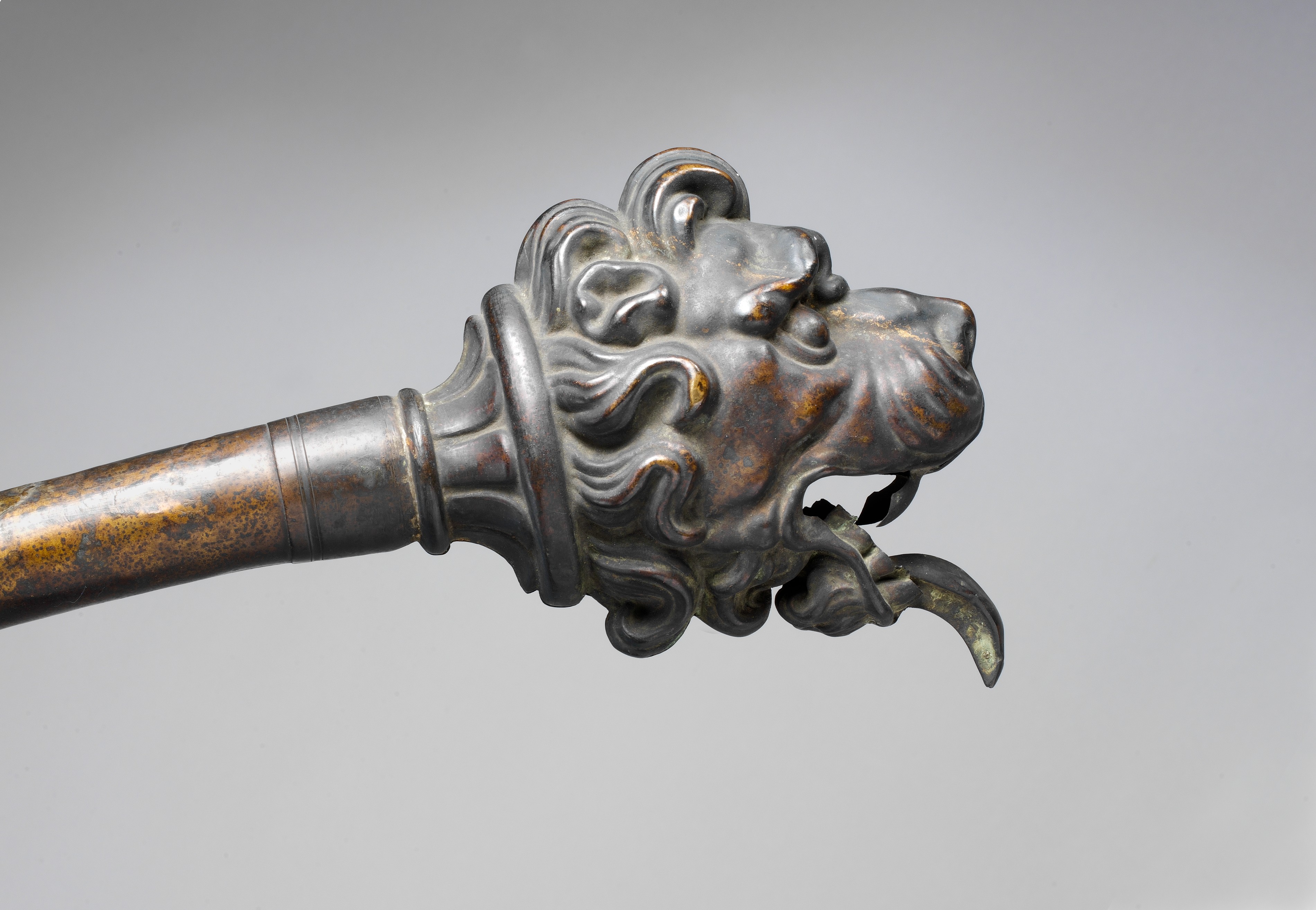
Collections assembled at that scale, through agents and dealers, in that decade, in Florence, carry a known risk, and the Museum's own records show it. Elsewhere in the same 1889 accession, at 89.4.1107, is a metal serpent catalogued as by Leopoldo Franciolini of Florence, 1844 to 1920 - the dealer whose name is now shorthand for the nineteenth-century fabrication and alteration of early musical instruments.
That is the context in which any early Florentine keyboard instrument should be read, and it cuts both ways. It explains why every such claim needs checking. It also shows that the checking has been done here: the Museum keeps Cristofori's name on this object and has taken it off another.
Chapter 9The Cristofori the Museum demoted
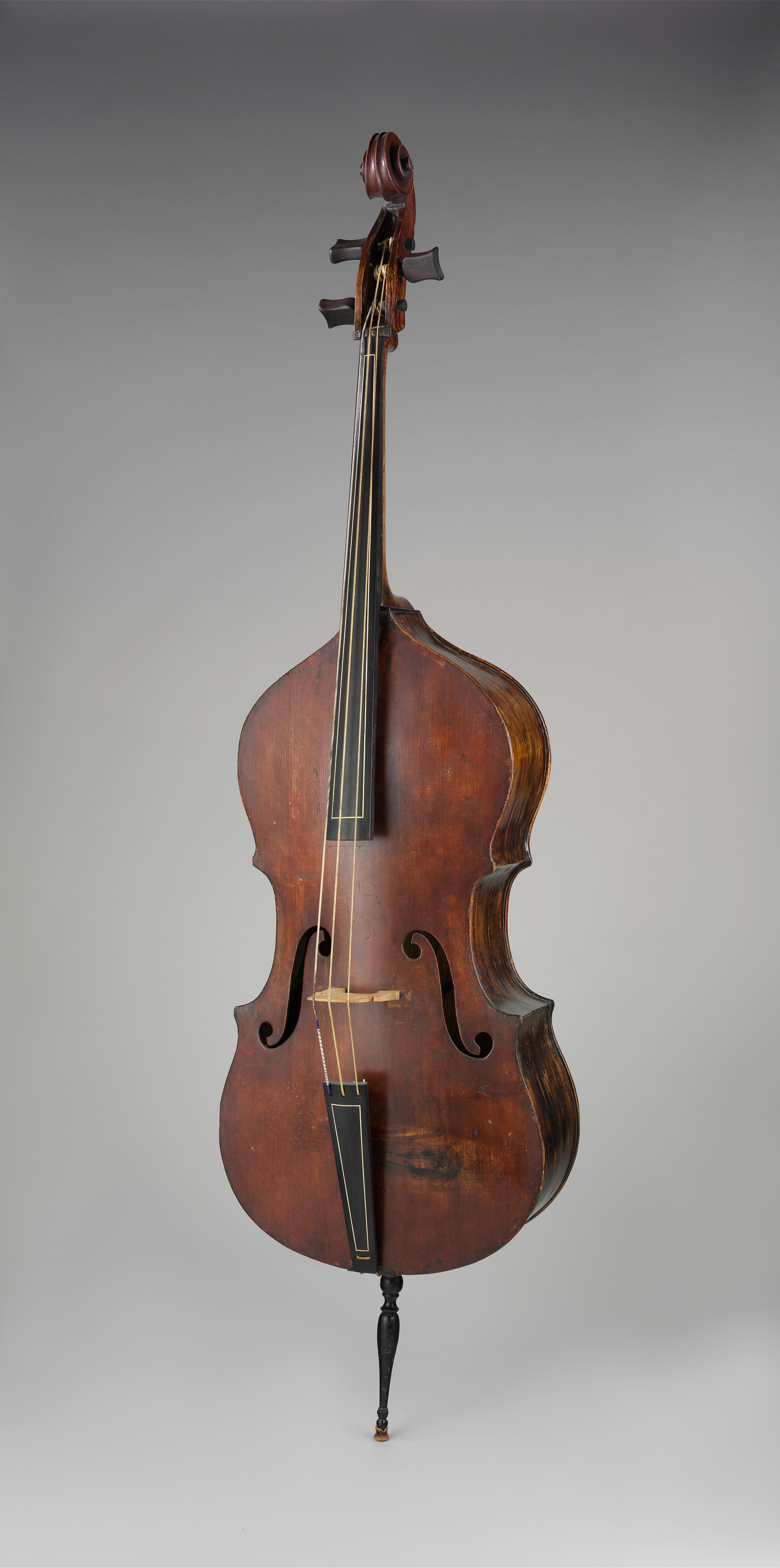
In 1980 the Museum bought a double bass, accession 1980.112, as the work of Bartolomeo Cristofori.
In 1980 the Museum bought a double bass, accession 1980.112, as the work of Bartolomeo Cristofori. It is now catalogued under the heading Former Attribution: Bartolomeo Cristofori, and its markings field reads, in the Museum's own words, Label (spurious): Io Bartolomeo Cristofari Fecit in Firenze 1717, or 1707.
A spurious label in an instrument is the exact analogue of a false hallmark on silver, and it is the standard mechanism by which value is manufactured in this trade. The Museum bought the object with the label, published it under the name, and later withdrew the attribution while keeping the object and printing the reason. That is the correct handling, and it is the direct comparison for the 1720 piano's ink inscription: one Cristofori inscription in this building has been rejected, and the Museum says which.
The pattern extends beyond the Museum. Stewart Pollens published a study in 2002 of a piano action ascribed to Cristofori, the Gatti-Kraus action, examining whether the ascription holds. Attribution in this field is argued object by object.
Chapter 101938: the soundboard
The largest single intervention on this instrument was the replacement of its soundboard in 1938.
The largest single intervention on this instrument was the replacement of its soundboard in 1938. A soundboard is not a component in the sense that a leg is a component; it is the surface that turns string vibration into audible sound, and replacing it replaces the voice.
Alongside it, the fifty-four-note compass was shifted by roughly half an octave. The instrument now runs C to f''' where it originally ran from F', G' and A' up to c'''. The keys are the same in number and different in what they sound.
This is why Wraight's judgement matters, and why the Museum's audio guide - which tells children this is the oldest piano in the world and invites them to listen to how it differs from a modern one - is describing a real object and an unreliable sound. The instrument has no pedals and fifty-four keys against a modern eighty-eight; those facts are original and audible. The timbre is not evidence of anything about 1720.
Chapter 11The other two
The 1722 Cristofori is in the Museo nazionale degli strumenti musicali in Rome.
The 1722 Cristofori is in the Museo nazionale degli strumenti musicali in Rome. It has a compass of four octaves, C to c''', and an una corda stop that shifts the keyboard so only one of the two strings at each pitch is struck. It has been damaged by worm and is not playable. The 1726 instrument in the Musikinstrumenten-Museum at Leipzig University has the same compass and the same stop and is not currently playable either, though recordings were made from it in the past.
The Metropolitan's is the plainest of the three: a wing-shaped case in the manner of an Italian harpsichord of the day, one keyboard, no stops. It is also the only one that can be played, which is the whole reason its rebuilding matters. The single playable example of an invention is the one everybody will listen to, and it is the one whose voice was replaced in 1938.
Chapter 12What the instrument is for now
Cristofori's invention was slow to take in Italy.
Cristofori's invention was slow to take in Italy. Five pianos by him or by his pupil Giovanni Ferrini were bought by Queen Maria Barbara de Braganza of Spain, patron and pupil of Domenico Scarlatti, which raises the real possibility that a large part of Scarlatti's five hundred keyboard sonatas were written for piano rather than for harpsichord as was long assumed. The earliest music unambiguously written for the instrument is Lodovico Giustini's twelve Sonate da cimbalo di piano e forte detto volgarmente di martelletti, published in Florence in 1732, the year after Cristofori died, carrying markings such as piu forte and piu piano that no harpsichord could execute.
Cristofori died on 27 January 1731, aged seventy-five. The object in Gallery 684 is the earliest physical evidence of the instrument that carried Western music for the next two centuries, and it survived because somebody in Florence thought it worth mending in 1875 and somebody in New York thought it worth buying by 1889.
The artist
Bartolomeo Cristofori di Francesco
Cristofori is the rare case of an invention with one author, one date and one surviving physical witness. He was a harpsichord technician in Medici service who, around 1700, built a keyboard instrument on which the player could control loudness by touch, and who solved at the first attempt most of the mechanical problems the trade would spend the next seventy-five years rediscovering.
The documentary base for his life is thin and precisely known: birth and death records, two wills, the bills he sent his employers, and one interview. That interview, taken by Scipione Maffei and published in 1711, is why the invention spread. It is also why the credit went for a while to somebody else.
Exhibited
- 1985Keynotes: Two Centuries of Piano Design, 29 May - 29 November 1985Metropolitan Museum of Art, New York
- 2026On view, Gallery 684Metropolitan Museum of Art, New York
Literature
- Stewart S. Pollens, Bartolomeo Cristofori and the Invention of the Piano (Cambridge University Press, 2017) - NOT read; the standard monograph and the first replacement this entry needs
- Stewart S. Pollens, A History of Stringed Keyboard Instruments (Cambridge University Press, 2022), pp. 35, 324, 335, 337, 358-59, 396, 510-11 - NOT read
- Stewart S. Pollens, 'The Gatti-Kraus Piano Action Ascribed to Bartolomeo Cristofori', The Galpin Society Journal LV (2002), p. 277 - NOT read
- Stewart S. Pollens, 'Bartolomeo Cristofori in Florence', The Galpin Society Journal 66 (2013), pp. 23, 37 - NOT read
- Denzil Wraight (2006), p. 635, cited for the assessment that the instrument's original condition has been irretrievably lost - NOT read directly; taken from the citation in the Wikipedia article
- Sally B. Brown, 'A Gift of Sound: The Crosby Brown Collection of Musical Instruments', Metropolitan Museum Journal (2018), p. 39, fig. 51 - NOT read
- Edwin M. Good, Giraffes, Black Dragons, and Other Pianos, 2nd ed. (Stanford, 2001), pp. 37-39 - NOT read
- Cesare Ponsicchi, Il pianoforte, sua origine e sviluppo (Florence, 1876) - NOT read; by the man who restored this instrument the year before
Related works
| Work | Relation | Where it is |
|---|---|---|
| Grand Piano, 1722 Bartolomeo Cristofori | The second of the three survivors Four-octave compass, C to c''', with an una corda stop. Damaged by worm and not playable. | Museo nazionale degli strumenti musicali, Rome |
| Grand Piano, 1726 Bartolomeo Cristofori | The third of the three survivors Four octaves, C to c''', with an una corda stop. Not currently playable, though recordings were made from it in the past. | Musikinstrumenten-Museum, Leipzig University |
| Double Bass Former attribution to Bartolomeo Cristofori | A Cristofori attribution the same museum has withdrawn Bought in 1980 as a Cristofori. The Museum's markings field now reads 'Label (spurious)'. | Metropolitan Museum of Art, 1980.112 |
| Serpon en metallo Leopoldo Franciolini | A documented Florentine fabricator in the same 1889 accession Nineteenth-century, by the Florentine dealer whose name is now shorthand for altered and invented early instruments. Same gift, same year, 112 accession numbers away from the Cristofori. | Metropolitan Museum of Art, 89.4.1107 |
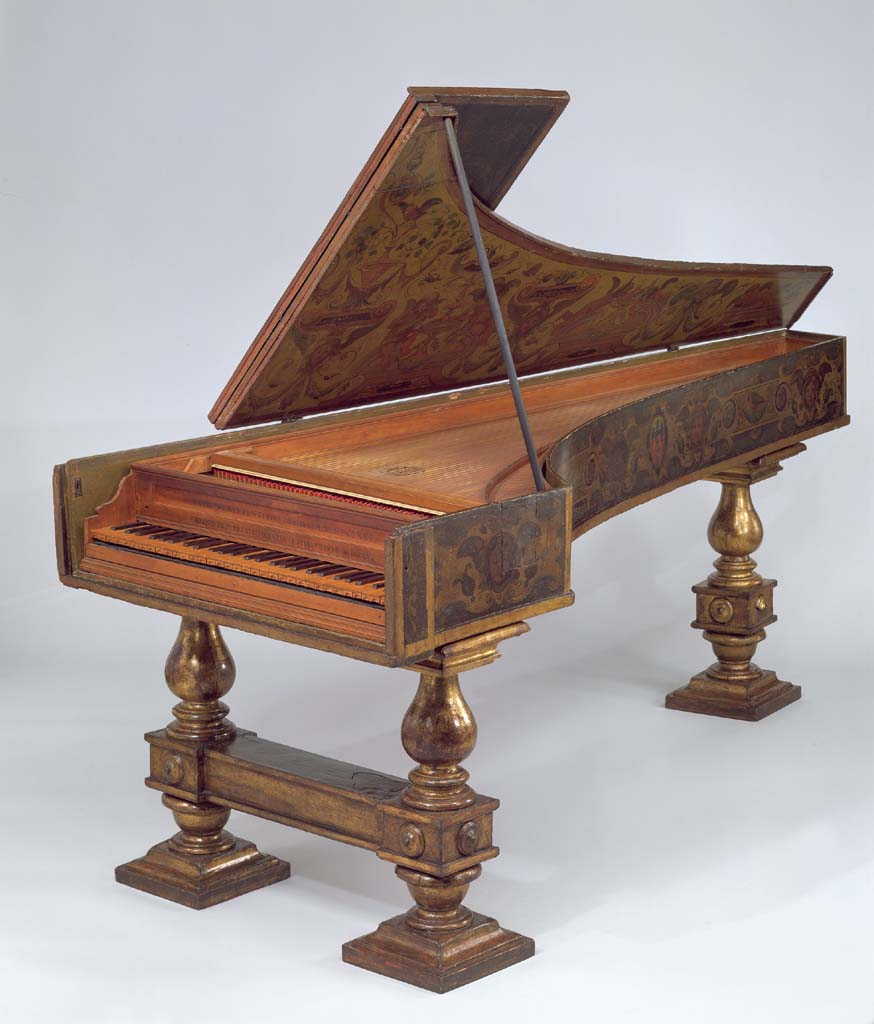
| Harpsichord Girolamo Zenti | The instrument the piano was built to supersede Florentine, 1666. Accessioned immediately after the Cristofori in the same gift. Louder and more brilliant than the piano, and incapable of answering to the player's touch. | Metropolitan Museum of Art, 89.4.1220a-b |
| The Gatti-Kraus piano action Ascribed to Bartolomeo Cristofori | A contested ascription in the same class Examined by Stewart Pollens in the Galpin Society Journal, volume LV (2002). Cristofori attribution is argued object by object. | Not established here |
Open questions
- Is the 'Signor Diego Martelli' of the Museum's provenance the Florentine critic Diego Martelli (1839-1896), champion of the Macchiaioli, whom Degas painted twice in 1879? The Museum gives no dates and no source consulted makes the identification.
- Who were Dr Fabio Mocenni and Ernesta Mocenni, what was their relationship, and when and how did the piano reach them? The Museum names them and nothing else.
- Where was the instrument between 1720 and the nineteenth century? Roughly a hundred and fifty years are undocumented, including whether it ever left Florence.
- What exactly did Cesare Ponsicchi do in 1875? He signed and dated the hammer rail, but the extent of his intervention is not published, and it is not clear whether the compass shift is his work or the 1938 campaign's.
- Was the present hammer rail originally the nameboard, as the Museum suggests, and if so when was it moved? The maker's date rests on that component.
- What did Mary Elizabeth Adams Brown pay, and to whom? No price, date or agent is published for the acquisition of this instrument.
- How much of the case, action and keyboard is original? The soundboard is 1938 and the compass has been shifted, but no published component-by-component survey has been located here.
Questions about this object
What is Grand Piano?
Grand Piano is a musical instrument, dated 1720. Medium: Cypress, boxwood, paint, leather, fir.
Who made Grand Piano, and is the attribution settled?
The attribution to Bartolomeo Cristofori is recorded here as accepted. Accepted as the work of Bartolomeo Cristofori and as the oldest surviving piano. The inscription is in ink on the present hammer rail, a component the Museum notes was possibly originally the nameboard, rather than cut into the structure - so the date is carried by a moveable part of a rebuilt instrument. No serious challenge to the attribution has been published. The same museum has withdrawn a Cristofori attribution from a double bass whose label it now calls spurious, which is the measure of how the name is policed.
Where is Grand Piano now?
Metropolitan Museum of Art, New York, Gallery 684. Inventory number 89.4.1219a-c. Last confirmed 4 August 2026. The Crosby Brown Collection of Musical Instruments, 1889; on view 2026.
What is still unknown about Grand Piano?
Is the 'Signor Diego Martelli' of the Museum's provenance the Florentine critic Diego Martelli (1839-1896), champion of the Macchiaioli, whom Degas painted twice in 1879? The Museum gives no dates and no source consulted makes the identification.
Sources
- 1Metropolitan Museum of Art, collection record for Grand Piano, Bartolomeo Cristofori, 1720, accession 89.4.1219a-c. Overview, additional dimensions, signatures and markings, provenance, exhibition history and references tabs all read 4 August 2026. metmuseum.org/art/...
- 2Metropolitan Museum of Art Collection API, object 501788: isPublicDomain true, medium 'Cypress, boxwood, paint, leather, fir', credit line 'The Crosby Brown Collection of Musical Instruments, 1889'. collectionapi.metmuseum.org/public/...
- 3Wendy Powers, 'The Piano: The Pianofortes of Bartolomeo Cristofori (1655-1731)', Heilbrunn Timeline of Art History, Metropolitan Museum of Art, October 2003. metmuseum.org/toah/...
- 4Wikipedia, 'Bartolomeo Cristofori'. TERTIARY. Read as raw wikitext rather than as a rendered summary. Carries the Denzil Wraight assessment (Wraight 2006, p. 635), the 1938 soundboard replacement and the compass shift, the 1700 Medici inventory wording, and Stewart Pollens's observation about the missing bills. To be replaced by Pollens, Bartolomeo Cristofori and the Invention of the Piano (Cambridge University Press, 2017). en.wikipedia.org/wiki/...
- 5Metropolitan Museum of Art, collection record for Double Bass, accession 1980.112, headed 'Former Attribution: Bartolomeo Cristofori', with the markings field reading 'Label (spurious)'. metmuseum.org/art/...
- 6Metropolitan Museum of Art, collection record for Serpon En Metallo, accession 89.4.1107, Leopoldo Franciolini (Italian, Florence 1844-1920 Florence), 19th century, credit line 'The Crosby Brown Collection of Musical Instruments, 1889'. metmuseum.org/art/...
- 7Wikipedia, 'Diego Martelli'. TERTIARY, read as raw wikitext. Used only for the identity, dates and career of the Florentine critic of that name, not to assert that he is the Martelli in the Museum's provenance line. en.wikipedia.org/wiki/...
Last verified 21 August 2026 · Published 4 August 2026
Change log
2 August 2026 - Record deepened to the house standard: narrative sections, technical evidence, artist dossier, related works and open questions added; provenance chain and auction results replaced with the researched versions; sources rebuilt.
4 August 2026 - Record created at the house standard: researched narrative, technical evidence, maker dossier, graded provenance chain, prices with hammer and premium separated, related works, open questions and sources.
21 August 2026 - Re-verified 2026-08-21: Met API (object 501788, accession 89.4.1219a-c) still lists isPublicDomain true, same credit line (Crosby Brown Collection of Musical Instruments, 1889) and same 1720 Florence date; no reattribution, relocation or new litigation found. All 7 cited source URLs still resolve. No change.