Harpsichord
Jan Couchet the Elder · ca. 1650 (original single-manual instrument); case, second keyboard and fourth register added by an unidentified rebuilder, probably first half of the 18th century
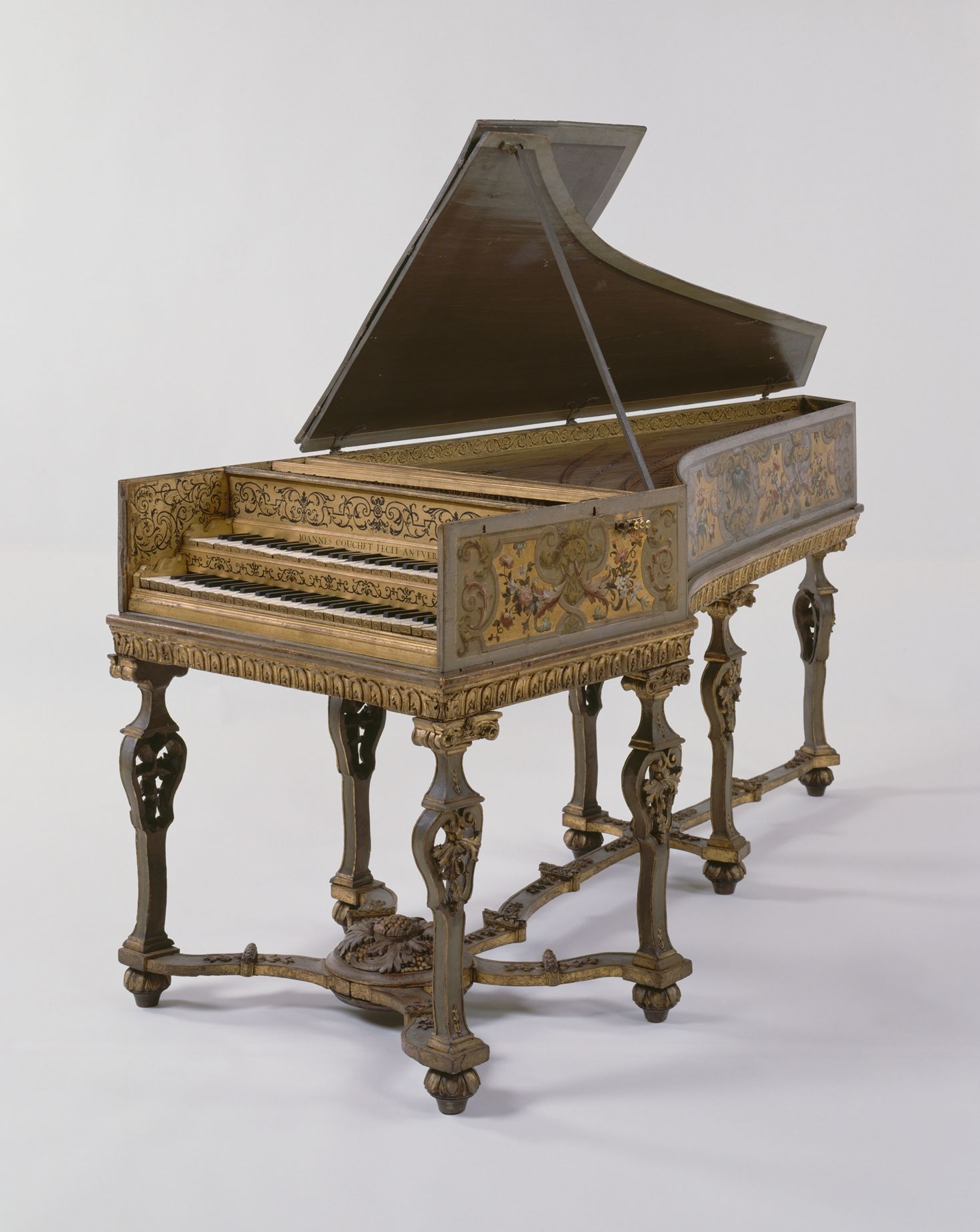
The instrument as it survives today: a single-manual Couchet harpsichord of about 1650, enlarged to two manuals and four registers by an unidentified rebuilder whose decorative matching is close enough that the join is invisible with the case closed.
| Artist | Jan Couchet the Elder |
|---|---|
| Date | ca. 1650 (original single-manual instrument); case, second keyboard and fourth register added by an unidentified rebuilder, probably first half of the 18th century |
| Medium | Wood and various materials (pine case, poplar or linden soundboard, ivory-covered keys on the added keyboards, gilt gesso and tempera decoration on a gold ground) |
| Dimensions | Instrument: 232 x 29 x 86 cm. Stand: 234 x 90 x 76 cm. |
| Where it is now | Metropolitan Museum of Art, New York, Department of Musical Instrumentslast confirmed |
| Inventory number | 89.4.2363 |
| Attribution | DisputedThe Metropolitan Museum catalogues the whole object as a harpsichord by Jan Couchet the Elder, Antwerp, ca. Full note |
| Object type | Musical instrument |
| Period | Flemish, 17th century, enlarged in the French-influenced ravalement style of the 18th century |
| Cases | Disputed attribution · Has a provenance gap |
| Inscriptions | No signature, rose inscription letters, or date survive from the maker in the ordinary sense; the soundboard carries a gilded rose in the form of an angel flanked by the maker's initials, in keeping with Ruckers-workshop practice. Faint ink lettering naming individual notes (visible behind the front row of tuning pins, the highest marked "c") survives from the original layout of the bass; the rebuilder left no mark of any kind identifying himself, his workshop, or the date of his work. |
| Owners on record | 4 links2 documented, 1 disputed, 1 unknown |
| Sources | 7 cited |
About this record Last verified · 7 sources cited · Change log
On this page 9 sections
ContentsClose
A harpsichord that is, physically, two objects wearing one skin. Jan Couchet the Elder, grandson and successor of the Ruckers workshop of Antwerp, built it as a single-manual instrument around 1650. An unidentified craftsman, probably working within the following century, cut the case open, lengthened it by five inches, built in a second keyboard and a fourth row of jacks, and matched the existing gilt strapwork so precisely that the join was invisible until the keyboards were removed from the case.
The Metropolitan Museum has owned it since 1889, as part of the founding gift of Mary Elizabeth Adams Brown's Crosby Brown Collection, and catalogues it under Couchet's name and date alone. The first technical study of the instrument, published in this museum's own journal in 1969, argued that the rebuilder wanted it that way: an enlargement built specifically to be mistaken for an original two-manual Couchet, rather than admitted as a later hand's work.
What survives is neither a pure Couchet nor a pure product of the rebuilder's shop, but a working record of both, folded into a single case that documents Flemish harpsichord practice on both sides of a hundred-year gap.
Provenance
Each link is graded. Documented: a cited source supports it. Disputed: the identification is argued but not established. Unknown: no owner for that span, and the gap is not smoothed into a narrative. The grades in the glossary.
- c. 1650 -Jan Couchet the Elder workshop, Antwerpdocumented
Built as a single-manual harpsichord, probably with a range of fifty-four notes (four octaves and a fourth) and two rows of jacks plus a buff stop, by Jan Couchet the Elder in his Antwerp workshop. Couchet inherited the workshop of his uncle Joannes Ruckers on the latter's death in 1642 and was himself a grandson of Hans Ruckers the Elder, founder of the Antwerp dynasty. The reconstruction of the original compass and disposition is not documentary; it is inferred from physical evidence in the surviving case, keyboard blocks, pinblock and bridge, set out in full by Edwin M. Ripin in 1969.14
- Unidentified rebuilderdisputed
The case was extended, a second keyboard and a fourth row of jacks (a close-plucking register unknown in Flanders before the eighteenth century) were added, and the front board and lid were replaced. Ripin dates the work to the eighteenth century on the evidence of the ivory key coverings and the documented late arrival of the close-plucking register in Flemish practice, but the rebuilder left no signature, mark, or date, and Ripin argues the omission was deliberate: the decorative match is close enough that the enlargement was meant to be undetectable. Whether the rebuilder worked in Antwerp, in the Flemish tradition the instrument itself displays, or was a Parisian craftsman working in a Flemish idiom, has not been resolved in the sources consulted for this record.1
- - 1889Unknownunknown
No owner, dealer, or location is documented between the presumed date of the rebuilding and the instrument's appearance in the Crosby Brown gift in 1889. How and when it left Antwerp, whether it passed through France, and who commissioned the ravalement are not recorded in the sources consulted.15
- 1889 - presentMetropolitan Museum of Art, New Yorkdocumented
Entered the Metropolitan Museum as part of the Crosby Brown Collection of Musical Instruments, assembled by Mary Elizabeth Adams Brown and given to the museum beginning with an initial gift of 270 to 276 instruments accepted by the trustees on 18 February 1889; she continued giving instruments until her death in 1918, by which point she had given the museum more than 3,300 pieces. The specific source from which she or her agents acquired this harpsichord before 1889 is not documented in the sources consulted for this record.56
Technical evidence
| Attribution note | The Metropolitan Museum catalogues the whole object as a harpsichord by Jan Couchet the Elder, Antwerp, ca. 1650. That is true of roughly half of what survives: the soundboard, the pinblock structure, the case sides below the added front section, the stand frame and the decorative scheme. The rest, including one complete keyboard, a fourth row of jacks, the front portion of the case, the front board and the lid, was added by an unidentified rebuilder, probably in the first half of the eighteenth century, who deliberately left no signature, mark or date and matched the existing decorative style so closely that Edwin M. Ripin, in the first technical study of the instrument (Metropolitan Museum Journal, 1969), concluded the rebuilder wanted the enlarged instrument to pass as an original two-manual Couchet. Whether that rebuilder worked in Antwerp or was trained there, rather than in Paris where most Ruckers-Couchet ravalement is otherwise documented, is itself unresolved; see Open questions. |
|---|---|
| Configuration as it survives | Two fifty-five-note keyboards, range FF to high c (four octaves and a fifth); three sets of strings (two unison, one octave); four rows of jacks providing four distinct tone colors, the front and fourth rows sharing the same strings.1 |
| Reconstructed original configuration | Probably a single fifty-four-note keyboard, range GG to high c (four octaves and a fourth); one set of unison strings and one of octave strings; two rows of jacks plus a buff stop operated by a batten fitted with soft leather.1 |
| Case construction and joins | Long side of the case extended by five inches at a vertical joint, visible unfinished behind the decorative blocks flanking the keyboards; the short side at the player's right is entirely new, showing none of the extension seams present in the long side.1 |
| Stand | Substantially original. The rebuilder lengthened the existing frame members at the front with long scarf joints rather than building a new stand, covering the visible splice with a five-inch insert of carving matched to the original frieze; the domed boss on the serpentine stretcher may not be original, since it is centered on a span that was itself lengthened by five inches.1 |
| Decoration and gesso analysis | Outside of the case decorated in simulated relief, gray strapwork, colored flowers and foliage on a gold ground; interior arabesques in black on gold around the soundboard rim and keyboard well. Toothed-scraper scoring beneath the gold leaf differs between the original curved side (random, overlapping pattern) and the added short side and front board (strictly horizontal and vertical, non-overlapping), evidence of two different hands executing a matched decorative scheme.1 |
| Soundboard and rose | Original soundboard decorated with gold borders and arabesques; gilded rose in the soundhole depicting an angel flanked by the maker's initials, in the form used across Ruckers-workshop instruments.1 |
| Keyboards | Both keyboards were made as a matched set by the later rebuilder, not by Couchet; playing surfaces covered in ivory rather than the bone typical of seventeenth-century originals, and the keys are cranked to the left, evidence that a note was added to the original bass compass.1 |
| Pinblock evidence | Faint ink lettering behind the front row of tuning pins names individual notes, the highest marked "c"; many holes for the later, added row of unison tuning pins are drilled directly through these letters, proving the second unison string course was added after the original layout was marked.1 |
| Registers | The added, close-plucking fourth row of jacks plucks very near the nut, producing a bright, reedy, nasal tone; it divides the pinblock into an original, decorated front portion and a later, undecorated, thicker triangular portion carrying the octave-string tuning pins.1 |
| Pitch | Treble string length (6.25 in. for high c) indicates the instrument was built to be tuned a whole tone above the ordinary Low Countries standard pitch (Chorista), a specialized pitch documented in a 1648 letter discussing Couchet's own work for export or high-voice accompaniment.12 |
Images
The record in full
Chapter 1Two instruments in one case
Musical instruments occupy an unusual place among the objects museums preserve.
Musical instruments occupy an unusual place among the objects museums preserve. Many are highly decorative pieces of furniture, but they were built, first and foremost, to be played, and to satisfy the musical taste of the moment they were built for, not the moment a later owner happened to prize them. Edwin Ripin, the Metropolitan curator who first examined this harpsichord closely, made the point directly: the finer a surviving keyboard or string instrument is, the greater the likelihood it was subjected to major rebuilding, because a fine instrument was worth the cost of updating rather than replacing. He drew the comparison to the violin family. A number of lesser seventeenth-century violins survive today exactly as their makers left them; virtually every surviving Stradivari violin does not, because nineteenth-century romantic music demanded a larger, more brilliant tone than Stradivari had built his instruments to produce, and owners of the finest violins in the world had them altered rather than set aside. This archive holds two Stradivari instruments elsewhere in its Musical instrument records; this harpsichord is the keyboard equivalent of exactly that pattern, a century and a half earlier.
Opened up and viewed with both keyboards removed, the harpsichord in the Metropolitan Museum's Department of Musical Instruments does not read as a single, coherent object. Two shaped wooden blocks are set into the inside of the case about six inches from the front, painted black and gold in a style that does not match the arabesques now surrounding the keyboards. In front of the left-hand block, a vertical joint runs down the long side of the case where new wood was spliced onto old. The lower edge of the board behind the keyboards has been cut away to make room for a second row of keys where, originally, there was only one.
None of this is visible with the instrument closed. The outside of the case is decorated in a single, unified scheme of gray strapwork, colored flowers and gilt foliage on a gold ground, and the stand beneath it carries matching motifs. Whoever did this work went to considerable trouble to make two centuries of Antwerp harpsichord-building look like one act of craftsmanship.
Chapter 2What the added register makes possible
The four rows of jacks in the instrument as it survives today are not simply four ways of doing the same thing.
The four rows of jacks in the instrument as it survives today are not simply four ways of doing the same thing. The front row, operated only from the upper keyboard, plucks one set of unison strings very close to the bridge, producing a bright, reedy, somewhat nasal tone. A second row, with extensions reaching down to the lower keyboard as well as the upper, plucks the same strings farther from the bridge for a rounder sound. A third row plucks the octave strings, and a fourth, plucking at the same point as the front row, provides a fuller variant of the close, nasal tone. Used together, the back three rows give a single combined unison-and-octave registration on the lower keyboard while the front row stands alone on the upper, producing exactly the contrast in loudness between the two manuals that echo effects, and compositions written to exploit them, such as Bach's Italian Concerto, require.
Because the front and fourth rows pluck the same strings, the close, reedy solo register cannot be combined with the fuller back registration; when the back row is engaged, its jacks' dampers rest on the strings the front row also uses. The rebuilder addressed this limitation with a genuine piece of mechanical ingenuity, dividing the movable guides for the first and fourth rows into separate treble and bass sections at middle c, each controlled by its own set of knobs, so that a player could use the close register in the treble while the fuller register sounded in the bass, or the reverse. This same four-row arrangement, with the same practical compromise, is documented in the harpsichords of eighteenth-century Antwerp builders such as Johann Daniel Dulcken, a detail Ripin treats as further, independent evidence that the rebuilder was working inside a living Antwerp tradition of harpsichord mechanism, not importing a Parisian one.
Chapter 3The Ruckers-Couchet workshop
Jan Couchet the Elder was born in Antwerp in 1615, the grandson of Hans Ruckers the Elder, the founder of the dynasty that made Antwerp the most important center of harpsichord and virginal building...
Jan Couchet the Elder was born in Antwerp in 1615, the grandson of Hans Ruckers the Elder, the founder of the dynasty that made Antwerp the most important center of harpsichord and virginal building in northern Europe for the better part of a century. The connection ran through marriage: Hans Ruckers's daughter Catharina married into the Couchet family, and it was her son Jan who inherited the workshop of his uncle, Joannes Ruckers, on Joannes's death in 1642, becoming a master in his own right.
By the time Jan Couchet the Elder was building instruments in his own name, the Ruckers reputation had become close to a trademark. Ruckers and Couchet instruments were the standard against which harpsichords across England, France, Germany and Scandinavia were measured, to the point that later builders in other countries absorbed their methods of construction wholesale. Couchet's own output, by the account of period letters discussed below, was itself built to specific commissions and specific pitches for specific markets, evidence of a workshop operating as an export business as much as a craft shop.
Roughly five instruments by Jan Couchet the Elder are known to survive today, most of them altered by ravalement in the century after they were built, all dated to around 1650. That the Metropolitan's example is one of only a handful gives every physical clue in it unusual weight: there is very little else by this maker's hand to compare it against.
Chapter 4Reconstructing what Couchet built
Because no unaltered instrument by Jan Couchet the Elder survives in this configuration, establishing what the Metropolitan's harpsichord looked like before it was rebuilt requires working backward...
Because no unaltered instrument by Jan Couchet the Elder survives in this configuration, establishing what the Metropolitan's harpsichord looked like before it was rebuilt requires working backward from what the rebuilder left untouched. The soundboard is original, decorated with gold borders and arabesques and a gilded rose showing an angel flanked by the maker's initials, in the form used across the Ruckers workshop tradition. The case sides below the level of the added front section are original. The stand, remarkably, is also substantially original: rather than build a new frame, as was usual practice when a harpsichord's case was widened, the rebuilder lengthened the existing frame members with long scarf joints and covered the visible splice with a five-inch insert of carving that matches the original frieze.
The keyboards themselves were made as a matched pair by the same later hand; neither can be Couchet's original single keyboard, since a single-manual instrument by definition had only one. Faint ink lettering behind the front row of tuning pins, naming individual notes, is the clearest surviving trace of Couchet's own layout: the highest pin is marked "c," consistent with a compass extending upward to high c. Working from the width and depth of the case, which are unusually generous for a single-manual Flemish instrument, from the un-cranked construction that an original keyboard should show, and from the standard treble string length used across surviving Flemish harpsichords, the most probable original compass is worked out as GG to high c, a fifty-four-note range in an instrument built, unusually, to be tuned a whole tone above normal pitch.
That last detail is not a guess. A 1648 letter from the merchant Gaspard Duarte to the scholar and diplomat Constantijn Huygens, discussing an instrument Couchet was building, distinguishes between the ordinary pitch used in the Low Countries, called Chorista, and a pitch a tone higher, favored for playing fast dance music and for accompanying voices pitched high, of the kind an English or other foreign client might specifically request. Antwerp instrument makers, in other words, were manufacturing to more than one pitch standard depending on where and for what an instrument was destined, and the string lengths in the Metropolitan's harpsichord match the higher of the two.
Chapter 5What the rebuilder added
The physical evidence for the enlargement is not a matter of interpretation; it can be read directly off the wood.
The physical evidence for the enlargement is not a matter of interpretation; it can be read directly off the wood. The long side of the case was extended by five inches at a vertical joint that remains visible, unfinished, behind the decorative blocks flanking the keyboards. The short side at the player's right is new in its entirety, since it shows none of the extension seams the long side does. A transverse board five inches wide was added at the front of the case bottom when the instrument was lengthened, and the surface immediately behind it still shows the outline and nail holes of the strap hinges that once held Couchet's original front board, which hung vertically at the player's knees in the ordinary Flemish manner rather than lying flat as the current, later front board does.
A fourth row of jacks was added to pluck a set of unison strings very close to the bridge, producing a bright, reedy, close-plucking tone quite different from the three original rows. This close-plucking register divides the pinblock in two: the front portion carries the tuning pins for the unison and octave strings that Couchet built, decorated to match the soundboard, while a smaller triangular portion behind it, thicker and undecorated, was added to carry the new register. A gold decorative line that should run continuously behind the original nut is instead cut off by the slot cut for the new jacks, physical proof that the line, and the strip of buff-leather-fitted wood it originally bordered, predates the alteration.
The most telling evidence lies in the tuning-pin holes themselves. Many of the holes drilled for the second, added set of unison strings pass directly through the ink letters naming the original unison strings, meaning the new holes were drilled after those letters were written; and the plugged holes left where guide pins were repositioned at the bass end of the bridge and nut do not occur in pairs, which they would if two sets of unison strings had been there from the start. Both details independently confirm that Couchet's instrument, as built, carried only one set of unison strings and one of octave strings: two rows of jacks, not the four the case now holds.
Chapter 6A rebuild built not to be found
What makes this instrument a genuine attribution problem, rather than simply a well-documented repair, is that the rebuilder's work was designed to be undetectable by ordinary inspection.
What makes this instrument a genuine attribution problem, rather than simply a well-documented repair, is that the rebuilder's work was designed to be undetectable by ordinary inspection. Careful comparison of the gesso under the gold leaf on the original curved side of the case against the gesso on the new short side shows a different scoring technique: random, overlapping toothed-scraper marks on the original portion, strictly horizontal and vertical, non-overlapping marks on the new portion, evidence of two different hands working to the same visual effect but by different methods. The black arabesques surrounding the keyboards do not quite match those surrounding the soundboard in detail, yet both echo the strapwork on the outside of the case closely enough that, closed and viewed as a whole, the instrument reads as a single decorative program.
Edwin M. Ripin, the Metropolitan curator who published the first full technical analysis of the instrument in 1969, argued that this level of care was deliberate rather than incidental, and drew a direct parallel to a documented case of exactly this kind of concealment. In 1739 the Dutch organist and theorist Quirinus van Blankenburg described, and objected to, a method by which in 1708 he had rebuilt a 1625 harpsichord by Johannes Ruckers, Couchet's uncle, adding a close-plucking register of the same type found in the Metropolitan's instrument; Blankenburg wrote of unscrupulous craftsmen of his period who built such registers into genuine Ruckers instruments specifically to multiply the tonal combinations available while letting the whole pass as untouched. Ripin's reading is that the Metropolitan's Couchet is a comparable, and unusually successful, example of the same practice: an enlargement designed to be received as an original two-manual instrument by Couchet himself, not as a later hand's addition to a smaller one.
That reading has an important consequence for how the object should be understood today. The Metropolitan's own catalogue record still lists the whole instrument under Couchet's name and a single date of about 1650, with no separate credit to the rebuilder, whose identity in any case is not known. Whether an institution's cataloguing choice to attribute a composite, substantially eighteenth-century object entirely to its seventeenth-century originator is the right call, or whether it perpetuates precisely the concealment the rebuilder intended, is not a question this record can settle; it is recorded here as an open one.
Chapter 7Flemish ravalement, not Parisian
Ravalement, as the term is usually used in organology, describes an overwhelmingly French and Parisian eighteenth-century practice: workshops such as those of the Blanchet family, Jean Goermans and...
Ravalement, as the term is usually used in organology, describes an overwhelmingly French and Parisian eighteenth-century practice: workshops such as those of the Blanchet family, Jean Goermans and Pascal Taskin bought Ruckers and Couchet harpsichords, prized above all for their soundboards and their tone, and rebuilt them to contemporary French taste, extending the compass, adding registers, and very often redecorating the case wholesale in the fashionable French manner of the day, sometimes leaving little of the original decorative scheme intact.
The Metropolitan's Couchet does not fit that pattern cleanly, and this is itself the second layer of the attribution problem. Ripin's analysis emphasizes that the rebuilder here preserved almost the entire original decorative program rather than replacing it, going to unusual lengths to match rather than supersede the existing gilt strapwork, and that the archaic, awkward arrangement of register controls, which requires the player to reach around the sides of the case rather than operate them from the front as most French ravalements did, is consistent with a craftsman working inside the Flemish tradition rather than importing Parisian conventions. Ripin's own conclusion is that the Metropolitan's instrument was very probably rebuilt within Flanders, or at least by a craftsman trained in Flemish practice, rather than being sent to Paris and returned in the ordinary Ruckers ravalement pattern. He points to a second, independent piece of evidence for this beyond the decoration: the four-row jack arrangement built into the rebuilt instrument, awkward compromise and all, is the same arrangement documented in the harpsichords of the eighteenth-century Antwerp builder Johann Daniel Dulcken, not a configuration typical of the Parisian workshops of Blanchet, Goermans or Taskin. Because the rebuilder left no mark, this remains an argument from internal stylistic and technical evidence rather than a documented fact, and it has not, so far as the sources consulted for this record show, been revisited in print since 1969. A more recent survey of the Metropolitan's Flemish harpsichords and virginals, covering exactly this kind of early alteration, was published by the museum's own conservator Stewart Pollens in 1997; this record was not able to consult that article directly, and it should be checked against the account given here before publication.
Chapter 8The rose, the guild, and what the decoration was for
The soundboard's gilded rose, an angel flanked by the maker's initials set into the wood at the point where the strings converge, follows a decorative convention used across the entire...
The soundboard's gilded rose, an angel flanked by the maker's initials set into the wood at the point where the strings converge, follows a decorative convention used across the entire Ruckers-Couchet output: every workshop instrument carried one, in a small number of recognized designs, and the rose was one of the few marks by which an unsigned instrument could be tied to a specific hand or generation of the family. It was never merely ornamental. In an instrument built for a market where buyers were explicitly paying for the Ruckers name as much as for the sound, as the Blankenburg episode above demonstrates was already happening within decades of the original construction, the rose functioned as a maker's mark does on silver or a hallmark on gold: a claim of origin embedded in the object itself, which is exactly what made an unmarked later addition, matched closely enough to the original decorative language, so effective a disguise.
Instrument makers in Antwerp, including the Ruckers family, registered with the city's Guild of Saint Luke, the same guild that regulated painters, an arrangement that placed harpsichord decoration under the same civic apparatus of craft standards and quality control that governed panel painting in the same city. Hans Ruckers the Elder became a member of the guild in 1579; two generations later, Petrus Joannes Couchet, a member of the same extended family, became a master and Guild of Saint Luke member in 1655 or 1656. The elaborate painted cases these workshops produced were not incidental to instruments built primarily to be played; they were themselves guild-regulated luxury objects, built for display in the households of buyers who expected the case to communicate the same standard of craft the strings and action delivered.
Chapter 9The gap before 1889
Between the presumed date of the rebuilding, sometime in the first half of the eighteenth century on Ripin's reading, and the instrument's appearance in New York in 1889, nothing about its ownership...
Between the presumed date of the rebuilding, sometime in the first half of the eighteenth century on Ripin's reading, and the instrument's appearance in New York in 1889, nothing about its ownership or location is documented in the sources consulted for this record. It is not known whether it stayed in Flanders, passed through France despite showing no clear signs of Parisian rebuilding, or moved directly to a private collection that later sold or gave it onward. This is a long, undocumented gap by the standards of this archive's other holdings, and it should be treated as a finding rather than papered over: a working eighteenth-century Antwerp harpsichord, deliberately built to look undisturbed, simply disappears from the record for roughly a century and a half.
Chapter 10A missionary family's collection
The instrument's documented history resumes in 1889, when it entered the Metropolitan Museum as part of the founding gift of the Crosby Brown Collection of Musical Instruments.
The instrument's documented history resumes in 1889, when it entered the Metropolitan Museum as part of the founding gift of the Crosby Brown Collection of Musical Instruments. The collection took its name from John Crosby Brown, a partner in the New York banking house of Brown Brothers and Company, but it was assembled and driven by his wife, Mary Elizabeth Adams Brown, whose interest in musical instruments grew out of her family's extensive contacts with foreign missionaries, who sent or brought her instruments from postings around the world.
Her first gift to the museum, accepted by the board of trustees at a fully attended meeting on 18 February 1889, held at Cornelius Vanderbilt's office at Grand Central Station, comprised roughly 270 to 276 instruments, most of them non-European. She continued to add to the collection for the rest of her life; by her death in 1918 she had given the Metropolitan more than 3,300 instruments, which by 1901 already filled five galleries, a tenth of the museum's total exhibition space at the time. The Couchet harpsichord's specific route into that collection, whether bought by an agent, inherited, or donated to Brown directly, is not established in the sources consulted for this record.
Chapter 11Comparanda: how other Ruckers-family instruments were altered, or were not
The Metropolitan's own galleries and storage hold two unaltered instruments from the two generations immediately surrounding Jan Couchet the Elder, both useful for understanding what his workshop...
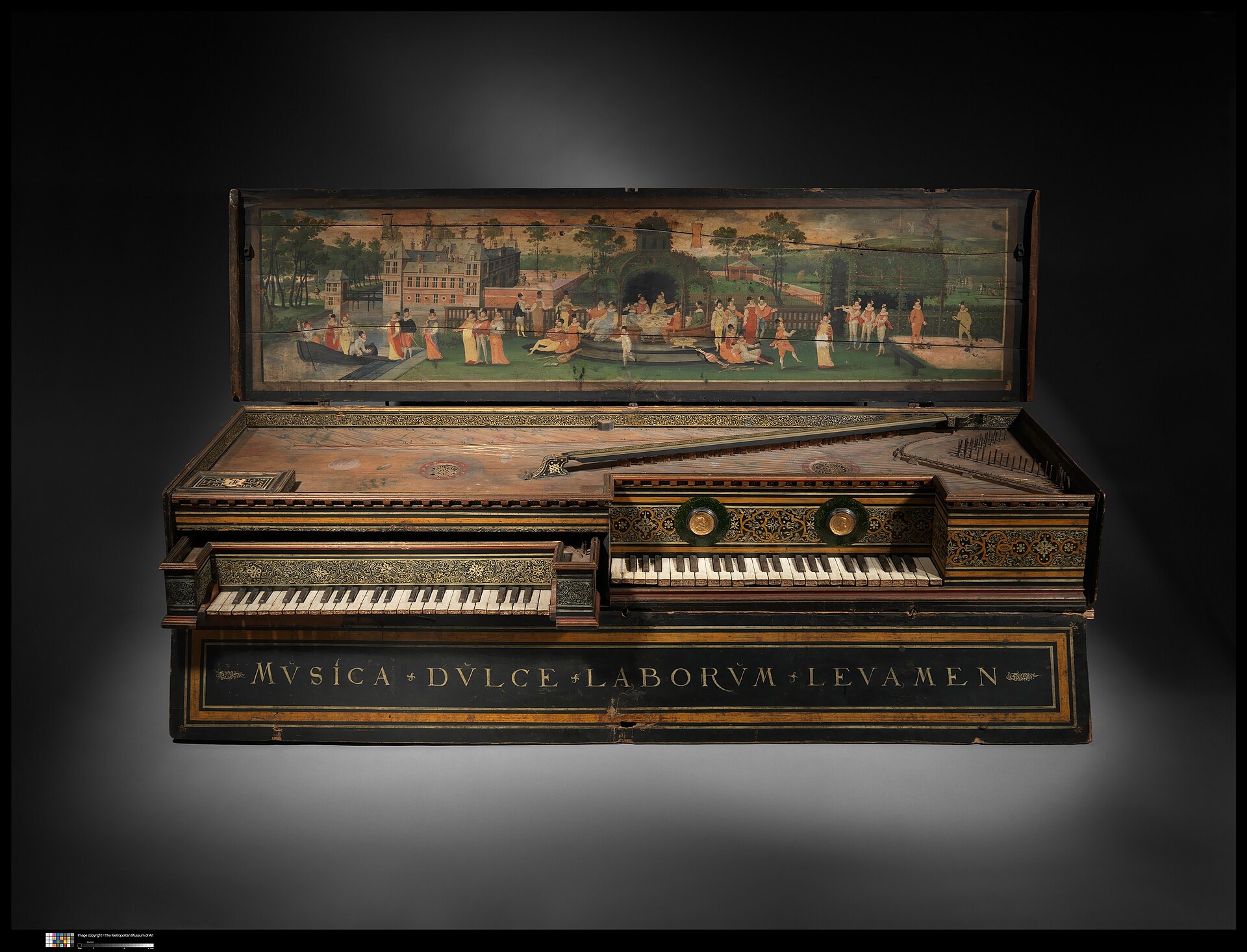
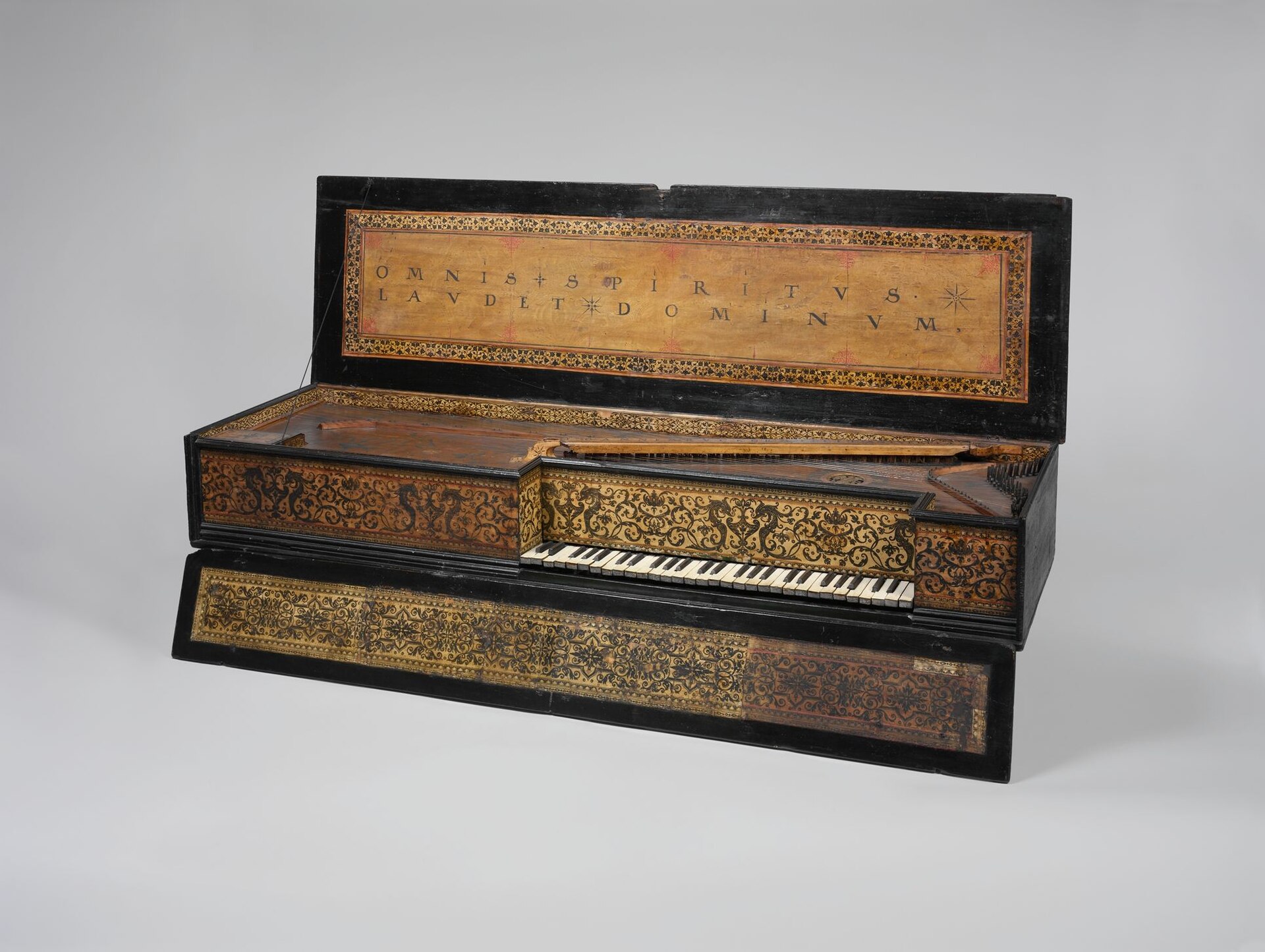
The Metropolitan's own galleries and storage hold two unaltered instruments from the two generations immediately surrounding Jan Couchet the Elder, both useful for understanding what his workshop, and his teachers, produced before any later hand touched their work. A double virginal built by Hans Ruckers the Elder, Couchet's grandfather, in 1581, survives as built, its case decoration giving a benchmark for sixteenth-century Ruckers-workshop painting a full generation before Couchet's own working life. A muselar virginal built in 1622 by Joannes Ruckers, the uncle whose Antwerp workshop Jan Couchet the Elder inherited in 1642, likewise survives unaltered, one generation closer to Couchet's own training and directly from the hand of the master he apprenticed under.
Ripin's 1969 article illustrates a closer comparandum still: a harpsichord originally built by Petrus Johannes Couchet, one of Jan Couchet the Elder's own sons, in Antwerp in 1668, later enlarged from a single-manual to a two-manual instrument and now in the Gemeentemuseum in The Hague. Unlike the Metropolitan's example, this instrument's original, smaller footprint is preserved in the painted decoration of its own lid, which was not replaced, giving a direct visual record of the case size before enlargement. Where the Metropolitan's rebuilder concealed the evidence of his work as far as he could, the Petrus Couchet instrument in The Hague shows, by comparison, how much case-widening a typical single-to-double conversion in this family actually required, underscoring by contrast just how unusually wide and deep Jan Couchet the Elder had already built his father's, or in this case his own, single-manual case to begin with.
Chapter 12What is unresolved
No firm date attaches to the rebuilding beyond a general eighteenth-century range inferred from the ivory key coverings and the documented late arrival of the close-plucking register in Flemish...
No firm date attaches to the rebuilding beyond a general eighteenth-century range inferred from the ivory key coverings and the documented late arrival of the close-plucking register in Flemish practice. No name attaches to the rebuilder at all. Whether the work was carried out in Antwerp, within the Flemish tradition the case's decorative technique suggests, or by a craftsman trained elsewhere and imitating that tradition, remains an argument from internal evidence rather than a settled fact, and has not, so far as this record's sources show, been tested against archival evidence since 1969. The instrument's whereabouts for roughly a century and a half between the presumed rebuilding and its appearance in the Crosby Brown Collection are entirely undocumented in the sources consulted. And the question the object poses to any cataloguer, whether a museum should attribute and date a composite instrument by its original maker alone when a later, anonymous hand built roughly half of what a visitor now sees and plays, remains open every time this or a comparable ravalement instrument goes on a museum label.
The artist
Jan (Joannes) Couchet the Elder
Jan Couchet the Elder belongs to the second great phase of the Antwerp harpsichord dynasty founded by his grandfather Hans Ruckers the Elder. He did not found a workshop; he inherited one, from an uncle whose instruments he had spent more than fifteen years learning to build before his own name went on any case. What survives under his name today is a small corpus, most of it altered within a century of construction, which makes every unaltered fragment of his working practice, wherever it can still be identified inside a later rebuild, unusually valuable evidence.
Related works
| Work | Relation | Where it is |
|---|---|---|
| Harpsichord, Petrus Johannes Couchet, Antwerp, 1668 Petrus Johannes Couchet | Comparandum: another single-to-double-manual ravalement within the same family workshop, whose original lid decoration preserves a visual record of the instrument's pre-enlargement size, illustrated and discussed directly in Ripin's 1969 analysis of the Metropolitan's instrument By Jan Couchet the Elder's own son. Cited by Ripin as an example of a more typical, visually obvious single-to-double conversion, by contrast with the Metropolitan harpsichord's concealed rebuild. | Gemeentemuseum, The Hague (now part of Kunstmuseum Den Haag) |
| Double Virginal Hans Ruckers the Elder | Unaltered instrument by the founder of the dynasty, Jan Couchet the Elder's grandfather, one generation before Couchet's own working life Dated 1581. Survives without later rebuilding, giving a benchmark for the workshop's sixteenth-century decorative practice. | Metropolitan Museum of Art, New York (accession 29.90) |
| Muselar Virginal Joannes (Jan) Ruckers | Unaltered instrument by the uncle whose Antwerp workshop Jan Couchet the Elder inherited in 1642 Dated 1622. Directly from the hand of Couchet's own teacher and predecessor in the same workshop. | Metropolitan Museum of Art, New York (accession 11.176.1) |
| Harpsichord by Johannes Ruckers, 1625, rebuilt by Quirinus van Blankenburg, 1708 Johannes Ruckers, rebuilt by Quirinus van Blankenburg | Documented case of a close-plucking register added to a genuine Ruckers instrument specifically to let the enlargement pass as untouched, described by the rebuilder himself in print in 1739 and used by Ripin as the closest documented parallel to the concealment strategy argued for the Metropolitan's Couchet Known only through Blankenburg's own 1739 published account (Elementa musica), not through survival of the instrument itself. | Not identified as extant in the sources consulted |
Open questions
- Who rebuilt the instrument, and where? Ripin's argument that the rebuilder worked within the Flemish tradition, in or near Antwerp, rather than in Paris where most Ruckers-Couchet ravalement is otherwise documented, rests on internal decorative and technical evidence, not on a name, date, or archival record, and does not appear to have been tested since 1969.
- When exactly was the instrument rebuilt? The dating rests on the use of ivory rather than bone on the keys and the documented late arrival of the close-plucking register in Flemish practice, both of which indicate the eighteenth century broadly but not a specific decade.
- Where was the instrument between the presumed date of rebuilding and its appearance in the Crosby Brown Collection in 1889? No owner, location, or transaction is documented in the sources consulted for this record.
- How and from whom did Mary Elizabeth Adams Brown or her agents acquire this specific harpsichord before donating it to the Metropolitan Museum in 1889? The general history of the Crosby Brown Collection is well documented; the individual acquisition history of this instrument is not, in the sources consulted.
- Does Stewart Pollens's 1997 Metropolitan Museum Journal study of the museum's Flemish harpsichords and virginals revise, confirm, or add evidence to Ripin's 1969 conclusions about this instrument specifically? This record could not access the full text of that article and flags it as the first source to consult before any further revision.
- Is the instrument currently on public display? The Metropolitan's Open Access API records no gallery number for this object as of the date of this record, which typically indicates storage rather than exhibition, but this could not be independently confirmed against the museum's own object page during research.
Questions about this object
What is Harpsichord?
Harpsichord is a musical instrument, dated ca. 1650 (original single-manual instrument); case, second keyboard and fourth register added by an unidentified rebuilder, probably first half of the 18th century. Medium: Wood and various materials (pine case, poplar or linden soundboard, ivory-covered keys on the added keyboards, gilt gesso and tempera decoration on a gold ground).
Who made Harpsichord, and is the attribution settled?
The attribution to Jan Couchet the Elder is recorded here as disputed. The Metropolitan Museum catalogues the whole object as a harpsichord by Jan Couchet the Elder, Antwerp, ca. 1650. That is true of roughly half of what survives: the soundboard, the pinblock structure, the case sides below the added front section, the stand frame and the decorative scheme. The rest, including one complete keyboard, a fourth row of jacks, the front portion of the case, the front board and the lid, was added by an unidentified rebuilder, probably in the first half of the eighteenth century, who deliberately left no signature, mark or date and matched the existing decorative style so closely that Edwin M. Ripin, in the first technical study of the instrument (Metropolitan Museum Journal, 1969), concluded the rebuilder wanted the enlarged instrument to pass as an original two-manual Couchet. Whether that rebuilder worked in Antwerp or was trained there, rather than in Paris where most Ruckers-Couchet ravalement is otherwise documented, is itself unresolved; see Open questions.
Where is Harpsichord now?
Metropolitan Museum of Art, New York, Department of Musical Instruments. Inventory number 89.4.2363. Last confirmed 11 August 2026. The Met's Open Access API records the object as public domain with no gallery number populated, which ordinarily indicates the instrument is in storage rather than on permanent display; this could not be independently confirmed against the museum's own object page, which returned repeated HTTP 429 errors during research and should be checked directly before publication.
What is still unknown about Harpsichord?
Who rebuilt the instrument, and where? Ripin's argument that the rebuilder worked within the Flemish tradition, in or near Antwerp, rather than in Paris where most Ruckers-Couchet ravalement is otherwise documented, rests on internal decorative and technical evidence, not on a name, date, or archival record, and does not appear to have been tested since 1969.
Sources
- 1Edwin M. Ripin, 'The Couchet Harpsichord in the Crosby Brown Collection,' The Metropolitan Museum Journal, vol. 2 (1969), pp. 169-178. The full technical study this record is primarily built on: physical evidence for the original single-manual configuration, the case extension, the gesso and decoration analysis, the pinblock and bridge evidence, the dating argument, and the concealment thesis are all drawn from this article. resources.metmuseum.org/resources/...
- 2Gaspard Duarte, letters to Constantijn Huygens dated 3 May 1648 and 5 March 1648, translated by Raymond Russell in The Harpsichord and Clavichord (London, 1959), p. 150-151, as quoted and cited in Ripin 1969 (source 1). Primary documentary evidence for Couchet's export-pitch practice. resources.metmuseum.org/resources/...
- 3Wikipedia, 'Ruckers,' for Hans Ruckers the Elder's 1579 Guild of Saint Luke membership and general family and workshop history. en.wikipedia.org/wiki/...
- 4Wikipedia, 'Couchet,' for Jan Couchet the Elder's dates, apprenticeship, workshop inheritance, family and descendants, and the approximate surviving-instrument count. en.wikipedia.org/wiki/...
- 5Metropolitan Museum of Art, Open Access Collection API, object 503614 (accession 89.4.2363): accession number, accession year, object date, dimensions, medium, credit line, department, culture, and public domain status. Also consulted for the two comparandum instruments illustrated in this record: object 503676 (Double Virginal, Hans Ruckers the Elder, 1581, accession 29.90) and object 505004 (Muselar Virginal, Joannes Ruckers, 1622, accession 11.176.1). collectionapi.metmuseum.org/public/...
- 6The Metropolitan Museum of Art, WebSearch synthesis of museum articles on Mary Elizabeth Adams Brown and the founding and growth of the Crosby Brown Collection of Musical Instruments (1889-1918), including the 18 February 1889 trustees' meeting and total gift figures by 1918. metmuseum.org/perspectives/...
- 7WebSearch synthesis of Boalch (Donald Howard Boalch, Makers of the Harpsichord and Clavichord, 1440-1840) maker-profile data for the Couchet family, including Petrus Joannes Couchet's 1655/1656 Guild of Saint Luke mastership. boalch.org/instruments/...
Last verified · Published
Change log
11 August 2026 - Record created at the house standard: researched narrative, technical evidence, maker dossier, graded provenance chain, prices with hammer and premium separated, related works, open questions and sources.