The Messiah
Antonio Stradivari · 1716
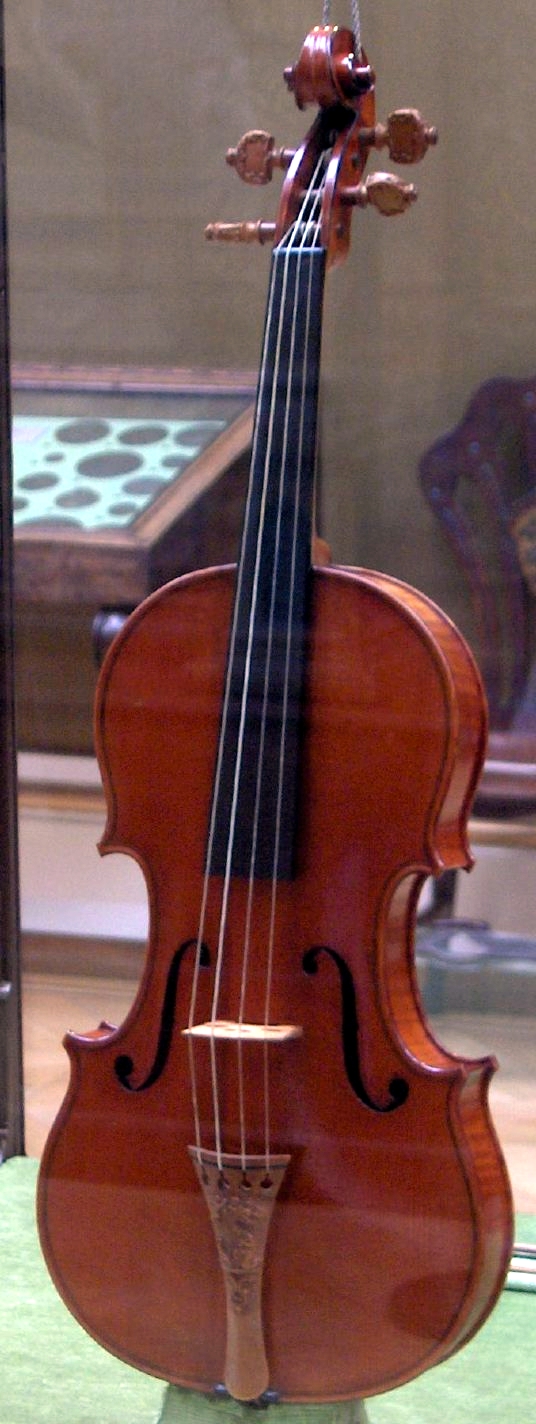
The violin on display at the Ashmolean Museum, Gallery 39, photographed in 2008. The file's own caption identifies it by name and gives the museum's inventory number, WA1940.112.
Ashmolean Museum, University of Oxford; photograph by Wikimedia contributor Pruneau · CC BY-SA 3.0| Artist | Antonio Stradivari |
|---|---|
| Date | 1716 |
| Medium | Spruce table, maple back, ribs and neck (fingerboard, pegs, bridge, tailpiece and bass bar later replaced), on Stradivari's own internal form, under oil varnish |
| Dimensions | Back length 35.6 cm; upper bout 16.75 cm; middle bout 10.83 cm; lower bout 20.8 cm; overall length approximately 59.3 cm as given by the Ashmolean Museum |
| Where it is now | Ashmolean Museum, University of Oxford, on display in Gallery 39 (Music and Tapestry)last confirmed 8 August 2026 |
| Inventory number | WA1940.112 |
| Attribution | AcceptedAccepted as an autograph Stradivari of 1716 following two rounds of dendrochronological testing. Full note |
| Object type | Musical instrument |
| Period | Italian, early eighteenth century (Cremonese school, Stradivari's 'Golden Period', c. 1700-1720) |
| Cases | Has a provenance gap |
| Inscriptions | Printed paper label inside, reading ANTONIUS STRADIUARIUS CREMONENSIS FACIEBAT ANNO 1716. A separate handwritten inscription, added by Jean-Baptiste Vuillaume, records his own understanding of how the violin reached him: 'achete par Tarisio au Ct Cozio de Salabue an 1827 ... Le Messie' (transcription per the Tarisio Cozio Archive; accents omitted here). |
| Owners on record | 15 links13 documented, 2 unknown |
| Sources | 30 cited |
About this record Last verified 8 August 2026 · 30 sources cited · Change log
On this page 10 sections
ContentsClose
The Messiah is a violin made by Antonio Stradivari in Cremona in 1716 and kept, by an unbroken sequence of owners who each chose not to use it, in something close to the condition it left his workshop in. It passed from Stradivari's own family to the collector Cozio di Salabue in 1775, to the dealer Luigi Tarisio in 1827, and after Tarisio's death in 1854 to Jean-Baptiste Vuillaume, the restorer and copyist whose dual skill made the violin's later authenticity dispute credible. It has been in the Ashmolean Museum, Oxford, since 1939, given by the Hill family on the condition that it never be played again.
Because it was so rarely played, doubt persisted for a century that Vuillaume, who both restored Stradivaris and made exact copies of them, had substituted or heavily altered the instrument. Two independent, peer-reviewed dendrochronological studies, published in 2000 and 2004, dated the wood to Stradivari's lifetime and neither corroborated nor was ever answered by the single contrary reading, presented at a 1998 conference and never published. That settles the timber. It does not settle Stewart Pollens's narrower, still unresolved question of whether Vuillaume's own account of acquiring the violin can be independently verified.
The Messiah has been sold once, privately, in 1890, for 2,600 pounds. Every other Stradivari to have made comparable or greater sums at market since, from the Lady Blunt to the Baron Knoop, has a documented history of being played. This one does not, by design, and that is the whole of its fame.
Provenance
Each link is graded. Documented: a cited source supports it. Disputed: the identification is argued but not established. Unknown: no owner for that span, and the gap is not smoothed into a narrative. The grades in the glossary.
- 1716 - 1737Antonio Stradivaridocumented
Made and labelled 1716; retained unsold in Stradivari's own workshop until his death in 1737, per the maker's label and the Hill firm's research into the workshop's later disposition.134
- 1737 - 1743Francesco Stradivaridocumented
Named in Antonio Stradivari's will as successor to the workshop, tools and unsold stock. Died 1743, unmarried and without heirs.4
- 1743 - 1775Paolo Stradivaridocumented
Inherited the workshop's remaining tools, patterns and unsold instruments, including this violin, on Francesco's death.4
- 1775 - 1827Count Ignazio Alessandro Cozio di Salabuedocumented
Bought the residue of the Stradivari workshop's tools, patterns and instruments from Paolo Stradivari in 1775, a year before Paolo's death. Cozio's own manuscript, the Carteggio, describes this specific violin in detail and values it at a minimum of 150 zecchini, quoted here at second hand via the Tarisio Cozio Archive's summary of Renzo Bacchetta's 1950 edition.3412
- 1827 - 1854Luigi Tarisiodocumented
Purchased from the Cozio estate in 1827, per Vuillaume's own later inscription inside the violin. Kept in Italy and almost never shown; Tarisio's habit of describing but not producing the violin to Parisian dealers, including Vuillaume, is the origin of its nickname. Tarisio died in Milan in 1854 and the violin was found among his effects.136
- 1854 - 1875Jean-Baptiste Vuillaumedocumented
Acquired with the rest of the Tarisio hoard shortly after Tarisio's death. Kept under lock and key; shown, so far as documented, only at the 1872 Special Exhibition of Ancient Musical Instruments at the South Kensington Museum (catalogue item 91). Replaced the bass bar, lengthened the neck, fitted a new Nativity-carved tailpiece, and added his own ownership inscription inside. Died 1875.123613
- 1875 - 1888Jean-Delphin Alarddocumented
Vuillaume's son-in-law and the violinist credited with the remark that gave the violin its name. Died 1888.16
- 1888 - 1890Alard's heirsdocumented
Held the violin briefly between Alard's death and its sale through W. E. Hill and Sons.36
- 1890 - 1897Robert Crawford, Edinburghdocumented
Bought via W. E. Hill and Sons in 1890 for 2,600 pounds, reported at the time as the largest sum ever paid for a single violin. Joseph Joachim wrote to Crawford in 1891 describing the violin's sound as sweet and grand.361
- 1897 - 1904Ernesto Nicoliniunknown
Given as the owner in this window by the Tarisio Cozio Archive's reconstructed chain. Not independently corroborated here; the well-known tenor of this name died in 1898, which sits awkwardly against the stated dates, so this identification is flagged rather than treated as settled.3
- 1904 - 1913W. E. Hill and Sonsdocumented
First of two later reacquisitions by the firm that eventually gave the violin to the Ashmolean.3
- 1913 - 1928Richard Bennettdocumented
Collector ownership, per the Tarisio Cozio Archive's reconstructed chain.3
- 1928 - 1931Unknownunknown
No owner is documented in the sources consulted for this three-year window between Richard Bennett's ownership and W. E. Hill and Sons' final repurchase.3
- 1931 - 1939W. E. Hill and Sonsdocumented
Second and final reacquisition by the firm, held until the gift to the Ashmolean.3
- 1939 - presentAshmolean Museum, University of Oxforddocumented
Given by Alfred and Arthur Hill in memory of their father, on the condition that it never be played again. Formally accessioned in 1940 as WA1940.112. Loaned briefly to the Museo del Violino in Cremona in 2016 for the tricentenary of its label date; otherwise permanently on display in Oxford.21822
Prices realised
| Date | Sale | Estimate | Result | Note |
|---|---|---|---|---|
| 1890 | W. E. Hill and Sons | Not applicable | Hammer GBP 2,600 With premium Not applicable; this was a private treaty sale brokered by a dealer, not a saleroom auction, so no separate hammer price and buyer's premium exist to distinguish. GBP | Sale by Delphin Alard's heirs, via W. E. Hill and Sons, to Robert Crawford of Edinburgh. Reported at the time as the largest sum ever paid for a single violin. This is the only documented market transaction in the violin's history; it has not been sold, at auction or otherwise, since 1904, and has not been a market object at all since the 1939 gift to the Ashmolean. |
Hammer is the price at which the bidding stopped; with premium adds the fee the house charges the buyer on top. Hammer price and buyer's premium in the glossary.
Technical evidence
| Attribution note | Accepted as an autograph Stradivari of 1716 following two rounds of dendrochronological testing. A challenge to the attribution, raised by then Metropolitan Museum conservator Stewart Pollens in 1999 and apparently supported by a dendrochronologist's reading of a growth ring dated 1738, one year after Stradivari's death, was answered by John Topham and Derek McCormick's direct, peer-reviewed examination of the violin, published in the Journal of Archaeological Science in 2000, which found a youngest ring of 1682. Henri Grissino-Mayer, Paul Sheppard and Malcolm Cleaveland's independent re-examination, published in the same journal in 2004, corroborated a pre-1737 date at a stated statistical confidence above 99.99 percent. The 1738 reading was presented at a 1998 conference but, so far as the sources consulted for this record show, was never defended in a peer-reviewed publication. Pollens's separate and narrower point, that Vuillaume's own account of acquiring the violin from Tarisio's estate cannot be independently corroborated beyond Vuillaume's own inscription and later trade testimony, is not something dendrochronology can settle, because it dates timber, not ownership, and it remains unresolved in the sources consulted. |
|---|---|
| Label | Printed paper label inside reading ANTONIUS STRADIUARIUS CREMONENSIS FACIEBAT ANNO 1716.3 |
| Table (belly) | Two-piece spruce, narrow center grain, the surface examined by dendrochronology (see below).36 |
| Back, ribs and neck | Two-piece maple back with irregular medium flame. Neck lengthened in the nineteenth century to modern standard, most likely by Vuillaume.361 |
| Varnish | Light orange-brown oil varnish, described by Cozio di Salabue in his own manuscript notes as a 'strong red varnish'; almost unworn, with the painted edge-work on the scroll intact.312 |
| Dimensions | Back length 35.6 cm; upper bout 16.75 cm; middle bout 10.83 cm; lower bout 20.8 cm; overall length approximately 59.3 cm per the Ashmolean Museum.32 |
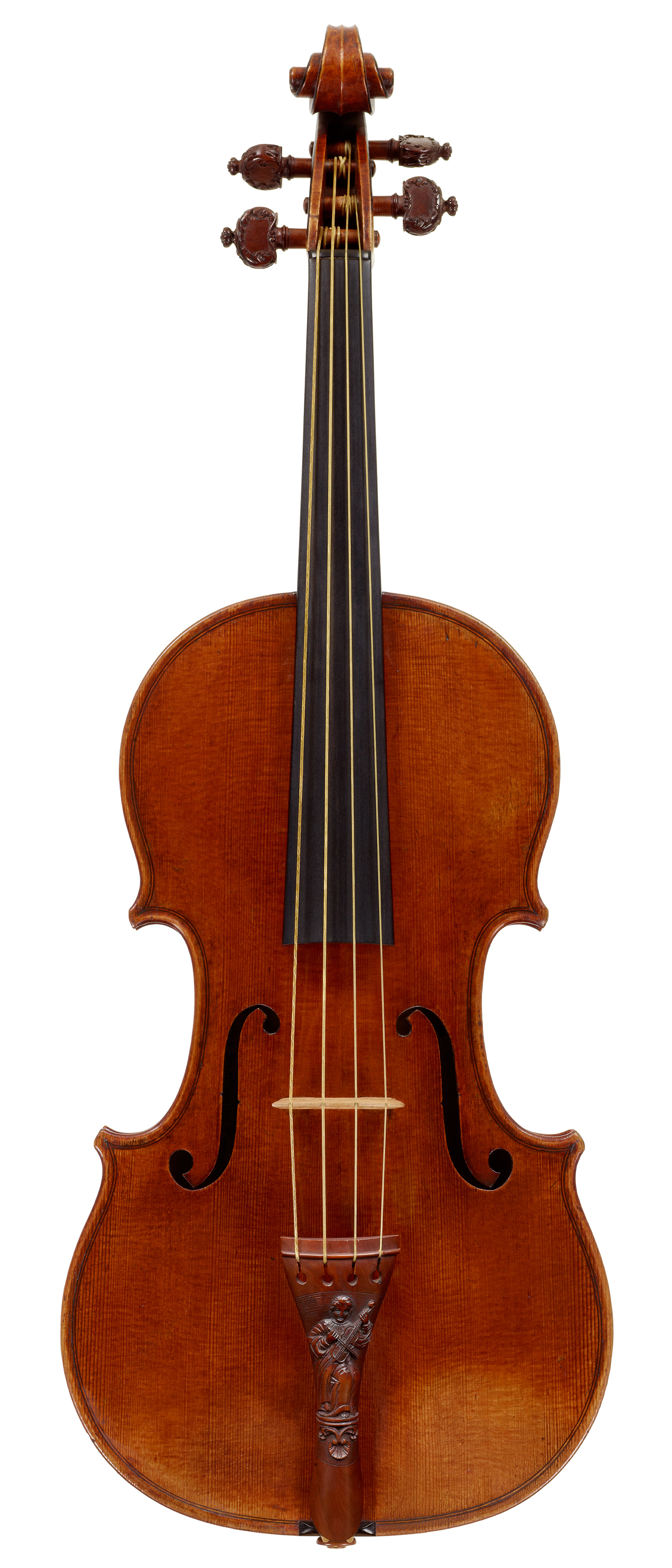
| Later replacements | Bass bar, bridge, tailpiece and pegs replaced, principally by Vuillaume; the replacement tailpiece is carved with a Nativity scene. The fingerboard has also been replaced. The condition is nonetheless judged the best preserved of any surviving Stradivari.129 |
| Dendrochronology (2000) | John Topham and Derek McCormick's direct examination identified a youngest growth ring of 1682, consistent with the 1716 label once seasoning and lost sapwood are allowed for. Published, peer-reviewed, in the Journal of Archaeological Science, volume 27 (2000), pages 183-192.783 |
| Dendrochronology (2004 re-examination) | Henri Grissino-Mayer, Paul Sheppard and Malcolm Cleaveland's independent re-examination, using a master chronology from sixteen high-Alpine sites, reported statistical confidence above 99.99 percent for a pre-1737 date, corroborating the 2000 result. Published in the Journal of Archaeological Science, volume 31 (2004), pages 167-174.73 |
| Disputed 1738 reading | Peter Klein's 1998 examination of photographs of the top proposed a youngest ring of 1738, one year after Stradivari's death. Presented at the 1998 Violin Society of America convention; not, so far as the sources consulted show, subsequently defended in a peer-reviewed publication.81 |
| Non-invasive imaging | CT-scanned and examined under blacklight in 2016 as part of a joint programme by the Museo del Violino's Arvedi Laboratory of Non-Invasive Diagnostics and Brandeis University's Digital Amati project. The full-resolution DICOM dataset is held under restricted access for qualified researchers rather than open publication.2223 |
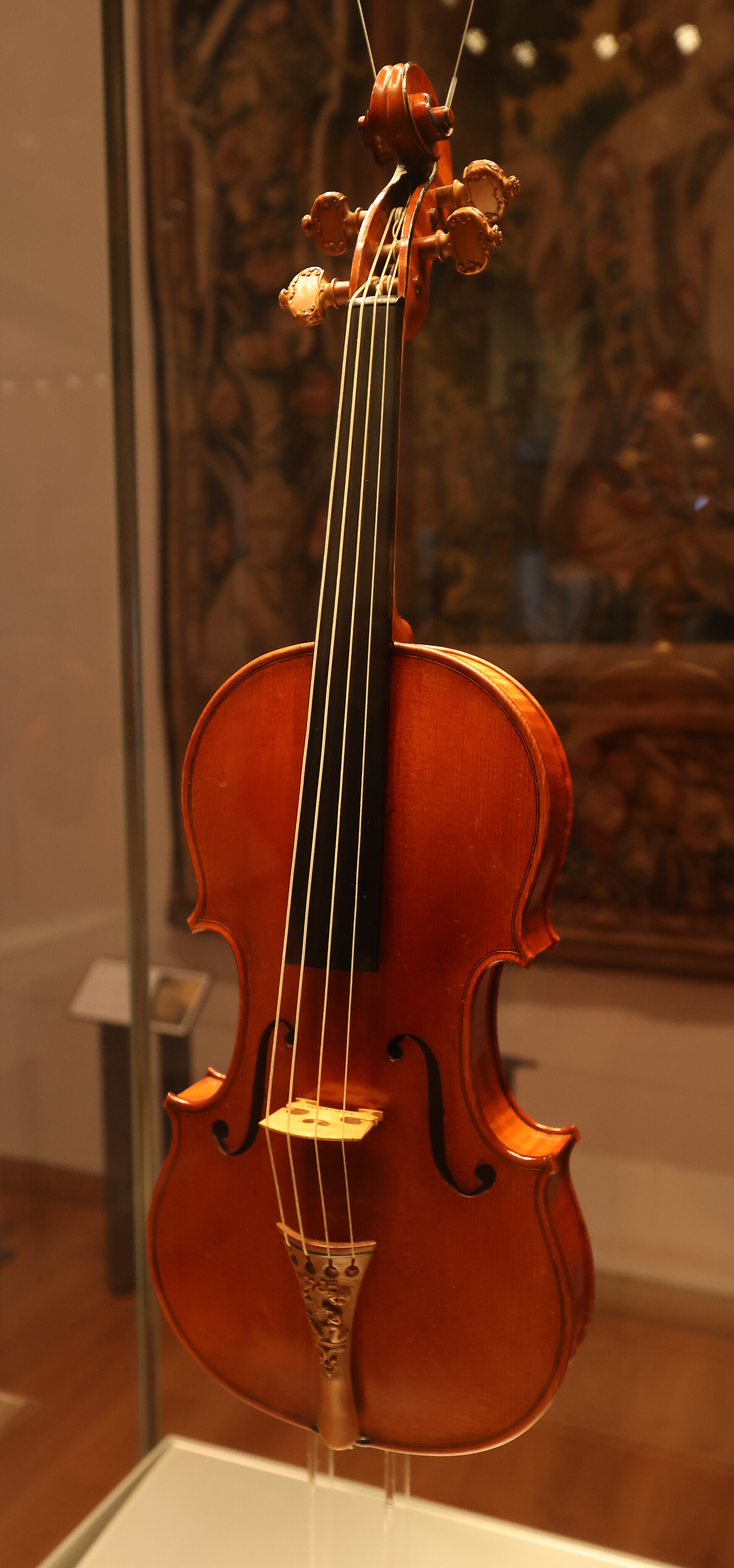
| Accession and display | Ashmolean Museum inventory WA1940.112, on display upright in a glass case in Gallery 39, Music and Tapestry.182 |
Images
The record in full
Chapter 1An object defined by what it has never done
The Messiah is a violin that has spent almost none of its three hundred and ten years being played.
The Messiah is a violin that has spent almost none of its three hundred and ten years being played. It was made by Antonio Stradivari in Cremona in 1716, kept in his own workshop until his death in 1737, passed intact through two more generations of his family, and has since moved through a short chain of collectors and dealers who, one after another, chose not to use it. The result is an instrument in something close to the condition it left the bench in: the orange-red varnish is almost unworn, the edge-work and purfling are crisp, and the corners and scroll show none of the rounding that comes from decades under a chin and shoulder.
Since 1939 it has belonged to the Ashmolean Museum in Oxford, given by the dealing family who owned it last on the explicit condition that it never be played again. It is now, by design, a violin that exists to be looked at rather than heard, which is also why it has spent more of its life disputed than any other instrument to carry Stradivari's name.
Chapter 2Stradivari's Golden Period, and why this violin matters to it
1716 falls inside what is conventionally called Stradivari's Golden Period, the two decades either side of 1710 in which his output is judged to have reached its fullest maturity of form, arching and...
1716 falls inside what is conventionally called Stradivari's Golden Period, the two decades either side of 1710 in which his output is judged to have reached its fullest maturity of form, arching and varnish. The Messiah is built on Stradivari's large violin pattern, the model he had settled on by this point in his career, and it survives with its original outline, arching and edge profile essentially undisturbed by later planing or re-varnishing, the fate of almost every other instrument from his hand that was actually put into a working musician's hands for a century or two.
That is the specific reason scholars value it beyond its sound: it is one of the very few surviving points of direct physical reference for what a Stradivari looked like when new, rather than as three hundred years of use and re-restoration have left it. The Ashmolean's own account of the instrument, and the violin trade's, both rest its reputation on this condition rather than on its tone.
Chapter 3The workshop years and the sale to Cozio di Salabue
Antonio Stradivari's will named his son Francesco as successor to the workshop, its tools, moulds, patterns and unsold stock.
Antonio Stradivari's will named his son Francesco as successor to the workshop, its tools, moulds, patterns and unsold stock. Francesco outlived his father by only six years, dying unmarried in 1743, and the workshop's remaining instruments, including the violin later called the Messiah and the 1715 violin later called the Alard, passed to his younger brother Paolo, a cloth merchant with no training as a maker. In 1775, a year before his own death, Paolo sold this entire residue of tools, drawings, correspondence and unsold instruments to Count Ignazio Alessandro Cozio di Salabue, a Piedmontese nobleman.
Cozio's rank formally barred him from trading instruments directly, so his purchases and later sales were generally handled through agents. His acquisition of the Stradivari workshop's own remaining stock, including ten Stradivari violins bought from Paolo across 1773 to 1775, is the founding transaction of modern Stradivari collecting: it is the point at which instruments that had simply been the maker's unsold inventory became collected, catalogued objects.
Chapter 4Cozio's own description
Cozio di Salabue is remembered as the first serious connoisseur-collector of violins, and the reason his name still carries weight is that he wrote things down.
Cozio di Salabue is remembered as the first serious connoisseur-collector of violins, and the reason his name still carries weight is that he wrote things down. His manuscript notebooks, later transcribed and published as the Carteggio, are the closest thing this instrument has to a contemporary inventory record. Cozio's own entry for the violin, as summarized in the Tarisio Cozio Archive's account of the Carteggio, describes it in terms that read like a dealer's condition report two and a half centuries early: a larger model, a round, beautiful and strong voice, a strong red varnish, a two-piece back with pronounced wide grain, and a valuation of at least 150 zecchini.
That figure is worth reading against Cozio's other valuations from the same hoard: he rated a 1727 Stradivari, later called the Paganini, at 130 zecchini, and a Carlo Bergonzi violin at 36 zecchini. Even inside his own private accounting, in other words, this was already the most highly valued violin he owned. This record quotes Cozio's words at second hand, through the Tarisio Cozio Archive's summary of Renzo Bacchetta's 1950 edition of the Carteggio; the original manuscript and Brandon Frazier's 2007 English translation have not been consulted directly.
Chapter 5Tarisio, and the origin of the name
The violin passed from the Cozio estate to Luigi Tarisio in 1827.
The violin passed from the Cozio estate to Luigi Tarisio in 1827. Tarisio was a dealer who travelled the Italian countryside buying up old instruments cheaply and reselling the best of them in Paris, and he kept this one back. He did not sell it and, by every account, barely showed it, but he talked about it to the Parisian dealers he did business with, among them Jean-Baptiste Vuillaume, for years.
The name comes directly from that habit. The violinist Jean-Delphin Alard, who would later become Vuillaume's son-in-law, is credited with the remark that gave the instrument its nickname: 'Really, Mister Tarisio, your violin is like the Messiah of the Jews: one always expects him but he never appears.' Tarisio died in Milan in 1854. The violin was found among his effects, essentially unseen outside Italy for the whole of his ownership.
Chapter 6Vuillaume: the one man positioned to both save it and fake it
Jean-Baptiste Vuillaume (1798-1875) was, by the scale of his workshop's output alone, the single most influential figure in nineteenth-century violin making; his shop produced more than three...
Jean-Baptiste Vuillaume (1798-1875) was, by the scale of his workshop's output alone, the single most influential figure in nineteenth-century violin making; his shop produced more than three thousand instruments. Two things about his career matter directly to this violin. He was an outstanding restorer, routinely fitting older instruments with new necks, bass bars and fittings to bring them up to modern playing standard. And he was, separately, a maker of exceptionally accurate copies of famous instruments, closely measuring originals and reproducing them well enough that Paganini himself is said to have been unable to tell one of Vuillaume's copies of his own Guarneri 'del Gesu' from the original by sight alone.
Vuillaume travelled to secure the Tarisio hoard after the dealer's 1854 death and the Messiah came to him with it. He kept it under lock and key, in a glass case, and appears to have shown it publicly only once, at the 1872 Special Exhibition of Ancient Musical Instruments at the South Kensington Museum, catalogued as item 91. He also altered it: he replaced the bass bar, lengthened the neck to the modern standard, fitted a new tailpiece carved with a Nativity scene, and added his own handwritten note inside recording how he understood he had acquired it. It is exactly this combination, master restorer and master forger of the same maker's work, owning the one Stradivari nobody else had properly examined in decades, that made the authenticity question impossible to dismiss once it was raised.
Chapter 7From Alard to the Hills
On Vuillaume's death the violin went to his son-in-law, the violinist Delphin Alard.
On Vuillaume's death the violin went to his son-in-law, the violinist Delphin Alard. After Alard's death in 1888 his heirs sold it through the London dealing firm W. E. Hill and Sons in 1890, for 2,600 pounds, to Robert Crawford of Edinburgh, at the time the largest sum on record for a single violin. The Tarisio Cozio Archive's reconstruction of the chain records further changes of hands after Crawford, an owner given as Ernesto Nicolini between 1897 and 1904, a Hill reacquisition from 1904 to 1913, ownership by the collector Richard Bennett from 1913, and a final Hill repurchase that held the violin from 1931 until the 1939 gift to the Ashmolean.
Two gaps in that later chain are worth stating plainly rather than smoothing over. The sources consulted give no account of who held the violin between roughly 1928 and 1931, and the identification of the 1897-1904 owner as 'Ernesto Nicolini' has not been independently corroborated here against the well-known tenor of that name, whose death in 1898 would sit awkwardly inside the stated ownership window.
Chapter 8A yardstick, not an instrument: the gift to the Ashmolean
Alfred and Arthur Hill gave the violin to the Ashmolean Museum in memory of their father in 1939; it was formally accessioned the following year, which is why its inventory number, WA1940.112...
Alfred and Arthur Hill gave the violin to the Ashmolean Museum in memory of their father in 1939; it was formally accessioned the following year, which is why its inventory number, WA1940.112, carries the later date. The stated purpose of the gift, repeated across the museum's own materials and the secondary literature, was to preserve the instrument as a permanent reference standard, 'a yardstick for future violin makers to learn from', rather than to keep it in circulation as a concert instrument. The condition attached to the gift was that it never be played again.
The last people documented to have played or heard it before that condition took hold are the violinist Joseph Joachim, who wrote to the then owner Robert Crawford in 1891 that he was 'struck by the combined sweetness and grandeur of the sound', and Nathan Milstein, who described playing it at the Hills' shop before 1940 as unforgettable in his own memoirs. Since the gift, display itself has been cautious: by several secondary accounts the violin was not placed on unrestricted public view until 2009, and its current glass display case, made by the conservation specialists Goppion for the Ashmolean's Music and Tapestry gallery, dates from the mid-2010s redisplay of that gallery.
Chapter 9The challenge: Stewart Pollens and the 1738 ring
The authenticity of the Messiah was formally challenged in print in 1999, in an article titled 'Le Messie' by Stewart Pollens, then Conservator of Musical Instruments at the Metropolitan Museum of...
The authenticity of the Messiah was formally challenged in print in 1999, in an article titled 'Le Messie' by Stewart Pollens, then Conservator of Musical Instruments at the Metropolitan Museum of Art and the author of a standard study of Stradivari's working forms. Pollens's argument was not a single claim but a set of them: that Vuillaume's own paper trail for how he acquired the instrument could not be independently verified beyond Vuillaume's own word, that Vuillaume was demonstrably capable of producing a copy good enough to pass for the original, and that specific details of the violin's construction, including its f-holes and rib structure, struck him as inconsistent with secure Stradivari work.
At Pollens's instigation, the German dendrochronologist Peter Klein examined photographs of the violin's top and reported, at the Violin Society of America's 1998 convention, a youngest identifiable growth ring at around 1738, a year after Stradivari's death. If correct, that reading would make Stradivari's authorship physically impossible, since a violin cannot be built from wood that had not yet grown. The claim, credibly sourced and presented by a specialist, is what turned a connoisseurship dispute into a scientific one.
Chapter 10Topham, McCormick, and the 1682 ring
John Topham, a violin maker with a specialism in dendrochronology, and Derek McCormick examined the instrument directly rather than from photographs, measuring the growth-ring sequence on the table...
John Topham, a violin maker with a specialism in dendrochronology, and Derek McCormick examined the instrument directly rather than from photographs, measuring the growth-ring sequence on the table itself and cross-matching it against a reference chronology built from Alpine spruce. They identified a youngest ring at 1682, a date consistent with the 1716 label once the normal allowance for lost sapwood and a seasoning period before construction is made, and found a close match between the Messiah's ring pattern and that of other securely attributed Stradivari instruments of the same years. Their findings were published, peer-reviewed, in the Journal of Archaeological Science in 2000, under the title 'A Dendrochronological Investigation of Stringed Instruments of the Cremonese School (1666-1757) including the Messiah violin attributed to Antonio Stradivari'.
Klein's 1738 reading, by contrast, had been generated from photographs rather than direct examination, and when the violin trade arranged for him to re-measure the rings on the instrument itself at the Ashmolean, a dispute over access to his own measurements from that session followed and Klein did not go on to publish a peer-reviewed defence of his original date. So far as the sources consulted for this record show, the 1738 reading exists in the record only as a conference presentation and press coverage of it, not as a published, reviewed paper.
Chapter 11A second, independent test
In 2004 a separate American team, Henri Grissino-Mayer, Paul Sheppard and Malcolm Cleaveland, published their own re-examination of the Messiah's wood in the same journal, using a newly built master...
In 2004 a separate American team, Henri Grissino-Mayer, Paul Sheppard and Malcolm Cleaveland, published their own re-examination of the Messiah's wood in the same journal, using a newly built master chronology drawn from sixteen high-Alpine sites across five countries. They reported statistical confidence levels above 99.99 percent for their dating, describing the odds of such a match occurring by chance as roughly one in ten thousand, and their results corroborated a pre-1737 date for the timber, broadly in line with Topham and McCormick's earlier finding. A further joint paper in 2010, co-authored by Grissino-Mayer's team together with Topham himself, addressed the methodological question of dendrochronological misdating directly, under the title 'Adverse implications of misdating in dendrochronology: Addressing the re-dating of the Messiah violin'.
Two independently conducted, peer-reviewed dendrochronological studies therefore support a date for the wood consistent with Stradivari's lifetime, and no peer-reviewed study supports Klein's 1738 reading. That is a real scientific resolution of the specific question dendrochronology can answer: when the tree was felled. It is not, on its own, a resolution of Pollens's separate and narrower point about whether Vuillaume's account of how the violin passed from Tarisio's estate into his own hands is independently verifiable. Wood dating cannot settle a question about custody, and this record treats that distinction as the honest state of the dispute rather than smoothing it into a single verdict.
Chapter 122016: the tricentenary and the CT scan
In 2016, marking three hundred years since the date on its label, the Ashmolean lent the violin to the Museo del Violino in Cremona, the city where it was made, for a temporary exhibition and a...
In 2016, marking three hundred years since the date on its label, the Ashmolean lent the violin to the Museo del Violino in Cremona, the city where it was made, for a temporary exhibition and a dedicated Study Day held on 9 October 2016. Speakers included the violin historians Carlo Chiesa and John Dilworth, the conservator Brigitte Brandmair, and John Topham himself, covering construction, dendrochronology, X-radiography and varnish. Around the same visit the instrument was examined non-invasively under blacklight and by CT scanning, part of a wider imaging programme run jointly by the Museo del Violino's Arvedi Laboratory of Non-Invasive Diagnostics and Brandeis University's Digital Amati project, which holds a full-resolution CT dataset of the violin under restricted access for qualified researchers rather than open publication.
Gregg T. Alf, a violin maker who helped curate the Cremona exhibition, has written that close examination under blacklight left him estimating, informally, that the violin has been played for perhaps a single year in total across its entire existence, enough, in his words, 'to prove it had lived, not enough to disturb its beauty'. That figure is an individual maker's impression rather than a measured finding, and this record reports it as such.
Chapter 13What the money meant, and what comparable violins have made since
The Messiah has never been sold at public auction.
The Messiah has never been sold at public auction. Its only documented market transaction is the private sale brokered by W. E. Hill and Sons in 1890, at 2,600 pounds, to Robert Crawford, a figure reported at the time as the largest sum ever paid for a single violin. No hammer price or buyer's premium applies to that sale, since it was a private treaty transaction handled by a dealer rather than a saleroom lot. From 1904 onward the violin moved by dealer repurchase and eventual gift rather than by any further sale, and it has not been a market object of any kind since 1939.
For scale, later Stradivari and Guarneri violins that have actually come to market carry very different histories of use. The 'Lady Blunt' Stradivari of 1721 made 9,808,000 pounds, reported as roughly 15.9 million US dollars, at a Tarisio sale in 2011 whose entire proceeds were donated to relief efforts after that year's Japanese earthquake and tsunami; the sources consulted report this as a single sale figure rather than a hammer price with a separately stated premium. The 'Vieuxtemps' Guarneri 'del Gesu' of 1741, a different maker's instrument included here only for market scale, changed hands privately for around 16 million US dollars in 2013. The 'Molitor' Stradivari of 1697 made 3.6 million US dollars in 2010, the 'da Vinci, ex-Seidel' Stradivari of 1714 made about 15.34 million US dollars in 2022, the 'Joachim-Ma' Stradivari of 1714 made 11.3 million US dollars in February 2025, and the 'Baron Knoop' Stradivari of 1715 has been reported at 23 million US dollars, the highest figure yet reported for any violin. Every one of those instruments, unlike the Messiah, carries a documented history of being played in public.
Chapter 14What is still unresolved
Four specific gaps survive in the material gathered for this record.
Four specific gaps survive in the material gathered for this record. The precise circumstances of Paolo Stradivari's 1775 sale to Cozio di Salabue, made a year before Paolo's own death, are not spelled out in the sources consulted beyond the fact and date of the transaction. Ownership between roughly 1928 and 1931 is not accounted for. The identity of the owner recorded as 'Ernesto Nicolini' between 1897 and 1904 has not been independently confirmed. And Peter Klein's original 1738 dendrochronological reading appears to survive only in conference and press form, never as a peer-reviewed publication defending it against Topham and McCormick's contrary result.
None of those four gaps touches the peer-reviewed wood-dating evidence that now anchors the attribution. What remains genuinely open is narrower and more specific than the popular framing of 'is it real': whether Vuillaume's own account of acquiring the violin from Tarisio's estate can ever be corroborated by anything beyond Vuillaume's own hand.
The artist
Antonio Stradivari
Antonio Stradivari worked in Cremona for roughly seven decades and is generally reckoned to have made over a thousand instruments, of which around six hundred and fifty are thought to survive. The Messiah occupies an unusual place in that output: because it was withdrawn from use almost immediately and has stayed withdrawn ever since, it is one of the few instruments that shows what the others looked like before three centuries of playing, repair and re-varnishing intervened.
Related works
| Work | Relation | Where it is |
|---|---|---|
| Le Messie, copy of 1860 Jean-Baptiste Vuillaume | An exact-dimension copy of this violin, made by its own former owner while he still had the original in his workshop Direct physical evidence of the skill that made doubts about the original's authenticity credible in the first place. This is a copy, not the object described in this record. | Private collection; documented via Wikimedia Commons |
| Lady Blunt Stradivarius Antonio Stradivari | Comparandum: a similarly famous, similarly well-preserved Stradivari that has been sold at auction and, unlike the Messiah, played Made 9,808,000 pounds (about 15.9 million US dollars) at a 2011 Tarisio sale for Japanese earthquake relief. | Private collection since 2011 |
| The Tuscan, viola Antonio Stradivari | Another Stradivari instrument from the same maker's hand, paired with the Messiah in the Hill firm's own scholarship (W. E. Hill and Sons, 'The Tuscan and Le Messie', 1976) Covered separately on this site; a different instrument, made for a different commission, and not to be confused with the Messiah. | Library of Congress, Washington DC |
| Cremonese, 1715 Antonio Stradivari | Cited by researchers as a comparison instrument for the Messiah's construction and thickness graduations Named alongside the Betts (1704) and the Messiah itself as reference points for Golden Period construction. | Various citations in the literature; not independently verified for this record |
| Archinto Antonio Stradivari | Co-dated alongside the Messiah in Grissino-Mayer, Sheppard and Cleaveland's 2004 dendrochronological study Labelled 1696; one of two other instruments successfully dated in the same paper. | Not established in the sources consulted for this record |
| Kux, later Castelbarco Antonio Stradivari | Co-dated alongside the Messiah in the same 2004 study Labelled circa 1720; the second of the two comparison instruments in that paper. | Not established in the sources consulted for this record |
Open questions
- What were the exact circumstances of Paolo Stradivari's 1775 sale to Cozio di Salabue, made a year before Paolo's own death? The sources consulted give the fact and date but not the transaction itself.
- Who held the violin between roughly 1928 and 1931? The Tarisio Cozio Archive's reconstructed chain shows Richard Bennett's ownership beginning in 1913 and W. E. Hill and Sons' final custody beginning in 1931, with no account of the intervening years.
- Is the owner recorded between 1897 and 1904 correctly identified as 'Ernesto Nicolini'? The well-known tenor of that name died in 1898, which sits awkwardly against the stated window, and this record has not independently resolved the discrepancy.
- Was Peter Klein's 1738 dendrochronological reading ever published in a peer-reviewed venue? The sources consulted trace it only to a 1998 conference presentation and press coverage, never to a journal article defending it against Topham and McCormick's contrary, published result.
- Can Vuillaume's own account of acquiring the violin from Tarisio's estate in 1854-1855 be corroborated by any document independent of Vuillaume's own inscription and later trade testimony? This is the specific, narrower question that Stewart Pollens raised and that dendrochronology, which dates wood rather than ownership, cannot resolve.
- Does a surviving written deed record the exact wording of the 1939 condition that the violin never be played? Every source consulted describes the restriction consistently but none was found to quote the original gift instrument verbatim.
- Was the Messiah in fact heard, anonymously, at the 1862 London International Exhibition, as one secondary account suggests? This claim is not corroborated by the better-documented 1872 South Kensington Special Exhibition appearance and is treated here as unverified.
Questions about this object
What is The Messiah?
The Messiah is a musical instrument, dated 1716. Medium: Spruce table, maple back, ribs and neck (fingerboard, pegs, bridge, tailpiece and bass bar later replaced), on Stradivari's own internal form, under oil varnish.
Who made The Messiah, and is the attribution settled?
The attribution to Antonio Stradivari is recorded here as accepted. Accepted as an autograph Stradivari of 1716 following two rounds of dendrochronological testing. A challenge to the attribution, raised by then Metropolitan Museum conservator Stewart Pollens in 1999 and apparently supported by a dendrochronologist's reading of a growth ring dated 1738, one year after Stradivari's death, was answered by John Topham and Derek McCormick's direct, peer-reviewed examination of the violin, published in the Journal of Archaeological Science in 2000, which found a youngest ring of 1682. Henri Grissino-Mayer, Paul Sheppard and Malcolm Cleaveland's independent re-examination, published in the same journal in 2004, corroborated a pre-1737 date at a stated statistical confidence above 99.99 percent. The 1738 reading was presented at a 1998 conference but, so far as the sources consulted for this record show, was never defended in a peer-reviewed publication. Pollens's separate and narrower point, that Vuillaume's own account of acquiring the violin from Tarisio's estate cannot be independently corroborated beyond Vuillaume's own inscription and later trade testimony, is not something dendrochronology can settle, because it dates timber, not ownership, and it remains unresolved in the sources consulted.
Where is The Messiah now?
Ashmolean Museum, University of Oxford, on display in Gallery 39 (Music and Tapestry). Inventory number WA1940.112. Last confirmed 8 August 2026. Gift of Alfred and Arthur Hill, of the London dealing firm W. E. Hill and Sons, in memory of their father William Ebsworth Hill. The gift was made in 1939 and the violin was formally accessioned into the Ashmolean's registers in 1940, which is why its own inventory number carries the later year.
What has The Messiah sold for?
Hammer GBP 2,600; with premium, Not applicable; this was a private treaty sale brokered by a dealer, not a saleroom auction, so no separate hammer price and buyer's premium exist to distinguish. W. E. Hill and Sons, 1890.
What is still unknown about The Messiah?
What were the exact circumstances of Paolo Stradivari's 1775 sale to Cozio di Salabue, made a year before Paolo's own death? The sources consulted give the fact and date but not the transaction itself.
Sources
- 1Wikipedia, 'Messiah Stradivarius'. Tertiary source; flagged for replacement with the Hill firm's own monographs and the peer-reviewed dendrochronology papers cited below. en.wikipedia.org/wiki/...
- 2Ashmolean Museum, 'Messiah Violin, by Stradivari'. ashmolean.org/messiah-violin-stradivari
- 3Tarisio Cozio Archive, 'Antonio Stradivari, Violin, Cremona, 1716, the Messiah, Messie, Salabue'. tarisio.com/cozio-archive/...
- 4Tarisio Cozio Archive, 'Stradivari and his sons, part 1'. tarisio.com/cozio-archive/...
- 5Tarisio Cozio Archive, 'A Messianic connection' (on the Ex-Wilhelmj violin's shared wood source with the Messiah). tarisio.com/cozio-archive/...
- 6Violins and Violinists, 'Messiah Complex: The Riddle of the Most Perfect Stradivarius Violin'. violinsandviolinists.com/stradivaris-fabled-messiah-three...
- 7Soundpost Online, 'Dendochronology and the Messiah Stradivarius'. soundpostonline.com/dendochronology-and-the-messiah-strad...
- 8Soundpost Online, 'Tree Ring Circus: The Messiah Controversy Rages On'. soundpostonline.com/tree-ring-circus
- 9The Nature of Music, 'The curious case of the violin in a cage'. the-nature-of-music.com/2022/...
- 10Stradivarius.org, 'A True Miracle - The Messiah Stradivarius'. stradivarius.org/messiah-stradivarius
- 11Euromanticism.org, 'The Messiah Violin'. euromanticism.org/the-messiah-violin
- 12Wikipedia, 'Ignazio Alessandro Cozio di Salabue'. en.wikipedia.org/wiki/...
- 13Wikipedia, 'Jean-Baptiste Vuillaume', consulted via search summary. en.wikipedia.org/wiki/...
- 14The Messiah Violin (themessiahviolin.uk), 'Bibliographic Sources', the published bibliography behind John Dilworth's research on the instrument, used here to confirm exact journal citations. themessiahviolin.uk/book/...
- 15Topham, J. and McCormick, D., 'A Dendrochronological Investigation of Stringed Instruments of the Cremonese School (1666-1757) including the Messiah violin attributed to Antonio Stradivari', Journal of Archaeological Science, volume 27 (2000), pages 183-192. Citation confirmed via source 14; findings as reported in sources 6, 7 and 8, the paper itself not read in full. sciencedirect.com/science/...
- 16Grissino-Mayer, H. D., Sheppard, P. R. and Cleaveland, M. K., 'A dendrochronological re-examination of the Messiah violin and other instruments attributed to Antonio Stradivari', Journal of Archaeological Science, volume 31 (2004), pages 167-174. Citation confirmed via source 14; findings as reported in source 7, the paper itself not read in full. sciencedirect.com/science/...
- 17Grissino-Mayer, H. D., Sheppard, P. R., Cleaveland, M. K., Cherubini, P., Ratcliff, P. and Topham, J., 'Adverse implications of misdating in dendrochronology: Addressing the re-dating of the Messiah violin', Dendrochronologia, volume 28, issue 3 (2010), pages 149-159. Citation confirmed via source 14; the paper itself not read in full. sciencedirect.com/science/...
- 18Wikimedia Commons, File:Messiah Stradivarius.jpg, file description page including licence and the museum's own inventory number. commons.wikimedia.org/wiki/...
- 19Wikimedia Commons, File:Messiah Stradivarius ashmolean.JPG, file description page. commons.wikimedia.org/wiki/...
- 20Wikimedia Commons, File:J.B.Vuillaume 1860 back 'Le Messie' Stradivarius copy.jpg, file description page. commons.wikimedia.org/wiki/...
- 21Wikimedia Commons, File:Lady Blunt top.jpg, file description page. commons.wikimedia.org/wiki/...
- 22Museo del Violino, 'The Homecoming to Cremona of the violin Messie - Study Day'. museodelviolino.org/en/...
- 23Alf Studios (Gregg T. Alf), 'Rethinking Antiquing in Contemporary Violin Making, Part 2'. alfstudios.com/news/...
- 24Stewart Pollens, biography page, on his tenure as Conservator of Musical Instruments at the Metropolitan Museum of Art (1976-2006) and his publications on Stradivari. stewartpollens.com/bio
- 25Tarisio, 'Lady Blunt Stradivarius of 1721', notable sales page. tarisio.com/auctions/...
- 26CBS News, 'Stradivarius sold for nearly $16M to aid Japan'. cbsnews.com/news/...
- 27The Strad, 'Record breaker: Baron Knoop Stradivari violin sells for $23 million'. thestrad.com/news/...
- 28George Eliot, 'Stradivarius' (1873/1878), full text. georgeeliotarchive.org/items/...
- 29Pollens, S., 'Le Messie', Journal of the Violin Society of America, volume XVI, no. 1 (1999), pages 77-101; and 'Messiah Redux' and 'The Messie: A Panel Discussion', Journal of the Violin Society of America, volume XVII, no. 3 (2000), pages 159-179 and 181-222. Citations confirmed via source 14; the articles themselves not read in full, their arguments as reported in sources 6, 8 and general search summaries. themessiahviolin.uk/book/...
- 30Count Cozio di Salabue, Carteggio, transcribed and edited by Renzo Bacchetta (Antonio Cordani, Milan, 1950). Cited at second hand via source 3's summary of the manuscript; the original edition and Brandon Frazier's 2007 English translation not consulted directly. tarisio.com/cozio-archive/...


Last verified 8 August 2026 · Published 8 August 2026
Change log
8 August 2026 - Record created at the house standard: researched narrative, technical evidence, maker dossier, graded provenance chain, prices with hammer and premium separated, related works, open questions and sources.