"Gould" Violin
Antonio Stradivari · 1693
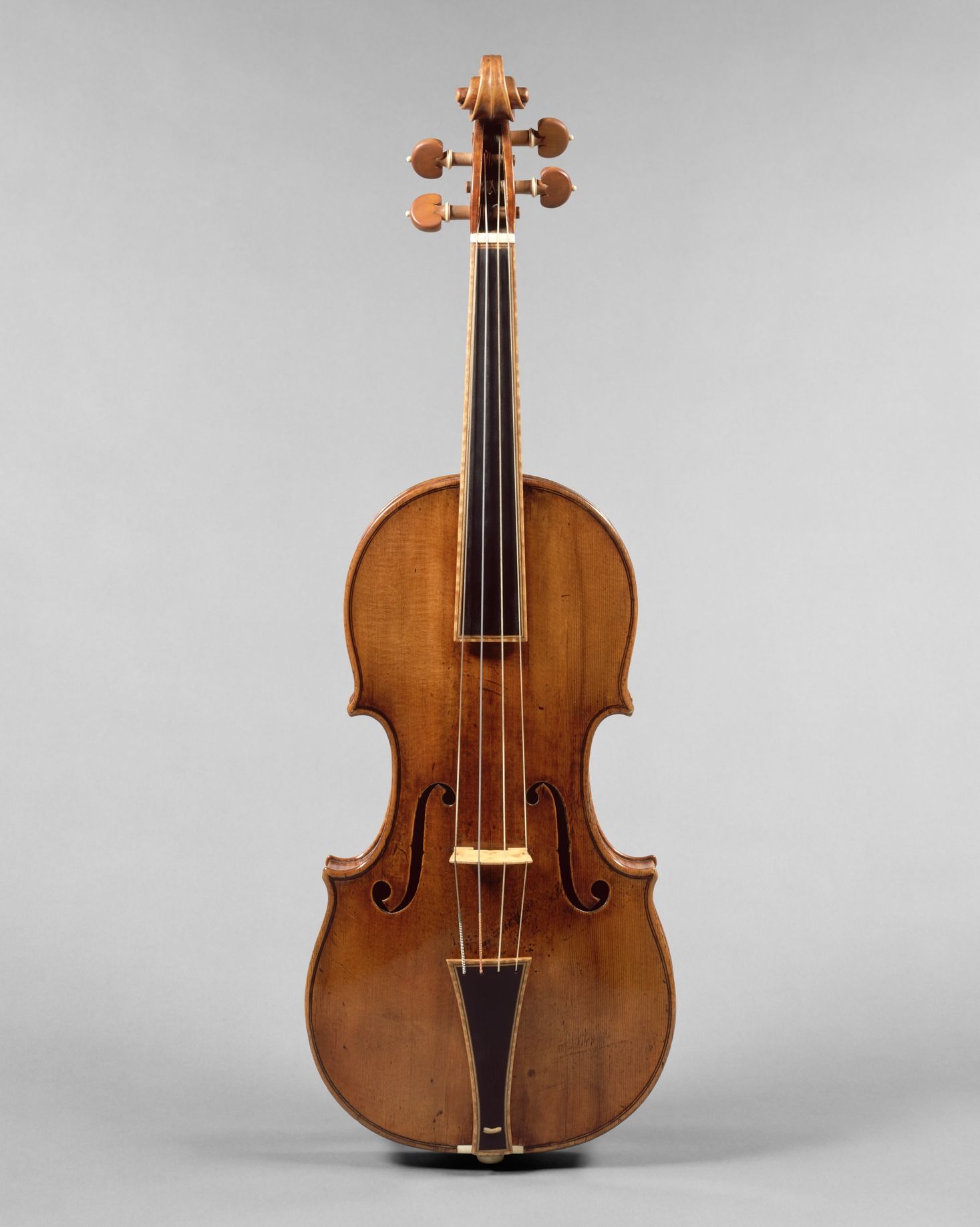
Antonio Stradivari, the "Gould" violin, Cremona, 1693. Maple, spruce and ebony. Gift of George Gould, 1955; Metropolitan Museum of Art, accession 55.86a-c. The Museum's own CC0 photograph of the object.
| Artist | Antonio Stradivari |
|---|---|
| Date | 1693 |
| Medium | Maple, spruce, ebony |
| Dimensions | Height 59 cm (23 1/4 in); width 19.7 cm (7 3/4 in), as given by the Metropolitan Museum of Art. Tarisio Cozio Archive: length of back 36.3 cm; bouts upper 16.1, middle 11.1, lower 20.1 cm. |
| Where it is now | The Metropolitan Museum of Art, New York, Department of Musical Instruments (Gallery 199 in the Museum's current open-access data)last confirmed |
| Inventory number | 55.86a-c (Met object ID 503045) |
| Attribution | AcceptedAttributed to Antonio Stradivari by the Metropolitan Museum of Art and listed under his name in the Tarisio Cozio Archive. Full note |
| Object type | Musical instrument |
| Period | Italian, late seventeenth century (Stradivari's long pattern years, 1690s) |
| Cases | Has a provenance gap |
| Inscriptions | Label pasted inside the body: Antonius Stradivarius Cremonensis / Faciebat Anno 1693 (Met object page, Signatures, Inscriptions and Markings). Two dealers' certificates survive with the violin: Albert Caressa, 25 April 1928, and Hermann, 20 March 1942. |
| Owners on record | 13 links10 documented, 2 disputed, 1 unknown |
| Sources | 17 cited |
About this record Last verified · 17 sources cited · Change log
On this page 8 sections
ContentsClose
A long-pattern violin made by Antonio Stradivari at Cremona in 1693 and given to the Metropolitan Museum of Art in 1955 by George Gould, for whom the Museum named it. In 1975 the luthier Frederick J. Lindeman of Amsterdam returned it to a Baroque setup, and the Museum describes it as the only Stradivari violin so restored and regularly used for period repertoire.
The Museum's provenance runs from a Marquis de Villers about 1820 through the French violinist Charles Dancla (1850), the collector Louis Labitte (1880), the Reverend Albert Willan (1897), the conductor Emil Mlynarski (1900), the Paris dealers Caressa and Francais (1902), the Allgemeine Musikgesellschaft of Basel (1903), Fridolin Hamma (1918, on Emil Herrmann's authority) and Albert Caressa (1926) to Gould in 1928. The earliest link is disputed, the Museum's two texts differ on the Basel years, and no price, insurance value or auction result is published. This is not the Antonius, the Francesca or the other Dancla violins of the Cozio Archive.
Provenance
Each link is graded. Documented: a cited source supports it. Disputed: the identification is argued but not established. Unknown: no owner for that span, and the gap is not smoothed into a narrative. The grades in the glossary.
- 1693 -Antonio Stradivari, Cremonadocumented
Dated 1693 by the Met catalogue and the Cozio Archive, and by a label pasted inside the body. Made in the long-pattern years; the attribution is the Museum's standing identification.127
- 1693 - c. 1820Unknownunknown
No owner is recorded for roughly 127 years.3
- c. 1820 -Marquis de Villers (seemingly Joseph-Marie David Hotman, 1754-1833)disputed
Earliest owner on the Met object page and in the essay, which says the title holder was 'seemingly' Hotman. Cozio carries Emil Herrmann's note identifying the violin as the 1691 ex-Villares (ID 1450), which conflicts on date and spelling and has not been reconciled.237
- c. 1850 -Charles Dancla (1817-1907), Parisdocumented
Bought about 1850 per the Met; the Museum rests its chain on the Caressa certificate and the Herrmann papers, not seen. Cozio names the violin 'Dancla, 43059'. The end of his ownership is not given.23715
- 1880 -Monsieur Louis Labitte, Reimsdocumented
The object page says Monsieur Louis Labitte; the essay says the celebrated amateur M. Labitte of Reims, who may have been Louis Labitte, a collector of musical manuscripts. How it passed from Dancla is not recorded.23
- 1897 - c. 1900Rev. Albert Willan (1842-1914), Copmanthorpe, Yorkdocumented
- c. 1900 - 1902Emil Szymon Mlynarskidocumented
Polish violinist, composer and conductor, to whom Willan sold it; dated 1900 on the object page. How and when he parted with it is not recorded.2316
- 1902 -Caressa and Francais, Paris (dealers)documented
Listed as a dealer link on the object page. Not mentioned in the essay.2
- 1903 - 1918 or 1928Allgemeine Musikgesellschaft, Baseldisputed
The object page dates the society to 1903 and follows it with Hamma (1918); the essay says the society held it by 1918 and used it until 1928. The two Museum texts do not agree and nothing independent was found.23
- 1918 -Fridolin Hamma (dealer)documented
Listed in square brackets as a dealer, 'acc. to Emil Hermann' (Herrmann): the date rests on Herrmann's notes, which were not seen. Whether he is the Stuttgart maker of that name is not stated.25
- 1926 -Albert Caressa, Paris (dealer)documented
Listed as a dealer on the object page; the Caressa certificate of 25 April 1928 survives with the violin.23
- 1928 - 1955George Gould of Bostondocumented
Sold by the Caressa firm in 1928 (essay); owner 1928-1955 (object page). No price is published. His identity beyond 'of Boston' is unknown; he cannot be the railroad financier George Jay Gould I, who died in 1923.2317
- 1955 - presentThe Metropolitan Museum of Art, New Yorkdocumented
Gift of George Gould, 1955, accession 55.86a-c. Wikipedia says bequest; the credit line says gift.123
Technical evidence
| Attribution note | Attributed to Antonio Stradivari by the Metropolitan Museum of Art and listed under his name in the Tarisio Cozio Archive. A paper label pasted inside the body reads 'Antonius Stradivarius Cremonensis Faciebat Anno 1693' (Met object page); a label is not proof of hand. No new technical study of the attribution was found, so it rests on the catalogue identification and the ownership chain, and the Cremona workshop included his sons, so the maker's own hand alone is not separately documented. |
|---|---|
| Maker, place and date | Antonio Stradivari, Cremona, 1693.1 |
| Accession | 55.86a-c; Met object ID 503045; Wikidata Q29385588; Tarisio Cozio Archive property 43059, named there "Dancla, 43059".1137 |
| Materials | Maple, spruce, ebony (Met). Two-piece maple back with tight flame, two-piece spruce top, orange-brown varnish (Met, Perspectives and object page).132 |
| Label | Paper label pasted inside the body: Antonius Stradivarius Cremonensis Faciebat Anno 1693.2 |
| Dimensions (Met) | Overall height 59 cm (23 1/4 in); width 19.7 cm (7 3/4 in). Rib height and neck length are not published in the sources consulted. Cozio: length of back 36.3 cm; upper, middle and lower bouts 16.1, 11.1 and 20.1 cm; back two-piece.17 |
| Pattern | Long pattern, the narrow outline Stradivari used in the 1690s.414 |
| Wood | Bass side of the top said to be from the same tree as the treble side of the top of the 1694 "Francesca" (Klein, as reported by the Met); a second Met essay says the backs may share a tree.34 |
| Present setup | Baroque configuration by Frederick J. Lindeman, Amsterdam, 1975 (decision 1974): shorter neck and bass bar; new soundpost, bridge and pegs; gut strings; fingerboard and tailpiece patterned on the 1690 Tuscan-Medici Strad at the Accademia, Florence. Removed parts kept at the Museum for study.23 |
| Classification | Chordophone-Lute-bowed-unfretted.1 |
| Certificates | Albert Caressa, 25 April 1928; Hermann, 20 March 1942 (Met object page).2 |
| Exhibitions | The Still Lifes of Evaristo Baschenis: The Music of Silence, Met, 17 November 2000 to 4 March 2001; Musical Bodies, Met, 7 June to 27 September 2026.2 |
| Principal literature (Met list) | Stewart Pollens, Stradivari (Cambridge, 2010); Pollens, The Violin Forms of Antonio Stradivari (1992); Laurence Libin, 'The Restored Stradivari and Amati Violins of the Metropolitan Museum of Art', Journal of the Violin Society of America 4:1 (1977-78), pp. 34-47; Dobney, 'Pride of New York', The Strad 126 (2015), p. 55.2 |
The record in full
Chapter 1A playing violin of 1693, not a showpiece
The Metropolitan Museum of Art holds this instrument as accession 55.86a-c, "Gould" Violin, made by Antonio Stradivari at Cremona in 1693 and credited "Gift of George Gould, 1955".
The Metropolitan Museum of Art holds this instrument as accession 55.86a-c, "Gould" Violin, made by Antonio Stradivari at Cremona in 1693 and credited "Gift of George Gould, 1955". The Museum records maple, spruce and ebony, an overall height of 59 cm (23 1/4 in) and a width of 19.7 cm (7 3/4 in), and classifies it as a bowed unfretted lute chordophone. The Museum describes a two-piece maple back with a tight flame and a two-piece spruce top with an orange-brown varnish. The three-part number means the accession covers more than the bare violin; the sources consulted do not say what parts b and c are.
A paper label is pasted inside the body and reads Antonius Stradivarius Cremonensis Faciebat Anno 1693. The Tarisio Cozio Archive gives the length of the back as 36.3 cm and the bouts as 16.1 cm (upper), 11.1 cm (middle) and 20.1 cm (lower).
It is one of four Stradivari instruments the Met holds, and the Museum calls it the only violin by the maker that has been returned to a Baroque setup and is regularly used for period repertoire. That fact, more than its owners, defines it today. It carries no iconographic programme or dedication in anything consulted. It is an ordinary documented craft object whose meaning is musical, and the record says so plainly.
Chapter 2Which Gould this is
Several Stradivari instruments carry names that sound alike, and a reader coming from a dealer's file can land on the wrong one.
Several Stradivari instruments carry names that sound alike, and a reader coming from a dealer's file can land on the wrong one. This record describes one violin only: the Met's "Gould", 1693, accession 55.86a-c, Met object ID 503045, Wikidata Q29385588.
The Tarisio Cozio Archive lists this same violin as "Dancla, 43059" (property 43059). Its page cites the Met's "Gould" entry, quotes the Met's gift credit, and carries a note from Emil Herrmann's papers. The Cozio provenance and certificate sections are behind a subscriber wall and were not read. The name must not be confused with the other Stradivari violins the Archive calls "Dancla", which are dated 1703, 1708 and 1710 and have their own histories. A separate 1693 Stradivari, the "Harrison" (Cozio 40039), is also a different instrument.
Nor is it any of the Museum's other violins: the "Antonius" (34.86.1a, 1711), the "Francesca" (34.86.2a, 1694) or the 1783 violin 1997.147. The "Goding", "Goulding" and Wigram names named in the commissioning brief were not examined for this record and nothing here should be read as describing them. The name "Gould" in this record comes from the donor of 1955: the Museum says it named the violin to honour him. It does not come from the Gould family of the Gilded Age railroads (see the section on the donor).
Chapter 3The long pattern years
Stradivari introduced a narrow, elongated outline in the early 1690s, the so-called Long Strad pattern.
Stradivari introduced a narrow, elongated outline in the early 1690s, the so-called Long Strad pattern. The Met's own essay dates his devising of the long pattern to 1690 and his abandoning it by 1700; Wikipedia's Stradivari article gives the early 1690s to 1698; The Strad's 2024 visit to the Met says 1700. The sources differ by a year or two at the end and this record does not choose between them. The Museum's "Gould" and the 1694 "Francesca" are both built to the long pattern; the Antonius of 1711 is a grand pattern.
The long pattern is therefore a period of experiment between his apprenticeship years in the Amati manner and the wider proportions of the early 1700s now called the Golden Period (1700-1725 in the same Wikipedia account). A 1693 violin sits inside the experiment, not at its end.
Chapter 4One tree, two violins: the dendrochronology
The Met's essay on the violin (Dobney, 2016, read on the Museum's page) reports that, according to the dendrochronological analysis of Dr Peter Klein, the bass side of the top of the "Gould" is made...
The Met's essay on the violin (Dobney, 2016, read on the Museum's page) reports that, according to the dendrochronological analysis of Dr Peter Klein, the bass side of the top of the "Gould" is made from the same tree as the treble side of the top of the "Francesca" of 1694. A second Met essay (Dobney and Strauchen-Scherer, 2015, also read on the page) is looser, saying only that the backs of the two violins may even have been made from the same tree. The Strad (2024) repeats the looser formulation. These accounts do not agree on which part of the violins shares the tree, and the underlying Klein report was not seen, so the claim is graded argued, not documented.
The finding matters for two reasons. It shows Stradivari working from one billet across two instruments about a year apart. And it was the central fact in the argument over whether the Museum needed a second long-pattern violin at all (see below).
A broader 2026 study in ScienceDirect of 284 Stradivari violins concludes that Stradivari often drew several instruments from one tree; its text was not opened here and it is cited only as general context. No CT study, tonal measurement or published dendrochronological date for the "Gould" alone was found.
Chapter 5The owners before the Museum
Two Museum texts give the owners and they are not identical.
Two Museum texts give the owners and they are not identical. The essay by Jayson Kerr Dobney (25 April 2016) says that a certificate from the Paris dealer Albert Caressa dated 25 April 1928 survives with the violin, with a later set of notes by the dealer Emil Herrmann of New York, and that together they give the ownership back to about 1820. The object page's provenance field, read in full, lists the following, newest first: George Gould (1928-1955); the dealer Albert Caressa (1926); the dealer Fridolin Hamma (1918, according to Emil Herrmann); the Allgemeine Musikgesellschaft, Basel (1903); the dealers Caressa and Francais (1902); Emil Szymon Mlynarski (1900); the Reverend A. Willan (1897, through Bernardel); Monsieur Louis Labitte (1880); Charles Dancla (1850); and the Marquis de Villers (about 1820).
The essay adds detail. The Marquis de Villers of 1820 is, in its word, seemingly Joseph-Marie David Hotman (1754-1833), who held the hereditary title then. Charles Dancla, a celebrated soloist and teacher, later served as a professor at the Paris Conservatoire for more than 35 years. By 1880 the violin had passed to the celebrated amateur M. Labitte of Reims, who may have been Louis Labitte, a collector of musical manuscripts best known for owning then-unpublished Boccherini scores. About 1897 the Reverend Albert Willan (1842-1914) of Copmanthorpe, York, bought it and kept it until about 1900, when he sold it to Emil Mlynarski, a student of Leopold Auer and Nikolai Rimsky-Korsakov, founding conductor of the Warsaw Philharmonic and later principal conductor of the Scottish Orchestra in Glasgow. The essay then says the violin was sold to the Allgemeine Musikgesellschaft of Basel by 1918, where it was used until 1928, when the Albert Caressa firm sold it to George Gould of Boston.
The two Museum texts disagree on the Basel years. The essay has the society holding it by 1918 and using it until 1928; the object page dates the society to 1903 and puts the dealers Hamma (1918) and Caressa (1926) after it. This record follows the object page for the order of links and marks the Basel link disputed. Fridolin Hamma is given by the Museum as a dealer; a Stuttgart violin maker and author of that name (1881-1969) existed, but the Museum does not say it is the same man and this record does not assume it.
Each link is the Museum's assertion, resting on the Caressa certificate and the Herrmann papers, which were not seen. The Museum's catalogue entry lists two certificates, Albert Caressa, 25 April 1928, and Hermann, 20 March 1942. Nothing documents the violin between its making in 1693 and about 1820, and no source records how it passed from Dancla (1850) to Labitte (1880). The Tarisio Cozio provenance section, which would give the dates and sources of each link independently, is behind a subscriber wall.
Chapter 6A conflict in the record: 1691, Villares and Herrmann
The Tarisio Cozio page for this violin carries a note, credited to the Jacques Francais Rare Violins, Inc.
The Tarisio Cozio page for this violin carries a note, credited to the Jacques Francais Rare Violins, Inc. photographic archive and business records at the Smithsonian Archives Center, saying that Emil Herrmann's notes identify the instrument as the 1691 ex-Villares (Cozio ID 1450). That does not fit a violin labelled and dated 1693 whose earliest named owner the Museum calls Villers. Two readings are possible: Herrmann's identification is a misdate of a different instrument, or the Museum's "Villers" is a variant spelling of an owner Herrmann knew as Villares and the date has shifted. The Met essay itself says Herrmann's notes support its chain back to 1820. Nothing available resolves the difference, so the earliest link is graded disputed and the 1691 date is not adopted. The Cozio page for ID 1450 was not opened.
Chapter 7George Gould: the donor and the other George Gould
The Met says the Caressa firm sold the violin in 1928 to "George Gould of Boston" and that the Museum, which named the violin to honour him, received it from him in 1955.
The Met says the Caressa firm sold the violin in 1928 to "George Gould of Boston" and that the Museum, which named the violin to honour him, received it from him in 1955. The object page dates his ownership 1928-1955.
The Gilded Age railroad financier George Jay Gould I (born 6 February 1864) died on 16 May 1923 on the French Riviera, as Wikipedia reports, so he cannot have bought the violin in 1928. The Museum's "of Boston" identifies a different man, and this record follows the Museum.
No source consulted gives the Boston donor's dates, occupation or family. His link to the railroad Goulds is unproven and the surname alone is no evidence of it. The identity of the donor is the largest open question in the violin's modern ownership.
Chapter 8The 1955 gift and the quarrel over duplicating the Francesca
The Museum already had a long-pattern Stradivari of 1694, the "Francesca", given by Annie Bolton Matthews Bryant (the Met essay says given in 1934; its credit line reads Bequest of Annie Bolton...
The Museum already had a long-pattern Stradivari of 1694, the "Francesca", given by Annie Bolton Matthews Bryant (the Met essay says given in 1934; its credit line reads Bequest of Annie Bolton Matthews Bryant, 1933). The essay describes the 1955 acquisition of the "Gould" as surprisingly controversial for that reason: the two long-pattern violins are quite similar, and the wood of the Gould is strikingly like that of the Francesca. Prominent figures from the violin world opposed the acquisition, including the prominent maker and dealer Rembert Wurlitzer. The Museum decided to acquire the instrument so that it could be used in concerts.
Wikipedia describes the transfer as a bequest. The Museum's credit line says gift, and this record follows the credit line.
Chapter 9Back to Baroque: the Lindeman conversion
The Museum's account is that the similarity of the two long-pattern violins led to the decision, in 1974, to put the instrument back into a Baroque setup so that artists specialising in historically...
The Museum's account is that the similarity of the two long-pattern violins led to the decision, in 1974, to put the instrument back into a Baroque setup so that artists specialising in historically informed performance could use it. The Belgian violinist Sigiswald Kuijken, visiting the Museum to perform and lecture, suggested that the Museum alter one of its Stradivari violins. After careful consideration the Museum selected Frederick J. Lindeman, a luthier in Amsterdam, to do the work in 1975. The decision was in 1974 and the work in 1975, which reconciles the two dates in the Museum's texts.
Lindeman based his changes on known historical setups of the late seventeenth century, patterning a new fingerboard and tailpiece, he said, after surviving original examples on the 1690 "Tuscan-Medici" Strad housed at the Accademia in Florence. He made a shorter neck and bass bar, fitted a new soundpost, bridge and pegs, and restrung the violin in gut. The items removed during the modification remain at the Museum for study. The Museum's 2015 essay says the Gould is a rare example of a Stradivari returned to Baroque configuration, reflecting how it may have left the workshop in 1693, which is a hedged claim; the catalogue's claim is that it is the only violin by the maker returned to a Baroque setup and regularly used for period repertoire.
The setup the violin had before 1975 and whether the changes are reversible are not recorded in the sources consulted. The Museum's 1977-78 article by Laurence Libin on the restored Stradivari and Amati violins in the Journal of the Violin Society of America is the likely contemporary account and was not seen.
Chapter 10In the hall: what it has been used for
The violin is played, not only shown. The Museum's essay names recordings on it by Sonya Monosoff (Pleiades Records, 1977) and Manfredo Kraemer (Il Violino, BMG, 1995), and a performance by Monica...
The violin is played, not only shown. The Museum's essay names recordings on it by Sonya Monosoff (Pleiades Records, 1977) and Manfredo Kraemer (Il Violino, BMG, 1995), and a performance by Monica Huggett with members of Juilliard 415 at the Met on 29 March 2016. On 20 December 2019 the Handel and Haydn Society of Boston gave "Christmas with the Strads" in the Grace Rainey Rogers Auditorium at the Met, with its concertmaster Aisslinn Nosky playing the "Gould" in Biber, Vivaldi, Torelli, Telemann, Albinoni and Charpentier. The Strad's reviewer called it played stunningly well and noted an unusually rich tone in the Vivaldi concerto.
The object page lists two exhibitions: "The Still Lifes of Evaristo Baschenis: The Music of Silence" at the Met, 17 November 2000 to 4 March 2001, and "Musical Bodies" at the Met, 7 June to 27 September 2026. The Museum's essay also records that the television series Mad Men, in an episode titled "The Gold Violin", has a character inspired by an instrument at the Met, which the Museum calls a probable reference to the "Gould".
The object page and the Museum's open-access data give the gallery as 199 (record updated 30 September 2026); older pages from the Handel and Haydn press release and from this publication's records of the other Met violins say Gallery 684. The current data is used.
Chapter 11What no source gives: price, insurance, condition
There is no auction record. No public sale of the violin is recorded in the sources consulted.
There is no auction record. No public sale of the violin is recorded in the sources consulted. It passed from a dealer to a private buyer in 1928 and from him to the Museum by gift. No sale price for 1928, no insurance or valuation figure, and no tax deduction for the 1955 gift is published in the sources consulted. This record gives no figure.
Equally absent are body length and other measurements beyond the Museum's overall height and width, the label text, any CT or tonal study, and a condition report. Each is listed as an open question.
The artist
Antonio Stradivari
Antonio Stradivari ran a workshop of family and assistants at Cremona for more than half a century, and the label on an instrument does not tell a buyer how much of it he cut himself. For this violin the Museum's attribution rests on its long-standing catalogue identification and its provenance, not on any new technical study seen for this record.
Related works
| Work | Relation | Where it is |
|---|---|---|
| "Francesca" Violin Antonio Stradivari | Same long pattern, the likely sibling in the wood Dated 1694; credit line Bequest of Annie Bolton Matthews Bryant, 1933 (the Met essay says given 1934). Klein's analysis links its treble top to the Gould's bass top. | Metropolitan Museum of Art, New York, 34.86.2a |
| "Antonius" Violin Antonio Stradivari | Another Met Stradivari, not related in make Dated 1711, grand pattern. Not this violin; see the separate record. | Metropolitan Museum of Art, New York, 34.86.1a |
| Tuscan-Medici instruments Antonio Stradivari | Model for the fingerboard and tailpiece of the 1975 Baroque setup Made 1690. Not to be confused with the Tuscan-Medici viola in the Library of Congress, which is a different instrument. | Accademia, Florence, per the Met |
| "Harrison" violin Antonio Stradivari | Another Stradivari violin of 1693; NOT this instrument Shown only so the date is not mistaken for identity. | Cozio Archive 40039 |
| Dancla violins (1703, 1708, 1710) Antonio Stradivari | Share a name with the Cozio label "Dancla, 43059"; NOT this instrument Different violins from the Dancla family of Parisian players. | Various |
| Rickert-Garriock replica Don Rickert and Garriock | Modern Baroque replica of the Gould Built from the Gould's long-pattern outline; not a source for its measurements. | Maker's shop, U.S. |
Open questions
- Who was the George Gould of Boston who owned the violin from 1928 and gave it to the Museum in 1955? His dates, profession and family are not given in any source consulted.
- Where was the violin between 1693 and about 1820? The Museum's chain begins with a Marquis de Villers about 1820.
- Who owned the violin between Dancla (1850) and Labitte (1880)? The Museum's chain has no intermediate link.
- What parts are b and c in accession 55.86a-c?
- Does a published Klein report give the dates and positions of the shared wood? The two Met essays differ on whether it concerns tops or backs.
- Is Herrmann's 1691 ex-Villares (Cozio ID 1450) the same violin as the Marquis de Villers of the Met's chain? The Cozio provenance section is subscriber-only.
- Do the Museum's two accounts of the Basel years (by 1918 to 1928 in the essay; 1903 in the object page, with Hamma 1918 and Caressa 1926 after) describe the same society ownership, and when did it end?
- Is the Fridolin Hamma of 1918 the Stuttgart violin maker and author of that name (1881-1969)? The Museum does not say.
- What was the violin's setup before Lindeman changed it in 1975, and is the conversion reversible? The removed parts are kept at the Museum, which suggests it might be.
Questions about this object
What is "Gould" Violin?
"Gould" Violin is a musical instrument, dated 1693. Medium: Maple, spruce, ebony.
Who made "Gould" Violin, and is the attribution settled?
The attribution to Antonio Stradivari is recorded here as accepted. Attributed to Antonio Stradivari by the Metropolitan Museum of Art and listed under his name in the Tarisio Cozio Archive. A paper label pasted inside the body reads 'Antonius Stradivarius Cremonensis Faciebat Anno 1693' (Met object page); a label is not proof of hand. No new technical study of the attribution was found, so it rests on the catalogue identification and the ownership chain, and the Cremona workshop included his sons, so the maker's own hand alone is not separately documented.
Where is "Gould" Violin now?
The Metropolitan Museum of Art, New York, Department of Musical Instruments (Gallery 199 in the Museum's current open-access data). Inventory number 55.86a-c (Met object ID 503045). Last confirmed 19 November 2026. Gift of George Gould, 1955.
What is still unknown about "Gould" Violin?
Who was the George Gould of Boston who owned the violin from 1928 and gave it to the Museum in 1955? His dates, profession and family are not given in any source consulted.
Sources
- 1The Metropolitan Museum of Art, Collection API, object 503045: title, date, medium, dimensions, credit line, gallery, images, classification. collectionapi.metmuseum.org/public/...
- 2The Metropolitan Museum of Art, collection object page for 55.86a-c, read in the in-app browser on 20 November 2026 (overview, certificates, marking, full provenance field, exhibition history, references). metmuseum.org/art/...
- 3Jayson Kerr Dobney, 'Tracing the History of Antonio Stradivari's "Gould" Violin,' Met Perspectives, 25 April 2016; read in full in the in-app browser on 20 November 2026. metmuseum.org/perspectives/...
- 4Jayson Kerr Dobney and Bradley Strauchen-Scherer, 'Stradivari and the Transformation of Tradition,' Met Perspectives, 23 March 2015; read in full in the in-app browser on 20 November 2026. metmuseum.org/perspectives/...
- 5Wikipedia, 'Fridolin Hamma' (a Stuttgart luthier, 1881-1969), consulted only to note that a maker of that name existed; the Met does not identify its dealer Hamma with him. en.wikipedia.org/wiki/...
- 6Wikipedia, "Gould Stradivarius." ; reproduces the Met essay's chain. en.wikipedia.org/wiki/...
- 7Tarisio, Cozio Archive, 'Antonio Stradivari, Violin, Cremona, 1693, the Dancla, 43059,' property 43059; read in the in-app browser on 20 November 2026. Description, references and notes are public; the provenance and certificates sections are subscriber-only and were not read. tarisio.com/archive/...
- 8Rita Fernandes, "Stradivari to Degas: The Strad visits the Metropolitan Museum's string instrument collection," The Strad, 11 October 2024. thestrad.com/lutherie/...
- 9Strings Magazine, "Museum Pieces: Do Stringed Instruments Belong Under Glass?" on the Met's playable instruments and curator Jayson Dobney. stringsmagazine.com/museum-pieces-do-stringed-instruments...
- 10Don Rickert Musician Shop, "Rickert - Garriock 1693 Gould Stradivarius Baroque Violin Replica" (maker's page; Lindeman 1975, Tuscan-Medici fingerboard, setup details). A commercial page, not a scholarly source. donrickertmusicianshop.com/rickert-garriock-1693-gould-st...
- 11Leah Hollingsworth, concert review of Aisslinn Nosky and the Handel and Haydn Society, Grace Rainey Rogers Auditorium, 20 December 2019, The Strad. thestrad.com/reviews/...
- 12Handel and Haydn Society, "Handel and Haydn Society Makes Double Christmastime Appearances in New York City" (2019 press release). handelandhaydn.org/handel-and-haydn-society-makes-double-...
- 13Wikidata, "The Gould" Violin, Q29385588. wikidata.org/wiki/...
- 14Wikipedia, "Antonio Stradivari." ; for the biography and the long-pattern dates. en.wikipedia.org/wiki/...
- 15Wikipedia, "Charles Dancla" (life dates and Conservatoire post). en.wikipedia.org/wiki/...
- 16Wikipedia, "Emil Mlynarski" (life dates and career). en.wikipedia.org/wiki/...
- 17Wikipedia, 'George Jay Gould I' (born 6 February 1864, died 16 May 1923). en.wikipedia.org/wiki/...
Last verified · Published
Change log
20 November 2026 - Record created at the house standard: researched narrative, technical evidence, maker dossier, graded provenance chain, prices with hammer and premium separated, related works, open questions and sources.