Lidded Ewer
Adam van Vianen · 1614
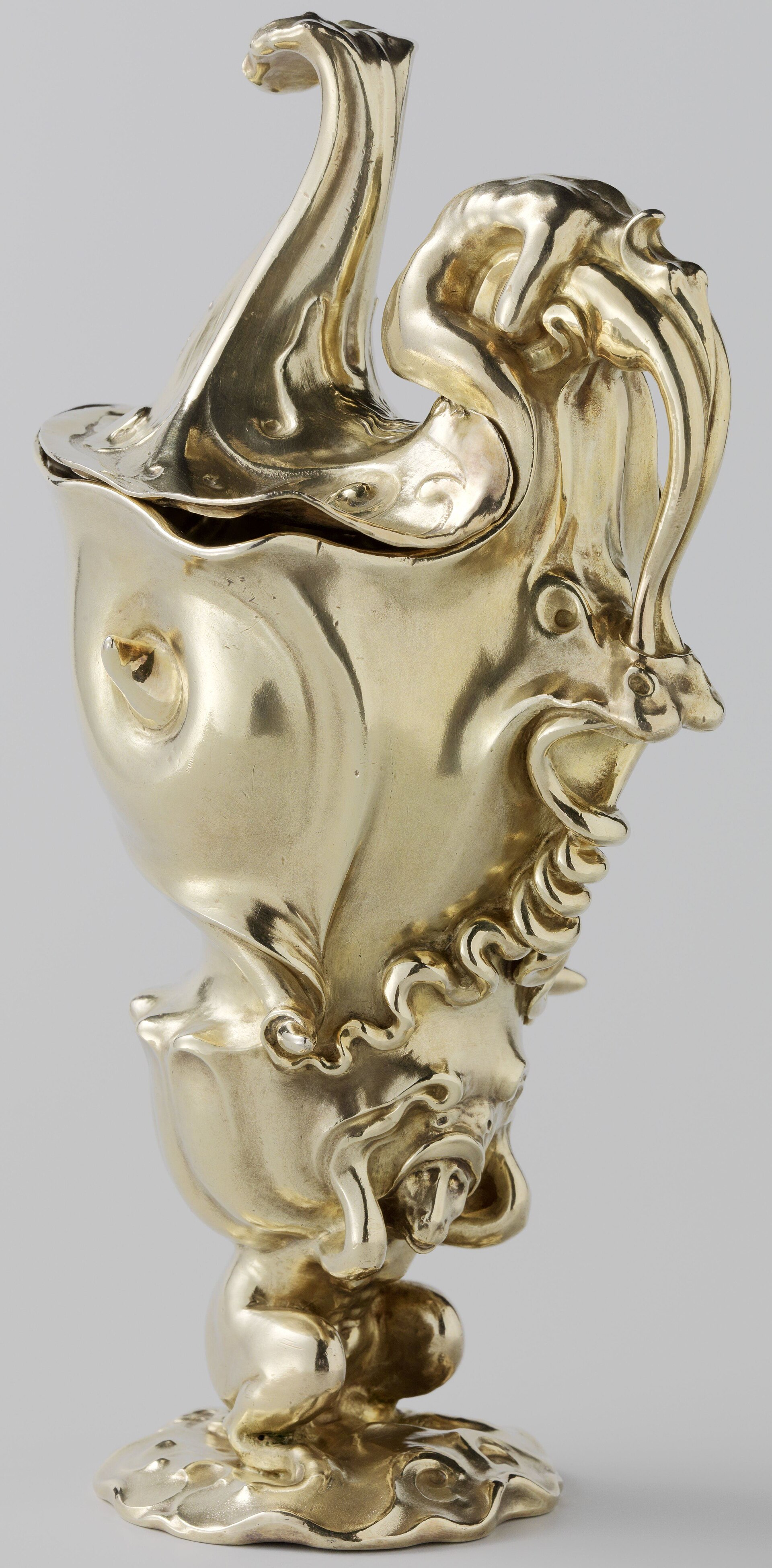
The memorial ewer, silver-gilt, 1614. Rijksmuseum photograph, released by the museum under a CC0 / Public Domain Mark, verified via the Wikimedia Commons API (LicenseShortName: Public domain, Credit: Rijksmuseum).
| Artist | Adam van Vianen |
|---|---|
| Date | 1614 |
| Medium | Silver, raised and chased from a single sheet, gilded after manufacture |
| Dimensions | 25 x 14 x 9 cm (9 7/8 x 5 1/2 x 3 3/8 in); weight 910 g |
| Where it is now | Rijksmuseum, Amsterdamlast confirmed |
| Inventory number | BK-1976-75 |
| Attribution | AcceptedSigned and dated on the body, A.D.Viana.FE. Full note |
| Object type | Silver |
| Period | Dutch, early seventeenth century (Dutch Golden Age) |
| Cases | Has a provenance gap |
| Inscriptions | A.D.Viana.FE. Ao 1614 (signed and dated by the maker on the body) |
| Owners on record | 6 links4 documented, 2 unknown |
| Sources | 22 cited |
About this record Last verified · 22 sources cited · Change log
On this page 10 sections
ContentsClose
A silver-gilt ewer just 25 centimetres high, raised and chased from a single sheet of silver by the Utrecht silversmith Adam van Vianen in 1614, commissioned by the Amsterdam goldsmiths' guild to mourn a member of neither city's guild: Adam's brother Paulus, court goldsmith to Rudolf II in Prague, who had died there the year before. It is generally treated as the founding masterpiece of the Dutch auricular, or kwab, style, and it appears repeatedly as a studio prop in Amsterdam history painting through the mid seventeenth century.
The guild that commissioned it lost it: guild ownership across the Dutch Republic collapsed after the Batavian Revolution of 1795 and the formal 1798 abolition of the guild system, and the ewer was sold in 1821 for a mere 166 guilders into an unnamed Scottish private collection. It resurfaced at auction in 1976, when the Rijksmuseum bought it back for 700,000 guilders, then the highest price recorded for a piece of Dutch silver.
Two long gaps in the record, the years immediately after 1794-98 and the 155 years of the Scottish ownership, are recorded here as gaps. What survives at both ends of them is not in question: one sheet of silver, worked into a memorial by one presumed inventor of an ornamental style for the other.
Provenance
Each link is graded. Documented: a cited source supports it. Disputed: the identification is argued but not established. Unknown: no owner for that span, and the gap is not smoothed into a narrative. The grades in the glossary.
- 1614 - 1614Guild of goldsmiths and silversmiths, Amsterdamdocumented
Commissioned directly from Adam van Vianen of Utrecht to commemorate his brother Paulus van Vianen, who had died in Prague in 1613. Neither brother was a member of the Amsterdam guild.1248
- 1614 - 1794/1798Guild of goldsmiths and silversmiths, Amsterdamdocumented
Kept, probably in guild offices adjacent to the Amsterdam town hall, and on public or semi-public view for close to two centuries; described by Sandrart in 1675 and reproduced repeatedly in Amsterdam paintings during this period.12513
- 1794/1798 - 1821Unknownunknown
Dutch guilds were formally abolished under the Batavian Republic's 1798 constitution (the Staatsregeling), following the disruption of ordinary guild life after the Batavian Revolution of January 1795. No source consulted establishes what became of this specific object, or who held it, in the years between the guild's effective loss of standing and the 1821 sale.1220
- 1821 - 1821Unnamed private collector, Scotlanddocumented
Sold for 166 guilders. The figure and the destination (a Scottish private collection) are consistently reported, but the seller, the buyer and the sale itself are not documented in any source consulted.1248
- 1821 - 1976Unnamed Scottish private collection (and presumed descendants)unknown
No source consulted names the owner or owners across this 155-year span, or establishes whether the object remained with a single family or changed hands more than once before reappearing at auction in 1976.124
- 1976 - presentRijksmuseum, Amsterdamdocumented
Purchased for 700,000 guilders, with the Vereniging Rembrandt pledging to underwrite up to one third of the price to a maximum of 250,000 guilders, alongside support from the Prins Bernhard Fonds and the Stichting tot Bevordering van de Belangen van het Rijksmuseum. The specific auction house, sale city, exact date within 1976 and consignor are not identified in any source consulted.1248
Prices realised
| Date | Sale | Estimate | Result | Note |
|---|---|---|---|---|
| 1976 | Not identified in sources consulted (multiple secondary sources report only that the ewer 'came up for auction in 1976') | Not identified in sources consulted | Hammer Reported as 700,000 guilders in the majority of sources consulted With premium Not separately and reliably documented; one source gives a total of 812,000 guilders inclusive of buyer's premium against a 700,000-guilder hammer, but this could not be corroborated against a second independent source NLG (Dutch guilders) | Every source consulted agrees the Rijksmuseum's total acquisition cost was a record for Dutch silver at the time, and that the Vereniging Rembrandt pledged up to one third of the price, capped at 250,000 guilders, alongside the Prins Bernhard Fonds and the Stichting tot Bevordering van de Belangen van het Rijksmuseum. No source consulted names the auction house, sale city, exact 1976 date, lot number or consignor. This record adopts 700,000 guilders as the reported total price and flags, rather than resolves, the single conflicting 812,000-guilder figure. |
Hammer is the price at which the bidding stopped; with premium adds the fee the house charges the buyer on top. Hammer price and buyer's premium in the glossary.
Technical evidence
| Attribution note | Signed and dated on the body, A.D.Viana.FE. Ao 1614, and consistently attributed to Adam van Vianen since the earliest written account of the object, Joachim von Sandrart's Teutsche Academie of 1675. Authorship has never been in scholarly dispute. |
|---|---|
| Material and technique | Silver, raised and chased (embossed) from a single sheet without joins, later gilded.16713 |
| Dimensions | 25 x 14 x 9 cm (9 7/8 x 5 1/2 x 3 3/8 in).145 |
| Weight | 910 grams.14 |
| Alloy | X-ray fluorescence analysis by the Rijksmuseum (2021) found a silver alloy that appears to be Van Vianen's own formulation: more highly purified than comparable Dutch silver of the period, with notably less bismuth but more copper than pure refining alone would produce, giving the metal unusual malleability and tensile strength.7 |
| Gilding | The vessel was fire-gilded at some point after its manufacture rather than during raising and chasing; no firm date for the gilding is given in the sources consulted.58 |
| Signature and date | Engraved on the body: A.D.Viana.FE. Ao 1614.1 |
| Construction | Handle, spout, lid, body and foot, ordinarily separate elements of a ewer, are integrated into one continuous swirling form rather than assembled as distinct parts; a removable inner cup, chased with two lizards, sits within the body.157 |
| Condition and display | On continuous public display at the Rijksmuseum, including during the museum's decade-long renovation, when it remained one of a small number of works kept on view throughout.5 |
Images
The record in full
Chapter 1What it is
The Rijksmuseum's Lidded Ewer is a silver-gilt covered jug, 25 centimetres high and weighing 910 grams, made in Utrecht in 1614 by the silversmith Adam van Vianen for the goldsmiths' and...
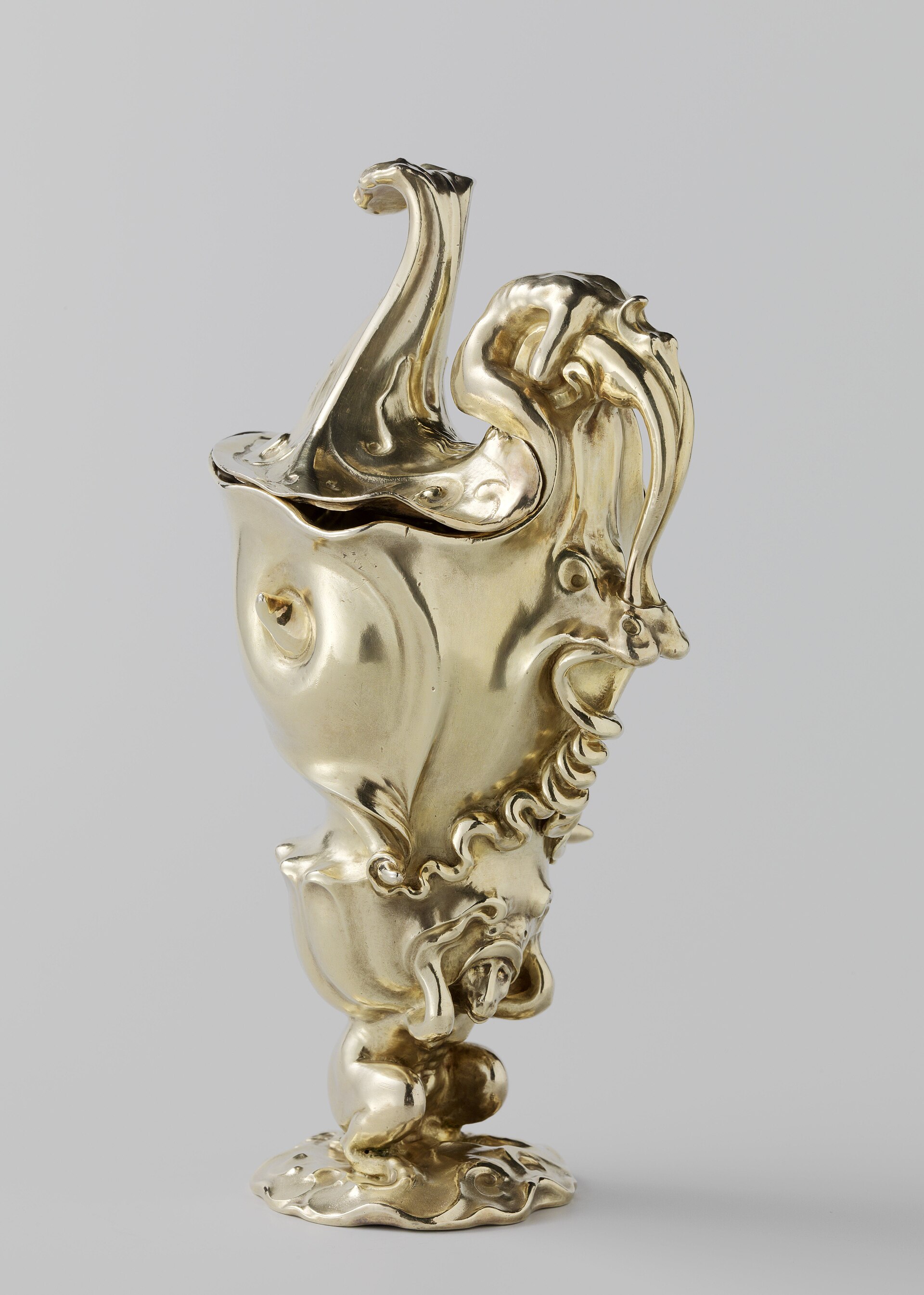
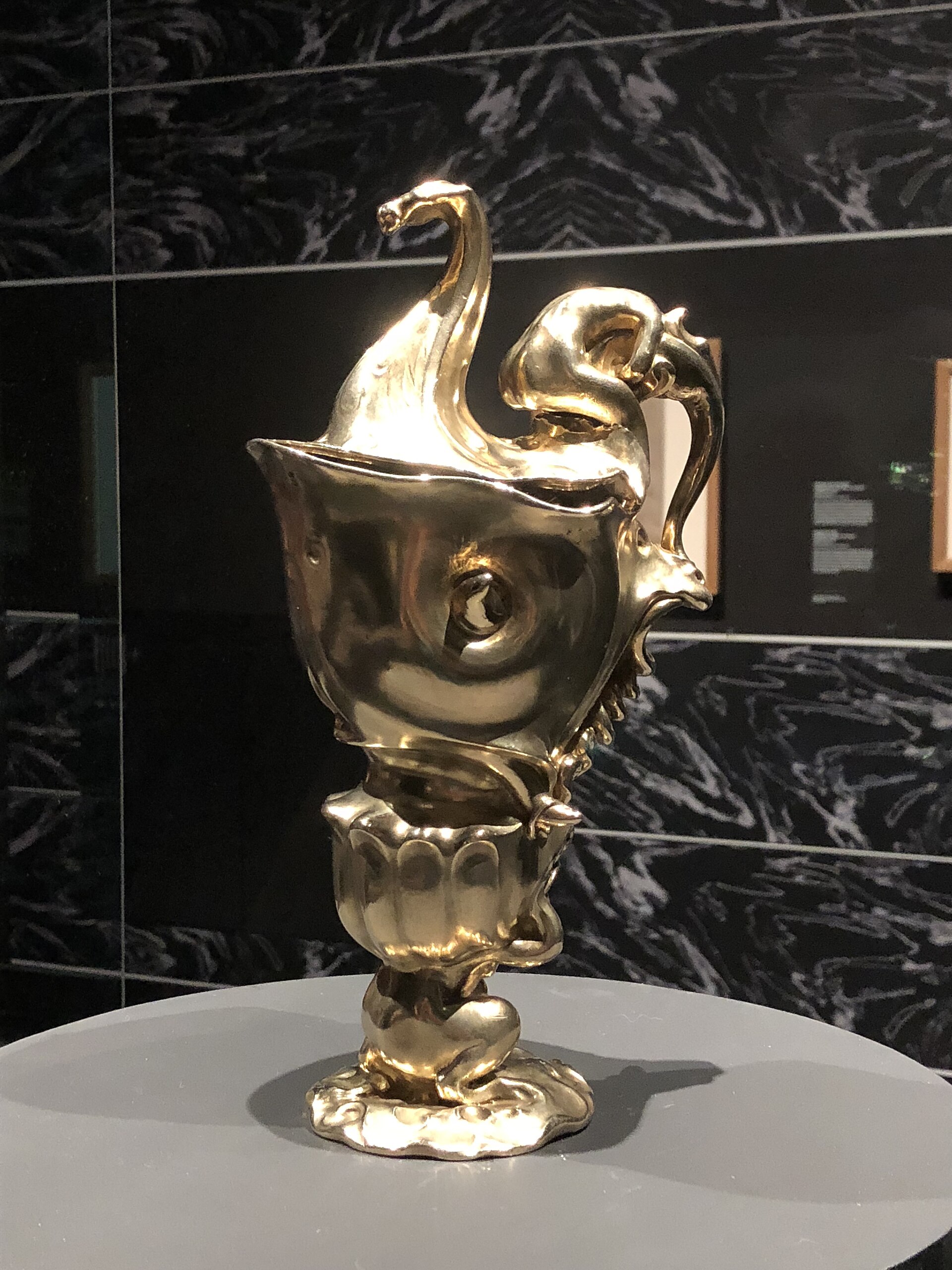
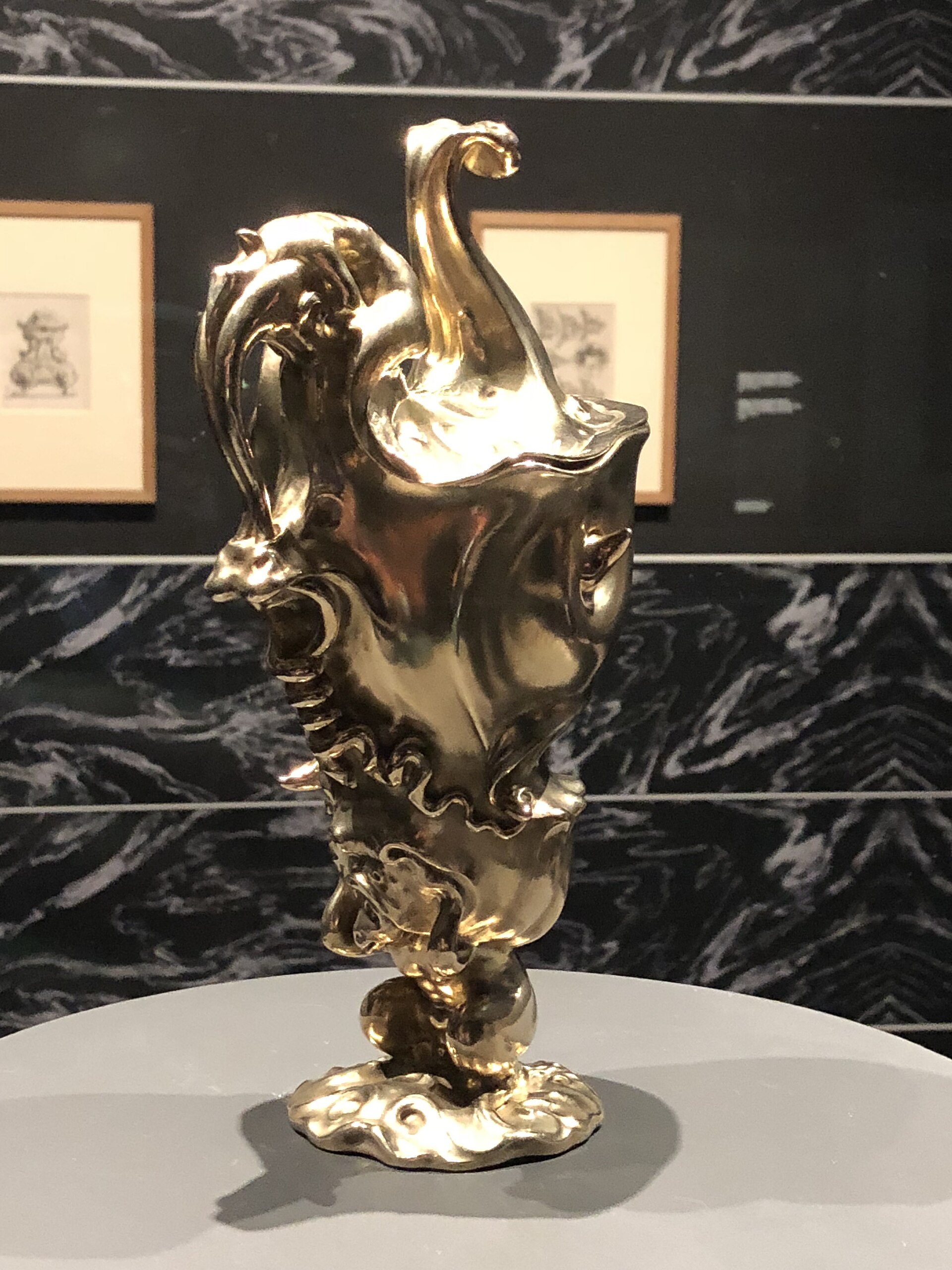
The Rijksmuseum's Lidded Ewer is a silver-gilt covered jug, 25 centimetres high and weighing 910 grams, made in Utrecht in 1614 by the silversmith Adam van Vianen for the goldsmiths' and silversmiths' guild of Amsterdam. It is signed and dated on the body: A.D.Viana.FE. Ao 1614. A crouching ape supports the rounded body of the vessel on its shoulders; the handle begins as the bent-over back and hair of a nude female figure and dissolves upward into swirling, fleshy forms before terminating near the spout in the protuberance of a monster's nose. The lid lifts away, and inside the body sits a removable inner cup, chased with two lizards.
Nothing about the ewer's outline resolves into a single coherent image. Forms suggest a body, an animal, a face, a wave, and then dissolve into the next suggestion before any one reading settles. This is the effect later writers named kwab, in English the auricular style: ornament built from soft, ear-like or gristle-like lobes in continuous transformation, rather than from the acanthus leaves, strapwork and grotesque masks of earlier Renaissance ornament.
Chapter 2How it was made
The body was raised and chased from a single sheet of silver, without joins or seams, a technically exceptional feat that contemporaries recognised as the object's central achievement.
The body was raised and chased from a single sheet of silver, without joins or seams, a technically exceptional feat that contemporaries recognised as the object's central achievement. Writing in 1675, the Frankfurt-born painter and theorist Joachim von Sandrart described it as a pouring ewer about one and a half spans high, of one piece of silver, worked entirely in what was then called Grotesque or Schnackerey style, and considered a rare and wonderful piece.
Laboratory analysis carried out by the Rijksmuseum in 2021, using X-ray fluorescence, found that Van Vianen worked with a silver alloy that appears to be his own formulation: more highly purified than the alloys typically used by Dutch contemporaries, with markedly less bismuth, but with more copper than simple purification alone would explain. The combination gave the metal the extended malleability and tensile strength that the seamless raising of the whole form required. The gilding was applied at some point after the vessel was finished rather than during its manufacture; the object began as bare silver and was gilded later, though the sources consulted do not give a firm date for when that happened.
Chapter 3A memorial the guild had no obvious claim to make
The ewer commemorates Paulus van Vianen, Adam's younger brother, who died in Prague in 1613 while serving as court goldsmith to the Holy Roman Emperor Rudolf II.
The ewer commemorates Paulus van Vianen, Adam's younger brother, who died in Prague in 1613 while serving as court goldsmith to the Holy Roman Emperor Rudolf II. It was commissioned the following year by the Amsterdam guild of goldsmiths and silversmiths.
The commission is, on its face, an odd one. Neither brother lived in Amsterdam or belonged to its guild. Adam worked his entire career in Utrecht, where he had joined the local silversmiths' guild shortly after 1590; he went on to serve that guild as assay master in 1606-07 and again in 1610-11, and as guild master in 1615-16, in the years immediately following the Amsterdam commission. Paulus had left the Low Countries still earlier, working for Duke Wilhelm V in Munich and for the Archbishop Wolf Dietrich von Raitenau in Salzburg before his 1603 appointment at the Prague court, where he remained until his death. The art historian Reinier Baarsen has argued that in commissioning a memorial to a goldsmith who had never worked for it, the Amsterdam guild was reaching for a reputation that extended beyond its own membership: Paulus's fame in courtly Europe, and the credit a rival Dutch city could claim by memorialising him. Every account of the specific circumstances of that decision rests on Sandrart's description of 1675, written six decades after the fact; Sandrart himself is imprecise or mistaken on at least one point, attributing the commission to the City of Amsterdam rather than to the silversmiths' guild specifically, and no guild resolution or contract recording the decision has been identified in the sources consulted for this record.
Chapter 4Two brothers, one style
Paulus van Vianen is generally credited by modern scholarship as the inventor of the auricular idiom.
Paulus van Vianen is generally credited by modern scholarship as the inventor of the auricular idiom. A skilled draughtsman whose landscape drawings stand on their own in the early history of European landscape art, he began at the Prague court to frame mythological reliefs in silver with ornament drawn from grotesque traditions of strapwork and printed animal-and-body-part designs, then pushed the framing itself away from any legible composite of parts toward faces and anatomies that stretch and merge into one another. Adam, who kept in touch with his brother's work from Utrecht, is credited with the further step of applying that two-dimensional framing idiom to fully three-dimensional sculptural form. No auricular object before or after the 1614 ewer achieves the same degree of what one recent reviewer of the Rijksmuseum's 2018 Kwab exhibition called its dazzling mouvemente, its sense of matter in continuous motion.
Paulus's own last work, made in the year of his death, was a matching ewer and basin depicting the story of Diana, Callisto and Actaeon from Ovid, of broadly similar shape and dimensions to Adam's memorial and now also in the Rijksmuseum. Adam's ewer reads, in the scholarship, as a direct response to it: motifs from Paulus's basin and ewer, such as the bud-form finial on the lid and the ridged carapace at the neck, reappear in Adam's work magnified and set in motion, as though the earlier, more contained vessel had been allowed to keep growing.
Chapter 5An object argued to be about making itself
Recent scholarship reads the ewer's iconography, cautiously, as a reflection on the act of artistic creation, though this is an argued interpretation rather than a documented intention: no letter...
Recent scholarship reads the ewer's iconography, cautiously, as a reflection on the act of artistic creation, though this is an argued interpretation rather than a documented intention: no letter, inventory or contemporary description sets out what the guild or Van Vianen believed the object meant, beyond Sandrart's bare account of its appearance. Writing in the Rijksmuseum Bulletin in 2021, Jessica Whittle proposed that the ewer functions as an allegory of the artist bringing life out of chaos, its forms situated within the vocabulary of seventeenth-century alchemy and natural philosophy. The crouching ape at the base, in the conventional pose of Atlas bearing a globe, was for centuries a recognised emblem of artifice and imitation; it is one of the few points where the ewer's meaning can be called relatively stable, though scholars disagree on how far to press an intentional programme onto the rest of the vessel's forms.
Paulus van Vianen's own circle at Prague provides one documented context for such readings: the Rudolfine court was, by 1613, a crucible of experimentation in alchemy and natural philosophy, and Anselmus de Boodt, physician to Rudolf II from 1606 until the emperor's death in 1612, had published a detailed account of the generation of metals and minerals through what he called an inner formative power, the spiritus architectonicus. Whether Paulus or Adam knew de Boodt's work directly is not established; Adam van Vianen left no trace of participation in the world of letters, and it is not known what, if anything, he read. What can be said is that the belief that lower forms of life, and even metals, could generate spontaneously from base matter was current, ordinary knowledge in the period, not an esoteric secret, and that the ewer's forms, understood by contemporaries such as Sandrart mainly as skilled foolery, sit inside that broader set of common ideas about matter and transformation rather than pointing to a hidden doctrine. The absence of a documented hidden programme is itself the finding here.
Chapter 6On display for two centuries
The ewer remained the property of the Amsterdam guild and, according to Baarsen, was probably kept in guild offices adjacent to the town hall.
The ewer remained the property of the Amsterdam guild and, according to Baarsen, was probably kept in guild offices adjacent to the town hall. It became famous quickly and stayed on view for close to two hundred years. Its fame generated an afterlife in other media: beginning around 1646, the engraver Theodorus van Kessel published a series titled Constighe Modellen (Artful Models) after designs by Adam and his son Christiaen, with title pages in Italian, French and Dutch aimed at an international audience of connoisseurs, presenting the family's auricular forms as inventions and works of art in their own right rather than as mere ornament. Adam continued working in Utrecht until his death in 1627; his workshop and the mantle of the family's auricular practice passed to his son Christiaen (about 1600-1667), who eventually moved to Westminster and produced silver plate for Charles I and other English patrons. The Amsterdam smith Johannes Lutma, whose own auricular cartouches and church fittings date from the following decades, is read by scholars as staking a rival claim, on behalf of Amsterdam itself, to a status the Van Vianen ewer had already made inseparable from that city's silversmithing fame.
Chapter 7Reproduced in paint
The ewer's singularity was recognised early by painters, and it is reported in the literature to appear repeatedly as a studio prop in Amsterdam history painting and still life through the middle...
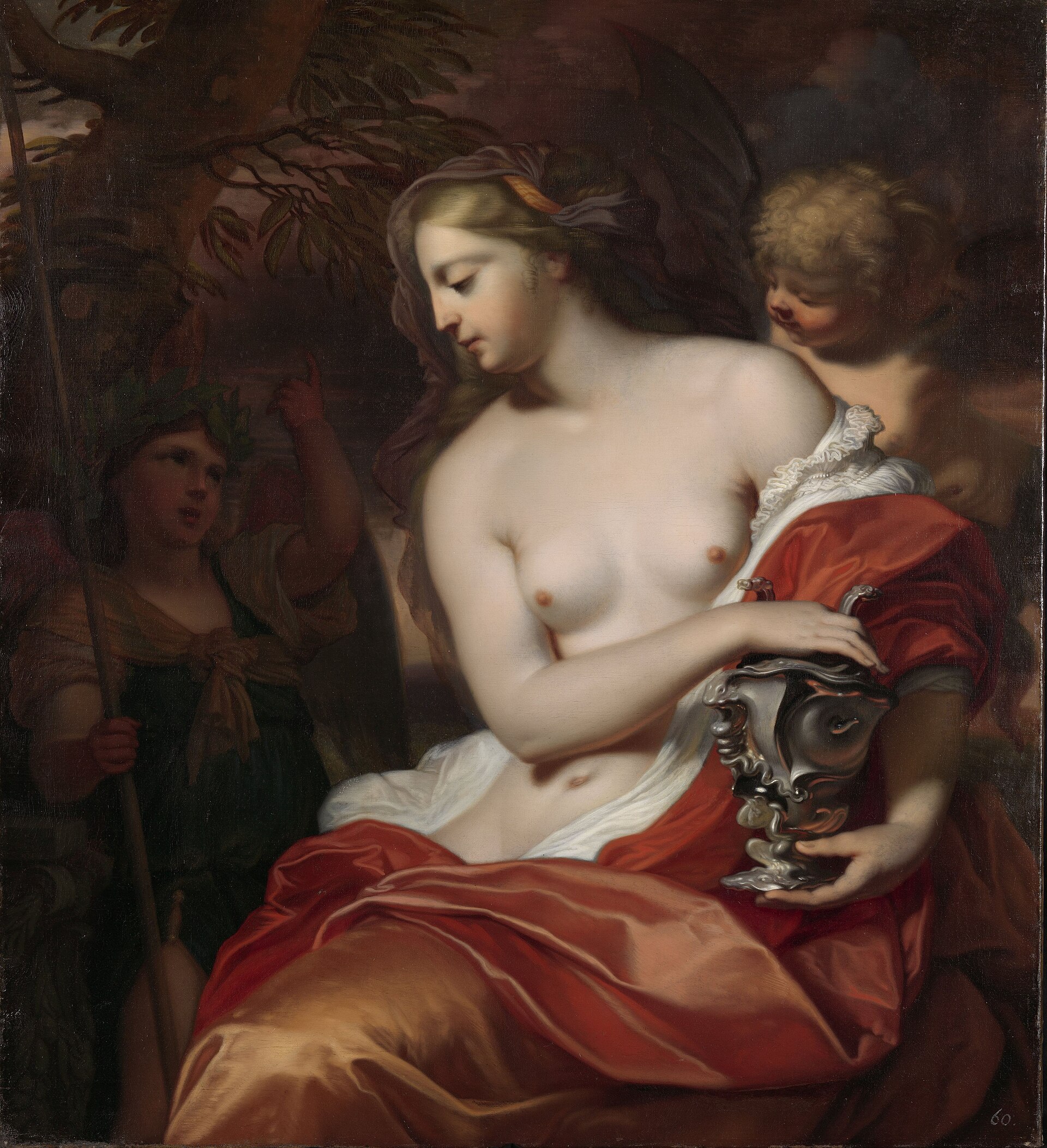
The ewer's singularity was recognised early by painters, and it is reported in the literature to appear repeatedly as a studio prop in Amsterdam history painting and still life through the middle decades of the seventeenth century. The identification of the ewer in specific paintings rests principally on the art historian J.R. ter Molen's 1979 study of Adam van Vianen's silverware in relation to Dutch painting and on Baarsen's 2018 Kwab exhibition catalogue, neither of which was directly available for this record. Paintings named in the secondary literature drawing on that scholarship include Pieter Lastman's Paul and Barnabas at Lystra (1617) and Odysseus and Nausicaa (1619), Adriaen van Nieulandt the younger's Kitchen Scene (1616), Jan Tengnagel's Continence of Scipio (1614-19), Salomon Koninck's Adoration of the Magi (1650), Govert Flinck's Marcus Curius Dentatus Refuses the Gifts of the Samnites (1656) and Barend Graat's Pandora (1676), the last of these now in the Rijksmuseum. This research was not able to independently compare each of these paintings against the ewer's exact silhouette against a primary reproduction, and treats these attributions as reported by the literature rather than independently confirmed here; a reader relying on this record should check them against ter Molen or Baarsen directly before citing them as certain.
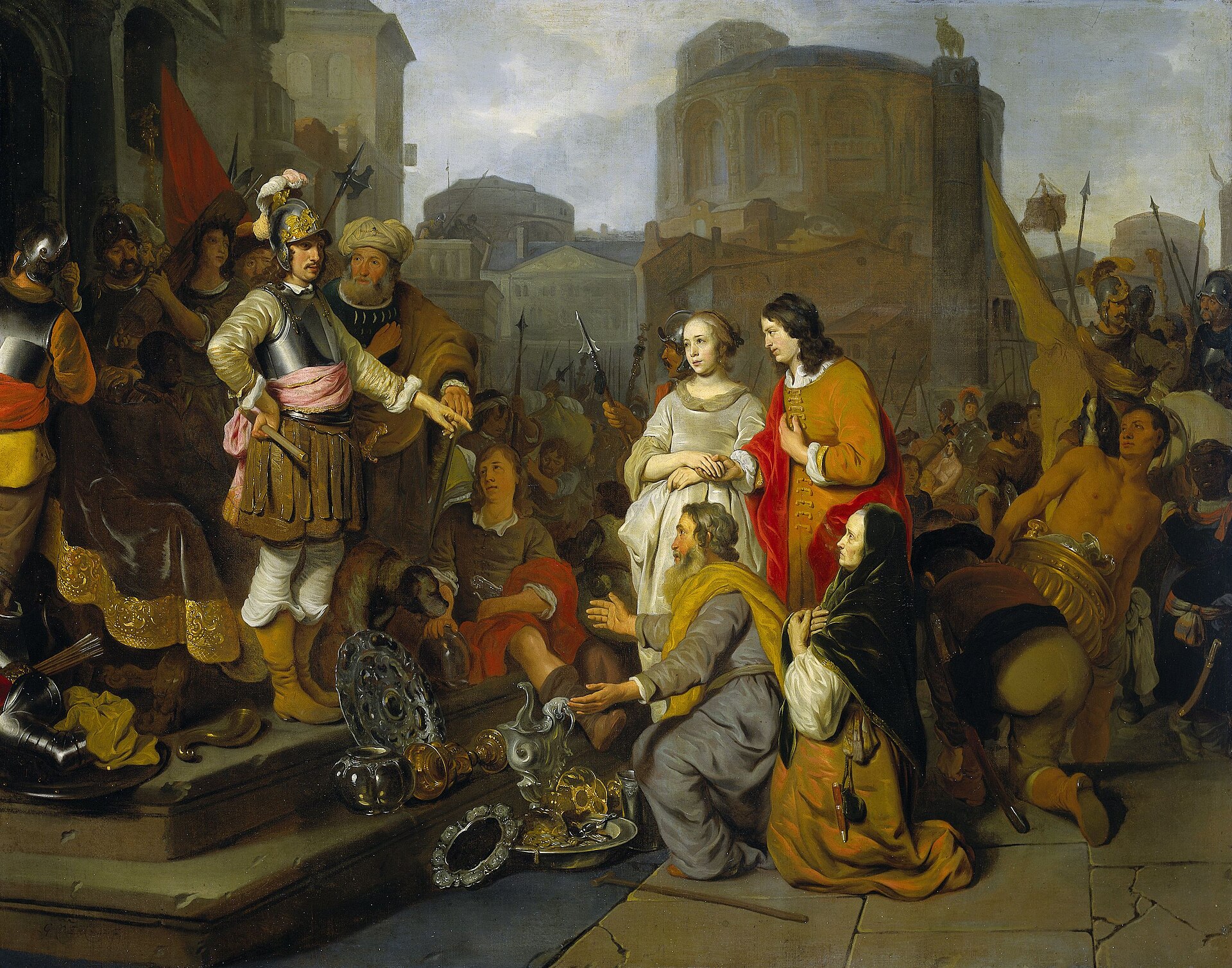
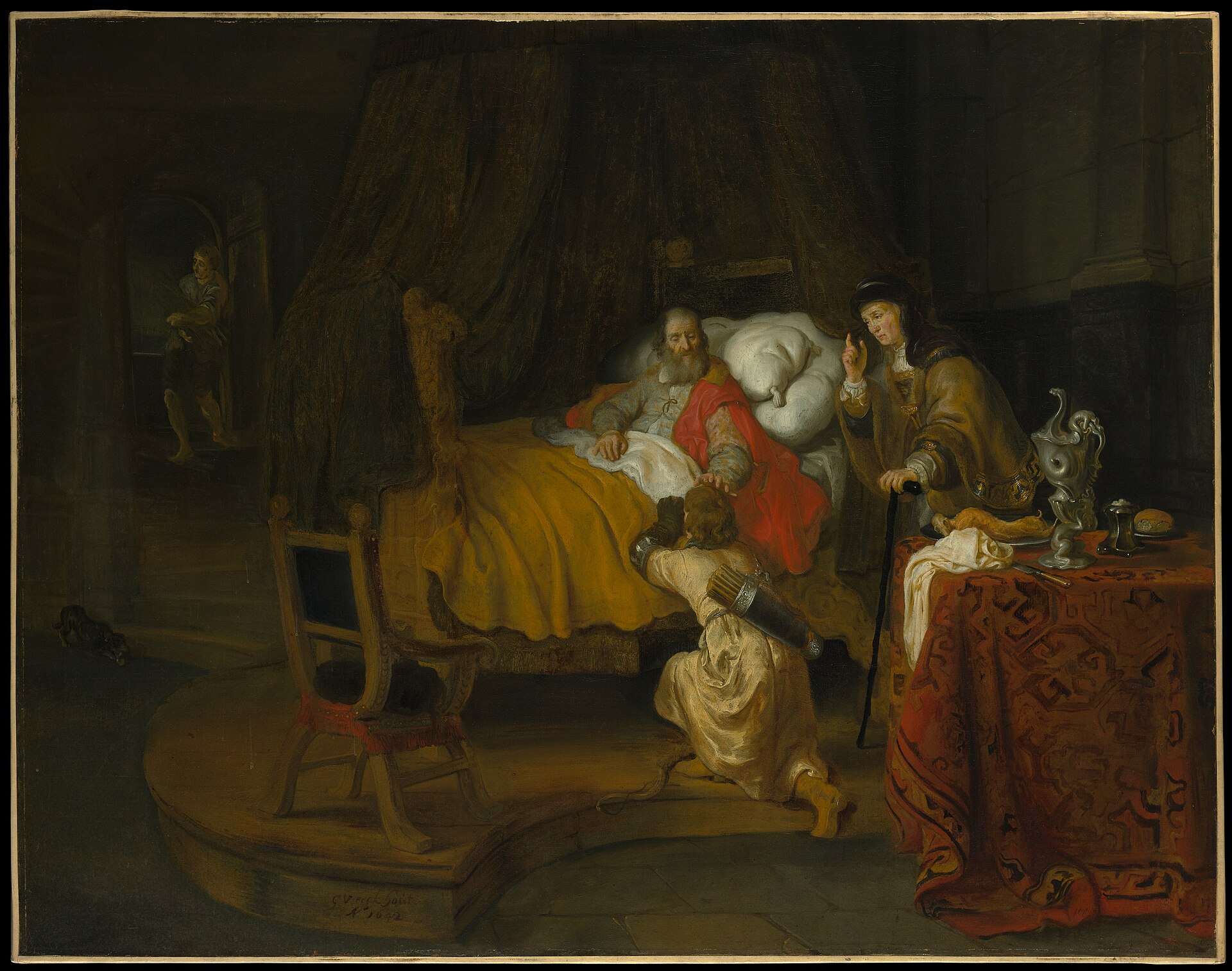
Two appearances can be confirmed with more confidence, because both paintings are themselves in public museum collections whose own cataloguing identifies the depicted vessel as this specific ewer. Gerbrand van den Eeckhout's Isaac Blessing Jacob (1642), in the Metropolitan Museum of Art, places the ewer prominently on a table beside the two figures; the Metropolitan's own account of the painting notes the identification is supported by comparison with a print after the same composition by Michiel Mosyn, in which the vessel's form is drawn clearly enough to match. Eeckhout returned to the ewer eleven years later in The Continence of Scipio (1653), now in the Rijksmuseum itself, among the treasures Scipio restores to the captive bride; the museum's own cataloguing of that painting identifies the depicted vessel as Van Vianen's ewer. That the Rijksmuseum holds both the ewer and one of the paintings that made it famous is, so far as this research found, the clearest surviving demonstration of how completely the object entered the visual culture of its own city.
Chapter 8Dissolution and a silence
Guild organisation across the Dutch Republic came under sustained pressure after the Batavian Revolution of January 1795, and was formally ended nationally under the Batavian Republic's 1798...
Guild organisation across the Dutch Republic came under sustained pressure after the Batavian Revolution of January 1795, and was formally ended nationally under the Batavian Republic's 1798 constitution, the Staatsregeling, which abolished the guild system by decree; the dataset consulted for this record dates a formal termination decree to the autumn of 1798, though the ordinary functioning of Amsterdam's guilds, including the silversmiths' guild that owned this ewer, had already been disrupted by the change of regime some years earlier. Guild-owned property across the Republic followed varied paths after dissolution: some guild halls and funds continued to be administered by the same men for years under new, informal or charitable structures, while others were dispersed or sold outright. No source consulted for this record establishes what specifically happened to the Amsterdam silversmiths' guild's holdings, this ewer included, in the years immediately after 1794-98; the object simply disappears from the documented record until it resurfaces at the point of sale in 1821.
Chapter 9Sold for 166 guilders
In 1821 the ewer was sold for 166 guilders and passed into a private collection in Scotland.
In 1821 the ewer was sold for 166 guilders and passed into a private collection in Scotland. The figure is recorded consistently across the secondary sources consulted, including the Vereniging Rembrandt's own account of the object, but none of them names the seller, the buyer, or the sale itself with enough detail to be checked against a primary sale record; the Scottish owner and the collection's later history across the nineteenth and earlier twentieth centuries are not established in any source consulted for this record. A sum that low did not reflect a serious assessment of the object's importance, and reads closer to a scrap or curiosity valuation than to a considered price for a documented masterpiece of Dutch silver. That it was not simply melted down for its bullion value across the following century and a half is, on the evidence available, as much a matter of chance as of connoisseurship.
Chapter 10A record price for Dutch silver
The ewer came up for auction again in 1976, and the Rijksmuseum purchased it with the support of the Vereniging Rembrandt, the Prins Bernhard Fonds and the Stichting tot Bevordering van de Belangen...
The ewer came up for auction again in 1976, and the Rijksmuseum purchased it with the support of the Vereniging Rembrandt, the Prins Bernhard Fonds and the Stichting tot Bevordering van de Belangen van het Rijksmuseum. The Vereniging Rembrandt had pledged to underwrite up to one third of the purchase price, to a maximum of 250,000 guilders. Secondary sources are consistent that the total price was 700,000 guilders, and consistent in calling it the highest price ever paid for a piece of silver in the Netherlands up to that point. One further source gives a total of 812,000 guilders inclusive of buyer's premium against the same 700,000-guilder figure treated as the hammer price, which would be the only source consulted to separate the two; that second figure could not be corroborated against an independent source or against a Christie's or other auction house sale record. Neither the auction house, the sale city, the exact sale date within 1976, nor the consignor's name were identified in the sources consulted. This record therefore states the acquisition price as 700,000 guilders, flags the 812,000-guilder figure as unconfirmed rather than adopting it, and leaves the underlying sale undocumented pending access to the auction record itself.
Chapter 11What is still unresolved
Two centuries of guild ownership and two centuries of documented fame are followed, in the record consulted for this entry, by two long silences: the years immediately after the guild's dissolution...
Two centuries of guild ownership and two centuries of documented fame are followed, in the record consulted for this entry, by two long silences: the years immediately after the guild's dissolution, and the 155 years between the 1821 Scottish sale and the 1976 return to Amsterdam. Both gaps are recorded here as gaps rather than bridged with plausible guesswork. What is not in doubt is the object at either end of them: a single sheet of silver, worked by one of the two men credited with inventing an entire idiom of ornament, made to mourn the other.
The artist
Adam van Vianen
Adam van Vianen worked his entire career in Utrecht, a member and eventually a master of its silversmiths' guild, while his younger brother Paulus carried the family's innovations in silver to the courts of Bavaria, Salzburg and, finally, Prague. The 1614 memorial ewer is the point at which the brothers' two careers, one settled and civic, the other itinerant and courtly, meet in a single documented object, and it is the work on which Adam's reputation now principally rests.
Related works
| Work | Relation | Where it is |
|---|---|---|
| Basin with scenes from the story of Diana and Actaeon, and its companion ewer with scenes from the story of Diana Paulus van Vianen | Paulus's own last work, made in 1613, the year of his death; broadly similar in shape and dimensions to Adam's memorial ewer, and read by scholars as the direct model Adam's ewer responds to and enlarges upon Not to be confused with the memorial ewer described in this record; a separate object by the other brother. | Rijksmuseum, Amsterdam (basin: BK-16089-A) |
| Ewer with scenes depicting the legend of Marcus Curtius Adam van Vianen (I) | Another documented ewer by the same maker, from a different commission, useful as a comparison piece for Adam's independent (non-memorial) work Should not be conflated with the 1614 Amsterdam memorial ewer; a different vessel, different commission, different iconographic programme. | Metropolitan Museum of Art, New York |
| Constighe Modellen (Artful Models) Theodorus van Kessel, after designs by Adam and Christiaen van Vianen | Print series, begun about 1646, that circulated the Van Vianen family's auricular forms to an international audience of connoisseurs a generation after the memorial ewer was made Etching, not silver; documents the design vocabulary's afterlife in print rather than the memorial ewer itself. | Victoria and Albert Museum, London (inv. E.1084-1889, among other holdings) |
| Portrait of Johannes Lutma Rembrandt van Rijn | 1656 etched portrait of the Amsterdam auricular silversmith whose cartouches and church fittings are read by scholars as staking Amsterdam's own claim to a style the Van Vianen ewer had already made famous Portrays a rival, later practitioner of the auricular style, not the Van Vianen family. | Rijksmuseum, Amsterdam (RP-P-OB-550) |
| The Continence of Scipio Gerbrand van den Eeckhout | 1653 history painting in which the museum's own cataloguing identifies the depicted silver vessel as this specific ewer The best independently corroborated painted appearance of the ewer identified in this research; the museum holds both the painting and the object it depicts. | Rijksmuseum, Amsterdam (SK-C-1631) |
| Isaac Blessing Jacob Gerbrand van den Eeckhout | 1642 history painting placing the ewer prominently on a table; the identification is supported in the Metropolitan's own account by comparison with an engraving after the same composition by Michiel Mosyn The second painted appearance independently corroborated in this research, though by comparison with a print rather than by direct museum ownership of both objects. | Metropolitan Museum of Art, New York (25.110.16) |
Open questions
- No guild resolution, contract or payment record for the 1614 commission has been identified in the sources consulted; every account of the decision to commission Adam, a non-member, to memorialise Paulus, also a non-member, rests on Sandrart's description of 1675, written six decades after the fact and imprecise on at least one point (he attributes the commission to the City of Amsterdam rather than the guild).
- What happened to the ewer between the guild's effective loss of standing after 1794-95 and its formal 1798 abolition, and the 1821 sale, is not established in any source consulted; the object is undocumented for this window.
- The 1821 buyer, the Scottish collection itself, and its ownership across the following century and a half (1821-1976) are not named in any source consulted.
- The 1976 sale is not documented beyond a bare price and the Rijksmuseum's own supporting funders: no source consulted names the auction house, the sale city, the exact date within 1976, or the consignor. One source's figure of 812,000 guilders inclusive of premium, against 700,000 guilders elsewhere reported as the total price, could not be corroborated and is flagged rather than resolved.
- Whether the paintings by Lastman, Van Nieulandt, Tengnagel, Koninck and Flinck reported in the secondary literature depict this specific ewer, rather than a generalised auricular-style vessel, was not independently verified against primary reproductions in this research; only the two Eeckhout paintings carry independent institutional confirmation.
- No firm date is given in the sources consulted for when the ewer, made and sold as plain silver, was gilded.
Questions about this object
What is Lidded Ewer?
Lidded Ewer is a silver, dated 1614. Medium: Silver, raised and chased from a single sheet, gilded after manufacture.
Who made Lidded Ewer, and is the attribution settled?
The attribution to Adam van Vianen is recorded here as accepted. Signed and dated on the body, A.D.Viana.FE. Ao 1614, and consistently attributed to Adam van Vianen since the earliest written account of the object, Joachim von Sandrart's Teutsche Academie of 1675. Authorship has never been in scholarly dispute.
Where is Lidded Ewer now?
Rijksmuseum, Amsterdam. Inventory number BK-1976-75. Last confirmed 9 September 2026. Purchased at auction in 1976 with the support of the Vereniging Rembrandt, the Prins Bernhard Fonds and the Stichting tot Bevordering van de Belangen van het Rijksmuseum.
What has Lidded Ewer sold for?
Hammer Reported as 700,000 guilders in the majority of sources consulted; with premium, Not separately and reliably documented; one source gives a total of 812,000 guilders inclusive of buyer's premium against a 700,000-guilder hammer, but this could not be corroborated against a second independent source. Not identified in sources consulted (multiple secondary sources report only that the ewer 'came up for auction in 1976'), 1976.
What is still unknown about Lidded Ewer?
No guild resolution, contract or payment record for the 1614 commission has been identified in the sources consulted; every account of the decision to commission Adam, a non-member, to memorialise Paulus, also a non-member, rests on Sandrart's description of 1675, written six decades after the fact and imprecise on at least one point (he attributes the commission to the City of Amsterdam rather than the guild).
Sources
- 1Rijksmuseum, 'Lidded ewer', collection object page, BK-1976-75. rijksmuseum.nl/en/...
- 2Vereniging Rembrandt, 'Kan met deksel vervaardigd voor het Amsterdamse zilversmidsgilde'. verenigingrembrandt.nl/nl/...
- 3Wikipedia, 'Memorial Guild Cup (Adam van Vianen)', consolidating the Vereniging Rembrandt account, Liedtke (2007), Oxford Art Online (Schroder) and Trilling (2001). en.wikipedia.org/wiki/...
- 4CODART Canon, 'Lidded Ewer'. canon.codart.nl/artwork/...
- 5Allison Stielau, 'Fit Vessel: Kwab at the Rijksmuseum' (review of Reinier Baarsen, Kwab: Ornament as Art in the Age of Rembrandt, Amsterdam: Rijksmuseum, 2018), West 86th, vol. 26, no. 1 (2019), pp. 110-124. discovery.ucl.ac.uk/10078094/...
- 6Jessica Whittle, 'Chaos and Creation: Adam van Vianen's Gilt Ewer', The Rijksmuseum Bulletin, vol. 69, no. 3 (2021), pp. 196-215. bulletin.rijksmuseum.nl/article/...
- 7Joosje van Bennekom, Ellen van Bork and Arie Pappot, 'The Unsurpassed Silversmithing Techniques of Adam van Vianen: His Silver Ewer Unravelled', The Rijksmuseum Bulletin, vol. 69, no. 3 (2021), pp. 216-243. bulletin.rijksmuseum.nl/article/...
- 8Richard Checketts, 'Adam van Vianen and Ghosts of Silver in the Late-Renaissance World', in Helen Hills (ed.), Silver: Material Transformations, Proceedings of the British Academy (Oxford: Oxford University Press, 2023). Accepted-manuscript version consulted. eprints.whiterose.ac.uk/id/...
- 9J.R. ter Molen, Van Vianen: een Utrechtse familie van zilversmeden met een internationale faam, 2 vols (PhD thesis, University of Leiden; Leiderdorp: J.R. ter Molen, 1984). The key monograph and catalogue raisonne on the family; cited here at second hand via sources 5 and 8, not consulted directly. worldcat.org/title/...
- 10J.R. ter Molen, 'Adam van Vianen's Silverware in Relation to Seventeenth-Century Dutch Painting', Apollo, vol. 110 (1979). The apparent original source for the identification of the ewer in several of the paintings named in this record; not consulted directly, cited at second hand via sources 3 and 11. lastman.rkdstudies.nl/bibliografie
- 11RKD (Lastman in Focus research project), bibliography page, checked for any direct link between Pieter Lastman's paintings and the Van Vianen ewer; none found beyond the ter Molen 1979 citation. lastman.rkdstudies.nl/bibliografie
- 12Th. M. Duyvene de Wit-Klinkhamer, 'Een vermaarde zilveren beker', Nederlands Kunsthistorisch Jaarboek / Netherlands Yearbook for History of Art, vol. 17 (1966), pp. 79-103. The earliest dedicated modern study of the object; cited at second hand via source 8, not consulted directly. eprints.whiterose.ac.uk/id/...
- 13Joachim von Sandrart, Teutsche Academie der Edlen Bau-, Bild- und Mahlerey-Kunste (1675), ed. A.R. Peltzer (Munich: G. Hirth's Verlag, 1925), p. 223. The earliest written account of the ewer. ta.sandrart.net/en/...
- 14Metropolitan Museum of Art, 'Isaac Blessing Jacob', Gerbrand van den Eeckhout, accession 25.110.16. metmuseum.org/art/...
- 15Wikipedia, 'Isaac Blessing Jacob (Gerbrand van den Eeckhout)', citing Great Dutch Paintings from America (1990-91 exhibition catalogue) for the identification of the depicted ewer via comparison with an engraving by Michiel Mosyn after Eeckhout. en.wikipedia.org/wiki/...
- 16Wikipedia, 'The Continence of Scipio (Gerbrand van den Eeckhout)', on the Rijksmuseum's own painting SK-C-1631, whose cataloguing identifies the depicted vessel as this ewer. en.wikipedia.org/wiki/...
- 17Rijksmuseum, 'Basin with scenes from the story of Diana and Actaeon' (and companion ewer), Paulus van Vianen, 1613, BK-16089-A. rijksmuseum.nl/en/...
- 18Barnebys Magazine, 'The Art of Ornamentation: Van Vianen Silver'. barnebys.com/blog/...
- 19Oud Utrecht, 'De Utrechtse edelsmeden Adam en Paulus van Vianen'. oud-utrecht.nl/nieuws/...
- 20Social Enterprises and Institutions for Collective Action (collective-action.info), dataset entry 'Guilds - The Netherlands', on the 1798 Staatsregeling and the formal abolition of Dutch guilds. collective-action.info/datasets-various-types-institution...
- 21Wikimedia Commons, file records and (LicenseShortName, Artist, Credit) for the images used in this record, verified via the Commons API. commons.wikimedia.org/wiki/...
- 22Wikipedia, 'Adam van Vianen' and 'Paul van Vianen'. en.wikipedia.org/wiki/...

Last verified · Published
Change log
9 September 2026 - Record created at the house standard: researched narrative, technical evidence, maker dossier, graded provenance chain, prices with hammer and premium separated, related works, open questions and sources.