Rosa Bonheur
 French · 1822-1899
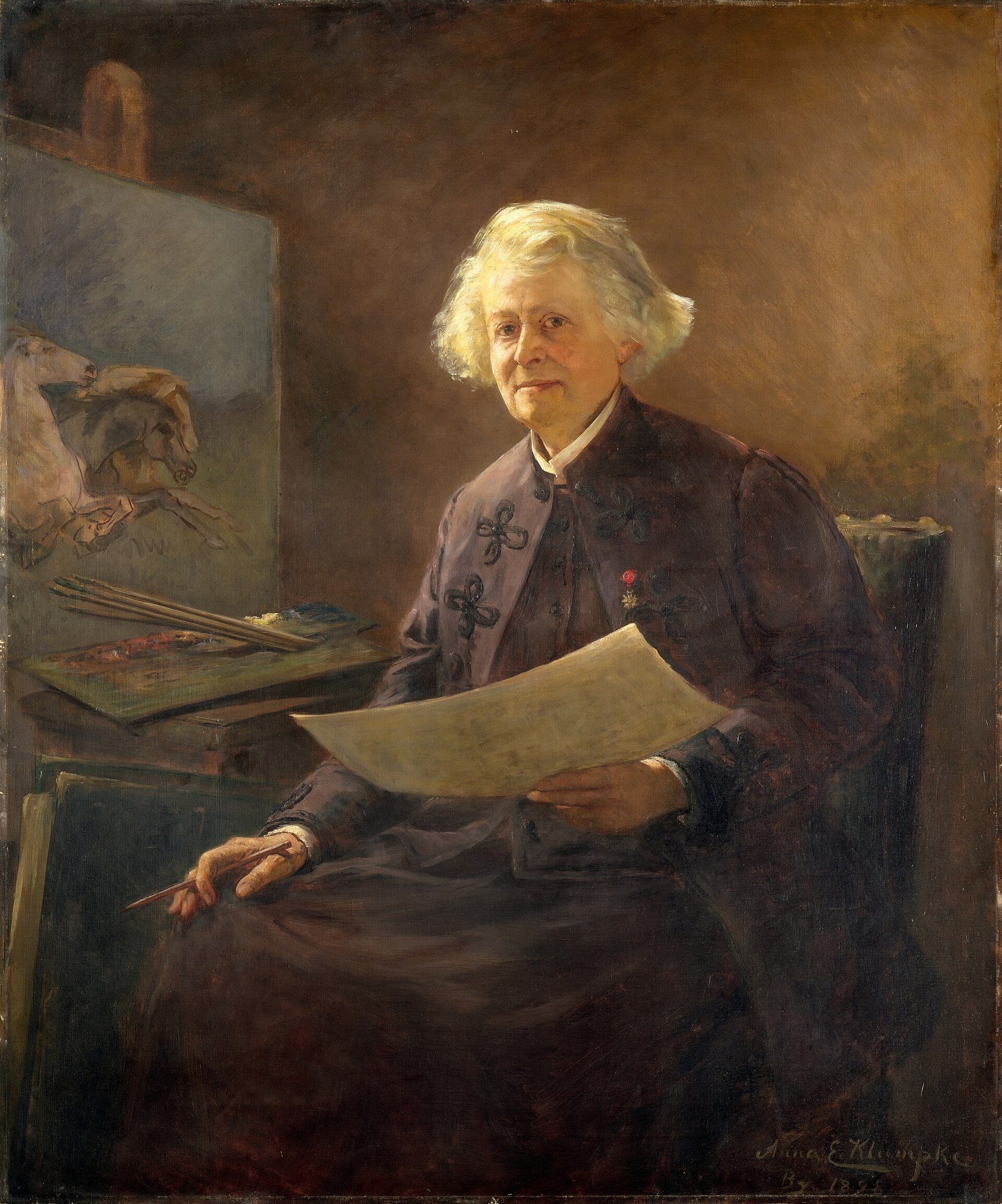
Rosa Bonheur at seventy-six, painted at By in 1898 by Anna Klumpke (signed Anna E. Klumpke / By 1898), oil on canvas, 117.2 by 98.1 cm, Metropolitan Museum 22.222, given by Klumpke in 1922 in memory of Bonheur. A contemporary portrait by her companion and heir, not a self-portrait; the Met catalogues the sitter as Rosa Bonheur. She wears the Legion of Honour rosette, and a horse picture stands on the easel behind her.
Metropolitan Museum of Art, New York (public domain)| Full name | Marie-Rosalie Bonheur, called Rosa Bonheur |
|---|---|
| Worked as | Painter, Sculptor, Draughtswoman |
| Born | 16 March 1822 · Bordeaux |
| Died | 25 May 1899 · Chateau de By, Thomery, near Fontainebleau |
| Nationality | French |
| Movement | Realism |
| Sources | 25 cited |
| Last verified |
About this page Last verified · 25 sources cited
On this page 13 sections
ContentsClose
Rosa Bonheur was the most famous woman painter of the nineteenth century and the first woman artist to receive the Legion of Honour, from the Empress Eugenie in 1865. Her name carries The Horse Fair, the five-metre canvas now in the Metropolitan Museum, which a dealer bought for 40,000 francs in the 1850s and which Cornelius Vanderbilt bought at auction in 1887 for 268,000 francs, by Klumpke's account, and gave to the museum. No published count of how many pictures she left was found for this page.
That is the fact most readers don't have. The searches for this page found no catalogue raisonne, no authentication board and no published figure for the accepted corpus. What exists instead is the sale catalogue of her studio in May and June 1900, two volumes with about two thousand numbered lots, in which every work she hadn't signed carries one of two studio stamps. Anna Klumpke, her heir, recorded that the sale made 1,181,498 francs against a private offer of 1,500,000 for the whole contents of the studio, and that the family had first sued her for obtaining the will by hypnosis.
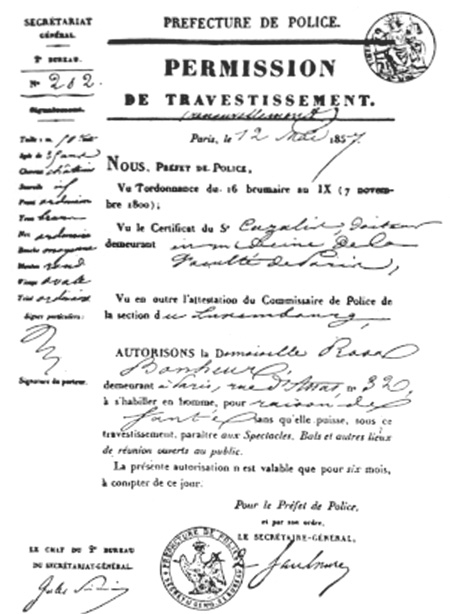
The standard story also gets small things wrong. The trouser permit that survives is a renewal dated 12 May 1857 and gives health as the reason. The state commission for Ploughing in the Nivernais followed her gold medal of 1848 and didn't cause it. And the National Gallery's smaller Horse Fair, catalogued as her autograph version, was begun by Nathalie Micas and finished by Bonheur, on Bonheur's own account.
Images
Chronology
- 1822
Marie-Rosalie Bonheur is born on 16 March in Bordeaux, the eldest child of the painter Raimond Bonheur and Sophie Marquis.1
- 1838
Registered as a copyist at the Louvre on 9 August, aged sixteen.4
- 1848
Awarded a gold medal for her Salon exhibition by a jury that included Delacroix, Corot and Horace Vernet, and receives the state order for a ploughing subject.1
- 1849
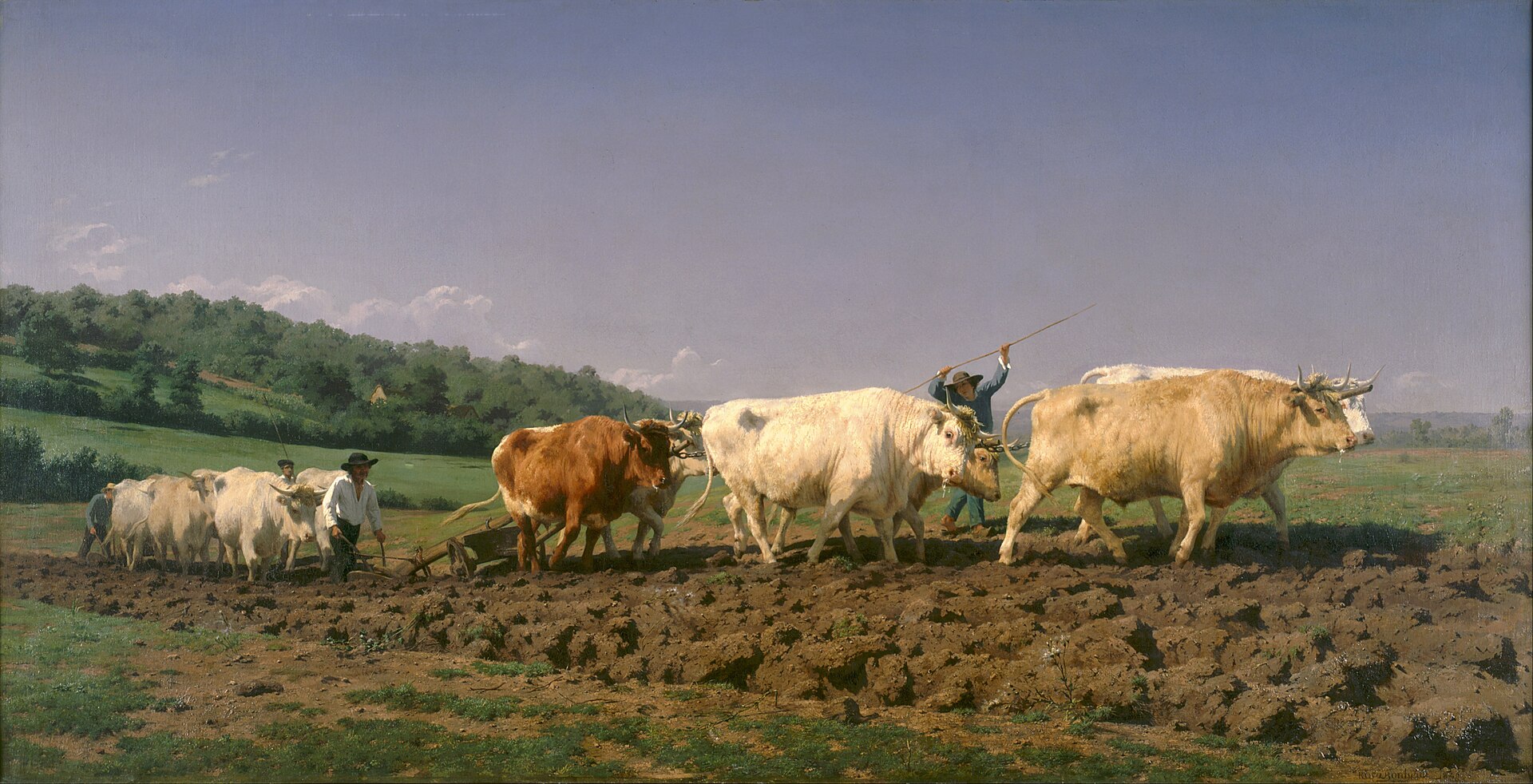
Raimond Bonheur dies on 23 March. Ploughing in the Nivernais is shown at the Salon and enters the state collections; it is now at the Musee d'Orsay as RF 64.124
- 1851-52
Called in December 1851 or January 1852 to the Interior minister Charles de Morny, who prefers a haymaking subject to the horse market she proposes and fixes 20,000 francs for it.14
- 1853
The Horse Fair is shown at the Salon, to great success, and the jury declares her future submissions admitted as of right.1
- 1854
Bordeaux declines her offer of The Horse Fair at 15,000 francs. Gambart buys it at 40,000 francs.114
- 1857
Her police permission to dress as a man is renewed on 12 May for six months.10
- 1859
The smaller Horse Fair is bequeathed to the National Gallery by Jacob Bell. The Chateau de By is bought or occupied in 1859 or 1860, depending on the source.5161
- 1865
The Empress Eugenie presents her with the Legion of Honour, the first for a woman artist; the act is dated 8 June.4
- 1870
On 26 September a Prussian army order protects her property at By.1
- 1887
The Horse Fair is bought at the Stewart sale at 268,000 francs by Cornelius Vanderbilt, who gives it to the Metropolitan Museum.1714
- 1889
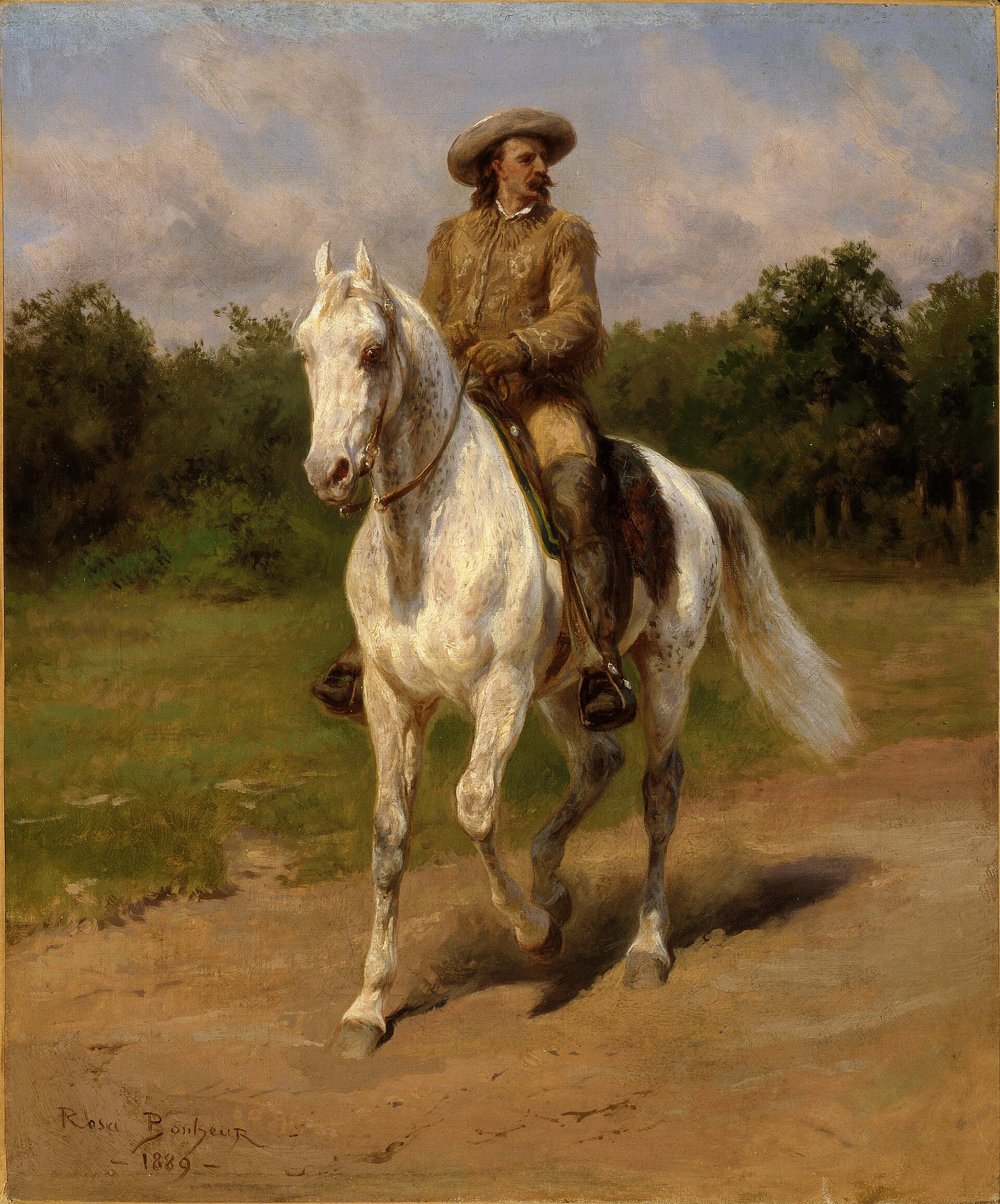
Nathalie Micas dies on 24 June. Bonheur paints Buffalo Bill on horseback.1325
- 1894
Promoted officer of the Legion of Honour, a year Morrison gives as 1893.14
- 1898
Anna Klumpke moves in, a new studio is begun on 29 August and Bonheur signs her will on 7 November.1
- 1899
Bonheur dies of a pulmonary congestion on 25 May. The large wheat-threshing canvas is left unfinished.21
- 1900
The studio sale at the Galerie Georges Petit runs from 30 May to 8 June and totals 1,181,498 francs.1234
- 1908
Klumpke publishes Rosa Bonheur, sa vie, son oeuvre.1
- 2017
Katherine Brault is reported by Wikipedia to buy the Chateau de By in September; Le Roi de la foret is sold at Christie's New York on 23 May.1620
- 2022
Bicentenary exhibition at Bordeaux (18 May to 18 September) and the Musee d'Orsay (18 October to 15 January 2023).22
- 2025
Alexandra Morrison shows that a Getty sketchbook long attributed to Bonheur alone is shared with her father and is lot 1847 of the 1900 sale.4
The market
The prices recorded in Bonheur's lifetime are in francs and are the best evidence of her value: 3,000 for the state's ploughing picture in 1848, 20,000 for the Haymaking, 40,000 for The Horse Fair. The studio sale of 1900 made 1,181,498 francs for the lot and the recent auction records are around 600,000 to 775,000 dollars all-in. No hammer-and-premium series was found; only the 2019 bison pastel has both figures from the auction's own page, and the others come from databases that don't say what is in the price.
| Date | Sale | Work | Result | Note |
|---|---|---|---|---|
| 1854-1855 | Private treaty, Ernest Gambart, London | The Horse Fair (now Metropolitan Museum 87.25) | Hammer not applicable (private sale); the price was 40,000 francs With premium none stated FRF | Price quoted by Micas to Gambart, who accepted. Wikipedia dates the purchase 1854; Bordeaux had declined it at 15,000 francs. |
| 1887 | Auction of the Stewart collection, New York (house not named in the sources read) | The Horse Fair | Hammer not stated; price reported as 268,000 francs (Klumpke, with 55,500 dollars) or 53,000 dollars (Wikipedia) With premium not stated in either source FRF and USD | Bought by Cornelius Vanderbilt and given to the Metropolitan Museum. The two dollar figures disagree; neither source separates hammer from any premium. |
| 1900-05-30 to 1900-06-08 | Galerie Georges Petit, Paris; Paul Chevallier auctioneer; Georges Petit and Tedesco Freres experts | Studio sale, paintings, drawings, prints and bronzes | Hammer not stated; Klumpke reports a total of 1,181,498 francs With premium buyers paid 5 per cent over the hammer per the catalogue conditions; whether the reported total includes it is not stated FRF | Net 799,209 francs after costs; 399,604 to the family. Tedesco had offered 1,500,000 francs for the whole contents. |
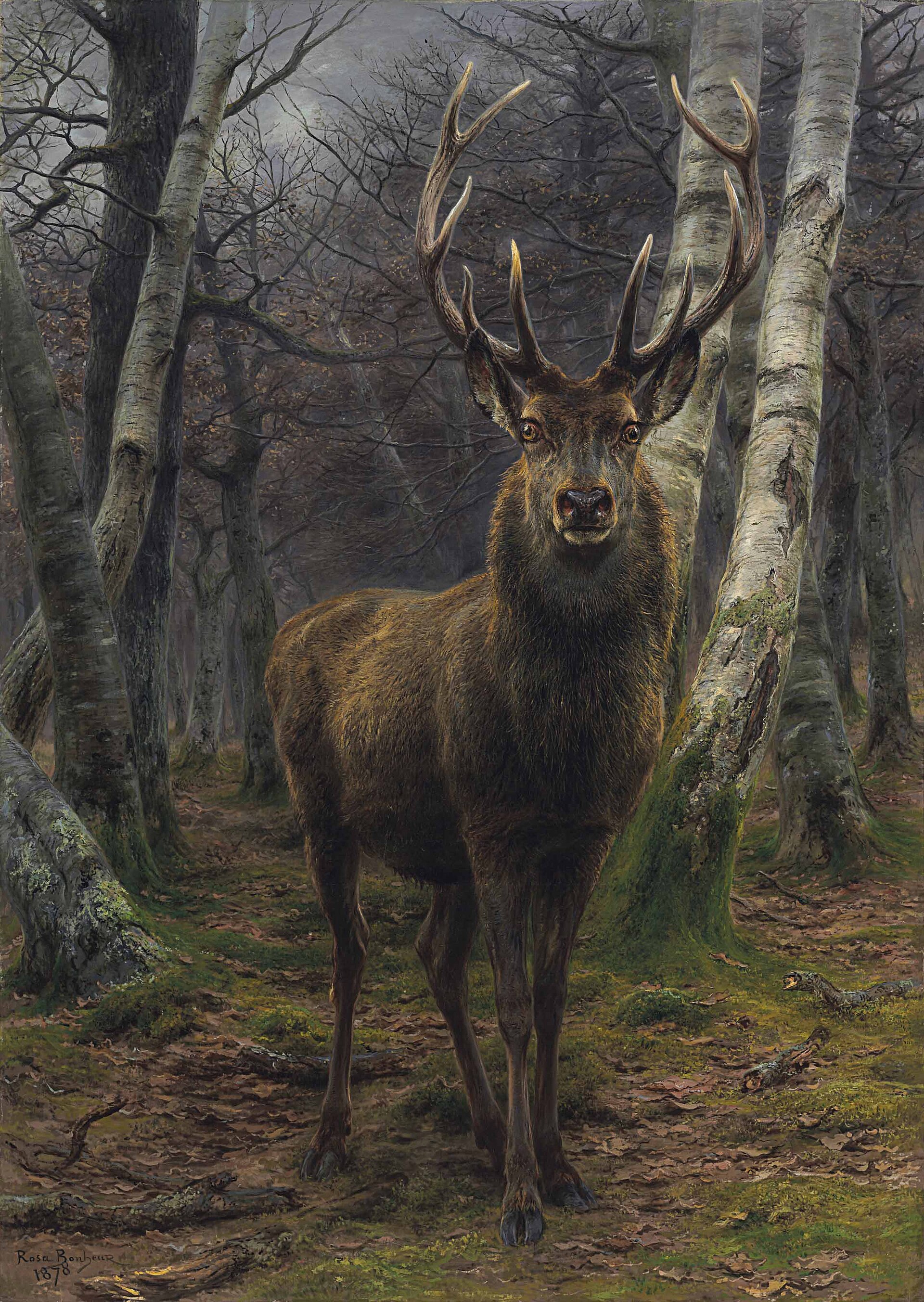
| 23 May 2017 | Christie's, New York, 19th Century European Art, lot 24 | Le Roi de la foret, 1878, 244.8 by 175 cm | Hammer not published in the source read With premium USD 607,500 price realised; premium treatment not stated USD | Estimate USD 800,000 to 1,200,000. Bought by a private collector. Source is a price database and Wikipedia, not Christie's. |
| 2019 | Coeur d'Alene Art Auction | Emigration de Bisons (Amerique), 1897, tempera and pastel on canvas, 44 by 74 in | Hammer 650000 With premium 123500 (implied, 19 per cent of hammer; derived from the lot page figures, not a stated rate) USD | Lot page data fields: estimate 300,000-500,000, hammer 650,000, final 773,500. Provenance: the artist; Georges Petit, 1897; the Mitchell collection by 1973. The lot page gives the title as Bison in the Snow in one place. |
Hammer is the price at which the bidding stopped; with premium adds the fee the house charges the buyer on top. Hammer price and buyer's premium in the glossary.
Recorded without a public price
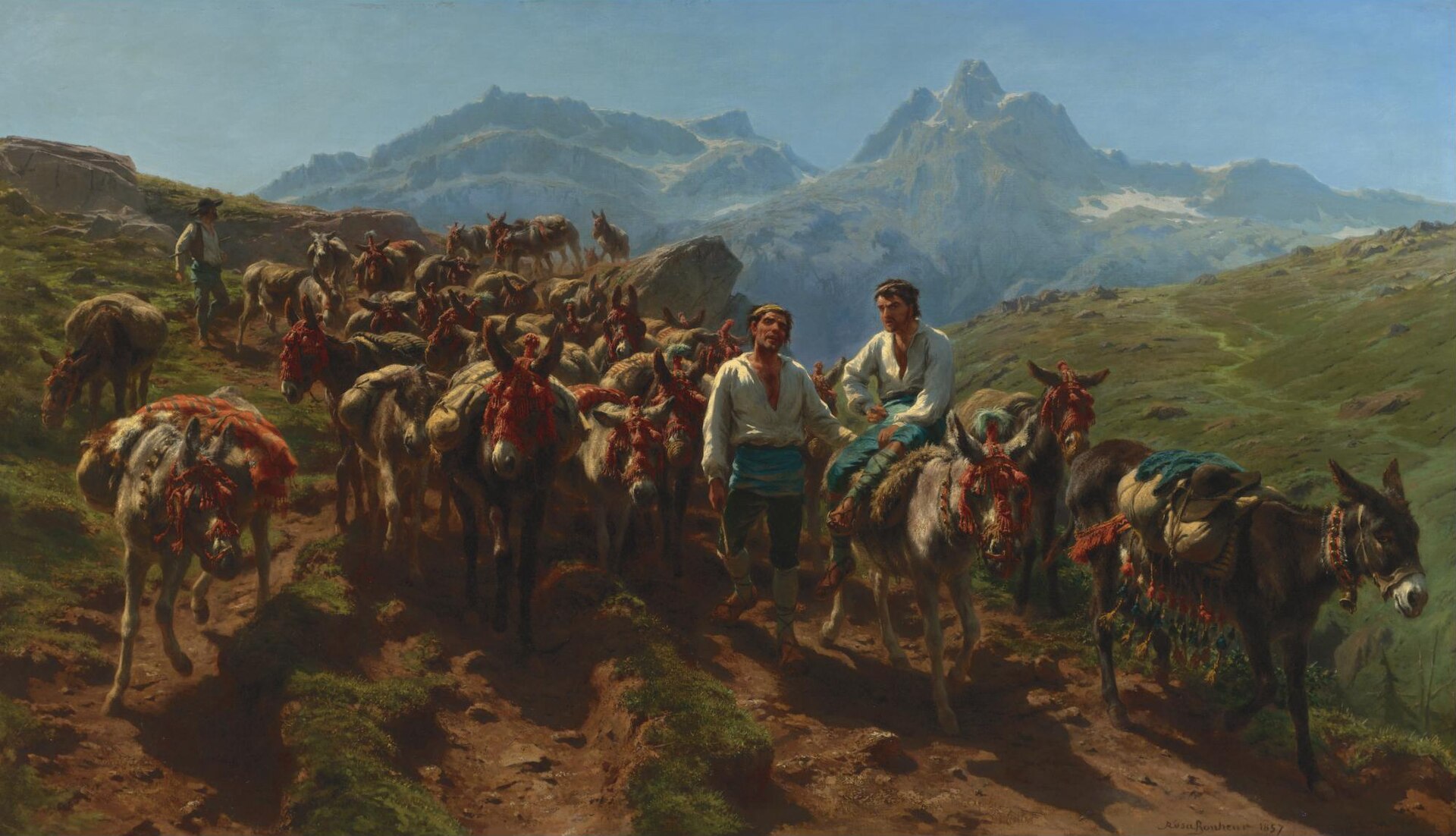
- 2007 · Spanish Muleteers Crossing the Pyrenees, 1857, 116.8 by 200 cm · Sotheby's, New York, 19th Century European Art, lot 120 · result not retrieved (requires login) Estimate USD 150,000 to 200,000. Provenance from Gambart and Christie's 1861 to Dodge and Christie's 1992.
Where to see the work
| Institution | City | Holdings | Note |
|---|---|---|---|
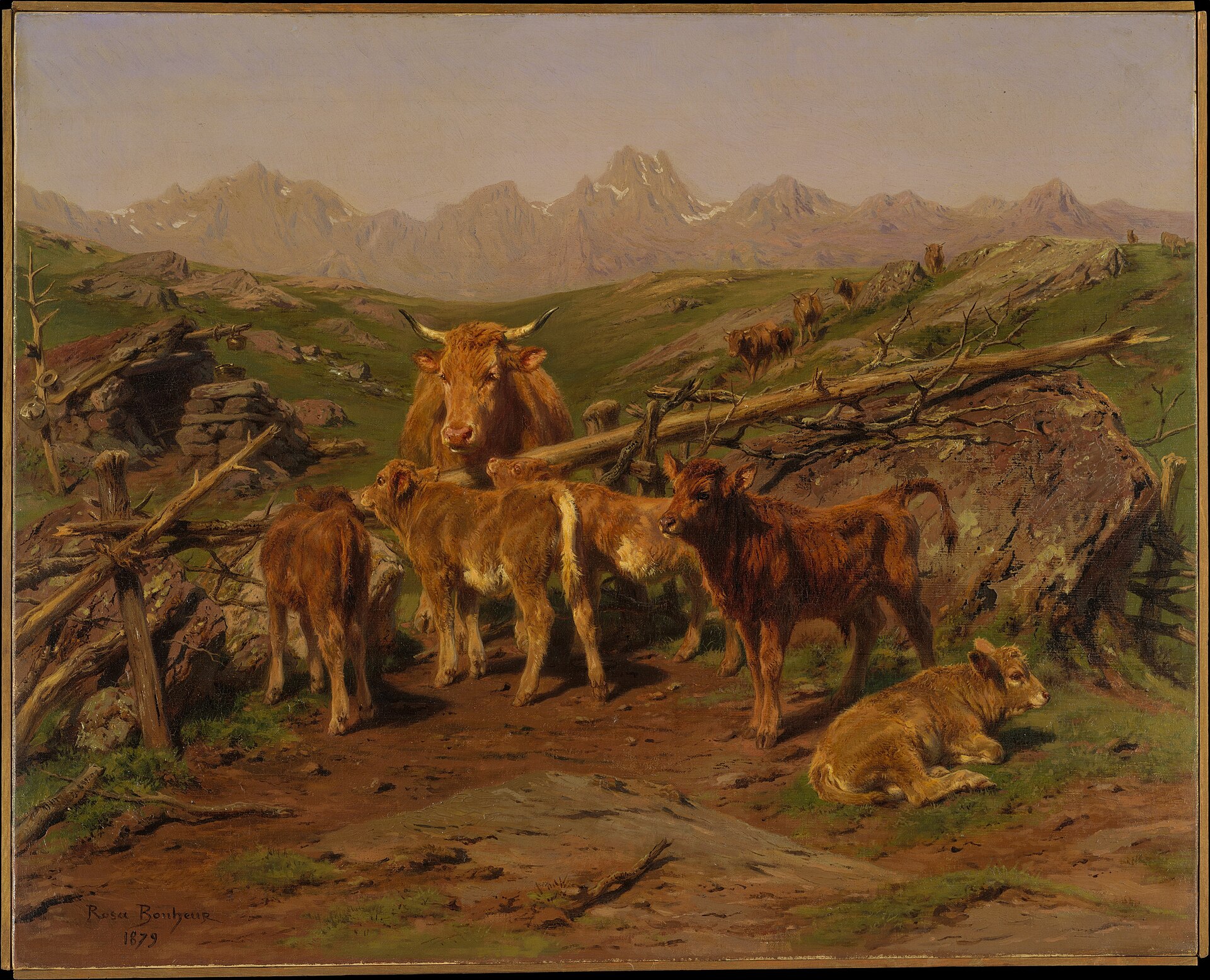
| Metropolitan Museum of Art | New York | The Horse Fair (87.25); Weaning the Calves (87.15.109); sheet of studies for The Horse Fair (1991.463); Klumpke's 1898 portrait of Bonheur (22.222) | Gift of Cornelius Vanderbilt 1887; Weaning the Calves is the Wolfe bequest 1887. |
| Musee d'Orsay | Paris | Ploughing in the Nivernais (RF 64) | Bought by the state in 1849. The museum's site was down when checked. |
| National Gallery | London | The Horse Fair, reduced version (NG621) | Room 13 per the Gallery catalogue page (its conservation article says Room 45); original frame. |
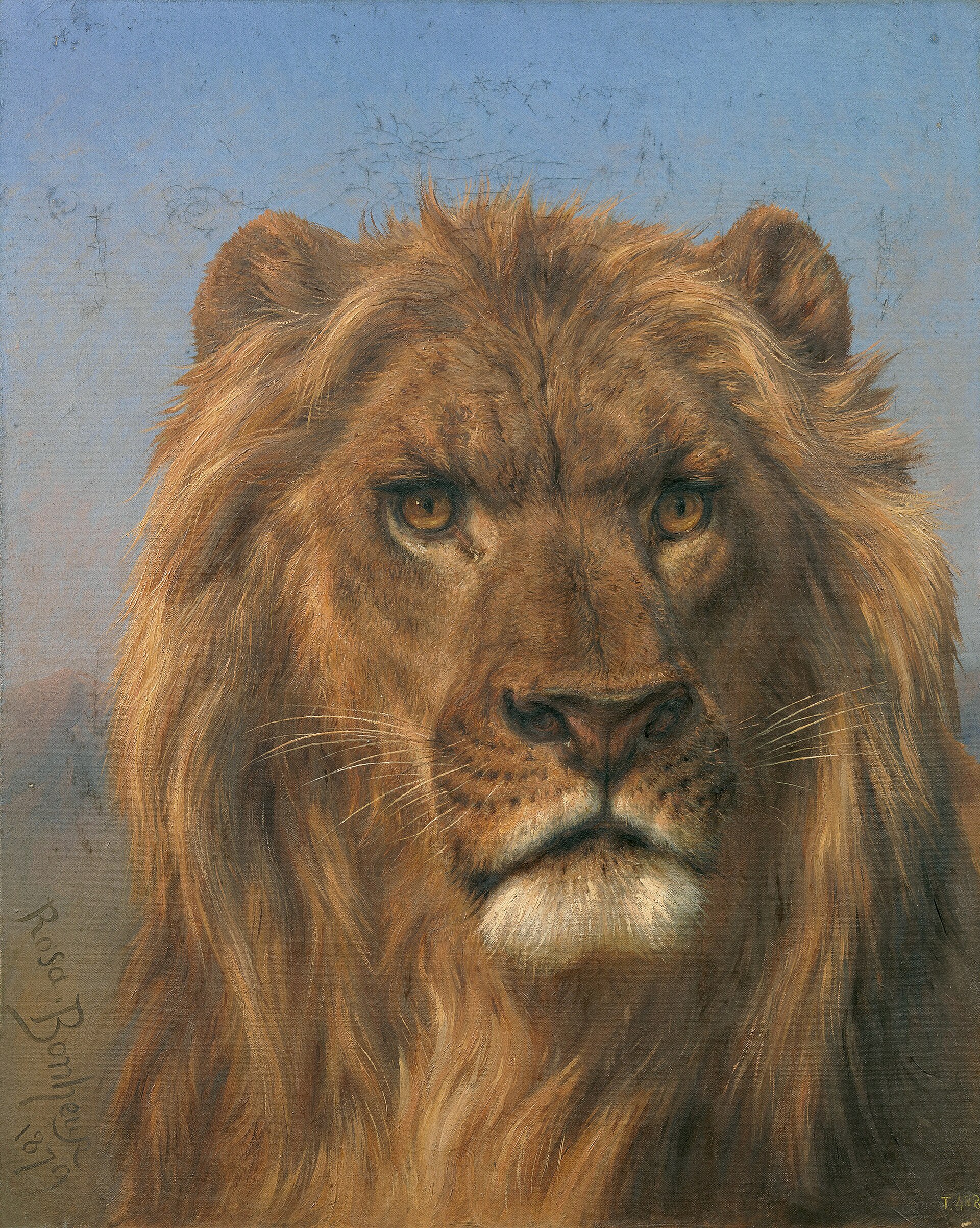
| Museo del Prado | Madrid | Lion head, 1879 (P4318) | Klumpke's list calls it A Young Prince. |
| Buffalo Bill Center of the West | Cody, Wyoming | Col. William F. Cody (Buffalo Bill), 1889 (8.66) | Painted at the Chateau de By per the museum label. |
| Getty Research Institute | Los Angeles | Sketchbook 850837, shared with Raimond Bonheur | Fully digitised; the only shared sketchbook in a public collection. |
| Chateau-Musee Rosa Bonheur | Thomery | Her house and studio, with daily-life objects | Reopened 2018 under the Brault family; private museum. |
| Musee des Beaux-Arts de Bordeaux | Bordeaux | Portraits of Rosa by Raimond (1826) and Auguste (1848); reported to hold the unfinished wheat-threshing canvas | The wheat-threshing location comes from search results, not a museum record. |
Forgeries and misattributions
- No forgery case documented
- No named forger, trial or exposed fake was found in any source read for this page. Not applicable. The documented risks are attribution, not forgery: stamped studies, pictures finished by Micas or Klumpke, and works by her brothers and father.23
- Getty sketchbook 850837
- Catalogued for years as Rosa Bonheur's alone and dated from its lot number. It is a shared book of Raimond and Rosa Bonheur. This is a misattribution, not a forgery. Alexandra Morrison matched it to lot 1847 of the 1900 sale and read two hands, two page orientations and the inscription that it belongs to R. Bonheur.4
The essay
Chapter 1No published count of the work
No catalogue raisonne of Rosa Bonheur has been published.
No catalogue raisonne of Rosa Bonheur has been published. The searches made for this page found no complete list, no authentication committee and no figure for how many paintings, drawings and sculptures are accepted. The nearest thing to a census is the sale catalogue of her studio, Atelier Rosa Bonheur, prepared by Leon Roger-Miles and printed by Georges Petit in 1900. Volume I covers the paintings sold from 30 May to 2 June 1900 and volume II the watercolours, drawings, prints and bronzes sold from 5 to 8 June. Volume II alone runs from lot 893 to lot 2102, and its last stretch is her own collection of other artists' work, so the lots by her are fewer than the numbers suggest.
Two later lists exist and neither claims to be complete. Klumpke closed her 1908 biography with a list headed principal works, year by year, with the engravers named. Rosalia Shriver's 1982 book carries a checklist of works in American collections only. For the modern scholarly picture the reference is the catalogue of the 2022 exhibition shown at Bordeaux and then at the Musee d'Orsay, with more than two hundred works in the room according to one reviewer. It is an exhibition catalogue, and the review that describes its structure doesn't present it as an attribution list.
Chapter 2The studio stamp is the nearest thing to a passport
The conditions of sale printed in both volumes of the 1900 catalogue say that the pictures, studies and drawings not signed by the artist bear one of two stamps reproduced on the page.
The conditions of sale printed in both volumes of the 1900 catalogue say that the pictures, studies and drawings not signed by the artist bear one of two stamps reproduced on the page. Buyers paid five per cent over the hammer price and the sale was for cash. That one line explains why so much of what reaches the market under her name carries a stamp where a signature would be.
The catalogue doesn't say who applied the stamps or on what test. The stamp shows at most that the work was in the sale, run by Klumpke, the auctioneer Paul Chevallier and the experts Georges Petit and Tedesco Freres. It doesn't say which pictures were finished by someone else. A work with a signature in her hand, a Salon record or an engraving made under her eye stands on firmer ground than a stamped study.
Chapter 3What the standard account gets wrong
Three things repeat in nearly every biography and need correcting from the primary record.
Three things repeat in nearly every biography and need correcting from the primary record. First, the trouser permit. The only permit found for this page, reproduced on Commons, is dated Paris, 12 May 1857, headed renouvellement, and issued to Mademoiselle Rosa Bonheur of the rue d'Assas for reasons of health. It allows her to dress as a man but forbids it at spectacles, balls and other places of public assembly, and it is valid for six months from its date. Gretchen van Slyke wrote a 1998 article on Bonheur's cross-dressing permits, but only its abstract was read here. The year 1852 that circulates as the date of the first grant comes from secondary sources and the searches made for this page found no document for it.
Second, the medal and the commission. Klumpke has Bonheur saying that most of her biographers claim the gold medal came from Ploughing in the Nivernais, when the gold medal of 1848 won the commission for it. The state order was a ploughing subject, no more, at 3,000 francs, and the first instalment was 1,500 francs.
Third, the youth in breeches. Klumpke gives Bonheur's own denial: she didn't run about Paris dressed as a boy in her youth, as some biographers had it, and took to trousers only when she began studying oxen in abattoirs and horses in markets after her first Salon pictures. She called the costume her working dress and nothing more.
Chapter 4A family firm, and who was left out of it
Bonheur's father Raimond (1796-1849) was her only teacher, by her own account, and the household ran as a drawing studio.
Bonheur's father Raimond (1796-1849) was her only teacher, by her own account, and the household ran as a drawing studio. Her brothers Auguste (1824-84) and Isidore (1827-1901) and her sister Juliette (1830-91) all became artists. Klumpke records Bonheur saying that she lent her brothers her drawings, shared with them the price of pictures they had worked on together, and gave her brother-in-law Hippolyte Peyrol her rights in the animal sculptures he still cast in bronze, and drew important compositions for him on lithographic stone. She stopped exhibiting sculpture once she saw how good Isidore was at it. Anyone buying a bronze of a bull or a horse under her name has to ask which of the family modelled it and which foundry cast it, and this page has no edition data to give.
The best-documented erasure is her father's. A sketchbook in the Getty Research Institute, bought in 1985 and long catalogued as Rosa Bonheur's alone, was identified in 2025 by Alexandra Morrison as lot 1847 of the 1900 sale and as a book that Raimond bought before 1841 and Rosa then used into the 1850s. Its first half is hers, its second half his, and the notation on the back leaf says that it belongs to R. Bonheur, which is the father's name as much as the daughter's. Three other sketchbooks the two shared were sold in the same sale as lots 1839 to 1841 and are untraced.
Nathalie Micas (1824-89) is the other name the record underplays. Klumpke has Bonheur saying that Micas traced her drawings and transferred them exactly to the canvas so as to spare her the preparation, and that Micas started the reduced copy of The Horse Fair that Bonheur finished. Micas kept the ledger in which every picture and every price was entered, she negotiated the sale of the large Horse Fair and she took out a patent of her own, for a railway brake that the engineers refused because it came from a woman's head. Her sketchbooks were sold in 1900 as lots 1837 and 1838, which the catalogue gives to her alone. The two women were partners for decades, over forty years by Wikipedia's count and fifty by Morrison's.
Chapter 5How she worked
Bonheur was registered as a copyist at the Louvre on 9 August 1838, at sixteen.
Bonheur was registered as a copyist at the Louvre on 9 August 1838, at sixteen. She later described reading anatomy books and making synoptic tables as memory aids, going to the abattoirs, and keeping diary lists of tasks such as preparing coloured papers for oil sketches, drawing cow and horse compositions, studying bulls and reading Richard of the Cantal on the make of the horse. Those entries are in Klumpke's biography, taken from her notebooks.
For The Horse Fair she went in men's clothes to the horse market on the boulevard de l'Hopital in the final months of preparation, according to Morrison, and Wikipedia says she went twice a week from the summer of 1850. The Getty sketchbook shows two early layers under that work: a horse copied from Dirck van Bergen's Landscape with a White Horse in the Louvre, and rough outlines on leaf 43 that match a sheet of studies in the Metropolitan Museum, where a second sketch of four horses seems to follow Gericault. Morrison reads those sheets as showing that the project reaches back into her father's lifetime, in line with the biographers' claim of an idea dating from the early 1840s, and names the Parthenon frieze as one source of the studies.
Klumpke reports that in old age Bonheur no longer took a paint box outside. She looked at the scene for a long time and took what she called mental notes, and once drew trees on a torn thank-you card at dusk. She told Klumpke she had taken up pastel after her promotion in the Legion, and in her last months she said she needed a house painter to cover the sky of the large unfinished canvas of wheat threshing in the Camargue so that she could work the details into the wet paint. Klumpke volunteered.
Chapter 6Money in her lifetime
The figures that survive come from Klumpke and from the ledger Micas kept, which Klumpke quotes but which isn't known to survive.
The figures that survive come from Klumpke and from the ledger Micas kept, which Klumpke quotes but which isn't known to survive. For the state's Ploughing in the Nivernais Bonheur was to receive 3,000 francs and was paid 1,500 on account, which she remembered as three banknotes. In 1852 the minister Charles de Morny commissioned Haymaking in the Auvergne at 20,000 francs, choosing the safe rural subject over the horse market she had proposed. A smaller picture of cows and sheep sold to him in 1853 had been agreed at 4,000 francs and was paid at 3,000, though Micas thought it could have fetched 6,000.
The Horse Fair found no buyer at Ghent in 1853. At Bordeaux in 1854 she offered it to her native city at 15,000 francs and the commission didn't reply. When the London dealer Ernest Gambart came to ask the price, Micas, who handled the money, said that if the picture left France it wouldn't go for less than 40,000 francs. He accepted at once. The duc d'Aumale, to whom she sent a Pyrenean shepherd in 1864 at an asking price of 5,000 francs, paid 10,000. Morrison says the sale of the canvas allowed her to buy the Chateau de By in 1860.
No source consulted here gives a wage or a house price for the 1850s, so no modern equivalent is offered for any of these sums. The comparison the record does support is internal: the Horse Fair fetched thirteen times the sum paid for Ploughing, and the 1887 price was nearly seven times what Gambart paid thirty years earlier.
Chapter 7The Horse Fair and its copies
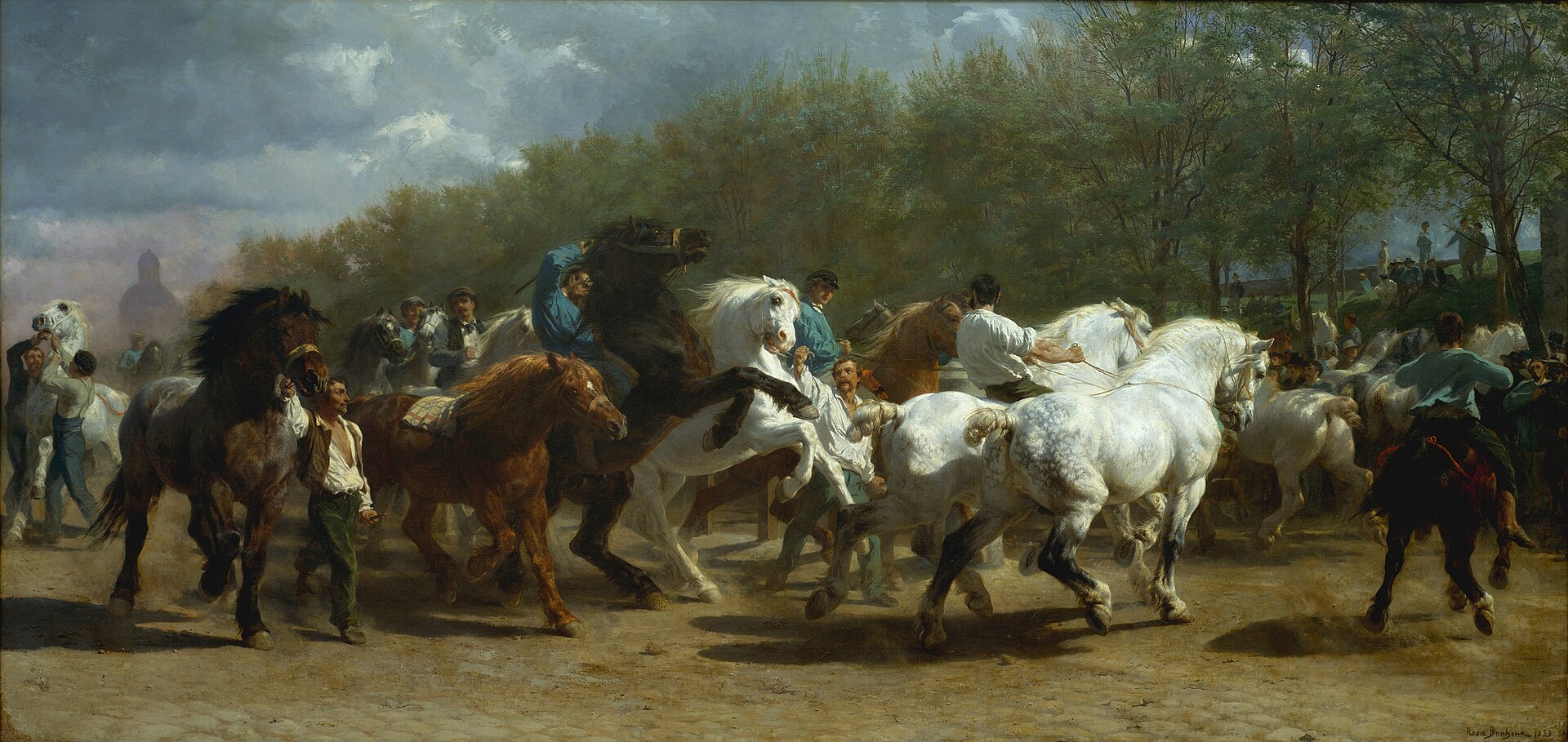
The large canvas, 244.5 by 506.7 centimetres, is at the Metropolitan Museum as accession 87.25, the gift of Cornelius Vanderbilt in 1887.
The large canvas, 244.5 by 506.7 centimetres, is at the Metropolitan Museum as accession 87.25, the gift of Cornelius Vanderbilt in 1887. It shows the horse market on the boulevard de l'Hopital with the dome of the Salpetriere at the left. Gambart toured it in Britain from 1855 (Wikipedia), sold it to William Wright, and by Klumpke's account it passed to a collector named in her book as Stuart, who is the New York dealer Alexander Turney Stewart in the Wikipedia account. At the Stewart sale in 1887 it made 268,000 francs. Klumpke gives that sum with a dollar figure that her scan prints as 55,500 (the OCR reads it as S 55.5oo), and Wikipedia gives 53,000 dollars, bought in March 1887 with Vanderbilt giving the picture to the museum at once. The two dollar figures disagree and neither source says whether commission is in them.
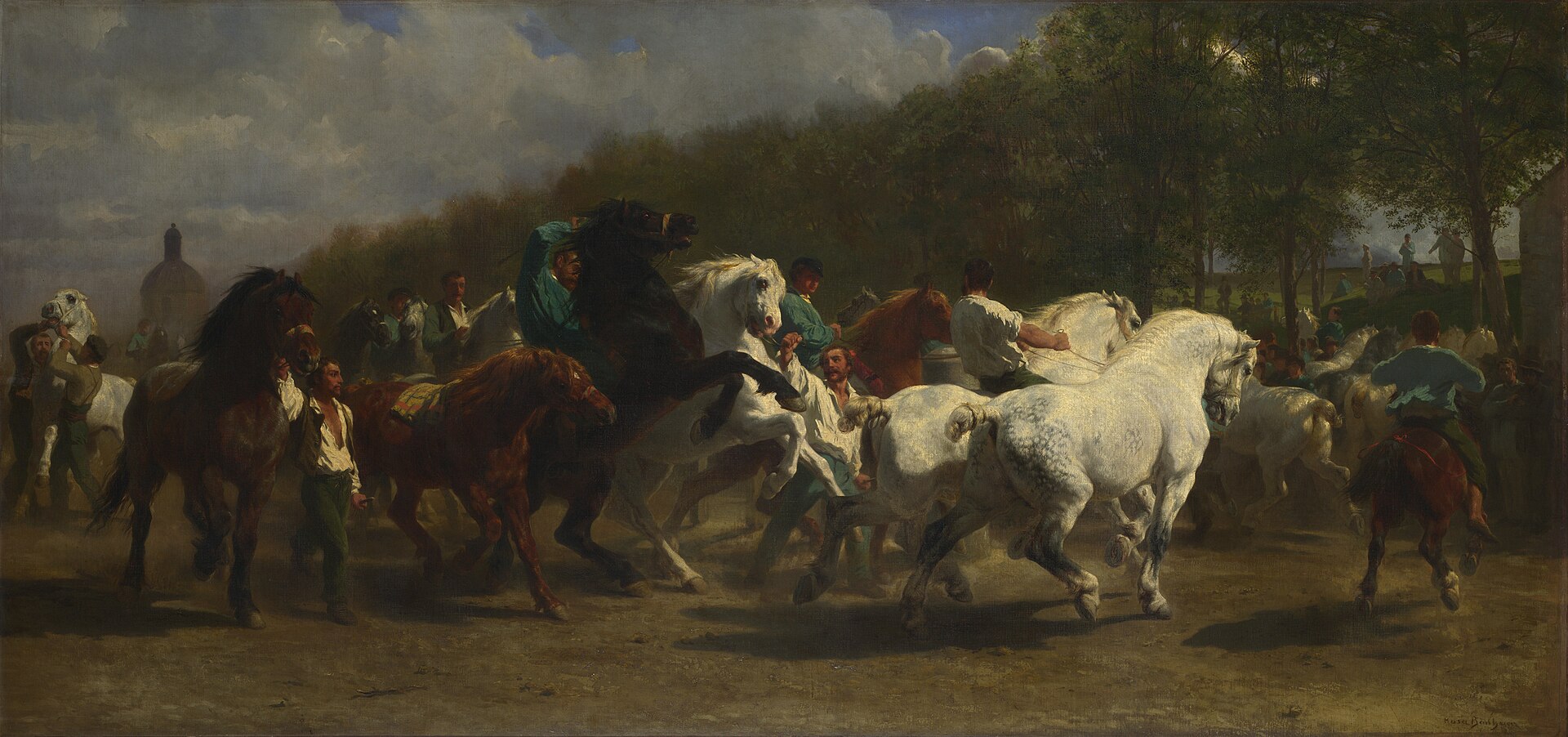
The smaller version is National Gallery NG621, 120 by 254.6 centimetres, bequeathed by Jacob Bell in 1859 and delivered in 1865. The National Gallery calls it a smaller autograph version made so that Thomas Landseer could engrave the picture while the original toured. Bonheur told Klumpke the history differently. She had offered Gambart a copy a quarter of the original size, Micas began it and she finished it, and when she learnt that Bell had left it to the Gallery she painted a second original from her studies to replace it. The trustees couldn't accept it because of the terms of Bell's will. The Gallery gives another reason for the offer, that she was unhappy with its condition, and says she restored this one herself and signed it as her own. Its page doesn't mention Micas.
There is also a claim that she painted a self-portrait into the middle of one of her pictures. The National Gallery states it for The Horse Fair without saying where or in which version, and Wikipedia says it has been suggested without a named source. This page records it as an unlocated claim.
Chapter 8What she believed, and what she didn't hide
Bonheur's father joined the Saint-Simonians in the early 1830s, and the family took part.
Bonheur's father joined the Saint-Simonians in the early 1830s, and the family took part. In Klumpke's record of what Bonheur told her, her mother offered to enrol too and was given no place except the care of her children, and Bonheur bought the main Saint-Simonian works later in life to understand what she had lived through. Her father wrote in a one-issue paper called the Carnet du Theo-gyno-demophile, the friend of God, of woman and of the people. Bonheur said those scenes weren't without influence in keeping her from marriage. That is her own statement of what the movement did to her.
Her stated religion is plain. She told Klumpke, a Protestant, that she rejected absolution bought by indulgences or candles and believed in the justice of God, in this world or the next. Klumpke adds that she gave animals a soul subject to mysterious metempsychoses, that Descartes's theory of animal machines made her angry, and that a note in her papers calls the horse the most beautiful or the most wretched of creatures like man. She called herself a convinced republican and said she went to see Morny, who had organised the coup, with a kind of inner trembling.
No hidden programme is documented in the pictures. The intention she stated for Ploughing in the Nivernais was to honour the making of the furrow from which the bread of all mankind comes. A link to George Sand's La Mare au Diable has been proposed, and a 1899 notice called the picture a pictorial translation of a novel, but no source read for this page shows that Bonheur named Sand as her model. The picture is an animal and farm subject painted for the state on a republican commission, and the record offers nothing more.
Chapter 9The will, the lawsuit and the sale
Klumpke became sole heir under a will Bonheur signed on 7 November, in 1898 on the order of her narrative.
Klumpke became sole heir under a will Bonheur signed on 7 November, in 1898 on the order of her narrative. Bonheur explained that Klumpke, as a foreigner, would owe about twelve per cent of the value of real property in inheritance duty, whereas a gift during her lifetime would cost little, and she sent the title deeds of the Chateau de By to her notary Tollu so that it could be put in Klumpke's name. She also forbade the family to live at By and told Klumpke that nothing belonging to the Micas family should go to them. Bonheur told Klumpke not to organise a public sale and that if money ran short she should sell a study.
Her liquid fortune was about 300,000 francs. When Klumpke went to the Tedesco brothers, who held it on deposit, they told her the studio held far more and offered 1,500,000 francs for the lot, recalling that their father had offered one million forty years earlier and had been told to leave her in peace. Morrison's note on the sale gives the offer as one million, a figure Klumpke attaches to the father's earlier offer. Klumpke balked at selling because she would lose the right to reproduce the studies. Her notary told her the only choices were to take the offer or to sell by auction.
Then the family sued, alleging that she had obtained the will by hypnotising Bonheur. The seals were lifted for the inventory and the cardboard folders of studies were found everywhere. The case was settled after about a year with half of the net proceeds going to the Bonheur family. The sale was held at the Galerie Georges Petit from 30 May to 8 June 1900 and, in Klumpke's account, lasted nine days. It made 1,181,498 francs, which she calls remarkable given the abundance of similar works, though under the 1,500,000 offered. After costs the net was 799,209 francs and the family's half 399,604. Fifty studies were set aside for the Luxembourg museum. Klumpke bought back many studies, and the unfinished wheat-threshing canvas went back to its place in the studio.
Chapter 10Fame, engravings and the state
Her reputation was manufactured partly by print.
Her reputation was manufactured partly by print. Gambart commissioned Thomas Landseer's engraving of The Horse Fair and the portrait of Bonheur by Edouard Dubufe with a bull's head at her side, which she says was ordered by Gambart, was improved by the live bull's head she asked for in place of a table, and whose engraving sold better with her signature. Klumpke's list of principal works names engravers against year after year. The picture toured Britain and America, and Klumpke dates her popularity in America to 1858.
The state used her too. The Empress Eugenie visited the Chateau de By in 1864 and presented the cross of the Legion of Honour in 1865. In September 1870 the Prussian Crown Prince's headquarters issued an order that her property and chateau at By be respected, and she kept the paper. Klumpke gives 1894 for her promotion to officer of the Legion after the Chicago exposition, while Morrison's note dates it to 1893. A monument to her, with a bronze bull by Isidore Bonheur and Peyrol and reliefs after her two best-known pictures, was put up at Fontainebleau in 1901, and Wikipedia says it was destroyed in 1941.
In 1889 she painted Colonel William F. Cody on horseback after he had brought Buffalo Bill's Wild West to Paris and visited her. The picture, signed 1889, is in the Buffalo Bill Center of the West. The 2019 essay on her bison pastel ties that picture to the same interest in the American West.
Chapter 11Reputation, loss and return
Wikipedia records that a critic in 1978 called Ploughing in the Nivernais entirely forgotten and that Paul Cezanne found it horribly like the real thing.
Wikipedia records that a critic in 1978 called Ploughing in the Nivernais entirely forgotten and that Paul Cezanne found it horribly like the real thing. Those are tertiary reports and the primary texts weren't read. The recovery is documented: the 2022 bicentenary exhibition was shown at Bordeaux from 18 May to 18 September and at the Musee d'Orsay from 18 October 2022 to 15 January 2023 (the National Gallery gives 17 October for the opening), and Katherine Brault is named among its curators in the review read here. For the Chateau de By, a Maisons des Illustres house since 2011, Wikipedia alone says it reopened in 2018 under the Brault family, who bought it in September 2017 from people it calls descendants of Anna Klumpke; the article names no source and no seller, and this page has not confirmed the sale or the seller.
Chapter 12The market now
The best sums in the record are modest beside her fame.
The best sums in the record are modest beside her fame. The highest figure the searches found is 773,500 dollars for a large pastel of bison, signed and dated 1897 and shown at Galerie Georges Petit that July, sold by the Coeur d'Alene Art Auction in 2019 from a collection where it had been since at least 1973. The auction's own lot page carries a hammer figure of 650,000 dollars against a final figure of 773,500 and an estimate of 300,000 to 500,000; the 123,500 dollars between them is a premium of 19 per cent, which is an inference from the two figures, not a stated rate. A second price is 607,500 dollars for Le Roi de la foret (1878, 244.8 by 175 centimetres) at Christie's New York on 23 May 2017, below an estimate of 800,000 to 1,200,000, according to a price database that doesn't state premium treatment. Other searches gave other figures for the record and none of them could be confirmed.
The cohort for the large canvases is small because the best are in museums. Le Roi de la foret was bought by Gambart in 1878, sold at his estate sale at Christie's London on 2 May 1903 as On the Alert, and passed through Tooth, Knoedler, Charles Schwab and Geraldine Rockefeller Dodge before the Dodge sale at Sotheby's New York in December 1975. A 1857 canvas of Spanish muleteers had the same sort of chain, from Gambart through Christie's in 1861 and 1888 to Dodge and to a Christie's sale of 1992, and was offered at Sotheby's New York in 2007 at 150,000 to 200,000 dollars. The result page needs a login and wasn't read.
What is documented
Technique
The surviving work
- What is accepted
- No figure is published by anyone. The nearest count is the 1900 studio sale, which Morrison puts at some two thousand paintings, works on paper and sculpture, and whose two catalogue volumes run to lot 2102 including her collection of other artists.
- What is contested
- There was never an official number to revise. The recorded disputes are between sources: whether Tedesco offered one million or one million five hundred thousand francs, whether she became officer of the Legion in 1893 or 1894, whether the chateau was bought in 1859 or 1860, and whether Micas should be credited on NG621.
- Who rules on attribution
- No active authority. No committee or board was found, and the searches for this page did not confirm any person or foundation that rules on attribution. Annie-Paule Quinsac wrote the essay for the 2019 bison pastel sale, and this page doesn't claim she is an authority. The Chateau de By holds a studio archive, but its role in authentication was not confirmed.
Catalogue raisonne
- Leon Roger-Miles, Atelier Rosa Bonheur, 2 vols (Paris: Georges Petit, 1900) The sale catalogue of the studio. Volume I covers paintings, volume II watercolours, drawings, prints and bronzes. Both volumes print the conditions of sale and the two studio stamps.23
- Anna Klumpke, Rosa Bonheur, sa vie, son oeuvre (Paris: Flammarion, 1908) Biography with a list of principal works by year and engraver. It is a selection.1
- Rosalia Shriver, Rosa Bonheur, with a checklist of works in American collections (Philadelphia: Art Alliance Press, 1982) A checklist of American holdings only; 111 pages.23
Questions about Rosa Bonheur
Who was Rosa Bonheur?
Painter; Sculptor; Draughtswoman. 1822-1899.
When did Rosa Bonheur live?
Born 16 March 1822, Bordeaux; died 25 May 1899, Chateau de By, Thomery, near Fontainebleau.
How are fakes and misattributions of Rosa Bonheur detected?
No forgery case documented. No named forger, trial or exposed fake was found in any source read for this page.
Where can you see work by Rosa Bonheur?
Metropolitan Museum of Art (New York); Musee d'Orsay (Paris); National Gallery (London); Museo del Prado (Madrid); Buffalo Bill Center of the West (Cody, Wyoming); Getty Research Institute (Los Angeles).
What does the market for Rosa Bonheur look like?
The prices recorded in Bonheur's lifetime are in francs and are the best evidence of her value: 3,000 for the state's ploughing picture in 1848, 20,000 for the Haymaking, 40,000 for The Horse Fair. The studio sale of 1900 made 1,181,498 francs for the lot and the recent auction records are around 600,000 to 775,000 dollars all-in.
What is still unresolved about Rosa Bonheur?
How many works are there? No catalogue raisonne exists, and the count of lots in the 1900 sale mixes her work with that of others she collected.
Open questions
- How many works are there? No catalogue raisonne exists, and the count of lots in the 1900 sale mixes her work with that of others she collected.
- Where is the ledger in which Nathalie Micas entered every work and price, which Klumpke quotes in 1908? Nothing read for this page shows that it survives.
- Where in the picture is the self-portrait the National Gallery says she painted into The Horse Fair, and in which version? The Gallery doesn't say.
- Did Tedesco offer one million or one million five hundred thousand francs for the studio? Klumpke's text gives 1,500,000 for the offer made to her and 1,000,000 for the offer made to Bonheur forty years before; Morrison's note puts the offer at one million.
- Was Bonheur made officer of the Legion of Honour in 1893 or 1894? Klumpke says 1894 and Morrison says 1893.
- What did each lot of the 1900 sale make? The totals are known; the per-lot prices are in the press of the day (Le Gaulois, Le Radical), which this page has not read.
- How are her bronzes to be catalogued? Her rights in the sculptures were ceded to Peyrol, and Isidore Bonheur modelled too, but no edition data was found.
- What was a franc worth in the 1850s in wages or rent? No source for a period price frame was read.
Sources
- 1Anna Klumpke, Rosa Bonheur, sa vie, son oeuvre (Paris: Flammarion; printed by Georges Petit, 1908), Internet Archive scan, read in full text. Primary memoir, written by the heir from Bonheur's words and papers; its quotations of Bonheur are Klumpke's record. archive.org/details/...
- 2Leon Roger-Miles, Atelier Rosa Bonheur, vol. I, Tableaux (Paris: Georges Petit, 1900), sale catalogue, Internet Archive scan. archive.org/details/...
- 3Leon Roger-Miles, Atelier Rosa Bonheur, vol. II, Aquarelles et dessins (Paris: Georges Petit, 1900), sale catalogue, Internet Archive scan. archive.org/details/...
- 4Alexandra Morrison, 'Like Father, Like Daughter: A Sketchbook Shared by Raymond and Rosa Bonheur, Rediscovered', Getty Research Journal no. 20 (2025), pp. 151-66, read in full. getty.edu/publications/...
- 5National Gallery, London, 'The Horse Fair', NG621, catalogue page. nationalgallery.org.uk/paintings/...
- 6National Gallery, London, 'Why was The Horse Fair chosen for conservation treatment, Hayley?', conservation page. nationalgallery.org.uk/behind-the-scenes/...
- 7Metropolitan Museum of Art, Open Access API record for The Horse Fair, object 435702 (accession 87.25, 244.5 x 506.7 cm, gift of Cornelius Vanderbilt 1887). collectionapi.metmuseum.org/public/...
- 8Metropolitan Museum of Art, Open Access API record for Weaning the Calves, object 435703 (87.15.109). collectionapi.metmuseum.org/public/...
- 9Wikimedia Commons file page for Anna Klumpke's portrait of Rosa Bonheur (Met 22.222, inscription, licence PD-Art), read as wikitext. commons.wikimedia.org/wiki/...
- 10Wikimedia Commons file page, 'Permission de travestissement Rosa Bonheur' (12 May 1857), with transcription; image also viewed. commons.wikimedia.org/wiki/...
- 11Gretchen van Slyke, article on Rosa Bonheur's cross-dressing permits, Nineteenth-Century French Studies 26, nos 3-4 (1998), 321-35, abstract page only. ncfs-journal.org/node/...
- 12JSTOR Daily, 'Rosa Bonheur's Permission to Wear Pants'. Secondary and general; used only for the permit's legal basis. daily.jstor.org/rosa-bonheurs-permission-to-wear-pants
- 13Wikipedia, 'Rosa Bonheur'. en.wikipedia.org/wiki/...
- 14Wikipedia, 'The Horse Fair'. en.wikipedia.org/wiki/...
- 15Wikipedia, 'Ploughing in the Nivernais'. en.wikipedia.org/wiki/...
- 16Wikipedia, 'Chateau de By'. en.wikipedia.org/wiki/...
- 17Wikipedia, 'Anna Klumpke'. en.wikipedia.org/wiki/...
- 18Coeur d'Alene Art Auction, 2019 sale, lot page for Emigration de Bisons (Amerique), 1897, with essay by Annie-Paule Quinsac. cdaartauction.com/2019/...
- 19Sotheby's, New York, 19th Century European Art, 2007, lot 120, Spanish Muleteers Crossing the Pyrenees; result not visible without login. sothebys.com/en/...
- 20Art.Salon price database, Le Roi de la foret, Christie's New York 23 May 2017, lot 24. art.salon/artwork/...
- 21Wikipedia, 'King of the Forest'. en.wikipedia.org/wiki/...
- 22Veronica Uribe Hanabergh, review of 'Rosa Bonheur (1822-1899)', Nineteenth-Century Art Worldwide 22, no. 1 (Spring 2023). 19thc-artworldwide.org/spring23/...
- 23Rosalia Shriver, Rosa Bonheur: with a checklist of works in American collections (Philadelphia: Art Alliance Press, 1982), Internet Archive catalogue record only. archive.org/details/...
- 24Wikimedia Commons file page for Ploughing in the Nivernais (Google Art Project), giving the Orsay inventory RF 64 and 'bought in 1849'. commons.wikimedia.org/wiki/...
- 25Wikimedia Commons file page for Col. William F. Cody, carrying the Buffalo Bill Center of the West display label and accession 8.66. commons.wikimedia.org/wiki/...


Last verified