Rene Lalique
 French · 1860-1945
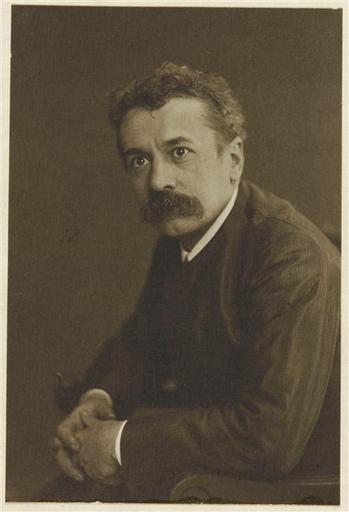
Portrait of Rene Lalique by the photographer Aron Gerschel, 1906, midway through the years in which he was simultaneously running down his jewellery workshop and building his first glassworks. The sitter is identified by the Commons file record and by the Paris photo archive (photo-arago.fr) it is sourced from.
Public domain, via Wikimedia Commons. Photograph by Aron Gerschel, 1906.| Full name | Rene Jules Lalique |
|---|---|
| Worked as | Jeweller, Glass designer, Glassmaker, Founder, Rene Lalique et Cie |
| Born | 6 April 1860 · Ay, Marne, France (the Champagne region) |
| Died | 1 May 1945 · Paris, France |
| Nationality | French |
| Movement | Art Nouveau (jewellery, to c. 1912) |
| Sources | 25 cited |
| Last verified |
About this page Last verified · 25 sources cited
On this page 13 sections
ContentsClose
Rene Lalique had two careers inside one name, and the second one erased the first from most people's idea of who he was. From the 1880s to 1912 he was, on the account of his own contemporaries, the man who reinvented jewellery: he used horn, glass and enamel instead of stones, and his single largest patron, the oil financier Calouste Gulbenkian, bought almost two hundred pieces directly from him between 1899 and 1927, a collection now housed in its own room at the Gulbenkian Museum in Lisbon and still described there as the largest set of Lalique's work in existence. Then, in 1912, Lalique walked away from jewellery entirely and spent the rest of his working life as what he called a creator-industrialist, building a glassworks that mass-produced perfume bottles, vases, car mascots and architectural panels by the tens of thousands. Almost everyone who owns a piece signed Lalique owns glass from the second career; almost everyone who has heard the name associates it with the first.
The two careers do not photograph the same way, and that matters for anyone trying to verify a claim about this maker. Lalique himself has been dead since 1945, long enough that his own designs are out of copyright by any measure. The objects are not. A modern photograph of a piece of jewellery or a glass vase carries its own fresh copyright regardless of how old the object is, because German and most other copyright law's exemption for reproducing two-dimensional works does not extend to three-dimensional ones. Every image on this page is therefore checked for the licence on the photograph itself, not for the age of the object it shows.
The detail most readers do not know is what happened to the name after he died. His son Marc Lalique kept the firm running and kept signing pieces Lalique, but he dropped the R that had prefixed his father's signature since around 1905, and within a few years moved the whole enterprise from glass to lead crystal. A piece signed R. LALIQUE and a piece signed LALIQUE FRANCE were not made by the same hand, were not made from the same material, and were very often not made in the same decade. The rest of this page is organised, as far as the evidence allows, around that distinction.
Images
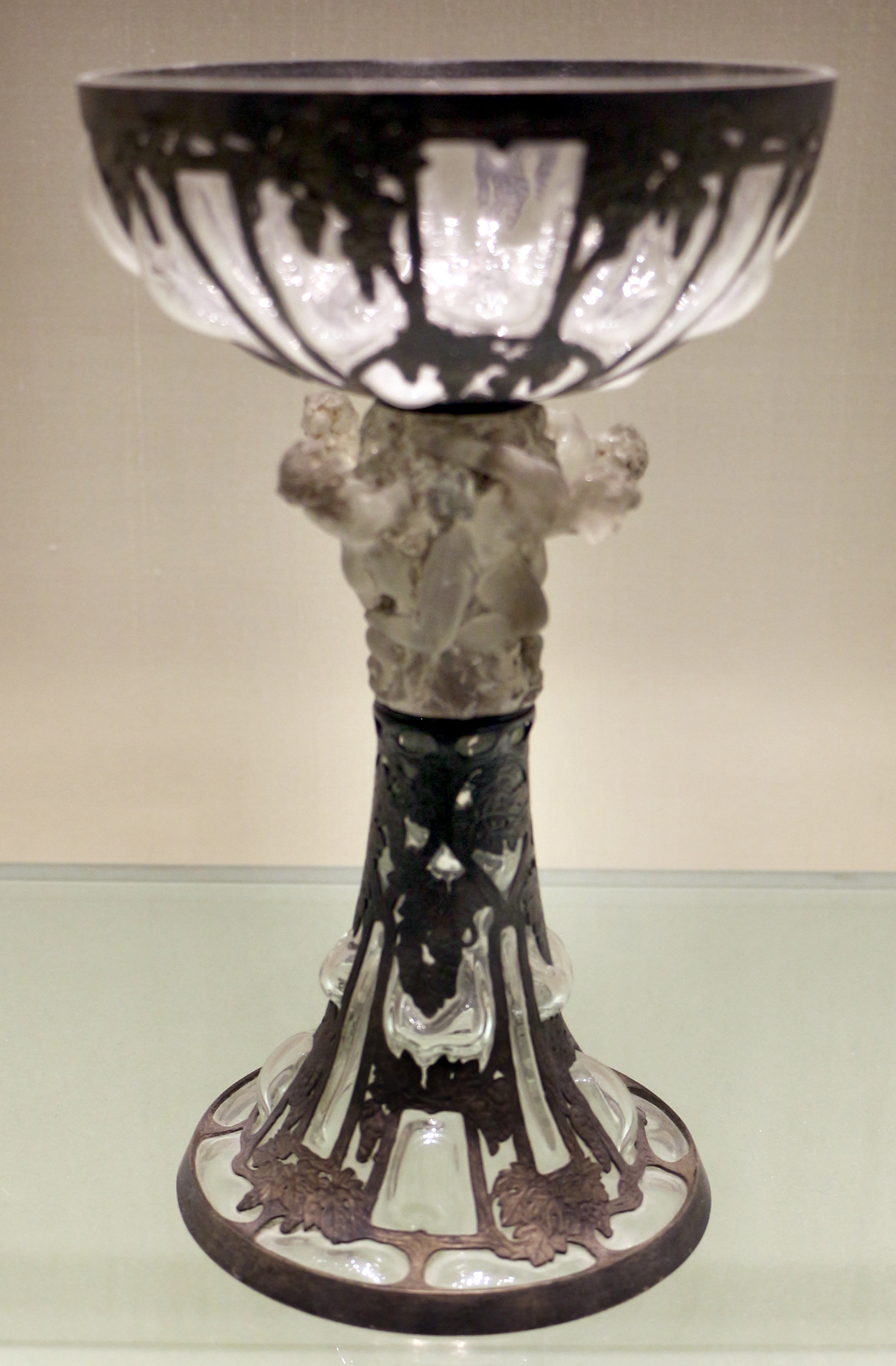
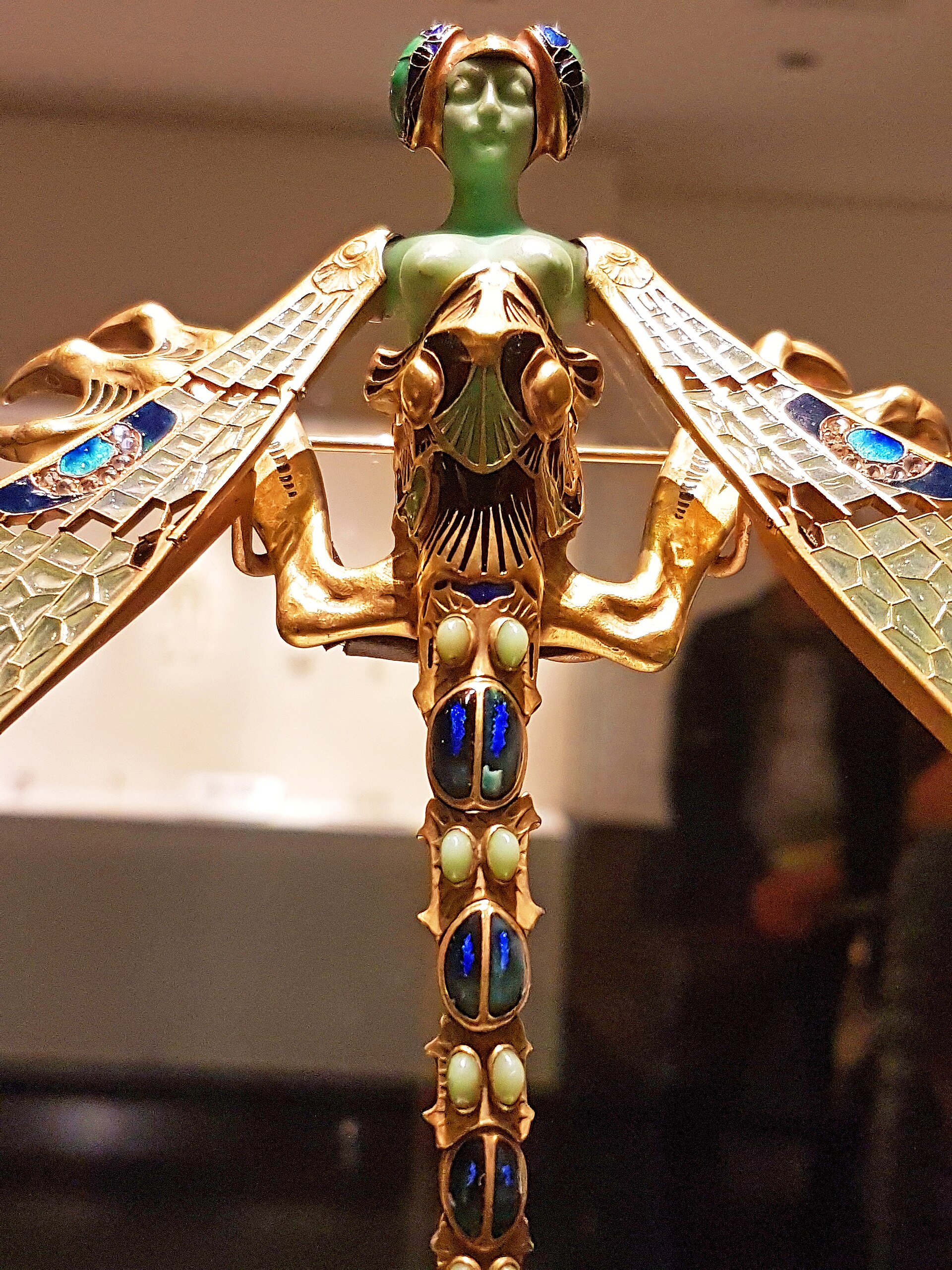
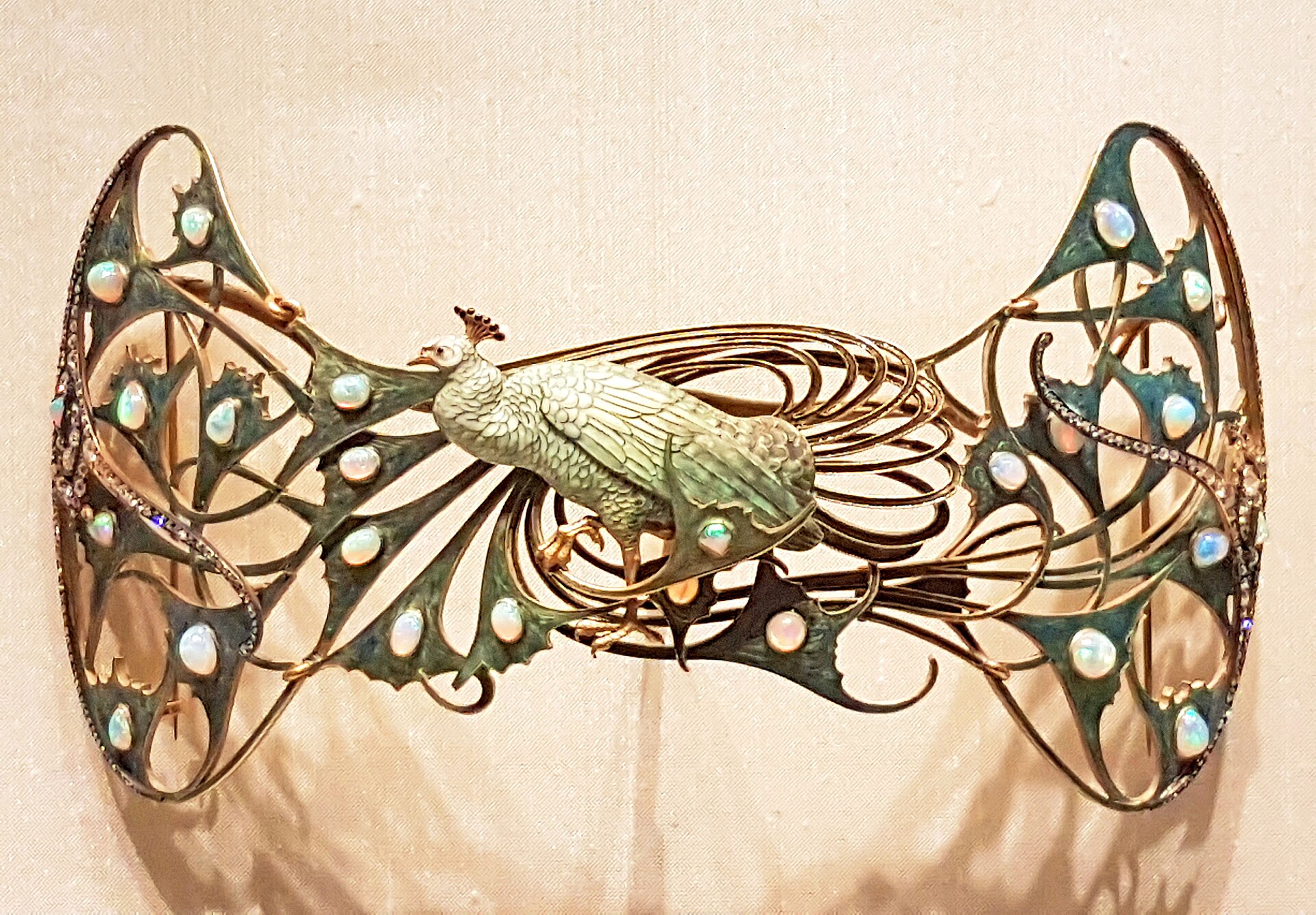
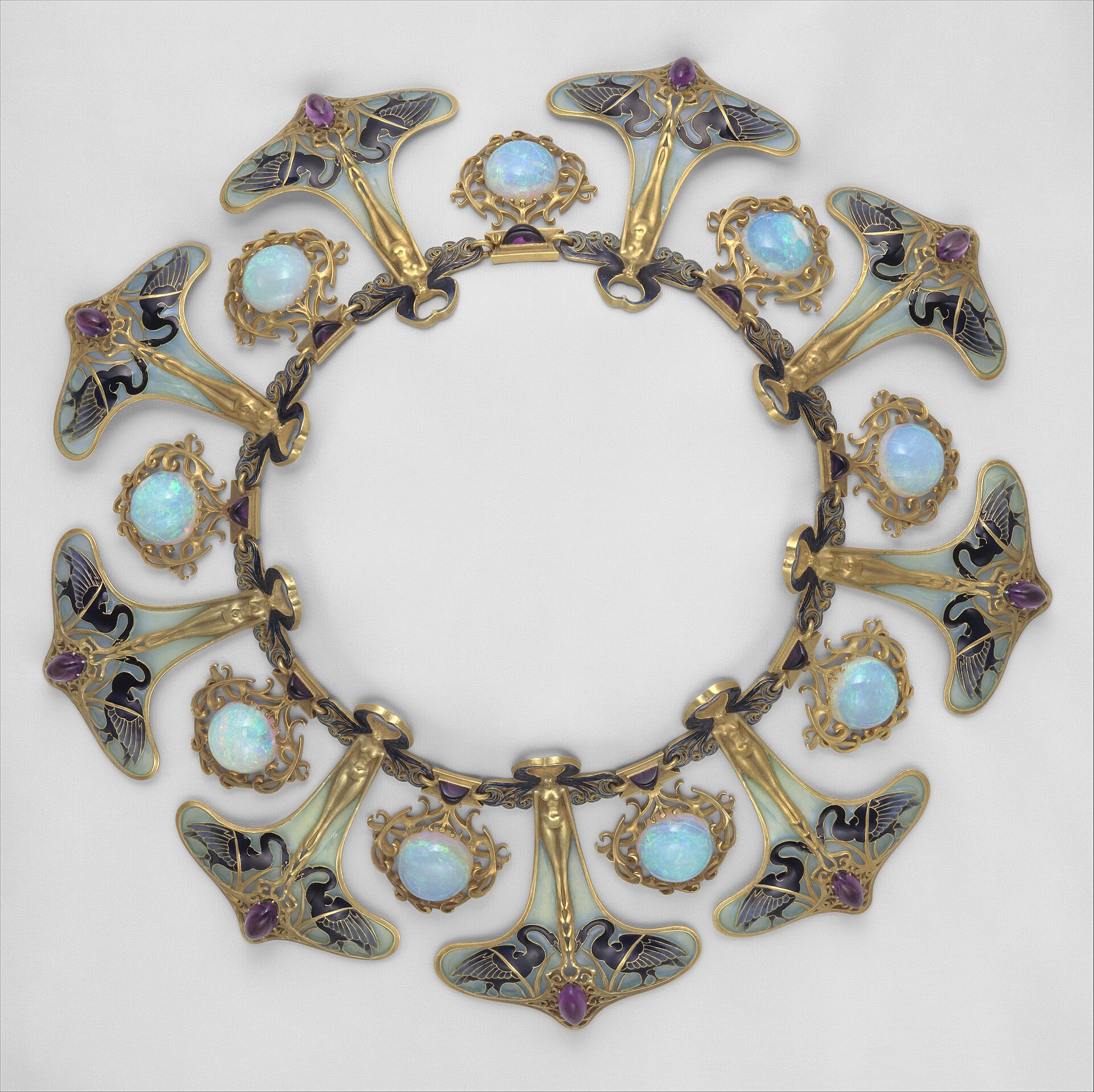
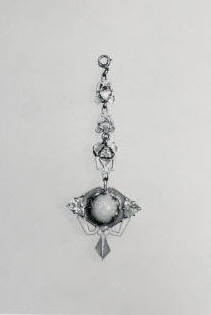
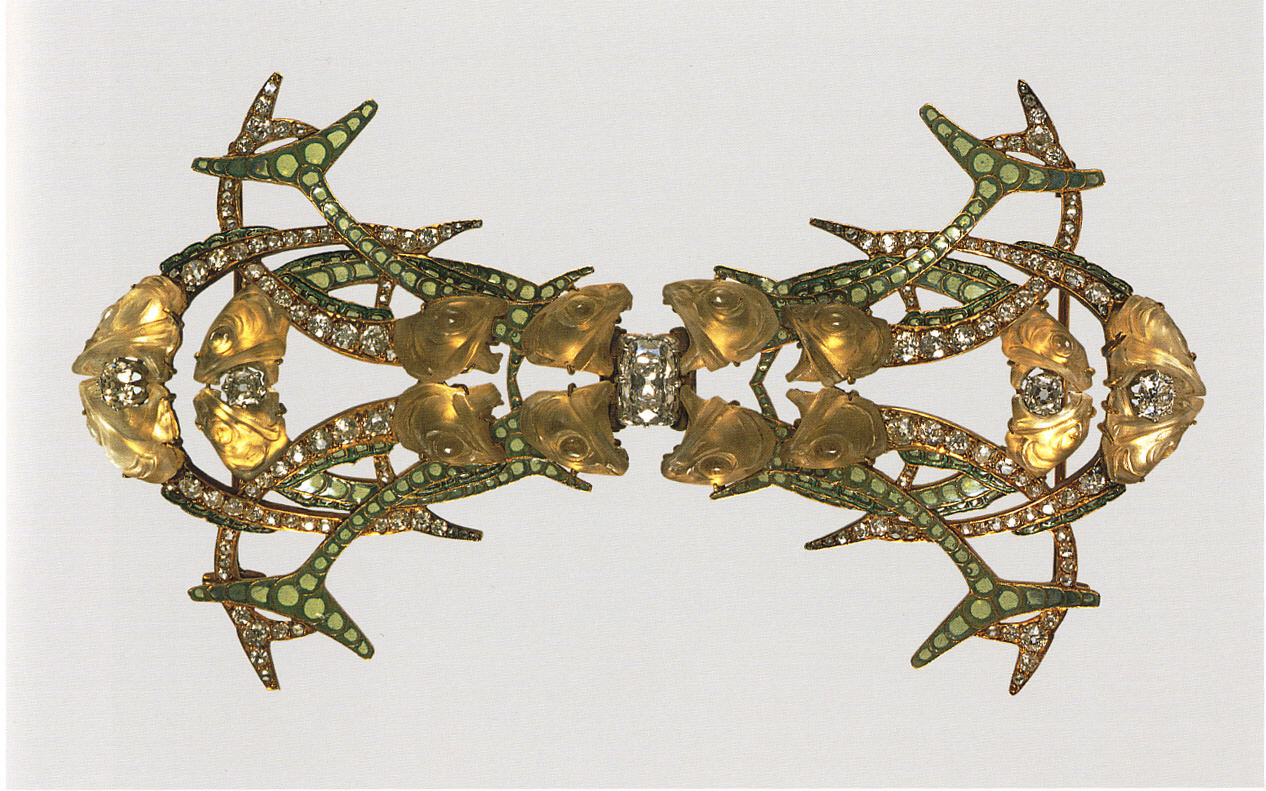
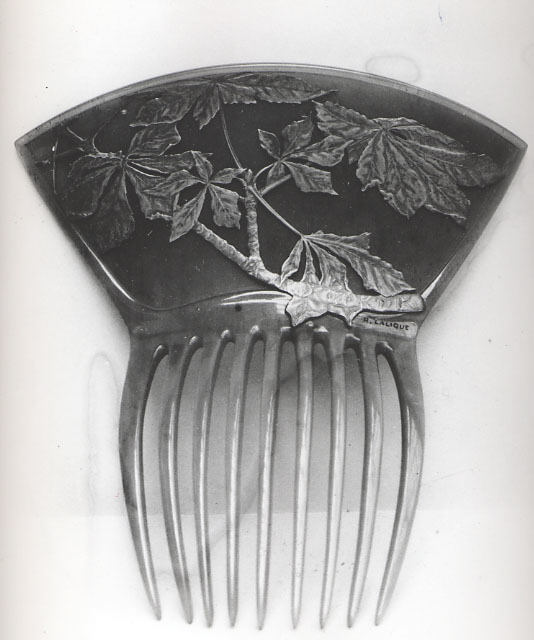
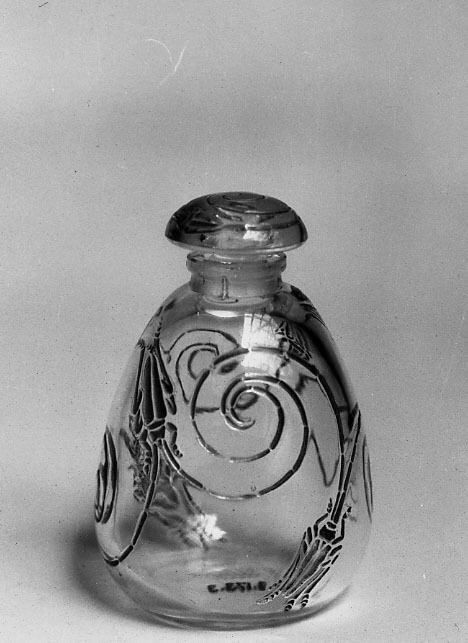
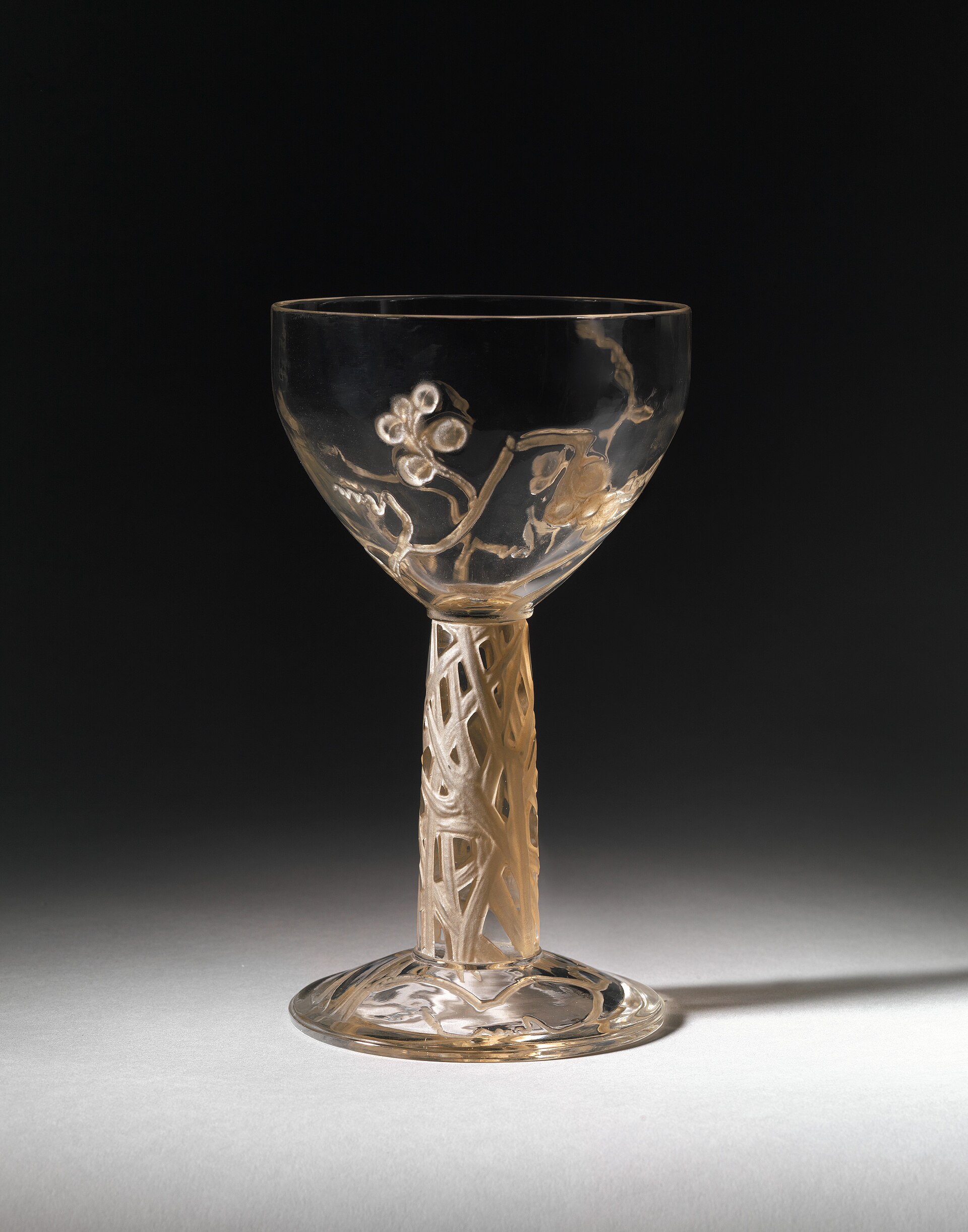
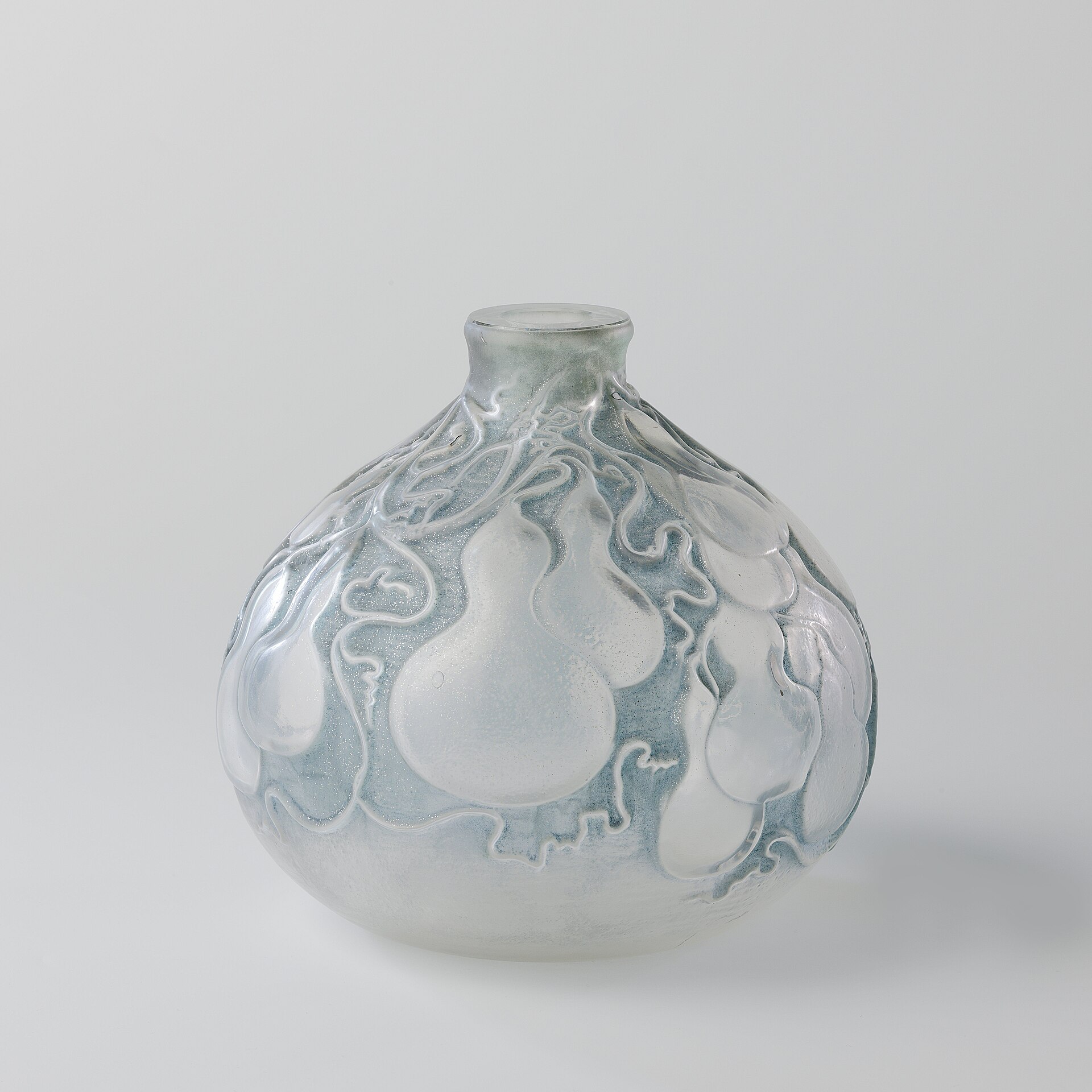
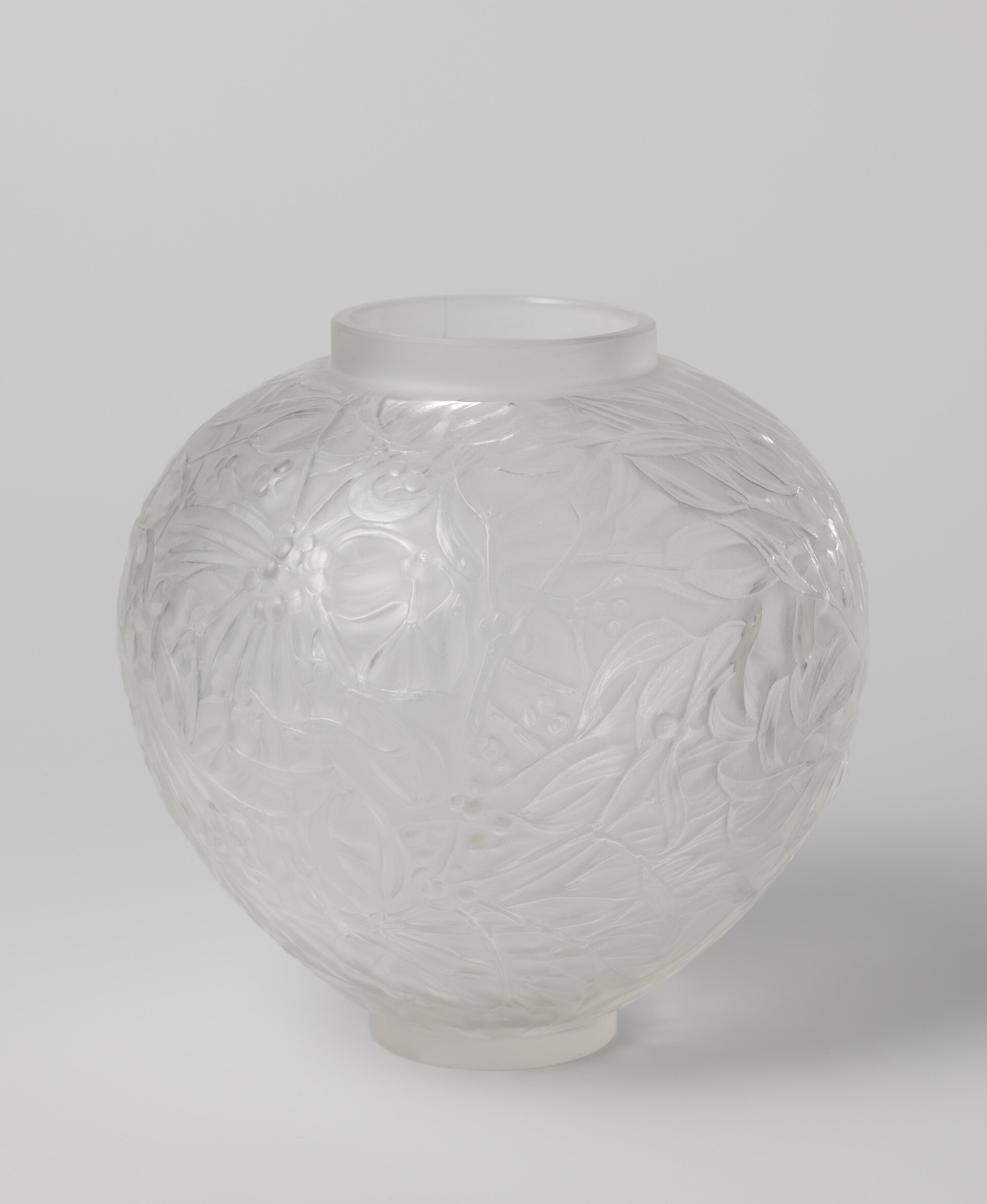
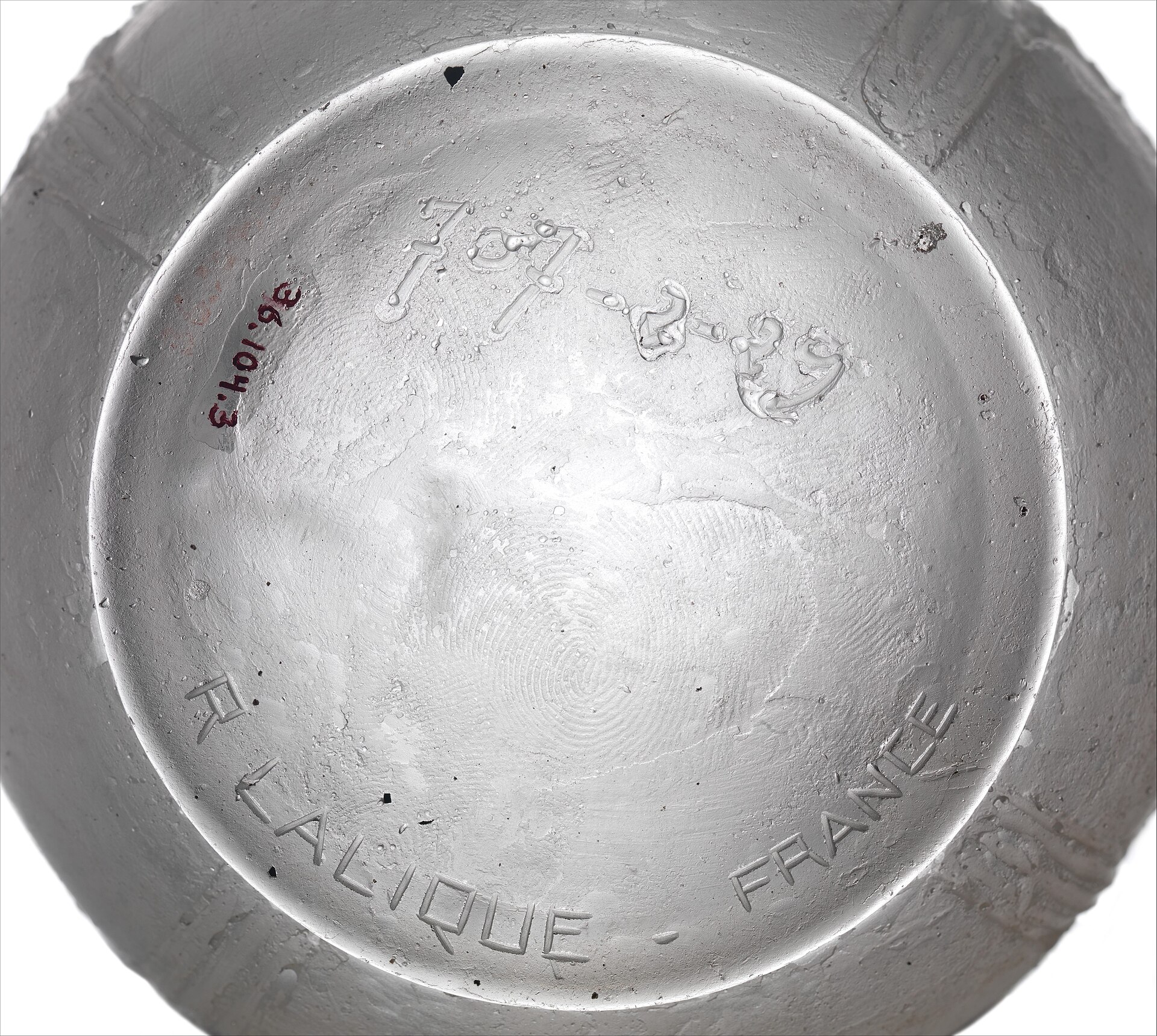
Chronology
- 1860
- 1876
Apprenticed, aged sixteen, to the Parisian jeweller Louis Aucoc; attends evening classes at the Ecole des Arts Decoratifs.37
- 1878-1880
Studies at the Crystal Palace School of Art, Sydenham, London.37
- 1885 or 1886
Opens his own workshop in Paris, in the Place Gaillon (one source) or in premises formerly occupied by the jeweller Jules Destape (another). Sources do not agree on which.67
- 1890
- mid-1890s
Meets Calouste Gulbenkian, who will become his single largest patron.1
- 1896
Shows jewellery in horn for the first time, at the Paris Salon.1
- 1897
Emile Galle describes Lalique's Salon submission as the definitive creation of modern jewellery.1
- 1899
Gulbenkian's first documented direct purchase from Lalique, the Wooded Landscape choker plaque, begins a run of acquisitions that will continue to 1927.1
- 1900
Exhibits around one hundred pieces at the Paris Exposition Universelle, including the Dragonfly Woman corsage ornament, the Cockerel diadem and the Peacock corsage ornament (bought by Gulbenkian that year); the display is received as the peak of his jewellery career and brings orders from Sarah Bernhardt and others.179
- 1902
Moves his home and business to 40 Cours-la-Reine, Paris.1
- 1903
Gulbenkian buys the Dragonfly Woman corsage ornament.2
- 1905
Sells Gulbenkian the Female figure centrepiece for the highest sum Gulbenkian is recorded as having paid for any Lalique work; opens a shop at the Place Vendome showing jewellery and glass together.18
- c. 1905-1907
Meets the perfumer Francois Coty; sources disagree on the exact year.68
- 1908
Designs a paper, then a fused-glass, label for Coty's L'Effleurt scent, applied to a bottle bought in from Baccarat. The Musee Lalique dates the paper label to 1908 without hedging; this record found no cited source giving a different year for the label itself, as distinct from the separate, genuinely disputed question of when Lalique and Coty first met (see 1905-1907 above).5
- 1908
Gulbenkian buys the Serpents corsage ornament, a variant of a piece Lalique had shown in 1900.1
- 1909
Widely reported in general Lalique literature as the year Lalique began renting a glassworks at Combs-la-Ville, south-east of Paris. This specific date is not confirmed by the source cited here: the Journal of Antiques and Collectibles piece describes only a workshop at Clairefontaine before the outright 1913 purchase of Combs-la-Ville, without naming a rental start year.8
- 1912
Designs the fully independent, mould-blown L'Effleurt bottle in his own glassworks, without Baccarat; abandons jewellery-making entirely to concentrate on glass.15
- 1913
Purchases the Combs-la-Ville glassworks outright; Gulbenkian buys the moulded-blown Gorgons vase around this year.18
- 1921-1922
Builds and opens a second, larger glassworks at Wingen-sur-Moder in Alsace, the Verrerie d'Alsace.13
- 1925
Shows new glass, which he calls a wonderful material, at the International Exhibition of Modern Decorative and Industrial Arts in Paris; Gulbenkian buys the Cluny vase from this period.1
- 1928
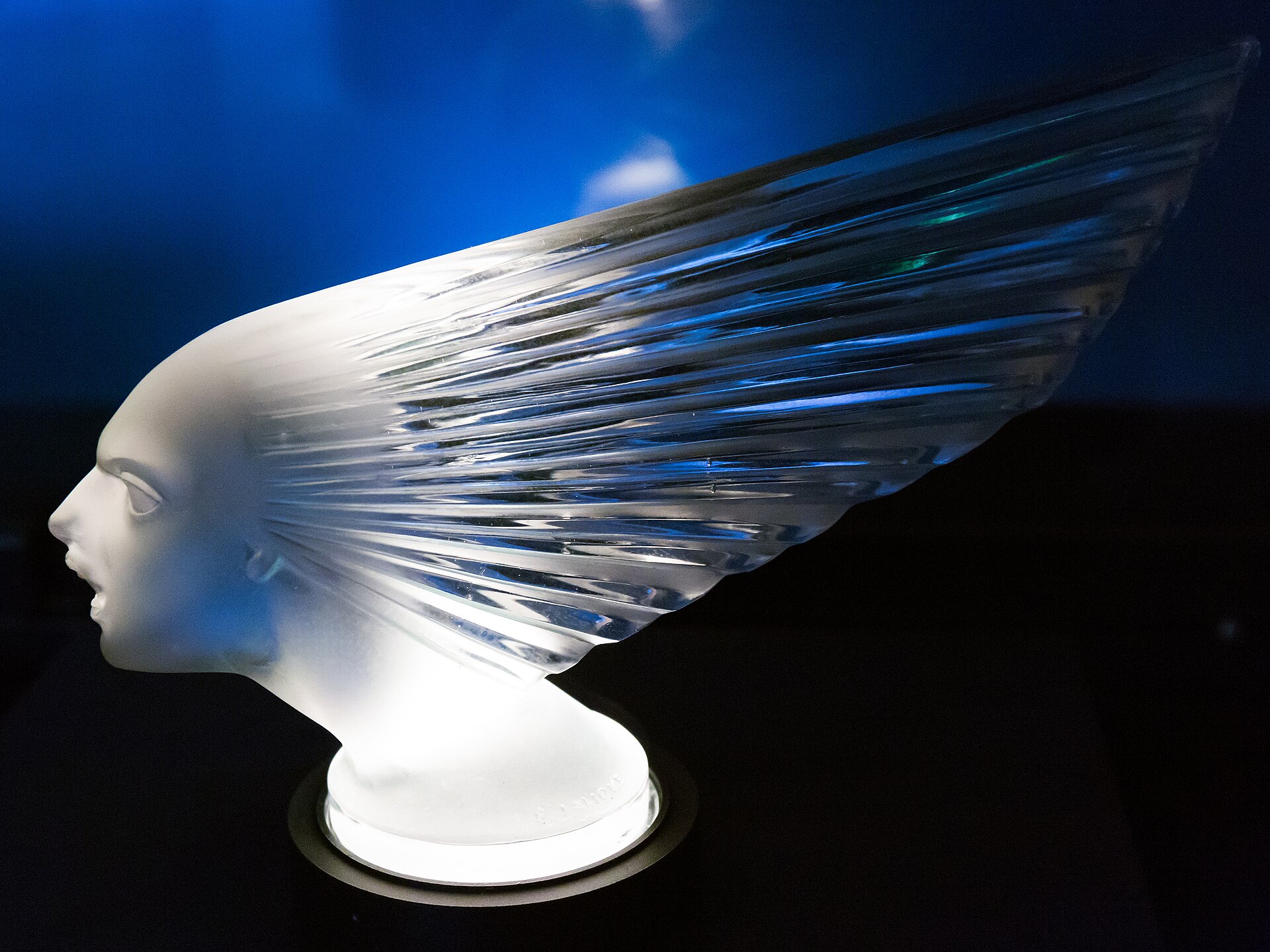
Designs the Victoire (Spirit of the Wind) glass car mascot.
- 1932-1935
Designs the illuminated glass pillars and columns for the first-class dining room and Cafe Grill of the ocean liner Normandie, launched 1932 and in service from 1935.22
- 1942
The Normandie, under conversion to the US troopship Lafayette, catches fire and capsizes in New York harbour on the night of 9-10 February; some of Lalique's glass fixtures are later recovered, and a group is now installed at the Metropolitan Museum of Art.22
- 1945
Dies in Paris on 1 May, aged eighty-five. His son Marc Lalique takes over the firm and drops the R from the R. LALIQUE signature.617
- 1977
Marc Lalique dies; his daughter Marie-Claude Lalique takes over.21
- 1994
Marie-Claude Lalique sells the family's controlling interest to Pochet, ending close to 110 years of family ownership.21
- 2003
Marie-Claude Lalique dies.21
- 2008-2010
Pochet sells the business on; by 2010 full ownership has passed to the entrepreneur Silvio Denz. Denz is Swiss (born in Basel); the source cited here for this chronology entry misidentifies him as Singaporean, an error this record does not repeat, though it means the nationality detail rests on background knowledge rather than on the cited source.21
- 2011
The Musee Lalique opens at Wingen-sur-Moder, on the site of the absorbed Hochberg glassworks, with more than 650 pieces on display.3
The market
The market runs on three scales that should not be averaged together. Ordinary Art Deco glass trades from the low thousands of dollars up to the tens of thousands for a strong model; a single amber Serpent vase of about 1924 reached 56,673 US dollars at Heritage Auctions' 4 December 2010 art-glass sale in New York, described by the house as a world record price for Lalique at that sale. Art Nouveau jewellery, made decades earlier by hand in far smaller numbers, reaches much higher: a Lalique pendant necklace made 978,480 US dollars at Christie's Geneva in November 2017, reported at the time as an auction record for any piece of Art Nouveau jewellery, and an ivory, horn, enamel and diamond comb made 738,500 euros at Sotheby's Paris in December 2021, a record for that house specifically rather than a claim to beat the 2017 figure. Above both sits a single result from neither category: a pair of Moineaux glass doors made for a Jersey villa, sold at Sotheby's Paris in November 2011 for 2,024,750 euros with premium against a 400,000 to 600,000 euro estimate, the recorded world auction record for any single Lalique work. None of the results below separate hammer from premium unless stated.
| Date | Sale | Work | Result | Note |
|---|---|---|---|---|
| 22 November 2011 | Sotheby's | Moineaux (Sparrows) glass doors, Villa Millbrook, Jersey (Lady Trent) | Hammer EUR 1,750,000 With premium EUR 2,024,750 total with buyer's premium EUR | Sale: Arts Decoratifs du XXe siecle et Design Contemporain, lot 131. Estimate EUR 400,000-600,000. Reported as the world auction record for any single work by Lalique. |
| 13 November 2017 | Christie's | Enamel, diamond and pearl pendant necklace, c. 1899-1901 | Hammer not separated from premium in the sources consulted With premium USD 978,480 total, as reported USD | Christie's Geneva, Magnificent Jewels from a European Collection (the Michel Perinet collection), 110 lots totalling over USD 12.4 million. Estimate reported around USD 90,000-131,000. Reported at the time as a new world auction record for any piece of Art Nouveau jewellery and for any Lalique jewel. |
| 17 December 2021 | Sotheby's | Ivory, horn, enamel and diamond comb | Hammer not separated from premium in the sources consulted With premium EUR 738,500 total (approx. USD 836,000), as reported EUR | Sotheby's Paris, single-owner sale of 39 Lalique pieces from a private Paris collector; sale totalled EUR 1.7 million with 35 of 39 lots sold. Reported as the record for any Lalique jewel sold at Sotheby's specifically. |
| 4 December 2010 | Heritage Auctions | 'Serpent' vase, deep amber glass, c. 1924 | Hammer not separated from premium in the sources consulted With premium USD 56,673 total, as reported USD | Sold at Heritage's 'Signature Lalique, Art Glass and Perfume Bottles' auction in New York, held 4 December 2010 (press release dated 10 December 2010), with more than 400 lots and 415-plus bidders; total sale USD 1.28 million-plus at a 94% sell-through rate by lot value. Heritage's own release describes the vase as having 'set a world record price for Lalique,' i.e. a record for the house's Lalique sales generally, not explicitly a record for that vase model. |
| 4 December 2024 | Bonhams | 'Bacchantes' vase, designed 1927, produced post-war | Hammer GBP 1,000 With premium GBP 1,280 total with buyer's premium (28% on the first GBP 40,000) GBP | Online sale, 29 November-4 December 2024. Clear glass, frosted and polished, sepia-stained, 24.4 cm high, signed LALIQUE FRANCE (no R) on the base; provenance a private Barcelona collection. Given here as the low end of the same model's range against the Petit Palais's own lifetime, R.LALIQUE-signed example (see narrative and the Bacchantes vase in the images below); no hammer-and-premium-separated result for a pre-1945 example of this specific model was located for direct comparison. |
Hammer is the price at which the bidding stopped; with premium adds the fee the house charges the buyer on top. Hammer price and buyer's premium in the glossary.
Where to see the work
| Institution | City | Holdings | Note |
|---|---|---|---|
| Museu Calouste Gulbenkian | Lisbon | Almost 200 pieces bought directly from Lalique between 1899 and 1927, including 82 jewels; the largest surviving set of his work, displayed in a dedicated Rene Lalique room. | Includes the Dragonfly Woman corsage ornament (1903), the Peacock corsage ornament (1900), the Serpents corsage ornament (1908) and the Gorgons vase (c. 1913). |
| Musee Lalique | Wingen-sur-Moder, France | More than 650 pieces spanning jewellery, glass and crystal, including material from the absorbed Hochberg glassworks. | Opened 2011 on the site of Lalique's own second factory, still in operation as a glassworks under the Lalique company. |
| Metropolitan Museum of Art | New York | Jewellery (brooches, pendants, necklaces, combs) and glass (bottles, vases, cups), largely CC0 Open Access; also holds an installed corner of recovered glass panels from the ocean liner Normandie's Grand Salon. | |
| Rijksmuseum | Amsterdam | Glass vases including 'Gourdes' (1914) and 'Gui' (1920), CC0. | |
| Toyota Automobile Museum | Nagakute, Japan | A gallery of Lalique glass car mascots, including Victoire (1928). | |
| Musee des Arts Decoratifs | Paris | Jewellery and glass across both periods. | Not independently verified for this record beyond general institutional listings. |
| Petit Palais, Musee des Beaux-Arts de la Ville de Paris | Paris | The Bacchantes vase (inv. OGAL530, no. 997), acquired directly in March 1929, R.LALIQUE FRANCE-signed. | Held since within Lalique's own lifetime, two years after the 1927 design; exhibited in the Petit Palais's own 2011-2012 show 'Poemes de cristal: de Galle a Lalique'. |
| Corning Museum of Glass | Corning, New York | Glass, referenced in general appraisal-industry listings. | Not independently verified for this record. |
Forgeries and misattributions
- The Pittsburgh 'Lalique' vase, Antiques Roadshow
- A frosted glass vase decorated with female figures and grape clusters, bought for USD 20 at a Pittsburgh auction house and brought to the Antiques Roadshow (Pittsburgh episode, filmed 1997, broadcast as part of the 'Vintage Pittsburgh' Season 16 selection in 2012). Appraiser Nick Dawes of Heritage Auctions identified the piece as Czechoslovakian glass fraudulently signed to pass as Lalique. Red flags: a faceted, shaped foot atypical of genuine Lalique production, moulding lacking the sharpness of the genuine article, and a signature Dawes noted was 'not difficult to put on a piece of glass.' He advised judging the object's quality, form and design before trusting any mark.16
- The wider 'R.' problem and Czech reproductions
- Trade sources describe Lalique glass as one of the more heavily counterfeited names in twentieth-century decorative art, with Czech-made reproductions of the period regularly signed 'Lalique' or 'R. Lalique' to raise their apparent value, and forgers adding a false 'R' to genuine post-1945 or entirely fabricated pieces. Trade diagnostics rather than published technical research: genuine marks are described as small and modestly placed, often struck rather than engraved, against bold, obvious forged signatures; genuine post-1945 wording is reported to read 'Lalique, France' only, without 'Made in France' or 'Made in Paris'. None of these criteria was located in a source independent of the antiques trade, and they are reported here as trade practice, not as an established scientific test.1718
The essay
Chapter 1From an apprentice's bench to his own name
Lalique was born in Ay in the Champagne region on 6 April 1860 and moved to Paris as a child.
Lalique was born in Ay in the Champagne region on 6 April 1860 and moved to Paris as a child. At sixteen he was apprenticed to the Parisian jeweller Louis Aucoc, a conventional start for a boy with no family background in the trade, and he combined it with evening classes at the Ecole des Arts Decoratifs. Around 1878 to 1880 he spent two years in London studying at the Crystal Palace School of Art in Sydenham, an experience later credited with sharpening his graphic sense and his taste for close observation of plants and insects rather than for the historical ornament that dominated French jewellery training.
He returned to Paris in 1880 and worked for several years as a freelance designer, supplying finished drawings to established houses including Cartier and Boucheron rather than trading under his own name. Sources differ on exactly when that changed: one account places his first independent workshop in 1885 in the Place Gaillon, another dates it to 1886, in premises previously occupied by the jeweller Jules Destape. Both agree on what followed: by 1890 he had opened his own shop in the Opera district of Paris, and by the mid-1890s he was designing pieces unlike anything the Paris trade had shown before.
Chapter 2The inventor of modern jewellery
What made Lalique's jewellery different was not craftsmanship, which the Paris trade already had in abundance, but a refusal to let the price of the material set the value of the piece.
What made Lalique's jewellery different was not craftsmanship, which the Paris trade already had in abundance, but a refusal to let the price of the material set the value of the piece. The museum that now holds his archive states the principle plainly: for Lalique it was no longer the cost of the material that counted, but the result. He worked gold and diamonds when a piece called for them, but he set them beside horn, ivory, semi-precious stones and glass, materials a conventional jeweller would not have touched, and priced the finished object on its design rather than on its raw content.
Horn is the clearest case. Lalique showed jewellery in horn for the first time at the Paris Salon of 1896, and the Gulbenkian collection alone holds twenty-seven pieces made from it, combined in some diadems with ivory to build, in the museum's words, a sublime synthesis of nature. A year later, in 1897, Emile Galle, himself the leading glass and furniture designer of the Ecole de Nancy, described Lalique's submission to that year's Salon as the definitive creation of modern jewellery. Lalique had told the jeweller Henri Vever two years earlier, in 1895, that his intention was to produce something never seen before; by his own contemporaries' account, he had done it.
The technique that carried this ambition furthest was plique-a-jour enamelling, a method in which coloured glass enamel is fired inside a framework of gold partitions with no metal backing, so that light passes through the finished piece exactly as it does through stained glass. Lalique hand-pierced the partitions from gold sheet, supported them temporarily with copper while the enamel was fired, then removed the copper in an acid bath, leaving nothing behind the colour but air. The technique had been known since the Renaissance and was rediscovered in France around 1900; Lalique's handling of it, in corsage ornaments, combs and pendants built around wings, petals and insect bodies, is what most decisively separated his jewellery from the trade around him.
Chapter 3The woman who becomes the insect
Lalique's most characteristic jewels are built on a single recurring transformation: a woman's body merging into, or emerging from, an insect, a reptile or a flower.
Lalique's most characteristic jewels are built on a single recurring transformation: a woman's body merging into, or emerging from, an insect, a reptile or a flower. The Gulbenkian Museum, which owns the largest surviving group of these pieces and displays them under exactly this reading, states it as a documented pattern in the work rather than a modern imposition: the image of the woman was a central motif in Lalique's imagery, and it provided the pretext for some of his most daring creations, most often by fusing her with the insect she transforms into.
The clearest single example is the piece usually called the Dragonfly Woman corsage ornament, shown at the 1900 Paris Exposition Universelle and bought by Gulbenkian in 1903: a chased gold and enamel dragonfly with articulated wings in vitreous enamel, its open, claw-like mouth releasing the bust of a woman carved in chrysoprase, her head covered by a gold and enamel helmet set with two beetles. The museum's own catalogue text calls it probably the most spectacular piece of jewellery Lalique ever made, and states, with the hedge that word carries, that it was probably worn on stage by Sarah Bernhardt, one of Lalique's earliest and most public clients. No firmer source for the Bernhardt connection was located for this record, and the museum's own wording is reproduced here rather than sharpened into a certainty it does not claim.
The same pattern recurs across the Gulbenkian holdings in different registers. The Serpents corsage ornament, bought by Gulbenkian in 1908, reworks a piece Lalique had shown in 1900 in gold and opalescent enamel, one of a group of jewels built on reptiles and insects that the museum describes as a fabulous bestiary, attractive and repellent at once. The Peacock corsage ornament, bought in 1900 in blue and green enamel set with cabochon opals, drew a dedicatory verse from the poet Robert de Montesquiou in his 1901 collection Les Paons, whose cover Lalique illustrated himself; opal, the museum notes, was the material Lalique used more than any other and returns across the collection. A third register replaces the insect with the flower: the Orchid pendant, in opalescent enamel, and the Female Face pendant, its baroque pearl surrounded by four open silver poppies, both work the femme-fleur, the woman-flower pairing that recurs through the Symbolist poetry of the period and that the museum treats as a direct and acknowledged source for this side of Lalique's imagery rather than a later reader's projection onto it. No documentary evidence was located, in the sources consulted for this record, that Lalique read or subscribed to any specific Symbolist author; the connection made here is the institutional one the Gulbenkian's own curators draw between the motif and the wider literary fashion, not a claim about Lalique's library.
Chapter 4Sarah Bernhardt, and the patron who bought two hundred pieces
Lalique's clients in the 1890s and 1900s included the actress Sarah Bernhardt, the Countess of Bearn and the collector Arconati-Visconti, but one relationship outweighs all the others in what it left...
Lalique's clients in the 1890s and 1900s included the actress Sarah Bernhardt, the Countess of Bearn and the collector Arconati-Visconti, but one relationship outweighs all the others in what it left behind. Calouste Gulbenkian, the Ottoman-Armenian oil financier, met Lalique in the mid-1890s and went on buying from him, directly and continuously, until 1927: almost two hundred pieces of jewellery and glass in all, eighty-two of them jewels bought straight from the artist with only a single exception, and the collection today constitutes what the museum built to hold it calls the largest existing set of Lalique's work anywhere.
The relationship outlasted the transactions. In a letter to Lalique's daughter Suzanne Lalique-Haviland written on 8 July 1945, in the weeks after the artist's death, Gulbenkian set down what fifty years of buying had actually been: your father was a very dear friend, and my regret at his loss is deepened by the infinite sorrow one always feels upon the demise of a great man. My admiration for his unique work grew and grew over the course of our fifty-year friendship. I am proud to have in my possession what I believe to be the largest existing set of his works, and the latter occupy a privileged place in my collections. The letter is held in the Gulbenkian Archives under the reference MCG 00972 and is quoted by the museum itself; it is one of the few places where the commercial relationship between a maker and a single patron across an entire working life is documented in the patron's own words rather than reconstructed from invoices.
The purchases were not evenly priced. The single highest sum Gulbenkian is recorded as having paid for any Lalique piece went not to a corsage ornament or a diadem but to the Female figure centrepiece, bought in 1905 from the artist's home and shop at 40 Cours-la-Reine, where Lalique had moved his business in 1902. No figure for that purchase was located in the sources consulted for this record; the museum states only that it was the highest price Gulbenkian ever paid for a work by Lalique, without publishing the sum, and this record does not supply one.
Chapter 51900: the exhibition that made the reputation
The Paris Exposition Universelle of 1900 is the fixed point every account of Lalique's jewellery career returns to.
The Paris Exposition Universelle of 1900 is the fixed point every account of Lalique's jewellery career returns to. He exhibited around one hundred pieces in display cases built specifically for his stand in the Jewellers' Pavilion on the Esplanade des Invalides, alongside Samuel Bing's separate pavilion, the Maison de l'Art Nouveau, that had given the wider movement its name. Contemporary and later commentary is consistent that his stand was received as the finest entry in the exhibition: he was called, in terms later writers have kept repeating, the emancipator and master of modern French jewellery, and compared to historic figures such as Bernard Palissy and Gianlorenzo Bernini.
Four pieces now in the Gulbenkian collection were shown there, among them the Dragonfly Woman corsage ornament, the Cockerel diadem and the Wooded Landscape choker plaque, which was also the first piece Gulbenkian bought directly from Lalique. The Figures and Serpents brooch, carved in ivory and drawing on the Vatican's ancient Laocoon group, was a fourth. It was not simply a critical success. Orders followed from some of the most visible people in Europe, Bernhardt and Gulbenkian among them, and the exhibition is treated by every source consulted here, museum and trade alike, as the peak of Lalique's career as a jeweller in the ordinary sense of that word. He had seven more years of jewellery-making left in him before the pivot to glass began in earnest, and roughly twelve before he gave the craft up outright.
Chapter 6Coty, and the label that became a bottle
The engine of the pivot away from jewellery was a perfumer, not a jeweller.
The engine of the pivot away from jewellery was a perfumer, not a jeweller. Around 1905 to 1907, sources differ on the exact year, Lalique met Francois Coty, whose shop stood next to his own near the Place Vendome. Coty wanted his perfumes sold in bottles as considered as jewellery, at a price the ordinary customer could still afford, and Lalique's first response, in 1908, was modest: a paper label for a scent called L'Effleurt, applied to a plain crystal bottle bought in from Baccarat. He then developed a glass version of the same label, heat-fused onto the Baccarat bottle. Only with the finished 1912 version of L'Effleurt did Lalique design the whole object himself, a mould-blown bottle with a patinated female figure worked directly into the glass and a stopper formed as two facing cicadas, made without Baccarat's involvement at all.
The five years between the paper label and the fully independent bottle are the whole of the pivot in miniature: a jeweller who had spent thirty years working precious materials by hand learning, commission by commission, how to design for a process that could be repeated by the thousand. The Coty relationship is described by the museum that now holds Lalique's archive as a powerful springboard for his career as a master glassmaker and, in the same sentence, his transition to industrial glassmaking. By the time it was finished he was no longer taking commissions for jewellery at all.
Chapter 7Becoming a creator-industrialist
Lalique gave up jewellery-making altogether in 1912, a fact stated plainly by the Gulbenkian Museum and confirmed nowhere in the popular literature with the emphasis it deserves: this was not a...
Lalique gave up jewellery-making altogether in 1912, a fact stated plainly by the Gulbenkian Museum and confirmed nowhere in the popular literature with the emphasis it deserves: this was not a gradual fade but a documented, dated stop. What replaced it was glass production on an industrial scale, and Lalique described his own new role in exactly those terms, as what the Gulbenkian's own gallery text renders as a creator-industrialist.
He had been renting a small glassworks at Combs-la-Ville, south-east of Paris, since around 1909; he bought the site outright in 1913, once the Coty commissions and his own growing production justified owning rather than leasing the plant. The technical range of what came out of it is documented in the pieces Gulbenkian himself bought in these years. Lalique adapted lost-wax casting, an ancient bronze-founding technique, to his more elaborate glass objects at the turn of the century, and the Gorgons vase, in moulded-blown glass and decorated with gorgons' heads, bought by Gulbenkian around 1913, belongs to that group of effectively unique, hand-finished pieces. Alongside it sat a second, cheaper and much larger category: moulded-pressed glass, in which a single mould could turn out the same design hundreds or thousands of times, the technique that eventually supplied most of what the name Lalique now means to a general buyer.
Chapter 8Wingen-sur-Moder, and the acclaim of 1925
After the First World War Lalique built a second and larger factory at Wingen-sur-Moder, in the Alsace region returned to France after the war, completed around 1921 and in production by 1922 as the...
After the First World War Lalique built a second and larger factory at Wingen-sur-Moder, in the Alsace region returned to France after the war, completed around 1921 and in production by 1922 as the Verrerie d'Alsace, specialising in tableware for export as well as the perfume and decorative lines Combs-la-Ville had built its reputation on. The village still holds the Musee Lalique today, opened in 2011 on the site of the old Hochberg glassworks the factory had absorbed, with more than 650 pieces on permanent display.
The public high point of this second career came at the 1925 International Exhibition of Modern Decorative and Industrial Arts in Paris, the exhibition that gave Art Deco its name. Lalique showed his new glass there and, by the Gulbenkian Museum's account, described the material himself as wonderful, a deliberate echo of the language once used for gold and gems now applied to a substance that could be pressed out by the machine-load. The Cluny vase of the same year, decorated with masks drawn from classical theatre and made in moulded-pressed glass, is one of the pieces that carried this new aesthetic into the Gulbenkian collection. The decade also produced work that left the vase and the bottle behind altogether: the illuminated glass pillars and columns Lalique designed for the first-class dining room and Cafe Grill of the ocean liner Normandie, launched in 1932 and in service from 1935, and the fittings, cross, screens, reredos and font of Saint Matthew's Church on Jersey, still known locally as the Glass Church. Car radiator mascots, cast and moulded in glass for models including Cinq Chevaux, Victoire and Tete de Coq, belong to the same decade and the same industrial method, sold through the motor trade rather than the jewellery or glassware trade his name had started in.
The Normandie fixtures survived a disaster that could easily have destroyed them. On the night of 9 to 10 February 1942, while the liner was being converted into a troopship in New York under the name USS Lafayette, a welding spark set fire to stacked kapok life vests in the former first-class lounge; the ship's own fire-suppression system had been disconnected for the conversion, and she capsized in the Hudson River in the early hours of 10 February. She was never restored and was eventually broken up for scrap. Some of the Lalique glass was recovered from the wreck and dispersed afterward; a substantial run of individual panels from the murals of the Grand Salon is now installed as a single corner display at the Metropolitan Museum of Art in New York, one of the more improbable survivals in this maker's whole output.
Chapter 91945, and the mark that dates the object
Lalique died in Paris on 1 May 1945, at eighty-five.
Lalique died in Paris on 1 May 1945, at eighty-five. His son Marc Lalique took over the firm and kept it operating under the family name, but he made one change to the signature that now matters more than almost anything else printed about this maker in the trade press: he dropped the R that had prefixed R. LALIQUE since around 1905, so that pieces made after his father's death read simply LALIQUE FRANCE. Marc also began moving the business from glass to lead crystal through the early 1950s, a material change as significant as the mark change, since the two were made by different processes and, on the account given by several dealers, carry different lead-oxide content that can itself be tested. None of this detection detail was located in a source with named scientific authorship rather than trade experience; it is reported here as trade practice, not as a peer-reviewed finding, and is flagged as such in the sources below.
The firm passed again on Marc Lalique's death in 1977 to his daughter Marie-Claude Lalique, born in 1935, who ran it until 1994, when she sold the family's controlling interest to Pochet, the French glass-bottle and luxury-packaging group, ending close to a hundred and ten years of continuous family ownership. Pochet sold the business on in 2008, and by 2010 full ownership had passed to Silvio Denz, a Swiss entrepreneur, under whom the company has expanded well beyond the glass and crystal lines Lalique himself would recognise. Marie-Claude Lalique died in 2003. A minority of sources consulted for this record give her death year as 1994, apparently confusing it with the year she sold the company; this record follows the more specific and independently corroborated 2003 date.
The practical upshot for anyone examining an unmarked or ambiguously marked object is blunt. R. LALIQUE FRANCE, on a piece that also reads as pre-war in its glass and its finish, was made within Lalique's own lifetime or in the few years immediately after his death before Marc's change took hold; LALIQUE FRANCE without the R was made after that change; a small trademark R inside a circle, used from around 1978, marks a later corporate product entirely. A signature by itself proves none of this on its own, which is the subject of the next section.
Chapter 10The reproduction problem
Lalique glass has been faked and reproduced for long enough, and in high enough volume, that dealers describe it as one of the more heavily counterfeited names in twentieth-century decorative art.
Lalique glass has been faked and reproduced for long enough, and in high enough volume, that dealers describe it as one of the more heavily counterfeited names in twentieth-century decorative art. The best-documented single case located for this record is a straightforward one: a frosted glass vase decorated with female figures and grape clusters, bought for twenty dollars at a Pittsburgh auction house and brought to the Antiques Roadshow, where the appraiser Nick Dawes of Heritage Auctions identified it as Czechoslovakian glass fraudulently signed to pass as Lalique. His stated reasoning is worth keeping as a general method rather than a checklist specific to this piece: a faceted, shaped foot was atypical of Lalique's own production, the moulding lacked the sharpness of the genuine article, and, in his own words, a signature like that is not difficult to put on a piece of glass. He advised evaluating the object's quality, form and design before ever trusting the mark.
Beyond that single documented case, the detection claims in circulation come from dealers and auction houses rather than from published, named technical research, and this record treats them accordingly. Trade sources describe genuine signatures as small, modestly placed and struck rather than engraved, against forged signatures that tend to be bold, cursive and placed somewhere conspicuous; they describe post-1945 Lalique crystal as containing roughly twice the lead oxide of the pre-war glass, making it heavier and clearer; and they describe a black-light test in which colourless pre-1945 pieces fluoresce yellow under long-wave ultraviolet light and colourless post-1945 pieces fluoresce blue, with a piece showing neither treated as suspect. None of these three claims was located in a source independent of the antiques trade, and none is presented here as more than that: a working method used by dealers and appraisers, not a scientifically established test. A wording detail is at least independently checkable: genuine production is reported to read LALIQUE, FRANCE only, and a bottle or vase marked MADE IN FRANCE or MADE IN PARIS in addition is treated by the trade as a further warning sign.
Chapter 11One model, two eras: the Bacchantes vase
No single object makes the mark-dating problem concrete better than the Bacchantes vase, designed in 1927 and still the name most people picture when they hear Lalique.
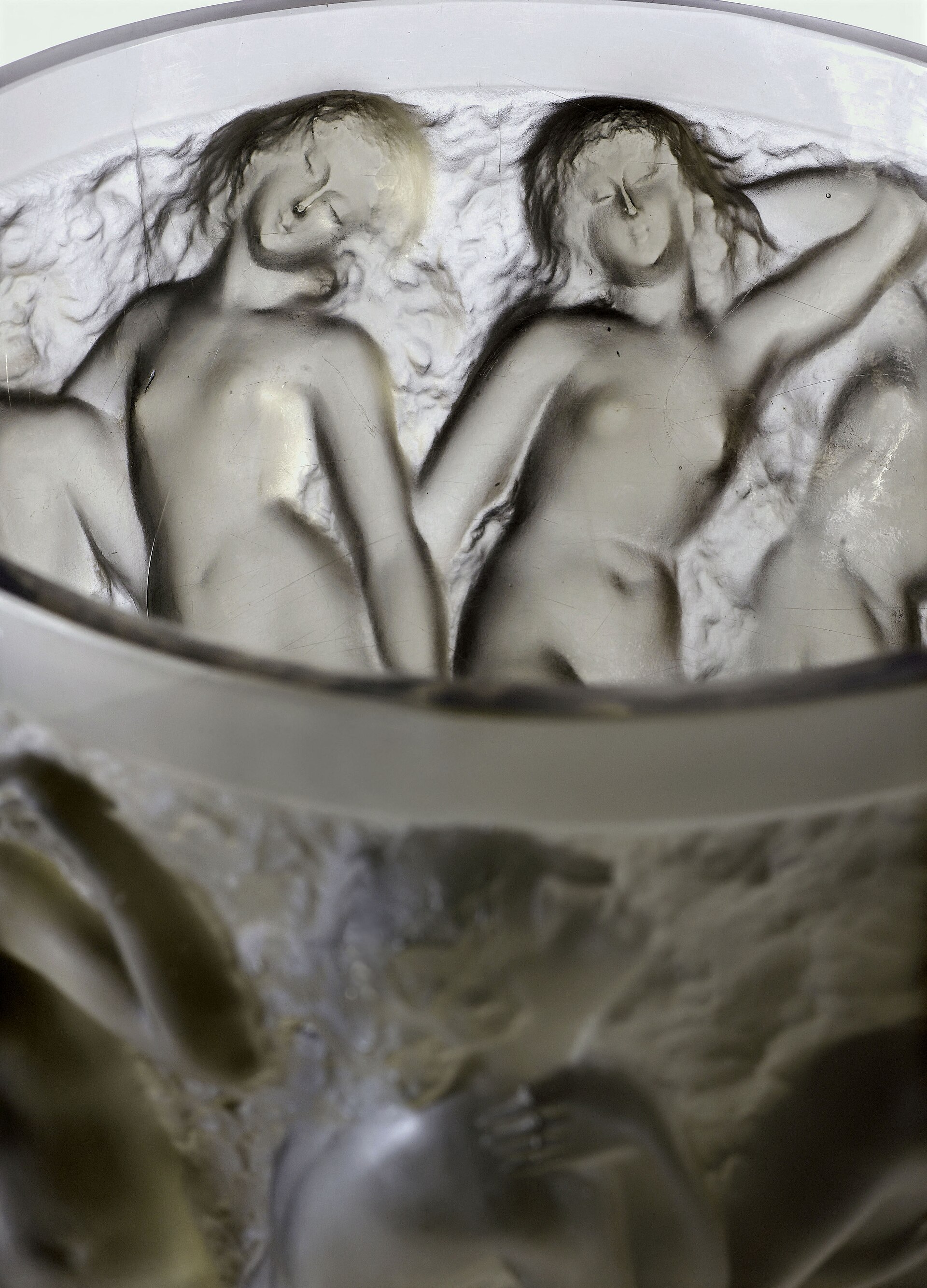
No single object makes the mark-dating problem concrete better than the Bacchantes vase, designed in 1927 and still the name most people picture when they hear Lalique. The Petit Palais in Paris holds an example acquired directly in March 1929, within Lalique's own lifetime and only two years after the design was released: numbered 997, signed R.LALIQUE FRANCE on the base, glass, 24.5 cm high. The Petit Palais's own catalogue entry states plainly that Lalique had the piece manufactured industrially, prizing the brilliance and transparency of the colourless glass over any claim to uniqueness, and that the model is actuellement encore reedite, still in reissue today by the Lalique maison.
That continuity is the whole point. A Bacchantes vase sold at Bonhams online in an auction running 29 November to 4 December 2024 was catalogued outright as designed 1927, produced post-war: clear glass, frosted and polished, with sepia staining, signed LALIQUE FRANCE with no R on the base, and traced to a private Barcelona collection. It made a hammer price of GBP 1,000, GBP 1,280 with premium at 28 per cent on the first GBP 40,000, a price consistent with an unremarkable piece of ongoing production rather than a rare survival. The design has not changed in essentials since 1927; what changed is the maker, the material and the signature, and the auction result tracks that change rather than the shape of the object. This record did not locate a directly comparable hammer price for a documented pre-1945, R.LALIQUE-signed example of the same model sold with hammer and premium separately reported, and does not manufacture a contrast it cannot source; the point stands on the Petit Palais's own lifetime acquisition record set against the 2024 post-war result.
Chapter 12The market: jewellery against glass against the exceptional object
The market for Lalique runs on three quite different scales, and collapsing them into one number misrepresents all three.
The market for Lalique runs on three quite different scales, and collapsing them into one number misrepresents all three. Ordinary Art Deco glass, the moulded-pressed vases, bowls and car mascots produced by the thousand from the 1920s, trades at levels an amber Serpent vase from around 1924 illustrates: it made 56,673 US dollars at Heritage Auctions' 'Signature Lalique, Art Glass and Perfume Bottles' sale, held in New York on 4 December 2010, described in the house's own press release as having set a world record price for Lalique at that auction.
Art Nouveau jewellery, made by hand in far smaller numbers and thirty years earlier, sits well above that. On 13 November 2017 Christie's sold a 1899 to 1901 enamel, diamond and pearl pendant necklace by Lalique in Geneva, as part of a single-owner sale of 110 pieces of jewellery, the Michel Perinet collection, that totalled more than 12.4 million US dollars; the Lalique necklace alone realised 978,480 dollars against a published high estimate of around 131,000 dollars, a result reported at the time as a new auction record for any piece of Art Nouveau jewellery and for any Lalique jewel. The source consulted does not separate a hammer figure from the buyer's premium for this lot, so the total is given as reported rather than split. Four years later, on 17 December 2021, Sotheby's Paris sold an ivory, horn, enamel and diamond comb by Lalique for 738,500 euros, roughly 836,000 US dollars, in a single-owner sale of thirty-nine Lalique pieces from a private Paris collector that realised 1.7 million euros in total with thirty-five of the thirty-nine lots sold; the result was reported as the record for any Lalique jewel sold at that house specifically, a narrower claim than the 2017 Christie's figure and consistent with it rather than in conflict.
Above both stands a single result that belongs to neither category: a pair of moulded and pressed glass doors, the Moineaux design, made for Villa Millbrook on Jersey for its owner Lady Trent and sold as lot 131 at Sotheby's Paris on 22 November 2011, in the sale Arts Decoratifs du XXe siecle et Design Contemporain. Against a pre-sale estimate of 400,000 to 600,000 euros, the doors hammered at 1,750,000 euros and totalled 2,024,750 euros with premium, a figure reported as the world record for any single work by Lalique at auction, ahead of every jewel and every vase. The lesson the three results together support is that the ceiling on this market is set neither by the jewellery Lalique is best remembered for nor by the glass that carries his name today, but by the rare architectural commission that falls into neither category.
What is documented
Technique
The surviving work
- What is accepted
- There is no single accepted-or-rejected corpus figure of the kind a painter's catalogue raisonne would give, because Lalique's glass output was industrial in scale. Felix Marcilhac's catalogue raisonne de l'oeuvre de verre, the standard glass reference, illustrates more than four thousand pieces across its 1989, 1994 and 2005 editions.
- What is contested
- The jewellery is catalogued separately and on a far smaller scale: Sigrid Barten's 1977 Rene Lalique: Schmuck und Objets d'art 1890-1910 is the standard reference, and the Gulbenkian Museum's own holding of eighty-two jewels, bought directly from the artist between 1899 and 1927, is treated by specialists as the largest coherent group anywhere against which other attributions are checked.
- Who rules on attribution
- No single attribution board exists for either the jewellery or the glass. In practice, attribution is decided against the mark sequence (R. LALIQUE versus LALIQUE, and the post-1978 trademark), the two catalogues raisonnes above, comparanda in the major institutional holdings (the Gulbenkian Museum for jewellery, the Musee Lalique at Wingen-sur-Moder and the Metropolitan Museum of Art for glass), and trade expertise from dealers and auction-house specialists, none of which functions as a formal authenticating body.
Catalogue raisonne
- Felix Marcilhac, R. Lalique: catalogue raisonne de l'oeuvre de verre, Les Editions de l'Amateur, Paris, 1st ed. 1989, revised 1994 and 2005. The standard glass reference, illustrating more than four thousand pieces with model name, date, duration of manufacture, material, technique, colour, dimensions and known variants. Not independently consulted for this record; described here from bookseller and appraisal-industry listings.19
- Sigrid Barten, Rene Lalique: Schmuck und Objets d'art 1890-1910, Prestel-Verlag, Munich, 1977 (German). The standard jewellery reference for the Art Nouveau period. Not independently consulted for this record; described here from bookseller listings.20
Questions about Rene Lalique
Who was Rene Lalique?
Jeweller; Glass designer; Glassmaker; Founder, Rene Lalique et Cie. 1860-1945.
When did Rene Lalique live?
Born 6 April 1860, Ay, Marne, France (the Champagne region); died 1 May 1945, Paris, France.
How are fakes and misattributions of Rene Lalique detected?
The Pittsburgh 'Lalique' vase, Antiques Roadshow. A frosted glass vase decorated with female figures and grape clusters, bought for USD 20 at a Pittsburgh auction house and brought to the Antiques Roadshow (Pittsburgh episode, filmed 1997, broadcast as part of the 'Vintage Pittsburgh' Season 16 selection in 2012).
Where can you see work by Rene Lalique?
Museu Calouste Gulbenkian (Lisbon); Musee Lalique (Wingen-sur-Moder, France); Metropolitan Museum of Art (New York); Rijksmuseum (Amsterdam); Toyota Automobile Museum (Nagakute, Japan); Musee des Arts Decoratifs (Paris).
What does the market for Rene Lalique look like?
The market runs on three scales that should not be averaged together. Ordinary Art Deco glass trades from the low thousands of dollars up to the tens of thousands for a strong model; a single amber Serpent vase of about 1924 reached 56,673 US dollars at Heritage Auctions' 4 December 2010 art-glass sale in New York, described by the house as a world record price for Lalique at that sale.
What is still unresolved about Rene Lalique?
Whether Lalique's first independent workshop opened in 1885 (Place Gaillon) or 1886 (former premises of Jules Destape). Sources consulted for this record disagree and neither is corrected here.
Open questions
- Whether Lalique's first independent workshop opened in 1885 (Place Gaillon) or 1886 (former premises of Jules Destape). Sources consulted for this record disagree and neither is corrected here.
- Whether Lalique met Francois Coty around 1905 (implied by the Journal of Antiques and Collectibles' account, which places the Coty connection immediately after the 1905 Place Vendome shop opening) or in 1907 (stated directly by Wikipedia and by the Musee Lalique's own biography page). Sources disagree on the meeting date; the separate question of when the first L'Effleurt label was made is not actually in dispute among the sources cited here, which converge on 1908.
- The sum Gulbenkian paid in 1905 for the Female figure centrepiece, described by the Gulbenkian Museum as the highest price he ever paid for a Lalique work but not published in the sources consulted.
- Whether the Dragonfly Woman corsage ornament was in fact worn on stage by Sarah Bernhardt. The Gulbenkian Museum's own catalogue text calls this 'probable' rather than documented, and no firmer source was located.
- Whether Marie-Claude Lalique's leadership of the firm ended, and the sale to Pochet took place, in 1993 or 1994. Most sources consulted give 1994; one gives 1993 in a context that also names 1994 for the same event, and appears to be an internal inconsistency in that source rather than a genuine second date.
- No independently authored, non-trade technical study of Lalique glass composition or ultraviolet fluorescence was located; the lead-oxide and black-light detection claims reported by dealers could not be verified against a scientific source for this record.
- The 1909 start date for Lalique's rental of the Combs-la-Ville glassworks is widely repeated in general Lalique literature but is not stated by the Journal of Antiques and Collectibles piece cited for it in this record, which documents only the outright 1913 purchase; no source actually consulted for this record was found to confirm 1909 specifically.
Sources
- 1Museu Calouste Gulbenkian, 'Rene Lalique Room', gallery text. gulbenkian.pt/museu/...
- 2Museu Calouste Gulbenkian, "'Dragonfly' Corsage ornament", object record. gulbenkian.pt/museu/...
- 3Musee Lalique, Wingen-sur-Moder, 'Rene Lalique: more than a name', biography page. musee-lalique.com/en/...
- 4Musee Lalique, Wingen-sur-Moder, 'Jewellery', collections page. musee-lalique.com/en/...
- 5Musee Lalique, Wingen-sur-Moder, "L'Effleurt perfume bottle", object page. musee-lalique.com/en/...
- 6Wikipedia, 'Rene Lalique'. Used for general biographical dates and family history. en.wikipedia.org/wiki/...
- 7BADA (British Antique Dealers' Association), 'The Makers Series: Rene Lalique'. TRADE SOURCE. bada.org/features/...
- 8Journal of Antiques and Collectibles, 'Rene Lalique: Master Jeweler Turned Glassmaker'. TRADE SOURCE. journalofantiques.com/digital-publications/...
- 9Lang Antiques, 'Art Nouveau at the 1900 Paris Exposition', Antique Jewelry University. langantiques.com/university/...
- 10Lang Antiques, 'Plique-a-Jour', Antique Jewelry University. langantiques.com/university/...
- 11RLalique.com (blog), 'Rene Lalique Doors: World Record Price For Lalique at Auction!'. TRADE SOURCE, used for the Moineaux doors sale detail (hammer, premium, estimate, lot number). rlalique.com/blog
- 12Jersey Evening Post, 'Lalique doors from Millbrook are sold at auction for GBP1.7m', 1 December 2011. jerseyeveningpost.com/news/...
- 13Art Nouveau Club, 'New world auction record for a piece of Art Nouveau jewellery'. artnouveau.club/new-world-auction-record-piece-art-nouvea...
- 14Le Gemmologue, 'An incredible Lalique collection at auction', 20 September 2017. legemmologue.com/en/...
- 15Rapaport, 'Lalique Sets Auction Record at Sotheby's'. rapaport.com/news/...
- 16PBS, 'Fake Rene Lalique Vase', Antiques Roadshow appraisal (Pittsburgh, filmed 1997, broadcast in the 'Vintage Pittsburgh' selection, Season 16, 2012). pbs.org/wgbh/...
- 17Dawsons Auctioneers, 'How Do I Know if My Lalique is Real?'. TRADE SOURCE. dawsonsauctions.co.uk/news-item/...
- 18RLalique.com, 'R Lalique and Rene Lalique Forgeries Fakes Copies'. TRADE SOURCE, thin technical content; used only for the general characterisation of the forgery problem. rlalique.com/Sections/...
- 19Bookseller listings (Amazon, AbeBooks, Liberty's Books) for Felix Marcilhac, R. Lalique: catalogue raisonne de l'oeuvre de verre. amazon.com/rene-lalique-3ed-CATALOGUE-RAISONNE/...
- 20AbeBooks listing for Sigrid Barten (with Yvonne Brunhammer), The Jewels of Lalique / Rene Lalique: Schmuck und Objets d'art 1890-1910. abebooks.com/9782080136329/...
- 21Skyjems, 'Marie-Claude Lalique - Third Generation of a Crystal House'. TRADE SOURCE. skyjems.ca/pages/...
- 22Wikipedia, 'SS Normandie'. Used for the 1942 fire, capsizing, and the recovery and Metropolitan Museum installation of the Lalique glass fixtures. en.wikipedia.org/wiki/...
- 23Heritage Auctions, press release, "Lalique 'Serpent' vase brings $56,673 world record price in Heritage art glass auction," dated 10 December 2010, describing the 4 December 2010 'Signature Lalique, Art Glass and Perfume Bottles' auction in New York. Corrects an earlier draft of this record, which had misattributed this figure to source 16 (the unrelated PBS 'Fake Rene Lalique Vase' page) and had wrongly reported ha.com as unreachable; this press release page loaded without issue on a direct check. fineart.ha.com/heritage-auctions-press-releases-and-news/...
- 24Paris Musees / Petit Palais, Musee des Beaux-Arts de la Ville de Paris, object record for 'Bacchantes' vase, inventory OGAL530. parismuseescollections.paris.fr/fr/...
- 25Bonhams, lot page, "Rene Lalique 'Bacchantes' vase, designed 1927, produced post-war," online sale 29 November-4 December 2024. bonhams.com/auction/...
Last verified