Paula Modersohn-Becker
 German · 1876-1907
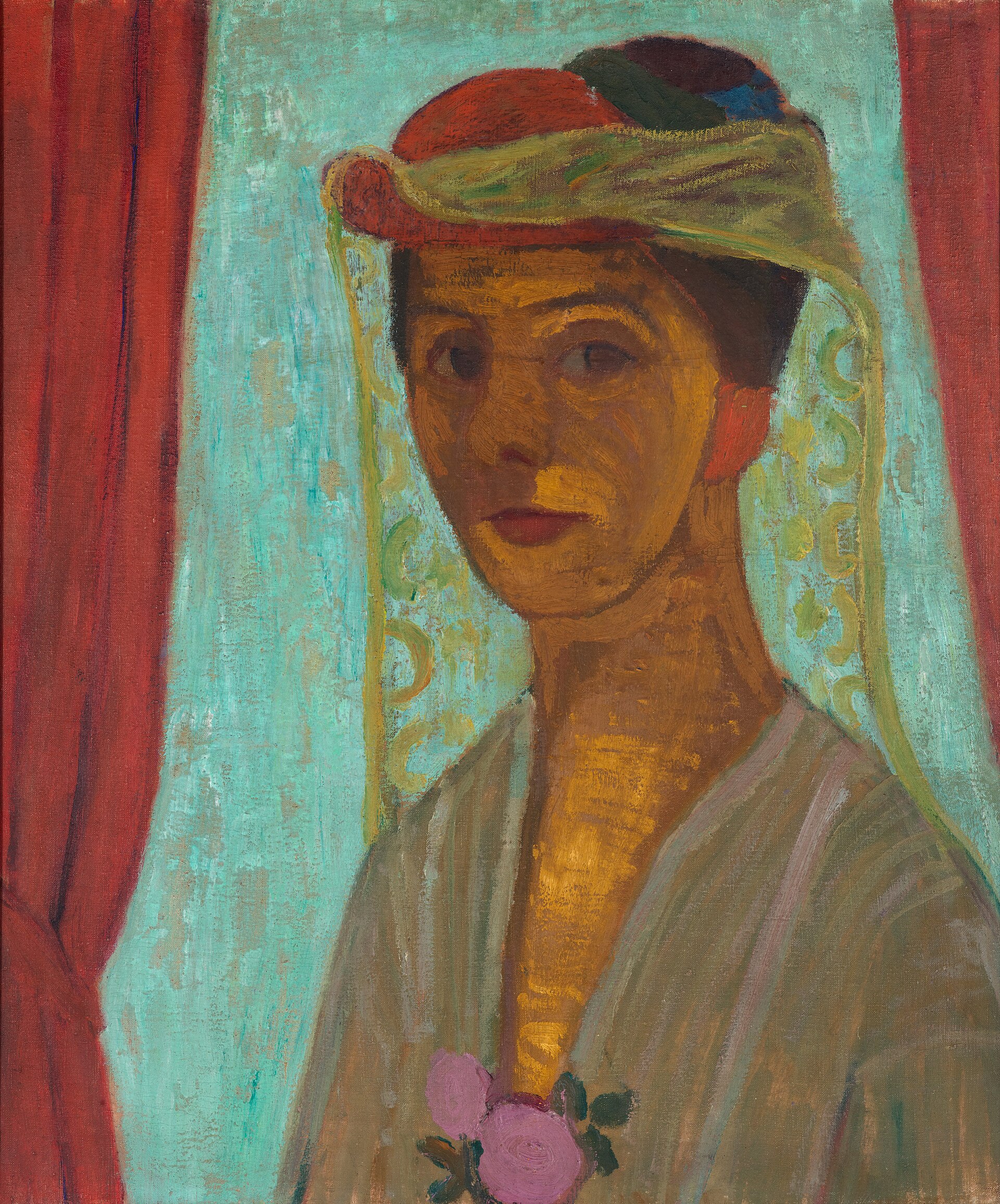
Self-portrait with hat and veil, about 1906 to 1907, oil on canvas, 89.6 by 79.8 cm, Kunstmuseum Den Haag (bought 1952). A self-portrait by the artist and not disputed as to sitter; the museum and the Commons catalogue record both title it a self-portrait. The date is approximate.
Kunstmuseum Den Haag, via Google Art Project, Wikimedia Commons (public domain)| Full name | Minna Hermine Paula Modersohn-Becker, born Becker |
|---|---|
| Worked as | Painter, Draughtswoman, Printmaker |
| Born | 8 February 1876 · Dresden-Friedrichstadt |
| Died | 20 November 1907 · Worpswede |
| Nationality | German |
| Movement | Early German Expressionism |
| Sources | 23 cited |
| Last verified |
About this page Last verified · 23 sources cited
On this page 13 sections
ContentsClose
Paula Modersohn-Becker died at 31, eighteen days after the birth of her daughter, and left a body of work that the Nazi state then tried to remove from German museums. Seventy of her works were taken in 1937, according to the German Historical Museum. The Hamburg Kunsthalle's own provenance file shows what happened to one of them: bought in 1919 or 1920 for 25,000 Reichsmark, seized on 21 August 1937, sold to a Berlin dealer in 1939 for USD 120 or USD 35 depending on which list you believe, and bought back in 1951 for 4,000 Deutsche Mark.
The number most readers want is the one nobody prints with a source. The foundation that holds her estate has catalogued the paintings in a two-volume raisonne of 1998 and the drawings in another of 2023. The museum in Bremen says more than 1,400 drawings survive. For the paintings, German Wikipedia says about 750, English Wikipedia and a 2024 magazine piece say over 700, and the foundation's own pages that this page opened give no total at all. That gap is recorded below as a gap.
What a reader probably doesn't know is how recently and how quietly the money arrived. On 27 November 2025 a small 1906 self-portrait sold in Berlin for EUR 1,270,000 including premium, which the auction house called a new world record, in a press release that also calls it a record hammer price. That picture had been a Lubeck museum's until the Nazi confiscation of 1937. Its route out of the state's hands, through a dealer and a collector whom the catalogue says was arrested and tortured in 1944, is in the auction house's own catalogue, and the catalogue's essay and its lot entry appear to name different dealers for one link.
Images
Chronology
- 1876
Born in Dresden-Friedrichstadt on 8 February, third of seven children of the railway engineer Carl Woldemar Becker and Mathilde von Bultzingslowen.123
- 1888
The family moves to Bremen.3
- 1896-1897
Takes a course at the painting and drawing school of the Verein der Berliner Kunstlerinnen, the women's academy route open to her.3
- 1898
Moves to Worpswede and studies with Fritz Mackensen; begins her friendship with the sculptor Clara Westhoff.3
- 1899
Shows at the Kunsthalle Bremen and receives devastating reviews; withdraws from public view.314
- 1901
- 1906
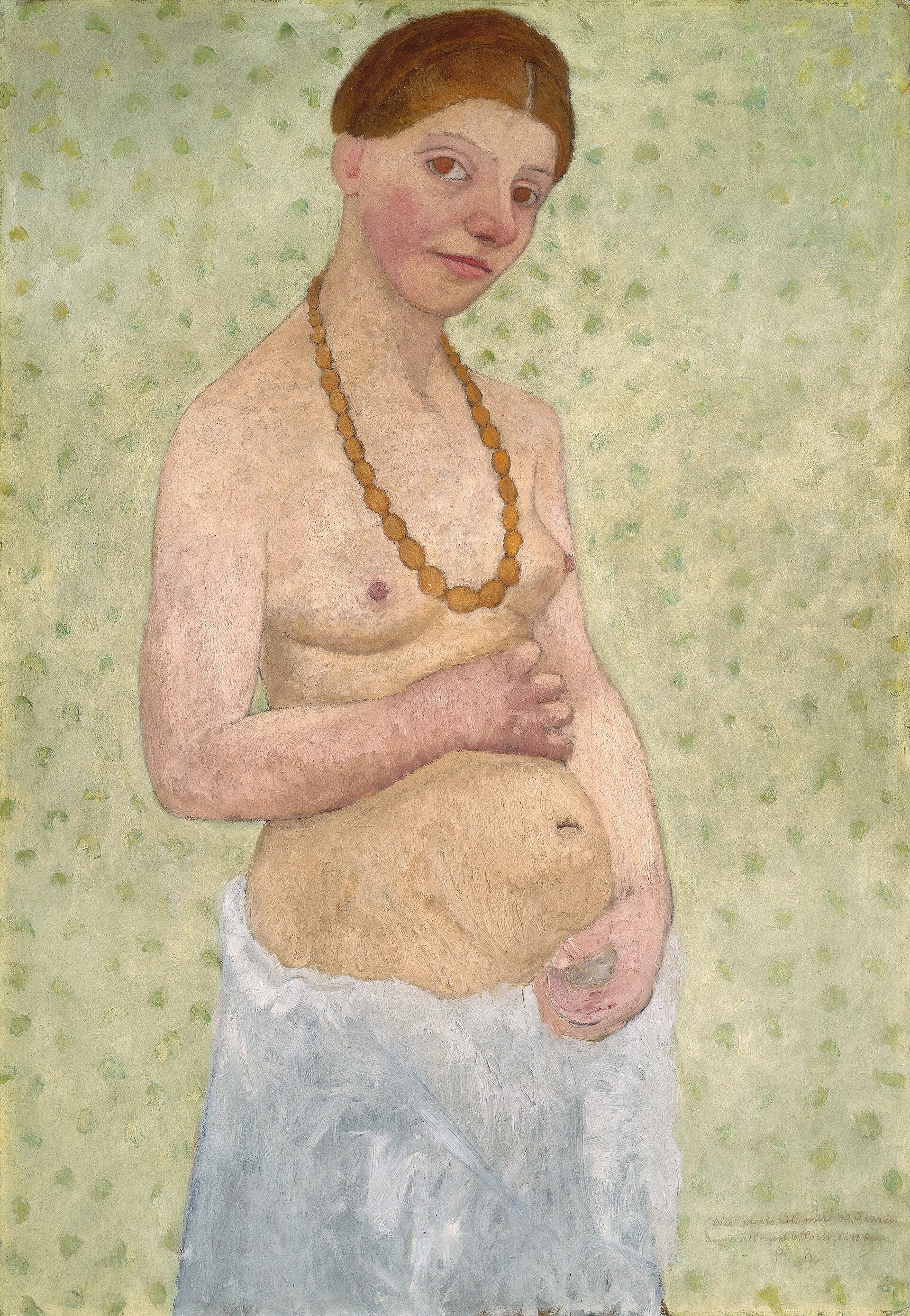
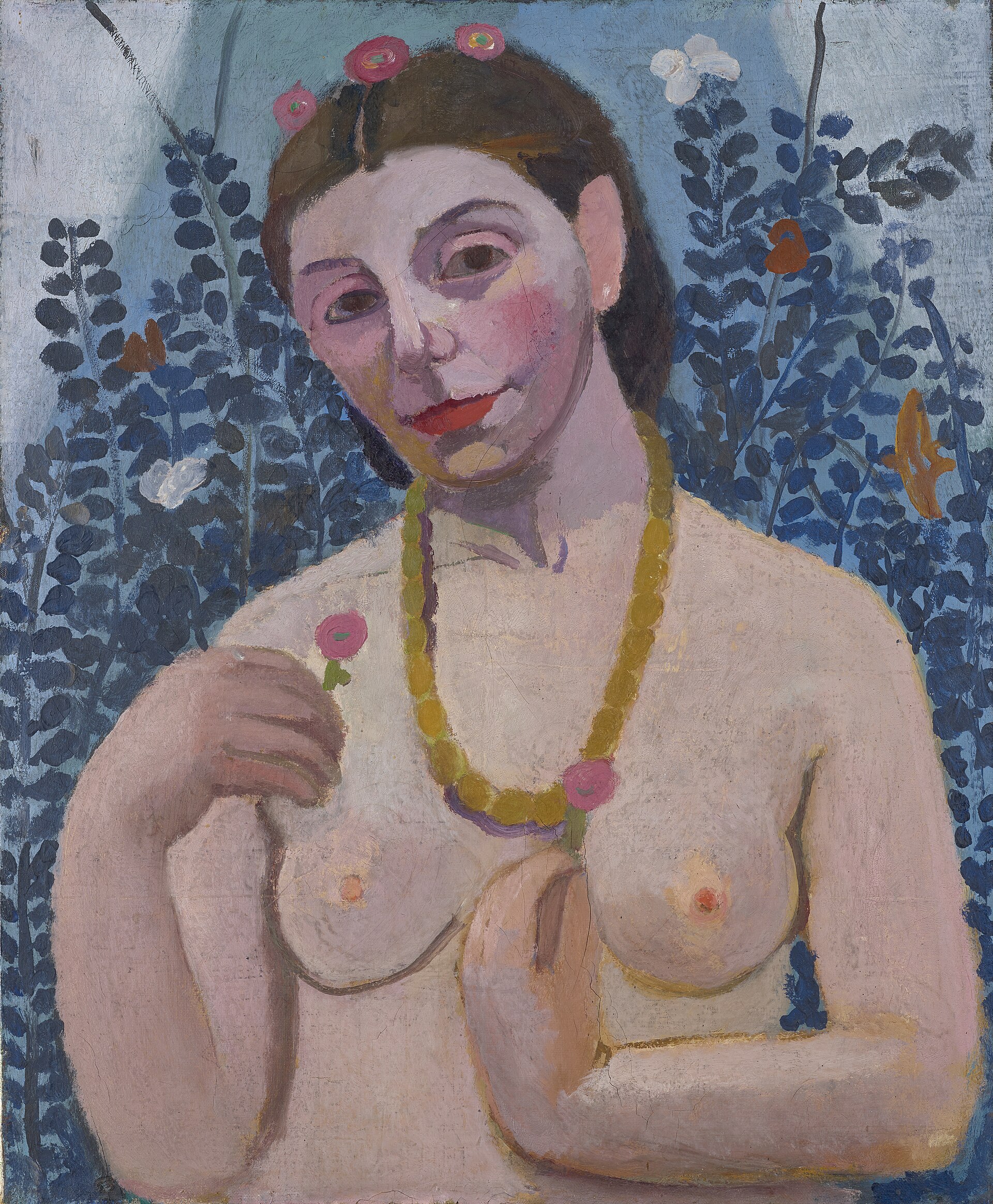
Leaves Worpswede for Paris on 23 February and paints a run of self-portraits including the half-nude on her wedding anniversary.211
- 1907
Daughter Mathilde born on 2 November; Paula Modersohn-Becker dies on 20 November of an embolism at 31.2314
- 1909
On Hoetger's introduction the banker August von der Heydt begins buying; he acquires 28 pictures, 17 of which remain in Wuppertal.6
- 1917
Kestner Society, Hanover, mounts a large memorial exhibition and publishes selected letters and diaries.1
- 1919-1920
Hamburg Kunsthalle buys the Alte Moorbauerin for 25,000 Reichsmark.8
- 1921
Behnhaus, Lubeck, acquires the 1906 Selbstbildnis nach halblinks.11
- 1927
The Paula-Becker-Modersohn-Haus, later the Paula Modersohn-Becker Museum, opens in Bottcherstrasse, Bremen, on 2 June; Otto Modersohn signs a certificate for an oil on 15 April.21322
- 1937
70 works seized from German museums, according to the German Historical Museum; the Hamburg Alte Moorbauerin is taken on 21 August and the Lubeck self-portrait the same year.3811
- 1939
Hamburg's picture is sold to Karl Buchholz for USD 120 or 35; on 30 June the Kunstmuseum Basel buys a self-portrait at the Lucerne auction of seized works and two more paintings two weeks later.816
- 1941-1942
Galerie Ferdinand Moller takes the 1906 self-portrait in an exchange contract; Walter Bauer buys it from Moller in 1942.11
- 1951
Hamburg buys back its Alte Moorbauerin for 4,000 Deutsche Mark on 4 July.8
- 1957
Neue Nationalgalerie, Berlin, buys the 1903 Stillleben mit Apfeln from Galerie Anne Abels, Cologne.18
- 1978
Tille Modersohn founds the Paula Modersohn-Becker-Stiftung with more than 50 paintings and about 500 drawings.4
- 1998
Busch, Schicketanz and Werner publish the Werkverzeichnis der Gemalde in two volumes.5
- 2017
MoMA and the Neue Galerie jointly acquire the 1907 Selbstbildnis mit zwei Blumen.1121
- 2023
Werkverzeichnis der Handzeichnungen published by Hirmer; a Lempertz gouache with Hoetger's pencil attestation sells in Cologne on 7 June.5715
- 2025
Selbstbildnis nach halblinks sells at Grisebach on 27 November for EUR 1,270,000 including premium.1112
- 2026
150th anniversary: the Bremen museum shows Becoming Paula from 8 February to 13 September (the German Wikipedia article on the museum gives 13 September; ZDF gives 12 September).2223
The market
Two of the dated results below, from 2008 and 2023, are in the EUR 30,000 range. Grisebach's archive page lists many other lots without sale dates, so they are not placed in time here: oils from EUR 87,500 to EUR 537,500 and a 1903 charcoal self-portrait at EUR 503,100. The 1906 self-portrait sold for EUR 1,270,000 including premium and the house called it a world record. The premium for that sale cannot be derived: Grisebach's printed conditions and the pattern in its own press release point to different hammers, and the release itself says 'record hammer price' beside a note that results include premium, so none is given. The two earlier results are both totals including premium with no hammer published. A prior record was not confirmed.
The record picture has a documented chain from the artist's friend to a museum, to one of the four authorised dealers, to a collector whom the catalogue says was arrested and tortured in 1944, and a 1962 Munich exhibition entry on the confiscation; no source opened says how much that chain added to the price. Museum purchases are priced differently: in 1957 Berlin bought a still life from a Cologne dealer, and in 2017 New York received a self-portrait as two gifts. Price in period terms: no modern equivalent is given for any pre-war sum; no method-based conversion was sourced.
| Date | Sale | Work | Result | Note |
|---|---|---|---|---|
| 28 Nov 2008 | Grisebach, Berlin | Brustbild einer alten Frau mit Haube, 1897-98, oil on card laid on cardboard, 65.5 x 45.5 cm; certificate by Otto Modersohn of 15 April 1927 on the reverse | Hammer not published With premium 38,080 total including premium EUR | Estimate EUR 30,000 to 40,000; Busch/Schicketanz/Werner 18. |
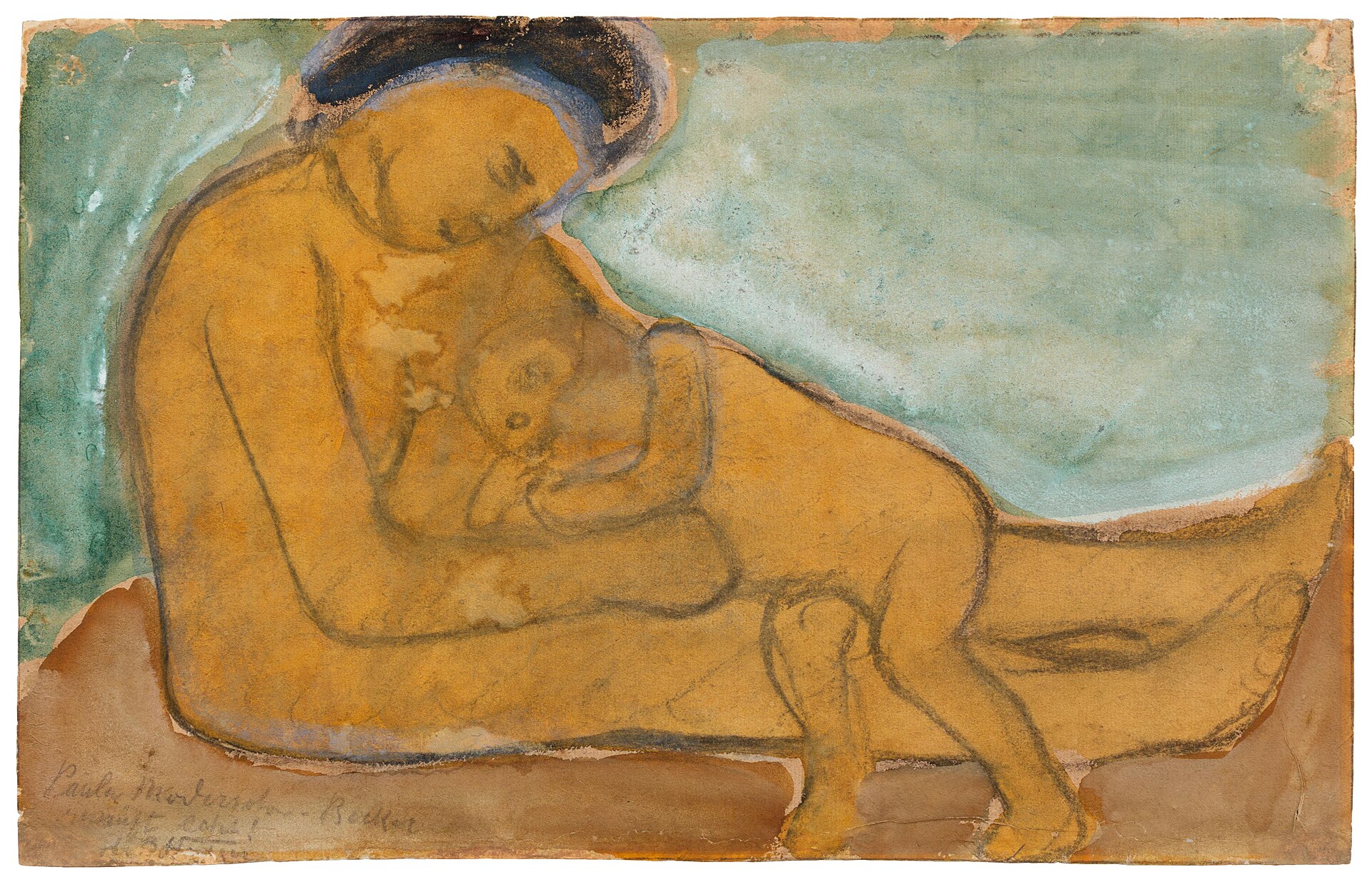
| 7 Jun 2023 | Lempertz, Cologne, auction 1224, lot 116 | Mutter und Kind, 1906, gouache, body colour and carpenter's pencil, 20 x 31.3 cm; Hoetger's pencil note 'geprueft - echt' | Hammer not published With premium 32,760 total including premium EUR | Estimate EUR 20,000 to 30,000; provenance Dr. Sabine Jacob, Braunschweig, 1970s. |
| 27 Nov 2025 | Grisebach, Berlin, auction 370, lot 109 | Selbstbildnis nach halblinks, 1906, oil tempera on paper on cardboard, 26.8 x 21.2 cm; Busch/Schicketanz/Werner 675 | Hammer not published (see note) With premium 1,270,000 total including premium EUR | Estimate EUR 250,000 to 350,000. Buyer a European private collector. Grisebach conditions say 32 per cent premium on the first EUR 1 million for EU buyers; other results in the same release divide by 1.27; the two readings conflict. |
| 1919-1920 | Private purchase, Hamburger Kunsthalle (not an auction) | Alte Moorbauerin, c. 1903, oil on canvas, 77 x 57 cm | Hammer no auction With premium 25,000 purchase price, no premium RM | Seized 21 Aug 1937; sold to Buchholz 1939 for USD 120 or 35; re-bought 4 Jul 1951 for DM 4,000. No modern equivalent given. |
Hammer is the price at which the bidding stopped; with premium adds the fee the house charges the buyer on top. Hammer price and buyer's premium in the glossary.
Where to see the work
| Institution | City | Holdings | Note |
|---|---|---|---|
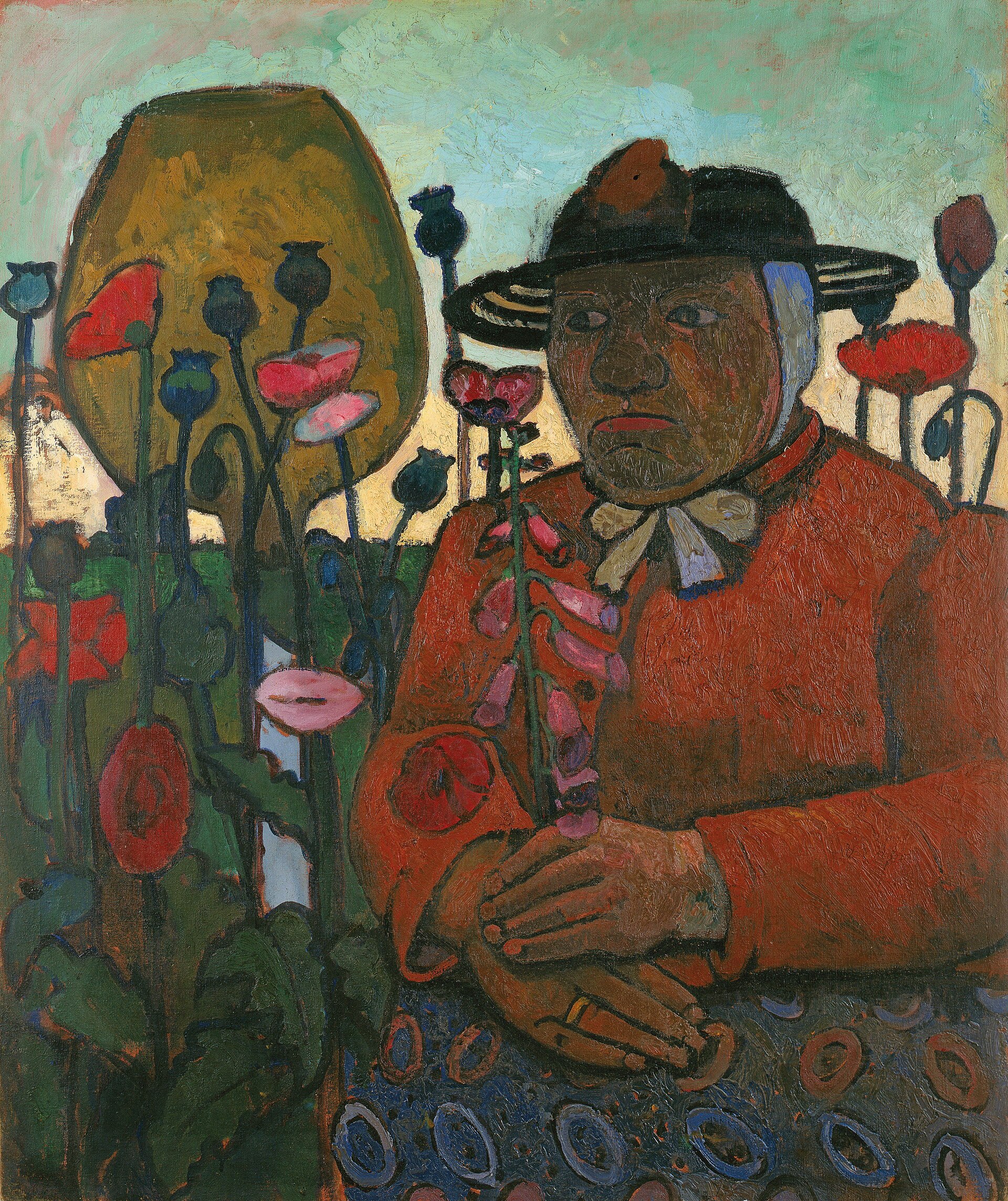
| Paula Modersohn-Becker Museum, Museen Bottcherstrasse | Bremen | Self-portrait on her wedding anniversary, 1906; Alte Armenhauslerin mit Glaskugel und Mohnblumen, 1907; part of the Roselius collection and loans from the foundation. | Opened 2 June 1927; the Commons file notes give catalogue numbers 628 and 720. |
| Kunsthalle Bremen | Bremen | Paintings and drawings, with the foundation's holdings shown there. | The foundation says its works are shown and stored in the Kunsthalle and the Bottcherstrasse museum. |
| Von der Heydt Museum | Wuppertal | 17 paintings from August von der Heydt's 28 purchases. | Mostly later works, per the Bremen museum. |
| Hamburger Kunsthalle | Hamburg | Alte Moorbauerin, c. 1903, HK-1954; seized in 1937 and bought back in 1951. | The provenance file is open online. |
| Kunstmuseum Basel | Basel | Selbstbildnis als Halbakt mit Bernsteinkette II, 1906, and two further paintings bought in 1939. | Bought at the Lucerne auction of 30 June 1939. |
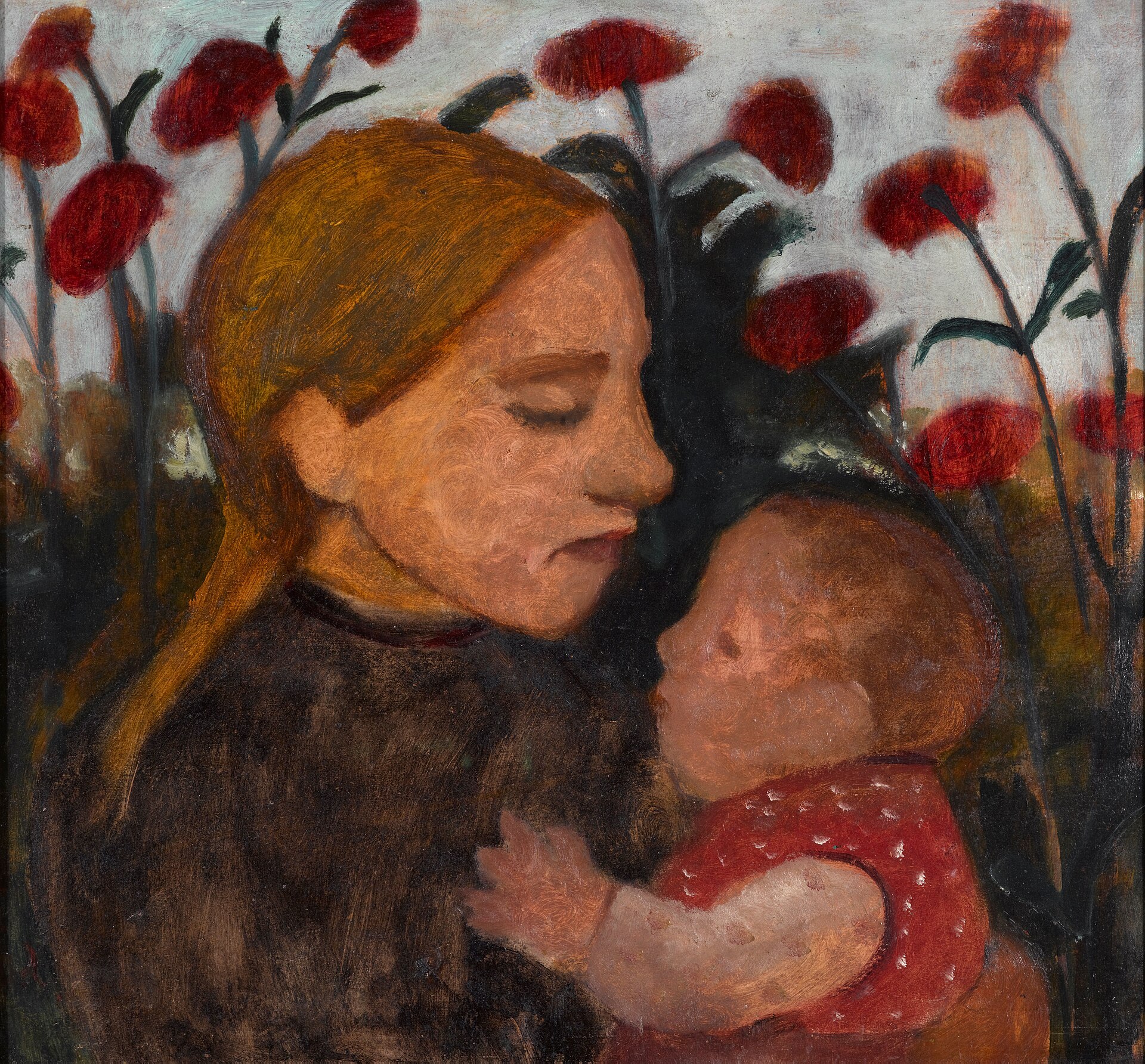
| Kunstmuseum Den Haag | The Hague | Girl with Child, 1902; Self-portrait with hat and veil, about 1906-07. | Both are on Commons from the Google Art Project. |
| Neue Nationalgalerie | Berlin | Stillleben mit Apfeln, 1903, NG 5/57. | Bought 1957. |
| Museum Folkwang | Essen | Selbstbildnis mit Kamelienzweig, about 1906-07. | Osthaus acquired it for the Folkwang, per the Grisebach catalogue. |
| Museum of Modern Art and Neue Galerie, jointly owned | New York | Selbstbildnis mit zwei Blumen in der erhobenen linken Hand, 1907. | Gifts of Debra and Leon Black and of Jo Carole and Ronald S. Lauder, 2017. |
| Kunstmuseen Krefeld | Krefeld | Kleines Madchen neben einem Birkenstamm, 1904, oil on cardboard, 73 x 55 cm. | Subject of a 2016 provenance study after a restitution claim by the heirs of the Dresden collector Franz Kochmann, received in 2015. The researcher concluded that it could not be proved that the picture was seized from him through Nazi persecution; the gap between 1929 and 1948 was not closed. |
Forgeries and misattributions
- No documented forgery case found; what exists is a chain of attestations.
- The sources opened show the practice of the people closest to her: Otto Modersohn certified works in 1927 and added monograms to drawings, and Bernhard Hoetger wrote 'geprueft - echt' on a gouache in pencil. The Krefeld provenance study for Kleines Madchen neben einem Birkenstamm found a framer's sticker from Dusseldorf and a Brussels shipping sticker but could not identify the picture's whereabouts between 1929 and 1948; the study concerned a restitution claim, not authenticity. Not applicable; none exposed. Check the monogram and any reverse labels against the 1998 catalogue and the foundation's archive.14151317
The essay
Chapter 1About 750 paintings and over 1,400 drawings, two catalogues, one foundation
The standard reference for the paintings is the Werkverzeichnis der Gemalde by Gunter Busch, Milena Schicketanz and Wolfgang Werner, two volumes, Hirmer, Munich, 1998.
The standard reference for the paintings is the Werkverzeichnis der Gemalde by Gunter Busch, Milena Schicketanz and Wolfgang Werner, two volumes, Hirmer, Munich, 1998. The foundation lists volume 1 as 302 pages of essays and volume 2 as a 614-page catalogue with 783 illustrations, both out of print at the publisher. Auction houses cite it as Busch/Schicketanz/Werner or Busch/Werner followed by a number: Grisebach cites 675 for the 1906 self-portrait sold in 2025, and the Hamburg Kunsthalle cites 381 for its seized Alte Moorbauerin. The Commons file notes for the Bremen museum's two best-known pictures give 628 for the 1906 self-portrait on her wedding anniversary and 720 for the 1907 Alte Armenhauslerin; those two numbers come from file notes and were not checked against the book.
The drawings have their own catalogue, Werkverzeichnis der Handzeichnungen, edited by Anne Rover-Kann and Wolfgang Werner for the foundation, two volumes, Hirmer, 2023. Volume 1 covers single sheets, watercolours and gouaches in 511 pages and volume 2 covers the sketchbooks in 438 pages, with 1,800 illustrations. The Bremen museum's page for its 2023 drawings show says more than 1,400 drawings survive. There is also a supplement: in 2026 Grisebach recorded a charcoal self-portrait as number E IV/99a in a Nachtrag by Rover-Kann, Werner, Duckwitz and Rascher-Friesenhausen, with a written confirmation from Wolfgang Werner of the foundation dated 5 February 2026.
The paintings total is where the sources part. German Wikipedia says that in just under fourteen years of work she made 750 paintings, about 1,000 drawings and 13 etchings, and estimates that about 90 paintings date from 1906 and 1907. English Wikipedia says more than 700 paintings and over 1,000 drawings. The Magazine Antiques, in 2024, says about seven hundred works in seven years. ZDF says over 700 paintings and 1,400 drawings. None of these is a catalogue. The foundation's pages say only that the Kunsthalle Bremen, the Paula Modersohn-Becker Museum and the foundation together hold more than 100 paintings and 700 drawings. Whoever needs the figure should count the 1998 volume 2 and the 2023 supplements; this page did not have access to either book.
Chapter 2She sold almost nothing, and the first buyers came after she died
German Wikipedia says that in her lifetime she sold a single picture each to her friends Rilke and Vogeler, and that marriage to Otto Modersohn in May 1901 freed her from having to take a post as a...
German Wikipedia says that in her lifetime she sold a single picture each to her friends Rilke and Vogeler, and that marriage to Otto Modersohn in May 1901 freed her from having to take a post as a governess. That is a tertiary source and the claim has not been checked against her letters. The facts around it are firmer. In 1896 and 1897 she took a course at the painting and drawing school of the Verein der Berliner Kunstlerinnen, which the German Historical Museum describes as giving women the chance to study art. In 1899 an exhibition at the Kunsthalle Bremen, where she showed with Marie Bock and Clara Westhoff, drew what the Grisebach 2026 catalogue essay calls devastating criticism, and the museum biography says she withdrew from public view afterwards.
Recognition came from men who had known her or heard of her through Bernhard Hoetger, the sculptor she met in Paris in 1906. The Bremen museum states that Hoetger drew the banker August von der Heydt's attention to her in 1909, that von der Heydt bought 28 pictures, and that 17 of them are still in the Von der Heydt Museum in Wuppertal. The Grisebach 2025 catalogue dates the first collectors' discovery of her to a travelling exhibition six years after her death, shown in Hagen, Munich, Jena and Wuppertal-Elberfeld, and names von der Heydt and Karl Ernst Osthaus, who bought the Selbstbildnis mit Kamelienzweig for the Folkwang. The two accounts place the first collectors four years apart, 1909 in the Bremen text and 1913 in the Grisebach essay; the essay does not say when von der Heydt bought his first picture. Ten years after her death, in 1917, the Kestner Society in Hanover held a large exhibition and published a selection of her letters and diaries.
The foundation's own history gives the other half of the story. Her daughter Mathilde, called Tille Modersohn (1907 to 1998), founded the Paula Modersohn-Becker-Stiftung in 1978 and gave it her share of the estate, more than 50 paintings and about 500 drawings and etchings. The Bremen museum, the Bremen Kunsthalle and the foundation together own the bulk of the oeuvre.
Chapter 3The last Paris year produced the self-portraits, and she showed them to almost nobody
In February 1906 she wrote to Rilke, in a sentence the Grisebach 2025 catalogue quotes from the 2007 edition of her letters and journals: 'Ich bin Ich, und hoffe es immer mehr zu werden.' A few days...
In February 1906 she wrote to Rilke, in a sentence the Grisebach 2025 catalogue quotes from the 2007 edition of her letters and journals: 'Ich bin Ich, und hoffe es immer mehr zu werden.' A few days later she left Worpswede for Paris for the fourth and last time. German Wikipedia gives the date as 23 February 1906 and says she wrote in her diary that she had left Otto Modersohn. On 3 September she asked him to agree to a divorce, and on 9 September she withdrew the request after Hoetger had shown her how little she could earn. That sequence rests on one tertiary source, which in turn relies on her diaries.
Rainer Stamm, writing in the 2025 Grisebach catalogue, says she kept the radically simplified paintings of that summer back even from her closest artist friends. Heinrich Vogeler found them in her Worpswede studio after she died and wrote that only then could one see what she had been and how she had struggled. Rudolf Alexander Schroder, quoted in the same essay, described sorting through the estate as surprise upon surprise. Both are quotations from Stamm's 2025 biography, read here at second hand.
The best-known picture of the year is the self-portrait in the Paula Modersohn-Becker Museum, Bremen, painted on cardboard, 101.8 by 70.2 cm per the Commons file note. It shows her half-nude with an amber necklace and a rounded belly. The lower right carries a short inscription in her hand; at the resolution available it reads as 'Dies malte ich mit 30 Jahren an meinem 6. Hochzeitstag. P.B.' She had married on 25 May 1901, which would make May 1906 the fifth anniversary, and the English file title on Commons says fifth where the German title and the inscription say sixth. The sources opened for this page place her pregnancy in 1907, after the Paris stay, so the picture shows a pregnancy she was not in. English Wikipedia says she is generally accepted as the first known woman painter to paint nude self-portraits and the first known to have painted herself pregnant, and it notes the dispute over Artemisia Gentileschi. Those are claims from a tertiary source and are not settled here.
Chapter 4She died of a clot after a hard birth, and her last picture is a self-portrait
Her daughter was born on 2 November 1907 after what German Wikipedia calls a difficult delivery.
Her daughter was born on 2 November 1907 after what German Wikipedia calls a difficult delivery. The doctor ordered bed rest, she was allowed up on 20 November, and an embolism followed that killed her at 31. The Grisebach 2026 catalogue essay says only that she died of an embolism shortly after the birth. English Wikipedia says deep venous thrombosis is the likely cause and that the thrombus travelled to the lung; that is a suggestion in a tertiary source and no medical record was found. Otto Modersohn is quoted as reporting her last words as 'Wie schade' (what a pity).
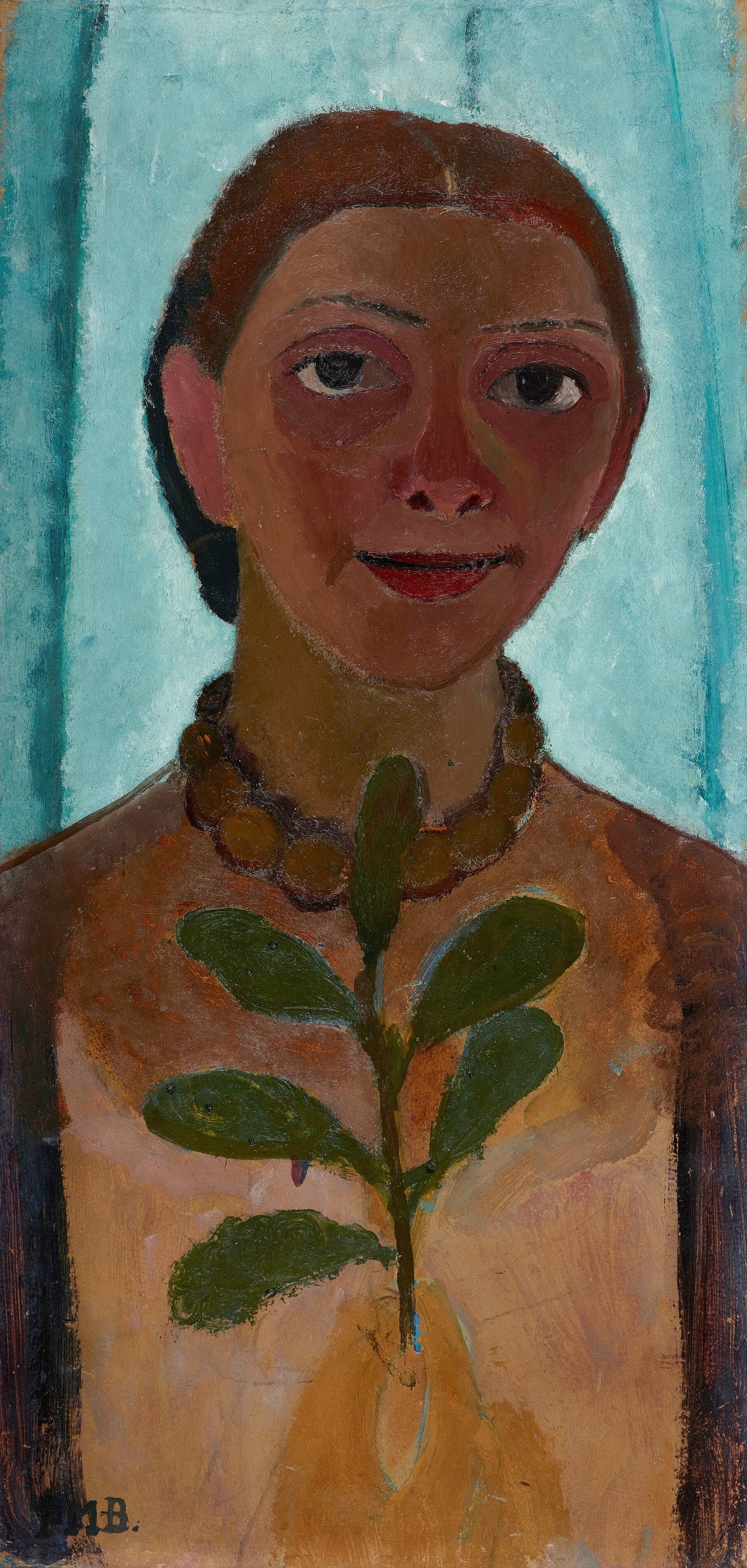
Her last completed paintings, per German Wikipedia, were the Alte Armenhauslerin im Garten, now in the Bremen museum, and then the Selbstbildnis mit Kamelienzweig. The camellia picture is dated about 1907 on Commons and 1906 to 1907 by the Grisebach catalogue, which says Osthaus bought it for the Folkwang. Rilke wrote his Requiem for a Friend in 1908 on the first anniversary of her death, according to English Wikipedia.
Chapter 5Seventy works were seized in 1937, and one file shows exactly what the state got for them
The German Historical Museum's biography says the Nazis defamed her as a degenerate artist and confiscated 70 of her works from German museums in 1937.
The German Historical Museum's biography says the Nazis defamed her as a degenerate artist and confiscated 70 of her works from German museums in 1937. English Wikipedia repeats the figure as a quotation without naming its source. This page has not seen the Freie Universitat Berlin confiscation inventory as a list by artist, so the total of 70 is the museum's statement and not a count made here. The Freie Universitat database is the place to count it: its record for the Hamburg painting carries the Nazi inventory number 4894 and the museum's inventory number 1954. The general scale is on the same university's pages: a delegation travelling from 6 August 1937 visited about 100 museums and confiscated 20,000 works by more than 1,400 artists.
The Hamburg Kunsthalle's own provenance file for HK-1954, Alte Moorbauerin, about 1903, oil on canvas, 77 by 57 cm, is the most complete case this page found. It records that the picture was with the physician and collector Emil Lohnberg of Hamm by 1911, that the Kunsthalle bought it in 1919 or 1920 for 25,000 Reichsmark, and that the commission on degenerate art and the Reich propaganda ministry seized it on 21 August 1937. It was stored at Schloss Schonhausen in Berlin and sold to the dealer Karl Buchholz in 1939 for USD 120 or USD 35; the file gives both figures from the sources it cites and marks the choice as still to be checked. Its note ties USD 120 to the confiscation inventory number 4893 and USD 35 to 4894, and the Freie Universitat record gives this picture 4894; the file itself does not draw that conclusion. The next owner recorded is the Hungarian consul general for Norway, Peter Mathias Rowde, in Oslo in 1939. After a gap and a Hamburg owner, the Kunsthalle bought it back on 4 July 1951 for 4,000 Deutsche Mark with money from the Campe'sche Historische Kunststiftung. The file's own status line reads 'in Bearbeitung, ungeklaert, unbedenklich' (in progress, unresolved, unobjectionable), last updated June 2026; the file does not say which of the last two words applies to the whole.
The Kunstmuseum Basel documents the other end of such sales. On 30 June 1939 Galerie Theodor Fischer in Lucerne auctioned 125 works from German museums, and the Basel museum bought eight, among them Modersohn-Becker's Selbstbildnis als Halbakt mit Bernsteinkette II. It bought twelve more two weeks later from works sent to Basel from Berlin, among them two further Modersohn-Becker paintings. Basel's own exhibition text says the canton allocated CHF 50,000 on the eve of the auction and calls the purchase a controversial business transaction with a dictatorial regime.
The same story runs the other way. Lubeck's Behnhaus, directed by Carl Georg Heise, built a collection of German Expressionism and, in the words of its own site, lost almost all of it under the Nazis; its Modersohn-Becker works now once again characterise the collection. The titles migrate: the Freie Universitat database files the Hamburg picture as 'Sitzende alte Frau mit aufgestutztem Arm' with the confiscation title 'Alte Baeuerin' and a size of 71 by 59 cm, where Hamburg gives Alte Moorbauerin and 77 by 57 cm. Anyone searching a dealer file for a seized Modersohn-Becker should search all three.
Chapter 6The record picture was a Lubeck museum's, bought in 1942 through one of the four dealers authorised to sell seized art
The Selbstbildnis nach halblinks of 1906 is oil tempera on paper laid on cardboard, 26.8 by 21.2 cm, catalogued as Busch/Schicketanz/Werner 675.
The Selbstbildnis nach halblinks of 1906 is oil tempera on paper laid on cardboard, 26.8 by 21.2 cm, catalogued as Busch/Schicketanz/Werner 675. Grisebach's provenance line reads: Clara Rilke-Westhoff, Fischerhude, about 1916; Behnhaus, Lubeck, acquired 1921 and confiscated in 1937 as degenerate, inventory number EK 11475; Galerie Ferdinand Moller, Berlin, acquired by exchange contract in 1941; Walter Bauer, Fulda, acquired from Moller in Berlin in 1942 and in the family since. The exhibition list in the same entry includes the Munich Haus der Kunst show of 1962, Entartete Kunst: Bildersturm vor 25 Jahren, catalogue number 110. The catalogue calls it one of the last self-portraits by the artist in private hands.
Moller was one of four dealers the regime officially authorised to sell confiscated art abroad for foreign currency; the others were Bernhard A. Bohmer, Karl Buchholz and Hildebrand Gurlitt, as both the Freie Universitat history page and the Grisebach essay say. Walter Bauer, born in 1901 in Heilbronn, was a bank and coal-industry manager who joined the Confessing Church, and the catalogue says he was arrested in October 1944 and subjected to torture and interrogation. His collecting was advised by Carl Georg Heise, the former director of the Lubeck Behnhaus and later of the Hamburg Kunsthalle. The Grisebach essay says that for Heise there was 'possibly' an opportunity through Bauer to rescue four Lubeck works from going abroad, and it counts the Modersohn-Becker self-portrait among them.
The catalogue appears not to be consistent on one link. The essay names four Lubeck works, the self-portrait last, and says of the group 'alle ueber Bernhard Boehmer' (all via Bernhard Bohmer); the grammar leaves open whether the self-portrait is covered, but the sentence reads that way. The lot's provenance line and its entry both say Galerie Ferdinand Moller by exchange contract. This page records both and does not choose. The Freie Universitat database would carry the dealer entry for EK 11475; it was not searched.
Chapter 7Roselius, Hoetger and the first museum for a woman painter
The Bremen museum says Ludwig Roselius, a Bremen coffee merchant, collected her work some years after von der Heydt and opened in 1927 the world's first museum for a woman painter, designed by...
The Bremen museum says Ludwig Roselius, a Bremen coffee merchant, collected her work some years after von der Heydt and opened in 1927 the world's first museum for a woman painter, designed by Bernhard Hoetger. German Wikipedia adds that Roselius commissioned Hoetger about 1924, that the building went up from 1926 and opened on 2 June 1927, which was Roselius's 53rd birthday, and that he put her birth name first when he named it the Paula-Becker-Modersohn-Haus. The plan to show his collection there only developed during construction, the same article says, because the street was first being redeveloped for tourism. Those details are from a tertiary source.
Under the Nazis the museum's position was precarious. According to German Wikipedia, Hitler condemned the whole Bottcherstrasse culture in a speech at the Nuremberg party congress in 1936, the street was kept as an example of decadent art, Roselius's Modersohn-Becker collection was declared a private collection that could be seen only on request, and a dedication on the entrance was altered from 'wenn' to 'bis' so that it no longer suggested a woman artist's work could outlast men's heroic fame. English Wikipedia adds that Roselius's secretary Barbara Goette intervened with Hitler. None of this was checked against a primary source; the plaque story in particular needs the original inscription.
The Bremen museum's 2017 exhibition on early collectors reports that war losses destroyed some of the finest pictures of both the Roselius and the von der Heydt collections and that seven of the destroyed paintings were shown there as reproductions beside surviving originals. Which paintings, and how many in total, was not stated in the text opened. German Wikipedia says the core of the Roselius collection was bought in 1988 by the city of Bremen together with the Federal Republic; this is the only source found for the 1988 purchase and its price is not given.
Chapter 8Who rules on a picture: a foundation, a catalogue and the marks on the back
No source opened describes a certificate committee.
No source opened describes a certificate committee. The Paula Modersohn-Becker-Stiftung in Bremen is the body whose catalogues and written confirmations the auction houses cite. Its executive council lists Wolfgang Werner, Bremen, who co-edited the 1998 and 2023 catalogues. Auction houses record his role in their own entries: Grisebach prints a confirmation by him dated 5 February 2026 for a drawing it adds to the supplement, and Lempertz thanks him for scholarly advice on a 1906 gouache that, it says, is in the archive and in the as-yet unpublished catalogue by Werner and Rover-Kann. Grisebach's literature list for the 2025 self-portrait also names a 1992 to 1993 exhibition at a Berlin and Bremen firm called Kunsthandel Wolfgang Werner KG. No source opened says whether that firm is connected with the foundation's Wolfgang Werner, and nothing is alleged here.
Before the foundation the authority was the family. Grisebach's 2008 entry for an oil of 1897 to 1898 records a certificate by Otto Modersohn, Fischerhude, dated 15 April 1927, on the reverse. Its 2026 entry for a charcoal drawing of 1903 says it is monogrammed PM-B at lower right by Otto Modersohn on the artist's behalf. So a monogram on a Modersohn-Becker drawing is not necessarily her hand: at least this one was added by the widower. The Lempertz gouache, offered in Cologne on 7 June 2023, carries a pencil note at lower left, badly legible, in Bernhard Hoetger's hand: 'Paula Modersohn-Becker gepruft - echt!' followed by his initials B H. That is an attestation by a friend and sculptor, not a technical examination, and no forgery case was found in any source opened.
Chapter 9What the market has paid: EUR 1.27 million at the top, hundreds of thousands for good oils, tens of thousands below
The three dated results below are all the auction houses' own published figures, and all are totals including premium.
The three dated results below are all the auction houses' own published figures, and all are totals including premium. Grisebach's press release says expressly that all results include premium. The hammer prices were not published in any source opened, although the same release calls the record a hammer price in its prose. On 28 November 2008 an oil, Brustbild einer alten Frau mit Haube, 1897 to 1898, sold at Grisebach for EUR 38,080 against an estimate of EUR 30,000 to 40,000. On 7 June 2023 Lempertz Cologne sold the Mutter und Kind gouache for EUR 32,760 against EUR 20,000 to 30,000. On 27 November 2025 the Selbstbildnis nach halblinks sold at Grisebach lot 109 for EUR 1,270,000 against EUR 250,000 to 350,000, to a European private collector, and the house called it a new world record. The previous record was not confirmed from a source opened here. Grisebach's object archive page for the 2008 oil also lists many other Modersohn-Becker lots, without dates and without saying whether each figure includes premium: oils at EUR 537,500, EUR 525,000, EUR 452,200, EUR 375,000 and EUR 321,300, and a 1903 charcoal self-portrait estimated at EUR 25,000 to 35,000 listed at EUR 503,100, which is the lot of the Summer 2026 catalogue. Good Worpswede oils therefore sit in the low to mid hundreds of thousands at Grisebach, and the 2008 and 2023 results below are the bottom of the range, not its middle.
The premium question cannot be settled from the paper. Grisebach's printed conditions for the winter 2025 sale say 32 per cent on the hammer up to EUR 1,000,000 and 27 per cent above for buyers in the EU, with value added tax included. Several other results in the same press release divide cleanly by 1.27, and 1,270,000 divided by 1.27 is exactly 1,000,000, which would suggest a hammer of EUR 1,000,000. But 32 per cent of the first million would give a different hammer, about EUR 962,000, which is not a bid step. The release says 'record hammer price' while its footnote says all results include premium. The readings conflict, so no hammer is given.
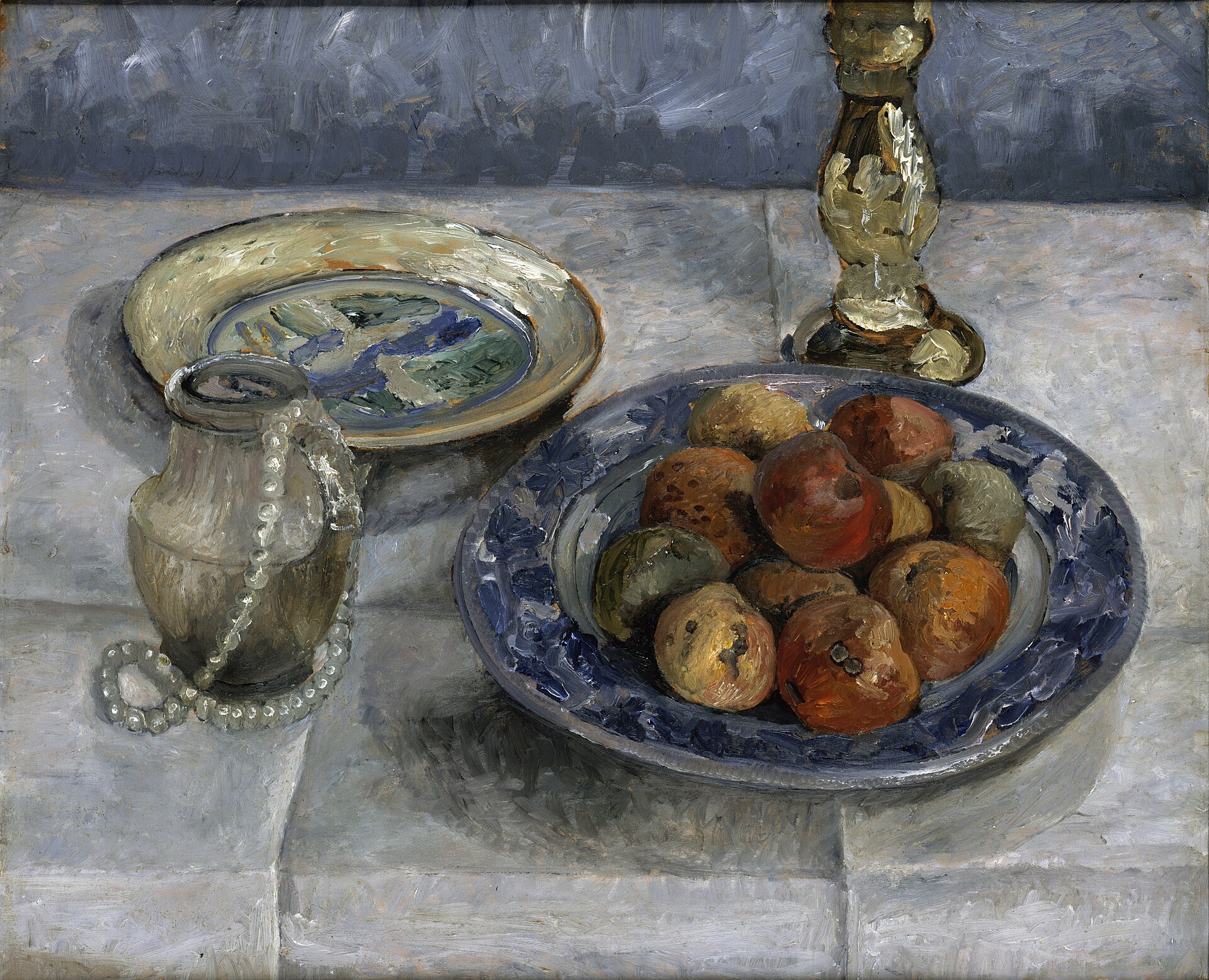
Museums have paid in other ways. The Neue Nationalgalerie in Berlin bought a 1903 Stillleben mit Apfeln in 1957 from Galerie Anne Abels in Cologne; its provenance runs from Heinrich Vogeler in 1908 through Hannover and Bremen owners. The Museum of Modern Art in New York and the Neue Galerie own the 1907 Selbstbildnis mit zwei Blumen in der erhobenen linken Hand jointly, as gifts of Debra and Leon Black and of Jo Carole and Ronald S. Lauder, in 2017. Her large oils are in museums; what comes to market is drawings, gouaches, small studies and the occasional picture.
Chapter 10What her pictures were for, as far as anyone has documented
The documented part is short and it comes from her own diary.
The documented part is short and it comes from her own diary. In 1903, after visiting the Louvre, she wrote that the great simplicity of form was wonderful, that she had always tried to give the heads she painted the simplicity of nature, and that she could learn from the heads of antiquity. The 2025 Grisebach essay quotes this from the 2007 edition of her letters and journals. In the same period she wrote that she was reading Marie Bashkirtseff's diary and found it exciting, as the 2026 Grisebach catalogue records. Both are documented in her own words. In Paris she found Cezanne, van Gogh and Gauguin, per the Grisebach essay; that is the essay's reading of the evidence.
The argued part belongs to named writers. Rainer Stamm, in the Grisebach catalogue, argues that her nude nursing mothers freed the subject from the Christian image of Mary with the child. The catalogue note for a 1906 charcoal makes the same point, and quotes Vogeler's description of the mother paintings as an archetype of motherhood. Those are what later readers saw, not what the maker said. An exhibition at the Bremen museum in 2007 and 2008 was titled as a homage linking her to the Egyptian mummy portraits; the title is the only part of that argument this page has seen.
The absence of a hidden programme is a finding. No letter, contract or inventory found sets out a system of belief behind the peasant portraits, the poorhouse women of Worpswede or the late still lifes.
What is documented
Technique
The surviving work
- What is accepted
- No accepted total was found in a source opened. German Wikipedia says about 750 paintings and 1,000 drawings; English Wikipedia and The Magazine Antiques say about 700 or over 700 paintings; the Bremen museum says more than 1,400 drawings. These are figures for works made, not an authority's count of accepted works.
- What is contested
- Wikipedia's 750 and its 700-plus are not reconciled in any source opened. The drawings count of over 1,400 sits against English Wikipedia's 1,000. No source opened reports works removed from the catalogue or rejected.
- Who rules on attribution
- The Paula Modersohn-Becker-Stiftung, Bremen, through Wolfgang Werner and its editors. Auction houses cite his written confirmation and archive entry. Before the foundation, Otto Modersohn issued certificates, and Bernhard Hoetger marked works.
Catalogue raisonne
- Gunter Busch, Milena Schicketanz and Wolfgang Werner, Paula Modersohn-Becker: Werkverzeichnis der Gemalde, 2 vols, Munich: Hirmer, 1998. Volume 1: essays, 302 pages; volume 2: catalogue, 614 pages with 783 illustrations. Cited by auction houses as Busch/Schicketanz/Werner or Busch/Werner with a number. Out of print at the publisher.511
- Anne Rover-Kann and Wolfgang Werner (eds), Paula Modersohn-Becker: Werkverzeichnis der Handzeichnungen, 2 vols, Munich: Hirmer, 2023, with a Nachtrag. Volume 1: single sheets, watercolours and gouaches; volume 2: sketchbooks. The supplement is cited by Grisebach in 2026 as E IV/99a.514
- Wolfgang Werner, Paula Modersohn-Becker: Oeuvreverzeichnis der Graphik, Bremen 1968; enlarged 1972; revised Lilienthal 1978. Prints. The foundation says a new edition is in preparation.5
Questions about Paula Modersohn-Becker
Who was Paula Modersohn-Becker?
Painter; Draughtswoman; Printmaker. 1876-1907.
When did Paula Modersohn-Becker live?
Born 8 February 1876, Dresden-Friedrichstadt; died 20 November 1907, Worpswede.
How are fakes and misattributions of Paula Modersohn-Becker detected?
No documented forgery case found; what exists is a chain of attestations. The sources opened show the practice of the people closest to her: Otto Modersohn certified works in 1927 and added monograms to drawings, and Bernhard Hoetger wrote 'geprueft - echt' on a gouache in pencil. The Krefeld provenance study for Kleines Madchen neben einem Birkenstamm found a framer's sticker from Dusseldorf and a Brussels shipping sticker but could not identify the picture's whereabouts between 1929 and 1948; the study concerned a restitution claim, not authenticity.
Where can you see work by Paula Modersohn-Becker?
Paula Modersohn-Becker Museum, Museen Bottcherstrasse (Bremen); Kunsthalle Bremen (Bremen); Von der Heydt Museum (Wuppertal); Hamburger Kunsthalle (Hamburg); Kunstmuseum Basel (Basel); Kunstmuseum Den Haag (The Hague).
What does the market for Paula Modersohn-Becker look like?
Two of the dated results below, from 2008 and 2023, are in the EUR 30,000 range. Grisebach's archive page lists many other lots without sale dates, so they are not placed in time here: oils from EUR 87,500 to EUR 537,500 and a 1903 charcoal self-portrait at EUR 503,100.
What is still unresolved about Paula Modersohn-Becker?
How many paintings and drawings are accepted? Wikipedia's 750 and its 700-plus are not reconciled, and the foundation's pages that were opened give no catalogue total.
Open questions
- How many paintings and drawings are accepted? Wikipedia's 750 and its 700-plus are not reconciled, and the foundation's pages that were opened give no catalogue total.
- Was the 1937 total 70 works? The German Historical Museum says so; the Freie Universitat inventory has not been counted by artist here, and the Bremen Kunsthalle's share is unknown.
- Did the 1906 record self-portrait reach Walter Bauer through Galerie Ferdinand Moller by exchange contract, as its provenance line says, or through Bernhard Bohmer, as the catalogue essay's wording suggests?
- What was the hammer for the record picture? Grisebach's printed 32 per cent premium on the first million and the 1.27 ratio in its own results give different answers.
- Is the Hamburg Alte Moorbauerin the one sold to Buchholz for USD 120 or for USD 35? Hamburg's file says it must still check.
- Which seven destroyed paintings did the Bremen museum show as reproductions in 2017, and what happened to the Roselius collection between 1945 and the reported 1988 purchase?
- Was the 1906 self-portrait painted on her fifth or sixth wedding anniversary, given the marriage date of 25 May 1901 and an inscription that reads sixth?
Sources
- 1Wikipedia (English), Paula Modersohn-Becker. en.wikipedia.org/wiki/...
- 2Wikipedia (German), Paula Modersohn-Becker. Replace with her letters and diaries. de.wikipedia.org/wiki/...
- 3Deutsches Historisches Museum, LeMO Biografie: Paula Modersohn-Becker (Walther and Imwolde, 2014). Opened and read in full. dhm.de/lemo/...
- 4Paula Modersohn-Becker-Stiftung, The foundation (English page). Opened and read. pmb-stiftung.de/E_stiftung.html
- 5Paula Modersohn-Becker-Stiftung, Publications and catalogues raisonnes. Opened and read. pmb-stiftung.de/E_publikationen.html
- 6Museen in Bremen, 'Sammler der ersten Stunde: August von der Heydt entdeckt Paula Modersohn-Becker', exhibition text, 25 May to 10 September 2017. Opened and read. museeninbremen.de/sammler-der-ersten-stunde
- 7Museen in Bremen, 'Die Zeichnerin Paula Modersohn-Becker', exhibition text, 2023. Opened and read. museeninbremen.de/die-zeichnerin-paula-modersohn-becker
- 8Hamburger Kunsthalle online collection, Paula Modersohn-Becker, Alte Moorbauerin, HK-1954, provenance file by Ute Haug (updated to June 2026). Opened and read. online-sammlung.hamburger-kunsthalle.de/en/...
- 9Freie Universitat Berlin, Beschlagnahmeinventar 'Entartete Kunst', record for the Hamburg painting, EK no. 4894. Opened and read. emuseum.campus.fu-berlin.de/eMuseumPlus
- 10Freie Universitat Berlin, Forschungsstelle 'Entartete Kunst', history of the confiscation. Opened and read. geschkult.fu-berlin.de/en/...
- 11Grisebach, Winter 2025 sale 370 catalogue (Walter Bauer Collection), lot 109 entry and Rainer Stamm and Walter Bauer essays, e-book PDF. Opened and read. grisebach.com/e-books/...
- 12Grisebach press release, 'World records, fierce bidding wars and remarkable sales', 30 November 2025. Opened and read. grisebach.com/en/...
- 13Grisebach object archive, Brustbild einer alten Frau mit Haube, sold 28 November 2008. Opened and read. grisebach.com/en/...
- 14Grisebach Summer 2026 catalogue lot 4, Julia Voss essay and entry for the 1903 charcoal self-portrait (PDF). Opened and read. grisebach.com/assets/...
- 15Lempertz, auction 1224, Cologne, 7 June 2023, lot 116, Mutter und Kind. Opened and read. lempertz.com/de/...
- 16Kunstmuseum Basel, 'Castaway Modernism' press text on the 1939 acquisitions. Opened and read. kunstmuseumbasel.ch/en/...
- 17Stiftung Deutsches Zentrum Kulturgutverluste, project page on Kleines Madchen neben einem Birkenstamm, Kunstmuseen Krefeld, 2016. Opened and read. kulturgutverluste.de/en/...
- 18Staatliche Museen zu Berlin, Neue Nationalgalerie, Stillleben mit Apfeln, NG 5/57, provenance. Opened and read. recherche.smb.museum/detail/...
- 19Museum Behnhaus Draegerhaus, Lubeck, the collection (English). Opened and read. en.museum-behnhaus-draegerhaus.de/the-museum-the-collection
- 20Wikimedia Commons, Category Paintings by Paula Modersohn-Becker and the file pages for the plates; licence read from and the file wikitext. commons.wikimedia.org/wiki/...
- 21Mitchell Owens, 'Current and coming: Becoming Paula Modersohn-Becker at the Neue Galerie', The Magazine Antiques, 7 August 2024. Opened and read. themagazineantiques.com/article/...
- 22Wikipedia (German), Paula Modersohn-Becker Museum. de.wikipedia.org/wiki/...
- 23ZDFheute, '150 Jahre Modersohn-Becker: Ausstellung Becoming Paula startet', 2026. Opened and read. zdfheute.de/panorama/...
Last verified